A Billionaire’s Son Pulled a Gun on a Navy SEAL and His Dog—What Happened Next Brought Down an Empire
PART2:
We rounded the hedge in time to see Royce shove Clara into the wall hard enough that her head struck stone.
He leaned close and said something quiet.
Something specific.
The kind of thing a man says when he wants a woman to understand that help is not coming because he has already purchased the road it would have to travel.
Then Clara closed her eyes.
And said one word.
“No.”
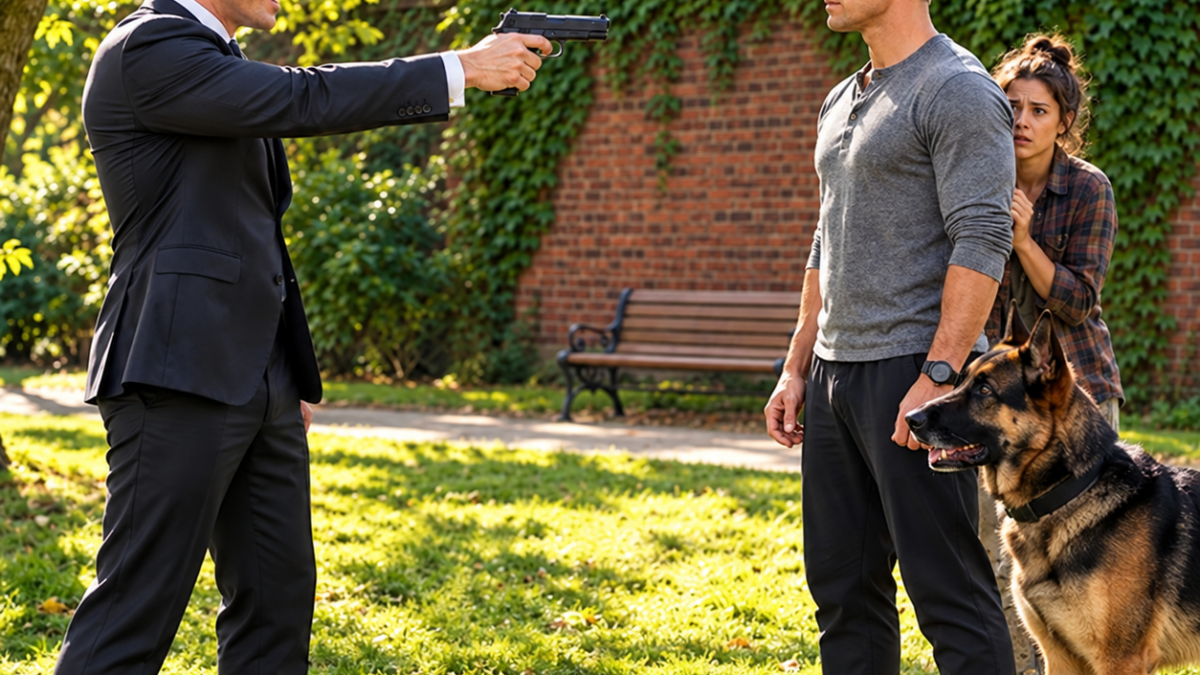
That was when Royce reached under his jacket.
Now his gun was pointed at me.
His smile was bright and performative.
“Walk away,” he said. “Whatever you think you saw, you didn’t see it.”
Petra’s body went rigid beside mine.
Every muscle loaded.
She gave one low warning growl.
Not loud.
Not theatrical.
Just enough to tell the room — or in this case, the empty corner of the park — that she understood the shape of the threat.
Royce’s eyes flicked toward her.
“And your dog takes one step toward me,” he said, “I shoot it first.”
Petra did not move.
She was waiting for one word from me.
I did not give it.
PART3:
I said nothing for three full seconds.
People think three seconds is short.
It is not.
Not when a man has a gun on you.
Not when a woman is bleeding behind him.
Not when your dog is waiting for permission to become violence.
In those three seconds, I counted everything.
Royce’s grip.
His elbow.
His weight distribution.
The angle of the barrel.
The distance between us.
The bench twenty feet to my left.
The equipment shed behind the hedge.
Clara’s position against the wall.
Petra’s line.
The fact that there were no children nearby.
No joggers in the immediate corner.
No one close enough to get caught in what came next.
Then I moved.
Not fast the way movies teach people to imagine fast.
No shout.
No charge.
No wasted sound.
Just enough.
Royce’s arm followed, but not soon enough.
I took the weapon line away from my center, trapped his gun hand before he understood the mistake, and controlled the joint with the kind of efficient pressure that gives a man one option if he wants his arm to remain part of his body.
Royce chose too late.
The gun dropped into the wet grass.
I kicked it away.
Then I put Royce Aldren down.
Not gently.
Not cruelly.
Precisely.
His cheek hit the grass.
His injured arm folded at an angle that made him scream before his pride caught up with his pain.
The entire thing took four seconds.
Petra walked over, sat beside his pinned body, and looked at him with profound professional disappointment.
Clara had not moved.
She stared at me with both hands pressed over her mouth.
Her eyes were filling, but not with relief yet.
Relief requires belief.
She was not there yet.
“Are you hurt?” I asked.
I kept one knee centered on Royce’s back.
Clara slowly lowered her hands.
“I’m okay.”
Her voice was steadier than I expected.
“I’m okay.”
Royce was still talking into the grass.
Lawyers.
My father.
You have no idea who I am.
The Aldren name came out of his mouth like an emergency code he expected reality to obey.
I had heard men call gods, presidents, generals, warlords, and family names when the world stopped bending the way they expected.
It all sounds similar when their face is in the dirt.
A retired schoolteacher had seen part of the confrontation from the path above the garden and called 911.
Two officers arrived seven minutes later.
They retrieved the gun.
Took statements.
Looked at my military ID.
Then looked at Royce Aldren’s name.
And got quiet.
A specific kind of quiet.
The quiet of people doing math they do not want to show on their faces.
Royce was transported in handcuffs.
Still insisting on things that would be disproven if truth mattered.
Clara sat on a park bench while a paramedic pressed gauze to her cheek.
She watched Royce leave.
Then looked at me.
“He’s been following me for weeks,” she said. “I didn’t know who to call.”
I crouched beside Petra and let her press her heavy head briefly against my knee.
“Who is he to you?”
Clara looked toward the garden.
The roses were just beginning to open.
“His father is Harlon Aldren.”
I had heard the name.
Most people in Portland had.
Real estate.
Development.
Philanthropy.
Glass towers.
Historical restoration projects that somehow always ended with old tenants gone and the Aldren name polished onto a plaque.
Clara continued.
“He owns about a third of the Pearl District. He’s been buying up everything west of Burnside for the last four years.”
“And you?”
“My family owns a building on Everett. It’s been in my family since my grandmother bought it after the war.”
“World War II?”
She nodded.
“Harlon wants it. I keep saying no.”
She looked at the grass where Royce’s gun had been.
“Royce is his way of making me say yes.”
Something settled in me then.
Not anger exactly.
Recognition.
I had seen this pattern in other countries.
Different languages.
Different flags.
Different weapons.
Same structure.
Power using fear as a delivery system.
A man with enough money to make the law feel optional.
A family building standing where an empire wanted another tower.
A woman saying no.
And a son with a gun sent to translate that no into pain.
I stood.
Petra stood with me.
I looked across the park toward the gray city skyline.
“I’ll see you at the precinct.”
What happened in the next fourteen hours confirmed every instinct I had developed over twelve years of active service.
By ten o’clock that morning, Royce Aldren’s arrest record had become difficult to locate.
By noon, one of the responding officer’s body-camera files had developed a convenient technical failure.
By two in the afternoon, a certified envelope arrived at the hotel where I was staying three days into a two-week leave from Naval Air Station Coronado.
Inside was a civil complaint.
Aggravated assault.
Battery.
Intentional infliction of emotional distress.
The plaintiff was Royce Aldren.
The suit sought $1.8 million.
I set the envelope on the hotel room desk.
Poured a glass of water.
Sat on the edge of the bed.
Petra placed her chin on my knee and looked at me with amber eyes that had watched men lie in much worse rooms than this one.
“Well,” I said.
She wagged once.
I picked up my phone and called Clara Voss.
She answered on the second ring.
I could hear from the silence behind her breathing that she already knew.
“They let him go,” she said.
“I figured.”
“I went to the precinct to give my full statement. The detective said there was insufficient evidence of criminal intent.”
She laughed once.
It had no humor in it.
“He said Royce was merely having a heated property negotiation and that I may have misunderstood the situation.”
“He used those exact words?”
“Word for word. He had them written down.”
I looked at the lawsuit on my desk.
“Clara, I need you to tell me everything about the Aldren family.”
“You mean what’s in the news?”
“No. I can read what’s in the news. I want what people in your neighborhood actually know.”
There was a pause.
Then Clara began to talk.
Harlon Aldren was seventy-one years old, though every profile described him as ageless, timeless, still vigorous, still sharp, still steering Portland’s future with what the magazines called “vision.”
He had started in commercial real estate in the early nineties with money no one had ever successfully traced to a clean source.
That was the phrase Clara used.
A clean source.
Over three decades, he layered legitimate development over whatever that original foundation had been.
Charity boards.
Police pension fund donations.
A courthouse wing.
Affordable housing panels where he spoke earnestly about community preservation while pricing out families who had been in those communities longer than his name had been on a letterhead.
He had a standing golf arrangement with two city council members and a former deputy district attorney who now worked as his personal attorney.
When Harlon wanted a property, the legal process moved like a river.
Slow.
Patient.
Relentless.
Offers first.
Then zoning pressure.
Then code complaints.
Then inspections.
Then lawsuits.
Then lease purchases.
Then taxes.
Then vandalism no one could prove.
Then one final offer that looked generous only because refusal had become expensive.
“But sometimes,” Clara said quietly, “he gets impatient.”
“That’s what Royce is for.”
“Yes.”
I stood and walked to the window.
Portland moved below me, wet and indifferent.
Buses.
Umbrellas.
Glass towers.
Food carts venting steam.
People going where they needed to go while the machinery under the city turned unseen.
“Does your family building have any history with the Aldren family?” I asked. “Anything before the current offers?”
Clara did not answer right away.
“My grandmother used to say something strange.”
“What?”
“She said the building had a heartbeat certain people couldn’t hear.”
I waited.
“I thought she was being poetic.”
“Maybe she was.”
“Maybe.”
Her voice shifted.
“She died when I was twelve. But she left behind instructions.”
“What kind?”
“There’s an old storage room in the basement. I’ve never opened it.”
“Why not?”
“Because the instructions in her will said it was only to be opened if the family’s ownership of the building was threatened.”
The silence between us changed.
It gained weight.
“I think,” I said carefully, “we may be in the part of your grandmother’s instructions where you open it.”
We agreed to meet at the building after dark.
I spent the rest of the afternoon doing what I do when an adversary is still mostly unseen.
I built a picture.
I walked the neighborhood.
Petra walked with me.
She did not like the Pearl District.
Too many reflective surfaces.
Too many sudden doors.
Too many people looking at her and then pretending they had not.
The block around Clara’s building held nine other businesses.
A florist.
A letterpress print shop.
A Portuguese bakery.
A vintage bookstore.
Two residential apartments.
A dry cleaner.
A tailor.
A small ceramic studio.
I talked to people.
People who have never worked intelligence often think the work is about secrets.
Sometimes it is.
Often, it is about asking ordinary questions and listening without acting like you already know the answer.
The florist had received three offers in the past year, each one followed by a vandalism incident when the offer was declined.
Broken windows.
Cut irrigation.
A delivery truck damaged with no witnesses.
The tailor’s lease had been purchased by an Aldren shell company without his knowledge, then rent jumped two hundred percent.
The dry cleaner’s son, Osei Mensah, had grown up behind the counter and now ran the place because his father’s hands shook too much for delicate work.
Six months earlier, two men came in after closing and destroyed every piece of equipment they owned.
The police came.
Took a report.
Never called back.
At four in the afternoon, I sat in the small ceramic studio drinking tea with Harriet Bell, a woman in her late sixties who had been on that block for thirty-one years.
She was not afraid.
She was furious.
“There’s a difference between development and erasure,” she told me, wrapping both hands around her mug. “People like Harlon don’t want neighborhoods. They want surfaces.”
“Surfaces?”
“Something clean enough to sell to people who never ask who was there before.”
Petra lay at my feet, eyes half closed.
Not sleeping.
Listening.
“My grandmother bought this building after the war,” Clara had said.
I thought about that.
The kind of woman who arrived in postwar Portland and bought brick.
The kind of woman who understood ownership not as status but as protection.
The kind of woman who left instructions inside a will for a future threat she had not lived to see.
That evening, my secure phone buzzed.
Commander Errol Fitch.
My commanding officer at Coronado.
Lean.
Methodical.
Communicated in short sentences and expected the same discipline in return.
“Tell me,” he said, “that I didn’t just read your name in a civil lawsuit filed in Multnomah County.”
“You did.”
“The plaintiff is Royce Aldren.”
“Yes, sir.”
“His father is Harlon Aldren.”
“Yes, sir.”
“I know who Harlon Aldren is.”
That gave me pause.
“Every federal agency in the Pacific Northwest knows who Harlon Aldren is,” Fitch said. “Tell me what happened.”
I told him.
Everything.
The run.
Petra’s alert.
Clara.
The gun.
The takedown.
The body-cam failure.
The released suspect.
The lawsuit.
The building.
The basement instructions.
Fitch listened without interrupting.
When I finished, he was quiet for four seconds.
“The civil suit is political cover,” he said. “They’re trying to discredit you before you testify.”
“Yes, sir.”
“You have ten days of leave remaining.”
“Yes, sir.”
“The Navy cannot be involved in a civilian criminal matter. You know that.”
“I understand.”
“What I also know,” he said slowly, “is that twelve years ago I recommended a twenty-two-year-old from Tacoma for the SEAL program because his evaluator wrote that he demonstrated an unusual capacity for doing the right thing under sustained pressure.”
I said nothing.
“That was you.”
“Yes, sir.”
“You have ten days.”
“Yes, sir.”
“Don’t embarrass us.”
“No, sir.”
“And Kai?”
He rarely used my first name.
“Yes, sir?”
“The people Aldren has bought stay bought because no one has ever shown the city what the receipts look like.”
“If those receipts exist, I’ll find them.”
The line went dead.
I met Clara at the rear entrance of the building at 9:30 that night.
Six stories.
Brick.
Built in 1948.
Narrow from the street but deep, with the kind of bones that did not get made anymore because modern buildings are designed to impress before they are designed to endure.
Clara unlocked the heavy service door with a key she wore on a chain around her neck.
Petra entered first.
Nose working the baseboards.
Ears tracking the building sounds.
Old pipes.
Distant traffic.
Refrigeration hum from the bakery next door.
She swept the ground floor and settled by the door.
Clear.
The basement stairs were steep and smelled of old stone, dust, and linseed oil.
Clara pulled a chain for the overhead bulb.
The light that came on was yellow and insufficient.
I clicked on my flashlight and swept the space.
The basement ran the full footprint of the building, broken into sections by heavy support columns.
File boxes.
Old furniture.
Wrapped frames.
Seasonal decorations.
Tools.
Unused shelving.
And along the far wall, behind a standing metal shelving unit bolted to brick, was a door.
Not a standard door.
A wooden panel set flush with the wall, painted the same dim gray as the surrounding surface.
A small brass fixture sat where a handle should have been.
Clara stopped in front of it.
She went very still.
“My grandmother’s name was Marin Voss,” she said quietly. “She came here from Berlin in 1947. Alone.”
I watched her face.
“She got this building in 1951. She never told anyone exactly how.”
“Did people ask?”
“Of course they asked. She told them to mind their own books.”
I almost smiled.
Clara did not.
“I think she knew something.”
“About Aldren?”
“About his family. Or someone connected to them. I don’t know.”
She reached into the neck of her flannel and pulled out the keychain.
There was a smaller key attached behind the others.
Brass.
Tarnished almost black.
“I’ve had this since I was twelve.”
She pressed it into the fixture.
The mechanism turned.
The panel swung inward on counterbalanced hinges so smooth they must have been maintained for decades before she was born.
The room behind it was barely large enough for two people to stand in.
It held one thing.
A metal filing cabinet.
Four drawers.
Olive drab.
Combination lock on the top drawer.
Beside it, taped to the wall at eye level, was an envelope.
The handwriting on the front was firm, elegant, European.
For Clara, when the time comes.
Clara reached for it with hands that were not entirely steady.
She opened the envelope.
Read in silence.
I watched her face shift.
Confusion.
Recognition.
Pain.
A little fear.
Then something harder.
She handed me the letter and reached for the combination lock.
The letter was in English written by someone who had learned the language carefully.
To my granddaughter,
The combination is the year I arrived and the number of steps from the front door to the counter, which you will remember from the game we played when you were small.
What is in this cabinet has kept this family safe because no one knew I had it.
It will keep you safe now only if you give it to someone who cannot be bought.
Choose carefully.
Your grandmother,
M.V.
Clara whispered to herself.
“1947.”
Then she closed her eyes.
“Twenty-three steps.”
The combination was four digits.
She turned the dial.
Once.
Twice.
Three times.
The lock released on the first try.
The drawer opened with a low metallic scrape.
Inside were files.
Real files.
Physical paper.
Meticulous.
Carbon copies.
Ledger entries.
Dates going back to the late 1980s.
Names.
Numbers.
Account identifiers.
Company names that likely no longer existed but could be traced if someone had the patience.
At the top of each entry, in a different hand, older and more cramped, was a notation code.
I lifted one folder.
Then another.
A signature appeared again and again.
H. Aldren.
Not Harlon.
Older.
Same family.
Different generation.
Clara was reading a file of her own.
Her face had gone pale beneath the basement light.
“What did your grandmother do before she got this building?” I asked.
“She was a bookkeeper.”
“For whom?”
“Several firms downtown. She never said which ones.”
I looked at the cabinet.
A woman arrives from Berlin in 1947 with whatever she could carry out of a continent that had taught her exactly what powerful men do when no one keeps records.
She learns a new city.
Finds work in books.
Numbers.
Ledgers.
Money.
She sees something.
Copies it.
Keeps it.
Builds a wall around it.
Buys a building.
Raises a family.
Leaves a key.
“She kept their books,” I said.
Clara looked up.
“And she kept copies.”
Petra made a sound at the top of the stairs.
Not a bark.
A low, brief tone.
My body listened before my mind finished naming it.
Two people on the ground floor.
Moving.
Not random movement.
Directed searching.
Someone kicked something over near the front.
Glass broke.
I closed the file and looked at Clara.
Held up two fingers.
She nodded.
I pointed to the back of the hidden room, then to the floor.
Stay low.
She moved without a word and pulled the panel mostly closed behind her.
I moved to the bottom of the stairs.
Petra fell in at my heel.
Silent.
The men came down without checking angles.
That told me they were hired rather than trained.
The first one reached the basement floor and got four steps in before he realized he was no longer alone.
I intercepted him, controlled his momentum, and put him into the wall hard enough to stop the conversation he thought he was about to start.
The second man had a flashlight and an expandable baton.
He raised it.
Petra did not move until I shifted my weight.
That was enough.
She stepped between him and the hidden room, teeth visible but silent.
His confidence left his body in stages.
I took the baton arm, locked the wrist, and put him on the floor with enough discomfort to make further resistance an educational choice.
Petra stood between both men wearing the expression of a professional deeply tired of amateurs.
I crouched beside the man with the baton.
“Who sent you?”
He stared at the ceiling.
“That’s fine,” I said. “You can tell a federal agent instead.”
I secured both men to a support column with zip ties I had carried since the park.
Deployment teaches habits.
Some are useful.
Then I called 911.
Reported a breaking and entering.
Gave the address.
Said the suspects were restrained and awaiting officers.
Then I called a different number.
It rang twice.
“Reyes.”
Special Agent Nora Reyes had been with the FBI’s public corruption unit in the Portland field office for nine years.
She and I had worked overlapping intelligence operations in two separate countries.
She owed me a professional debt she had once said she intended to repay if the occasion ever arose.
We had not spoken in fourteen months.
“Nora.”
There was a pause.
“Kai?”
“I have a four-drawer filing cabinet in a basement in the Pearl District. It contains thirty-plus years of documented bribery payments traceable to the Aldren family. Source is a woman named Marin Voss. Deceased 2009. Documents appear to be originals and carbon copies dating at least to 1988.”
Silence.
“Kai,” she said slowly, “are you currently on leave?”
“I have nine days remaining.”
Another silence.
I could hear her thinking.
“Where exactly in the Pearl District?”
I gave her the address.
“Don’t touch anything else in that cabinet,” she said. “Don’t move the cabinet. Don’t let anyone else into that room.”
“I have two individuals secured in the basement.”
“Are they alive?”
“They’re fine.”
“Define fine.”
“Marginally uncomfortable.”
“God.” She exhaled. “Forty minutes. Do not do anything else.”
The FBI arrived in thirty-eight.
Nora came in the second vehicle wearing a dark jacket and the expression of someone who had learned to keep urgency behind her eyes where it would not contaminate procedure.
She looked at the two men zip-tied to the support column.
Then at Petra sitting near the hidden room’s door.
Then at me.
“You’ve been here three days.”
“The situation developed quickly.”
“I hate when you say things like that.”
“You asked me not to do anything else.”
“And did you?”
“No.”
She looked at the two men.
“After tying them to a column.”
“That was before.”
Nora stared at me for half a second, then stepped past.
Evidence technicians gloved up.
Photographs first.
Room.
Panel.
Cabinet.
Envelope.
Letter.
Lock.
Files in place.
No one touched the cabinet until federal evidence authority was confirmed.
Procedure matters.
Without procedure, evidence becomes argument.
With procedure, evidence becomes a door no one can close.
Nora stood in the hidden room reading for four minutes without speaking.
When she turned, her expression had changed.
Not shock.
Confirmation.
The look people get when an abstract suspicion becomes a physical fact.
“The Aldren family has been under preliminary investigation three separate times since 2004,” she said. “Every time we got close, local cooperating witnesses recanted or disappeared. We could never get a paper trail because Harlon Aldren never commits anything to paper.”
She looked at the filing cabinet.
“Except apparently he did thirty-five years ago. Or his father did. And a German immigrant bookkeeper kept the receipts.”
Clara stood in the doorway of the hidden room.
She had been listening.
“She knew they’d come back someday,” Clara said. “She just didn’t know when.”
Nora looked at her.
“Your grandmother may have just saved half this city.”
Clara touched the envelope.
“She always said the building had a heartbeat.”
Nora nodded toward the files.
“It does.”
What came next was not fast.
Fast is for movies.
Fast is for bad evidence and broken cases.
What came next was federal.
Methodical.
Comprehensive.
Unromantic.
And in the end, inescapable.
Nora secured a federal evidence warrant for the cabinet within two hours.
The hidden room was sealed.
The building secured.
The two men from the basement were taken into custody and separated before they could coordinate stories.
By morning, the account identifiers in Marin Voss’s ledgers were being cross-referenced with modern shell-company structures.
By that afternoon, Nora’s team found matching beneficial owners across four decades.
By the next day, they were connecting payments to three sitting city council members, a state superior court judge, two former police captains, and the former deputy DA who now served as Harlon Aldren’s personal attorney.
One of the older folders contained documentation of a 1994 arrangement in which the Aldren family agreed to fund development connected to a police substation in exchange for a specific letter of non-interference signed by the then-chief of police.
Not a rumor.
Not neighborhood gossip.
Paper.
Signatures.
Dates.
Money moving through entities that had changed names every few years but never truly changed hands.
The files were not just evidence of a pattern.
They were an archaeology of purchased power.
Layer by layer.
City by city.
Permit by permit.
Judge by judge.
Complaint by complaint.
For thirty-five years, the Aldren family had built an empire not only with money, but with the confidence that no one they hurt would ever have proof arranged neatly enough to matter.
Marin Voss had arranged it.
Carbon copies.
Ledger pages.
Notes.
Codes.
Receipts.
A woman who understood that power without accountability is a specific kind of danger.
A woman who had survived one century’s version of it and prepared a defense for another.
Royce Aldren was arrested at his condominium at six o’clock in the morning four days later.
Aggravated assault.
Attempted coercion.
Conspiracy to commit extortion.
He did not smile this time.
Harlon Aldren was arrested at his office at nine that same morning.
Sixty-eight floors up in a glass tower with his name on the outside.
By the time federal agents walked through the lobby, his attorney was already calling everyone he knew.
It did not help.
The attorney’s name was in Marin Voss’s files too.
That was the thing about rot.
It rarely respects the walls people build around it.
The civil suit against me was dismissed on a Friday afternoon, four days before my leave expired.
I received the notice by email.
Read it once.
Set my phone on the hotel desk.
Petra was asleep in a beam of afternoon light near the window.
I let her sleep.
She had earned that.
Clara called ten minutes later.
“They dismissed it,” she said.
“I saw.”
“I don’t know what to say.”
“Then don’t.”
She was quiet.
“They arrested Harlon.”
“Yes.”
“And Royce.”
“Yes.”
“And Judge Merrill.”
“I heard.”
“And two council members.”
“It appears so.”
She exhaled.
“My grandmother kept all of that in our basement.”
“She knew what she was doing.”
“I keep thinking she must have been terrified.”
“Probably.”
“And she did it anyway.”
“That’s usually what courage looks like.”
On my last morning in Portland, I ran.
Same route.
Petra beside me.
Foresight Commons was cold and clear.
We passed the garden wall.
The place where Clara had said no.
The place where Royce had pointed a gun at the wrong target.
The roses were fully open now.
Morning light caught on water along the petals.
Nothing dramatic happened.
No sirens.
No confrontation.
No speech.
Just grass, stone, roses, and the memory of one woman refusing to surrender a building that her grandmother had defended before Clara was even born.
We ran through the main park and out onto the street leading toward the Pearl District.
Past the florist.
The letterpress shop.
The Portuguese bakery.
The bookstore.
The apartments.
The dry cleaner.
The tailor.
The ceramic studio.
The building with Marin Voss’s courage built into its brick.
Clara was outside when we passed.
Sitting on the front step with a cup of coffee.
Watching morning the way people watch morning when the thing they feared is no longer coming through it.
She saw me before I could redirect.
She lifted her cup.
I raised one hand.
Kept running.
Petra broke into a brief satisfied trot beside me.
She approved of the decision.
We ran three more blocks before I slowed to a walk.
The city was waking up.
A food cart opened its window and released coffee-scented steam.
A delivery driver stacked crates on a handcart and nodded at Petra.
She ignored him with dignity.
Somewhere behind us, a block that had lived under threat for four years was breathing again.
People would call it a corruption case.
They would call it an Aldren scandal.
They would put Harlon’s face on screens and discuss legacy, downfall, influence, greed.
Some would call Royce a spoiled son.
Some would call me a hero.
Both would miss the point.
I was not the point.
Petra was not the point, though she would disagree if treats were involved.
Marin Voss was the point.
Clara keeping the building was the point.
Osei Mensah reopening his dry-cleaning equipment and starting over was the point.
The florist ordering new inventory was the point.
Harriet in her ceramic studio, thirty-one years on that block and planning for thirty-one more, was the point.
The old brick building still standing was the point.
When Marin Voss arrived in Portland in 1947, alone, carrying whatever a person could carry out of Berlin after the war, she did not know Harlon Aldren’s name.
She did not know Royce would one day put a gun in his hand and point it at the wrong man in a park.
She did not know her granddaughter would stand bleeding against a stone wall and say no.
She did not know the FBI would one day open her filing cabinet.
She only knew what history had already taught her:
Power without accountability is not success.
It is a threat.
And the only way to survive it is to remember what everyone else is paid to forget.
So she kept records.
Carbon copies.
Ledgers.
Names.
Numbers.
Proof.
She built a room behind a painted panel and trusted that one day, when the time came, someone in her family would be brave enough to open it.
Clara was.
All I did was clear the path long enough for the truth to walk through.
That is how help works when it works.
It arrives.
Does what it came to do.
Then steps out of the way.
The people who were there before remain.
The building still stands.
The bakery still opens before dawn.
The florist still waters the roses out front.
The dry cleaner still presses shirts.
The ceramic studio still smells like clay and heat.
And somewhere in a basement room behind a gray-painted panel, a filing cabinet holds its breath, waiting for the next generation to understand why someone saved what everyone else tried to bury.
Petra and I left Portland that afternoon.
My leave ended.
The Navy got me back.
Commander Fitch sent one message.
No embarrassment.
That was all.
From him, it was practically an embrace.
I saw Clara once more before I left.
Not at the precinct.
Not in court.
Not in some dramatic hallway under fluorescent lights.
She stood outside her building, one hand resting against the brick near the entrance.
“You leaving?” she asked.
“Yes.”
“Will you have to testify?”
“Probably.”
“You’ll come back?”
“For that, yes.”
She nodded.
Then looked down at Petra.
“Thank you too.”
Petra sat.
Accepted the gratitude with the solemn arrogance of a dog who believed most human crises could be solved faster with better noses and fewer meetings.
Clara smiled for the first time without looking surprised by the feeling.
“My grandmother used to say buildings remember.”
“She was right.”
Clara looked up at the brick.
“I think this one does.”
“It remembered long enough.”
She looked at me.
“You really think this is over?”
“No.”
Her face changed.
I clarified.
“The case isn’t over. The cleanup isn’t over. Men like Harlon leave messes behind. There will be hearings, subpoenas, motions, delays. People will claim they don’t remember. Others will remember suddenly when it helps them.”
Clara absorbed that.
“But?”
“But the fear part is over.”
She looked toward the street.
“The fear part.”
“Yes.”
Petra leaned lightly against my leg.
I looked at the building, the windows above, the brick older than most of the glass around it.
“They wanted you to believe you were alone. You’re not.”
Clara’s eyes filled, but she did not cry.
Not then.
“Thank you,” she said.
I nodded.
“Keep the building.”
She gave a small laugh.
“I intend to.”
As Petra and I walked away, I heard the front door open behind us.
A bell chimed somewhere inside the building.
Small sound.
Ordinary sound.
The kind of sound empires never notice.
The kind of sound they fall over.
Months later, when the first federal indictments became public, news crews stood outside Harlon Aldren’s tower and spoke in serious voices about influence networks, bribery structures, municipal capture, and financial crimes spanning decades.
They showed footage of Harlon entering court.
Royce hiding his face.
Council members resigning.
Former police officials refusing comment.
Experts discussed institutional corruption.
Analysts explained how no one person could have brought it down alone.
They were right.
No one person did.
A grandmother kept records.
A granddaughter said no.
A neighborhood told the truth.
An FBI agent followed the money.
A dog heard distress behind hedges.
And a man with a gun smiled because he thought the world belonged to his father.
He was wrong.
That was the part I remembered.
Not the gun.
Not the lawsuit.
Not the headline.
The smile.
A man smiling because he believed consequence was impossible.
I have seen that smile in warlords.
Contractors.
Local strongmen.
Men in expensive suits.
Men in dusty uniforms.
Men with private armies.
Men with donor plaques.
The costume changes.
The smile does not.
Neither does the answer.
You stop them.
Not always with force.
Not usually.
Sometimes you stop them with a witness statement.
Sometimes a file.
Sometimes a ledger.
Sometimes a grandmother’s envelope.
Sometimes a woman saying no even though she is bleeding.
Sometimes a dog stopping mid-run because she hears what everyone else missed.
When people ask me what happened in Portland, I do not start with Royce Aldren.
Men like him are loud, but they are rarely important.
I start with Marin Voss.
I start with a woman arriving after a war, learning the language, keeping books, saving copies, buying brick, building a hidden room, and trusting the future to open the door when it had to.
Then I mention Clara.
Then the block.
Then Nora Reyes and the federal team.
Then Petra.
Petra always deserves mention.
Only after that do I mention Royce.
Because in the end, he was not a villain grand enough to define the story.
He was a spoiled match dropped too close to a room full of old paper.
And that paper burned his family’s empire to the ground.
Not with flames.
With evidence.
The better kind of fire.