A 9-Year-Old Girl Stopped My Harley and Said My Dead Best Friend Had Sent Her—Then She Handed Me the Key to the Box I Had Refused to Open Since My 6-Year-Old Daughter Died.
PART3:
She glanced at the Harley.
“That one’s cooler.”
“That one’s staying here.”
She looked disappointed, which was ridiculous under the circumstances.
I took out my phone.
“Do you know Mrs. Bell’s number?”
Lucy nodded and recited it from memory.
Mrs. Bell answered on the second ring, frantic.
“Lucy? Lucy, baby, where are you?”
“This is Jack Mercer,” I said. “Lucy’s with me. She’s safe.”
A sharp inhale.
“Oh, thank God. I was on the phone with the hospital for two minutes. Two minutes. I turned around and she was gone.”
“She’s here.”
“She told me once her daddy had a friend who fixed motorcycles. I didn’t know she knew the address. I’m so sorry. I should have—”
“Ma’am,” I said, softer than I expected, “breathe. She’s safe.”
Lucy watched me closely while I handed her the phone.
Mrs. Bell said enough that Lucy’s face went through three changes.
Guilt.
Impatience.
A flash of fear when the hospital was mentioned.
Then she said, “I’m sorry,” in the flat way children say it when they already know adults are upset but cannot regret doing the only thing that made sense to them.
I took the phone back and promised to call from the hospital.
Then I put the Harley away.
That should have been easy.
But when I rolled it backward into the garage and shut the door on the sunlight, I felt something inside me hesitate.
Everything I had planned to leave with was still strapped behind the seat.
Everything I had planned to leave behind was still inside the garage.
The workbench.
The smell of grease.
The framed license plates.
The steel cabinet beneath the stairs that Ben had locked eight years ago after helping me pack Emma’s things.
I had told him to keep the key.
I had never wanted it back.
Lucy stood just inside the doorway, looking around like the garage was a museum built for one person’s refusal to move on.
“Do you fix all these?” she asked.
“Most of them.”
“Dad said you could fix anything.”
“Your dad exaggerated.”
“He said you’d say that too.”
I looked at her.
She looked back.
Ben had left me a ghost with gray eyes and a backpack.
At Millie’s Diner, Lucy ate a sugar packet before the waitress brought our food.
She tried to do it quietly, tearing one corner open and tipping it into her mouth like medicine.
I pretended not to see.
Then I ordered pancakes, eggs, toast, and milk.
“For both of us?” she asked.
“For you.”
“I’m not that hungry.”
“Then insult me by leaving half.”
She tried to eat slowly.
For about thirty seconds.
Then she stopped pretending.
I watched her cut pancakes with the side of a fork and push them through syrup until the whole plate looked like something had gone wrong in a sugar factory.
“Mom usually makes dinner,” she said. “She’s been tired lately.”
I pushed the toast toward her.
She took it without arguing.
That told me more than the words did.
I had known Rachel Lawson years ago. Back then, she had been quick to laugh, quicker to call Ben out when he was being dramatic, and so steady that being around her made me feel like I ought to stand straighter.
After Emma died, Rachel sent casseroles twice.
Then a card.
Then a birthday note the first year after.
I answered none of it.
Grief made cowards of people who used to think they were brave.
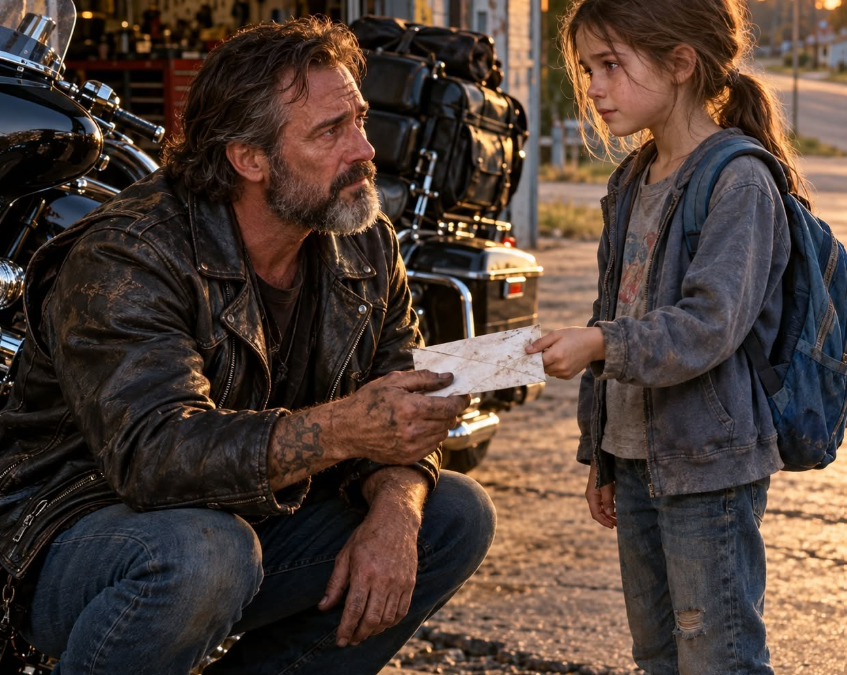
Lucy opened the backpack and placed an envelope beside my coffee.
JACK.
Ben’s handwriting.
Even his crooked K looked familiar.
I did not touch it at first.
The waitress came by with more coffee. I waved her off.
Lucy dragged her fork through syrup and tried not to watch me watching the envelope.
Finally, I picked it up.
Inside was a single page folded around an old photograph of us beside two motorcycles. We were younger in the picture. Leaner. Smirking like men who had not yet learned how easily life could take the faces off people.
I read the letter while Lucy ate.
Jack,
If Lucy brings you this, something has gone wrong. Help her get to Rachel. She’s going to act braver than she feels. Don’t let that fool you.
I swallowed.
Typical Ben.
Dead and still bossing me around.
I kept reading.
You don’t have to replace me. Just don’t disappear when being needed scares you.
The letters blurred for a second.
I blinked hard until they sharpened.
There are people who ask for help politely.
There are people who demand it.
Ben had always done something worse.
He told the truth in a way that left you no room to pretend you had not heard it.
Lucy watched my face.
“Did he say you’d help?”
“He asked me to.”
“Are you going to?”
I looked past her through the diner window.
My truck sat in the lot.
The Harley was back in the garage.
Leaving would still be easy once her mother was better.
That was what I told myself.
Just this.
Just tonight.
Just get the kid to the hospital.
Just make sure Rachel was not alone.
Then west.
“Yes,” I said.
Lucy nodded like she had already known.
At the hospital, Rachel looked smaller than I remembered.
An oxygen tube rested beneath her nose. Her hair had been pulled back loosely, and her skin held the pale, exhausted color of someone whose body had been spending too much energy just staying here.
Lucy climbed carefully onto the edge of her bed, and Rachel held her so tightly the backpack slid to the floor.
“You scared Mrs. Bell,” Rachel whispered.
“I found Jack.”
Rachel looked at me over her daughter’s head.
Her eyes were tired.
Ben’s eyes had been gray like Lucy’s.
Rachel’s were brown, deep and gentle and much harder to face because she knew exactly who I had been before I disappeared.
“Ben always hoped you’d come back,” she said.
I could not hold her gaze.
“I’m sorry I didn’t come sooner.”
She nodded toward the chair beside the bed.
“Then sit down now.”
I sat.
That was how it began.
Not with forgiveness.
Not with some dramatic promise.
A chair.
A child.
A sick woman.
A dead friend’s handwriting folded in my pocket.
There were things to arrange. Groceries. School pickup. Medication lists. Someone to take Lucy while Rachel remained in the hospital. Mrs. Bell could help, but she was seventy-three and already taking care of her husband, who used a walker and argued with television judges.
With Rachel’s permission, I agreed to help.
For a few days, I told myself I was only solving problems.
Practical problems.
The kind I understood.
Pick up Lucy at school.
Make sure she ate.
Drive her to the hospital.
Call Mrs. Bell.
Bring Rachel clean clothes.
Fix the loose latch on her apartment door.
Take trash to the dumpster.
Pay for groceries without making a performance of it.
Useful things.
Safe things.
Every afternoon that week, Lucy did homework at my workbench.
I bought a lamp, cleared away the solvents, and discovered I remembered less about fractions than carburetors.
“That’s not how Mrs. Hayes does it,” Lucy said on Wednesday.
“Mrs. Hayes has probably had training.”
“You’re supposed to be good at fixing things.”
“Fractions are not things.”
“They are numbers.”
“Worse.”
She laughed.
It came out small the first time, like she was testing whether the room could hold it.
By Friday, she laughed without checking my face afterward.
I started listening for her footsteps.
That should have scared me.
It did.
Friday evening, while we waited for Mrs. Bell to come by after visiting Rachel, Lucy found the photograph I had left beside my toolbox.
It had slipped from Ben’s letter.
I should have put it away.
I should have put a lot of things away.
“Who’s the little girl?” she asked.
My hand went still over a set of spark plugs.
In the photograph, I was kneeling beside a purple child-sized bicycle. Emma stood next to me wearing a yellow shirt, striped leggings, and a helmet covered in stickers. Her grin was missing one front tooth. Her hand rested on the bike seat like she had built it herself.
“My daughter,” I said.
“What’s her name?”
“Emma.”
“Does she live somewhere else?”
The air left the garage.
There were questions children ask because nobody has taught them which truths adults hide behind fences.
I set the spark plug down.
“She died when she was six.”
Lucy did not gasp.
Did not apologize too quickly.
Did not ask how in that hungry way children sometimes ask about terrible things because they have not yet learned that details can become knives.
She sat quietly.
Then she reached into her backpack.
“Dad said you’d know what this opens.”
A small brass key landed in my palm.
I recognized it immediately.
The shape.
The worn edge.
The tiny scratch near the teeth from where Ben had once used it to pry open a paint can because he was an idiot.
Under the stairs stood the steel cabinet Ben had locked after helping me pack Emma’s things.
Eight years.
That cabinet had sat in my garage like a second furnace, burning cold.
I had moved it once.
Dust gathered behind it.
I cleaned around it.
Never opened it.
Ben had kept the key because I made him.
“If I ask for it back,” I had told him, “don’t give it to me unless I’m sober and serious.”
He had looked at me with red eyes and said, “And if you never ask?”
“Then don’t.”
Now his daughter was standing beside me, and the key was in my palm.
“Did I do something wrong?” Lucy asked.
I realized I had stopped breathing right.
“No, sweetheart,” I said. “Not a thing.”
My voice sounded like it belonged to someone older.
I walked to the cabinet.
Each step felt stupidly loud.
I knelt.
For a moment, I just stared at the lock.
Lucy stayed behind me.
Not pushing.
Not asking.
I slid the key in.
It turned.
The sound was small.
It still felt like something breaking.
Inside were cardboard boxes, a purple helmet, a pair of tiny sneakers, a stack of drawings tied with ribbon, and a wooden box Ben had made because he was better with wood than he ever admitted.
I lifted the box out and carried it to the workbench.
Beneath Emma’s photograph lay a folded note.
Ben’s handwriting again.
The first line made my knees buckle.
Jack, before you decide Lucy deserves a better man, there’s something you need to remember about the day Emma died.
I caught the edge of the workbench and sat on the stool.
Lucy pulled a chair closer but did not touch me.
I read the next line.
You came. I was there. You came before she was gone.
For years, whenever I remembered that day, I started with the phone ringing in my garage.
Emma was sick.
I had left her with my sister that morning because I had an engine to finish and a mortgage payment due. Emma had begged to stay home with me. She wanted to watch me work on a bike because she liked pretending she was my assistant.
I told her next time.
There are two words that can haunt a man forever.
Next time.
By afternoon, my sister called from the emergency room.
Her voice was wrong.
Not scared.
Past scared.
I remembered dropping a wrench.
Driving through a red light.
The hospital hallway.
The way the fluorescent lights made everything look too clean for what was happening.
Mostly, I remembered that I had not been home when my daughter needed me.
Everything after that became proof of the same accusation.
If I had stayed.
If I had listened.
If I had not cared about the mortgage.
If I had not promised next time.
If I had been there.
If.
If.
If.
Grief loves that word.
It builds a whole prison out of it.
Ben’s handwriting blurred.
You keep saying you weren’t there. You weren’t there when she got sick. That is different. You held her hand. You sang that ridiculous song she liked. She heard you.
I remembered the song.
An old rock chorus I had changed into nonsense about a rabbit stealing pancakes. Emma had always made me sing it twice.
In the hospital, I had sung it until I could not make another sound.
I had buried that memory under the others because it did not fit the punishment I had chosen for myself.
If I remembered holding her hand, then I had to remember she had not died alone.
If I remembered singing, then I had to admit love had been present in the room.
If I admitted love had been present, then guilt lost one of its favorite weapons.
I kept reading.
Working that morning didn’t cause what happened to her. Loving another child won’t erase her. And making yourself lonely for the rest of your life won’t give her back one afternoon.
Below the note lay a drawing on yellow construction paper.
Emma had drawn me with enormous hands, standing beside a purple motorcycle.
Across the top, in uneven letters, she had written:
MY DADDY CAN FIX ANYTHING.
I pressed my fist against my mouth.
“I couldn’t,” I said.
Lucy studied the drawing.
“Maybe she meant her bike.”
A laugh escaped before I could stop it.
Then I cried harder than I had at the funeral.
Not because it hurt more.
Because it hurt differently.
For eight years, I had only allowed myself the kind of grief that punished me.
This was worse.
This was grief with love still breathing inside it.
Lucy stayed in her chair.
When Mrs. Bell arrived, I wiped my face, helped Lucy gather her homework, and thanked the woman for coming.
At the truck, Lucy turned back.
“You can put the picture where you can see it,” she said.
That night, I did.
I placed Emma’s drawing on the wall above my workbench.
Right where the garage light hit it.
MY DADDY CAN FIX ANYTHING.
I sat on the stool for a long time, looking at those uneven letters.
Then I took the luggage off my Harley.
The next morning, I visited Rachel alone while Lucy was at school.
She was sitting up a little more, but the hospital still seemed to swallow her. Machines beside the bed. A plastic cup of ice chips. A tray she had barely touched.
“I opened the box,” I told her.
Rachel closed her eyes briefly.
“He wondered if you ever would.”
“Why put the key in her backpack?”
“Because he was sick, Jack.” Her voice was gentle, but tired. “He was trying to leave her people to turn to. Your address was in the notebook. He hoped she’d never need it.”
I sat with that for a while.
Ben had not sent his daughter to cure me.
He had trusted me to protect her, despite everything I had done to convince him I could not.
“I let him down,” I said.
Rachel looked at me.
“You hurt him,” she said. “He missed you. Both things can be true.”
There was no easy forgiveness in that room.
I was grateful she did not offer any.
“I can’t make that right with him now.”
“No.” She shifted against the pillow. “But Lucy needs someone to pick her up at three.”
I checked my watch.
“I’ll be there.”
For a few days, I thought keeping that promise would be simple.
Then the hospital called on Tuesday evening.
Rachel needed more treatment.
She would not be going home the next morning after all.
Lucy watched me end the call.
She had been sitting on the floor of the garage sorting bolts into little trays because she said my system was bad.
“Is Mom dying?” she asked.
The garage seemed to narrow around us.
I smelled disinfectant though there was none.
My hands went cold.
I could see the hospital hallway from eight years ago.
The floor.
The lights.
The room where singing became silence.
“I don’t know,” I said. “They want us to come see her.”
“Then let’s go.”
I picked up my keys.
But at the truck, I stopped.
For one terrible second, I wanted to call Mrs. Bell.
Let someone steadier handle it.
Someone who could enter a hospital without hearing a song in his head.
Someone who did not look at a scared child and see every way the world could take her apart.
Lucy saw the hesitation.
“You don’t have to go in,” she said quickly. “You could just drive me.”
Her voice was careful.
She was already making her need smaller so I could bear it.
That made the decision for me.
I opened the passenger door.
“I’m going in with you.”
At Rachel’s bedside, we listened while she explained what the doctor had told her.
Lucy asked questions I had not thought of.
Would her mother miss her birthday?
Could she bring her own pillow?
Was the new treatment going to hurt?
Would her hair fall out?
Would Mrs. Bell still take her to school?
Could Jack still pick her up if Mom stayed longer?
I could not answer most of them.
Rachel answered what she could.
When Lucy began to cry, I stayed in my chair.
That was all.
I did not fix the treatment.
I did not promise a recovery.
I did not say everything would be okay, because adults had told me that in hospital rooms and sometimes they were wrong.
I stayed while she cried.
Then I drove her back to Mrs. Bell’s and returned in the morning with clean pajamas for Rachel.
The weeks that followed were exhausting in ordinary ways.
I burned grilled cheese.
Signed a permission slip in the wrong place.
Forgot a library book and drove back for it.
Learned which cereal Lucy liked.
Learned that she hated peas unless they were mixed into rice.
Learned that “I’m fine” sometimes meant she needed someone to sit nearby without talking.
Learned that nine-year-olds can ask impossible questions while tying their shoes.
“Do you think Dad knew he was going to die?”
“Do you think Mom is scared when I’m not there?”
“Do you still dream about Emma?”
“Do you think dead people get mad if we laugh?”
I never had good answers.
But I stopped disappearing from the questions.
That was new.
I also found someone to talk to myself.
At my first grief counseling appointment, I spent ten minutes discussing motorcycles before admitting why I was there.
The counselor, a woman named Denise with silver hair and terrible office coffee, let me talk about valve timing until I ran out of mechanical distractions.
Then she said, “Tell me about Emma.”
I almost walked out.
Instead, I told her about the purple bike.
The song.
The cabinet.
The word if.
Later, I called my sister.
Her voice broke when she saw my name.
We talked about Emma.
Then about all the years I had made it difficult for her to talk about Emma with me.
“I thought you blamed me,” she whispered.
I shut my eyes.
“No,” I said. “I blamed myself so loudly I couldn’t hear anybody else.”
None of it made the missing stop.
But I could look at my daughter’s drawing without immediately turning it facedown.
Rachel eventually came home.
Recovery was slow.
Some afternoons, she sat on her porch wrapped in a blanket while Lucy showed her spelling tests. I repaired a loose railing, brought groceries, and left when Rachel needed quiet.
We never pretended I was Ben.
That mattered.
Lucy spoke about him whenever she wanted.
Sometimes she asked me for stories about the younger man she had barely gotten to know before illness thinned him down and made him tired.
So I told her.
How Ben once rebuilt an engine perfectly and forgot to put gas in the tank.
How he danced badly at my wedding and insisted he was “experimenting with rhythm.”
How he got lost on a charity ride he had organized himself.
How he could make me laugh even when I was determined to stay angry.
One Friday, Lucy asked me to drive them to his grave.
I bought flowers.
For Emma’s grave, I had often bought flowers and left them in the truck, unable to carry them all the way.
For Ben, I carried them.
We stood in the cemetery under a pale sky while Rachel and Lucy placed the bouquet by his headstone.
Lucy talked to him like he was sitting on the grass.
She told him about school.
About my bad grilled cheese.
About her mom coming home.
About the fact that I still did not understand fractions.
Rachel cried quietly.
I looked away to give her the dignity of not being watched.
After they walked back toward the truck, I crouched beside the headstone.
The stone looked too clean.
Too new.
Benjamin Aaron Lawson.
Beloved Husband. Father. Friend.
Friend.
That word caught.
“You deserved a phone call,” I said. “A lot of them.”
Wind moved through the grass.
No answer came.
Of course it didn’t.
But for the first time, I stayed there until I could stand up without feeling I was running away.
Six months after Lucy stopped my Harley, her backpack broke.
The zipper split while she was pulling out math homework at my workbench. Pencils rolled across the garage floor. A notebook fell open. The old envelope with my name on it slipped halfway out before she pushed it back in.
“We can get you another one,” I said.
She held the faded blue bag against her chest.
“Dad picked this one.”
I understood.
So we fixed it.
We sat at the workbench and replaced the zipper. She supervised every stitch. I did the actual work because I had needles thick enough for canvas and hands steady enough for once.
When we finished, she slipped Ben’s notebook into the largest pocket and reached for the brass key.
“You keep this now.”
The key lay in her palm.
Small.
Ordinary.
Impossible.
I took it.
The cabinet stood open beneath the stairs now.
Not empty.
Not conquered.
Open.
Emma’s photograph was on my desk, her drawing beside it. Her purple helmet sat on a shelf. There were still things inside I was not ready to unpack.
I would get to them.
That was different from never.
Outside, Rachel honked once from her car.
“Dinner,” Lucy announced. “Mom says don’t be late.”
“I wasn’t invited.”
Lucy gave me Ben’s stubborn expression.
“You are now.”
I turned off the work light.
At the door, Lucy glanced at the Harley.
Its saddlebags had been empty for months.
“Remember when I asked you to take me with you?”
“I remember.”
“I’m glad you didn’t.”
She took my hand.
Careless and certain now.
Without checking whether I would pull away.
“We needed you here.”
I locked the garage and walked with her to the waiting car.
In my pocket was the key Ben had kept for eight years.
In my hand was his daughter’s hand.
I still wished, every day, that I could hold Emma’s again.
For the first time, that wish did not make me let go.
A year later, Rachel’s health had steadied enough for ordinary life to become possible again.
Not easy.
Possible.
There is a difference, and people who have lived through hospitals know it well.
Possible meant Rachel could make breakfast most mornings.
Possible meant Lucy stopped asking, “Are you tired or hospital tired?”
Possible meant I drove them less because they needed me less, and somehow that did not feel like abandonment.
Possible meant Sunday dinners.
At first, Rachel invited me because she said I had fixed the porch railing and deserved payment in lasagna.
Then because Lucy asked.
Then because nobody explained it anymore.
I would arrive at six with bread or pie or something from the grocery store Rachel claimed was unnecessary and then served anyway.
Lucy would talk through half the meal.
Rachel would roll her eyes at both of us.
Sometimes we talked about Ben.
Sometimes Emma.
Sometimes neither.
Love does not always heal by constantly naming the wound.
Sometimes it heals by letting normal sounds return to the room.
Forks on plates.
A child complaining about homework.
A woman laughing in the kitchen.
A man washing dishes because he does not know what else to do with tenderness.
One evening, Lucy brought out a photo album Rachel had found in a closet.
Ben and me at twenty-five.
Ben and me covered in grease.
Ben holding baby Lucy.
Me holding Emma on my shoulders at a barbecue I had almost forgotten.
The two girls had never met.
Emma died before Lucy was born.
But in one photo, Ben was standing beside me while I held Emma, and Rachel was standing beside him with one hand on her stomach, pregnant and smiling.
Lucy touched the picture.
“We were almost in the same photo,” she said.
I looked at Emma’s face.
Then at Lucy’s finger resting near the edge.
“Yeah,” I said. “You were.”
She glanced up.
“Do you think she would’ve liked me?”
The question hit me in the center of the chest.
I could have given a simple answer.
Of course.
Absolutely.
She would’ve loved you.
Instead, I let myself really imagine it.
Emma with her purple bike and missing tooth.
Lucy with her blue backpack and Ben’s gray eyes.
The two of them in the garage, conspiring against me.
Emma teaching Lucy the pancake rabbit song.
Lucy correcting Emma’s fractions.
Both of them asking impossible questions while I tried to work.
“She would’ve bossed you around,” I said.
Lucy smiled.
“I would’ve let her.”
“You say that now.”
Rachel wiped her eyes with a napkin and pretended it was allergies.
It was November.
No one believed her.
The next spring, Lucy asked me to help her build something for the school science fair.
“What kind of something?”
“A machine.”
“That narrows it down.”
“I want it to lift a backpack.”
“Why?”
“Because backpacks are heavy and little kids shouldn’t have to drag them.”
I looked at her.
Sometimes children reveal their scars by designing solutions.
So we built a pulley system from scrap wood, bicycle cable, small wheels, and too much ambition.
It barely worked.
Then it worked.
Then it worked too well and launched an empty backpack into the garage wall hard enough to knock down a calendar.
Lucy laughed so hard she fell off the stool.
I laughed too.
For once, the garage sounded like it had before.
Not the same.
Never the same.
But alive.
The science fair display was titled:
HELPING HANDS LIFT HEAVY THINGS.
She won second place.
She was furious for forty-eight hours because first place was a volcano, and in her opinion, the world did not need another baking soda volcano.
I agreed.
Rachel told us both we were poor sports.
We accepted that.
Years passed the way years do when you stop trying to outrun them.
Not gently.
Not cruelly.
Just steadily.
Lucy grew taller.
Her backpack changed.
The blue one stayed on a hook in my garage after the straps finally gave out for good. We never threw it away.
Rachel returned to work part time.
Then full time.
Mrs. Bell’s husband passed away, and we all started checking on her instead.
My shop expanded by one bay after business improved.
People said it was because I did good work.
That was true.
It was also because I had stopped making the place feel like a locked door.
I hired a kid named Marcus who needed a job more than a lecture.
Then a woman named Tasha who could diagnose electrical problems faster than most men could admit they were lost.
The garage changed.
Music played sometimes.
People stayed after closing.
There was a stool near the workbench that everyone called Lucy’s even after she became too old to sit there doing homework.
Emma’s drawing stayed on the wall.
MY DADDY CAN FIX ANYTHING.
For years, that sentence had accused me.
Then it comforted me.
Then it became something else entirely.
A reminder that children rarely mean what guilt tells us they mean.
Emma had not asked me to fix death.
She had loved the way I tried.
One summer night, Lucy was sixteen and helping me close the shop when a man came in angry about a repair bill.
He was loud.
Red-faced.
The kind of man who believed volume could become truth if he kept feeding it.
Lucy went very still.
I saw it.
That old child instinct.
The one that measures exits.
The one that makes need small.
I stepped between them.
Not dramatically.
Just enough.
“Come back tomorrow when you can talk like an adult,” I said.
The man cursed.
I opened the office door.
“Tomorrow.”
He left.
Lucy stared at me.
“What?”
“You didn’t yell back.”
“No.”
“You used to.”
That was true.
“When did you stop?”
I looked at Emma’s drawing.
Then at Ben’s old letter tucked in a frame beside it.
“I don’t know,” I said. “Somewhere between fractions and lasagna.”
She rolled her eyes.
“You’re weird.”
“Known fact.”
She smiled.
Then she said, “Dad would’ve liked this version of you.”
The words landed softly.
Still heavy.
But soft.
“I hope so.”
“He would,” she said. “He wrote instructions and everything.”
I laughed.
Ben would have liked that.
When Lucy graduated high school, she wore a blue dress under her gown because she said her dad liked blue.
Rachel cried before we even parked.
I promised not to.
I failed.
Lucy walked across the stage, and for one strange second, I saw every version of her at once.
The nine-year-old in my driveway.
The child eating sugar packets in a diner.
The girl holding a brass key in my garage.
The teenager arguing that pulleys were better than volcanoes.
The young woman crossing a stage toward a life Ben had tried so hard to protect from beyond his own.
After the ceremony, she found me near the truck.
Rachel was talking to Mrs. Bell, who had become the unofficial grandmother of every person within emotional reach.
Lucy held out a small wrapped box.
“What’s this?”
“Open it.”
Inside was a keychain.
On it was a tiny brass key charm.
Not the real key.
That stayed in my pocket.
This one was engraved with four words:
YOU CAME BACK TOO.
I had to look away.
Lucy pretended not to notice.
That was one of her kindnesses.
She had learned when to leave a person space and when to stand close enough that space did not become loneliness.
“You okay?” she asked.
“No.”
She nodded.
“Good answer.”
I laughed through whatever was trying to break open in me.
The night before she left for college, Lucy came to the garage.
The Harley sat near the open door.
The same one I had almost ridden out of town for good.
Its saddlebags were empty now except for rain gear and a first-aid kit Rachel insisted I carry because she had become bossier with age.
Lucy ran one hand along the seat.
“You ever think about leaving again?”
“Sometimes.”
She looked up.
“Really?”
“Thinking isn’t doing.”
“Where would you go?”
“West, probably.”
“Still?”
“Maybe.”
She nodded.
“If you do, you better come back.”
I smiled.
“You giving orders now?”
“Yes.”
“Very Ben of you.”
She looked pleased.
Then she grew quiet.
“I’m scared,” she admitted.
That surprised me.
Lucy had always been brave in the way children become brave when life does not give them a choice. But this was different. This was almost-adult fear. The doorway kind. The leaving kind.
“Of college?”
“Of everything changing.”
“It will.”
“That’s not comforting.”
“I know.”
She leaned against the workbench.
“What if Mom gets sick again while I’m gone?”
“We’ll call.”
“What if you need something?”
“I’ll call.”
She raised one eyebrow.
I sighed.
“I’ll try to call.”
“Jack.”
“I’ll call.”
She nodded.
“What if I miss Dad so much I can’t stand it?”
“Then you call me.”
“What if I miss you too?”
That one got through.
“Then you call me twice.”
She smiled.
Then she looked at Emma’s drawing.
“Do you ever feel guilty for loving me?”
The garage went quiet.
I wanted to lie.
Not because she deserved a lie.
Because the truth was complicated.
“At first,” I said.
She nodded like she had known.
“Do you still?”
I looked at the steel cabinet beneath the stairs.
Open now.
Not empty.
Open.
“No,” I said. “Now I think love doesn’t divide the way fear says it will.”
Lucy’s eyes shone.
“Dad wrote something like that.”
“Your dad wrote a lot for a dead man.”
She laughed.
Then she hugged me.
Not like a child.
Not like a daughter exactly.
Like Lucy.
That was enough.
Years later, when people asked how we were related, Lucy would sometimes say, “He was my dad’s best friend.”
Sometimes she would say, “He’s family.”
Once, at a hospital intake desk when Rachel needed a minor procedure and the nurse asked who I was, Lucy said, “He’s the guy who didn’t leave.”
I had to sit down.
By then, I had learned that being needed did not always mean being trapped.
Sometimes it meant being tethered to the world in the only way strong enough to keep you from drifting out of it.
Ben knew that.
That was why he gave Lucy my address.
That was why he kept the key.
That was why he wrote the note I had needed long before I had the courage to read it.
He had not asked me to replace him.
He had asked me to stop letting absence be the only thing I honored.
I still visit Emma’s grave.
I still bring flowers.
I still sing the pancake rabbit song sometimes when no one can hear me.
Except once, Lucy did.
She was home from college, sitting on the porch with Rachel while I worked in the garage. I did not know the door was open.
When I finished, I turned around and saw both of them watching.
Rachel was crying.
Lucy was smiling.
“What?” I asked.
Lucy wiped her eyes.
“Nothing.”
“It’s a stupid song.”
“It’s a terrible song.”
“Then stop crying.”
“No.”
I shook my head.
Emma would have liked her.
I know that now.
Not because Lucy replaced anything.
She did not.
No one replaces a child.
No one fills that room.
No one takes that chair.
But sometimes another child knocks on the door of your grief carrying a backpack, a dead man’s letter, and a key.
Sometimes she does not ask you to forget.
Sometimes she simply asks you to come with her.
To the diner.
To the hospital.
To school pickup.
To the grave.
To dinner.
To tomorrow.
And if you are lucky, if you are brave in the smallest possible way, you go.
The steel cabinet is still under the stairs.
Its door stays open now.
Inside are Emma’s helmet, the wooden box, Ben’s first letter, Lucy’s old blue backpack, and the keychain she gave me at graduation.
MY DADDY CAN FIX ANYTHING still hangs above my workbench.
I still cannot fix the one thing I wanted most.
But I have fixed enough to understand what Emma may have meant.
I fixed the latch on Rachel’s door.
The zipper on Lucy’s backpack.
The loose railing on the porch.
The bad habits of a man who thought leaving was safer than being loved.
I fixed enough mornings to make a life.
And maybe that is what fixing really is most of the time.
Not undoing the break.
Not making the damage disappear.
Just making sure the next person who needs the door can open it.
On the anniversary of Ben’s death, I rode the Harley to the cemetery.
Not to leave town.
Not anymore.
Just to visit.
I parked beside the gate and carried flowers all the way to his stone.
Then I sat in the grass like he could hear me.
“You were right,” I said.
That would have made him insufferable.
I could almost hear him.
About what?
“All of it.”
The wind moved through the trees.
I looked at his name, then at the small stone not far away where Emma’s name waited with a purple pinwheel spinning beside it.
“I’m still mad at you,” I said.
That also would have pleased him.
“But I came.”
The grass was damp beneath my boots.
The road beyond the cemetery hummed with late traffic.
Life continuing.
Annoying.
Beautiful.
Unfair.
Necessary.
“I came,” I said again.
And for the first time, it did not sound like a confession.
It sounded like a promise.
That afternoon, Lucy called from school.
“Are you busy?”
“I own a garage.”
“So no?”
“Correct.”
She laughed.
Then she said, “I got into the internship.”
I leaned against the Harley.
The same Harley I had almost used to disappear.
“Of course you did.”
“You’re supposed to act surprised.”
“I’m overcome.”
“You’re bad at this.”
“Known fact.”
There was a pause.
Then she said, softer, “I wish Dad could know.”
I looked toward Ben’s grave.
“He knows enough,” I said.
“You think?”
“I do.”
Another pause.
“Do you think Emma knows too?”
I looked at the purple pinwheel spinning in the wind.
“Yes,” I said. “I think she knows I finally opened the cabinet.”
Lucy breathed out.
“Good.”
After we hung up, I stayed between the two graves for a long time.
My daughter.
My best friend.
The two people I thought I had lost so completely that loving anyone after them would be betrayal.
But grief had lied to me.
Grief does that.
It tells you love is a closed room.
It tells you memory is a locked cabinet.
It tells you if you stop punishing yourself, you are admitting the loss was bearable.
It tells you being needed is dangerous because you might fail again.
But grief is not the only voice the dead leave behind.
Sometimes they leave letters.
Keys.
Children with gray eyes.
Drawings on yellow construction paper.
A sentence that waits eight years to save your life.
You came.
I was there.
You came before she was gone.
I still wish, every day, that I could hold Emma’s hand again.
That wish has never left me.
It probably never will.
But now, when Lucy takes my hand, I do not pull away from the living because I cannot reach the dead.
That is the difference.
That is the whole story.
I was leaving town for good when a nine-year-old girl stepped in front of my Harley and asked me to take her away.
I thought she had come to interrupt my escape.
I know better now.
She came to end it.
Not by asking me to save her.
By giving me the key to the part of myself I had locked away and mistaken for loyalty.
Ben knew I would resist.
He knew I would argue.
He knew I would believe Lucy deserved a better man.
So he sent her anyway.
Because the people who love us best do not always wait until we feel ready.
Sometimes they place the key in a child’s backpack.
Sometimes they write one last letter.
Sometimes they trust us with what matters before we trust ourselves.
And sometimes, if we are brave enough to stop the engine, sit down in the hospital chair, and stay when the crying starts, we discover that being needed was never the thing that broke us.
It was the thing that finally brought us home.