A 74-Year-Old Man Dug Through His Collapsed Home for 36 Hours After Finding His Wife Dead—Because Somewhere Beneath the Rubble, the Last Family Member He Had Left Was Still Missing.
PART3:
Shattered roof tiles.
Furniture.
Dishes.
Bedding.
Photographs.
The crushed remains of ordinary things that had mattered only because they had belonged to a life.
Keiko was somewhere underneath.
Sora was somewhere underneath.
Haruto shouted his wife’s name first.
“Keiko!”
No answer.
He shouted again.
Then Sora’s name.
“Sora!”
Nothing.
Dust moved in the air.
Somewhere down the road, a woman was crying.
A child screamed for his mother.
A car alarm wailed until the battery died.
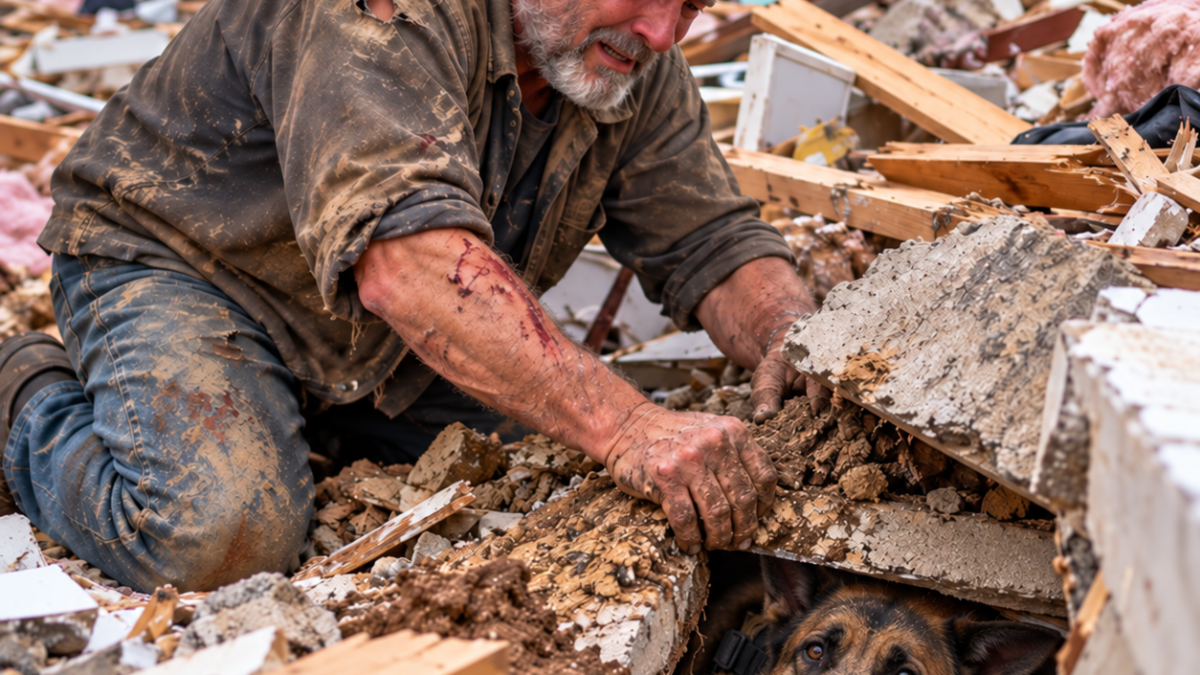
Haruto dropped to his knees and began digging with his bare hands.
The surviving neighbors tried to help when they could, but nearly every family on the street had its own missing person, damaged home, or emergency.
The roads into the neighborhood had been cut by landslides.
Power and communications were down.
Organized rescue crews were not expected to reach them for more than forty-eight hours.
So the old fisherman kept digging.
He dug through sunset.
He dug through the first night as snow began to fall and the temperature dropped close to freezing.
For the first several hours, he had no flashlight.
He worked by touch until a neighbor brought him one.
Roof tiles sliced his palms.
Splintered beams drove wood beneath his skin.
Within two hours, blood covered his fingers.
By morning, both hands were swollen and blackened with dust, dirt, and dried blood.
He did not stop.
At about six o’clock on January 2, fourteen hours after the earthquake, he found Keiko.
She had been in the kitchen.
Preparing tea.
A roof beam had fallen before she had any chance to escape.
Later, he would be told that she died within seconds.
She had not suffered.
It was a small mercy, almost too small to hold, but he held onto it anyway.
Haruto sat beside her in the ruins for nearly an hour.
Neighbors watching from a distance said he did not cry.
He did not speak.
He simply sat beside the woman who had shared more than half a century of his life while snow settled on the wreckage around them.
Then, without explanation, he stood up.
And he started digging again.
At first, the neighbors thought grief had confused him.
They approached carefully and told him there was nothing else he needed to search for.
They begged him to rest.
They told him to eat something.
They told him someone needed to clean and bandage his hands before infection set in.
Haruto kept moving broken boards aside.
One neighbor finally crouched beside him and asked what he was looking for.
The old man stopped.
For the first time since finding his wife, he lifted his face.
He said one word.
“Sora.”
The neighbors looked at the ruins.
Nobody could know whether Sora was alive.
The house had collapsed almost completely.
The second floor had driven downward into the first.
The heavy tiled roof had come down on top of everything.
There were places where even a rat could not have survived.
But there were other places where furniture, beams, and walls had fallen at angles and created small pockets of empty space.
Haruto understood that.
He had spent his entire life around boats, nets, storms, ropes, engines, timber, and weight.
He knew destruction was rarely as simple as it appeared from the outside.
A thing could collapse and still leave a hollow place inside.
A roof could fall and stop six inches above the floor because a cabinet had caught it.
A beam could break and become the very thing preventing another beam from crushing what lay underneath.
He did not know whether Sora had found one of those places.
But he knew something else.
He had not found Sora’s body.
Until he did, he would keep looking.
A neighbor caught his wrist before he lifted the next broken tile.
“Please,” the man said quietly. “Your hands.”
Haruto looked down at his palms as though he had forgotten they belonged to him.
The cuts had opened again.
Fresh blood had soaked through the cloth someone had wrapped around his fingers.
His knuckles were swollen until the skin looked polished.
There were splinters buried too deeply to pull out without a needle.
Some of his fingernails had cracked.
None of it seemed important to him.
“Sora is in there,” he said.
The neighbor released his wrist.
For a moment, he looked at the collapsed house.
Then he knelt beside Haruto.
“All right,” he said.
Together they moved the tile.
For the next several hours, Haruto worked without measuring time.
People brought him rice balls.
He ate them while standing in the rubble.
Someone brought water.
He drank half the bottle, put it beside a broken cabinet, and immediately reached for another board.
Someone found a pair of work gloves in a garage that had survived.
The gloves were too large.
He pulled them on anyway.
Within an hour, blood had seeped through the fabric at the fingertips.
He never removed them.
A woman from across the road tried to persuade him to sit near a portable heater someone had managed to start.
“Ten minutes,” she pleaded.
“No.”
“Five.”
“No.”
“You’ll collapse.”
Haruto looked toward the remains of his living room.
“He might already have waited too long.”
The woman had no answer for that.
By the afternoon of January 2, a university student who lived three houses away came over.
His name was Ren.
He was twenty-two and had returned home for the New Year holiday.
His own family had survived.
Their house was damaged but still standing.
He had spent the morning helping older neighbors move away from unstable buildings.
When he reached Haruto’s property, he did not ask whether help was wanted.
He simply picked up a piece of broken timber and said, “Where?”
Haruto pointed.
“Not there.”
Ren stopped.
“Why?”
“That beam is carrying weight.”
Haruto pointed to another section.
“Start there.”
Ren obeyed.
Ten minutes later, he realized the old fisherman was not digging randomly.
He knew the house.
Not merely its rooms.
He knew its bones.
He knew where each wall had stood.
He knew the direction of the floorboards.
He knew which part of the rubble had once been the hallway and which part had once been the bedroom.
He could look at a broken cabinet buried sideways and understand where the collapse had pushed it from.
“This was the bedroom,” Haruto said at one point.
Later he pointed several feet away.
“Hall.”
And then, more quietly, toward the place where Keiko had been found.
“Kitchen.”
Every word cost him something.
Ren stopped asking unnecessary questions.
They worked.
Two other neighbors joined before evening.
Haruto began directing all three.
“Lift that end first.”
“Don’t step there.”
“Move the small pieces before the large one.”
“Slowly.”
“Leave that beam.”
“What are we trying to reach?” Ren finally asked.
Haruto wiped dust from his forehead with his sleeve.
“The living room.”
Sora’s bed had been there.
It had been beside a low wooden cabinet near the window facing the sea.
On winter mornings, sunlight reached that spot before the rest of the room.
Sora loved it.
Keiko used to complain that the dog had learned to calculate the path of the sun better than either of them.
“He moves six times a day,” Keiko would say. “Always exactly where the warm patch goes.”
Haruto would pretend not to listen.
Then he would move Sora’s blanket for him before the sunlight shifted.
Keiko always noticed.
“You’re spoiling my dog.”
“He isn’t your dog.”
“Oh?”
“He’s his own dog.”
Keiko would smile.
“That is what a man says when he knows the dog loves him more.”
Sora had come into their lives eight years earlier.
Haruto had retired after more than forty years working at sea.
For the first few months, retirement had seemed like freedom.
Then it became something else.
He woke before dawn because his body still expected work.
He ate breakfast at the same hour.
He walked toward the harbor even when he had no reason to be there.
Sometimes he stood watching younger crews prepare their boats.
He told himself he was only checking the weather.
Keiko knew better.
“You miss it,” she said one morning.
Haruto shrugged.
“I miss knowing what I am supposed to do.”
Keiko said nothing.
A week later, she told him they were going somewhere.
She took him to a rescue organization that worked with retired service dogs, failed working-dog candidates, and high-drive breeds that ordinary families often could not handle.
Sora was not the smallest.
He was not the youngest.
He was not even the dog Keiko had originally gone there to meet.
He was a lean Belgian Malinois and German Shepherd mix with a dark sable coat, a black mask, one torn ear, and a scar along his left shoulder.
His body was all angles and attention.
Long legs.
Deep chest.
Watchful eyes.
The rescue worker explained that Sora had once been evaluated for police K9 work when he was younger, but he had never completed the program. He was intelligent, loyal, and highly alert, but too sensitive to harsh handling and too attached once he bonded.
“He needs someone patient,” the rescue worker said.
Haruto crossed his arms.
“He looks like he needs a job.”
The rescue worker smiled.
“He does.”
Keiko looked at her husband.
“So do you.”
Sora did not rush toward them.
He sat at the back of his enclosure watching.
Not fearful.
Not eager.
Assessing.
Keiko crouched several feet away.
“Hello,” she said softly.
Sora looked at her.
Then he looked at Haruto.
Haruto was standing with his hands in his coat pockets.
“I thought you wanted a dog,” he said.
“I do.”
“That one looks like he is interviewing us.”
Keiko smiled.
“Maybe he has standards.”
The rescue worker opened the gate.
Sora came out slowly.
He sniffed Keiko’s hand.
Allowed her to touch his cheek.
Then he walked directly to Haruto and sat on his shoe.
Haruto looked down.
Sora leaned his whole shoulder against the retired fisherman’s leg.
Keiko laughed.
“Oh,” she said. “This is going badly for me already.”
They brought him home that afternoon.
Keiko named him Sora, meaning “sky,” because the winter sky over the sea was unusually clear and blue that day.
“I want to remember today,” she said.
Haruto thought the name was too gentle for such a serious-looking dog.
Within a week, he stopped thinking that.
Sora learned the rhythms of the house quickly.
He learned that Keiko woke later.
He learned that Haruto woke before sunrise.
So he began waking before sunrise too.
Haruto would sit at the low table with tea and the newspaper.
Sora would settle beside him.
At first, he stayed several feet away.
Then beside his chair.
Then against his ankle.
Eventually, Sora discovered that if he rested his chin across Haruto’s knees while the old man read, Haruto’s hand would begin scratching behind his ears without Haruto noticing.
Keiko caught them one morning.
“You said you didn’t need a dog.”
“I don’t.”
Sora’s head was in his lap.
Haruto’s hand was rubbing his neck.
Keiko stared at him.
He stared back.
“He came over here.”
“Clearly against your will.”
Haruto tried not to smile.
He failed.
From then on, the joke became part of their marriage.
Keiko had rescued Sora.
Sora had selected Haruto.
When Haruto worked in the garden, Sora followed.
When he walked to the harbor, Sora waited by the door until he came home.
When he sat outside repairing an old fishing net he had no practical reason to keep repairing, Sora slept beside his feet.
At night, Sora had a bed of his own.
He rarely used it.
Instead, he slept at the foot of Haruto’s side of their futon.
Every night.
For eight years.
Keiko would sometimes tap her husband’s shoulder and whisper, “Your guard is snoring.”
Haruto would whisper back, “Your dog.”
“My dog sleeps on your side.”
“He likes the draft.”
“There is no draft.”
“He likes my feet.”
“That may be the least believable thing you’ve ever said.”
Those tiny conversations were the furniture of their marriage.
Nothing dramatic.
Nothing anyone would think to photograph.
Nothing they understood they might one day miss more than almost anything else.
Now the house that had contained those conversations was gone.
Keiko was gone.
And somewhere inside what remained, Haruto hoped Sora was still breathing.
Night fell again.
The temperature dropped.
Flashlight beams cut narrow tunnels through the darkness.
Snow drifted through places where a roof had once been.
Ren’s mother brought hot soup in a thermos.
Haruto took three swallows.
“That’s not enough,” she said.
He handed it back.
“Later.”
“You said that before.”
He looked at her.
She saw something in his face and stopped arguing.
The second night was harder than the first.
During the first, Haruto had been searching for Keiko.
There had been no room in his mind for anything except reaching her.
During the second, he knew she was dead.
Grief now existed beside hope.
The two feelings did not balance each other.
They tore at him from opposite directions.
Every object they uncovered belonged to both worlds.
A cracked teacup.
Keiko’s.
A drawer from the cabinet where she kept towels.
A framed photograph with the glass shattered.
A slipper.
A calendar.
A wooden spoon.
A fragment of the table where he and Keiko had eaten breakfast that morning.
He recognized everything.
Every recognition hurt.
Ren noticed that sometimes the old man would freeze for one or two seconds after finding something familiar.
Then he would place it carefully aside and continue.
At one point, they uncovered a small ceramic bowl.
It was almost untouched.
Keiko had used it for pickled vegetables.
Haruto held it for several seconds.
Ren expected him to keep it.
Instead, he set it on an intact piece of debris.
Perfectly upright.
Then he resumed digging.
Around midnight, one neighbor told him, “We should stop until daylight.”
“No.”
“We can’t see enough.”
“We have lights.”
“We’re exhausted.”
Haruto nodded.
“You should sleep.”
The neighbor stared at him.
“And you?”
“No.”
Ren remained too.
So did one of the other men.
They continued.
At approximately two o’clock in the morning on January 3, they had been digging for thirty-four hours.
Ren was shifting small pieces of shattered flooring when the neighbor beside him raised one hand.
“Stop.”
Everyone froze.
“What?”
The man tilted his head.
“I heard something.”
Wind moved through the broken neighborhood.
Somewhere in the distance, metal knocked rhythmically against metal.
Snow whispered against the rubble.
Nothing else.
Haruto whispered, “Again.”
They waited.
Ten seconds.
Twenty.
Then came a sound so faint Ren initially thought he had imagined it.
Not a bark.
Not even a proper whine.
A thin, exhausted noise from somewhere below the collapsed floor.
The sound a dog might make after calling until he no longer had enough strength to call.
Haruto dropped to his knees.
He pressed both damaged hands onto the debris.
Then he lowered his ear toward the wood.
Nobody moved.
“Sora,” he said.
Silence.
Haruto closed his eyes.
“Sora.”
There it was.
A weak whimper.
Slightly louder.
Ren felt the hair rise on his arms.
Haruto’s head lifted.
“Sora.”
Another sound answered.
This time there was no doubt.
Sora knew his voice.
Thirty-four hours under the ruins.
Cold.
Dark.
Injured.
Without water.
And he knew his voice.
Haruto’s expression changed for the first time since Ren had joined him.
Not into joy.
Not yet.
Fear.
Because now he knew Sora was alive.
And knowing he was alive meant every movement they made could save him or kill him.
“No pulling,” Haruto said immediately.
He pointed at the boards above the sound.
“We remove them one at a time.”
Ren reached toward a larger piece.
“No.”
Haruto caught his sleeve.
“That piece is holding something.”
They studied the structure.
A fallen shelf had wedged itself against a heavy cabinet.
Several boards rested across both.
The space beneath might be where Sora was trapped.
If they shifted the wrong part, the small cavity could collapse.
They began again.
Slowly.
Painfully slowly.
Every piece was tested before it was moved.
They removed loose tile first.
Then splintered strips of flooring.
Then insulation.
Then pieces of a wall.
Haruto kept talking.
Not to the men.
To Sora.
“I’m here.”
A pause.
“We’re coming.”
A pause.
“Good boy.”
Sometimes Sora answered.
Sometimes he did not.
Whenever too much time passed without a sound, Haruto’s hands began moving faster.
Ren would remind him.
“Slowly.”
The old fisherman would stop.
Breathe.
Nod.
Then continue.
At one point, twenty minutes passed without any sound from below.
Haruto lay flat against the debris.
“Sora.”
Nothing.
His face went pale.
“Sora.”
Still nothing.
He pressed his ear harder against the wood.
Then there was a tiny scrape.
A breath.
A weak whine.
Haruto closed his eyes.
“All right,” he whispered.
“All right.”
For the next two hours, they moved less than three feet.
The cold became irrelevant.
Fatigue became irrelevant.
Every person there understood that below their hands was a living animal inside a pocket of air that had somehow survived the destruction of an entire house.
Shortly before four in the morning, Haruto reached a collapsed section of tatami.
He could feel cold air moving through a narrow opening.
He shined the flashlight inside.
Dust floated in the beam.
He saw wood.
Fabric.
Something dark and sable.
His breath stopped.
“Sora?”
The shape moved.
Ren heard Haruto make a sound that was almost a gasp.
They widened the opening.
Not much.
Just enough.
A fallen shelving unit had become lodged against the base of a heavy wooden cabinet, creating a triangular hollow roughly the size of a small suitcase.
Inside it lay Sora.
For thirty-six hours, that accident of angles had kept the weight of the house from reaching him.
He was on his side.
His sable coat looked gray beneath the dust.
His black mask was almost hidden.
His ears, usually sharp and alert, lay unevenly against his head.
His body trembled continuously.
He tried to raise his head.
He could barely manage it.
Haruto removed one glove.
The skin beneath was swollen, cut, and bloodied.
He pushed his hand through the opening.
“Sora.”
The dog’s nose moved.
He smelled him.
Then his tail struck the floor once.
Just once.
A weak tap against the darkness.
Ren turned away for a moment.
Haruto reached farther.
Sora tried to move toward him.
He could not.
“It’s all right,” Haruto whispered.
“I’ll do it.”
They enlarged the opening by inches.
Finally, there was enough space.
Haruto slid both arms inside.
“Careful,” Ren said.
The old man nodded.
He put one arm beneath Sora’s chest and the other beneath his hindquarters.
When he lifted him, Sora did not resist.
He had no strength left for resistance.
He was heavier than anyone expected.
A K9-bodied dog, built from muscle and bone and years of movement.
But at that moment, Haruto lifted him as though he were something fragile enough to break from a breath.
He pulled Sora through the opening.
Then he sat back in the ruins.
Sora collapsed against his chest.
His head went beneath Haruto’s chin.
One front paw rested against the old man’s shoulder.
He was shaking.
Haruto wrapped both arms around him.
Blood from his damaged hand left a thin streak on the dusty fur near Sora’s neck.
Sora lifted his muzzle.
He touched his nose to Haruto’s jaw.
Then he tried to lick his chin.
That was when the old fisherman broke.
For thirty-six hours, the neighbors had watched him survive by refusing to feel anything he did not have time to feel.
He had not cried when his home collapsed.
He had not cried while digging through the night.
He had not cried when he found his wife.
He had sat beside Keiko in silence.
Then he had stood and continued working.
But with Sora pressed against his chest, something inside him finally gave way.
He buried his face against the dog’s head.
And he sobbed.
Not quietly.
Not with dignity.
Not with the controlled tears of someone aware that other people were watching.
He cried the way a person cries when grief has been held behind a locked door for too long and the door finally breaks.
His shoulders shook.
His breath caught.
He said Keiko’s name once.
Then again.
Sora remained against him.
Too weak to stand.
Too exhausted to do anything except lean into the familiar body holding him.
Ren stood several feet away.
He had his phone in his pocket.
For reasons he would later have difficulty explaining, he took it out.
He did not ask Haruto to look up.
He did not tell him a photograph was being taken.
He did not move anything.
He simply saw the old man sitting amid the ruins of his home, holding the last living creature that had shared that home with Keiko, and understood that the moment mattered.
He pressed the button once.
The photograph captured almost everything words struggled to explain.
Haruto’s dark sweater was gray with dust and torn at one shoulder.
His face was dirty.
His beard had grown in unevenly over two sleepless nights.
His eyes were red.
His hands were wrapped in improvised bandages stained through with blood.
His fingers were so swollen they could barely close properly around Sora.
And Sora looked as though the house itself had tried to erase his color.
Dust covered his sable coat.
His body was slack with exhaustion.
His eyes were half closed.
His black-masked head was tucked beneath Haruto’s chin.
One paw rested near the old man’s collarbone.
He was not trying to get away.
He was trying to get closer.
Behind them was everything they had lost.
Broken wood.
Roof tiles.
Furniture.
A refrigerator lying on its side.
Fragments of walls.
Pieces of sixty-three years.
And, sitting strangely upright on a slab of debris, the unbroken ceramic bowl Haruto had found hours earlier.
Snow passed through the beam of the flashlight.
Ren lowered his phone.
Haruto never noticed.
After several minutes, a neighbor touched his shoulder.
“We have to warm him.”
Haruto nodded.
He tried to stand.
His legs almost failed.
The men helped him.
He would not hand Sora over.
“We can carry him,” Ren offered.
Haruto tightened his arms.
“No.”
Nobody argued.
They brought Sora to one of the nearby homes that remained safe enough to enter.
Someone found blankets.
Someone warmed water.
They were careful not to heat him too quickly.
A local volunteer with animal-care experience checked his breathing and gums as best she could.
“He needs fluids,” the woman said.
“Is he going to live?” Haruto asked.
“I can’t promise anything.”
He looked down at Sora.
The woman continued quickly.
“But he’s responsive.”
Sora’s eyes opened when Haruto said his name.
“That is good,” the woman said. “He’s cold and badly dehydrated, but he’s here.”
There was a cut on Sora’s left hind leg.
It was not deep.
He had bruising.
No obvious major fracture could be found.
His greatest enemies were dehydration, shock, and thirty-six hours without warmth.
Haruto sat on the floor beside him.
For the first time since the earthquake, he stopped moving.
Sora lay beneath two blankets with his head on Haruto’s thigh.
Whenever Haruto shifted, Sora’s eyes opened.
So the old man stopped shifting.
Someone tried again to examine his hands.
This time, he allowed it.
A neighbor cleaned the cuts.
He did not react when antiseptic reached the deeper wounds.
“You should be at a hospital,” she told him.
He looked at Sora.
“So should he.”
“Yes.”
“Then we go when he goes.”
By daylight, limited emergency assistance had begun reaching closer areas.
Sora was eventually examined by a veterinarian working with displaced families and animals.
He was given fluids.
His wound was cleaned.
His body temperature slowly improved.
The veterinarian listened to his heart for a long time.
Haruto stood beside the table.
“Well?”
“He is very lucky.”
The old man stared.
The veterinarian corrected herself.
“No.”
She looked at his bandaged hands.
“Maybe not luck.”
Haruto did not answer.
Sora spent most of that day sleeping.
When he woke, the first thing he did was search for Haruto.
The old man was sitting three feet away.
Sora’s tail moved.
Once.
Twice.
Haruto leaned forward and put his palm against the dog’s cheek.
“I’m here.”
The words became something he would say often in the months that followed.
The funeral for Keiko came later, after the immediate chaos of the earthquake had begun to settle into the slower misery of aftermath.
There was paperwork.
Identification.
Officials.
Lists.
Temporary shelters.
Names of the missing.
Names of the dead.
Families trying to understand which parts of their lives still existed.
Haruto moved through all of it quietly.
He had spent fifty-one years married to Keiko.
How was he supposed to summarize her for forms?
Wife.
Deceased.
That word seemed obscene in its smallness.
Keiko had been the person who reminded him to take medicine.
The person who complained when he tracked dirt inside.
The person who could tell from the sound of his footsteps whether his knee hurt.
The person who always cut fruit into pieces that were unnecessarily neat.
The person who had once hidden his cigarettes until he finally quit.
The person who knew he pretended not to like sentimental television dramas and deliberately left the room before the ending so she would not see his eyes.
The person who had spent decades beside him.
Now government documents reduced her to a box someone had checked.
At the funeral, Sora was not beside him.
He was still recovering and staying with neighbors who could care for him.
Haruto sat through the ceremony with his back straight.
People spoke to him.
He bowed.
He thanked them.
He did not know what he was thanking them for.
Afterward, he returned to where Sora was staying.
The dog was lying on a folded blanket.
The moment Haruto entered, Sora struggled to his feet.
His injured hind leg made him step awkwardly.
“Stay,” Haruto said.
Sora ignored him.
He crossed the room slowly.
Then he pressed his forehead into Haruto’s stomach.
The old man placed both hands on his shoulders.
For a long time, he stood there.
Finally he whispered, “She’s really gone.”
Sora remained against him.
Haruto sat down.
The dog lowered himself beside him.
That night, for the first time since the earthquake, Haruto said his wife’s name aloud when nobody else was there.
“Keiko would tell me I’m worrying you.”
Sora lifted his head.
Haruto almost smiled.
“Then she would feed you twice because she forgot I already fed you.”
Sora’s ears moved.
The old man looked toward the dark window.
“And you would pretend you had eaten nothing all day.”
That was how it began.
Not healing.
Haruto would have rejected that word.
There was no repairing what had happened.
There was only learning how to wake up in a world that contained an absence where a person had once been.
Sora gave him something to do inside that world.
He needed food.
He needed water.
He needed his wound checked.
He needed medication.
He needed short walks once he became strong enough.
He needed someone beside him when sudden noises made him shake.
The earthquake had changed him too.
Before January 1, Sora had tolerated the sounds of construction, storms, and doors slamming.
Afterward, anything low and sudden could make his body stiffen.
A truck passing too close.
A heavy object dropped on the floor.
A vibration through the ground.
Sometimes he woke from sleep already trembling.
Haruto learned to place his hand against Sora’s ribs.
“I’m here.”
The dog’s breathing would slow.
Once, several weeks after the earthquake, a metal container fell in the temporary housing area.
The crash echoed through the thin prefab walls.
Sora scrambled beneath the small table.
He refused to come out.
Haruto lowered himself painfully onto the floor.
He did not pull him.
He did not command him.
He simply sat beside the table.
Minutes passed.
“Sora.”
The dog’s eyes watched him from the shadow.
“Nothing is falling.”
Another minute.
“You’re safe.”
Eventually Sora’s nose appeared.
Then his head.
He crawled out and pressed himself against Haruto.
The old man rested his chin on the dog’s skull.
Neither of them needed the other to be fearless.
That became important.
People sometimes spoke to Haruto as though rescuing Sora had saved him from grief.
It had not.
He still woke expecting Keiko to be beside him.
He still turned when he thought he heard her voice.
He still remembered things at inconvenient times.
The smell of tea.
A particular song.
Mandarins.
The scarf she wore every winter.
The way she said his name when she was irritated.
The way she said it differently when she was worried.
No dog could replace those things.
Sora did not replace Keiko.
He carried pieces of the life that had included her.
That was different.
Sora had heard Keiko’s voice on the last morning.
Sora had been inside the house while Keiko prepared tea.
Sora had slept in the room where Keiko had slept.
His fur had once been brushed by Keiko’s hands.
Haruto could look at Sora and know that another living creature remembered.
Maybe not as a human remembered.
Maybe not with dates or sentences.
But Sora remembered routines.
Smells.
Voices.
Places.
Touch.
He remembered a home that no longer existed.
That mattered to Haruto.
Eventually, the authorities placed him in temporary housing.
It was a small prefabricated unit among rows of nearly identical structures.
About twelve square meters.
A tiny kitchen.
A toilet.
A place to sleep.
Thin walls.
New plastic.
Industrial flooring.
Everything clean.
Everything unfamiliar.
The first evening, Haruto stood inside holding the few things he had acquired since the disaster.
A pot.
Clothing.
Reading glasses.
A folded futon.
A bag of dog food.
Sora walked slowly around the room.
He sniffed the corners.
He sniffed the door.
He inspected the kitchenette.
Then he returned to Haruto.
The old man looked around.
“This is it.”
Sora sat.
Haruto put down the bag.
“It isn’t much.”
The dog’s tail touched the floor.
“You don’t care, do you?”
Sora looked at him.
Haruto exhaled.
“All right.”
He unfolded the futon.
That night, Sora had a new dog bed donated by an animal rescue organization.
It was thick.
Soft.
Probably more comfortable than anything he had owned before.
Haruto placed it beside the wall.
Sora sniffed it.
Walked around it once.
Then, when the lights went out, he lay down at the foot of Haruto’s side of the futon.
Exactly where he had slept in the old house.
The old fisherman stared into the darkness.
His throat tightened.
“You have a bed.”
Sora did not move.
“A very expensive-looking bed.”
Nothing.
Haruto turned his face toward the wall.
After a moment, he whispered, “Keiko would say you are impossible.”
Sora sighed.
The sound was so familiar that Haruto closed his eyes.
For a few seconds, the room did not feel quite as empty.
Life inside the temporary settlement developed its own rhythms.
Every morning, Haruto woke early.
Sora woke with him.
He prepared tea.
The dog waited nearby.
He walked outside.
Sora followed.
Sometimes they stood at the edge of the housing area where the sea could be seen in the distance.
It was the same sea on which Haruto had spent more than forty years.
The same sea Keiko had watched from their kitchen window.
Some mornings it was blue.
Other mornings gray.
On windy days, the surface looked almost metallic.
Haruto would stand with his hands in his coat pockets.
Sora would sit beside his leg.
He began talking to him.
Not constantly.
He was not a man accustomed to filling silence.
But he told him things.
“The boats went out early.”
Or, “Rain tonight.”
Or, “Rice is too expensive.”
Or, “I need to buy your food tomorrow.”
At first, the conversations were practical.
Then they changed.
One afternoon, he cooked fish.
Sora waited in his usual spot.
Haruto looked at the pan.
“Keiko would say I’m using too much salt.”
Sora’s ears lifted.
Haruto froze.
It was the first time he had spoken his wife’s name aloud since the funeral.
The room became very quiet.
The name seemed to remain in the air.
Keiko.
For weeks he had avoided it without realizing he was avoiding it.
He had said “my wife.”
He had said “she.”
He had filled out forms.
He had accepted condolences.
But he had not said Keiko.
Now he had said it because he was talking to Sora.
His eyes filled.
Sora stood.
He crossed the tiny room.
He rested his head against Haruto’s thigh.
The old man put the cooking spoon down.
“Keiko,” he said again.
Sora looked up.
Haruto rubbed behind his ear.
“She listened the way you listen.”
He laughed once, softly.
“Maybe neither of you listened.”
Sora leaned harder against him.
A neighbor in the adjacent unit sometimes heard him talking through the thin walls.
The neighbor never interrupted.
He would hear Haruto tell Sora about the weather.
About fishing boats.
About things he remembered.
About Keiko.
Some nights the old man spoke for twenty minutes.
Other nights only one sentence.
The important thing was not whether Sora understood the words.
He stayed in the room.
That was enough.
The photograph taken the night of the rescue began traveling far beyond the neighborhood.
Ren had shared it through a local disaster-support network.
He wrote only a brief explanation.
An elderly neighbor had lost his wife in the collapse.
After finding her, he continued digging for their missing rescued K9-type dog.
Thirty-six hours after the earthquake, they found Sora alive.
The photograph spread.
Thousands saw it.
Then hundreds of thousands.
Within days, millions of people had encountered the image through news reports and social media.
It was shared with captions in languages Haruto could not read.
People saw grief in it.
Others saw loyalty.
Some saw the extraordinary survival of a trapped dog.
Some saw a human being reaching for the final piece of a vanished life.
Haruto saw none of it.
He did not use social media.
He barely used the internet.
When Ren eventually told him the photograph had been widely shared, Haruto looked confused.
“Why?”
Ren did not know how to answer.
“Because people were moved.”
Haruto looked at Sora.
“By a dirty dog?”
Ren smiled.
“By both of you.”
Haruto frowned.
“I looked terrible.”
“You had been digging for thirty-six hours.”
“That is not an excuse.”
Ren laughed.
For a moment, so did Haruto.
It was not much.
But it was laughter.
Later, Ren apologized for taking the photograph without permission.
Haruto was quiet.
Finally he asked, “Can I see it?”
Ren showed him.
The old man stared at the screen for a long time.
He looked at his own face.
Then Sora.
Then the ruins behind them.
His eyes moved to the small ceramic bowl sitting upright in the wreckage.
“That was Keiko’s.”
“The bowl?”
He nodded.
“She used it almost every day.”
Ren waited.
Haruto handed back the phone.
“You can keep the picture.”
“Are you sure?”
“Yes.”
Another pause.
“Send me one.”
Ren blinked.
“You want a copy?”
Haruto looked toward Sora.
“Yes.”
The photograph eventually became one of the very few images he kept from that period.
Not because he liked seeing himself cry.
He did not.
Not because millions of strangers had seen it.
That embarrassed him.
He kept it because of what it proved.
Keiko had been real.
The house had been real.
The life inside it had been real.
And after almost all of it disappeared in seconds, something had remained.
Sora.
Months passed.
The cut on Sora’s hind leg healed into a small scar.
His strength returned.
He gained back the weight he had lost.
His coat became sable and black again instead of the gray of earthquake dust.
One change remained.
His head developed a slight tilt.
The veterinarian could not say with certainty whether it came from trauma to the inner ear during the collapse or whether age had contributed.
It was subtle.
Whenever Sora listened to Haruto, one side of his head dipped slightly.
Haruto noticed it immediately.
“Keiko used to do that,” he told him once.
Sora tilted farther.
The old man narrowed his eyes.
“Don’t become proud about it.”
His tail moved.
At seventy-five, Haruto applied for permanent housing.
Officials warned him the process could take two years.
He nodded.
“That’s fine.”
A social worker asked whether he was sure.
The temporary unit was small.
He had lost nearly everything.
There were programs that might help.
Haruto looked around the twelve-square-meter room.
Sora was sleeping at the foot of his futon.
“I have enough.”
The social worker had heard that answer from many older survivors.
Sometimes it meant resignation.
Sometimes pride.
Sometimes exhaustion.
So she asked him to complete an inventory of the main possessions in his household.
It was a routine form.
Haruto put on his reading glasses.
He considered the page.
Then he wrote.
One futon.
One cooking pot.
One pair of reading glasses.
Sora.
The social worker read the list.
She smiled slightly.
“You listed your dog.”
“Yes.”
“Under possessions.”
“Yes.”
“You know you don’t have to count him as a household possession.”
Haruto looked toward Sora.
He was asleep.
“You asked what I have.”
“Yes.”
“I have him.”
The social worker started to explain the technical meaning of the form.
Then she stopped.
There was something in the old man’s expression that made further explanation feel foolish.
He was not confusing Sora with furniture.
He was saying something the form had no box for.
Sora was what remained.
Not something replaceable.
Not something measured by money.
Something that was his responsibility.
Something entrusted to him.
Something he would carry if the walls began falling and he had five seconds and only two hands.
He knew that because he had already done it once.
Some evenings, Haruto still dreams about the earthquake.
In the dream, he is walking toward the shrine.
The ground begins moving.
He turns.
The roof falls.
He runs.
Sometimes he wakes before reaching the house.
Sometimes he wakes while digging.
Sometimes he hears Keiko in the kitchen.
In the worst dreams, he hears Sora beneath the rubble but can never reach him.
When that happens, Haruto wakes with his heart racing.
The temporary room is dark.
For one confused second, he does not know where he is.
Then he feels weight across his feet.
Sora.
He reaches down.
His fingers find the dog’s shoulder.
Sora wakes immediately.
His head rises.
“I’m here,” Haruto whispers.
But it is not always clear which of them he is reassuring.
One winter morning, nearly a year after the disaster, snow began falling over the temporary housing.
Not heavy snow.
Soft flakes.
The kind that disappeared when they touched the wet ground.
Haruto stood outside the door.
Sora sat beside him.
For several minutes they watched in silence.
Then he said, “You remember?”
Sora looked up.
Haruto regretted the question immediately.
Of course he remembered something.
His body had told him that.
The fear of crashing sounds.
The trembling.
The need to know where Haruto was.
The old fisherman crouched beside him.
His knees complained.
He ignored them.
“We’re not there anymore.”
Sora leaned into his chest.
Haruto put both arms around him.
His hands had healed.
The scars remained.
Thin white lines crossed his palms and fingers.
On cold mornings, they ached.
Sometimes people told him he had been brave.
He never agreed.
Bravery suggested a decision.
He did not remember deciding.
He remembered Keiko beneath the house.
He remembered failing to reach her in time.
He remembered sitting beside her.
Then he remembered one thought.
Sora.
That was all.
There had been no heroic speech inside his head.
No promise to the universe.
No certainty.
Only the possibility that another member of his family might still be waiting.
So he dug.
Fourteen hours to find his wife.
Twenty-two more for Sora.
Thirty-six in all.
He had not known the dog was alive until almost the end.
That was the part people often misunderstood when they heard the story.
They imagined he must have heard Sora early.
He had not.
For almost thirty-four hours, there had been no sound.
No proof.
No bark.
No movement.
Nothing.
He had kept digging through silence.
Haruto once explained this to Ren, the student who had helped him.
They were sitting outside the temporary unit while Sora slept nearby.
“How did you know?” Ren asked.
“Know what?”
“That he was alive.”
“I didn’t.”
“But you kept going.”
“Yes.”
“Why?”
Haruto looked at the sea.
For a long time, he said nothing.
Then he answered.
“Because I did not know he was dead.”
Ren waited.
The old man rubbed his palms together.
“If there was even a small chance he was waiting, then stopping would have meant I decided for him.”
He looked toward Sora.
“I couldn’t do that.”
Ren nodded slowly.
Haruto added, “Keiko brought him home.”
The young man turned toward him.
Haruto rarely spoke directly about the connection between saving Sora and losing his wife.
This time, he did.
“When I found Keiko, I could do nothing for her.”
His voice stayed calm.
“That is the hardest thing.”
Ren said nothing.
“I had spent my whole life fixing things. Nets. Engines. Boats. Roof leaks. Broken doors. If something went wrong, I found the problem and did something.”
He looked down at his hands.
“With Keiko, there was nothing to do.”
A long silence followed.
“Then I remembered Sora.”
His eyes moved to the sleeping dog.
“I thought maybe there was still one thing I could do.”
Ren finally understood something he had sensed on the night of the rescue.
Haruto had not dug only because he loved Sora.
He had dug because Sora was the final task love had left him.
One life was beyond saving.
One might not be.
Stopping would have meant surrendering both.
A few months later, Haruto visited the site of his former house.
Much of the wreckage had been cleared.
Without the building, the plot looked smaller than he remembered.
Sora came with him.
He stopped at the edge.
His body stiffened.
Haruto felt the leash tighten.
He did not pull.
They stood together.
“Do you want to go?”
Sora sniffed the air.
One step.
Then another.
They entered the property.
There was almost nothing recognizable.
The foundation remained.
A few stones.
Marks in the earth.
The shape of the place was there, but the life had gone.
Haruto walked toward where the living room had been.
Sora moved slowly.
Then he stopped.
Haruto looked down.
They were near the place where his bed had once sat.
Near the pocket where he had survived.
Sora sniffed the ground for a long time.
Then he sat.
Haruto stood beside him.
“This was your place.”
Sora looked toward him.
Haruto pointed toward another part of the empty foundation.
“Kitchen.”
His voice became quieter.
“Keiko was there.”
Sora remained still.
Haruto looked over the land toward the sea.
For the first time, he let himself remember the house as it had been rather than as rubble.
The wooden entrance.
Keiko’s shoes.
The narrow hallway.
The kitchen window.
Steam rising from tea.
Sora stretched in the sunlight.
The television too loud.
A bowl on the table.
Rain against the roof.
Summer insects.
Winter wind.
Keiko saying his name from another room.
Sora’s nails clicking across the floor.
Ordinary life.
For years, he had thought ordinary life was simply what happened between important events.
Now he understood it had been the important event.
He sat on the edge of the foundation.
Sora lowered himself beside him.
“I should have thanked her more.”
The dog breathed quietly.
Haruto rubbed his shoulder.
“I suppose everyone says that afterward.”
A breeze came in from the sea.
Sora rested his chin on Haruto’s knee.
The old man stayed there until the light began fading.
Then he stood.
“Come on.”
Sora rose.
They walked back toward temporary housing together.
Nothing about Haruto’s life was the same.
He was no longer a husband.
He no longer lived in the house his father built.
Most of the objects accumulated over seventy-four years were gone.
The neighborhood itself had changed.
Friends had moved.
Some had died.
Some would never return.
There was no version of the story where those losses became acceptable.
But there was a version where life continued beside them.
Sora was part of that continuation.
Every morning, he still waited for Haruto to wake.
Every afternoon, he found the warmest patch of sunlight.
Every evening, he watched Haruto cook.
Every night, he ignored his own bed and slept at the foot of the old man’s futon.
On difficult nights, Haruto talked.
About weather.
About boats.
About food.
About nothing.
About Keiko.
Especially Keiko.
Sora listened with his head tilted slightly to one side.
He never interrupted.
He never told Haruto it was time to move on.
He never became uncomfortable when the old man repeated the same memory.
He never suggested grief should have an expiration date.
He simply remained in the room.
And sometimes remaining is the most merciful thing one living creature can do for another.
Haruto once told his neighbor, “He listens the same way Keiko listened.”
He was quiet after saying it.
Then he added, “He doesn’t answer.”
A faint smile appeared.
“He doesn’t need to.”
The neighbor looked at Sora sleeping nearby.
“He just stays?”
“Yes.”
Haruto nodded.
“He stays.”
That word contained more than the neighbor could have known.
Keiko could not stay.
The house could not stay.
The possessions could not stay.
The life Haruto understood could not stay.
Sora had.
Against the weight of timber and tile.
Against cold.
Against thirst.
Against thirty-six hours of darkness.
He had stayed.
And Haruto had come for him.
That was the promise they had made to each other without words.
Years of ordinary mornings had created it.
A K9-shaped dog waiting beside a door.
A man moving his blanket into sunlight.
A woman laughing because the dog she rescued had chosen her husband.
A head resting on a knee.
A hand reaching down automatically.
A place at the foot of a bed.
Love had been building quietly the whole time.
Then one afternoon the world collapsed.
And when everything decorative was stripped away, when there was no house, no furniture, no photographs, no certainty, that quiet love became the one thing strong enough to make an exhausted seventy-four-year-old man place his bleeding hands back into the ruins.
People who saw the famous photograph often focused on the moment he found Sora.
But perhaps the most important moment had come twenty-two hours earlier.
It was the moment after he found Keiko.
The moment everyone told him there was nothing left to search for.
The moment he could have believed them.
Instead, he stood.
He said one name.
And he kept digging.
Today, Sora still bears the small scar on his left hind leg.
His head still tilts slightly when Haruto speaks.
His muzzle has begun showing gray.
He moves more slowly than he did before the earthquake.
Haruto notices every change.
He pretends not to worry.
Sora knows better.
When Sora takes too long to rise in the morning, Haruto watches.
When he leaves food in his bowl, Haruto watches.
When he sleeps more deeply than usual, Haruto checks whether his chest is moving.
Once a neighbor caught him doing it.
“You’re staring at him.”
“No.”
“You are.”
“He’s old.”
“So are you.”
Haruto frowned.
“That is irrelevant.”
The neighbor laughed.
Sora opened one eye.
Haruto looked down at him.
“Don’t listen to him.”
Sora’s tail thumped once.
There are still moments when Haruto reaches the end of a day and realizes he has spoken more words to Sora than to any human being.
That does not trouble him.
He does not believe Sora is Keiko.
He does not pretend Sora understands everything.
He understands perfectly what Sora is.
A dog.
An old rescued K9-type dog.
A living creature with fears, habits, appetites, aches, memories, and a stubborn preference for sleeping on the wrong bed.
And he is family.
Those two things do not contradict each other.
One evening, while filling out another housing document, Haruto found the old inventory list among his papers.
One futon.
One cooking pot.
One pair of reading glasses.
Sora.
He read it twice.
Then he looked across the room.
Sora was asleep near the foot of the futon.
His body rose and fell with each breath.
Haruto removed his glasses.
He remembered the social worker asking why he had listed a dog as a possession.
He had not had the words then.
Perhaps he still did not.
But if he had been forced to explain, he might have said this.
A possession is something you own.
Family is something you carry.
Sometimes physically.
Sometimes for the rest of your life.
He had carried Keiko in ways no inventory could record.
He carried fifty-one years of meals and arguments and jokes.
He carried the memory of her asking him to bring mandarins home.
He carried the knowledge that she had been making tea when the roof fell.
He carried the sound of her laugh when Sora chose his side of the bed.
He carried guilt he did not deserve.
He carried love with nowhere obvious to go.
And on one freezing night in January, he had carried Sora out of the ruins with both arms.
His hands had been bleeding.
The dog’s body had been trembling.
The house had been gone.
His wife had been gone.
But against his chest, he had felt a heartbeat.
That heartbeat had not restored what was lost.
It had done something smaller.
And perhaps more necessary.
It had given him a reason to take the next step.
Then another.
Then another.
One morning, long after the scars on his hands had faded, Haruto prepared to walk toward the sea.
He opened the door.
Cold air entered the small temporary room.
Sora slowly stood.
“You can stay,” Haruto said.
The dog walked toward him.
“It’s cold.”
Sora kept coming.
“You’re stubborn.”
He reached the doorway.
Haruto sighed.
“That was Keiko’s fault.”
Sora looked up at him with his familiar tilted head.
The old man froze for a second.
Then he smiled.
A real smile.
Small.
Tired.
But real.
“All right.”
He clipped the leash to Sora’s collar.
They stepped outside.
The morning sky above the sea was a clear winter blue.
Almost the same blue Keiko had admired eight years earlier when she brought home a rescued K9-looking dog and decided to name him Sora.
Sky.
Haruto looked upward.
Then down at the dog beside him.
For a moment, past and present existed together without fighting.
Keiko was gone.
He knew that.
His old house was gone.
He knew that too.
Grief did not disappear because the sun came up.
But neither did love disappear because the people who created it were no longer there.
Sometimes love changed shape.
Sometimes it became memory.
Sometimes it became scars on an old man’s hands.
Sometimes it became a photograph taken in darkness.
Sometimes it became a dog sleeping at the foot of a futon in a room that would never quite feel like home.
And sometimes it became one simple fact.
When the world collapsed, Haruto did not stop searching.
When Sora heard his voice beneath the ruins, he answered.
And when the old man finally reached him after thirty-six hours of blood, snow, darkness, and grief, each of them discovered the same thing.
They had lost nearly everything.
But not each other.