A 7-Year-Old Girl Ran Into a Hailstorm to Save My Motorcycle—Then I Saw the Sky and Realized Her Trailer Park Had Minutes to Live
PART2:
She had the arms of a woman who carried coffee pots like weapons and the stare of a woman who could tell which men were mean and which were only tired.
She never treated me like trouble.
That was one reason I kept coming back.
The other was apple pie.
Not that I ever said so.
Outside, the first hailstones struck the parking lot.
Small ones at first.
White dots bouncing across blacktop.
A trucker near the door whistled.
“That’ll leave a mark.”
Deputy Sean Carter sat two stools down from the entrance with a coffee he had barely touched. Young enough to still believe the badge made him older than he was. Good posture. Clean uniform. Careful eyes.
He had watched me for five years.
Never rudely.
Never kindly either.
Just watchfully.
Like a man keeping one hand near a door he might need to close.
I could feel the glances.
The deputy.
The trucker.
The couple in the booth by the jukebox.
The mother with two boys who whispered, “Don’t stare,” after one of them looked at my tattoos too long.
I took another sip of coffee and refreshed radar.
PART3:
The storm cell southwest of town had teeth.
Not on television yet.
Not in the official voices yet.
But it had teeth.
The inflow notch was sharpening. Reflectivity was wrapping. Velocity data looked like someone twisting a towel too tight.
I leaned closer to my phone.
That was when Louise yelled.
“Hannah! Your girl’s outside!”
Every head turned toward the window.
There she was.
Lucy Parker.
Seven years old.
Yellow raincoat.
Sandals.
Brown hair plastered to her face.
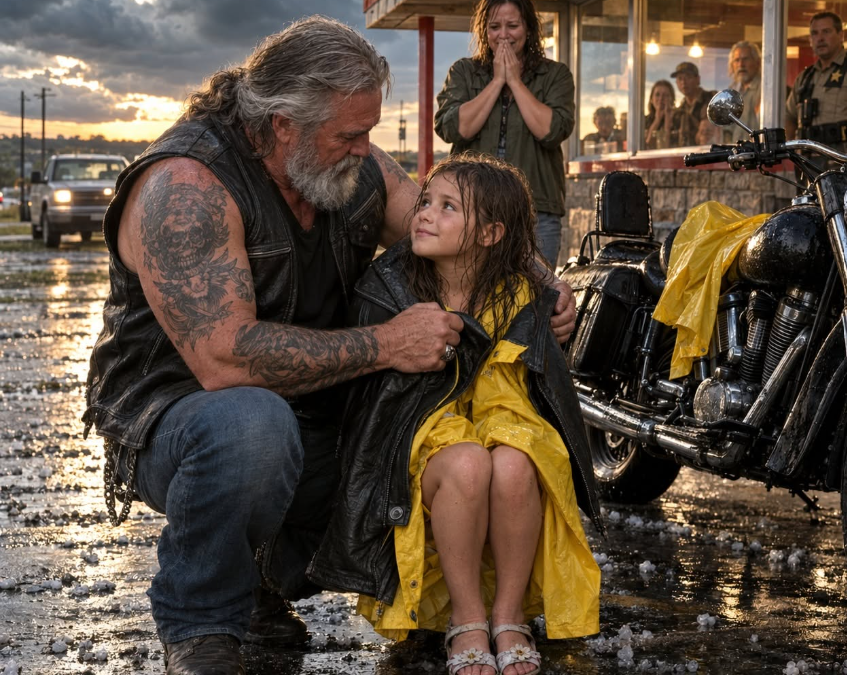
Standing beside my motorcycle in marble-sized hail.
At first, nobody moved.
Maybe we were all too stunned.
Maybe the picture did not make sense fast enough.
A tiny girl in a yellow coat, alone in the parking lot, ice striking the ground around her hard enough to bounce. She had taken the coat off her own shoulders and stretched it across my fuel tank and gauges.
Then she leaned over the motorcycle with both hands holding the fabric down.
Protecting the machine with her body.
I forgot my age.
Forgot the pain in my lower back.
Forgot that my kidneys had been failing for almost a year and that three mornings a week I sat beside a dialysis machine pretending I was not afraid.
I ran.
“Lucy!”
Her mother was behind me, chair scraping, voice breaking.
But I reached the girl first.
By the time I got to her, ice was striking her bare legs hard enough to leave red marks.
I pulled off my vest and covered her head and shoulders with it.
“What are you doing?” I shouted over the hail.
“My coat!”
“Forget the coat.”
“The motorcycle!”
She fought me for half a second.
That almost made me laugh.
That little child, half my height, decided the black Indian was her responsibility and would not surrender the mission easily.
Then another wave of hail came sideways.
I lifted her under one arm and carried her beneath the awning.
Her mother grabbed her the second we reached the door.
“Lucy Parker, have you lost your mind?”
Lucy shook water from her face and pointed toward the parking lot.
“His motorcycle was getting hurt.”
Inside, nobody spoke.
That silence was different from the usual silence around me.
It was not suspicion.
It was confusion.
Nobody knew what to do with the picture of the scary old biker carrying a soaked child under his vest while she cried about his motorcycle.
I knelt in front of Lucy.
She stood between her mother’s arms, trembling now that the decision had left her body and the cold had found its way in.
Her knees were red where hail had struck.
Her sandals were slick with water.
I pulled my vest tighter around her shoulders.
“Why?” I asked.
She looked confused.
“Why what?”
“Why would you go outside for my motorcycle?”
She wiped water from her nose with the back of her hand.
“It was getting hurt.”
That answer did something to me.
Not because the bike mattered.
It didn’t.
The Indian was metal. Chrome. Paint. Time. Money. Pride, maybe.
But not a life.
It moved me because every adult in that diner had spent years looking at me and asking whether I deserved kindness.
Lucy had not.
She saw something being damaged and acted.
Simple as that.
Her mother, Hannah Parker, wrapped both arms around her and held on like the storm had reached inside the diner and almost taken more than a raincoat.
Hannah was thirty-one, maybe thirty-two. Dark circles under her eyes. Diner apron over a faded blue shirt. Hair tied in a messy knot. The kind of tired that comes from working too many hours while pretending exhaustion is just a scheduling issue.
I had seen her plenty of times.
Louise hired her for evening shifts three months before.
She was polite to me.
Not friendly.
Not unfriendly.
Polite in the way single mothers in small towns are polite to men they cannot afford to misjudge.
Lucy had no such caution.
She had waved at me twice before.
Once from the pie case.
Once from a booth while coloring on a napkin.
Both times I had nodded, because I did not trust myself with children anymore.
Not because I disliked them.
Because children still looked at people like stories were unfinished.
And I had spent years pretending mine was over.
Then the weather radio behind the counter changed tone.
Three sharp bursts.
The kind of sound that turns a room into listening.
I stood.
Louise reached for the volume.
The television above the corner booth showed the radar loop.
The storm cell had intensified.
The hook was forming southwest of town.
Its path pointed toward Willow Bend Mobile Park.
Lucy’s home.
Forty-three trailers.
One concrete laundry building.
Almost no underground shelters.
My chest tightened in a way that had nothing to do with kidneys.
“Hannah.”
She looked at me while still holding Lucy.
“How many people out at Willow Bend have storm shelters?”
She blinked.
“Almost nobody.”
Deputy Carter frowned from near the door.
“It’s a severe thunderstorm watch.”
“Not for long.”
He looked at my phone.
“You seeing something the weather service isn’t?”
“Something they haven’t warned on yet.”
His eyebrows lifted.
I understood that look.
He was wondering why the old biker thought he knew more than professional meteorologists.
Fair question.
I had no time to answer it.
I turned my phone toward myself again.
The rotation was tightening.
Rain wrapping around the southwest flank.
The cell was moving faster than the television graphics suggested.
Warnings often come late in places where minutes matter most.
People think sirens are magic.
They are not.
They are machines fed by human decisions, radar scans, storm reports, probability, hesitation, and the awful knowledge that if you warn too often, people stop listening, and if you warn too late, people die.
“How long?” Hannah asked.
I calculated again.
Storm motion.
Distance.
Velocity signature.
Road layout.
“Maybe eight minutes before it reaches the park.”
The diner shifted.
A fork clinked against a plate.
Someone whispered, “Eight minutes?”
Deputy Carter stood.
“You’re guessing.”
“No.”
“What makes you so sure?”
I looked through the glass at the sky.
The green-gray had deepened. Clouds low. Inflow rushing east. Hail slackening in that bad way storms sometimes have when the next thing is worse than ice.
“I’ve seen this before.”
He waited.
I didn’t explain.
Not yet.
Instead, I called my road captain.
Eddie Ruiz answered on the second ring.
“Hawk?”
“Get everybody moving toward Willow Bend.”
“Why?”
“Tornado.”
Silence.
“The TV isn’t saying—”
“I know.”
That was enough.
Eddie had ridden with me twelve years.
He had learned when to question me and when not to.
“How many?” he asked.
“Everyone available.”
“On it.”
I hung up.
Deputy Carter stepped closer.
“You can’t just send a motorcycle club into a residential area during a storm.”
“I just did.”
“Hawk—”
“Deputy, you can argue with me for the next five minutes, or you can help get people into the only concrete building in that park.”
He looked at Hannah.
Then at Lucy, still wrapped in my vest.
Then out the window.
The sky had started moving in ways even people without training could feel.
Louise came around the counter.
“What do you need?”
That was Louise.
No speeches.
No panic.
Just what do you need?
“Call everyone you know at Willow Bend,” I said. “Tell them to get to the laundry building now. Not in five minutes. Now.”
Hannah let go of Lucy just enough to dig her phone from her apron.
“My neighbor has three kids,” she said. “And Mrs. Ellis won’t leave for anything.”
“She will tonight.”
I hoped I was telling the truth.
Within ninety seconds, engines approached from the east.
At first, the diner heard them before seeing them.
Low thunder under sky thunder.
Then eight motorcycles pulled into the lot.
Then eleven.
Men and women in black leather and rain gear.
Some gray-haired.
Some young.
Some big enough to make nervous people step back.
Some small enough to be underestimated until they opened their mouths.
The Iron Valley Riders.
My people.
The people Red Creek loved to fear when we rode together and loved to call when a veteran needed a ramp built, a roof needed patching, or a fundraiser needed more bodies than church committees could provide.
Funny how that works.
People will take your help and still pretend your appearance is the whole truth.
Eddie pulled beside the awning on a blue Harley with rain flying off his shoulders.
He killed the engine and looked at me.
“Tell me.”
I pointed southwest.
“Door to door. Everyone goes to the concrete laundry building. Elderly first. Families with kids. Don’t argue longer than necessary.”
He studied the sky.
“How bad?”
“Bad enough.”
Nobody asked another question.
We rode.
The hail had softened into hard rain by the time we hit the highway. Wind shoved at our bikes, and the world blurred into water, brake lights, and the pulsing dark of the storm ahead.
My back screamed.
My hands ached on the grips.
My body was not built for this anymore.
That was the quiet humiliation of illness.
The mind still sees what needs doing.
The body starts negotiating.
Mine had been negotiating for almost a year.
End-stage renal disease.
A phrase too large for a man who still liked the smell of gasoline and black coffee.
Three mornings a week, I drove to the dialysis center before sunrise. I sat in a recliner with a needle in my arm and watched my blood move through a machine because my body had decided to fail at cleaning itself.
I told almost nobody.
Not Eddie.
Not Louise.
Not the club.
Not even Deputy Carter, though I doubted he would have cared before that night.
I did not want pity.
Pity changes a room faster than fear does.
At least when people thought I was dangerous, they left me my dignity.
By the time we reached Willow Bend, the storm had changed shape completely.
The sky seemed lower.
Heavier.
The southwest horizon was nearly black.
Willow Bend Mobile Park sat in a shallow dip between two fields, the kind of place developers call affordable and storms call easy.
Rows of trailers lined narrow gravel lanes.
Some had porch lights glowing.
Some had toys in muddy yards.
Some had plywood patches from the last storm still screwed over windows.
One concrete laundry building stood near the entrance.
Low.
Blocky.
Ugly.
Beautiful.
We split into pairs.
Pounded on doors.
“Tornado! Get to the laundry building!”
Some residents believed us.
Some grabbed children before we finished speaking.
Some stared like the last people they expected to trust were bikers in black leather.
One woman yelled that she had no shoes.
“Bring them in your hand,” Eddie shouted. “Move.”
One man asked whether the sirens had sounded.
“They will,” I said.
As if I had summoned them, the tornado sirens finally started.
A long mechanical wail rolled across the park.
That helped.
So did the first official warning arriving on everyone’s phones seconds later.
Suddenly, suspicion turned into movement.
Doors slammed.
Children cried.
Dogs barked.
Rain hit sideways.
A woman carried a baby under one arm and a plastic bag of medicine in the other.
An old man in a robe walked barefoot through gravel until one of our riders lifted him like a child and carried him the rest of the way.
Deputy Carter arrived with Hannah and Lucy in his cruiser.
Hannah jumped out before the car had fully stopped.
Lucy stayed in the back seat for half a second, pressing both hands to the glass.
Looking for me.
I did not see that then.
I was moving toward the far row.
One trailer belonged to eighty-year-old Frank Miller, who rarely wore his hearing aids.
No answer.
I pounded again.
Nothing.
Wind threw rain into my face.
I tried the handle.
Locked.
The trailer shook.
“Frank!”
No response.
I forced the damaged latch with my shoulder.
Pain flashed through my back, white and sharp, but the door gave.
Inside, Frank sat in a recliner watching television, completely unaware.
The sound was turned up high enough to rattle the walls, but the weather warning crawled silently across the bottom of the screen.
“Frank!”
He looked up, offended.
“What are you doing in my house?”
“Saving your evening.”
“I ain’t dressed.”
“You’re dressed enough.”
I got his arm over my shoulder and hauled him upright.
He cursed at me, then at the weather, then at the government for reasons I did not have time to explore.
Half carrying him outside, I felt the first true blast of inflow hit.
It sucked the rain sideways.
The air turned alive and wrong.
That was when pain exploded through my back.
I almost dropped.
Kidney pain.
Fatigue.
Too much fluid.
Too much strain.
Frank looked at me.
“You okay?”
“Perfect.”
Lie.
We kept moving.
Eddie met us near the laundry building.
He took Frank from me.
“You need to sit down.”
“I’ve got three trailers left.”
“Hawk.”
“Three.”
His jaw tightened.
But he knew better than to waste time.
I went back out.
Behind me, Hannah and Lucy reached the concrete building.
Inside, people crowded shoulder to shoulder.
Children on the floor.
Elderly folks on benches.
A dog trembling under a sink.
Lucy searched the crowd.
Then I later learned she asked, “Where’s the biker man?”
Nobody answered.
Because forty yards away, through rain and flying debris, I was still knocking on the final row of trailers.
And behind me, the funnel finally touched the ground.
Lucy started screaming my name.
I didn’t hear her.
By then, the tornado sounded like machinery grinding through the earth.
The second-to-last trailer was empty.
The last belonged to a seventy-six-year-old widow named Margaret Ellis, who had lived in Willow Bend longer than half the roads in town had been paved.
I pounded on her door.
She opened it two inches.
“I’m not leaving.”
“Ma’am, there’s a tornado.”
“I’ve lived here twenty-eight years.”
“I’m sure you have.”
“This house has survived storms.”
“Not this one.”
She tried closing the door.
Then the whole trailer shifted.
Not shook.
Shifted.
Margaret’s face changed.
I reached for her.
“Now.”
She stopped arguing.
We made it outside.
The laundry building was too far.
Maybe fifty yards.
The tornado was closer.
There was a drainage ditch behind the property.
Ugly.
Muddy.
Low.
Exactly what we needed.
“This way.”
Margaret stumbled.
I grabbed her around the waist and pulled her toward the ditch.
Rain blinded us.
Something tore loose behind us with a scream of metal.
Margaret fell hard to one knee.
I got her up.
The world narrowed to mud, breath, and the next three feet.
We reached the ditch just as the air above us filled with debris.
I shoved her down first, then dropped over her as best I could.
“Cover your head!”
She did.
I covered her with my body because sometimes the only shelter left is whatever body stands between danger and someone more fragile.
Twenty seconds.
Maybe thirty.
Time becomes strange when the world is coming apart above you.
Metal passed overhead.
Wood.
Branches.
Something struck my shoulder hard enough to turn me sideways.
I held on.
Margaret screamed once.
Or maybe I did.
Then the roar moved north.
Rain remained.
Ordinary rain.
The most beautiful sound I had ever heard.
For a few seconds, neither of us moved.
Mud filled my mouth.
My shoulder burned.
My back throbbed with a deep, sick rhythm.
“You alive?” I asked.
Margaret answered by swearing at me.
I laughed.
“Good.”
We climbed from the ditch.
Two trailers were badly damaged.
A shed was gone.
Trees were down.
Power lines sparked near the road.
But nearly every resident was inside the concrete building.
Nobody had been left in the homes that took the worst hit.
We had moved them in time.
I got Margaret about halfway toward the shelter.
Then my body quit pretending.
Pain folded me to one knee.
Eddie reached me first.
“Hawk.”
“I’m fine.”
“You look like death wearing a vest.”
“Always had that problem.”
He saw my shoulder.
Then my face.
His expression changed.
“Hawk, what’s wrong?”
I tried to stand.
Couldn’t.
“Kidneys.”
He stared.
“What?”
I had hidden the diagnosis from almost everyone.
That ended there.
“End-stage renal disease.”
Eddie’s face went pale beneath rain and road grit.
“You’ve been riding with us while on dialysis?”
“Apparently.”
“You idiot.”
“Probably.”
They got me onto the tailgate of a pickup.
Somebody wrapped a towel around my shoulder.
Somebody else pressed gauze where debris had opened my sleeve and skin.
I heard radios.
Crying.
Engines.
Deputy Carter’s voice calling in damage.
Then Lucy came running.
Her mother shouted after her.
The little girl stopped directly in front of me.
She had my leather vest around her shoulders again, too large for her, hanging almost to her knees.
She saw my torn sleeve.
Her eyes filled.
“You got hurt.”
“Little bit.”
“Because you went back.”
I smiled.
“So did you.”
That stopped her.
“What?”
“You ran into hail for my bike.”
“That’s different.”
“How?”
She looked at me like adults were exhausting.
“It couldn’t protect itself.”
I looked toward the residents gathering beneath the floodlight.
Old Frank wrapped in a blanket.
Margaret shaking but alive.
A mother counting three children over and over.
A teenage boy holding a dog against his chest.
“Neither could some of them,” I said.
Lucy reached for the bottom of my vest.
Small fingers holding leather.
Exactly like she had held her yellow coat across my motorcycle.
She didn’t let go.
Deputy Carter came over.
He had heard the official timeline by then.
His face looked different now.
Not frightened.
Not suspicious.
Humbled.
“Hawk.”
“Deputy.”
“The warning went out at 6:54.”
“Sounds right.”
“You had riders knocking doors before 6:30.”
“Also sounds right.”
He stared.
“How?”
I was tired of secrets.
Maybe saving forty people does that.
Maybe a seven-year-old holding your vest does.
Maybe almost dying in a drainage ditch makes a man less interested in preserving a false image.
“Eleven years,” I said.
“What?”
“I worked eleven years as a severe-storm forecaster.”
“For who?”
“National Weather Service.”
Deputy Carter looked at me like I had announced I was an astronaut.
Eddie stared too.
“You never told us that,” Eddie said.
“You never asked.”
“Why’d you leave?”
I looked past him toward the damaged trailers.
For a second, I saw a different room.
No rain.
No mud.
No twisted metal.
Just radar screens glowing in the dark and my hands trembling over a keyboard while a storm outbreak marched across western Oklahoma.
My hands had begun shaking during my final years there.
Not fear.
A neurological condition made worse by kidney disease I didn’t yet know I had.
At first, I hid it.
Then I made jokes.
Then one night, during a fast-moving storm, I misread a data field and caught myself seconds later.
No harm done.
But I could not unfeel what almost happened.
Forecasting severe storms is not just science.
It is timing.
Judgment.
Pattern recognition under pressure.
Humility before weather that does not care how many degrees you have or how many storms you have seen.
I stopped trusting myself to work the most demanding shifts.
So I retired earlier than planned.
Then my wife, Marlene, died.
Then I started riding more.
The vest became easier than introductions.
Nobody expected explanations from the scary old biker.
So I let them have the simple story.
“He got old,” I said finally. “Got sick. Left before I made a mistake that mattered.”
Deputy Carter swallowed.
“I spent five years seeing you at that diner and never knew.”
“You spent five years deciding you already did.”
He absorbed that.
I had not said it cruelly.
Truth does not need extra weight.
An ambulance took me to the hospital.
Four days.
Stitches.
Dialysis.
A lecture from my nephrologist that lasted longer than the tornado.
Dr. Sayeed stood at the foot of my bed with my chart in one hand and the disappointed patience of a man who had spent years telling stubborn patients that mortality was not a debate.
“You lifted an adult man, carried a woman through a tornado, sustained blunt trauma, and missed fluid restrictions during a storm response?”
“Sounds worse when you list it.”
“It is worse when I list it because it is bad.”
“I was helping.”
“You cannot help anyone if you collapse in a ditch.”
“I waited until after.”
He did not laugh.
Doctors like him rarely do when they are right.
Eddie sat in the chair by the window with his arms folded.
Lucy had sent a drawing through Hannah.
It showed me on a motorcycle wearing a cape.
The tornado in the drawing had angry eyes.
My motorcycle had a smile.
I looked at it longer than necessary so nobody would see what it did to me.
When I came home, Red Creek had changed.
At least toward me.
People who once moved their kids away from me in grocery-store aisles started stopping to speak.
The cashier at Millard’s Hardware asked if I needed help carrying a bag of cat litter, even though I did not own a cat and had only bought driveway salt.
A man who had crossed the street to avoid me in March shook my hand outside the pharmacy and said he always knew bikers were good people.
That one nearly made me laugh in his face.
People love claiming they knew the truth after someone else proves it.
Louise called the day I got home.
“You coming Thursday?”
“Always do.”
“Good.”
Then something bigger happened.
The Iron Valley Riders organized a repair day for Willow Bend.
At first, Eddie planned on twenty people.
Maybe thirty.
Word spread.
Riders came from Kansas.
Texas.
New Mexico.
By Saturday morning, more than two hundred motorcycles filled the road outside the park.
They did not come to intimidate anyone.
They brought ladders.
Roofing.
Generators.
Lumber.
Electricians.
Plumbers.
One rider owned a small construction company.
Another ran a hardware store.
Two women were nurses.
Several were veterans.
One was an accountant who spent the day arguing with an insurance company until they agreed to expedite Margaret’s claim.
Funny how people rarely ask what someone in leather does Monday through Friday.
We rebuilt.
Not perfectly.
Not all at once.
But enough to make the park breathe again.
Damaged skirting came down.
Tarps went up.
Broken windows were covered.
Porches were braced.
The shed that had vanished was found in three counties if you counted pieces.
Margaret sat in a folding chair and supervised everyone badly.
Frank wore his hearing aids for once and still misunderstood half of what people said.
Children carried bottled water.
Hannah worked the food table with Louise, passing out sandwiches and pretending she was not overwhelmed by the fact that half the town had shown up for people who were used to being invisible.
Lucy stayed beside me most of the day.
My arm was still limited, so mostly I directed traffic and pretended not to be frustrated.
She wore the same yellow raincoat.
Sunshine.
Eighty degrees.
Yellow raincoat.
“Why are you wearing that?” I asked.
She shrugged.
“Lucky.”
I accepted that.
At lunch, she sat beside me on a pickup tailgate while the park buzzed with hammers, saws, generators, and the strange music of people deciding each other mattered.
“Can I ask something?” she said.
“Sure.”
“Why was everybody scared of you before?”
Children ask the questions adults spend years avoiding.
I looked at the riders across the park.
Eddie was carrying plywood with a woman named Marcy who could out-cuss half the club.
Deputy Carter was helping unload supplies from his cruiser.
Louise was laughing at something Hannah said.
“Because sometimes people decide a story from the cover,” I told Lucy.
“That’s dumb.”
“Frequently.”
“Did it bother you?”
“Used to.”
“What changed?”
“I got tired of explaining.”
She thought about that.
“Maybe you should explain sometimes.”
I laughed.
“You seven-year-olds are exhausting.”
She smiled.
Then her face became serious.
“I wasn’t scared of you.”
“I know.”
“Why?”
“You tell me.”
She looked toward my motorcycle.
It was parked near the entrance, still dented from hail, still streaked with mud, still beautiful to me in the way damaged things become beautiful when they survive something.
“Because the bike looked loved,” she said.
“What?”
“You kept it clean. You always parked it where you could see it. Mom says people take care of things they love.”
She shrugged.
“So I thought maybe you weren’t mean.”
That might have been the most ridiculous logic I had ever heard.
It was also better than the logic most adults had used to judge me.
“You know something, Lucy?”
“What?”
“You may be onto something.”
Her mother’s financial problems became known too.
Not because Hannah announced them.
Pride is expensive when you are poor.
People learn to hide need like it is evidence of failure.
Five months behind on lot rent.
Working double shifts.
Skipping dentist appointments.
Stretching groceries.
Keeping the car running with prayer and duct tape.
Trying to make sure Lucy never noticed how often dinner was whatever could be made from eggs, rice, and bravery.
Nobody handed Hannah a giant check.
That would have made her uncomfortable.
Instead, the riders paid two overdue months anonymously and helped Willow Bend organize a legitimate storm-shelter fund.
Louise gave Hannah extra catering work.
A woman named Denise, whose husband rode with the club, found her a bookkeeping position with better hours.
Somebody fixed her car without leaving a bill.
Somebody else left a grocery card in her mailbox and never admitted to it.
Help arrived as opportunity instead of spectacle.
That mattered.
Deputy Carter came by near sunset.
He found me resting beside Eddie’s truck, one hand pressed against my lower back, trying to breathe through pain without letting Lucy notice.
“I owe you an apology,” he said.
“For what?”
“For deciding who you were before asking.”
“You showed up.”
“I was late believing you.”
“But you showed up.”
He nodded.
Then smiled a little.
“You always this forgiving?”
“No.”
“Good.”
We shook hands.
His grip was firmer than before.
Not harder.
Just more honest.
The next Thursday, I returned to Louise’s diner.
Six o’clock sharp.
For six years, I had taken the same stool at the far end.
Usually I ordered black coffee.
Usually I ordered whatever pie had not sold.
Usually everyone let me exist without acknowledging me.
That evening, I opened the door and the room changed.
Not dramatically.
No applause.
Thank God.
But three regulars nodded.
Deputy Carter lifted his coffee.
A boy in the corner booth whispered, “That’s him,” and his mother did not pull him away.
Louise had already placed my cup on the counter.
Beside it sat a slice of apple pie.
Fresh.
Not leftover.
I looked at her.
“Fancy.”
“Don’t get used to it.”
I sat.
For a moment, I did not know what to do with being welcomed.
Ignored is easy after you practice long enough.
Accepted is harder.
It asks you to participate.
Then the door opened again.
Lucy entered holding Hannah’s hand.
The yellow raincoat was folded over one arm.
She climbed onto the stool beside mine like she had been doing it for years.
Louise brought her hot chocolate.
Lucy looked out the window at my motorcycle.
Most of the hail dents were still there.
I had decided not to repair them.
“You’re leaving those?” she asked.
“Yes.”
“They look bad.”
“I like them.”
“Why?”
I took a drink of coffee.
“They remind me that somebody protected it.”
She smiled.
Then looked around the diner.
Nobody was staring at me anymore.
Nobody was moving farther away.
I had spent years thinking that was what I wanted.
To be left alone.
Turns out being accepted feels different from being ignored.
Much better.
My kidney disease did not disappear.
Storms do not rewrite bloodwork.
I still had dialysis.
Still had bad mornings.
Still woke sometimes with pain in my back and fear in my throat.
Eventually, I stopped hiding it.
The club started rotating who drove me.
Eddie took Mondays.
Marcy took Wednesdays and pretended she was only doing it because she liked the vending machine coffee at the clinic.
Hank, one of our quieter riders, took Fridays and spent the drives talking about fishing in such detail that I considered jumping from the truck twice.
Lucy occasionally came with her mother to bring crayons and drawings.
She once drew my kidneys as two angry beans wearing helmets.
Dr. Sayeed laughed so hard he had to leave the room.
A year later, Willow Bend opened a reinforced community shelter built with grants, donations, county funds, and thousands of volunteer hours.
It stood where the old laundry building had been.
Stronger.
Wider.
Stocked with water, flashlights, radios, first-aid kits, blankets, and a list of residents who would need help in a warning.
Above its entrance was a small plaque.
No biker logos.
No names.
Just six words:
WHEN THE WARNING COMES, WE SHOW UP.
People assumed I chose the wording.
I didn’t.
Lucy did.
She was eight by then.
Still smarter than most of us.
At the dedication, the mayor talked too long.
Deputy Carter spoke briefly, which made everyone like him more.
Louise brought pies.
The Iron Valley Riders stood near the back because most of us were allergic to folding chairs and public praise.
Hannah held Lucy’s hand while the ribbon was cut.
Margaret cried and denied it.
Frank wore both hearing aids and still asked who died.
When it was over, Lucy found me near the edge of the crowd.
She had grown taller, though not by much.
Her yellow raincoat was gone, finally outgrown, but she had brought a square of it folded in her pocket.
“Mom says I can keep it,” she told me.
“I should hope so. It’s famous.”
She rolled her eyes.
“It’s not famous.”
“Lucky, then.”
She nodded seriously.
“Lucky.”
Then she looked up at me.
“Are you still sick?”
Children.
No soft entrance.
No polite hallway.
Just the door.
“Yes,” I said.
“Are you scared?”
I looked toward the shelter.
Toward the plaque.
Toward the riders.
Toward Hannah laughing with Louise.
Toward the sky, which was blue that day, innocent as a liar.
“Sometimes.”
She took that in.
Then she slipped her small hand into mine.
“My mom says being scared doesn’t mean you don’t show up.”
I squeezed her hand gently.
“Your mom is right.”
She looked pleased with that.
Then she said, “I still think your bike needs those dents fixed.”
“I still think it doesn’t.”
“They’re ugly.”
“So am I.”
She gave me a look so fierce it would have scared better men.
“You’re not ugly.”
I had no answer for that.
So I looked away.
Some kindness hits harder than hail.
I spent a long time believing my useful years were behind me.
I had been a forecaster.
Then a husband.
Then a widower.
Then a sick old man on a motorcycle who let strangers think whatever they wanted because being misunderstood felt easier than being known.
A seven-year-old girl changed that with a yellow raincoat.
She did not ask whether I deserved kindness.
She simply saw something exposed in a storm and tried to protect it.
Hours later, I did the same thing for her neighborhood.
Maybe that is all community ever really is.
Seeing what the storm is about to hit.
And showing up before the warning sounds.
Sometimes the sky gives you time.
Sometimes it does not.
Sometimes the person who sees it first is a deputy.
Sometimes a mother.
Sometimes a tired waitress behind a diner counter.
Sometimes an old biker with failing kidneys and a weather map glowing in his hand.
And sometimes, before any siren screams, before any radar confirms what the bones already know, it is a little girl in sandals running into a hailstorm because she believes damaged things should not have to stand alone.
That was Lucy’s gift.
Not the raincoat.
Not the saving of my motorcycle.
The reminder.
That the world does not get kinder because we wait for proof that someone deserves it.
It gets kinder when someone runs into the storm anyway.
When the warning comes, we show up.
And sometimes, if we are lucky, we show up early enough to save more than we came for.