“YOU’RE A FAILURE, MOM. GO FIND A SHELTER!” My Daughter and Her Husband Threw Me Out After I Lost Everything — Less Than an Hour Later, the Whole Neighborhood Came Outside.
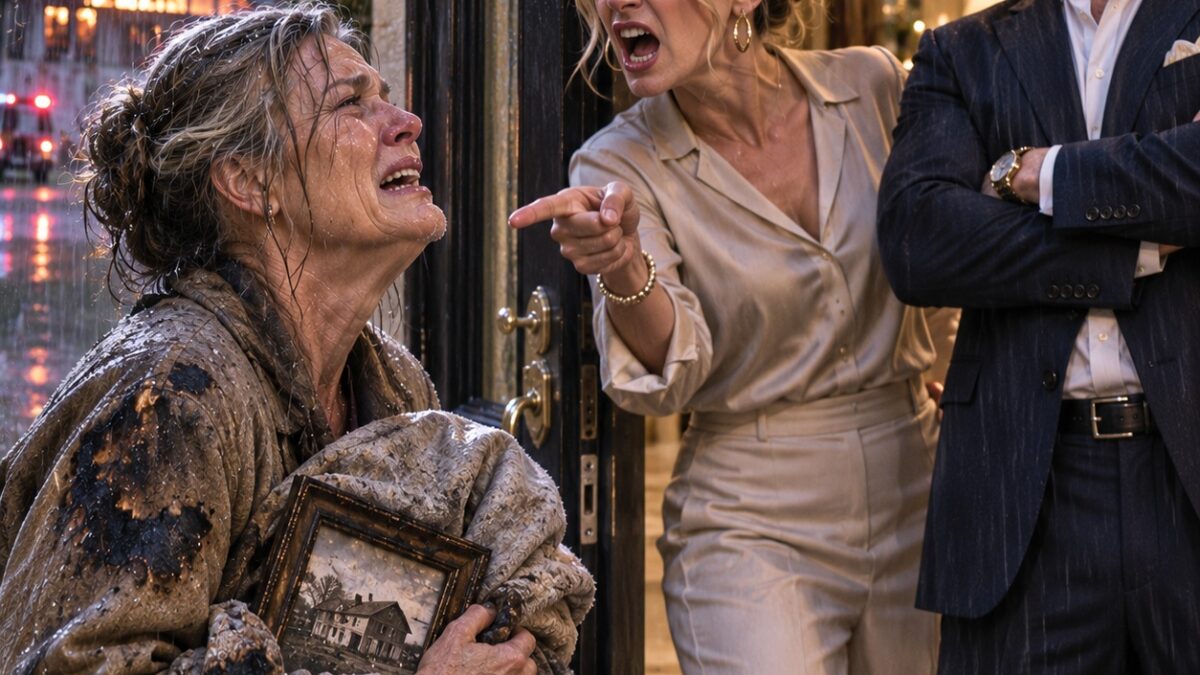
FULL STORY CONTINUATION
I gave him Holly’s address.
“I’m coming.”
That was all.
The call ended.
I stood under the roof of a bus stop because it was the only shelter nearby.
Rain blew sideways.
My teeth chattered.
I wrapped my arms around myself.
And while I waited, memory returned.
Marcus had entered my life in 1995.
I was thirty-six.
Already a widow.
My husband had died two years earlier in a tractor accident.
Holly was eleven.
The farm was barely surviving.
I was barely surviving.
Then a social worker called.
“We need a temporary placement.”
“For who?”
“Eight-year-old boy.”
“How temporary?”
“A few weeks.”
I laughed when I remembered that.
A few weeks.
Marcus stayed ten years.
Then a lifetime.
The first day he arrived, he carried everything he owned in a plastic bag.
Two shirts.
One pair of pants.
A toy truck missing a wheel.
He was thin.
Quiet.
Scared.
His eyes never stopped watching doors.
The social worker warned me.
“Three foster homes.”
“Why did they send him back?”
“Behavior.”
“What behavior?”
“Nightmares.”
“Withdrawal.”
“Trouble trusting people.”
I looked at the child standing beside her.
“That sounds like pain.”
She stared at me.
Marcus did too.
That night, he lay on top of the covers fully dressed.
Shoes still on.
I sat beside him.
“Why aren’t you under the blanket?”
He shrugged.
“You planning to run?”
His eyes widened.
“No.”
“Then take off the shoes.”
He hesitated.
“What if you tell me to leave?”
“Not tonight.”
“When?”
“I don’t know.”
That terrified honesty seemed to calm him more than a promise would have.
I read him a story.
Halfway through, I realized he was crying silently.
I kept reading.
Holly hated him almost immediately.
“Why is he here?”
“He needs somewhere safe.”
“So?”
“Holly.”
“He’s weird.”
“He’s scared.”
“He isn’t my brother.”
“No one said he was.”
Not yet.
Weeks became months.
Marcus began following me everywhere.
Barn.
Field.
Kitchen.
Office.
He had an extraordinary mind.
At nine, he asked why our irrigation schedule wasted water in the afternoons.
At ten, he reorganized my feed ledger because he said my columns were confusing.
At eleven, he understood the farm books better than I did.
Holly noticed.
And resentment grew.
“Why do you always let him help?”
“Because he likes helping.”
“I can help.”
“I’ve asked you.”
“You like him better.”
“That is not true.”
But children do not always believe explanations when jealousy has already chosen its story.
I tried.
God knows I tried.
Holly got shopping trips.
Girls’ afternoons.
Time alone with me.
Marcus got help with nightmares.
Tutoring.
Counseling.
Structure.
They needed different things.
Holly interpreted difference as favoritism.
When Marcus turned twelve, I adopted him.
Legally.
Officially.
The social worker asked him:
“Are you sure?”
Marcus looked at me.
Then said:
“Yes.”
At the little celebration afterward, Holly stood in the kitchen doorway.
“He’s not my brother.”
Marcus heard.
I saw his smile disappear.
That night, I found him crying in the barn.
“Do you want me to leave?”
“No.”
“Holly hates me.”
“She is hurting.”
“Because of me.”
“Her feelings are not your fault.”
“She thinks I stole you.”
I crouched beside him.
“You cannot steal a mother’s love by needing some.”
He looked at me.
“This is your home.”
“Really?”
“Really.”
“You’re my son.”
His face crumpled.
I held him.
Holly saw that too.
Maybe that made everything worse.
Maybe there were things I should have handled differently.
I have asked myself that for years.
Did I miss her pain?
Did I focus so much on healing Marcus that I failed to notice Holly believed she was being replaced?
Possibly.
That is one regret I carry.
But regret does not excuse what came later.
When Marcus was seventeen, teachers began calling.
“This boy is exceptional.”
“Business.”
“Finance.”
“Math.”
“Leadership.”
He earned a full scholarship to a university in California.
Holly exploded.
“Of course.”
“Of course what?”
“The perfect son wins again.”
“Holly.”
“He isn’t even your real son.”
Marcus was on the stairs.
He heard everything.
I saw his face.
Holly saw it too.
She continued.
“You’ve always loved him more.”
“That is not true.”
“Yes it is.”
Marcus left for college soon after.
He called every week.
Then every two weeks.
Letters.
Emails.
Summer internships.
Work.
Distance.
He told me the internships were opportunities.
I suspect part of him also wanted to avoid coming home where Holly treated his existence like an accusation.
Holly married Ethan when she was twenty.
He was ten years older.
Polished.
Wealthy.
Confident.
The first time he visited the farm, he looked around as if evaluating something he might bulldoze.
“You should sell.”
“No.”
“This place is exhausting.”
“It is my life.”
“You could buy a little house.”
“I don’t want a little house.”
He smiled in that way wealthy people sometimes smile when they think somebody poor does not understand what is best for herself.
Holly slowly became like him.
She stopped wearing boots.
Stopped helping in the garden.
Stopped talking about childhood.
She started calling the farm “that old place.”
Meanwhile, Marcus graduated.
Real estate job.
New York.
Promotions.
Then business.
I heard pieces through other people.
“He’s doing very well.”
“Marcus is moving fast.”
“He started something.”
“His company is huge.”
He sent money occasionally.
I returned it whenever I could.
“You need it more than I do.”
“Mom, I’m fine.”
“So am I.”
That was often a lie.
The last time I saw him before the fire was at my sister’s funeral.
Ten years earlier.
He arrived in a luxury car wearing a beautiful suit.
For one instant, I thought:
That cannot be my little Marcus.
Then he hugged me.
“Mom.”
Same boy.
Different body.
“Are you okay?”
“Fine.”
Another lie.
The farm was already struggling.
I said nothing.
He went back to New York.
I continued fighting.
Now, soaked under a bus stop, I wondered whether calling him after years of distance had been selfish.
Then I heard something strange.
A deep rhythmic thumping.
People came out of their houses.
I looked up.
A helicopter descended over the neighborhood.
Black.
Sleek.
Gold lettering.
Wind blasted rainwater across the road.
A neighbor lifted her phone to record.
Another man stepped onto his balcony.
The helicopter landed in an open area near the end of the street.
The door opened.
A man stepped out.
Tall.
Dark suit.
Sunglasses.
Expensive overcoat.
He walked toward me.
For several seconds, I stared.
Then he removed the glasses.
Marcus.
My Marcus.
His face changed the instant he saw me.
“Mom.”
He ran.
Not walked.
Ran.
I stood.
He wrapped both arms around me.
I cried into his chest.
“You came.”
“Of course I came.”
“You really came.”
He pulled back.
“You’re freezing.”
He removed his coat.
Cashmere.
Probably worth more than everything I was wearing.
He wrapped it around me.
“How long have you been outside?”
“Not long.”
He looked at me.
“Mom.”
“Long enough.”
“What happened?”
I told him about the fire.
Then the farm.
Then Holly.
By the time I repeated Ethan’s words—
I don’t make room for homeless people.
Marcus’s face became something I had never seen before.
Cold.
“They said that?”
“Marcus.”
“They put you outside?”
“I don’t want trouble.”
“You called them first.”
“She is my daughter.”
“That is not what I asked.”
I looked down.
“Yes.”
His jaw tightened.
“They left you in the rain?”
“Yes.”
Marcus looked toward Holly’s house.
The front door opened.
Holly came outside.
Ethan followed.
Suddenly both of them looked much more presentable than they had twenty minutes earlier.
Interesting.
Holly approached.
“Excuse me.”
False smile.
“The neighbors are complaining about the helicopter.”
Marcus turned.
No smile.
“Holly.”
Her face changed.
“Marcus?”
“Hello, sister.”
The word sister sounded ceremonial.
Nothing more.
Ethan stepped forward.
Hand extended.
“Ethan Miller.”
Marcus looked at the hand.
Did not take it.
“I know.”
Ethan lowered it.
“I’ve heard a lot about you.”
“I doubt that.”
Holly stared at the helicopter.
Then Marcus.
“Are you…”
She stopped.
“What?”
“Marcus Rivers?”
“Yes.”
“The Rivers Holdings Marcus Rivers?”
“Yes.”
Ethan spoke.
“What exactly do you do?”
Marcus looked at him.
“I own several companies.”
“What kind?”
“Real estate.”
“Banking.”
“Construction.”
“Development.”
Ethan’s expression changed.
Marcus continued.
“I also own a financial institution you are familiar with.”
“Which?”
“The institution that currently holds most of the mortgage exposure in this neighborhood.”
Ethan went pale.
Including his.
I did not understand the significance yet.
He did.
Holly whispered:
“Are you rich?”
Marcus gave a faint smile.
“I do well.”
Ethan asked:
“How well?”
Marcus looked bored.
“Enough.”
Later I would learn enough meant billions.
At that moment, it did not matter.
Marcus took my hand.
“My mother needs somewhere safe.”
Ethan scoffed.
“She isn’t your mother.”
Marcus stopped.
The entire street seemed to quiet.
“She raised you.”
Ethan continued.
“She’s just the woman who—”
Marcus took one step closer.
“Finish that sentence carefully.”
Ethan stepped backward.
Marcus’s voice remained low.
“She fed me when no one wanted me.”
“She read to me when I was afraid to sleep.”
“She gave me her name.”
“She put me through school.”
“She showed me that being abandoned once did not mean I was disposable forever.”
His eyes hardened.
“She is my mother.”
I touched his arm.
“Marcus.”
He looked at me.
“Please.”
He breathed.
Then stepped away.
“Fine.”
He turned back toward Holly and Ethan.
“Tomorrow morning, you will receive a letter.”
Ethan frowned.
“What letter?”
“Regarding your mortgage.”
Holly’s face changed.
“What about it?”
“Read carefully.”
“What does that mean?”
Marcus slipped his sunglasses back on.
“You’ll have seventy-two hours to provide documentation regarding several irregularities.”
Ethan looked frightened.
“What irregularities?”
Marcus smiled.
“You already know.”
Then he turned to me.
“Let’s go home.”
Home.
The word hit me.
As we walked away, Holly called:
“Mom!”
I stopped.
For one second, hope flickered.
Maybe she would apologize.
Maybe she would finally say:
Come inside.
Instead:
“Can you tell him not to do anything crazy?”
I looked at her.
That was when something inside me changed permanently.
Even now, her concern was not me.
It was her mortgage.
I turned away.
Marcus’s home was extraordinary.
Not because it was large.
It was.
But because it was warm.
Books.
Photographs.
Wood.
Comfort.
No museum-like rooms designed only to impress guests.
An employee brought me dry clothes.
Tea.
Food.
Then Marcus took me into his study.
On his desk sat a silver frame.
A photograph.
The day I adopted him.
Twelve-year-old Marcus.
Skinny.
Nervous.
My arm around him.
“You kept that?”
He looked almost offended.
“Of course.”
“For all these years?”
“It’s the first thing I see when I come to work.”
I cried again.
He waited.
Then his expression became serious.
“Mom, there’s something you need to know.”
“About what?”
“Holly.”
My stomach tightened.
“And Ethan.”
He opened a filing cabinet.
Pulled out a thick folder.
“Five years ago, I hired someone to quietly check on you.”
I stared.
“You investigated me?”
“No.”
He sat.
“I checked whether you were safe.”
“Why?”
“Because every time I offered money, you refused.”
“That does not mean you hire investigators.”
“You were lying about being fine.”
I crossed my arms.
He almost smiled.
“I inherited stubbornness from you.”
“Not genetically.”
“Still counts.”
I did not laugh.
He continued.
“I paid several of your bills anonymously.”
My eyes widened.
“What?”
“Some mortgage payments.”
“Medical.”
“Veterinary.”
“Marcus.”
“You wouldn’t take it directly.”
“You had no right.”
“I know.”
That answer stopped me.
“I was wrong to do it secretly.”
He looked at me.
“But during that process I found something worse.”
He opened the folder.
Documents.
Invoices.
Contracts.
Bank records.
“Do you remember the electrical repair six years ago?”
“The barn?”
“Yes.”
“Ethan recommended the contractor.”
“Yes.”
“He owned the company indirectly.”
My stomach sank.
“No.”
“He charged you fifteen thousand.”
“It was expensive.”
“The work cost six.”
Silence.
“Nine thousand went to him.”
I stared.
Marcus moved another sheet.
“Fence repair.”
Another.
“Water pump.”
Another.
“Insurance.”
Another.
“Roof.”
With every page, my breathing became shallower.
“Over eight years, Ethan extracted approximately one hundred fifty-three thousand dollars from you through inflated invoices, hidden commissions, and fraudulent arrangements.”
I sat back.
“No.”
“Yes.”
“That’s impossible.”
“I wish it were.”
“But Holly…”
He did not answer.
I looked at him.
“Did Holly know?”
Marcus slowly pushed a bank statement toward me.
Joint account.
Holly and Ethan.
Deposits corresponding to money taken from me.
Purchases.
Trips.
Jewelry.
A five-thousand-dollar necklace bought the same day Ethan overcharged me for a repair.
I stared at the number.
The necklace.
I remembered complimenting it.
Holly had said:
“Ethan surprised me.”
Yes.
With my money.
“Mom.”
I could barely hear Marcus.
I suddenly understood something else.
The insurance.
I had reduced coverage because I could not keep up.
Why had I been struggling so badly?
Not only weather.
Not only farm costs.
Money had been leaking out through every arrangement Ethan touched.
“I lost the farm.”
Marcus closed his eyes.
“Yes.”
“Because I couldn’t afford full insurance.”
“Yes.”
“And part of the reason I couldn’t…”
My voice broke.
“Was them.”
Marcus came around the table.
Knelt in front of me.
“I am so sorry.”
I started shaking.
“All those years.”
“I know.”
“I thought I was bad with money.”
“You weren’t.”
“I thought the farm was failing because I was old.”
“No.”
“I thought…”
I could not finish.
Marcus took my hands.
“They counted on you blaming yourself.”
That sentence did something to me.
Anger arrived.
Not explosive.
Clear.
“What are you going to do?”
“I already started.”
He stood.
“Three months ago, I bought the note on Holly and Ethan’s mortgage.”
“What does that mean?”
“They now owe a company I control approximately two hundred eighty thousand dollars.”
“Can you do that?”
“Yes.”
I frowned.
“Marcus.”
“Legally.”
“That isn’t the same as morally.”
He paused.
Fair.
“What do you want?”
“Repayment.”
“To me?”
“Every dollar.”
“With interest.”
“And an admission.”
“From Holly?”
“Yes.”
“What if they refuse?”
“I turn over evidence of fraud and potential tax violations to the appropriate authorities.”
My stomach turned.
“And the house?”
“Their mortgage documents contain irregularities I was already reviewing.”
He closed the folder.
“They have options.”
His phone rang.
Holly.
He put it on speaker.
“Hello.”
“Marcus.”
She sounded desperate.
“We need to talk.”
“You had a chance earlier.”
“Please.”
“About what?”
“What happened.”
“Which part?”
Silence.
“The fraud?”
Holly gasped.
I stared at the phone.
Marcus continued.
“Or leaving our mother outside in the rain?”
Another silence.
“We made mistakes.”
“Mistakes.”
“Marcus, please.”
He looked at me.
I knew what he was asking.
Did I want to go back?
Hours earlier, I would have said no.
Now I needed to see her face.
“Yes.”
Marcus nodded.
“We’ll come.”
Holly exhaled.
“Thank you.”
“My mother comes with me.”
“Of course.”
The call ended.
Marcus looked at me.
“You do not have to do this.”
“I know.”
“If she cries, that does not make you responsible for fixing it.”
“I know.”
“If Ethan threatens—”
“I know.”
He smiled faintly.
“When did you become so strong?”
I stood.
“Probably around the time my daughter left me in the rain.”
Holly opened the door before we knocked.
Her eyes were swollen.
“Mom.”
She reached for me.
I did not move.
Her arms fell.
Ethan appeared behind her.
No suit.
No polished confidence.
“Marcus.”
“There is no misunderstanding.”
Marcus entered.
“We are here to discuss documented fraud.”
The living room was elegant.
White furniture.
Art.
Crystal.
The Persian rug Ethan had worried I would ruin.
I looked down at it.
Funny.
A few hours earlier, I had been considered too dirty to step on it.
Now they were begging me to sit.
“Drink?”
Holly asked.
“No.”
I sat.
Marcus placed his phone on the coffee table.
“I am recording this conversation for legal documentation.”
Ethan shifted.
“Is that necessary?”
“Yes.”
Holly began:
“Mom, I didn’t know—”
“Stop.”
She froze.
“I saw the statements.”
Her face changed.
“You received the money.”
“I didn’t understand where—”
“Stop lying.”
My own voice startled me.
“I know about the necklace.”
Her hand moved instinctively toward her throat.
Not wearing it tonight.
“I know about Europe.”
“I know about the car.”
“I know about the deposits.”
Tears spilled.
“Mom.”
“You watched me struggle.”
“I didn’t know it was that bad.”
“You knew enough.”
Ethan leaned forward.
“Valerie, business arrangements can be complicated.”
Marcus stood.
“Do not talk down to her.”
Ethan sat back.
Marcus opened the folder.
“Eight years.”
Invoices.
“Inflated contracting.”
Documents.
“Hidden ownership.”
Bank statements.
“Unauthorized commissions.”
Insurance records.
“Fraudulent policy arrangements.”
He put one final sheet down.
“Total directly traceable loss: approximately one hundred fifty-three thousand dollars.”
Holly covered her mouth.
“Of that, at least forty-two thousand moved directly into accounts available to Holly.”
“No.”
Marcus slid a statement forward.
“Your signature.”
Holly looked.
Collapsed.
“I…”
Nothing.
Marcus said:
“With interest and documented consequential losses, my settlement demand is two hundred thousand dollars.”
Ethan laughed once.
A desperate sound.
“We don’t have that.”
“Then you have an asset.”
The room became still.
“The house?”
Holly whispered.
Marcus nodded.
“You can transfer the property as settlement.”
“This is our home.”
I spoke.
“So was my farm.”
Holly looked at me.
“Mom.”
“I stood at your door with nothing.”
Tears came.
“You told me the neighbors would be embarrassed.”
“I was shocked.”
“No.”
“You were ashamed.”
“That’s different.”
She cried harder.
“Please.”
Ethan interrupted.
“You can’t just take our house.”
Marcus looked at him.
“No one is taking anything.”
“You have choices.”
“Pay.”
“Transfer.”
“Or dispute it through the legal system while the evidence goes to investigators.”
Ethan’s mouth opened.
Closed.
“What evidence?”
Marcus smiled without warmth.
“Enough.”
Holly fell to her knees near my chair.
“Mom.”
I looked down.
“Please.”
Her hands reached for mine.
I moved them away.
“I am your daughter.”
“Yes.”
“Then how can you do this?”
I stared.
“How could you close the door?”
She began sobbing.
“I’m sorry.”
“Why?”
“I was stupid.”
“Why?”
“I was embarrassed.”
“Of me.”
“No.”
“Say it.”
She looked away.
“Holly.”
“Yes.”
Her voice broke.
“I was embarrassed.”
“Because I was poor.”
She nodded.
“Because I was dirty from a fire.”
Another nod.
“Because Ethan cared what the neighbors thought.”
“Yes.”
That hurt.
But less than hearing her deny it.
I leaned back.
“And the money?”
“I knew some.”
“How much?”
“I don’t know.”
“Enough to ask where it came from?”
“Yes.”
“Did you?”
“No.”
“Why?”
She cried.
“Because I liked the life.”
There.
Truth.
Finally.
Ethan stood.
“This is ridiculous.”
Marcus turned.
“Sit.”
“No.”
“You don’t order me around in my own house.”
Marcus looked around.
“Potentially not your house for long.”
Ethan’s face turned purple.
“You think because you’re rich you can destroy us?”
Marcus’s voice stayed calm.
“No.”
“You did that yourselves.”
He closed the folder.
“You have twenty-four hours.”
Holly stared.
“To do what?”
“Decide.”
“Two hundred thousand.”
“Or the house.”
“Or legal escalation.”
Ethan cursed.
Marcus ignored him.
Then I spoke.
“There is one more thing.”
Everyone looked at me.
“If the house transfers to me, I am not giving it back.”
Holly stared.
“Mom.”
“I mean it.”
“You would let your daughter become homeless?”
The manipulation was almost impressive.
“You told me to use a shelter.”
Silence.
“That was different.”
“How?”
She had no answer.
I stood.
“We’re done.”
Holly grabbed my arm.
“Please.”
I looked at her hand.
She released me.
Then:
“Someday you’ll forgive me.”
I looked into her face.
Maybe.
Maybe not.
But forgiveness and access were not the same thing.
“I don’t know.”
That was all I said.
Marcus and I left.
They signed twenty-three hours later.
Not because Marcus forced them.
Because their alternative was to challenge evidence neither believed they could survive.
The deed transferred.
The mortgage issue was settled through the agreement.
Holly and Ethan packed.
Moved into a small apartment.
No gated entrance.
No fountain.
No club friends.
No Persian rug worth more than a human being’s dignity.
The first time I walked into the house after the transfer, I expected satisfaction.
Instead, I felt strange.
“This was hers.”
Marcus stood beside me.
“It was theirs.”
“Was.”
“Yes.”
“And now?”
“Yours.”
I stared at the marble floors.
“I don’t know if I want it.”
“You don’t have to keep it.”
“Then why did we do this?”
“Because the decision needed to belong to you.”
That answer helped.
I walked through every room.
Dining room.
Kitchen.
Guest suite.
The porch where they had left me.
I stood at the front door.
Opened it.
Closed it.
Opened it again.
Marcus waited.
“I think I’ll stay.”
He smiled.
“Then stay.”
I removed the fountain.
Holly loved that fountain because it impressed visitors.
I hated it.
In its place, I planted flowers.
Roses.
Lavender.
Then Marcus planted fruit trees.
“Reminds you of the farm.”
“Yes.”
We brought some salvaged pieces from the burned property.
A metal sign.
One old milk can.
A section of fence wood.
Not much.
Enough.
I did not try to rebuild the farm.
Some things cannot be rebuilt.
You build something new.
Holly came the day she moved out.
Ethan was loading boxes.
She stood near the driveway.
“Mom.”
I turned.
“Can we talk?”
“We are.”
She cried immediately.
“I know you hate me.”
“I don’t.”
That surprised her.
“You don’t?”
“No.”
“Then maybe someday—”
“I don’t hate you because hate requires energy.”
Her face collapsed.
I almost softened the next sentence.
Then did not.
“I don’t have that energy for you anymore.”
“I’m your daughter.”
“Yes.”
“I’ll always be your daughter.”
“Yes.”
“Doesn’t that mean anything?”
“It means you were born to me.”
“That isn’t nothing.”
“No.”
“But it also isn’t a lifetime pass to betray me.”
She wiped her face.
“I was jealous.”
“Of Marcus?”
“All my life.”
“I know.”
“You always saw something special in him.”
“I saw pain.”
“You saw potential.”
“I saw both.”
“What did you see in me?”
The question stopped me.
For the first time, I heard the eleven-year-old Holly beneath the sixty-something woman.
“My daughter.”
Her face crumpled.
“That was it.”
“No.”
“You never thought I was special.”
“Holly.”
“Marcus was smart.”
“Marcus was wounded.”
“Everyone talked about how brilliant he was.”
“And I should have done a better job making sure you understood that his gifts did not make you less valuable.”
She stared.
I continued.
“That part is mine.”
Tears ran down her cheeks.
“I failed you there.”
She stepped closer.
Hope.
“But.”
The hope stopped.
“My failures as a mother do not excuse fraud.”
“No.”
“They do not excuse letting your husband exploit me.”
“No.”
“They do not excuse leaving me outside after a fire.”
“No.”
She covered her face.
“I know.”
I looked at her for a long time.
“I hope you become someone you can live with.”
She lowered her hands.
“What about us?”
“I don’t know.”
That was more honest than the cruel line I could have used.
“I need distance.”
“For how long?”
“I don’t know.”
She nodded.
Then walked away.
That was the last real conversation we had for a long time.
Six months passed.
I began a new life.
Not a glamorous one.
Despite what people might imagine, I did not suddenly become a socialite because I lived in a wealthy neighborhood.
I still woke early.
Still drank coffee from an old ceramic mug.
Still preferred denim.
Still grew tomatoes.
Still cooked too much food.
The difference was that I was no longer ashamed of any of it.
Every Friday, Marcus came to dinner.
No assistants.
No helicopter.
Usually just his car.
He loosened his tie in the kitchen.
Opened wine.
Chopped vegetables badly.
I corrected him.
“You run companies and still cannot cut an onion?”
“I delegate.”
“Not in this kitchen.”
He smiled.
“Yes, Mom.”
We talked.
Not about Holly.
Not usually.
Business.
Books.
His employees.
My garden.
The rebuilding plans for the old farm property.
I eventually sold the burned land to a neighboring farmer.
Marcus offered to buy it and restore everything.
I refused.
“That chapter is finished.”
“You sure?”
“Yes.”
“Then what do you want?”
I thought.
“A garden.”
He looked outside.
“You have one.”
“A bigger one.”
He laughed.
“Done.”
“I did not say buy one.”
“I know.”
“You’re impossible.”
“You raised me.”
That became our joke.
One Friday, Marcus arrived with flowers and a strange smile.
“What?”
“Nothing.”
“Marcus.”
He sat.
Pulled out his phone.
Showed me a photograph.
A woman’s hand.
Engagement ring.
I screamed.
“Sarah?”
“Yes.”
Sarah was an architect at his company.
Smart.
Warm.
Grounded.
She had never treated me like a curiosity or charity case.
The first time we met, she asked me about irrigation on the old farm because Marcus had told her I could keep anything alive.
“When?”
“Last night.”
“What did she say?”
“Obviously yes.”
“Obviously?”
He laughed.
“She said yes.”
I hugged him.
Then hit his shoulder.
“You didn’t tell me you were proposing.”
“I wanted to surprise you.”
“You are forty-something years old and still making poor decisions.”
“Noted.”
Then:
“Would you help us plan the wedding?”
I stared.
“Me?”
“Who else?”
“Her mother?”
“She is involved.”
“Wedding planner?”
“Also.”
“Then why me?”
Marcus looked at me like the answer should be obvious.
“Because you’re my mother.”
That still had the power to undo me.
At dinner, he asked:
“Do you ever think about Holly?”
“Yes.”
“Do you want updates?”
“No.”
He nodded.
A neighbor had mentioned she was working as a receptionist.
Ethan had lost another job.
Their marriage was apparently strained.
I did not investigate.
Did not ask Marcus to.
Did not check.
That became part of my healing.
Consequences do not require spectators.
“Does that make you sad?” Marcus asked.
I cut apple pie.
“No.”
“Nothing?”
I thought carefully.
“It makes me peaceful.”
He frowned.
“Peaceful?”
“For most of my life, I believed being a good mother meant feeling guilty whenever my child suffered.”
I served him a slice.
“Now I understand some suffering belongs to the person who created it.”
Marcus took my hand.
“You shouldn’t feel guilty.”
“I don’t anymore.”
That was new.
Wonderful.
Later we sat outside.
Fruit trees moving in the wind.
Marcus asked:
“Do you regret being so hard on Holly?”
“No.”
The answer came immediately.
“Not even a little?”
“I regret that things reached that point.”
“That isn’t the same.”
“No.”
I looked at the house.
“For sixty-three years, I thought peace meant absorbing pain.”
He listened.
“Someone insults you.”
“Forgive.”
“Someone takes.”
“Give more.”
“Someone rejects you.”
“Try harder.”
I shook my head.
“That isn’t peace.”
“What is it?”
“Erasure.”
Marcus was quiet.
“The night you came for me, you gave me something.”
“What?”
“Proof that I did not have to earn love by being useful.”
His eyes softened.
“You never did.”
“I know that now.”
He hesitated.
“There is something Sarah and I have been talking about.”
I smiled.
“Wedding?”
“After.”
“What after?”
“Children.”
My heart jumped.
“You want children?”
“Yes.”
“Marcus.”
He laughed.
“Eventually.”
I already had tears.
“And we want them around you.”
I covered my mouth.
“Mom.”
He squeezed my hand.
“We want our children to know the woman who taught me family isn’t biology.”
My voice failed.
“Grandmother.”
“Yes.”
I laughed through tears.
“You’re going to make me a grandmother?”
“If we’re lucky.”
I hugged him.
For years, I had measured family by what I had lost.
That night, I began imagining what could still grow.
Sarah called me the next day.
I congratulated her.
Then asked:
“Can I make a request?”
“Anything.”
“The wedding.”
“Yes?”
“Would you consider the garden here?”
Silence.
I panicked.
“You don’t have to.”
“Valerie.”
“Yes?”
“Are you serious?”
“If you want.”
Her voice changed.
“We would love that.”
“Really?”
“Marcus talks about this house differently now.”
My stomach tightened.
“How?”
“Like it became home because you are here.”
I had to sit.
“Then we’ll do it here.”
Spring.
Roses.
Fruit blossoms.
Simple ceremony.
The planning gave me joy I had not expected.
Sarah came every weekend.
Menus.
Flowers.
Chairs.
Lights.
One afternoon, she called me Mom without realizing it.
“Mom, do you think—”
She stopped.
We looked at each other.
“Sorry.”
“No.”
I smiled.
“Say it again.”
Her eyes filled.
“Mom.”
I hugged her.
Family can break your heart.
Family can also arrive twice.
The wedding took place three months later.
Perfect spring afternoon.
No giant spectacle.
No people invited for status.
Employees Marcus loved.
Friends.
Neighbors.
Sarah’s family.
People who had actually shown up in their lives.
Holly was not invited.
I thought that might hurt.
It didn’t.
Not because I had stopped remembering her.
I kept childhood photographs in a box.
Birthday parties.
School pictures.
A little girl with pigtails sitting on a tractor.
I did not destroy those memories.
Holly had been my daughter.
She still was biologically.
But memory does not require access.
That was another lesson.
I wore a pale blue dress.
Marcus stood under the arbor.
When he saw Sarah, his face became the face of the boy who once came to my farm afraid nobody would keep him.
Loved.
Chosen.
Safe.
I cried through most of the ceremony.
Afterward, Marcus hugged me.
“Thank you.”
“For what?”
“Everything.”
“That is vague.”
He laughed.
Then whispered:
“For telling me I was your son before I believed I deserved one mother.”
My chest tightened.
“You were always worth loving.”
“So were you.”
That nearly broke me.
“Thank you for choosing me.”
He pulled back.
“You chose me first.”
Maybe that was the truth of our family.
Not blood.
Choice repeated until it became belonging.
After everyone left, rose petals covered the grass.
Lights remained strung through the trees.
I sat alone for a while.
Not lonely.
Alone.
There is a difference.
The house glowed behind me.
My house.
Not because taking Holly’s home had made me whole.
Property cannot do that.
What made me whole was realizing I could lose everything and still remain someone worthy of love.
The farm was gone.
Forty years.
Gone.
I could not replace the barn.
The soil.
My husband’s memories there.
The kitchen where Holly and Marcus once fought over pancakes.
The marks on the wall where I measured their height.
All gone.
But I was not gone.
That mattered.
For weeks after the fire, Marcus tried to convince me to change my legal last name to Rivers.
At first, I laughed.
“That is your name.”
“It’s ours.”
Eventually, I understood why it mattered to him.
Not to erase my husband.
Not to erase Holly.
But to acknowledge the family Marcus and I had consciously built.
I eventually added Rivers legally alongside the name I had carried for decades.
I did not erase my past.
I expanded it.
That was important.
Healing does not require pretending the old life never existed.
It requires refusing to let the old life dictate every future decision.
Marcus and Sarah came every Friday when they were in town.
Sometimes Sarah cooked.
Better than Marcus.
Sometimes I cooked.
Always too much.
We discussed houses.
Children.
Work.
My garden.
One evening, Sarah placed her hand on her stomach.
I stared.
She smiled.
Marcus smiled.
I screamed before either said anything.
“Are you pregnant?”
Sarah laughed.
“Yes.”
I cried.
“How far?”
“Twelve weeks.”
“You waited twelve weeks to tell me?”
“Doctor’s advice.”
“I disagree with the doctor.”
Marcus laughed.
“Of course you do.”
I touched Sarah’s hand.
“Baby.”
“Yes.”
“I’m really going to be a grandmother.”
“You already act like one.”
“I need practice.”
Marcus raised an eyebrow.
“You raised two children.”
“Clearly with mixed results.”
We laughed.
Even that joke no longer felt like a wound.
I thought about Holly.
For one second.
Then let the thought pass.
Not every family event requires inviting someone who hurt you.
That is not cruelty.
It is boundary.
Months later, I stood in the nursery Marcus and Sarah had prepared.
Nothing ostentatious.
Soft colors.
Books.
Wooden crib.
On one shelf was the same silver-framed photograph from Marcus’s office.
Our adoption day.
Beside it was a picture from the wedding.
Sarah noticed me looking.
“We want the baby to know the whole story.”
I smiled.
“Not all of it.”
Marcus entered.
“Definitely not all of it.”
“Maybe wait until sixteen.”
“Thirty.”
Sarah laughed.
The baby kicked under her dress.
She took my hand and placed it against her stomach.
Movement.
Tiny.
Unbelievable.
I cried.
That moment taught me something no revenge ever could.
A future is the best answer to people who behaved as if your life was over.
Ethan had called me a failure.
Holly had treated me like an embarrassment.
They had stood behind a door believing my value ended with the farm.
But here I was.
Loved.
Needed.
Not because I cleaned.
Not because I had property.
Not because Marcus was wealthy.
Because I was me.
I never reconciled fully with Holly.
That is the truth.
I will not invent a beautiful reunion because sometimes there isn’t one.
She wrote twice.
The first letter blamed Ethan.
I did not respond.
The second was different.
She wrote:
Mom, I know now that saying Ethan manipulated me is not enough.
I knew.
Maybe not every detail, but enough.
I liked the money.
I liked the life.
And I hated Marcus because I thought his place in your heart reduced mine.
That was never his fault.
I don’t expect forgiveness.
I only want you to know I finally understand why you walked away.
I read it several times.
Then put it in the box with her photographs.
I did not answer immediately.
Months later, I sent one card.
No invitation.
No money.
No promise.
Just:
I received your letter. I hope you build a life based on honesty. I wish you well.
That was enough for me.
Perhaps someday there would be more.
Perhaps not.
Forgiveness does not obligate reunion.
That is something people misunderstand.
You can release hatred and still keep the door closed.
I know because I once stood outside Holly’s door begging to come in.
I will never again beg someone to make room for me.
The baby was born on a rainy morning.
A girl.
Marcus called.
“Mom.”
“What?”
“She’s here.”
I was already grabbing my coat.
“Name?”
He paused.
“Grace Valerie Rivers.”
I stopped.
“What did you say?”
“Grace Valerie.”
My eyes filled.
“Marcus.”
“Sarah chose it.”
Sarah’s voice came faintly through the phone.
“We both did.”
I sat down because my legs suddenly refused to cooperate.
Thirty minutes later, Marcus’s driver picked me up.
No helicopter.
Thank God.
At the hospital, Marcus placed the baby in my arms.
Tiny face.
Dark hair.
Warm.
I stared at her.
“Hello, Grace.”
Her fingers closed around mine.
Marcus stood beside me.
“You know what I want her to learn from you?”
“How to grow tomatoes?”
“That too.”
He smiled.
“That family is what you do.”
I looked at him.
“Not what you’re born into.”
“Exactly.”
I kissed Grace’s forehead.
Outside, rain streaked the hospital window.
Rain.
Once, it had been the backdrop to the worst humiliation of my life.
Now it surrounded one of the happiest moments.
Funny how life reuses weather.
Years later, Grace would run through my garden.
She would pick roses too early.
Dig holes where she should not.
Ask why there was an old metal farm sign near the patio.
I would tell her:
“That belonged to Grandma’s first home.”
“Did it break?”
“Yes.”
“Did you fix it?”
“No.”
“Why?”
“Some things can’t be fixed.”
Her little face would become serious.
“Then what do you do?”
I would point to the fruit trees.
“You grow something else.”
That was the lesson.
Not everything lost must be recovered.
Not every relationship restored.
Not every wound erased.
Sometimes healing is not returning.
It is building somewhere new.
I am older now.
I still garden.
Marcus still comes for Friday dinner when work allows.
Sarah calls me Mom without hesitation.
Grace calls me Grandma Val.
There are toys in the house now.
Fingerprints on windows.
Crayons in drawers.
Life.
Real life.
Sometimes I stand at the front door during rainstorms.
Not because I am afraid.
Because I remember.
The woman on Holly’s porch thought she had nothing.
Her farm was gone.
Her daughter had rejected her.
Her son-in-law had called her poor.
She believed she had lost everything.
She had not.
She still had a phone number.
She still had a son she once chose.
She still had enough courage left to make one call.
And Marcus came.
People often think the helicopter was the moment everything changed.
It wasn’t.
The money was not the miracle.
The bank was not the miracle.
Taking Holly’s house was not the miracle.
The miracle was hearing one word on the phone.
Mom.
After years apart.
After silence.
After doubt.
That word reminded me that being rejected by one child did not mean I had failed as a mother.
Marcus’s success did not make him my real son.
His love did.
And Holly’s blood did not make her incapable of betraying me.
Her actions did.
That distinction took me sixty-three years to understand.
Family is not proven by DNA.
It is proven by who comes when you call.
Who opens the door.
Who protects your dignity when you have nothing to offer.
Who loves you when loving you brings no status.
Who looks at you soaked, burned out, frightened, and humiliated—and does not ask what the neighbors will think.
Marcus did that.
I once saved an eight-year-old boy because I thought he needed a home.
Decades later, when my own home was gone, he gave me one.
Not the mansion.
Not the property.
Something better.
Belonging.
And that is why, if you ask me today what survived the fire, I will not say nothing.
The farm burned.
The barn burned.
Most of my possessions burned.
But the one thing I had planted years earlier without knowing what it would become survived perfectly.
Love.
The kind you give without guarantee.
The kind that grows in people.
The kind that sometimes comes back decades later in a black helicopter, steps into the rain, wraps a coat around your shoulders, and says:
“You’re my mother.”
That was what I still had.
That was what no fire could take.
And in the end, it was more than enough.


