“SHE NEEDS TO KNOW WHO’S IN CHARGE!” My Son-in-Law Hurt My Daughter in Public — But the Bruises Beneath Her Sleeves Told Me This Wasn’t the First Time.
FULL STORY CONTINUATION
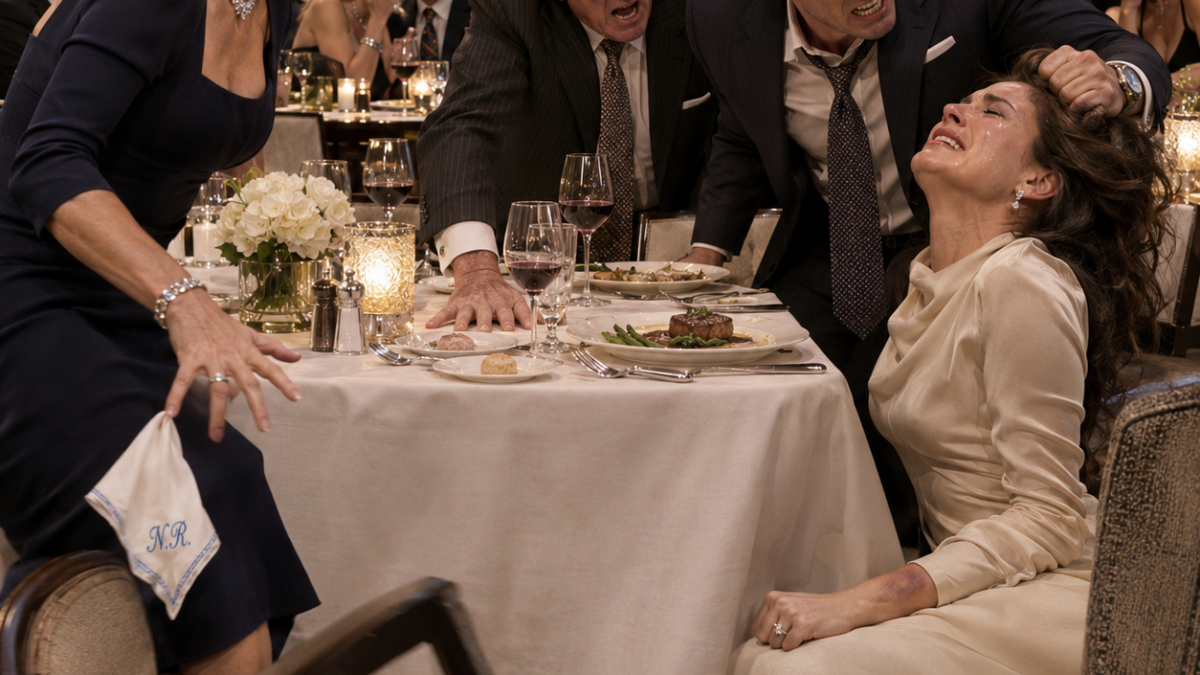
My chair hit the floor behind me with a crack so loud several people turned from across the restaurant.
Robert still had one hand half-raised.
Olivia’s hair was disheveled.
Tears rolled down her cheeks.
She did not wipe them away.
She did not look angry.
She looked terrified.
But not of Robert.
Of me.
Her eyes found mine and widened.
A tiny shake of her head.
Please, Mom.
Don’t.
That was what I saw.
And that terrified me more than the violence itself.
Because fear had trained my daughter to defend the man who had just hurt her.
“Olivia.”
My voice sounded strange to me.
Too calm.
“Honey, stand up.”
She shook her head again.
“Mom.”
“Stand up.”
Robert leaned back in his chair.
“Nerissa, you are misunderstanding what happened.”
I turned to him.
His face had already changed.
That was the thing about Robert.
His anger could disappear in seconds when witnesses were present.
The hand that had just twisted into my daughter’s hair now rested calmly beside his wineglass.
His voice was measured.
Reasonable.
Professional.
“It was a moment.”
“A moment.”
“Yes.”
“Work stress.”
I stared at him.
“You pulled my daughter’s hair.”
He sighed as if I were being exhausting.
“I lost my temper.”
His father snorted.
“No crime in correcting your own wife.”
A few people at nearby tables shifted uncomfortably.
The waiter stood several feet away.
Frozen.
The restaurant manager had appeared near the host stand.
Nobody yet knew whether to intervene.
I looked at Olivia.
“Honey.”
She wiped her face quickly.
“It’s okay.”
“No.”
“Mom, please.”
“It is not okay.”
She lowered her voice.
“Please don’t make this worse.”
That sentence broke something inside me.
Make this worse.
As though the problem was not the man who had just assaulted her.
The problem was me refusing to pretend he had not.
Robert’s father stood.
His name was Harold Armstrong.
I had called him Mr. Armstrong for years.
He straightened his jacket.
“Nerissa, sit down.”
I looked at him.
“What?”
“You’re making a scene.”
“A scene.”
“Yes.”
His eyes hardened.
“This is between a husband and wife.”
“Your son assaulted my daughter.”
“My son disciplined his wife after she embarrassed him.”
Someone behind us gasped.
Harold did not care.
He actually looked proud.
“In my day, women understood that a marriage required order.”
I looked at Susan.
She was staring at her plate.
“Is that what you call this?”
Harold followed my gaze.
“Susan and I have been married fifty years.”
He smiled.
“Never had these ridiculous problems modern couples have.”
Susan’s hands were folded tightly in her lap.
The skin around her knuckles was white.
I had known that woman for years.
She barely spoke at family gatherings.
Always asked Harold before ordering.
Always stopped laughing when he entered a room.
Always dressed in muted colors.
Always apologized.
Suddenly I saw her differently.
Not quiet.
Silenced.
Fifty years.
And Robert had grown up watching it.
I understood, all at once, that I was not looking at one violent man.
I was looking at an inheritance.
Not money.
A philosophy.
A father teaching a son that love meant control.
A mother teaching him, through survival, that women endured it.
And now my grandson was somewhere else growing up inside the next generation of that lesson.
I walked around the table.
Olivia recoiled.
“Mom.”
“Give me your arm.”
“No.”
“Honey.”
“Please.”
I gently caught her wrist.
She tried to pull away.
I did not grip hard.
I simply lifted her sleeve.
The bruises became visible beneath the restaurant lights.
Every table near us could see.
A woman at the next table covered her mouth.
The manager stepped closer.
I heard myself say:
“This.”
My voice shook.
But I did not lower it.
“This is not stress.”
Robert stood abruptly.
His chair scraped backward.
“Nerissa.”
“This is not marriage.”
“Nerissa, stop.”
“This is not discipline.”
My eyes stayed on him.
“This is abuse.”
Olivia began crying harder.
“Mom, please.”
Robert reached for her arm.
I stepped between them.
He stopped.
For the first time that night, the mask slipped.
His eyes became cold.
“Move.”
“No.”
His voice dropped.
“She is my wife.”
“And she is my daughter.”
“She goes home with me.”
I felt my entire body shaking.
But my feet did not move.
“No.”
A strange smile touched his mouth.
“You do not make decisions for my family.”
“Neither do you get to hurt her.”
“I provide everything for her.”
He spread one hand.
“House.”
“Clothes.”
“Food.”
“Health insurance.”
“I pay for everything.”
I stared.
“That means you own her?”
“I did not say that.”
“You didn’t have to.”
His father stood beside him now.
“Enough.”
Harold pointed at me.
“You are interfering in a marriage.”
“And you applauded your son for hurting his wife.”
“Because she embarrassed him.”
“Over dessert?”
“Over disrespect.”
I turned back toward Olivia.
She was looking at the floor.
“Honey, come home with me.”
She shook her head.
“Tonight.”
“No.”
“Matthew can come too.”
“No.”
“You have your old room.”
“Mom.”
“You have money.”
“You have a career.”
“You have choices.”
Her head came up sharply.
“I do not have a career.”
“You can go back.”
“You don’t understand.”
“Then help me.”
Tears ran down her face.
“I have a family.”
“So do I.”
“Robert needs me.”
I almost could not breathe.
“He just pulled your hair in public.”
“He has pressure.”
The words came faster now.
Desperate.
“He’s under stress.”
“His project.”
“His job.”
“He started therapy.”
“He is trying.”
Robert watched her.
Not lovingly.
Assessing.
Making sure she said the correct things.
I saw it.
And I saw Olivia see him.
She changed one sentence midway.
“I mean…”
She swallowed.
“We’re working on things.”
“You’re afraid of him.”
“No.”
“You flinch when he moves.”
“I’m tired.”
“You have bruises.”
“I fell.”
“How many times?”
Silence.
“Olivia.”
“Mom.”
“How many times have you fallen?”
Her mouth opened.
Closed.
Then Robert placed one hand on her shoulder.
She stiffened immediately.
He smiled at me.
“You’re upsetting her.”
That gentle voice.
That poisonous calm.
“Look at her.”
“She’s distressed because you are making accusations.”
I looked at my daughter.
“Honey, is he hurting you?”
Her eyes filled.
Robert’s fingers rested on her shoulder.
“Tell your mother.”
Olivia inhaled.
“We’re fine.”
My heart cracked.
“We’re happy.”
“No.”
“Yes.”
Her voice trembled.
“Robert loves me.”
I could not stop myself.
“Love does not make you afraid to order wine.”
That landed.
Her face collapsed.
Robert stepped forward.
“That’s enough.”
I ignored him.
“What do you want Matthew to learn?”
Olivia went still.
“Don’t bring him into this.”
“He’s already in it.”
“No.”
“What will he learn if he sees his father talk to you this way?”
“Robert would never hurt Matthew.”
“I am not asking whether he hits Matthew.”
My voice broke.
“I am asking what kind of man Matthew will become if he learns that this is what husbands do.”
Olivia paled.
Harold laughed.
“That boy will become a man.”
I turned.
“Not if I can help it.”
His face darkened.
“You think masculinity is letting women control the household?”
“I think masculinity is not needing to terrify a woman to feel powerful.”
The restaurant was silent again.
Harold stared at me.
Robert stared at me.
And Susan—
Susan finally looked up.
Only for a second.
But something moved in her eyes.
Pain.
Recognition.
Maybe shame.
Then she looked away.
Olivia stood.
My heart jumped.
I thought she had chosen me.
Instead, she picked up her purse.
“I’m going home.”
“No.”
“Mom.”
She could barely speak.
“Please let me.”
“Honey.”
“I’m asking you.”
Robert took his coat.
Harold threw cash onto the table.
“Shame you ruined the dinner.”
I laughed once.
A broken sound.
“I ruined it?”
“Yes.”
He gave me a disgusted look.
“Meddling mothers always think they know better.”
Susan rose.
She followed him automatically.
But before she turned away, our eyes met.
Her mouth opened.
Nothing came out.
Fifty years of silence.
Then she followed her husband.
Olivia stood beside Robert.
I caught her hand.
“Listen to me.”
She looked at me.
“No matter what happens.”
“No matter what he tells you.”
“No matter how angry he becomes.”
“My door is open.”
Her mouth trembled.
“Day or night.”
“You bring Matthew.”
“You bring nothing.”
“You come barefoot.”
“You come with nothing but your clothes.”
“You come.”
A tear rolled down her cheek.
“I love you.”
“I love you too, Mom.”
Robert touched her back.
“Let’s go.”
She left.
I watched my daughter walk behind the man who had just hurt her.
And I understood the cruelest truth I had ever learned.
You cannot pull someone out of a prison if they still believe leaving the prison is more dangerous than staying inside.
I paid the check.
Left a tip.
I do not know why I remember that.
Maybe because ordinary habits survive even when your world collapses.
Outside, the rain had stopped.
I sat in my car.
Pulled my mother’s handkerchief from my purse.
Pressed it against my mouth.
Then cried until my chest hurt.
I cried for Olivia.
For the little girl who built birdhouses because “birds need a safe place too.”
For the teenager who covered her bedroom wall with drawings of museums and bridges.
For the young architect who used to tell me buildings should make people feel protected.
And now she lived in a house where she was afraid to order wine.
My husband Edward had died three years earlier.
That night, I talked to him.
Out loud.
“Help me.”
I looked through the windshield.
“Edward, please.”
Nothing.
Of course nothing.
But sometimes grief makes you ask dead people questions because the living answers hurt too much.
When I got home, Olivia texted.
Mom, I’m sorry. Please don’t worry. I’m fine. I love you.
I replied immediately.
My house is open. Always. No questions. No judgment. I love you.
Three dots appeared.
Then disappeared.
Ten minutes later:
Please don’t call the police. It will make everything worse. Robert is better. I promise.
I stared at the screen.
My instinct screamed:
Call.
Police.
Now.
But Olivia was an adult.
I knew enough to know forcing action could push her deeper into isolation.
So I wrote:
I won’t do anything behind your back tonight. But promise me you’ll contact me every day. Even one word. I need to know you’re alive.
Long pause.
Then:
Okay. I promise.
That became our thread.
For two weeks, I woke every morning checking my phone.
Sometimes the message came at seven.
All good. Love you.
Sometimes eleven.
Sometimes noon.
Those mornings nearly killed me.
What does a mother imagine when her abused daughter is three hours late saying she is alive?
Everything.
Hospital.
Police.
Morgue.
Every nightmare.
The messages were sterile.
Too clean.
I suspected Robert saw them.
I called.
No answer.
I asked Olivia to meet me.
Excuses.
Matthew was sick.
Housework.
Plans.
Couples therapy.
Always something.
Finally, I contacted an attorney who specialized in domestic violence.
Patricia.
She listened.
Asked whether Olivia would cooperate.
“No.”
“Evidence?”
“Bruises.”
“Restaurant witnesses.”
“Possibly photographs.”
“Will Olivia confirm?”
“No.”
Patricia folded her hands.
“Nerissa, this is going to be hard to hear.”
“Say it.”
“You cannot make an adult victim leave.”
“So I wait?”
“You prepare.”
“That sounds like waiting.”
“It is not.”
She leaned forward.
“Save every message.”
“Document every visible injury.”
“Collect witness names.”
“Know where shelters are.”
“Have emergency documents ready.”
“Keep money accessible.”
“And most important…”
She held my eyes.
“Do not let Robert isolate her from you.”
I swallowed.
“What if I push too hard?”
“He will use it.”
“How?”
“He will tell her you are unstable.”
“Controlling.”
“Trying to break up the family.”
“He will make your concern proof that you are the problem.”
That sounded exactly like Robert.
“What do I do?”
“Keep the door open.”
I thought of what I had told Olivia.
You come barefoot.
You come with nothing.
You come.
I nodded.
Three weeks after the restaurant, I went to her house unannounced.
I knew Robert usually worked late Thursdays.
The house was immaculate.
Perfect lawn.
Perfect windows.
Perfect lie.
I rang.
No answer.
Again.
Finally, the door opened a few inches.
Olivia.
“Mom?”
She looked horrified.
“What are you doing here?”
“I came to see you.”
“You should have called.”
“I did.”
She looked behind her.
“Can I come in?”
“Robert isn’t here.”
“I know.”
Wrong thing to say.
Her face changed.
“You knew?”
“I wanted five minutes alone with you.”
“Mom.”
“Please.”
She eventually opened the door.
Inside, the curtains were closed.
Middle of the afternoon.
The house felt cold.
Matthew was upstairs sleeping.
Olivia sat on the edge of the sofa.
Turtleneck.
Long pants.
Warm day.
“Honey.”
“I’m fine.”
“Has he hurt you again?”
“No.”
“Look at me.”
She did.
“Has he?”
“No.”
Her hands were trembling.
“You’re afraid.”
“I’m annoyed.”
“No.”
“You need to stop this.”
“Stop what?”
“Interfering.”
The word sounded borrowed.
I heard Robert in it.
“This is my marriage.”
“And you are my daughter.”
“I know.”
“He’s changing.”
“How?”
“Therapy.”
“Has he hit you since therapy started?”
Her face became blank.
“Olivia.”
“No.”
Too fast.
I stood.
She stood too.
“Mom, you need to leave.”
“Why?”
“Because Robert can come home early.”
“So?”
“So I live here!”
She shouted.
The force of it startled us both.
Then her voice broke.
“You leave.”
“You go home.”
“And I stay here after you’ve made him angry.”
That stopped me.
My anger became shame.
Not because I had caused his violence.
I had not.
But because Olivia was telling me something important.
Every confrontation I initiated had consequences she bore after I left.
I lowered my voice.
“I’m sorry.”
Her eyes filled.
“I just want to help.”
“You’re making it harder.”
Then I noticed a black lens in the corner of the room.
Small.
Mounted near the ceiling.
“What is that?”
She followed my gaze.
“Security camera.”
“Inside?”
“It’s normal.”
I found another.
Hallway.
Another near the stairs.
“How many?”
“I don’t know.”
“Does Robert watch them?”
“They’re security.”
“That isn’t what I asked.”
Silence.
“Bedroom?”
Her face changed.
My stomach turned.
“Oh my God.”
“Mom.”
“He watches you inside the house?”
“He checks sometimes.”
“For security.”
“That is surveillance.”
“No.”
“That is control.”
“Stop!”
Matthew began crying upstairs.
Olivia covered her face.
“Look what you did.”
I hated that she believed I had done it.
But I remembered Patricia.
Do not make yourself another person demanding something from her.
So I left.
And when I reached my car, my phone buzzed.
Unknown number.
A video.
It showed me sitting in Olivia’s living room.
Recorded from one of the cameras.
Below it was a message from Robert.
Nerissa, your unannounced visits are upsetting Olivia and damaging her mental health. For her sake, please visit only when invited. I hope you understand. Regards, Robert.
Regards.
That word made the message more frightening.
He wanted me to know he had watched.
He wanted me to know I could not enter his house unseen.
He wanted me afraid.
I saved the message.
Did not reply.
That night, I researched coercive control until three in the morning.
Surveillance.
Isolation.
Financial dependence.
Threats disguised as concern.
The more I read, the more I recognized my daughter’s life.
Robert had not simply become violent.
He had built a system around her.
And systems are harder to escape than angry men.
A week later, an unknown woman called me.
“My name is Andrea.”
I did not recognize it.
“I was Matthew’s babysitter.”
Was.
My heart sped up.
“What happened?”
“I need to show you something.”
We met at a coffee shop far from Olivia’s neighborhood.
Andrea was young.
Maybe twenty-four.
She kept looking toward the door.
“I arrived early one Thursday.”
She began.
“I had a key.”
“I heard yelling upstairs.”
“What kind?”
“Robert.”
She swallowed.
“He was calling Olivia useless.”
“Stupid.”
“Ungrateful.”
“He said any other woman could do what she did.”
My eyes burned.
“I went upstairs.”
Andrea unlocked her phone.
Her hands shook.
“I took this.”
She turned the screen toward me.
My entire body went cold.
Olivia was pressed against a bedroom wall.
Robert’s hand was around her throat.
His other arm was raised.
And several feet away—
Matthew.
Three years old.
Sitting on a small bed.
Watching.
I touched the edge of the table because the room tilted.
“Did he hit her?”
“I don’t know.”
“He saw me.”
“He released her.”
“What happened then?”
“He came downstairs.”
“Calm.”
She laughed bitterly.
“Completely calm.”
“He said it was a marital argument.”
“I told him I would call the police.”
“He told me Olivia would deny it.”
“And she did?”
Andrea began crying.
“She came downstairs with red marks around her neck and said everything was fine.”
I closed my eyes.
“Then Robert fired me.”
“He said I stole money.”
“Did you?”
“No.”
“Would you testify?”
Fear crossed her face.
“He threatened me.”
“I know.”
“He has lawyers.”
“I know.”
Long pause.
Then:
“If it helps Olivia…”
Andrea nodded.
“Yes.”
I sent the photo to myself.
Then she told me something worse.
“Matthew has nightmares.”
I looked up.
“He wakes up screaming.”
“What does he say?”
Andrea’s voice broke.
“He says he’s scared of Daddy.”
I went to the bathroom after she left and vomited.
Patricia said the photograph changed things.
But Olivia still mattered legally.
She needed to cooperate.
That was the unbearable part.
I had proof.
I had a witness.
I had terror.
And still, Olivia had to choose.
Then Robert invited me to the house.
Not Olivia.
Robert.
“Clear the air.”
Patricia told me not to go alone.
I went anyway, but prepared.
Phone charged.
Audio recording running.
My friend Carmen had instructions to call at eleven.
If I did not answer:
Police.
At ten exactly, Robert opened the door.
White shirt.
Dress pants.
Perfect host.
“Thank you for coming.”
Olivia sat in the living room.
Gray turtleneck.
No makeup.
Ghost.
Matthew was with Robert’s parents.
Convenient.
I activated the recorder inside my purse.
Robert sat close beside Olivia.
One arm along the back of the sofa.
Possession disguised as affection.
“Nerissa, there have been misunderstandings.”
“Such as?”
“The restaurant.”
“I saw you pull her hair.”
“I snapped.”
The word mattered.
An admission.
“I was under tremendous stress.”
“So you assaulted her.”
“That’s dramatic.”
“No.”
“What happened was unfortunate.”
“Unfortunate is dropping a plate.”
His jaw tightened.
He breathed through it.
That told me therapy had taught him how to manage appearances.
Not behavior.
“We need space.”
he said.
“Your interference is destabilizing Olivia.”
I looked at my daughter.
“Honey, is that true?”
She stared at her hands.
“Yes.”
“When I came…”
Her throat moved.
“It was difficult.”
“Did he hurt you afterward?”
“Nerissa.”
Robert’s voice became hard.
“I asked Olivia.”
“And I am telling you these accusations are harmful.”
“Did you hurt her?”
“No.”
“Then why can’t she answer?”
His eyes flashed.
“She can.”
“Olivia.”
My daughter spoke quickly.
“No.”
Then Robert smiled.
“There.”
I wanted to scream.
Instead I opened my phone.
“Then explain this.”
I showed them Andrea’s photograph.
Olivia turned white.
Robert went perfectly still.
Not shocked.
Calculating.
Then he smiled.
“Blackmail.”
“No.”
“This is illegal surveillance.”
“Andrea had a key.”
“Andrea was fired for theft.”
Olivia looked at him.
“You told me she quit.”
His eyes moved toward her.
One second.
But I saw it.
The warning.
She immediately looked away.
Robert turned back to me.
“A disgruntled employee.”
“A blurry photograph.”
“No context.”
“Nothing admissible.”
“You had your hand around her throat.”
“I could have been stopping her from falling.”
I almost laughed.
He leaned forward.
“Do you really want to destroy your daughter’s reputation?”
“Public trial.”
“Newspapers.”
“Her private life discussed by strangers.”
I looked at Olivia.
She was shaking.
“Mom.”
“Please.”
“Don’t.”
Tears poured down her face.
“Delete it.”
“No.”
“Please!”
She screamed.
“I just want this to stop!”
She collapsed.
Robert pulled her against him.
And said:
“See?”
His hand stroked her back.
“You are hurting her.”
For one second, doubt entered me.
That is the poison of abuse.
It does not only distort the victim.
It distorts everyone around her.
I looked at my daughter crying against the chest of the man who had put his hand around her throat.
Then made a decision.
“I will not release the photograph today.”
Robert smiled.
“But I will not delete it.”
His smile disappeared.
“And if anything happens to her…”
I leaned forward.
“One new bruise.”
“One hospital visit.”
“One unexplained injury.”
“One threat.”
“This photograph goes to the police.”
“To prosecutors.”
“To anyone who needs to see it.”
His voice became icy.
“Is that a threat?”
“No.”
I stood.
“It is a promise.”
I knelt before Olivia.
“Honey.”
She looked at me.
“If you remember nothing else, remember this.”
“My door stays open.”
“No shame.”
“No lecture.”
“No ‘I told you so.’”
“Nothing.”
“You come.”
She nodded.
“I love you.”
“I love you too.”
I hugged her.
Then left.
In the car, I checked the recording.
Perfect.
Robert admitting he had snapped.
Threatening legal action.
Controlling access.
Enough to matter someday.
Not enough today.
So I waited.
The next months were the darkest of my life.
Olivia became more distant.
Two days without messages.
Three.
Christmas came.
She spent it with Robert’s family.
New Year’s.
One text.
I love you.
I sat alone at midnight with old photographs spread across the table.
Olivia laughing at fourteen.
Olivia graduating.
Olivia in her architecture studio.
Olivia on her wedding day.
I wondered which photograph contained the last version of my daughter before fear took over.
January came.
Cold.
Gray.
One Tuesday afternoon, I was pruning dormant roses when my phone rang.
Unknown number.
“Nerissa Caldwell?”
“Yes.”
“This is Dr. Mendes from General Hospital.”
Everything inside me stopped.
“Your daughter was admitted this morning.”
The pruning shears fell from my hand.
“What happened?”
“She is stable.”
Stable.
The word people say before telling you something terrible.
“Please come immediately.”
“Matthew?”
“Physically unharmed.”
“Where is he?”
“Child Protective Services.”
I was already running.
At the hospital, Dr. Mendes took me into a private room.
“Your daughter has a fractured wrist.”
“Facial contusions.”
“Multiple bruises.”
“Some old.”
“Some recent.”
She paused.
“And injuries to her neck consistent with manual strangulation.”
I stopped breathing.
“Strangulation.”
“Yes.”
“Did he try to kill her?”
The doctor chose her words carefully.
“I cannot state intent.”
“But strangulation in domestic violence is extremely serious.”
I understood.
“Another minute?”
She did not finish.
She did not need to.
Neighbors had heard screaming around six.
Olivia ran barefoot into the yard carrying Matthew.
Blood on her face.
No coat.
January.
She reached a neighbor’s house and pounded on the door.
“Help me.”
“He’s going to kill me.”
They locked her inside.
Robert came after her.
Pounded on the neighbor’s door.
Demanded his wife and son.
Police arrived.
Robert became calm.
Of course.
He told them Olivia was hysterical.
Emotionally unstable.
Needed psychiatric help.
Then officers saw her neck.
They arrested him.
Attempted homicide.
Aggravated domestic assault.
I sat there shaking.
“Can I see her?”
“Yes.”
She was asleep.
Bandaged wrist.
Swollen face.
Bruises.
Neck support.
I took her uninjured hand.
“Honey.”
No response.
“I’m here.”
I cried without sound.
Then Dr. Mendes returned.
“There is something else.”
I looked up.
“Olivia is pregnant.”
I stared.
“Approximately eight weeks.”
The room disappeared.
Pregnant.
The doctor continued.
“Given the trauma, we will monitor closely.”
“Does she know?”
“We’re not sure.”
“When she arrived, she was in shock.”
“She kept repeating one sentence.”
“What?”
Dr. Mendes looked at me.
“Protect Matthew.”
That was my daughter.
Nearly strangled.
Pregnant.
Bleeding.
And her first thought was still her child.
At three in the morning, Olivia woke.
Confused.
“Mom?”
“I’m here.”
“Where…”
“Hospital.”
She tried to sit.
Pain stopped her.
“Matthew.”
“He is safe.”
“Where?”
“CPS for now.”
“Robert?”
“In jail.”
Her whole face crumpled.
“I’m sorry.”
“No.”
“I should’ve listened.”
“No.”
“I thought I could fix him.”
“Honey.”
“I thought if I was better…”
“No.”
“If I didn’t argue…”
“No.”
“If I kept the house right…”
“Stop.”
I held her hand.
“There is nothing you could do that would justify this.”
She sobbed.
“He tried to kill me.”
The words came quietly.
Not dramatic.
Almost disbelieving.
“He tried to kill me, Mom.”
I closed my eyes.
She needed to say it.
So I let her.
“I told him I was pregnant.”
I opened my eyes.
“You knew?”
She nodded.
“I found out two days ago.”
“What happened?”
“He said he didn’t want another child.”
Her breathing became shallow.
“He said one child already gave me too much leverage.”
“He said two would make me impossible to control.”
My stomach turned.
“Then he…”
She touched her neck.
“He grabbed me.”
“Don’t.”
“I need to say it.”
She was crying now.
“I need someone to know.”
So I listened.
“He squeezed.”
“I couldn’t breathe.”
“I saw black spots.”
“Matthew was screaming.”
“And I thought…”
She stopped.
“What?”
“My children are going to grow up without me.”
Her face twisted.
“And worse…”
“They are going to think this is normal.”
Something changed in her eyes.
“That was what made me run.”
Not herself.
Her children.
“He let go.”
“I grabbed Matthew.”
“No shoes.”
“Nothing.”
“I ran.”
She looked at me.
“I finally ran.”
I kissed her hand.
“Yes.”
“You did.”
She began crying harder.
“I’m scared.”
“I know.”
“What if he gets out?”
“Then we prepare.”
“Your house?”
“My house.”
“You said…”
“I remember exactly what I said.”
Her grip tightened.
“My door is open.”
“You.”
“Matthew.”
“And the baby.”
Her eyes filled again.
“You know.”
“The doctor told me.”
“I don’t know if I can do this.”
“You do not need to decide everything tonight.”
“But I brought another baby into…”
“No.”
I interrupted.
“You are not responsible for his violence.”
“You are responsible for what you do next.”
She stared at me.
“And you already did the hardest part.”
“You ran.”
Detective Ramirez came the next morning.
Olivia gave a statement.
Not the edited version.
The truth.
Years.
Control.
Cameras.
Isolation.
Bruises.
Threats.
Hair pulling.
Strangulation.
When she finished, Ramirez closed his notebook.
“That is enough to maintain charges.”
Olivia looked at me.
Terrified.
Then I showed her Andrea’s photograph.
My recording.
Robert’s messages.
The surveillance video he had sent me.
The pieces I had been collecting while waiting for her.
She stared at the evidence.
“Why didn’t you use it?”
“Because you weren’t ready.”
Her eyes filled.
“I’m ready now.”
That was the sentence I had waited months to hear.
“I’m going to testify.”
I held her hand.
“There will be pressure.”
“I know.”
“His family.”
“I know.”
“Lawyers.”
“I know.”
“They will say you are destroying Matthew’s family.”
Her face hardened.
“I am saving his family.”
There she was.
Olivia.
My daughter.
The girl who built safe places.
Robert received bail.
Five hundred thousand dollars.
Electronic monitor.
Restraining order.
Passport surrendered.
No contact.
I hated it.
His father could afford the amount.
Olivia did not panic.
Not like before.
“How long?”
she asked.
“Until he can post it?”
“Yes.”
“Not long.”
She looked at me.
“Then get me out.”
Doctors preferred more time.
Olivia signed herself out under strict instructions.
We retrieved Matthew.
The moment he saw his mother, he dropped his toys.
“Mommy!”
He ran.
Olivia knelt despite her pain.
He crashed into her good arm.
“Mommy, Mommy, Mommy.”
“I’m here.”
He cried into her neck.
Then asked the question that destroyed me.
“We’re not going back, right?”
Olivia closed her eyes.
“No.”
“Promise?”
“Promise.”
“And Daddy?”
Her face changed.
Then she answered carefully.
“Daddy did things that were not safe.”
“He has to get help.”
“But you are safe.”
“Grandma and I are going to protect you.”
Matthew looked at me.
I nodded.
“Promise?”
“Yes.”
He believed us.
Children are terrifying that way.
They hand you their trust before you know if you deserve it.
I changed every lock on my house.
Installed cameras.
Alarm.
Motion lights.
Not because I wanted to live afraid.
Because preparation gave us room to heal.
Olivia and Matthew moved into my guest room.
Chicken soup first night.
Toast.
Tea.
Nothing dramatic.
Matthew fell asleep on the sofa.
I carried him upstairs.
“Grandma?”
“Yes?”
“Will I have bad dreams?”
“Maybe.”
His face fell.
“But when you do, you call.”
“Will you come?”
“Every time.”
He nodded.
That night, he screamed at two in the morning.
Olivia reached him before I did.
I stood in the doorway while she held him.
“Daddy’s mad.”
“No.”
She rocked him.
“Daddy is not here.”
“He can’t hurt you.”
“I’m here.”
Grandmother.
Mother.
Child.
Three generations in one dark bedroom trying to convince a frightened little boy that walls could be safe again.
The next day, Olivia asked to return to the house.
“One last time.”
“No.”
“I need documents.”
“We can send police.”
“I need Dad’s things.”
“Then police.”
She agreed.
Two officers accompanied us.
One hour.
Essentials only.
The house was frozen exactly as she left it.
Cup on the counter.
Toys.
Dish in sink.
Normal domestic life interrupted by terror.
Upstairs, Olivia packed.
Documents.
Birth certificate.
Jewelry from my mother.
Matthew’s clothes.
Edward’s belongings.
Architectural drawings.
Then she found a shoebox.
Inside:
Photographs.
Dozens.
Every injury.
Dated.
Notes on the back.
January 15 — pushed me into door.
March 3 — twisted my arm.
July 28 — slapped me after dinner with his parents.
I sat on the edge of the bed.
“You documented everything.”
She nodded.
“Why?”
“I think…”
She swallowed.
“I needed proof for myself.”
“So I couldn’t tell myself I imagined it.”
That sentence stayed with me.
Abuse does not only injure the body.
It attacks reality.
The victim starts needing evidence that her own pain exists.
We packed the box.
Then found a letter from Robert.
Apology.
Love.
Blame.
The usual poison.
Everything I did was because I love you too much.
You provoke me.
You became defiant.
If you had been the wife you promised to be, none of this would have happened.
Then:
Drop the charges. Come home. We can fix this.
Olivia read it once.
Then folded it.
“Evidence.”
Not love letter.
Evidence.
Another shift.
Robert’s mother called.
Susan.
Her voice trembled.
“Olivia, please.”
Olivia put the call on speaker.
“Robert is destroyed.”
Silence.
“He’s not eating.”
Olivia stared at the phone.
“He almost killed me.”
“It was a mistake.”
“A mistake.”
“A terrible moment.”
“It was years.”
“He’s in therapy.”
“I’m glad.”
“He loves you.”
Olivia’s jaw tightened.
“Mrs. Armstrong, love did not put fingerprints on my throat.”
Susan started crying.
“Think of Matthew.”
“I am.”
“A child needs his father.”
“A child needs a living mother.”
Susan’s breathing became uneven.
Then came the line.
“A good wife learns how not to provoke a man.”
Olivia closed her eyes.
I saw fifty years of Susan’s own survival speaking through the phone.
“Listen to yourself.”
Olivia whispered.
“That’s marriage.”
Susan said.
“No.”
Olivia’s voice became stronger.
“That’s what you survived.”
“It does not have to be what I survive.”
Silence.
“If every woman reported every husband who lost his temper, there would be no families left.”
“Then maybe some families should end.”
Olivia hung up.
She was shaking.
I held her.
“That was cruel.”
“No.”
She looked at me.
“That was the first honest thing I’ve said to her.”
Robert’s friends started posting online.
Good man.
False accusations.
Perfect father.
Perfect husband.
Olivia read too many comments.
Bad mother.
Liar.
Vindictive wife.
One night she sat at my kitchen table crying.
“What if I’m ruining Matthew’s life?”
I pushed the phone away.
“Whose hands were on your throat?”
She looked at me.
“Robert’s.”
“Who ran barefoot carrying Matthew?”
“I did.”
“Who called police?”
“The neighbors.”
“Who photographed earlier abuse?”
“Andrea.”
“Who has years of injuries documented?”
“I do.”
“Then why are strangers who saw none of it more believable than you?”
Her mouth trembled.
“I don’t know.”
“Because Robert spent years teaching you to distrust yourself.”
I put both hands around hers.
“That lesson is over.”
She cried.
But she stopped reading comments after that.
Two weeks before trial, Harold Armstrong asked to meet me.
Public coffee shop.
Daylight.
He looked older.
Smaller somehow.
“Robert is my only son.”
I said nothing.
“I raised him.”
“Yes.”
“I taught him to be strong.”
“You taught him control.”
He flinched.
Then surprised me.
“Yes.”
I stared.
He removed his glasses.
“I saw the photographs.”
His voice shook.
“I saw my son.”
Pause.
“And I saw myself.”
The air changed.
“For fifty years…”
He swallowed.
“I controlled Susan.”
“Not like Robert.”
He immediately corrected himself.
“No.”
“That’s a coward’s distinction.”
I stayed silent.
“I humiliated her.”
“Decided things.”
“Silenced her.”
“I thought that was marriage.”
His eyes filled.
“Susan has cancer.”
I stared.
“Stage four.”
“I’m sorry.”
“They say months.”
He looked at the table.
“And now…”
His voice broke.
“I realize I don’t know her.”
“Not really.”
“I know what she cooks.”
“What she wears.”
“What time she wakes.”
“But I don’t know what she wanted.”
“What she dreamed about.”
“What she would have done if she hadn’t spent fifty years becoming small enough to fit beside me.”
For the first time, I felt something other than rage toward Harold.
Not forgiveness.
Pity.
Maybe.
“I applauded him.”
he whispered.
“At that restaurant.”
“I clapped.”
“Yes.”
“I told him good boy.”
“Yes.”
He began crying.
“I taught him.”
I did not comfort him.
Some pain should be felt.
“What do you want from me?”
“I want Olivia to give him a chance if he changes.”
“That is not your decision.”
“I know.”
“Not mine either.”
He nodded.
“What can I do?”
“Stop protecting him from consequences.”
His face tightened.
“He’s my son.”
“And Olivia is someone’s daughter.”
That landed.
He looked away.
“Write her a letter.”
I said.
“No requests.”
“No guilt.”
“No excuses.”
“Apologize.”
“And mean it.”
He nodded.
Before leaving, he said:
“Tell her I’m sorry.”
“No.”
He looked confused.
“Tell her yourself.”
Trial lasted three days.
The courtroom was packed.
Press.
Family.
Curious strangers.
Robert arrived in a suit.
Hair perfect.
If you did not know him, you might think:
Responsible professional.
Good father.
Wrongly accused.
Olivia wore blue.
Simple.
No long sleeves.
No makeup hiding anything.
The bruises had faded.
She did not need visible wounds anymore.
Her evidence spoke.
Photographs.
Medical reports.
Andrea.
Security messages.
My recording.
The letter.
The shoebox.
Years of dated injuries.
Then Olivia testified.
She raised her hand.
Swore to tell the truth.
And she did.
No melodrama.
No screaming.
That made it stronger.
She explained the first insults.
The first shove.
The first apology.
Flowers.
Promises.
The next incident.
Isolation.
Cameras.
Financial control.
Leaving architecture.
Fear.
Hair pulling.
Strangulation.
“When did you decide to leave?”
the prosecutor asked.
Olivia’s voice remained steady.
“When I thought I was dying.”
“Why then?”
“My son was watching.”
She swallowed.
“I realized that if I stayed, I was not only teaching him that his father’s behavior was acceptable.”
“I was teaching him that my suffering was acceptable too.”
The courtroom was silent.
“And I was pregnant.”
The prosecutor nodded.
“What did you want your children to learn instead?”
Olivia looked toward the jury.
“That love does not require fear.”
Robert’s attorney tried to break her.
“You stayed.”
“Yes.”
“You defended him.”
“Yes.”
“You told your mother you were happy.”
“Yes.”
“So which version should we believe?”
“The version I was safe enough to tell.”
That shut him up for a second.
He tried again.
“Did you provoke arguments?”
“Yes.”
“Ah.”
The lawyer turned toward the jury.
“You argued with your husband.”
Olivia looked almost confused.
“Yes.”
“Married people argue.”
“Correct.”
“And sometimes voices rise.”
“Yes.”
“So these were marital conflicts.”
“No.”
“Why not?”
“Because when I disagreed, I used words.”
“When Robert disagreed, he used fear and violence.”
The prosecutor hid a smile.
The defense attorney did not.
Andrea testified.
Hands shaking.
But she did it.
“I saw Robert holding Olivia by the throat.”
“Where was Matthew?”
“In the room.”
“Did he appear frightened?”
“He was crying.”
“Why did you take a photograph?”
“Because I was afraid no one would believe me.”
I looked at Olivia.
That sentence echoed her shoebox.
Proof.
Everybody around Robert needed proof because Robert had built a world where truth could be rewritten.
The hospital doctor testified.
Manual strangulation.
High lethality risk.
Multiple injuries over time.
Detective Ramirez testified.
Neighbor statements.
Arrest.
Robert’s calm attempt to frame Olivia as unstable.
Then the prosecutor played my recording.
Robert’s voice filled the courtroom.
I snapped.
You are interfering in my marriage.
I will take legal measures.
A judge could see your behavior as harassment.
Robert stared straight ahead.
Harold sat behind him.
Head bowed.
Then Robert testified.
At first, confident.
“I loved my wife.”
“I still love her.”
“I made mistakes.”
“Work pressure.”
“Stress.”
The prosecutor approached.
“Do you recognize these photographs?”
“Yes.”
“Did you cause these injuries?”
Silence.
“Mr. Armstrong.”
“Some.”
“Some.”
“Yes.”
“Which?”
“I don’t remember.”
“You remember your fish order at a restaurant months earlier.”
A murmur moved through the room.
The judge warned everyone.
The prosecutor continued.
“But you cannot remember whether you caused a purple bruise on your wife’s neck.”
Robert’s jaw tightened.
“I lost control.”
“Again.”
“Yes.”
“And again.”
“Yes.”
“And again.”
He looked at the jury.
“I was under tremendous stress.”
The prosecutor stopped.
“Mr. Armstrong, when you were under stress at work, did you strangle your supervisor?”
“No.”
“Your clients?”
“No.”
“Your father?”
“No.”
“So you were capable of controlling yourself.”
Robert said nothing.
“You chose the person you believed would not fight back.”
“Objection.”
“Sustained.”
But the point had landed.
Then the prosecutor produced the letter.
You provoke me.
Your defiance.
Your disobedience.
“Is this your handwriting?”
“Yes.”
“You wrote this after your wife fled because you strangled her?”
“Yes.”
“And this is your apology?”
“I was emotional.”
“You blamed her.”
“I took responsibility.”
“Where?”
Silence.
The prosecutor looked toward the jury.
“No further questions.”
For the first time since I had known Robert, he looked small.
Not because the courtroom humiliated him.
Because he had lost control of the narrative.
The jury deliberated six hours.
Six of the longest hours of Olivia’s life.
We waited.
She barely spoke.
I held her hand.
When the jury returned, everyone stood.
Guilty.
Aggravated domestic assault.
Guilty.
Attempted homicide.
Guilty.
Witness intimidation.
Olivia closed her eyes.
One tear fell.
Not triumph.
Release.
Two weeks later, sentencing.
Eight years.
Restraining order.
Custody lost.
Any future contact with Matthew subject to strict legal conditions and Matthew’s own wishes when age-appropriate.
Robert stood as deputies prepared to take him.
Then he looked at Olivia.
One last attempt.
“Someday you’ll understand.”
She stared back.
“Understand what?”
“That I loved you too much.”
Olivia’s face became calm.
“No.”
Robert stopped.
“What you felt was possession.”
Her voice did not shake.
“Love does not make a person afraid to breathe.”
Silence.
“You never loved me too much.”
“You controlled me too much.”
The deputies led him away.
That was the last conversation they had.
Outside the courthouse, reporters surrounded us.
Olivia did not want fame.
But she wanted one thing said clearly.
She stood before microphones.
“My name is Olivia Caldwell.”
“For years, I lived with domestic violence.”
“I stayed because I was afraid.”
“Because I was ashamed.”
“Because I believed if I became a better wife, I could make the violence stop.”
Her voice broke briefly.
“I was wrong.”
“The violence was not caused by my failures.”
“It was caused by the person choosing violence.”
She looked into the cameras.
“If someone listening to this is living the way I lived, please understand something.”
“You are not weak because you stayed.”
“But you still deserve a way out.”
“My mother kept a door open for me long before I was brave enough to walk through it.”
She looked toward me.
I cried.
“And when I was ready, that door saved my life.”
That clip went everywhere.
Olivia did not seek activism.
But women wrote.
Shelters called.
Organizations asked her to speak.
She said yes selectively.
Not because she wanted to become a symbol.
Because she knew silence had almost killed her.
Months later, Olivia gave birth to a girl.
Valentina.
“Why Valentina?”
I asked.
Olivia smiled.
“Because courage deserves a name.”
Matthew slowly improved.
Therapy.
Routine.
Nightmares became less frequent.
Then rare.
Then gone.
He asked questions.
“Is Daddy bad?”
I knelt beside him.
“Your father did very bad things.”
“Does that mean I’ll be bad?”
“No.”
“How do you know?”
“Because you are learning that strength means keeping people safe.”
He thought about that.
“So strong people don’t scare people.”
“Exactly.”
“Even when they’re mad?”
“Especially when they’re mad.”
He nodded.
Children absorb different lessons when adults are brave enough to teach them.
Susan died months later.
Cancer.
Olivia attended the funeral.
Some people were surprised.
“Why?”
she asked me.
“She never protected you.”
“No.”
“But she was trapped too.”
Olivia looked sad.
“She taught Robert silence because silence was the only thing that kept her life stable.”
“That doesn’t excuse it.”
“No.”
“But I don’t want to hate her.”
Harold looked destroyed at the funeral.
For the first time, he stood behind Susan.
Too late.
That image stayed with me.
He later wrote an article.
A public confession.
Not asking forgiveness.
Admitting what he had taught his son.
He wrote that he had confused masculinity with control.
Authority with fear.
Marriage with ownership.
That article circulated widely.
Some people praised him.
Some called it too little too late.
Both were probably true.
Change does not erase harm.
But late truth is still truth.
Three years passed.
My kitchen became noisy again.
Matthew, six.
Valentina, two.
Crayons.
Toys.
Juice cups.
Olivia making coffee.
She no longer wore sleeves in summer unless she wanted to.
No one checked her phone.
No one told her what wine to order.
No one measured her laughter.
She returned to architecture.
At first, small projects from home.
Then larger ones.
One Sunday morning, she walked into the kitchen carrying rolled plans.
“Mom.”
“What?”
“I got the project.”
“What project?”
She spread the drawings across my table.
A shelter.
For women and children escaping domestic violence.
Private family rooms.
Counseling offices.
Secure entrances.
A courtyard.
Play areas.
Natural light.
No dark interior corridors.
I looked at the plan.
“Honey.”
She pointed toward one section.
“These rooms face the garden.”
“Why?”
“Women who have lived in controlled environments need sightlines.”
“Windows.”
“Light.”
“Doors they can lock from inside.”
She traced another area.
“Children need spaces that don’t feel institutional.”
“Somewhere they can play without feeling watched.”
My throat tightened.
Then she smiled.
“Remember the birdhouse?”
Of course I did.
She had been eight.
Rough wood.
Crooked roof.
Proud.
“Birds need safe places too.”
I whispered.
Olivia nodded.
“I think I’ve been designing the same thing my whole life.”
She looked around my kitchen.
“I just had to learn I deserved one too.”
I took her hand.
She squeezed mine.
“Thank you.”
“For what?”
“For leaving the door open.”
I shook my head.
“You did the running.”
“You did the testifying.”
“You rebuilt.”
She looked at me.
“Yes.”
“But I needed somewhere to run.”
That was true.
Sometimes saving someone does not mean dragging them out.
Sometimes it means refusing to disappear while they are still trapped.
It means documenting.
Waiting.
Believing.
Keeping a bedroom ready.
Answering the phone.
Holding the line between help and control.
Being there when fear finally cracks.
Robert wrote letters from prison.
At first, manipulation.
Excuses.
Love.
Blame.
Olivia stopped reading.
Then, almost three years into his sentence, a different letter arrived.
She brought it to me.
“He sounds different.”
I read.
No request for forgiveness.
No demand for contact.
He wrote that mandatory therapy and offender programs had forced him to confront something he had spent his life denying.
Control was not love.
Fear was not respect.
He had believed being a husband gave him rights over another person’s choices.
He admitted he had learned that from his father.
Then added:
That explains where the belief came from. It does not excuse what I chose to do with it.
That sentence mattered.
He wrote:
If Matthew ever chooses to know me when he is older, I will tell him the truth. I will not ask him to see me as a victim. I will tell him what I did so he does not become me.
Olivia folded the letter.
“Do you believe him?”
I thought.
“I believe he may finally believe what he wrote.”
“That’s not the same as trust.”
“No.”
She nodded.
“I don’t forgive him.”
“You don’t have to.”
“But I don’t hate him anymore.”
“That’s different too.”
She looked toward Matthew playing outside.
“I don’t want him living in my head.”
“That is probably the closest thing to freedom.”
She smiled.
“Yes.”
Harold changed too.
Not into a saint.
I would never write him that way.
The man had spent decades controlling his wife and one unforgettable night applauding his son for hurting mine.
Nothing erases that.
But Susan’s death broke something open.
He began speaking publicly about how fathers teach sons violence without ever hitting them.
Through jokes.
Through entitlement.
Through disrespect.
Through watching mothers shrink.
Once he told me:
“If one father hears me before his son becomes Robert, then maybe I can do one decent thing with what’s left of my life.”
I looked at him.
“You cannot undo your son.”
“I know.”
“You cannot undo Susan.”
His eyes filled.
“I know.”
“But you can stop pretending nothing happened.”
“That’s what I’m trying to do.”
For once, I believed him.
One Sunday afternoon, Matthew brought me a drawing.
Big house.
Sun.
Four people.
Olivia.
Matthew.
Valentina.
Me.
“Where are the windows?”
I asked.
He pointed proudly.
“Everywhere.”
“Why?”
“So the light gets in.”
Olivia looked at me from across the room.
Her eyes filled.
Matthew continued coloring.
“Mom says houses should feel safe.”
I looked at my daughter.
She smiled.
There she was.
The eight-year-old with a birdhouse.
The architecture student.
The woman Robert tried to erase.
Still there.
Changed.
Scarred.
But there.
I used to think surviving meant returning to who you were before something terrible happened.
I know better now.
Olivia never returned.
She became someone else.
Someone who understood exactly what safety costs.
Someone who could look at fear without confusing it for love.
Someone who could build literal doors for women who needed a way out.
And I changed too.
The woman I was before that restaurant wanted peace at almost any cost.
The woman I became understands that peace purchased with silence is not peace.
It is surrender.
That night, when Robert pulled my daughter’s hair and his father said, “Good boy,” I thought standing up was the bravest thing I would ever do.
It wasn’t.
Standing was easy compared with what came later.
Waiting without abandoning her.
Helping without taking control from her.
Watching her return to Robert.
Walking away when pressure would have pushed her deeper into isolation.
Keeping evidence.
Sleeping beside my phone.
Answering every message.
Preparing a room.
Believing in the woman inside the frightened person she had become.
That was harder.
And Olivia’s greatest courage was not testifying.
Not the cameras.
Not facing Robert in court.
It was the barefoot run.
A broken wrist.
Bruised face.
Hands around her throat moments earlier.
A terrified three-year-old in her arms.
And one decision:
Enough.
She ran.
Not because fear disappeared.
Because something finally became more important than fear.
Her children.
Her life.
Her right to survive.
That is why, when people ask me what saved my daughter, I never say it was me.
I did not save Olivia.
I kept a door open.
She saved herself by walking through it.
And years later, every time I see her standing over blueprints for another shelter, arguing about windows, locks, courtyards, and light, I think of that little girl holding a crooked wooden birdhouse in my garage.
“Birds need a safe place too, Mom.”
She had known the truth at eight years old.
It simply took the hardest years of her life to understand that it applied to her.
Today she knows.
Matthew knows.
Valentina will know.
And that is how the cycle ends.
Not with revenge.
Not with pretending the past did not happen.
It ends when one person finally says:
What happened to me stops here.
Robert inherited violence from his father.
Olivia refused to hand it to her children.
That was her victory.
That was mine.
And that was the moment our family finally learned the difference between keeping the peace and being free.


