PART2:She Bulldozed My Late Wife’s 22-Year Rose Garden Because She Wanted the View—My Family Had Drawn Every Boundary in Her Subdivision
PART2
We landed in Charleston at 12:52.
I got to my truck at 1:15.
The drive to Summerville took forty-one minutes.
I remember almost none of it.
I remember my hands on the wheel.
I remember traffic lights.
I remember one man in a pickup beside me at an intersection singing along to his radio.
I remember thinking how obscene it felt that the rest of the world could continue normally.
At 2:03 p.m., I turned onto my gravel driveway.
Scout heard my truck.
He was our nine-year-old German Shepherd.
Rufus had taken him that morning for his usual walk, which was the only reason he had not been in the garden when the equipment came through.
Scout burst through Rufus’s side door.
He ran toward me.
Then stopped.
Not at me.
At what had been the garden.
I got out of the truck.
And I understood, in one instant, that whatever I had imagined on the flight home had not been bad enough.
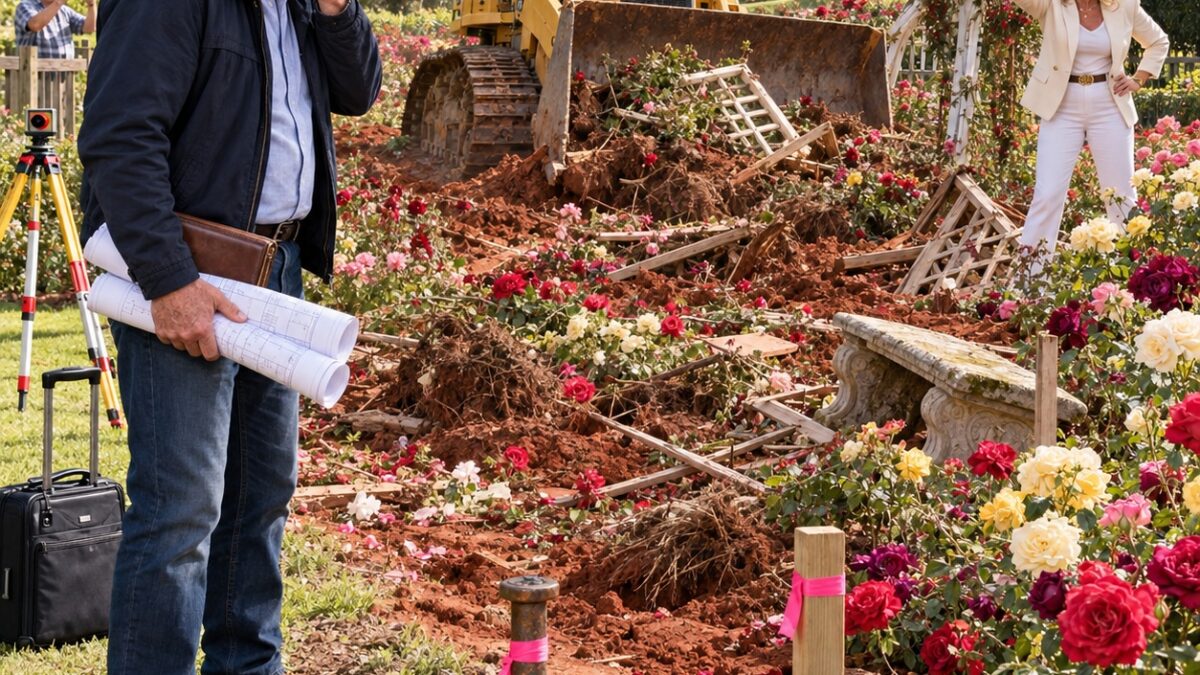
The garden was gone.
Not damaged.
Not trimmed.
Not cleared in sections.
Gone.
Two days earlier, I had walked there before sunrise.
I had checked the Abraham Darby.
The Jude the Obscure.
The pink Souvenir de la Malmaison Catherine had grafted from a cutting she obtained from a Charleston estate in 2008.
I had touched the rough stone of the bluestone arbor she installed herself over three weekends in 2010.
I had sat for five minutes on the bench engraved:
For Kate, from Duncan — 2005.
Now there was red clay.
Deep bulldozer tracks curled through it like wounds.
Rose canes lay in an eight-foot pile.
Boxwood branches.
Broken trellis pieces.
Fragments of the arbor.
The little garden shed Catherine had painted blue was flattened.
One stone bench had been broken into three pieces beside the live oak we called Grandmother Oak.
The oak was almost three centuries old.
A bulldozer tread had gouged the root flare.
I stood there.
Scout sat beside me.
He whined once.
Then he did something that broke me harder than anything else.
He refused to enter the garden.
Scout had walked those rows with Catherine for years.
He knew every path.
Every bench.
Every place she had stopped to kneel.
But he sat at the edge where the rose beds used to begin.
He watched me step into the ruin alone.
I walked slowly.
There was no reason to hurry anymore.
Everything had already happened.
I passed a crushed irrigation line.
A torn plant tag.
Part of a stone border.
I found one small brass label half buried in clay.
Catherine’s Light.
My wife’s pale-yellow hybrid.
I bent down and picked it up.
The label was bent.
I rubbed mud from the letters with my thumb.
Then I heard Rufus behind me.
“Duncan.”
I turned.
He crossed the fence line toward me.
He looked older than he had that morning.
I had known Rufus long enough to understand that he did not cry easily.
He had served as a combat engineer.
He had buried friends.
He had outlived his wife.
But his eyes were red.
He put a hand on my shoulder.
“Deputy Haywood got here at 11:22.”
I nodded.
“Courtney?”
“Left around 11:45.”
“What did she say?”
Rufus’s jaw tightened.
“She said she had authorized a community-initiated abatement of encroachment.”
I actually laughed.
One sound.
No humor in it.
“An abatement.”
“That’s what she called it.”
“And the contractor?”
“Lombardi Land Clearing.”
“Licensed?”
“Don’t know.”
“Video?”
Rufus lifted his phone.
“Forty-three minutes.”
I looked at him.
“All of it?”
“All of it.”
He swallowed.
“Duncan, I was a combat engineer in Germany in 1968. I’ve seen destruction. I haven’t cried over anything in forty years.”
He looked toward the clay.
“I cried in my kitchen at 11:15 this morning.”
I put my hand over his.
“Thank you for filming.”
He nodded.
“Thank you for calling the sheriff.”
He nodded again.
“And thank you for Scout.”
At that, Rufus looked away.
Scout finally moved.
He walked slowly through what had been the garden.
Not far.
Just to where our marriage bench used to stand.
He lowered himself onto a flat broken fragment of the backrest.
Then lay down.
He stayed there nearly twenty minutes.
At 2:08, Brennan’s work truck came up the drive.
He got out.
He took three steps.
Stopped.
“Dad.”
That was all he had.
I said, “Brennan.”
He looked at the ruined beds.
His mother’s garden.
The place where she had taught him to prune when he was a teenager.
The place where she had made him haul compost when he wanted to be playing baseball.
He wiped his face with the heel of one hand.
Then he walked back to his truck and pulled out a file case.
“I’ve got the plat.”
He opened it.
“And the boundary acknowledgment Grayson signed in March 2020.”
Another folder.
“Brock’s waiting for us tomorrow morning.”
Then he looked at me.
“What do you want to do now?”
That question mattered.
Because rage wanted one answer.
Grief wanted another.
But I had spent thirty-five years as a surveyor.
Surveyors live by evidence.
Not feeling.
Not assumptions.
Evidence.
I looked across the destroyed garden.
“LiDAR.”
Brennan nodded immediately.
“I want every fragment documented.”
“Okay.”
“Every destroyed witness monument located.”
“Okay.”
“Rufus’s video copied and preserved.”
“Chain of custody.”
“Yes.”
“I’ll get Laurel involved.”
“Good.”
“And Dad?”
I looked at him.
“What?”
“You’re not sleeping here tonight.”
I almost argued.
Then I looked at Scout lying on the broken bench.
“No.”
“You’re coming to Sadie’s.”
My daughter lived in Charleston with her husband and my grandchildren.
I nodded.
“Fine.”
Brennan closed the file.
Then he said quietly:
“We’re going to make her answer for this.”
I looked down at the bent brass label in my hand.
“No.”
He frowned.
I said, “We’re going to make the record answer for this.”
That was different.
And it mattered.
At 7:53 the next morning, Brennan and I walked into the offices of Latimer and Haynes on Main Street in Summerville.
Westbrook “Brock” Latimer had been my college roommate at Clemson.
He had been at my wedding.
I had been at his.
He carried Catherine’s coffin.
He was sixty-four now.
Silver hair.
Bow tie.
Civil litigator for more than three decades.
He did not greet us with small talk.
He poured coffee.
Sat across from us.
Then said:
“Tell me everything.”
We did.
Brennan laid out the 2019 recorded plat for Oak Shadow Estates.
My firm’s seal was on it.
His signature was on it.
Our company had surveyed the development.
Set every corner pin.
Installed every witness monument.
Filed the final plat.
Then Brennan placed Grayson Kensington’s signed boundary acknowledgment beside it.
March 2020.
Grayson had personally walked the property line.
He had received an annotated copy.
He had signed a document confirming he understood the location of the boundary between Oak Shadow Estates and my family land.
Then came Rufus’s video.
Forty-three minutes.
We watched only enough for Brock to understand.
Courtney in white linen.
Expensive boots.
Coffee mug.
Pointing.
Jesse Lombardi operating the bulldozer.
Then her voice.
Clear.
“Keep pushing.”
The blade moved through a rose bed.
“I don’t care about his dead wife’s flowers.”
Another pass.
“Get the whole bed.”
Brock froze the video.
He removed his reading glasses.
Set them down.
Then looked at me.
“Duncan.”
“Yes.”
“This is one of the cleanest civil cases I’ve seen in thirty-four years.”
I felt nothing.
Not relief.
Not satisfaction.
Just tired.
“Walk me through it.”
He leaned back.
“Trespass to real property.”
He tapped the plat.
“Ownership is documented.”
Another tap.
“Boundary professionally surveyed.”
Another.
“Defendant had prior notice.”
He moved to the destroyed property photographs.
“Conversion and destruction of personal property.”
Then:
“Survey monuments.”
Brennan said, “Twelve primary markers disturbed or destroyed, plus two old county benchmark discs.”
Brock wrote.
“Contractor licensing?”
“We’re checking.”
“HOA authorization?”
“None that we know of.”
Brock looked at me.
“Social media?”
Brennan answered.
“Courtney posted yesterday.”
Brock stopped writing.
“What did she post?”
“A reel.”
“About this?”
“Yes.”
Brennan pulled out his phone.
“She called it ‘Community Standards Upheld.’”
My stomach turned.
He played the clip.
Courtney had filmed herself while the garden was being bulldozed behind her.
She described me as a hoarder.
Said I had allowed a nuisance to remain because I could not “move on.”
Then she said:
“His wife’s been dead three years. It’s time someone cleaned it up.”
I looked away.
Brock did not.
He watched every second.
When the video ended, he said:
“Save it.”
“Already done,” Brennan said.
“Save the comments too.”
“Done.”
Brock looked at me.
“Duncan, this is no longer only trespass.”
I said nothing.
“It’s defamation if the statements are provably false. It’s potentially unfair trade practice exposure depending on the contractor and board records. It may be conspiracy if we can establish knowledge through Grayson.”
I looked at the plat.
“What is the garden worth?”
Brock sighed.
“That’s the ugly question.”
“The law needs a number.”
“Yes.”
“So give it one.”
He began outlining experts.
Horticulture.
Hardscape.
Arborist.
Survey monument replacement.
Emotional damages.
The fourteen registered hybrids.
Then he stopped.
“Who can value those?”
I answered immediately.
“Dr. Pamela Glasscock at Clemson.”
“You know her?”
“She knew Catherine.”
“That’s better.”
Brennan’s voice was quiet.
“Mom corresponded with her.”
Brock nodded.
“Good.”
He ran preliminary figures.
Two point something million compensatory.
Possibly much higher with punitive enhancement.
I listened.
Then Brennan said:
“Dad, that’s the number for the garden.”
I turned.
He was staring at the table.
“It’s not the number for Mom.”
I reached over and put my hand on his shoulder.
“I know.”
Brock leaned forward.
“The law can only pay for what it can count.”
Neither of us looked at him.
He continued.
“It cannot pay for Catherine.”
Pause.
“But it can make sure a person who knowingly bulldozes another person’s life’s work remembers the cost.”
I looked at him.
“File it.”
He nodded.
“We file today.”
Over the next three weeks, grief turned into evidence.
That was the only way I knew how to survive it.
Brennan and our team reconstructed the boundary file.
Original 2019 field notes.
GPS coordinates.
Installation photographs.
Witness monument records.
LiDAR.
Drone imagery.
The destruction scan.
Everything.
The garden was dead.
But its geometry remained.
That mattered to me.
Courtney could flatten roses.
She could not flatten coordinates.
She could destroy stone.
She could not destroy a recorded plat.
She could lie about where the property line was.
She could not move it.
Dr. Pamela Glasscock came to the property.
She had visited Catherine’s garden seven times over the years.
When she stepped out of her car and saw the clay, she covered her mouth.
“Oh, Duncan.”
I nodded.
She did not hug me immediately.
That was why I liked her.
She understood grief sometimes needs distance.
She walked the former rows with Catherine’s notes in one hand.
She stopped at places where certain cultivars had stood.
“Dorchester Moon?”
“Here.”
“Catherine’s Anchor?”
“West row.”
“Catherine’s Courage?”
“Beside the arbor.”
She closed her eyes.
Then she began working.
Her report eventually ran sixty-one pages.
Cultivar by cultivar.
Years of breeding investment.
Unique genetic material.
Replacement impossibility.
Documentation.
Valuation.
Some losses could be assigned market equivalents.
Some could not.
That did not mean they were worthless.
It meant money was an inadequate language.
The arborist came next.
Grandmother Oak’s roots had been damaged.
Not necessarily killed.
But harmed.
Ten-year monitoring plan.
Remediation.
Then we investigated Jesse Lombardi.
His contractor license had lapsed years earlier.
His liability insurance had lapsed too.
When Brock invited him to give a voluntary statement, Jesse arrived looking like a man who had not slept.
He held a paper coffee cup with both hands.
He cried for nearly forty-five minutes.
Courtney had paid him five thousand dollars cash.
She told him the garden sat on HOA common area.
She gave him a printed HOA authorization.
Brock asked for it.
Jesse produced the document.
Brennan looked at it.
Then at me.
Then back at the page.
“No board signatures.”
Brock said, “Was there a vote?”
Jesse shook his head.
“She told me there was.”
The document had been created by Courtney herself.
Backdated.
Printed on HOA letterhead.
No real board approval.
Jesse signed a cooperation statement.
Before he left, he asked if he could speak to me alone.
We walked outside.
He looked down at the sidewalk.
“I got a daughter.”
I said nothing.
“Two years old.”
He swallowed.
“My mom raised me. She grew cabbage roses behind our house outside Florence.”
I kept waiting.
He rubbed his palms against his jeans.
“I knew they were flowers.”
His voice broke.
“I didn’t look at what kind.”
I stared at him.
He continued.
“I didn’t want to know.”
There it was.
Not innocence.
Not malice like Courtney’s.
Cowardice.
I could understand cowardice better than cruelty.
He looked at me.
“I’m sorry.”
I believed he was sorry.
That did not undo anything.
I said, “I’ll see you in court.”
He nodded.
“I know.”
“I don’t wish you harm.”
That surprised him.
Then he held out his hand.
I shook it.
He walked away.
The social media evidence was worse.
Our GIS lead, Laurel Weathers, also had digital forensic experience.
She cataloged Courtney’s posts.
More than a thousand.
Dozens referencing my property.
Some directly naming me.
Others not.
Encroachment.
Blight.
Nuisance.
Hoarding.
Unmaintained property.
And always that implication that grief itself was some kind of civic violation.
The April bulldozer reel had forty-one thousand views before Courtney deleted it.
Laurel had already archived it.
Every frame.
Every caption.
Every timestamp.
The internet is cruel to people who believe deleting means erasing.
Then Brock subpoenaed the HOA board minutes.
That changed everything again.
Courtney had brought up my garden repeatedly.
Three separate times.
Three separate board votes.
Three separate refusals.
The HOA itself had told her no.
She bulldozed anyway.
Then Grayson Kensington sat for deposition.
He was the developer.
Courtney’s husband.
The man whose company built Oak Shadow Estates.
He had personally signed the boundary acknowledgment.
Under oath, he admitted it.
“Yes, I knew the garden was on Mr. McCabe’s land.”
Brock asked:
“Did you tell your wife?”
“Yes.”
“How many times?”
“I don’t know. Several.”
“Did you ever tell her she had authority to clear it?”
“No.”
“Did you ever authorize a contractor?”
“No.”
“Did you speak with Mrs. Kensington before April 12?”
Grayson looked exhausted.
“Yes.”
“What did you tell her?”
His attorney shifted.
Grayson answered anyway.
“I told Courtney she was not permitted to have anything done on that property.”
“When?”
“The morning before.”
“And what happened?”
“She did it anyway.”
Brock looked at me across the room.
Just for a second.
No smile.
Didn’t need one.
Three days later, Grayson moved to sever himself from the case.
Eventually he became a cooperating witness.
But even then, something bothered me.
Courtney had been told.
Repeatedly.
Her husband knew.
The HOA board knew.
The plat existed.
The boundary was recorded.
Still, I felt there was one more piece somewhere.
A written piece.
Something older.
Then Brennan and I went to the Dorchester County Register of Deeds.
Marsha Billingsley had worked there since the 1990s.
She had played bridge with Catherine for ten years.
She had attended the funeral.
When we walked in, she did not ask why we were there.
She simply said:
“Reading room.”
She brought four accordion files.
We went page by page.
Subdivision approvals.
Planning documents.
Easements.
Variance requests.
Then, in the third file, I found it.
February 2020.
Kensington Development Group.
Petition for a scenic walking easement across a portion of Lot 15.
The Kensington family’s own lot.
But the proposed path crossed onto adjacent private property.
Mine.
Dorchester County Planning had denied it.
The written denial stated specifically that Kensington Development Group did not own the adjacent McCabe parcel and would need written easement rights from me.
They never asked.
They withdrew the petition.
I read the document once.
Twice.
Three times.
Brennan took it from me.
His face changed.
“Dad.”
“I know.”
“They petitioned to cross your property.”
“Yes.”
“County told them no.”
“Yes.”
“Right after I walked the boundary with Grayson.”
“Yes.”
He sat back.
“Then they knew.”
I looked at him.
“They knew officially.”
Marsha spoke from the other table.
“I remember this.”
We turned.
She adjusted her glasses.
“Grayson came in to pick up the denial letter.”
“You remember?”
“He was not happy.”
Brennan immediately photographed every page.
Marsha certified copies.
We walked into the parking lot.
I called Brock.
“We found something.”
“What?”
“2020 variance denial.”
Silence.
I continued.
“Kensington Development petitioned for an easement across my parcel. County denied it in writing. Named my property.”
Another pause.
Then Brock said:
“Duncan, you just handed me the willfulness element in writing.”
I looked across the parking lot.
“What does it do?”
“It changes punitive exposure.”
“How much?”
“A lot.”
“Brock.”
“They didn’t just know the boundary from your plat. They asked the county for permission to cross it.”
“Yes.”
“And were denied.”
“Yes.”
“Then Courtney bulldozed the same land years later while claiming she believed it belonged to the HOA.”
“That’s right.”
Brock’s voice hardened.
“That argument is dead.”
I closed my eyes.
“File whatever you need.”
“Already drafting.”
That evening I went back to the garden.
Scout walked with me.
We had started placing small white flags where important plants once stood.
The first was Catherine’s Courage.
Deep red.
She named it during her second year of chemotherapy.
The next was Catherine’s Light.
Pale yellow.
Then Dorchester Moon.
A salmon-colored hybrid she had spent seven years refining.
I stood over the empty place.
Somewhere in my memory Catherine was kneeling there.
Straw hat.
Dirty gloves.
Talking to a rose like it had personally offended her.
I said aloud:
“They knew, Kate.”
Scout looked at me.
“They knew where the line was.”
Wind moved the Spanish moss.
That was all.
I sat on a piece of the broken marriage bench.
“I’m sorry.”
I did not know exactly what I was apologizing for.
Being away.
Not stopping it.
Living when she was not.
Maybe all of it.
Then I remembered something Catherine had said during her final autumn.
She had been weak enough that I had started doing most of the heavy garden work.
I once asked:
“What happens if I kill one?”
She laughed.
“Then you learn and plant another.”
I had said, “That’s not very comforting.”
She looked over her tea.
“Duncan, gardening is mostly believing in next spring.”
I had forgotten that.
Until then.
The legal case grew.
So did the restoration effort.
Catherine’s sister, Delilah, came down from Greenville.
We walked the ruined garden three mornings.
On the third, she said:
“You think all Kate’s roses died here.”
I looked at her.
“They did.”
“No.”
I almost snapped.
She held up one finger.
“You remember how your wife gave cuttings to everybody?”
I stared.
Delilah smiled through tears.
“Summerville Garden Club. Charleston. Beaufort. Mount Pleasant.”
My heart started beating faster.
“I called people.”
“How many?”
“Thirty-one so far.”
I sat down.
She continued.
“Kate gave cuttings away constantly. Half the Lowcountry has pieces of your wife in their backyards.”
I covered my mouth.
Delilah crouched beside me.
“Twelve of the fourteen hybrids may still exist.”
“May?”
“Single cuttings in some cases. Maybe two.”
“And the other two?”
She looked down.
“Nothing yet.”
That was the first good news I had heard since April 12.
It did not bring the garden back.
But it changed the word gone.
Gone became scattered.
And scattered could sometimes be gathered.
Dr. Glasscock brought Clemson graduate students.
People mailed photographs.
Old garden club members searched labels.
Cuttings arrived wrapped in damp paper.
One woman from Mount Pleasant brought a living cane of Catherine’s Courage in the back seat of her car like she was transporting a newborn.
She handed it to me.
“I’m sorry it took so long.”
I touched the leaves.
“No.”
My voice failed.
Then I tried again.
“You brought her home.”
The story went public.
A reporter from the Charleston Post and Courier contacted us.
I refused at first.
Then Brock said:
“Public record is already part of the case.”
So I agreed to one interview.
No theatrics.
No revenge language.
I told the reporter about Catherine.
The promise.
The boundary.
The county denial.
The garden.
The article spread.
Regional news.
Then national.
People emailed from everywhere.
Some sent photographs of their own late spouses’ gardens.
Some sent stories about HOA disputes.
Some mailed rose cuttings that had nothing to do with Catherine but came with notes saying:
Plant this somewhere.
I did.
Not in the restoration beds.
Along the edge.
A row of strangers’ roses.
I called it the Kindness Border.
Catherine would have mocked the name.
Then secretly loved it.
The Oak Shadow Estates HOA finally voted Courtney out.
Thirty-eight to four.
A retired superintendent named Gwendolyn Treadwell became acting president.
She came to my property afterward.
She stood at the fence.
Did not cross.
That alone impressed me.
“Mr. McCabe?”
“Yes.”
“I wanted to apologize on behalf of the board.”
“You voted against her?”
“Yes.”
“Then don’t apologize for her.”
She nodded.
“We’ve changed procedures.”
“Good.”
“And we want to contribute to the garden restoration.”
I considered it.
Then said:
“Not money.”
“What then?”
“Labor.”
She smiled.
“That we can do.”
And they did.
Residents who had nothing to do with Courtney’s actions came with gloves.
Carried stone.
Moved soil.
Helped install fencing.
A subdivision does not become evil because one person abuses authority.
That lesson mattered.
I refused to turn fifty-two families into Courtney Kensington.
She had done enough damage without recruiting innocent people into it.
By August, the criminal side began catching up.
Courtney was charged over the destruction of survey monuments and the fabricated HOA document.
She turned herself in.
Her employer terminated her.
Her social media account eventually disappeared.
Her husband filed for divorce.
People kept asking whether I felt satisfied.
I never knew how to answer.
Did I enjoy watching her life collapse?
No.
Did I feel sorry enough to stop the case?
Also no.
Consequences are not revenge simply because they hurt.
Sometimes they are just arithmetic.
Courtney had made choices.
Then more choices.
Then choices to cover the first ones.
She had crossed my property line knowing it existed.
She had ordered a bulldozer forward.
She had filmed it.
Mocked my dead wife.
Posted it.
Lied to her own HOA.
Backdated paperwork.
Ignored her husband.
Ignored the county.
Ignored the plat.
At some point, sympathy stops meaning exemption.
Two days before trial, her lawyer offered two hundred thousand dollars.
Confidential.
No admission.
I read the letter in Brock’s office.
Then slid it back.
“No.”
Brock raised an eyebrow.
“No confidentiality.”
“You’d take the money without it?”
“I didn’t say that.”
He almost smiled.
“What do you want?”
“My wife’s garden in the public record.”
He nodded.
“That’s what I thought.”
We rejected the offer.
On September 14, I walked into Dorchester County Courthouse wearing the dark gray suit I had worn to Catherine’s memorial.
Brennan came beside me.
He wore a white shirt under his surveyor’s field vest.
At first I asked why.
He said:
“Because this is what Mom knew me in.”
I said nothing.
Sadie wore Catherine’s pearl earrings.
My grandson Henry wore a navy blazer Catherine had bought him.
Lily had one of her grandmother’s pink garden ribbons in her hair.
Rufus came in wearing his Class A jacket.
His Bronze Star above the pocket.
Delilah sat beside him.
Garden club members filled seats.
Dr. Glasscock.
Our arborist.
Survey staff.
Church friends.
People Catherine had fed.
Argued with.
Traded cuttings with.
Loved.
Courtney sat at the defense table in a cream dress.
Five months had aged her.
She did not look at me.
Judge Carolyn Beauchamp entered at nine.
The trial lasted five days.
Brennan testified first.
He was calm.
Precise.
Professional.
Plat.
Coordinates.
Pins.
Monuments.
Boundary acknowledgment.
LiDAR.
The judge asked:
“Who physically set these monuments?”
Brennan said:
“My field crew set the corner pins. I personally set several witness monuments.”
“You were present?”
“Yes, Your Honor.”
“You verified them?”
“Yes.”
“Recorded?”
“Yes.”
“Photographed?”
“Yes.”
“GPS located?”
“Yes.”
The defense declined cross-examination.
That told me more than any argument could.
Then Grayson testified.
Under oath.
He confirmed the 2020 boundary walk.
The county easement denial.
The conversations with Courtney.
Then Brock asked:
“Did your wife know the rose garden sat on Mr. McCabe’s property?”
Grayson looked at Courtney.
She stared straight ahead.
“Yes.”
“How do you know?”
“Because I told her.”
“How many times?”
“Many.”
“Did you tell her before April 12?”
“Yes.”
“What did you say?”
“That she had no right to touch the property.”
“And did she?”
“Yes.”
No dramatics.
No shouting.
Truth rarely needs it.
Day two belonged to Catherine.
Dr. Glasscock projected photographs of the garden.
The courtroom screen filled with blooms.
Red.
Yellow.
Salmon.
Cream.
Deep pink.
Catherine’s handwriting appeared in breeding notes.
Her dates.
Cross numbers.
Observations.
I had seen those pages for years.
I had never imagined strangers would study them under courtroom lights.
The judge asked about the fourteen registered hybrids.
“How many still existed elsewhere?”
Dr. Glasscock answered carefully.
“We have confirmed twelve through cuttings distributed by Mrs. McCabe.”
The judge looked over her glasses.
“And the other two?”
“Dorchester Moon and Catherine’s Anchor have not been located.”
“Meaning?”
Dr. Glasscock swallowed.
“As of the date of destruction, we believe those two cultivars became extinct in horticulture.”
The courtroom went silent.
The judge repeated the word.
“Extinct?”
“Yes, Your Honor.”
I lowered my head.
Brennan put one hand against my back.
That was the first moment in the trial I almost left.
Money meant nothing then.
All I could see was Catherine holding tiny white plant tags.
Her handwriting.
Her confidence.
“The roses will outlive me by fifty years if you let them.”
She had been wrong about two.
That hurt more than the bulldozer.
Day three, Jesse Lombardi testified.
He admitted the cash payment.
The false HOA authorization.
The instructions.
Then Brock played Rufus’s recording.
Courtney’s voice filled the courtroom.
“Keep pushing.”
The bulldozer moved.
“I don’t care about his dead wife’s flowers.”
I stared at the table.
“Get the whole bed.”
Jesse began crying on the stand.
He apologized.
I nodded.
Then Rufus testified.
He described filming from his porch.
Calling the sheriff.
Watching the Belle Portugaise collapse under the blade.
At one point Brock asked:
“Colonel Boatwright, why did you keep recording instead of confronting Mrs. Kensington?”
Rufus sat straighter.
“Because Duncan told me to stay safe.”
“And why did you listen?”
“Because he is my friend, and I knew if I got myself arrested or injured, I’d be one more problem he had to solve while somebody was destroying his wife’s garden.”
Even the judge looked down for a moment.
Day four, I testified.
Forty-eight minutes.
Brock asked about Catherine.
So I told them.
Clemson.
The football game.
Popcorn.
Thirty-six years.
Cancer.
The garden.
The promise.
I told them about Scout refusing to enter the bulldozed beds.
About the brass label.
About the marriage bench.
Then Brock asked:
“What is your profession, Mr. McCabe?”
“Land surveyor.”
“How long?”
“Since 1987.”
“What does a surveyor do?”
I almost smiled.
“Finds where one thing ends and another begins.”
“Was the boundary between your property and Oak Shadow Estates uncertain?”
“No.”
“Disputed?”
“No.”
“Ambiguous?”
“No.”
“Was Mrs. Kensington informed?”
“Yes.”
“How?”
“Plat.”
“Anything else?”
“Letters.”
“Anything else?”
“Her husband’s boundary acknowledgment.”
“Anything else?”
“HOA board votes.”
“Anything else?”
“The county’s denial of Kensington Development’s easement petition.”
Brock paused.
Then:
“So what happened on April 12?”
I looked at Courtney.
For the first time, she looked back.
I said:
“She crossed a line she knew existed.”
The room was silent.
I continued.
“My entire professional life has been about knowing where lines are.”
I pointed toward the plat.
“That line has existed in the public record since 2019.”
Then I looked at the judge.
“Mrs. Kensington was told for years not to cross it.”
I stopped.
“What she destroyed when she crossed it was my wife’s life’s work.”
My voice shook.
I hated that.
But I let it.
“I am asking this court for the full relief available because Catherine is not here to ask for herself.”
Brock said:
“No further questions.”
Day five, Courtney testified.
She cried.
For most of it.
Her attorney tried to frame the bulldozing as a terrible misunderstanding.
Years of frustration.
Property confusion.
Community pressure.
Bad advice.
Then Brock stood for cross-examination.
He carried one piece of paper.
The county variance denial.
He handed it to her.
“Mrs. Kensington, do you recognize this?”
“Yes.”
“Your husband’s company filed it?”
“Yes.”
“Seeking an easement across Mr. McCabe’s property?”
“Yes.”
“And the county denied it because the Kensington company did not own that property?”
“Yes.”
“Did you know about this denial?”
Courtney hesitated.
“Yes.”
Brock stepped closer.
“Then on April 12, 2026, when you directed a bulldozer into Mr. McCabe’s garden, did you actually believe that garden sat on HOA common area?”
The silence lasted so long I heard someone shift in the second row.
Nine seconds.
Maybe ten.
Courtney wiped her face.
Then said:
“No.”
Brock did not celebrate.
He simply nodded.
“No further questions.”
That was the case.
Everything after was numbers.
Judge Beauchamp took three weeks.
On October 5, we returned.
She read from a seventy-three-page ruling.
Willful and malicious trespass.
Destruction of personal property.
Destruction of survey monuments.
Unfair trade practice violations.
Defamation.
Civil conspiracy.
Compensatory damages.
Treble enhancement.
Punitive damages.
Attorney fees.
Total:
$8,532,000.
I felt Brennan’s hand tighten around my arm.
The judge looked directly at Courtney.
Then she said:
“I have presided on this bench for twenty-one years.”
Courtney stared down.
“I have never seen a defendant destroy twenty-two years of a dead woman’s botanical work with heavy equipment on the basis of a claim she knew was false after the county itself had informed her of the truth in writing.”
No one moved.
The judge continued.
“This ruling is the state of South Carolina’s answer.”
Then the gavel fell.
People behind me exhaled.
Brennan leaned close.
“We won.”
I looked at him.
“No.”
His face changed.
I said, “We proved it.”
That mattered more.
Winning sounded like Catherine’s garden came back.
It hadn’t.
The court could assign a dollar amount.
It could not resurrect Dorchester Moon.
It could not put three lost years back in Scout’s legs.
It could not make Catherine stand beside me under the arbor.
All it could do was say:
This happened.
It was wrong.
The line was real.
Sometimes that is what justice is.
Not restoration.
Recognition.
Courtney appealed.
The appeal failed.
Her financial exposure was far beyond what she could pay at once.
Her divorce finalized.
She filed for bankruptcy.
The judgment remained largely collectible because of the findings tied to willful conduct.
Eventually, Brock negotiated a payment structure.
Liquid assets.
Home equity.
Retirement accounts.
Jewelry.
Art.
Future wage withholding.
People asked if I enjoyed receiving the checks.
I never opened the quarterly statements.
I did not want a relationship with Courtney’s punishment.
The law had a schedule.
Let the law keep it.
I had something else to build.
I kept enough money to handle taxes, legal costs, and Grandmother Oak’s restoration plan.
Then I created the Catherine McCabe Heirloom Rose Conservation Foundation.
Not because I wanted my name on a building.
I wanted hers on something alive.
The foundation had three purposes.
Preserve Catherine’s surviving cultivars.
Fund professional boundary surveys for elderly widows and widowers facing HOA encroachment disputes.
Support horticultural research and education at Clemson.
Brock read the mission statement.
Then looked at me.
“Free surveys?”
“Yes.”
“You’re serious.”
“I’ve spent my whole life drawing lines for people who can afford to hire me.”
I looked at the garden outside his office window.
“Some people lose land because they can’t.”
He nodded.
“Catherine would like that.”
“She’d tell me the paperwork was too long.”
“She would.”
We both laughed.
For the first time in months, talking about her did not hurt immediately.
Restoration began in November.
Delilah coordinated cuttings.
Clemson students propagated.
Garden club members brought plants.
Oak Shadow Estates residents came with shovels.
Brennan re-established every bed from LiDAR records.
That was his idea.
“Mom’s garden exists in coordinates.”
I looked at him.
“Of course you’d say that.”
“You raised me.”
“No, your mother did most of the useful parts.”
He smiled.
We rebuilt the bluestone arbor.
Not perfectly.
Some original stones had broken.
We used what could be saved.
The marriage bench was reconstructed from fragments.
The inscription survived.
For Kate, from Duncan — 2005.
I sat there the first morning it was reinstalled.
Scout came beside me.
He sniffed the stone.
Then lay down.
Same place.
I put one hand on his back.
“Better?”
His tail hit the ground once.
I took that as yes.
The first restored roses bloomed the following spring.
Sixty-one bushes.
Not 240.
But sixty-one.
The first flower to open was Catherine’s Courage.
Deep red.
Just after sunrise.
I stood there alone with coffee.
Then I laughed.
“Of course.”
Scout looked up.
“She always did like drama.”
The next year, we reached 114.
Then 192.
The garden became itself again slowly.
Not a replica.
A continuation.
Twelve of Catherine’s hybrids came back from cuttings she had given away.
That was the part that saved me.
My wife had spent years giving pieces of her work away.
At the time, I teased her.
“You realize you’re giving your secrets to everybody?”
She would say:
“Plants aren’t secrets, Duncan.”
I understood later.
Her generosity had become preservation.
The garden survived because she had shared it.
Dorchester Moon did not return.
Neither did Catherine’s Anchor.
We placed two stones on the western edge.
The children put wildflowers there.
No replacement rose.
No imitation.
Some losses should remain visible.
They remind you restoration is not pretending nothing happened.
Courtney eventually moved into a rental apartment in North Charleston.
I heard through legal statements that she found administrative work.
Her wages were garnished.
People sometimes expected me to celebrate that.
I didn’t.
A ruined life does not rebuild a garden.
I did not need her to suffer every morning so that I could enjoy mine.
I needed accountability.
I got it.
After that, I wanted distance.
Jesse Lombardi eventually left South Carolina.
Years later, he sent me a letter.
He apologized again.
Said he had taken work maintaining grounds at a public botanical garden in Georgia.
There was irony in that.
Maybe grace too.
I wrote back.
Two sentences.
Jesse, I received your letter. I wish you and your daughter well.
That was enough.
Grayson Kensington moved on too.
He and I never became friends.
But I did not hate him.
He had signed the boundary.
He had told Courtney no.
And when the time came, he told the truth under oath.
Catherine once told me:
“People reveal themselves when truth becomes expensive.”
Grayson paid a price for telling it.
He told it anyway.
I respected that.
Oak Shadow Estates rewrote its bylaws.
No officer could independently authorize property-altering action against adjacent land.
Other HOAs adopted similar language.
That pleased Brennan more than the judgment.
“Mom changed HOA policy.”
I said:
“Your mother would hate that sentence.”
He laughed.
“She’d hate HOAs.”
“She hated meetings.”
“Same thing.”
Fair.
Brennan eventually became president of McCabe Land and Geospatial.
I moved to chairman.
Three days a week.
Sometimes fewer.
He runs the company now.
He is better with new technology.
I am better at telling him why the old records still matter.
Every April 12, I go to the garden before sunrise.
Thermos.
Folded photograph of Catherine.
The one from six weeks before she died.
She is standing beside the Belle Portugaise in a straw hat.
Thin from treatment.
Still smiling like she had personally defeated mortality by getting a rose to bloom out of season.
Some years Brennan joins me.
Sadie comes when she can.
Henry brings his sketchbook.
Lily knows the names of the surviving cultivars.
She pronounces them carefully.
Scout got older.
Gray around the muzzle.
Slow in the hips.
But every morning he still walked the perimeter.
He stopped at the marriage bench.
Stopped beneath the rebuilt arbor.
Stopped where Dorchester Moon used to grow.
Maybe dogs remember maps too.
Just not the kind we file at the courthouse.
One April morning, I sat beneath the arbor with Scout at my feet.
Spanish moss moved in the breeze.
A mockingbird called from Grandmother Oak.
Catherine’s Courage had opened overnight.
Red petals catching the first light.
I took the photograph from my jacket.
Set it beside my coffee.
Then I looked toward the north fence.
Beyond it stood Oak Shadow Estates.
Fifty-two expensive houses.
Perfect lawns.
The same development my family had surveyed years before.
Every property line still where we put it.
Courtney had believed power meant she could move one.
She had been wrong.
Lines are strange things.
Sometimes they divide neighbors.
Sometimes they protect them.
Sometimes they exist only as coordinates, pins, signatures, and ink until somebody decides they do not matter.
That is when you discover what they are really worth.
Catherine understood boundaries in a different way.
She gave roses away freely.
Shared cuttings.
Taught strangers.
Welcomed anyone who wanted to learn.
But she also knew what belonged to care.
What should not be trampled.
What deserved patience.
A garden needs both openness and boundaries.
So does a life.
I touched the stone bench beside me.
“Kate.”
Scout lifted his head.
“The line held.”
Wind moved the roses.
“The garden’s back.”
Not all of it.
Never all.
But enough.
More than enough.
I had once believed my promise meant keeping every bush exactly where Catherine left it.
I was wrong.
The promise was bigger.
Protect the work.
Protect the memory.
Protect what could still grow.
And when somebody destroyed part of it, make sure destruction did not get the final word.
That morning, sunlight moved across Catherine’s Courage.
Deep, forgiving red.
Exactly the way she used to describe it.
I could almost hear her from the kitchen window.
“Duncan, stop staring at it and deadhead the others.”
I laughed.
Scout thumped his tail.
Then I stood.
Picked up my pruning shears.
And went back to work.



