PART2:My DIL Demanded My Bedroom for Her Mother—Then Slapped Me in Front of 47 Guests in the House I Paid For
PART2
Peter and Kira arrived on a Thursday with a rental van, two cats, and enough belongings to make “a few months” look suspiciously permanent.
At first, everything was fine.
More than fine.
For the first time since Frank died, the house felt full.
Peter repaired a leaking kitchen tap I had ignored for months.
Kira washed dishes after dinner without being asked.
We sat at the kitchen table talking late enough that I sometimes forgot, for a few minutes, that the fourth chair would never be filled again.
I let myself think Beth had been overly cautious.
Maybe Kira and I were finally going to know each other better.
Maybe Peter simply needed a soft landing.
Maybe generosity did not always have to be defended.
Then, around the third week, the quilt disappeared.
It had hung in the upstairs hallway for twenty-seven years.
Frank’s mother had sewn it by hand in the 1970s.
Double wedding-ring pattern.
Blues and greens.
I passed it every morning without consciously looking at it anymore.
Some things stop being decorations after enough years.
They become part of the architecture of memory.
One afternoon, I walked upstairs.
Bare wall.
I stopped.
For several seconds, I genuinely wondered whether I was remembering incorrectly.
Then I opened the linen closet.
There it was.
Folded on a shelf.
That evening, Kira was making tea.
“Did you take down the quilt?”
She looked over.
“Yes.”
“Why?”
“The hallway looked cluttered.”
I waited.
She smiled slightly.
“I’m going for something cleaner upstairs.”
Something about the sentence bothered me.
Not the decorating opinion.
The pronoun.
I’m going for.
As though she had been hired to redesign my house.
I kept my voice calm.
“That quilt belonged to Frank’s mother.”
“Oh.”
“She made it.”
“I didn’t know.”
“Well, now you do.”
I took it upstairs and rehung it.
The next morning it was crooked.
The hook had been moved about six inches.
I stood there staring at it.
Then straightened it.
The following day, Kira shifted it again.
That was the first moment I understood the behavior was deliberate.
Too small to confront without sounding petty.
Too obvious to misunderstand.
I fixed it again.
No discussion.
Two weeks later, Frank’s wooden bowl disappeared.
I found it inside a bag by the back door.
Old cookbooks.
Dish towels.
A few kitchen items.
Donation pile.
I lifted the bowl.
My thumb moved over a shallow mark near the rim where Frank had dropped it while sanding years ago.
“Kira?”
She came around the corner.
“Yes?”
“What is this?”
“A donation run.”
I held up the bowl.
“That doesn’t leave this house.”
She looked at it.
“Oh.”
Again, that little word.
As if she could not imagine why a wooden bowl mattered.
I put it back on the counter.
Then came the workshop.
We were eating dinner.
Peter at one end.
Kira beside him.
I was across from them.
She said:
“My friend Lauren might visit next month.”
“That’s nice.”
“She’d probably stay two nights.”
I nodded.
Then Kira said casually:
“I was thinking we could clear out Frank’s workshop and put a bed in there.”
My fork stopped.
“The workshop?”
“Yes.”
“It’s just sitting there.”
I looked at Peter.
He stared at his plate.
Kira continued.
“There’s so much unused space.”
“The workshop is not unused.”
She glanced toward the hall.
“No one uses it.”
“I do.”
“For what?”
I looked at her.
“To remember my husband.”
Silence.
Kira gave a small sigh.
“I’m not saying throw everything away.”
“The workshop is not available.”
Peter kept looking at his food.
That was the moment I understood something important.
Peter was not caught between two women.
He was not confused.
He was not avoiding conflict because he did not know what to do.
He had already chosen what to do.
Nothing.
He was going to let me defend myself against his wife so he would never have to risk disappointing her.
I wish I could say I acted immediately.
I didn’t.
Mothers are often very skilled at explaining away the weaknesses of their children.
Peter was stressed.
Peter had lost his job.
Peter wanted peace in his marriage.
Peter was embarrassed.
I had an explanation for everything.
Explanations can become dangerous when we use them to prevent consequences.
I did not understand that yet.
Then Kira’s mother arrived.
Mona.
No warning.
No call.
No:
“Would it be all right if Mom stayed?”
I came home from grocery shopping one afternoon in June and found a taxi in the driveway.
A woman stood near my front door with two large suitcases and a rolling carry-on.
Mona was not a stranger.
I had met her at the wedding and on a few occasions afterward.
But we were not close.
She was physically imposing, yes, but more than that, she moved with confidence.
The kind that assumes space will rearrange itself around her.
“Oh.”
I said.
“Mona.”
“Wendy.”
She looked behind me toward the house.
“Finally.”
I almost laughed.
“Finally?”
“That driver took forever.”
Not hello.
Not thank you.
Not sorry for arriving without notice.
I unlocked the door.
Kira came running from upstairs.
“Mom!”
They hugged.
I stood there holding two grocery bags.
Peter appeared behind Kira.
He did not look surprised.
That was when I knew they had known.
“How long is Mona staying?”
I asked.
Kira smiled.
“We’ll figure that out.”
No.
That was not an answer.
Mona walked through my entryway slowly.
Her eyes moved across the walls.
Furniture.
Stairs.
Living room.
The way a hotel guest might inspect whether her room matched the photographs.
Then she said:
“I’ll need the main-floor bedroom.”
I blinked.
“There is no main-floor bedroom.”
“That room there.”
She pointed toward my home office.
“That’s my office.”
“I’ve been having trouble with my hip.”
“I’m sorry to hear that.”
“Stairs are difficult.”
“I understand.”
“So I’ll take the downstairs room.”
Again, not a question.
I placed my grocery bags on the kitchen counter.
“The downstairs room is not a bedroom.”
“You could move your desk upstairs.”
Kira nodded.
“That actually makes sense.”
I looked from one woman to the other.
“I can recommend several hotels nearby.”
Mona’s expression hardened.
“Hotels?”
“Yes.”
“You expect me to stay in a hotel while my daughter is here?”
“If you need accommodation that this house does not provide, yes.”
Mona stared at me as though I had arrived uninvited at her property.
Then she said:
“I see.”
That phrase can carry a remarkable amount of hostility when spoken properly.
That evening, Kira asked me to sit at the kitchen table.
Frank’s table.
Handmade.
Oak.
Heavy enough that three movers had complained the last time we changed the kitchen floor.
Kira sat where Frank used to sit.
“Mom needs family right now.”
I stared at her.
“I’m not her family.”
“You’re my family.”
“You’re married to my son.”
“Exactly.”
“That does not automatically give Mona a bedroom in my house.”
Kira inhaled through her nose.
“This house is enormous for one person.”
There it was.
I had heard versions of that sentence since Frank died.
What do you need all this space for?
Why stay in such a big house?
Wouldn’t something smaller be easier?
People talk about widows’ homes as though the death of a husband activates some moral requirement to liquidate memories.
Kira continued.
“Honestly, Wendy, it seems a little selfish.”
The word landed exactly where she intended.
Selfish.
She watched my face.
I realized she had chosen it because she knew me.
Or thought she did.
She knew I hated disappointing people.
She knew I had taken them in.
Helped financially.
Cosigned things.
Given.
Covered.
Absorbed.
A selfish person would not have done those things.
So if she could make me afraid of becoming selfish, perhaps I would give one more thing.
I folded my hands.
“Kira.”
“Yes?”
“I allowed you and Peter to stay here because you were struggling.”
“I know.”
“That was generosity.”
“Of course.”
“It was not an invitation to reorganize my life.”
“No one is trying to reorganize—”
“You removed my quilt.”
She sighed.
“You nearly donated Frank’s bowl.”
“That was a misunderstanding.”
“You suggested turning his workshop into a guest room.”
“We need space.”
“Now your mother has arrived without asking.”
Her face changed.
Only slightly.
I continued.
“This house is not family property.”
“Wendy—”
“My name is on the title.”
“That’s not the point.”
“It is the point.”
I leaned forward.
“Generosity, once taken for granted, eventually finds its limit.”
Kira smiled.
“I understand.”
No, she did not.
Two days later, I came upstairs and found Mona’s suitcases outside my bedroom.
My bedroom.
The room Frank and I had shared.
The room where his watch still sat in the nightstand.
Where one of his cardigans still hung in the closet because sometimes I could touch the sleeve and remember the shape of his shoulder.
Kira stood in the hallway with a cardboard box.
My heart began beating hard.
“What are you doing?”
She looked almost annoyed that I had interrupted.
“We started moving you downstairs.”
I stared at the box.
Black marker across the side.
MISCELLANEOUS.
Inside was a framed photograph from our honeymoon in Tofino.
Frank’s watch case.
A small wooden frame he had made.
The cardigan.
Miscellaneous.
My marriage.
My grief.
Thirty-one years.
Miscellaneous.
I reached into the box and lifted the cardigan.
Kira said:
“Wendy, please don’t make this emotional.”
That sentence almost made me laugh.
“Emotional?”
“Mona can’t manage the stairs comfortably.”
“So you decided she would have my bedroom?”
“It’s practical.”
“Where exactly am I supposed to sleep?”
“The office downstairs can work.”
“No.”
“Wendy—”
“No.”
I placed the cardigan back in my closet.
Then I picked up Mona’s first suitcase.
It was heavy.
I carried it downstairs.
Kira followed.
“What are you doing?”
“Correcting the misunderstanding.”
I carried the second suitcase.
Then the third.
Placed all of them beside the front door.
Mona emerged from the kitchen.
“What is going on?”
“You’re not taking my bedroom.”
Her mouth opened.
Kira said:
“Mom has a medical issue.”
“I understand.”
Mona said sharply:
“I have never been so insulted in my life.”
I looked at her.
“I find that difficult to believe.”
Peter appeared at the top of the stairs.
He had heard everything.
I looked at him.
Say something.
That is what I wanted.
Not necessarily defend me.
Just speak.
Acknowledge reality.
Tell your wife she crossed a line.
Tell your mother-in-law you cannot assign bedrooms in someone else’s house.
Anything.
Peter rubbed the back of his neck.
“Maybe everybody should calm down.”
That was what he chose.
Everybody.
As if all three positions were equally unreasonable.
Mona left.
Not permanently from the family, of course.
She went back to Kira’s place in Scarborough.
Or what remained of Kira’s arrangements there.
The house changed after that.
Kira became cold.
Peter became invisible.
Dinner conversation disappeared.
Doors closed.
Phone calls happened in other rooms.
The two cats were friendlier to me than the people.
I began realizing they had no intention of leaving.
The realization became certainty when Beth came over one Thursday.
Peter and Kira were out.
Beth placed a folder on Frank’s table.
She sat down.
I looked at the folder.
“What is that?”
“Things you should know.”
I did not open it immediately.
Beth had always been careful.
Even as a girl, she watched first.
Spoke second.
Frank used to say:
“If Beth tells you the bridge is unsafe, don’t stand there asking whether she checked both sides.”
I opened the folder.
Beth said:
“They’re not leaving.”
“I know.”
“No, Mom.”
She leaned toward me.
“I mean they have no plan to leave.”
She had looked into what she legally and appropriately could because several financial obligations involved my name.
Their Toronto lease had expired.
No renewal.
No active rental applications that she could identify.
Their credit had deteriorated significantly.
Then Beth showed me something that made me feel stupid.
A trip to Cancun.
March.
Charged to a card I had helped them obtain eighteen months earlier.
I remembered Peter’s call at the time.
“It’s just for emergencies, Mom.”
They had called it an emergency fund.
Apparently emergency now meant resort drinks.
I turned another page.
Spending.
More spending.
Expenses.
Things I had quietly supported.
Car insurance.
Transfers.
Credit.
The total was not one enormous betrayal.
It was worse in a way.
It was years of small rescues I had performed so routinely I had stopped calling them rescues.
Beth watched me.
She did not say:
I told you so.
God bless her.
She simply asked:
“What do you want to do?”
I looked through the kitchen window.
Frank’s deck was outside.
Every board still spaced exactly the way he insisted.
Something about seeing it made my thinking clear.
“I want them to face what they’ve done.”
Beth nodded.
“Properly.”
Another nod.
Then:
“How can I help?”
That was Beth.
She did not tell me what I should feel.
She did not demand that I forgive.
Did not demand anger.
She asked what I needed.
Over the next week, while Peter and Kira were away, we began preparing.
Not destroying.
Not throwing away their belongings.
I wanted no chaos.
No accusations that I had damaged property.
Beth and I packed everything carefully.
Clothes.
Shoes.
Electronics.
Boxes.
A bicycle.
Kira’s secondhand record player that had appeared in my living room without anyone asking.
We labeled bags.
Stacked them in the attic.
All of it waiting.
I also started making phone calls.
The bank first.
“Mrs. Callahan, how can I help you?”
“I need to remove my son’s access from an account.”
There was paperwork.
Verification.
Questions.
Fine.
Next.
The emergency credit card.
Canceled.
Automatic monthly transfer.
Stopped.
Car insurance arrangement.
Removed.
Cosigned loan.
More complicated.
I contacted the appropriate people and began the process of extracting myself.
Each conversation took twenty minutes.
Sometimes longer.
Each one ended with less weight attached to me.
That was the surprising part.
I expected guilt.
Instead, I felt physically lighter.
I had been carrying Peter’s financial instability for so long that I had mistaken the weight for motherhood.
Then Kira announced her birthday party.
Thirty-five.
She wanted to celebrate at the house.
Not ask.
Announce.
Caterers.
Florist.
DJ in the backyard.
She showed me an estimate.
Four thousand six hundred dollars.
“They’ve handled it.”
she said.
I looked at the paper.
Who “they” were financially remained mysterious.
Probably another card.
Another obligation.
Another future problem.
I could have refused the party.
I did not.
Because by then, Beth and I had finished preparing.
And I wanted something very specific.
I wanted Peter and Kira to confront reality in the same space where they had spent months pretending everything belonged to them.
I did not plan the slap.
No part of me expected that.
But I knew the party would eventually reveal something.
Kira had become too confident.
People reveal themselves most clearly when they believe nobody can stop them.
The night arrived.
Forty-seven guests.
I counted later.
At the time it felt like twice that.
People I barely knew filled my kitchen.
My living room.
Frank’s deck.
They set glasses on surfaces Frank had refinished.
Admired the house.
Asked how long “we” had lived there, sometimes meaning Kira and Peter.
I corrected no one.
Beth was upstairs.
Waiting.
That afternoon I had texted her:
When I send you the word NOW, you’ll know.
That was all.
Mona arrived before most guests.
Of course.
She moved through the rooms the same way she had months earlier.
Surveying.
At one point, I heard her talking to a woman near the kitchen.
“This size would be perfect for me.”
The woman smiled politely.
Mona continued:
“Once I’m settled here, I’ll finally have room.”
I was carrying a tray.
I stopped.
Once I’m settled here.
Not if.
When.
I looked toward Peter.
He was across the room speaking to someone.
I wondered whether he knew.
Then I stopped wondering.
Of course he knew.
Or he had perfected not knowing.
At 9:30, Kira tapped a glass.
The DJ lowered the music.
Conversations faded.
Kira stood near the center of the room in a dress she had probably spent too much money on.
She looked happy.
Confident.
Powerful.
“This has been such an amazing year.”
she began.
I almost laughed.
She thanked her friends.
The caterers.
The florist.
Then she thanked “our beautiful home.”
A few people glanced toward me.
Our.
Kira continued.
She talked about family.
Fresh starts.
Support.
Then she smiled toward Mona.
“And we’re actually making another exciting change.”
My stomach tightened.
“Mona is going to be moving in.”
People applauded lightly.
Some uncertainly.
I stared at Peter.
He looked away.
Kira continued.
“We’re reorganizing the space a little.”
Then she looked directly at me.
“Because it’s time this family really came together.”
She reached into her bag.
Removed a small white box.
Ribbon.
Lid.
For one absurd moment I wondered whether she had bought me jewelry.
She opened it.
Empty.
Held it toward me.
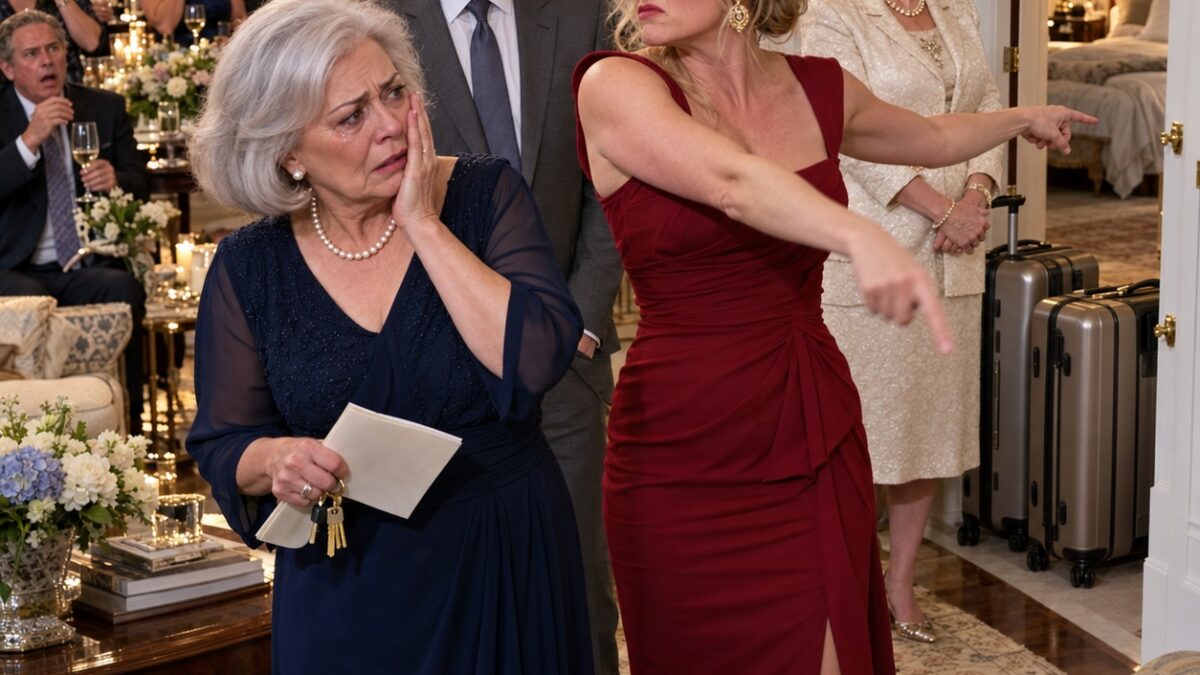
“The keys, Wendy.”
Silence began spreading through the room.
I looked at the box.
“To what?”
She smiled.
“My mom’s room.”
I knew.
But I wanted her to say it.
“Which room is that?”
A few guests shifted uncomfortably.
Kira’s smile tightened.
“The master bedroom.”
My bedroom.
The room where Frank and I had slept for decades.
I thought of him sitting at the kitchen table after we made the final mortgage payment.
He held the statement.
Did not say anything.
Then tears ran down his face.
I teased him for years.
“You cried over a mortgage.”
“I cried because I never have to pay it again.”
That room.
That house.
His hands everywhere.
The kitchen table.
The deck.
The workshop.
The bowl.
The little bookshelf.
The blanket box.
And Kira was holding out an empty gift box demanding my keys as though my home were a prize she could redistribute at her birthday party.
I said:
“No.”
Her smile remained for a second.
Then faded slowly.
“Wendy.”
“No.”
She took one step closer.
“Don’t make a scene.”
I almost admired the audacity.
Forty-seven guests.
Public announcement.
Empty box.
Demand for keys.
And I was making a scene.
“I’m not making anything.”
I said.
“This is my house, and the answer is no.”
Her face flushed.
“Mom needs that room.”
“Then your mother needs another place to live.”
Mona stepped forward.
“This is humiliating.”
I looked at her.
“You announced plans for my bedroom at a party.”
Kira’s voice sharpened.
“Wendy, just give me the keys.”
“No.”
She looked at my cardigan.
I kept my keys in the pocket.
Always had.
Kira reached.
Not symbolically.
Actually reached toward my pocket.
I caught her wrist.
“Don’t.”
Her eyes changed.
She jerked free.
Then her hand came across my face.
Sharp.
Immediate.
The sound seemed louder than the DJ speakers had been.
A woman standing closest to me held a Prosecco glass.
I watched the liquid ripple.
That tiny detail remains clearer than almost everything else.
Forty-seven people.
No one spoke.
My cheek burned.
My eyes watered automatically.
Physical reflex.
Not tears.
Not yet.
I looked at Kira.
Then Peter.
Four feet away.
My son.
He looked at the floor.
That hurt more than the slap.
I looked around.
Friends.
Acquaintances.
People who had eaten my food.
Walked through my rooms.
Some knew Kira.
Some knew Peter.
Most barely knew me.
Every face frozen.
I turned.
Walked through the sliding door.
Onto Frank’s deck.
The night was warm.
That late Ontario summer warmth that hangs around just long enough to make you think autumn may wait.
My cheek burned.
My hands were astonishingly steady.
I took out my phone.
Opened Beth’s conversation.
Typed one word.
Now.
Then I waited.
One heartbeat.
Two.
Three.
Four.
Five.
At around twelve seconds, the scream came from upstairs.
Not pain.
Discovery.
Kira.
“What the hell?”
A second voice.
Mona.
Then a heavy sound.
Something sliding.
I turned toward the glass doors.
A large bag came over the upstairs railing.
It landed in the living room.
Burst open.
Shoes scattered across Frank’s hardwood.
Expensive shoes.
I recognized one pair Kira had bought the previous fall.
She had called me afterward because there was a “small technical issue” with the credit card.
Another bag landed.
Then another.
A box of records.
The carry-on Mona had brought in June.
People began moving away from the staircase.
Beth appeared at the top.
Calm.
Completely calm.
She looked down at Kira.
“These are yours.”
Kira stared.
Then looked through the glass doors at me.
That moment was almost visible.
Understanding.
Not all of it.
Enough.
I stepped inside.
My cheek was still red.
The room smelled of perfume, alcohol, flowers, and cake.
“You have until eleven.”
I said.
Kira’s mouth opened.
“You can’t do this.”
I looked at her.
“Whose name is on the title?”
“This is insane.”
“Whose name?”
Mona pushed forward.
“Family does not treat family this way.”
Something almost peaceful entered me.
I thought of Frank.
The way he looked when a decision was finished.
No raised voice.
No performance.
Just certainty.
“I extended generosity to your daughter and my son for seven months.”
I said.
“What happened tonight was not a disagreement.”
Kira looked away.
“It was assault.”
People went still again.
“And I am giving all of you the opportunity to leave quietly rather than allow tonight to become more complicated than it needs to be.”
That was enough.
Guests began leaving.
Not all at once.
Slowly.
Awkwardly.
Some whispered.
A woman I had never met touched my arm near the door.
“I’m sorry.”
I nodded.
An older man shook his head.
“I’m sorry too.”
Another woman—one of Kira’s friends—paused.
“She’s under a lot of stress.”
I looked at her.
“Thank you for coming.”
She waited.
Perhaps expected me to engage.
I opened the door wider.
“Good night.”
She left.
Peter started carrying bags to the car.
One.
Two.
Three.
Four trips.
He did not look at me.
Kira did not apologize.
Not once.
Mona did not apologize.
Of course.
They moved their things.
The party dissolved.
The DJ packed equipment.
The caterers quietly gathered trays.
Around eleven, the last of them left.
Vases remained.
Some glasses.
Napkins.
The ridiculous three-layer birthday cake sat untouched on my kitchen counter.
Gold icing.
35.
I stood staring at it.
Beth came beside me.
“Want cake?”
I looked at her.
Then laughed.
It hurt my cheek.
“No.”
“Fair.”
She glanced at the clock.
“Are you okay?”
“Yes.”
She studied me.
“Actually?”
I thought.
“My face hurts.”
“Do you want ice?”
“Yes.”
“That’s a better answer.”
Beth wrapped ice in a dish towel.
I held it to my cheek.
We said very little.
At 11:40, headlights entered the driveway.
My body tightened.
Beth looked through the window.
“Peter.”
He came alone.
Walked to the front door.
I opened it.
He stood outside.
He had Frank’s height.
That always hurt in moments like this.
But Frank had carried himself differently.
Steady.
Even under pressure.
Peter looked like a man who had spent a year running toward a wall and had only just realized the wall would not move.
“Mom.”
I waited.
His eyes moved to my cheek.
“I should have done something.”
I stared at him.
“You should have done something seven months ago.”
He nodded.
“I know.”
I wanted anger.
A good mother in stories always knows exactly what to say.
I didn’t.
Part of me wanted to pull him inside.
Make coffee.
Tell him marriage was hard.
Tell him he had made mistakes.
Tell him we would fix it.
That part of me had been the problem.
Not love.
The habit of swallowing consequences before they reached him.
Peter reached into his pocket.
Held out a key.
My spare house key.
The one I had given him when he moved in.
Warm from his hand.
I took it.
He looked at me.
“I’m sorry.”
I believed he felt sorry.
That was not the same as understanding.
Not yet.
I could hear my own instinct beginning.
Ask where he will sleep.
Ask if he has money.
Offer something.
Solve it.
Instead, I closed my fingers around the key.
“Goodnight, Peter.”
His face changed.
“Mom—”
“Goodnight.”
He stood there for another few seconds.
Then nodded.
Walked to his car.
I watched the taillights disappear.
Closed the door.
Locked it.
The house was quiet.
Not empty.
Quiet.
There is a difference.
I had forgotten it.
For seven months, silence inside the house had meant tension.
Someone angry upstairs.
A conversation happening behind a closed door.
A passive-aggressive object moved six inches.
A new demand forming.
Now there was only silence.
Mine.
I walked into the kitchen.
Turned on the kettle.
Frank’s wooden bowl sat on the counter.
Exactly where it belonged.
I placed my keys inside.
Then immediately laughed.
“No.”
I picked them back up.
Cardigan pocket.
Where they had always been.
The kettle clicked.
I made tea.
Sat at Frank’s table.
For the first time that evening, I cried.
Not because Kira hit me.
Though that hurt.
Not because Peter failed to protect me.
Though that hurt more.
I cried because I suddenly understood how long I had been shrinking inside my own house to avoid making other people uncomfortable.
Frank and I had spent thirty-two years building a life there.
Within seven months, I had started behaving like a guest.
Asking myself whether a quilt was worth conflict.
Whether a bowl was just a bowl.
Whether a workshop was taking up too much space.
Whether my bedroom was selfish.
That realization humiliated me more than the party ever could.
I put my hand flat against the table Frank made.
“I’m sorry.”
I whispered.
Not to Frank exactly.
To myself.
Maybe both.
The next morning, Beth arrived with Tim Hortons and grocery-store bagels.
She let herself in because I had given her a key years ago and never once regretted it.
“Coffee.”
she announced.
“Good.”
“Bagels.”
“Better.”
She looked at my face.
The redness had faded.
“Any worse?”
“No.”
“Headache?”
“No.”
“Dizzy?”
“No.”
“Okay.”
She set the bag down.
We sat at the kitchen table.
Morning light came through the east window.
Clean.
Cool.
Ontario autumn beginning to announce itself.
Beth took a sip.
“You sure you’re okay?”
“Yes.”
She nodded.
“I know.”
I smiled.
“That is an infuriating response.”
“I learned from Dad.”
That nearly broke me.
We spent the day restoring things.
Not dramatically.
One object at a time.
The quilt first.
I took it down.
Beth held the level.
“Left.”
I moved it.
“Too far.”
“Beth.”
“Three millimeters.”
“Your father lives in you in terrible ways.”
She smiled.
Finally:
“There.”
We stepped back.
Straight.
Correct.
I looked at it.
The pattern Frank’s mother had sewn.
Blue.
Green.
Wedding rings.
The wall felt whole again.
Then we went to the workshop.
I opened the door.
Cedar.
Machine oil.
Dust.
Frank.
His half-finished side table remained on the bench.
Apron on the stool.
Tools.
Nothing touched.
Beth stood behind me.
“You want help in here?”
“No.”
“Okay.”
“I just want to sit.”
She nodded.
“I’ll be in the kitchen.”
I sat on the workshop stool.
Sunlight came through the small window.
Neighborhood sounds outside.
A lawn mower.
A car door.
Somebody calling to a child.
For the first time since Peter and Kira moved in, I did not feel like Frank’s workshop was a vulnerability I had to defend.
It was simply a room again.
A room I loved.
That afternoon, Beth and I put the rest of the house back.
The record player was gone.
Good.
Their shoes.
Clothes.
Boxes.
All gone.
Mona’s suitcase.
Gone.
The house looked larger.
Not because there was less furniture.
Because there was less pressure.
Peter called that evening.
I watched the phone ring.
Did not answer.
He called the next day.
I answered.
“Hi, Mom.”
“Hello, Peter.”
Pause.
“Kira’s really upset.”
There it was.
Not:
How is your face?
Not:
I have been thinking about what happened.
Kira is upset.
I closed my eyes.
“I’m going to stop you.”
“What?”
“If this call is about explaining Kira to me, I’m not interested.”
“She’s my wife.”
“Yes.”
“You know things have been difficult.”
“I know she slapped me.”
Silence.
“She shouldn’t have.”
“No.”
“But—”
I hung up.
The word but became a filter.
Over the next several weeks, Peter called many times.
Some conversations lasted.
Some did not.
If he said:
“I’ve been thinking about what I allowed.”
I stayed.
If he said:
“I know, but Kira felt—”
The conversation ended.
If he said:
“I should have spoken when she moved your things.”
I listened.
If he said:
“We were under financial pressure.”
I reminded him:
“Financial pressure did not move your father’s belongings into a box.”
That distinction mattered.
Circumstances explain stress.
They do not automatically excuse conduct.
I had spent years confusing those things.
No longer.
I removed my name from every shared financial arrangement I could appropriately end.
Some were simple.
Some required paperwork.
The loan required professional guidance.
I contacted a solicitor.
Straightforward.
No dramatic courtroom.
No revenge.
Documents.
Signatures.
Dates.
I put a lockbox on Frank’s workshop.
Not because I expected Peter or Kira to break in.
Because boundaries should not depend entirely on people respecting them voluntarily.
It felt sad the first day.
Then sensible.
Not victory.
Maintenance.
That became my word.
People love revenge stories.
There was no revenge.
I did not want Kira homeless.
Did not want Peter ruined.
Did not secretly hope their marriage collapsed.
I wanted my property, finances, and dignity protected.
That is maintenance.
You repair a leaking roof because you value the house.
You close financial access because you value your stability.
You lock a workshop because you value what is inside.
You say no because you value yourself.
None of that requires hatred.
October arrived.
One Tuesday morning, I stood at the kitchen window watching frost appear along Frank’s deck boards.
Perfect spacing.
Still.
I had a strange realization.
For seven months, I had been grieving a living person.
Peter.
Not because he had died.
Because the son I expected him to be had repeatedly failed to appear.
That kind of grief is confusing.
Death gives you an event.
A date.
A body.
A funeral.
Living disappointment gives you phone calls.
Explanations.
Hope.
Then another disappointment.
There is no socially recognized ceremony for realizing your adult child is capable of watching someone slap you and looking at the floor.
I did not stop loving him.
That would have been easier in some ways.
I loved him.
And I no longer trusted him in the same way.
Both were true.
I drank my coffee.
Watched frost.
Let both truths exist.
The cardigan remained in my closet.
Frank’s cardigan.
Some mornings I opened the door and it was simply fabric.
Brown.
Old.
Worn at the cuffs.
Other mornings I touched it and grief became twenty-six months old and brand new at exactly the same time.
I stopped judging which kind of morning it was.
A retired nurse in my neighborhood named Patricia—someone who had lost her husband six years before Frank died—once told me:
“The hardest year isn’t always the first.”
I asked:
“What do you mean?”
“The first year, everyone knows.”
She said.
“They call.”
“They remember anniversaries.”
“They ask whether you’re okay.”
“Later, they expect your grief to become tasteful.”
I laughed.
“Grief should become tasteful?”
“You know.”
She smiled sadly.
“Quiet enough not to inconvenience anybody.”
I thought about that often.
Kira had never understood why Frank’s objects mattered.
To her:
A bowl.
A quilt.
A workshop.
A cardigan.
A room.
Space.
Unused square footage.
To me, those things were not sacred because they were expensive.
They were sacred because time had happened around them.
That distinction became clearer after the party.
A home is not valuable because of bedrooms.
It is valuable because of repetition.
Frank making coffee before I woke.
Me yelling from upstairs asking whether he had seen my keys when they were usually in my own pocket.
Arguments over shutters.
Dinner at his handmade table.
Winter boots near the door.
Our son coming home late as a teenager.
Beth doing homework at the kitchen counter.
Ordinary life.
Thousands of repetitions.
That is what Kira tried to redistribute.
Not merely a room.
History.
By November, my mornings were mine again.
Coffee.
Always first.
I stood at the kitchen window.
No one came downstairs telling me the hallway looked cluttered.
No suitcases appeared outside my bedroom.
No one suggested Frank’s workshop needed a practical purpose.
Beth visited most weekends.
Sometimes we talked about Peter.
Sometimes not.
I appreciated the not.
Patricia drove from Hamilton occasionally.
We walked the dog along the lakefront trail.
The dog did not care about family drama.
An excellent quality.
One weekend, I decided to refinish Frank’s kitchen table.
It had needed sanding for two years.
I had kept postponing it because Frank had always handled that type of work.
Then I thought:
Wendy, you are sixty-five.
The man is not coming back to sand the table.
That sentence sounds harsh.
It wasn’t.
It was strangely freeing.
I borrowed a belt sander.
Watched a tutorial four times.
Four.
The first viewing was optimism.
The second was confusion.
Third, fear.
Fourth, acceptance.
Beth walked in while I was working.
“What are you doing?”
“Destroying your father’s table.”
She looked at it.
“Looks okay.”
“Leave.”
She laughed.
I did not destroy it.
In fact, it came out beautifully.
When I finished, I ran my hand across the surface.
Smooth.
Frank had built the table.
I maintained it.
There was something emotionally important about that.
Keeping Frank’s memory did not require freezing everything at the moment of his death.
I could care for what he left.
Repair it.
Use it.
Live around it.
That thought changed the workshop slightly too.
I still did not clear it.
I was not ready.
Maybe never would be.
But I started going in more often.
Opened windows.
Cleaned a little dust.
Touched the unfinished side table.
Not to complete it.
Not yet.
Just to exist there without feeling I was entering a mausoleum.
Grief softened when nobody was trying to take it away from me.
That surprised me.
Peter’s calls continued.
His tone changed gradually.
Not perfectly.
Some days he understood.
Other days he defended.
I learned not to measure my peace by his progress.
That was another old habit.
I had always wanted my children settled.
Happy.
Safe.
Parents can spend so much energy stabilizing adult children that they stop noticing they are standing in the middle of the child’s consequences.
I had done that with Peter financially.
Emergency card.
Insurance.
Transfers.
Cosigning.
Each individual act felt loving.
Together, they had created an environment where Peter could avoid fully facing his own choices.
My support had protected him.
Then my protection became permission.
That was difficult to admit.
Not because helping your children is wrong.
Because help without boundaries can quietly become participation in avoidance.
I had participated.
That did not make Kira’s conduct my fault.
Important distinction.
I did not make her move my belongings.
Did not make her slap me.
Did not make Peter look at the floor.
But I had trained all of us to believe Wendy would absorb discomfort.
Then one night Wendy stopped.
People sometimes asked whether throwing their belongings over the railing was too dramatic.
I always corrected that part.
Beth moved the bags.
Carefully packed.
They landed dramatically because stairs and gravity do dramatic things.
We did not smash valuables.
Did not destroy clothes.
Everything had been prepared.
The shock was not damage.
The shock was that Kira discovered I had already stopped negotiating.
That is why the scream came.
She finally saw the consequence before she could talk around it.
My favorite image from that night is not the bags.
Not her face.
Not even Beth at the top of the stairs.
It is my hand holding the phone on Frank’s deck.
Cheek burning.
Heart steady.
Typing:
Now.
One word.
I think that was the first clean boundary I had set in years.
No explanation.
No apology.
No request for permission.
Now.
Beth later told me she had been sitting on the edge of the guest bed waiting.
“When your message came through, I almost felt relieved.”
“Relieved?”
“Yes.”
“Why?”
“Because I was afraid you’d talk yourself out of it.”
I stared at her.
“That is insulting.”
“It is accurate.”
I sighed.
“Also insulting.”
She smiled.
“You know I love you.”
“Apparently enough to throw shoes.”
“They were packed.”
“Some scattered.”
“Gravity.”
I laughed.
Beth had inherited Frank’s timing.
Peter had inherited his height.
Life distributes things strangely.
I did not hate Kira.
That surprises people.
Anger, yes.
Disgust.
A profound loss of respect.
But hatred would have kept her living in my house emotionally after I removed her physically.
I had given her enough space.
I was not giving more.
Mona was easier.
I simply did not think about her often.
A woman who announces which room she will take in another woman’s house is very committed to her own perspective.
I had no desire to change it.
People are allowed to misunderstand boundaries.
They are not entitled to cross them.
Peter was harder because love remained.
I remember one phone call months later.
He said:
“Mom, I keep thinking about the party.”
I waited.
“I saw her hit you.”
“Yes.”
“And I did nothing.”
“Yes.”
“I don’t know why.”
I could have answered.
Fear.
Conflict avoidance.
Marriage dynamics.
Habit.
Cowardice.
Probably several.
I did not.
Peter needed to examine himself, not receive another explanation from me.
He said:
“I’m ashamed.”
I believed him.
I said:
“That feeling is yours.”
He was quiet.
Then:
“I know.”
For once, no but.
I stayed on the phone.
That was how rebuilding worked.
Not instant forgiveness.
Not dramatic estrangement.
Conversation by conversation.
Truth by truth.
If Peter wanted relationship, he had to participate in reality.
I would not carry both sides.
That was the new rule.
I did not know what would happen with Kira.
The source of my life at that moment did not provide a neat future.
Their marriage was theirs.
I stopped making predictions.
That was freedom too.
My job was not to manage what came next for them.
My job was to manage my own home.
My finances.
My boundaries.
My grief.
My relationship with my children as it actually existed, not as I wished it did.
I became very good at checking my cardigan pocket.
Keys.
Always.
The slap itself faded quickly.
The bruise never became something dramatic.
But the memory remained.
People ask:
“Weren’t you humiliated?”
For a few minutes, yes.
Forty-seven people saw my daughter-in-law hit me.
That is humiliating.
Then something changed.
The shame moved.
It belonged to her.
I did not strike anyone.
Did not reach into someone’s pocket.
Did not publicly announce ownership over a room that was not mine.
Did not stand four feet away while my mother was hit.
I had nothing to hide.
Once I understood that, the memory changed.
I stopped seeing forty-seven witnesses to my humiliation.
I saw forty-seven witnesses to Kira’s decision.
There is power in placing responsibility accurately.
One of those guests saw me weeks later at a grocery store.
I barely recognized her.
She approached carefully.
“Mrs. Callahan?”
“Yes?”
“I was at Kira’s party.”
My stomach tightened slightly.
She said:
“I’ve wanted to tell you something.”
I waited.
“I’m sorry nobody said anything.”
I did not know what to say.
She continued.
“It happened so fast.”
“I know.”
“I just froze.”
I nodded.
“So did a lot of people.”
She looked embarrassed.
“I should have said something.”
Maybe.
But I did not need forty-seven people to rewrite the moment afterward.
I said:
“You’re saying something now.”
She smiled faintly.
“Take care.”
“You too.”
That was enough.
The older man who apologized on his way out never contacted me.
Neither did most guests.
That was fine.
They had been temporary witnesses.
My life did not depend on their verdict.
The person whose verdict I had spent too long fearing was Kira.
Then Peter.
Then everyone.
Once I stopped, the world became quieter.
I began understanding why Beth had been wary before they moved in.
One day I asked her.
“What did you see?”
She thought.
“Kira always talked about your house like it was family property.”
“When?”
“Years ago.”
“Why didn’t you say anything?”
“I didn’t know if it meant anything.”
“Fair.”
“She’d say things like, ‘When Wendy downsizes,’ or ‘When we have more space someday.’”
I stared.
“She said that?”
“Not constantly.”
Beth shrugged.
“Just enough that I noticed.”
I felt anger rise.
Then stop.
Past evidence.
Current boundary.
No need to relitigate every sentence.
Beth said:
“I also saw how Peter got around her.”
“How?”
“He disappears.”
Accurate.
“He lets silence do the agreeing for him.”
That hurt.
Because it was exactly what happened at the dinner table.
At my bedroom.
At the party.
Peter believed silence kept him neutral.
It did not.
Silence usually benefits the person already pushing hardest.
I wished I had taught him that younger.
Maybe I had tried.
Maybe adults still choose.
Again, not everything belongs to mothers.
That lesson took me sixty-five years.
Frank would probably have understood earlier.
I imagined him sometimes.
Not as a ghost.
As memory.
What would Frank have done if Kira demanded our bedroom?
I could hear him.
“No.”
That would have been it.
Not cruel.
Not loud.
No argument.
Kira might have tried explaining.
Frank would listen.
Then:
“No.”
I had mistaken his steadiness for personality.
It was also practice.
Frank had known boundaries.
I had often been the softer one.
We balanced each other.
After he died, I had continued using only my half of the marriage.
Generosity without his counterweight.
Compassion without enough structure.
Maybe that was part of why things drifted.
That realization did not make me angry with myself.
It made me miss him differently.
I had not only lost the man I loved.
I had lost the person who helped me hold shape.
Now I had to do that work myself.
The party forced me to learn.
Winter arrived.
The first real snowfall covered the deck.
I stood at the back door with coffee.
Frank’s boards disappeared beneath white.
For a second, the house looked new.
Then I looked around the kitchen.
The bowl.
Table.
Kettle.
Quilt visible down the hallway.
My keys in my pocket.
Nothing new.
Everything reclaimed.
I had become comfortable alone again.
Not lonely every day.
Alone.
Important distinction.
Loneliness still came.
Frank was still dead.
Removing Kira did not cure widowhood.
Boundaries do not eliminate grief.
Some evenings, I would hear something I wanted to tell Frank.
Then remember.
That ache remained.
But now it was my ache.
Not mixed with somebody moving his belongings into boxes.
I could grieve without defending my right to grieve.
That was enormous.
One afternoon, I sat in his workshop with the door open.
Snow outside.
The half-finished side table in front of me.
I ran my hand over the wood.
“You know what happened?”
I said aloud.
Talking to dead husbands is one of the privileges of widowhood.
No answer.
“Peter disappointed me.”
I stared at the table.
“You’d be furious.”
Probably true.
“I’m trying not to be furious forever.”
I smiled sadly.
“You’d probably tell me to stop paying his insurance.”
That made me laugh.
Frank had said similar things while alive.
Not because he did not love Peter.
Because he believed adults needed enough friction to learn.
I had often intervened.
“Let him figure it out, Wendy.”
I would say:
“He’s struggling.”
Frank:
“Struggling is how people figure things out.”
At the time, I thought he was too hard.
Now I understood some of it.
Not all struggle is beneficial.
Not all help is harmful.
The line is complicated.
But absorbing every consequence is not love.
Sometimes love lets the weight land.
Peter needed weight.
I had finally stopped catching it.
In spring, Beth and I sat on the deck.
“You look better.”
she said.
“That is a dangerous thing to say to a sixty-five-year-old woman.”
“I mean relaxed.”
“Also dangerous.”
She laughed.
“You know what I mean.”
I did.
I slept better.
Ate better.
Did not feel constantly observed in my own house.
I had forgotten how exhausting it is to anticipate someone else’s disapproval in your own kitchen.
No one should live that way voluntarily.
I looked at Beth.
“Thank you.”
“For what?”
“The attic.”
She grinned.
“My pleasure.”
“You enjoyed that too much.”
“Maybe.”
“Throwing Kira’s shoes?”
“They were very expensive shoes.”
“Beth.”
“I packed them carefully.”
I laughed.
Frank would have laughed too.
The house was healing through laughter.
That is another thing nobody tells you.
After conflict, you do not need every recovery moment to be solemn.
Sometimes putting the quilt straight and laughing about shoes is enough.
Peter visited eventually.
Not to move back.
Important.
He asked.
That mattered.
“Can I come by?”
“Yes.”
He arrived alone.
He stood in the entryway awkwardly.
His eyes went automatically toward the kitchen bowl.
Then the hallway quilt.
He noticed the lockbox on the workshop.
His face changed.
“That’s new.”
“Yes.”
He nodded.
I did not explain.
We sat at the kitchen table.
For several minutes, Peter said nothing.
I waited.
Old Wendy would have filled the silence.
Asked about work.
Kira.
Money.
Anything to make him comfortable.
New Wendy drank coffee.
Finally, he said:
“I should have stopped it before the bedroom.”
“Yes.”
“I knew she moved your quilt.”
“Yes.”
“I knew about the bowl.”
I looked at him.
“You did?”
He nodded.
That hurt.
More truth.
Good.
“I told myself it was between you two.”
“It was happening in the house you were staying in for free.”
“I know.”
He rubbed his hands together.
“I didn’t want to fight with her.”
“So you let me fight with her.”
He closed his eyes briefly.
“Yes.”
That was one of the hardest admissions.
No defense.
I respected it.
He continued.
“When Mona came, I knew.”
“About the bedroom?”
“Yes.”
My stomach tightened.
“You knew they were moving my things?”
“Not until that day.”
“But you knew Kira planned to ask.”
“Yes.”
I looked at him for a long time.
He did not look away.
That mattered.
I said:
“I love you.”
His face crumpled slightly.
“I love you too.”
“But love does not erase this.”
“I know.”
“I need you to understand that.”
“I do.”
“Do you?”
“I’m trying.”
Good enough for that day.
We did not hug immediately.
That may surprise people.
I was not performing reconciliation.
We had coffee.
Talked.
When he left, he asked:
“Can I call you?”
“Yes.”
That was our rebuilding.
Consent.
Boundaries.
No automatic key.
No financial rescue.
No bedroom.
Relationship.
Separate from access.
That distinction may be the most important thing I learned.
Being someone’s mother does not mean they automatically receive unrestricted access to everything you own.
Money.
House.
Time.
Emotional energy.
Forgiveness.
Love can exist while doors remain closed.
In fact, sometimes love survives because doors finally have locks.
I became less afraid of the word selfish.
That was Kira’s favorite weapon.
Selfish.
I tested it.
Was keeping my bedroom selfish?
No.
Was protecting Frank’s workshop selfish?
No.
Was refusing to fund their spending selfish?
No.
Was refusing to house Mona without agreement selfish?
No.
Was expecting not to be hit selfish?
Obviously not.
Words lose power when you inspect them.
Kira had used selfish to mean:
You are not giving me what I want.
Those are not the same thing.
I wish I had learned that at forty.
At sixty-five works too.
The title of the house stayed in my name.
The keys stayed with me.
I reviewed estate paperwork eventually—not because of Kira, but because conflict reminds you clarity matters.
I did not make dramatic changes out of revenge.
I simply made sure my intentions were clear.
That gave me peace.
The house would one day belong to somebody else because I would one day be gone.
That is life.
But while I was alive, it was mine.
That sounds obvious.
It had taken a slap to make it emotionally obvious.
I resented that sometimes.
Then let it go.
I did not owe Kira gratitude for teaching me boundaries.
She had simply crossed enough of them that I finally defended one.
The growth was mine.
Months after the party, I ran into a neighbor who had heard a distorted version.
“You kicked your son out at a birthday party?”
I smiled.
“After his wife hit me.”
Her eyes widened.
“Oh.”
Information matters.
I did not give the full story.
Did not need the neighborhood jury.
“Families are complicated.”
she said.
“Yes.”
I replied.
“That’s why houses have doors.”
She looked confused.
I went home.
I was becoming funnier in my old age.
Frank would approve.
The house changed after Peter and Kira left, but not because I redecorated.
I barely changed anything.
That was the point.
The quilt.
Straight.
The bowl.
Counter.
Workshop.
Frank’s.
My bedroom.
Mine.
Keys.
Pocket.
Sometimes reclaiming a life is not about creating something new.
It is about stopping other people from moving what you never gave them permission to touch.
I began hosting Beth for dinner.
Patricia sometimes.
Small.
Comfortable.
No forty-seven strangers.
No DJ.
No $4,600 bill.
Just food.
Conversation.
A dog waiting for crumbs.
One evening Beth said:
“You know, Dad would have hated Kira’s party.”
I laughed.
“He would have gone upstairs at eight.”
“He would have complained about the DJ.”
“For weeks.”
“And the florist.”
“He would ask why flowers cost money when flowers grow outside.”
Beth smiled.
We sat quietly.
Then she said:
“I miss him.”
“Me too.”
No one told us to move on.
No one packed his things.
No one called the room wasted space.
Grief became tender again instead of defensive.
That may have been one of the greatest things I recovered.
The right to remember without arguing.
Peter’s financial life became his.
I mean that literally and emotionally.
If he mentioned a problem, I listened.
I stopped immediately solving.
Once he said:
“The car insurance is killing me.”
Old Wendy would have asked how much.
Maybe transferred money.
New Wendy said:
“That sounds stressful.”
He waited.
I waited.
Then he laughed awkwardly.
“You’re not going to offer, are you?”
“No.”
He nodded.
“Okay.”
Not cruel.
Clear.
He figured it out.
Imagine that.
Adults often do when nobody removes the need.
I felt proud of him.
And proud of myself for letting him.
His progress did not erase the party.
Again, no erasing.
But a relationship can accumulate better evidence.
He learned.
I learned.
Slowly.
Kira remained more distant.
That was fine.
I did not demand apology on a schedule.
I also did not pretend one had happened.
At the point my story ends, she had not apologized.
That is the truth.
Some stories do not need the person who hurt you to suddenly understand everything.
Closure is not always mutual.
I could restore peace without Kira agreeing I deserved it.
That was liberating.
Mona likewise did not apologize.
Also fine.
I did not need her to certify ownership of my own bedroom.
The deed had already handled that.
Sometimes paperwork is emotionally soothing.
I kept Frank’s cardigan.
Still do.
Some days it is a cardigan.
Some days it carries thirty-one years.
Both acceptable.
The watch remains in the nightstand.
The workshop remains largely as Frank left it.
Not because I am incapable of moving forward.
Because moving forward is not measured by how efficiently you dispose of the dead person’s belongings.
That is another lesson.
People confuse letting go with throwing away.
I let go of many things.
My need to rescue Peter financially.
My fear of Kira’s disapproval.
My reflex to call every boundary selfish.
I did not need to let go of Frank’s cardigan to prove growth.
Growth is selective.
Keep what gives love.
Release what demands self-erasure.
By the following summer, the deck needed maintenance.
I stood looking at it.
Frank’s boards.
Thirty years of weather.
I could have hired someone.
Instead, I called Beth.
“Do you own a drill?”
“Why?”
“Answer the question.”
“Mom.”
“Do you?”
“Yes.”
She arrived Saturday.
We repaired two boards.
Argued about spacing.
I stopped suddenly.
Beth looked at me.
“What?”
I started laughing.
“What?”
“Your father.”
She understood.
“Spacing?”
“Spacing.”
She shook her head.
“He was right.”
“Do not say that.”
“He absolutely was.”
We laughed until I cried.
Not grief exactly.
Love wearing another form.
The deck continued.
So did we.
One of the strange things about family conflict is that people expect an ending.
Did Peter become perfect?
No.
Did Kira transform?
Not in the part of the story I know.
Did I cut everyone off forever?
No.
Did I forgive everything instantly?
Absolutely not.
Life is less satisfying than revenge fiction and more meaningful.
I learned limits.
Peter began learning consequences.
Beth remained Beth.
Frank remained absent and present in all the ways grief allows.
The house remained standing.
That was enough.
The slap stopped being the center.
For a while, when I told someone what happened, I began with it.
Then gradually I began elsewhere.
The quilt.
The bowl.
The workshop.
Why?
Because the slap was shocking, but the smaller violations mattered.
People often wait for one dramatic act before trusting their discomfort.
You do not have to.
If someone repeatedly moves what belongs to you after you put it back, that matters.
If generosity turns into entitlement, that matters.
If someone boxes your dead husband’s things and labels them miscellaneous, that matters.
You do not need to be hit before saying no.
I wish I had understood sooner.
Maybe the party would never have happened.
But I refuse to punish myself for learning late.
Late learning is still learning.
At sixty-five, I finally understood my keys were not just metal.
They represented access.
Who enters.
Who stays.
Who decides.
For years, I gave access freely because I equated openness with love.
Frank was more selective.
He trusted slowly.
I teased him.
Now I understood.
A key is not affection.
A financial signature is not affection.
A bedroom is not proof of affection.
Love can be generous.
It should not require surrendering governance over your own life.
I sometimes take my keys out of the cardigan pocket and place them on Frank’s wooden bowl.
Then I remember the party and put them back.
Habit.
Maybe superstition.
Either way, they remain with me.
Nobody asks for them now.
Good.
I think about the empty white gift box sometimes.
The arrogance of it.
Kira had staged my surrender as part of her birthday celebration.
That was what stunned me later.
She did not privately pressure me.
She created a public moment because she believed the audience would force compliance.
She assumed I would be too embarrassed to say no.
She knew I valued politeness.
She counted on it.
That was the real reason I said no twice.
The first no was about the bedroom.
The second was about the strategy.
I refused to let an audience become a weapon against me.
Ironically, the audience became witnesses instead.
That is one of those turns life occasionally provides without planning.
Kira wanted forty-seven people to watch me surrender.
Instead, forty-seven people watched me refuse.
Then watched her hit me.
Then watched her belongings come down the stairs.
I did not design the symmetry.
I will admit I appreciate it.
But satisfaction is not revenge.
The satisfaction came from clarity.
Everyone saw.
Including Peter.
He could never later say:
“I didn’t realize how bad it was.”
He had stood four feet away.
That fact forced honesty.
Perhaps that was the most useful consequence of the party.
Private dysfunction survives through ambiguity.
Public behavior removes ambiguity.
Afterward, Peter could explain Kira’s stress.
Their finances.
Mona’s hip.
Anything.
But the central fact remained.
Kira slapped his mother.
He looked down.
No explanation changed the image.
Eventually, he had to face it.
So did I.
I faced another image too.
Myself on Frank’s deck typing Now.
I became proud of that woman.
For months, I was embarrassed I had allowed so much before that point.
Then I began respecting the moment I finally stopped.
There is no benefit in telling someone:
“You should have left earlier.”
Maybe.
But they left when they could.
I set the boundary when I could.
Honor the boundary.
Do not invalidate it because it was delayed.
That applies to many things.
My mornings became almost ceremonial.
Coffee.
Window.
Deck.
Sometimes frost.
Sometimes rain.
Sometimes sunlight.
No rush.
The first year after Frank died, mornings hurt because he was missing.
The months Peter and Kira lived there, mornings hurt because the house no longer felt entirely mine.
Now mornings held both absence and ownership.
I could handle that.
I began thinking of the house less as a monument to Frank and more as the life we had built that I was still allowed to inhabit.
Important.
Widows sometimes feel guilty enjoying things alone.
We built this for two.
Now one remains.
Does using it alone dishonor the missing person?
No.
Frank worked too hard on that deck for me to spend the rest of my life avoiding it.
So I sat there.
Drank coffee.
Sometimes laughed remembering our arguments.
The house became living space again.
Not merely memory.
That was my answer to everyone who thought one person did not need so much room.
Need is not only square footage.
A person can “need” a room because of history.
A person can also not need to justify it at all.
That may be even more important.
My name was on the title.
I lived there.
I did not owe a utilization report.
Kira had turned my grief into an argument for redistribution.
Empty workshop?
Use it.
Large bedroom?
Give it away.
Big house?
Family property.
No.
A widow does not lose property rights because her husband dies.
Obvious legally.
Apparently less obvious socially.
I became very clear about it.
Peter once said on the phone:
“I think Kira saw the house as part of the family.”
I replied:
“She saw my house as available.”
He was quiet.
“That’s different.”
“Yes.”
I appreciated that he finally heard it.
There is a difference between belonging in a family and owning whatever family members possess.
Boundaries make families possible.
Without them, “family” becomes a word people use to justify entitlement.
Mona used it that night.
Family.
Decency.
I remember almost smiling.
People often invoke decency immediately after violating it.
I chose not to argue.
The bags were already downstairs.
Some lessons need logistics more than debate.
Beth remained the quiet hero of the whole mess.
She would hate that phrase.
She did not rescue me.
I do not want the story told that way.
She supported me once I chose.
Important difference.
She did not storm into the house weeks earlier and take over.
She brought information.
Asked:
“What do you want to do?”
Then helped me do it.
That is respect.
It gave me agency instead of replacing one controlling person with another.
I tried to remember that when Peter began sorting out his own life.
Give information.
State boundaries.
Let him choose.
Harder than it sounds.
Mothers like control disguised as concern too.
I was not immune.
The events made me examine myself as much as everyone else.
I had controlled outcomes financially.
Prevented discomfort.
Softened landings.
Maybe I had underestimated Peter by assuming he could not handle consequences.
That was not kindness.
So I changed.
Slowly.
The relationship became more adult.
Less comfortable sometimes.
More honest.
There were days he did not call.
I let them pass.
Days I missed him.
I let myself miss him without using money as a bridge.
That was new.
Beth told me once:
“You’re doing better.”
I said:
“I hate when you say that.”
“Why?”
“Because it suggests I was doing badly.”
“You were.”
I stared.
She smiled.
Again, Frank.
I laughed.
“You people are unbearable.”
“You raised me.”
“Unfortunately.”
We ate bagels.
Life.
At some point, I realized I had stopped checking the hallway quilt every morning.
That seems small.
For months while Kira lived there, I would look.
Straight?
Moved?
Gone?
After she left, I still checked.
Hypervigilance.
Then one day I walked past without noticing.
Later, I realized.
The quilt had become part of the wall again.
Safe enough to become invisible.
That moved me.
Security is when you stop checking whether your things are where you left them.
I had that back.
The bowl too.
Sometimes mail piled in it.
Keys.
A pen.
Receipts.
Ordinary use.
No longer an object under threat.
Frank would have liked that.
He made things to be used.
I had to remember.
I kept his memories.
I also used his table.
Sat on his deck.
Filled his bowl.
Opened the workshop.
This was not a museum.
It was home.
One morning in late autumn, I stood in the workshop and looked at the unfinished side table.
For the first time, I wondered whether I might finish it someday.
Not then.
No pressure.
Just possibility.
That felt like progress.
Progress did not require completing it.
The thought itself was enough.
Grief had changed from:
Do not touch anything.
to:
Maybe one day.
I trusted that.
No schedule.
No Kira telling me the room was wasted.
My timing.
That was all I had ever wanted.
I began understanding that control over one’s home is deeply tied to control over grief.
Home contains the private rituals other people do not see.
The drawer you never open.
The cardigan you touch.
The chair you avoid for six months.
The room you eventually enter.
When someone takes over your home, they interfere with those rituals.
Kira could not understand because she was looking at utility.
But utility is not the only human value.
Memory.
Safety.
Identity.
Continuity.
These matter too.
The bedroom was perhaps the most intimate.
Thirty-one years with Frank.
Arguments.
Illness.
Reading.
Sleep.
Laughter.
The last morning he woke there.
His empty side afterward.
People might say:
“It’s just a room.”
No.
And also:
Even if it were just a room, it was mine.
Both arguments valid.
I no longer felt obligated to make the emotional case.
Ownership was sufficient.
That realization made boundaries easier.
You do not need a tragic backstory for every no.
“No” can stand alone.
Kira hated that.
I learned to love it.
Sometimes I practiced it in tiny situations.
Patricia:
“Want another coffee?”
“No.”
No explanation.
Beth:
“Want to come Sunday?”
“No, I’m tired.”
No elaborate excuse.
Small muscle.
Boundaries improve with use.
I had let mine weaken.
Now I exercised them.
Not into hardness.
Into clarity.
That distinction matters.
People who benefit from your lack of boundaries often describe boundaries as cruelty.
That does not make them cruel.
When Peter said once:
“You’re different now.”
I asked:
“Worse?”
He thought.
“No.”
“Then what?”
“Less… automatic.”
I knew exactly what he meant.
Old Wendy:
Problem?
Fix.
Need money?
How much?
Need room?
Yes.
Need insurance?
Fine.
New Wendy:
What happened?
What are you doing?
What do you need from me specifically?
What am I willing to give?
That pause felt radical.
Peter noticed.
Good.
The party had cost Kira $4,600 according to her estimate.
I never asked how the bill was paid.
Not my account.
That sentence became delicious.
Not my account.
So many adult problems become lighter when accurately assigned.
Their credit?
Not my account.
Their housing?
Not my account.
Their marriage?
Not my account.
My house?
Very much my account.
Simple.
I wish we taught that in schools.
The caterers left behind several vases that night.
For weeks, one sat empty on a shelf because I did not know whose it was.
Eventually I called.
They told me I could keep it.
I put flowers in it.
Something about that pleased me.
An artifact of the worst party I ever attended became a vase on my kitchen table.
Not symbolic deliberately.
It simply happened.
But I liked it.
Transform what remains.
No need to throw everything away because of association.
Use it differently.
I suppose that was my whole life after Frank.
Use what remains.
Differently.
The house.
The table.
The deck.
Me.
There is a version of this story where I sell the house and travel.
People like endings like that.
Fresh start.
New city.
Transformation.
That is not my story.
I stayed.
Staying was not weakness.
The house was not trapping me.
It was mine.
Why should Kira’s entitlement push me out of the place Frank and I built?
No.
Reclaiming meant remaining without apology.
My mornings there became the victory.
Coffee at the window.
No drama.
That is enough.
Beth once asked:
“Do you ever think about downsizing?”
I gave her a look.
She laughed immediately.
“Wrong question.”
“Very.”
“I mean eventually.”
“Maybe.”
That was honest.
Maybe one day.
If I choose.
That difference is everything.
Leaving by choice is not being pushed out.
Changing a room by choice is not having someone pack your husband into a box.
Timing.
Consent.
Ownership.
Simple words.
Entire life.
Peter’s relationship with me continued.
Imperfect.
I was still his mother.
That does not turn off.
Some days I worried.
I wanted to fix.
I resisted.
Other days I offered help because I genuinely wanted to and because the help did not undermine either of us.
Boundaries are not permanent refusal.
They are conscious choice.
That was another distinction.
I could give after the party.
I simply stopped believing giving was mandatory.
Generosity became generous again once it was voluntary.
Before that, it had become tribute.
That may be the best way to describe what Kira wanted.
Not help.
Tribute.
Prove family by surrendering.
Bedroom.
House.
Money.
Space.
No.
Family that requires tribute is not healthy family.
I stopped paying.
Emotionally and literally.
My solicitor eventually helped me manage the loan issues properly.
Again, boring.
Documents.
Calls.
No dramatic legal revenge.
I appreciated boring.
Drama had cost enough.
The bank did what banks do.
Forms.
Signatures.
Confirmation.
I filed everything.
Put copies in a drawer.
Responsibility feels unglamorous.
Good.
Glamour is overrated.
Maintenance saves homes.
Frank knew that.
Clean gutters.
Check roof.
Sand table.
Pay mortgage.
Protect title.
Say no to people who believe love makes property communal.
Maintenance.
I think Frank would be proud of that word.
One afternoon, while sanding the table, I imagined him watching.
“You’re pressing too hard.”
I could hear him.
I stopped.
“Shut up.”
I said aloud.
The dog looked at me.
I laughed.
“Not you.”
Grief had become companionable.
That is the best way I can describe it.
It still hurt.
But it could sit beside laughter.
Kira’s behavior had temporarily made grief defensive.
Once she was gone, grief could soften again.
I was grateful.
The twenty-six months since Frank’s death continued becoming more months.
Anniversaries passed.
People stopped mentioning him as often.
Patricia had been right.
The world expects grief to age politely.
I stopped caring.
If I wanted to mention Frank, I did.
If I did not, I did not.
No performance.
No schedule.
I wore his cardigan one cold morning.
That surprised me.
For years it had stayed in the closet.
I put it on.
Sleeves a little long.
Smelled mostly like fabric now, not him.
I stood in front of the mirror.
Cried briefly.
Then made coffee.
That was progress too.
Using instead of preserving.
Maybe eventually I would stop.
No rule.
My house.
My grief.
My cardigan now.
That sentence felt sad.
Then warm.
Some ownership passes through love.
Not entitlement.
Gift.
Frank could no longer wear it.
I could.
Different from Kira deciding my bedroom belonged to Mona.
Consent remains the dividing line.
Even with the dead, I felt that intuitively.
Frank had made things for our shared life.
Using them honored that.
Kira had tried to seize things for convenience.
Not the same.
I became very interested in distinctions.
Perhaps because for months everything had been blurred under the word family.
Family means help.
Family means sacrifice.
Family means sharing.
Sure.
But family also means respect.
Permission.
Protection.
Truth.
If only one side is expected to sacrifice, that is not a family principle.
It is a hierarchy.
Kira had placed herself near the top.
I declined the promotion.
One evening Peter called.
We talked for almost an hour.
No mention of money.
No defense of Kira.
At the end he said:
“I miss Dad.”
I closed my eyes.
“Me too.”
“I keep thinking what he would’ve said.”
“So do I.”
“He would’ve been disappointed in me.”
I could have comforted him.
“No, Peter.”
“He loved you.”
Both could be true.
I chose accuracy.
“He probably would have been.”
Peter inhaled.
I continued.
“He also would have loved you.”
Silence.
“That’s harder.”
he said.
“Yes.”
It is.
Love does not cancel disappointment.
Disappointment does not cancel love.
Adults must learn to hold both.
I was learning too.
After we hung up, I sat at Frank’s table.
Touched the wood.
I did not feel triumphant.
I felt sad.
And hopeful.
Sometimes those coexist.
No viral ending required.
The house at night became my favorite.
Lights low.
Dog sleeping.
No footsteps upstairs except mine.
No arguments behind doors.
I would walk through the hallway.
Quilt straight.
Bedroom intact.
Frank’s watch in the drawer.
I did not check every night.
But occasionally.
Not fear.
Affection.
I would touch the drawer handle.
Then leave it closed.
Knowing mattered.
One object Kira had placed in that miscellaneous box.
Not miscellaneous.
Nothing in a life is miscellaneous to the person whose life it is.
That became another lesson.
People categorize what they do not understand.
Old bowl.
Old cardigan.
Old tools.
Old widow.
Too much space.
Unnecessary.
Clutter.
Miscellaneous.
No.
Meaning does not require outsiders to recognize it.
I stopped arguing for recognition.
The objects stayed because I decided.
End.
I think about Kira’s phrase:
“Don’t make a scene.”
It became almost funny over time.
People often say that immediately before escalating when the other person refuses compliance.
The “scene” was not my no.
The scene was her belief that my no was unacceptable.
I learned to separate boundary from reaction.
You are responsible for the boundary you set respectfully.
You are not automatically responsible for someone else’s tantrum about it.
Kira slapped me.
That was her act.
My no did not make her hand move.
Important.
Victims sometimes absorb responsibility:
If I had just given the keys.
If I had waited until later.
If I had not embarrassed her.
No.
She had alternatives.
Discussion.
Leaving.
Anger without violence.
Any.
She chose slap.
Responsibility remains with chooser.
Once I understood that, I stopped replaying what I could have done differently.
I could have set boundaries earlier.
Yes.
Different lesson.
But at the party?
No.
My answer was legitimate.
She crossed the line.
Both can be true.
That clarity protected me from becoming bitter.
Bitterness often grows where responsibility is confused.
Place it accurately.
Then move.
I moved.
Coffee.
Table.
Deck.
Life.
Beth occasionally teased me about the word Now.
She once gave me a birthday card with only one word inside.
NOW.
I stared.
She laughed so hard she almost spilled coffee.
“That is terrible.”
“I thought it was funny.”
“It is too soon.”
“It’s been almost a year.”
“Still too soon.”
I kept the card.
Of course.
Humor reclaims language.
The word no longer belonged only to crisis.
That felt good.
At sixty-five, I discovered I liked parts of myself I had underestimated.
Steadiness.
Planning.
The ability to endure embarrassment without collapsing.
The ability to tell my son goodnight instead of rescuing him.
I did not become a different woman.
I became a fuller version of Wendy.
Frank always saw more of that version than I did.
Maybe because he did not mistake my softness for weakness.
I had.
Kira definitely had.
That was her mistake.
Softness can include a locked door.
Kindness can say no.
Love can end a phone call.
Grief can defend a bedroom.
A mother can refuse money.
A widow can keep her house.
None of those things contradict warmth.
They preserve it.
If I had continued giving under pressure, I would eventually have become resentful.
Then generosity would have died entirely.
Boundaries saved generosity too.
I could help Beth because she never demanded.
I could listen to Peter because he gradually stopped treating listening as financial rescue.
I could welcome friends.
Host dinner.
Even perhaps welcome Peter more in the future because the terms were clear.
No key automatically.
No moving in casually.
No unspoken entitlement.
Relationship instead of access.
That was healthier.
One cold morning, Peter came by to help with something small on the deck.
He asked first.
I said yes.
We worked quietly.
He measured a board.
I watched.
“You’re doing it wrong.”
He looked at me.
“Dad taught me.”
“Then he taught you wrong.”
Peter laughed.
The sound startled both of us.
For one second, Frank was there in the pattern.
Not literally.
Memory.
We finished the repair.
Peter stood.
“Coffee?”
I asked.
His expression softened.
“Yeah.”
We went inside.
That was not forgiveness completed.
Relationships are not projects with completion certificates.
It was coffee.
Enough.
I did not tell Kira about it.
Not my job to manage information between them.
Peter was an adult.
He would carry his own relationships.
Finally.
I had my own to carry.
My relationship with the house became almost like another relationship.
I noticed maintenance.
Paint.
A hinge.
The deck.
The table.
I took pride.
For years Frank handled many repairs.
After he died, I postponed things because doing them felt like admitting he was never returning to do them.
Then I realized caring for the house was not replacing Frank.
It was continuing the life we built.
That reframe mattered.
Every repair became less:
He should be here.
And more:
We built this. I’m still here.
There is strength in surviving half of a partnership without pretending the half that died never existed.
I did not become “independent” as if Frank had been a weakness.
He was part of me.
I carried his lessons.
Even his irritating obsession with board spacing.
Especially that.
The title to the house stayed where it had always been.
I reviewed it one afternoon.
My name.
Simple.
Paper.
People invest enormous emotional meaning in houses, but ownership itself is wonderfully unemotional.
Names.
Dates.
Legal description.
No debate about family feelings.
I appreciated that.
Kira could call it “our home” at a party.
The title did not get confused.
Reality can be comforting when people become manipulative.
Check facts.
Whose house?
Mine.
Whose bedroom?
Mine.
Who decides?
Me.
Simple.
I wish I had gone to facts earlier.
But again, no punishing the past forever.
I learned.
That is the point.
I never became someone who says:
“Never help family.”
That would be a shallow lesson.
I would still take Peter in under true emergency circumstances if I chose and if boundaries were explicit.
I would still help Beth.
Still lend.
Still give.
Still love.
The lesson is not:
Close your hand.
It is:
Know when you are opening it.
Know what belongs to you.
Know the difference between a gift and a seizure.
Kira stopped asking somewhere along the way.
She simply took.
The quilt.
The bowl.
The workshop idea.
Mona’s arrival.
My bedroom.
Then my keys.
Each step tested whether resistance existed.
For too long, resistance was weak.
At the keys, it became solid.
That is how entitlement works sometimes.
Small trespasses.
Normalize.
Escalate.
By the time the final demand comes, the person making it believes refusal is betrayal.
I see the pattern now.
Not because I became suspicious of everyone.
Because I respect small discomforts.
If something feels wrong, inspect it.
Do not wait for the slap.
I teach that to myself repeatedly.
The line that stays with me most is not Kira’s demand.
It is Peter’s silence.
That is where my grief remains complicated.
Kira was Kira.
Peter was mine.
But adult children are not extensions.
They are separate people.
He made choices.
I had to let those choices belong to him.
Only then could any repair between us be real.
If I blamed Kira entirely, I would protect Peter from accountability again.
I refused.
She hit.
He watched.
Different wrongs.
Both matter.
He began facing his.
That gave us possibility.
I did not require self-destruction from him as penance.
Just honesty.
That was enough.
Some calls still ended badly.
One day he slipped back:
“You know, Kira felt humiliated because—”
I interrupted.
“Peter.”
Silence.
“You’re doing it again.”
Another silence.
“You’re right.”
We continued.
Progress.
Not perfection.
I became less reactive too.
Not every mistake meant the relationship was doomed.
Boundaries can be firm without becoming brittle.
That nuance took time.
If Peter crossed a line, I corrected.
If he listened, we continued.
I no longer stored every offense as evidence for a future prosecution.
That was healthier for me.
Kira remained outside my close circle.
That was appropriate.
Not punishment.
Distance.
People sometimes need distance when trust has been damaged.
I did not owe immediate access to prove forgiveness.
Even if I someday forgave completely, access would still be a separate question.
Another distinction.
Forgiveness is internal.
Trust is evidence-based.
Access is a decision.
I wish someone had taught me those three separately.
I learned them at sixty-five.
Still counts.
The house kept accumulating mornings.
That phrase matters.
Accumulated mornings.
Every ordinary morning after the party added another layer over that night.
Coffee.
Dog.
Sun.
Snow.
Beth.
Peter sometimes.
Patricia.
Alone.
Each morning said:
The slap did not own this house.
Kira’s demand did not define the bedroom.
The party did not become the final memory of the living room.
Life continued.
That is how places heal.
You fill them with more life.
I hosted a small Christmas dinner.
Beth.
A friend.
Peter came briefly.
No Kira in the source period, so I will not invent a reconciliation.
The evening was quiet.
We ate at Frank’s table.
At one point, Peter looked at the empty chair where Frank often sat.
He swallowed.
I saw it.
Said nothing.
We all had our grief.
Afterward, Peter helped wash dishes.
No drama.
When he left, he handed me nothing.
No key.
He asked:
“Call tomorrow?”
“Yes.”
Simple.
That felt good.
I slept well.
The master bedroom remained mine.
Some nights I slept diagonally across the bed.
Purely because I could.
Frank would have complained.
I smiled thinking about it.
The cardigan remained in the closet.
His watch.
My books.
No boxes marked miscellaneous.
I stopped seeing the room as something I had defended from Mona.
It returned to being the room where I slept.
That is healing too.
When a violated space becomes ordinary again.
I hope everyone who has had a boundary crossed experiences that.
The room is yours again.
Not forever defined by the violation.
I sometimes think about the moment Kira reached for my pocket.
It was almost more shocking than the slap.
She believed the keys were obtainable by force of social pressure.
Then physical reach.
Keys are intimate.
You carry them because they allow passage.
I caught her wrist automatically.
My body understood before my mind.
No.
Not the keys.
There are limits even chronic givers protect instinctively.
I am grateful mine finally activated.
The slap came because her assumption met resistance.
Afterward, my life became the story of maintaining resistance without becoming consumed by anger.
That was harder than one dramatic confrontation.
Saying no once is powerful.
Living the no is the real work.
Cancel transfers.
Change access.
Contact bank.
Call solicitor.
Do not cave when son looks sad.
Do not explain yourself into surrender.
Do not reopen door because silence feels lonely.
That is the work.
I did it.
Not perfectly.
Enough.
The party guests disappeared from the story because they were never central.
That mattered too.
Public embarrassment feels enormous while happening.
Then everyone goes home.
They return to their lives.
You remain with yours.
Do not make life decisions solely around spectators.
Forty-seven people watched.
Forty-seven people eventually stopped thinking about it.
I still had to wake in the house the next morning.
My peace mattered more than their opinions.
That realization freed me from shame.
Years earlier, I might have given Kira the keys simply to avoid a scene.
Then every guest would have gone home.
And I would have slept in an office downstairs while Mona occupied the room I shared with Frank.
Imagine that.
A lifetime consequence to avoid five minutes of awkwardness.
No.
Never again.
Temporary discomfort is cheap compared with permanent self-betrayal.
That may be the hardest lesson of the whole story.
Let the room be awkward.
Let people stare.
Let someone call you selfish.
If the alternative is surrendering something fundamental, tolerate discomfort.
It passes.
Your life remains.
I became comfortable letting silence sit after I said no.
Huge skill.
Someone asks unreasonable thing.
“No.”
They wait.
Old Wendy filled silence with reasons.
New Wendy lets silence do work.
No is a complete sentence.
I used to think that phrase sounded rude.
It can be rude if delivered cruelly.
But clarity itself is not cruelty.
Sometimes explanation invites negotiation over things that are not negotiable.
My bedroom was not negotiable.
My body was not negotiable.
My keys were not negotiable.
My finances became selectively negotiable.
Good.
I sometimes wonder what would have happened if Kira had apologized immediately after the slap.
Would I still have asked them to leave?
Yes.
That matters.
An apology does not erase the need for consequence.
You can accept remorse and still require distance.
Again, distinction.
The act changed safety in the house.
They needed to leave.
Even if she had fallen to her knees crying.
Which she did not.
So the question is hypothetical.
No need.
Reality was clear.
She left without apology.
I slept in my own bedroom.
End of that night.
The next chapters belonged to me.
By the time another autumn approached, I could stand on Frank’s deck and remember the party without feeling my cheek.
The body releases before memory sometimes.
I remembered the Prosecco glass.
The silence.
Peter looking down.
Then Beth’s bags.
Then tea afterward.
The memory had become a sequence instead of a wound.
That felt like progress.
I did not need to forget.
Forgetfulness is not the goal.
Integration.
Put event in history.
Let present be larger.
My present was larger.
Beth came by.
The dog barked at squirrels.
Peter called.
The table needed oil.
Frank’s cardigan existed.
Life.
That is enough to overpower one slap eventually.
I became more protective of widows when I heard other people speak carelessly.
“Why does she keep that huge house?”
“Why hasn’t she cleared his things?”
“Why is the room untouched?”
I would say:
“Maybe she isn’t ready.”
Sometimes:
“Maybe she doesn’t need a reason.”
People looked at me.
I did not tell my whole story every time.
But I had become sensitive to the way society treats grief as inefficient use of space.
Human beings are not property managers of each other’s memories.
Leave people room.
Literally, sometimes.
I also became more careful not to judge people who do the opposite.
Some widows sell everything immediately.
Good.
If that is theirs.
Some move.
Some stay.
Some donate.
Some preserve.
The principle is not keeping.
It is choice.
Mine.
Yours.
Theirs.
Consent again.
It keeps appearing because it matters.
Kira’s deepest mistake was not preferring a cleaner hallway.
People can disagree about décor.
It was treating preference as authority.
Once she believed preference granted authority, everything followed.
That pattern exists far beyond houses.
I see it now.
I do not fear it.
I recognize it.
That is better.
One morning I stood beside the quilt.
Touched a corner.
Frank’s mother’s stitching.
Handmade decades ago.
Kira had called it clutter without those exact words.
Maybe to her it was.
Fine.
Taste is subjective.
But I smiled thinking:
It survived.
Not because fabric defeated anyone.
Because I put it back.
Again and again.
Small acts of restoration.
Before the big no came many little no’s.
I had not been as weak as I told myself afterward.
I had rehung the quilt.
Retrieved the bowl.
Protected the workshop.
Carried Mona’s bags downstairs.
I had been practicing.
The party was not the first boundary.
It was the loudest.
That reframed my self-judgment.
I had resisted.
Just incrementally.
By the time Kira reached for the keys, the pattern met its final limit.
Good.
I give that version of myself more credit now.
Growth often happens before we name it.
Peter noticed too.
During one visit, he looked at the bowl.
“You always loved that thing.”
“It was your father’s.”
“I know.”
He paused.
“I should’ve stopped Kira from putting it in the donation bag.”
“Yes.”
He nodded.
We moved on.
No dramatic forgiveness speech.
Sometimes accountability is one sentence.
Say true thing.
Let it stand.
I learned to appreciate those.
The relationship between us became quieter but perhaps more real.
I no longer needed him to be the son I imagined.
I dealt with the man he was.
He dealt with the mother I had become.
Adult relationship.
Messy.
Possible.
I did not know where it would end.
I did not need to.
This story’s ending belonged to me, not to predicting everyone else’s future.
My ending was the house.
Not because property is more important than people.
Because the house became the place where I finally understood my own boundaries.
Frank and I paid for it over thirty-two years.
But I also paid for something else there.
Experience.
Loss.
Learning.
By sixty-five, I had earned the right to stop auditioning for permission to occupy my own life.
That is what the keys represent now.
Not wealth.
Authority over self.
I carry them in my cardigan pocket.
Always.
Sometimes I hear them click when I walk.
Tiny sound.
I like it.
Proof of access that remains mine to grant.
No empty white box will change that.
No party.
No accusation of selfishness.
No family title.
No pressure.
If one day I hand those keys to someone, it will be because I chose.
That is the entire point.
I think about Frank making the kitchen table.
Hours.
Sanding.
Me complaining about sawdust.
He once said:
“Someday this thing will outlive me.”
I told him:
“Don’t be morbid.”
He laughed.
He was right.
The table outlived him.
I sit at it now.
That fact is sad.
Also beautiful.
Things carry hands forward.
When Kira sat there telling me I was selfish, I remember thinking about the dead man who made the surface beneath her elbows.
It felt obscene.
Now the memory is softer.
She cannot take the table’s meaning.
Meaning is not transferable by declaration.
No one can announce:
“This is mine now,”
and inherit another person’s years.
Years are not negotiable assets.
They belong to memory.
That is why the house is more than real estate.
Not because I am sentimental.
Because human beings attach meaning through repetition.
Every morning.
Every dinner.
Every argument.
Every repair.
Value accumulates invisibly.
Kira saw square footage.
I saw life.
Neither of us was looking at the same house.
But only one of us owned it.
That resolved the dispute.
I wish I could tell Frank about the party.
He would be horrified.
Then angry.
Then probably ask:
“Forty-seven people?”
Yes.
“Why forty-seven?”
Not the point, Frank.
Then:
“She slapped you?”
Yes.
His face would change.
Then I would tell him what Beth did.
He would laugh despite himself.
I know he would.
The image comforts me.
Memory can still participate in humor.
That is love after death.
Not constant sadness.
A continued internal conversation.
I do not apologize for it.
No one gets to tell me how long it should last.
The retired nurse was right.
The later years are strange.
People assume grief resolved.
It changes.
That is all.
Sometimes Frank is distant memory.
Sometimes cardigan.
Sometimes deck board.
Sometimes table.
I let him arrive however he arrives.
My house allows that.
Another reason I stayed.
Peter once asked whether I kept the workshop because I thought Frank would want it untouched.
Interesting question.
I said:
“No.”
“Then why?”
“Because I want it.”
That answer surprised me.
I had spent years framing choices through Frank.
Frank would like.
Frank would want.
Frank built.
But I was still alive.
The workshop remained because it comforted me.
That was valid.
Maybe one day my wants would change.
Also valid.
No deceased husband required as justification.
That realization felt like another step into my own identity after widowhood.
Wendy.
Not only Frank’s widow.
Not only Peter and Beth’s mother.
Wendy.
Sixty-five.
Homeowner.
Woman who likes coffee before conversation.
Terrible with belt sanders but improving.
Keeps keys in cardigan pocket.
Capable of saying no.
I liked her.
That may be the deepest change.
Before, my worth came through roles.
Wife.
Mother.
Helper.
Provider.
After Frank died, wife became widow.
After conflict with Peter, mother became complicated.
I had to meet the woman underneath roles.
She was not selfish.
She was not cruel.
She had preferences.
Limits.
History.
A bedroom.
That seems almost funny.
But dignity often lives in ordinary specifics.
A room.
A bowl.
A quilt.
Keys.
Protect those and sometimes you protect the larger self.
I do not think everyone needs a dramatic confrontation to learn boundaries.
I hope not.
I hope they learn earlier.
But if you are reading my story and recognizing small versions of it, listen sooner.
The moved object.
The assumption.
The guilt word.
The unasked arrival.
The person who looks at the floor.
Pay attention.
You are allowed to ask:
Who decided this?
Did I agree?
Do I want this?
Those questions are powerful.
I had spent years asking:
How can I help?
Good question.
But incomplete.
Now I ask:
How can I help without abandoning myself?
Better.
That is the version of generosity I trust.
When Beth needs something, I can give freely because I know I can also say no.
When Peter asks, I assess.
Giving becomes meaningful because refusal is possible.
Consent again.
Without the option to refuse, generosity is not generosity.
It is compliance.
Kira wanted compliance.
She mistook my history of giving for the absence of a limit.
We both discovered the limit at the same time.
My right cheek discovered it first.
Then the attic bags.
I can laugh now.
Not entirely.
Enough.
I have thought about whether I should have called the police that night.
I did not.
The source of my decision remains what it was.
I told them the slap was assault and gave them the opportunity to leave before things became more complicated.
They left.
That was my choice in that moment.
I do not turn it into advice for every situation.
People should make safety decisions based on their own circumstances.
For me, the immediate goal was removal.
It happened.
No extra revenge necessary.
I do not regret it.
The important part was that I named the act accurately.
Assault.
Not family argument.
Not “she lost her temper.”
Naming matters.
Soft language protects harmful behavior.
I had used soft language too often.
Kira was stressed.
Peter was overwhelmed.
Mona had hip trouble.
Yes.
And:
Kira hit me.
Peter failed to intervene.
Mona attempted to occupy my bedroom without permission.
Both context and truth.
No need to choose one.
I became more precise.
Precision brought peace.
By the second winter after Frank—well, later than the party but within the continuing life described—the house felt settled.
I decorated lightly.
Not because Kira liked minimalism.
Because I wanted fewer things out.
The irony made me smile.
Choice changes meaning.
If I take down an object, it is not capitulation.
If I leave it, not stubbornness.
I decide.
The quilt remained.
That one stayed.
Some symbols earn permanence.
The workshop door stayed locked when I was not using it.
Lockbox.
Practical.
Peter noticed once but did not ask again.
Good.
Respect can be quiet.
The cake from Kira’s party did not remain, obviously.
Beth and I eventually cut one slice the next day.
I had forgotten that until now.
We stood at the counter.
Gold 35 partially ruined.
Beth took a bite.
“Too sweet.”
I tried mine.
“Very.”
We threw the rest away later.
That felt appropriate.
Not symbolic.
Just bad cake.
Again, ordinary reality rescues us from over-meaning everything.
Not every object is history.
Some cake is just cake.
Frank would approve.
He disliked fondant.
I still miss him.
There is no neat final sentence that makes widowhood complete.
But I no longer feel surrounded by people trying to reorganize the evidence of his existence.
That gives grief room.
Room is what Kira thought I had too much of.
Funny.
The space she wanted to redistribute became the thing that allowed me to heal on my own terms.
Physical room.
Emotional room.
A workshop untouched.
A bedroom mine.
A kitchen quiet.
Maybe that is why I resist when people say one person does not “need” a big house.
Need can be measured badly.
I needed time.
Space gave me time in physical form.
Then one day, if I choose smaller, I will choose.
No deadline.
My friend Patricia sometimes says:
“You’re stubborn now.”
I answer:
“I was always stubborn.”
She says:
“No, you were secretly stubborn and publicly accommodating.”
Accurate.
I am learning integration.
Publicly stubborn when needed.
Privately soft.
Better balance.
Frank probably spent thirty-one years waiting for this development.
Too bad he missed the show.
Or maybe not.
Some part of him is in every choice I make because long marriages shape people.
Not ghosts.
Influence.
I hear his phrases.
His timing.
His steadiness.
I use them.
That is another inheritance no one can box as miscellaneous.
Kira could have thrown away every object and still not removed Frank from the structure of my mind.
I know that now.
Perhaps that knowledge would have made me less frightened when she touched his things.
But grief is physical.
Objects matter.
Both truths.
I keep them.
I also know love survives beyond them.
That gives me flexibility.
I may someday finish the side table.
Or donate something.
No urgency.
My choice.
The master bedroom changed very little.
I replaced one lamp.
Small act.
For months after Frank died, changing anything felt betrayal.
After Kira tried taking the room, changing anything felt like surrender.
Eventually I realized both fears gave other people—living or dead—too much control.
I bought a lamp because I liked it.
Set it on my side.
Looked at it.
Nothing terrible happened.
Frank remained loved.
Mona did not own the room.
I laughed at myself.
A lamp became another milestone.
Healing is ridiculous sometimes.
Belt sander.
Lamp.
Bagels.
Keys.
Not dramatic.
Real.
I think the slap gets attention because violence is easy to understand.
But the deeper story is not the slap.
It is a woman who spent years making herself useful enough to everyone else that she forgot usefulness was not the price of belonging.
I had belonged in that house before I helped Peter.
Before I cosigned.
Before I opened a room.
I belonged because it was mine.
More importantly, I belonged in my own life because I was alive.
No performance required.
That is what Frank’s death eventually forced me to learn.
Kira accelerated the lesson brutally.
I wish she had not.
But the lesson remains mine.
My son remains my son.
My daughter remains my daughter.
My late husband remains part of me.
My daughter-in-law remains the woman who crossed a line I will never pretend did not exist.
All true.
Life does not require one clean category.
People ask:
“Did you forgive?”
I dislike the question because it compresses too much.
Have I stopped waking angry?
Yes.
Do I wish Kira harm?
No.
Would I hand her my house key?
No.
Does that mean unforgiven?
Define forgiveness.
I do not need the label.
Peace is enough.
Trust can remain limited.
Access can remain closed.
I am not carrying hatred.
That is my answer.
Peter and I continue.
That is my answer about him.
Beth visits.
That is my answer about her.
Frank is gone and loved.
That is my answer about grief.
The house is mine.
That is my answer about the bedroom.
Simple.
One early morning, I stood in the kitchen before sunrise.
Coffee.
Dark window.
My reflection visible.
Older woman.
Gray hair.
Cardigan.
Keys in pocket.
I thought about the woman at the party.
She had been stunned by the slap but not destroyed.
She walked outside.
Sent one word.
Came back in.
Spoke clearly.
I felt affection for her.
Not pride exactly.
Affection.
She had spent so long caring for everyone else.
That night she cared for herself.
About time.
I whispered:
“Good for you.”
My reflection did not respond.
Coffee did.
The sun came up.
Deck boards appeared.
Life.
I think that is where I want to leave the story.
Not with Kira screaming.
Not bags flying over a railing.
Not Peter handing back a key.
Those are dramatic.
But my real ending is morning.
My own kitchen.
My own coffee.
Frank’s wooden bowl on the counter.
The quilt hanging straight.
His workshop protected.
My bedroom untouched.
My daughter visiting because she wants to, not because she needs something.
My son learning, imperfectly, that love is not an account he can overdraw forever.
And my keys exactly where I decide they should be.
In my cardigan pocket.
They have always been there.
The difference is that now I understand what they mean.
A home is not merely walls.
It is accumulated ordinary life.
Every argument about paint.
Every morning one person reaches the kettle before the other wakes.
Every mortgage payment.
Every repair.
Every child coming through the door.
Every night you sleep beside someone for thirty-one years and assume, without thinking, that you will do it again tomorrow.
Then one day you do not.
And the rooms remember.
Not literally.
You remember inside them.
That matters.
Those memories are not transferable simply because another person wants more space.
They are not negotiable because someone calls you selfish.
They do not become public property because the word family is spoken loudly enough.
And they certainly do not become someone else’s because she holds out an empty white box at a birthday party and demands your keys.
Kira learned that.
Peter learned something harder.
So did I.
I had spent much of my life believing love meant making room.
Now I know love also means knowing which room is yours.
I had spent years believing a good mother softened consequences.
Now I know sometimes a good mother lets her adult son feel their full weight.
I had spent twenty-six months wondering how to keep Frank close.
Now I know I do not have to freeze everything to love him.
I can sand the table.
Repair the deck.
Wear the cardigan.
Change a lamp.
Leave the workshop alone today and maybe change it tomorrow.
Memory does not vanish because life continues.
It becomes part of the continuation.
And I had spent seven months believing peace in a family meant avoiding conflict.
No.
Sometimes peace comes after conflict because somebody finally tells the truth.
The truth was simple.
This was my home.
My generosity had limits.
My grief did not require approval.
My son’s silence was a choice.
My daughter-in-law’s slap was not my shame.
And no person, regardless of marriage, blood, age, stress, financial difficulty, or how loudly they invoke family, is entitled to reach into my pocket and take the keys to a life they did not build.
These days, when I leave the house, I lock the door.
When I return, I unlock it.
That sounds ordinary.
It is ordinary.
That is why I love it.
I decide who comes in.
I decide who stays.
I decide which rooms change.
I decide which memories remain visible.
I decide when to help.
I decide when to stop.
It took me sixty-five years, one dead husband, seven months of entitlement, forty-seven silent guests, and one slap across the face to understand something that should have been obvious from the beginning.
A generous woman is still allowed to own her own life.
A mother is still allowed to say no to her son.
A widow is still allowed to keep the room where she slept beside the man she loved.
And a home is not an inheritance people begin dividing while you are still standing in the kitchen.
Sometimes I pass the hallway quilt and smile.
It hangs straight.
Exactly where I want it.
Sometimes I touch Frank’s bowl.
Sometimes I sit in his workshop.
Sometimes Peter calls and we have a good conversation.
Sometimes we do not.
Sometimes Beth brings coffee.
Sometimes the house is silent for hours.
But it is no longer the silence of people punishing me behind closed doors.
It is the silence of ownership.
Of safety.
Of a woman alone without being displaced.
I did not know how valuable that sound was until I got it back.
Tonight, before bed, I will walk through the kitchen.
Check the back door.
Maybe stand for a moment looking at the deck.
Frank’s deck.
My deck now too.
Then I will go upstairs.
Past the quilt.
Into my bedroom.
My bedroom.
Not because Mona lost.
Not because Kira lost.
Because it was never theirs to win.
I will put my cardigan over the chair.
Take the keys from the pocket.
Set them beside the bed for the night.
In the morning, I will put them back.
And if anyone ever tells me again that refusing to surrender what belongs to me is selfish, I will not argue.
I will not explain Frank.
I will not explain thirty-two years.
I will not explain grief.
I will not explain the mortgage.
I will not show receipts.
I will not prove that the room matters.
I will simply say the word I should have trusted much earlier.
No.
Then I will keep my keys.
Because they were never, not for one single day, up for discussion.


