PART2:HOA Vice President Blocked the Ambulance Lane With Traffic Cones—Then the Fire Marshal Read Her Own Email Back to the Board
PART2
Heat shimmered above the asphalt.
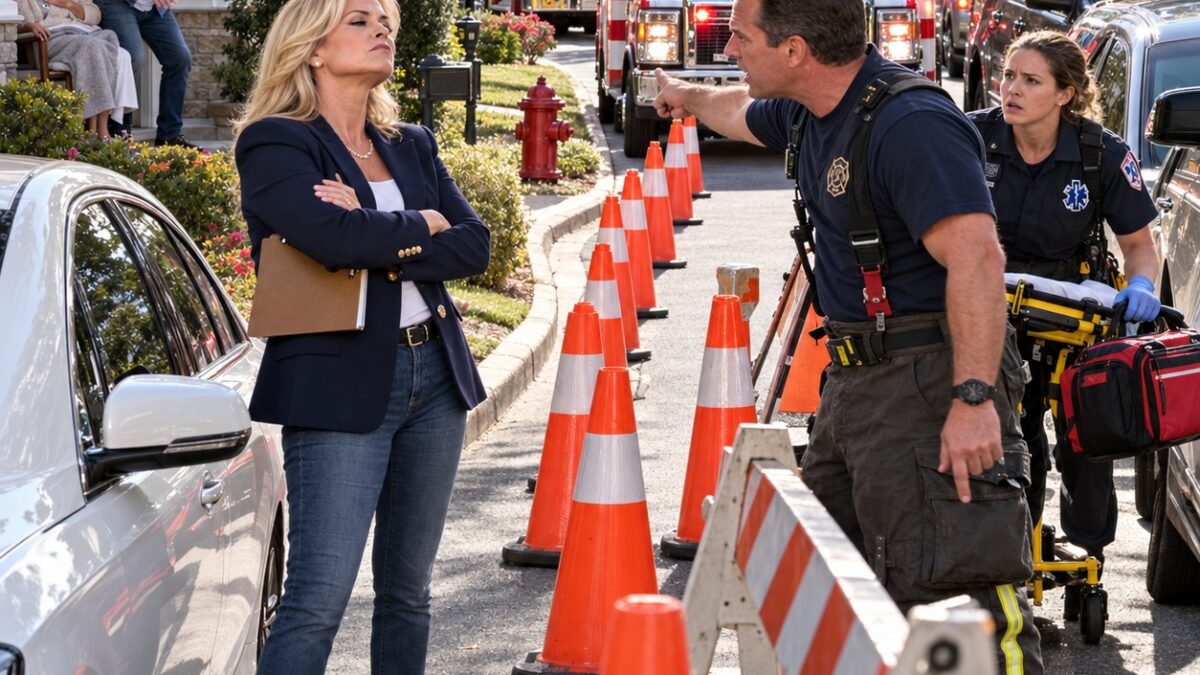
The ambulance sat nose-to-cones.
Engine 12 stacked behind it.
Parked cars on both sides narrowed the remaining space.
A hydrant sat partly screened by one of Melissa’s portable signs.
I started walking toward them with my phone already recording.
Not because I wanted content.
Because my mother was inside waiting for paramedics and something had gone wrong.
The fire captain stepped out of Engine 12.
Broad shoulders.
Dark uniform.
Helmet still in the cab.
He looked once at the lane.
Then at Melissa.
“Ma’am, we need the full width.”
Melissa held both palms out.
“This is an HOA traffic measure.”
He pointed at the cones.
“Move them.”
“We’re preventing speeding.”
“Ma’am.”
His voice remained calm.
“We are working an active medical call.”
“You can use the primary entrance.”
He stared at her.
“We’re already here.”
“The board approved these controls.”
“I’m not asking who approved them.”
“If we remove them and somebody gets hurt, that’s liability.”
That sentence stayed with me.
I was thirty yards away when she said it.
My mother was gasping for air inside our house.
And Melissa was worried about hypothetical liability from moving plastic cones.
I raised my phone.
“Engine 12.”
I read the number aloud.
“Medic 4.”
Timestamp.
“1:47 p.m.”
Melissa turned.
Saw me recording.
Her expression tightened.
“What are you doing?”
“Documenting the response.”
“You do not have permission to record me.”
I ignored her.
The ambulance driver tried easing forward.
Right-side tires nearly touched the curb.
Left mirror came dangerously close to a parked crossover.
The captain looked ahead.
Then toward the bend.
He keyed his shoulder radio.
Command answered.
He described the obstruction.
A few seconds later, the speaker crackled.
“All units, back it out. Reroute primary. Don’t risk getting stuck on the turn.”
My stomach dropped.
The ambulance reversed.
Slow.
Then Engine 12.
Diesel.
Backup alarms.
Sirens starting again.
Minutes leaving.
I looked at Melissa.
She looked almost relieved.
As if the system had worked.
“See?” she said.
“They can go around.”
I stared at her.
“My mother is waiting inside.”
For the first time, she hesitated.
Only a fraction.
Then:
“Emergency services have multiple access options.”
I wanted to throw every cone into the nearest yard.
I did not touch one.
I went back to the house.
The ambulance arrived from the other direction several minutes later.
I did not time the delay emotionally.
I timed it exactly.
Seven minutes and forty-three seconds from first arrival at Juniper’s secondary entrance to arrival at our driveway through the primary route.
Seven minutes.
Forty-three seconds.
For my mother, those minutes did not become catastrophic.
Thank God.
The paramedics stabilized her.
Transported her.
Hospital diagnosed a respiratory complication and medication issue.
She stayed overnight.
Came home the next evening.
That is the version of the story I am grateful to tell.
Because there is another version.
Same cones.
Same argument.
Different patient.
Different outcome.
I kept thinking about that.
At 11:18 that night, sitting beside Mom’s hospital bed while she slept, my phone buzzed.
Email from the HOA.
Subject:
NOTICE OF VIOLATION — INTERFERENCE WITH BOARD OPERATIONS.
I opened it.
Melissa had cited me.
For recording her.
Her wording said my conduct had created a hostile environment for a volunteer board member during implementation of approved safety measures.
I read it twice.
Then laughed quietly.
Not because it was funny.
Because outrage sometimes becomes so concentrated it turns cold.
Mom opened her eyes.
“What?”
“Nothing.”
“You’re making the face.”
“What face?”
“Your father’s paperwork face.”
She closed her eyes again.
“Poor woman.”
“Who?”
“The one who annoyed you.”
I smiled.
Then started a new file.
My response was four sentences.
No anger.
No accusation.
I requested the legal basis for placing traffic-control devices on Juniper Lane.
I requested the permit number, if one existed.
I requested the recorded document establishing the HOA’s authority over the pavement.
And I requested written confirmation that fire and EMS had approved the narrowing.
Last question:
Had the association’s insurer been informed that the board was intentionally restricting emergency-vehicle access?
Certified email.
Saved PDF.
Melissa responded in less than twenty minutes.
Juniper Lane is a private road.
The board voted.
Then:
Continued harassment of volunteer leadership will result in additional fines and attorney review.
She copied the property manager.
That was meant to add weight.
I did not argue with her definition of private road.
Because private ownership was not the issue.
Use restrictions were.
I pulled Dad’s manila folder from the cabinet.
The plat was there.
Recorded years before Melissa moved into the neighborhood.
Juniper Lane marked clearly.
And along the margin:
EMERGENCY ACCESS EASEMENT / SECONDARY EGRESS.
I sat at the dining table staring at it.
There was the hinge.
Juniper could be privately maintained and still legally burdened by an easement.
Owning pavement did not mean the HOA could use it however it wanted.
The road had an approved function.
Emergency access.
Then I pulled the CC&Rs.
Buried under association responsibilities was a simple clause:
The association had to comply with all applicable laws, ordinances, codes and recorded easements.
Boring language.
Powerful.
Next came fire code.
I am not a fire inspector.
So I did not pretend to interpret everything.
I found the city’s adopted summary for fire-apparatus access.
Minimum unobstructed widths.
Turning clearance.
Hydrant access.
No unauthorized obstructions.
The exact numbers varied depending on conditions and adopted provisions, but one thing was obvious.
Our twelve-foot cone funnel was not what emergency access was supposed to look like.
Then I called non-emergency dispatch.
Gave them Mom’s incident information.
Obtained the call number.
Reroute was documented.
That went into the folder.
Photos.
Video.
Plat.
CC&R clause.
Incident number.
Emails.
Then I drafted:
NOTICE OF HAZARD AND REQUEST TO CURE.
I hated the title.
Sounded like a lawyer.
That was useful.
I attached the plat excerpt.
Photographs with timestamps.
The incident number.
Then wrote:
The traffic-control arrangement had obstructed Medic 4 and Engine 12 during an active emergency response.
Please remove the devices.
Please obtain written fire-prevention review before reinstalling any narrowing measure.
Please confirm cure within seventy-two hours.
No threats.
No insults.
I sent it.
Then stopped talking.
On day four, instead of removing the cones, Melissa added more.
Two new A-frame signs.
LOCAL TRAFFIC ONLY.
SLOW — HOA SAFETY ZONE.
Then a neighborhood-app post.
Standing firm for safety despite intimidation.
Comments underneath.
Some residents supported her.
Others asked what intimidation meant.
Melissa never answered specifically.
I did not comment.
I made one phone call.
Fire Prevention.
The woman answering asked:
“What’s the complaint?”
“Emergency apparatus access.”
“Address?”
I gave it.
“Obstruction?”
“Traffic cones and signs narrowing a recorded secondary egress.”
Pause.
“Did an emergency unit encounter them?”
“Yes.”
“Incident number?”
I gave it.
That changed her tone.
“Do you have photographs?”
“Yes.”
“Recorded plat?”
“Yes.”
“Send everything.”
I did.
No speech about Melissa.
No HOA history.
Just facts.
Wednesday morning at 9:30, a white county pickup rolled onto Juniper.
A man stepped out wearing a fire-prevention polo.
Clipboard.
Measuring wheel.
He did not knock on my door first.
Good.
He started at the entrance.
Measured.
Photographed.
Walked slowly.
Curb to cone.
Cone to parked vehicle.
Hydrant clearance.
Turning area.
The measuring wheel clicked against asphalt.
A few neighbors watched from windows.
Then a battalion chief arrived.
SUV.
Uniform.
He stood at the bend.
Looked toward the secondary entrance.
Then toward the parked cars.
Walked the route an engine would need to take.
Melissa arrived five minutes later.
White Lexus.
Blazer.
Of course.
She stepped out smiling.
“We’re trying to reduce speeding.”
The inspector did not respond to that.
He asked:
“Where’s the permit?”
Her smile changed.
“For what?”
“These devices.”
“It’s private HOA pavement.”
“Where is fire-prevention approval?”
“The board voted.”
He looked at her.
Then at the cones.
“Did you notify this office?”
“We are allowed to manage our private streets.”
“That was not my question.”
I stood near my driveway holding my folder.
Said nothing.
Melissa noticed me.
“You caused this.”
The inspector looked between us.
I handed him my packet.
“Recorded plat is tab three. Incident report is behind it.”
He took it.
Read.
Battalion chief looked over his shoulder.
The inspector pointed to the margin note.
“Emergency access easement.”
The chief nodded.
Then walked the narrowest section again.
Measured with his eyes.
He looked at Melissa.
“This cannot stay like this.”
She folded her arms.
“We have a speeding problem.”
“Then use an approved method.”
“These cones are temporary.”
“Temporary obstructions can stop permanent fire engines.”
Her mouth tightened.
“Would you rather someone’s child be hit by a speeding car?”
The chief’s expression did not move.
“I would rather your board not create one hazard while trying to address another.”
That was the entire issue.
Melissa kept treating it like we were choosing between speeding and emergency access.
We were not.
Both could be addressed.
Legally.
Professionally.
With actual traffic engineering.
Not rented cones.
The inspectors stayed almost an hour.
Then left.
Melissa drove away without speaking to me.
Friday morning, the order arrived.
It was copied widely.
HOA.
Management company.
Registered agent.
City engineer.
Fire Prevention.
And me because I had filed the complaint.
The letter did not use words like:
Please consider.
It said:
REMOVE IMMEDIATELY.
All cones.
A-frame signs.
Temporary lane-narrowing devices.
Anything reducing apparatus access.
Juniper Lane had to be restored to its approved emergency-access condition.
Forty-eight hours.
The battalion chief attached a short addendum.
One sentence stood out.
The street is unsafe for emergency operations in its current obstructed configuration.
I read that line slowly.
Then printed the letter.
Mom was at the kitchen table drinking tea.
“How bad?”
“Bad enough.”
“Is Melissa going to jail?”
“No.”
“Shame.”
I laughed.
“You’re getting aggressive.”
“I almost died because of orange cones.”
“You did not almost die.”
“I was there. It felt dramatic.”
She pointed toward the letter.
“Put it in your father’s folder.”
“I started a new one.”
“Of course you did.”
By Saturday afternoon, most cones were gone.
Not all.
Two remained near the bend.
The HOA posted:
Temporary controls adjusted pending municipal clarification.
That wording annoyed me.
Fire Prevention had not issued clarification.
They had issued an order.
But I did not respond.
Next HOA meeting was Tuesday.
That was where Melissa planned to repair the narrative.
The clubhouse was full.
Normally maybe twelve people.
That night:
Thirty-one.
Mom wanted to come.
I said no.
She said:
“I live here.”
“You also recently spent a night in the hospital.”
“Unrelated.”
“Mom.”
She gave me Dad’s old look.
Then ultimately stayed home because cold weather made breathing harder.
Before I left, she said:
“Don’t yell.”
“I don’t yell.”
“You inherited that part from me.”
Fair.
The meeting room smelled like coffee and carpet cleaner.
Melissa stood at the podium.
The property manager beside her.
Board members lined up behind the long table.
At first, routine business.
Landscaping.
Budget.
Pool repairs.
Then:
“Juniper Lane traffic measures.”
Melissa began.
She described a speeding problem.
Resident complaints.
Board responsibility.
Then:
“Unfortunately, there was a miscommunication with local fire personnel regarding the temporary configuration.”
I wrote that word down.
Miscommunication.
She continued.
“The measures were never intended to interfere with legitimate emergency response.”
A few people murmured.
She said:
“The incident involving an ambulance was an unfortunate routing decision.”
That was when I looked up.
Routing decision.
Medic 4 had physically reached the cones.
A captain told her to move them.
She refused.
Command ordered the unit out because of the obstruction.
That was not a routing decision.
It was the exact result of her refusal.
The property manager started nodding.
Then the clubhouse door opened.
Uniform.
Fire marshal.
Not the inspector from Wednesday.
Senior officer.
Dark uniform.
Binder.
The room quieted instantly.
Melissa stopped.
The marshal said:
“Good evening. I’m sorry to interrupt.”
He was not sorry.
“I’ve asked to be added to the agenda regarding Juniper Lane.”
Melissa said:
“We’ve already addressed the misunderstanding.”
He looked at her.
“I’m here to clarify that there was no misunderstanding regarding our directive.”
Silence.
He walked to the front.
Opened the binder.
“Juniper Lane is identified on the recorded subdivision plat as secondary emergency egress.”
He displayed the plat.
“The fact that maintenance responsibility rests with the association does not eliminate the recorded access function.”
Then the fire-prevention order.
He read it into the meeting minutes.
Obstructed apparatus access.
Immediate removal.
Unsafe for emergency operations.
Nobody moved.
He explained turning radius.
Engine width.
Ambulance width.
Hydrant clearance.
The problem with improvised traffic-calming devices.
Then:
“Emergency access is not subject to a board vote.”
That was the sentence.
I watched Melissa.
Her face stayed mostly neutral.
Mostly.
One homeowner asked:
“So if the board votes to put the cones back?”
The marshal answered:
“They would be in violation after formal notice.”
Another:
“Fines?”
“Possible citations and escalating enforcement.”
“Against who?”
“That would depend on the circumstances and responsible party.”
People started doing mental arithmetic.
Not just fines.
Insurance.
Board liability.
Special assessments.
Suddenly Melissa’s “safety initiative” looked expensive.
When the floor opened, I stood.
No binder.
No speech.
“I don’t want drama.”
Melissa looked at me.
“I want an ambulance to reach my mother without backing out of our street.”
Quiet.
Then I read her sentence from the day of the call.
Exactly.
“If we remove them and someone gets hurt, it’s liability.”
I stopped.
Looked at the board.
“My mother was the person already waiting for help.”
No one spoke.
I sat down.
That silence did more than any argument could have.
A motion came from the floor.
Censure.
I had not requested it.
Did not know it was coming.
One homeowner stood.
“Melissa knowingly refused to move the obstruction during an active emergency response.”
Another seconded.
Melissa objected.
Said she had been acting under board authority.
A board member answered:
“You told us Fire Prevention was okay with the pilot.”
That got my attention.
Melissa looked at him.
“I said no objection had been received.”
“That’s not what you told us.”
The room shifted again.
Property manager looked down.
Minutes were reviewed.
Emails requested.
Marlene—sorry, Melissa—had apparently described the pilot internally as consistent with private-road authority without ever seeking actual fire review.
Vote.
Censure passed.
Not unanimous.
But comfortably.
Melissa looked at me as though I had engineered the whole thing.
I had not.
That was the strange part.
I had not asked people to punish her.
I had asked one question.
Was the road allowed to be narrowed?
Fire Prevention answered.
Reality did the rest.
By Saturday, Juniper looked like a street again.
No cones.
No folding signs.
No twelve-foot funnel.
Then a contractor crew arrived.
Not with random plastic.
With plans.
Measured curb segments.
Red paint.
Proper fire-lane markings.
Mounted signs.
Hydrant-clear zones.
Everything approved.
If speed reduction was still needed, the HOA would have to work through traffic engineering on something compliant.
Exactly what should have happened the first time.
The policy memo arrived the following Monday.
Short.
Very short.
Nobody in HOA management writes short memos until lawyers have explained something expensive.
Effective immediately, no traffic restriction, barrier, gate, cone pattern, sign installation, chain, bollard or other access-control measure may be placed on subdivision roadways without applicable municipal approval and written fire-prevention review where emergency access may be affected.
That was useful.
The property manager’s tone changed too.
No:
Hostile environment.
No:
Harassment of volunteers.
Instead:
Acknowledged.
Received.
Compliance confirmed.
My violation for recording Melissa disappeared.
No apology.
Fine.
I did not need one.
Two weeks later, Melissa resigned as vice president during executive session.
Personal reasons.
She remained in the neighborhood.
Still waved sometimes.
Sometimes not.
Nobody dragged her from office.
No dramatic punishment.
No lawsuit.
She simply lost the authority she had treated as larger than it was.
I found that fitting.
My mother recovered.
That is the ending that matters.
Her breathing never became easy again, but medication adjustments helped.
The oxygen machine stayed.
We installed grab rails.
Moved her bedroom downstairs.
She complained about every modification.
“You’re turning this place into a hospital.”
“I’m keeping you from falling.”
“I’ve been walking since before you were born.”
“Your record has been inconsistent lately.”
She threw a napkin at me.
Normal.
Beautifully normal.
A few weeks after the cones came down, Medic 4 returned to Juniper on another call.
Different house.
I heard the siren.
Stepped outside.
The ambulance came through the secondary entrance without slowing.
Full width.
Engine behind it.
No reverse.
No reroute.
No argument.
It took maybe eight seconds to pass my house.
I stood in the driveway and watched.
That was the victory.
Not Melissa resigning.
Not the censure.
Not the fire marshal’s speech.
Eight boring seconds.
An ambulance going where the plat said it should be able to go.
People still complained about speeding.
They had every right to.
Juniper was not magically safe because the cones disappeared.
So the new board did something radical.
They asked professionals.
Traffic count.
Speed study.
City engineer.
Fire Prevention.
The data showed some speeding.
Not as severe as Melissa had claimed.
But enough to address.
The approved solution involved pavement markings, better signage and a redesigned parking restriction near the blind bend.
No narrowed emergency lane.
No hydrant blockage.
No improvised choke point.
It cost more than orange cones.
Proper solutions often do.
But the board budgeted for it.
Discussed it.
Got approvals.
Implemented it.
Nobody’s ambulance had to reverse.
Amazing what happens when a community treats engineering like engineering.
I kept the original safety-initiative email.
Dad’s folder would have held it.
Mine did too.
I also kept the fire-prevention directive.
The censure minutes.
The policy memo.
The incident record.
Not because I expected another fight.
Because documentation is useful long after emotion becomes unreliable.
One year later, a new board member asked why the traffic-control policy was so strict.
Nobody remembered all the details.
I did.
I sent him the fire directive.
He replied:
Understood. No changes needed.
That is how institutional memory is supposed to work.
Not:
Because Daniel is still angry.
But:
Because this was tested once and here is the written result.
Melissa and I eventually spoke again.
Not at a meeting.
Mailbox cluster.
She was collecting mail.
I was walking back from Mom’s physical therapist’s car.
She said:
“Your mother doing okay?”
That surprised me.
“Better.”
She nodded.
“I’m glad.”
We stood there.
Then:
“I never meant to delay the ambulance.”
“I know.”
She looked at me.
“You do?”
“Yes.”
“You think I wanted someone hurt?”
“No.”
Her shoulders dropped slightly.
Then I added:
“I think you were so sure the board had authority that you stopped listening when the captain told you what he needed.”
That landed.
She looked away.
“I thought if I moved the cones I’d be undermining the policy.”
“During an emergency.”
“I know.”
“Policy can wait.”
“I know that now.”
Silence.
Then she said:
“I was trying to solve a real problem.”
“I know.”
“People were speeding.”
“I know.”
“So you understand?”
“I understand the problem.”
I looked toward Juniper.
“That doesn’t make the solution legal.”
She nodded.
Slowly.
Then:
“I should have called Fire Prevention before we installed anything.”
“Yes.”
That was the closest thing to an apology.
Enough.
I think about the phrase private road more than I should.
Melissa used it like a magic spell.
Private road.
Therefore HOA control.
Private road.
Therefore cones.
Private road.
Therefore board vote.
But property rights are often layered.
Private maintenance.
Public utility easement.
Emergency access.
Drainage easement.
Ingress rights.
Fire-code obligations.
Owning something does not always mean unlimited freedom to obstruct it.
My driveway is mine.
That does not mean I can block a utility easement if one is recorded through it.
The HOA maintained Juniper.
That did not erase the recorded emergency-access easement.
That was the entire case in one sentence.
You can own pavement and still be bound by what the pavement was approved to do.
The fire marshal’s measuring wheel became a joke in the neighborhood.
Bertrand—different neighbor, retired engineer—started calling it the Wheel of Truth.
“That thing scared Melissa more than an attorney.”
“Probably.”
“Click click click. There goes your policy.”
“It was not magical.”
“It looked magical.”
One year at the community picnic, somebody brought toy orange cones and put them around the dessert table.
A sign said:
TEMPORARY SAFETY MEASURE.
I laughed.
Melissa did not attend.
I took the cones down after ten minutes.
Some jokes are healthier when they do not become cruelty.
That is another thing I learned.
Accountability is useful.
Humiliation can become its own little addiction.
I did not want our neighborhood spending years defining itself around one woman’s bad decision.
Fix the road.
Fix the policy.
Move on.
Mom lived another four years.
That medical call was not her last.
There were three more ambulance visits.
Every time, access was clean.
The final one came early on a winter morning.
Snow in the grass.
Medic unit entered Juniper from the secondary route because it was closest.
No cones.
No parked cars at the bend because the new fire-lane markings were enforced.
They reached our driveway in seconds.
Mom died two days later at the hospital.
Peacefully.
I do not blame anyone.
She was eighty-two.
Her body was tired.
But I think about that last ambulance sometimes.
About how the route was open.
About how no one debated policy while she waited.
About the simple dignity of emergency systems working the way they are supposed to work.
I am grateful for that.
More grateful than I can explain.
After the funeral, I opened Dad’s manila folder.
Added Mom’s death certificate.
Then stared at the fire-prevention directive behind the plat.
Dad had been right.
Boring papers decide important things.
I closed the folder.
Put it back in the safe.
The next HOA board elected a retired nurse as president.
Her name was Helen.
First meeting, she said:
“If a policy touches fire, medical response, drainage, electricity or gas, we ask the professional jurisdiction before voting.”
Someone laughed.
She did not.
“Seriously.”
Good president.
The board became less exciting.
That was progress.
Meetings went back to landscaping.
Pool hours.
Budget.
Dogs.
People still argued.
Neighbors always will.
But the arguments stayed in lanes.
Nobody tried to use a board vote to overrule an ambulance captain.
I am not anti-HOA.
That surprises people who hear the story.
I pay dues.
Our common areas need money.
The pool requires insurance.
Landscaping requires contracts.
Private roads need maintenance.
Rules can protect property.
The problem is not that associations have authority.
The problem is when people stop asking where that authority ends.
Paint colors?
Probably board territory if valid covenants say so.
Mailbox design?
Maybe.
Pool hours?
Sure.
Emergency access?
Different hierarchy.
Fire code does not become optional because a board has quorum.
Recorded easements do not disappear because five people voted yes.
That is the part Melissa missed.
She thought authority stacked upward through the HOA.
It did not.
Some obligations sat above her.
Some ran beneath her through the recorded plat.
The board’s power existed inside those limits.
Not instead of them.
One Saturday, years later, a new family moved into the house near the bend.
Young couple.
Two children.
Big SUV.
They parked partly inside the fire-lane marking while unloading.
The property manager came by.
Asked them to move.
The husband got irritated.
“We’re just unloading.”
I happened to be walking past.
The manager pointed at the sign.
“Fire lane.”
The husband looked at me.
“Seriously?”
I nodded.
“Very.”
He moved the SUV.
No fight.
That is what a working rule looks like.
Clear.
Valid.
Connected to an actual purpose.
Not arbitrary.
Not improvised.
Nobody needs a blazer.
I found the old violation notice in my files last winter.
Interference with board operations for recording a volunteer member.
I laughed.
At the time, it had made me furious.
Years later, it looked absurd.
But I am glad they sent it.
Because retaliation changed how I handled the dispute.
Without that notice, I might have argued verbally.
Maybe moved the cones myself.
Maybe posted the video online.
Maybe turned the whole thing into neighborhood warfare.
Instead, I asked for the legal basis.
That question led me to the plat.
The plat led to the easement.
The easement led to Fire Prevention.
Fire Prevention brought a measuring wheel.
The measuring wheel brought an order.
The order changed the policy.
Clean.
Not painless.
But clean.
A reporter once contacted me after hearing about the incident.
Local story.
I declined.
He asked why.
I said:
“No one died.”
He seemed confused.
“That’s good.”
“Yes.”
“That’s why I don’t need a story.”
Of course I am telling it now.
But the point remains.
The best emergency-access story is one where the ambulance gets through and nobody remembers it.
The fact that ours became memorable meant something had failed.
I did not want Melissa famous.
I wanted Juniper open.
That happened.
For months after Mom died, I considered selling.
The house felt too quiet.
Her chair remained in the living room.
Oxygen machine gone.
Bedroom empty.
Juniper seemed smaller without the reason I had returned.
Then one morning, I was sorting Dad’s papers.
Found the original plat.
Black lines.
Easements.
Lot numbers.
The note marking Juniper as secondary emergency egress.
I remembered Dad spreading that same plat on the kitchen table when I was a kid.
Explaining where the drainage easement ran.
I had not cared.
I wanted to ride my bike.
Now that boring sheet had protected my mother’s access to emergency care.
I stayed.
Not forever, maybe.
But for now.
There is something comforting about living in a place after a conflict has become history.
You see the physical result.
Red curb paint near the bend.
Proper signs.
Clear hydrant.
Open lane.
No cones.
Reality recorded in asphalt.
Sometimes, if I hear sirens approaching, I step outside.
Habit.
Watch them turn.
My body still remembers that Saturday.
The change in pitch.
The ambulance slowing.
The captain’s face.
Melissa beside the Lexus.
My phone in my hand.
Seven minutes forty-three seconds.
Time becomes strange during medical emergencies.
Thirty seconds feels enormous.
That is why officials who manage streets should be humble around emergency access.
Theoretical inconvenience is not the same as a real person waiting for oxygen.
Safety policy is supposed to reduce risk.
Not transfer it to somebody you cannot see.
The funniest part, if there is one, is that Melissa’s original goal was not crazy.
Slow traffic.
Protect kids.
Reduce cut-through driving.
Most residents agreed.
I agreed.
Had she called the city first, they might have implemented proper measures months earlier.
Instead, she wanted the visible solution.
Cones.
Signs.
Immediate proof that the board was acting.
That is a temptation in local leadership.
Do something people can see.
Even if the right solution requires waiting for engineering.
Permits.
Measurements.
Review.
The boring parts.
The same boring parts that ultimately corrected her.
The current traffic system works.
Fire lane remains clear.
No-parking segments near the turn.
Reflective signage.
Speed reminder markings farther up.
The HOA requested a traffic study before making changes.
Average speeds dropped.
Emergency access remained open.
No one had to choose.
That is the lesson I wish Melissa had understood.
Good governance is rarely choosing between two legitimate goals.
Usually it is doing enough work to satisfy both.
Every once in a while, somebody asks:
“Why didn’t you just move the cones yourself?”
I could have.
Physically.
They weighed almost nothing.
But then the story would have become:
Homeowner removes HOA safety equipment.
Board reinstalls.
Argument.
Maybe trespass accusations.
Maybe police.
Maybe social-media war.
Instead, I left them.
Documented.
Asked the correct agency.
Let jurisdiction answer.
That took longer.
But the answer lasted.
The board could have put my cones back.
It could not casually ignore a formal fire-prevention order.
That is why I say calculation beats panic.
Not because panic is weak.
Because panic tends to solve the immediate object.
Calculation solves the authority behind the object.
I also learned not every government employee wants a speech.
When I called Fire Prevention, I almost launched into the whole story.
HOA retaliation.
Melissa’s personality.
My mother.
Then stopped.
The woman asked:
“What’s the obstruction?”
I answered.
That was enough.
Recorded emergency route.
Twelve-foot narrowing.
Medic reroute.
Incident number.
Those facts did the work.
Professionals can often help faster when you give them the information tied to their jurisdiction.
Everything else is context.
Useful later.
Not always first.
The censure meeting stayed in my mind because of Melissa’s email.
If we remove them and someone gets hurt, that’s liability.
She had said it like the cones were protecting her.
Then the fire marshal’s directive essentially said the opposite.
Maintaining them after notice created the hazard.
Authority can invert quickly when somebody finally checks the correct standard.
That is why board members should never treat legal-sounding language as a substitute for legal review.
“Liability” is not a spell either.
Sometimes reducing liability means removing the thing you installed to reduce liability.
After Melissa resigned, Helen asked me if I wanted to serve on the safety committee.
I said no.
Immediately.
She laughed.
“You seem passionate.”
“I am passionate about not serving on committees.”
“Fair.”
I agreed to review one emergency-access draft informally.
Then escaped.
I had no desire to become what I had fought.
Power attracts certain personalities.
It should also attract people willing to decline it.
Dad’s folder is thicker now.
I added:
Fire-prevention directive.
New traffic policy.
Updated plat notation.
Mom’s medical incident record.
Not because the incident belongs to the land title.
Because the folder became something else over time.
A record of what matters about the house.
Dad’s deed.
Mom’s access.
My notes.
One family’s boring archive.
Maybe someday somebody else will open it and wonder why a fire directive sits behind a subdivision plat.
If they read far enough, they will understand.
The last thing Melissa said to me about the whole episode came months after her resignation.
We were both at the community pool.
She was leaving.
I was fixing a loose chair for Helen.
Melissa stopped.
“Daniel.”
“Melissa.”
She looked toward Juniper.
“They’re putting another fire-lane sign up.”
“Yes.”
“It’s ugly.”
I laughed.
She did too.
Small laugh.
Then she said:
“But I suppose the truck can get through.”
“That’s the idea.”
She nodded.
Walked away.
That was closure.
No dramatic apology.
No friendship.
Just recognition.
Some lessons arrive quietly after the fight is over.
Today, Juniper Lane looks almost exactly like it did before Melissa’s safety initiative.
Cars.
Maples.
Garage doors.
Kids.
Delivery trucks struggling at Christmas.
Except near the bend.
Red curb segments.
Official fire-lane signs.
Hydrant open.
Clear width.
If you did not know the story, you would never notice.
Good.
Emergency infrastructure should be boring until you need it.
When you need it, it should work.
That is all.
Melissa thought a board vote gave her the right to narrow a private road.
The recorded plat said otherwise.
The fire code said otherwise.
The captain told her otherwise.
Eventually the fire marshal put it in writing.
And once the right authority showed up with a measuring wheel, all the polished emails and HOA language in the world could not change twelve feet into twenty.
I did not beat Melissa by shouting.
I did not threaten her.
I did not move her cones.
I did not need a viral confrontation.
I kept the video.
Pulled the plat.
Found the easement.
Got the incident number.
Asked for the permit.
Called the agency with jurisdiction.
Then let facts arrive in an official pickup truck.
That was enough.
My mother got four more years in the house she loved.
Every emergency vehicle that came for her after that entered Juniper without backing out.
No board member stood in the road.
No one debated “quiet enjoyment.”
No one asked whether a private street could ignore a recorded emergency easement.
The lane stayed open.
Exactly the way it was always supposed to be.
And every time I hear an ambulance pass cleanly through that bend, I remember what Dad used to say about property.
It is not about what somebody means.
It is about what got recorded.
In our case, one boring note on an old subdivision plat mattered more than every confident email Melissa ever sent.
Because an HOA can vote on paint.
It can vote on landscaping.
It can vote on pool hours.
But it cannot vote an emergency-access easement out of existence.
And it definitely cannot outvote a fire truck.


