PART2:HOA Queen Tried to Ban My Service Dog and Tear Down My Dead Wife’s Ramp—She Had No Idea the FBI Was Four Houses Away
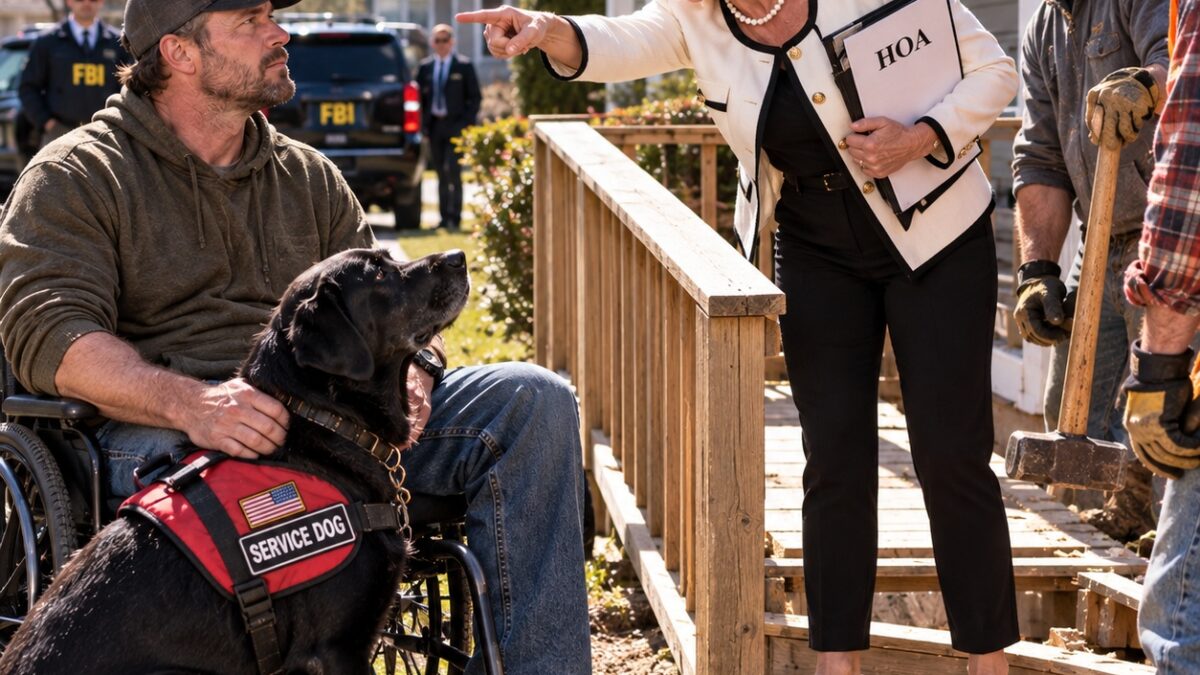
PART2
I did not call Brenda.
I did not go to her house.
I did not stand in the middle of the cul-de-sac yelling about veterans’ rights or threatening lawsuits.
I made a folder.
A real folder.
Manila.
Label on the tab.
WHITAKER / LAUREL RIDGE HOA
That was how the Army had trained me.
When something might matter later, document it while your memory is fresh.
Do not trust adrenaline.
Do not trust anger.
Do not trust yourself to remember the exact wording three months after the fact.
Write it down.
So I did.
Ranger’s training documentation went in first.
Then veterinary records.
Then my disability documentation.
Then copies of the federal housing and disability guidance I believed applied to the situation.
Then every HOA notice.
Dates.
Times.
Names.
I wrote Brenda a registered letter.
Three paragraphs.
No insults.
No threats.
Ranger was a trained service animal required because of my disability.
I was formally requesting reasonable accommodation.
I expected the association to stop applying ordinary pet rules in a way that interfered with his medical work.
I ended with:
I trust we can resolve this without further escalation.
Brenda signed for the letter on a Friday.
Monday morning, a new violation notice was taped flat against my front door.
Not placed in an envelope.
Not mailed.
Taped outside where the entire street could read it.
The notice accused me of submitting fraudulent medical documentation.
It demanded my private medical records, a notarized doctor’s letter, and an “official government registration number” for Ranger.
It also threatened another thousand-dollar fine.
I stood on the porch reading it while Ranger sat beside me.
My first reaction was not anger.
It was amazement.
She had put it on HOA letterhead.
Signed it.
Dated it.
Hand-delivered it into view of my Ring camera.
Sometimes people do half your documentation for you.
Haley came home from school in soccer cleats and read the notice before I took it down.
“Dad.”
“I know.”
“She put that where everybody could see it.”
“I know.”
“Can she do that?”
“That is one of the questions we may eventually have somebody else answer.”
Haley looked toward Brenda’s house.
“We should sue her.”
“We might.”
“That’s it?”
“No.”
I peeled the notice away from the blue painter’s tape.
“We’re going to do something harder first.”
“What?”
“Stay calm.”
She rolled her eyes.
Teenagers hate answers like that.
But calm mattered.
I downloaded the Ring footage.
Saved the exact timestamp.
Photographed the notice before removing it.
Recorded that Mr. Lawson from three houses down had been walking his greyhound when Brenda came up my porch.
He had nodded to her.
She nodded back.
A witness.
I did not yet know what kind.
At the time, Greg Lawson was simply the quiet neighbor with gray at his temples who spent evenings reading paperbacks on his porch.
I knew he worked downtown.
I knew he was polite to Haley.
That was about it.
By the second week, Brenda changed tactics.
The notices were not frightening me.
So she started building a story.
First, somebody told me Ranger had “lunged” at a child near the pool.
Then the story became that Ranger had snapped.
Then bitten.
Then the imaginary child had supposedly needed stitches.
No name.
No parent.
No incident report.
No call to animal control.
No medical record.
Nothing.
Just Brenda visiting neighbors with lemon squares and a concerned expression.
“For community safety.”
That phrase appeared everywhere.
Community safety meant whatever Brenda needed it to mean.
A dog she disliked.
A ramp she had not approved.
A person who would not obey quickly enough.
Haley heard the rumor at school.
She came home one afternoon quieter than usual.
I found her in the laundry room with her face pressed into a towel.
Ranger found her first.
He stood beside her until she sat on the floor.
Then he lowered his head into her lap.
“What happened?”
“Nothing.”
“Haley.”
She looked up.
“A girl asked if Ranger really attacked somebody.”
I sat beside her.
“She said her mom heard you lied about him being a service dog.”
My jaw tightened.
Haley wiped her face angrily.
“She said maybe you’re dangerous too.”
That one hurt more.
Not because I believed it.
Because Brenda had found a way to reach my daughter.
I had dealt with rumors in uniform.
You learn quickly that people who were not there often have strong opinions about what happened.
But Haley had not volunteered for any of this.
She had already buried her mother.
She had spent years learning what to do if her father seized.
Now she had to defend her family in a high-school hallway because Brenda Caldwell enjoyed winning arguments.
That night I added another tab to the folder.
WITNESSES / FALSE ALLEGATIONS
Then I started knocking on doors.
No clipboard.
No speeches.
Ranger beside me.
I asked one question.
“Have you or your children ever had a problem with this dog?”
Twenty-three houses.
Twenty-three noes.
Three neighbors immediately volunteered that Brenda had been telling them Ranger was dangerous.
A retired teacher, Mrs. Halloway, asked:
“Would you like me to write down exactly what she told me?”
“Yes, ma’am.”
Within five days, I had eleven signed statements.
Dates.
Approximate times.
Exact claims where people could remember them.
Ranger bite.
Veteran with anger problems.
Fake service dog.
Danger to children.
I sent copies to the appropriate county animal office along with my own written request that they evaluate Ranger directly.
The officer who came out was named Puit.
She watched Ranger lie on his side while Haley rubbed his stomach.
She observed him working.
She looked at his records.
Then wrote:
Animal exhibits no aggressive behavior. Allegations cannot be substantiated.
I made three copies.
One for the folder.
One digital scan.
One somewhere Brenda could not reach.
I was beginning to understand that this might last longer than either of us expected.
One evening, Greg Lawson walked up my driveway carrying a six-pack.
He looked at Ranger.
Then at me.
“How’s the documentation coming?”
I stared at him.
“What documentation?”
He gave me a small smile.
“The documentation you’re obviously building.”
I looked toward the house.
Then back at him.
“Fine.”
“Good.”
He set the six-pack on my porch railing.
“Keep every piece of paper she sends you.”
“Why?”
“Just do it.”
“That’s a strange thing to say.”
“I know.”
Then he walked home.
His greyhound followed.
I watched him go.
Ranger watched too.
Neither of us knew Greg Lawson was already months ahead of me.
Brenda finally crossed from paper to physical action on a Saturday morning.
Nine-fifteen.
Cold enough for a jacket.
Wet leaves.
Smoke from somebody’s wood stove.
Haley was away at a cross-country meet.
I sat on the porch drinking coffee from an old Army mug Elaine had bought me years earlier.
Ranger lay with his chin over my boot.
Then Brenda’s white Tahoe stopped at the curb.
Engine running.
She came up the sidewalk fast.
Clipboard in one hand.
Blue nylon slip leash in the other.
That made me stand.
She climbed the steps.
“I’m exercising the HOA’s authority to impound your animal.”
“Brenda.”
“Removal is effective immediately.”
“Go back to your truck.”
She stepped around me.
Ranger lifted his head.
Brenda bent toward him with the slip leash.
He stayed still.
Training.
I moved closer.
“Do not touch him.”
She looped the rope over Ranger’s head.
He did not move.
She pulled.
Ranger stayed planted.
“Brenda.”
She yanked harder.
Nothing.
Then she kicked him.
White sneaker.
Right into his ribs.
Ranger made one sound.
Not a bark.
More surprise than pain.
Something inside me became perfectly still.
People assume rage is loud.
Mine never was.
As a medic, the moments that scared me most were the ones when my mind became extremely clear.
Distance.
Hands.
Exit.
Threat.
Do the next right thing.
I stepped between Brenda and Ranger.
Placed my palm on her wrist.
Pushed her hand down.
Removed the rope.
Dropped it on the porch.
“Get off my property.”
She stepped backward.
Then saw the Ring camera.
Her face changed.
Anger.
Calculation.
Fear.
All in about two seconds.
Then she pointed at me.
“He attacked me!”
I stared.
“You just kicked my dog.”
“He put his hands on me!”
The camera had everything.
Audio.
Her hand.
Her foot.
My open palm.
No strike.
No shove.
No lunge.
Brenda hurried toward her Tahoe.
She called law enforcement from the driver’s seat loudly enough for half the street to hear.
“I’ve been assaulted.”
Nineteen minutes later, a deputy arrived.
He watched the footage twice.
Then looked at the bruise beginning on Ranger’s side.
Then walked toward Brenda.
“Ma’am, please step out of the vehicle.”
She did.
When the cuffs went on, her mouth actually dropped open.
For the first time since I had known her, Brenda looked as though reality had failed to follow her instructions.
She was arrested on state-level allegations connected to the incident, including what the deputy believed the video showed.
She posted bond before the weekend ended.
I thought being arrested might teach caution.
I was wrong.
Brenda did not return from jail embarrassed.
She returned furious.
Forty-eight hours later, she announced an emergency HOA meeting to discuss “community safety.”
That was when Greg Lawson knocked on my door again.
This time he did not bring beer.
He brought a manila envelope.
“I want you to look at something,” he said. “Then I want you to listen before asking questions.”
We sat at my kitchen table.
Ranger lay between us.
Greg pulled out three documents.
The first described another veteran who had lived in Laurel Ridge years earlier.
Theodore Hatcher.
Iraq veteran.
PTSD.
German Shepherd service dog named Patton.
Brenda had targeted Patton as a nuisance.
Violation notices.
Complaints.
Pressure.
Hatcher eventually surrendered the dog and left the neighborhood.
Patton died months later in rescue care.
I read the page twice.
“What happened to Brenda?”
“Nothing.”
The second document involved Carla Wentz.
Marine veteran.
Spinal injury.
Service dog named Buster.
Same basic pattern.
Brenda had used different words.
Different rules.
Same goal.
Carla left Laurel Ridge too.
My stomach tightened.
“How many?”
Greg did not answer immediately.
Instead, he slid the third document forward.
HOA finances.
Payments.
A line item called a community compliance fund.
Money flowing year after year to something called Caldwell Compliance Consulting.
I looked up.
“Caldwell.”
“Yes.”
“Related?”
Greg reached inside his jacket.
Pulled out a slim black wallet.
Opened it.
Badge.
Identification.
Three letters.
FBI.
I stared at him.
“Greg.”
“Special Agent Gregory Lawson.”
Ranger lifted his head.
Greg scratched behind his ear as if he had not just rearranged my understanding of the entire street.
“I’ve been watching Brenda for six months.”
“From your house?”
“Partly.”
“You bought that house for an investigation?”
“I needed to be in the area. The timing worked.”
I looked again at the financial document.
“Hatcher’s family contacted our office. We started reviewing whether there was a broader pattern involving disabled residents.”
“And the money?”
“Still under investigation.”
I leaned back.
Every strange thing Greg had said suddenly made sense.
Keep the paperwork.
Keep the notices.
Keep the video.
“You knew she was targeting Ranger.”
“I knew she was beginning the same pattern.”
“Why didn’t you tell me?”
“Because until recently, you were a resident documenting an HOA dispute. I couldn’t compromise an active case.”
“And now?”
His face hardened.
“Now she walked onto your property, tried to take a trained service animal, and kicked him while your camera recorded it.”
He folded his hands.
“That changes things.”
I looked down at Ranger.
“What do you need from me?”
“Keep doing what you’ve been doing.”
“That’s it?”
“And let me sit on your porch occasionally.”
I laughed once.
“That seems anticlimactic.”
“Good investigations usually are until the end.”
From then on, the whole thing became quieter.
Brenda got louder.
We got quieter.
I filed formal complaints through every channel Greg and the disability-rights attorneys believed was appropriate.
Housing discrimination.
Disability access.
Retaliation.
Ranger interference.
I copied everything.
Date stamped.
Certified.
Logged.
Greg did not make dramatic appearances.
He walked his greyhound.
Sat on porches.
Drank coffee.
Went to work.
The FBI case moved behind doors I could not see.
My part remained simple.
Document.
Preserve.
Do not exaggerate.
Do not retaliate.
Let Brenda speak.
That last part was the easiest.
She loved speaking.
Meanwhile, I went looking for the people she had hurt before me.
Theodore Hatcher lived in Tennessee.
I met him in a Cracker Barrel parking lot.
He was thin.
Quiet.
Shoulders rounded as if he had been apologizing for taking up space for too long.
We sat inside.
I told him about Ranger.
About Brenda.
About the porch.
When I said Patton’s name, Theodore stopped looking at me.
“I should’ve fought.”
“No.”
“I gave him up.”
“You were exhausted.”
“I was supposed to protect him.”
“You were being pressured by people who understood exactly how to exhaust you.”
He wiped his eyes.
Then reached beneath the table.
He had brought Patton’s old service vest inside a plastic bag.
He pushed it toward me.
“I kept this.”
I did not touch it immediately.
“What do you want me to do with it?”
“Something that means something.”
I drove home with Patton’s vest on the passenger seat.
Ranger rode behind me.
I cried twice on the interstate.
Not because I thought I was tougher than Theodore.
Because I understood how close I could have come to his ending if Elaine had been alive and sick, if Haley had been younger, if the seizures had been worse, if money had been tighter, if I had not known how to build a paper trail.
People love stories where the victim fights back immediately.
Real life is uglier.
Sometimes harassment works because ordinary people have jobs.
Children.
Medical appointments.
Grief.
Bills.
Eventually they choose survival over principle.
Brenda had counted on that.
Carla Wentz was harder.
She trusted no one.
Understandably.
Greg helped make contact.
Eventually she signed a declaration describing how Brenda had pushed her out.
Three disabled veterans.
Three service dogs.
Three versions of the same strategy.
Then the financial investigation deepened.
Federal subpoenas pulled HOA bank records.
A forensic accountant traced payments.
Caldwell Compliance Consulting had been receiving HOA money for years.
It had no meaningful operation anyone could identify.
Its registered agent was Brenda’s husband, Hank.
The amount was no longer eighteen thousand here or there.
It was more than ninety thousand dollars across several years.
The more investigators looked, the clearer the pattern became.
Brenda’s aggressive “compliance” activity did more than feed her authority.
It fed a vendor tied to her husband.
Fines.
Notices.
Enforcement.
Consulting.
Money going out.
Some of the same harassment she used against residents had become part of a system generating fees and justifying payments.
Greg did not celebrate when the evidence strengthened.
He simply added pages.
That taught me something.
Good investigators do not become emotionally dependent on the villain being stupid.
They verify.
Meanwhile, Haley became our unofficial records department.
One Saturday she walked into the kitchen carrying her laptop.
“I fixed your system.”
“My system is fine.”
“You have seven paper lists.”
“They’re organized.”
“You wrote ‘probably Brenda’ in the margin of one.”
“Context.”
She ignored me.
Three spreadsheet tabs.
Violation notices.
Video clips.
Witness contacts.
Every entry linked to filenames and timestamps.
Color coded.
Searchable.
Greg looked at it for about forty seconds.
Then looked at me.
“If she ever wants a job, tell her to call me.”
Haley was halfway up the stairs pretending not to listen.
She smiled.
For the first time in weeks.
That mattered more than the spreadsheet.
By November, Brenda could feel the neighborhood slipping.
She did not know why.
She only knew people stopped nodding automatically.
Neighbors asked questions at meetings.
The management company started requesting things in writing.
Homeowners wanted copies of bylaws.
People who had once ignored her gossip began asking where the incident report was.
Power feels permanent until people stop agreeing to perform it.
Brenda responded by escalating.
A pale green flyer appeared on mailboxes before dawn.
EMERGENCY HOA VOTE — COMMUNITY SAFETY ACTION
My address.
Claims that I was psychologically unstable.
Claims Ranger was a known biter.
Threats of a ten-thousand-dollar fine and foreclosure action if he was not removed.
I read it on my porch.
Haley read another copy at the mailbox.
Her face tightened.
“What does psychologically unstable mean?”
“It means Brenda has run out of dog accusations.”
“She’s talking about your brain injury.”
“Yes.”
“That’s disgusting.”
“Yes.”
At school, somebody repeated it.
Dangerous veteran.
Anger problems.
Dishonorable discharge.
All false.
Haley punched a locker.
Not a person.
A locker.
We went to the school.
I showed the vice principal enough documentation for him to understand this was not normal neighborhood gossip.
Animal-control findings.
The flyer.
Video.
A contact Greg had authorized me to provide.
The school handled the student rumors.
By the end of the week, Haley received an apology.
I wish that had ended it.
It did not.
The contractor crew arrived at 6:30 on a Friday morning.
Two men.
Beat-up white truck.
Work jackets.
Sledgehammer.
Reciprocating saw.
Orange caution tape.
I was still in my bathrobe.
Coffee in one hand.
Ranger at my feet.
One of the men pointed toward the side of my house.
“We’re here for the structure.”
“What structure?”
“The unauthorized ramp.”
Everything in me stopped.
Elaine’s ramp.
They walked toward it.
I came out through the side door wearing boots and whatever shirt I grabbed first.
Body camera clipped to my chest.
Not because I expected trouble that morning.
Because by then wearing it had become habit.
“Gentlemen.”
One man lifted the sledgehammer.
“Please put that down.”
He hesitated.
I held up three documents.
County permit.
The work order Brenda had signed.
Documentation showing the property and dispute were already connected to active disability-rights complaints.
“I am telling you clearly that this ramp is permitted, that I have not authorized demolition, and that the person who hired you is the subject of active investigations connected to this property.”
The men looked at each other.
I continued.
“If you touch it after I’ve shown you this, your company’s name becomes part of my file.”
That got their attention.
Contractors understand liability.
They inspected the permit.
Compared the address.
Looked at Brenda’s work order.
Then the taller man lowered the sledgehammer.
“We were told it was illegal.”
“It isn’t.”
“She said the HOA owned the exterior compliance authority.”
“She told you wrong.”
They loaded their tools.
I did not insult them.
They had been given bad information.
Once they received good information, they stopped.
That is all I wanted.
Brenda sat in her Tahoe at the end of my driveway watching.
The truck drove away.
She stayed.
I walked toward her.
Not close.
Close enough.
She rolled down the window.
“You think you won something?”
“No.”
“You’re making this much worse.”
“For whom?”
She glared.
“That ramp violates community standards.”
“My wife used that ramp during the last year of her life.”
Brenda’s expression did not change.
“I’m sorry for your loss, but rules don’t stop because people have sad stories.”
I looked at her.
There are sentences people speak that tell you everything about them.
That was one.
“No,” I said. “They don’t.”
She seemed satisfied.
Then I added:
“But rules also apply to you.”
I walked away.
By December, Brenda had almost no allies left.
She did not know that.
People still smiled at her.
Still answered doors.
Still attended meetings.
But the neighborhood had changed.
Mrs. Halloway recorded Brenda pressuring her to withdraw her statement.
Brenda sat in a retired middle-school teacher’s living room and talked about property values.
Good-faith cooperation.
Community unity.
How unfortunate it would be if a lawsuit affected everybody.
Mrs. Halloway’s phone sat facedown on the table recording every word.
When she handed me the audio, she said:
“I taught thirteen-year-olds for thirty-one years. I know a bully when she comes into my house.”
Greg listened once.
Then sent the file where it needed to go.
Brenda tried to stack the emergency vote through proxy calls.
People told me.
Haley logged them.
Brenda did not know fourteen homeowners were documenting those calls.
Then she came for the camera.
Two-fourteen in the morning.
Black hoodie.
Screwdriver.
She crossed the street.
Came up my yard.
Unscrewed the trail camera from the dogwood.
Tucked it beneath her clothes.
Walked away.
She believed she had removed evidence.
What she did not know was that the trail camera was no longer the camera that mattered.
Another small weatherproof camera had a clear angle from the porch fixture.
It recorded everything.
Her face.
Hands.
Screwdriver.
The time.
The direction she walked.
I watched the footage the next morning with Greg.
His greyhound slept beside Ranger on my kitchen floor.
Greg paused on the frame where Brenda looked toward my porch.
“This is enough.”
I looked at him.
“For what?”
“Enough.”
He shut the laptop.
Then:
“I want one more week.”
“Why?”
“She’s calling the emergency vote for the eleventh.”
“Yes.”
“I want her to hold it.”
I stared.
“Why?”
Greg’s expression barely changed.
“She has spent years using that clubhouse to humiliate people.”
Then he looked toward Ranger.
“I think the clubhouse can serve another purpose.”
I thought of Theodore.
Patton’s vest.
Carla.
Haley crying.
Elaine’s ramp.
Ranger taking a shoe to the ribs without moving because he trusted me to handle it.
“All right.”
The December eleventh meeting filled the clubhouse.
Forty-one homeowners.
Local media.
Disability-rights attorneys.
County deputies.
People I did not recognize.
Brenda stood at the podium in pearls and a navy blazer.
She looked relieved.
That was the strange part.
She saw a full room and mistook attendance for support.
“Good evening, neighbors.”
The familiar smile.
“We are here tonight to address an ongoing community safety concern.”
I sat in the second row.
Haley beside me.
Ranger at my feet.
Greg directly behind.
Mrs. Halloway across the aisle.
Brenda read the resolution.
Credible reports.
Unsafe animal.
Resident instability.
Repeated disturbances.
She called Ranger an emotional-support animal more than once.
She referred to me as unstable three times.
Then she requested a vote.
Nobody raised a hand.
Brenda looked irritated.
“Before we begin—”
I stood.
Ranger stood with me.
I held the manila folder in my left hand.
Leash in my right.
“Mrs. Caldwell.”
She looked at me.
“I’d like to introduce several people before you conduct that vote.”
Her smile tightened.
“This is a board proceeding.”
“I know.”
I turned.
The men in dark suits at the rear stood.
One walked toward the front.
Not Greg.
Another agent.
He opened his credential wallet where Brenda could see it.
Then he introduced himself as Special Agent Marshall Reyes.
FBI.
The room became so quiet I could hear Ranger breathing.
Reyes spoke clearly.
He said federal warrants had been issued for Brenda Caldwell and her husband in connection with an investigation involving civil-rights allegations, fraud, witness interference, and HOA funds.
Brenda stared at him.
Then at Greg.
Greg remained seated.
Understanding finally reached her.
“Greg?”
He stood.
Not dramatic.
No smile.
No speech.
Just Special Agent Gregory Lawson standing in the same room where Brenda had spent months believing he was an irrelevant neighbor with a greyhound.
Her husband Hank was in the front row.
When the deputies moved, Hank moved faster.
Toward the door.
Bad choice.
He made it about six steps.
The deputies stopped him.
Brenda did not run.
She seemed incapable of it.
Agent Reyes asked her to place her hands flat on the podium.
The same podium she had used to call other people nuisances.
The same room where she had pushed votes through.
The same neighbors.
The same bright overhead lights.
She obeyed.
Cuffs clicked.
Mrs. Halloway started clapping.
Softly.
One pair of hands.
Then somebody else.
I did not.
Greg did not.
Haley did not.
Ranger’s tail thumped against my boot.
I opened the manila folder.
“Before they take her out, I’d like three names entered into the minutes.”
People stopped clapping.
I looked toward Brenda.
“Theodore Hatcher.”
Her face changed.
“Carla Wentz.”
She stared.
“And Patton.”
I paused.
“The German Shepherd.”
Brenda looked away.
“You did this before me.”
My voice shook despite everything.
“You did it because it worked.”
I closed the folder.
“You thought people would leave, surrender, stay quiet, or run out of money before anybody connected the pattern.”
I looked at Ranger.
“You were wrong.”
Then I looked at the room.
“My dog is not a nuisance.”
Ranger looked up at me.
“He has kept me alive.”
My throat tightened.
“He has done his job every day since he came into my life.”
I turned toward the neighbors.
“I don’t need an apology from her.”
Brenda’s face hardened.
“I would like one from anybody who repeated stories they had never verified.”
Silence.
Long.
Awful.
Then Carl Mendelson stood.
Three rows back.
He looked embarrassed.
“Daniel.”
I waited.
“I’m sorry.”
His voice was quiet.
“I repeated the bite story. I never asked who the child was.”
He sat.
Then another neighbor stood.
Then another.
Fourteen people before Brenda reached the door.
Not everybody.
That was all right.
Apologies are not votes.
You do not need a quorum.
Brenda and Hank were led outside.
Cameras followed.
The meeting never took the Ranger vote.
There was nothing left to vote on.
The story moved quickly after that.
Local television aired the clubhouse footage.
The newspaper ran photographs.
Then national reporters started calling.
I did one local interview.
Not because I wanted attention.
Because Haley asked me to start at home.
“Hometown paper first,” she said.
“Why?”
“Because they had to live with Brenda too.”
Fair.
The existing HOA board unraveled within days.
Resignations.
Suspended operations.
Audit.
Then a new board was elected under supervision.
Mrs. Halloway became president.
Her campaign platform was one sentence.
“I’d just like the rules to be the rules again.”
She won easily.
I told her I expected lemon squares at every meeting.
She told me to mind my business.
The criminal cases took longer.
They always do.
Brenda and Hank eventually accepted plea agreements.
Brenda received a federal prison sentence measured in years, not weeks.
Hank received a shorter sentence and lost the positions of influence he had enjoyed.
Restitution orders followed.
Money went back to the HOA and to people harmed through the scheme.
Some charges and counts changed through negotiation.
That is normal too.
Real cases rarely end with every allegation becoming a conviction.
What mattered to me was not whether Brenda received the longest possible sentence.
It was that the record finally said what the neighborhood had refused to say for years.
The problem had not been the veterans.
It had not been the service dogs.
It had not been the people who asked for accommodations.
The problem had been the person using authority as a private weapon.
The first thing I did with my portion of restitution was not buy anything.
I thought about Patton’s vest.
It was still in the plastic bag Theodore had given me.
One evening, I laid it on the kitchen table.
Haley came in.
“What are you doing?”
“I don’t know.”
“That’s unusual.”
“Thank you.”
She sat across from me.
Ranger rested beneath the table.
I told her about Theodore.
About Carla.
About how close I had come to never knowing their stories.
Then I said:
“I think we should do something.”
“With the money?”
“Yes.”
She looked suspicious.
“What kind of something?”
“I don’t know yet.”
“Good start.”
We built it slowly.
Not a giant nonprofit.
No glossy headquarters.
No gala.
The first year, most of it operated from our kitchen.
We called it Ranger’s Watch.
The mission was narrow on purpose.
Disabled veterans living in HOA-governed communities who were being harassed over service animals could call us.
Within seventy-two hours, we sent a packet.
Relevant housing guidance.
Sample accommodation letters.
Agency contacts.
Instructions for preserving notices and video.
And, when appropriate, a prepaid consultation with a disability-rights attorney.
I did not want another Theodore Hatcher sitting alone at a kitchen table believing surrendering his dog was the only way to stop the pressure.
Theodore joined the board.
Carla eventually agreed to help with intake calls.
The first year, we sent dozens of packets.
Many disputes stopped before they became lawsuits.
That was the best outcome.
Not court.
Not arrest.
Not television.
A board receives a clear letter, talks to competent counsel, realizes it is heading somewhere bad, and backs down.
Quiet victory.
The first person who called us was a Navy corpsman outside Wilmington.
His golden retriever was named Biscuit.
Eleven citations in three months.
Same exhausting rhythm.
Notice.
Fine.
Notice.
Threat.
We sent the packet.
He sent the accommodation request and supporting information.
By the end of the week, the citations were withdrawn and his board adopted a written policy for handling disability accommodations.
He called me.
Started thanking us.
Then cried.
Biscuit barked in the background.
I saved the voicemail.
Still have it.
Greg moved to Charlotte the following spring after a promotion.
He calls sometimes.
His greyhound’s name, which somehow I had failed to learn for months, is Margaret.
Ranger sends Margaret a Christmas card every year.
I had nothing to do with this.
Haley claims she does not either.
I do not believe her.
Haley graduates soon.
She plans to attend North Carolina State.
Public policy.
When she told me, I asked:
“Why?”
She looked offended.
“Because policies are what people hide behind when they don’t want to admit they’re making choices.”
I stared at her.
“That’s disturbingly good.”
“I’ve had material.”
“Are you blaming me?”
“Mostly Brenda.”
Fair.
She wants to work in disability policy someday.
Maybe write laws.
Maybe work for an agency.
Maybe change her mind six times.
She is sixteen.
She is allowed.
Elaine would have been unbearable about it.
Proud.
Crying.
Calling relatives.
Buying school merchandise six months too early.
I miss her most when something good happens.
People assume grief is sharpest on anniversaries.
Sometimes.
But there are days when Haley tells me something wonderful and my first thought is:
I need to tell Elaine.
Then memory arrives.
Those are the days grief surprises you.
I still drink coffee on the porch.
Ranger is older now.
Gray around his muzzle.
Slower getting up.
Still working.
Still alerts.
Still puts his chin over my boot.
Elaine’s ramp is still there.
No contractor ever touched it.
Sometimes I stand beside it in the evening and remember her wheelchair halfway down.
Blanket.
Sunlight.
Haley sitting on the grass doing homework.
Ranger did not know her then.
I wish he had.
She would have loved him.
The new HOA asked me once whether I wanted the ramp formally exempted from any future architectural review.
I said no.
They looked confused.
“It is already permitted.”
That was enough.
I did not want special treatment.
I wanted ordinary rules applied honestly.
That was what Mrs. Halloway meant.
Let the rules be the rules.
Not weapons.
Not favors.
Rules.
Brenda had never understood the difference.
For years, she believed authority meant discretion belonged entirely to the person holding the clipboard.
She mistook compliance for respect.
Fear for agreement.
Silence for consent.
The dangerous part was that people around her helped maintain the illusion.
They laughed at jokes.
Repeated rumors.
Signed proxies.
Stayed home from meetings.
Told themselves it was easier.
Most people who empower a bully do not wake up wanting to hurt somebody.
They simply decide somebody else’s suffering is not worth their inconvenience.
That is enough.
I learned something else too.
Documentation matters.
Not because paper is more moral than emotion.
Because power loves ambiguity.
Brenda thrived when claims were verbal.
She said Ranger bit somebody.
Who?
Confidential.
She said neighbors were afraid.
Which ones?
Could not say.
She said my ramp violated standards.
Which permit was missing?
None.
She said I attacked her.
Then video existed.
Ambiguity is where people like Brenda become strongest.
A date weakens them.
A recording weakens them.
A signed statement weakens them.
A permit.
Receipt.
Email.
Bank transfer.
Timestamp.
One boring piece of evidence after another until the story no longer belongs to whoever speaks loudest.
People later congratulated me for “beating” Brenda.
I never loved that word.
I did not beat her.
Theodore did not beat her.
Carla did not.
Greg did not.
The FBI did not.
Brenda built the thing that eventually collapsed on her.
We simply kept the pieces she handed us.
Every notice.
Every lie.
Every attempt to pressure a witness.
Every payment.
Every camera theft.
Every act of escalation.
She kept believing the next abuse of authority would restore the authority she had lost.
It never did.
That is another thing about power.
Once legitimate power begins to slip, illegitimate power often becomes louder.
More desperate.
More physical.
You can almost see the transition.
Clipboard.
Notice.
Rumor.
Threat.
Rope.
Kick.
Sledgehammer.
Witness pressure.
Stolen camera.
Emergency vote.
Every step felt like Brenda trying to force reality back into the shape she preferred.
By the end, the woman who had spent eight years telling everybody to follow rules had broken more of them than anybody else on the street.
I do not visit her.
I do not write.
I have no interest in whether she thinks about me.
That would give her too much space in my life.
The better ending is this.
Theodore Hatcher has Patton’s vest back now.
For a while, I wanted to frame it on the wall of our kitchen.
Then Ranger’s Watch became real enough that we rented a tiny office.
Nothing glamorous.
Two rooms.
One printer that jams.
Coffee machine that should probably be illegal.
We framed Patton’s vest there.
Theodore stood beside me when it went up.
He touched the corner of the frame.
“You did something with it.”
“We did.”
He nodded.
Then Ranger walked over and sat beside him.
Theodore crouched.
Ran both hands through Ranger’s fur.
Cried.
I looked away.
Some moments deserve privacy even when you are standing three feet away.
Carla keeps a picture of Buster on her desk when she works intake calls.
She still distrusts HOAs on principle.
I cannot blame her.
When somebody calls angry and scared, she is better than I am.
She does not jump into explaining laws.
She lets them talk.
Then she says:
“I believe you. Now let’s document it.”
That phrase has probably saved more people than anything else we send.
I believe you.
Now let’s document it.
Both matter.
Belief without evidence can become another rumor.
Evidence without belief can become another bureaucracy.
You need both.
Haley runs our social media.
Technically volunteers.
In practice, she runs everybody.
One afternoon I walked into the office and found her telling Theodore his Facebook post was too long.
He looked at me for backup.
I left.
Combat medic.
Federal investigation.
HOA war.
None of it prepared me to challenge a sixteen-year-old who understands analytics.
Ranger sleeps beneath her desk.
He is officially not supposed to be distracted while working.
Haley claims he is “off duty” when his vest is off.
I have lost that argument.
Mrs. Halloway still runs Laurel Ridge.
Meetings are boring now.
That is the highest compliment I can give them.
Budgets.
Landscaping.
Pool maintenance.
Roof replacement schedule.
The occasional fight over mailbox colors.
Nobody is accused of being dangerous because they request accommodation.
Nobody is ambushed by contractors at dawn.
The HOA publishes financial statements.
Vendor conflicts have to be disclosed.
Enforcement notices go through review.
Residents can appeal to more than one person.
Boring.
Beautifully boring.
One spring afternoon, Mrs. Halloway came up my driveway.
No clipboard.
Plate of pumpkin bread.
“You know what I hate?”
“What?”
“Being HOA president.”
I laughed.
“You ran for it.”
“I know. I was angry.”
“Poor campaign strategy.”
She handed me the bread.
“You want the job?”
“No.”
“Haley?”
“Absolutely not.”
Ranger came onto the porch.
Mrs. Halloway scratched his ear.
“You caused all this trouble.”
His tail moved once.
“He prefers to think Brenda caused it.”
“Smart dog.”
“Yes.”
We sat for a while.
The dogwoods were blooming.
Elaine loved that season.
Pink flowers everywhere.
Air smelling like rain.
I told Mrs. Halloway that once.
She looked toward the ramp.
“Elaine picked this house, didn’t she?”
“Yes.”
“You ever think about leaving?”
“After Brenda?”
“Yes.”
I looked down the cul-de-sac.
Greg’s old house had new owners.
Children’s bicycles lay in one driveway.
A man across the street washed his truck.
Ranger watched a squirrel.
“No.”
“Why not?”
“Because she doesn’t get the neighborhood.”
Mrs. Halloway smiled.
“Good answer.”
That night Haley and I ate dinner on the porch.
She had college brochures spread across the table even though she had mostly decided where she wanted to go.
Ranger lay between us.
“Dad?”
“Yes?”
“When I leave, are you going to be weird?”
“I’m always weird.”
“You know what I mean.”
“No.”
“You’re lying.”
“Yes.”
She smiled.
Then looked toward the ramp.
“Mom would’ve made you take a thousand pictures.”
“Your mother would’ve followed you to campus.”
“She would not.”
“She absolutely would.”
Haley laughed.
Then got quiet.
“You think she’d be proud?”
There are questions your child asks where every instinct says answer immediately.
Yes.
Of course.
No hesitation.
But Haley deserved more than reflex.
“She would be proud you care about people who get ignored.”
Haley looked down.
“She’d also tell you to sleep more.”
“Definitely.”
“And stop arguing with strangers online.”
“That was one time.”
“It was twelve times.”
“Bad policy takes energy.”
I smiled.
Elaine would have loved this version of her.
I wanted to say that.
Instead I let the moment be enough.
Ranger suddenly lifted his head.
His eyes locked on me.
There it was.
The shift.
Subtle.
Almost invisible unless you knew him.
He stood.
Pressed his body against my left leg.
Haley’s expression changed instantly.
“Dad?”
“I know.”
Ranger nudged.
Four minutes.
Maybe less.
I lowered myself onto the porch bench.
Haley moved the coffee cup.
Cleared the area.
Same routine.
No panic.
Slow is smooth.
Smooth is fast.
I remember thinking how many times Ranger had done this.
How ordinary he made something frightening.
That was his gift.
Not heroics.
Predictability.
The seizure passed without a fall.
I sat for a while afterward.
Ranger placed his chin on my knee.
Haley rubbed my shoulder.
“You good?”
“Getting there.”
She looked at Ranger.
Then toward Brenda’s old house.
The Caldwells had sold it after the criminal case.
New family now.
No white Tahoe.
No vanity plate.
No clipboard.
Haley shook her head.
“She really tried to get rid of him.”
“Yes.”
“That’s insane.”
“Yes.”
“She had no idea.”
“About Greg?”
“About any of it.”
I looked at Ranger.
“No.”
Brenda never understood that Ranger was not making my life smaller.
He made it possible.
That Elaine’s ramp was not an eyesore.
It was history.
That accommodations were not favors.
They were the difference between people being included and pushed out.
That the quietest people in a neighborhood may have entire lives she knew nothing about.
Veteran.
Teacher.
Federal agent.
Disabled resident.
Teenage daughter with a spreadsheet.
Service dog who would stay motionless while being kicked because he trusted the person beside him.
Power obsessed people often underestimate ordinary competence.
They expect opposition to arrive yelling.
Sometimes it arrives certified mail.
Sometimes it arrives in a spreadsheet.
Sometimes on a Ring camera.
Sometimes in a dog vest.
Sometimes it lives four houses away and walks a greyhound every morning.
Months later, Greg visited.
Promotion had changed his schedule, but not much else.
Same plain clothes.
Same quiet way of entering a room.
Margaret, his greyhound, came too.
Ranger greeted her with the kind of restrained enthusiasm that proves dogs are better socially adjusted than humans.
We sat on the porch.
“You ever miss the neighborhood?” I asked.
“No.”
“Good.”
“I miss this porch.”
“That’s disturbing.”
He smiled.
Haley came outside.
“Agent Lawson.”
“Ms. Whitaker.”
She rolled her eyes.
“I got into State.”
“I heard.”
“How?”
“Your father has told approximately everyone.”
“That tracks.”
Greg looked at me.
“Public policy?”
“Yes.”
He nodded.
“Offer stands.”
“What offer?”
“Call me when you need an internship.”
Haley looked at him.
“I might not want federal work.”
“That’s fine.”
“Really?”
“Yes.”
She looked suspicious.
Adults are not supposed to allow teenagers options.
At least that is what teenagers seem to believe.
Greg continued:
“Work somewhere you can disagree with people.”
Haley glanced at me.
“I already live somewhere like that.”
She went inside.
Greg watched her leave.
“Elaine would be proud.”
I swallowed.
“Yes.”
We sat quietly.
Then I asked him:
“When did you know Brenda would go too far?”
Greg thought.
“Which time?”
Fair.
“I mean enough to destroy herself.”
He looked down the street.
“People like Brenda usually think escalation is proof of commitment.”
“What does that mean?”
“They mistake doubling down for strength.”
He took a sip of coffee.
“Every time something failed, she treated failure as evidence she needed to push harder.”
“The notices.”
“Yes.”
“The smear campaign.”
“Yes.”
“The dog.”
“The ramp.”
“The witness visits.”
“The camera.”
“The meeting.”
He nodded.
“She had off ramps all the way down.”
I looked toward Elaine’s ramp.
Interesting choice of words.
“She ignored every one.”
“Yes.”
“Why?”
“Because stopping would’ve required admitting she was wrong.”
That was it.
All of it.
Not just Brenda.
How many disasters begin because somebody decides being wrong is more frightening than doing more harm?
I thought about war.
Marriage.
Parenting.
HOA presidents.
My own life.
“Expensive fear,” I said.
Greg looked at me.
“Very.”
A year after the arrests, Ranger’s Watch held its first tiny anniversary meeting.
Kitchen table.
Theodore.
Carla.
Haley.
Me.
Two lawyers on video.
Ranger under the table.
Thirty-seven packets sent.
Twenty-nine actions withdrawn or resolved before major escalation.
Four veterans kept homes they feared losing.
Not every case succeeded.
That mattered.
We did not turn the numbers into mythology.
Some boards fought.
Some residents moved for reasons beyond us.
Some legal issues were messy.
Sometimes the law was less clear than people wanted.
Sometimes evidence was weak.
Sometimes everybody in the dispute had made mistakes.
Our job was not to promise victory.
Our job was to make sure disabled residents did not enter the fight alone and uninformed.
Theodore raised a paper cup of coffee.
“To Patton.”
Carla raised hers.
“To Buster.”
I looked at Ranger.
“To the ones still working.”
Haley lifted her soda.
“To documentation.”
We laughed.
That became the toast.
Not revenge.
Documentation.
I still had Brenda’s first violation notice.
The two-hundred-fifty-dollar one.
Unauthorized animal traffic.
Sometimes I pull it out.
Not often.
I do not keep it because I am proud of the fight.
I keep it because it reminds me how small everything looked at the beginning.
One notice.
One ridiculous fine.
One woman with a clipboard.
It would have been easy to pay.
Easier to comply.
Easier to stop walking Ranger on community paths.
Easier to avoid confrontation.
Maybe she would have stopped.
Except Theodore had tried versions of that.
Carla too.
People who misuse authority are rarely satisfied by one concession.
Concession teaches them where your next boundary is.
Then they move toward it.
I also keep the notice because I remember how I felt.
Tired.
Widowed.
Brain injured.
Trying to raise a daughter.
Teaching students.
Managing medication.
Keeping a house Elaine chose.
Ranger beside me.
The idea of adding a legal fight to that life felt exhausting.
That is what Brenda depended on.
Exhaustion.
Theodore taught me that.
Abuse of power does not always require strength.
Sometimes it simply requires more energy than the target has left.
That is why Ranger’s Watch exists.
Not to make every veteran into a lawyer.
To lend energy.
A template.
A phone number.
A consultation.
Somebody saying:
Here is the next step.
You do not have to invent it while tired.
If I am proud of anything that came out of Laurel Ridge, it is that.
Not Brenda’s arrest.
Not the television cameras.
Not the sentence.
A man named Earl calling because his golden retriever got to stay home.
Theodore seeing Patton’s vest mean something beyond loss.
Carla answering a phone and telling another disabled veteran:
“I believe you.”
Haley deciding policy matters.
Those are the parts Brenda never understood.
Every attempt she made to shrink somebody’s life ended up connecting people.
Not because suffering is good.
It is not.
I would have preferred none of it.
Theodore should still have had Patton.
Carla should never have moved.
Haley should never have cried in a laundry room.
Ranger should never have been kicked.
Elaine’s ramp should never have had a sledgehammer carried toward it.
Good outcomes do not make the harm necessary.
They only mean the harm did not get the last word.
That distinction matters to me.
It is easy to tell stories where everything happened “for a reason.”
I do not believe that.
Elaine did not die so I would become stronger.
My brain injury did not happen so Ranger could enter my life.
Brenda did not harass us so I could start a nonprofit.
Bad things are bad things.
What matters is what you build afterward.
A ramp.
A folder.
A case.
A nonprofit.
A daughter who wants to write better policy.
A morning routine with an older black Labrador whose muzzle is turning gray.
I still teach trauma response.
Two nights a week and most Saturdays.
EMT students.
Young faces.
Nervous hands.
On the first day, I still tell them:
“Slow is smooth. Smooth is fast.”
Some write it down.
Some roll their eyes.
They are young.
I explain that panic creates motion, not progress.
Then, occasionally, I tell them about Brenda.
Not the whole story.
They came to learn medicine, not HOA law.
But I tell them this:
“When somebody is making you afraid, your first job is not always to become louder. Sometimes your first job is to get accurate.”
What happened?
When?
Who saw it?
What is the immediate risk?
What is the next right action?
That is medic thinking.
It worked in Afghanistan.
It worked on my porch.
One student once asked:
“Wouldn’t you rather have just punched her after she kicked your dog?”
Half the class laughed.
I looked at him.
“For about half a second.”
More laughter.
“Then what?”
“I wanted Ranger safe more than I wanted Brenda hurt.”
The room went quiet.
“That’s the decision.”
Not whether anger is justified.
Whether anger gets to choose the next action.
Mine did not.
Her anger did.
That difference put her in handcuffs and left me standing beside my dog.
Ranger is sleeping as I write this.
Gray muzzle over his paws.
Haley upstairs pretending she is not packing for college months too early.
Elaine’s photograph sits beside the coffee maker because that was where she used to complain I left mugs.
The ramp outside catches evening light.
Laurel Ridge is quiet.
Ordinary.
I have come to value ordinary more than I once did.
Ordinary means nobody is at your door with a violation notice.
No contractors with a saw.
No rumor traveling toward your child.
No agent waiting for a warrant.
Ordinary means coffee.
A dog.
Homework.
Trash day.
Neighbors arguing about mulch.
That is not boring after chaos.
That is peace.
One morning not long ago, Ranger and I were on the porch when a white SUV slowed near the cul-de-sac.
For one stupid second, my body tightened.
Old association.
White Tahoe.
Brenda.
Then the vehicle continued.
Ranger did not move.
I laughed at myself.
“You knew, didn’t you?”
His tail tapped once.
Of course.
He always knows before I do.
I scratched his head.
The sun was just touching the dogwoods.
For a second, I pictured Elaine on the ramp.
Not sick.
Just Elaine.
Hair pulled back.
Annoyed at me for something.
Probably coffee.
The memory hurt.
Then softened.
Haley opened the door.
“Dad?”
“Yeah?”
“You left your meds on the counter.”
“I was coming back.”
“You say that every time.”
“I was.”
She handed them to me.
Ranger looked between us.
Haley scratched behind his ears.
“You two would be dead without me.”
“That seems dramatic.”
“Accurate.”
She went inside.
I smiled.
The porch became quiet again.
I thought about Brenda.
Not because I missed the fight.
Because I finally understood what she had misunderstood from the beginning.
She looked at me and saw a widower.
She saw seizures.
A service dog.
A teenage daughter.
A ramp.
Things she categorized as weaknesses.
What she never saw were systems of support.
Elaine’s memory.
Haley’s intelligence.
Ranger’s training.
Neighbors’ consciences.
Theodore’s testimony.
Carla’s courage.
Mrs. Halloway’s iPhone.
Greg’s badge.
A camera.
A folder.
A county permit.
One person alone can be exhausted.
Connected people are much harder to erase.
Brenda built her power by isolating people.
Whisper about the dog.
Make the veteran sound unstable.
Turn neighbors away.
Make the person believe resistance will cost too much.
Once people compared notes, her power evaporated.
That may be the part of the story I care about most.
Not the FBI reveal.
Not the arrest.
Not the clubhouse applause.
The moment people stopped experiencing Brenda privately.
Theodore thought he was alone.
Carla thought she was alone.
I thought I had a dog problem.
The truth was a pattern.
Patterns become visible only when people talk.
That is why I keep answering the Ranger’s Watch phone even when somebody calls while I am eating dinner.
Sometimes all a person needs at first is another voice saying:
“No, that does not sound normal.”
Then:
“Save the letter.”
“Take the screenshot.”
“Write down the date.”
“Ask for the policy.”
“Do not sign anything tonight.”
“Call a lawyer.”
“Take care of yourself.”
Small instructions.
Off ramps in the other direction.
Away from panic.
Toward clarity.
Brenda ignored every off ramp she was given.
I want our callers to have more.
Years from now, Haley may run Ranger’s Watch.
She insists she will not.
I believe her about fifty percent.
Maybe Theodore will.
Maybe Carla.
Maybe it will close because nobody needs it anymore.
That would be the best outcome.
Ranger will not be here forever.
I know that.
He is older.
He sleeps more.
Sometimes after a long walk, his hips are stiff.
The veterinarian says he is doing well.
I still see the gray.
I still count.
That is what people do after loss.
Elaine taught me.
You notice time.
One night Haley asked:
“What happens when Ranger retires?”
I looked at him.
“I don’t know.”
“You’ll need another service dog.”
“Probably.”
“Will you?”
“Yes.”
She looked relieved.
Then guilty.
“Not replace him.”
“I know.”
“Just…”
“I know.”
Ranger opened one eye.
He seemed offended by the conversation.
I scratched his side.
Same side Brenda kicked.
The bruise disappeared long ago.
I remember it anyway.
Not because pain should be permanent.
Because evidence becomes memory after the case ends.
I do not need the video anymore.
The truth no longer depends on proving it.
That is freedom too.
The first time I deleted a duplicate copy of Brenda’s porch incident, my hand actually hesitated.
Haley noticed.
“We have it backed up.”
“I know.”
“Three places.”
“I know.”
“You’re weird.”
“I was trained by lawyers.”
Eventually, we archived everything properly.
The manila folder went into a cabinet at Ranger’s Watch.
Not displayed.
Stored.
Paper curls over time.
Ink fades.
The story does not need the folder on my kitchen table anymore.
That was another transition.
For months, documentation helped me feel safe.
Eventually keeping the fight physically close began keeping Brenda close too.
So I moved it.
Not destroyed.
Not forgotten.
Filed.
There is a difference.
The ramp remains.
Patton’s vest remains.
Ranger remains.
The rest can live in a cabinet.
On Haley’s last birthday before college, she asked for one thing.
“Can we have dinner at home?”
“That’s your request?”
“No restaurant.”
“Why?”
She looked toward Elaine’s picture.
“Mom always made spaghetti.”
“She burned the sauce.”
“You ate it.”
“I loved her.”
“That’s not a defense.”
We made spaghetti.
Haley handled the sauce.
I handled garlic bread.
Ranger supervised from the kitchen doorway.
Mrs. Halloway came over with cake.
Theodore joined by video.
Carla called.
Greg texted.
It was messy.
Ordinary.
Good.
After everyone left, Haley and I sat on the porch.
She looked down the cul-de-sac.
“Do you think Brenda ever understood why she lost?”
I considered it.
“No.”
“Really?”
“She probably thinks people betrayed her.”
“Didn’t they?”
“No.”
I shook my head.
“They stopped cooperating with something wrong.”
Haley thought about that.
“Difference?”
“Big one.”
She nodded.
Then:
“I’m going to miss this porch.”
There it was.
College.
Elaine.
Time.
Everything moving again.
“You can come back.”
“I know.”
“I mean it.”
“I know.”
She smiled.
Unlike my daughter, I had no money ultimatum hanging behind the words.
No condition.
No “if.”
Come back.
Home should not require surrender.
Maybe that was another thing Laurel Ridge taught me.
Theodore left because his community made staying impossible.
Carla left too.
I almost could have.
A home is not simply the deed.
It is whether the rules allow you to exist there as yourself.
Ranger beside you.
Ramp at the door.
Medical condition not turned into a public accusation.
The new Laurel Ridge understood that better.
Not perfectly.
Nothing is.
Enough.
One final thing happened about eighteen months after Brenda’s arrest.
I received an envelope.
Federal prison return address.
Her name.
I stared at it for several minutes.
Haley was home from school.
“What is it?”
I showed her.
“Are you opening it?”
“I don’t know.”
“Do you have to?”
“No.”
“Then don’t if you don’t want to.”
Good advice.
I left it on the counter all afternoon.
Then opened it that evening.
Three pages.
Brenda wrote that prison had given her time to think.
She said she had been trying to protect the neighborhood.
Said things became “misunderstood.”
Said her financial decisions had been poorly documented.
Said Hank handled some vendor details.
Said she regretted how the situation escalated.
Then one sentence:
I am sorry if Ranger was frightened during our interaction.
I laughed.
Haley came in.
“What?”
I handed her the page.
She read it.
“Wow.”
“Yeah.”
“That’s not an apology.”
“No.”
“What are you going to do?”
“Nothing.”
“Write back?”
“No.”
“Keep it for evidence?”
“The case is over.”
She looked at me.
“Then trash?”
I thought.
“No.”
I put it in the old manila folder.
Not because Brenda deserved archive space.
Because Ranger’s Watch sometimes trains advocates on the difference between apology and avoidance.
That letter became an example.
No names.
No personal details.
Just language.
Mistakes were made.
Things escalated.
If harm occurred.
If you were frightened.
Passive sentences people use to stay innocent inside their own apologies.
Brenda still could not say:
I lied.
I kicked your dog.
I tried to remove him.
I hurt people.
I stole.
Maybe she never would.
That stopped mattering.
Accountability does not require the person who harmed you to understand accountability.
The sentence existed.
The restitution existed.
The rules changed.
Ranger stayed.
That was enough.
Elaine used to say I held grudges too long.
She was probably right.
But I do not think this is a grudge.
A grudge wants the other person miserable.
I do not care whether Brenda is miserable.
I care that she cannot do what she did again.
There is peace in that difference.
When Ranger finally retires, his vest will hang beside Patton’s at Ranger’s Watch.
Not because the dogs are symbols first.
They are not.
Patton was Theodore’s dog.
Buster was Carla’s.
Ranger is mine.
Individual lives.
Individual bonds.
But together the vests will remind people why the organization exists.
A disabled person should not have to become a legal expert simply to keep the support that lets them live.
A veteran should not have to surrender a trained dog because a neighborhood volunteer dislikes the look of him.
A widow’s ramp should not become target practice for a clipboard.
Rules matter.
Process matters.
Evidence matters.
So does humanity.
The morning after Brenda’s arrest, I woke early.
Earlier than usual.
Ranger followed me outside.
The street was quiet.
Brenda’s Tahoe was still in the driveway.
Empty.
No engine.
No blinkers.
Just a vehicle.
For months it had represented threat.
That morning it was a parked car.
I sat on the porch.
Ranger placed his chin on my boot.
The sun came up.
Nothing happened.
No notice.
No confrontation.
No emergency.
I remember thinking:
This is what winning feels like?
Not applause.
Not handcuffs.
Quiet.
Then I looked at Elaine’s ramp.
At Ranger.
At the house my wife chose.
And I understood.
Winning was not watching Brenda leave in cuffs.
Winning was that she had failed to make us leave.
I still lived there.
Haley still came home from school there.
Ranger still walked the paths.
Elaine’s ramp still touched the side door.
The neighborhood had changed around us instead of forcing us out.
That was the ending Theodore should have had.
Carla too.
I could not give them their old years back.
But maybe Ranger’s Watch could help somebody else get that ending sooner.
Stay.
Keep the dog.
Keep the home.
Keep your dignity.
Brenda had wanted compliance.
What she created instead was connection.
She wanted Ranger gone.
Ranger got a nonprofit named after him.
She wanted the ramp removed.
It is still there.
She wanted neighbors afraid of me.
Fourteen apologized publicly.
She wanted witnesses quiet.
They recorded her.
She wanted documents gone.
Haley backed them up three times.
She wanted the emergency meeting to prove she still controlled Laurel Ridge.
It became the place federal agents arrested her.
Sometimes consequences have a sense of symmetry.
I do not need to improve on it.
These days, when I walk Ranger down the community path, people wave.
Some stop.
A few ask whether they can pet him.
I tell them:
“Not while he’s working.”
They say:
“Of course.”
No argument.
No clipboard.
No explanation longer than necessary.
One little boy asked why Ranger wears a red vest.
I told him:
“He helps me know when my brain is about to have a problem.”
The boy thought about that.
“So he’s like an alarm?”
“Pretty much.”
“Cool.”
Then he ran back to his mother.
That was it.
No fear.
No debate about whether Ranger was fake.
No rumor.
Just a child learning what a service dog does.
I wish Brenda could have understood how simple it could have been.
But maybe people like her need everything to become about authority because ordinary respect gives them nothing to control.
I no longer spend much time asking why.
I have better things to do.
Ranger’s medication.
My medication.
Haley’s tuition paperwork.
Mrs. Halloway complaining about meeting minutes.
Theodore sending me photographs of the dog he eventually adopted.
Carla arguing with a property manager in Tennessee on behalf of a veteran she has never met.
Greg occasionally texting me pictures of Margaret wearing ridiculous holiday sweaters.
Life moved forward.
Not cleanly.
It rarely does.
Elaine is still gone.
The brain injury remains.
Ranger is aging.
Haley is leaving for college.
Nothing about Brenda’s arrest changed the hardest facts in my life.
It changed one thing.
I stopped letting a small person with borrowed authority decide how much space my family was allowed to occupy.
That matters.
On Haley’s final night before leaving for school, she carried a box down the stairs.
Ranger followed.
I sat in the living room pretending to read.
She stopped.
“You’re doing the sad dad thing.”
“I’m reading.”
“The book is upside down.”
I looked.
It was.
“Experimental.”
She sat beside me.
For a minute, neither of us spoke.
Then:
“You going to be okay?”
“Yes.”
She gave me the look.
“No.”
“Better.”
She smiled.
Ranger put his head in her lap.
“I’m going to miss him.”
“He’ll miss you.”
“You?”
“I’ll enjoy the quiet.”
“Liar.”
“Probably.”
She leaned against my shoulder.
Elaine used to sit the same way.
That nearly broke me.
Then Haley whispered:
“You know Mom would’ve been really proud of Ranger’s Watch.”
“I know.”
“She’d also make fun of the name.”
“Definitely.”
“And she would’ve hated Brenda.”
I laughed.
“Your mother was too polite to hate people publicly.”
“Privately?”
“Elite level.”
Haley laughed.
We stayed there until late.
No legal strategy.
No HOA.
No FBI.
Just father.
Daughter.
Dog.
That was what all the paperwork had protected.
Not principles in the abstract.
A life.
The next morning, after Haley left for college, I returned to the porch alone.
Not completely alone.
Ranger came with me.
Coffee.
Old Army mug.
The dogwoods had started turning.
He settled at my feet.
I looked down the street.
For a second, I remembered Brenda’s first visit.
Clipboard.
White blazer.
The smile.
“We’ll see.”
I smiled to myself.
She had been right about one thing.
We did see.
We saw what happened when rumor met records.
When intimidation met witnesses.
When secrecy met subpoenas.
When a woman who believed she owned a neighborhood discovered the quiet man four houses down carried a federal badge.
We saw what happened when people she pushed out finally had somebody ask them to come back and tell the story.
And we saw what happened when a black Labrador everybody was told to fear simply kept doing his job.
Ranger lifted his head.
Looked at me.
Tail once against the porch.
I reached down and scratched the gray fur around his muzzle.
“You ready?”
He stood.
So did I.
We walked down the same path Brenda once tried to ban him from.
No one stopped us.
No one should have.
And when we reached the corner, I looked back at Elaine’s ramp beside the house, still solid beneath the morning sun.
Brenda had sent men to tear it down because she believed authority meant being able to decide what stayed and what disappeared.
She never understood the most important thing about that ramp.
I had built it for a woman I loved when she was running out of time.
It was never just lumber.
Ranger was never just a dog.
Haley was never just a witness.
Theodore and Carla were never just old complaints.
And I was never the quiet disabled widower Brenda had decided would eventually get tired enough to obey.
She spent years believing power belonged to the loudest person holding the clipboard.
In the end, all it took to prove her wrong was a folder, a few cameras, a handful of neighbors willing to tell the truth, a daughter with a spreadsheet, one very good dog—and a federal agent quietly walking his greyhound four houses away.



