PART2:HOA Queen Sent Animal Control to Seize My Guide Dog—She Never Expected Me to Save Every Lie She Told
PART2
At first, I thought Eleanor was simply irritating.
That was my mistake.
I had met people who misunderstood service animals before.
Store employees.
Restaurant hosts.
Neighbors who thought Buster should be allowed everywhere because he was “cute,” which was almost as frustrating as people who thought he belonged nowhere.
Usually a conversation fixed things.
So when Eleanor sent the first notice accusing Buster of excessive barking, I answered calmly.
Buster did bark occasionally.
His job included alerting me when someone approached the door if I had not heard them.
He was not spending afternoons on the deck howling at the moon.
I explained that.
Two days later, another notice arrived.
Unrestrained animal.
The supposed incident had happened while Buster was guiding me along the lake path in full harness and attached to me.
I photographed his harness.
Copied his records.
Sent everything.
Another notice.
Improper waste handling on my own lawn.
Then one claiming that a special permit might be required because Buster’s service work constituted “business-related pet activity.”
That one made my attorney laugh for nearly a minute.
I had known him before the accident.
When I sent photographs of Eleanor’s paperwork, he called me.
“Marcus.”
“Yes?”
“Please tell me this is satire.”
“I wish.”
He read one passage aloud.
The continued presence of an oversized animal creates an unwelcoming atmosphere for compliant residents and may negatively affect community property values.
He paused.
“Your dog is reducing property values.”
“Apparently.”
“Has he considered the housing market?”
“Not recently.”
Buster was asleep under my desk while we spoke.
His back legs twitched.
Probably dreaming about squirrels.
I kept every notice.
Every envelope.
Every email.
At first, because my attorney told me to.
Later, because I began recognizing the pattern.
Eleanor was not trying to enforce a rule.
She was trying to create a record.
There is a difference.
A legitimate complaint starts with conduct.
A manufactured complaint starts with the conclusion and works backward until enough paper exists to make the conclusion appear reasonable.
Eleanor wanted Buster gone.
Therefore every ordinary thing he did became evidence.
If he barked once, excessive noise.
If he walked beside me, roaming.
If he lay on the deck, intimidating presence.
If children stopped to pet him, dangerous animal near minors.
Then came the HOA meetings.
I did not attend the first one because my migraines had been bad that week.
A neighbor later told me Eleanor devoted almost fifteen minutes to “the continuing canine situation at Lot 47.”
The next month, I went.
The room was in the shared lakeside facility.
Metal folding chairs.
Coffee machine.
Air-conditioning loud enough that I had to concentrate harder than usual to separate voices.
Eleanor had photographs.
Blurred ones.
Taken from a distance.
Buster sleeping on my deck.
Buster carrying my mail pouch.
Buster stretching.
Buster playing ball with the Thompson children.
She displayed them as though she were briefing a tactical unit on an armed suspect.
“This beast lunged at me yesterday.”
Someone shifted uncomfortably.
I leaned forward.
The photograph on the screen showed Buster walking beside me.
Harness on.
Calm.
I could not see Eleanor’s expression clearly from where I sat, but I could hear confidence in her voice.
“I barely escaped serious injury.”
Arthur Gallagher spoke from behind me.
“Where did this happen?”
“Near your property.”
“My azaleas?”
“Yes.”
“You said you jumped into them.”
“I did.”
Arthur paused.
“My azaleas are behind a fence.”
Silence.
“And fifty feet from the path.”
A few people laughed nervously.
Eleanor recovered.
“The exact location is beside the point.”
No.
It was exactly the point.
Facts are irritating that way.
Afterward, Mrs. Thompson stopped me outside.
Her children adored Buster.
They had learned to ask whether his harness was off before trying to play with him.
“Marcus,” she said quietly, “I don’t understand what Eleanor is doing.”
“Neither do I.”
“She asked me whether Buster had ever frightened the kids.”
“What did you say?”
“That they’d climb inside his fur if I let them.”
I smiled.
“Accurate.”
“She didn’t like the answer.”
That became another pattern.
Eleanor did not gather information.
She gathered support.
When support failed, she changed the question.
Soon she was waiting near the shared mailboxes and warning residents about Buster.
Some ignored her.
A few friends from her bridge group began crossing the road when Buster and I approached.
I could hear handbags being pulled closer.
Shoes scraping.
Voices lowering.
Buster noticed none of it.
Or if he did, he did not care.
His responsibility was me.
Then cameras appeared.
Multiple units mounted on Eleanor’s property and aimed toward my house.
At first, I assumed coincidence.
Then she mentioned footage during a board session.
She had assembled weekly compilations.
Edited clips.
With music.
Actual ominous background music.
I am an audio engineer.
That insulted me professionally almost as much as it offended me personally.
One clip showed Buster standing on the deck while low, dramatic music played beneath the footage.
He yawned.
The music intensified.
Another showed him swishing his tail toward a butterfly.
Eleanor slowed it down.
I sat there wondering if anyone else understood how absurd this had become.
Arthur Gallagher whispered:
“Dangerous butterfly.”
I almost laughed.
But beneath the absurdity was something that did not feel funny.
Someone was recording my house.
My movements.
Buster’s movements.
My daily routine.
I had moved to Whispering Pines because I wanted peace after losing most of my sight.
Now every time I stepped onto the deck, I knew lenses were pointed toward me.
That changes how a home feels.
People who have never dealt with surveillance think the problem is simply being recorded.
It is not.
The deeper problem is that you begin imagining yourself from the other person’s perspective.
What are they seeing?
What are they collecting?
What harmless thing will be turned into evidence next?
I hated that.
More than the notices.
More than the fines.
Because blindness had already taken away some control over how I moved through the world.
Eleanor was trying to take another piece.
I invited her for coffee.
That surprises people.
But I wanted one clean attempt at normal human communication.
No board.
No spectators.
No paperwork.
Just:
Come meet the dog.
Watch him work.
Ask questions.
Eleanor refused.
“I will not enter property containing an aggressive animal.”
“Then we can meet at the community building.”
“That would expose others.”
“He’ll be leashed.”
“Marcus, you need to understand that responsible leadership means not normalizing dangerous behavior.”
There was no point.
She did not want to learn.
Learning might force her to change her mind.
Eleanor wanted confirmation.
So she kept calling authorities.
Health inspector first.
Complaint about unsanitary animal conditions.
The inspector arrived.
Found a clean yard.
Current vaccinations.
No issue.
Apologized.
Then code enforcement.
Buster had a small doghouse outside.
He almost never used it because he slept indoors and worked with me.
Eleanor reported it as an unpermitted structure.
An inspector measured it.
Photographed it.
Checked whatever needed checking.
Compliant.
He apologized too.
Every failed complaint should have discouraged her.
Instead, failure seemed to convince her she simply had not found the correct weapon yet.
Next came the petition.
Ban dangerous dogs.
Wording vague enough to cover almost any animal over thirty pounds.
Not enough signatures.
Then a proposed muzzle rule for all larger dogs in shared spaces.
Again, she cited “recent events.”
Events nobody else seemed to remember.
The proposal failed.
That was when animal control began arriving.
First visit.
Routine.
Two officers.
Documentation checked.
Buster evaluated.
No issue.
Second visit.
Different complaint.
Same result.
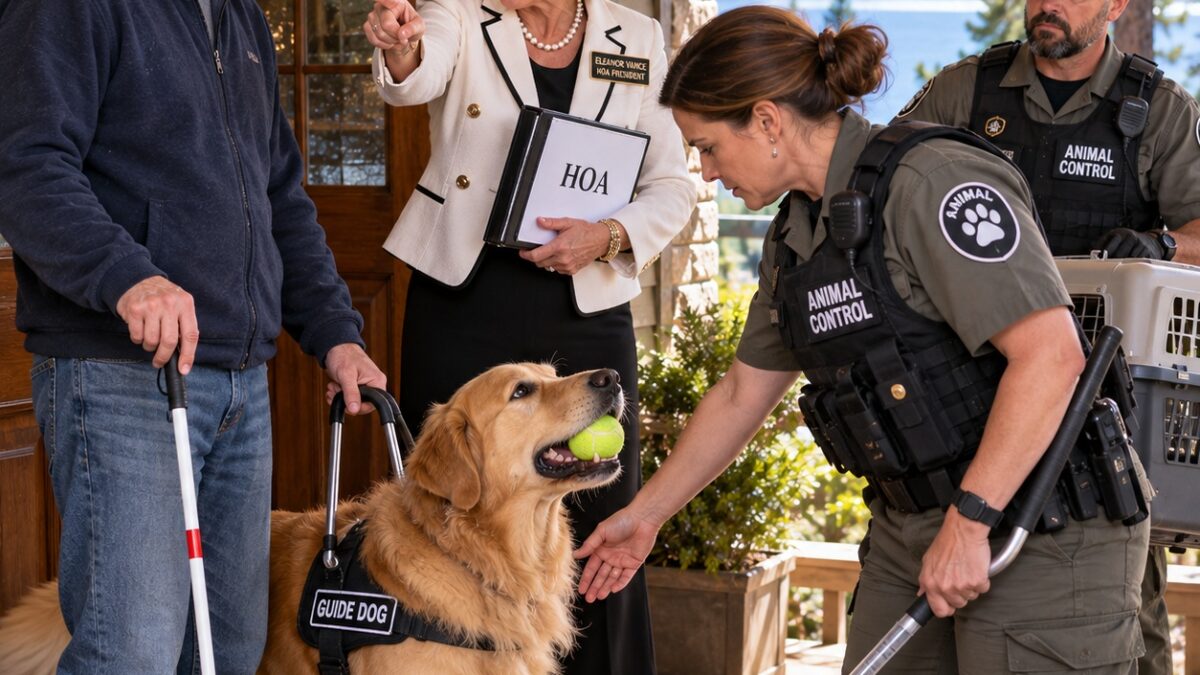
The third visit happened at 6:45 on a Tuesday morning.
I was making coffee.
Buster was off duty.
No harness.
Someone knocked.
Buster gave one short alert bark.
Then walked with me toward the door.
I put on his harness before opening because the front steps were shaded and my depth perception was poor that morning.
When the door opened, I heard equipment shifting.
Two voices.
Professional.
Uncomfortable.
“Mr. Sterling?”
“Yes.”
“We received a report involving a dangerous unregistered attack dog.”
Buster immediately dropped his tennis ball at the taller officer’s boots.
Silence.
Then the second officer laughed.
“Is this the suspect?”
“Yes.”
Buster wagged.
The second officer crouched.
Buster looked at me.
I gave the release command.
He promptly rolled onto his back.
The officer scratched his chest.
The taller one looked down at his paperwork.
Then at the harness.
Then at me.
“This is a service dog?”
“Guide dog.”
“Documentation?”
“Inside.”
I retrieved everything.
Vaccinations.
Training records.
Guide-dog records.
Identification.
The officer read.
His colleague was still rubbing Buster’s ears.
Finally, the taller man sighed.
“Mr. Sterling, this complaint says he lunged at several homeowners.”
“No.”
“Chased children near the playground.”
“No.”
“And you refused repeated requests to restrain him.”
“He is literally attached to me when working.”
The officer nodded.
“There’s a date on here.”
He told me.
I smiled without humor.
“I was in the city for a doctor’s appointment that entire day.”
“You have proof?”
“Yes.”
Appointment record.
Transportation receipt.
My phone location if necessary.
Buster had been with me.
The whole accusation was physically impossible.
The officers left after apologizing.
Again.
But before they went, the taller one said:
“We’re going to document that the complaint was unfounded.”
“Thank you.”
“And the complainant will be cautioned regarding false reports.”
That sentence changed something in me.
For months, I had been treating Eleanor’s campaign as an irritation I should outlast.
Suddenly I understood what I was allowing.
Every time she failed, she simply escalated.
Health inspector.
Code enforcement.
Animal control.
Board policy.
Surveillance.
Rumors.
If I kept absorbing it quietly, the next step might be worse.
I called my attorney.
“I’m done waiting.”
“Good.”
That afternoon, I began assembling the complete file.
Not a pile anymore.
A case.
Every citation.
Chronological.
Every email.
Every photograph Eleanor had displayed.
Every animal-control report I could obtain.
Health-inspection result.
Code-enforcement finding.
Witness names.
Meeting minutes.
Screenshots from neighborhood posts.
Photographs of Eleanor’s cameras aimed toward my house.
Mrs. Thompson agreed to provide a written statement.
So did Arthur Gallagher.
Mrs. Thompson wrote that her children had regularly interacted with Buster and had never experienced threatening behavior.
Arthur described Eleanor’s false story involving his azaleas.
He included the approximate distance from the path and noted the ornamental fence she had apparently forgotten existed.
Other neighbors added what they had heard at the mailboxes.
Not everyone wanted to participate.
I understood.
People get nervous when conflict becomes formal.
That was fine.
I did not need everybody.
I needed facts.
My attorney drafted the disability-discrimination complaint.
I sent a separate formal grievance to the HOA board.
That was when I learned how little some board members actually knew.
William Bradley was the nominal president on the association’s formal records, though Eleanor had behaved publicly as if she ran the entire organization and frequently described herself as its president or chief authority.
William was older.
Quiet.
The kind of man who sat through meetings while Eleanor filled every empty space with her voice.
When he received my packet, he called.
“Marcus.”
“Yes?”
“I need to ask you something.”
“Go ahead.”
“Those cameras.”
“What about them?”
“She really installed them facing your home?”
“Yes.”
“I didn’t authorize that.”
“I know.”
“Animal control came three times?”
“Yes.”
“I only knew about one.”
“That is part of the problem.”
Silence.
He sounded tired.
Then:
“We need an emergency session.”
My attorney attended by video.
That meeting was different from every HOA meeting before it.
Not because I spoke louder.
Because Eleanor was no longer controlling the evidence.
We entered with copies.
Organized.
Labeled.
Dates.
The first twenty minutes belonged to me.
I explained what Buster did.
Not emotionally.
Practically.
I described what blindness meant for my daily life.
What Buster’s guide work allowed.
How he navigated obstacles.
Why his harness mattered.
Why access mattered.
Then I walked them through the timeline.
Notice one.
Notice two.
Meeting statements.
Surveillance.
Health complaint.
Code complaint.
Animal control one.
Two.
Three.
False allegation made for a day when both Buster and I had been miles away.
Mrs. Thompson spoke.
Arthur spoke.
Then my attorney appeared on the laptop screen.
His tone was controlled.
That made people listen harder.
He explained the legal exposure created when a housing association or its representatives targeted a disabled resident because of a service animal, interfered with reasonable access, generated a hostile environment, or used repeated unfounded complaints as pressure.
He discussed federal disability protections and the seriousness of continuing after notice.
Then he said:
“Mr. Sterling has been extraordinarily patient.”
Eleanor laughed.
Actually laughed.
“Patient?”
“Yes.”
“He has brought an unregulated seventy-pound animal into shared community spaces.”
My attorney said:
“Guide dog.”
“Alleged guide dog.”
The room went quiet.
I felt something in my chest tighten.
Not because she insulted me.
Because after months of documents, after seeing the harness, after animal control verified everything, she still needed Buster to be fake.
My attorney asked:
“What evidence do you have that Mr. Sterling’s service animal is illegitimate?”
Eleanor began talking about internet fraud.
People purchasing vests online.
Fake certifications.
General abuse.
He interrupted politely.
“I asked about Buster.”
She shifted.
“There have been concerns.”
“Which documented concerns?”
“Residents are afraid.”
“Which residents?”
She would not say.
“Which verified aggressive incident?”
“He lunged at me.”
“Date?”
She hesitated.
“Last month.”
“Which day?”
“I don’t carry every detail in my head.”
Arthur Gallagher raised his hand.
“Was that the azalea incident?”
Eleanor turned.
Arthur continued:
“Because I’d still like to know how you dove through a fence.”
Someone laughed.
William Bradley did not.
He looked at Eleanor.
“Did you file the playground complaint?”
“Yes.”
“Marcus says he was in the city that day.”
“He could be mistaken.”
“I have the animal-control report.”
William tapped the packet.
“They verified it.”
Eleanor’s voice sharpened.
“You’re all missing the point.”
That phrase always means the facts are becoming inconvenient.
“The point is safety.”
Mrs. Thompson responded.
“No. The point is that you have been telling people my children are in danger from a dog they play with every week.”
Eleanor turned toward her.
“You are irresponsible for allowing that.”
Mrs. Thompson’s chair moved.
Not dramatically.
Just enough that I could hear it.
“My children know the difference between a working dog and a pet better than you do.”
That was the moment the room stopped being Eleanor’s.
Not the final vote.
Earlier.
Right there.
Because for months, people had listened to her as if she represented community concern.
Now they were recognizing that the community itself did not share the concern.
Eleanor did.
That difference matters.
The board went into closed discussion.
My attorney muted his microphone.
I sat with Buster at my feet.
He leaned against my leg.
I scratched behind his ear.
“Good boy.”
He exhaled.
Five minutes.
Ten.
Fifteen.
William called us back.
His voice sounded different.
Less sleepy.
More like someone who had finally realized being nominally in charge still carried responsibility.
The board’s decision was immediate.
Eleanor was removed from the leadership authority she had been exercising over enforcement and HOA operations.
She was prohibited from filing complaints concerning Buster unless she presented objective video evidence for review by the full board.
Her surveillance cameras aimed toward my property had to be removed within seventy-two hours.
Failure to do so would expose her to direct action from the association and from me.
The board also suspended every pending Buster-related citation.
Eleanor voted against the decision.
Nobody cared.
When the meeting ended, she walked past me.
Her perfume reached me before her voice.
“This isn’t over.”
I almost smiled.
People like Eleanor love that sentence.
They think it makes them sound powerful.
Most of the time, it simply tells you they have not learned anything.
“No,” I said. “It probably isn’t.”
She stopped.
Maybe she expected fear.
I had none left for her.
I had spent five years learning to move through a world I could not always see clearly.
Eleanor Vance was much easier to navigate than a poorly marked curb.
The cameras came down within seventy-two hours.
I heard the work happening from my deck.
Metal ladder.
Drill.
Someone calling measurements.
When the last camera disappeared, I sat outside with Buster.
For the first time in weeks, the deck felt like mine again.
But the legal complaint was already moving.
My attorney had filed with the appropriate federal channel concerning disability harassment.
Eventually, correspondence arrived from the Department of Justice.
That was when Eleanor became frightened.
Not during the board meeting.
Not after animal control warned her.
Federal letterhead.
Apparently, that looked official enough.
The potential civil exposure was significant.
My attorney explained that penalties for disability-rights violations could begin around the twenty-five-thousand-dollar range in circumstances like those being examined, with additional consequences depending on conduct.
Eleanor hired her own lawyer.
Good lawyer, from what I could tell.
His first useful decision was telling her to stop speaking publicly.
The neighborhood Facebook group became quiet overnight.
No warning posts.
No photographs of Buster.
No “concerned resident” language.
Silence.
My attorney eventually called.
“She wants settlement.”
“What does she want?”
“To avoid extended federal proceedings.”
“What are they offering?”
He explained.
Attorney costs.
A significant financial contribution to a guide-dog organization.
Mandatory disability-rights education.
Written commitments regarding future conduct.
Additional consequences tied to her HOA involvement.
I did not ask for an apology video.
Did not demand she stand in the community center and confess.
People sometimes think justice needs humiliation.
I did not.
I wanted Buster left alone.
I wanted my home left alone.
I wanted enough consequence that Eleanor understood she could never repeat the campaign without risk.
The final financial consequences reached the level my attorney had warned her about.
Twenty-five thousand dollars associated with the matter, along with the other settlement obligations.
She also lost any realistic path back to HOA leadership.
That part bothered her more than the money.
I knew because three months later, annual elections were held.
Eleanor attempted to join the architectural review committee.
Not president.
Not enforcement.
Just a seat.
She received three votes.
Three.
Probably her bridge friends.
Nobody said that officially.
Arthur Gallagher told me afterward:
“Those handbags stayed loyal.”
I laughed harder than I should have.
Mrs. Thompson became the new HOA president.
That made sense.
She had children.
Patience.
A practical mind.
And no apparent desire to turn landscaping preferences into constitutional law.
Her first major priority was revising the association’s governing documents.
Not because the law had suddenly changed.
Because good local rules should make lawful behavior easier to understand.
Service animals.
Accommodations.
Complaint procedures.
No targeting residents through informal enforcement campaigns.
No surveillance of another home disguised as association oversight.
Complaints involving safety needed evidence.
Repeat false reporting could itself trigger discipline.
The board also created clearer separation between actual HOA authority and one member’s personal concern.
William Bradley supported everything.
Then stepped back.
He admitted something to me later.
“I let Eleanor run meetings because it was easier.”
We were standing beside the lake.
Buster was sniffing grass.
William continued.
“She was prepared. Always had a binder. Always wanted to do things.”
“That can be useful.”
“It can also become an excuse.”
“For what?”
“For everyone else not doing their job.”
I appreciated that.
Eleanor had been the loudest problem.
But systems fail when quieter people surrender responsibility to the loudest person because resistance feels inconvenient.
William understood that now.
The neighborhood changed quickly after the conflict ended.
Not because everyone suddenly loved me.
That would have been weird.
Most people simply returned to living.
The bridge-group ladies stopped crossing the road so dramatically.
One still did.
I respected the commitment.
The Thompson children continued visiting.
Their favorite ritual was waiting for me to remove Buster’s harness.
The moment it came off:
“Buster!”
He transformed.
Professional guide dog became golden tornado.
One child threw the tennis ball.
Buster ran.
Returned.
Dropped it.
Again.
Again.
Again.
Golden retrievers operate under the belief that human arms never become tired.
Arthur Gallagher started greeting us each morning near his azaleas.
After Eleanor’s famous story, the shrubs became a neighborhood joke.
One morning Arthur said:
“Careful, Marcus. Dangerous terrain.”
“What?”
“Azaleas.”
“Right.”
“You could lose a good HOA official in there.”
I laughed.
Even Buster wagged.
The community newsletter ran a feature about service animals and neighborhood inclusion.
They used a photograph of Buster.
A good one.
Not a blurry surveillance shot.
His harness was visible.
He looked noble.
This annoyed me because I knew he had tried to eat a paper towel thirty minutes after the photograph was taken.
Still, people liked the article.
It explained when not to distract a working guide dog.
Why children should ask before touching.
Why access is not a special favor.
And how Buster assisted me.
For the first time, the neighborhood conversation about him was based on reality.
Not Eleanor.
That felt strange.
Good.
But strange.
I had become accustomed to anticipating the next problem.
When problems stop, your body does not immediately believe them.
For several weeks after the cameras came down, I still felt watched when I stepped onto the deck.
Sometimes I would turn toward Eleanor’s property automatically.
I could not see the windows clearly enough from that distance to know whether someone stood behind them.
But I imagined it.
That was the residue.
Harassment is not over simply because the letters stop.
You carry the expectation of the next one.
The first quiet month was harder than I expected.
No notice.
No inspector.
No animal-control truck.
No complaint.
Every knock on the door still tightened my shoulders.
Buster noticed.
Dogs always notice what people pretend is not happening.
He would press against my leg.
Wait.
Eventually my nervous system learned the same lesson the board had.
The threat was not coming.
One Saturday morning, Buster and I walked toward the lake.
Harness on.
He stopped before the curb.
I followed.
Crossed.
Mrs. Thompson called from across the street.
“Morning, Marcus.”
“Morning.”
Her children asked:
“Can we play with him later?”
“If the vest is off.”
“We know!”
They were offended I had reminded them.
Buster guided me toward the water.
Wind moved through the trees.
The lake smelled cool and clean.
No one crossed the road.
No one whispered.
No one photographed us.
That was the first morning Whispering Pines felt like the place I thought I had moved to.
A home.
Not a case file.
My attorney called once after everything had settled.
“Do you regret not suing for more?”
“No.”
“Good.”
“You sound disappointed.”
“I’m a lawyer. Litigation is how we make friends.”
“You have a strange definition of friendship.”
He laughed.
Then became serious.
“You know you could have pushed harder.”
“I know.”
“Why didn’t you?”
I looked toward Buster.
He was asleep near the desk.
“I wanted it to stop.”
That answer sounds simple.
It was.
I did not want Eleanor ruined.
I did not want her house.
Her career.
Her money.
I wanted the campaign to stop.
The settlement did that.
Her real-estate business suffered anyway.
That came from her own choices.
Whispering Pines was a small market.
Eleanor had built her professional image around knowing the community.
Knowing rules.
Knowing people.
Knowing property.
After word spread that she had been removed from HOA authority following a disability-harassment dispute, some prospective clients began choosing other brokers.
I did not campaign against her.
Did not call anyone.
Did not post reviews.
Actions have reputational consequences without victims needing to become public-relations departments.
For a while, her face still appeared on bus-stop advertisements.
Perfect smile.
Phone number.
YOUR WHISPERING PINES EXPERT
Arthur once said:
“They should add ‘except golden retrievers.’”
I told him he was becoming mean in retirement.
He said retirement had freed his personality.
Eleanor remained four houses away.
That was important.
No cinematic disappearance.
No moving truck during a rainstorm.
No final confrontation.
She remained part of the neighborhood.
Sometimes consequences do not remove the person who caused harm.
They simply remove their ability to keep causing it.
At first, seeing her worried me.
Or rather, sensing her.
The sound of her car.
Her voice at a distance.
The scent of the perfume she always wore when passing too close.
But she avoided us.
When Buster and I approached on the sidewalk, Eleanor crossed.
Once, I heard her sandals change direction before I realized who it was.
Old habit.
Only now the movement felt different.
Before, she crossed as if avoiding danger.
Afterward, it felt like shame.
I did not chase her.
Did not greet her.
Did not force reconciliation.
We simply occupied the same neighborhood.
That was enough.
Months later, I heard she had become involved in a debate over pool noodle colors.
I assumed Arthur was joking.
He swore he was not.
Apparently Eleanor believed brightly colored floating toys harmed the visual character of the pool area.
I almost admired the consistency.
At least pool noodles did not have federal disability protections.
I told Mrs. Thompson:
“That one is yours.”
She sighed.
“Thanks.”
Buster and I continued our morning walks.
He learned the exact route from the cabin to the lake.
Left at the mailbox.
Straight past the Gallaghers.
Pause near the path junction.
Then down toward the water.
I knew it too.
But with Buster, knowing the route and navigating it were different things.
One morning a storm had dropped a branch across the walkway.
I could make out the dark shape, but not its height.
Buster stopped.
Shifted.
Guided me around.
No drama.
No barking.
That is what a good guide dog does.
He prevents the accident before anyone else realizes there was a problem.
I thought about Eleanor.
All those photographs.
All those complaints.
Months spent trying to prove Buster was dangerous.
Meanwhile, every day he was quietly preventing me from being hurt.
There was something almost tragic about it.
Not for me.
For her.
Imagine living in a world where every unfamiliar thing must become a threat before you are willing to understand it.
I had lost most of my sight.
Eleanor, with perfect vision, had been the one refusing to see.
I did not say that aloud.
Too dramatic.
I am an audio engineer.
We have standards.
The Department of Justice matter eventually closed.
Paperwork filed.
Terms completed.
Eleanor finished the required education.
The donation to the guide-dog organization was made.
My legal expenses were handled.
Twenty-five-thousand-dollar consequences had become very real in a way her original HOA warnings never were.
The irony was not lost on me.
She had spent months creating invented violations.
Then discovered what an actual one looked like.
No homemade soundtrack.
No blurry zoom.
No bridge-club rumor.
Just law.
I framed nothing.
People expected me to frame the final letter.
I did not.
The whole file went into a cabinet.
My attorney told me to keep it.
I did.
But I stopped leaving the folder on my desk.
That mattered.
For months, Eleanor had occupied part of every workday.
Recording.
Saving.
Answering.
Sorting.
Cross-referencing.
The case file became part of the furniture.
Once it ended, putting it away was how I told myself the dispute was no longer the center of my life.
Audio work returned to being audio work.
I spent mornings editing dialogue.
Cleaning background hum.
Balancing tracks.
Buster slept under the desk.
Sometimes he snored loudly enough that I had to redo a take.
I accused him of sabotaging my career.
He did not care.
At lunch, I removed the harness and threw the tennis ball from the deck.
Those were the days I had moved there to have.
Quiet.
Work.
Dog.
Water.
The first anniversary of the animal-control visit passed without me noticing.
Mrs. Thompson reminded me.
“Do you realize it’s been a year?”
“Since what?”
“Since Buster nearly mauled those officers with affection.”
I laughed.
“I had forgotten.”
She smiled.
“That’s good.”
She was right.
Forgetting dates can be healing.
Not everything needs an anniversary.
Some events deserve to shrink.
Buster had become something of a neighborhood celebrity.
That embarrassed me more than it embarrassed him.
He appeared in another newsletter article.
The Thompson children tried to convince the board he needed an honorary title.
Arthur suggested:
Director of Azalea Security.
Mrs. Thompson rejected it.
Barely.
The board instead held a short community session on service animals.
Not about me.
General education.
A trainer spoke.
Explained that working dogs may ignore people while harnessed.
That strangers should not feed them.
That service animals are not neighborhood pets even if they live among neighbors.
I attended.
Sat in back.
Eleanor did not.
That was fine.
The people who mattered were learning.
Afterward, one woman from the bridge group approached.
I recognized her voice.
She had crossed the road many times.
“Marcus?”
“Yes.”
“I owe you an apology.”
I waited.
“I believed Eleanor.”
“Okay.”
“She said Buster had bitten somebody.”
“He didn’t.”
“I know now.”
Silence.
“I’m sorry.”
“Thank you.”
She started to leave.
Then:
“Can I pet him?”
I smiled.
“Not with the harness on.”
“Oh.”
“Later.”
She laughed nervously.
“Right. I’m learning.”
That was enough.
Not every apology needs a dramatic embrace.
Nobody hugged.
Nobody cried.
She learned something.
We moved on.
William Bradley resigned from formal board leadership the following year.
Health.
Age.
And, I suspect, exhaustion from discovering what happens when you sleep through too many meetings.
Before stepping down, he came to my cabin.
No agenda.
No notice.
He stood on the deck.
Buster off duty beside him.
“I should’ve stopped her sooner.”
“Yes.”
He looked surprised.
People expect reassurance when they confess something uncomfortable.
Sometimes honesty is kinder.
“I thought you’d tell me I couldn’t have known.”
“You could’ve known more.”
He nodded.
“Fair.”
I offered coffee.
He accepted.
We sat outside.
William told me Eleanor had always volunteered for everything.
Committees.
Enforcement.
Architecture.
Meetings.
She read documents.
Prepared packets.
Called contractors.
Everyone else gradually let her do more because the work got done.
Until eventually nobody could tell where Eleanor’s personality ended and HOA policy began.
That is a governance problem long before it becomes a legal one.
Authority expands into empty space.
If everybody else steps backward, the person stepping forward begins believing the room belongs to them.
William understood that now.
Mrs. Thompson did too.
She required multiple board members to review enforcement issues.
No one-person campaigns.
Written evidence.
Appeal process.
Minutes reflecting actual decisions instead of whatever one officer said afterward.
Boring.
Healthy.
I became an accidental advocate for boring governance.
I had never wanted an HOA role.
Still did not.
People occasionally asked me to join the board.
“No.”
“Why not?”
“Because I like you people.”
They laughed.
I meant it.
I did not want another authority structure.
I wanted the one we already had to work correctly.
That is an important distinction.
Eleanor had taught me something by doing the opposite.
Not every problem requires replacing the bad leader with the person who fought them.
Sometimes the healthiest result is creating a system that no longer needs heroes.
One summer afternoon, the Thompson children were throwing Buster’s tennis ball near the lake.
His harness was off.
He ran badly.
Golden retrievers are graceful until they become excited.
Then all four legs seem to belong to separate animals.
Arthur sat near his azaleas.
Mrs. Thompson was reading.
I stood at the edge of the path.
The sun was bright enough that I wore dark glasses.
Migraine risk.
But otherwise good.
Buster came racing back.
Ball in mouth.
Stopped directly in front of me.
Dropped it against my shoe.
“Again?”
His tail answered.
I threw.
Not far.
My depth perception is terrible.
Buster did not care.
The children cheered as though I had thrown fifty yards.
For a moment, I thought about the animal-control report.
Dangerous unregistered attack dog.
The language felt ridiculous now.
Paper from another life.
People often ask what changed Eleanor.
Nothing, probably.
Not fundamentally.
The law changed her behavior.
Consequences changed her access.
The board changed her authority.
Maybe the training taught her something.
Maybe it did not.
I no longer needed to know.
That became another form of freedom.
At the beginning, I wanted her to understand Buster.
Eventually, I understood that understanding was optional.
Compliance with boundaries was not.
You do not have to like a disabled neighbor.
You do not have to love service dogs.
You do not have to think golden retrievers are adorable.
You simply do not get to fabricate danger because someone’s disability makes you uncomfortable.
That is where law becomes useful.
Law cannot make Eleanor kind.
It can stop Eleanor from turning her fear into my problem.
That was enough.
My migraines improved after the first year at the lake.
Not disappeared.
Never completely.
But fewer.
My doctor said lower stress probably helped.
I did not tell him my first months at Whispering Pines had included an HOA crusade and three animal-control visits.
Medical appointments are already long enough.
Buster remained central.
On bad migraine days, he guided me through darkened rooms.
Found the bedroom.
Waited.
When vision became worse from light sensitivity, he became more important, not less.
There were days when I thought about what Eleanor had actually been asking when she demanded Buster be removed.
She was not asking me to give up a dog.
She was asking me to give up independence.
People who do not rely on adaptive tools often misunderstand that.
A ramp is not decoration.
A cane is not an accessory.
A guide dog is not a pet you can simply leave home because the neighbors prefer it.
Buster was the difference between:
Can I safely walk to the lake?
and:
Yes.
That was why the fight mattered.
Not because Eleanor hurt my feelings.
Because her campaign targeted the thing that made my daily life larger.
The first time I traveled alone after the dispute, Buster and I went into the city for work.
Train platform.
Crowded sidewalk.
Elevator.
Studio.
He moved through everything with the same calm competence he brought to Whispering Pines.
At the end of the day, someone at the studio said:
“I forget you can’t see well.”
I laughed.
“That means Buster is doing his job.”
On the ride home, I thought about Eleanor’s insistence that he created danger.
Some people look at support and see weakness.
Others see dependency as something shameful.
I stopped caring.
Everyone depends on something.
Glasses.
Cars.
Medication.
Maps.
Other people.
I depended on Buster.
He depended on me for food and tennis balls.
Fair arrangement.
One autumn morning, Eleanor and I ended up near the mailboxes at the same time.
First direct encounter in months.
I heard her car door close.
Her perfume.
Then silence.
Buster stopped appropriately.
I knew she was there.
“Morning,” I said.
Long pause.
“Good morning.”
Her voice was smaller than I remembered.
No clipboard.
No lecture.
No warning.
We collected mail.
Then Buster guided me away.
That was all.
Some part of me had once imagined a final confrontation.
Eleanor apologizing.
Me delivering a devastating speech.
Reality was better.
Two neighbors getting mail.
No power struggle.
No audience.
Nothing to prove.
The opposite of harassment is not revenge.
It is ordinary life.
Mrs. Thompson eventually asked permission to feature Buster on the cover of the association newsletter.
I said:
“Ask his agent.”
She said:
“You’re his agent.”
“Then the fee is two tennis balls.”
The Thompson children delivered three.
Aggressive negotiation.
The photograph showed Buster sitting beside the lake.
Harness on.
Head high.
Underneath:
SERVICE, ACCESS, AND COMMUNITY: WHY ACCOMMODATION MATTERS
No mention of Eleanor.
I liked that.
Education did not need a villain’s name.
The story was bigger than her.
The article explained disability accommodations in general.
Guide dogs.
Mobility devices.
Accessible parking.
Home modifications.
The board had learned not to create rules based on whoever happened to be making the loudest complaint that month.
That mattered more than whether Eleanor ever became less prejudiced.
Years later, I still have the tennis ball from the morning animal control arrived.
Not because I intentionally saved it.
Buster has a collection.
But I think it is the same one.
Faded green.
Bare patches where the felt wore away.
Sometimes I look at it and remember the taller officer standing on my porch reading a report describing a dangerous attack dog while the alleged threat begged him to play fetch.
There was something almost perfect about that moment.
Reality standing directly beside the accusation.
That is what ultimately defeated Eleanor.
Not anger.
Not me being clever.
Reality.
Every time somebody independent checked, her story collapsed.
Health inspector.
Nothing.
Code enforcement.
Compliant.
Animal control.
Gentle guide dog.
Neighbors.
No attacks.
Board.
No evidence.
Department of Justice.
Documented pattern.
Eleanor had one advantage for months:
She spoke first.
Once evidence started speaking, that advantage disappeared.
That is why I tell people facing harassment to save things.
Not because every bad neighbor becomes a federal case.
Most do not.
But memory gets argued with.
Paper is harder.
Write the date.
Keep the email.
Save the notice.
Take the photograph.
Ask witnesses what they actually saw.
Do not exaggerate.
Do not improve the story.
Truth does not need better marketing.
Eleanor had cameras.
I had records.
The difference was that my records reflected what happened.
Her cameras were supposed to manufacture meaning from harmless behavior.
Buster yawns.
Threat.
Buster plays.
Threat.
Buster walks.
Threat.
It is amazing how much fear people can create if they are allowed to narrate ordinary footage without challenge.
The board never again permitted one member to present edited surveillance packages as evidence without context.
Arthur suggested banning dramatic background music from official proceedings.
Mrs. Thompson told him the bylaws were already long enough.
He remains disappointed.
Buster grew older.
Gold appeared lighter around his face.
Still strong.
Still working.
The thought of his eventual retirement became difficult.
I knew another guide dog would someday enter my life.
That did not make Buster replaceable.
Service animals occupy two roles at once.
Medical support.
Relationship.
The law cares about the first because access depends on it.
Humans care about both.
Eleanor had reduced Buster to a category she disliked.
Large dog.
Possible risk.
She never learned the individual.
That was her failure long before it became discrimination.
She never met him.
She refused every invitation.
Fear survives best when it never has to sit across from the thing it fears.
One cool morning, Buster and I walked down toward the water.
No rush.
The path had become familiar enough that I knew almost every turn from memory.
Still, his harness guided my hand.
Arthur called from his yard.
“Morning.”
“Morning.”
“How’s the beast?”
“Planning another azalea attack.”
“Thought so.”
Buster’s tail moved.
We reached the lake.
I removed his harness.
He shook himself.
Then started searching for something.
A branch.
He found one.
Naturally.
Dropped it near my foot.
I picked it up.
The bark was rough beneath my fingers.
I threw.
Buster exploded toward the sound of it hitting the ground.
I listened to his paws.
The Thompson kids were somewhere farther down the shore.
I could hear them laughing.
A boat engine started across the lake.
Wind moved through leaves.
Whispering Pines had finally become what I wanted when I moved there.
A place where I could recover.
Work.
Walk.
Live.
Not as a blind man everybody needed to manage.
Not as the owner of a controversial dog.
Marcus.
Buster.
Neighbors.
That simple.
Behind us, somewhere four houses away, a curtain moved.
I heard a window close.
Maybe Eleanor.
Maybe not.
I did not turn.
That was the final difference.
Months earlier, every movement from her direction would have mattered.
Now it did not.
Buster returned.
Branch in his mouth.
I reached down.
“Again?”
His tail hit my leg.
I threw it.
And as he ran toward the water in complete, ridiculous happiness, I understood that justice had never been the board humiliating Eleanor.
It was not the federal complaint.
Not the twenty-five-thousand-dollar consequence.
Not her three votes.
Not even the cameras coming down.
Justice was Buster still being here.
Harness beside me when I needed him.
Tennis ball under my desk.
Golden fur on my couch despite my repeated objections.
The Thompson children waiting politely until he was off duty before throwing sticks.
Arthur joking from behind his azaleas.
A board that had finally learned that accommodation was not charity and disability was not misconduct.
A home that felt like home again.
Eleanor had spent months trying to convince Whispering Pines that Buster’s existence endangered the community.
In the end, the only thing he ever threatened was her ability to control the story.
And once everyone stopped listening to her version and started looking at the facts, there was nothing left for her to fight.
Buster was not dangerous.
He was not unregistered.
He was not fake.
He had never chased children.
Never lunged at homeowners.
Never reduced a property value.
He had done exactly what he had been trained to do from the beginning.
Guide me safely through a world I could no longer fully see.
Eleanor Vance could see perfectly.
She was the one who needed months of consequences before she finally learned where she was going.


