PART2:HOA Queen Sent a Semi Through My Grandfather’s Barn—Then Learned My Farm Could Never Become Hers
PART2
Three months later, the first certified letter came.
Heavy cream paper.
HOA letterhead.
Gold seal.
The seal looked homemade.
Vivian cited me for three things.
Agricultural odor nuisance.
Visual blight.
And my favorite:
Unsanctioned commercial activity.
That referred to my produce stand.
The same produce stand my mother had operated before Ridgeview Estates existed.
I stood at my kitchen counter reading the letter while cattle called from the pasture.
That low morning sound.
Slow.
Rolling.
Older than the subdivision.
Older than Vivian’s complaint.
I taped her letter to the equipment shed door.
Then fed my cat.
That was a mistake.
Not because Vivian was right.
She was not.
My land was zoned agricultural.
My farm was legal.
My produce stand was permitted.
The HOA had exactly as much jurisdiction over my cattle as the cattle had over Vivian’s kitchen curtains.
My mistake was believing being right was enough.
It often is not.
Not when the person across from you has decided the real problem is not a rule violation.
It is that you refuse to be controlled.
The anonymous complaints started a month later.
County zoning.
First complaint:
Equipment shed setback.
Inspector came.
Measured.
Legal.
Next:
Unpermitted barn wiring.
Inspector came.
Checked the electrical work.
Legal.
Next:
Drainage violation near the south hay field.
Inspector came during rain.
Walked the ditch.
Legal.
Then livestock density.
Roadside commerce.
Fence height.
Agricultural waste.
Possible unapproved structure.
Over ten months, I received twelve inspection visits.
Twelve.
Violations found:
Zero.
The chief county inspector was Howard Cobb.
Lean man.
Weathered face.
Twenty-three years on the job.
A person with the patience of someone who had spent two decades watching human beings use bureaucracy for reasons bureaucracy was never designed for.
After inspection number seven, Howard shut his clipboard.
We were standing beside my equipment shed.
Afternoon sun in his eyes.
He looked toward Ridgeview.
Then back at me.
“Del.”
“Yeah?”
“Whoever keeps filing these complaints is spending more on postage than you’re ever going to spend on fines.”
I almost smiled.
“You know who?”
“I don’t officially know anything.”
“Officially?”
He put his sunglasses on.
“Officially, your shed is legal.”
Then he left.
The inspection parade did one thing Vivian never intended.
It made me organized.
Before that, my permits lived wherever farmers put paperwork they know they should care about.
A filing drawer.
A shoebox.
Truck glovebox.
Desk.
Kitchen drawer beneath the batteries.
After Vivian, I pulled everything.
Deeds.
Permits.
Registrations.
Tax records.
Agricultural certificates.
Livestock documents.
Water records.
I verified every page.
Updated whatever needed updating.
One manila folder became a binder.
The binder became two.
My farmhouse office smelled like coffee and printer toner for three straight months.
Then I hired Patricia Swell.
County agricultural extension agent.
Sharp woman.
No patience for drama.
Drove a pickup older than half my fence posts.
She came out one cold morning and walked all forty acres.
She photographed.
Measured.
Reviewed use.
Barn.
Pasture.
Cattle.
Hay.
Produce stand.
Equipment.
Pond.
Then filed a certified land-use assessment.
It said what any reasonable person could see.
The Briggs farm was a legitimate, active agricultural enterprise with grandfathered status predating Ridgeview Estates by roughly sixty years.
Certified copy.
Binder number two.
When the inspection campaign failed, Vivian changed tactics.
She announced a “neighborhood beautification initiative.”
Ridgeview residents were encouraged to photograph portions of my farm visible from subdivision streets.
Fence posts.
Equipment.
Hay.
Mud.
Cattle.
Apparently cows had become an aesthetic issue.
She assembled the images into a presentation for the county commission.
Forty-two households supposedly stood united against my property.
Seventeen people attended.
A few left before she finished.
I sat in the back.
Not because I needed to defend myself.
Because Adeline had started telling me something I was finally learning to believe:
“Del, never let somebody create a public record about you without being in the room.”
Adeline Briggs Tanner is my cousin.
Property attorney in Chattanooga.
Smart enough to make you feel safer and stupid at the same time.
Vivian spoke for eight minutes.
Slides.
Charts.
Photographs.
Terms like “community character.”
“Property harmony.”
“Visual compatibility.”
Finally, the commission chair leaned toward his microphone.
Garrett Wilson.
Tobacco farmer on weekends.
Little patience for theater.
“Mrs. Marchand?”
“Yes?”
“Mr. Briggs’s property is protected agricultural use.”
Vivian smiled.
“We understand there are historic uses—”
“No.”
She stopped.
Garrett continued.
“I mean protected.”
He referenced Tennessee’s right-to-farm protections.
Existing agricultural operations could not simply be nuisance-claimed out of existence because residential development arrived beside them later.
Vivian tried:
“We are not asking him to cease farming.”
Garrett looked at her slides.
“You cited cattle odor.”
“We’re asking for reasonable accommodation.”
“His cattle were there first.”
A few people laughed.
Vivian’s face tightened.
The commission took no action.
I thought that would embarrass her into stopping.
Instead, she became more careful.
The whisper campaign started.
I was hostile.
Uncooperative.
Threatening.
One rumor said I had threatened a resident.
The alleged resident was Bertram.
He called me personally.
His voice had the controlled outrage of a man who had spent thirty years correcting teenagers who invented facts during civics debate.
“I did not say that.”
“I know.”
“I told Vivian her characterization was defamatory.”
“Thank you.”
“I want that noted.”
That was when I started the notebook.
Small spiral pad.
Binders held official documents.
Notebook held everything else.
Dates.
Calls.
Names.
Comments.
Things heard at meetings.
Things Bertram reported.
Things Howard said.
Not gossip.
Chronology.
I did not realize it then, but I was building the thing Vivian would eventually be unable to survive.
A pattern.
Lawyers love patterns.
Fourteen months in, Vivian found something real.
Not useful.
But real.
A lien.
My father had taken a fourteen-thousand-dollar agricultural operating loan.
The bank no longer existed.
Absorbed through mergers.
Dad had paid it in 1991.
The satisfaction document had been filed.
But when the county digitized old records, the document had been misindexed.
If you searched badly enough—and wanted badly enough to find trouble—it looked unresolved.
Vivian took it to an attorney.
That attorney told her what any competent property lawyer would have told her.
Old lien.
Almost certainly paid.
Easy to verify.
Do not touch it.
So Vivian found another attorney.
Younger.
Hungrier.
Less concerned with looking ridiculous.
He filed a cloud-on-title action.
I received notice on a Tuesday.
Coffee cold.
Toast burned.
One calf limping outside.
I read the complaint twice.
Then called Adeline.
She was quiet for several seconds.
“Del.”
“What?”
“This is the dumbest thing I have read since the bar exam.”
“Good.”
“No. Not good.”
“Why?”
“Because dumb litigation is still litigation.”
That was the lesson.
Vivian did not have to win.
She only had to create enough uncertainty to hurt me.
I was negotiating a three-year supply agreement with a regional agricultural co-op.
Guaranteed cattle pricing.
For a farm my size, that meant stability.
The co-op’s attorneys saw the active title litigation.
Negotiations stopped immediately.
They did not believe Vivian.
Did not matter.
They could not execute the agreement while a title dispute was pending.
Potential loss:
Roughly forty thousand dollars over three years.
That was the first time Vivian’s obsession reached directly into my operating income.
I drove to Chattanooga.
Adeline and I covered her dining table with paper.
By Saturday afternoon, you could not see wood.
She worked through it in layers.
“First,” she said, “we kill the lien issue.”
Title company search.
Paid in 1991.
Satisfaction document found.
Misindexed.
Simple correction.
“Second, counterclaim.”
“For what?”
“Attorney’s fees on a claim devoid of merit.”
“Will we get them?”
“Maybe.”
She smiled.
“But I want her lawyer reading it.”
“Third?”
Her smile changed.
“Professional responsibility complaint.”
I looked at her.
“Adeline.”
“He filed a title action without properly investigating whether the lien had been satisfied.”
“Could hurt his license?”
“Probably not.”
“Then why?”
“Records.”
There was that word.
Records.
She filed.
Within forty-five days, Vivian’s title action collapsed.
Her attorney withdrew.
The co-op agreement came back.
I signed.
Adeline reduced her bill.
I paid the balance in Angus beef for six months.
She accepted because she grew up helping my father move calves and understood the true Briggs family currency.
I mailed Howard Cobb a copy of the dismissal.
He called.
Said one word.
“Good.”
Hung up.
I thought Vivian would stop.
Instead, she began checking out property-law books from the county library.
Bertram discovered that because his wife volunteered there.
I remember him telling me.
We stood at my produce stand.
“You’re joking.”
“No.”
“What books?”
“Easements.”
I stared at him.
“Seriously?”
“Three.”
“Anything about hobbies?”
“No.”
That was when Vivian found the gravel road.
Along my eastern boundary ran an old gravel lane.
For years, Ridgeview residents had used it informally.
Walking.
Jogging.
Occasional vehicle shortcut.
I never cared.
They were neighbors.
They waved.
I waved.
Nobody damaged anything.
Then Vivian claimed those years of use created a prescriptive easement.
The theory was not stupid.
That worried me more.
Prescriptive easements exist.
Under the right circumstances, open and continuous use of another person’s land can mature into legal rights.
Vivian proposed formalizing the road as HOA access.
Then demanded I improve it to county standards.
Grading.
Drainage.
Possibly paving.
Estimate:
Twenty-two to thirty-eight thousand dollars.
I read that certified letter on the porch at dusk.
Fireflies over the south field.
For the first time, I felt something close to fear.
Not because she was right.
Because she had finally found an argument requiring more than laughter.
I called Adeline.
She said:
“Long shot.”
“That good?”
“With legs.”
“That sounds bad.”
“It means we answer it.”
I had allowed use.
That saved me.
Prescriptive rights generally depend on use that is adverse, not permission from the owner.
So we made the permission formal.
I had signs printed.
USE OF THIS ROAD BY ADJACENT RESIDENTS IS PERMITTED BY PERMISSION OF D. BRIGGS, LANDOWNER. PERMISSION MAY BE WITHDRAWN AT ANY TIME.
Posted both ends.
Then I mailed notice to all forty-two Ridgeview households.
Not hostile.
Not revocation.
Just clarity.
You may use the road because I permit you to.
Not because the HOA owns any right.
Adeline recorded the relevant notice.
Copied Vivian’s third attorney.
Third.
That number alone told me something.
Then Adeline said:
“We need to stop defending.”
“What does that mean?”
“You keep waiting for her next idea.”
“What else am I supposed to do?”
“Change the board.”
“What board?”
“The chessboard.”
I hate lawyer metaphors.
Especially when they are accurate.
That conversation led me to Patricia and the USDA Agricultural Conservation Easement Program.
ACEP.
A voluntary permanent conservation easement.
The concept was simple enough.
My land had two values.
Agricultural value.
Development value.
Because Ridgeview had pushed property prices upward, the land was worth considerably more if chopped into residential lots than if maintained as a working farm.
Under the program, I could receive payment for part of that difference.
In exchange, the farm would receive permanent restrictions protecting agricultural use.
Permanent.
Recorded in the chain of title.
No subdivision.
No residential development.
No conversion to some future phase of Ridgeview Estates.
Not while I owned it.
Not after I died.
Not fifty years later.
The thought hit me harder than I expected.
My grandfather had protected this farm by working.
My father protected it by paying every debt.
Maybe my job was to protect it with paper.
I applied.
Estimated development-value gap:
Around sixty-eight thousand dollars.
Useful money.
But the money was not why I wanted it.
I wanted the word:
permanent.
Vivian learned about the application.
Then went quiet.
For one week.
By then I understood quiet.
Quiet meant she was reading.
What I did not understand was that Vivian had been reading longer than any of us knew.
Adeline found that out during the conservation easement title review.
ACEP required a deep title and encumbrance search.
Back to the 1948 deed.
She went through everything.
Then called me.
“Come to Chattanooga.”
“Can’t tell me over the phone?”
“Come.”
That is lawyer language for you will not enjoy this.
I drove down.
She had a twenty-two-page 2003 annexation agreement on her desk.
Page eighteen marked.
“Read Section 7C.”
I read it.
Then again.
The developer who created Ridgeview had inserted language stating that parcels inside a designated annexation corridor could be subject to unified stormwater-management standards contained in HOA covenant documents, including certain existing non-residential parcels.
My farm was technically in that corridor.
I looked at Adeline.
“This is bad.”
“It’s sloppy drafting.”
“Can she use it?”
“Keep reading.”
Before I did, Adeline placed copies of Vivian’s earliest complaints beside it.
Highlighted.
Stormwater management standards as defined by HOA covenant documents.
Word for word.
My stomach tightened.
“She knew.”
Adeline clicked her pen.
“Yes.”
“From the beginning.”
“Yes.”
Vivian had not wandered randomly from complaint to complaint.
She had found Section 7C before sending the first letter.
The inspections.
The nuisance complaints.
The title action.
The easement attempt.
All of it had one purpose.
Build a record portraying me as chronically noncompliant.
Then eventually deploy the buried stormwater clause and make it look like the HOA had been trying to manage a difficult property owner all along.
“That’s insane.”
“It’s strategic.”
“That’s worse.”
“Yes.”
I looked back at Section 7C.
“So we’re screwed.”
Adeline smiled.
I hate when lawyers smile during terrifying conversations.
“Read the rest.”
The second half limited enforcement against non-HOA parcels.
Vivian needed either:
My written consent.
Or a court order after a finding of material drainage impact.
I had never consented.
No court had found anything.
More important:
My property drained east.
Away from the subdivision.
Hydrologically, Vivian’s theory made no sense.
“She would need to sue?”
“Yes.”
“And prove drainage impact?”
“Yes.”
“She has none.”
“Correct.”
“Then why are you smiling like that?”
“Discovery.”
I understood.
If Vivian pushed Section 7C into court, she would open the entire campaign to discovery.
Every communication.
Board discussion.
Complaint.
Attorney interaction.
The timing.
The language proving she knew about 7C from the beginning.
“She handed us everything.”
Adeline leaned back.
“She really did.”
That was the moment I stopped merely surviving.
The next six weeks were almost peaceful.
On the outside.
Inside, we were building.
Adeline assigned Sherry Voss.
Paralegal.
Compact woman.
Precise.
Had once processed discovery involving hundreds of thousands of documents.
She saw my binders and looked disappointed.
“This is it?”
I said, “Sorry?”
She smiled.
“I was told this was complicated.”
Two binders.
One notebook.
County records.
Inspection reports.
Letters.
Legal filings.
Certified receipts.
Bertram’s notes.
Howard’s records.
Sherry digitized everything.
Indexed it.
Chronological cross-reference.
Three hundred forty pages.
Twelve-page executive summary.
When she printed the package and dropped it on Adeline’s table, it made a sound I found deeply comforting.
Patricia moved the ACEP application forward.
Hydrological survey.
Agricultural-use documentation.
Mapping.
Federal paperwork.
Then Chip Wakefield entered the story.
Staff attorney for the Tennessee Farm Bureau.
Patricia connected us.
I gave him the history on the phone.
Long silence.
Then:
“Send me the full exhibit package.”
“Why?”
“Because I’m deciding how angry I am.”
I liked Chip immediately.
He reviewed it.
Called two days later.
“I’m very angry.”
“Good?”
“For you? Probably.”
We also requested an official drainage-impact study from the county engineer.
That was important.
Vivian believed her Section 7C argument had hidden leverage.
What she did not know was that an official hydrological record was moving through the county system showing my farm’s runoff did not materially affect Ridgeview.
I stopped responding publicly.
Stopped attending unnecessary meetings.
Stopped reacting.
Fed cattle.
Repaired fence.
Sold eggs.
Managed calves.
Waited.
Bertram continued notes.
One Saturday, he arrived with a folder held together by a rubber band.
“What’s this?”
“Vivian.”
“Of course.”
“I wrote down everything I remember her saying at meetings.”
I opened it.
Dates.
Quotes.
Context.
Names.
“You did all this?”
“I taught civics thirty years.”
He handed it over.
“I know what a record looks like.”
I added it to Sherry’s package.
Then waited.
Vivian interpreted silence as weakness.
That was her final serious mistake.
February.
Twenty-two months into the campaign.
Vivian had been telling Ridgeview residents my barn was unsafe.
Structurally compromised.
One windstorm away from collapsing.
County inspections said otherwise.
Twice.
Howard Cobb’s office had specifically documented the barn as structurally adequate.
So Vivian found Dwayne Pitt.
Demolition and site-clearing contractor.
Forty miles away.
Also her second cousin.
His letter claimed significant foundation movement and structural danger.
He had never inspected the barn.
Vivian submitted it seeking emergency condemnation.
The county declined.
Terrence, the building inspector who had actually examined the barn, marked Dwayne’s letter:
NOT CONSISTENT WITH ON-SITE FINDINGS.
Vivian had reached the point where lawful channels kept saying no.
So she stopped asking.
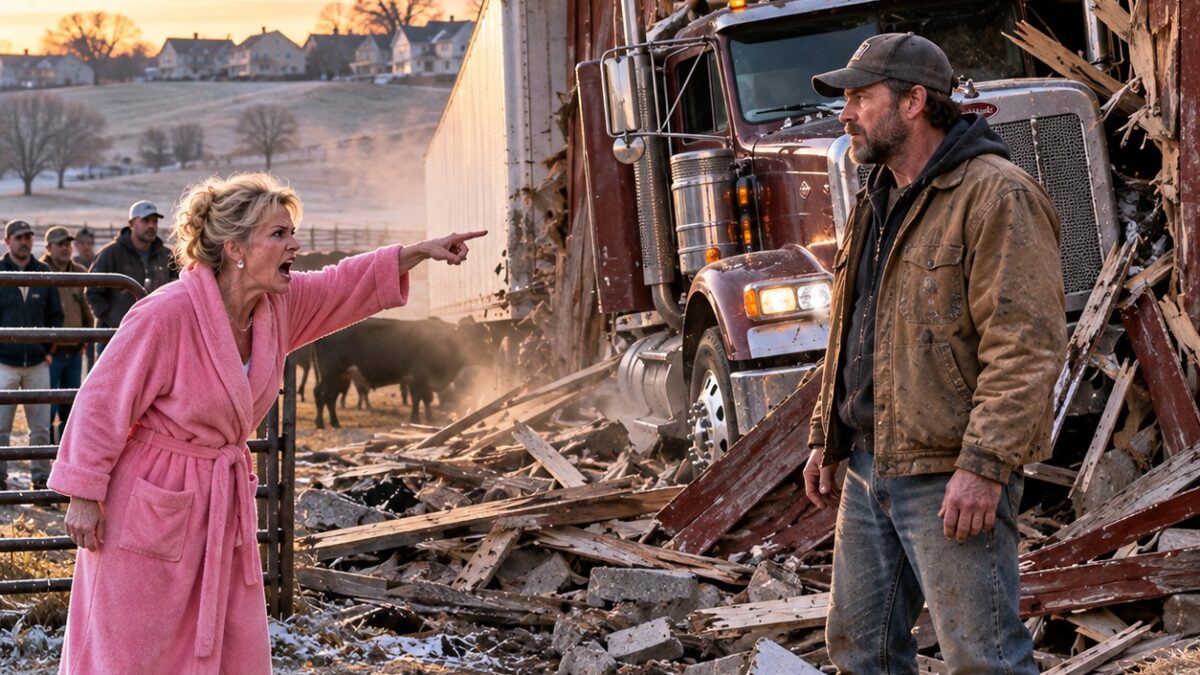
Tuesday morning.
February.
5:47 a.m.
I woke to a diesel engine screaming.
Not passing the house.
Coming toward it.
Then impact.
The sound did not resemble one thing.
It was several sounds stacked together.
Metal.
Wood.
Glass.
Engine.
Beams cracking.
Boards exploding.
A low concussion I felt through the mattress.
I was on my feet before I fully understood.
Pulled back the curtain.
Headlights.
Black diesel smoke.
A Peterbilt 389.
Backing through the south wall of my barn.
Full throttle.
I saw cedar planks burst outward.
One post snapped.
Another bent.
Dust swallowed the truck.
My grandfather’s barn disappeared behind it.
Then through the haze I saw somebody standing forty feet away.
Pink bathrobe.
Bunny slippers.
Vivian.
Arms folded.
Watching.
I threw on boots.
Ran outside.
The truck driver saw me.
For one second, our eyes met.
Then he drove forward.
Pulled out of the hole.
Backed over part of the broken fence.
Turned.
Accelerated toward the east lane.
I ran after him far enough to see the company marking.
PITT SITE CLEARING.
Then stopped.
No point getting run over by an idiot.
Vivian was still there.
Dust moving through the headlights.
I turned toward her.
She smiled.
Actually smiled.
“What the hell did you do?”
She raised her voice over the engine noise.
“Your farm is illegal to exist here anyway!”
I stared.
“Excuse me?”
“Consider it a favor!”
Then she started toward Ridgeview.
I took one step.
Stopped myself.
No.
No confrontation.
No touching.
No shouting.
I pulled out my phone.
“Vivian.”
She kept walking.
“Vivian!”
She turned.
I held the camera up.
“Say it again.”
Her expression changed.
Not much.
Enough.
Then she walked away.
I stood in freezing grass.
Breath white.
Dust drifting.
Diesel smoke in my throat.
The barn had an eight-foot hole.
My grandfather built that wall in 1962.
Doubled framing.
Because Amos Briggs had grown up in tornado country and trusted nothing built with one layer when two were possible.
That stubbornness probably saved the barn.
The truck had cracked two primary uprights.
Destroyed lower framing.
Tore siding.
But the structure remained standing.
I walked closer.
Moonlight showed through the hole.
For one second I put my palm on one broken cedar board.
I expected rage.
What came instead was clarity.
Cold.
Clean.
Useful.
I went inside.
Made four calls.
Adeline.
Sheriff.
Chip Wakefield.
Howard Cobb.
Howard answered second ring.
“Howard.”
“Vivian sent a truck through my barn.”
Silence.
Then:
“I’ll be there in forty.”
Click.
I went back outside.
Photographed everything.
Tracks.
Broken fence.
Wall.
Posts.
Ground.
Tire impressions.
Fresh paint transfer.
Every angle.
The sun began rising while I documented the destruction.
I thought of Grandpa Amos.
He believed repairs should be done before breakfast if possible.
I wondered what he would have thought of this.
Probably something unprintable.
Sheriff’s deputies arrived.
Howard arrived.
County vehicles.
Then Adeline called again.
“Do not touch anything.”
“Wasn’t planning to.”
“Did you see the truck?”
“Yes.”
“Company?”
“Yes.”
“Vivian?”
“Yes.”
“She was there?”
“Bathrobe.”
Long silence.
“Pink.”
Another silence.
“Bunny slippers.”
Adeline exhaled.
“I’m going to pretend you’re joking.”
“I wish.”
The truck was not difficult to locate.
Dwayne had removed magnetic company decals.
Then parked the Peterbilt behind his equipment building seventeen miles away.
Deputies found him eating breakfast.
Apparently hiding an enormous commercial truck behind a building had felt sufficient.
By eight-thirty, officers had the truck.
Damage matched.
Tire pattern matched.
Fresh cedar and paint transfer.
Dwayne began discovering that demolition equipment leaves rather distinctive evidence.
At 9:15, deputies knocked on Vivian’s door.
I was not there.
Howard later heard from one deputy that Vivian’s face changed the instant she saw county vehicles down the road at my farm.
Criminal territory has a clarifying effect.
For almost two years, Vivian had lived inside ambiguity.
HOA rules.
Letters.
Complaints.
Civil actions.
Interpretations.
Now a truck had been driven through private property.
Into a barn.
That is less ambiguous.
Two days later, Vivian held an emergency HOA meeting.
Hartwell recorded it.
Hartwell was the quiet board member.
Accountant.
Sunday-school teacher.
Had voted against many of Vivian’s more aggressive proposals but rarely fought publicly.
That changed.
Vivian stood in front of the board and described the barn incident as:
“An authorized safety assessment misunderstood by the driver.”
Hartwell placed his phone on the table.
Hit record.
Then said:
“I need the minutes to reflect that I had no knowledge of and did not authorize heavy equipment entering Mr. Briggs’s property.”
One board member immediately said:
“Same.”
Then another.
Then another.
Vivian looked around.
“You all knew we were addressing the barn.”
Hartwell answered:
“Addressing is not driving a truck through it.”
“It was an accident.”
“Was Dwayne Pitt hired by this HOA?”
Silence.
“Vivian?”
“He was acting in a consultative capacity.”
“Who authorized payment?”
She looked toward the secretary.
Nobody answered.
Hartwell leaned back.
“I want all HOA financial records preserved.”
That sentence eventually mattered.
Vivian’s fourth attorney contacted Adeline.
Fourth.
Settlement offer.
HOA drops covenant claims.
Vivian pays up to fifteen thousand toward barn repair.
Mutual nondisparagement agreement.
Adeline called.
“She’s scared.”
“What do you think?”
“We don’t settle.”
“I was going to ask whether fifteen was enough.”
“No.”
“Why?”
“Because she does not get to spend two years building a false public record and then buy your silence for fifteen thousand dollars.”
I looked through the broken wall.
Temporary bracing held the uprights.
“You sound angry.”
“I am billing you at the family rate. Let me enjoy something.”
We declined.
Then anonymous Facebook accounts appeared.
Created recently.
Claiming I threatened HOA members.
Claiming the barn had actually been condemned.
Claiming the truck story was complicated.
Bertram entered the comments.
I did not ask him to.
He dismantled the posts one paragraph at a time.
Dates.
Public records.
Inspection outcomes.
At least three people asked if he was an attorney.
He responded:
No. Retired eighth-grade civics teacher.
I printed that one.
Vivian then petitioned county government to interfere with my ACEP application.
Failed.
Then she made the strangest decision of the entire campaign.
She tried to influence Howard Cobb.
Not directly.
Not cash.
Through Howard’s brother-in-law.
The HOA had landscaping work available.
Possibly lucrative.
If Howard reconsidered his prior findings about my barn’s structural condition.
Howard did not negotiate.
Did not confront Vivian.
He called county ethics.
Complaint opened Thursday.
By Friday, Knoxville television knew.
Reporter Sandra Cho contacted me.
Adeline wrote my statement.
I read it exactly.
“The Briggs family has farmed this property for three generations. We have cooperated fully with every legitimate legal and regulatory process. We look forward to the complete record becoming clear.”
That was all.
No insults.
No Vivian.
No bunny slippers.
Nothing.
That week, I could see her kitchen light from my porch.
Past midnight.
Every night.
Yellow square across the field.
I wondered what she was doing.
Lawyer calls.
Records.
Pacing.
Maybe crying.
For a moment, I almost felt sorry for her.
Then wind moved through the damaged barn wall.
Plastic sheeting snapped.
I remembered the crash.
The beams.
The hole.
My grandfather’s work.
I let the sympathy go.
Harlan County Agricultural Heritage Day had existed for thirty-one years.
Every March.
Fairgrounds.
Livestock.
Tractors.
Diesel.
Fried food.
Hay.
Vendors.
About three thousand people across Saturday.
The main-stage community forum usually attracted forty people.
Road budget.
Watershed.
Extension updates.
That year, six or seven hundred showed up.
Word had spread.
The first reason was official.
My ACEP agricultural conservation easement had been approved.
After six months of review.
Patricia Swell would present it publicly.
Forty acres.
Permanent agricultural protection.
Recorded federal conservation easement.
No subdivision.
No conversion.
No future Ridgeview expansion.
Not now.
Not after me.
Forever.
The second reason people came was Sandra Cho.
That part was not printed in the program.
Sandra had spent roughly forty hours reading Sherry’s exhibit package.
By the end, she understood the story better than some people who had lived through it.
I stood near the back of the hall.
Adeline on one side.
Chip Wakefield on the other.
Bertram somewhere behind us with a cooler full of deviled eggs.
He brought deviled eggs everywhere.
I never understood why.
Vivian arrived.
Two board members with her.
She wore navy.
Perfect hair.
No clipboard.
She saw me.
I saw her.
Neither of us moved.
Patricia spoke first.
History of the farm.
1948 deed.
1962 barn.
My father’s cattle operation.
Current agricultural use.
ACEP.
She explained what the easement meant.
Then she asked me to stand.
I walked to the microphone.
Looked at the crowd.
Said three sentences.
“My grandfather built this farm.”
Pause.
“My father kept it alive.”
Pause.
“I intend to keep it alive after me.”
Applause.
Warm.
Not theatrical.
People understood land.
Then Sandra Cho stood.
The commission chair recognized her.
She had four minutes.
She did not use one adjective she did not need.
That made it devastating.
“Twelve county inspections over ten months.”
“Zero violations.”
“Cloud-on-title action based on a lien satisfied in 1991.”
“Dismissed.”
“Prescriptive easement attempt.”
“Withdrawn.”
“Section 7C of the 2003 annexation agreement.”
She displayed the language.
Then Vivian’s earliest complaint.
Same phrase.
Word for word.
Sandra continued.
“County records indicate Mrs. Marchand referenced this clause in complaints more than a year before publicly asserting broader HOA authority over the Briggs property.”
People turned toward Vivian.
Sandra did not.
“County inspectors twice documented the Briggs barn as structurally adequate.”
Next slide.
“An outside letter alleging structural compromise was submitted by demolition contractor Dwayne Pitt.”
Next.
“Public records identify Mr. Pitt as a relative of Mrs. Marchand.”
Murmurs.
“The county building department found the letter inconsistent with direct inspection.”
Then:
“On February fifth, a Peterbilt registered to Pitt Site Clearing entered Briggs property and struck the barn.”
The hall became silent.
“Mr. Pitt has been charged with criminal trespass and felony property destruction.”
Vivian shifted.
Sandra continued.
“An investigation into possible conspiracy remains open.”
Then the ethics complaint.
Attempt to influence Howard.
Landscaping contract.
Inspection findings.
By the end, nobody was whispering.
Chip Wakefield stood next.
“Tennessee Farm Bureau is requesting a financial audit of Ridgeview Estates HOA.”
That got the homeowners.
“Specifically, whether member dues were used to fund legal actions against Briggs Farm without valid board authorization.”
Vivian stood.
“This is misinformation.”
Sandra lowered her notes.
Vivian continued.
“There is substantial context missing from this presentation—”
Hartwell rose.
Three rows back.
Quiet Hartwell.
He had never looked impressive in the dramatic sense.
Gray sport coat.
Glasses.
Accountant.
He did not need drama.
“Vivian.”
She stopped.
He continued.
“I move that any Ridgeview Estates HOA response be tabled pending completion of the county ethics investigation and financial audit.”
One of the board members beside Vivian looked at him.
Then raised her hand.
Second board member did the same.
Hartwell said:
“All in favor?”
Hands.
“Motion carries.”
In front of hundreds of people.
Camera rolling.
Vivian stood there for one second longer.
Then sat.
Adeline put a hand on my arm.
I breathed.
Outside, the tractor pull had started.
Low engine vibration came through the floor.
Something heavy doing exactly what it had been built to do.
That is the closest I came to feeling victory.
It was not joy.
It was release.
A thing ending that should never have lasted this long.
Dwayne took a plea.
Deferred prosecution.
Restitution.
Probation.
The barn repair cost twenty-three thousand.
I hired a timber framer who specialized in period-correct work.
He spent three weeks matching cedar.
Reinforcing the two cracked uprights.
Repairing the south wall.
One afternoon he called me over.
“Look.”
I did.
Could barely see where old material ended and new began.
He ran one hand across the post.
“Your grandfather overbuilt this thing.”
“He distrusted weather.”
“Smart man.”
I smiled.
“He distrusted everything.”
The criminal conspiracy investigation into Vivian stayed open for eight months.
Ultimately, the district attorney declined direct criminal charges against her.
Evidence existed.
Suspicion existed.
Circumstantial links existed.
But explicit instructions connecting her legally to Dwayne’s truck attack were not strong enough.
People expected me to be furious.
I was not.
Law has standards.
I had spent two years demanding people respect rules that protected me.
I was not going to complain because those same rules protected Vivian from a charge prosecutors could not prove beyond the required standard.
But the investigation uncovered something else.
Money.
About fourteen thousand dollars in HOA dues had funded portions of Vivian’s campaign.
Attorney retainers.
The title action.
Easement work.
Other legal expenses.
Without proper board authorization.
The HOA ethics panel was reconstituted.
Hartwell chaired it.
Vote:
Unanimous.
Vivian had to repay the fourteen thousand personally.
She was barred from holding HOA office for five years.
She resigned that afternoon.
By July, her house was listed.
By August, she was gone.
The new owners were a young couple with a two-year-old.
The child waves at me through the fence when I move cattle.
Second week they lived there, they came to buy eggs.
The husband asked:
“How much?”
I gave him the neighbor price.
He looked confused.
“There’s a neighbor price?”
“There is now.”
He smiled.
Good enough.
The Farm Bureau audit caused something larger than Ridgeview.
County officials finally paid attention to how HOAs were using member dues for legal actions.
New governance guidelines followed.
Public-facing records.
Itemized legal expenses.
Better disclosure.
No more quietly funding one president’s personal campaign through forty-two households that barely understood what was happening.
Then April came.
My ACEP easement was formally recorded.
I drove to the county office for the final copy.
Held it in both hands.
Forty acres.
Permanent agricultural restriction.
My grandfather could never have imagined it.
He protected land through labor.
I protected it through federal paperwork.
Both counted.
I drove home.
Parked beside the barn.
Walked into the field.
The cattle came over because cattle assume any man walking into a field exists to feed them.
Kevin pushed between two cows.
“Move.”
He did not.
“Your name is Kevin. You have no dignity.”
Still did not move.
I laughed.
Then looked toward Ridgeview.
For nearly two years, Vivian had behaved as if my farm was temporary.
An inconvenience.
Something modern development would eventually absorb.
She had been wrong.
The subdivision was the new thing.
The farm was now the permanent one.
That irony was enough.
I did not need anything else.
The ACEP payment was roughly sixty-eight thousand dollars.
Not enough to change my life.
Enough to do something useful.
I thought about Granddad.
Amos Briggs.
Man who poured barn foundation one bucket at a time.
Man who thought boards could look lazy.
Man who believed land was something you left better than you received it.
I worked with Patricia and the county extension office.
We created the Amos Briggs Agricultural Stewardship Award.
Scholarship.
High school students pursuing agriculture.
Soil science.
Land management.
Rural conservation.
First award was presented the next Heritage Day.
Sixteen-year-old student from the south end of the county.
Wanted to study soil science.
Patricia had mentored her for two years.
She stood at the podium.
Hands shaking.
Said thank you.
Short.
Awkward.
Sincere.
Exactly right.
I stood in the back.
Same hall.
Adeline nearby.
Chip.
Howard Cobb in the front row.
Arms crossed.
Professionally satisfied.
Bertram had another cooler of deviled eggs.
Of course.
Outside, tractors.
Livestock.
Families.
The same county smells.
Hay.
Diesel.
Machine oil.
I looked around and realized Vivian had consumed nearly two years of my life.
That is the part people forget when they call stories like mine victories.
Yes.
The farm survived.
Yes.
Vivian left.
Yes.
Her legal attacks collapsed.
Yes.
The barn was repaired.
Yes.
Federal protection now runs with the deed forever.
Yes.
The county changed policy.
Yes.
A scholarship carries my grandfather’s name.
All true.
I still spent two years proving something that had been obvious the entire time.
My farm had the right to exist.
There is no refund for that time.
No judgment puts mornings back.
No easement erases the sound of a Peterbilt crashing through cedar.
No public embarrassment repairs the part of you that becomes cautious after a neighbor decides your home is her project.
Winning is complicated.
Sometimes winning means standing exactly where you started, except older.
That does not make it meaningless.
It makes the cost honest.
The farm is still here.
Forty acres.
Two hay fields.
Pond.
Produce stand.
Black Angus.
The barn.
On hot afternoons, the cedar still gives off that old smell.
Wood.
Machine oil.
Dust.
If you know where to look, you can see the repaired south wall.
The carpenter matched it beautifully.
But I know.
I know which boards Amos installed.
Which ones were replaced.
At first that bothered me.
Then one evening I realized something.
My grandfather repaired that barn too.
So did my father.
No structure survives sixty years untouched.
Storms happen.
Wood rots.
Animals kick things.
People make mistakes.
Apparently HOA presidents occasionally arrange catastrophic vehicular misunderstandings.
A building that survives is not a building that never gets damaged.
It is one somebody keeps repairing.
Land is the same.
Families too.
Bertram still buys eggs.
He returns cartons.
Sometimes he stops to talk.
Howard retired recently.
Twenty-three years.
At his retirement reception, I gave him a framed photograph of the barn with a small brass plate:
ZERO VIOLATIONS.
He laughed harder than I had ever heard him laugh.
Adeline still accepts beef as partial payment when she feels charitable.
Chip still calls when another farm family has HOA trouble.
Patricia still drives that ancient pickup.
The young family in Vivian’s old house planted tomatoes along the fence.
Their little girl named one of my calves Daisy.
It was a bull calf.
I told her.
She said his name was still Daisy.
I decided not to argue.
Some disputes are not worth the paperwork.
Sometimes I sit on the porch after dark.
Ridgeview’s windows glow through the trees.
Forty-two houses.
Families.
Most of them never wanted any part of Vivian’s campaign.
That matters.
It would have been easy to turn the whole subdivision into an enemy.
I almost did.
For a while, every certified letter felt like it came from forty-two people instead of one president and a board that had failed to stop her.
But Hartwell taught me something.
So did the two board members who eventually raised their hands.
So did the residents who apologized after the audit.
Institutions are dangerous when people stop asking who is actually making decisions.
An HOA is paper.
Authority comes from people.
Silence becomes permission faster than most of us like to admit.
Vivian was loud.
Hartwell was quiet.
For too long, loud won.
Then one day quiet stood up.
That mattered.
So did my own mistake at the beginning.
I taped the first ridiculous letter to the shed and ignored it.
Because it was ridiculous.
I thought absurdity was self-defeating.
It is not.
A ridiculous claim written down can become a record.
A record repeated can become a narrative.
A narrative left unanswered can eventually look like history.
That is why I kept the binders.
Notebook.
Receipts.
Inspection reports.
Dates.
Certified mail.
Not because I enjoyed paperwork.
Because memory loses arguments against documents.
Vivian understood paperwork too.
That was what made her dangerous.
She nearly weaponized a buried clause on page eighteen of a 2003 annexation agreement.
Section 7C.
Approved late at night in a meeting almost nobody watched.
One tired commission.
One badly drafted paragraph.
Years later, that paragraph almost became a lever against forty acres of third-generation farmland.
That scared me more than the truck.
The truck was obvious.
Loud.
Criminal.
Splintered wood.
Everybody understands a truck through a barn.
Section 7C was quiet.
That is how property disappears more often.
Not with engines.
With language.
A clause.
A signature.
A meeting nobody attended.
A rule nobody read.
Then years later somebody points to it and says:
See? We had the right all along.
Vivian did not.
Because Adeline read the second half.
Because Patricia documented the farm.
Because Howard kept inspection records.
Because Bertram wrote dates down.
Because Sherry indexed everything.
Because Chip knew where pressure belonged.
Because I finally stopped assuming being right was enough.
One evening, not long after the easement was recorded, I walked down to the pond.
Sunset purple on the ridge.
Cattle scattered across the field.
The barn behind me.
I could hear a tractor somewhere miles away.
I thought about my father.
He had spent his whole life worried about debt.
His generation believed the bank was what could take a farm.
Granddad worried about weather.
My generation got HOAs.
Every era invents its own threat.
But the answer stays surprisingly similar.
Know what you own.
Take care of it.
Keep your records.
Do not sign what you have not read.
Do not let somebody else define your silence.
And when a person tells you the thing your family built has no right to exist, make them prove it.
Vivian tried for nearly two years.
Twelve inspections.
Zero violations.
A failed nuisance campaign.
A false title cloud.
A failed easement claim.
A buried stormwater clause.
A fabricated structural concern.
A truck through a barn.
An ethics scandal.
Legal fees secretly funded with HOA money.
In the end, the only thing she proved was how much damage a person can cause when nobody checks authority early enough.
The farm remained.
Not because I was cleverer than everyone.
I had help.
A lot.
Adeline.
Patricia.
Howard.
Bertram.
Chip.
Sherry.
Hartwell.
The county officials who eventually paid attention.
The neighbors who chose truth over loyalty to a board president.
That is another thing people forget in stories where one person stands against an institution.
Nobody really wins alone.
You survive long enough for the right people to stand beside you.
Then you build something after.
That last part matters most.
The scholarship.
The easement.
The repaired barn.
The county transparency rules.
Those things last longer than Vivian’s embarrassment.
I prefer it that way.
On the anniversary of Grandpa Amos’s birthday, I sometimes open the barn before sunrise.
The cattle are quiet.
Cold air.
Cedar.
Old oil.
I stand near the repaired wall.
Run my hand along the upright that cracked when Dwayne’s truck hit it.
You can feel the transition if you know where to look.
Old wood.
New reinforcement.
Strong.
I think Amos would approve.
Not because the barn remained untouched.
Because it did not.
And we fixed it.
I used to believe legacy meant preserving something exactly as it was handed to you.
I do not anymore.
Legacy is keeping the important part alive while the world keeps hitting it.
Sometimes weather hits it.
Sometimes debt.
Sometimes mistakes.
Sometimes a woman in bunny slippers hires the wrong cousin.
You repair.
You document.
You keep going.
Outside, the farm wakes.
Cattle low.
Birds start.
Light reaches Ridgeview.
The subdivision is quieter now.
Different board.
Different president.
Different rules.
My east gravel road is still available to residents.
By permission.
The sign stays up.
People wave.
I wave back.
One morning, a Ridgeview teenager stopped while I was fixing fence.
“Mr. Briggs?”
“Yeah?”
“My mom says you almost shut the road down.”
“No.”
“She said the HOA tried to take it.”
“Closer.”
“Why do you still let us use it?”
I looked at him.
“Because you didn’t sue me.”
He laughed.
Then I said:
“Being allowed something is different from owning it.”
He nodded.
Not sure he understood.
Maybe someday.
That sentence applies to more than roads.
Vivian became a story people told.
For a while.
Then people moved on.
That is healthy.
Public humiliation should not become a life sentence.
She repaid the HOA money.
Left office.
Sold the house.
Whatever she did next was hers.
I did not track her.
Did not search her name.
Did not care.
My job was never to destroy her.
It was to stop her from destroying this.
That distinction saved me from becoming uglier than the fight.
Anger is useful.
For a while.
It gets you out of bed.
Makes you answer letters.
Makes you hire the lawyer.
But if you keep feeding it after the danger passes, eventually anger starts eating the thing you supposedly fought to protect.
My farm did not need an angry man.
It needed a farmer.
So I went back to farming.
Hay.
Cattle.
Fence.
Eggs.
Produce.
Mud.
Rain.
Calves born at inconvenient hours.
Equipment breaking exactly when you need it.
The normal trouble.
The good trouble.
The kind Granddad understood.
Every spring, I repaint the produce stand.
Mom used to insist on white.
I still do it white.
Some traditions do not require improvement.
The scholarship recipient comes by occasionally.
Soil-science student now.
She tells me things about microbes I pretend to understand.
I tell her things about cattle she pretends to care about.
Fair trade.
Bertram is getting slower.
Still brings egg cartons.
Still corrects grammar on community Facebook posts.
Adeline says she will retire someday.
Nobody believes her.
Howard sends Christmas cards.
Patricia still shows up without warning.
The barn still smells like cedar.
The pond still collects fog in the morning.
The ridges still turn purple at dusk.
And in the deed chain, recorded where future developers and future HOA presidents and future attorneys can find it, sits a permanent agricultural conservation easement.
Forty acres.
Protected.
Forever.
Vivian wanted to create a paper trail proving my farm did not belong.
Instead, she forced me to create one proving it always would.
There is a certain poetry in that.
Granddad would have hated the word poetry.
He would have called it common sense.
Maybe he would have been right.
A few weeks after the easement was finalized, I took a copy into the barn.
Not the official one.
Just a photocopy.
I folded it.
Put it inside an old metal toolbox that had belonged to Amos.
Dad used it after him.
Now I use it.
On the inside lid, I taped a note.
One sentence.
THE FARM STAYS.
That is the ending.
Not Vivian leaving.
Not the criminal case.
Not the barn repair.
Not Heritage Day.
Not the scholarship.
This.
Morning light.
Cattle.
Cedar.
Forty acres.
And a deed that finally says, in language even the most determined HOA president cannot reinterpret:
The Briggs farm stays.


