PART2:HOA Queen Said My Motorcycle Club Didn’t Belong in Her Neighborhood—Then 31 Riders Quietly Filled Her Annual Meeting
PART2
For two months, nothing happened.
No notices.
No golf cart.
No white Lexus gliding past my house at six miles an hour.
I started thinking the motorcycle fine had been exactly what I hoped it was.
One silly disagreement.
Seventy-five dollars.
Done.
I should have known better.
Silence from certain people is not peace.
It is reload time.
The next notice arrived on a Friday afternoon.
Smart timing.
If somebody wants to irritate you efficiently, send the problem after every office involved has closed for the weekend.
The violation was for my front landscaping.
I had planted lantana along the gravel border beside my driveway.
Orange and yellow clusters.
Native.
Drought tolerant.
Bees loved it.
I loved not watering it every twelve minutes under the Texas sun.
According to Constance, lantana was not on the approved plant list.
Fine: one hundred fifty dollars.
Fourteen days to remove all nonconforming plants.
I requested a copy of the approved list.
Seventeen species.
I read it twice.
Then I took a slow walk past Constance’s house.
Every plant on the list was growing in her yard.
Every single one.
Her personal landscaping had somehow become community policy.
That was when irritation became curiosity.
Curiosity is dangerous for people who depend on everyone else staying bored.
I looked up lantana through the state agriculture resources.
It appeared on recommended native pollinator lists.
I saved the information.
Then I sent a written request asking how Cedar Brook’s approved plant list had been adopted.
Not why.
How.
When was it voted on?
Who voted?
What meeting?
What quorum?
Constance responded through Prescott.
Approved by board vote in 2019.
No additional documentation necessary.
I wrote back.
Please provide the meeting minutes reflecting that vote and confirm quorum.
Eleven days.
Nothing.
On day twelve, I received four pages of minutes.
Clean formatting.
Polished.
Official looking.
I might have stopped there if I had not spent most of my life dealing with shipping documents created by people who thought drivers never read the small print.
I opened the electronic file properties.
The document had been created six days earlier.
The font used in part of it did not even line up with records from the supposed year.
I sat at my desk for a long time.
Someone appeared to have manufactured historical paperwork after I asked for it.
I did not accuse anyone.
That was important.
Do not announce your best evidence before you know what it means.
I printed the metadata.
Photographed everything.
Sent a certified dispute letter on procedural grounds.
Then I started a physical folder.
Black marker on the tab:
PROBLEMS
The lantana fine was suspended pending review.
I left every plant exactly where it was.
That evening, Dara knocked on my door.
She held a violation notice.
Wind chimes.
“Acoustically disruptive to community standards.”
She had already taken them down.
“Why?”
She shrugged.
“She makes things worse if people argue.”
That sentence changed the way I saw the entire situation.
Not because wind chimes mattered.
Because Dara was afraid of consequences for asking questions.
I stepped aside.
“Coffee?”
She came in.
We sat at my kitchen table.
I showed her the plant dispute.
She showed me the notice.
“I probably should’ve challenged it,” she said.
“You can still document it.”
“What good does that do?”
“I don’t know yet.”
That was true.
“But if somebody is relying on people forgetting how often something happens, memory is the first thing you stop giving them control over.”
Dara stared at me.
“You always talk like that?”
“Thirty-one years alone in a truck does strange things.”
She laughed.
Then I slid an empty folder toward her.
“Write down every notice you remember.”
Dates if possible.
Rules.
What you did.
Who called.
She opened the folder.
That night, Cedar Brook Crossing gained its second file.
For the next six weeks, I kept my head down.
I worked on the Sportster.
The engine had been sitting longer than I liked.
I rebuilt parts of the fuel system.
Replaced hoses.
Cleaned chrome.
Sometimes I opened the garage door.
Sometimes I did not.
Not because Constance had won.
Because it was hot.
My riding club, Iron Meridian, came through one Saturday for a cookout.
Seven guys.
Mostly retired tradesmen and veterans.
Nothing exotic.
Hector Viramontes had been a union electrician.
Wes Trandahl had spent years as a paralegal.
Others had worked construction, county maintenance, manufacturing.
We liked motorcycles, smoked meat, and criticizing one another’s repair methods.
They parked legally on the public street.
No engines revving.
No music blasting.
By five o’clock, three violation notices were under my door.
Excessive guest vehicles.
Noise disturbance.
And my favorite:
Display of club-related insignia on apparel inconsistent with community aesthetic standards.
Violation 14.3.
I pulled out the CC&Rs.
Section fourteen.
Subsection three.
Fence height.
I read it again because I assumed I had missed something.
No.
Constance had cited a fence rule to regulate clothing.
Hector saw me standing at the kitchen counter.
“What?”
I handed him the notice.
He read it.
Then laughed.
“She cited your vest under fence height?”
“Yes.”
“I’ve seen lazy.”
He gave it back.
“That’s impressive.”
Wes wandered over.
He was sixty-seven and had the face of a man people underestimated until they realized he had already read the entire contract.
He studied the notice.
“Don’t call her.”
“I wasn’t planning to.”
“Dispute it in writing.”
“Already thinking that.”
“Certified.”
“Always.”
He smiled.
“Retirement suits you.”
The parking notice was weak too.
Public street.
City-controlled.
The HOA’s own documents did not clearly give Constance the authority she claimed.
The noise notice provided no decibel reading, time, witness, or specific conduct.
We drafted one clean letter addressing all three.
No emotion.
No sarcasm.
Just rule numbers, facts, and requests for correction.
I formally asked the association to send me the complete current text of violation 14.3.
I knew what it said.
That was not the point.
I wanted Constance to know I knew.
Six days later, corrected notices arrived.
New rule numbers.
New dates.
Reset deadlines.
Tucked behind them was a new “community addendum.”
From that point forward, gatherings involving four or more motorcycles at a single residence supposedly required seventy-two hours of advance written notice.
I sat at my kitchen table smiling.
She had created a new rule because the existing rules did not give her what she wanted.
No homeowner vote.
No amendment process shown.
No evidence of adoption.
I added the addendum to PROBLEMS.
Then created another folder.
PROCEDURE
The folders began taking up part of the kitchen table.
Dara came over.
Looked at them.
Then at me.
“You’re building something.”
“I’m keeping records.”
“That is not a normal amount of records.”
“Maybe not.”
“Can I help?”
I poured coffee.
“Keep writing.”
She did.
The poison letter arrived about a month later.
That is what neighbors eventually called it.
Officially it was a Community Standards Update.
Two pages.
HOA letterhead.
Constance’s watermark.
It referred to unnamed properties exhibiting “non-conforming character.”
It warned about “property value degradation.”
It mentioned “visitor patterns inconsistent with a family-oriented residential environment.”
Forty-seven houses in Cedar Brook.
Everybody knew who had motorcycles on weekends.
Nobody needed my name printed.
The letter did what Constance wanted.
It placed a question into people’s heads without making a statement specific enough to challenge easily.
Then she started talking.
One neighbor told Dale that “Garrett’s biker associates” had criminal records.
No names.
No evidence.
Just the phrase.
Dale Busby had spent twenty-eight years writing fire incident reports.
He came straight to my house.
“What exactly did you hear?”
He told me.
Word for word.
Who said it.
Where.
When.
I called Wes.
He listened.
Then said:
“Write it down before anybody has another conversation.”
Dale wrote three paragraphs.
Sequential.
Specific.
No editorializing.
We notarized it.
I had no idea then whether I would ever pursue anything personally.
But once again, the rule was simple.
Preserve first.
Decide later.
The poison letter backfired.
Three homeowners I had never spoken to came to me within a week.
They did not like being told which neighbors fit the community’s “character.”
One of them was Rhonda Pickett.
Fifty-five.
Civil engineer.
Six years in Cedar Brook.
Rhonda entered my kitchen carrying a thick file.
She looked at my table.
Folders.
Highlighters.
Certified mail receipts.
Then set hers down.
“I guess I’m not the only one.”
“What do you have?”
“A question first.”
“Go ahead.”
“You actually read the meeting minutes?”
“Yes.”
“All of them?”
“Not yet.”
She smiled.
“You will.”
Then she opened her folder.
For two years, Rhonda had been tracking board irregularities.
Meetings where minutes claimed quorum even though homeowner attendance records suggested otherwise.
Fine revenue going into an account not clearly identified in financial disclosures.
And a landscaping contract.
Forty-seven thousand dollars a year.
No competitive bid package in the records she had.
Contractor:
Drayhill Grounds Services LLC.
I looked at Rhonda.
“Drayhill.”
She nodded.
“Constance’s husband?”
“Malcolm.”
“How long have you had this?”
“Two years.”
“Why didn’t you do anything?”
Her answer sounded almost identical to Dara’s.
“I thought I was the only one paying attention.”
That may be one of the most powerful tools bad leadership has.
Isolation.
Everybody sees something.
Nobody knows anybody else sees it.
So each person assumes the problem is too small, too complicated, or too personal to matter.
Then people compare notes.
The shape changes.
Rhonda brought more records.
Dara brought hers.
Dale’s statement sat beside them.
My little folder labeled PROBLEMS suddenly looked less like a dispute over flowers.
“We need the financial records,” I said.
Rhonda nodded.
“I know.”
We submitted a formal joint request.
Association financials.
Contracts.
Invoices.
Payment histories.
Bank information available for member inspection under the rights we believed Texas law and our governing documents provided.
Constance denied us within a day.
Board discretion regarding sensitive financial matters.
I printed it.
Into PROCEDURE.
We sent a follow-up.
Exact request.
Exact deadline.
Certified mail.
Copied to the state complaint channel we intended to use.
On day nine, records arrived.
Partial.
Heavy redactions.
Constance had clearly looked them over.
Not carefully enough.
The landscaping contract was there.
Forty-seven thousand per year.
Drayhill Grounds Services.
Rhonda sat beside me while I searched the business registration.
Registered agent:
Malcolm Drayhill.
Company created months before the HOA contract began.
I read the board minutes again.
Constance had participated in the contract decision.
No conflict disclosure in the records we had.
No recusal shown.
Rhonda leaned back.
“Well.”
I stared at the screen.
“This is bigger than lantana.”
“It was always bigger than lantana.”
She was right.
I called Wes.
Read everything slowly.
He did not interrupt.
When I finished, there was silence.
Then:
“You have her.”
I did not like the phrase.
“This isn’t poker.”
“No.”
He corrected himself.
“You have documented a conflict she will have difficulty explaining.”
“Better.”
“Don’t use it yet.”
“Why?”
“Because right now she controls the room.”
The annual meeting was nine weeks away.
Wes continued.
“If you confront her privately, she gets time to shape the story.”
“So we wait.”
“Yes.”
“Nine weeks.”
“You drove freight.”
I smiled.
“I once sat nine hours at a weigh station in Nevada because somebody transposed two numbers.”
“Then you’ll survive.”
I printed the contract.
New folder:
DRAYHILL GROUNDS
Then I went into the garage.
Put on work gloves.
Polished the Sportster’s headlight bracket until the chrome reflected the workbench lamp perfectly.
Patience had paid my bills for thirty-one years.
Nine weeks did not scare me.
What happened next stopped being my dispute and became a neighborhood project.
Not a mob.
Not a revenge campaign.
A collection of people with different skills sitting around the same table.
That mattered.
One Saturday, a few weeks before the annual meeting, we had a cookout.
Dale managed ribs like the fire department had assigned him to defend them.
Hector drove up from San Antonio.
Wes came with sweet tea.
Rhonda brought her laptop.
Dara brought her notice records.
Lupe Cortinas joined us.
Forty-nine.
Bookkeeping business.
She had been comparing five years of HOA financial disclosures against publicly available requirements and the association’s own records.
Troy Fenwick came too.
Retired county zoning officer.
Sixty-eight.
The kind of man who could read a land-use document without losing consciousness.
We sat around the fire pit.
No secret handshake.
No war council.
Just adults eating smoked meat and comparing paper.
Wes took a napkin.
Drew three lines.
“Three prongs.”
I groaned.
“You practiced that.”
“I did not.”
“You absolutely did.”
He ignored me.
First: conflict-of-interest and governance complaint related to the Drayhill contract.
Second: my personal defamation issue.
Third: board procedure and elections.
Rhonda had already collected enough homeowner support to force issues onto the annual meeting agenda under the association’s voting rules.
She, Dara, and Troy planned to run for board seats.
I did not.
Dara asked why.
“I don’t want to run Cedar Brook.”
“You’re doing all this.”
“I want Cedar Brook run correctly.”
“Difference?”
“Big one.”
I pointed toward Rhonda.
“She likes meetings.”
Rhonda threw a napkin at me.
The group laughed.
That sound mattered.
Constance had spent months trying to make my presence seem dangerous.
We were sitting beside a fire arguing over brisket bark.
Nobody was dangerous.
Just tired of being pushed.
Troy raised another issue.
HOA inspections.
Prescott had been doing most of his observing from public areas.
That was one thing.
But my cameras had now caught him entering onto my property twice without the advance notice required under our association documents.
Once he stepped onto the driveway to photograph the garage.
Another time he leaned toward a window gap.
Prescott never looked happy doing it.
Still documented.
I sent a polite letter.
Quoted the HOA’s own access rule.
Requested that enforcement staff be instructed to remain where they were allowed unless proper notice was given.
No threat.
No accusation.
Just boundary.
Lupe finished reviewing financials the following week.
The landscaping contract was the biggest problem.
Not the only one.
The association had an events budget.
Holiday lights.
Community gatherings.
Ordinary stuff.
Over three years, more than eleven thousand dollars had paid catering and venue expenses tied to an annual party at Constance’s home.
Not an HOA-wide gathering.
Her social circle.
Lupe put the summary into two pages.
Every line cited.
No adjectives.
No “corrupt.”
No “theft.”
No “scam.”
Numbers did the work.
That was one of the lessons I liked most.
When facts are strong, do not decorate them.
Constance learned about the formal complaint on a Monday.
The board treasurer, Vance Okafor, told her.
I did not blame him much.
The demand letter to all five board members had changed the calculation.
Until then, Constance’s choices belonged to Constance.
Now every director had been told there might be a conflict.
Continuing to ignore it could become their decision too.
People become courageous quickly when personal liability enters the conversation.
Constance went online.
Private Facebook group.
Long post.
Unnamed disruptive homeowner.
Community values.
Visitors of concern.
Associations inconsistent with family character.
She attached a photo of our motorcycles parked legally on a public street.
Everyone knew.
One neighbor shared the post and wrote:
I’ve had dinner with these guys. They brought enough brisket for the whole block. This is embarrassing.
Fourteen likes.
Constance deleted it.
Screenshots existed.
Of course they did.
I was learning.
So was everybody else.
Then my doorbell rang one Wednesday evening.
Constance stood on the porch.
Professional clothes.
Printed paper in both hands.
No golf cart.
No Prescott.
She smiled.
Different smile.
Negotiation smile.
“Garrett, I think this has gotten unnecessarily adversarial.”
“Okay.”
“I’d like to resolve it.”
She offered to clear every violation.
Suspend every fine.
Issue a written compliance letter.
All I had to do was withdraw the complaint, drop the effort to force board action, and agree to move all motorcycle-related activity to an offsite storage facility.
She did not mention her husband’s contract.
She did not mention the accusation that my friends were criminals.
She did not mention the financial records.
Just:
Your little problems disappear if you stop pushing on the big ones.
My phone was recording from my shirt pocket.
I had started doing that whenever she came near the house.
“Let me think about it.”
Her shoulders relaxed.
“Of course.”
I closed the door.
Sent the recording to Wes.
He called twenty minutes later.
“She came alone?”
“Yes.”
“You saved the original?”
“Yes.”
“Cloud copy?”
“Hector bullied me into it.”
“Good.”
“What do you think?”
“I think she knows she has a problem.”
That was enough for me.
No victory lap.
No reply.
We waited.
Constance called an emergency board meeting six weeks before the annual meeting.
Notice went up late Friday.
Meeting Sunday morning.
Not enough notice under the rules we had been tracking.
They met anyway.
One board member did not show.
The remaining group voted to table the homeowner petition.
Then increased my fines retroactively to two hundred fifty dollars per day.
I actually laughed when I read the notice.
Not because it was harmless.
Because it was desperate.
Rhonda did not laugh.
She said:
“She’s panicking.”
We sent certified objections to every board member.
Procedure.
Timing.
Authority.
Copied the complaint office.
Added everything to the files.
Then a quieter board member, Nadia Brisco, called Rhonda.
Constance had spoken with HOA counsel.
The legal assessment had apparently been ugly.
Conflict issue difficult.
Procedural record worse.
Personal defamation exposure not something Constance could simply dump onto the association.
Constance’s response?
Three new violations against me.
One claimed the motorcycle cover inside my closed garage constituted a non-approved exterior addition to a garage fixture.
I read that sentence three times.
Then put it in the folder.
At that point, I contacted Tamara Velde, a consumer-affairs reporter at the local NBC affiliate.
I did not call her because I wanted fame.
I called because annual meetings change when somebody with a camera is sitting in the corner.
Tamara listened for twelve minutes.
No interruption.
Then:
“Can you send me the contract and business registration?”
I did.
She confirmed she would attend the annual meeting.
Meanwhile, Iron Meridian members heard what was happening.
Thirty-two said they wanted to come.
I called each one myself.
“Listen to me.”
Hector laughed.
“I know what you’re going to say.”
“No intimidation.”
“I know.”
“No engines revving.”
“I know.”
“No yelling.”
“I know.”
“No stupid patches or signs made specifically to provoke her.”
Long pause.
“Hector.”
“Fine.”
“This is a governance meeting.”
“Garrett, we’re old men with motorcycles, not an invading army.”
“Some of you need reminders.”
My request was simple.
Come.
Sit.
Watch.
Leave.
Presence.
That was it.
Constance had spent months portraying motorcycle riders as a threat to Cedar Brook.
Thirty-one of them behaving better than the board would make the point without anybody saying a word.
The week before the meeting, I went into my garage late.
Sportster finished.
Deep burgundy.
Chrome polished.
Custom leather seat.
New exhaust.
I had not ridden it yet.
Strange, considering the entire fight had supposedly been about that bike.
I ran my hand over the tank.
Then went inside.
Sixty-one notebook pages.
From the seventy-five-dollar “intent to display” fine through every letter, meeting, violation, photograph, recording, timestamp, and request.
I read the whole notebook once.
Closed it.
Put it on the shelf.
Ready.
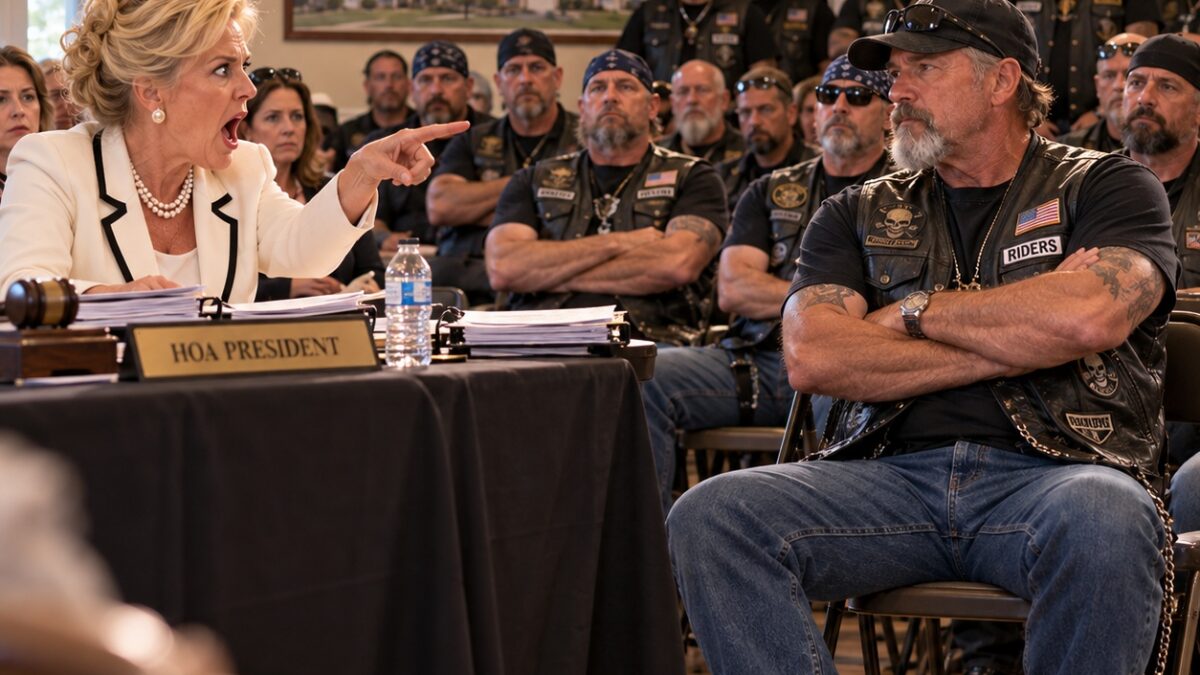
The annual meeting took place at Millbrook Community Center on a Thursday evening.
I arrived early.
Parking lot already filling.
By 6:15, every normal parking space looked taken.
On the public street outside, motorcycles stood in a neat line stretching down the block.
Thirty-one.
No engines running.
No performance.
Men and women standing beside bikes, talking quietly.
Helmets on handlebars.
Neighbors walked past them into the building.
Some stared.
Some smiled.
Dale stood near the entrance.
“Nice turnout.”
“Too many people.”
“You’re the one who invited bikers.”
“I invited thirty-two.”
“One couldn’t make it.”
“Good.”
He laughed.
Inside, ninety-four chairs had been set.
All full.
People stood along walls.
Homeowners I had never met.
Former residents.
Curious neighbors.
Lupe sat with printed summaries.
Rhonda held the petition.
Dara looked nervous.
Troy looked as though he was attending a zoning hearing in 1987 and had been born ready for it.
Tamara and a camera operator occupied one corner.
Quiet.
Professional.
At 6:29, the board entered.
Constance stopped for half a second when she saw the room.
Then the camera.
Her face did what it always did.
Adjusted.
She took her place.
HOA polo.
Binder.
Smile.
“Good evening.”
Nobody answered.
She called the meeting to order.
Rhonda stood first.
She presented thirteen homeowner signatures.
Twenty-seven percent of the voting households.
Requested that the previous tabling action be deemed invalid and that elections proceed.
She cited the procedural grounds.
No drama.
Then Troy stood.
“Point of order.”
His voice sounded like gravel spread evenly with a rake.
He explained the notice issue.
The emergency meeting had been convened with far less than the notice period they believed applied.
Therefore, actions taken there should not block the election.
Board member Garrison Pruitt seconded the motion to proceed.
Constance’s binder snapped shut.
Small sound.
Everybody heard it.
Then Lupe stood.
Laptop closed.
Twelve printed copies in hand.
She walked to the board table.
Placed one in front of every director.
One at a time.
Then faced the room.
“Drayhill Grounds Services LLC.”
Constance’s face went still.
“Forty-seven thousand dollars annually.”
No movement.
“Registered agent: Malcolm Drayhill.”
A murmur.
“Contract awarded after a board vote in which the president participated. We found no conflict disclosure and no documented recusal in the records provided.”
Constance leaned toward her microphone.
“Those documents are taken out of—”
Vance Okafor spoke.
Quiet.
“Constance.”
She stopped.
“I think we should stop talking.”
There are moments when authority disappears without anybody physically removing it.
That was one.
No shouting.
No handcuffs.
No dramatic security escort.
One man who had spent years sitting beside her finally deciding he was no longer going to help hold the story together.
The election proceeded.
Rhonda won.
Dara won.
Troy won.
Double-digit margins.
Procedural motions shifted toward the homeowners.
Garrison voted with them.
Constance sat at the table.
Silent.
The person who had controlled every meeting for years no longer had the room.
Outside, motorcycles started one by one.
Not revving.
Not circling.
Leaving.
They had come for one reason.
That reason was over.
I stood in the parking lot listening.
Dale put one hand on my shoulder.
Neither of us said anything.
The air smelled like cedar and cooling asphalt.
For the first time in months, I did not feel like I needed to write something down.
Things moved fast afterward.
The landscaping contract was terminated.
The new board authorized a broader financial review.
The complaint over procedural violations resolved in the homeowners’ favor.
Every fine issued against me was voided.
The motorcycle.
The lantana.
The gatherings.
The retroactive daily fines.
All of them.
Certified mail.
Clean record.
I read the letter once.
Then put it in the folder.
Constance resigned before completing her term.
Her letter said she was leaving because of “personal priorities.”
She thanked the community for the opportunity to serve.
No apology.
I did not need one.
Prescott left the HOA job and found work somewhere else by January.
Nobody gave him much trouble.
He had done things I disagreed with.
But from the beginning, he looked like somebody carrying orders he did not enjoy.
I hoped he found better work.
My personal defamation dispute ended quietly.
Confidential terms.
People asked what I got.
I said:
“Enough.”
That was all.
I did not buy a new motorcycle.
I finished the old one.
Better exhaust.
Professional burgundy paint.
The custom leather seat I had wanted since the beginning.
One clear November morning, I opened the garage.
Rolled the Sportster out.
Stood beside it.
For a long moment, I simply looked.
Months earlier, Constance had treated the sight of that motorcycle as contamination.
Something incompatible with her image of Cedar Brook.
Now the street was empty.
Quiet.
No golf cart.
No camera.
No violation notice.
I started the engine.
Let it settle.
Then rode.
Three hours.
Central Texas backroads.
No destination.
Cedar.
Dry grass.
Cold air leaking around my jacket.
Low winter sun flashing off chrome.
I had spent thirty-one years driving because somebody else needed something delivered.
That morning, nobody needed anything.
I went nowhere.
That was the point.
The new board’s first major community proposal came from Rhonda.
Dara seconded it.
Redirect a small portion of landscaping money toward native pollinator planting along the greenway.
Lupe’s financial review had also recovered money from the old events spending.
Some of that went into the project.
They revised the approved plant list.
Lantana was added.
Alphabetical order.
First entry.
I stood in my driveway reading the revised list.
Then looked at the plants Constance had ordered me to remove months earlier.
Still there.
Orange.
Yellow.
Bees working over them.
Never moved.
I laughed.
Dara came outside.
“What?”
“Nothing.”
“You’re staring at flowers.”
“I’m retired.”
“Fair.”
That spring, Iron Meridian and Cedar Brook organized a Veterans Appreciation Ride.
Not my idea.
I want that stated clearly.
If it had been my idea, nobody would ever let me forget how sentimental retirement had made me.
The event benefited a local veterans housing nonprofit.
Thirty-eight motorcycles registered.
Residents came on foot.
Bicycles.
Lawn chairs.
Dale ran the brisket smoker for nine hours.
Nobody was allowed near it without permission.
Dara made three kinds of pie.
Lupe brought her kids.
Hector drove from San Antonio because, as he put it, he had survived the beginning and deserved dessert at the end.
The Millbrook parking lot smelled like smoke, coffee, pie crust, and warm pavement.
Children walked between motorcycles with their parents.
Iron Meridian members explained engines.
Residents who had once stared through curtains sat in folding chairs talking to them.
No threatening “visitor patterns.”
No “community character.”
Just people.
At noon, I stood back from the crowd.
Rhonda came beside me.
“You going to make a speech?”
“No.”
“Good.”
“Why?”
“You’d ruin it.”
“Thank you.”
“You’re welcome.”
She walked away.
I watched Cedar Brook look like a real neighborhood.
Maybe for the first time.
Not a curated one.
Real.
Messy.
Retired firefighter.
Vet tech.
Civil engineer.
Bookkeeper.
Bikers.
Kids.
Older couples.
People who liked native flowers.
People who did not care.
Community is not everybody matching.
It is everybody getting enough room to remain recognizable.
I had not known how much Constance’s leadership had reduced Cedar Brook to an aesthetic until it stopped.
After the ride, my kitchen table finally cleared.
No highlighted CC&Rs.
No stacks of certified mail.
No folders spread across placemats.
I put everything together.
PROBLEMS.
PROCEDURE.
DRAYHILL GROUNDS.
Witness statements.
Notices.
Financial summaries.
The sixty-one-page notebook.
Then I made one final folder.
Black marker.
DONE
I placed it on the garage shelf beside the filing cabinet.
That evening, I set six plates on my kitchen table.
Dale and his wife came.
Rhonda.
Dara.
Hector.
Somebody brought dessert.
Nobody talked about HOA law for more than five minutes.
That may have been the greatest victory of all.
We talked about motorcycles.
Dale’s smoker.
Hector’s bad knee.
Dara’s impossible cat patients.
Rhonda complaining that board email chains were already making her regret democracy.
Outside, the lantana bloomed in the dark.
Small orange and yellow dots along the driveway.
Exactly where I had put them.
Months later, a new resident knocked on my door.
Young couple.
Had heard I “knew HOA stuff.”
That reputation was unfortunate.
The man carried a notice about a fence stain.
“Can you tell me what to do?”
I looked at the paper.
Then at him.
“First, don’t panic.”
“We’re not panicking.”
His wife looked at him.
“He’s panicking.”
“Fine.”
I handed the notice back.
“Read the rule it cites.”
“We did.”
“Read it again.”
He frowned.
“That’s it?”
“For tonight.”
“What if they’re wrong?”
“Then ask them to explain in writing.”
“What if they’re right?”
“Then decide whether fixing it is easier than fighting it.”
He looked disappointed.
People hear what happened with Constance and expect me to advise warfare over every mailbox.
I do not.
Most HOA problems are ordinary.
Sometimes your fence really is wrong.
Sometimes paperwork is messy without being sinister.
Sometimes a board volunteer makes a mistake.
The lesson was never:
Fight everything.
The lesson was:
Understand what you are being told before surrendering to it.
The young couple left.
Dara had been listening from her driveway.
“You’ve become wise.”
“No.”
“Boring, then.”
“That I accept.”
The new Cedar Brook board became boring.
Budgets.
Pool maintenance.
Trees.
Insurance.
Repair reserves.
People complained.
People voted.
Some motions failed.
Some passed.
Nobody invented rules on Friday because one homeowner annoyed the president on Thursday.
Rhonda published records.
Dara pushed for clearer violation notices.
Troy insisted every meeting follow procedure whether three people attended or thirty.
Boring government is underrated.
Constance had treated governance like theater.
The new board treated it like maintenance.
That is closer to what it should be.
About a year after everything ended, I found my first seventy-five-dollar notice while cleaning the garage.
Storage of recreational vehicle visible from street.
I stood there holding it.
The Sportster was parked six feet away.
I could have thrown the notice out.
Instead I carried it into the kitchen.
Made coffee.
Read it again.
What surprised me was how small it looked.
One page.
One fine.
One silly phrase.
Pattern of intent to display.
That tiny piece of paper had been the first thread.
Pull it long enough and eventually we found:
Manufactured-looking minutes.
Improper rule changes.
Neighbors afraid to challenge notices.
Defamation.
Access violations.
A family-connected landscaping contract.
Community money used for private social expenses.
Broken meeting procedure.
A president who believed every new problem could be solved by giving herself more authority.
I put the notice back.
Not as a trophy.
Reminder.
Problems often introduce themselves as something too small to bother with.
Seventy-five dollars.
One plant list.
One wind chime.
One wrong rule number.
Bad systems survive because each individual injury seems cheaper to absorb than challenge.
That does not mean every small problem hides corruption.
It means small problems deserve enough attention that you know what they are.
There was another reason I kept it.
I remembered myself that morning.
Newly retired.
Coffee.
Garage.
No intention of becoming anybody’s neighborhood troublemaker.
If you had told me I would spend the next year reading property documents with a civil engineer and discussing financial disclosures over brisket, I would have moved somewhere without sidewalks.
But life does not always ask what kind of story you wanted.
Sometimes it puts two men in polos at your driveway at 7:42 in the morning and lets you decide whether to forget the sentence they used.
Your presence here is becoming a problem for this community.
That sentence bothered me more with time.
Not the motorcycle.
Not flowers.
My presence.
That was always the deeper issue.
Constance had a picture of Cedar Brook.
Neat.
Predictable.
Her approved plants.
Her garden parties.
Her social circle.
Her version of retirement.
A long-haired biker polishing a 1987 Harley in an open garage did not fit.
Neither did Dara’s wind chimes.
Neither did a flagpole somebody else once removed.
Rules became a way to smooth people down until the neighborhood matched the person enforcing them.
But homes are not hotel lobbies.
People are supposed to leave evidence of themselves.
A motorcycle.
Native flowers.
Wind chimes.
A fire pit.
Children’s chalk.
Bad Christmas lights.
Within reason.
That phrase matters.
Community does require compromise.
What it should not require is personality surrender.
I think about Prescott sometimes.
People ask why I never went after him.
Because not everybody inside a bad system has equal power.
He delivered notices.
He stepped onto my property when he should not have.
He participated.
That is true.
But I also watched him.
Every time.
He looked uncomfortable.
He never invented the rules.
Never yelled.
Never threatened.
When Constance’s power collapsed, he left.
Sometimes accountability means consequences.
Sometimes it means getting out of a role that kept making you part of things you knew were wrong.
I hope he learned something.
I know I did.
Dale once asked me whether I wished I had refused that first seventy-five-dollar fine.
We were in my garage.
He was holding a flashlight while I adjusted something on the Sportster.
“No.”
“Why?”
“Would’ve saved seventy-five dollars.”
“Probably.”
“You hate wasting money.”
“I do.”
“So?”
I tightened a bolt.
“Paying it taught me what compliance bought.”
“What?”
“Nothing.”
Constance came back anyway.
Plant fine.
Bike notices.
Poison letter.
The first payment did not create peace.
It established expectation.
Dale nodded.
“So you regret it.”
“No.”
He groaned.
“You are exhausting.”
“I said it taught me something.”
“What?”
“Sometimes the cheapest lesson costs seventy-five dollars.”
He handed me the flashlight.
“I’m getting beer.”
That is retirement.
Arguing philosophy over motorcycle parts with a man who once carried people out of burning houses.
The Iron Meridian never turned into some neighborhood enforcement force.
Thank God.
Hector suggested matching shirts for the Veterans Ride.
I vetoed them.
He called me authoritarian.
I told him to file a complaint.
Wes eventually framed one photocopy of the fence-height citation and hung it in his garage.
Under it, a little label:
APPAREL REGULATION — 14.3
I hated how funny it was.
The club never let me forget Constance had once tried to regulate our vests using a fence rule.
Humiliation is easier when friends turn it into a joke you control.
One afternoon, months after the board change, Rhonda asked whether I had ever considered running for HOA president.
We were standing near the greenway where volunteers had planted native flowers.
“No.”
“You’d win.”
“That is not an argument.”
“You understand the documents.”
“I understand freight paperwork too. I never wanted to own a shipping company.”
“You like helping people.”
“I like helping people leave my kitchen so I can eat.”
She laughed.
Then grew serious.
“You opened the door.”
I remembered saying that around the fire.
My job is to open the door.
Other people walk through.
Rhonda had.
Dara had.
Troy.
Lupe.
Neighbors who showed up.
People sometimes tell stories like mine by choosing one hero.
Easier that way.
Retired trucker defeats HOA queen.
Good headline.
Bad history.
I did not defeat Constance.
I found the first thread.
Dara brought another.
Dale documented the rumor.
Rhonda had two years of records.
Lupe followed the money.
Troy understood procedure.
Wes understood legal strategy.
Hector kept us precise and occasionally obnoxious.
Homeowners signed.
Board members eventually decided their duty mattered more than Constance’s approval.
Thirty-one riders filled chairs.
Tamara turned a private governance dispute into something that could not easily be rewritten after the meeting.
A community corrected itself.
That is messier than a hero story.
Also more useful.
Because most people do not have to become Garrett Wolfe to challenge something wrong.
They need to become one useful piece.
Witness.
Bookkeeper.
Neighbor.
Person who reads the minutes.
Person who asks:
“Where is that rule?”
One useful piece beside another.
That is how systems change.
Constance’s landscaping contract stayed terminated.
The financial review closed.
Money recovered.
Policies updated.
The world did not end.
Property values did not collapse because motorcycles existed.
Families did not flee because lantana bloomed.
Cedar Brook survived people disagreeing.
Imagine that.
The white Lexus disappeared a few weeks after Constance resigned.
I do not know whether she sold it.
Moved it.
Stored it.
Do not care.
The vanity plate mattered even less.
I never needed some symbolic destruction of her car or house.
That would have turned her back into the center of the story.
She was not.
The neighborhood was.
The people staying were.
The flowers staying were.
The Sportster finally leaving the garage because I wanted to ride it—not because somebody approved.
Those were the important parts.
One Sunday morning, I rode for an hour and came back to find a little boy standing at the edge of my driveway with his father.
Maybe eight.
He pointed at the Harley.
“Can I see it?”
The father looked embarrassed.
“Sorry.”
“No problem.”
I rolled it farther into the light.
The boy stared.
“Is it loud?”
“Can be.”
“Can you start it?”
I looked at the father.
He shrugged.
I started it.
Not revving.
Just idle.
The boy grinned.
When I shut it off, he touched the air near the engine without touching metal.
“Cool.”
Then:
“Mrs. Pickett says motorcycles are allowed now.”
I laughed.
“Motorcycles were always allowed.”
He frowned.
“Then why did she say now?”
His father looked mortified.
I crouched slightly.
“Sometimes grown-ups make rules sound bigger than they are.”
He considered that.
Then ran home.
The father stayed.
“Sorry about that.”
“Kids ask good questions.”
“He heard pieces of the story.”
“They all did.”
The man looked toward the lantana.
“I voted for Constance.”
There it was.
I had not asked.
He continued.
“Twice.”
“Okay.”
“I believed some of what she said about you.”
I waited.
“I’m sorry.”
I nodded.
“Thank you.”
He looked surprised.
Maybe he expected more.
Forgiveness speech.
Anger.
Something.
He said:
“That’s it?”
“What do you want me to do?”
“I don’t know.”
“I don’t either.”
He laughed awkwardly.
Then left.
Not every apology needs a reconciliation ceremony.
Sometimes the cleanest ending is somebody saying they were wrong and you no longer needing them to be punished for it.
Constance never gave me that.
My life continued anyway.
That may be the most important freedom I got.
For months, my mood had depended on what she did next.
Mail arrived.
Pulse changed.
Golf cart slowed.
I watched.
Lexus parked.
I noticed.
Notification from the HOA portal.
Everything stopped.
That is another kind of control.
Even before somebody wins legally, they can occupy your nervous system.
After the annual meeting, that faded.
Slowly.
One day a white golf cart drove past.
Landscaping crew.
I did not look twice.
That felt better than the election result.
Dara eventually put her wind chimes back up.
Same ones.
She invited me over when she did it.
“You need moral support?”
“Yes.”
“For wind chimes.”
“Exactly.”
She hung them.
A light breeze moved through.
Tiny sound.
Nothing disruptive.
She looked toward Constance’s old house.
Then back at me.
“I hate that I took these down.”
“You were tired.”
“I should’ve fought.”
“No.”
She frowned.
“You always fight.”
“No.”
“I’ve seen your files.”
“I document.”
“That’s fighting with office supplies.”
Fair.
Then I told her something Theodore’s story had taught me.
“You do not owe anybody heroic resistance.”
She looked at me.
“If somebody pressures you until removing wind chimes feels easier than arguing, that is on the person abusing the pressure.”
“But if everybody does that—”
“Then eventually somebody else fights.”
“Like you.”
“Or Rhonda.”
“Or both.”
The chimes moved again.
Dara smiled.
“I like them.”
“I know.”
“You hate them.”
“I did not say that.”
“You make a face.”
“I’m old.”
She laughed.
The chimes stayed.
So did the lantana.
So did the motorcycle.
Not because our preferences became more important than everybody else’s.
Because the rules finally had to justify interference instead of Constance’s taste doing the job.
That is a distinction worth protecting.
The annual meeting after Constance resigned drew twenty-eight people.
No motorcycles outside except mine and Hector’s.
No television cameras.
Rhonda opened with budget review.
I nearly fell asleep.
It was magnificent.
One homeowner argued about pool hours for twelve minutes.
Another wanted brighter entrance lighting.
Lupe corrected a number.
Troy asked whether the motion was properly seconded.
Somebody’s baby cried.
That was governance.
Boring enough that nobody had to fear it.
Afterward, Rhonda found me near the door.
“Thoughts?”
“You need shorter meetings.”
“Anything useful?”
“Coffee.”
“We have coffee.”
“Better coffee.”
“You are impossible.”
I rode home.
Garage door stayed open while I wiped down the bike.
Nobody issued a notice.
That small thing felt enormous.
Eventually, I stopped keeping the notebook nearby.
Then the folders moved to the garage.
Then I stopped checking the HOA portal every morning.
At some point, you have to decide whether winning means continuing to stand guard forever.
I chose not to.
The records stayed.
The lesson stayed.
Hypervigilance did not need to.
The Veterans Appreciation Ride became annual.
The second year, more people came.
I warned everybody that if it became too large, I was disappearing.
Dale said nobody would notice.
Dara told him that was mean.
Hector said:
“He likes being ignored. That’s his whole personality.”
Accurate.
The veterans housing nonprofit used the money for emergency rent assistance and repairs.
That part mattered to me more than the motorcycles.
I had met older drivers and veterans across the country who spent decades working and still reached retirement one medical bill away from losing a home.
Housing stability sounds like boring policy language until you watch somebody pack boxes.
Then it becomes real.
The event remained simple.
Ride.
Food.
Donation.
No giant portraits.
No speeches about how Garrett defeated tyranny.
I threatened to leave if they made one.
The first year, a local reporter asked:
“What do you think changed Cedar Brook?”
I said:
“People compared notes.”
She seemed disappointed.
“Nothing more dramatic?”
“No.”
“What about the motorcycles at the meeting?”
“Chairs needed filling.”
“And the financial documents?”
“Somebody read them.”
“And Constance?”
“She stopped being president.”
The reporter stared at me.
“You’re not very quotable.”
“Excellent.”
She used the line anyway.
People compared notes.
Maybe that was quotable after all.
Constance’s entire system depended on private discomfort.
Garrett’s motorcycle problem.
Dara’s wind chime problem.
Somebody else’s flagpole problem.
Rhonda’s bookkeeping concern.
Separate.
Small.
Once those stories sat on one kitchen table, they became governance.
That is why I tell people now:
Do not start with outrage.
Start with comparison.
What happened to you?
Has it happened to anyone else?
What rule?
What date?
Same wording?
Same vendor?
Same board member?
Patterns do not announce themselves.
You build them.
One entry at a time.
It is not glamorous.
Neither is long-haul trucking.
You still get where you are going.
A few years after I retired, my Sportster had more miles on it than I expected.
I had originally imagined restoring it mostly as a garage project.
Turns out motorcycles prefer roads.
So do truckers, even retired ones.
Some mornings I rode past Cedar Brook’s entrance and kept going.
Hill Country.
Small towns.
Diners.
Gas stations.
No freight schedule.
No logbook deadline.
No delivery window.
Hector would meet me sometimes.
Other mornings, I rode alone.
I liked that too.
One morning, I passed a landscaping crew planting native species along a new subdivision entrance.
Lantana.
I laughed inside my helmet.
Nothing symbolic about it.
Just a plant.
That was the point.
Constance had managed to turn a flower into a loyalty test.
Once she was gone, it became a flower again.
That may be what freedom does.
It returns ordinary things to being ordinary.
Motorcycle.
Wind chimes.
Front yard.
Meeting.
Neighbor.
You stop seeing every object as evidence.
You stop seeing every person as a potential witness.
You go back to living.
I still keep the old folders.
I probably always will.
Thirty-one years of trucking makes throwing away documentation physically painful.
But they are not on the kitchen table.
They live on a shelf beside spare filters, old manuals, and a box of receipts.
The folder labeled DONE is on top.
Sometimes someone asks to see it.
Usually a homeowner fighting their own board.
I show them.
But I also give a warning.
“Do not copy my fight.”
“What does that mean?”
“Your facts will be different.”
They usually look disappointed.
People want templates.
“I had financial records, witness statements, a rule-adoption issue, a contract conflict, meeting problems, and enough neighbors willing to get involved.”
“So?”
“So find your facts.”
“What if I don’t have that?”
“Then do not invent it.”
That matters.
The same habits that expose bad power can become bad power if you start treating every disagreement as corruption.
Truth first.
Always.
Constance exaggerated.
Invented.
Bent procedure.
That was what made her dangerous.
You do not beat that by becoming another version of it.
I learned that from trucking too.
Bad logbook?
You do not fix it by falsifying a better one.
You correct the record.
The neighborhood changed me.
I did not expect that.
I moved to Cedar Brook wanting fewer people in my life.
I got Dale.
Dara.
Rhonda.
Lupe.
Troy.
Neighbors.
People at my kitchen table.
Iron Meridian somehow becoming community volunteers.
It was inconvenient.
Also good.
The fire pit got used more.
My tomatoes never got as much attention as planned.
Dale blamed the soil.
I blamed Dale for giving advice after I had already planted them.
Dara adopted another dog.
Rhonda remained HOA president longer than she intended because nobody else volunteered.
I reminded her that dictatorship would be more efficient.
She told me never to joke about that again.
Fair.
One evening, after a board meeting, Constance’s old house came up in conversation.
New owners had replaced half the landscaping.
Not because anybody ordered them.
They liked different plants.
I drove past later.
Her carefully curated front garden was gone.
Different shrubs.
A small basketball hoop near the driveway.
Child’s scooter on the grass.
For a second, I expected some old part of the neighborhood to object.
Then I smiled.
Houses change.
People move.
Communities survive.
Control is temporary no matter how permanent it feels while somebody holds it.
That may have been Constance’s deepest mistake.
She thought Cedar Brook was hers because people had obeyed her for years.
It was never hers.
It belonged to forty-seven households with forty-seven different lives.
She was a volunteer officer serving them.
Not a queen.
The vanity plate should have been warning enough.
On the fifth anniversary of my retirement, Iron Meridian came over.
Not thirty-two people.
Seven.
Original crew.
Dale smoked meat.
Hector brought something he claimed was salsa and everybody else classified as a weapon.
Wes sat by the fire complaining about his knees.
Dara came over.
Rhonda too.
Someone asked if we remembered the first cookout when Constance issued three notices.
Hector raised his drink.
“To fence height.”
Everybody laughed.
I looked around.
“This is why I should’ve moved.”
“No chance,” Dale said.
“Property values,” Rhonda added.
“Community character,” Dara said.
I pointed at all of them.
“You people are why HOAs have rules.”
More laughter.
Later, after everybody left, I sat alone by the fire.
The Sportster was visible through the open garage.
Lantana along the driveway.
Kitchen table empty.
I thought about that first Tuesday morning.
7:42.
Coffee.
White golf cart.
Two men walking toward me.
Your presence here is becoming a problem for this community.
If I could go back, I would not tell myself exactly what to do.
I would not spoil the ending.
I would tell that version of me one thing.
Do not let them make you believe belonging is something a board grants.
You bought the house.
You follow legitimate rules.
You respect neighbors.
That is enough.
You do not need to become aesthetically convenient.
You do not need to remove harmless pieces of yourself so somebody else’s idea of community stays symmetrical.
But you also do not need to rage.
Open the notebook.
Write the date.
Keep the paper.
Ask the question.
Then another.
Let truth accumulate.
People drunk on petty authority expect one of two reactions.
Fear.
Or explosion.
Both are useful to them.
Fear gets compliance.
Explosion gives them a villain.
Patience gives them nothing.
That was my advantage from the beginning.
Constance could provoke.
I could wait.
She could issue notices on Friday.
I could mail certified responses Monday.
She could invent a rule.
I could ask for adoption records.
She could spread a rumor.
Dale could write down who repeated it.
She could deny financial access.
Rhonda could request it again.
She could bury a conflict inside a contract.
Lupe could follow the number.
She could manipulate a meeting.
Troy could count the notice hours.
She could call us dangerous.
Thirty-one motorcycles could arrive and remain quiet.
By the end, the contrast became impossible to ignore.
She was the one creating chaos.
We were reading documents.
That was satisfying.
Not because I enjoyed seeing her embarrassed.
Because for months, she had relied on presentation.
Her polo.
Her Lexus.
Her letterhead.
Her authority.
Then the annual meeting stripped all that down to something simple.
Who had the records?
Who followed the rules?
Who could explain the money?
The answers no longer favored her.
No amount of aesthetic could fix that.
Spring came again.
The pollinator strip along the greenway bloomed.
Kids learned the names of plants from little signs.
Lantana.
Black-eyed Susan.
Texas sage.
Butterflies appeared.
Nobody asked whether bees met community aesthetic standards.
One morning, I saw Constance’s old approved list in the archive packet.
Seventeen species.
Almost all from her yard.
I considered keeping it.
Then laughed and recycled the copy.
I had the actual adoption history now.
The old list no longer mattered.
That was another change.
At first, I wanted to preserve every single page because every page might save me.
Later, I learned some pages can go.
When the system works, you stop carrying the whole case on your body.
My notebook remains.
That I will keep.
Sixty-one pages.
Mileage-log handwriting.
Coffee stain near page thirty-two.
Grease mark from the garage around page forty-eight.
The final page has one entry.
Date.
Annual meeting.
Under it:
Election completed.
Then:
All riders left peacefully.
That line makes me smile.
Not:
Constance defeated.
Not:
Victory.
All riders left peacefully.
That was what I wanted documented.
Because she had spent months making them sound like criminals.
The record deserved the truth.
I added one final sentence years later.
Not part of the original timeline.
Just for me.
The lantana stayed.
Then I closed the notebook.
That is Garrett Wolfe’s grand philosophy after sixty-some years of life.
Keep the paperwork.
Keep your friends.
And if somebody tells you to rip out native flowers because they do not match her yard, maybe ask who voted on the list before you reach for a shovel.
The rest tends to reveal itself.
These days, my coffee still goes black.
The Sportster still runs.
The garage door is often open.
Dale still wanders over whenever he hears tools.
Dara’s wind chimes still make noise when the wind comes from the east.
Rhonda still sends emails with too many attachments.
Iron Meridian still shows up hungry.
And Cedar Brook still has rules.
Good.
Communities need them.
What changed was not that we got rid of authority.
What changed was that authority had to explain itself.
Constance had spent five years running Cedar Brook like her private clubhouse.
I never wanted to replace her clubhouse with mine.
The real win was that nobody owned the club anymore.
People simply lived there.
On the first warm Saturday of one recent spring, I rolled the Sportster into the driveway.
Sunlight hit the burgundy tank.
Lantana along the border was beginning to bloom again.
I wiped one spot of dust from the chrome.
Then heard engines in the distance.
Iron Meridian.
Seven bikes.
Not thirty-one.
No annual meeting.
No strategy.
Just lunch.
Dale came outside carrying a tray.
Dara waved from her yard.
Rhonda yelled something about not blocking mailboxes.
Hector pulled in first.
Killed his engine.
Looked around.
“No citations?”
“Give it time.”
He laughed.
We parked.
Ate.
Talked about nothing important.
That was the ending I wanted all along.
Not a courtroom.
Not somebody in handcuffs.
Not Constance publicly destroyed.
A Saturday where the garage could stay open and nobody cared.
A motorcycle on the street.
Flowers beside the driveway.
Friends at the table.
No folder between the plates.
No certified mail waiting by the door.
People later told me I had “won.”
I suppose I did.
But if you want to know exactly when I felt it, it was not at the annual meeting when Constance stopped speaking.
It was not when the fines disappeared.
Not when the contract was canceled.
Not when the new board took over.
It was much later.
I was sitting in my backyard after dinner.
The others had gone home.
Night had settled over Cedar Brook.
My garage light was still on.
The Sportster stood inside.
Front wheel visible from the street.
Exactly the thing Constance had fined me for years earlier.
I noticed it.
Then noticed something else.
I had forgotten to worry about it.
That was the moment.
The real one.
Because power had not merely changed hands.
It had stopped living in my head.
I finished my coffee.
Went inside.
Left the garage door open another twenty minutes.
Not to prove a point.
Not as protest.
I forgot.
And nobody came.
Nobody needed to.
The next morning, I closed it.
Because I wanted to.
That difference was everything.



