PART2:HOA Queen Ordered Me to Shut Off My Tornado Siren During an Active Warning—Then the Funnel Hit Her Street
PART2
Dolores Whitman was forty-eight.
Real estate agent.
Blonde hair cut perfectly straight.
White Escalade.
Vanity plate that read:
RULES1ST.
She had been HOA president for six years.
People spoke about her the way people speak about weather they have learned to endure.
“You get used to her.”
“She means well.”
“Just don’t get on her radar.”
That last one came from Pete Martinez.
We were standing beside my driveway after he saw the violation notice.
“What happens if you get on her radar?”
Pete snorted.
“You’ll find out.”
I did.
The next notice arrived a week later.
Five hundred dollars.
Monthly.
For:
NOISE CREATING RESIDENT ANXIETY AND DISRUPTING PROPERTY SHOWINGS.
That made no sense.
The siren had only run during the scheduled test.
We had not had severe weather since installation.
There had been no random noise.
No malfunction.
Nothing.
I started digging.
That was when I learned Brad Whitman, Dolores’s husband, owned Sooner Storm Solutions.
Biggest storm-damage restoration company in the county.
Roof replacement.
Water remediation.
Structural repairs.
Emergency board-up.
The kind of business that becomes extremely busy after hail, wind and tornadoes.
At first, I did not assume corruption.
That would have been irresponsible.
Owning a storm-restoration company does not make somebody criminal.
But the conflict bothered me.
Dolores wanted fewer warning systems in a tornado-prone neighborhood.
Her husband made money when storms caused severe property damage.
Maybe coincidence.
Maybe not.
Then Sarah came into the kitchen holding the emergency HOA meeting notice.
“Thursday?”
“Yeah.”
“My oncology appointment is Thursday.”
I took the paper.
Time:
6:30 p.m.
The exact evening Dolores knew we would be at Sarah’s follow-up.
Sarah looked at me.
“She knows.”
“How?”
“I told Mrs. Henderson last week I’d be gone Thursday for the appointment.”
That did not prove anything.
But it felt deliberate.
I requested postponement.
Denied.
I requested remote participation.
Denied.
I sent written objections.
Ignored.
Thursday evening, while Sarah sat in an oncology waiting room with me holding her hand, Dolores held her meeting.
Twelve votes for removing my “unauthorized structure.”
Three against.
The Hendersons.
Pete.
Mrs. Patterson.
Forty-eight hours to remove it.
Then one hundred dollars per day.
That night, Sarah and I got home after ten.
Her scan had gone well enough that the doctor sounded optimistic.
We should have been celebrating.
Instead, I spread HOA papers across the table.
Sarah stood beside me.
“You’re building a file.”
“I am now.”
“Good.”
Military people document.
Meteorologists document too.
Different reasons.
Same instinct.
Emails.
Letters.
Violation notices.
Permit approvals.
Meeting notices.
Votes.
I printed everything.
Started a timeline.
Then Dolores made her first serious legal mistake.
She filed a municipal noise complaint.
City code enforcement came Monday.
Officer Mike Reynolds.
Coffee in one hand.
Clipboard in the other.
He looked embarrassed before he even reached the tower.
“Mr. Blackwood?”
“That’s me.”
“I need to inspect an alleged noise violation.”
“Of course.”
Then I handed him Tulsa’s municipal exemption for emergency warning systems.
He read it.
Looked at me.
Looked at the tower.
Read again.
“Where did you get this?”
“City code.”
He exhaled through his nose.
Then called Dolores on speaker.
“Ms. Whitman?”
“Yes?”
“This equipment is exempt from municipal noise restrictions.”
Silence.
“There must be some mistake.”
“No, ma’am.”
“You haven’t heard how disruptive it is.”
“I’m not evaluating taste. I’m evaluating code.”
Another silence.
“The installation appears permitted and the equipment category is exempt.”
Dolores’s voice hardened.
“So you’re refusing to enforce?”
“I’m telling you there’s nothing to enforce.”
Mike ended the call.
Then looked at me.
“People really should read the ordinances before filing complaints.”
“That would ruin half the disputes in America.”
He laughed.
Then left.
First small victory.
Dolores responded by hiring lawyers.
The envelope came Thursday.
Hammond and Associates.
Thick paper.
Formal language.
CEASE AND DESIST.
PUBLIC NUISANCE.
CONTINUING COVENANT VIOLATION.
Then:
FORECLOSURE REMEDIES.
I read that word three times.
Sarah came into the kitchen.
“What?”
I handed it to her.
Her face changed.
“Can they?”
“Not like this.”
“You sure?”
“I’m sure enough to call somebody who knows better.”
Patricia Samuel was a property attorney in Tulsa.
Leather chairs.
Mahogany desk.
No patience for bluster.
She read everything.
Our permit.
County approval.
HOA architectural sign-off.
Violation notices.
Code enforcement closure.
Then the foreclosure threat.
She leaned back.
“Marcus.”
“Yes?”
“They are aggressively wrong.”
“How aggressively?”
“They are threatening to foreclose on a house over safety equipment that appears protected by state and local law.”
“Meaning?”
“If they proceed knowingly, they may expose themselves to attorney fees and damages.”
Sarah asked:
“So they cannot simply take our home?”
Patricia looked directly at her.
“No.”
Sarah relaxed slightly.
I did not.
Because a weak legal position does not make an obsessed person harmless.
On the way home, I drove past Dolores’s house.
Large deck.
Beautiful.
Something about it bothered me.
I pulled county permit records that evening.
No deck addition.
I checked satellite imagery.
The extension was relatively new.
Setback looked questionable.
Potentially fifteen thousand dollars of unpermitted construction.
I could have reported her.
I did not.
I saved it.
There is a difference between evidence and revenge.
I was still trying to remember that.
Meanwhile, neighbors started choosing sides.
Dolores walked the subdivision with petitions.
Designer heels clicking on sidewalks.
“That eyesore lowers every home value on this street.”
Mrs. Patterson surprised her.
“I’d rather have my house worth five thousand less than be dead inside one worth five thousand more.”
The Hendersons started a counter-petition.
Pete printed copies of the emergency-equipment laws.
For the first time, Dolores’s control looked less complete.
Then Sunday evening, a real storm developed.
Not tornado warned.
Severe thunderstorm watch with rotation possible.
My system activated.
The siren sounded.
Twelve families took shelter early.
Outdoor furniture came inside.
Cars moved under cover.
Mrs. Patterson secured her medications and backup battery.
The Hendersons put the twins in their safe room.
Dolores was gone.
Weekend trip.
Her house sat empty.
The woman who claimed my warnings created anxiety had left town before the weather arrived.
That bothered me.
Monday morning, she came back furious.
She brought James Hammond himself.
And a younger associate.
Two attorneys standing in my driveway before I finished coffee.
Dolores behind them.
“This ends today, Marcus.”
Hammond held out papers.
“Remove the structure voluntarily or the association will proceed with lien enforcement.”
I looked at him.
“Did your office review the emergency equipment statutes?”
The younger associate leaned toward Hammond.
Whispered.
Just for a second, Hammond’s confidence flickered.
“We’ll be in touch.”
They left.
I sat at the kitchen table afterward.
Hands shaking.
Not fear exactly.
Adrenaline.
Sarah put her hand on my neck.
“They can’t really take this house?”
“Not if the law means anything.”
That afternoon, I went to the courthouse.
My father had been an attorney.
Small-town practice.
Estates.
Property.
Whatever walked through the door.
He used to tell me:
“When someone threatens you with the law, learn the law better than they did before they threatened you.”
Three hours into county records, I found something even Patricia had not yet seen.
Original 1987 covenant language.
Subsection 4.7.
Emergency preparedness measures installed under county emergency-management protocols were protected from ordinary covenant restrictions.
I read it twice.
Then photocopied the entire section.
The HOA’s own original documents protected my siren.
I called Patricia.
She said:
“Oh, Marcus.”
“What?”
“This is beautiful.”
“You lawyers have strange definitions of beauty.”
“They are threatening you under documents that explicitly protect you.”
“So we go on offense?”
“Yes.”
“Harassment?”
“Yes.”
“Selective enforcement?”
“Potentially.”
“Anything else?”
“We’ll see.”
That was the beginning.
While digging through public records around Sooner Storm Solutions, I found pricing complaints.
Overbilling accusations.
Insurance disagreements.
Nothing individually conclusive.
But enough to make me uncomfortable.
Then Sarah got the news that mattered.
Six-month scan.
Clear.
She walked through the front door holding the report.
“Cancer-free.”
I forgot Dolores existed.
I grabbed my wife.
Held her.
She cried.
I cried.
We stood there in the entryway like people who had finally been given permission to breathe.
Eventually she pulled back.
“There’s something else.”
“What?”
“I saw Janet Rodriguez.”
“Who?”
“Oklahoma Insurance Commission.”
Sarah had met her through cancer support events.
Janet investigated insurance fraud.
Sarah mentioned the siren fight casually.
Janet’s reaction changed.
Apparently the Commission had received anonymous tips about storm-restoration firms that encouraged communities to reduce or remove private early-warning and mitigation systems.
Not proof.
But now there was a thread.
A real one.
The following Tuesday, Dolores filed a police report claiming I had threatened her.
Deputy Walsh came during my monthly siren test.
He looked uncomfortable.
“Mr. Blackwood, we received a complaint concerning threatening behavior.”
I invited him inside.
Gave him the timeline.
Emails.
Recorded calls.
Witness statements.
Copies of my conversations.
Twenty minutes later, his expression changed.
“Did you threaten her?”
“No.”
“I don’t see evidence that you did.”
He closed the folder.
“What I do see is a lot of repeated contact directed at you.”
He stood.
“Keep documenting.”
At his cruiser, he rolled down the window.
“Mr. Blackwood?”
“Yeah?”
“My family lives two streets over.”
I waited.
“Keep that siren running.”
Then Hammond and Associates withdrew their cease-and-desist.
Patricia called.
“They found the grandfather clause.”
“Good.”
“Maybe.”
“You don’t sound convinced.”
“I’m not.”
“Why?”
“Because people who de-escalate legally sometimes escalate personally.”
She was right.
Thursday morning, I found the power line cut.
Cleanly.
Professional cutters.
The copper lay in wet grass.
My stomach turned cold.
Not vandalism.
Not spray paint.
Someone had intentionally disabled a life-safety system during Oklahoma severe-weather season.
Sarah came outside.
Saw me kneeling.
“What happened?”
“Main power feed.”
“Accident?”
“No.”
Deputy Walsh came.
Photographed.
Bagged sections.
“Felony criminal mischief at minimum.”
He looked toward the tower.
“Install cameras.”
By noon, I had eight.
High definition.
Motion alerts.
Night vision.
Three thousand dollars.
Worth every penny.
Within days, footage showed Dolores arriving with a city inspector.
She walked the perimeter pointing at everything.
The inspection notice came Monday.
Updated safety standards.
Immediate access requested.
It felt like a fishing expedition.
Inspector Martinez arrived Tuesday.
Measured everything.
Grounding.
Anchoring.
Electrical.
Wind load.
Battery backup.
Control system.
Two hours.
Then he lowered the clipboard.
“I’m going to be honest.”
“Please.”
“This is the best privately installed severe-weather system I’ve inspected.”
“Can I get that in writing?”
He almost smiled.
“Already doing it.”
I added the report to the file.
Then somebody crossed the line from threatening equipment to threatening Sarah.
Unknown number.
Male voice.
Rough.
“Your wife still gets cancer treatment at Mercy?”
My hand went cold.
“What?”
“Be a shame if her recovery got interrupted.”
Click.
I stood staring at the phone.
Sarah saw my face.
“What happened?”
I did not want to tell her.
She made me.
Deputy Walsh escalated the case to detectives.
Then security footage gave us our first physical link to Brad.
Saturday night.
2:17 a.m.
Sooner Storm Solutions truck parked at the corner.
Lights off.
Figure exits passenger side.
Dark clothes.
Tool bag.
Walks toward my property.
Timing matched the damaged electrical feed.
Not enough by itself to prove who cut it.
Enough to matter.
We sent it to police.
Then Dolores made things easier.
She threatened me on camera.
Monthly test.
Afternoon.
Thunderstorms building in the distance.
Dolores walked up with three supporters carrying printed signs.
STOP THE NOISE.
SAFETY FIRST.
That second one almost made me laugh.
Dolores held her phone up.
“I’m live-streaming.”
“Okay.”
“Everyone is going to see how you terrorize this neighborhood.”
“My monthly test lasts ninety seconds.”
“You are going to remove that monstrosity.”
“No.”
She stepped closer.
My cameras captured everything.
“You think you can humiliate me?”
“I’m standing in my driveway.”
“I’ll destroy your life piece by piece.”
Her supporters went quiet.
I said:
“Are you threatening me?”
“I’m guaranteeing it.”
“Guaranteeing what?”
“Your house. Your sick wife. Everything you care about.”
The moment she mentioned Sarah, something in me changed.
I wanted to step toward her.
Did not.
I looked directly at the nearest camera.
Then back at Dolores.
“Thank you.”
She frowned.
“For what?”
“For being clear.”
That night, storms hit hard.
Three alerts.
Tornado-strength winds.
Baseball-size hail.
Power outages.
Over two hundred thousand dollars in damage throughout Willow Brook.
But families prepared.
The Hendersons had twelve minutes.
Twins underground.
Pete’s classic car inside.
Mrs. Patterson’s medications protected.
Dolores and Brad?
Gone again.
Conference.
Out of town.
The people fighting warnings had removed themselves from the danger before it arrived.
That was when I realized they had never experienced the risk they were imposing on everyone else.
Then the envelope appeared.
No stamp.
No return address.
Slid under our front door.
Inside:
Insurance documents.
Internal memos.
Spreadsheets.
And a handwritten note:
I CAN’T STAY SILENT ANYMORE. CHECK RIVERSIDE HOA.
Sarah and I spread everything over the kitchen table.
I read one sentence.
Then another.
Then stopped breathing normally.
The documents described advance-warning systems as reducing claim severity.
Private preparedness reduced restoration revenue.
There were discussions of “target zones.”
Coordination fees.
Payments.
Then a spreadsheet.
REVENUE ENHANCEMENT 2023–2025.
Millions in inflated claims.
And another:
NETWORK COORDINATION FEES.
Dolores Whitman.
Payments totaling $127,000 across two years.
My mouth went dry.
This was no longer circumstantial conflict of interest.
If authentic, this was a criminal scheme.
At the bottom of the package was a business card.
Kevin Walsh.
Former claims adjuster.
Same last name as Deputy Walsh.
His brother.
I called.
He answered quietly.
“Marcus?”
“You sent this?”
“Yes.”
“Is it real?”
“Yes.”
“How long?”
“Three years.”
“How many communities?”
“At least seventeen.”
Sarah sat across from me.
Hands folded.
Kevin continued.
“They target weak boards. HOA restrictions discourage preparedness. Then Brad’s crews receive preferred restoration work.”
“Riverside?”
Silence.
Then:
“Forty-three homes destroyed.”
“What happened?”
“The HOA discouraged weather radios and private warning systems.”
“Why?”
“Same reason.”
I felt sick.
“How much did Sooner make?”
“More than eight hundred thousand on that event.”
I wrote everything down.
Then asked:
“Why now?”
Kevin’s voice broke.
“My daughter asked why her friend had to move away after their house was destroyed.”
Silence.
“I realized I helped build the machine.”
That sentence never left me.
We contacted victims.
Broken Arrow.
Edmond.
Norman.
Different communities.
Same structure.
Warnings discouraged.
Preparedness equipment challenged.
Severe weather.
Heavy damage.
Preferred restoration company.
Inflated claims.
Janet Morrison cried while telling me about losing her husband’s antique tools.
Another family had been threatened with HOA action over a private weather station.
Three weeks later, straight-line winds caused ninety thousand dollars in damage.
Patricia reviewed the documents.
Her voice turned serious.
“This is beyond us.”
“Meaning?”
“Federal.”
She began listing possibilities.
Wire fraud.
Insurance fraud.
Conspiracy.
Potential racketeering pattern.
“We go to the FBI.”
The Tulsa field office smelled like burnt coffee and carpet cleaner.
Special Agent Rebecca Torres took the first meeting.
Financial crimes.
Fifteen years.
She spread the documents across a conference table.
Payment ledgers.
HOA communications.
Claims.
Company records.
Security footage.
Threats.
She looked at me.
“This is systematic.”
“So you believe Kevin?”
“I believe these documents warrant investigation.”
That distinction mattered.
Then she pointed at the money.
“If the transfers authenticate, we have real exposure.”
“What happens now?”
“We verify independently.”
I leaned back.
“Do you need me?”
“Yes.”
“For what?”
She looked at Sarah.
Then me.
“To keep behaving normally.”
That sounded easy.
It was not.
Over the next weeks, federal investigators built their own case.
Subpoenas.
Financial surveillance.
Communications.
Kevin cooperating.
Patricia coordinating civil matters.
I upgraded security.
Sarah organized victim statements.
Our basement turned into a war room.
Maps.
Timelines.
Storm dates.
HOAs.
Claims.
Payments.
One line of evidence kept intersecting another.
Then Torres asked me to wear a wire.
Sarah went silent.
I did too.
“You want me to get Dolores and Brad talking?”
“We want you to attend the HOA meeting.”
“They already know I document everything.”
“Yes.”
“So why would they confess?”
“People who believe they hold local power often talk more freely than they should when they think they’re simply intimidating someone.”
Sarah looked at me.
“No.”
Torres answered gently.
“Mrs. Blackwood, we would have agents present.”
“No.”
I reached for her hand.
She looked at me.
“You don’t owe anybody this.”
“I know.”
“You already gave them the evidence.”
“I know.”
“Then let the FBI do it.”
Torres did not pressure.
Good agent.
She waited.
I thought about Riverside.
Forty-three houses.
Families.
Kevin’s daughter.
The Henderson twins.
Sarah’s cancer recovery.
Then:
“If the meeting happens while severe weather is active?”
Torres looked at me.
“What do you mean?”
I pulled up models.
The Thursday meeting coincided with an elevated supercell window.
Wind shear.
Moisture.
Instability.
Not a guaranteed tornado.
But real potential.
“If they try to disable the system during active weather, you’ll have their intent in context.”
Torres’s expression changed.
“We don’t manufacture circumstances.”
“Neither do I.”
I pointed at the forecast.
“Mother Nature scheduled this one.”
Kevin provided another piece.
Brad’s company had pre-positioned crews for the day after the HOA meeting.
Overtime already authorized.
Equipment rented.
Before any storm damage existed.
That was ugly.
Patricia began preparing asset information for prosecutors.
Torres monitored communications.
Meanwhile, Dolores became erratic.
Her Escalade sat across from our house one morning for forty-seven minutes.
Then moved.
FBI financial monitoring showed Brad shifting hundreds of thousands through shell accounts.
Then Dolores filed a harassment complaint against me.
Temporary restraining-order paperwork.
Claimed I had surveilled her home and photographed her family.
Deputy Walsh served it looking ill.
“Marcus, I have to deliver this.”
“I know.”
“She says you drove past Sunday taking pictures.”
“I was home.”
“I know.”
“My vehicle tracker shows it.”
“I know.”
“Who is her witness?”
“Randy Fletcher.”
One of her real-estate friends.
I handed Walsh the GPS history and camera footage covering the entire afternoon.
He sighed.
“This is getting stupid.”
“It passed stupid six weeks ago.”
Then somebody came to my home posing as a city electrical inspector.
Badge number.
Coveralls.
Nervous hands.
Wanted access to my power system.
I called the city while he waited.
Speakerphone.
“Badge 4778?”
Receptionist paused.
“That badge belongs to Inspector Martinez.”
The fake inspector smiled weakly.
“Right.”
I continued.
“Is Inspector Martinez at my address?”
“No, sir. He’s in Broken Arrow.”
The man ran.
Actually ran.
Pickup waiting three houses away.
Stolen plates.
FBI got the footage.
Then they came after Sarah psychologically.
A man approached while she watered the garden.
Claimed he was from her oncology clinic.
Urgent test results.
Immediate consultation.
Sarah went white.
I saw him through the window.
Something about his posture was wrong.
“Honey.”
She looked at me.
“Come inside.”
The man took one step back.
“Sir, this is private medical—”
“Sarah, call Dr. Peterson.”
The stranger walked quickly away.
The oncology clinic confirmed:
No messenger.
No urgent test.
No new result.
Nothing.
Sarah sat at the kitchen table afterward.
Hands shaking.
“I thought it came back.”
I knelt beside her.
“I know.”
“They made me think it came back.”
That was the moment I stopped thinking of Dolores and Brad as greedy.
Greed did not fully describe it.
Cruelty did.
Torres said the escalation suggested panic.
Federal investigators had already detected equipment staging.
Brad’s crews had rented industrial gear supposedly for post-storm cleanup.
Before the storm.
The theory became obvious.
Disable my siren during the HOA meeting.
Use severe weather as cover.
Then claim storm damage destroyed it.
Thursday morning, I found a note under my windshield wiper.
Block letters.
YOUR WIFE BEAT CANCER ONCE. STRESS CAN BRING IT BACK. REMOVE THE SIREN OR FIND OUT.
My hands shook.
Then I noticed the paper.
Hammond and Associates letterhead.
Someone had grabbed office stationery without thinking.
I photographed the note exactly where it lay.
Bagged it.
Called Torres.
She said:
“Do not touch anything else.”
I stared at Sarah through the kitchen window.
She was making coffee.
Alive.
Cancer-free.
Still smiling some mornings like she could not believe she had been given another ordinary day.
Whatever fear I had about the sting disappeared.
Thursday came with the kind of silence meteorologists learn to distrust.
Barometric pressure falling.
Birds restless.
Air humid and strangely still.
Cloud base thickening west.
I barely touched breakfast.
Sarah made blueberry pancakes.
“You should eat.”
“I’m watching pressure.”
“You can watch pressure with syrup.”
I smiled despite myself.
Torres called at ten.
“Federal meteorology confirms significant supercell probability this evening.”
“I know.”
“How significant?”
“High enough I would already have families reviewing shelter plans.”
“Brad’s vehicles?”
“Moving.”
“Where?”
“Around the subdivision.”
I checked my cameras.
Sooner Storm Solutions trucks.
Two on nearby roads.
Another outside the neighborhood.
Vultures waiting before the animal was dead.
At three, my instruments showed strong low-level shear southwest of Tulsa.
At four, Dolores and Brad argued in their driveway.
Cameras caught only body language.
Brad pointing toward my house.
Dolores shaking her head.
Phones.
Sharp gestures.
Five o’clock:
Wire check.
Torres fitted the device.
“If anything changes, we pull you.”
“What about families?”
“Emergency management has backup mobile warning capacity nearby.”
“Good.”
“If your siren fails, they cover.”
“Good.”
“Marcus.”
“Yes?”
“You are not law enforcement.”
“I know.”
“You do not confront Brad.”
“I know.”
“You do not try to make an arrest.”
“I definitely know.”
“If people need shelter, safety comes before evidence.”
“That’s been my point for three months.”
She smiled faintly.
“Fair.”
At six, Tornado Watch issued.
My system automatically broadcast.
“TORNADO WATCH IN EFFECT UNTIL MIDNIGHT. MONITOR CONDITIONS.”
Neighbors reacted.
Patio furniture inside.
Cars garaged.
Batteries checked.
The Henderson twins’ emergency bags went downstairs.
Pete secured his yard.
Mrs. Patterson checked her safe room.
Dolores’s house?
Nothing.
Thirty minutes before the meeting, Sarah helped adjust the wire under my shirt.
Her fingers trembled.
I covered her hand.
“I’ll be okay.”
“I know.”
“That does not sound convincing.”
“It’s not supposed to.”
I kissed her.
“Stay with the Hendersons.”
“I’m staying here.”
“Sarah.”
“I survived cancer.”
“That is not a tactical qualification.”
“It outranks HOA nonsense.”
Hard to argue.
I left.
On the drive to the clubhouse, I passed three Sooner trucks staged beyond subdivision boundaries.
Crews inside.
Engines running.
No storm damage yet.
Waiting.
I felt something settle inside me.
Not anger.
Focus.
Fifty neighbors packed the clubhouse.
More than usual by a factor of five.
Dolores supporters near the front.
My allies farther back.
Undercover agents mixed among them.
Torres in the third row.
No obvious badge.
No obvious weapon.
Just another homeowner.
Channel 8 had a crew nearby covering severe weather and the community dispute.
Outside, thunder rolled.
Clouds southwest had the color every Oklahoman understands.
Dark charcoal.
Green underneath.
Lightning inside.
Dolores stood at the podium.
Power suit.
Perfect hair.
Phone beside her.
She kept checking it.
Then called the meeting to order.
“Tonight we end the tyranny of noise pollution in Willow Brook.”
Pete muttered behind me:
“Oh, for God’s sake.”
A few people laughed nervously.
Dolores continued.
“First order of business: immediate removal of Marcus Blackwood’s unauthorized warning device.”
I stood.
“Point of order.”
Her face tightened.
“The system is county-approved, municipally exempt, and protected under the original HOA covenant.”
Dolores snapped:
“That interpretation is disputed.”
“By who?”
“The board.”
“The original covenant language is not ambiguous.”
“We’re not debating your personal interpretation.”
Thunder shook the windows.
My pocket radio vibrated.
Then the clubhouse weather receiver crackled.
TORNADO WARNING FOR CENTRAL TULSA COUNTY. RADAR INDICATES ROTATION SEVEN MILES SOUTHWEST OF WILLOW BROOK ESTATES. MOVING NORTHEAST. TAKE SHELTER IMMEDIATELY.
Nobody moved.
For two seconds.
Then chairs scraped.
People stood.
Phones screamed alerts.
Outside, my siren came alive.
Long.
Mechanical.
Urgent.
“Tornado warning. Seek shelter immediately.”
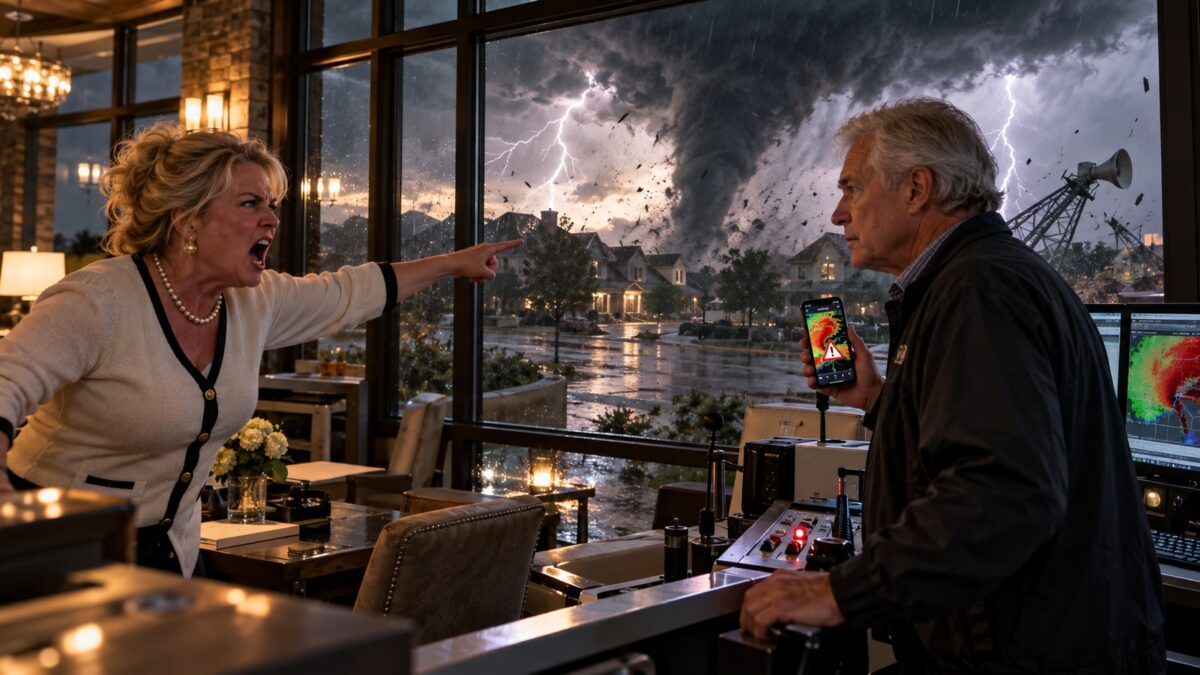
Dolores slammed her palm on the table.
“TURN OFF THAT DAMN SIREN!”
Everyone froze.
Wind hit the building.
Hard.
I said:
“There is an active tornado warning.”
“I don’t care!”
Her voice cracked.
“That siren is illegal noise pollution and we are voting to ban it right now!”
Pete stood.
“Dolores, are you insane?”
“Sit down!”
“There’s rotation seven miles away!”
“This meeting will proceed!”
I looked toward Torres.
Her face had gone completely still.
Agent face.
Recording.
Dolores continued.
“All in favor of immediate removal?”
Twelve hands.
Thunder.
Lightning.
Windows vibrating.
“Twelve in favor. Motion passes.”
A woman shouted:
“We need shelter!”
Dolores ignored her.
“Mr. Blackwood, you have until tomorrow to remove the device or the association will proceed with foreclosure remedies.”
Then the lights flickered.
Once.
Twice.
Dark.
Emergency lights came on.
Red glow.
Rain exploded against the windows.
My phone buzzed.
One message.
Unknown number.
EQUIPMENT DESTROYED. PROBLEM SOLVED. — B
My stomach turned cold.
Brad.
Or someone using his phone.
Either way, they had done it.
During the meeting.
During a tornado warning.
My main siren stopped.
Silence outside.
Except wind.
Neighbors noticed.
Pete looked at me.
“Marcus?”
I stood.
“Everybody stay calm.”
Dolores smiled.
Actually smiled.
For half a second.
Then I pulled a small backup recorder from my pocket.
Not the federal wire.
Mine.
Pressed play.
Her voice filled the clubhouse.
“I don’t care about weather warnings. That siren is illegal noise pollution.”
Gasps.
Mrs. Patterson looked at Dolores.
“You just shut off tornado warnings during a tornado.”
Pete said:
“You voted to silence a safety system while it was warning us.”
Dolores turned toward me.
“You recorded me illegally.”
“No.”
North Carolina rules did not apply here, and Oklahoma recording law was not the point anyway.
Before she could continue, Torres stood.
“Federal agent.”
The room changed instantly.
Another agent near the rear stood.
Then another.
Torres produced credentials.
“Everyone remain calm.”
Dolores stepped backward.
“What is this?”
“Dolores Whitman, you are being detained in connection with an ongoing federal investigation.”
Her face lost color.
“What?”
Torres continued.
“Conspiracy, wire fraud, and racketeering-related offenses are among the matters under investigation.”
Dolores looked at me.
“You did this.”
“No.”
A crash outside cut through the room.
Window flexed.
Someone screamed.
Then a man near the west windows shouted:
“Funnel!”
Everyone turned.
Lightning flashed.
There it was.
Dark wedge beneath the storm.
Moving toward Willow Brook.
All legal drama disappeared.
Because weather does that.
Torres shouted:
“Shelter! Interior rooms now!”
I grabbed the emergency radio.
My main tower was dead.
But Dolores did not know I had installed two independent battery-powered backup units after the sabotage.
They activated automatically.
Smaller.
Less range.
Enough.
“Tornado warning. Seek shelter immediately.”
Across Willow Brook, families who had listened were already sheltered.
Hendersons underground.
Pete’s wife in their safe room.
Mrs. Patterson’s shelter active.
Mobile emergency units covered the remaining blocks.
Inside the clubhouse, we moved people into interior storage and restrooms.
Dolores was still detained but no longer anyone’s priority.
Brad arrived in the parking lot.
Wrong time.
Sooner Storm Solutions truck.
He probably thought his crew had completed the job.
Instead, federal agents met him in driving rain.
I saw through the glass for one second.
Brad stepping out.
Torres’s team surrounding him.
Then the tornado hit Dolores’s street.
Roof material flew.
Power lines snapped.
Her white Escalade lifted.
Not gently.
It disappeared behind debris.
Later we learned it landed several houses away.
Her house took a direct hit.
Roof peeled.
Upper floor heavily damaged.
Brad’s restoration empire could not stop wind.
Neither could HOA rules.
The tornado moved on.
Fast.
As they do.
And then came the strange quiet afterward.
Rain.
Sirens.
Alarms.
People calling names.
Checking neighbors.
Emergency vehicles.
I took the ham radio.
“This is Marcus Blackwood on neighborhood emergency frequency.”
Static.
“Tornado has passed the immediate Willow Brook sector. Confirm shelter status by block.”
One by one:
Safe.
Safe.
Safe.
Henderson family safe.
Martinez family safe.
Patterson safe.
Minor injuries elsewhere.
No deaths.
No serious casualty among families reached by the backup warnings.
I sat on the clubhouse floor for several seconds.
Then Sarah called.
I answered on the first ring.
“Marcus?”
“I’m okay.”
“You sure?”
“Yes.”
“The house?”
“I don’t know.”
“You?”
“I’m okay.”
She started crying.
So did I.
Behind me, Dolores sat in handcuffs.
Her hair wet.
Blazer stained.
For the first time since I met her, she looked small.
She whispered:
“My house.”
I looked at her.
I did not smile.
That surprised me.
I had imagined a moment like this enough times to know revenge fantasies are cleaner than real disasters.
“Everyone got out?”
Torres said:
“Your family was not inside.”
Dolores closed her eyes.
Thank God.
That was all that mattered.
The house could be rebuilt.
A person could not.
Six months later, Willow Brook looked different.
Roof crews.
New fences.
Replanted trees.
Fresh siding.
My rebuilt siren tower stood forty feet high again.
This time with more redundancy than any residential warning system in the county.
Independent batteries.
Buried power feeds.
Tamper detection.
Remote backup.
Three nearby subdivisions eventually linked into the network.
The federal case was much larger.
Kevin’s documents opened everything.
Bank records.
Insurance payments.
Coordination fees.
Restoration contracts.
HOA board payments.
Adjusters.
Contractors.
Seventeen communities.
Brad and Dolores were only part of it.
The network collapsed once people started talking.
Dolores ultimately received eight years on federal conspiracy, racketeering-related and wire-fraud charges.
Brad received six years plus restitution obligations exceeding four million dollars.
Other HOA officials.
Insurance adjusters.
Contractors.
One after another.
The people who had treated storms like revenue events finally had to explain the money in court.
Federal asset forfeiture seized criminal proceeds.
Vehicles.
Accounts.
Business assets.
Funds flowed into victim compensation.
Families from Riverside and other communities received restitution.
Not enough to give them back lost heirlooms.
Not enough to erase nights in hotels.
But recognition mattered.
Accountability mattered.
The state responded too.
Lawmakers passed expanded protections for emergency preparedness equipment.
Weather monitoring.
Warning systems.
Life-safety infrastructure approved by emergency management.
People started calling it Marcus’s Law.
I hated that name.
Still do.
Sarah loved it.
Of course.
“You’re a law now.”
“I’m not a law.”
“You’re at least a subsection.”
“Stop.”
She laughed.
Property values in Willow Brook increased after the new safety network went in.
Twelve percent according to the local report the following year.
I printed that page.
Framed it.
Sent a copy to Pete.
He wrote:
PROPERTY VALUES SURVIVED THE SIREN. MIRACLE.
Sarah stayed cancer-free.
That is the ending I care about.
More than Dolores.
More than Brad.
More than the FBI.
Sarah’s scans remained clean.
She started a support group for families dealing with serious illness while also facing housing or HOA conflicts.
Her explanation was simple.
“Medical vulnerability attracts the wrong kind of people sometimes.”
Then:
“But it also teaches you who matters.”
The Henderson twins started calling the tower:
“The voice that keeps us safe.”
Pete became our unofficial storm-spotter coordinator.
Mrs. Patterson brought cookies to new residents and made them sit through a fifteen-minute tornado-preparedness lecture before she let them escape.
My whistleblower portion and part of the recovered funds helped establish a severe-weather safety scholarship through Oklahoma State’s meteorology program.
Three students each year.
Atmospheric science.
Early warning.
Underserved communities.
During summers, recipients helped install weather-monitoring equipment at rural schools, community centers and mobile-home parks.
Places where eight extra minutes matter most.
That made sense to me.
Take something ugly.
Turn it into warning time.
Willow Brook eventually started an annual severe-weather preparedness festival.
At first, I hated the idea.
“Festival?”
“People come to festivals,” Sarah said.
“They should come to training.”
“They won’t.”
“They should.”
“They won’t.”
She was right.
Again.
So we had storm spotter training beside food trucks.
Emergency-management booths beside games for children.
Safe-room demonstrations.
Weather-radio programming stations.
Kids learned what a tornado watch meant.
Parents exchanged contact information.
Nobody used the phrase property values.
Not once.
That was progress.
The first year, Pete stood beneath the rebuilt siren tower and said:
“Never thought I’d feel sentimental about that ugly thing.”
“It is not ugly.”
“It’s hideous.”
“It’s functional.”
“So is a fire hydrant.”
“Exactly.”
He nodded.
“Hideous.”
Some arguments cannot be won.
One afternoon, I received a call from Colorado.
Homeowner.
HOA fighting wildfire evacuation equipment.
He had heard about Willow Brook.
“Can you help?”
I looked at Sarah.
She smiled.
“Another Dolores?”
“Apparently.”
I took the call.
Not because I wanted another fight.
Because knowledge should travel.
That is the part Dolores never understood.
Every attempt to isolate us created more connections.
The Hendersons.
Pete.
Mrs. Patterson.
Janet.
Kevin.
Patricia.
Torres.
Storm victims.
One person’s evidence linked to another person’s story.
Eventually, the thing that looked like a neighborhood dispute became visible for what it was.
A system.
And systems are hardest to abuse once everybody can see them.
People sometimes ask what I thought when Dolores’s house was hit.
They want a satisfying answer.
They want me to say:
Justice.
Or:
Karma.
I do not.
Tornadoes are not judges.
They do not know who deserves what.
I spent thirty years teaching that.
The funnel did not hit Dolores because she was corrupt.
It hit because moisture, instability, wind shear, pressure, terrain and chance placed rotating air over her street.
That is all.
The lesson was not:
Mother Nature punished her.
The lesson was:
Mother Nature never cared about her argument in the first place.
The entire time Dolores fought my siren, she behaved as if the storm had to respect her priorities.
Aesthetics.
Real estate.
Money.
Control.
The atmosphere did not know her name.
That is why warnings matter.
We cannot control the storm.
We can control whether people know it is coming.
Dolores tried to take away that second part.
That was the unforgivable piece.
I still run the monthly test.
First Saturday.
Noon.
Ninety seconds.
Sarah usually stands in the garden.
The siren rolls across Willow Brook.
Dogs bark.
Children cover their ears.
Pete occasionally salutes because he enjoys embarrassing me.
Then silence.
I check the telemetry.
Battery.
Remote node.
Tower.
Pressure sensor.
Lightning detector.
Everything good.
Sometimes, during the test, I remember that first violation notice.
Thick cream paper.
Three days after installation.
An order to remove the equipment.
I kept it.
It is in a file drawer beside the federal case documents.
People laugh when I tell them.
“Why keep it?”
Because that piece of paper was the first sign somebody expected me not to check.
That was Dolores’s real mistake.
She assumed official-looking paper would be enough.
Then she assumed attorney letterhead would be enough.
Then police complaints.
Then sabotage.
Then fear.
Each step failed for the same reason.
Records.
Evidence.
Witnesses.
And people who refused to be isolated.
Kevin Walsh eventually left insurance entirely.
He had a difficult few years.
Being a whistleblower sounds noble after the fact.
Living through it is different.
He lost friends.
Career.
Income.
He carried guilt for the claims he had approved before speaking.
I saw him at the second preparedness festival.
His daughter was with him.
Ten years old by then.
She was building a model tornado out of plastic bottles at the science booth.
Kevin watched.
I stood beside him.
“You doing okay?”
He shrugged.
“Better.”
“That’s not an answer.”
“It’s the one I’ve got.”
Fair.
His daughter held up the bottle.
“Dad! Look!”
He smiled.
Real smile.
I thought about the sentence he had told me on the phone.
I realized I was part of the machine that hurt kids.
Now his daughter was learning how warnings worked.
Maybe redemption is not erasing what happened.
Maybe it is choosing what you build afterward.
Agent Torres came once.
Not in uniform.
No official reason.
She brought her husband and their son to the festival.
I caught her near the weather-radio booth.
“You voluntarily came to an event about tornado sirens?”
She smiled.
“Occupational trauma.”
“Want a volunteer badge?”
“No.”
“Storm spotter certification?”
“Absolutely not.”
Sarah walked up.
“You arrested Dolores during a tornado.”
Torres said:
“I would prefer never to repeat that.”
“Marcus thinks it was dramatic.”
“I think it was horrifying.”
I agreed.
That was the honest version.
It had looked cinematic from the outside.
Inside the building, with fifty people suddenly realizing a tornado was close enough to throw debris past the windows, nobody cared about cinematic justice.
People wanted their children.
Their spouses.
Their houses.
Safety.
That memory keeps the story grounded for me.
I once asked Sarah what she remembered most from that night.
I expected:
The tornado.
The arrest.
My call.
She said:
“The fake oncology messenger.”
I went quiet.
“Why?”
“Because for ten seconds, I thought the cancer was back.”
She looked toward her garden.
“That was worse than the tornado.”
I understood.
Storm fear is honest.
You know what is threatening you.
Psychological cruelty is different.
It enters through the thing you already fear most.
I took her hand.
“I’m sorry.”
“You didn’t do it.”
“I know.”
She squeezed.
Then:
“But if you ever put another forty-foot tower in the yard without asking me first, I will.”
I laughed.
“Fair.”
The garden grew.
Honeysuckle along the fence.
Tomatoes.
Peppers.
Flowers I cannot name.
Sarah knows all of them.
She spends mornings outside now.
No hospital wristband.
No chemo schedule.
No Dolores.
Sometimes she sits beneath the siren shadow.
I tease her.
“Property values.”
She throws a gardening glove at me.
That is also an ending.
Ordinary irritation.
Ordinary marriage.
Ordinary summer.
After cancer and criminals and tornadoes, ordinary is luxury.
The scholarship became the thing I was proudest of.
One student came from a rural county where tornado warnings were weak indoors.
Her project involved low-cost battery warning receivers for mobile homes.
Another studied Spanish-language severe-weather communication.
Another worked on alert accessibility for people with hearing loss.
That one hit Sarah hard because chemotherapy had damaged some of her hearing.
She donated additional money anonymously.
I knew.
Did not tell her I knew.
Warnings only save people if people can receive them.
Obvious.
Often ignored.
The original siren was one tool.
The system we eventually built became larger.
Phones.
Radios.
Battery nodes.
Text networks.
Spotters.
Shelters.
Education.
Redundancy.
Exactly what Dolores’s scheme had tried to suppress.
Irony does not get cleaner than that.
Years later, a new family moved into Dolores’s rebuilt house.
Young couple.
Two kids.
They had no connection to her.
I worried they would feel awkward.
Instead, the husband walked over during their first week.
“Are you Marcus?”
“Depends who’s asking.”
He laughed.
“They said you’re the tornado guy.”
“I’ve been called worse.”
He pointed toward the tower.
“Can you show me how the warning network works?”
I spent forty-five minutes explaining.
His wife joined.
Kids too.
At the end, the older boy asked:
“Did a tornado really pick up a car?”
“Yes.”
“Cool.”
His mother said:
“Not cool.”
“Kind of cool.”
I said:
“From far away.”
He accepted that compromise.
That family did not deserve Dolores’s history attached to their address.
So we never treated the house like a monument to what happened.
It was a house again.
That mattered.
Dolores once told me:
“This is my neighborhood.”
She was wrong in two ways.
First:
No neighborhood belongs to one person.
Second:
A community is not created by authority.
It is created by responsibility.
Pete checking elderly neighbors.
The Hendersons sharing shelter space.
Mrs. Patterson explaining procedures.
Sarah helping families.
Kevin speaking after staying silent too long.
Torres doing her job.
Students installing warning systems in rural places.
That is community.
Not fines.
Not power suits.
Not meeting gavels.
Not control.
I still forecast storms.
Retirement did not cure me.
Sarah knows when a big system is coming because I stop pretending to listen during dinner.
“You’re looking at radar in your head.”
“I am not.”
“You are.”
“I’m listening.”
“What did I just say?”
I pause.
She points.
“Radar.”
Then I open the laptop.
Old habits.
When the ingredients line up, I walk outside.
Feel wind.
Smell rain.
Watch clouds.
Thirty years taught me instrumentation matters.
It also taught me humans remain animals under all the technology.
You can feel a bad sky.
Not predict it perfectly.
Feel it.
On those nights, the rebuilt siren tower stands above the trees.
Battery green.
Network connected.
Ready.
That is enough.
The strangest thing about the entire story is how small it began.
One violation notice.
That was it.
No FBI.
No tornado.
No fraud network.
Just:
Your structure is ugly. Remove it.
Most disasters begin smaller than the story told afterward.
The important moment is often the one nobody recognizes.
When Sarah told me:
“Keep everything.”
When Mike Reynolds said the siren was exempt.
When Patricia found the covenant clause.
When Kevin decided he could not stay silent.
When Torres looked at the money.
When neighbors listened to the warning instead of Dolores.
None felt historic in the moment.
They were simply the next right thing.
That is how accountability usually works.
Not one heroic act.
A sequence of people refusing to look away.
Every spring before tornado season, Willow Brook holds a preparedness meeting.
No drama.
No FBI.
No arguing about aesthetics.
We review shelters.
Radios.
Mobility needs.
Medical lists.
Backup power.
Which families have basements.
Which elderly residents need help.
Where pets go.
Who checks on whom.
I always end the same way.
“Warnings are not predictions of tragedy.”
People look at me.
“They are invitations to make one good decision early.”
That is all a siren is.
A chance.
A few minutes.
A sound telling you:
Move now.
Dolores heard that sound and thought about property values.
The rest of us learned to hear something else.
Time.
The tower still runs its monthly test.
Sarah’s garden still grows beneath it.
The Henderson twins are older now.
Pete is somehow louder.
Mrs. Patterson still bakes too many cookies.
The scholarship keeps sending students into meteorology.
Willow Brook’s property values survived.
So did the neighborhood.
So did Sarah.
That last one is the only statistic I need.
Sometimes at dusk, thunder starts far west.
I sit on the porch with coffee.
Sarah beside me.
Wind moves through honeysuckle.
The siren control panel glows inside my office.
Ready.
I think about Dolores screaming:
“TURN OFF THAT DAMN SIREN!”
And I think about how completely she misunderstood what the sound meant.
It was never noise.
It was time.
Time to wake your children.
Time to move downstairs.
Time to grab your medication.
Time to close the garage.
Time to call the neighbor who lives alone.
Time to survive.
You can rebuild a house.
You can replace an Escalade.
You can repay stolen money.
You can even rewrite bad laws.
You cannot give a dead family back the twelve minutes you stole from them.
That was why I installed the siren.
That was why I refused to remove it.
And after everything Dolores and Brad tried to do, the warning system they wanted silenced now protects more families than I ever imagined when Sarah first stood in our driveway, looked up at that forty-foot tower and whispered:
“Now I feel safe.”
She was the reason.
She still is.
And every time that siren sounds, Willow Brook listens.


