PART2:HOA Queen Locked My Water at 5:12 A.M. Over a Gravel Strip—Then the State Asked to See Her Pump Station Records
PART2
The first dispute had been almost embarrassingly small.
A gravel strip.
That was it.
We had a drainage problem along the side yard.
During heavy rain, runoff collected beside the house and carved a shallow trench through the soil near the foundation.
Nothing dramatic.
No flooding.
No structural damage.
But year after year, water found the same path.
I did not want erosion becoming a bigger issue.
So I removed loose soil, compacted the base, and laid a narrow strip of clean gravel where the water already ran.
No wall.
No retaining structure.
No concrete.
No expansion of the driveway.
Just a controlled drainage surface designed to keep rain from chewing away at the same piece of ground.
I took photographs before and after.
Of course I did.
That was how I handled projects.
A week later, Marlene photographed the gravel from the sidewalk.
I did not know she had done it until the email arrived.
Subject:
NOTICE OF UNAPPROVED HARDSCAPE ALTERATION
I read it twice.
Then walked outside.
Looked at the gravel.
Looked back at the email.
They called it an alteration requiring architectural approval.
I answered politely.
Explained the purpose.
Asked which section of the governing documents applied.
No direct answer.
Instead, Marlene wrote that all visible exterior improvements were subject to review.
Two days later, my brother brought over a small work trailer.
We were replacing a water heater.
The permit had already been pulled.
New unit inside.
Old one waiting to be hauled away.
The trailer sat in the driveway for less than a day.
Marlene tagged that too.
COMMERCIAL VEHICLE STORAGE
I stared at the notice.
Then called my brother.
“Did you accidentally open a construction company in my driveway?”
He laughed.
“What?”
“Apparently your trailer is commercial storage.”
“It has a ladder and an old water heater in it.”
“I know.”
“How long was it there?”
“Six hours.”
“That HOA lady again?”
“Yes.”
He said something I will not repeat.
I did not say it to Marlene.
Instead, I answered in writing.
The trailer was temporary.
It was being used in connection with a permitted residential repair.
No commercial business was being operated from the home.
Again, she avoided the narrow question.
Her emails had a particular style.
Corporate language.
Smooth phrases.
Opportunity to cure.
Board directive.
Community standards.
Continued non-compliance.
The words did not directly accuse you of anything dramatic.
They made disagreement itself sound suspicious.
If you asked for evidence, you were being difficult.
If you challenged the interpretation, you were failing to cooperate.
If you did not immediately remove whatever she disliked, the failure became a pattern.
So I stopped arguing casually.
I sent a formal hearing request.
Certified mail.
Quoted the section of the CC&Rs requiring notice and an opportunity to be heard before escalating penalties.
I asked for a date.
The green return card came back signed.
I filed it in the binder.
Then waited.
No hearing.
Instead, fines appeared on my account.
Twenty-five dollars.
Another.
Then fifty.
Then a formal letter.
It said habitual non-compliance could result in suspension of “association-provided amenities and utilities.”
That phrase stopped me.
Amenities and utilities.
Pool access?
Clubhouse privileges?
Maybe.
Water?
I went back through the documents.
The HOA maintained our private system, yes.
But I could not find anything granting the compliance committee authority to use drinking water as a disciplinary tool.
I wrote again.
Asked for the policy.
No answer.
Asked for the board vote.
No answer.
Asked for the hearing.
No hearing.
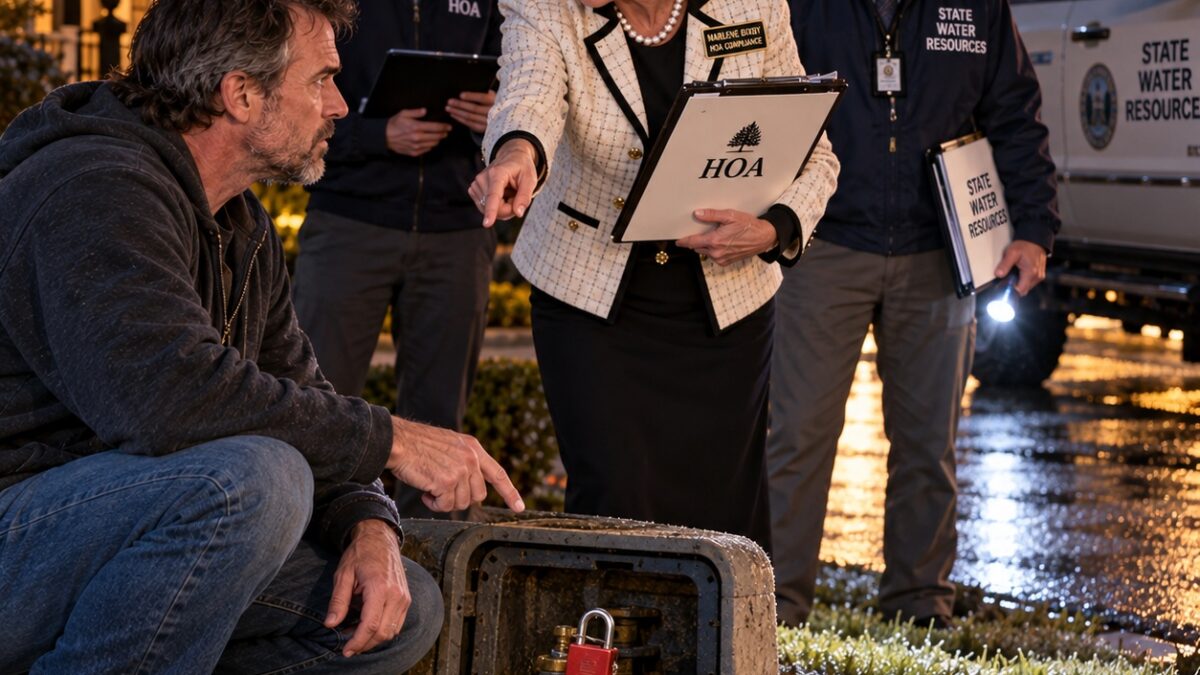
Then, before sunrise one Tuesday, someone turned a wrench at my curb and locked my water off.
At 5:12 that morning, the issue stopped being gravel.
By 7:00, I had stopped pacing.
That was when useful work began.
I spread documents across the kitchen table.
CC&Rs.
Amendments.
Utility addendum.
Notices.
Canceled checks.
Water bills.
Meeting minutes.
Certified receipts.
The house kept reminding me what the board had done.
The dishwasher clicked.
Stopped.
Tried to draw water again.
Nothing.
The refrigerator ice maker cycled with a faint mechanical buzz.
The toilet tank in the hall bath sat empty.
I filled a pot from two gallon jugs I kept in the garage for emergencies and put it on the counter.
There is something unsettling about rationing water inside a house where the plumbing works perfectly.
Nothing had failed.
A person had decided the pipes should stay empty.
I opened the CC&Rs.
Enforcement section.
Letters.
Fines.
Hearings.
Liens.
Remedies.
I read each subsection carefully.
Nothing about shutting off residential water for architectural violations.
I read again.
Still nothing.
Utility addendum.
The association maintained the private system.
Residents paid charges.
The association had access rights for repairs and maintenance.
Emergency provisions.
Billing responsibilities.
No general power allowing the compliance chair to lock a customer out of water because she disliked gravel.
I searched state statutes.
HOA authority.
Assessments.
Collections.
Notice.
Due process.
Then utility regulations.
Public-health standards.
Small water systems.
Operator certification.
Pressure.
Cross-connection control.
Backflow prevention.
Treatment.
Reporting.
Emergency service.
The more I read, the clearer the distinction became.
The HOA could manage a water system.
But once it did, the system was not merely another amenity.
Water carried regulatory obligations.
A pool card could be turned off.
A clubhouse reservation could be canceled.
Pressurized household water was tied to health codes.
Sanitation.
Fire protection.
Minimum service.
If the association wanted to behave like a utility when punishing me, then maybe it should answer utility-grade questions.
I drafted one letter.
Six pages at first.
Deleted half.
Emotion does not improve a demand letter.
Final version was clean.
Four numbered demands.
1. Identify the written authority permitting suspension of residential water service for covenant or architectural enforcement.
2. Produce the board minutes or recorded vote authorizing this shutoff.
3. Schedule the hearing requested under the governing documents.
4. Restore service immediately while the dispute remains unresolved.
Then I asked for additional records.
Operating procedures.
Billing rules.
Shutoff procedures.
Appeal process.
Emergency contact information.
Operator records.
Maintenance documentation available to customers.
Certified mail.
Return receipt.
Email copy to the property manager.
Then I waited.
Marlene answered.
Six words.
Service restored when compliance is achieved.
That was the entire email.
No citation.
No policy.
No vote.
No signature.
No explanation.
I printed it.
Filed it.
Then I went outside with a pressure gauge.
If somebody wanted to turn my water system into an enforcement tool, I wanted the physical condition documented.
The gauge was simple.
Brass fitting.
Round dial.
I screwed it onto the exterior spigot.
Opened the valve.
Zero.
The needle did not move.
I recorded video.
Close shot of the gauge.
Then wide shot showing the exterior wall.
Time.
Temperature.
Date.
I wrote everything down.
5:12 — no water.
5:23 — HOA padlock observed.
5:26 — Marlene Bixby present.
5:29 — unsigned notice provided.
6:58 — pressure verified at zero psi.
7:14 — certified demand drafted.
I made a timeline.
Not because I expected some courtroom drama.
Because memory gets argued with.
Paper is harder.
Later that morning, I spoke with a neighbor while he brought trash bins in.
“Your water okay?”
He shrugged.
“Low last night.”
“How low?”
“Shower got weak.”
“Does that happen often?”
“Sometimes.”
Another neighbor said his sprinklers occasionally sputtered after maintenance work at the pump station.
I asked both the same question.
“Have you ever seen the annual water-quality report?”
They both looked at me.
One laughed.
“What annual report?”
Exactly.
That night, the kitchen table looked like an investigation board.
Plat map.
Utility easement.
Marlene’s notice.
CC&Rs.
The six-word email.
My water bills.
I sat there long after the kids had gone to bed.
I could hear nothing in the pipes.
The silence made the issue feel larger.
At first, I had believed I was defending myself from an overreaching compliance chair.
Now I was beginning to wonder whether Marlene’s mistake had opened a door into something the board itself did not understand.
The next morning, I put the plat map on the passenger seat and drove toward work.
I made it halfway.
Then pulled into a parking lot.
Opened my laptop.
Started searching public records.
County property data first.
Pump station parcel belonged to the association.
No surprise.
Recorded utility easements matched what I already had.
Then municipal permit records.
That was where things became interesting.
I remembered seeing HOA meeting references to upgrades.
A variable-frequency-drive installation.
Chemical-feed adjustment.
Storage-tank work.
Electrical modifications.
I searched addresses.
Parcel numbers.
Project descriptions.
The permit portal showed less than I expected.
That did not prove wrongdoing.
Public databases are imperfect.
Projects get filed under contractor names.
Addresses are entered differently.
Some work may not require the permit I thought it did.
So I made notes instead of conclusions.
Then I opened the state drinking-water database.
That changed everything.
Our neighborhood system was listed as a small public water system.
Not merely a private association pump.
The classification meant health oversight.
Operator certification.
Testing.
Reporting.
Inspection.
I clicked into the operator record.
The name meant nothing to me.
Then I saw the status.
Inactive.
Nearly three years.
I leaned closer to the screen.
Checked the date again.
Maybe the database had not updated.
Maybe another operator had replaced that one.
I searched.
Nothing current.
Last sanitary survey.
Older than expected.
Renewal line.
Pending.
I opened old HOA minutes.
Invoices.
Maintenance notices.
Variable-frequency-drive upgrade.
Chemical-feed adjustment.
Tank work.
I searched the permit portal again.
Still could not find matching approvals.
Now the board on my table had two sides.
On one side:
Gravel strip.
Trailer.
Ignored hearing.
Fines.
Water threat.
Padlock.
On the other:
Inactive operator.
Overdue survey.
Missing backflow documentation.
Equipment changes without an obvious permit trail.
I wrote one phrase across the top of the page.
Paper authority versus real authority.
Then I did something Marlene probably did not expect.
Nothing.
I did not send her the screenshots.
Did not post in the neighborhood group.
Did not call the board president.
I wanted the records checked by someone whose job was actually water compliance.
So I called the county health department’s drinking-water desk.
A woman answered.
I introduced myself as a customer of a privately operated neighborhood system.
“My residential water was shut off at the curb yesterday.”
“Repair?”
“No.”
“Nonpayment?”
“No.”
Pause.
“Why?”
“HOA covenant enforcement.”
Another pause.
Longer.
I kept going.
“I’m trying to confirm the lawful shutoff procedure, the current certified operator, backflow testing, and minimum service pressure.”
“All right.”
“I measured zero psi at my residence after the service valve was locked.”
“Zero?”
“Yes.”
“System-wide?”
“No. My service only.”
“Who locked it?”
“The association.”
“For a utility issue?”
“For a gravel-strip dispute.”
Silence.
Then her voice changed.
Professional.
Focused.
“Give me the system name.”
I did.
Address.
Customer information.
Date.
She asked whether I had documentation.
“Yes.”
“What kind?”
“Photographs of the lock and tag, the HOA notice, the email stating service stays off until compliance, state database records, and a video pressure reading.”
“Send everything.”
I did.
She reviewed it while we were still on the phone.
Then asked:
“Do you know when the last backflow assemblies were tested?”
“No.”
“Do you receive water-quality reporting?”
“Not that I can recall.”
“Emergency contact information?”
“Nothing posted that I’ve seen.”
She offered an inspection for the following week.
I said:
“Sooner is fine.”
Two days later, a city utilities truck rolled into the neighborhood.
Plain truck.
Official logo.
No dramatic lights.
The inspector who stepped out looked like someone who actually worked around machinery.
Hard hat scratched.
Work boots dirty.
Tablet.
He met me near the chain-link fence surrounding the pump station.
Marlene arrived before he even asked for access.
She was back in professional mode.
Blazer.
Folder.
Smile.
“I’m sure this is just a resident misunderstanding.”
The inspector looked at her.
“I need the operating permit.”
She opened her folder.
“Of course.”
“Current operator-of-record certification.”
Pages turned.
“Backflow test reports.”
More pages.
“Treatment documentation.”
“Certainly.”
“Maintenance records.”
The property manager appeared.
He looked tired.
“Emergency shutdown procedure.”
No one answered.
The inspector waited.
That silence was different from an HOA meeting.
He was not embarrassed by it.
Did not fill it.
Did not reassure anyone.
He simply waited for the required record.
Eventually the gate opened.
We went inside.
The air smelled damp.
Metal.
A faint chemical edge.
The main pump cycled with a low vibration that traveled through the slab.
Electrical panels lined one wall.
Some labels were typed.
Others handwritten.
Chemical jugs sat directly on the concrete floor.
The inspector stopped.
“Secondary containment?”
Marlene looked toward the manager.
The manager looked toward the inspector.
No answer.
He made a note.
“Current operator contact posting?”
Nothing.
“Emergency contact sheet?”
No.
“Cross-connection-control binder?”
The manager opened a cabinet.
Found old manuals.
Invoices.
No organized binder.
“Last backflow assembly test?”
Marlene gave a month.
Then another.
Then said:
“My understanding is management handled that.”
The manager cleared his throat.
“The operator normally did.”
The inspector looked at his tablet.
“The operator listed with the state is inactive.”
Neither of them answered.
That moment mattered to me.
For months, Marlene had demanded precision from homeowners.
Dates.
Cure deadlines.
Rule numbers.
Compliance.
Now the person with actual regulatory authority was asking her for the same thing.
And she answered with:
“I believe.”
“My understanding.”
“That should be.”
The inspector walked to the variable-frequency-drive panel.
“Who installed this?”
The manager searched his tablet.
“Contractor.”
“Name?”
He found one.
“Permit?”
No immediate answer.
“Final inspection?”
Silence.
The inspector moved toward the chemical-feed equipment.
“Modification date?”
Marlene stepped in.
“I think we are moving beyond the scope of one resident’s complaint.”
The inspector looked at her.
“What do you think the scope is?”
“This began as an HOA compliance matter.”
“No.”
He said it without anger.
“This is an operating water system.”
That sentence changed the entire atmosphere.
He stepped outside.
Made a short phone call.
Came back.
Then attached a bright compliance notice to the main panel.
“This facility is out of compliance.”
Marlene’s smile disappeared completely.
He listed the issues.
Operator status.
Inspection documentation.
Backflow reporting.
Treatment records.
Equipment modifications requiring verification.
Emergency procedures.
“Corrective action is required.”
The property manager nodded.
Marlene did not.
“Service restrictions may apply until documentation and operating conditions meet requirements.”
She crossed her arms.
“That feels like overreach.”
The inspector looked directly at her.
“This isn’t HOA.”
Pause.
“This is code.”
I wanted to smile.
I did not.
Because the moment was bigger than being right.
Every home in the subdivision depended on that pump station.
If the records were incomplete, the problem belonged to all of us.
The emergency meeting notice arrived that afternoon.
Same template used for pool closures.
Same association logo.
Different subject.
WATER SYSTEM COMPLIANCE
By 7:00 p.m., the clubhouse was full.
Standing room only.
I had lived there eight years and had never seen that many residents attend anything.
People ignored landscaping meetings.
They skipped annual elections.
They sent proxies.
Water was different.
People with children were there.
Retirees.
Men who had never spoken at an HOA meeting.
Women holding folders.
People who could not have named the board members a week earlier.
Marlene sat at the front.
The property manager beside her.
The board president opened the meeting.
Marlene took over quickly.
She called the inspection a “review arising from an individual service dispute.”
I almost admired the phrasing.
She was trying to shrink the issue.
One difficult resident.
One misunderstanding.
One inspection.
Nothing to see.
Then a neighbor in the second row raised his hand.
“Can we see the city notice?”
Marlene paused.
“We are still evaluating it.”
“Read it.”
“We do not want to create unnecessary alarm.”
“Read it.”
Someone behind him said:
“Yeah.”
Another:
“Let us hear it.”
The manager cleared his throat.
Marlene looked at him.
For once, he did not look away.
He unfolded the notice.
Read.
Inactive certified operator.
Overdue compliance items.
Missing backflow documentation.
Unverified equipment modifications.
Potential enforcement.
The room changed line by line.
A man near the back spoke.
“So you shut off his water to punish him while our whole system was out of compliance?”
Marlene opened her mouth.
Nothing came out.
Another resident raised a hand.
“Who has been operating the pumps?”
The manager answered:
“A maintenance contractor.”
“Licensed?”
“We’re verifying.”
Someone else:
“Who checks the chemicals?”
Another:
“Where are the quality reports?”
Another:
“What about fire pressure?”
Another:
“Who authorized the equipment upgrade?”
The board president tried to slow things down.
People were not screaming.
That made the questions more difficult to dismiss.
They wanted answers.
Marlene had spent months turning ordinary homeowner questions into “non-compliance.”
Now thirty people were asking questions at once.
Then somebody said:
“What about the actual shutoff?”
The room turned toward me.
I had been sitting halfway back.
Binder on my lap.
I stood.
No speech.
No attack.
I held up the timeline.
Photos.
Certified receipts.
Emails.
That was all I needed.
“Restore the service immediately.”
Quiet.
“Rescind the fines connected to a dispute where the hearing I requested never occurred.”
Marlene stared at me.
“Put in writing that water cannot be used as punishment for ordinary covenant enforcement.”
A woman near the wall said:
“Absolutely.”
I continued.
“Then hire an independent certified operator and bring the system records current.”
Those were my demands.
No resignation.
No lawsuit.
No apology.
Water.
Process.
Operator.
Documentation.
The discussion lasted more than an hour.
Eventually, someone made a motion removing Marlene from utility oversight.
Nothing dramatic.
No speech about abuse of power.
Just a motion.
Hands went up.
Enough.
Passed.
Marlene sat still.
The clipboard remained on the table.
The board authorized service restoration immediately.
The next morning, the property manager met me at the curb.
9:03.
Same valve box.
Same brass handle.
Same white HOA tag.
He removed the padlock.
Unlocked the service.
I filmed everything.
Inside the house, pipes began filling.
I went to the exterior spigot.
Attached the pressure gauge.
Opened the valve.
The needle moved.
Ten.
Twenty.
Thirty.
Forty.
Fifty.
Then settled.
Fifty-eight psi.
I zoomed in.
Recorded the reading.
Inside, I opened the kitchen faucet.
Air.
Then a rush.
Cloudy water for a second from the line.
Then clear.
I let it run.
The sound was ordinary.
I had never appreciated ordinary water before.
The toilet tank filled.
Dishwasher drew water.
The refrigerator stopped trying to make ice from an empty line.
My house sounded normal again.
That should never feel like victory.
But it did.
The board did not stop with unlocking the valve.
That was important.
A written utility addendum followed.
Signed.
Recorded in the association’s policy file.
Residential water could not be suspended as punishment for covenant or architectural enforcement.
Hearings had to occur before disputed fines became final.
Actual nonpayment shutoffs required written notice.
Cure period.
Board vote.
Emergency and safety shutoffs were addressed separately.
No more six-word policy created by email.
A licensed operator was hired.
A sanitary survey was scheduled.
Backflow documentation began being rebuilt.
Emergency contact information went inside the pump station.
Chemical storage was corrected.
Maintenance logs were standardized.
Equipment changes were reviewed.
The whole place started looking less like a forgotten mechanical room and more like infrastructure serving drinking water.
The fines against me disappeared.
The gravel stayed.
My brother’s trailer had been gone for months.
Civilization survived.
Neighbors asked whether I planned to sue.
I did not.
Could I have explored damages?
Probably.
The shutdown had been reckless.
The hearing request had been ignored.
Water had been used as leverage.
But I knew what I wanted.
Lawful service.
Fair process.
A properly run system.
I did not want Marlene becoming the central character in my life.
The board fixed the rules.
The water stayed on.
That was enough.
I did one thing for everybody else.
I emailed my documentation template.
Not my whole binder.
Just the structure.
Date.
Time.
What happened.
Who was present.
Photo.
Original notice.
Your response.
Certified receipt.
Policy cited.
Final result.
Then one sentence:
Do not exaggerate.
That mattered most.
A record only helps if people can trust it.
If the HOA is right, document that too.
If you missed a payment, say it.
If a rule really applies, address it.
Documentation is not a weapon.
It is memory with structure.
For a while, the neighborhood became strangely interested in water.
People who had never asked where it came from suddenly wanted to tour the pump station.
The new operator politely declined casual tours.
Good.
Instead, he produced information.
Annual quality reports.
Emergency numbers.
Maintenance notices.
Pressure standards.
Testing dates.
The first report appeared in our inboxes a few months later.
Tables.
Mineral results.
Treatment information.
Boring.
Beautifully boring.
I read every page.
A neighbor laughed.
“You really read all that?”
“Yes.”
“Why?”
“Because people put interesting things in documents when they assume nobody reads them.”
He laughed.
I meant it.
The property manager changed too.
He stopped hiding behind the tablet.
One afternoon he called.
“We’re rewriting the utility manual.”
“Okay.”
“Would you review the customer shutoff section?”
I laughed.
“You want the guy whose water you locked to review it?”
“You found the gap.”
“That does not make me a utility lawyer.”
“No.”
He paused.
“But you know where the old policy failed.”
I agreed to read it.
Not draft it.
Important difference.
The new manual separated:
Emergency shutoff.
Scheduled maintenance.
Health hazard.
Nonpayment.
Covenant enforcement.
The last category said:
Utility service shall not be suspended for covenant-enforcement purposes.
One sentence.
That sentence could have saved months of conflict if it had existed earlier.
Then again, maybe the absence was exactly what Marlene liked.
She interpreted silence as discretion.
I interpreted silence as lack of authority.
The board finally wrote the answer.
Good.
Marlene stayed on the board for a while.
Just not over utilities.
That surprised some people.
They expected me to demand her removal.
I did not.
The motion had addressed the thing that mattered.
She had crossed a line by treating household water like a disciplinary tool.
The board removed that power.
That was enough.
I did not need to turn accountability into annihilation.
That distinction matters.
One morning, several weeks later, I saw Marlene near the mailboxes.
She said:
“Morning.”
I said:
“Morning.”
Nothing else.
No apology.
No lecture.
No closing speech.
I did not need one.
People often believe closure requires the other person to understand exactly why they were wrong.
Sometimes they never do.
The policy can still change.
The water can still flow.
Your life can move on without their moral awakening.
That became one of the most useful things I learned.
The new operator began testing pressure at multiple points.
One evening, a report showed lower pressure at the far end of the neighborhood during peak demand.
Not dangerous.
But lower than ideal.
Maintenance adjusted controls.
Pressure stabilized.
Another issue was caught in a backflow report.
Fixed.
These were normal system problems.
That was the point.
A professional operator found them.
Documented them.
Corrected them.
Nobody needed a compliance chair guessing.
Infrastructure works best when authority belongs to people qualified to operate infrastructure.
That should sound obvious.
Apparently, we needed a padlock at 5:12 in the morning to learn it.
The budget changed too.
Professional oversight cost money.
Inspections cost money.
Testing cost money.
Documentation cost money.
Deferred work cost money.
There was no magical ending where responsible operation appeared for free.
The treasurer held a workshop.
For once, people attended.
One homeowner complained:
“Why are we paying for an operator now when we didn’t before?”
The treasurer answered:
“Because we should have been paying for proper oversight before.”
No spin.
No blame.
Just truth.
I respected that.
I did not ask the board to waive my share.
Why would I?
I used the system.
My family benefited from a licensed operator.
That had never been the dispute.
The dispute was whether the HOA could take an unrelated landscaping disagreement and turn drinking water into leverage.
Legitimate cost?
Pay it.
Invented punishment?
Challenge it.
Both principles can exist at the same time.
That summer, rain hit hard.
The gravel strip worked exactly as intended.
Water drained.
No trench.
No erosion.
No damage to the foundation.
I stood there one afternoon watching runoff move across the stones.
I almost laughed.
That narrow strip had started everything.
Or so it seemed.
But really, the gravel had only exposed something already present.
Marlene believed visible non-compliance justified expanding enforcement until obedience happened.
The padlock was the logical endpoint of that belief.
My refusal did not create the problem.
It revealed how far she was willing to go.
My brother’s trailer returned months later when we had to replace a shutoff valve inside the house.
I emailed management.
Small work trailer present Saturday, 8:00–3:00 for permitted plumbing repair. Temporary only.
Reply:
Received. No issue.
That was healthy governance.
No drama.
No defiance.
No secret photographs.
Information.
Clarity.
Done.
People often think neighborhood disputes offer only two choices.
Submit.
Or fight.
There is a third.
Process.
Read the rule.
Give notice.
Ask questions.
Preserve records.
Challenge unsupported authority.
Accept legitimate obligations.
That is less exciting than war.
It is also much more useful.
One day one of my kids asked:
“Why didn’t you just cut the lock?”
I stared.
“Because that would’ve been stupid.”
“You could’ve turned the water back on.”
“For five minutes.”
“Then?”
“Then the story changes.”
“How?”
“Instead of ‘HOA shut off a family’s water without showing authority,’ it becomes ‘angry homeowner tampered with utility equipment.’”
“Oh.”
“Never hand somebody a cleaner story about you than the story you have about them.”
That took a second to land.
Then:
“So taking pictures was better?”
“Yes.”
“Boring.”
“Exactly.”
Boring saved me.
The untouched padlock mattered.
The zero-pressure video mattered.
Marlene’s six-word email mattered.
The unanswered hearing request mattered.
The inactive operator status mattered.
None of those things required shouting.
The inspector could walk into the pump station and see a clean sequence.
Homeowner requests process.
No hearing.
Water shutoff.
No cited policy.
Zero pressure.
Operational records questionable.
That was stronger than a cut lock and an angry confrontation.
The old padlock photograph remained in my binder.
A small object.
Maybe worth fifteen dollars.
It looked insignificant.
Yet that tiny lock triggered:
A document review.
A regulatory inspection.
Discovery of an inactive operator.
Questions about overdue compliance.
Backflow documentation.
Equipment records.
An emergency meeting.
New policy.
Professional utility oversight.
A whole neighborhood learning where its water actually came from.
Small actions reveal large assumptions.
Marlene assumed the HOA owned the water relationship in the same way it owned pool rules.
But management authority brings responsibility.
That was what she missed.
If you control the pump station, then people can ask about the pump station.
Who operates it?
Who is certified?
What gets tested?
Where are the logs?
When was the last survey?
What happens during an emergency?
The board had enjoyed the authority.
The padlock forced everybody to examine the responsibility.
That was the real reversal.
Before the shutoff, Marlene was asking whether I had complied.
After the inspection, residents were asking whether the board had.
The system itself became the issue.
I thought about that often.
Had Marlene simply scheduled the hearing I requested, she might have won the gravel dispute.
Maybe not.
But the matter would have remained small.
A hearing.
A rule interpretation.
A fine.
Instead, she escalated.
Every escalation created more documentation.
Fines.
Utility threat.
Padlock.
Email.
Zero pressure.
Regulatory complaint.
The more aggressively she tried to force the issue closed, the wider she opened it.
That is a common mistake in authority.
People think escalation proves strength.
Sometimes escalation simply increases the number of people allowed to ask questions.
The inspector never seemed impressed by Marlene.
He also never seemed angry at her.
I liked that.
His interest began and ended with the system.
Records.
Operator.
Chemicals.
Backflow.
Pressure.
He did not need her to admit anything.
That was another lesson.
Professional authority does not require emotional victory.
He found a problem.
Documented it.
Required correction.
Moved on.
Marlene’s compliance style had been almost the opposite.
She needed acknowledgment.
Agreement.
Visible submission.
The gravel itself was harmless.
My refusal to accept her interpretation became the offense.
That is dangerous.
When enforcement becomes personal, rules stop being standards and become tools of relationship management.
Who is cooperative?
Who is difficult?
Who needs to be taught?
That was why the hearing requirement mattered.
Process removes some of the personality.
Notice.
Rule.
Response.
Decision.
Record.
If the board is right, the homeowner has to deal with it.
If the homeowner is right, the board has a mechanism to correct itself.
Skip the process and every disagreement becomes ego.
The new policy restored that structure.
Months later, another homeowner received a violation.
Different issue.
A storage structure.
The board actually held the hearing before imposing the final fine.
He lost.
The structure violated the rule.
He removed it.
Nobody shut off his water.
Nobody called him habitually non-compliant because he asked a question.
The world continued.
I heard about it later and thought:
Good.
A fair process does not mean homeowners always win.
It means they know why they lost.
That is enough.
The water-quality report became an annual ritual.
Most residents probably deleted it.
I did not.
I read.
Filed.
One year, a minor testing delay was noted.
Explanation included.
Corrective action documented.
Good.
Transparency does not mean perfection.
It means problems do not have to hide before they can be fixed.
The same was true of the budget.
Once people began attending, the board stopped treating utility costs as some mysterious line buried below landscaping.
We learned how much pumping cost.
Treatment.
Electricity.
Operator contract.
Testing.
Tank maintenance.
Suddenly the monthly water charge looked less arbitrary.
Knowledge has a strange effect.
Sometimes it makes people angrier.
Sometimes it makes them more reasonable.
Before, residents complained about costs they did not understand.
Afterward, they could at least see what the system required.
I began to appreciate boring spreadsheets.
Not enough to volunteer as treasurer.
I have limits.
Marlene gradually became less visible.
Not gone.
Just less central.
The board required utility decisions to go through proper channels.
She could no longer convert a compliance disagreement into a water decision.
That boundary did more than any apology could have.
Because apologies depend on personality.
Policy survives personality.
If Marlene resigned tomorrow, fine.
If she stayed, fine.
The water rules no longer depended on whether she liked a homeowner.
That was the win.
There were moments I wondered whether I had been too calm.
People told me:
“You should’ve gone after them harder.”
“You could’ve sued.”
“You should’ve forced her off the board.”
Maybe.
But every legal fight costs attention.
Time.
Money.
Energy.
I had already spent enough.
When the result you actually want exists, it is worth asking whether additional punishment improves anything.
My water stayed on.
The fines disappeared.
The process changed.
The system became safer.
Neighbors had better information.
I had no need to turn victory into a hobby.
That can happen.
People fight so long that eventually the fight becomes part of identity.
Then the other side cannot stop being important.
I did not want Marlene living in my head longer than necessary.
The first sign that she had stopped was simple.
I turned on the kitchen faucet one morning and did not listen.
For weeks after the shutoff, I noticed the sound every time.
Pressure.
Flow.
Any cough in the pipes made me look up.
I checked the gauge more than necessary.
I watched HOA vehicles.
Then, one morning, water ran and I did not think about it at all.
Only later did I realize.
That felt like peace.
Not dramatic.
No applause.
Forgetting to be afraid of something ordinary.
The pressure gauge stayed in the garage.
A few months later, I checked again.
Fifty-eight psi.
Same as restoration day.
I smiled.
Then thought:
You are turning into the kind of person who checks water pressure recreationally.
Put the tool away.
I did.
The pump station improved.
Current contact sheet.
Better labels.
Containment.
Records.
Operator information.
Nothing glamorous.
If you drove past, you would never know a neighborhood revolt had happened over it.
That was ideal.
Infrastructure should not be famous.
It should work.
There was one afternoon when the new operator shut water down for scheduled maintenance.
This time, forty-eight hours before:
Email.
Door notice.
Reason.
Expected duration.
Emergency number.
Affected streets.
When the time came, the water went off.
I filled a pot beforehand.
No anger.
Why?
Because the process was legitimate.
Same physical result.
No water.
Completely different meaning.
Consent is not always about agreeing.
Sometimes it is about being given lawful notice, a real reason, and the ability to plan.
That outage felt like maintenance.
Marlene’s felt like coercion.
The pipes did not know the difference.
I did.
That distinction became important in every governance conversation afterward.
A board member once said:
“But technically both are shutoffs.”
I said:
“Technically, surgery and assault can both involve a knife.”
He stopped arguing.
Maybe dramatic.
Still accurate.
Context matters.
Authority matters.
Process matters.
I became known as the guy who kept documentation.
There are worse reputations.
A new neighbor once stopped me.
“I heard you got the HOA in trouble with the state.”
“No.”
He looked disappointed.
“What happened?”
“I asked the right agency to inspect a water system after the HOA shut off my service.”
“So they were in trouble.”
“The system had compliance issues.”
“Because of you?”
“No. The issues existed before I called.”
That distinction mattered.
I had not created the inactive operator status.
I had not created missing records.
I did not make the pump station non-compliant by asking questions.
Exposure is not causation.
People confuse those all the time.
If someone discovers a leak behind a wall, they did not cause the leak.
They noticed it.
Same here.
That is why I never accepted the idea that my complaint cost the neighborhood money.
Neglect cost money.
Professional correction cost money because correction had been delayed.
My call simply moved the bill from the future into the present.
Unpleasant.
Necessary.
The special-assessment discussions began quietly.
At first, they were just budget notes.
Operator costs.
Inspection fees.
Potential equipment correction.
Maintenance reserves.
I saw drafts.
Nothing final.
The board knew residents would be sensitive.
Some people blamed the new oversight.
Others understood the old budget had been artificially low because important work was not being done properly.
I stayed out of the arguments.
I had opinions.
Of course.
But the board needed to build a lawful budget.
That was their job.
My job was to read what they sent me.
That became almost a running joke.
One neighbor said:
“If Carter hasn’t read it yet, it isn’t official.”
I told him never to say that near the board.
The truth was simpler.
I no longer accepted summaries when the underlying document was available.
That habit had saved me.
Marlene’s entire position depended on summarized authority.
The board can do this.
The utility is ours.
Habitual non-compliance allows suspension.
Each sentence sounded plausible.
Then:
Show me where.
That was where the certainty dissolved.
I taught my kids the same lesson.
Not anti-authority.
Anti-vagueness.
If a teacher says something is due Friday, fine.
If someone says “you have to pay this fee,” ask what it is.
If a contract says “subject to policy,” read the policy.
If the policy does not say what someone claims, ask.
Good authority survives questions.
Bad authority gets offended.
That does not mean every offended person is wrong.
It means you keep reading.
I thought often about Marlene waiting in my driveway at 5:12.
Why had she been there?
She could have had the maintenance person lock the valve and send an email.
But she came.
That told me the shutoff was partly performative.
She wanted to witness the consequence.
Maybe she expected me to come outside angry.
Maybe she wanted the moment I surrendered.
“I’ll remove the gravel.”
“I’ll pay the fines.”
“Please turn the water back on.”
Instead, I asked:
Who authorized this?
What policy?
Those questions changed the scene.
She had a notice.
Not authority.
That tiny distinction became everything.
The property manager later admitted privately that he had been uncomfortable.
“Why didn’t you say anything?”
He looked embarrassed.
“I thought the board had already checked.”
There it was again.
Assumption.
Everyone assumes someone else checked.
The manager assumes the board checked the policy.
The board assumes management checked the utility rules.
Management assumes the operator handles compliance.
Residents assume the state is watching.
The state assumes required reports arrive.
Then three years pass with an inactive operator record.
Systems fail inside assumptions.
The fix is not distrust.
It is verification at the points that matter.
The board eventually created a compliance calendar.
Operator certification expiration.
Backflow testing dates.
Sanitary surveys.
Tank inspections.
Permit files.
Emergency contacts.
I saw the spreadsheet once.
Simple.
Color coded.
Boring.
Useful.
A calendar can prevent more trouble than a lawyer.
Nobody puts that on television.
The neighborhood calmed down.
People went back to arguing about normal things.
Holiday lights.
Parking.
Pool hours.
A tree that somebody believed was dropping too many leaves into the common area.
That last one produced a thirty-minute debate.
I sat through ten minutes and went home.
It felt wonderful.
If you have never lived through a governance crisis, you may not understand how beautiful a pointless argument can become.
Nobody’s drinking water was involved.
Argue away.
The binder stayed in my office.
I added the signed addendum.
The inspector notice.
The restoration video.
A printed still showing fifty-eight psi.
Not because I expected to use it.
Because records should close cleanly.
Problem.
Action.
Resolution.
Done.
One evening I reorganized the file.
The draft budget slipped out.
I almost ignored it.
Then one line caught my eye.
EMERGENCY SPECIAL ASSESSMENT
I stopped.
Read the number.
Then the notes beneath it.
Water-system corrective costs.
Operator contract.
Inspection.
Repairs.
Testing.
Compliance.
Not final.
Draft.
No vote yet.
I looked at it for a long moment.
Maybe every dollar was legitimate.
Maybe the assessment was necessary.
Maybe the board would follow proper procedure.
Maybe the cost allocation was fair.
Maybe they had learned.
I did not know.
And that was fine.
Not knowing is not the same as being threatened.
It simply means:
Read.
I pulled out the governing documents.
Turned to the assessment section.
Meeting notice.
Voting requirements.
Budget authority.
Emergency powers.
Not because I wanted another fight.
Because I had finally learned something that was more useful than fighting.
Understand the rule before somebody tells you what it means.
I made a new tab.
Black marker.
SPECIAL ASSESSMENT
Slid the draft behind it.
Closed the binder.
From the kitchen, I could hear the faucet running while one of the kids washed dishes.
Steady.
Normal.
The last time I had checked, the pressure gauge read fifty-eight psi.
Documented.
Dated.
Boring.
Exactly how water should be.
I sat there with my hand on the binder and started laughing quietly.
Not because I had found another scandal.
I had not.
Not because Marlene was about to lose another battle.
I did not even know whether she had anything to do with the draft.
I laughed because I recognized the feeling.
A piece of paper.
A claim.
A number.
And the temptation to assume somebody else had checked.
I was not going to make that mistake again.
Some boards learn once.
Some try again.


