PART2:HOA Queen Called My Family “Squatters” and Sent Security to Tow Our Trucks—Then the Judge Asked Her for One Recorded Document
PART2
Five years before Marlene showed up at my gate with private security, the property east of us had been nothing but open pasture.
Cattle occasionally pushed against our fence.
Coyotes crossed at night.
After rain, the low ground held water for a day or two before draining toward the creek.
Then the land sold.
First came survey stakes.
Orange flags.
Wooden lath.
Painted lines across grass.
Then heavy equipment.
Bulldozers.
Loaders.
Dump trucks.
The first time my father saw the machines, he stood beside me at the gate and said:
“Well, there goes the quiet.”
He was right.
Within months, pasture became graded streets.
Concrete forms.
Storm drains.
Utility trenches.
Then model homes.
The developer named it Stonegate Preserve.
There was no gate.
I never understood that.
Developments like to use words such as Preserve after removing everything they are supposedly preserving.
But the houses sold.
Fast.
Families moved in.
The developer built a clubhouse.
Pool.
Playground.
Walking trails.
Decorative entrance.
Then the HOA took over.
At first, none of that concerned us.
Why would it?
Our tract was separate.
Different parcel number.
Different legal description.
Our fence had stood in the same location through every phase of development.
Surveyors had worked right up against it.
Nobody asked us to sign covenants.
Nobody offered annexation papers.
Nobody sent dues invoices.
Nobody invited us to HOA elections.
The property tax bill still came directly to our family.
We maintained our own well.
Our own driveway.
Our own structures.
Then Marlene Hayes became HOA president.
I first noticed her because she began appearing everywhere.
Clipboard at the pool.
Clipboard at the mailbox cluster.
Clipboard walking sidewalks.
She had been on the board less than a year when the letters started.
The first was almost polite.
NOTICE OF COMMUNITY ENCROACHMENT REVIEW.
It stated that the association was “reconciling historic parcel discrepancies” along the western boundary.
That phrase bothered me.
Historic parcel discrepancies.
Land does not become a discrepancy because somebody draws a new subdivision beside it.
I called the management office.
A young woman answered.
I gave her the parcel number.
She typed.
Paused.
Then said:
“Yes, your property appears within our community mapping layer.”
“Mapping layer?”
“Our GIS.”
“Is it recorded?”
“I’m sorry?”
“The boundary.”
Pause.
“You’re within the subdivision outline.”
“That’s not what I asked.”
She transferred me.
Nobody picked up.
I left a voicemail.
No response.
Second letter.
More direct.
UNAUTHORIZED NONCONFORMING USE.
It listed the shed.
Well box.
Gravel driveway.
Vehicles.
I responded in writing.
One paragraph.
Please provide the recorded declaration, annexation instrument or other recorded covenant document establishing HOA jurisdiction over Parcel 0148732009.
No answer.
Third letter.
Fine schedule.
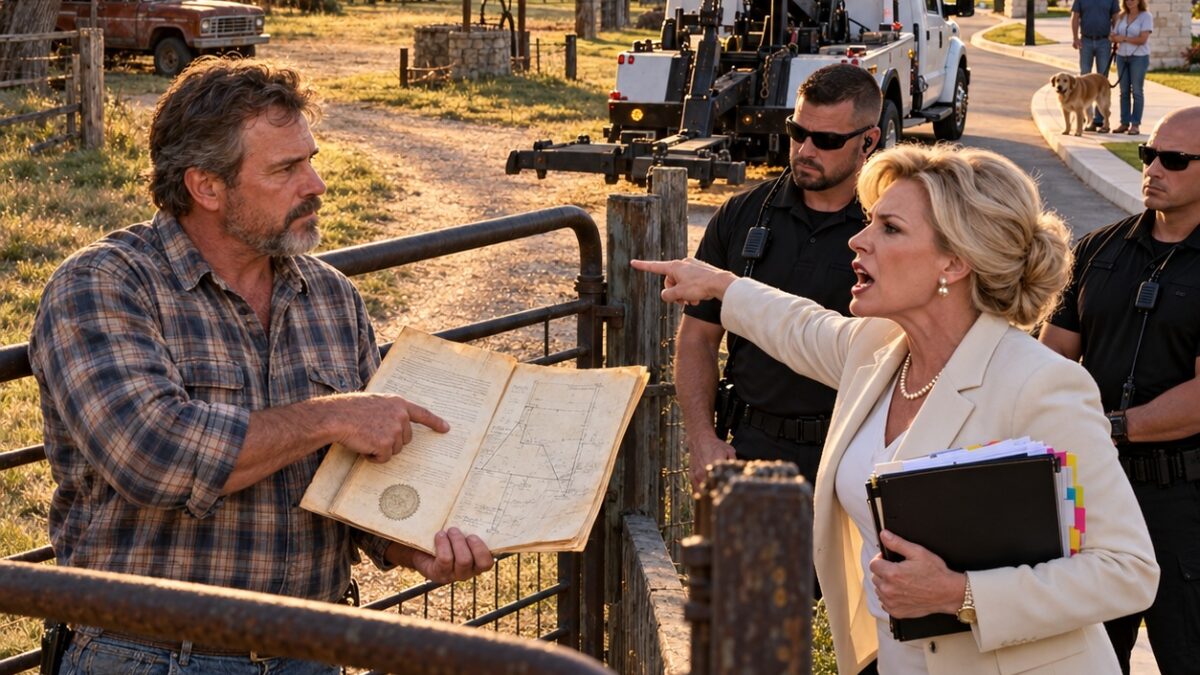
Then Marlene arrived at the gate with security and called us squatters.
That was when I stopped assuming incompetence.
Because incompetence might explain a bad map.
It did not explain publicly attacking somebody’s title after being asked repeatedly to show the document supporting the claim.
The certified letters started immediately after the gate incident.
Green cards.
Heavy envelopes.
The first one listed:
Unauthorized occupancy.
I read that phrase three times.
My last name appeared on county tax records.
My father’s name before mine.
My grandfather’s name in older documents.
Yet an HOA formed decades later was calling our presence unauthorized.
Second notice included fines.
One hundred dollars per day after ten days.
Then two hundred fifty.
Third notice added:
Failure to comply may result in lien enforcement.
I sat at our kitchen table with the papers spread around me.
My father walked in.
He was seventy-three then.
Still drove the old truck Marlene wanted to tow.
He picked up the notice.
Read the heading.
“Squatters?”
“Apparently.”
He laughed once.
Then stopped.
“What exactly are they claiming?”
“That we’re inside their association.”
“Since when?”
“Depends who you ask.”
He set the paper down.
“Your granddad bought this in ’78.”
“I know.”
“He’d love this.”
“I know.”
My grandfather had not been a calm man when it came to property.
If Marlene had called him a squatter at his own gate, the story would probably have involved language I could not repeat publicly.
Fortunately, he had taught my father something more useful than temper.
Keep your paperwork.
So I started a file.
Every envelope.
Photographed before opening.
Every certified receipt.
Every email exported to PDF.
Every voicemail summarized with date and time.
Every public statement written down as close to word-for-word as possible.
Then I stopped talking on the phone.
Marlene called twice.
I did not answer.
The property manager called.
Voicemail.
I responded by email.
Please direct all communication regarding this parcel in writing. Please provide the recorded instrument establishing HOA authority over the property.
Again.
Again.
Again.
Same request.
The document.
Not a map.
Not a screenshot.
Not somebody’s interpretation.
The recorded instrument.
Their response was always some variation of:
The property lies within the community boundary.
That sentence became almost funny.
Because nobody ever finished it with:
according to Instrument Number ____ recorded at Book ___ Page ___.
They could not.
Still, I did not know that for certain yet.
So I went looking.
The morning after they updated the compliance hearing notice and put my name in bold, I took a half day off work.
I did not go to the clubhouse.
I drove downtown.
County courthouse.
The land-record office had fluorescent lights bright enough to make everyone look tired.
Scuffed linoleum.
Old counters.
A clock that ran four minutes slow.
The place smelled like toner, dust and paper that had passed through too many hands.
A clerk named Evelyn asked what I needed.
“Our parcel.”
“Address?”
“Legal description.”
That got her attention.
Most people use addresses.
I gave her the parcel number first.
Then our deed reference.
She pulled the index.
There it was.
Our current warranty deed.
Then the prior conveyance.
Then probate.
Then older deed.
One after another.
Chain of title.
My family.
I requested copies.
Then we traced backward.
The legal description carried the same basic calls.
Beginning at an iron rod.
Bearing north.
Distance.
Turn.
Another call.
Fence line.
Old road.
Markers.
The language changed slightly as survey technology improved, but the tract stayed recognizable.
Then came the original reference.
Land grant.
Not romantic.
Not magical.
Just a recorded historical link carrying the tract back before Stonegate Preserve had even been imagined.
I asked Evelyn:
“Does the subdivision declaration show anywhere in this chain?”
She shook her head.
“Not that I’m seeing.”
“Any supplemental declaration?”
“We’d have to search.”
We did.
HOA name.
Developer.
Parcel ID.
Prior owner names.
Nothing.
I ordered certified copies.
Then I pulled Stonegate Preserve’s declaration.
Big document.
Dozens of pages.
Architectural standards.
Assessment powers.
Maintenance.
Amenities.
Enforcement.
Definitions.
Then Exhibit A.
PROPERTY SUBJECT TO DECLARATION.
I spread it on the counter.
Lot numbers.
Blocks.
Plat references.
New subdivision parcels.
I looked for ours.
Nothing.
Different language entirely.
Their land was described by numbered lots tied to a subdivision plat.
Ours used metes and bounds.
I kept reading.
Then I found the annexation clause.
Additional property could be added.
But only by recorded supplemental declaration meeting specific requirements.
In some circumstances with owner consent.
That was the hinge.
If the developer had legally annexed our tract, there should be a document.
So we searched again.
No annexation.
No supplemental declaration.
No consent.
No deed restriction.
Nothing.
I walked out of the courthouse at noon carrying certified copies in a flat folder.
The sun was bright enough to hurt my eyes.
I sat in my truck.
Did not start the engine.
Instead, I read the certified deed again.
Then the declaration.
Then Exhibit A.
Then annexation language.
For the first time since Marlene called us squatters, I smiled.
Not because the fight was over.
Because now we were finally arguing about the same thing.
Recorded reality.
My next call was to a surveyor.
A real surveyor.
Licensed.
Stamped work.
Not someone flying a drone and drawing a colored line over aerial imagery.
His name was Dennis Clarke.
Late fifties.
He had been surveying the county thirty years.
When I explained the issue, he said:
“Send me your deed and their plat.”
“I have both.”
“Any old survey?”
“Yes.”
“Good.”
“HOA has a GIS overlay.”
He laughed.
“Everybody has a GIS overlay.”
“That bad?”
“GIS is useful.”
Pause.
“It is not a deed.”
I liked Dennis immediately.
A week later, he came to the house.
Boots.
Tripod.
Equipment case.
He spent most of the morning walking fence lines.
Finding old corners.
Comparing bearings.
Checking monuments.
He located an old iron rod near the northwest corner under years of soil and roots.
My father came out.
“That thing still there?”
Dennis looked up.
“You knew about it?”
“Dad showed me when I was a kid.”
Dennis cleaned the top.
“Then your dad had a good memory.”
He worked another day.
Then came back with two maps.
We sat at the kitchen table.
First:
Our tract.
Surveyed calls.
Fence.
Well.
Shed.
Drive.
Pins.
Second:
Stonegate Preserve plat.
He laid translucent paper over both.
The developer boundary ran up to our tract.
Stopped.
Marlene’s overlay, by contrast, had extended a clean digital line across part of our parcel as though the older tract simply did not exist.
Dennis pointed.
“They treated the planning boundary like a title boundary.”
“Meaning?”
“Meaning somebody colored over you.”
“Legally?”
“No.”
He tapped the map.
“Your fence is where the deed calls put it.”
“And the HOA?”
“No recorded annexation I can find.”
“So their line is wrong.”
He nodded.
“Clean.”
Then:
“Wrong.”
I asked:
“Can you stamp that?”
He smiled.
“That’s why you hired me.”
Once I had Dennis’s preliminary stamped plat, I stopped handling the matter like a neighbor dispute.
I hired a real-estate litigator.
Mason Alder.
Not a closing attorney.
Not someone who spent all day drafting deeds.
A man who went to court when people fought about land.
His office had almost no decoration.
One framed survey map.
Two law books.
Coffee machine that sounded broken.
I brought the entire file.
He read silently.
Marlene’s letters.
Squatter accusation.
Fine schedule.
Towing threat.
Certified requests.
Deeds.
Probate.
Land-grant reference.
HOA declaration.
Exhibit A.
Annexation provision.
Certified search.
Survey.
When he finished, he leaned back.
“They have no instrument.”
“That’s what I thought.”
“No.”
He pointed at me.
“Do not say ‘I thought.’”
I stopped.
He tapped the documents.
“Say: no recorded instrument has been located.”
“Lawyer language.”
“Accurate language.”
He kept reading.
Then:
“They publicly called you squatters?”
“Yes.”
“In front of neighbors?”
“Yes.”
“In writing too?”
I handed him the notice.
His eyebrows rose.
“That was unwise.”
“They also threatened towing.”
“Any tow company?”
“Notice says scheduled.”
“Vehicle ever touched?”
“No.”
“Good.”
“Why good?”
“Because we can stop it before somebody creates another problem.”
He made a list.
Demand letter first.
Cease enforcement.
Retract squatter allegation.
Confirm no jurisdiction.
Then he drafted a petition for declaratory relief and quiet title.
Temporary injunction.
Stop towing.
Stop fines.
Stop notices.
Stop any lien while title issue was pending.
Preservation demand for:
Board emails.
Management communications.
Maps.
Legal reviews.
Vendor instructions.
Anything discussing our tract.
I asked:
“You think we need court?”
“They already threatened a lien.”
“That serious?”
“Clouding title is serious.”
He tapped Marlene’s letter.
“They have shown they are willing to treat their assumption as authority.”
Then:
“We put the question somewhere assumptions don’t matter.”
“Court.”
“Exactly.”
He notified our title insurer.
Then sent notice to the county recorder that any HOA lien affecting our tract would be disputed.
For weeks, Marlene had been swinging paper.
Now the paper was going somewhere that could issue orders.
The HOA did not cancel the compliance hearing.
That surprised Mason.
I asked:
“Should I go?”
“Yes.”
“Say anything?”
“Very little.”
“How little?”
“Enough to put them on notice. Nothing more.”
The clubhouse sat near the community pool.
Beige stucco outside.
Beige carpet inside.
Framed aerial photographs of Stonegate Preserve on the walls.
Perfect roofs.
Perfect curving streets.
The kind of images developers use to make land look as though nobody ever lived there before concrete arrived.
Marlene stood at the front.
Projector.
Handouts.
Security again.
Not the same two men.
Apparently she thought atmosphere mattered.
Neighbors filled about half the chairs.
Some there because they had received parking complaints.
Some landscaping questions.
Some clearly there because they had heard about “the squatters.”
When I walked in carrying a thin folder, Marlene looked at me for one second too long.
Then turned back to her laptop.
I sat in the second row.
Did not speak.
The meeting opened.
Normal business.
Pool repairs.
Landscaping.
Then Marlene clicked to a slide.
A color aerial map.
Our property highlighted red.
Title at the top:
UNAUTHORIZED OCCUPANCY / WESTERN BOUNDARY ENCROACHMENT.
She said:
“We have a situation involving trespassers.”
There it was again.
Publicly.
A few people glanced at me.
Marlene continued.
“The board has a fiduciary obligation to protect association property and community values.”
Next slide.
GIS screenshot.
Cropped so tightly you could not see the older parcel boundaries clearly.
Next:
Developer’s planning map.
“Our legal department has reviewed the matter.”
That was interesting.
Mason had already sent the preservation letter.
So whatever legal department had supposedly reviewed this would now have to produce its records.
Marlene said:
“The county recognizes the association boundary.”
Not true in the way she was implying.
Then she laughed softly.
“Some people believe they can game the system if nobody pushes back.”
A few people murmured.
I stayed seated.
Let her finish.
She discussed towing.
Fines.
Enforcement.
Then:
“Does the occupant wish to respond?”
Occupant.
Not owner.
I stood.
Walked forward.
No speech.
I gave the parcel number.
Then read the legal description.
Metes and bounds.
Bearings.
Distances.
A few people looked confused.
That was fine.
I finished.
Then said:
“This matter is now in litigation.”
Marlene’s expression shifted.
I continued.
“Please preserve all board emails, management communications, vendor instructions, maps and enforcement records relating to my family and this tract.”
Silence.
“Counsel has been notified.”
Then I sat down.
That was it.
No accusation.
No argument.
No emotional story about my grandfather.
Because title does not get stronger when you speak louder.
The room felt different afterward.
People had arrived expecting an HOA violation.
They were beginning to understand this was a boundary dispute.
And the boundary had documents.
The first attempt to tow my father’s truck came two mornings later.
That was when things stopped feeling theoretical.
I heard a diesel engine outside before seven.
Looked through the kitchen window.
Flatbed tow truck.
Yellow lights.
Parked partly on the loop road.
Driver walking toward our gate with paperwork.
My father was already outside.
Of course he was.
Seventy-three years old.
Jeans.
Work jacket.
Holding coffee.
He said:
“You here for me?”
The driver looked confused.
“I’m here for a vehicle.”
“That one?”
Dad pointed toward his own truck.
“Yes, sir.”
“Good luck.”
I came outside carrying my phone.
“Who authorized this?”
The driver handed me a work order.
Stonegate Preserve HOA.
Unauthorized vehicle.
Private-property removal.
I took a photo.
Then:
“This truck is on a parcel currently subject to pending title litigation. There is no HOA jurisdiction established over this tract.”
He looked toward the gate.
Then at the truck.
“HOA said this is their property.”
“They’re wrong.”
I called Mason.
Put him on speaker.
Mason told the driver plainly:
“Do not enter the parcel. Your company has now been notified that title and authority are disputed and that injunctive relief has been requested.”
The driver backed away.
“I’m not getting in the middle of this.”
“Good decision,” my father said.
I gave Dad a look.
He drank coffee.
The tow truck left.
Mason filed an emergency supplement that morning.
By afternoon, we had a hearing date on the temporary injunction.
Marlene sent an email to homeowners calling the towing incident:
obstruction of lawful community enforcement.
Mason printed it.
“Keep talking,” he said.
“Me?”
“No.”
He smiled without humor.
“Her.”
The HOA’s attorney entered the case the following week.
His name was Richard Kelso.
Experienced.
Professional.
The first communication from his office was noticeably different from Marlene’s.
No “squatters.”
No “unauthorized occupants.”
No certainty.
Just:
The association contends the tract falls within the development boundary and reserves all rights pending review of the recorded instruments.
I showed Mason.
“They’re backing away.”
“Counsel is.”
“Marlene?”
“Different problem.”
Discovery began.
Board emails.
Management files.
Mapping records.
That was when we learned how little research had occurred before the enforcement campaign.
The management company had used a GIS layer supplied by the developer years earlier.
It showed a broad planning outline.
Someone had imported it into the HOA property-management system.
Our tract sat visually within the outline.
Therefore somebody tagged it:
ASSOCIATION ADJACENT / REVIEW.
Later, that became:
ASSOCIATION PROPERTY.
No deed review.
No title search.
No annexation verification.
Just database drift.
Then Marlene became president.
She saw the map.
Saw our older buildings.
Our gravel.
Our trucks.
Our trailer.
And decided the association had inherited a problem.
One email from her to the manager said:
We need to clean up the western pocket before owners start assuming these people are exempt from standards.
These people.
Another:
If they cannot prove ownership acceptable to the HOA, treat as unauthorized occupancy.
Mason read that twice.
Then:
“She reversed the burden.”
“What do you mean?”
“Ownership is not something the HOA gets to approve.”
He tapped the email.
“She assumed jurisdiction first, then demanded you prove your way out.”
Another email was worse.
Property manager had written:
I’m not finding their tract in Exhibit A. Should we ask counsel before enforcement?
Marlene replied:
The development map is sufficient for preliminary enforcement. We can sort title later.
I sat staring at the screen.
There it was.
Not misunderstanding.
Not entirely.
She had been warned before calling us squatters that the tract was missing from Exhibit A.
Her answer:
Sort title later.
Fines first.
Tow first.
Threaten lien first.
Then sort title.
That changed the case.
Not the ownership question.
That was already strong.
It changed how Mason viewed the public accusations.
The temporary injunction hearing was not dramatic.
No jury.
No packed gallery.
Just courtroom.
Judge.
Lawyers.
Documents.
But I have never felt tension like that over paper.
Mason set Dennis’s survey on an easel.
Stamped.
Signed.
Clear.
Our tract outlined.
Stonegate Preserve beside it.
Fence line aligned with the historical calls.
Then he walked through the chain.
Warranty deed.
Probate.
Prior deed.
Older deed.
Land-grant reference.
Tax parcel.
Recorded survey.
Then the HOA declaration.
Exhibit A.
Annexation section.
No instrument.
Kelso had the subdivision plat.
CC&Rs.
Developer planning documents.
GIS maps.
He argued that the tract sat within the intended community footprint.
The judge looked at him.
“Intended by whom?”
“The developer’s planning records indicate—”
“I’m asking about the recorded covenant.”
Kelso paused.
The judge continued.
“What instrument subjected this tract to the declaration?”
Kelso referenced the plat.
Judge:
“Does the plat identify this tract as a subdivision lot?”
“No, Your Honor.”
“Supplemental declaration?”
“We have not located one.”
“Annexation instrument?”
“Not yet.”
“Owner consent?”
“No document has been located.”
The judge looked over his glasses.
“So what is the association enforcing?”
Kelso tried:
“The property is geographically encompassed by—”
The judge raised one hand.
“I understand geography.”
The room went silent.
“I am asking about legal encumbrance.”
That sentence went through me like electricity.
Mason did not smile.
Good lawyers know when not to.
The judge turned to Dennis’s survey.
Asked two questions about calls.
Fence alignment.
Monuments.
Dennis answered.
Then:
“Does the subdivision plat alter the earlier metes-and-bounds description?”
“No, Your Honor.”
“Can a GIS overlay do so?”
“No.”
Judge nodded.
Then looked at counsel.
“Absent evidence of lawful annexation, the tract is not presently shown to be subject to the association declaration.”
Marlene sat behind Kelso.
For the first time since I had met her, her face did not look controlled.
The court issued temporary relief.
No enforcement.
No towing.
No fines.
No lien.
No interference with our possession pending final disposition.
The gavel was not loud.
It did not need to be.
You would think that would have ended it.
It should have.
Instead, Marlene tried to win socially what she was losing legally.
She sent a community email.
COURT ORDER IS TEMPORARY AND DOES NOT RESOLVE COMMUNITY BOUNDARY CONCERNS.
Technically true.
Then:
Residents should avoid entering the disputed tract due to unresolved ownership issues.
That was not.
Our ownership was not unresolved.
HOA jurisdiction was.
Mason sent a demand.
Retract.
Correct.
By then, several neighbors had started asking questions.
A woman named Denise knocked one evening.
“I’m sorry.”
“For what?”
“I believed the squatter thing.”
I shrugged.
“You heard it from the president.”
“She said you didn’t have a deed.”
“We have several.”
She looked embarrassed.
“My husband wanted to call police when he saw your uncle’s trailer.”
“That would’ve been awkward.”
She laughed nervously.
Then:
“Why would she say that if she didn’t know?”
That was the question everyone kept asking.
Because people assume certainty comes from information.
Sometimes it comes from personality.
Marlene had the kind of confidence people confuse with proof.
She spoke first.
Spoke clearly.
Used institutional language.
Our legal department.
Community boundary.
Official records.
Noncompliant occupancy.
Those phrases make ordinary people step back.
Until somebody asks:
Which document?
The quiet-title case moved faster once the injunction was entered.
Title insurer joined our side.
They had an interest in defending clean ownership.
Discovery produced more records.
Nothing annexing the tract.
Nothing.
Kelso eventually told the court the association could not identify a recorded instrument.
At that point, the remaining fight was mostly over the declaratory language and costs.
Mason wanted a clean order.
Not:
HOA failed to prove jurisdiction today.
He wanted:
The tract is not subject to the declaration absent lawful future annexation.
That distinction mattered.
I did not want this argument restarted in five years by a new president with another map.
The final hearing took less than two hours.
Judge reviewed the record.
Chain of title.
Survey.
Declaration.
No annexation.
No consent.
No instrument.
Then issued the words I had been waiting months to hear.
“The tract is not subject to the HOA declaration absent lawful annexation.”
Simple.
Final.
The order permanently barred Stonegate Preserve HOA from:
Assessing our property.
Enforcing architectural rules.
Towing vehicles from the tract.
Recording liens.
Representing us as unauthorized occupants.
Or interfering with possession under the association declaration.
The squatter language was addressed too.
Marlene was required to correct the board record.
The management company sent formal compliance within days.
Our parcel lay outside the declaration.
No lien would be recorded.
All violation records were withdrawn.
The tow authorization canceled.
My online “account” disappeared.
Balance:
Zero.
Jurisdiction:
None.
The next board meeting was standing-room-only.
I almost did not go.
Mason said:
“You should.”
“Why?”
“Correction should be heard by the same community that heard the accusation.”
Fair.
Marlene sat at the board table.
No private security.
No projector.
No dramatic maps.
She read from a prepared statement.
“Pursuant to the court’s final order, the tract associated with Parcel 0148732009 is not subject to the Stonegate Preserve declaration.”
The room was silent.
She continued.
“The board withdraws prior enforcement notices.”
Pause.
“And corrects previous references to occupants of that parcel as squatters or unauthorized residents.”
Her jaw tightened on squatters.
“The association will not conduct enforcement on the tract absent future lawful annexation.”
That was it.
No apology.
I had learned not to need one.
The court order mattered.
The correction mattered.
Her feelings did not.
Afterward, a man I barely knew came over.
“You could sue her personally for saying all that, couldn’t you?”
“Maybe.”
“You going to?”
“No.”
“Why not?”
I looked toward Marlene packing her papers.
“Because I wanted my title clear.”
He waited.
“And it is.”
That was enough.
The morning after the final order, Dennis met me at sunrise.
Cold enough to see our breath.
We walked all four corners.
He set rebar pins.
Proper caps.
Coordinates documented.
At the north line, beneath the pecans, my father came with us.
Dennis drove the last pin.
Dad stood looking at it.
“Your granddad would’ve liked this.”
“The court case?”
“He’d have hated the court case.”
“Yeah.”
Dad nudged the marker with his boot.
“He’d like that.”
I asked Dennis:
“You record the plat?”
“Tomorrow.”
Mason prepared an affidavit referencing the final order, survey and legal description.
Recorded.
Indexed.
Permanent.
Anyone researching the tract later would not have to repeat my fight.
That mattered.
Then I went home.
Fixed the well-box hinge.
Mowed.
Checked the trailer tires.
Latched the gate.
Normal life.
That was the reward.
Marlene remained president another six months.
I did not campaign against her.
Did not create a Facebook group.
Did not start a petition.
Not my association.
Not my election.
But the lawsuit changed how people looked at her.
That was inevitable.
Because once someone confidently calls a family squatters and a judge says the HOA had no jurisdiction over their land, future claims sound different.
People began asking for documents.
A landscaping dispute?
“Show us the section.”
Fee increase?
“When was it adopted?”
Boundary issue?
“Is that map recorded?”
The board meetings became slower.
Marlene hated that.
I thought it was healthy.
Eventually she resigned.
Personal reasons.
Someone told me she sold her house the following year.
I never verified.
Did not care.
The property manager stayed.
He apologized.
That surprised me.
He came to the gate one Saturday.
No blazer.
No security.
Just jeans and a polo.
“I should have checked.”
“Yes.”
He nodded.
“I relied on the GIS layer.”
“Yes.”
“Marlene said legal had already reviewed it.”
“Had they?”
“No.”
We stood quietly.
Then he said:
“I’m sorry.”
I believed him.
“Do better next time.”
“We changed the procedure.”
“What procedure?”
“Legacy parcels.”
I listened.
Before any enforcement against a parcel with a legal description that did not match the subdivision plat, management had to obtain title verification.
Recorded declaration.
Annexation.
Legal review.
Before fines.
Before notices.
Before vendor action.
I smiled.
“That’s useful.”
He nodded.
“Your case cost the association a lot of money.”
“Then at least buy something with it.”
“What?”
“Better habits.”
He laughed.
We shook hands.
A strange thing happened after the court order.
Owners from nearby developments started calling.
Not many.
A handful.
They had heard about the case through surveyors, attorneys or neighbors.
One man believed his acreage had been annexed incorrectly.
His records showed it actually had been properly annexed.
Different case.
I told him:
“Then you’re probably in.”
He sounded disappointed.
I said:
“The goal isn’t to escape rules.”
Silence.
“The goal is to know what rules actually attach to your land.”
Another woman had a fence dispute with an HOA claiming an easement.
Her deed clearly showed the easement.
Again:
Different.
Another family found no annexation instrument for an old tract similar to ours.
They hired counsel.
Resolved it without court.
That was good.
I never became an anti-HOA activist.
I am not anti-contract.
If you buy a lot subject to covenants, read them.
Follow valid rules.
Pay lawful dues.
Vote.
Attend meetings.
That is not oppression.
The problem begins when someone starts treating proximity as consent.
Aerial maps as title.
Assumption as law.
The old HOA overlay is still in my file.
Mason gave me a copy after discovery.
Glossy.
Colored.
Very convincing.
Our tract sits inside a thick blue outline.
If that were the only thing you saw, you would think Marlene had been right.
That taught me something.
A map can be accurate for one purpose and wrong for another.
Planning map.
Service map.
Tax map.
Marketing map.
Emergency-response map.
Survey.
Plat.
They answer different questions.
Marlene took a map created to show a development area and treated it as though it created property rights.
It did not.
The court cared about the recorded legal description.
That was where confidence ended.
My grandfather’s shed still stands.
Tin roof.
Concrete piers.
Same one Marlene called an unapproved accessory structure.
I replaced two rusted panels last spring.
Pulled no HOA architectural request.
Did not need one.
My father’s truck still sits on gravel when he visits.
Un-towed.
My uncle’s trailer comes and goes.
Well equipment box still does not match Stonegate Preserve landscaping standards.
The pecan trees still drop shells all over the driveway.
Kids from the subdivision sometimes ask if they can pick them up.
I tell them yes.
Their parents usually look nervous the first time.
Like crossing our gate might somehow be political.
It is not.
They are neighbors.
The HOA overstepped.
That does not make every resident an enemy.
One of the best things that happened after the lawsuit was normal relationships returning.
People walked dogs.
Stopped to talk.
Borrowed tools.
Asked if my father needed help loading something.
The subdivision became what it should have been all along.
A group of houses beside our land.
Not an invading government.
Not an enemy.
Just neighbors.
For a long time, the word squatter bothered me.
More than I wanted to admit.
Lien threat?
Legal problem.
Towing?
Practical problem.
Fines?
Annoying.
But squatters?
That touched something older.
My grandfather had worked for that land.
My father had maintained it.
Taxes paid every year.
Fence repaired.
Well repaired.
Storms cleaned up.
Funerals held.
Birthdays celebrated.
One word from a woman with a clipboard tried to turn all that history into trespass.
It was ridiculous.
But public accusations can hurt even when absurd.
For weeks, I wondered which neighbors believed her.
Who thought we were exploiting some technicality.
Who thought our family had simply occupied forgotten land until the nice subdivision came along.
Then I realized something.
Title does not care who believes you.
The deed remained the deed on the day Marlene called us squatters.
It did not become stronger when the judge ruled.
The judge simply recognized what was already true.
There is peace in understanding that.
Reality does not need unanimous approval.
Mason once asked me what I wanted written into the final proposed order.
I said:
“Certainty.”
He laughed.
“That’s not legal language.”
“You know what I mean.”
He did.
No temporary ambiguity.
No language suggesting the HOA might revive the theory under the same documents.
No vague settlement that left future boards wondering.
Clear.
Tract identified by full legal description.
Not subject to declaration.
No enforcement.
No lien.
No towing.
No representation that possession was unauthorized.
That was certainty.
He wrote it.
The judge signed it.
Then we recorded the relevant affidavit.
Future buyer searches the parcel?
There.
Future title company?
There.
Future HOA president?
There.
Future developer?
There.
Certainty does not prevent somebody from making a mistake.
It makes the mistake harder to sustain.
The final legal bill hurt.
I will not pretend otherwise.
Surveyor.
Attorney.
Filing fees.
Certified copies.
Title work.
Time off.
The HOA paid some recoverable costs under the final resolution, but not every dollar and not every hour.
People ask:
“Was it worth it?”
Wrong question.
If somebody threatens to put a lien on land they have no authority over, the choice is not really between spending money and doing nothing.
Doing nothing can cost more.
Clouded title.
Towing.
Accumulated fines.
Future sale problems.
The longer an incorrect claim sits unchallenged, the more paperwork grows around it.
I would rather spend money early making the record clean than spend years later untangling ten layers of false history.
That is another lesson Marlene gave me accidentally.
Problems involving land get more expensive when ignored.
One evening, my father and I sat under the pecan trees.
He had his truck parked where the HOA once said it could be towed.
He looked toward Stonegate’s roofs.
“They ever apologize?”
“No.”
“Good.”
I laughed.
“Good?”
“You’d have gotten soft.”
“Dad.”
He smiled.
Then:
“Your granddad would’ve gone to jail.”
“For what?”
“Something involving that first security guard.”
I laughed harder.
“That’s why I handled it.”
“Exactly.”
We sat quietly.
Then he said:
“You know why your grandfather saved all that old paperwork?”
“Because he didn’t trust anyone?”
“That too.”
He looked toward the fence.
“Because he watched two neighbors fight over ten feet of pasture for twenty years.”
“Seriously?”
“Survey settled it in a week.”
“Then why twenty years?”
“Neither one wanted to pay for the survey.”
I shook my head.
Dad smiled.
“People get emotional about land.”
He was right.
I had too.
But emotion is not where the answer lives.
The gate where Marlene confronted me still hangs slightly crooked.
I keep meaning to adjust it.
Haven’t.
Some mornings I stand there with coffee.
Feel the cold steel under my hand.
Remember the two security guards.
Marlene’s perfect hair.
The packet.
The neighbors pretending not to listen.
“Squatters.”
Then I look at the survey cap near the corner.
Recorded plat.
Court order.
Fence.
Well.
Shed.
Truck.
Everything where it always was.
It makes the original confrontation feel smaller.
Not harmless.
Smaller.
At the time, Marlene’s authority felt enormous because she brought people.
Paper.
Security.
Fines.
Legal threats.
Volume.
Later I learned how much of that authority depended on nobody asking the first question.
Where is the recorded instrument?
That question collapsed almost everything.
Not immediately.
But inevitably.
Because there was no answer.
A year after the case, the new HOA president came to the gate.
His name was Stephen.
Gray hair.
Normal polo shirt.
No security.
He stayed on the road side until I opened.
Good start.
“I wanted to introduce myself.”
“Okay.”
“I know your tract is outside the association.”
“Better start.”
He laughed.
“I also know we share drainage concerns along the east fence.”
“That we do.”
“We’re replacing a culvert near the loop. I wanted you to see the plan before work starts.”
He handed me the engineering sheet.
I looked.
Work remained on HOA land.
No encroachment.
Drainage improved.
“Looks fine.”
“Can we access the fence corner for measurements?”
“You ask first, yes.”
He nodded.
That relationship worked.
Not because jurisdiction changed.
Because respect did.
The HOA did not need to own my land to coordinate with me.
That was what Marlene never understood.
Neighbor cooperation and legal authority are different things.
She wanted authority.
I wanted certainty.
Stephen wanted to solve a drainage problem.
Guess which approach worked best.
The quiet-title order lives in the fireproof safe now.
Certified copy.
Survey.
Recorded affidavit.
Original family documents.
I scanned everything too.
Cloud backup.
External drive.
My father laughed.
“Granddad had a cigar box.”
“Granddad didn’t have ransomware.”
“Fair.”
The old land-grant reference still fascinates me.
Not because it gives our family some grand historical importance.
It does not.
We are ordinary people.
The reference matters because it shows continuity.
Legal identity carried through time.
One tract.
One chain.
The subdivision came later.
That does not make the subdivision less legitimate.
It simply means new lines cannot erase old ones without proper legal action.
Development changes landscapes.
It does not rewrite history automatically.
Marlene assumed the new map superseded the old land.
The court reminded her maps follow title, not the other way around.
The last conversation I ever had with Marlene happened unexpectedly.
Grocery store parking lot.
Months after she left the board.
I was loading feed bags.
She was returning a cart.
We saw each other.
For a moment, I considered saying nothing.
She walked over.
“I heard you recorded the new survey.”
“Yes.”
She nodded.
Long pause.
Then:
“I believed the developer map.”
I said nothing.
She continued.
“They told us everything inside the outline belonged to the association.”
“Who?”
“Previous management.”
“Did you ever ask for the annexation?”
Her face tightened.
“No.”
I waited.
Then she said:
“I should have.”
“Yes.”
No anger.
Just true.
She looked toward my truck.
“I shouldn’t have used the word squatters.”
“No.”
“I was trying to force compliance.”
“I know.”
“That was wrong.”
I had imagined an apology many times.
In those imaginary versions, I said something sharp.
Memorable.
Satisfying.
Reality was different.
I said:
“Thank you.”
That was it.
She walked away.
I finished loading feed.
No music.
No dramatic ending.
Just two people in a grocery parking lot, one finally admitting what the record had already settled.
That was enough.
There is a phrase I hear sometimes in property disputes:
Everybody knows where the line is.
Dangerous sentence.
Everybody knowing is not a substitute for a survey.
Another:
That’s always been common area.
Maybe.
Show me.
Another:
You’re inside the neighborhood.
Physically?
Socially?
Legally?
Words matter.
Maps matter.
But recorded instruments matter more when somebody is claiming a covenant runs with land.
That is why the judge kept asking for the same thing.
Book.
Page.
Instrument.
Annexation.
The HOA had a beautiful presentation.
Colored maps.
Aerial images.
CC&Rs.
Security contracts.
Enforcement schedules.
What they did not have was the one piece that mattered.
A lawful bridge between their declaration and our tract.
Without that bridge, everything else stopped at the fence.
The fines disappeared.
All of them.
The “unauthorized occupancy” notices too.
No lien.
No towing.
No HOA inspection.
No architectural review.
My father joked that he missed receiving violation letters.
“They made good kindling.”
“I saved them.”
“Of course you did.”
One day he asked:
“What’d you do with the original squatter packet?”
“File.”
“You ought to frame it.”
“Why?”
“Put it in the shed.”
“No.”
“Above the door.”
“No.”
“Granddad would.”
That was probably true.
I still did not.
Some things deserve to be archived, not worshipped.
The biggest change was not on our tract.
It was inside the HOA.
The board adopted a legacy-parcel verification policy.
Management could no longer rely solely on GIS overlays for jurisdiction.
Before enforcement against any parcel outside the numbered subdivision lots, they had to confirm:
Recorded legal description.
Declaration coverage.
Supplemental annexation if applicable.
Title review where necessary.
That policy never used my name.
Good.
It did not need to.
The best consequences become process.
People rotate.
Boards change.
Management companies change.
Procedure can remain.
If that one paragraph prevents another family from getting branded squatters because somebody misread a map, then the legal bills bought something useful.
Years later, the neighborhood looks settled.
Trees taller.
Kids older.
Some original owners moved away.
Stonegate Preserve’s houses no longer look new.
That happens.
Weather.
Sun.
Life.
Our tract still looks different.
Gravel instead of decorative aggregate.
Older shed.
Older trees.
More space.
No sidewalk through the gate.
There is something reassuring about that difference.
Not superior.
Just honest.
The land did not become a subdivision lot simply because everything around it did.
The fence still follows the old calls.
Survey pins sit where Dennis put them.
Well still runs.
Pecans still fall.
My father’s truck eventually died for real.
Transmission.
No HOA involved.
He replaced it.
Parks the new one in exactly the same spot.
Out of principle, I suspect.
Whenever somebody tells me a property dispute is obvious because of how a map looks, I think about Marlene’s projector.
Big glossy image.
Our land shaded inside her outline.
She looked completely certain.
Then I think about the judge.
No interest in color.
No interest in HOA confidence.
No interest in community aesthetics.
He asked:
“Where is the recorded instrument?”
Silence.
That silence was the whole case.
Everything before it was noise.
I did not win because my family had been there longer.
Length of possession helped explain history.
It was not the legal answer.
I did not win because my grandfather built the fence.
Not enough.
I did not win because the HOA was annoying.
Courts do not invalidate covenants because presidents are rude.
I won because the chain of title said one thing.
The HOA said another.
And when both were placed on the same table, only one had a recorded legal foundation.
That distinction matters.
People love stories where arrogant officials get embarrassed.
I understand why.
Marlene standing in the clubhouse being forced to retract “squatters” was satisfying.
But humiliation was not the victory.
The recorded survey was.
The declaratory order was.
The permanent injunction was.
The clean title was.
Certainty.
Sometimes my uncle still parks his trailer near the south fence.
The same trailer Marlene called an unauthorized vehicle.
One summer afternoon, a Stonegate kid riding a bike stopped outside the gate.
“Is that the illegal trailer?”
I laughed.
“Who told you that?”
“My dad.”
“Your dad joking?”
“Probably.”
I walked over.
“It was never illegal.”
“Then why did the HOA say it was?”
“Wrong map.”
He considered that.
“That’s dumb.”
“Sometimes adults make mistakes.”
“Did they get in trouble?”
“Depends what you mean.”
He looked disappointed.
Kids want explosions.
“No jail?”
“No.”
“No police?”
“No.”
“Boring.”
“Very.”
He rode away.
I smiled.
Boring is good when the subject is your home.
The folder from the case is thick now.
Original notices.
Certified receipts.
Screenshots.
Marlene’s emails.
Tow work order.
Court filings.
Survey.
Final order.
Management compliance.
Recorded affidavit.
I keep one particular page near the front.
Marlene’s first public violation packet.
At the top:
UNAUTHORIZED OCCUPANCY.
Underneath:
Our misspelled address.
Every time I see it, I remember the gate.
Her voice carrying toward neighbors.
“You’re not on the deed the HOA recognizes.”
She was technically right about one thing.
We were not on any deed the HOA recognized.
Because the HOA had never bothered to recognize the actual deed.
The county had.
The title company had.
The tax office had.
The probate court had.
The surveyor did.
Eventually, the judge did.
That was plenty.
Ownership is not a mood.
It is not a colored outline.
It is not a board vote.
It is not someone standing at your gate with two hired security guards.
It is not a clipboard.
Not a violation portal.
Not a confident voice.
For land, ownership lives in legal descriptions.
Recorded instruments.
Chains of title.
Surveys.
Deeds.
And when those records contradict somebody’s assumption, the assumption does not become law because a whole HOA board repeats it.
That is what Marlene learned.
That is what I learned too.
Before this happened, I thought my family’s old paperwork was history.
Afterward, I understood it was infrastructure.
Grandfather saved deeds because deeds mattered.
Dad saved probate orders because probate mattered.
Those old papers carried the weight of the tract forward.
I added my part.
Court order.
Survey.
Recorded affidavit.
Something the next generation can pull if somebody ever redraws another map.
One morning not long ago, I went down to the gate before sunrise.
Cool enough for a jacket.
Pecan leaves barely moving.
Stonegate’s streetlights still on.
No cars.
No security guards.
No violation notice.
I opened the gate.
Metal hinge squeaked.
Same sound it has made for years.
Then I noticed the survey pin just beyond the fence.
Small cap.
Easy to miss.
I crouched.
Brushed dirt away.
Dennis’s survey number stamped into the top.
Not dramatic.
Maybe half the size of my thumb.
But I thought about how much noise had been required to arrive at something so quiet.
Marlene’s accusations.
Certified mail.
Security.
Fines.
Towing.
Clubhouse speeches.
Lawyers.
Court.
All of it finally reduced to one tiny piece of metal saying:
The line is here.
I stood.
Closed the gate behind me.
My father’s new truck sat near the shed.
Well pump kicked on.
Morning light began reaching the pecans.
Stonegate Preserve woke on the other side of the fence.
And nothing happened.
Exactly the way I wanted it.
They wanted authority.
I wanted certainty.
Authority based on assumption disappears the moment somebody checks the record.
Certainty survives.
Our tract had been ours before the HOA existed.
It remained ours while Marlene called us squatters.
It remained ours while the fines accumulated.
It remained ours while the tow truck came.
It remained ours while glossy maps were projected across a clubhouse wall.
The court did not give us our land.
The court simply forced the HOA to admit what the deeds had been saying all along.
And after the final survey was recorded, after the violations vanished, after Marlene withdrew the accusation and the tow request disappeared, I went back to doing what my family had always done.
Mowing.
Fixing the well.
Keeping the fence tight.
Paying the taxes.
Closing the gate.
Because once you learn how to read the paper trail behind a piece of land, you start noticing something else too.
You start noticing exactly who has been counting on you never to read it.


