PART2:HOA Queen Built a 120-Foot Cell Tower on My Family Farm Without Asking—Then She Learned Whose Name Was on the Deed
PART2
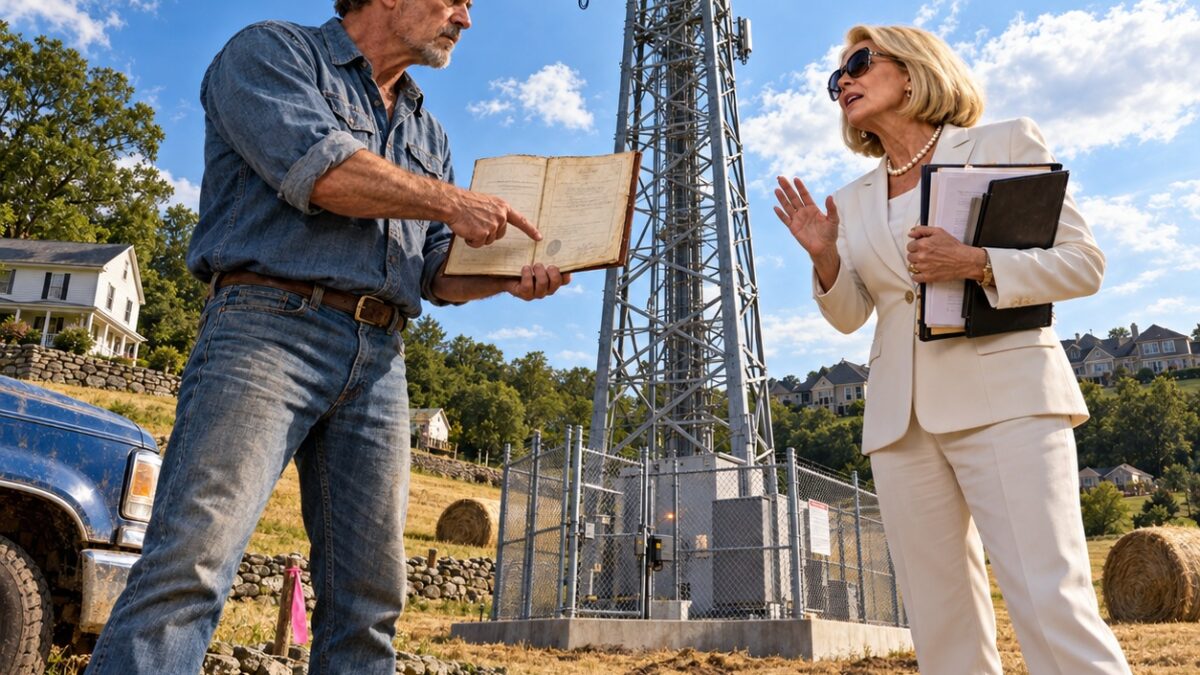
The base was fresh.
Pale concrete.
Four steel legs disappearing into it.
Chain-link fence wrapped around the site.
Padlocked gate.
Orange warning stickers.
Generator shed off to one side.
Tire tracks cut deep through the ground where Dougie normally brought hay equipment.
This had not happened overnight.
Men had worked there.
Machines had worked there.
Concrete had cured there.
A tower crew had spent days doing something on my property while not one person involved had apparently considered contacting the person who owned it.
I got out.
Walked toward the fence.
The hum grew stronger.
Not loud.
Persistent.
A sound you could learn to ignore if you had chosen it.
I had not.
A laminated sign had been zip-tied to the chain link.
MILLHAVEN CROSSING TELECOMMUNICATIONS INFRASTRUCTURE PROJECT
AUTHORIZED UNDER HOA BOARD RESOLUTION 2024-17
I read it three times.
Then took out my phone.
Photos.
Tower.
Concrete.
Fence.
Padlock.
Warning stickers.
Generator.
Tire tracks.
The laminated card.
Wide shots.
Close shots.
Every angle.
Years working electrical taught me something.
If you find a problem on a jobsite, photographs before conversation.
Once people start explaining, the physical facts get buried beneath the story.
I called Rosalind.
Voicemail.
I called Pinnacle Community Services.
That was the management company handling Millhaven’s books and administrative work.
A receptionist answered.
Very polite.
Very careful.
She told me the telecommunications project had been “properly authorized under association infrastructure authority.”
“I own the land.”
Pause.
“You should have received notice.”
“I didn’t.”
“I can make a note.”
“Who is the carrier?”
“I’m not authorized to disclose project contractual information without a records request.”
“Who signed the lease?”
“I would need to review that.”
“What exactly does Resolution 2024-17 authorize?”
“I can have somebody follow up.”
“Nobody is following up. There is a tower on my farm.”
“I understand your concern.”
“No. I don’t think you do.”
I ended the call before frustration made me less useful.
Rosalind called two hours later.
She sounded calm.
Prepared.
Almost cheerful.
“Apex Wireless approached us regarding a coverage gap.”
“Rosalind.”
“The board reviewed the opportunity carefully.”
“You built a tower on my property.”
“We approved a community infrastructure lease.”
“My property.”
“The field was selected because of elevation and minimal obstruction.”
“Who gave you permission to select it?”
“We have infrastructure authority under the annexation documents.”
That sentence mattered.
She continued before I could answer.
“Apex is paying $2,200 monthly. That revenue goes directly to the community fund. It will offset future dues and support improvements. Frankly, Garrett, this benefits everyone, including you.”
Including me.
I stood on my porch staring across the field at the steel tower.
My grandfather’s fence ran across the foreground.
The same fence Rosalind wanted gone.
I asked:
“Did I sign anything?”
“No, but—”
“Did you notify me before construction?”
“Garrett, the board acted under—”
“Did I sign anything?”
Her tone hardened.
“The HOA holds broad authority.”
“That wasn’t my question.”
“You need to see the larger benefit.”
There it was.
Bigger picture.
I said:
“I’m going to look into it.”
She sounded relieved.
“Of course.”
She thought I meant I was angry and needed time to cool off.
What I meant was:
I am going to read every document that has ever touched this land.
That afternoon, I drove to the Knox County Recorder’s office.
Fluorescent lights.
Laminate table.
Vending-machine coffee that tasted like hot cardboard.
Three hours.
Deed.
Clean.
Twelve acres.
Mine.
No recorded telecommunications easement.
No tower right-of-way.
No leasehold conveyed to the HOA.
Then the 2003 annexation agreement.
The document that pulled my property into Millhaven.
Paragraph fourteen.
I slowed down.
14A.
14B.
Then 14C.
I read it once.
Twice.
A third time.
Nothing herein shall grant the association any interest in or authority over the physical improvements or leasehold of parcels predating association formation.
My land predated Millhaven Crossing by roughly forty years.
That meant the HOA had authority in certain community matters.
Dues.
Rules properly applicable under the annexation.
But the agreement specifically did not give them ownership authority over my physical improvements or leasehold.
They could not simply take my field and become landlord.
No ambiguity.
No secret clause later saying “unless Rosalind wants better cell coverage.”
I copied the entire document.
Drove home.
Sat on my porch.
The tower’s red aircraft light came on when daylight faded.
Slow blink.
Blink.
Blink.
The machine looked permanent.
That is one of the psychological advantages of construction.
Concrete makes people assume the argument is over.
They poured it.
Therefore it belongs.
They built it.
Therefore it stays.
But I had spent my life around construction.
Concrete is only as legitimate as the right to put it there.
I called Desmond Okafor.
Knoxville real-estate attorney.
Twenty years.
Smart.
Calm.
Never impressed by anybody’s title.
He answered.
“Garrett.”
“Dez, I need you to tell me what a trespass case looks like when the thing trespassing is a hundred twenty feet tall.”
Silence.
Then:
“What did they build?”
“A cell tower.”
“On your land?”
“Dead center.”
Another pause.
“Pour yourself a drink.”
The next morning, I sat in Desmond’s office on Gay Street.
Dark wood.
Bookshelves.
Old files.
His assistant’s Ethiopian coffee, which immediately made the recorder-office coffee seem like a criminal act.
He listened.
Did not interrupt.
Tower.
HOA.
Rosalind.
Pinnacle.
Resolution.
Paragraph 14C.
Then he leaned back.
“They trespassed.”
“Plainly?”
“Very.”
He wrote three words on his pad.
Trespass. Conversion. Unjust enrichment.
He tapped the first.
“They physically occupied land they don’t own.”
Second.
“They treated the economic use of your property as if it were theirs to sell.”
Third.
“They’re collecting revenue generated from your land.”
“Twenty-two hundred a month.”
“Yes.”
He called a telecom-lease attorney he knew.
Brief conversation.
Then he slid a legal pad toward me.
“Locations like yours?”
“What about them?”
“Elevated, rural-adjacent, coverage need. Ground rent could run fifteen hundred to thirty-five hundred monthly. Sometimes more depending on leverage.”
I looked at the tower numbers.
“Rosalind got twenty-two.”
“Which isn’t ridiculous market rent.”
“She just negotiated it on land she didn’t own.”
“Exactly.”
He explained typical lease terms.
Twenty-five years.
Annual escalators.
Long-term value.
Then he said:
“That’s your land.”
He paused.
“That should have been your negotiation.”
That was the first moment the scale of what Rosalind had done really settled in.
She had not merely trespassed.
She had taken a revenue-producing right attached to my property and sold it.
For twenty-five years.
Then told me I should be thankful.
Desmond had another question.
“Did Apex perform title work?”
“They must’ve.”
“They should have.”
He made calls.
Within an hour, we learned the likely problem.
Apex’s title review had been run against HOA common-area records.
Somebody followed the wrong parcel assumption.
The tower sat roughly twenty-two feet inside my deed line.
Apex had signed with a lessor who did not own the tower site.
That meant Apex had a problem too.
Different problem.
They were not Rosalind.
I knew that immediately.
Rosalind knew it was my field.
She had argued with me over that field for months.
Apex probably trusted the documents delivered to them.
Still careless.
Still expensive.
But different.
Desmond said:
“We give the HOA a clean chance.”
Three days later, demand letter.
Six pages.
Certified.
HOA board.
Pinnacle.
My deed.
Annexation agreement.
14C quoted.
Construction timeline.
Market rent.
Trespass.
Unjust enrichment.
Two options.
One:
Remove tower.
Restore my land.
HOA pays.
Two:
Proper easement with me as lessor.
Thirty-five hundred dollars a month.
Top end of market.
Retroactive rent from groundbreaking.
Twenty-one days.
Rosalind received the letter.
Then ignored Desmond’s instruction that future communications go through counsel.
She called me.
“Garrett, we are not going to be extorted.”
I was in the kitchen.
I looked at the tower through the window.
“Okay.”
“You signed away these rights when you joined the association.”
“That’s not what 14C says.”
“You are selectively reading.”
“You should talk to Desmond.”
“I’m talking to you.”
There was an edge beneath her calm.
Then she made the mistake.
“If you pursue this frivolous action, I am prepared to file a nuisance complaint with Knox County regarding your unmaintained field.”
I said nothing.
“And frankly, your little field has been an aesthetic issue for years.”
Little field.
She said it again less than a minute later.
Your little field.
Like the ground my grandfather worked was a patch of weeds waiting for her permission to matter.
What Rosalind did not know was that Tennessee allows one-party recording when a participant consents.
I had a recording app.
Old habit.
I had been burned in a subcontractor dispute years earlier.
Never again.
The entire conversation was recorded.
I ended politely.
Texted Desmond.
She called direct. Threatened nuisance complaint. Recorded all of it.
Three dots appeared.
Then:
Beautiful. Keep everything.
That evening, the tower’s warning light blinked red above the field.
Rosalind thought she had threatened me.
What she had actually done was help document retaliatory intent.
Seventeen days later, the HOA finally responded through counsel.
Clifford Spruce.
Estate planning.
Residential closings.
General civil matters.
Desmond read the letter.
Then rubbed his forehead.
“What?”
“He’s arguing broad infrastructure authority overrides the ownership carve-out.”
“Does he address 14C?”
“No.”
“Not once?”
“Not once.”
At the end, they offered me five hundred dollars a month.
Goodwill compensation.
Five hundred.
They were collecting twenty-two hundred.
They had built without permission.
Now their version of compromise was letting me have less than a quarter of the money generated from my land.
I pinned Clifford’s letter to the cork board in my garage.
On the left was a photograph of Grandpa Raymond standing in the field in 1951.
On the right, Brooke’s college-graduation picture.
In between:
$500 per month goodwill compensation.
I stood there a while.
Then called Desmond.
“They didn’t touch 14C.”
“I know.”
“That’s good?”
“That is the case.”
His next move changed everything.
We stopped talking only to the people who wanted the problem to remain small.
Desmond sent a letter directly to Apex Wireless legal.
Not hostile.
That part mattered.
He attached:
My deed.
Annexation agreement.
Full title chain.
Survey overlay.
Tower location.
He explained that Apex had leased ground from someone without title.
Their lease was voidable.
Payments were going to the wrong party.
But he did not demand removal.
He invited them to resolve it directly with me.
Correct landowner.
Commercially reasonable terms.
Apex’s legal department reacted the way professionals often do when somebody presents clean evidence of a clean mistake.
Fast.
Their title company had missed the parcel.
That meant insurance.
Errors-and-omissions exposure.
Nobody at Apex wanted a twenty-five-year telecom asset sitting on ground they might not legally occupy.
Two weeks later, I sat across from Waverly Sands, Apex regional real-estate manager.
Conference room.
Knoxville.
She did not waste time pretending nothing happened.
Term sheet.
$3,200 per month.
2.5% annual escalator.
Twenty-five years.
Direct easement.
Me as lessor.
I read the number.
Then read it again.
Three thousand two hundred dollars every month.
Escalating annually.
For a field Dougie had been cutting for hay.
I thought of Grandpa.
One second.
No more.
Negotiations punish sentimentality.
“I’ll review it with counsel.”
Waverly nodded.
Expected.
When I stood, she said:
“Mr. Holloway.”
I looked back.
“You should have been contacted before anything was built. I’m sorry you weren’t.”
“Yes, ma’am.”
That was enough.
Contrast that with Rosalind.
While Apex was acknowledging the title mistake, she was preparing a slideshow.
An actual slide deck.
The tower project presented as a community success story.
Revenue graphs.
Projected fund balance.
Dues reduction.
Infrastructure benefit.
One slide near the end described a single property owner interfering with community progress through frivolous legal action.
No name.
Mine anyway.
July board meeting.
Twelve people.
Folding chairs.
Golf shirts.
Rosalind smiling.
A man asked if dues would decrease the next year.
She said she was optimistic.
I sat in back.
Arms crossed.
Took notes.
I learned years ago pulling wire through hot attics that the loudest person at the beginning of a job is rarely the one who finishes it.
The finishers are usually sweating somewhere nobody sees, checking measurements.
After the meeting, a retired teacher named Bertram Coldwell caught me in the parking lot.
Wire-rimmed glasses.
Nineteen years in Millhaven.
He looked at me.
“Whatever you’re doing, son, do it right.”
“Yes, sir.”
First person who stepped beside me without being asked.
That matters when everyone else seems comfortable letting you stand alone.
Bertram gave me the name Carla Hewitt.
Independent title abstractor.
Silver hair.
Thick glasses.
Small woman.
Serious.
Carla lived in courthouse archives.
Her job was reading old paper until assumptions became facts or fell apart.
She took four days.
Then asked me to come in.
First finding:
The gravel access road along the east side of my field had been replatted in 2009.
Minor lot-line adjustment.
County planning meeting.
Nobody I knew had cared.
On paper, that road had become HOA common area.
I had continued using it openly.
So had Dougie.
For decades.
Implied access.
Never formally recorded.
Carla looked at me.
“You knew this?”
“No.”
“Rosalind might.”
That bothered me.
She had never attacked my access before.
Maybe because she knew the legal status was complicated enough to keep in reserve.
A card.
Not used yet.
Second finding.
Ridgeline Site Prep LLC.
Tower foundation contractor.
Contract value:
$38,400.
Owner:
Rosalind’s brother-in-law.
I looked up.
“Say that again.”
Carla did.
I read the paperwork myself.
Rosalind voted for the tower.
Rosalind voted on the contractor.
No conflict disclosure we could find.
No recusal.
Her family connection had not been presented to the community.
That was not just rude.
Board members had fiduciary duties.
Conflict rules.
The management company had processed the payment.
Pinnacle now had its own questions to answer.
I pictured Rosalind at the April meeting calling my land an eyesore.
At that moment, she already knew a company owned by her brother-in-law was positioned to make $38,400 from building on it.
Third finding was worse.
The signed Apex ground lease.
Warranty of title.
The HOA had certified that it owned the tower land and had legal authority to lease it.
It did not.
I called Desmond.
Read him the clause.
Silence.
Five seconds.
Long for him.
Then:
“They represented ownership in writing.”
“Yes.”
“They didn’t just trespass.”
“What does that mean?”
“It means they signed a commercial contract certifying a fact that appears false.”
His voice changed.
Not excited.
Focused.
“We’re not playing defense anymore.”
I wrote that down.
Underlined it twice.
The next phase started at Desmond’s kitchen table.
Sunday.
Real mugs.
Yellow legal pad.
Bacon smell.
He drew a circle.
TOWER
Four arrows.
Civil suit.
Ethics.
Apex.
Rent.
“We don’t fire everything at once.”
He tapped the pad.
“We load each track. We control timing.”
The civil complaint was already drafted.
Trespass.
Unjust enrichment.
Conversion of leasehold value.
Intentional infliction tied to the threats and conduct.
He filed it in Knox County Circuit Court.
Got the case number.
Then did not immediately serve the HOA.
A filed case existed.
Rosalind did not know.
Clifford did not know.
Desmond called it the dormant grenade.
I told him lawyers needed better hobbies.
He said electricians should not judge anyone.
The ethics complaint went through the HOA’s internal process.
Separate regulatory complaint went toward oversight of Pinnacle Community Services.
Management had processed the related-party contract without flagging what should have been obvious if records had been reviewed properly.
A state case number followed.
Now Pinnacle had a reason to stop treating me like one irritated homeowner.
Then Apex.
We pushed for immediate suspension of HOA rent payments.
Escrow until title resolved.
Indemnification against HOA claims arising from Apex’s use of my land.
Waverly agreed.
The $2,200 per month stopped.
No announcement.
No siren.
No meeting.
A wire simply did not arrive.
That quiet interruption did more damage to Rosalind’s narrative than anything I had said publicly.
Because she had built her tower story around revenue.
Money for everyone.
Lower dues.
Improvements.
Community benefit.
Now the “benefit” was sitting in escrow because the association could not prove it belonged to them.
Then came the road.
Apex’s maintenance appendix designated the existing gravel path as tower service access.
Same road Carla discovered had become HOA common area.
Same road I had used openly for decades without a formal easement.
Desmond filed an action to formalize my access rights.
Now Apex had a second uncertainty.
Not just tower title.
Access.
Telecom operations hate uncertainty.
A tower has to be reachable.
Maintenance.
Emergency work.
Inspection.
Suddenly, I was not merely someone threatening to interfere.
I was the property owner Apex needed cooperation from in order to make its asset legally stable.
Desmond said:
“You’re not the obstacle anymore.”
He capped his pen.
“You’re the solution.”
Then he smiled.
“Solutions get paid.”
That night I called Bertram.
Tower humming behind the house.
I explained the brother-in-law contract.
The $38,400.
No disclosure.
The suspended rent.
He listened.
Then asked:
“How many households know?”
“Almost none.”
“Give me two weeks.”
Bertram spent thirty-seven years teaching school.
He knew something about explaining complicated things without making people feel stupid.
He did not gossip.
Did not call Rosalind corrupt.
Did not tell people what opinion to hold.
He sat at kitchen tables.
Back porches.
Explained:
Tower built on Garrett’s land.
No authorization.
HOA receiving rent.
Board president voted on contractor owned by relative.
No disclosed conflict.
Rent now frozen.
He reached eleven households.
Eight concerned.
Six angry.
Three already wanted Rosalind removed.
Millhaven had forty-seven households.
Typical meeting attendance was twelve.
Numbers did not need to get huge before they mattered.
Desmond sent the next notice.
As landowner, I asserted the right to fair-market rent.
Any HOA attempt to keep collecting Apex revenue would continue unjust enrichment.
And under the HOA’s own bylaws, a parcel owner whose property was used for community benefit without consent could demand reimbursement from association funds.
My figure:
$3,200 per month.
Retroactive.
From groundbreaking.
Rosalind had first offered five hundred.
Now the number was more than six times that.
Running.
Month after month.
Phyllis texted me the afternoon Rosalind signed for it.
She got it.
Three days later, code enforcement arrived.
Of course it did.
Dale Hutchins.
County officer.
Khaki.
Clipboard.
Apologetic expression.
Two citations.
Grass over twelve inches in the right-of-way.
Unpermitted outbuilding.
Dougie’s hay shed.
Been standing since 1987.
Rosalind had threatened nuisance action.
Now nuisance citations appeared.
I did not give her outrage.
I gave her compliance where compliance was cheaper.
That afternoon:
Push mower.
Ninety-four degrees.
Photos before.
During.
After.
Road strip clean.
Sweat through my shirt.
One Gatorade.
Done.
The shed required paperwork.
Dougie brought three documents within twenty-four hours.
Property-tax record listing it as assessed improvement since 1989.
1994 zoning letter recognizing it as preexisting nonconforming structure.
Old photograph of Dougie beside it.
“What year?”
“Ninety-one.”
“How do you know?”
“I was there.”
“That is not documentation.”
“It is if you trust me.”
I laughed.
The county documents were enough.
Dale Hutchins closed both issues two weeks later.
Rosalind had forced me to mow.
That was all she achieved.
Then she moved from property to reputation.
Millhaven summer cookout.
Gazebo.
Charcoal.
Sunscreen.
Neighbors pretending forced socializing was natural.
Rosalind circulated.
Low voice.
Concerned expression.
She told people I was suing the community.
Wanted money from their dues.
My attorney was “one of those types.”
I had always resented Millhaven.
Never been cooperative.
Could not see the bigger picture.
Again.
Bertram listened.
Said nothing.
A newer resident named Trip Banning posted afterward:
Disappointed to hear that one long-time resident is attempting to hold our community hostage over an infrastructure project that benefits everyone. Some people only think about themselves.
Phyllis sent me a screenshot with enough angry emojis to qualify as punctuation.
I did not respond.
Forwarded it to Desmond.
He added it to:
Exhibit Package A.
The package was getting thick.
Then Apex formally notified the HOA.
All rent suspended.
Escrow.
Title dispute.
The twenty-two hundred disappeared.
Rosalind called Pinnacle.
Pinnacle said it was legal.
She called Clifford.
Clifford called Desmond.
Desmond remained courteous.
Meanwhile Bertram, sitting on the finance committee, discovered something else.
The board had already committed the money.
Not received years in advance.
Committed.
Gazebo roof.
Tennis-court resurfacing.
Entrance landscaping.
Contracts.
Schedules.
All built on expected tower revenue.
When the rent stopped, the HOA was roughly $18,000 behind on commitments.
Now understand the board’s position.
They had:
A missing revenue stream.
A title dispute.
Regulatory complaint.
A reimbursement demand from me.
A filed civil complaint they still did not know about.
A conflict involving Rosalind’s brother-in-law.
And Rosalind was still walking around cookouts explaining that I was the problem.
Mid-August, she called me again.
Different energy.
Still controlled.
But held together.
She offered $15,000.
One-time retroactive license.
Two years of HOA dues credited.
She said “reasonable” four times.
I listened.
“Send it through counsel.”
“Garrett, we can settle this neighbor to neighbor.”
“You hired a lawyer.”
“So did you.”
“Exactly.”
She paused.
“This is a generous offer.”
“I’ll have Desmond review it.”
I ended the call.
Called him.
“She offered fifteen.”
He interrupted.
“She put a number on it.”
“Yes.”
“She knows money is owed.”
“That’s how I read it.”
“Good.”
He declined.
Restated our position.
Then added something Rosalind had not expected.
Written board acknowledgement of the undisclosed conflict.
Signed.
Recorded.
Permanent.
Money can disappear into settlement language.
An admission is harder.
Rosalind did not answer.
Bertram moved next.
Petition.
Paper.
Door to door.
Not Facebook.
Not email.
Actual signatures.
Under the governing threshold, five homeowners could force a special meeting.
He got twenty-three.
Twenty-three out of forty-seven.
When Rosalind learned, she called him.
No recording.
Bertram later summarized her tone as:
“Agitated.”
She told him I manipulated him.
He did not understand the full picture.
She had always acted for Millhaven.
Bertram told her:
“I believe I understand the picture.”
Then:
“I’ll see you at the meeting.”
Hung up.
Desmond sent final pre-meeting notice.
Ten days.
Resolve.
Or the already-filed civil complaint would be formally served.
The letter included the state regulatory case number.
Apex had already signed a side understanding that its eventual lawful lease would be directly with me once the title issue was formally cleared.
Everything was ready.
The night before the special meeting, I printed forty-one copies of a one-page summary.
No insults.
No adjectives.
No rhetoric.
Facts.
Deed.
Construction.
Resolution.
Paragraph 14C.
Ridgeline.
$38,400.
Family relationship.
No conflict disclosure.
Recorded call.
Nuisance threat.
Suspended rent.
$15,000 offer.
Case numbers.
One page.
Brooke drove up from Chattanooga.
She sat at my kitchen table.
Picked up a copy.
Read it.
“They really thought you’d do nothing.”
“No.”
“They thought because the tower was already built, you’d give up.”
“I think so.”
She put it down.
“Bad read.”
Dougie arrived the next morning wearing his cleanest Carhartt jacket.
His boots were actually clean.
That may have been the most serious indicator of the night.
Bertram brought coffee.
Millhaven clubhouse.
Beige walls.
Drop ceiling.
Fluorescent lights.
Industrial cleaner smell.
Forty-one chairs.
Bertram and I arrived early.
One paper facedown on every chair.
By 6:45:
Thirty-eight homeowners.
Triple normal turnout.
People picked up the paper before sitting.
Read.
Whispered.
Read again.
At 6:52, Rosalind walked in.
She saw the papers.
Picked one up.
Read paragraph one.
Then her face went still.
Not panic.
Recognition.
For four years, she had controlled the explanation.
Now thirty-eight homeowners were holding a competing version.
And ours had footnotes without needing footnotes.
She looked toward the back.
Found me.
I nodded once.
Nothing else.
Bertram opened the meeting.
No shouting.
He read.
Deed.
Date.
Resolution.
14C.
Plain English.
Then Ridgeline.
Contract.
Thirty-eight thousand four hundred dollars.
Owner.
Rosalind’s brother-in-law.
Vote date.
No disclosed conflict.
Bertram looked at the board.
“Did any member disclose a family relationship to the contractor before voting?”
Silence.
“The bylaws require disclosure.”
Still silence.
Then I stood.
I had rehearsed nothing dramatic because drama would only make Rosalind’s version of me easier.
“I didn’t want to be here.”
Everyone looked.
“I wanted to maintain my land, pay my dues, and be left alone.”
I pointed toward the paper.
“I drove into my field one Tuesday morning and found a cell tower on land my family has owned since 1951.”
Quiet.
“No phone call. No letter. No permission.”
I held up my phone.
“When I challenged it, I was told the board had authority. When my attorney sent documents showing otherwise, I was threatened with a nuisance complaint.”
I held the phone higher.
“I recorded that call.”
Nothing moved.
Clifford Spruce stood.
“This legal matter is pending and should not be litigated in a community meeting.”
Desmond was seated at the back.
He did not bother standing.
“These are public filings, recorded property instruments, and association records, counsel. No one is trying the civil case here.”
Clifford sat.
That exchange lasted maybe fifteen seconds.
It told the room everything.
I connected my laptop to the projector.
Rosalind had used that same screen for her tower-success presentation.
Now I put two documents on it.
Apex notice.
Rent suspended.
My ownership confirmed as disputed title holder requiring resolution.
Then the Tennessee Real Estate Commission complaint number.
Public.
Assigned.
Real.
I let people read.
Then said:
“The $2,200 a month you were told would lower dues is not coming to Millhaven.”
Heads turned toward Rosalind.
“It is in escrow.”
I clicked once.
Apex term framework.
“I have a twenty-five-year lease offer directly from Apex for the tower site.”
I looked around the room.
“When this is resolved, the rent will go to the person who owns the land.”
Then:
“I did not take money from this HOA.”
Pause.
“I stopped the HOA from collecting mine.”
That line changed the room.
Rosalind stood.
She went where she always went.
Unity.
Moving forward.
Community good.
Mistakes may have been made.
Bigger picture.
A woman in the third row raised her hand.
“Did you know the tower was physically on Garrett’s land when you voted?”
Rosalind answered:
“We believed the association possessed infrastructure authority.”
“Did you check ownership?”
Silence.
Outside, a car door closed.
Coffee urn clicked.
That was all.
Then a homeowner I had barely spoken to stood.
“I move for a vote of no confidence in current board leadership.”
Second.
Hands.
Nineteen in favor.
Four opposed.
Fifteen abstentions.
Rosalind Fitch’s four-year presidency ended beneath fluorescent lights.
No screaming.
No security guards.
No spectacular collapse.
Nineteen hands.
That was enough.
A Knox County Sentinel reporter sat in back.
Phyllis had called.
Story ran Friday.
Knoxville television picked it up by Sunday.
By Wednesday, Desmond’s office received an inquiry from a state legislative aide looking at possible HOA conflict-disclosure reform.
One hay field.
One missed title line.
One paragraph Rosalind never expected me to read.
Six weeks after the meeting, the HOA liability insurer did what insurers do best.
Calculated risk.
Deed.
14C.
Recorded calls.
Conflict.
Warranty of title.
Construction.
Potential jury.
Settlement became the intelligent option.
The HOA formally acknowledged my title.
Its lease with Apex was voided.
I signed a new one.
Twenty-five years.
$3,200 monthly.
2.5% annual escalation.
My name as lawful landowner.
Every page.
Apex paid me $24,000 in retroactive compensation for the period the tower operated without my authorization.
Desmond documented every day.
The civil lawsuit settled too.
Terms confidential.
Legal fees fully covered.
Meaningful amount left afterward.
Desmond had one bourbon.
One.
I told him successful lawyers were disappointing.
Rosalind did not run again.
Nine months later, she sold and moved to a golf community outside Maryville.
Pinnacle Community Services received a formal reprimand and a $4,500 fine from the Tennessee Real Estate Commission.
Ridgeline Site Prep did not receive another HOA contract under the new board.
Clifford Spruce went back to wills and closings.
Trip Banning deleted his Facebook post three days after the special meeting.
I did not contact him.
Did not need an apology.
People follow whatever current feels strongest until somebody shows them where the water is actually going.
Bertram Coldwell ran for president.
Won thirty-one to four.
His first meeting lasted forty minutes.
He brought coffee.
Used the word “frankly” zero times.
The board renegotiated the capital commitments Rosalind had built around the tower revenue.
Dues stabilized.
Then the HOA and I signed something that should have existed twenty years earlier.
A cooperation agreement.
Recorded.
Clear property boundaries.
Mutual access arrangements.
Road rights.
No assumptions.
No implied authority.
Paper done correctly.
Sometimes the difference between peace and a ten-thousand-dollar legal bill is a document everyone should have signed in the first place.
The first thing I did with the new Apex income involved Dougie.
I called him.
“You need to come over.”
“Problem?”
“No.”
“That’s suspicious.”
He arrived.
I told him I was changing the field lease.
He frowned.
“To what?”
“Four hundred a month.”
He stared.
“That’s too much.”
“No.”
“We had a deal.”
“We had a deal when diesel cost less and when I wasn’t collecting tower money from the middle of your hay.”
“You don’t owe me.”
“It isn’t charity.”
He looked at me.
“Then what is it?”
“Fair.”
Dougie went quiet.
That is rare.
Then:
“All right then.”
Done.
No speech.
No handshake ceremony.
Just a better number.
Twenty-two years of honest work deserved adjustment more than Rosalind’s community fund ever did.
The next spring, I created the Holloway Family Field Grant through the Knox County Community Foundation.
Eight thousand dollars from the first year’s Apex payments.
Two annual scholarships for Knox County students pursuing skilled-trade certification through Pellissippi State.
Electrical.
Plumbing.
HVAC.
Welding.
My grandfather Raymond never made it past eighth grade.
He worked with his hands his entire life.
My father too.
Me too.
I liked the idea that money produced by the ground Raymond broke in 1951 would help somebody else learn a trade.
The grant carries his name.
Brooke said he would have been embarrassed.
Then secretly proud.
She was right.
That fall, I went back to the stone fence.
Rosalind had wanted it gone.
Six years of weather had loosened some mortar.
I mixed fresh cement in a bucket.
Kneeled in dry October grass.
Margin trowel.
Old limestone.
Careful joints.
Behind me, the tower hummed.
Same sound that had made my teeth vibrate that first Tuesday.
Only now it sounded different.
Not because the tower changed.
Because the relationship did.
My tower site.
My easement.
My lease.
My rent.
My terms.
The steel structure will eventually become obsolete.
Technology always does.
Something better will replace it.
Maybe the tower comes down after twenty-five years.
Maybe the lease gets renewed.
I do not know.
The stone fence will still be there.
I believe that.
Grandpa built for permanence.
Rosalind built for leverage.
There is a difference.
When people hear this story, they sometimes ask why I did not demand the tower be torn down.
I considered it.
For about five minutes.
I could have forced the removal issue harder.
The demand letter offered that option.
Restore the field.
Take everything out.
But once Apex came to the table professionally, the problem changed.
The tower already existed.
Concrete already poured.
Coverage need real.
The land had acquired a commercial value I had never expected.
Why destroy a useful asset just because the wrong person had tried to steal the right to profit from it?
That would have been anger making the decision.
I did not need revenge.
I needed ownership restored.
Apex understood.
Eventually the HOA understood too.
Rosalind never really did.
At least not publicly.
That was fine.
People think satisfying endings require the person who caused the damage to admit everything.
They do not.
Sometimes the most satisfying ending is the contract.
My name.
Correct parcel.
Correct rent.
Correct rights.
The person who did the wrong thing can believe whatever helps them sleep.
The deed does not care.
The tower still sits in the back field.
Dougie cuts around the fenced compound.
He complained the first year.
“Ruins my line.”
“You’re getting four hundred a month.”
“Still ruins my line.”
Fair.
The access road is properly documented now.
Apex schedules maintenance.
Calls first.
Technicians check in.
Nobody arrives assuming.
The first time an Apex truck came after the new agreement, I watched it drive across the gravel path.
Technician stopped near the house.
Got out.
“Mr. Holloway?”
“Yes.”
“We’re scheduled for routine inspection.”
“I know.”
“Just checking in.”
“Appreciate it.”
That little exchange mattered more than he knew.
Permission.
Notice.
Respect.
All the things Rosalind had decided were unnecessary because she believed an HOA resolution turned my deed into community property.
Brooke laughs when I tell her I enjoy Apex service calls.
“You’re old.”
“I appreciate process.”
“You’re very old.”
“Your inheritance can go to Dougie.”
“He’d spend it on diesel.”
“Useful.”
She still lives in Chattanooga.
That apartment I helped her move into during the week Rosalind pushed the tower project through became the beginning of a good chapter for her.
She eventually moved again.
Better place.
Still reminds me that the entire disaster started because I left town to carry her sofa up three flights of stairs.
“I’m not blaming you.”
“You bring it up a lot.”
“I’m establishing chronology.”
“Sure.”
Family.
The field grant became one of my favorite things.
First recipients came out to the property for a photograph because the foundation thought that would be nice.
Two young men.
One studying HVAC.
One welding.
They stood near Grandpa’s fence.
Tower in the background.
One asked:
“What’s that?”
I told them the short version.
“HOA built it without permission.”
He stared.
“How?”
“Bad paperwork.”
Then:
“Good paperwork fixed it.”
That made both of them laugh.
I did not tell them the whole story.
They did not need Rosalind living inside their scholarship moment.
The grant belonged to Raymond.
That mattered.
There is something dangerous about allowing the person who harmed you to become the main character of everything good you build afterward.
Rosalind was the catalyst.
She was not the legacy.
Grandpa was.
The land was.
Brooke.
Dougie.
Bertram.
Desmond.
Carla.
People who showed up with something useful.
That became the better story.
Bertram’s presidency remained remarkably dull.
The highest compliment I can give him.
Budgets.
Drainage complaints.
Pool schedules.
Someone arguing about a mailbox.
Normal.
No secret contracts.
No family vendors without disclosure.
No commercial leases on land the HOA did not own.
Pinnacle remained involved for a while under stricter oversight, then the board later reconsidered management arrangements through normal procedure.
I attended meetings sometimes.
Not all.
That was another sign things improved.
Under Rosalind, missing a meeting felt dangerous.
Anything might happen while you were gone.
A rule.
A contract.
A tower.
Under Bertram, if I missed a meeting because Brooke needed something in Chattanooga, I could assume nobody would build telecommunications infrastructure on my property while I was away.
That is a low standard.
You would be amazed how comforting it feels after somebody violates it.
The old code citation went into my records.
Grass.
Shed.
Closed.
I never filed anything against Officer Dale Hutchins.
He had done his job.
Someone complained.
He inspected.
I corrected the grass.
Produced documents.
He closed it.
That is what fair enforcement looks like.
The official does not care who wins personally.
Facts come in.
Issue resolves.
Rosalind had tried to weaponize that process.
The process itself worked.
Important difference.
Same with Apex.
They made a mistake.
A serious one.
Their title vendor failed.
Their project team relied on a party that falsely claimed ownership.
But when confronted, they did not call me a troublemaker.
They did not send me a slideshow.
They looked at the deed.
Adjusted.
Paid.
Signed correctly.
Professional accountability is not perfection.
It is what happens after the mistake becomes undeniable.
I respected that.
I respected Waverly most of all.
She said one sentence:
You should have been contacted from the start.
No “if.”
No “misunderstanding.”
No “bigger picture.”
Simple.
True.
Compare that with Rosalind’s calls.
Reasonable.
Frivolous.
Community.
Your little field.
People reveal themselves in the language they choose when they need something from you.
The $15,000 offer became funny later.
At the time it was not.
The HOA wanted to buy retroactive permission for an amount that would have been eaten by the value of the land use and legal expenses almost immediately.
Had I accepted, Rosalind could have told everyone the tower dispute was settled because she was generous.
Instead the final structure became:
Actual owner gets rent.
Actual carrier gets valid easement.
HOA stops collecting money that never belonged to it.
That is not extortion.
That is basic property law.
The $2,200 community rent did not become $3,200 because I punished Millhaven.
It became $3,200 because Apex negotiated a new commercial agreement with the owner who had leverage and title.
The community had never possessed that revenue lawfully.
That distinction mattered when neighbors started worrying about dues.
I did not take away their money.
There was no their money.
It was mine before anyone deposited the first check.
Bertram understood that.
He explained it better than I could.
At one meeting, a homeowner asked:
“So Garrett gets the full rent now?”
Bertram said:
“Yes.”
The man frowned.
“And the HOA gets none?”
“Correct.”
“Why?”
Bertram looked over his glasses.
“Because we do not own Garrett’s field.”
Meeting moved on.
Beautiful.
No slide deck necessary.
I eventually thanked Phyllis for calling the reporter.
She smiled.
“I thought sunlight might help.”
“You could’ve told me.”
“You would’ve said no.”
She was right.
I dislike publicity.
“So you ignored me preemptively?”
“Yes.”
“You’d make a good HOA president.”
“Absolutely not.”
The Knox County Sentinel article brought attention I did not enjoy.
Local television worse.
A camera crew wanted footage of me standing beneath the tower looking angry.
I declined.
They settled for exterior shots.
The story did something useful, though.
It made other homeowners read their own documents.
Desmond started getting calls.
So did the county.
A legislative aide asked questions about HOA conflict disclosures.
Whether anything major changed statewide was not my concern.
I was not trying to become an activist.
I wanted my twelve acres respected.
Still, if somebody elsewhere learned to ask:
Who owns the parcel?
before pouring concrete, good.
The most expensive part of Rosalind’s mistake was not greed.
It was assumption.
She assumed annexation meant ownership authority.
Assumed the board resolution solved the legal problem.
Assumed Pinnacle would process the contract.
Assumed Apex’s title work was enough.
Assumed I would complain but eventually accept.
Assumed neighbors cared more about lower dues than how those dues were lowered.
Assumed Bertram was just an old teacher.
Assumed Carla Hewitt would never read the title chain.
Assumed Desmond would negotiate only with her.
Assumed I would get angry in public.
Every assumption made the next mistake easier.
That is how overreach works.
It rarely arrives as one giant decision.
It is a staircase.
One step.
Nobody stops you.
Second.
Still nothing.
Third.
You start believing the stairs belong to you.
By the time Rosalind signed a lease certifying ownership of my field, she had already spent years practicing the belief that my no was temporary.
Stone fence.
Visual standards.
Hayfield aesthetics.
Noncompliant owner.
Each time, she treated my property right as something she could wear down.
Then she reached the tower and mistook wear-down for permission.
My silence during those first forty-eight hours frightened Brooke.
She called.
“You okay?”
“Yes.”
“You sound too calm.”
“I’m reading.”
“That’s worse.”
She knew me.
When I am loud, I am usually still deciding.
When I go quiet, the decision is made.
But the quiet did not mean I wanted to hurt Rosalind.
It meant I wanted no mistake in my response.
If I screamed at the crew, Apex could say I obstructed technicians.
If I cut the lock, somebody could claim damage.
If I shut down the generator, I could create telecommunications consequences I did not understand.
If I drove my F-250 through the fence, I would turn a clean property case into a mess.
So I photographed.
Read.
Called.
That was all.
People later called it patience.
It was discipline.
Any electrician who has worked around live power understands it.
Being angry at the circuit does not make you immune to electricity.
You respect the system even when the system is wrong.
Desmond once told me the strongest thing we had was not 14C.
I disagreed.
“What is?”
“You.”
“That sounds expensive.”
“I’m serious.”
“Unfortunate.”
“You haven’t done anything stupid.”
“Yet.”
He smiled.
“Most good cases get damaged by their owners.”
That stayed with me.
Rosalind kept trying to provoke a reaction that would make her narrative feel true.
Difficult Garrett.
Hostage-taking Garrett.
Anti-community Garrett.
The more I refused, the harder she had to work.
Eventually her behavior became the evidence.
Threat call.
Code complaint.
Smear campaign.
Related-party contract.
$15,000 offer.
She kept handing Desmond pages.
At the special meeting, I realized something I had missed for months.
The tower was no longer the largest thing in the room.
The paper was.
One sheet on each chair.
Thirty-eight homeowners.
Rosalind could not talk faster than people could read.
That was the moment her style stopped working.
A confident speaker can dominate uncertainty.
Documented facts remove uncertainty.
Did the HOA own the field?
No.
Did 14C reserve those rights?
Yes.
Was Ridgeline owned by her brother-in-law?
Yes.
Was that relationship disclosed before the vote?
No documented disclosure.
Was Apex rent suspended?
Yes.
Did she offer me $15,000 afterward?
Yes.
People did not need me to call her corrupt.
They needed me not to interfere with their ability to reach a conclusion.
That is why the meeting worked.
Bertram taught me that.
“Never tell a room what to think when the papers can do it.”
Thirty-seven years of teaching.
He understood audiences.
His 31-to-4 election later felt almost inevitable.
But he did not enjoy winning the way Rosalind had enjoyed authority.
First meeting:
Forty minutes.
Coffee.
Numbers.
Agenda.
Adjourned.
He called me afterward.
“How’d I do?”
“You said frankly zero times.”
“My goal exactly.”
The field changed physically after the tower.
I will not pretend it did not.
There is steel where there used to be grass.
Service fence.
Equipment.
A red light at night.
Dougie cuts around it.
The view is different.
I did not choose the change.
That part never became acceptable retroactively just because the lease paid well.
Money does not make the violation disappear.
That matters.
I can accept the asset while still believing they had no right to create it without me.
Both things are true.
People sometimes want a story to become:
It all worked out, so maybe the HOA accidentally did Garrett a favor.
No.
They did not.
A profitable outcome does not turn trespass into generosity.
If somebody walks into your kitchen, steals flour, bakes a cake, and the cake happens to sell for a thousand dollars, they still entered your kitchen without permission.
You can choose to keep selling cake afterward.
That does not make the break-in good.
The Apex rent gave me options.
I used some.
Saved some.
Funded the grant.
Raised Dougie’s lease payment.
Improved the house.
Nothing ridiculous.
Brooke once asked why I did not buy a new truck.
“My F-250 works.”
“It has more miles than civilization.”
“Still starts.”
“The seat is held together with tape.”
“That’s structural tape.”
“No such thing.”
“There is in Tennessee.”
She gave up.
I eventually bought new tires.
That was enough excitement.
Grandpa would have hated the idea of a 120-foot tower in his hay field.
I know that.
He also would have understood rent.
He was practical.
I imagine telling him:
“Somebody built this without asking.”
He would say something short and unprintable.
Then I would tell him the monthly number.
He would stare at the tower.
Then probably say:
“Well. Make them pay proper.”
That is what I did.
The Holloway Family Field Grant made the whole thing feel less absurd.
Money extracted from a telecommunications mistake became training for people who would work with their hands.
A welder.
Electrician.
Plumber.
HVAC tech.
Tangible work.
Grandpa understood tangible.
So did Dad.
Every scholarship year, I look at the applications.
I do not choose the winners alone.
The foundation does that properly.
Conflict rules.
Funny how important those seem now.
When the grant committee first asked whether I wanted final approval, I said no.
“Why?”
“Because if we create rules, follow them.”
Simple.
Rosalind taught me that too, indirectly.
A system where one person always gets final say eventually becomes that person.
No thanks.
My stone fence needed real work last fall.
Sixty-six Tennessee winters.
Rain.
Heat.
Roots.
Some mortar had powdered away.
I spent three days repointing sections.
Slow.
Old limestone cannot be rushed.
Tower humming behind me.
At first, I resented the sound.
Then it became background.
Every now and then I would look up.
One hundred twenty feet of steel.
The thing Rosalind had assumed would prove her power.
Instead it became a monthly reminder of the opposite.
The deed won.
Not because deeds are magical.
Because property rights mean nothing if nobody is willing to read and enforce them.
The stone fence sat there before Millhaven.
Before Pinnacle.
Before Rosalind.
Before Apex.
It will probably sit there after the technology bolted to the tower is obsolete.
I like that.
Not because old automatically means better.
Because continuity matters.
My grandfather touched those stones.
My father repaired sections.
Now me.
Maybe Brooke someday.
Maybe she sells the place after I am gone.
Her decision.
I told her that.
She looked offended.
“You think I’d sell?”
“I think you should do what fits your life.”
“That’s sentimental.”
“Don’t tell anyone.”
The $24,000 retroactive check arrived by wire.
No giant cardboard check.
No cinematic moment.
I logged into my bank.
There it was.
Twenty-four thousand dollars.
Back rent.
Compensation for time Apex occupied the land before proper agreement.
I stared at the screen.
Then went outside.
Walked to the tower fence.
The red warning signs were the same.
Padlock.
Hum.
Nothing visually changed.
But legally, almost everything had.
The first day I found it, the padlock felt like someone locking me out of my own land.
Now it marked a leased commercial compound sitting inside a relationship I had authorized.
Same fence.
Different rights.
That is why paperwork matters.
People laugh at legal language until the legal language decides whether the lock belongs there.
Rosalind’s house sold nine months after the meeting.
I did not attend the closing.
Did not drive past while movers loaded.
Did not photograph the Escalade leaving.
Phyllis texted:
She’s gone.
I replied:
Okay.
That was all.
I did not need to stand at the end of her driveway.
She had taken enough of my attention.
Maryville could have her golf community.
I hoped she read the covenants before signing.
That was as close to a joke as I needed.
Trip Banning avoided me for months.
Then one morning we met near the mailboxes.
He looked embarrassed.
“Garrett.”
“Trip.”
“I deleted that post.”
“I heard.”
“I didn’t know everything.”
“No.”
“I should’ve asked.”
“Yes.”
He nodded.
“I’m sorry.”
“Thank you.”
That was it.
I did not make him beg.
He had been wrong.
He admitted it.
People make mistakes when they trust the wrong narrator.
The important part is what they do after facts appear.
Rosalind’s four supporters at the special meeting remained neighbors.
I never treated them differently.
Four people voted against no confidence.
Their right.
Some had personal loyalty.
Some believed continuity mattered.
Some probably thought I was still making too much of the tower.
Fine.
Community does not mean unanimous thinking.
It means disagreement without somebody stealing your field.
The fifteen abstentions mattered too.
People sometimes call abstention cowardice.
Not always.
Some people did not feel informed enough.
Some disliked Rosalind but disliked confrontation.
Some needed time.
They did not stop the vote.
The system worked.
Nineteen was enough.
Later Bertram won thirty-one to four because the room had months to process what happened.
Opinions mature.
That is another reason not to demand everybody agree immediately.
Rosalind had always wanted instant compliance.
I learned to respect slower judgment.
Desmond kept the original one-page meeting summary.
He framed it in his office.
I told him that was strange.
“It’s clean.”
“What?”
“Case architecture.”
“That’s a very lawyer answer.”
He pointed to the page.
“People think legal wins come from dramatic courtroom arguments.”
“And?”
“Most come from organizing facts better than the other side organizes excuses.”
Fair.
Our civil matter never reached a jury.
Part of me was relieved.
Another part wondered what a jury would have done with:
Tower.
No consent.
Threat recording.
Brother-in-law contract.
False warranty.
Retaliatory code complaint.
Maybe a lot.
Maybe less than people imagine.
Litigation is uncertainty.
Settlement removed uncertainty.
Legal fees gone.
Title fixed.
Rent fixed.
Retroactive compensation.
Regulatory outcome.
Board changed.
I had what I needed.
Desmond asked one final time:
“Comfortable closing?”
“Yes.”
“Certain?”
“Yes.”
“Then we close.”
No fantasy damages.
No dramatic punitive verdict.
The source of the problem ended.
That is satisfying enough when it is your real life.
Pinnacle’s $4,500 regulatory fine was not huge.
The reprimand mattered more.
Management companies operate on trust.
They are supposed to catch problems boards create, not simply process whatever paperwork arrives.
Ridgeline’s contract also became part of Millhaven’s institutional memory.
Bertram’s board created a conflict-disclosure process.
Actual form.
Actual recusal record.
Vendor relationships listed.
Not complicated.
One page.
Rosalind could have filled out a similar page.
Instead, months of litigation.
This is what fascinates me most about the whole thing.
The massive consequences were built from decisions that would have been easy to avoid.
Call Garrett.
Ask.
Run correct title.
Disclose brother-in-law.
Review 14C.
Do not threaten nuisance complaint.
Do not spend rent before title is secure.
Do not insult a man’s land while negotiating with him.
Each mistake was optional.
She selected every one.
Dougie still cuts the field.
The tower occupies a small portion.
The rest remains grass.
Some summers I sit on the porch and watch the baler turn.
That rhythmic mechanical movement calms me.
Round bale after round bale.
The tower does not change the smell.
Cut hay is cut hay.
Diesel is diesel.
Swallows still fly above Grandpa’s stone fence.
That was one of my earliest fears.
Not rational maybe.
That the tower would somehow make the field stop feeling like ours.
It did not.
Ownership is not just what is written in the deed.
It is memory.
Use.
Care.
Twenty-two years of Dougie entering the same gate.
Brooke running through grass as a kid.
Grandpa’s fence.
Dad’s tools.
The tower became another layer.
Uninvited at first.
Then corrected.
It never erased the rest.
Bertram once asked whether I would ever forgive Rosalind.
I said:
“For what?”
He laughed.
“You know what I mean.”
“I don’t think about it.”
“That’s not an answer.”
I thought.
“She does not need forgiveness from me to live her life.”
“And you?”
“I don’t need an apology from her to live mine.”
He nodded.
“Good.”
That may be forgiveness.
Maybe not.
Labels do not matter.
I do not wake angry.
That matters.
The tower hum no longer feels like an insult.
That matters.
I can say her name without my pulse changing.
That is probably enough.
The most important page is still paragraph 14C.
I keep a copy in the fireproof file.
Not because I expect another HOA president to build something.
Because it reminds me of the gap between authority and claimed authority.
Rosalind had letterhead.
Resolution.
Management company.
Board vote.
Contractor.
Carrier.
Concrete.
Everything looked official.
None of that created ownership.
You can stack a thousand official-looking pages on top of a bad assumption.
The deed remains underneath.
That lesson travels beyond HOAs.
Any time someone says:
We have authority.
Ask:
From where?
Show me.
Which document?
Which clause?
Which vote?
Which law?
Maybe they do.
If they do, fine.
Then you know.
If they do not, volume does not fix it.
Neither does a white Escalade.
The last time I told the full story was to one of the scholarship students.
Young woman entering electrical work.
She had heard rumors.
“Did they really build the whole tower without you knowing?”
“Yes.”
“How does that even happen?”
“Everyone assumes somebody else checked.”
She stared at the tower.
“You weren’t furious?”
“Very.”
“You didn’t go after them?”
“I did.”
“I mean like—”
She laughed.
“I don’t know. Tear it down?”
“I’m an electrician, not Godzilla.”
She laughed harder.
Then I said:
“Anger is useful for telling you a boundary got crossed.”
She listened.
“It is terrible at paperwork.”
That was the lesson I wanted her to keep.
Feel everything.
Then document.
The trades are full of people who think toughness means immediate reaction.
Sometimes toughness is waiting until the breaker is off.
Sometimes it is calling the engineer.
Sometimes it is reading page fourteen.
When I was younger, I might have handled Rosalind differently.
Louder.
More personal.
Age helped.
Getting burned on contracts helped.
Raising Brooke helped most.
When you have a daughter watching how you handle conflict, you start thinking about which habits you want her to inherit.
Brooke saw me angry.
I did not hide that.
But she also saw me go to the recorder’s office.
Hire specialists.
Accept an apology from Apex.
Refuse bad settlement terms.
Mow the county strip when the citation was valid.
Defend the shed with documents when it was not.
That distinction matters.
Being right about the big thing does not make you right about every small thing.
Grass was too tall.
I mowed it.
Shed had documentation.
I produced it.
Tower was unlawful.
I fought.
If you treat every inconvenience as oppression, nobody trusts you when the real boundary gets crossed.
Rosalind never understood proportionality.
Everything became authority.
My field.
Fence.
Tower.
Nuisance.
Community narrative.
Her mistake was thinking escalation proved seriousness.
It mostly multiplied evidence.
The special meeting papers are still in a box.
Forty-one copies originally.
A few extras remained.
Brooke found one years later.
Read it.
“Wow.”
“What?”
“You were concise.”
“I’m always concise.”
She stared.
“Dad.”
“Fine.”
The entire dispute fit on one page by the end.
That is another thing.
Months of stress.
Calls.
Records.
Lawyers.
Public arguments.
Fear.
Anger.
Eventually, the material facts fit on a single sheet.
Most complicated stories have a simple spine.
Who owned the land?
Me.
Who authorized the tower?
HOA.
Did they have authority?
No.
Did Rosalind have an undisclosed family connection to the contractor?
Yes.
Did Apex stop paying after learning title was wrong?
Yes.
Everything else was noise around that.
The hard part was getting enough evidence that nobody could successfully replace those facts with a story.
When the field grant reached its third year, Brooke convinced me to attend the student ceremony in something other than work boots.
I wore clean boots.
Compromise.
Two recipients.
One electrical.
One welding.
Bertram came.
Dougie too.
Desmond.
Carla.
Phyllis.
Apex did not sponsor it.
I deliberately kept the grant independent of corporate branding.
The money came from the lease.
The identity came from Raymond Holloway.
At the end, the foundation representative asked if I wanted a photograph beneath the tower.
I said:
“Stone fence.”
So we stood by the limestone.
Tower visible behind, but not center.
That was right.
The tower is revenue.
The fence is history.
Never confuse the two.
My grandfather’s original 1951 property photograph hangs in my garage.
Raymond standing in the field.
No development.
No tower.
No HOA.
Just land.
Next to it is Brooke’s graduation photo.
Clifford Spruce’s $500 letter is no longer between them.
I took it down after the settlement.
Why?
Because he did not belong on that wall.
For a while, I needed the bad offer visible.
Motivation.
After it ended, keeping it there would mean giving the insult permanent space beside people I loved.
So I filed it.
Not destroyed.
Filed.
Evidence should become archive when it stops being emergency.
That was part of moving on.
Same with Rosalind’s recording.
Desmond has the legal copy.
I do not listen.
I remember “your little field.”
Enough.
She was wrong.
The field turned out to be financially significant.
But even if Apex had offered me nothing, she would still have been wrong.
The field did not become valuable when a carrier wanted it.
It was valuable when Grandpa worked it.
When Dad maintained it.
When Dougie baled it.
When Brooke ran through it.
Property value and human value overlap sometimes.
They are not identical.
Rosalind only understood the first kind.
Maybe that is why she thought $2,200 into the community fund settled the moral question.
Money benefits everyone.
Therefore permission unnecessary.
That logic is dangerous.
Lots of bad decisions hide inside “benefit.”
If something belongs to somebody else, ask.
The end.
Millhaven remained my home.
I never moved.
Never considered selling because of Rosalind.
That mattered to me.
People who overreach sometimes count on exhaustion.
Make someone miserable enough and eventually they leave.
Then the aggressor’s version becomes reality.
I stayed.
Not to prove anything.
Because my home was already mine.
The farmhouse still creaks when wind comes off the ridge.
My truck still has too many miles.
Dougie still criticizes my timing.
Brooke still calls me stubborn.
Bertram still holds HOA meetings short.
The tower still hums.
The fence still stands.
Ordinary.
One October evening after finishing the last section of mortar, I sat back on my heels.
Hands dusty.
Knees aching.
Sun dropping.
The tower’s red light had just begun blinking.
I looked from the steel lattice to Grandpa’s stonework.
Two structures.
Different eras.
Different purposes.
One built without permission.
One built by the hands of the man who first made the land ours.
The irony was obvious.
Rosalind had once called that old fence an eyesore.
Wanted it gone.
Then she planted a 120-foot commercial tower behind it and called that progress.
I laughed to myself.
Not angry.
Just amused at how people use aesthetics when aesthetics are convenient.
I packed the trowel.
Carried the bucket toward the house.
Then stopped.
Turned around.
The field had changed.
Yes.
But it was still my field.
That was the point of every letter.
Every recording.
Every legal filing.
Every meeting.
Not money first.
Not Rosalind.
Ownership.
Choice.
Consent.
The right to decide what happened on ground my family had cared for since 1951.
I thought about the first morning.
Truck window down.
Honeysuckle.
Metal smell.
That strange hum.
Turning the tree line.
Seeing steel where grass should have been.
The locked gate.
The laminated HOA sign.
That moment of absolute disbelief.
If I could stand beside the version of myself sitting in the F-250 that morning, I would tell him only one thing.
Do not touch the lock.
Take pictures.
Then go read.
Because the people who built that tower were counting on the size of it to make you feel small.
They thought steel meant final.
Concrete meant legal.
Board vote meant ownership.
They thought the work already being done meant you were too late.
You are not.
Your grandfather’s name is still in the chain of title.
Your name is on the deed.
Paragraph 14C is still there.
They just never expected you to find it.
And when you do, do not run outside waving it.
Call the right lawyer.
Then keep going.
Because one document will lead to another.
Deed.
Lease.
Title search.
Contractor invoice.
Conflict disclosure that does not exist.
Warranty of title.
Access road.
Recorded phone call.
Regulatory case number.
Every page will make the story harder to distort.
Eventually, thirty-eight people will sit in a beige clubhouse under fluorescent lights and discover that the woman who spent four years telling them she represented the bigger picture never bothered to verify the most basic fact in the entire project.
Whose land is it?
Mine.
The answer had been there since 1951.
Everything else took two years of paper to force people to respect it.
These days, the Apex deposit hits automatically.
$3,200 a month at the beginning.
Then the 2.5% escalator does what escalators do.
Dougie gets his fair lease.
The grant gets funded.
Taxes get paid.
Life moves.
I do not think of the money as winning.
Winning was the corrected deed relationship.
The valid easement.
The access agreement.
The board being forced to acknowledge the boundary.
The money is what happens when commercial companies use commercial land.
That is business.
My family did business long before Rosalind arrived.
We just preferred asking first.
If somebody wants the shortest version of the story, I give them this:
An HOA built a cell tower on my property without permission.
They believed annexation gave them rights it did not.
Their president failed to disclose that her brother-in-law got a $38,400 contract connected to the project.
The carrier discovered the title problem.
The HOA lost the lease.
I became the direct lessor.
The president lost her board.
The community fixed its paperwork.
That is the story.
The longer version includes everything that matters emotionally.
The moment the tower came into view.
The insult of “your little field.”
Brooke reading the meeting sheet at my kitchen table.
Bertram saying he would help.
Carla finding the contractor.
Desmond drawing four lines around the word tower.
Dougie bringing ancient shed records like he was delivering sacred tablets.
Thirty-eight neighbors reading quietly.
Rosalind discovering a room no longer accepted her version automatically.
And me years later kneeling beside Grandpa’s stone fence with fresh mortar while the tower hummed behind me.
That is the picture I keep.
Not Rosalind losing.
The fence staying.
Because the fence had always been the first thing she wanted to erase.
Too old.
Too rough.
Did not match.
She thought community improvement meant replacing whatever did not fit her preferred picture.
But that wall survived.
My field survived.
The documents survived.
Raymond’s name survived in the grant.
And the tower she built as proof of HOA authority now sends rent directly to Raymond Holloway’s grandson every month.
There is a kind of justice in that.
Quiet justice.
No parade.
No revenge.
No need to watch Rosalind’s Escalade disappear down the road.
Just a bank deposit.
A legal easement.
Two scholarships.
A farmer getting fair rent.
An old limestone wall repaired by hand.
And a deed that says exactly what it said before any of this started.
Holloway.
They thought my hay field was an asset they could use without asking.
They were right about one thing.
It was an asset.
They just forgot the only question that mattered.
Who owned it?
I did.
And once I started reading, so did everyone else.


