PART2:HOA Queen Brought Three Lawyers to Take 18 Feet of My Family Land—Then They Learned What I Do for a Living
PART2
I answered the first notice in six lines.
No argument.
No emotion.
Just:
Please identify the covenant provision being enforced.
Please provide the amendment date.
Please provide the recorded instrument number.
That was my habit.
I have spent most of my adult life around administrative procedure.
Not glamorous law.
No dramatic criminal trials.
No television cameras.
Administrative law is where rules become real.
Licenses.
Permits.
Agency authority.
Notice.
Hearings.
Records.
Jurisdiction.
People outside the field sometimes assume procedural questions are technicalities.
They are not.
Procedure is often the only thing separating lawful authority from somebody simply declaring themselves entitled to act.
The president answered my first request with a longer letter.
Polished.
Formal.
The association believed the fence interfered with updated community planning.
No recorded instrument number.
I asked again.
Then came the second notice.
Landscaping irregularities along the eastern boundary.
I responded the same way.
Specific covenant.
Amendment date.
Recording reference.
Nothing.
Then the third notice.
This one used a stronger word.
ENCROACHMENT.
I sat at my kitchen table reading it.
The phrase that caught my eye was not the accusation.
It was a reference to an amendment.
The language looked familiar.
Not because I remembered it.
Because it did not fit.
The development had been created decades after my grandfather acquired the property.
The HOA could govern its own parcels and members under whatever lawful covenants attached to them.
But the amendment cited in the notice appeared newer than the original development documents and was being used as though it somehow reached backward across deeded land that had never been burdened by the original association.
Something felt grafted on.
Technically precise.
Slightly misplaced.
I did not tell her.
There is no advantage in educating someone who believes she already controls the outcome.
Instead, I waited.
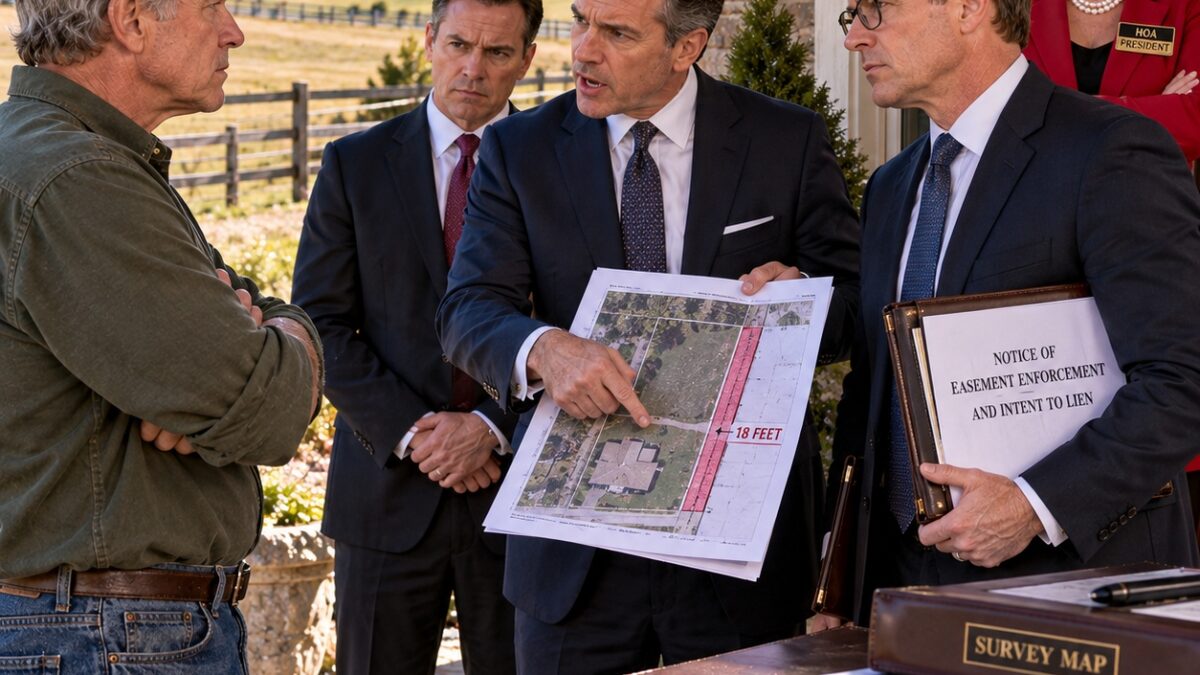
A week later, a rigid cardboard tube appeared at my door.
Hand-delivered.
Inside was a survey.
Bold red shading.
Eighteen feet along my eastern boundary.
The legend called it:
HISTORICAL UTILITY EASEMENT — PRIOR IMPLICIT DEDICATION FOR COMMUNITY BENEFIT
I said the phrase aloud.
“Implicit dedication.”
That is the kind of phrase people reach for when the recorded document they wish existed does not.
Sometimes implied rights are legally meaningful.
Of course.
Land law is full of doctrines that do not fit on bumper stickers.
Prescriptive rights.
Adverse possession.
Implied easements.
Easements by necessity.
Dedication.
But none of those concepts becomes valid simply because a board prints the words in red on a survey.
I drove to the county archives the next morning.
Same building my father used decades earlier when we needed certified copies.
The counters had changed.
The fluorescent lights had not.
I pulled the 1946 deed.
Then every subsequent conveyance.
Each transfer.
Each marginal notation.
Each recorded burden.
I searched for utility easements.
Access rights.
Reservations.
Anything touching that eastern strip.
Nothing.
Not one recorded grant giving the subdivision or its HOA rights over those eighteen feet.
Then I found the amendment.
Twelve years old.
The document the president had been citing.
It expanded internal enforcement authority.
It contained language about easement clarification and community infrastructure.
On first read, it looked legitimate.
Board-adopted.
Signed.
Notarized.
But something was missing.
Recording.
I checked the county index.
No book.
No page.
No instrument number.
I checked the sequence around the date.
Nothing.
The amendment existed in the HOA binder.
It did not exist in the public land records.
That distinction was enormous.
Internal association paperwork can bind people within the scope of the association where lawfully adopted.
It does not automatically burden outside deeded property merely because somebody wishes it did.
I requested a certified search.
The clerk provided a document confirming that no recorded instrument matching the amendment existed in the county’s property records.
I folded it into my briefcase.
Still, I did not contact the president.
Not yet.
I wanted to know how far the association had gone.
So I asked for board minutes.
Specifically:
Minutes authorizing legal action.
Minutes authorizing land acquisition.
Minutes approving litigation spending.
Minutes approving any survey expenditure connected to my property.
If the board intended to seize or burden private land, somebody should have voted.
Somebody should have recorded that vote.
Somebody should have budgeted for it.
No response.
Then the fines started.
Fifty dollars.
Seven days later:
One hundred.
Then two hundred.
Compounding.
A ledger appeared showing an increasing balance.
The letters began mentioning attorney costs.
Then lien rights.
I made a spreadsheet.
Date.
Notice.
Fine.
Cumulative exposure.
Board communication.
My response.
No response.
By then I had stopped thinking about the eighteen feet only as a boundary dispute.
Something else bothered me.
Board members often assume association insurance protects them personally.
Sometimes it does.
Sometimes it does not.
So I requested the association’s insurance declaration page.
The property manager emailed it to me within a day.
He probably believed it was routine.
Most homeowners never ask.
I always have.
What people insure tells you something about what they fear.
The association carried directors-and-officers liability coverage.
Standard enough.
Designed to protect board members when they make decisions within the lawful scope of their duties.
I downloaded the complete policy.
Not the declaration.
The whole thing.
Coverage language.
Endorsements.
Definitions.
Then exclusions.
There it was.
Claims arising from knowing enforcement of unrecorded or invalid governing instruments could fall outside coverage.
I read the clause twice.
Then pulled the amendment again.
Association binder:
Yes.
County record:
No.
If the board continued after receiving direct notice that the instrument was not recorded, members who assumed insurance would stand behind them might discover it would not.
That was the moment the balance shifted.
Not emotionally.
Strategically.
Until then, the president believed the cost curve favored her.
Fine me.
Threaten me.
Hire lawyers.
Stack costs.
Eventually I would decide eighteen feet was cheaper to surrender than litigate.
But if their insurance disappeared because the board knowingly enforced an invalid instrument, the cost curve changed.
Board members could become personally interested very quickly.
I drafted one letter.
Short.
Calm.
I did not mention the insurance exclusion yet.
I asked for written confirmation of the amendment’s recording book and page number.
Ten business days.
That was all.
No reply.
Instead:
NOTICE OF INTENT TO PLACE LIEN FOR UNPAID FINES AND ENFORCEMENT COSTS
I read it.
Set it on the table.
Then looked out toward the eastern fence.
The land itself was unchanged.
Same grass.
Same cedar posts.
Same strip where I had learned to ride a bicycle.
Paper, however, was getting more aggressive.
That was when I knew we had crossed a line.
A mistaken notice can be corrected.
An unrecorded amendment can be investigated.
A lien threat is different.
A lien touches title.
Marketability.
Refinancing.
Sale.
Inheritance.
You do not use that remedy casually.
Not against land your association cannot prove it has authority over.
Then the three attorneys appeared on my porch.
The tallest referenced adverse possession in passing.
Interesting choice.
Then shifted back to the amended covenants.
Another lawyer talked about the association’s right to resolve “boundary ambiguities” for planned infrastructure.
I listened.
No interruptions.
They spoke almost five minutes.
Then I asked one question.
“Which recorded instrument are you relying on?”
The tallest lawyer gave the amendment number.
Confidently.
“Recording book and page?”
Pause.
Brief.
Noticeable.
The second attorney looked down at his portfolio.
The third shifted slightly.
The president’s posture changed behind them.
One attorney said:
“It forms part of the association’s governing documents.”
“That wasn’t my question.”
Silence.
Morning insects buzzed near the shrubs.
A truck passed at the end of the road.
No one spoke.
I stepped inside.
Returned with one sheet.
County-clerk certification.
No recorded instrument matching the amendment.
I handed it to the tallest lawyer.
He read the heading.
Then the certification language.
His expression did not collapse.
Good attorneys rarely react dramatically.
But his shoulders changed.
So did the way the second lawyer looked at the president.
Then I said:
“You may want to advise your client that I serve as an administrative law judge.”
The president blinked.
The third lawyer finally looked directly at me.
“I review procedural compliance for a living.”
No raised voice.
No threat.
Just context.
The president recovered first.
“You’re attempting to intimidate the board.”
“No.”
I looked at her.
“I’m offering you a chance to stop.”
“You’ve been obstructing a legitimate community project for months.”
“I’ve been asking for the document giving you authority.”
“You know exactly what the board adopted.”
“I know what the board adopted.”
I glanced at the certification.
“I also know what the county recorded.”
The tallest attorney intervened.
“Perhaps we should take a short period to review the record.”
“That would be wise.”
The president did not like that.
“You came here to serve notice.”
The lawyer looked at her.
“We’ve served notice.”
He folded the survey.
They left.
No confrontation.
No door slammed.
No dramatic threat.
But I knew something had changed.
Three lawyers had arrived thinking the dispute was about whether I would comply.
They left needing to investigate whether their own client had given them a legally defective foundation.
That is a very different problem.
The HOA meeting was scheduled for the following week.
Word traveled quickly.
Lawyers on porches have a way of improving meeting attendance.
About thirty residents came.
More than usual.
The clubhouse was ordinary.
Folding chairs.
Projector.
Bad coffee.
Air-conditioning slightly too cold.
The president sat at the board table with her binder.
Same posture.
Same controlled expression.
She called the session to order.
Routine items first.
Landscaping budget.
Entrance maintenance.
Architectural updates.
Then she shifted.
“Legacy property compliance.”
That was me.
She never said my name angrily.
That was part of her style.
She talked about modernization.
Fairness.
Uniform standards.
Shared sacrifice.
She described one legacy owner resisting necessary infrastructure planning.
She said the association could not protect property values if individual homeowners refused reasonable accommodation of community needs.
I sat in the third row.
Waited.
Nobody interrupted her.
Neither did I.
This is another thing administrative hearings teach you.
Let the record develop.
People often expose more when they are not fighting interruption.
She spoke for almost ten minutes.
When homeowner comments opened, I stood.
No uniform.
No robe.
No theatrical stack of binders.
A slim folder.
I connected my laptop to the projector.
First slide:
The 1946 deed.
Not the whole thing.
Relevant portion.
Legal description.
Then every subsequent conveyance.
No recorded utility easement.
No eighteen-foot burden.
Then the amendment.
Adoption date.
Internal approval.
Then the county-clerk certification.
No recorded instrument.
I handed paper copies down each row.
People began reading.
A homeowner asked:
“So it was never filed?”
I answered:
“Correct.”
The president leaned toward the microphone.
“It was validly adopted by the association.”
“Internally.”
I pointed at the screen.
“It was never recorded against my property.”
She started to answer.
I continued before the discussion dissolved into competing interpretations.
Next slide:
D&O policy.
Not the whole thing.
Relevant exclusion.
I read it aloud.
Claims arising from knowing enforcement of unrecorded or invalid governing documents could be excluded.
The treasurer shifted.
I saw it immediately.
Treasurers understand numbers.
Insurance exclusions are numbers waiting to happen.
I explained in plain language.
“If the board proceeds after receiving actual notice that the instrument has not been recorded, your carrier may argue that you knowingly acted outside valid governing authority.”
I did not say:
You will lose coverage.
That would have been too absolute.
I said:
“You may be personally exposed.”
The room went quieter.
The president frowned.
“This is fearmongering.”
“No.”
I looked toward the board.
“It is the policy language you purchased.”
Then I put up the lien statute.
Wrongful encumbrance.
Attorney-fee recovery.
Statutory damages available under the applicable provisions.
Again, I was careful.
No exaggerated numbers.
No guarantee of outcome.
Just law.
Then I explained the sequence.
Unrecorded amendment.
Fines based on it.
Lien notice.
Written notice of the recording defect.
Continued enforcement.
Potential insurance exclusion.
Potential individual exposure.
One board member asked:
“Would you sue us personally?”
I answered honestly.
“If you proceed, I will file for declaratory judgment and name individual board members where legally appropriate.”
No threat in my tone.
No anger.
Just consequence.
“Why individual?”
“Because after actual notice of the defect, the question becomes whether each decision remains within protected board authority.”
The treasurer looked toward counsel.
The president said:
“This is intimidation.”
I shook my head.
“Intimidation is telling somebody you’ll take eighteen feet of deeded land unless he accepts an instrument you cannot produce in the county record.”
That was the sharpest sentence I used all night.
Then I stopped.
Silence did more.
The board attorney requested a recess.
Ten minutes.
It became twenty.
Residents stood.
Whispered.
Read the insurance excerpt.
Read the clerk certification.
One homeowner asked me:
“Could they really lose coverage?”
“I said they might.”
“What does that mean?”
“It means the carrier decides whether the conduct falls inside the exclusion.”
“Would you fight that too?”
“I wouldn’t need to. The board members would.”
He stared at the policy.
That was the moment many residents understood the stakes.
Up until then, the fight had been easy to treat as:
Old property owner versus modernization.
Now:
Association dues paying lawyers to pursue an unrecorded claim that might leave individual directors without coverage.
That is a different conversation.
The meeting resumed.
The president did not withdraw anything that night.
Not formally.
She said counsel needed additional time.
Fine.
I was not in a hurry.
The lawyers called me privately two days later.
Different tone.
No porch.
No survey map.
No language about inevitable enforcement.
Measured.
Collegial.
One attorney said:
“We’ve reviewed the recording history.”
“I assumed you would.”
“We believe there may be a practical way to resolve the boundary issue without further expense.”
There it was.
Not:
You were right.
Not:
Our client was wrong.
Lawyers rarely begin there.
They proposed:
Lien notice withdrawn.
Disputed strip remaining as historically deeded.
No further enforcement.
Mutual clarification of boundary expectations.
No admission of fault.
I let them finish.
Then said:
“I have three conditions.”
Silence.
“Written acknowledgement that no recorded easement currently exists over my property.”
The lawyer started to respond.
I continued.
“All fines formally rescinded.”
Another pause.
“And reimbursement of my reasonable legal consultation expenses incurred reviewing your notices, survey claim, and proposed lien.”
The first attorney said:
“The association is concerned about optics.”
“I’m concerned about title.”
“The board may view reimbursement as precedent.”
“Discovery creates precedent too.”
Silence.
I continued.
“If this becomes litigation, board communications will be discoverable.”
No response.
“Amendment history.”
Silence.
“Insurance communications.”
Longer silence.
“Internal discussions after I notified you the amendment was unrecorded.”
One lawyer exhaled.
I did not need to raise my voice.
The statute was doing the work.
The documents were doing the work.
I was simply describing what litigation would require.
One attorney said:
“We’ll take that back.”
“Good.”
Forty-eight hours later, revised draft.
Clean.
No decorative language.
No community vision.
No implied dedication.
The association acknowledged there was no recorded easement over my property.
The lien notice was withdrawn.
Fines rescinded.
Legal consultation costs reimbursed.
Every board member signed.
I signed.
No courtroom.
No press.
No judge ruling from a bench.
Ink on paper.
That is how many good legal outcomes actually look.
Boring.
Specific.
Final.
The eighteen feet remained exactly where they had always been.
Mine.
I walked the boundary that evening.
Not because the agreement changed the land.
Because I needed to remind myself the whole fight had happened around something physically silent.
The cedar posts did not know.
The grass did not know.
The old boundary marker sat in the same place it had sat before the president learned the phrase implicit dedication.
That is what property disputes do.
They create enormous emotional pressure around physical facts that remain indifferent.
The title had not shifted.
The county index had not changed.
What changed was the association’s willingness to pretend those facts could be stretched.
I could have stopped there.
Many people expected me to run for the board.
Residents asked.
Several times.
“You understand the documents.”
“You’d win.”
“We need someone who knows procedure.”
No.
I was not interested.
Running would have turned the dispute into a contest for authority.
It never was.
I did not want the president’s chair.
I wanted guardrails around whoever sat in it.
That distinction mattered.
Authority attracts the wrong people when winning a dispute becomes qualification for wielding more authority.
I had spent my career reviewing government actors.
The best systems do not depend on having the best person in every chair.
They make it difficult for a bad decision to travel too far before somebody has to verify it.
So at the annual meeting, I did not nominate myself.
Attendance doubled anyway.
People who had never cared about quorum suddenly cared.
Amazing what an attempted lien can do for civic engagement.
New business.
A neighbor stood.
Introduced a motion.
Any future enforcement involving:
Liens.
Boundary claims.
Property acquisition.
Easement claims.
Or litigation funding.
Would require independent legal review before formal board action.
Not internal board interpretation.
Not one committee chair.
Independent counsel.
Written opinion where appropriate.
I seconded.
The discussion was sober.
No one said my name.
No one needed to.
A homeowner asked whether the rule would slow enforcement.
“Yes,” someone answered.
Another resident said:
“Maybe some things should be slow.”
That line received quiet agreement.
The motion passed by a clear majority.
That was the reform I wanted.
Not:
Never enforce anything.
Not:
Homeowners always win.
Just:
If you are about to burden title, threaten a lien, claim somebody’s land, or spend community money on litigation, stop and make sure the authority exists.
That should not be controversial.
Yet we had needed three lawyers on my porch to learn it.
Three months later, the president resigned.
“Professional commitments.”
That was the phrase in the email.
No confession.
No apology.
No dramatic final board meeting.
No moving truck surrounded by neighbors.
She resigned.
The neighborhood continued.
Lawns were cut.
Trash bins rolled out.
Packages arrived.
Children rode bicycles.
Someone complained about paint color.
Someone else complained about that complaint.
Life.
The biggest change was almost invisible.
People stopped assuming a confident interpretation was the same as a lawful one.
At meetings, residents began asking:
“Is that recorded?”
“Has counsel reviewed it?”
“Which section?”
“What vote?”
Some board members found that annoying.
Good.
A little procedural friction is healthy.
Rules affecting homes and property should survive questions.
The new board created a checklist.
I heard about it later.
Any action touching title required:
Source document.
Recording reference.
Board authority.
Legal review.
Insurance implications.
Notice procedure.
It fit on one page.
One page might have prevented the entire fight.
That is how governance often works.
The expensive lesson produces a cheap checklist.
I liked that.
My legal costs were reimbursed within thirty days.
Not enormous.
I had not hired a litigation team.
Mostly consultations.
Document review.
Still, reimbursement mattered because it completed the principle.
I had not created the defective claim.
I should not have paid to explain it to the people enforcing it.
That said, I never asked for punitive money.
Never pursued damages after settlement.
Could I have filed?
Perhaps.
Would I have won everything?
No legal outcome is guaranteed.
But I had what I wanted.
Land secure.
Lien gone.
Record corrected.
Guardrails added.
The president leaving was incidental.
I did not need more.
People underestimate the cost of extended conflict even when you are right.
Time.
Sleep.
Attention.
Relationships.
Every new filing keeps the other side alive in your day.
I wanted my eastern boundary back as a boundary.
Not a case file.
After settlement, I put the documents into one archive box.
1946 deed copy.
County certification.
Survey.
HOA letters.
Insurance policy.
Settlement.
Then I carried the box to my office closet.
Not the kitchen table.
That movement mattered.
Emergency becomes archive.
Archive becomes history.
History stops deciding what you think about every morning.
I walked the property more often afterward.
Maybe because I had spent months looking at it through documents.
The eastern strip remained ordinary.
Grass.
Old posts.
The slight dip where rainwater collected after storms.
A few trees along the far edge.
Nothing about it looked worth three attorneys.
But land disputes are rarely about whether dirt looks special.
They are about what someone else can do once a precedent exists.
If I had surrendered eighteen feet under an unrecorded “clarification,” what came next?
Utility trench?
Access road?
Permanent equipment?
Another amendment?
Maybe nothing.
Maybe something.
That was the point.
Once title becomes negotiable by internal committee interpretation, you no longer own the same property.
My grandfather paid cash for that ground.
My father maintained it.
I inherited both the benefit and the responsibility.
I was not going to casually let an association redefine the deed because litigation looked expensive.
That is how weak claims become permanent.
People do not always lose rights in court.
Sometimes they give them away because defending them feels inconvenient.
There is no shame in settling disputes.
Settlement is often smart.
But you should know what you are settling.
The president wanted me to settle the existence of the boundary.
I settled the conflict instead.
The boundary stayed.
Big difference.
My son was old enough by then to understand some of it.
Not every technical detail.
Enough.
He had watched the certified envelopes arrive.
Seen lawyers on the porch.
Asked why people wanted our land.
I had tried not to turn the HOA president into a villain in his mind.
That matters with children.
They hear absolutes easily.
“She thinks the HOA has a right.”
“Does it?”
“No.”
“Then she’s lying.”
“Not necessarily.”
He frowned.
“How?”
“She may believe she’s right.”
“But she isn’t.”
“People can sincerely be wrong.”
He thought about that.
“Then why doesn’t she stop?”
Good question.
“Because stopping gets harder after you’ve committed publicly.”
That may have been the most important explanation I gave him.
Human beings protect positions long after the evidence weakens them.
Especially leaders.
Especially when changing course feels like losing status.
Good process gives people permission to correct without humiliation.
Bad process rewards doubling down.
The president had built an identity around modernization and decisive leadership.
My old property became symbolic resistance.
That made a small boundary claim harder for her to reassess.
By the time lawyers appeared, she probably no longer saw eighteen feet of dirt.
She saw whether the board could make me obey.
I saw exactly the opposite.
Whether property ownership meant anything when institutional pressure arrived.
Neither side was really arguing about landscaping anymore.
That is why the insurance exclusion mattered so much.
It transformed the board’s emotional investment into personal risk.
People become philosophical about authority when insurance is paying.
Much less philosophical when coverage might disappear.
I do not say that cynically.
It is simply governance.
Insurance exists because decision-makers can make mistakes.
Exclusions exist because some mistakes become choices after notice.
Once I had told them:
This amendment is not recorded.
And produced the county certification, the board could no longer claim complete ignorance.
Continuing after that point changed the risk.
Their lawyers understood immediately.
The president did not.
Or did not want to.
One former board member spoke to me months later.
We met near the mailboxes.
He said:
“When you read the insurance exclusion, that was when I knew we had to stop.”
“Why?”
“I thought worst case, the association gets sued.”
“And?”
“You made me realize worst case could be my name.”
Exactly.
Boards are corporations or associations.
But directors remain human.
They go home.
They have mortgages.
Retirement accounts.
Families.
Personal exposure focuses attention.
That is why fiduciary duties matter.
Not to frighten volunteers.
To remind them that being unpaid does not make decisions consequence-free.
I told him:
“You did stop.”
He nodded.
“I should’ve asked earlier.”
“Yes.”
He laughed.
“I appreciate your mercy.”
“It’s not mercy.”
“What is it?”
“Accuracy.”
He had made a mistake.
Then voted to correct it.
That was the complete record.
I did not need to turn him into something worse.
My professional work influenced that attitude.
Administrative cases are full of people who want moral certainty.
Good agency.
Bad citizen.
Bad agency.
Good citizen.
Reality is often less satisfying.
A clerk misunderstands a rule.
A supervisor signs the wrong form.
A board relies on a bad amendment.
Then somebody doubles down.
The legal question is not:
Who is evil?
It is:
Who had authority?
What procedure applied?
What notice was given?
What record exists?
What remedy follows?
That discipline keeps disputes from becoming personality trials.
I needed it during the HOA fight.
The president irritated me.
Of course.
Some letters were condescending enough that I had to walk away before responding.
The porch appearance was designed to pressure.
The lien threat was serious.
Still, anger did not strengthen the deed.
County records did.
That became the lesson I repeated to neighbors.
Do not improve a good case with bad emotion.
Use the strongest thing you have.
If it is a deed, use the deed.
If it is a survey, use the survey.
If it is a recording defect, use the index.
If the other side is wrong, you do not need to invent motives.
The president’s motive was ultimately irrelevant.
Maybe she wanted control.
Maybe she genuinely believed modernization required the strip.
Maybe attorneys had given incomplete advice based on incomplete documents.
Maybe all three.
The outcome depended on authority, not psychology.
That distinction also protected me from obsession.
If I had spent months trying to prove she personally wanted my land, I might still be arguing.
Instead:
No recorded easement.
Done.
The new guardrail motion became more important with time.
Another issue arose the following year.
Different property.
A drainage easement.
The board believed it had access rights.
Under the new rule, counsel reviewed before enforcement.
Turns out the easement existed.
Recorded correctly.
The homeowner objected.
Lost.
But because the board had the document and followed notice procedure, the dispute ended without catastrophe.
I heard about it secondhand.
That pleased me.
Guardrails are not designed to make homeowners win.
They are designed to make legitimate authority easier to distinguish from assumed authority.
That case proved the system was working.
The board had rights.
They showed them.
Homeowner complied.
No three attorneys on a porch.
No insurance scare.
No threatened wrongful lien.
That is success.
My son eventually asked why I never joined the HOA board.
“We could make sure they don’t do it again.”
I smiled.
“The system should make sure.”
“What if bad people get elected?”
“Then rules matter even more.”
“What if they ignore the rules?”
“Then somebody pushes back.”
“You?”
“Maybe.”
He looked satisfied.
I was less certain.
There is always another generation of conflict.
You cannot personally patrol every institution forever.
The goal is to leave structures stronger than you found them.
That was what the independent-review requirement did.
Not perfect.
Better.
Three months after the president resigned, the neighborhood Facebook page looked almost normal again.
Lost dog.
Garage sale.
Landscaping recommendation.
Somebody angry about speeding.
The phrase property value optimization disappeared.
I did not miss it.
Modernization continued anyway.
Entrance sign repainted.
Streetlights upgraded.
People renovated houses.
Nothing collapsed because one old property remained outside an invented easement.
That was another useful lesson.
Organizations often frame resistance as existential.
If we cannot do this, the community cannot function.
Usually false.
The HOA did not need eighteen feet of my family land to survive.
It wanted flexibility.
Desire became necessity because necessity sounded stronger.
Once denied, the neighborhood adapted.
That happens all the time.
My property did not block progress.
It simply required progress to respect title.
There is a difference.
I repaired the eastern fence the next spring.
One old cedar post had finally rotted.
I pulled it.
Set a new one.
My son helped.
I almost laughed when I realized we were working within the disputed strip.
For months, attorneys had discussed it in abstract language.
Utility planning.
Implicit dedication.
Future infrastructure.
To me, that afternoon, it was dirt deep enough to hold a post.
My son packed soil around the base.
Asked:
“This one on our side?”
“Yes.”
“How do you know?”
I almost said:
Because I won.
That would have been the wrong answer.
I walked to the house.
Brought back the survey.
Showed him.
“This.”
He followed the line with his finger.
“Not because the HOA said?”
“No.”
“Not because you said?”
“No.”
“Because it’s recorded?”
“Because the deed, survey, and records all agree.”
He nodded.
That was the lesson.
Authority does not become trustworthy merely because it belongs to the person you like.
My conclusion needed evidence too.
That matters when teaching children about boundaries.
Otherwise you simply replace one form of “because I said so” with another.
The county clerk later recognized me when I returned for unrelated records.
“Eighteen-foot man.”
I laughed.
“Is that what I’m called?”
“Only here.”
“Excellent.”
She had seen stranger disputes.
Property offices always have.
Neighbors fighting over inches.
Driveways.
Trees.
Old easements.
She said:
“You’d be amazed how many people come in after the fight starts.”
“I came after the fight started.”
“You came before court.”
“Fair.”
Then:
“Most people don’t read closing documents.”
“I know.”
She shook her head.
“We keep them anyway.”
That sentence stayed with me.
Records exist for future conflict even when nobody knows which future conflict.
My grandfather could not have imagined an HOA.
He could not have imagined a Facebook group arguing about cohesive visual standards.
Yet the deed he accepted in 1946 remained stronger than every modern presentation.
Continuity.
That is what recording systems provide.
They let dead people and future people speak through the same chain.
Not emotionally.
Precisely.
I value that.
The settlement agreement went into the same family property file.
Future generations will know.
No recorded HOA easement.
Eastern strip remains deeded.
Any later change requires an actual legal instrument.
No rediscovery necessary.
That may be the most satisfying part.
Not winning for myself.
Reducing the chance my son has to repeat it.
The president’s resignation eventually became uninteresting.
At first, neighbors talked.
Why did she leave?
Was it because of me?
Professional commitments?
Embarrassment?
Pressure?
I did not speculate.
She said professional commitments.
Fine.
I had spent enough time on what documents said.
I was not going to replace that discipline with gossip at the end.
Maybe the dispute influenced her.
Maybe it did not.
The result mattered more.
New leadership.
More cautious procedures.
Independent review.
Life continued.
No need to invent a dramatic downfall.
That is another thing viral stories often get wrong.
They want the antagonist destroyed.
Real life is usually better when people simply stop having the power to hurt you.
She did.
That was enough.
I still saw her occasionally before she moved or became less involved.
We exchanged nods.
Nothing else.
No apology.
I never asked.
My boundary did not require emotional closure.
It required legal clarity.
Those are different.
One can exist without the other.
That realization saved me from waiting on something she might never give.
I had already received the important acknowledgement.
Signed by all board members.
No recorded easement.
Fines rescinded.
Lien withdrawn.
My title clean.
Ink matters more than an apology in a property dispute.
The annual meeting guardrail passed with a clear majority.
That was the community’s apology in a sense.
Not to me personally.
To itself.
We made it too easy for authority to expand without verification.
We are making it harder.
That is a mature response.
Better than pretending only one person was responsible.
The president drove the claim.
But board members voted.
Management processed fines.
Attorneys were hired.
Residents ignored meetings.
Systems fail collectively even when one person is louder.
Repair also requires more than removing one person.
That was why I cared more about the motion than the resignation.
People who focus only on leaders miss the structure that allowed the leader to act.
If the next president inherited the same unchecked authority, nothing important would have changed.
Now:
Liens required review.
Boundary claims required review.
Litigation spending required review.
Property acquisition required review.
That was structural.
I could live with that.
One afternoon, years later, I found one of the original violation letters in a desk drawer.
I had filed copies elsewhere.
This one had escaped.
ENCROACHMENT.
Bold.
Certified-mail sticker.
The president’s signature.
I read it.
The tone felt heavier than the actual page.
At the time, opening those envelopes had tightened my chest.
Now it looked like what it was.
Paper making a claim.
Claims are not self-proving.
That is another lesson.
People see letterhead and assume conclusion.
Do not.
Read.
Verify.
Respond.
A letter is the beginning of a record, not the end of one.
I shredded the duplicate.
Did not need it.
The original remained archived.
Some documents deserve preservation.
Duplicates do not deserve emotional real estate.
That act felt good.
My son was older by the time we walked the entire property line together.
Almost the age I had been when Dad first made me read metes and bounds.
I carried the deed.
He carried a steel tape.
Not because we needed to resurvey.
Tradition.
We started at the old reference point.
Walked north.
Then east.
I showed him how descriptions work.
Bearing.
Distance.
Marker.
Next course.
He read aloud.
Stumbled over some of the terminology.
I made him start the line again.
He complained.
Exactly as I had.
“You know GPS exists.”
“Yes.”
“So why are we doing this?”
“Because GPS doesn’t teach you what the deed means.”
He rolled his eyes.
I smiled.
Dad would have enjoyed it.
When we reached the eastern strip, I stopped.
The eighteen feet.
He knew the story by then.
Everyone did.
But I did not tell it like a victory story.
I showed him the marker.
Then the old fence.
Then the survey.
“See?”
He nodded.
“What did they want to do?”
“Treat this as a utility easement.”
“Was it?”
“No.”
“Could they have made it one?”
“With agreement.”
“Would you have agreed?”
I looked across the land.
“Depends what they wanted.”
He seemed surprised.
“You fought them.”
“I fought the claim that they already owned the right.”
“That’s different?”
“Completely.”
That distinction matters.
Property ownership does not mean refusing every request.
It means the choice remains yours unless lawfully transferred.
If the HOA had approached honestly:
We need eighteen feet for a utility.
Here is the plan.
Here is compensation.
Here are construction limits.
Here is the recorded easement we propose.
Maybe we negotiate.
Maybe I say no.
But the process starts from truth.
What they did instead was pretend the right already existed.
That removed choice.
That was why I pushed back.
My son thought about it.
“So this wasn’t really about the dirt.”
“No.”
“What was it about?”
“Consent.”
He nodded.
That was close enough.
We kept walking.
The same route my father and I had taken.
Past the place where I had fallen from my bicycle.
Past cedar posts replaced three times.
Past the corner where the old dirt road once ran.
The subdivision was visible through the trees.
Roofs.
Trimmed lawns.
Newer world beside older ground.
Neither needed to defeat the other.
They simply needed a line both respected.
That is what boundaries are for.
People think boundaries divide.
Sometimes they protect cooperation.
If I know where mine ends and yours begins, I can help you without fearing the favor will become a claim.
I can say yes voluntarily.
I can say no without being accused of theft.
Clear boundaries make generosity safer.
That was the lesson hidden beneath the whole dispute.
My grandfather’s land survived not because our family hated change.
We adapted constantly.
Roads.
Utilities.
Development.
Taxes.
Technology.
What survived was the principle that change does not erase ownership by implication.
If someone wants a legal interest, record it.
If a board wants authority, identify it.
If a policy affects title, review it.
If you threaten a lien, make sure your foundation is stronger than confidence.
The HOA president brought three lawyers to my porch because she believed scale created legitimacy.
Three suits.
Three portfolios.
Survey map.
Notice.
Lien language.
The whole presentation said:
This is inevitable.
But inevitability is not a legal doctrine.
Recording is.
Jurisdiction is.
Procedure is.
Evidence is.
Once those entered the conversation, the performance changed.
The lawyers adjusted first.
Professionals usually do.
Their job is not to preserve a client’s pride.
It is to assess risk.
When I produced the clerk certification, they understood the question immediately.
The president heard challenge.
They heard exposure.
That difference saved everybody money.
Had her lawyers simply echoed her certainty forever, we would probably have ended in court.
Instead, they eventually called with a practical resolution.
Good counsel does not guarantee clients win.
Good counsel tells clients when continuing is expensive.
I respected them for that.
Even after the porch.
Especially after.
One attorney later said privately:
“We were given the amendment as though it had been recorded.”
“I assumed.”
“That changed once we checked.”
“Yes.”
He paused.
“You could’ve told us before we came.”
“I asked your client for the book and page.”
Fair.
No hostility.
That was the end.
There is no need to make every opposing lawyer a villain.
They are often working from the record provided.
When the record changes, good lawyers change advice.
That is the system working.
The president had less flexibility because the claim had become part of her identity.
That is human.
Not unique to HOA presidents.
Judges do it.
Lawyers.
Sheriffs.
Parents.
Anyone.
We become attached to being right.
Procedure exists partly to protect everyone from that attachment.
Independent review.
Appeals.
Written findings.
Records.
Guardrails.
That is why I wanted those things after the dispute.
Not because I distrusted every future board member.
Because I distrust every human being, including myself, just enough to value process.
When I sit as an administrative law judge, I am not infallible.
My decisions can be reviewed.
They should be.
Authority without review rots quickly.
The neighborhood learned a small version of that.
The architectural committee could recommend.
Board could act.
But high-risk actions needed outside review.
Healthy.
Some residents complained it would increase legal expenses.
Maybe.
A thirty-minute legal review costs less than a wrongful lien case.
Prevention often looks expensive until compared with repair.
Our case had already shown the difference.
Three attorneys on a porch.
County research.
Insurance analysis.
Settlement negotiations.
Reimbursement.
All because nobody asked the county clerk the simplest question early enough.
Is the amendment recorded?
The answer cost almost nothing.
Ignoring it cost much more.
I taught that lesson at one neighborhood meeting without meaning to.
Someone proposed a new rule affecting shared access.
A homeowner asked:
“Should counsel look at this first?”
The treasurer sighed.
“Do we really need to pay a lawyer every time?”
I said from the back:
“Not every time.”
People turned.
“Only when you’re about to tell somebody what they own.”
Laughter.
Then agreement.
The rule went to review.
No issue.
Passed.
That is the kind of institutional memory I wanted.
Not fear of litigation.
Respect for scope.
Three years after the dispute, someone repainted the clubhouse.
New color.
Nobody asked my opinion.
Good.
I did not want to become the neighborhood oracle.
People occasionally came to my door with HOA questions.
I usually disappointed them.
“Can they make me remove this?”
“Read the rule.”
“I thought you’d know.”
“I don’t know your section.”
“But you’re a judge.”
“That does not make me your free lawyer.”
Then I usually helped them find the document anyway.
Occupational weakness.
Most disputes were ordinary.
A fence really too tall.
An unapproved shed.
A parking violation.
Not every notice hides a constitutional crisis.
That was another important lesson.
Because my HOA had been wrong about eighteen feet did not mean it was wrong about everything.
Do not become the person who treats one proven overreach as evidence all authority is fake.
That is intellectually lazy.
The correction should make everyone better.
Board more careful.
Homeowners more informed.
Not permanently hostile.
Our neighborhood mostly managed that.
Attendance stayed higher for a while.
Then gradually dropped.
Normal.
People have lives.
But quorum mattered more.
Minutes improved.
Insurance declarations were easier to access.
The governing documents got organized online.
The unrecorded amendment was either properly limited or replaced with language consistent with recorded authority.
Nobody tried to use it against my parcel again.
Good.
The system learned enough.
I did not need perfection.
My property file now contains four generations of paper.
Grandfather’s deed.
Father’s notes.
My surveys.
Settlement.
Someday my son’s records.
There is something humbling about that.
You spend months feeling like the central figure in a property dispute.
Then you look at a deed from 1946.
You are temporary.
The land will outlast your ego.
That thought kept me calm more than once.
The president wanted modernization.
Fine.
Modernize.
The subdivision will change again.
Electric vehicles.
Fiber lines.
New utilities.
Different landscaping.
Maybe one day someone genuinely needs access across the eastern side of my property.
If I am alive, they can ask.
If my son owns it, ask him.
Maybe it makes sense.
Maybe compensation makes sense.
Maybe the public benefit is real.
Nothing about this story means land should never carry easements.
It means easements should exist legally before people enforce them.
That is all.
Simple enough.
Apparently difficult enough to require months of certified mail.
One afternoon, my son asked if I still had the original insurance policy.
“Yes.”
“Why?”
“Record.”
“They changed companies.”
“I know.”
“So it doesn’t matter now.”
“It mattered then.”
He shook his head.
“You save everything.”
“My father saved nails.”
“He was weird too.”
Probably.
I showed him the exclusion.
Explained why it mattered.
Not because I wanted him to become suspicious of every institution.
Because contracts contain boundaries just like deeds.
What looks like protection may stop at conduct outside authority.
Read exclusions.
Read end dates.
Read definitions.
The important words are often the ones nobody puts in a summary.
The HOA president loved summaries.
Community easement.
Historical use.
Modernization authority.
The county record was less elegant.
No instrument.
That was enough.
Years after the settlement, I ran into the former president at a local event.
We had not spoken in a long time.
She recognized me.
I recognized her.
We exchanged a polite greeting.
That was all.
No confrontation.
No apology.
No speech.
I did not need to remind her of the eighteen feet.
The land had already done that.
I went home.
That encounter confirmed something.
Conflict becomes smaller when the underlying issue is actually resolved.
If I had accepted a vague settlement, maybe resentment would have remained.
Instead:
Written acknowledgment.
No easement.
Fines gone.
Costs reimbursed.
Guardrails.
Clear.
Nothing left to renegotiate emotionally.
That is why precise settlements matter.
Ambiguity is where future resentment breeds.
The final document was plain.
No admission of wrongdoing.
Fine.
I did not need the board to say:
We behaved terribly.
I needed them to say:
No recorded easement exists.
That was the legal fact.
Everything else was commentary.
One evening I walked the boundary alone.
My son was away.
Sun low.
The eastern strip glowed gold.
I stopped where Dad had once made me read the deed.
I could hear his voice in memory.
Read it again.
Not sentimental in the moment.
He was impatient.
I was ten.
I wanted to ride my bike.
He made me read bearings.
At the time it felt pointless.
Decades later, three attorneys stood on my porch claiming authority over the same strip.
Maybe that is why the story still matters to me.
Not because I outsmarted an HOA.
Because a lesson my father gave me before I was old enough to appreciate it eventually protected what his father built.
Understand the line.
Not emotionally.
Literally.
Know where it is.
Know what burdens it.
Know what does not.
Then do not let somebody else’s confidence redraw it.
The neighborhood annual meeting after the president resigned lasted forty-seven minutes.
I know because somebody joked afterward that it was a record.
Budget.
Landscaping.
Reserve study.
Pool maintenance.
No one threatened a lien against an eighty-year-old deed.
Excellent meeting.
Boring governance is underrated.
People think leadership should feel decisive.
Sometimes the best leadership is forcing everyone to slow down before they make an irreversible mistake.
The new president was less charismatic.
Good.
Asked counsel questions.
Better.
Read minutes carefully.
Wonderful.
Nobody used phrases like property value optimization for months.
A gift.
I never learned whether the former president understood the deeper problem.
Maybe she still believed the HOA should have gotten the land.
Fine.
Understanding is not required for compliance.
That is another reason law exists.
We do not need universal agreement.
We need enforceable boundaries.
She could believe the eighteen feet should serve the community.
I could believe otherwise.
The deed answered ownership.
If the community wanted a future right, negotiation could answer that.
No personal conversion required.
The guardrail motion became part of the standing policy.
I kept a copy.
Not because I feared repeal.
Because it was proof of something good coming out of conflict without pretending the conflict itself was good.
The board had overreached.
The community responded by making overreach harder.
That is mature institutional repair.
Not revenge.
Not mythology.
Guardrails.
The last time I walked the fence line with my son, I handed him the tape.
Same kind my father had carried.
Steel.
Old-fashioned.
He laughed.
“Seriously?”
“Seriously.”
We measured between two markers.
Close enough.
The survey already existed.
This was not about accuracy.
It was ritual.
I told him:
“Grandpa bought this in 1946.”
“I know.”
“Two months after he came home.”
“I know.”
“He built the first fence himself.”
“I know.”
“You know everything now?”
“Pretty much.”
“Then read.”
I handed him the deed.
He sighed.
Started reading.
Metes and bounds.
Distances.
Directions.
He stumbled.
Started again.
When we reached the eastern boundary, I stopped.
Pointed to the ground.
“This is the eighteen feet.”
He looked at it.
“That’s it?”
“That’s it.”
“It doesn’t look like much.”
“No.”
“Why did they want it?”
“Future utility access.”
“Why didn’t they just ask?”
I smiled.
“That’s the whole story.”
He looked toward the subdivision.
Then back at me.
“What did they lose?”
I thought about the lawyers.
Lien notice.
Insurance exclusion.
Settlement.
President’s resignation.
Annual meeting.
Guardrails.
Then I answered:
“Not land.”
He waited.
“They lost the assumption that nobody would make them prove what they claimed.”
He nodded.
That was closer to the truth than any headline.
They came to take eighteen feet of my grandfather’s property.
They left the land exactly where it had always been.
What changed was the neighborhood.
People read.
Board members asked questions.
Liens became serious again instead of rhetorical weapons.
Boundary claims needed evidence.
Legal review happened before enforcement instead of after.
And my son learned the same lesson my father taught me when I was ten.
Property lines are not suggestions.
Procedure is not decoration.
Authority does not become real because three lawyers stand on your porch and say the same thing.
If someone claims a right over land your family has carried for generations, you do not have to scream.
You do not have to threaten.
You do not have to become more intimidating than they are.
You ask for the record.
Book.
Page.
Instrument.
Vote.
Authority.
Then you wait.
Because sometimes the strongest response to people who believe nobody will challenge them is simply forcing them to finish the sentence.
“Under what recorded right?”
If they have one, you deal with it.
If they do not, no amount of letterhead can manufacture it after the fact.
The HOA president believed eighteen feet of my grandfather’s land was the easiest place to expand her modernization plan.
She was wrong.
Not because I was an administrative law judge.
Not because I knew insurance exclusions.
Not because I could quote lien statutes.
Those things helped.
She was wrong because the deed had been right the entire time.
All I did was make everyone read it.
Years later, when I walk that line, I do not think first about her.
I think about my father.
Steel tape in his hand.
Folded deed in his back pocket.
Ten-year-old me impatient to get back on my bicycle.
“Read it again.”
So I did.
And decades later, when three attorneys arrived with a red stripe drawn across the same ground and told me the community had “clarified” ownership, the answer was already waiting in a county record older than their entire association.
They came to take eighteen feet.
They lost something else instead.
The illusion that procedure could be stretched until it became ownership.
And that illusion never came back.


