PART2:HOA President Targeted My Family Until Our House Burned—Months Later, She Walked Into My Courtroom and Faced Her Own Records
PART2
The first violation notice arrived two days after the lawn confrontation.
Thin envelope.
Maple Ridge logo in blue.
NOTICE OF NON-COMPLIANCE.
Mailbox color.
“Non-approved beige.”
Ten-day cure period.
Fifty-dollar fine.
I went to the HOA website.
Downloaded the architectural guidelines.
Printed the mailbox section.
Approved color:
Sandstone.
I carried the page outside the next morning.
Held it beside the mailbox.
Rebecca stood behind me drinking coffee.
“Well?”
I squinted.
“If these colors are different, we need laboratory equipment.”
She looked from the paper to the mailbox.
“Maybe one is emotionally beige.”
I laughed.
Then photographed them together.
Front.
Side.
Close-up.
Date stamp.
I sent the response by certified mail.
Not because fifty dollars threatened us.
Because the notice created a record.
I asked for the inspection date.
Photographic evidence.
The exact rule cited.
No answer.
Three days later:
Second violation.
Hairline cracks in the driveway.
I walked the concrete.
Two thin lines near the expansion joint.
Normal.
No trip hazard.
No structural failure.
I checked the rules.
Nothing requiring crack-free concrete.
I responded again.
Certified.
Please identify the applicable standard.
Photographic evidence.
Inspection methodology.
Board authorization.
No direct answer.
Then holiday lights.
Forty-eight hours beyond the approved removal window.
That one was technically closer.
We had left a strand around the porch two days longer than permitted after New Year’s.
Fair enough.
But neighboring houses still had lights up.
Three on our street.
One across from Diane’s own house.
I photographed those too.
Not because I planned to accuse.
Because patterns become visible only if somebody records them.
Letters came faster.
Fine.
Interest.
Administrative charge.
Then another.
I paid nothing.
Not because I thought rules did not apply.
Because the association refused to demonstrate that they were applying them consistently.
Rebecca watched my folder grow.
“You’re litigating our mailbox.”
“I’m documenting our mailbox.”
“Different?”
“Emotionally.”
She smiled.
We joked because at that point it still felt petty.
Then neighbors started asking questions.
Not directly.
Carefully.
One afternoon, a man from three doors down said:
“Everything okay?”
“Yes.”
“Just heard you’ve got some kind of legal issue with the HOA.”
“I’ve asked for documents.”
He nodded.
Looked uncomfortable.
“Right.”
Then left.
Another neighbor who usually waved from his garage suddenly became deeply interested in reorganizing a socket set whenever I walked by.
Someone told Rebecca there was a rumor I planned to sue the board.
I had threatened nobody.
I had filed nothing.
I had asked for records.
That distinction began to matter.
Pressure does not always arrive on letterhead.
Sometimes it arrives as silence from people who used to talk to you.
I recognized the tactic because I had seen versions of it in litigation.
Create administrative pressure.
Then social pressure.
Make the person feel isolated enough that compliance becomes cheaper than resistance.
So I went to the statute.
Under our state’s homeowner-association disclosure provisions, members were entitled to inspect specified association records.
I submitted a formal financial-record request.
Budgets.
Reserve statements.
Board minutes.
Enforcement policy.
Fine schedules.
Meeting records.
Weeks passed.
Then a partial response.
Summaries.
Not originals.
Broad categories.
One category caught my attention.
Emergency Remediation Reserve.
The balance had nearly doubled from the prior year.
No explanation in the meeting summaries.
No recorded vote that I could find authorizing the increase.
No corresponding project.
I wrote again.
What was the purpose of the reserve increase?
What meeting approved the transfer?
Please provide minutes.
Silence.
Then a property-management email.
The association maintains discretion to manage reserves in accordance with community needs.
That did not answer the question.
I sent another certified request.
Rebecca watched me seal the envelope.
“Do you ever get tired?”
“Of envelopes?”
“Of being correct.”
“That hasn’t happened yet.”
She laughed.
But I could see worry behind it.
Because our home was beginning to feel watched.
The anonymous complaints started soon afterward.
Someone reported our garbage bins as visible from the street on a non-collection day.
Someone complained our children’s basketball hoop was positioned too close to the sidewalk.
Someone reported “frequent contractor traffic.”
That was my brother-in-law helping me replace shelving in the garage.
Each complaint became another notice.
Another fee.
Another entry in the association’s system.
At first, I assumed Diane was simply obsessive.
Then I noticed selectivity.
House three lots down had a basketball hoop closer to the sidewalk than ours.
No violation.
Two houses had visible bins.
No violation.
Driveways with more pronounced cracks.
No violation.
The issue was not that standards existed.
The issue was that standards appeared to become visible when Diane looked at us.
I requested enforcement logs.
Denied initially.
I renewed.
The next HOA meeting listed:
LOT 47 — COMPREHENSIVE COMPLIANCE REVIEW.
Lot 47.
Our home.
Rebecca read the agenda.
“Comprehensive?”
“Apparently our mailbox has developed into a constitutional crisis.”
She did not smile.
“Jonathan.”
“I know.”
“Why us?”
I did not answer because I did not know.
That bothered me.
I am used to facts.
Motives are softer.
You can prove a notice.
Prove a fine.
Prove a vote.
Proving why somebody does something is harder.
I went to the meeting.
Clubhouse.
Folding chairs.
Coffee.
Twenty or so residents.
Diane stood at the front with a printed packet.
She wore a navy suit and the expression of someone reluctantly carrying out an unpleasant duty.
“We have received multiple concerns regarding ongoing non-compliance at Lot 47.”
Multiple concerns.
She did not identify sources.
“Property values are a shared responsibility.”
Someone nodded.
She continued.
“The board cannot selectively ignore repeated disregard for community standards.”
I nearly laughed at the word selectively.
A motion was introduced for a comprehensive compliance audit.
Only our property.
Vote passed quickly.
When she opened the floor, I stood.
No anger.
“Under state disclosure law, homeowners are entitled to specified financial records and meeting minutes. I’m formally renewing my outstanding request.”
Diane smiled.
“We’ll review what is appropriate.”
“I’m not requesting what you consider appropriate.”
Her smile thinned.
“I’m requesting what the statute requires.”
Several heads turned.
Not toward me.
Toward her.
Tiny moment.
But I noticed.
Diane said:
“This is not the forum for legal posturing.”
“I agree.”
I sat down.
The next morning, I sent a statutory records demand.
Certified.
Specific code sections.
Specific categories.
Specific dates.
That was when the dispute changed.
Not because of anything I said.
Because four nights later, I woke to smoke.
The alarm did not scream immediately.
It clicked.
Sharp.
Irregular.
Once.
Twice.
Then silence.
I opened my eyes.
At first, I thought one of the kids had left electronics running.
Then I smelled it.
Not cooking.
Not fireplace smoke.
Electrical.
Bitter.
Heavy.
The kind of smell that tells your body to move before your brain explains why.
I got out of bed.
The detector clicked again.
Then erupted.
Rebecca sat up.
“What—”
“Get up.”
My voice sounded different even to me.
I opened the bedroom door.
Smoke already floated near the ceiling.
Gray.
Thin at first.
Moving across the upper hallway.
“Owen!”
I pounded his door.
“Sophie!”
Rebecca went for our daughter.
I grabbed our son.
No shoes.
No bags.
No documents.
No laptop.
Nothing.
Just people.
I remember that clearly because later I would think about everything we lost.
Furniture.
Photos.
Clothes.
Files.
Paintings.
The height marks.
But inside the smoke, ownership disappears.
The only property that matters has a pulse.
We moved down the stairs.
Smoke thickened.
Heat pressed from the rear portion of the house.
I saw orange for the first time near the garage-side hallway.
Not flame exactly.
Glow.
Then a snap from inside the wall.
Rebecca coughed.
Sophie cried.
Owen grabbed the back of my shirt.
“Dad?”
“Keep moving.”
I opened the front door.
Cold air hit us.
We ran across the lawn.
I counted.
Rebecca.
Sophie.
Owen.
Me.
Again.
Four.
Again.
Four.
My son held my sleeve.
Flames appeared along the roofline near the garage.
Orange beneath black smoke.
The sound was worse than I expected.
Cracking.
Popping.
Glass.
A low roar.
I called 911 even though a neighbor already had.
The first engine arrived within minutes.
It felt like half an hour.
We stood on the opposite sidewalk.
Barefoot.
A neighbor brought blankets.
Someone gave the kids shoes.
Rebecca buried her face against my shoulder.
Sophie kept saying:
“My room.”
Owen said nothing.
The firefighters contained it before the flames jumped to the neighboring fence.
By dawn, the house was still standing.
But parts of it were black skeleton.
Garage.
Upper framing.
Electrical chase.
Smoke damage throughout.
The pencil marks on the garage wall were gone.
That detail broke Rebecca.
Not the television.
Not the furniture.
The height chart.
She stood behind the fire tape staring at the wall that no longer existed.
“I took pictures,” I told her.
She nodded.
Could not speak.
The fire marshal walked through the remains the next morning.
He met me near the driveway.
“Preliminary read looks electrical.”
“Accidental?”
“Possibly.”
“I had a wiring inspection eight months ago.”
“I saw the permit.”
“Passed.”
“Yes.”
He looked toward the house.
“Passing an inspection doesn’t make electrical failure impossible.”
I knew that.
Lawyers also know one fact does not prove the opposite.
A clean inspection does not mean nothing could later fail.
I nodded.
“Understood.”
He asked about renovations.
Appliances.
Breaker issues.
Anything unusual.
I answered.
There was one detail in the debris that made me pause.
Something near the damaged electrical area did not look the way I remembered it after the renovation.
But I was not an electrical investigator.
Not an arson expert.
Not a fire scientist.
I did not turn uncertainty into accusation.
I photographed it.
Preserved what I could.
Said nothing publicly.
While we stood wrapped in blankets outside a neighbor’s house, Owen looked up at me.
His face was gray from exhaustion.
“Dad?”
“Yeah?”
“Did we do something wrong?”
That question stayed inside me.
“No.”
I crouched.
“No, buddy.”
“Because the HOA lady said—”
“No.”
I held his shoulders.
“We did nothing to deserve this.”
He nodded because children want to believe parents can explain the world.
I meant what I said.
But I did not yet understand how complicated the answer would become.
A week before the fire, the HOA had increased its community hazard insurance rider.
I discovered that later.
The board summaries referenced a risk-adjustment decision.
Still no complete minutes.
Still no transparent vote record.
Two weeks after the fire, an envelope arrived at the temporary rental where we were staying.
Association management company.
I assumed it was another notice.
It was not.
Someone had mailed me a correspondence packet intended for internal distribution.
Probably clerical error.
Inside was an email chain.
Subject:
LOT 47 — RISK EXPOSURE.
My address.
I sat at the rental-house dining table.
Rebecca was upstairs with the kids.
I read the first email.
From Diane.
Nine days before our fire.
She described:
ongoing compliance irregularities
and
concerns regarding potentially unsafe property conditions that may elevate hazard classification.
Then she asked the insurer whether association coverage might respond if:
known violations contributed to future loss.
I read it once.
Then again.
Then a third time.
The insurer’s response was cautious.
No accusation.
No prediction.
It outlined reporting obligations.
Warned the board that material representations affecting risk classification needed support.
Requested documentation if the board intended to characterize a property as a heightened hazard.
There was no mention of fire.
No plan.
No evidence of arson.
No smoking gun.
But there was something important.
Knowledge before loss.
Narrative before loss.
Diane had been positioning our property as a hazard before our house burned.
I called Martin Keller.
Colleague.
Municipal-liability practice.
Trusted him because he hated speculation almost as much as I did.
I forwarded the chain.
Asked one question.
“What does this suggest to you?”
He called twenty minutes later.
“Selective risk reporting.”
“Meaning?”
“Maybe positioning.”
“For what?”
“Could be insurance.”
“Could be nothing?”
“Yes.”
“Could be worse?”
“Yes.”
Silence.
Then:
“But what you actually have is knowledge before loss.”
I stared at the email.
“Knowledge before loss.”
“Do not turn that into causation.”
“I know.”
“I mean it.”
“I know.”
“Do not confront her.”
“I wasn’t planning to.”
“Expand your records request.”
That I did.
Board communications.
Insurance disclosures.
Audit trails.
Reserve transfers.
Enforcement logs.
Property-specific risk communications.
I asked for metadata where available.
Rebecca watched me work late at the rental kitchen.
“Do you think she caused the fire?”
I looked at her.
“I don’t know.”
“Do you think it was an accident?”
“I don’t know.”
“What do you think?”
I closed the laptop.
“I think we have facts that deserve to be preserved.”
“That’s such a lawyer answer.”
“It’s the only honest one.”
She looked tired.
“I hate not knowing.”
“So do I.”
But uncertainty does not give you permission to invent certainty.
That principle would matter later.
During those same weeks, something in my professional life reached its final stage.
My appointment to the county civil bench had been under review for months.
Background checks.
Interviews.
Administrative clearance.
The governor’s office issued the final notice quietly.
Approved.
Swearing-in date scheduled.
I told Rebecca.
My parents.
The kids.
No one in Maple Ridge.
Especially not Diane.
The oath ceremony was small.
No grand courtroom crowd.
No applause.
Raised hand.
Steady voice.
A promise to follow law faithfully and impartially.
I had spent years arguing cases.
The bench is different.
From counsel table, you advocate.
From the bench, your job is restraint.
Listen.
Measure.
Separate suspicion from proof.
Separate outrage from admissible evidence.
Separate what happened from what somebody wishes had happened.
Given what was happening in my personal life, those distinctions felt sharper than ever.
I filed disclosures regarding my residence.
The fire.
The HOA dispute.
Any matter directly concerning my property would be reassigned.
Immediately.
No question.
No hesitation.
That was not generosity.
It was basic obligation.
The rebuild started.
Insurance adjusters.
Contractors.
Engineers.
Permits.
Temporary housing.
For several months, life narrowed.
Work.
Family.
Selections.
Cabinets.
Drywall.
Electrical plans.
The things you never want to choose after losing a house but still have to.
Then a civil case landed on my docket.
Random assignment.
Multiple Homeowners v. Maple Ridge Homeowners Association.
I read the caption twice.
Plaintiffs were not me.
Claims did not seek relief concerning my property.
Allegations:
Selective enforcement.
Fiduciary breach.
Improper reserve allocations.
Failure to disclose financial records.
Unequal treatment of homeowners.
My first reaction was immediate.
Disclosure.
At the initial scheduling conference, I put everything on the record.
“I previously resided within Maple Ridge and experienced a property loss while involved in a separate records dispute with the association.”
I explained that matters directly involving my property had been reassigned.
I invited motions.
“If either side believes reassignment is appropriate based on these facts, file the motion. It will be considered under the ordinary standards.”
Plaintiffs’ counsel requested time.
Defense counsel did too.
No motion came.
At the next conference, both sides confirmed they were prepared to proceed.
I made the disclosure again in written form.
Still no recusal motion.
That did not erase my responsibility.
It increased it.
Every ruling would need to be cleaner.
Every question narrower.
Every conclusion supported.
The first full evidentiary hearing was set months later.
By then, our rebuilt house was nearly finished.
I walked into court that morning.
Took the bench.
Called the case.
Defense counsel entered.
Then Diane walked through the doors.
She stopped.
Completely.
For the first time in all the years I had known her, her face lost every practiced expression.
She stared at me.
I stared back.
No smile.
No satisfaction.
No recognition beyond what was necessary.
She leaned toward her lawyer.
He whispered.
She whispered back.
Then took her seat.
The case was called.
I repeated the disclosure.
Defense counsel stood.
“Your Honor, we do not seek reassignment.”
Plaintiffs’ counsel agreed.
I nodded.
“Very well.”
Diane looked at me as though she expected something personal.
What she got was procedure.
That would prove much worse for her.
The plaintiffs’ case began slowly.
That is how strong cases often begin.
No dramatic accusation.
No one screamed corruption.
Counsel called homeowners.
One after another.
A retired teacher fined repeatedly for landscaping while identical landscaping appeared elsewhere.
A single mother cited for driveway cracks.
Another family cited for holiday décor while board allies received warnings.
Then enforcement records.
Dates.
Addresses.
Fine amounts.
Appeals.
Outcomes.
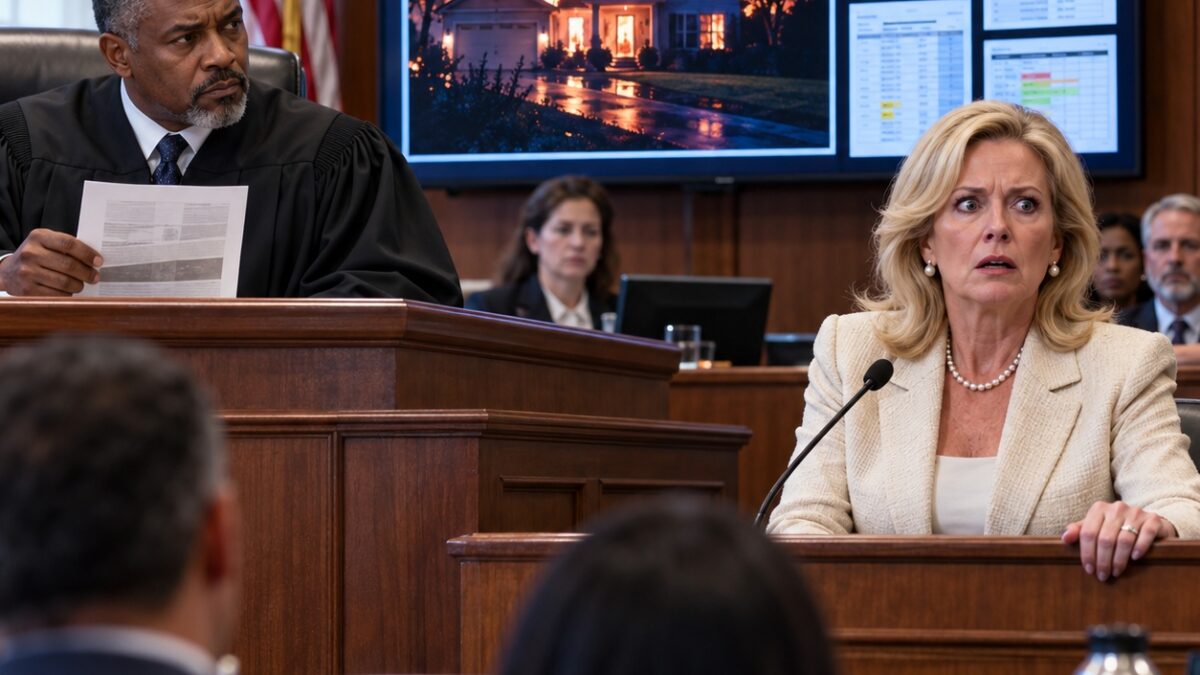
Diane eventually took the stand.
She approached with the same posture she had used on my lawn.
Shoulders back.
Chin slightly raised.
Perfect control.
The clerk administered the oath.
She answered:
“I do.”
Plaintiffs’ counsel began.
“Ms. Whitmore, during your presidency did Maple Ridge maintain a uniform enforcement policy?”
“Yes.”
“Was that policy intended to apply equally to all homeowners?”
“Absolutely.”
“Did you personally participate in identifying violations?”
“Sometimes.”
“Did you authorize compliance reviews?”
“When appropriate.”
“Lot-specific?”
“When patterns justified it.”
Her tone was smooth.
Professional.
She described the system as consistent.
Responsible.
Protective of shared value.
Then the first exhibit appeared on the courtroom monitor.
Enforcement logs sorted chronologically.
Rows.
Addresses.
Violation type.
Disposition.
Colors.
The plaintiffs’ attorney had organized two years of data.
Patterns became visible.
Several homes received repeated fines.
Others received warnings.
Comparable violations.
Different outcomes.
One cluster included my former address.
I did not react.
Could not.
Would not.
Plaintiffs’ counsel asked:
“Why was Lot 47 cited for mailbox color when these eight properties with the same mailbox specification received no citation?”
Defense counsel objected.
“Foundation.”
Sustained.
Counsel laid foundation.
Inspector.
Dates.
Photographs.
Then asked again.
Diane said:
“Enforcement is complaint driven.”
“So properties are not systematically reviewed?”
“Not always.”
“Was Lot 47 subject to a comprehensive compliance audit?”
“Yes.”
“Were any of these eight?”
“I don’t recall.”
Documents answered.
No.
Then driveway cracks.
Holiday lights.
Basketball equipment.
Landscaping.
The pattern did not prove bias by itself.
But it required explanation.
Diane shifted from:
uniform enforcement
to:
discretionary prioritization.
Then:
resource limitations.
Then:
complaint volume.
Each answer narrowed her earlier certainty.
That is what records do under oath.
They force broad statements into specific spaces.
Then came the finances.
Budget summaries.
Reserve transfers.
Emergency Remediation Reserve.
The same category I had noticed before the fire.
Plaintiffs’ counsel asked:
“Was the increase approved by membership?”
“No membership vote was required.”
“Board vote?”
“I believe so.”
“Where is it recorded?”
Defense counsel requested a moment.
Diane looked at the screen.
Minutes.
No vote.
Another meeting.
No vote.
Finance committee notes.
Recommendation.
No formal adoption.
Diane said:
“Some actions occur through administrative discretion.”
Plaintiffs’ counsel asked:
“Who exercised that discretion?”
“As president, I coordinated with management.”
“So you authorized the transfers?”
“I participated.”
“How much?”
“I would need the records.”
The records were already on the screen.
That was day one.
No explosion.
No confession.
No revenge.
Just confidence shrinking under chronology.
Day two brought insurance communications.
I had wondered whether plaintiffs possessed the same email chain that had been accidentally sent to me.
They had more.
Discovery had produced the complete series.
Not because I provided it.
I had taken no role in their case preparation.
The documents came through ordinary discovery requests.
That distinction was important.
Counsel displayed the first email.
Diane’s pre-loss communication regarding Lot 47.
My former address.
Nine days before the fire.
I felt Rebecca’s hand in my memory.
Our rental kitchen.
The word:
risk exposure.
But from the bench, I was not the homeowner reading an email about his burned house.
I was a judge reading an exhibit admitted into a separate civil case.
That required discipline.
Plaintiffs’ counsel asked:
“Ms. Whitmore, did you send this?”
“Yes.”
“Why?”
“We routinely evaluated association risk.”
“Did you have an inspection report concluding Lot 47 presented an elevated hazard?”
Diane paused.
“I relied on compliance history.”
“Mailbox color?”
Defense counsel objected.
“Argumentative.”
Sustained.
Counsel rephrased.
“What violations formed your basis for describing the property as potentially unsafe?”
Diane listed driveway condition.
Exterior maintenance.
“Electrical?”
“I had concerns.”
“Based on what inspection?”
“I don’t recall.”
“Fire inspection?”
“No.”
“Electrical inspection?”
“Not specifically.”
“Building inspection?”
“No.”
“Any report from a licensed professional?”
Pause.
“Not to my recollection.”
I leaned forward slightly.
Not because of my history.
Because the record needed clarity.
“For the court’s understanding, were any other properties submitted to the insurer for hazard review during that period?”
Diane looked at me.
Her face changed.
Only slightly.
“Not to my recollection.”
I asked:
“What documentation supports the selection of properties for hazard review?”
Defense counsel requested a moment.
I waited.
He conferred.
Then:
“Your Honor, the association will supplement.”
“Very well.”
No commentary.
No accusation.
I moved on.
But the question stayed.
If risk reporting was routine, where were the routines?
If it was discretionary, where were the criteria?
If our property was unsafe, where was the inspection?
Those were governance questions.
Not arson questions.
That distinction remained absolute.
Outside court, people began talking.
News traveled.
Not national news.
Local.
Neighbors.
Lawyers.
Community groups.
I received messages.
Some congratulatory.
I disliked those.
Nothing had been decided.
One person wrote:
Bet she regrets burning your house now.
I deleted it.
Because we did not know she burned anything.
No criminal charge.
No fire investigation finding that.
No confession.
No evidence sufficient to say it.
People prefer stories with a villain who commits every wrong.
Reality is usually narrower.
Diane could have abused HOA authority without causing a fire.
The fire could have been accidental.
The suspicious timing could remain suspicious forever.
A court order cannot fill gaps with narrative satisfaction.
I told my clerk:
“No social media discussion of this case.”
She looked almost offended.
“Obviously.”
“Still saying it.”
At home, Rebecca asked how it felt seeing Diane on the stand.
“Complicated.”
“You hate her?”
“No.”
“Really?”
“I hate some things she did.”
“That wasn’t my question.”
I took a breath.
“No.”
She looked at me for a long time.
Then:
“I might.”
“Fair.”
She had lost more emotionally than I had.
The house had been her refuge.
She had spent months rebuilding a life around smoke damage and insurance forms.
She was allowed anger.
I was not going to police it.
I only said:
“Whatever we feel doesn’t change what can be proved.”
“I know.”
She looked toward the kids.
“That’s the part I hate.”
So did I.
Then the forensic accountant took the stand.
His name was Arthur Bell.
Gray hair.
Wire-rim glasses.
Voice so flat he could read a grocery list like expert testimony.
He had been retained by the plaintiffs to analyze association finances and enforcement data.
Defense had challenged portions of his methodology.
We conducted the necessary admissibility arguments.
Then he testified.
“Let’s start with reserves.”
Plaintiffs’ counsel displayed a chart.
Arthur walked through transfers.
General maintenance funds moved into the emergency remediation reserve.
Quarter by quarter.
The reserve increased sharply before my fire.
But again:
Timing is not causation.
The relevant question in this case was whether association funds were managed transparently and according to governing requirements.
Arthur testified:
“I located internal references describing the increase as risk mitigation.”
“Did you locate a recorded board vote authorizing each transfer?”
“No.”
“Member notice?”
“No.”
“Budget amendment?”
“Not in the materials provided.”
Defense counsel later suggested management had delegated authority.
Arthur agreed delegated authority could exist.
Then pointed out that the association’s own policy required certain reserve reallocations to appear in minutes.
They did not.
Numbers do not shout.
That is why they are dangerous to people who depend on narrative.
Then enforcement data.
Two-year period.
Properties on one axis.
Citations on another.
Colors for warning, fine, escalation, hearing.
A visible cluster appeared.
Five properties received disproportionately frequent escalation.
Mine was one.
Several others belonged to plaintiffs.
Comparable violations on other lots often produced warning letters or no action.
Defense counsel attacked the data.
Different complaint histories.
Different cure times.
Different property conditions.
Valid points.
Arthur controlled for what he could.
He did not claim the chart proved discriminatory motive.
He said it showed inconsistent enforcement outcomes requiring explanation.
That was responsible testimony.
Then insurance.
Pre-loss communications categorizing certain homes as elevated hazards.
Arthur had cross-referenced those designations against inspection reports.
In multiple instances, including my former home, he found no documented professional inspection supporting the hazard characterization.
He said:
“I am not offering an opinion regarding the cause of any property loss.”
Important.
“I am saying the record shows risk representations were transmitted to insurance stakeholders without a consistent documented evaluation process.”
That was all.
And it was enough for the governance claims.
Board members seated behind defense counsel began shifting.
One asked to leave briefly.
Another conferred with separate counsel.
By the end of the afternoon, affidavits started appearing.
One board member stated he had relied on Diane’s representations about compliance investigations.
Another said he believed reserve changes had already received proper authorization.
A third said he had never been shown the underlying property-specific hazard communications.
The wall of collective authority was becoming individualized.
That always changes behavior.
When people believe responsibility belongs to “the board,” they speak one way.
When lawyers ask:
What did you personally know?
They speak differently.
Diane remained controlled.
Mostly.
On redirect, her lawyer gave her room to explain.
“Were you attempting to harm any homeowner?”
“No.”
“Did you believe you were acting in the association’s best interest?”
“Yes.”
“Did you personally profit from the reserve transfers?”
“No.”
“Did you cause any property fire?”
Plaintiffs’ counsel stood.
“Objection. No allegation in the pleadings.”
“Sustained.”
I looked at the jury box.
There was no jury in this bench proceeding, but the room still reacted.
The question had been too clever.
Defense wanted the emotional benefit of denying a claim nobody had legally made.
I said:
“The court will not consider causation of the Lot 47 fire. That issue is not before the court.”
Diane looked at me.
I continued:
“The claims concern enforcement practices, fiduciary obligations, financial governance, disclosures, and related representations.”
That sentence mattered to me personally.
Maybe more than anyone knew.
Because I wanted the public record clear.
No one was trying Diane for burning my house.
I was not going to let a civil governance case mutate into revenge fiction simply because the timing made people suspicious.
The law is strongest when it refuses the temptation of a more dramatic story.
The evidentiary hearing lasted multiple days.
Documents accumulated.
Board manuals.
Emails.
Appeal logs.
Property-manager notes.
One exchange showed Diane instructing management to:
maintain pressure on chronic noncompliance addresses.
Another used:
community examples.
Plaintiffs argued certain owners were being made examples.
Defense argued the phrase referred to deterrence and ordinary enforcement.
Both interpretations were plausible.
So I did not decide based on adjectives.
I looked at conduct.
Notice.
Comparators.
Escalation.
Appeals.
Records.
A homeowner named Evelyn Cross testified that she received a $200 fine for garden edging.
Photographs showed identical edging at the home of a board ally.
Defense said inspectors may not have observed the other property.
Reasonable.
Then an email appeared.
Diane had personally photographed both.
Only Evelyn was cited.
That mattered.
Another owner had holiday lights up four days late.
Warning only.
My family:
Two days.
Fine.
Again:
One example proves little.
Ten begin forming a pattern.
Twenty demand explanation.
The defense eventually stopped arguing complete uniformity.
Instead, it argued board discretion.
Boards do need discretion.
But discretion is not the power to apply rules according to unrecorded preference.
That became the central legal issue.
The financial testimony grew worse.
Not criminal.
Governance.
The emergency reserve had been increased without the notice procedure required by the association’s own governing documents.
Some expenditures were legitimate.
Storm cleanup.
Water intrusion.
Emergency contractor retainers.
The reserve itself was not improper.
What was improper was how money moved into it.
Missing recorded approval.
Incomplete disclosure.
Budget summaries that obscured the movement.
Then the plaintiffs established that the larger reserve had been used as part of the argument for raising homeowner assessments.
Again:
Maybe reasonable if properly done.
But homeowners had been asked to pay based on numbers that were not transparently explained.
One plaintiff testified:
“We were told reserves were inadequate because of new risks.”
Counsel asked:
“What risks?”
“We weren’t told.”
That was the problem.
Authority asks for trust.
Fiduciary duty requires enough transparency to justify it.
During the hearing, our rebuilt house passed final electrical inspection.
Twice.
I requested a secondary inspection voluntarily.
Rebecca teased me.
“One wasn’t enough?”
“No.”
“You’re going to have the safest toaster in the county.”
“Correct.”
The house looked different.
New beams.
Updated panel.
Better fire blocking.
Different trim shade.
Approved.
Documented.
Signed off.
Twice.
The garage wall was new drywall.
For a while, Rebecca refused to mark it.
Said it felt wrong.
Then Sophie found old photos.
Birthday pictures.
School mornings.
One showed the original height chart clearly enough to read several lines.
We enlarged the images.
Measured proportionally.
Transferred the old marks onto the new wall.
Not pretending they were original.
Just continuing them.
Beside the copied measurements, Rebecca wrote:
REBUILT.
Then the kids stood against the wall.
Fresh lines.
New dates.
Owen looked at me.
“Does this one count?”
“They all count.”
He nodded.
He no longer asked whether we had done something wrong.
That change mattered more than anything happening in court.
When the record closed, both sides submitted proposed findings.
Hundreds of pages.
I read every one.
My clerks prepared summaries.
I checked citations.
Then checked them again.
This case required more discipline than most.
Not because the law was uniquely difficult.
Because I knew how easily people would interpret any ruling through my own history.
If I ruled for the homeowners, someone would call it revenge.
If I ruled for the HOA despite the record, someone would accuse me of overcorrecting to appear neutral.
The only solution was the same solution I had always believed in.
Write the decision so tightly that motive becomes irrelevant.
Findings first.
Fact by fact.
The association had maintained written enforcement standards.
The standards were not consistently applied across comparable documented violations.
Certain properties experienced materially greater escalation without a sufficiently articulated neutral basis.
Appeal processes were inconsistently documented.
Financial reallocations into the emergency remediation reserve occurred without the full notice and recorded approval required by the governing framework.
Homeowners’ statutory records requests had been delayed or incompletely fulfilled.
Property-specific insurance communications characterized certain homes as elevated risks without consistent supporting inspection documentation.
I did not write:
The president targeted my home because she hated me.
Not proven.
I did not write:
The reserve increase caused or anticipated a fire.
Not proven.
I did not write:
The president committed arson.
Never alleged.
Never established.
Instead:
Governance.
Duty.
Process.
Then conclusions of law.
The association, acting through its authorized leadership, breached fiduciary obligations by failing to apply enforcement standards consistently and by failing to administer certain association funds with the transparency required by its governing framework and applicable law.
The remedy required precision.
I did not dissolve the HOA.
Did not impose fantasy damages.
Did not remove anyone from office by judicial declaration where the law did not provide that remedy.
I ordered:
Three years of independent financial oversight.
Mandatory revision of enforcement procedures.
Published criteria for escalating warnings into fines.
Full member access to enforcement logs subject to lawful privacy limitations.
Formal records-response timelines.
Independent review of reserve reallocations.
Corrected financial disclosures.
Training for board officers and management regarding fiduciary duties and records obligations.
Claims relating to potential individual officer liability were referred for separate proceedings under applicable statutes and procedural rules.
That part mattered.
I would not adjudicate personal liability questions entangled with my own prior interactions.
Those went elsewhere.
Boundaries.
Even judges need them.
Especially judges.
The courtroom was full the morning I read the order.
Homeowners.
Board members.
Local reporter.
Rebecca sat in the back.
She had asked whether she should attend.
I told her the choice was hers.
She came.
Diane sat at defense table.
Dark suit.
Hands folded.
I began with findings.
No speeches.
No moral lecture.
No mention of our burned house beyond the limited insurance record already relevant to the evidence.
I read.
Selective enforcement.
Insufficient documented criteria.
Improper reserve process.
Incomplete records access.
Unsupported hazard characterizations.
Then conclusions.
Fiduciary breach.
Corrective orders.
Oversight.
Policy revisions.
Separate review of individual responsibility.
When I finished, I looked up.
Diane was staring at the tabletop.
Her hands were clenched together hard enough that the knuckles looked pale.
For the first time since I had known her, she had nothing to say.
I did not enjoy that.
That surprised me.
For months, people had told me:
“Wait until she faces you in court.”
As though the bench were a throne.
As though the goal was to reverse the power dynamic.
It was not.
The bench does not exist so a judge can finally become the strongest person in an old argument.
It exists so the argument stops belonging to personalities.
I said:
“Court is adjourned.”
The clerk called it.
Chairs moved.
Papers gathered.
People stood.
Ordinary sounds.
Diane left through a side aisle with counsel.
No dramatic confrontation.
No scream.
No confession.
No handcuffs.
Consequences would arrive in audits.
Reports.
Elections.
Insurance review.
Individual proceedings.
Minutes she no longer controlled.
That was enough.
Justice rarely looks like people imagine.
It is often just a document nobody can talk around anymore.
The press called.
I declined comment beyond the written order.
One reporter asked:
“Did ruling against your former HOA feel vindicating?”
“My personal feelings are not part of the ruling.”
“Did you suspect the president had something to do with your fire?”
“The cause of my former residence fire was not before the court.”
“But personally?”
“No comment.”
“Why?”
“Because speculation does not become responsible simply because the microphone is on.”
That quote made the story.
I wished it had not.
But at least it was accurate.
Separate review of individual board liability continued elsewhere.
I had no role.
I asked for no updates beyond what became public.
The association’s insurance carrier conducted its own review.
The board commissioned an independent audit.
Several financial-control recommendations followed.
Diane did not remain HOA president.
At the next annual cycle, a new board took office.
Whether she resigned before the vote or simply understood there were not enough votes to continue mattered less than the result.
Maple Ridge had new leadership.
The new president was a retired school administrator named Helen Ward.
Her first meeting began with a sentence Rebecca later repeated to me.
“Authority is borrowed, not owned.”
I wrote it down.
Good rule for HOA presidents.
Better rule for judges.
Probably good for parents too.
The independent audit went online.
Full reports.
Reserve activity.
Explanatory notes.
Homeowners could see where money moved.
Enforcement logs became reviewable.
Names redacted where required.
Addresses coded.
Violation categories.
Warning versus fine.
Appeals.
Outcomes.
Patterns became harder to hide because the data no longer lived behind private conversations.
Meetings began on time.
Agendas were followed.
Records requests received formal acknowledgment.
Nobody called it revolutionary.
Good.
Basic accountability should not feel revolutionary.
The new board reviewed outstanding fines.
Some were upheld.
Important.
Not every old fine had been wrong.
Some homeowners had genuinely violated valid rules.
Others were reduced or rescinded because enforcement had been inconsistent or documentation inadequate.
That was exactly how correction should work.
Not:
Everything Diane touched was evil.
But:
Everything gets checked.
One Saturday, about a year after the ruling, Rebecca and I walked through Maple Ridge.
The house was fully rebuilt.
Trees recovering.
Same sidewalks.
Different feeling.
A woman pushing a stroller stopped.
“Judge Hale?”
“Jonathan is fine.”
“I just wanted to say thank you.”
“For what?”
“The records policy.”
Not the court case.
Not Diane.
The records policy.
“My husband and I disagreed with a fine last month.”
“How’d it go?”
“We requested the inspection log.”
“And?”
“They realized the notice was sent to the wrong lot.”
“Fixed?”
“Same day.”
She smiled.
“No attorney.”
“Best kind of legal outcome.”
She laughed and moved on.
Rebecca looked at me.
“You liked that.”
“Maybe.”
“You definitely liked that.”
I did.
Because the case had stopped being about what happened to us.
The system was working better for somebody who had never met Diane.
That is the point of institutional correction.
We rebuilt the mailbox too.
Same design.
Same color.
Sandstone.
Rebecca insisted.
I offered darker gray.
“No.”
“Why?”
“Because I want it exactly the color it was when she cited us.”
“That is petty.”
“I survived a fire. I’ve earned petty.”
Fair.
The first time I installed the mailbox flag, Owen came outside.
“Is that the illegal one?”
“It was never illegal.”
“Mom says it started everything.”
“Your mother is dramatic.”
Rebecca shouted from the porch:
“I HEARD THAT.”
Owen laughed.
Then asked:
“Can the HOA fine us again?”
“If we actually violate a valid rule, yes.”
He frowned.
“Why would we let them?”
“Because rules still matter.”
“But they were mean.”
“That doesn’t erase the rules.”
He thought.
Then:
“They have to follow them too?”
“Exactly.”
That was the lesson.
The one I wanted my children to keep.
Not:
Never trust an HOA.
Not:
Fight every fine.
Not:
Your father became a judge and beat them.
Rules matter when they run both directions.
The fire report remained preliminary in a way that frustrated people.
Electrical origin area.
No definitive criminal cause.
No evidence supporting prosecution for arson.
I had the renovated wiring report.
The clean inspection.
The strange detail I had photographed.
The pre-loss insurance communication.
The timing.
All of it created questions.
Questions are not proof.
That sentence became something I repeated often.
Rebecca struggled more.
One night, years later, we sat on the rebuilt porch during rain.
She said:
“Do you really believe it was accidental?”
I looked at the yard.
“I believe I can’t prove otherwise.”
“That’s not what I asked.”
“I know.”
She waited.
I said:
“There are days I think about the timing.”
“Me too.”
“Days I think about the email.”
“Me too.”
“The reserve.”
“Yes.”
“The targeting.”
“Yes.”
Then:
“But if I let suspicion become certainty because it makes the story cleaner, then everything I claim to believe about evidence is fake.”
She looked at me.
“That must be exhausting.”
“It is.”
She rested her head against my shoulder.
“I still hate her.”
“I know.”
“Working on it.”
“No rush.”
We sat listening to rain hit the roof we had rebuilt.
Some truths arrive.
Some do not.
You still have to live.
Diane’s most lasting damage was not the fire.
I cannot assign that to her.
It was what happened to our children’s sense of belonging.
That I can say.
Before the dispute, Sophie and Owen saw Maple Ridge as home.
After months of notices and whispered conversations, they began asking:
“Are we moving?”
“Do they want us here?”
“Did we break a rule?”
Then the fire.
For a while, Owen believed the disaster was somehow connected to us being the family in trouble.
That hurt more than the fines.
Children personalize adult systems.
If the HOA says your family is noncompliant, maybe your family is bad.
If your house burns afterward, maybe you did something wrong.
That was why his question in the blanket outside the fire stayed with me.
Did we do something wrong?
No child should stand outside a burning home wondering whether a homeowners association had somehow judged them.
When we moved back after the rebuild, Owen was hesitant.
First night, he asked if the fire alarm worked.
I showed him every detector.
Backup batteries.
Monitoring system.
Breaker panel.
Inspection stickers.
We walked through the house room by room.
At the garage wall, he saw the reconstructed height chart.
He touched the old copied measurements.
Then stood against the wall.
“Measure me.”
Rebecca did.
Fresh line.
Date.
Owen smiled.
That was when the house became ours again.
Not when the certificate of occupancy was issued.
Not when insurance closed the claim.
When my son wanted his height written on the wall.
Sophie was older.
More skeptical.
She asked me:
“Did Mrs. Whitmore get fired?”
“Not exactly.”
“Did she lose?”
“That’s complicated.”
“Dad.”
“She stopped being president.”
“So yes.”
“I wouldn’t use that word.”
“Why?”
“Because this wasn’t a game.”
“She treated it like one.”
That stopped me.
Children notice more than we think.
I said:
“Maybe.”
“She wanted control.”
“Yes.”
“And now she doesn’t have it.”
“Yes.”
“Sounds like losing.”
I smiled despite myself.
“Your legal analysis needs work.”
“Maybe I’ll become a judge.”
“Please don’t.”
She laughed.
That became a family joke.
Arthur Bell, the forensic accountant, sent me a note after the case was fully concluded.
Not discussing confidential material.
Just:
Transparency is cheaper than reconstruction.
I framed that in my office.
Because it applies to buildings and institutions.
The house had to be reconstructed because fire destroyed part of it.
Maple Ridge had to reconstruct trust because opaque governance destroyed part of that.
Both repairs cost more than prevention would have.
Helen Ward, the new president, invited me to speak at an annual governance workshop.
I declined.
Then Rebecca found out.
“You should do it.”
“I have no desire to become the HOA reform judge.”
“You already are to half the neighborhood.”
“No.”
“They call you ‘Judge Sandstone.’”
“What?”
She laughed so hard she had to sit down.
Apparently someone had used it online.
I did not attend the workshop.
Helen invited Martin Keller instead.
Smarter.
A neutral attorney explaining records obligations was better than me becoming part of Maple Ridge mythology.
Institutions should not depend on heroes either.
They should depend on repeatable procedures.
The independent oversight period lasted three years.
Quarterly reports.
External accountant.
Compliance reviews.
No major issues.
By year two, some homeowners complained it was unnecessary expense.
That almost made me happy.
Oversight had become boring.
People forget why boring safeguards exist once the crisis fades.
Helen defended it.
“Court ordered.”
Simple.
No argument.
At the end of year three, the external monitor filed the final report.
Controls improved.
Records access compliant.
Reserve approvals documented.
Enforcement disparities reduced substantially.
The court terminated formal oversight.
That was the second ending.
A corrected institution returning to ordinary governance without permanent judicial supervision.
Success.
I never saw Diane in a courtroom again.
Once was enough.
I did see her in Maple Ridge occasionally.
She still owned her home for some time.
We did not speak.
Then one morning, years after the fire, I was walking to the mailbox.
She approached from the opposite direction.
No clipboard.
No board badge.
Just a woman carrying envelopes.
We stopped several feet apart.
“Jonathan.”
“Diane.”
She looked toward our rebuilt house.
“You did a beautiful job.”
“Rebecca chose most of it.”
“She always had good taste.”
That surprised me.
Then silence.
She said:
“I heard Owen made varsity.”
“He did.”
“Congratulations.”
“Thank you.”
She shifted the mail in her hand.
Then:
“I know you probably think I targeted your family.”
I did not answer.
She continued.
“I thought I was protecting the neighborhood.”
Still no answer.
“The enforcement got… aggressive.”
“That’s one word.”
She nodded.
“I made mistakes.”
I waited.
She did not mention the fire.
Neither did I.
Finally:
“I’m sorry for the way I spoke to you that first day.”
“You people.
The phrase sat between us without either saying it.
I nodded once.
“Thank you.”
She looked almost relieved.
Then walked away.
No dramatic reconciliation.
No confession.
No explanation of the things nobody could prove.
Just one narrow apology for one thing we both knew had happened.
That was appropriate.
The rest belonged to the record—or to uncertainty.
I sometimes think fans of stories like ours want a cleaner ending.
They want Diane caught on camera with gasoline.
They want handcuffs.
They want a confession.
They want a judge to pound a gavel and tell her exactly what kind of person she is.
Life rarely gives you that.
And courts should almost never try.
What we got was harder and, in some ways, more satisfying.
Her power was dismantled by documentation.
Not spectacle.
The selective enforcement was exposed.
The financial process was corrected.
The hazard communications were placed in context.
Homeowners gained access to the records that had been withheld.
Independent oversight replaced personal discretion.
A new board took over.
The association’s rules remained.
But so did limits.
That is real accountability.
Not every unanswered question needs to be answered by imagination.
The pencil marks on the new garage wall climbed higher.
Sophie stopped letting us measure her first.
Then Owen passed me.
He celebrated for three days.
Rebecca still writes the dates.
The original marks from before the fire are copied in lighter pencil.
New marks darker.
You can tell exactly where the old house ended and the rebuilt house began.
I like that.
Continuity does not require pretending nothing happened.
You acknowledge the break.
Then continue.
Maple Ridge is like that now.
The old board years are part of its history.
So is the court order.
So are the audits.
So are the new procedures.
You do not erase bad governance by pretending it never happened.
You build something around the lesson.
One evening, Owen came home from college and stood in the garage.
He touched the lowest old mark.
“Was I really that small?”
“Yes.”
“No way.”
“You cried when the barber cut your hair too.”
“That is slander.”
“I have witnesses.”
He smiled.
Then looked at the REBUILT note Rebecca had written.
“Do you ever think about the fire?”
“Sometimes.”
“Do you think she did it?”
There it was.
Years later.
The question everyone wanted.
I looked at my son.
“I don’t know.”
He frowned.
“You really don’t?”
“No.”
“You’re okay with that?”
“No.”
“Then how do you live with it?”
I thought before answering.
“You learn the difference between what you know and what you need to know.”
He waited.
“I know the house burned.”
“Yes.”
“I know the official cause was never established as intentional.”
“Yes.”
“I know we had a recent clean inspection.”
“Yes.”
“I know Diane had been targeting the property.”
“Yes.”
“I know she communicated with the insurer before the loss.”
“Yes.”
“I know the HOA mishandled enforcement and finances.”
“Yes.”
“Those things are true.”
He nodded.
“But the step from those facts to ‘she burned our house’ requires evidence we never got.”
He looked disappointed.
Not at me.
At reality.
“That sucks.”
“Yes.”
“Can I say that?”
“You’re twenty-one.”
“Good.”
Then I said:
“Not knowing is better than being wrong on purpose.”
He looked at the wall.
“I guess.”
It took me years to reach that peace.
He did not need to reach it in one conversation.
The final legal consequence of the HOA case came not in my courtroom but at a membership meeting.
The new board proposed amendments incorporating the court-ordered reforms permanently into association policy.
Transparent reserve transfers.
Documented enforcement criteria.
Records deadlines.
Conflict disclosures.
Independent review for extraordinary enforcement.
Members voted.
Overwhelmingly approved.
Rebecca and I attended.
Not as combatants.
Homeowners.
When the vote was announced, Helen said:
“These policies are not here because we expect future boards to be bad people.”
She paused.
“They are here because good systems should not require perfect people.”
I wrote that down too.
Better than most judicial language I had drafted.
Our house remains in Maple Ridge.
We could have moved.
People expected us to.
After the fire, after the HOA fight, after court.
Several colleagues said:
“Why stay?”
Because leaving would have meant something different for us.
Not defeat.
I do not believe moving is surrender.
Sometimes leaving is the smartest thing.
But Rebecca and I still loved the street.
The kids’ school friends.
The maple near the sidewalk.
The neighbors who brought blankets during the fire.
The family across the road who took our dog overnight.
The retired nurse who sat with Sophie while firefighters worked.
Diane was not the neighborhood.
That distinction saved Maple Ridge for us.
One person can occupy an institution so visibly that you begin confusing the person with the institution.
They are not the same.
When leadership changed, the community had room to become itself again.
The neighbor who had stopped waving during the early rumors eventually apologized.
His name was Carl.
He caught me near the driveway.
“I acted like a coward.”
“That seems harsh.”
“I believed some of what I heard.”
“People hear things.”
“I should’ve asked you.”
“Yes.”
He winced.
“You don’t make apologies easy.”
“I accepted it.”
He laughed.
Then helped me plant a tree.
That was better than words.
Rebecca started volunteering on the architectural committee.
I nearly filed for divorce.
“You cannot be serious.”
“I am.”
“You spent years complaining about HOA power.”
“That’s why I’m doing it.”
“Rebecca.”
“Someone has to approve beige.”
“Sandstone.”
She smiled.
“Exactly.”
She served one term.
Her proudest achievement was simplifying the exterior color chart and removing seven redundant approval categories.
Democracy.
I returned to ordinary judicial work.
Contract disputes.
Landlord matters.
Business cases.
Neighbor arguments.
Every now and then, an attorney recognized the Maple Ridge story and tried to make small talk.
I shut it down.
The bench cannot become branding.
The experience did influence me in one legitimate way.
It made me even more attentive to process.
Not because I favored homeowners.
Because I had lived what procedural imbalance feels like.
That should not produce bias.
It should produce humility.
People standing before judges often feel what I felt when Diane’s letters arrived.
An institution knows your name.
Has forms.
Deadlines.
Authority.
You feel small.
The law cannot eliminate that imbalance.
But judges can make sure procedure does not become theater.
That lesson stayed.
Years after the case, Maple Ridge had another major dispute.
Nothing involving me.
Pool reconstruction.
Assessment increase.
Half the neighborhood angry.
Old Maple Ridge might have hidden discussion in informal meetings.
New Maple Ridge published the proposal.
Three budget options.
Engineering report.
Public Q&A.
Vote.
People still screamed.
People will always scream about money.
But when the assessment passed, even opponents could see the process.
No lawsuit.
No whispered conspiracy.
No secret reserve transfer.
That was progress.
The original emergency remediation reserve still exists.
Properly authorized now.
Clearly explained.
Storm damage.
Water emergencies.
Tree removal.
Temporary housing assistance after common-area incidents.
Rebecca joked:
“Should we send it a birthday card?”
“No.”
“It brought us together.”
“It absolutely did not.”
She laughed.
Humor came back slowly.
That was another sign of healing.
One anniversary of the fire, Rebecca suggested dinner out.
I thought she wanted to avoid being home.
She said:
“No. I want to celebrate.”
“What?”
“We got everybody out.”
I looked at her.
“That’s what happened that night.”
I had spent years remembering loss.
She remembered survival.
Four people walked out.
No burns.
No smoke injury requiring hospitalization.
Firefighters contained it.
Neighbors helped.
The house came back.
Maybe anniversaries can mean more than one thing.
We went to dinner.
The kids joined.
No one talked about Diane.
That was one of the best nights.
If I tell this story now, I am careful about the sequence.
Because sequence prevents mythology.
First:
Selective enforcement.
Then records requests.
Then reserve questions.
Then the fire.
Then the misdirected insurance correspondence showing pre-loss risk communication.
Then my judicial appointment.
Then a separate civil action by multiple homeowners.
Then disclosure.
Then evidence.
Then findings limited to what the evidence proved.
Not:
HOA president burns lawyer’s house and ends up before him.
That headline would get clicks.
It would also be dishonest.
The truth is more interesting.
A woman accustomed to controlling narrative eventually entered a system where narrative had to survive exhibits.
That was enough.
Diane’s real undoing was not the fire.
Not even the emails.
It was documentation.
She had spoken in generalities.
Community protection.
Uniform standards.
Risk mitigation.
Shared responsibility.
Then the records arrived.
Which property?
Which violation?
Which inspector?
Which warning?
Which fine?
Which board vote?
Which reserve transfer?
Which insurance report?
Which supporting inspection?
Specificity is uncomfortable for arbitrary power.
That was true when I was a lawyer.
True when I became a judge.
True when I was just a homeowner standing beside a beige mailbox.
The funniest artifact from the entire dispute is still the first violation.
MAILBOX COLOR: NON-APPROVED BEIGE.
I framed it.
Rebecca made me.
It hangs inside the garage.
Beside the rebuilt height chart.
Underneath, she added a small label:
Sandstone.
When visitors ask, we tell the story.
Usually the short version.
Diane thought beige was wrong.
We checked.
It was approved.
Things got worse.
House burned.
Records surfaced.
Years later, governance got better.
That is enough at dinner.
The full version takes much longer.
As you now know.
Helen eventually stepped down as president voluntarily.
At her last meeting, she repeated the phrase she had used from day one.
“Authority is borrowed, not owned.”
Then she added:
“And borrowed things should be returned in good condition.”
Standing ovation.
HOA meetings should almost never receive standing ovations.
That one earned it.
A younger board took over.
They inherited a functioning system.
That is what healthy leadership should produce.
A system that does not collapse when you leave.
I once ran into Arthur Bell at a legal conference.
“Forensic accountants are popular at parties now?” I asked.
“No.”
“Good.”
He smiled.
Then asked:
“How’s Maple Ridge?”
“Boring.”
“Congratulations.”
Exactly.
Boring was the goal.
There is a temptation in stories about power to make the ending about humiliation.
The president cries.
The board begs.
The homeowner wins millions.
The villain loses everything.
That did not happen.
Our ending was better suited to the actual harm.
The system that had been opaque became transparent.
The selective enforcement stopped.
Records opened.
Reserve practices changed.
Officer responsibility became reviewable.
New leadership emerged.
Our house returned.
Our children stopped feeling like outsiders.
Diane lost control over a process she had treated as personal territory.
That is enough.
More than enough.
Sometimes I stand on the rebuilt porch late in the afternoon.
Sun low.
Sprinklers ticking two houses down.
Exactly like the day Diane first confronted me.
Mailbox at the curb.
Same flag.
Sandstone.
Trim slightly different after the rebuild.
Approved.
Documented.
Signed off.
No one standing on the lawn with a clipboard.
Sophie’s old bicycle is gone now.
Owen’s car sometimes occupies the driveway when he visits.
Life moved.
That was always the goal.
Not status.
Not revenge.
Stability.
We lost it for a while.
Then rebuilt it.
Physically.
Legally.
Emotionally.
Owen does not ask if we did something wrong anymore.
That may be the sentence I care about most.
When he was younger, the notices made him think our family had violated some invisible social contract.
Then the fire made everything worse.
Now he understands.
We followed the rules.
We asked the institution to follow them too.
That is not rebellion.
That is membership.
Maybe the healthiest form of it.
You belong enough to demand fairness.
You care enough to insist the system be worthy of trust.
At the most recent Maple Ridge annual meeting, I sat in the back with Rebecca.
I had no role.
No robe.
No bench.
Just a homeowner.
A young couple raised a records question.
The president answered:
“You’re entitled to inspect that. Management will send it within the statutory period.”
No defensiveness.
No:
We’ll decide what is appropriate.
Just:
You are entitled.
Rebecca leaned toward me.
“You heard that?”
“I did.”
“You going to cry?”
“No.”
“You’re crying.”
“I have allergies.”
“In February?”
“Severe.”
She smiled.
The meeting moved on.
Landscaping.
Pool hours.
Tree trimming.
Beautifully boring.
At the end, I walked past the garage after we got home.
Saw the height chart.
Old marks in light pencil.
New marks dark.
The framed mailbox violation.
Sandstone.
Rebecca’s handwriting.
For a moment, I could see every version of our family at once.
The family saving for the down payment.
The family moving into Maple Ridge.
The children riding bikes.
Diane on the lawn.
Certified envelopes.
Smoke.
Bare feet on cold pavement.
The rental house.
The appointment letter.
The courtroom.
The exhibits.
The ruling.
The rebuild.
The new board.
Fresh pencil lines.
All of it.
People sometimes ask if it felt like revenge when Diane had to answer questions in my courtroom.
No.
Revenge is immediate.
Hot.
Personal.
This was the opposite.
Slow.
Structured.
Bounded.
Every time emotion could have expanded the story beyond the evidence, the process narrowed it again.
That was not frustrating.
That was the point.
I did not win because I became more powerful than Diane.
I won because once the records were opened, neither of us got to decide what the facts were.
The documents did.
The data did.
The law did.
And wherever the evidence stopped, I stopped too.
Even when I wanted a cleaner answer.
Especially then.
That is what fairness looks like when it matters.
We bought Maple Ridge because we wanted a place where our children could grow up under stable rules.
For a while, one person made those rules feel like weapons.
In the end, the rules became guardrails again.
Our home stands.
The pencil marks are back.
The mailbox is still sandstone.
The HOA still exists.
So do we.
We never forced our way into that neighborhood.
We bought a home.
We paid our dues.
We followed the rules.
We insisted they be followed back.
We belonged there.
And now that truth is not merely something our family says.
It is written into the record.


