PART2:HOA Came at Dawn to Take My House Over an American Flag—Then My Retired Sergeant Major Wife Opened the Binder
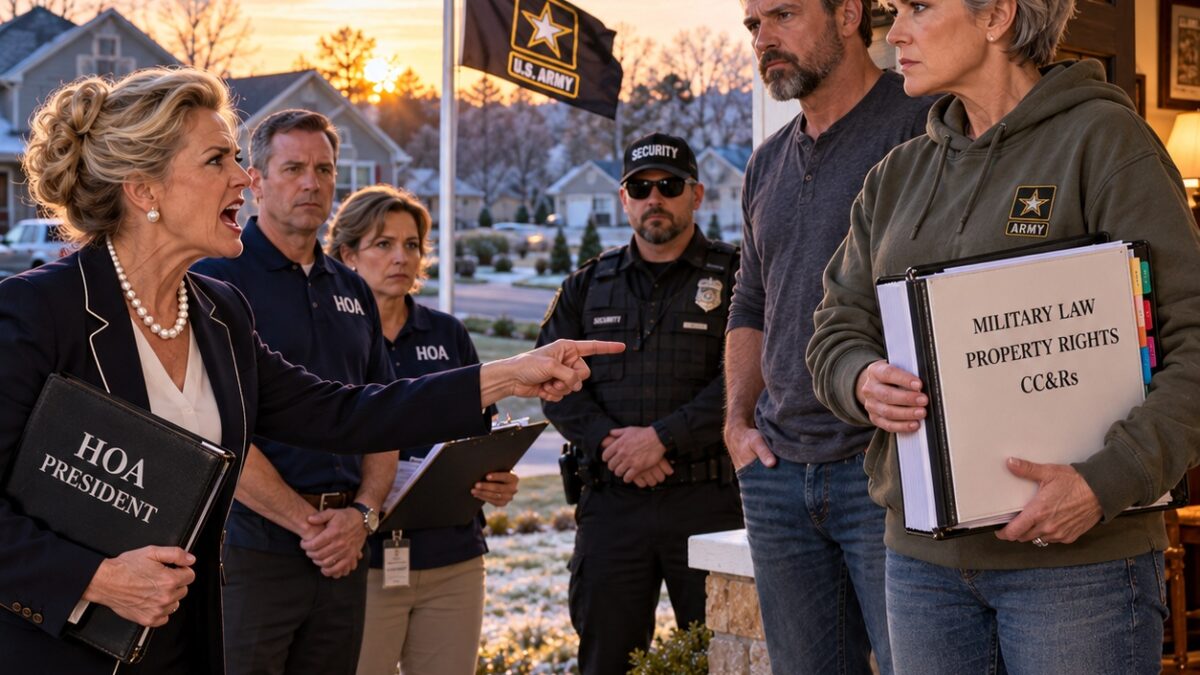
PART2
Eighteen months earlier, Delia and I were standing in a Costco parking lot in Raleigh arguing about freezers.
This was normal.
We had recently moved into Pinecrest Estates after more than two decades of military life.
Fort Bragg.
Okinawa.
Germany.
Back again.
Different houses.
Different neighborhoods.
Different temporary definitions of home.
Our F-250 was loaded with moving supplies, shelving, storage bins, and one chest freezer.
Delia stared at the second one.
“We need it.”
“We do not need two chest freezers.”
“We absolutely do.”
“There are two of us.”
“We have children.”
“They live here.”
“They eat.”
“Occasionally.”
She put both hands on the cart.
“Marcus.”
“No.”
“Remember Fort Bragg during the hurricane warning?”
“That is unfair.”
“We lost power for four days.”
“That freezer would also lose power.”
“We have a generator now.”
I stared at her.
She raised one eyebrow.
We bought the second freezer.
She was right.
She usually is.
I mention that because Delia spent twenty-two years moving people, equipment, food, fuel, medical supplies, and entire logistical systems into places where small mistakes could become enormous problems.
Her brain does not naturally accept:
Close enough.
It accepts:
Verified.
Which is exactly the wrong kind of spouse for an HOA president who depends on nobody reading the documents.
At first, Pinecrest Estates seemed ordinary.
Reasonable dues.
Grass height.
Fence colors.
Holiday decorations.
Nothing unusual.
Forty-some houses.
Tree-lined streets.
Community pond.
Small clubhouse.
Private management company called Clarendon Property Solutions.
We read the CC&Rs before closing.
Of course we did.
After military life, you learn not to sign anything without reading it.
Nothing bothered us.
The house was worth it.
Corner lot.
Covered porch.
Original hardwood.
Detached garage.
I converted the garage into a workshop.
I am an electrician by trade.
I like building things.
Cabinets.
Shelves.
Furniture.
Anything that lets me work with my hands after a day of working with wires.
Our first thirty-eight days were peaceful.
Then I installed the flagpole.
Regulation height.
Below twenty feet.
Proper footing.
American flag.
Army flag beneath.
Several other veterans in Pinecrest had similar displays.
I checked the governing documents before I poured concrete.
Nothing prohibited it.
Six days later:
Violation notice.
AESTHETIC DISRUPTION TO NEIGHBORHOOD VISUAL HARMONY.
Two hundred dollars.
I laughed.
Delia did not.
“What section?”
“Doesn’t say.”
“Then don’t laugh.”
“It’s ridiculous.”
“That doesn’t mean harmless.”
I should have remembered that sentence.
I took the notice to the next HOA meeting.
Delia had a VA appointment, so I went alone.
Pinecrest clubhouse.
Beige walls.
Burned coffee.
Old carpet.
Seven homeowners.
Renata sat behind the folding table with Chuck and Gerald.
Gerald was a retired accountant.
Quiet.
Always looked like someone had tricked him into joining the board and he had been trying to find the exit ever since.
I raised the flagpole issue.
“Can someone show me the written rule?”
Renata smiled.
“The board has discretionary authority over matters of community aesthetics, Mr. Hargrove.”
“Where?”
She folded her hands.
“Perhaps if you were more familiar with how established communities operate, you’d understand.”
The room went quiet.
Three people looked down.
That was my first clue.
Nobody looked surprised.
One older man in the back met my eyes.
Bertrand Holloway.
Retired civil engineer.
He gave me a look that communicated an entire sentence without moving his mouth.
Welcome to the club.
I stayed polite.
“I’ve read the documents.”
“Then you should understand the board’s authority.”
“I understand written authority.”
She smiled again.
Meeting moved on.
That night, I told Delia.
She stopped chopping onions.
“She said what?”
I repeated it.
Delia set the knife down.
“Show me the violation.”
I did.
She read.
Then:
“Certified response.”
“For a flagpole?”
“For the record.”
“You really want to send certified mail over this?”
She looked at me.
I got an envelope.
The letter was simple.
I cited the sections I had reviewed.
Requested the specific governing provision authorizing the violation.
Return receipt.
Renata signed for it.
Eight days later, we received a second violation.
Not an answer.
My workshop.
Apparently my detached garage had become a “commercial-style workspace” violating community noise standards.
I had been sanding cabinet doors on Saturdays.
Not rebuilding diesel engines.
Not welding at midnight.
Sanding cabinet doors.
This notice cited:
Section 14, Paragraph C.
That sounded official.
So I pulled the binder.
Section 14.
Paragraph C.
Sprinkler schedules.
Nothing about garages.
Nothing about commercial work.
Nothing about noise.
I carried the binder into the kitchen.
“Delia.”
She looked up.
“What?”
“You’re going to enjoy this.”
She did not smile.
That worried me.
We spent that Saturday at the kitchen table.
Two mugs of coffee.
One highlighter.
Then three.
Delia worked silently.
Page.
Tab.
Page.
Tab.
Back and forth between the printed packet from Clarendon and county records we could access online.
Within an hour, yellow flags stuck from the binder like feathers.
“Marcus.”
“What?”
“These were added.”
She showed me three board resolutions.
Expanded enforcement power.
Broad discretionary language.
New fines.
New board authority.
I said:
“Okay.”
“No.”
“What?”
“These are not in the original filing.”
“How do you know?”
“Because the numbering breaks.”
She flipped pages.
“Look.”
The original sections followed a consistent structure.
The added resolutions were physically inserted.
Different formatting.
Different page margins.
But Clarendon had stapled them into the governing packet as though they belonged there from the start.
Delia sat back.
“This needs a homeowner vote.”
“You sure?”
“No.”
That surprised me.
She continued.
“I’m sure enough to verify.”
That is Delia.
Never:
I think therefore it’s true.
Always:
I think therefore check.
We reviewed North Carolina’s planned-community statutes.
Then called Wake County.
Then pulled what documents we could.
The question became obvious.
Had Pinecrest homeowners ever voted to give the board these powers?
We could find no evidence they had.
Delia closed the binder.
“We don’t tell Renata yet.”
“Why?”
“Because we don’t know enough.”
“What do we do?”
“Gather.”
That word became our life.
I started meeting neighbors.
Not campaigning.
Just talking.
Bertrand was first.
I brought beer.
We sat on his back porch.
October wind.
Wood smoke.
He pulled out a manila folder before I even mentioned mine.
Violation letters.
Appeals.
Non-answers.
His mailbox post had recently been cited.
Installed in 2011.
Renata had joined the board years later.
“She’s been doing this for three years.”
“Why hasn’t anyone challenged her?”
Bertrand took a drink.
“People have.”
“Together?”
“No.”
That mattered.
He continued.
“She picks one house.”
“What happens?”
“They fight.”
“And?”
“Eventually they pay.”
“Why?”
“Because most people have lives.”
Fair.
Attorney fees.
Meetings.
Letters.
Stress.
Most homeowners do not buy houses because they want a second career interpreting covenants.
Bertrand looked at me.
“Son, nobody’s ever pushed back coordinated.”
I thought of Delia at the kitchen table.
Yellow tabs everywhere.
“My wife is a retired sergeant major.”
Bertrand raised the bottle.
“Lord help Renata.”
He had no idea.
Delia attended the November meeting.
Flannel shirt.
Jeans.
Silver hair.
Legal pad.
One pen.
She sat in the first row.
Renata walked in wearing her board-president lanyard.
Looked at Delia.
Assessed.
Dismissed.
Mistake.
The meeting moved normally until Renata introduced Resolution 2024-7.
Community standards enforcement personnel.
Essentially authority to hire private enforcement.
The resolution had not been in the homeowner agenda notice.
Delia raised her hand.
“Point of procedure.”
Her voice is not loud.
Never needed to be.
“Under the applicable notice requirements, when was this resolution circulated to the membership?”
Renata smiled.
“The board has authority to—”
“I asked when it was circulated.”
Chuck whispered to her.
Gerald stared at the table.
Renata’s jaw tightened.
“We’ll table this matter pending proper notice.”
Delia wrote something.
Then clicked her pen shut.
That sound felt louder than it should have.
Afterward, Renata intercepted us in the parking lot.
Cold air.
Our breath visible.
She looked at me.
“I hope you understand the board takes a dim view of homeowners choosing confrontation over community.”
Delia stepped forward.
“We’re not confrontational.”
Renata looked at her.
Delia smiled pleasantly.
“We just read the documents you signed too.”
Then she walked away.
I followed.
“You enjoyed that.”
“A little.”
Within two weeks, we got three violations.
Front door color.
Tree removal.
Doorbell camera.
Yes.
Doorbell camera.
Surveillance device violating community privacy standards.
Each notice carried fines.
Each cited rules we could not tie to valid governing language.
I was furious.
Delia was delighted.
Not emotionally.
Operationally.
She opened Excel.
Created tabs.
Notice date.
Delivery method.
Rule cited.
Original CC&R authority.
Amendment authority.
Whether amendment had evidence of membership adoption.
Fine amount.
Appeal status.
Board response.
She color coded it.
I stared at the spreadsheet.
“You’ve done this before.”
“I ran logistics.”
“This looks like a military supply manifest.”
“Good.”
“It’s an HOA.”
“Paperwork doesn’t care.”
Then she started calling neighbors.
Priscilla Tan.
Nurse.
Fined for her daughter’s basketball hoop.
Bertrand.
Then four more.
One story.
Then another.
Selective fines.
Rules nobody remembered voting for.
Homeowners who asked questions suddenly finding their properties under greater scrutiny.
Delia put addresses on a neighborhood map.
Different marks for:
Women living alone.
Minority households.
Residents who had publicly challenged the board.
The pattern was uncomfortable.
We did not jump to conclusions.
But once shown geographically, it was difficult to ignore.
Then December brought the attorney letter.
Heavy cardstock.
Aldridge and Mercer.
Our alleged balance:
$1,847.
Threat:
Pay within thirty days or HOA may file a lien.
I read it once.
Then again.
My stomach dropped.
I knew enough to understand a lien did not mean somebody could take our house tomorrow.
But the emotional effect does not care about nuance.
I looked around the kitchen.
This was our home.
After twenty-two years of temporary housing.
I imagined a legal claim attached to the title over a flagpole and doorbell camera.
That is exactly how intimidation works.
Not because the threat is necessarily strong.
Because the thing at risk matters enormously.
Delia read the letter.
Made Earl Grey.
Sat.
I paced.
“Can you not drink tea right now?”
“Why?”
“They’re threatening our house.”
“Yes.”
“You seem very calm.”
She tapped one paragraph.
“They made a mistake.”
“What?”
The attorney had specifically claimed our fines arose under amendments “duly adopted” by the association.
The same ones.
If those amendments were invalid, the fines might be invalid.
If the fines were invalid, the lien threat became a much more dangerous move for them.
“We need a lawyer,” I said.
“Yes.”
“Actual HOA lawyer.”
“Yes.”
“Tomorrow.”
“I already made a list.”
Of course she had.
Wallace Okafor’s office was in Raleigh.
Former state attorney.
Late forties.
Calm.
He read everything.
Not skimmed.
Read.
Delia’s spreadsheet.
Original CC&Rs.
Added resolutions.
Fine notices.
Attorney letter.
Neighbor histories.
When he finished, he closed the folder.
“Mr. and Mrs. Hargrove.”
We waited.
“This is not really a flagpole dispute.”
“No?”
“No.”
He looked at Delia.
“You potentially have an ultra vires governance challenge.”
Then me.
“Potential debt collection issues.”
Back to Delia.
“And depending on what the enforcement pattern demonstrates, potentially a fair housing matter.”
I leaned back.
“That sounds expensive.”
He almost smiled.
“It could become expensive for somebody.”
Then:
“The question is whether you want to defend individual violations or challenge the structure producing them.”
Delia answered immediately.
“We go.”
I looked at her.
She looked at me.
Twenty-two Army years.
Of course we were going.
Renata began telling neighbors we were litigious troublemakers.
That we wanted to destroy neighborhood character.
That we were bringing outsiders into Pinecrest.
Bertrand reported most of this.
He possessed neighborhood intelligence capabilities that would have impressed certain federal agencies.
More concerning:
Homeowners who had spoken with Delia received hints that their violation histories might be reviewed.
Wallace wrote that down.
Then I began building three cedar bulletin boards.
Delia came into the garage one night.
“What are those?”
“Community boards.”
“Why?”
“Information.”
She looked at the cedar frames.
Glass fronts.
Locks.
“These are nice.”
“I know.”
“Suspiciously nice.”
“I want them to look legitimate.”
“What goes inside?”
“The documents.”
She smiled.
Not often that my woodworking became part of legal strategy.
Two days before Christmas, Wallace called.
He had pulled the actual 2004 Pinecrest CC&Rs from the Wake County Register of Deeds.
Then compared them to the document package Clarendon had been distributing.
Different.
Not slightly.
Materially.
The county-recorded declaration did not contain the later board-resolution language.
The Clarendon version had inserted it seamlessly enough that a normal homeowner would assume it was part of the original declaration.
No obvious amendment cover page.
No homeowner-vote record.
Nothing explaining the distinction.
Wallace’s voice was careful.
“I’m not using the word fraudulent yet.”
“Why not?”
“Because words matter.”
“What word can you use?”
“Altered.”
Delia and I looked at each other.
“Materially altered.”
That was enough.
Then Wallace found the money.
Public HOA audit records.
2022:
Thirty-four thousand dollars in management consulting fees paid to Clarendon above its ordinary contract.
2023:
Forty-one thousand.
Total:
More than seventy-five thousand dollars.
No homeowner disclosure we could find.
No clear board authorization in the minutes Wallace reviewed.
Then one appendix.
Gerald had asked about it.
The board treasurer.
He had requested documentation.
Renata tabled the discussion.
Never revisited.
Delia made three columns on a yellow legal pad.
WHAT WE KNOW.
WHAT WE CAN PROVE.
WHAT WE NEED.
I looked at the third column.
Short.
“Public venue?”
“Yes.”
“More witnesses?”
“Yes.”
“And one more move from Renata.”
Delia nodded.
“Why?”
“Because right now we have a lot of history.”
She tapped the paper.
“I want contemporaneous conduct in front of a room.”
Then she looked toward the garage.
“And finish the bulletin boards.”
“When’s the next main meeting?”
“February 14.”
“Valentine’s Day.”
She smiled.
I did not like that smile.
I loved my wife.
I did not like that smile.
January became preparation.
Wallace filed the formal association dispute challenge.
Invalid amendments.
Improper fines.
Selective enforcement.
The filing created deadlines.
Then he sent Clarendon’s lawyer a letter warning that any lien based on fines lacking valid governing authority would create additional exposure.
The lien threat disappeared.
No apology.
No explanation.
Just vanished.
That mattered.
People who are legally confident usually explain why they are proceeding.
People who are suddenly worried often simply stop.
Delia expanded the coalition.
Eleven homeowners.
Claudette.
Seventy-one.
Raised herb beds beside her house.
Three fines.
Nobody could even see the garden from the street.
She brought a binder.
Tabs.
Receipts.
Letters.
Delia came home afterward.
“She has tabs.”
I laughed.
“You’ve found your people.”
“I almost hugged her.”
“You don’t hug.”
“Exactly.”
Bertrand joined.
Priscilla.
Others.
Eleven violation histories.
Wallace mapped them against demographic and meeting-participation data.
The pattern became serious enough for a Fair Housing Act component to be added to the complaint.
Then Gerald.
The treasurer.
Bertrand contacted him.
Gerald agreed to meet Wallace.
Brought his own records.
His own notes.
Questions about Clarendon’s consulting payments.
Requests for supporting invoices.
Discussions Renata had tabled.
When Wallace finished that meeting, he called Delia.
“What did Gerald say?”
“I can’t tell you everything yet.”
“Good?”
A pause.
“Useful.”
Attorney language.
Meaning very useful.
Gerald resigned from the board.
Not quietly.
Not loudly.
Just:
Effective immediately.
But he agreed to attend February as a witness.
Then we installed the bulletin boards.
Middle of January.
Frozen ground.
Bertrand.
Another neighbor, Dale.
Battery lanterns.
Post-hole tools.
Cold air smelling like cedar.
One at the main entrance.
One at the mailbox cluster.
One near the pond.
Inside the glass:
Original recorded 2004 CC&Rs.
Relevant North Carolina statutory text.
Plain-language homeowner-rights summary.
And notice of a homeowner meeting at Bertrand’s house on February 13.
Not an official board meeting.
A neighbor meeting.
Renata discovered the main board Monday morning.
Bertrand’s camera caught her Escalade.
Slow.
Stop.
Forty-five seconds.
Drive away.
Within forty-eight hours:
Removal demand.
Unauthorized structures.
Three boards.
Two hundred dollars per day each.
Six hundred dollars a day.
Seventy-two hours.
I called Wallace.
“Do I remove them?”
“No.”
He sent Clarendon’s attorney a short response addressing members’ lawful informational use of common areas and challenging the enforcement basis.
Clarendon did not repeat the demand.
Renata changed direction.
Anonymous Facebook account.
Pinecrest Concerned Resident.
Posts about outside agitators.
People trying to profit from legal conflict.
New homeowners disrupting an established community.
The hilarious part was that the anonymous account gave frustrated residents a place to speak.
Comments exploded.
Violation stories.
Old fines.
Appeals.
Rules nobody understood.
Two hundred forty-seven responses under one post.
By day four, the anonymous account disappeared.
I wanted to celebrate.
Delia said:
“No.”
“Why?”
“Because she’ll move again.”
She did.
Priscilla received a call.
Someone claiming to represent Clarendon suggested her entire violation history might be reviewed if she remained attached to the joint complaint.
Priscilla laughed.
Twenty-seven years as a nurse.
She had handled surgeons with worse personalities.
She told the caller:
“Please continue. I’m recording this.”
Then sent the recording to Wallace.
He added it to the file.
At this point, his file had become two folders.
Then we heard about three liens Clarendon had filed in another Raleigh subdivision.
All three against minority homeowners.
All based on questionable fine structures.
We did not yet know enough to accuse anyone.
But Delia added two names to her contact list.
North Carolina Human Relations Commission.
And Fletcher, a business reporter at the Raleigh News & Observer.
She did not call yet.
February was coming.
I was not sleeping.
That is the part stories sometimes skip.
Legal fights around your home invade every quiet moment.
You brush your teeth and think about liens.
Drive to work and think about attorney fees.
Sit at dinner and calculate worst cases.
Wake at 2:15 a.m. convinced you forgot a deadline.
Sometimes I went into my workshop after midnight.
The bulletin boards were already installed, but I would stand there anyway.
Sawdust.
Wood sealer.
Tools.
Concrete floor.
Something real.
Done.
Built.
My house felt less abstract in the workshop.
Delia slept.
One night I finally asked:
“How?”
She opened one eye.
“How what?”
“Are you sleeping?”
“Yes.”
“They’re threatening our home.”
“Marcus.”
“What?”
“I have been in situations where the worst-case scenario involved getting shot.”
I stared.
“This woman has a lien form and a bad attitude.”
I started laughing.
She pulled the blanket higher.
“Go to sleep.”
Perspective.
Useful thing.
Renata’s next move came one week before our homeowner meeting.
Emergency board session.
Four days’ notice.
Agenda:
“Threats to community governance stability.”
That sounded like wording from a small dictatorship.
The actual goal was obvious.
New authority to remove unauthorized installations from common areas.
The bulletin boards.
She also attempted to formally rescind Gerald’s board position for conflict of interest even though Gerald had already resigned.
Theater.
We attended.
Nine other homeowners too.
The room felt different.
People were listening.
Renata moved to ratify the emergency enforcement resolution.
Delia raised her hand.
“Quorum requirement?”
Renata stated a number.
Delia opened the CC&Rs.
“That’s for regular board actions.”
Renata stared.
Delia continued.
“Under Section 9, an emergency action creating new enforcement authority requires two-thirds of the full board.”
Chuck looked at Renata.
Gerald had resigned.
Two active members remained.
Delia said:
“Two people cannot satisfy two-thirds of a three-seat board where the governing instrument requires the full board calculation.”
Renata flipped pages.
“The board will seek legal guidance.”
Delia smiled.
“That would be a good idea.”
Resolution failed to move.
In the parking lot afterward, Renata came directly for Delia.
Not me.
Her professional voice was gone.
“I don’t know what you think you’re accomplishing.”
Delia stopped.
Renata stepped closer.
“You should understand this board has relationships in this county going back twenty years.”
There it was.
Influence.
Connections.
The implied:
You are outsiders.
Delia looked at her.
“Ma’am.”
Very calm.
“I’ve worked in environments where the people across the table had actual authority.”
Renata stiffened.
“I’m not concerned about relationships.”
Delia lifted the binder slightly.
“I’m concerned about what’s in writing.”
Then walked away.
I followed.
“That felt good.”
“A little.”
“You enjoyed it.”
“I remain professionally neutral.”
“Liar.”
“Drive.”
February 13.
Bertrand’s house.
Twenty-six residents.
Chili.
Cornbread.
People standing along walls.
Some coalition members.
Some just curious.
Wallace appeared on Bertrand’s television by video call.
For ninety minutes, he explained.
Not dramatic.
Specific.
Original CC&Rs versus distributed version.
Amendment process.
Fine authority.
Lien concerns.
Selective enforcement.
Consulting fees.
Formal complaint.
Then he said:
“I want to be very clear.”
Everybody quieted.
“We can have strong documentation, but the strongest cases are built by people willing to preserve their own records and tell the truth.”
He looked into the camera.
“If you have been cited under a rule you cannot trace to valid governing authority, I want to know.”
Fourteen people gave him contact information.
Fourteen.
Fletcher was there too.
News & Observer reporter.
Delia had learned he actually rented nearby.
He attended as a resident.
No notebook.
No recorder.
Just listened.
On the way out, he handed me his card.
“If tomorrow goes the way I think it might, call me.”
I put it in my wallet.
Went home.
Tried to sleep.
Valentine’s Day.
February 14.
7:00 p.m.
Pinecrest clubhouse.
Forty-two people.
I counted twice.
Normal attendance:
Six to ten.
Every chair full.
People standing in the corridor.
Coffee.
Winter coats.
Whispers.
Something electric in the room.
Renata entered.
Saw the crowd.
For half a second, her face changed.
Then reset.
Chuck followed.
No Gerald at the board table.
In the third row sat a woman Renata did not know.
Attorney from the North Carolina Human Relations Commission.
Observer.
Back wall:
Wake County sheriff’s deputy.
Uniform.
Neutral presence after the reported intimidation attempt involving Priscilla.
Beside him:
Fletcher.
This time with notebook.
Recorder.
Renata called the meeting to order.
Routine agenda.
Dues increase.
Entrance sign proposal.
She tried to move quickly.
After the first item, Delia raised her hand.
“Open forum.”
Renata hesitated.
Then:
“Five minutes.”
Delia stood.
The room changed.
I have watched my wife address soldiers.
Officers.
Families.
Contractors.
People who outranked her and people who did not.
She does not need volume.
“My name is Sergeant Major Delia Hargrove, United States Army, retired.”
Renata’s expression tightened.
“Twenty-two years of service.”
Delia held up two document packets.
“I have here a comparison between the CC&R document distributed to Pinecrest homeowners by Clarendon Property Solutions and the original governing document recorded with Wake County.”
Silence.
“They are materially different.”
People shifted.
“The Clarendon-distributed version includes sections that do not appear in the recorded declaration.”
She held up the county copy.
“We have been unable to locate evidence that those provisions were adopted through the required membership vote.”
Renata stood.
“This is an inappropriate characterization—”
Delia continued.
“I also have eleven violation histories in which homeowners were cited under provisions arising from those disputed additions.”
She placed copies on the table.
“And public financial records reflecting more than seventy-five thousand dollars in consulting fees paid to Clarendon Property Solutions across two years, above the ordinary management contract.”
Now people whispered.
Renata said:
“These are unsubstantiated allegations.”
Delia looked directly at her.
“No.”
The room went quiet again.
“They are documented.”
She tapped the stack.
“Register of Deeds records.”
Another stack.
“Public financial audits.”
Another.
“Violation notices.”
Another.
“Formal filing number.”
Then she looked around the room.
“I am not asking anyone here to take my word for any of it.”
That was the most powerful sentence.
“These records can be independently verified.”
Renata stared.
Delia continued.
“There is also a pending complaint alleging that the pattern of enforcement may raise Fair Housing concerns.”
One homeowner whispered:
“Oh my God.”
Delia remained calm.
“I’m asking only that Pinecrest homeowners be given accurate governing documents and accurate information about how association money and enforcement authority are being used.”
She sat down.
No applause.
Not yet.
Too serious.
Chuck leaned toward Renata.
Whispered.
She did not respond.
Then Gerald stood from the audience.
The former treasurer.
His face looked tired.
“I was board treasurer.”
Renata closed her eyes briefly.
Gerald continued.
“I raised concerns about the consulting fees in 2022.”
Someone asked:
“What happened?”
“I was told the matter was being reviewed.”
He looked around.
“I should have followed up harder.”
Pause.
“I didn’t.”
His voice cracked slightly.
“I’m sorry.”
Then he sat.
Renata looked toward the deputy.
Toward Fletcher.
Toward the Human Relations Commission observer.
Toward forty-two neighbors.
For years, she had controlled rooms by controlling information.
That advantage was gone.
She closed her folder.
“This meeting is adjourned.”
Someone said:
“We still have agenda items.”
She ignored them.
Stood.
Chuck followed.
They walked toward the door.
Past forty-two homeowners.
Past the sheriff’s deputy.
Past the reporter.
Past the glass-front bulletin board outside holding the original 2004 governing documents.
Cold air rushed in when the door opened.
Renata walked into the night.
I looked at Delia.
She looked at me.
“Happy Valentine’s Day.”
Then the room erupted.
Not because somebody had been humiliated.
Because people understood they were no longer alone.
That was different.
Three weeks later, Renata resigned.
Personal reasons.
That is what the letter said.
Clarendon Property Solutions terminated its Pinecrest management contract the following month by mutual agreement.
Also polite wording.
The Human Relations Commission investigation continued.
Settlement terms prevented us from publicly discussing every detail.
What I can say is:
The outcome did not favor Clarendon.
Similar complaints appeared from two other communities the company managed.
Fletcher’s News & Observer story ran in March.
Documents.
Altered governing packets.
Multiple communities.
Questionable enforcement.
Public financial records.
The story spread regionally.
All eleven homeowners in our joint complaint had their fines voided.
Every one.
Bertrand’s mailbox post remains.
Exactly where it was.
Claudette’s herb garden remains.
Her basil is so aggressive I believe it could violate several independent treaties.
Priscilla’s daughter still has the basketball hoop.
The girl apparently has an excellent left hand.
My American flag still flies.
So does the Army flag.
Nobody has mentioned aesthetic harmony lately.
A new board was elected.
Bertrand.
A woman named Marguerite who ran the book club and apparently enjoyed administration enough to voluntarily enter HOA governance.
And Gerald.
The community asked him to return as treasurer.
He hesitated.
Then accepted.
I asked why.
He said:
“Second chances should come with work.”
I respected that.
The new board’s first major action was deliberately boring.
They formally recognized the original 2004 CC&Rs as governing until any future amendments could be properly proposed, circulated, discussed, and approved.
Not invented.
Not hidden.
Not slipped behind another document.
Voted.
The process took time.
Owners complained about the time.
That was healthy.
Democracy is inconvenient.
So is transparent governance.
That is the point.
The new board pursued recovery of questionable consulting fees from Clarendon.
Lawyers handled the details.
Some money was expected back into Pinecrest’s general fund.
Then came the question:
What do we do with it?
Meeting in Bertrand’s backyard.
June.
Warm evening.
His chili again.
Children running.
People arguing normally about ordinary things.
The board proposed reserves.
Road maintenance.
Pump improvements.
Then Claudette raised her hand.
“What if some of it helped kids?”
Everybody looked.
She shrugged.
“We spent enough money fighting each other.”
That led to the Pinecrest Community Integrity Scholarship.
Two awards each year.
Local high school students pursuing fields tied to community service.
Public administration.
Social work.
Law.
Delia liked that.
“So we’re funding future bureaucrats?”
I asked.
“Competent bureaucrats.”
“Important distinction.”
“Yes.”
The first recipients were announced at Pinecrest’s first annual fall festival.
Renata’s board had never organized one.
The new board did.
Funnel cake.
Charcoal.
Kids.
Music.
Claudette sold basil.
Bertrand stood near a folding table telling anybody unfortunate enough to pause within six feet of him the entire HOA story from the beginning.
His version got longer every hour.
At one point I heard him say:
“Then Marcus deployed the bulletin boards.”
I interrupted.
“I did not deploy bulletin boards.”
“You installed three strategic communication platforms.”
Delia nearly choked laughing.
I walked away.
People sometimes ask what happened to the security guard.
Nothing.
He had been hired.
He stood on our lawn.
He never touched anybody.
Never threatened anybody.
Probably went home and told his wife he had spent a morning guarding a suburban flagpole.
The Clarendon representative who came to our door ended up cooperating with document requests.
Chuck disappeared from HOA life.
He sold his house about a year later.
No drama.
Gerald became one of the most transparent treasurers in North Carolina history.
Every quarter he posted financial reports in three places.
Email.
Website.
Bulletin board.
I told him once:
“Gerald, nobody needs this much detail.”
He stared at me.
“Somebody does.”
Fair.
The bulletin boards stayed.
That surprised me.
I built them as part of a fight.
They became part of the neighborhood.
Meeting notices.
Lost dogs.
Yard sales.
Community events.
Storm warnings.
Scholarship applications.
One morning I walked past the main entrance board.
Some kid had taped a hand-drawn flyer inside.
LEMONADE SATURDAY.
Wrong size.
Crooked.
Technically not approved.
I smiled.
Left it.
A community should have enough rules to function.
Not enough to suffocate.
The flagpole remained the thing strangers asked about.
Maybe because the image was simple.
Veteran.
American flag.
HOA.
Lien threat.
People wanted a story about patriotism versus bureaucracy.
That was part of it.
But not really the heart.
The flag was just the first thread.
Pull it and everything else came with it.
Rules that did not exist.
Documents that had been altered.
Amendments never properly adopted.
Selective enforcement.
Money homeowners did not understand.
A management company nobody questioned because its letterhead looked official.
That is what stayed with me.
Authority often looks more legitimate than it is.
A logo.
A letter.
A board title.
A security guard.
A phrase like:
The board has determined.
Those words can make ordinary homeowners feel powerless.
Especially when the threat is attached to your house.
That is why Renata’s system worked for years.
She did not have to win every argument.
She had to make the cost of challenging her feel higher than the cost of paying.
Two hundred dollars.
Four hundred.
One thousand.
People paid.
Not because they agreed.
Because they wanted peace.
Then each payment taught the system the same lesson:
Pressure works.
Delia changed that equation.
Not with anger.
With verification.
After everything settled, I found the original flag violation in one of our storage boxes.
I carried it to the kitchen.
Delia was making tea.
“You keeping this?”
She read it.
“Obviously.”
“Why?”
“Training aid.”
“For who?”
“You.”
I laughed.
“Very funny.”
She held it up.
“Remember what you wanted to do?”
“Pay it.”
“Yes.”
“Because it was cheaper than fighting.”
“Yes.”
“That was reasonable.”
“No.”
“Why not?”
“Because you hadn’t checked whether you owed it.”
She set the letter down.
“That’s the lesson.”
I leaned against the counter.
“Not the flag?”
“No.”
“Not Fair Housing?”
“Important.”
“Altered CC&Rs?”
“Important.”
“Then what?”
She poured water.
“Never surrender just because somebody makes their demand look official.”
That sounded exactly like a sergeant major.
I said:
“You know normal people don’t turn everything into doctrine.”
She took a sip.
“Normal people should improve.”
I remember the eleven days without water differently now.
At the time, I felt humiliated.
Every gallon jug from the gas station made me angry.
Every cold morning.
Every thermometer photograph.
Every flush calculated.
It felt ridiculous.
Two retired military adults in a paid-for suburban house, carrying water inside because an HOA president wanted leverage over a disputed fine.
Delia never complained.
She photographed.
Logged.
Receipts.
Temperature.
Communication.
When water returned, she put everything in a folder.
I asked:
“You really keeping grocery-store water receipts?”
“Yes.”
“They turned it back on.”
“Yes.”
“So we’re done.”
“No.”
She was right.
Again.
Those details mattered later because they transformed our memory into evidence.
Not:
They made it hard for us.
But:
Service was interrupted on this date.
Restored on this date.
Temperature was this.
We purchased this amount of water.
Specific facts are difficult to intimidate.
Claudette became my favorite part of the whole story.
Seventy-one.
Quiet.
Her garden sat on the side of the house.
Invisible from the street.
Three violation notices anyway.
For years she paid.
Not because she believed them.
Because she lived alone.
Did not want trouble.
Then Delia called.
Claudette arrived with her binder.
Every letter.
Receipt.
Photograph.
She had fought in the only way she felt safe.
Privately.
Carefully.
Keeping records.
Waiting for somebody to ask.
That is what I eventually understood.
We thought we were starting resistance.
We were not.
There were already people resisting.
They just had not found each other yet.
Bertrand with the mailbox folder.
Claudette with tabs.
Priscilla with the basketball-hoop letters.
Gerald with financial notes.
Different houses.
Different problems.
Same system.
Isolation had made each one look small.
Connection made the pattern visible.
That might be the single biggest thing I learned.
If a rule feels strange, ask your neighbor.
Not to gossip.
To compare.
If yours is the only house cited, that means something.
If ten houses have the same problem, that means something else.
Patterns live between people.
Delia eventually stopped maintaining the master spreadsheet.
I noticed one Saturday.
Laptop open.
No new entries for months.
“What happened?”
“What?”
“The spreadsheet.”
“Case is closed.”
“So you just stop?”
“Yes.”
I sat down.
“I thought you kept records forever.”
“We keep the important records.”
“What happens to everything else?”
“Archive.”
She clicked.
Folder moved.
PINECREST HOA — CLOSED.
I stared at the word.
Closed.
That affected me more than Renata’s resignation.
Because Delia does not label things closed until they are.
I took her hand.
She looked up.
“You okay?”
“Yeah.”
“Why are you being weird?”
“Twenty-two years moving around.”
She waited.
“I thought buying the house was the moment we were finally home.”
She squeezed my hand.
“It was.”
“Didn’t feel like it for a while.”
“No.”
I looked through the window.
Flag moving in a light wind.
“Does now.”
She nodded.
“Good.”
Then:
“Second freezer was still the right call.”
I pulled my hand away.
“Unbelievable.”
The flag is still there.
Not because I think patriotism is proven by lawn equipment.
Not because everybody should install one.
It is there because I wanted it there.
Within the law.
Within valid community rules.
At my own home.
Below it, the Army flag flies for Delia.
Sometimes people ask if she ever misses the military.
She says:
“I miss people. I do not miss inventories.”
I do not believe the second half.
She inventory-checks our pantry.
Once a logistician, always a logistician.
Our workshop still exists.
I sand cabinets.
Build shelves.
Use the orbital sander.
No commercial-noise notices.
The front door remains the same color Renata cited.
Doorbell camera remains.
Dead tree branch is obviously gone.
Because it was dead.
The horror.
Claudette still grows basil.
Priscilla’s daughter eventually made varsity.
Bertrand still has his allegedly rebellious mailbox.
Life resumed.
That is the best outcome.
Not endless victory.
Normal.
One fall evening, Delia and I walked through the neighborhood festival.
Kids on grass.
Smoke from grills.
Music.
Funnel cake.
The bulletin boards covered with ordinary announcements.
I said:
“Remember when those were evidence boards?”
“Governance information boards.”
“Evidence boards.”
“Your terminology lacks precision.”
“You married me.”
“Operational error.”
We walked past the entrance.
American flag at our house visible down the street.
I thought about Renata standing there at 6:30 in the morning.
Security guard.
Clipboard.
Threatening a lien.
At the time, she had looked powerful.
That is the strange thing.
The authority was partly real.
HOAs have legitimate powers.
Boards can enforce valid rules.
Management companies can collect actual debts.
Liens can be serious.
That is why abuse is dangerous.
It hides inside legitimate structures.
The answer is not to assume every HOA action is illegal.
The answer is to ask:
What rule?
Where is it recorded?
Who adopted it?
When?
By what vote?
Does it apply equally?
Where did the money go?
Renata hated those questions.
Delia loved them.
You can guess who won.
I still think about Renata sometimes.
Not often.
I do not know much about her life now.
That is intentional.
I did not need an enemy forever.
She resigned.
Clarendon left.
Investigations happened.
Fines were voided.
Community changed.
Enough.
Delia once told me:
“If your victory still requires the other person to remain miserable, you didn’t actually move on.”
That sounds wise.
I asked if she learned it in the Army.
She said:
“No. Army would make a PowerPoint.”
Also fair.
The Pinecrest Community Integrity Scholarship grew.
People donated.
Local businesses matched.
One year, a recipient wanted to study public administration.
He thanked the neighborhood at the fall festival.
Said he wanted to make local government easier for ordinary people to understand.
Bertrand leaned toward me.
“See?”
“What?”
“This is because of us.”
“Please don’t tell the kid the scholarship exists because of my flagpole.”
“It makes the story better.”
“Do not.”
He absolutely did.
By dessert, the teenager knew everything.
Possibly including exaggerated tactical details about the bulletin boards.
I gave up.
What people call an HOA story is usually a paperwork story.
That is the boring truth.
Nobody makes movies about certified mail receipts.
Nobody cheers for county record searches.
No soundtrack swells while somebody highlights Section 14 Paragraph C.
But those were the things that mattered.
The confrontation at our front door was dramatic.
The Valentine’s meeting was satisfying.
The real win happened earlier.
Kitchen table.
Two coffees.
Delia looking at the binder and saying:
“This section doesn’t belong here.”
Everything grew from that.
One inconsistency.
Then verification.
Then another.
Then neighbors.
Then public records.
Then money.
Then accountability.
That is how these things usually work.
Not one genius revelation.
Accumulation.
Years after the fight, a new family moved into Pinecrest.
Young couple.
First house.
The husband stopped me while I was mowing.
“Are you Marcus?”
“Depends.”
He laughed.
“They told me to ask you about HOA documents.”
I shut off the mower.
“Who told you?”
“Bertrand.”
Of course.
He held up a binder.
“The management packet.”
I looked.
“You pull the county copy?”
“No.”
“Do that.”
“Why?”
“Because you should always know the document the county has matches the document somebody handed you.”
He nodded.
“Anything else?”
“Go to one meeting a year.”
“One?”
“At least.”
“What if it’s boring?”
“Then celebrate.”
He laughed.
I did not.
Boring HOA meetings are a blessing.
Sometimes I wake early.
Not because somebody is knocking.
Military life never completely leaves your internal clock.
I make coffee.
Step onto the porch.
6:30.
Same time Renata came.
Street quiet.
Sprinklers.
Birds.
Flag barely moving.
No security guard.
No clipboard.
No threat.
Delia eventually joins me.
Usually says nothing for the first five minutes.
One morning I asked:
“You know what I remember most about that day?”
“What?”
“Her security guard’s sunglasses.”
Delia laughed.
“It was dark.”
“Exactly.”
“Maybe prescription.”
“Don’t ruin this.”
She smiled.
Then looked at the flag.
“You were scared.”
I nodded.
Not ashamed of that anymore.
“Yes.”
“So was I.”
I looked at her.
“You did not look scared.”
“I was.”
“You interrogated her about voting percentages while drinking coffee.”
“Fear and competence can coexist.”
That sounded like something worth remembering.
People imagine courage as absence of fear.
Delia never taught me that.
Courage was having the fear and still opening the binder.
We did not change North Carolina.
Did not destroy HOAs.
Did not become activists.
We changed one subdivision.
Forty-something houses.
Some unfair fines.
One management contract.
One board.
A few financial questions.
A scholarship.
Three bulletin boards.
That is not nothing.
Claudette no longer fears planting herbs.
Priscilla no longer worries that supporting a neighbor will trigger another notice.
Gerald learned that staying silent has a cost.
Bertrand unfortunately gained unlimited confidence in his storytelling ability.
My family kept our house.
And the next time Pinecrest wants to change a rule, homeowners receive notice.
They read it.
They ask questions.
Then they vote.
Boring.
Transparent.
Exactly right.
I still have the thick envelope Renata handed me that morning.
Seventy-two hours.
Lien threat.
Flagpole violation.
It sits in our archive box.
Beside the original CC&Rs.
The altered packet.
Delia’s spreadsheet.
Water receipts.
Fine letters.
Wallace’s correspondence.
Gerald’s financial notes.
The February meeting materials.
I asked Delia once if we should shred it all.
She said:
“No.”
“Why?”
“History.”
“You mean evidence.”
“That too.”
Then she looked at me.
“One day the kids will own this house.”
That got my attention.
“They should know what protected it.”
I expected her to say law.
Documents.
Neighbors.
Instead she said:
“People who paid attention.”
That was the answer.
Renata’s power had depended on people not paying attention.
The moment forty-two homeowners did, the room changed.
Not because Delia outranked Renata.
Not because of the American flag.
Not because we were military.
Because facts stopped being private.
Once everyone saw the same documents, the intimidation lost its shape.
So the flag still flies.
Our workshop still smells like sawdust and motor oil.
The porch still catches the afternoon breeze.
The hardwood still creaks near the dining room.
The two chest freezers still sit in the garage.
Both.
Because Delia was right.
Again.
And every Valentine’s Day, I occasionally ask:
“Want to go to an HOA meeting?”
She answers:
“I’d rather redeploy.”
That tells you everything.
We spent twenty-two years moving wherever the Army told us.
Then we finally chose a home.
One address.
One yard.
One flagpole.
One place where nobody could hand us orders telling us to pack again.
Renata Voss thought an invented rule and official-looking paperwork could change that.
She underestimated the wrong household.
Not because we were tougher than everybody else.
Because Delia had spent a career learning that organizations only function when the paperwork matches reality.
Renata’s did not.
And once my wife started comparing the pages, everything else followed.
One document.
One neighbor.
One receipt.
One meeting.
One vote.
At a time.
That morning on the porch, Renata gave me seventy-two hours to comply.
Years later, the flag is still there.
And so are we.


