PART2:HOA Billed Me $9,000 for 10 Years of Dues—Then Their Own Recorded Map Proved I Was Never in the HOA
PART2
Three days later, the certified-mail slip appeared.
Green card.
Signature required.
I picked the envelope up at the post office.
Did not open it inside.
I sat in my truck.
Set the envelope on the steering wheel.
Slid one finger beneath the flap carefully because I had already decided the original would go into a file.
The letterhead was clean.
Association name at the top.
Management company underneath.
Professional formatting.
Clinical language.
It looked exactly like what it was designed to look like.
Serious.
Official.
Final.
NOTICE OF DELINQUENT ASSESSMENT.
The same $8,947.62.
Annual dues going back ten years.
Interest calculated at twelve percent.
Late fees on unpaid assessments.
Administrative fees.
Legal review.
Deadline:
NOVEMBER 15.
Then:
FAILURE TO PAY MAY RESULT IN THE RECORDING OF A LIEN AGAINST THE PROPERTY.
I sat there for several minutes.
Not panicking.
Reading.
The oldest charges predated my ownership.
There had never been an invoice during my first seven years.
No welcome packet.
No voting notices.
No annual dues statement.
No board election ballot.
Nothing.
Then suddenly I owed ten years.
That alone did not prove anything.
Administrative errors happen.
Records get missed.
Owners get overlooked.
But when someone threatens your title, you stop giving them the benefit of informal explanations.
I drove home.
Did not call Mara.
Did not call the management company.
Did not send an angry email.
I opened a drawer in my office and pulled out an empty hanging folder.
On the tab I wrote:
HOA MEMBERSHIP DISPUTE.
Then I made a timeline.
Purchase date.
Deed recording date.
HOA formation date.
First communication I had ever received.
First assessment demand.
Threat of lien.
I added another line:
Prior invoices received: 0.
Then I drafted one page.
Not ten.
Not emotional.
Just a dispute and a request for validation.
I asked for:
The recorded declaration binding my legal description.
Any supplemental declaration.
Any annexation instrument.
Any document showing owner consent if consent was required.
Any record showing the effective date my tract became subject to assessments.
I sent it certified.
The property manager emailed less than an hour after delivery.
One sentence.
Your lot is within the community boundary and therefore subject to association assessments.
I read it.
Then looked out my office window toward the street.
A boundary.
Which boundary?
Marketing map?
Service area?
Subdivision plat?
County parcel map?
Recorded covenant boundary?
Those are not the same thing.
I responded:
Please provide the recorded instrument establishing that fact as to my legal description.
No answer that day.
Next week, pressure stopped being polite.
I came home from work and saw orange on my front door.
Bright orange.
A pre-lien notice taped at eye level.
Anybody walking past could see it.
The adhesive had been pressed hard enough that one corner tore when I removed it.
Same debt.
Same threat.
Same missing proof.
Later that afternoon, I drove toward the neighborhood pool to meet a neighbor who wanted help fixing a gate hinge.
My access key no longer worked.
Red light.
Denied.
I tried again.
Same thing.
Then I found a white sticker under my windshield wiper.
ACCOUNT RESTRICTION — DELINQUENCY.
I stood in the parking lot holding it.
That was when anger finally arrived.
Not because I cared about pool access.
I barely used the pool.
Because the HOA had begun acting as though membership had already been established.
Punishment first.
Proof later.
Mara called that evening.
I almost let it go to voicemail.
Then answered.
“Hello.”
“It’s Mara.”
“I know.”
“This has become unnecessarily difficult.”
“Has it?”
“It’s not personal.”
I leaned back in my chair.
“That’s usually what people say right before explaining something very personal.”
“You benefit from the neighborhood.”
“I pay county taxes.”
“That’s not what I mean.”
“Then explain.”
“Road appearance. Common landscaping. Property-value stability. Pool facilities. Entrance features.”
“I don’t use most of those.”
“You benefit indirectly.”
“Maybe.”
“The system only works if everyone participates.”
I kept my voice even.
“Put it in writing.”
Silence.
“Excuse me?”
“Send me the document that binds my deed.”
“I already told you—”
“You told me I’m inside a boundary.”
“You are.”
“Which recorded boundary?”
Silence again.
Then:
“Our attorney will address your questions.”
“Good.”
She ended the call.
After that, I stopped answering.
Every voicemail got the same response by email.
Please communicate in writing. Please provide the recorded declaration or annexation instrument encumbering my parcel.
Then I went looking myself.
County recorder databases are not dramatic.
They do not look like places where somebody’s house can be saved or lost.
Plain screens.
Search boxes.
Book numbers.
Instrument numbers.
Scanned pages.
I entered the association’s name.
Results appeared.
Declarations.
Amendments.
Liens.
Releases.
More liens.
Then something caught my attention.
Some of the liened parcels used older tract notation.
Not numbered subdivision lots.
Descriptions similar to mine.
I clicked one.
Then another.
Same management company.
Same HOA.
Older parcel.
Assessment lien.
I felt my stomach turn cold.
Not fear.
Clarity.
Maybe those parcels had been validly annexed.
Maybe not.
I could not know from the index.
But one thing became clear.
The association had done this before.
So I stopped defending myself against their conclusion.
I started verifying the land from the beginning.
The next morning, I took half a day off.
Drove downtown.
County recorder’s office.
Fluorescent lights.
Scuffed counters.
Rows of old indexes and newer terminals.
A clerk asked:
“What are you looking for?”
“My deed first.”
I gave her the recording information.
She pulled it.
There it was.
My parcel.
Old description.
Bearings.
Distances.
Reference to an older tract.
No subdivision lot designation.
I requested a certified copy.
Then I pulled the HOA declaration.
Thick packet.
Recorded book and page.
Exhibits.
Definitions.
Assessment authority.
Architectural provisions.
Common property.
Enforcement.
I turned to Exhibit A.
PROPERTY SUBJECT TO DECLARATION.
A clean list.
Lot numbers.
Block numbers.
References to the recorded subdivision plat.
Curving streets.
Numbered lots.
Uniform descriptions.
I ran my finger down every page.
My tract was not there.
Not by lot number.
Not by tax ID.
Not by legal description.
Not as an outlot.
Nothing.
That was the first real crack.
I did not celebrate.
I kept reading.
People lose arguments because they stop reading when they find one sentence they like.
I wanted the rest.
Halfway through the declaration, I found:
ANNEXATION OF ADDITIONAL PROPERTY.
That mattered.
The original developer had reserved a method for bringing additional land under the covenants.
A recorded supplemental instrument.
Specific execution requirements.
Notice.
In some circumstances, owner consent.
The language was not mysterious.
If they wanted additional land covered, something had to be recorded.
So I searched.
My tax parcel.
Old tract name.
Prior owners.
Legal-description fragments.
Supplemental declarations.
Annexations.
Nothing.
I asked the clerk to help verify the search.
She did.
Nothing.
No instrument bringing my tract under the HOA.
I requested certified search results and copies.
The papers came from the printer warm.
I stacked them carefully.
That sound—paper sliding into a folder—was the first moment I felt control return.
Not because I had won.
Because now I had something more useful than Mara’s confidence.
A record.
I went home and pulled the closing box from the closet.
Eight years old.
Dust along the lid.
Inside:
Settlement statement.
Loan documents.
Survey.
Owner’s title policy.
Original title commitment.
I turned directly to Schedule B.
Exceptions.
Utility easements.
Mortgage.
Drainage easement.
Old mineral reservation.
A road-related item.
Nothing about HOA covenants.
Nothing about a declaration.
Nothing about annual assessments.
That did not automatically end the question.
Title companies make mistakes.
I did not want to base my whole position on what should have appeared.
So I paid for a fresh title search.
Then hired a real-estate attorney.
Not to write a threatening letter.
Not yet.
I asked one narrow question.
I gave him my deed.
The HOA declaration.
Parcel ID.
Title policy.
Then:
“Is this legal description subject to this HOA’s recorded CC&Rs?”
He said:
“Give me forty-eight hours.”
Two days later, his email arrived at 8:12 a.m.
Three short paragraphs.
The first sentence was all I needed.
No recorded instrument located in the county land records annexes the subject tract to the association declaration.
Then recording references.
Book.
Page.
Instrument numbers.
Search methodology.
He added:
On the documents presently available, no covenant obligation to the association appears to run with this parcel.
I printed it.
Twice.
One copy for the file.
One working copy.
Then I read the HOA’s demand again.
That was when I found their second problem.
Fees.
Their own declaration capped certain late charges.
Mara’s ledger exceeded those caps.
And the collection process in the declaration required a certified pre-lien timeline.
Their orange door notice did not match it.
They had jumped steps.
That did not matter if I was not a member at all.
But it mattered for pattern and credibility.
If they had misread their authority over my parcel, they had also misapplied their own collection process.
I sat at the dining-room table.
Spread everything out.
Deed.
Plat excerpt.
Exhibit A.
Annexation provisions.
Search results.
Title policy.
Attorney email.
Demand letters.
Timeline.
Then wrote my response.
The way I would want a judge or jury to read it one day.
Numbered.
Calm.
No insults.
No mention of Mara’s personality.
No accusation of fraud.
Just facts.
1. I dispute the alleged debt in full.
2. My parcel, identified by its complete legal description, does not appear in Exhibit A of the recorded declaration.
3. No recorded annexation or supplemental declaration encumbering the tract has been located.
4. My owner’s title policy does not identify the HOA declaration as an exception.
5. Please cease collection activity and refrain from recording any lien absent documentary proof establishing lawful covenant authority over the tract.
6. Please confirm within ten business days that the account has been closed and the property removed from association enforcement and vendor lists.
Then one paragraph.
Measured.
No shouting.
Recording a lien against property without lawful basis may expose the association, responsible officers, and its management agent to claims including slander of title, injunctive relief, damages, and attorney fees. Nothing in this correspondence waives any rights or remedies.
I attached four exhibits.
Certified deed.
Recorded declaration Exhibit A.
Annexation search.
Title-policy page.
Enough proof to force an answer.
Not enough unnecessary commentary to give them something to fight about.
Sent certified.
Then waited.
The difference was immediate.
No Mara phone call.
No windshield sticker.
No new orange notice.
The property manager emailed:
We need time to research.
Their attorney sent one sentence:
Please provide the assessor tract identification number for confirmation.
I smiled when I read it.
Not because I thought it was over.
Because their language had changed.
Before:
Everyone pays.
Now:
Please provide the tract ID.
Confidence had become calculation.
That is what documents do.
They did not answer my letter with proof.
They answered with a hearing.
Tuesday night.
Clubhouse.
DELINQUENCY REVIEW.
I received the agenda by email.
My name appeared under:
Outstanding Assessments / Enforcement Determination.
I read it twice.
Then called my attorney.
“Do I go?”
“Yes.”
“You coming?”
“Do you want me to?”
I thought about it.
“No.”
“Why?”
“I want to see what their counsel says when he sees the record.”
My attorney paused.
“Fair.”
“Anything I should not do?”
“Do not speculate.”
“Okay.”
“Do not accuse.”
“Okay.”
“Do not interrupt their lawyer.”
“Okay.”
“Do not let Mara turn it into an argument about fairness.”
I understood.
Because fairness was not the issue.
Authority was.
Tuesday night, the clubhouse smelled like lukewarm coffee.
Folding chairs.
Fluorescent lights.
A sign-in sheet by the door.
Neighbors were there for ordinary complaints.
Parking.
Landscaping.
A broken sprinkler head near the entrance.
I signed in.
Thin folder under my arm.
Mara sat at the center of the board table.
Same posture as always.
Calm.
To her right sat the association attorney.
Late fifties.
Gray suit.
Legal pad.
Printed declaration in front of him.
That interested me.
The property manager sat at the far end.
He did not make eye contact.
Meeting began.
Routine items.
Treasurer report.
Maintenance.
Parking issue.
Then:
“Delinquency hearing.”
Mara looked at me.
“Mr. —”
I stood before she finished.
“Thank you.”
She looked mildly irritated.
I walked to the front.
No slides.
No speech.
Just documents.
“This isn’t about whether I want to pay dues.”
Mara started:
“No one said—”
I looked at counsel.
“This is about whether the association has legal authority over my deed.”
The lawyer’s pen stopped.
I opened the certified deed.
“My property is not identified as a subdivision lot.”
I read the legal description.
Bearings.
Distances.
Tract notation.
The room grew quiet because legal descriptions sound strange when read aloud.
Technical.
Older than marketing maps.
Then I placed the HOA declaration beside it.
“Your recorded declaration identifies covered property in Exhibit A.”
I opened the page.
Passed one copy toward counsel.
“These are the parcels subject to the covenants.”
He leaned forward.
I said:
“My tract is not listed.”
Silence.
Mara shifted.
I continued.
“The declaration provides a method for annexing additional land.”
I turned to that section.
“By recorded instrument.”
I placed the certified search result beside it.
“There is no annexation instrument for my parcel in the county record.”
The attorney took off his glasses.
Looked at the deed again.
Then Exhibit A.
Then the annexation language.
I slid one final document forward.
“My title policy.”
Schedule B.
“No HOA covenant exception.”
A voice in the back said:
“So he’s not in the HOA?”
Mara looked toward the room.
“This hearing is not open for—”
Her attorney raised one hand slightly.
That stopped her.
He looked at me.
“Do you have the parcel identification number?”
I read it.
He wrote it.
Then looked at the property manager.
“Is that the tract ID management used?”
The young man checked the tablet.
His face changed.
He turned the screen toward counsel.
I could not see it.
Counsel asked:
“Where did membership status come from?”
The property manager said quietly:
“Community map.”
“What map?”
“Our service map.”
“Recorded?”
“I don’t know.”
The attorney sat back.
Mara said:
“The property is plainly inside the neighborhood.”
Counsel did not look at her.
He asked the manager:
“Do we have an annexation instrument?”
“I haven’t located one.”
Mara said:
“That doesn’t mean one doesn’t exist.”
Counsel finally turned toward her.
“No.”
His voice was calm.
“It does mean we shouldn’t proceed with collection until we locate it.”
That was the first public crack.
Mara’s face tightened.
She said:
“We have ten years of records.”
I answered:
“Records created by whom?”
She looked at me.
I continued.
“A ledger is not an annexation.”
Nobody spoke.
Counsel turned back to the declaration.
He spent maybe thirty seconds reading.
It felt much longer.
Then the neighbor in the back said again:
“So is he in or not?”
This time counsel answered.
“Based on what has been presented tonight, this parcel does not appear to be subject to the recorded declaration.”
The room changed.
Not loudly.
But you could feel people sitting differently.
Mara’s expression stayed controlled.
Barely.
She said:
“We will verify.”
I nodded.
“That’s all I’ve been asking you to do.”
Then I sat down.
No applause.
I did not want applause.
I wanted my title left alone.
The next morning, I received an email from association counsel.
Subject:
ACCOUNT CORRECTION.
No emotional language.
No apology.
Just:
Their preliminary review confirmed no recorded instrument had been located binding my tract to the HOA declaration.
My account would be closed.
Collection activity would cease.
No lien had been recorded.
If any lien had been inadvertently submitted, it would be released at association expense.
I read the line:
No lien has been recorded.
Then exhaled.
I had not realized how much tension I had been carrying until that moment.
Because a threat against a house is different from a threat against money.
Money can be replaced.
A cloud on title becomes part of the property.
It can affect refinancing.
Sale.
Insurance.
Future buyers.
Inheritance.
I forwarded the email to my attorney.
His response:
Good. Do not stop yet. Get formal written confirmation from the association.
So I did.
A week later, certified mail arrived.
Association letterhead.
Signed by counsel and management.
Zero balance.
Collection closed.
Property removed from enforcement lists.
Vendors instructed not to treat my address as an association parcel.
No dues obligation.
No architectural enforcement.
No violation routing.
Nothing.
Mara sent a separate short follow-up.
This appears to have been a clerical oversight arising from historic mapping.
I read it.
Then put it in the folder.
I did not argue.
Because by then I did not need to win a sentence.
The record already said what mattered.
But I wanted one more thing.
Not money.
Not an apology.
Policy.
I wrote the board.
Suggested a directive.
Before management billed any parcel not clearly identified as a covered subdivision lot in Exhibit A, it had to verify membership through:
Legal description.
Recorded annexation.
Or other valid recorded covenant instrument.
Put that requirement in the minutes.
Make management check before mailing a ten-year debt package to somebody else.
Mara did not answer personally.
Counsel did.
The board would consider it.
The next month, they adopted it.
Unanimously.
No fanfare.
No admission of wrongdoing.
Just a policy entry.
That mattered more to me than an apology would have.
Because apologies disappear.
Procedure remains.
I thought the story was over.
Mostly, it was.
Sprinklers started ticking before sunrise again.
Kids left bikes in driveways.
Landscapers blew leaves into piles and then blew half of them back where they started.
My mailbox contained ordinary junk instead of certified threats.
Mara stopped walking up my driveway.
The property manager waved once from his car.
I waved back.
I did not want a feud.
The people living around me still belonged to the HOA.
They still had to attend meetings.
Pay dues.
Share amenities.
Follow valid rules.
My fight was never with the concept of an HOA.
It was with authority that had not been established.
That distinction mattered.
Then, about a month later, somebody knocked on my door.
Neighbor from the far side of the subdivision.
Older man.
He looked uncomfortable.
“Can I ask you something?”
“Sure.”
“Were you really not in the HOA?”
“Correct.”
He nodded slowly.
“I’ve been paying dues for six years.”
“Okay.”
“I’ve never seen the declaration.”
That got my attention.
“What kind of parcel?”
“Old tract.”
I almost laughed.
Not because it was funny.
Because I knew exactly what came next.
“Do you have your deed?”
“Yes.”
“Title policy?”
“Probably.”
“Start there.”
He looked nervous.
“Can you look at it?”
“I’m not a lawyer.”
“I know.”
“I can show you where I looked.”
That seemed to be what he wanted.
Two days later, another homeowner stopped by.
Different old parcel.
Different question.
Property-line issue involving an easement the HOA apparently preferred not to discuss.
I sat on my porch afterward thinking about the county recorder search.
Those older tract liens.
Maybe all were valid.
Maybe none.
Not my case to decide.
But once you learn how to read the land records, you start noticing how much depends on people never looking.
The part Mara had misunderstood from the beginning was not my willingness to pay.
If my deed had been validly bound, I would have paid.
I keep my property clean.
Pay taxes.
Pull permits.
I do not believe rules become oppression simply because they inconvenience me.
Valid covenants are contracts tied to land.
If you buy subject to them, that matters.
But authority cannot be created backward from convenience.
You cannot say:
You look like one of our lots, therefore you owe us money.
You cannot replace a recorded annexation with a colored marketing map.
You cannot turn a service boundary into a covenant.
You cannot treat assumptions as title instruments.
And you definitely should not threaten foreclosure before checking.
That is what bothered me most.
The order of operations.
They had already calculated ten years of fees.
Already charged legal review.
Already threatened lien.
Already suspended access.
Already put a pre-lien notice on my door.
Before anybody had apparently asked:
Does this deed actually belong to us?
That should have been question one.
Instead, it became question last.
I eventually requested copies of the board minutes from my hearing.
Not because I needed them.
Because I had learned.
The minutes said:
After review of documentary evidence concerning tract status, association counsel advised that the parcel was not presently demonstrated to be subject to the recorded declaration. Management directed to close account pending any contrary recorded evidence.
Boring.
Perfect.
Then the policy item:
Management shall verify covenant membership by recorded legal description prior to establishing assessment accounts for legacy tracts or parcels not expressly identified in Exhibit A.
Even better.
I printed both.
Added them to the folder.
On the tab, beneath:
HOA MEMBERSHIP DISPUTE
I wrote:
CLOSED.
That was my victory lap.
One word on a file folder.
People expected me to hate Mara afterward.
I did not.
I did not like what she had done.
I did not like the confidence with which she threatened my home.
I did not like the orange notice on my door.
I did not like hearing foreclosure used as leverage before membership had been verified.
But permanent enemies are exhausting.
A few months later, I saw Mara at the mailbox cluster.
She was talking with another resident.
We made eye contact.
She gave a stiff nod.
I returned it.
That was all.
I did not need her embarrassed forever.
I needed the records corrected.
They were.
I needed the account closed.
It was.
I needed the board to verify old parcels before billing them.
They changed the policy.
Anything beyond that would have been about ego.
I had already spent enough time on somebody else’s assumption.
I did keep the original ledger.
Almost nine thousand dollars.
Ten years.
Some charges dating before I owned the place.
Once in a while, I pull it out because the first page still amazes me.
It looks so convincing.
That is what people should understand.
Bad authority rarely arrives looking ridiculous.
It arrives formatted.
Logo.
Columns.
Bold totals.
Deadlines.
Legal terminology.
Somebody in a blazer saying:
The records are clear.
That sentence almost got me.
Not because I believed I owed the money.
Because official presentation creates pressure.
It makes you wonder whether there is a rule you missed.
A document you forgot.
A legal fact everybody understands except you.
And most people do not want to be the difficult person.
They pay.
Or they call and negotiate.
Or they ask:
“Can I get on a payment plan?”
The moment you ask for a payment plan, you may have psychologically accepted the debt before anybody proves it.
I almost did something similar.
Not a payment plan.
But I caught myself thinking:
Maybe I can settle for half.
Before I had even verified membership.
That is what pressure does.
It skips past:
Do I owe this?
And jumps directly to:
How do I make this go away?
That is why the first useful question I asked Mara was not:
“Can you reduce the fees?”
It was:
“What document are you relying on?”
Everything changed after that.
My attorney later told me he sees the same psychological pattern all the time.
Not just HOAs.
Debt disputes.
Boundary disputes.
Old easements.
Contractor claims.
Property taxes.
People receive official-looking demands and assume the sender has already done the legal research.
Sometimes they have.
Sometimes they have not.
Sometimes the person who created the account simply selected an address on a map.
That was more or less what had happened to me.
The subdivision had grown around an older tract.
At some point, somebody’s database treated the marketing boundary as though it were the covenant boundary.
Nobody corrected it because nobody had billed me for years.
Then a management transition or audit apparently noticed the address.
Instead of confirming title first, they built a ledger backward.
Ten years.
Assessments.
Interest.
Fees.
Then mailed it.
Once the system had created the debt, everyone behaved as though the debt proved the membership.
That is circular.
But circular logic becomes powerful inside administrative systems because each new action validates the last.
Ledger says delinquent.
Therefore pre-lien notice.
Pre-lien notice says member.
Therefore amenity suspension.
Amenity suspension makes the account look legitimate.
Then legal review.
Then hearing.
By the time a human being finally opens Exhibit A, ten other documents already assume the answer.
That is why I cared about the board’s new verification rule.
Stop the mistake at the beginning.
Do not create the debt until you know the covenant exists.
The first neighbor who asked me for help brought his papers over on Saturday.
We sat at my dining-room table.
I told him three times:
“I’m not giving you legal advice.”
“I know.”
“I mean it.”
“I know.”
“Good.”
His deed used a tract description.
Older than the subdivision.
He had a title policy.
There was an HOA declaration listed as an exception.
That changed things.
I pointed to it.
“This is why you don’t assume your situation is mine.”
His face fell slightly.
“So I’m in?”
“I don’t know.”
“But the title policy—”
“It means you need to investigate why it’s listed.”
We searched the recorder index.
Found a supplemental annexation.
Recorded years earlier.
His prior owner had signed.
Valid-looking.
He sat back.
“So I owe.”
“Looks like you actually might.”
He laughed.
“You’re terrible at this revolution thing.”
“I’m not leading a revolution.”
“Apparently.”
He paid his dues.
That story mattered to me too.
Because the lesson was never:
HOAs have no authority.
The lesson was:
Check the authority.
Sometimes the answer is yes.
Sometimes no.
Records decide.
Not feelings.
The second homeowner had a stranger problem.
An easement.
Not membership.
Their driveway crossed what the HOA called common open space.
The deed showed an older access easement.
Association wanted landscaping changes that would partially obstruct it.
Again:
Not my case.
I gave him the recorder website.
Told him what document types I had searched.
Then sent him to a lawyer.
Months later he told me they resolved it.
No lawsuit.
No shouting.
The old easement controlled.
That was when I began appreciating how much peace comes from boring land records.
People think property disputes are emotional because homes are emotional.
And they are.
But the best answers are often painfully unemotional.
Book.
Page.
Instrument.
Legal description.
Signature.
Date.
Sometimes the most satisfying sentence in the world is:
Recorded at Instrument No. 2014-008732.
You cannot glare that away.
The oak in my front yard became a strange symbol for me.
It had been there before the subdivision.
Before the HOA monument signs.
Before the curving sidewalks.
Before Mara.
Probably before I was born.
Its roots did not know the neighborhood map had changed.
The trunk did not care what color the developer shaded my parcel on a brochure.
The property around it had a legal identity independent of whatever community grew beside it.
One evening, I stood beneath it while sprinklers clicked across the street.
The HOA entrance lights came on.
Families were walking dogs.
A kid rode past on a bicycle.
Nothing looked dramatic.
That was the thing.
The dispute had felt enormous while it was happening.
Foreclosure.
Lien.
Title.
Almost nine thousand dollars.
Orange notice.
Attorney.
Public hearing.
Then afterward, life shrank back to normal proportions.
Grass.
Mail.
Dinner.
Work.
That is what I wanted all along.
Not to defeat anybody.
To go back to not thinking about the HOA.
Mara’s phrase stayed with me.
Everyone pays.
It sounded reasonable.
Systems need funding.
Shared roads.
Pools.
Landscaping.
Insurance.
Maintenance.
If you belong to a community association, everybody paying their lawful share is important.
But the first half of that sentence is missing.
Everyone legally obligated pays.
That extra word is not a technicality.
It is the whole structure.
A contract binds the people and property subject to it.
Not everybody nearby.
Not everyone who benefits aesthetically.
Not everybody whose mailbox is within walking distance.
The law does not normally create land obligations because somebody believes participation would be fairer.
That is why recorded documents matter.
They turn vague expectations into specific obligations.
My tract had never been brought in.
Nobody had signed for me.
No supplemental declaration.
No recorded annexation.
No covenant exception in my title policy.
The authority was missing.
Everything after that was theater.
Expensive theater.
But still theater.
I later learned the young property manager was new.
Very new.
About six weeks into the job when Mara and he approached me.
I saw him at a neighborhood event almost a year later.
He came over.
“I owe you an apology.”
“You don’t owe me anything.”
“I brought the ledger.”
“Mara brought the ledger.”
“I built it.”
That surprised me.
He looked embarrassed.
“The old management database had your address tagged as legacy member.”
“Based on?”
“A boundary layer.”
“Marketing map?”
He nodded.
“No title verification?”
“No.”
“And nobody asked why there were no prior invoices?”
He winced.
“I should have.”
“Yes.”
He nodded.
No argument.
Then:
“I do now.”
That mattered.
He told me the new policy had changed their onboarding process for older communities.
Legacy parcels received title verification before assessment accounts were opened.
Not just mine.
Other associations they managed.
I liked that.
Mistakes become useful only if the system learns something.
Otherwise, they are just rehearsals.
I shook his hand.
“Good.”
He looked relieved.
Then asked:
“You really weren’t worried when Mara mentioned foreclosure?”
I laughed.
“Of course I was worried.”
“You didn’t look worried.”
“That’s not the same thing.”
The truth is, I barely slept the week after that first demand.
Not because I thought they would take my house immediately.
Because uncertainty is exhausting.
I kept waking up at two in the morning thinking:
What if I missed something?
What if there was an annexation buried under a prior owner’s name?
What if the title company missed it?
What if the association attorney had a document I had not found?
That is why I kept searching until I had independent confirmation.
Confidence is not a substitute for verification.
Mine included.
I remember one night in particular.
Around 1:30.
Kitchen dark except for the light over the stove.
All the papers spread out.
I had the HOA declaration open to Exhibit A.
My deed beside it.
For the tenth time, I checked.
Not there.
Then the annexation section.
Then recorder search.
Still nothing.
I was tired enough that I started doubting my own eyes.
So I wrote the legal description on a separate sheet.
Line by line.
Compared every reference.
Then compared the parcel map.
Then the older plat.
Nothing.
At two in the morning, I realized something important.
Mara’s confidence had made me assume she knew something I did not.
Maybe she assumed the same thing about me.
That is how these conflicts grow.
Two people standing on opposite sides of uncertainty.
One of them speaks with more authority.
Everyone else assumes that must mean more evidence.
It does not.
That night I stopped asking:
What does Mara know?
And started asking:
What does the record show?
That question let me sleep.
Eventually.
The orange pre-lien notice remained in my file.
It still has a little strip of paint from my front door stuck to the adhesive.
I considered throwing it away once.
Did not.
Not because I enjoy collecting grievances.
Because it reminds me what escalation looks like.
First:
Informal demand.
Then certified debt letter.
Then public notice.
Amenity restriction.
Vehicle sticker.
Phone call.
Attorney.
Hearing.
Each step raises emotional pressure.
If you do not have a method, you start reacting to each new thing separately.
I nearly did.
Instead, once everything went into one timeline, escalation lost some of its power.
It became data.
October 28:
Initial ledger.
October 31:
Certified demand.
November 2:
Validation request.
November 6:
Pre-lien notice.
November 6:
Amenity restriction.
November 7:
Telephone statement.
November 8:
Recorder search.
November 9:
Certified deed and declaration obtained.
November 11:
Title search ordered.
November 13:
Counsel opinion.
November 14:
Formal dispute package mailed.
November 21:
Hearing.
November 22:
Account closure email.
Dates turn chaos into sequence.
Sequence reveals mistakes.
That is not glamorous.
It works.
I never found evidence that Mara was personally trying to steal property.
I want to be clear about that.
She overreached.
Threatened aggressively.
Relied on bad membership data.
But I did not uncover some secret foreclosure conspiracy.
That would make a more dramatic story.
It would also be dishonest.
What happened was simpler.
And maybe more useful.
A system made an assumption.
A board president trusted the assumption.
A management company calculated backward charges.
Everyone treated the resulting ledger as proof.
Nobody verified the deed until I forced them to.
That is enough of a problem.
You do not need a villainous conspiracy when administrative carelessness is capable of recording a lien against somebody’s home.
Carelessness with power can do real damage.
That is why process matters.
The HOA eventually refunded nothing because I had never paid anything.
That was fine.
No attorney-fee lawsuit.
No damages case.
No public apology ceremony.
Also fine.
My legal cost was modest.
Title search.
Consultation.
A few letters.
I could have pursued more aggressively.
Maybe tried to recover expenses.
My attorney said we had options depending on what the association did next.
But once the account was closed, no lien recorded, and the policy adopted, I made a choice.
Stop.
Some people thought that was too soft.
A neighbor said:
“You should have sued them into the ground.”
“Why?”
“To teach them.”
“They changed the policy.”
“Not enough.”
“For me it is.”
I did not need Mara’s house.
I did not need damages large enough to become a Facebook headline.
I needed accurate title treatment.
I got it.
There is a point where enforcement becomes punishment.
Those are not the same thing.
I wanted correction.
Not revenge.
At the next annual association meeting, I did not attend.
I was not a member.
That was perhaps the most satisfying detail of all.
One neighbor later told me Mara mentioned the legacy-parcel policy.
No drama.
Management would verify legal descriptions.
Counsel had recommended it.
Motion passed.
Done.
He asked:
“You don’t want to know what she said about you?”
“No.”
“Really?”
“Really.”
Because once the question of my deed was settled, her opinion became irrelevant.
That is another kind of freedom.
The neighborhood remained a mix of HOA and non-HOA land.
That sounds messy.
It is.
Older communities often are.
Legacy tracts.
Later plats.
Easements crossing parcels.
Road agreements.
Different deed histories.
People look at a street and assume everything on it follows one legal structure.
Sometimes yes.
Sometimes not.
Physical continuity does not equal legal continuity.
My property looks like part of the neighborhood.
Same road.
Same utilities nearby.
Same postal route.
Same school district.
Same garbage pickup.
But those similarities do not write covenants into a deed.
That difference is invisible until somebody tries to enforce something.
Then suddenly invisible lines matter a great deal.
Survey lines.
Deed lines.
Recorded declarations.
That is why I laugh when somebody says:
“But you’re obviously inside the neighborhood.”
Visually?
Sure.
Legally?
Show me the instrument.
One of the older homeowners who approached me later had been paying dues for years voluntarily.
His situation turned out complicated.
No recorded annexation we could immediately locate.
But his purchase agreement referenced HOA membership.
His title file contained ambiguous language.
He hired counsel.
Eventually settled with the association and continued membership under a new voluntary agreement.
Again:
Different facts.
Different result.
That reinforced the point.
There is no universal shortcut.
You cannot say:
“My neighbor got out, so I get out.”
Land records are parcel-specific.
Your deed matters.
Your title chain matters.
Your recorded instruments matter.
That is why Mara’s original mistake was so fundamental.
She treated location as status.
It was not enough.
My favorite document in the file is not the attorney letter.
Not the zero-balance confirmation.
Not even the certified deed.
It is the new board directive.
One paragraph.
Dry.
Administrative.
Almost boring enough to put you to sleep.
But it says, in substance:
Before establishing an assessment account for a legacy tract not expressly identified in the recorded declaration, management must verify the parcel’s legal description and any recorded annexation instrument.
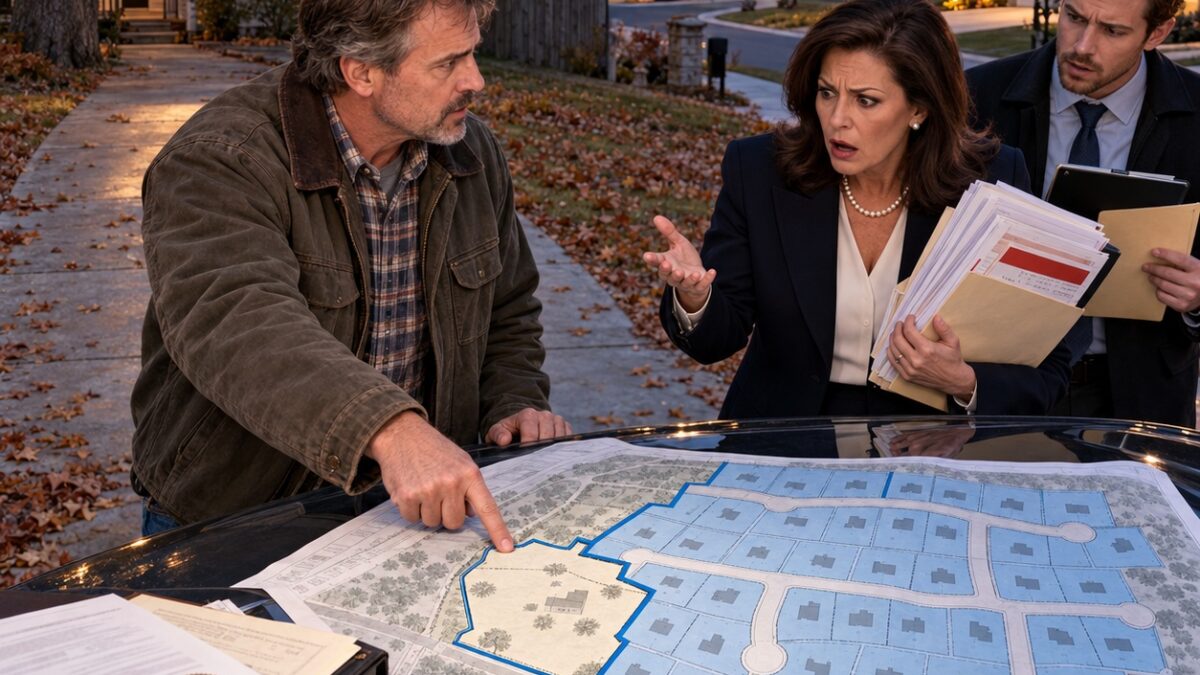
That sentence prevents somebody else from standing over the hood of a truck at dusk holding a nine-thousand-dollar debt they never owed.
That is consequence.
Not humiliation.
Not a viral confrontation.
A procedure that makes the next mistake less likely.
I wish more disputes ended that way.
A year later, my oak lost a large limb in a storm.
It landed partly across the sidewalk.
I pulled a permit where required, hired an arborist, cleared it.
The young property manager drove past while we were working.
He stopped.
Rolled down the window.
“For what it’s worth, no violation.”
I laughed.
“Good to know.”
He smiled.
Then:
“We checked.”
That made me laugh harder.
“Now you’re learning.”
He drove away.
Normal.
That is what I wanted.
Mara eventually stepped down as president.
Not because of me.
Term ended.
Somebody else took over.
I heard she stayed involved in committees.
That was fine.
I did not need her banished.
The new president introduced himself one afternoon while I was trimming the fence line.
“I know your property isn’t part of the association.”
Strong opening.
I smiled.
“Glad we got that out of the way.”
He laughed.
“I just wanted to make sure if there are shared issues—storm drainage, traffic, whatever—we have your number.”
“That’s reasonable.”
We exchanged contact information.
That relationship worked.
Because cooperation is easier when nobody pretends cooperation equals jurisdiction.
I helped once with a drainage issue near the entrance.
Another time, the HOA warned me before tree work closed part of the street.
Neighborly.
No letters.
No threats.
No liens.
That is how it should have been from the start.
I still sort mail over the hood of my truck sometimes.
Habit.
Every now and then, the light hits a cream envelope and my stomach remembers before my brain does.
Then I laugh at myself.
Open it.
Usually insurance.
Or an advertisement.
The house is still mine.
Title clean.
No HOA lien.
No balance.
No enforcement account.
No dues.
The oak still throws the kind of shade you cannot buy at a garden center.
The fence still runs straight north-south while the sidewalks curve around it.
Physical reminder that the land was there first.
Not superior.
Just older.
Different.
Legally separate.
And somewhere in the association records is a policy created because one evening Mara Denton handed me ten years of charges and told me:
“Everyone pays.”
She was almost right.
Everyone who owes pays.
Everyone else gets to ask:
Show me the document.
That question saved me nearly nine thousand dollars.
More important, it kept a wrongful lien off my title.
No shouting required.
No lawsuit.
No revenge.
Just a deed.
A declaration.
A missing annexation.
A title policy.
And enough patience to make the paperwork catch up to reality.
A month after the whole thing ended, two neighbors came to me because they had started asking questions about their own parcels.
That might have been the most lasting result.
Not because I wanted people fighting their HOA.
I didn’t.
Because once people learn how land records actually work, they stop treating confidence as proof.
They pull the deed.
They read the declaration.
They search the annexation.
They ask what got recorded.
And people who have been counting on them never asking those questions suddenly have to start producing answers.
My property was never inside that HOA.
It only looked like it was.
For ten years, apparently, nobody had bothered to verify the difference.
Then they tried to charge me $8,947.62 for the assumption.
I made them check.
And when they finally did, the debt disappeared.
The lien threat disappeared.
The enforcement account disappeared.
What remained was exactly what had been there all along:
My house.
My deed.
My land.
And a record that finally told the truth.


