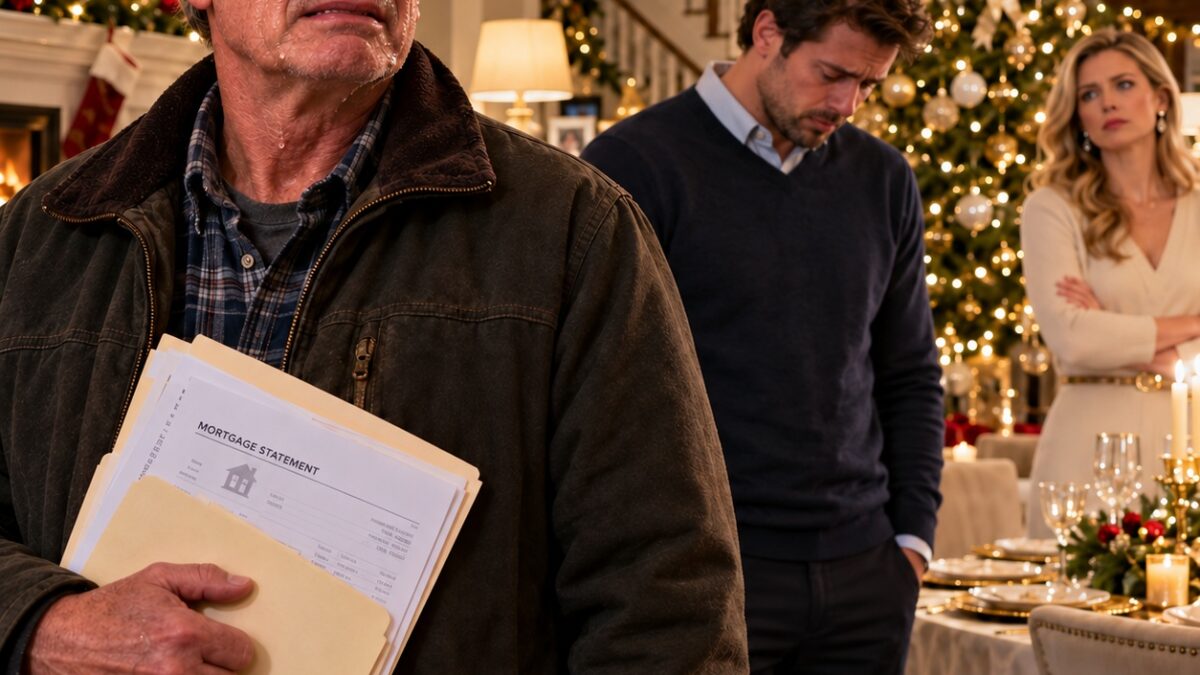
My son told me I wasn’t expected for Christmas while sitting in the living room of the house I had helped him buy. For five years, I had quietly sent $2,800 every month toward the mortgage, paid the down payment, and postponed repairs on my own home so his family could keep theirs. So when Michael looked at the floor and said, “Dad, Isabella’s parents would be more comfortable if it was just us this year,” I smiled, drove home, and opened the folder I should have opened years earlier.
PART 2 and FULL ENDING  Thank you

“Certainly, sir,” the woman said. “I can help you with that.”
Her name was Jennifer.
I remember because her voice was ordinary.
Pleasant.
Professional.
There was no thunder outside.
No dramatic music.
No feeling that a life was changing.
Just a woman somewhere in a call center asking me to verify the last four digits of my Social Security number.
That is how some of the biggest decisions happen.
Quietly.
“Can you identify the recurring transfer?” she asked.
“Twenty-eight hundred dollars.”
I looked down at the statement.
“Monthly.”
“To Wells Fargo account ending in 7423?”
“Yes.”
“And you want to cancel future transfers beginning with the payment scheduled for December fifteenth?”
I hesitated.
Not because I had changed my mind.
Because saying yes made the decision real.
For five years, that transfer had become as automatic emotionally as it was financially.
Mortgage.
Utilities.
Insurance.
Something broken.
Michael calling.
Dad, can you help?
Dad, just this once.
Dad, we’re almost caught up.
Every request carried the same invisible sentence behind it.
You’re my father.
And every time, I answered with money because money was easier than admitting my son and I were slowly forgetting how to have a relationship that did not involve rescue.
“Yes,” I said.
“Cancel it.”
I heard typing.
Then Jennifer said, “The transfer has been stopped.”
That was it.
Five years ended in seven words.
“Anything else I can assist you with tonight?”
I looked around my kitchen.
The refrigerator was twelve years old.
One cabinet hinge had been broken since August.
There was painter’s tape around the inside of the back window where cold air leaked through the frame.
Every time I considered replacing something, I calculated what Michael might need.
“No,” I said.
Then I smiled.
“No. That’s everything.”
I hung up.
The house became very quiet.
Maria had been gone eight years.
You would think I would have adjusted to quiet by then.
I hadn’t.
She had filled rooms without trying.
Hummed while cooking.
Talked to the television.
Read newspaper headlines aloud and expected me to respond even when I was standing outside the room.
After she died, Michael became the center of whatever family I still had.
Maybe that was part of the problem.
I had been so afraid of losing the last person who connected me to the life Maria and I built that I made myself useful in every way possible.
Useful people get invited.
Useful people get called.
Useful people still matter.
Except eventually I became useful enough to finance Christmas and inconvenient enough not to attend it.
My phone buzzed.
Michael.
DAD, PLEASE CALL ME.
Another message appeared.
I’M SORRY ABOUT HOW THAT CAME OUT.
Then:
WE LOVE YOU. THIS IS JUST ONE DINNER.
I read that one three times.
Just one dinner.
Maybe he believed that.
Maybe exclusion feels small to the person doing it.
To the person being excluded, it can contain years.
I turned the phone facedown.
Then I did something I had not done in months.
I cooked.
Not much.
Two eggs.
Potatoes with onion and peppers.
Toast.
I ate at my own kitchen table without calculating whether grocery money needed to last until the next transfer.
Afterward, I poured one finger of the whiskey Maria had bought me for our thirty-fifth anniversary.
The bottle was still almost full.
She had laughed when she gave it to me.
“You save everything good for later.”
Apparently I did.
Wine.
Whiskey.
Vacation days.
Money.
Anger.
My own needs.
Later was becoming crowded.
I lifted the glass toward her photograph.
“Merry Christmas, Mari.”
My voice cracked.
I drank anyway.
Isabella called the next morning at 9:06.
I considered ignoring it.
Then answered.
“Hello.”
“Dennis.”
She had a polished voice.
She could make a complaint sound like an invitation.
“We need to clear up yesterday.”
“Do we?”
“I think emotions got involved.”
“They usually do in families.”
A pause.
“I hope you understand this isn’t personal.”
I almost laughed.
“How could it not be?”
“My parents are only here for a few days.”
“So am I.”
“That’s not what I meant.”
“I know.”
I walked to the coffeemaker.
Outside, snow had started dusting the backyard.
Isabella continued.
“They have a very specific Christmas tradition.”
“And my existence interferes with it?”
“You’re making this hostile.”
“No.”
I poured coffee.
“I’m making it accurate.”
She sighed.
“Michael said you seemed hurt.”
“Michael is observant.”
“Dennis, we’ve included you in every holiday for years.”
That was not quite true.
Thanksgiving had moved to her parents’ rental condo the year before.
I was invited for dessert.
Their anniversary dinner included “immediate family only,” which apparently did not include me but did include Isabella’s sister’s boyfriend.
Still, I did not argue.
“Okay.”
“Okay?”
“Yes.”
“You’re not going to make this into something bigger?”
I looked at the bank folder still sitting on the table.
“No.”
That was also true.
I didn’t need to make anything bigger.
I only needed to stop making myself smaller.
“Good,” she said, relieved. “Because I actually need a favor.”
I closed my eyes.
Of course she did.
“What?”
“My parents land tomorrow at two. Michael is working, and I have catering arriving.”
“Okay.”
“Could you pick them up?”
For a moment, I thought I had misunderstood.
“You don’t want me at Christmas.”
“It’s not about wanting.”
“But you want me to drive to the airport.”
“That’s completely different.”
“How?”
“Because family helps family.”
There are sentences so perfect you almost admire them.
I sat down.
“Isabella.”
“Yes?”
“No.”
Silence.
“What?”
“I won’t be picking them up.”
“Dennis, I already told them you would.”
“That was your mistake.”
“They’ll be stranded.”
“They can take a taxi.”
“My father hates taxis.”
“That sounds difficult.”
Her voice sharpened.
“You don’t have anything else to do.”
I looked around my house.
She was probably right.
No meetings.
No jobsite.
No one expecting me.
For years, that fact had made me ashamed.
Now it didn’t.
“I do have something to do.”
“What?”
“Whatever I want.”
She went quiet.
Then colder.
“This attitude is exactly why Christmas would have been uncomfortable.”
I almost responded.
Then I decided I did not need the last word.
“Goodbye, Isabella.”
I hung up.
My hands were shaking.
Boundaries sound impressive after the fact.
While you are setting them, they often feel like being rude to people who were comfortable with your compliance.
I stood in my kitchen wondering whether I had become petty.
Maria would have picked them up.
Wouldn’t she?
Actually, no.
Maria would have smiled sweetly, told Isabella to call a car, and then spent six months pretending she had forgotten the conversation.
I laughed.
“Fine,” I said to the empty room. “You win.”
I did not go to the airport.
I also did not spend the afternoon imagining them suffering.
I drove to Home Depot.
Bought a new porch light.
Weather stripping.
Paint.
A decent drill because mine had finally died.
Then I came home and repaired the window.
At 2:41, my phone rang.
Isabella.
At 2:48, again.
At 3:03, Michael.
At 3:09, Isabella.
A text appeared.
WHERE ARE YOU?
I answered once.
I told Isabella yesterday I would not be coming.
Michael responded immediately.
DAD WHAT IS GOING ON?
I typed:
Nothing. I said no.
Then I put the phone away.
That felt stranger than canceling the payment.
At 6:30 that evening, someone knocked.
Not pounded.
Knocked.
Michael stood on the porch.
Alone.
His cheeks were red from the cold.
“Can I come in?”
I stepped aside.
He entered and stared at the new porch light through the front window.
“You fixed it.”
“Yes.”
“You’ve been saying you were going to.”
“I finally had the money.”
His face changed slightly.
He followed me into the kitchen.
“Dad, what’s happening?”
“You keep asking that.”
“Because you’re acting different.”
“I said no twice.”
“That’s what I mean.”
I sat.
He remained standing.
“Isabella’s parents spent forty-five minutes waiting for a rideshare.”
“I’m sorry to hear that.”
“No, you aren’t.”
“No.”
He stared at me.
“Why are you doing this?”
I almost became angry.
Then I saw what was actually happening.
Michael had never needed to think about the cost of my help.
Not only money.
Time.
Convenience.
Dignity.
My help simply appeared.
Like electricity.
People notice electricity only when the lights go out.
“I canceled the mortgage transfer.”
The color left his face.
“What?”
“The automatic payment.”
“You canceled it?”
“Yes.”
“Dad.”
He sat suddenly.
“The payment is due Monday.”
“I know.”
“We don’t have twenty-eight hundred dollars sitting around.”
“Then you have a problem.”
He blinked.
“You can’t just stop.”
“I can.”
“But you’ve been paying it.”
“Yes.”
“For five years.”
“Yes.”
“So why now?”
I looked at him.
“You really need me to answer that?”
His eyes dropped.
“This is punishment.”
“No.”
“It obviously is.”
I shook my head.
“Punishment would be me trying to hurt you.”
“What do you call this?”
“Ending something I should have ended years ago.”
He pushed back from the table.
“Because of one Christmas dinner?”
“No.”
My voice stayed calm.
“Because of what one Christmas dinner finally made impossible for me to ignore.”
He looked away.
I continued.
“You make seventy-eight thousand dollars a year.”
His head snapped back.
“How do you know what I make?”
“You told me when you got promoted.”
“Isabella works too.”
“Yes.”
“She has student loans.”
“I know.”
“We have expenses.”
“So do I.”
That stopped him.
“I refinanced this house for your down payment.”
He said nothing.
“I paid your mortgage while you were unemployed.”
“I know.”
“I kept paying after you were employed.”
“We were catching up.”
“For three years?”
His jaw tightened.
“You offered.”
“Yes.”
“That matters.”
“It does.”
I nodded.
“I offered because I loved you. You accepted because you needed help.”
I leaned forward.
“But somewhere along the way, need became expectation.”
“That’s not fair.”
“My porch light flickered for nine months because I kept deciding your mortgage mattered more.”
“Dad—”
“My dental crown broke in March.”
He stared at me.
“I didn’t fix it until September because your property taxes were due.”
“I didn’t know that.”
“That is exactly the point.”
Silence.
He ran a hand through his hair.
“Why didn’t you tell me?”
“I’m telling you now.”
His eyes filled, but he looked away before tears could form.
“We can’t afford the house without your help.”
That was the first honest sentence of the evening.
“Then you cannot afford the house.”
He looked at me as though I had said something cruel.
Maybe it was cruel.
Or maybe reality sounds cruel when somebody else has been paying the difference.
“What are we supposed to do?”
“Cut expenses.”
“We have.”
I raised one eyebrow.
He almost smiled despite himself.
Then didn’t.
“Sell the house.”
His face hardened.
“Isabella will never agree.”
“That is between you and your wife.”
“She loves that house.”
“So do I.”
He stared at me.
“You do?”
“Of course I do.”
I softened.
“I wanted you to have it.”
“Then why—”
“Because loving something doesn’t mean I have to finance it forever.”
He stood.
“This is unbelievable.”
“No, son.”
I looked at him.
“What was unbelievable was me spending five years paying for a house where somebody had to explain why I wasn’t welcome for Christmas.”
He opened his mouth.
Nothing came out.
At the door, he turned.
“Mom would hate this.”
That sentence landed like a fist.
He knew it immediately.
His face changed.
“Dad, I didn’t mean—”
I opened the door.
“Go home, Michael.”
“Dad.”
“Now.”
He left.
I closed the door.
Then I stood with one hand on the lock until my breathing slowed.
That night, for the first time since Maria died, I was angry with my son.
Not disappointed.
Not hurt.
Angry.
And strangely, anger was easier to survive.
Michael apologized by text the next morning.
I’M SORRY I BROUGHT MOM INTO IT.
I replied:
Thank you.
Nothing more.
Christmas arrived four days later.
Aunt Rosa called on Christmas Eve.
Rosa was Maria’s older sister.
Seventy.
Widowed.
Loud.
She had opinions about everything from politics to supermarket tomatoes.
“You’re coming tomorrow.”
It was not phrased as a question.
“I don’t want to impose.”
“You are family.”
I nearly laughed at the timing.
“I’m serious.”
“So am I.”
“We’re eating at three.”
“I can bring something.”
“Bring your stuffing.”
I smiled.
“Maria’s stuffing.”
“Your stuffing. She stole it from you forty years ago.”
“Historical revisionism.”
“Three o’clock.”
I went.
Rosa’s house was small.
Too warm.
Crowded.
Her daughter had three children.
Her son had two.
Someone’s dog stole a dinner roll.
The youngest child spilled cranberry sauce on my shirt.
Nobody cared.
There were folding chairs around the table because they didn’t own enough matching ones.
I had not had that much fun on Christmas in years.
Halfway through dinner, Rosa looked at me.
“You seem lighter.”
“I stopped paying Michael’s mortgage.”
She put down her fork.
“Finally.”
I stared.
“You knew?”
“Everyone knew.”
“Everyone?”
“Maria would have haunted you if she could.”
I laughed.
Then almost cried.
Rosa reached across the table and squeezed my wrist.
“Helping your child is good.”
“I know.”
“Making sure he never experiences consequences is not helping.”
I looked at her.
“You sound like Maria.”
“She was smarter.”
“That’s debatable.”
“It isn’t.”
Across the table, Rosa’s granddaughter shouted, “Uncle Dennis, are you coming to my school play?”
Uncle.
Technically wrong.
Emotionally perfect.
“When?”
“February.”
“What day?”
She told me.
I put it in my phone.
“Wouldn’t miss it.”
For the first time that Christmas, I did not think about Michael’s house.
Not until I returned home.
There was a gift on my porch.
Wrapped in green paper.
From Michael.
Inside was a framed photograph.
Me.
Michael.
Maria.
Taken at his college graduation.
On the back he had written:
I’m sorry.
I sat on the porch step holding it.
I did not call.
Not yet.
Forgiveness and access are not the same thing.
I was only beginning to learn that.
The January mortgage payment failed.
Then February.
Michael called several times.
I answered some.
The conversations improved when money stopped being the first subject.
Not immediately.
At first, everything circled back.
“We’re cutting subscriptions.”
“Good.”
“We canceled the landscaping service.”
“Good.”
“Isabella sold some designer bags.”
I said nothing.
“We might rent the basement.”
“That could help.”
Then one evening, he asked about my doctor appointment.
I almost did not know how to answer.
For years, calls had begun with Dad, can you…
Now he asked because he remembered.
“Doctor says I need to walk more.”
“You should.”
“I walk.”
“To your truck.”
“That counts.”
“No.”
I smiled.
Small moments.
Nothing cinematic.
No grand apology.
Just a relationship trying to learn a different language.
Isabella did not call me for two months.
That was fine.
Then a letter arrived in March.
Not from her.
From Wells Fargo.
I had been listed as an interested financial contributor during the original mortgage restructuring, which meant certain notices still came to me.
DELINQUENCY NOTICE.
Three missed payments.
$8,400 due.
Potential foreclosure if unresolved.
I read it once.
Then set it down.
My first instinct was immediate.
Fix it.
Call Michael.
Transfer the money.
Protect him.
I stood in the kitchen with my phone in my hand.
Then I looked at the new window trim.
The repaired porch.
The dental receipt from the crown I had finally replaced.
The plane brochure Rosa had given me because she wanted to take a summer trip to New Mexico.
My life had reappeared quietly after I stopped financing theirs.
I put the phone down.
Michael came over two nights later.
He looked exhausted.
No expensive coat.
No polished shoes.
Jeans.
Work boots.
A man who had spent the day somewhere physical.
“New job?” I asked.
“Second job.”
He smiled weakly.
“Warehouse. Nights and weekends.”
I nodded.
“Coffee?”
“Yes.”
We sat at the kitchen table.
Same table where I canceled the transfer.
Same table where I told him the house was no longer my responsibility.
“The bank sent me a notice,” I said.
“I know.”
He stared at his coffee.
“We’re going to sell.”
I said nothing.
“We listed yesterday.”
“How does Isabella feel?”
“Angry.”
“Understandable.”
“She blamed you.”
“Also understandable.”
He looked up.
“I told her to stop.”
That mattered.
“What happened?”
“She said if you hadn’t canceled the payments, none of this would be happening.”
“And?”
“I told her we’re thirty-seven years old.”
I almost smiled.
“Heavy insight.”
“She didn’t appreciate it.”
“Most insight arrives badly.”
He rubbed his hands together.
“We had a fight.”
I waited.
“She said my father had embarrassed her family.”
I looked down.
“And I asked her when exactly you became my father only when we needed money.”
My throat tightened.
“Michael.”
“I should have said it sooner.”
“Yes.”
“I know.”
He breathed out.
“Dad, I’m sorry.”
“I know.”
“No.”
His voice broke.
“I need to say it correctly.”
He looked directly at me.
“I let you become the financial plan for my adult life.”
I sat very still.
“I kept telling myself you wanted to help.”
“I did.”
“I know.”
“That’s what made it easier.”
His eyes filled.
“And I let Isabella make you feel like a guest in a family you helped hold together.”
He wiped his face quickly.
“I should have defended you.”
I thought about telling him it was okay.
It wasn’t.
So I didn’t.
“You should have.”
He nodded.
“Are you ever going to forgive me?”
“I already do.”
His head lifted.
“That doesn’t mean I’m paying the mortgage.”
For the first time, he laughed.
A broken little laugh.
“I know.”
“Good.”
“I don’t think Isabella does.”
“That’s between you and Isabella.”
He looked tired.
“Everything is between me and Isabella lately.”
I understood what he was saying.
“Do you want advice?”
“Yes.”
“Stop making me the issue.”
He frowned.
“Meaning?”
“The mortgage exposed something.”
I leaned back.
“Maybe several things.”
“The way she treated you?”
“That too.”
“But if your marriage has problems, don’t hide behind Dad canceled the mortgage.”
He looked at me.
“Figure out what you actually believe.”
“And if what I believe changes the marriage?”
“Then at least it is your life.”
He nodded slowly.
I wanted to reach across the table and fix everything.
Instead, I drank my coffee.
Sometimes love looks like restraint.
The house sold in May.
They lost money.
Not everything.
Enough to sting.
Michael and Isabella moved into a three-bedroom townhouse thirty minutes away.
No twelve-foot Christmas tree.
No marble coffee table.
No professional landscaping.
Their monthly payment dropped by almost half.
Michael quit the warehouse job after they stabilized.
Isabella returned to full-time work instead of freelance consulting.
For several months, she and I had no relationship.
Then, unexpectedly, she came to my house alone.
It was a Tuesday.
I was replacing boards on the back steps when her car pulled into the driveway.
She stepped out wearing jeans and a plain sweater.
No giant handbag.
No careful holiday-host expression.
“Can we talk?”
I set down the drill.
“Sure.”
We sat on the porch.
She looked toward the yard.
“Michael doesn’t know I’m here.”
“That seems promising.”
A tiny smile.
Then she became serious.
“I was cruel to you.”
I waited.
“I told myself I was protecting my parents’ holiday.”
“From me.”
“Yes.”
She swallowed.
“That sounds awful out loud.”
“It sounded awful the first time too.”
She accepted it.
“I grew up in a house where appearances mattered.”
I said nothing.
“My mother notices everything.”
“She does seem observant.”
Another brief smile.
“She thought you were…”
She stopped.
“Go ahead.”
“Too informal.”
I nodded.
“Plainspoken.”
“Yes.”
“Blue-collar.”
Her face reddened.
“Yes.”
“Wrong kind of person for her table.”
Isabella looked down.
“Yes.”
There it was.
Not hatred.
Not some dramatic evil.
Something more ordinary.
Snobbery.
Cowardice.
The willingness to let someone else feel small so you could feel accepted by people you were afraid to disappoint.
“I knew it was wrong,” she said.
“Why did you do it?”
“Because I wanted her approval.”
That answer surprised me with its honesty.
“She never really approved of Michael.”
“Why?”
“Not enough money.”
I almost laughed at the irony.
“Your mother thought my son wasn’t good enough while I paid his mortgage?”
Isabella covered her face.
“I know.”
I waited.
She dropped her hands.
“When you stopped paying, she blamed Michael.”
“Of course.”
“She told me I had married down.”
My jaw tightened.
“And what did you say?”
“Nothing.”
Then she corrected herself.
“At first.”
I waited.
“Then I told her she wasn’t allowed to talk about my husband like that.”
I smiled slightly.
“Took you long enough.”
“Yes.”
“She doesn’t speak to me much now.”
“I’m sorry.”
Isabella looked surprised.
“You are?”
“Losing a parent’s approval hurts even when the approval came with terrible conditions.”
Her eyes filled.
“I thought you hated me.”
“I was angry.”
“Still?”
“Yes.”
She nodded.
“Fair.”
“Why are you here?”
“To apologize.”
“Done.”
“And…”
I waited.
“I want Michael to have his father.”
I looked at her.
“Michael decides that.”
“I know.”
She wiped beneath one eye.
“And if we ever have children…”
My chest tightened.
“We’re thinking about it.”
I looked away toward the maple tree.
For five years, I had contributed to a grandchildren fund in my head.
Then spent most of that money on their mortgage.
“I don’t want them growing up watching us treat family the way I did.”
That sentence reached me.
Not enough to erase anything.
Enough to open a door.
“I won’t be paying for your children.”
She laughed through tears.
“Deal.”
“Or your mortgage.”
“Definitely.”
“Or airport transportation for people who dislike me.”
She smiled.
“We learned that one.”
We sat quietly.
Then she pointed toward the porch boards.
“Need help?”
“Do you know how to use a drill?”
“No.”
“Then absolutely.”
I taught her.
She was terrible.
We laughed anyway.
That was the first afternoon I believed our family might become something other than what it had been.
Not repaired.
Rebuilt.
Those are different.
Repair tries to make an old thing look untouched.
Rebuilding admits the damage happened and decides what deserves to remain.
That December, Michael called two weeks before Christmas.
“Dad.”
“Yes?”
“We’re hosting.”
I waited.
“You and Aunt Rosa. Her kids. Whoever you want.”
“And Isabella’s parents?”
Silence.
“They’re doing Christmas in Portland.”
“Ah.”
“Mom and Isabella are still…”
“Complicated?”
“Yes.”
“Families do that.”
He cleared his throat.
“Will you come?”
I smiled.
“What time?”
“Three.”
“I’ll bring stuffing.”
His voice changed.
“Mom’s?”
“Ours.”
He laughed.
“Yeah.”
Christmas at the townhouse was nothing like the Christmas I had been excluded from one year earlier.
Tree too small.
Turkey slightly dry.
One of Rosa’s grandchildren broke a glass.
Michael burned the rolls.
Isabella’s pie collapsed in the center.
It was perfect.
Halfway through dinner, Michael stood.
I groaned.
“Please don’t make a speech.”
“I’m making a speech.”
“Sit down.”
“No.”
Everyone laughed.
He lifted his glass.
“To Dad.”
I looked down.
“For teaching me something I should have learned much earlier.”
He paused.
“That help is not the same as obligation.”
The table quieted.
“And that loving someone doesn’t mean asking them to make themselves smaller so your life can stay comfortable.”
I looked at him.
He swallowed.
“I’m glad you came.”
Simple.
Better than any apology.
I raised my glass.
“Merry Christmas.”
Everyone echoed it.
After dinner, I stood in the kitchen washing dishes.
Isabella handed me a plate.
“You know we have a dishwasher.”
“I don’t trust it.”
“You literally rebuilt a commercial property company.”
“Dishwashers are mysterious.”
She smiled.
Then said quietly, “Thank you for coming.”
“Thank you for inviting me.”
She nodded.
That was all.
No dramatic reconciliation.
No hugging.
No tears.
Real families often heal in tiny sentences nobody else notices.
Two years later, Michael and Isabella had their first child.
A girl.
Maria.
They asked me before naming her.
I cried anyway.
When she was six months old, Michael came to my house carrying her in one arm and a folder in the other.
I immediately distrusted the folder.
“What is that?”
“Financial documents.”
“No.”
“Dad.”
“No mortgage.”
“It’s not a mortgage.”
“No down payment.”
“Dad.”
“No private school trust.”
“Will you stop?”
I looked at baby Maria.
She smiled at me with absolutely no understanding of how expensive she might become.
“What?”
Michael put the folder on my table.
“College account.”
I narrowed my eyes.
“I opened one.”
“Good.”
“I want you to be a beneficiary contact.”
“Fine.”
“And only contribute if you want.”
I stared at him.
He smiled.
“I’ve learned.”
“Apparently.”
He sat.
“We’re putting in three hundred a month.”
“Good.”
“Isabella got another promotion.”
“Good.”
“We’re thinking about buying again next year.”
I froze.
He laughed.
“Using our money.”
“Excellent phrase.”
“Smaller place.”
“Even better.”
“No granite renovation request.”
“Now you’re showing off.”
Baby Maria reached toward me.
I took her.
She immediately grabbed my glasses.
I had never felt richer.
That surprised me.
Money had dominated my family for years.
Who gave it.
Who needed it.
Who controlled it.
Who deserved gratitude.
Then one tiny girl took my glasses, drooled on my shirt, and reminded me what inheritance was supposed to feel like.
Not leverage.
Not obligation.
Continuity.
I began contributing to her college account.
One hundred dollars a month.
Not because Michael asked.
Because I wanted to.
That difference mattered more than the amount.
I turned sixty-five the following summer.
Rosa organized a birthday party.
Michael wanted to pay.
I let him.
That was harder than it sounds.
People who spend years rescuing others often become strangely uncomfortable receiving anything.
At the party, Michael handed me an envelope.
“Please don’t tell me this is a mortgage statement.”
“No.”
Inside was a cashier’s check.
$10,000.
I stared at him.
“What is this?”
“The beginning.”
“Of what?”
“Paying you back.”
My face hardened.
“No.”
“Dad.”
“No.”
“You spent more than two hundred thousand dollars helping us.”
“I know.”
“I want to repay it.”
“No.”
“Why?”
“Because you can’t.”
His face fell.
I placed the check on the table.
“Not financially.”
He sat across from me.
“I understand what you’re trying to do.”
“Then let me.”
“I won’t take ten thousand dollars if it means you delay your retirement account, Maria’s college savings, or something your family actually needs.”
“I can afford it.”
“Can you?”
“Yes.”
I studied him.
He had changed.
Not magically.
He was still impatient.
Still avoided conflict longer than he should.
Still occasionally bought things without discussing them with Isabella.
But he had learned numbers.
Budgets.
Limits.
The word enough.
“What does Isabella think?”
“She helped save it.”
That surprised me.
I picked up the check.
“Then I’ll accept it.”
His eyes widened.
“With conditions.”
“Of course.”
“Half goes into my retirement account.”
“Okay.”
“Half goes into an account for trips with my granddaughter.”
He laughed.
“That is cheating.”
“My money.”
“Fair.”
“And this is the last repayment.”
His smile disappeared.
“Dad—”
“I gave the money willingly.”
“Not all of it.”
“I know.”
I softened.
“If you spend the next twenty years trying to repay my worst decisions, we’ll just build another kind of debt between us.”
He looked down.
“Then how do I make it right?”
“You already are.”
“How?”
“By calling when you don’t need anything.”
His eyes filled.
“By inviting me because you want me there.”
I continued.
“By showing your daughter that family isn’t a transaction.”
He nodded.
“And by never saying your mother would hate something during an argument again.”
He groaned.
“I knew that was coming.”
“Forever.”
“I deserve it.”
“Yes.”
We hugged.
Michael had been taller than me since he was seventeen.
That day, for some reason, I remembered exactly what it felt like when he was five and his arms could barely reach around my waist.
You never stop carrying some version of your child.
You just have to learn when to put down the parts they need to carry themselves.
Years later, people who knew the story sometimes asked whether canceling the mortgage was revenge.
I understood why.
It sounded like revenge.
Son excludes father.
Father stops paying.
Consequences follow.
Clean.
Satisfying.
But real life was messier.
If I had canceled the payment only to hurt Michael, I think I would have regretted it.
What saved me was something quieter.
I stopped paying because continuing had become dishonest.
Dishonest to him.
Dishonest to me.
Dishonest to Maria’s memory.
I had used money to avoid conflict.
Michael had used my generosity to avoid adulthood.
Isabella had used appearances to avoid disappointing her parents.
Everybody was hiding behind something.
The mortgage exposed us.
Painfully.
But clearly.
The townhouse years turned out to be good for Michael and Isabella.
They became closer.
Not because money problems are magically healthy.
Because they finally had to build a life whose cost matched their income.
When they bought another house, it was modest.
Four bedrooms.
Ordinary neighborhood.
Small backyard.
Michael called before closing.
“Want to know the monthly payment?”
“No.”
“Why?”
“Because it’s not mine.”
He laughed.
“Correct answer.”
They paid it themselves.
Every month.
One Christmas, when Maria was seven, she climbed onto my lap and asked why her father always joked that Grandpa wasn’t allowed near mortgage documents.
I nearly choked on my coffee.
Michael shouted from the kitchen.
“Do not tell her.”
I smiled.
“Your father was once very bad at budgeting.”
“Grandpa!”
“What?”
“That is not the story.”
Maria looked between us.
“Tell me.”
So we did.
A child-safe version.
Grandpa helped too much.
Dad depended too much.
Everybody learned.
She listened seriously.
Then asked, “Did you really get kicked out of Christmas?”
The room became quiet.
Michael sat beside her.
“Yes.”
“Why?”
He looked at me.
Then answered himself.
“Because I was trying to make other people comfortable and I forgot that Grandpa had feelings too.”
Maria frowned.
“That was mean.”
“Yes.”
“Did Grandpa forgive you?”
Michael smiled sadly.
“Eventually.”
I corrected him.
“Quickly.”
He looked at me.
“You did?”
“I forgave you before you understood why I was angry.”
“Then why did everything take so long?”
Because forgiveness is not restoration.
I had learned that years earlier.
“You can forgive someone and still need them to change before you trust them again.”
Maria thought about that.
Then nodded as if filing it away for later.
Children do that.
Maybe someday she would need it.
I hoped not.
I am seventy-one now.
The old house is finally fixed.
New windows.
New roof.
Kitchen cabinets that close properly.
Porch light that has not flickered in eight years.
I never moved.
People asked why.
Because Maria is still here.
Not literally.
In the scratches on the hallway wall where we measured Michael’s height.
In the small burn mark beside the stove from the Christmas she tried to make caramel.
In the rose bush she planted thirty years ago that refuses to die despite my complete lack of gardening talent.
I also traveled.
New Mexico with Rosa.
Yellowstone with Michael and his family.
Mexico City alone, because Maria and I always said we would go someday.
I carried her photograph in my suitcase.
Not because I could not move forward.
Because moving forward did not require leaving everything behind.
Last Christmas, everyone came to my house.
Michael.
Isabella.
Maria, now almost ten.
Rosa.
Her children.
Too many people.
Not enough chairs.
Exactly right.
Michael arrived early.
He carried groceries.
“No twelve-foot tree?”
I asked.
“Never again.”
“Trauma?”
“Electric bill.”
We laughed.
Isabella came through the door behind him holding pie.
“Dennis.”
“Yes?”
“My parents called.”
I raised an eyebrow.
Years had softened that relationship too.
Catherine had apologized eventually.
Not beautifully.
Not fully.
Enough that we could occupy the same room without anyone bleeding emotionally.
“Are they coming?”
“For dessert.”
“Fine.”
She smiled.
“You’re sure?”
“This is my house.”
“That’s why I’m asking.”
I thought about the Christmas years earlier.
The polished dining room.
Michael staring at the floor.
You weren’t expected.
I looked around my own living room.
Children arguing over ornaments.
Rosa yelling from the kitchen.
Music playing too loudly.
Michael fixing a loose cabinet handle without being asked.
Isabella setting the table.
Then I said, “Everyone’s welcome.”
She hugged me.
That still surprised me sometimes.
At dinner, Michael raised his glass.
“No speeches,” I warned.
He ignored me.
“To Dad.”
Maria groaned.
“Dad always makes speeches.”
“Genetic defect,” I told her.
Michael continued.
“Years ago, my father taught me the most expensive lesson of my life.”
Everyone laughed.
I shook my head.
“He taught me that generosity is a gift, not a contract.”
His voice softened.
“And that the fastest way to lose someone who loves you is to start treating their love like an entitlement.”
The room quieted.
I looked down at my plate.
“I nearly lost him.”
He swallowed.
“I’m grateful I didn’t.”
He raised the glass.
“To Dad.”
Everyone followed.
I lifted mine.
“To mortgages you pay yourself.”
The room exploded with laughter.
Maria looked confused.
She would understand someday.
Maybe.
After dinner, I stepped outside.
Snow had begun falling.
Soft.
Small flakes catching the porch light.
Michael joined me.
“You okay?”
“Yeah.”
He leaned against the railing.
“Cold.”
“You’re getting soft.”
“I’m fifty.”
“You think that impresses me?”
He smiled.
For a while, we watched the snow.
Then he said, “Dad.”
“Yes?”
“Do you ever wish you hadn’t canceled it?”
“The mortgage?”
“Yes.”
I thought about the question.
The house they lost.
The fights.
The months of distance.
The shame.
The rebuilding.
“No.”
He nodded.
“Me neither.”
That surprised me.
He continued.
“I hated you for about two weeks.”
“Only two?”
“Maybe four.”
“Reasonable.”
“But if you’d kept paying…”
He looked through the window at Isabella laughing with Rosa.
“I think I would have stayed a boy forever.”
I said nothing.
“You weren’t helping anymore.”
He looked at me.
“You were protecting me from becoming responsible.”
There it was.
The entire story in one sentence.
I put my hand on his shoulder.
“I didn’t know how to stop.”
“I know.”
“We both learned.”
He smiled.
“Expensive lesson.”
“Very.”
We went back inside.
Maria ran toward me holding a plate.
“Grandpa, Grandma Isabella says you have to try her pie.”
I stared at my daughter-in-law.
“Grandma Isabella?”
Michael burst out laughing.
Isabella threw a napkin at him.
Family.
Loud.
Imperfect.
Expensive in all the right ways.
That night, after everyone left, I cleaned the kitchen.
Maria’s old photograph sat on the mantel.
I picked it up.
“Not bad,” I told her.
She smiled back from a summer afternoon thirty years gone.
I sometimes wondered what she would have done differently.
Probably everything.
She had always been better with people.
But I think she would have understood the decision eventually.
Because canceling the mortgage had never really been about money.
The money simply made the truth impossible to ignore.
I wanted a son who chose me.
Michael needed a father who loved him enough to stop rescuing him.
We could not become those people while $2,800 moved between our accounts every month and carried all the things neither of us knew how to say.
So I stopped the payment.
He nearly lost a house.
I nearly lost a son.
And somehow, after the anger, the shame, the downsizing, the apologies, and years of small choices, we found each other without money standing between us.
People sometimes say parents should give their children everything.
I disagree.
Give them love.
Give them opportunities.
Give them help when life knocks them down.
Give them a place to come home when they truly need one.
But do not give so much that your child forgets the difference between support and entitlement.
And do not sacrifice yourself so completely that they learn your needs do not count.
I learned that late.
Michael learned it painfully.
But we learned.
The last thing I did before going to bed that Christmas was check my bank account.
Old habit.
My mortgage had been paid off years earlier.
No automatic transfer waited to disappear on behalf of anyone else.
The balance was comfortable.
Not enormous.
Enough.
I closed the banking app.
Then my phone buzzed.
Michael.
HOME SAFE. LOVE YOU, DAD. MERRY CHRISTMAS.
I smiled.
Years earlier, I would have measured our relationship in money transferred.
That night, five words were worth more.
LOVE YOU, DAD. MERRY CHRISTMAS.
I typed back:
Love you too, son.
Then I turned off the light in the kitchen and walked past Maria’s photograph toward bed.
Outside, snow covered the porch I could finally afford to repair.
Inside, there was no bitterness left.
Only a quiet house, a full heart, and the knowledge that the hardest payment I ever canceled ended up buying back something I had almost lost completely.
My place in my own life.



