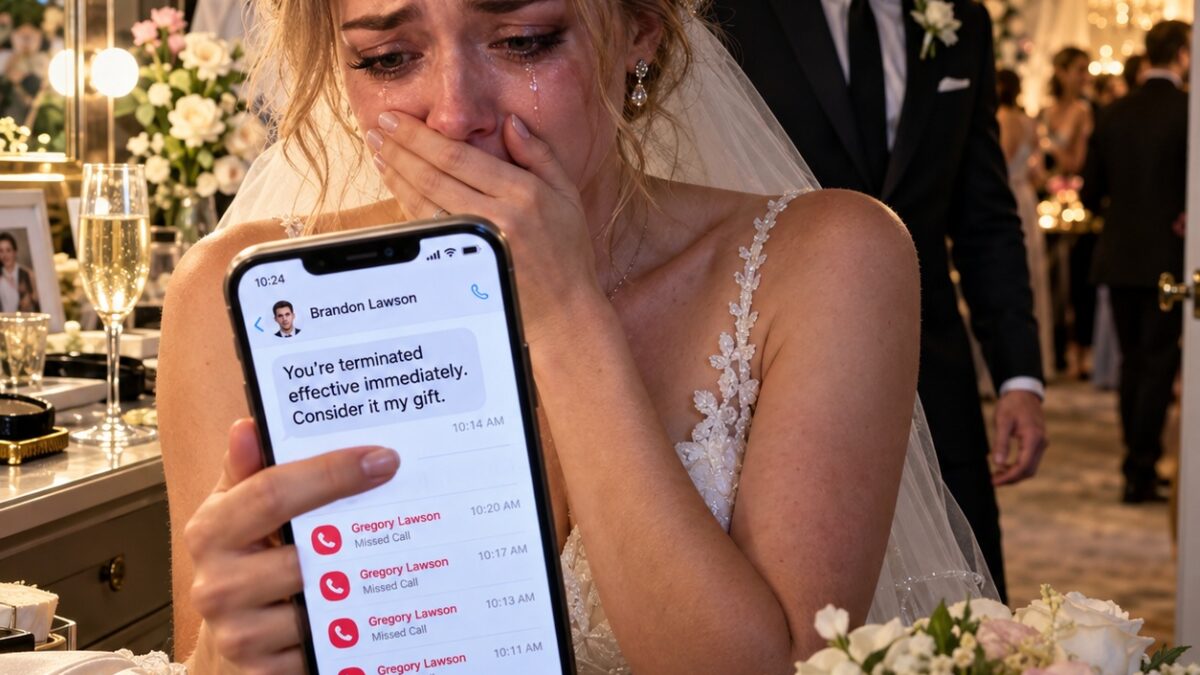
My Boss’s Son Fired Me by Text Less Than 20 Minutes After I Said “I Do” — He Called It His “Gift,” But Hours Later, His Father Was Begging Me to Answer 17 Desperate Calls


I stared at Caleb.
The noise from our reception felt impossibly far away.
“What kind of something?”
He closed the bridal suite door behind him.
For a few seconds, he just stood there.
Still in his dark wedding suit.
Tie slightly loosened.
White rose boutonniere leaning sideways because my eight-year-old nephew had hugged him too hard after the ceremony.
It should have been an ordinary newlywed moment.
Instead, my phone showed seventeen calls from the man whose company had just fired me.
Caleb crossed the room and sat beside me carefully, making sure he didn’t crush the skirt of my dress.
“The downtown redevelopment package,” he said. “I’ve reviewed four versions over the last six weeks.”
I nodded.
That project had consumed most of my life for nearly a year.
A mixed-use development in a neglected industrial section near the river.
Affordable housing.
Retail.
Public green space.
A community health center.
Gregory called it Crescent’s legacy project.
Tate called it the deal that would finally prove he belonged in his father’s chair.
“What about it?”
Caleb looked at the closed door.
Then back at me.
“The versions your engineering team stamped aren’t always the versions arriving at the city.”
My stomach tightened.
“What?”
“I noticed the first discrepancy three weeks ago. Fire separation detail in Building C.”
I knew the drawing.
“You’re sure?”
“Yes.”
“What changed?”
“The approved package showed two-hour separation around the utility shaft. The submitted version reduced part of it.”
“That doesn’t make sense.”
“I know.”
“That would never pass review.”
“It didn’t. We sent it back.”
“Did Tate submit the revision?”
“The cover letter came from his office.”
I stopped breathing for a second.
Caleb continued.
“Then last week, another package came in with a substitution on structural steel specifications.”
My hands went cold.
“Cheaper grade?”
“Yes.”
“Without engineer approval?”
“No revised engineering stamp.”
I stood so quickly the vanity stool scraped against the floor.
“That’s not project management sloppiness.”
“I know.”
“That’s potentially fraud.”
“I know.”
“And dangerous.”
“Yes.”
I paced once across the small room.
My wedding shoes hurt.
I kicked them off.
“You’ve been sitting on this?”
“I haven’t been sitting on it.”
His voice stayed calm, but there was steel under it now.
“I documented the discrepancies. My supervisor has them. Legal review was already being discussed.”
“Why didn’t you tell me?”
“Because you worked for Crescent.”
That stopped me.
He was right.
My marriage did not entitle me to confidential city records.
And his job did not entitle him to share an open compliance concern with someone employed by the company under review.
“I was going to tell you something was coming after we got back from the honeymoon,” he said. “Only what I was legally allowed to.”
I sank back onto the stool.
“Tate fired me.”
“Yes.”
“On the exact day you were getting ready to flag his submissions.”
“That’s why I told you not to call anyone yet.”
I looked at Gregory’s voicemail list.
“What do I do?”
Caleb smiled sadly.
“For the next four hours?”
“Yes.”
“Nothing.”
“Nothing?”
“We go back downstairs.”
I stared at him.
“You want me to dance?”
“I want you to have your wedding.”
“My career just exploded.”
“No.”
He took my hand.
“Your job exploded. That is not the same thing as your career.”
I looked away.
He squeezed my fingers.
“Tomorrow, you can decide what comes next.”
“And Gregory?”
“He can survive until tomorrow.”
I laughed once.
It came out half broken.
“Are you sure?”
“He’s run a thirty-year architecture firm. I have faith in him.”
That was the first moment I realized I was married to the right man.
Not because he promised to destroy Tate.
Not because he told me everything would magically be fine.
Because he reminded me that one cruel person did not get to own the day.
I turned off my phone.
Then I went back to my reception.
And I danced.
Not because I wasn’t devastated.
I was.
But because there are moments people can steal only if you hand them over.
Tate had taken my job.
He was not getting my wedding.
At midnight, Caleb and I left beneath sparklers held by people who had no idea I was unemployed.
I remember laughing as we ran toward the old black car my sister had rented.
I remember my veil catching on the door.
I remember Caleb freeing it while everyone shouted advice he did not need.
For ten minutes, I forgot Crescent existed.
Then we reached the hotel.
I turned my phone back on.
212 missed calls and messages.
My heart sank.
There were texts from coworkers.
WAVERLY WHAT HAPPENED?
Did Tate really fire you???
Gregory is losing his mind.
Nobody can find the Westside final package.
Call me please.
Then there were messages from Gregory.
The last one arrived at 11:48 p.m.
Please do not make any decisions tonight. Tate’s action is being reviewed. Whatever happened between the two of you, we can fix it.
I stared at that sentence.
Whatever happened between the two of you.
As though this were a disagreement.
As though Tate had insulted me at a meeting instead of firing me by text on my wedding day.
Caleb was removing his cuff links.
“You okay?”
“I don’t know.”
“Reasonable answer.”
I held up the phone.
“Gregory wants to fix it.”
“Do you?”
That question stayed with me all night.
We left for our honeymoon the next morning.
Not Bali.
Not Bora Bora.
Not anywhere glamorous enough for one of those glossy wedding magazines.
We had booked a small oceanfront hotel in Belize because Caleb had found a ridiculous airfare sale and I had always wanted to snorkel.
At the airport, Gregory called again.
I let it ring.
Then Raina Ellis called.
She had been my project coordinator at Crescent for eighteen months.
I answered.
“Waverly?”
She sounded close to tears.
“Hey.”
“Oh my God. I’m so sorry.”
“Are you okay?”
“Am I okay?”
She laughed sharply.
“You got fired at your wedding.”
“I noticed.”
“How can you joke?”
“Temporary insanity.”
I heard office noise behind her.
Voices.
Phones.
Printers.
“What’s happening?”
She lowered her voice.
“Chaos.”
“How bad?”
“Gregory came in at six this morning.”
That alone told me enough.
Gregory Lawson considered anything before eight an assault on civilization.
“Tate’s office is closed.”
“Meaning?”
“He’s inside with his father and legal.”
I looked at Caleb.
He was watching the gate display, giving me privacy without pretending not to listen.
Raina continued.
“They tried restoring your account.”
“My account is disabled.”
“I know.”
“They don’t need mine.”
“That’s what I said.”
“All project access is role-based.”
“I know.”
“Admin can reassign ownership.”
“I know.”
I paused.
“Then what’s the problem?”
A long silence.
“Training.”
Of course.
“What can’t they figure out?”
“Version relationships.”
I closed my eyes.
The system itself was not impossible.
It was actually logical.
But the downtown project had nearly eighteen hundred active documents.
Architectural.
Structural.
Mechanical.
Electrical.
Client markups.
City corrections.
Vendor alternates.
Permit submissions.
Superseded files.
Approved files.
Pending files.
The software showed all of them.
What it could not teach instantly was why one version superseded another.
That required context.
Context I had tried to distribute.
Training Tate canceled.
“How much did the team complete?”
I asked.
“Maybe twenty percent of the modules.”
“Raina.”
“I know.”
“I scheduled those sessions.”
“I know.”
“He canceled them.”
“I know.”
Neither of us spoke.
Then she whispered, “He said everyone could learn it if necessary.”
“And now?”
“Apparently necessary arrived.”
I pressed my fingers against my forehead.
“Raina, listen to me.”
“Okay.”
“Do not change anything you don’t understand.”
“We have a Monday deadline.”
“I don’t care.”
“Gregory does.”
“A missed deadline costs money. A corrupted revision chain can put the wrong drawings on a construction site.”
She was quiet.
“Right.”
“Freeze uncertain files. Use the audit trail. Call the software vendor if needed.”
“The vendor says custom workflow support isn’t covered.”
“Tate declined the support package.”
Another silence.
“He did?”
“Yes.”
“Why?”
“Cost.”
Raina muttered something impolite.
I almost smiled.
Then she said, “Gregory wants to talk to you.”
“I’m boarding a plane.”
“He offered double your salary.”
I looked at Caleb.
He raised one eyebrow.
“When?”
“About twenty minutes ago.”
“That was fast.”
“He’s desperate.”
“I know.”
“Waverly…”
Her voice softened.
“What do I tell him?”
I looked through the terminal window.
Planes moved slowly across the wet runway.
“I’ll call him when I’m ready.”
Then I boarded.
I did not call Crescent for three days.
That was not revenge.
At least, not mostly.
I needed distance.
And I was legally no longer their employee.
I did not want to become the fired worker informally directing projects from a beach while somebody else carried authority and liability.
On our third afternoon in Belize, Caleb and I were sitting under a faded blue umbrella drinking something involving too much pineapple when my phone buzzed.
Gregory.
I ignored it.
A voicemail appeared.
I played it.
“Waverly, this is Gregory. I know you’re on your honeymoon and I deeply regret disturbing you. The downtown submission missed its deadline this morning. The client has issued a notice of breach. I am prepared to triple your previous salary and guarantee a vice president title if you return. Tate will no longer supervise you. Call me.”
I stared at the ocean.
Caleb waited.
“Well?”
“Triple.”
He whistled.
“Vice president.”
“Fancy.”
“You sound unimpressed.”
“I would have been impressed six months ago.”
“What changed?”
I looked at him.
“He fired me.”
“Fair.”
I deleted the voicemail.
Caleb smiled.
“That looked satisfying.”
“A little.”
Then his expression turned serious.
“The city review is moving forward.”
I lowered my drink.
“How far?”
“My supervisor escalated the altered submissions to compliance.”
“So it’s formal.”
“Yes.”
“Does Gregory know?”
“I don’t know.”
“Does Tate?”
“If he understands the process, probably.”
That explained something.
Maybe Tate had not fired me only because of ego.
Maybe he also wanted someone gone who knew exactly what the approved plans should look like.
I hated that thought.
Not because it was certain.
Because it was plausible.
“Caleb.”
“Yeah?”
“What if he fired me because he thought I’d notice?”
“You already had.”
“I mean notice enough to report him.”
Caleb considered that.
“We don’t know.”
“I hate not knowing.”
“I know.”
I looked at the water again.
The Caribbean stayed beautiful despite corporate corruption.
Rude, honestly.
“What are you going to do when we get home?” he asked.
“I have no idea.”
“That’s not true.”
I turned.
He smiled.
“You’ve been writing something every morning while you think I’m asleep.”
I froze.
“You saw that?”
“I married a woman who color-codes vacation packing.”
“I did not color-code.”
“Blue was beach.”
“Practical.”
“Green was travel.”
“Efficient.”
“Red was emergency.”
“That was one pouch.”
He laughed.
“What are you building?”
I looked down at my hands.
“A business plan.”
He nodded as if that made perfect sense.
“For what?”
“Independent project systems and compliance consulting.”
His smile widened.
“What?”
“That’s exactly what I hoped you’d say.”
“Why?”
“Because the city is hiring outside support to redesign submission verification after this mess.”
I stared at him.
“Are you suggesting I bid?”
“I’m suggesting you stop building systems for people who think your expertise belongs to them.”
I leaned back.
“You understand I have no company.”
“Yet.”
“No staff.”
“Yet.”
“No municipal contract history.”
“You have two years of turning Crescent’s operations around.”
“I was fired.”
“On your wedding day.”
“That is not traditionally listed under qualifications.”
“Depends how memorable you want the proposal to be.”
I laughed so hard the couple at the next table looked over.
That night, instead of checking Gregory’s newest offer, I finished the first draft of a business plan.
Precision Protocol Consulting.
The name was terrible.
I knew it.
It also stuck.
Three days after we returned home, I registered the company.
The business address was our apartment.
My office was a second bedroom containing two unpacked wedding gifts, a printer, and a desk Caleb bought from a college student for forty dollars.
At 9:12 that morning, my phone rang.
Gregory.
I stared at it.
Then answered.
“Hello.”
“Waverly.”
The relief in his voice was almost painful.
“Thank God.”
“Good morning, Gregory.”
“Where are you?”
“Home.”
“Can you come in?”
“No.”
Silence.
“Can we meet?”
“Possibly.”
“When?”
“Why?”
Another silence.
Then he said, “Because I owe you an apology.”
That surprised me.
“Go ahead.”
“Not over the phone.”
“Then we may be waiting.”
He exhaled.
“I also need your help.”
There it was.
“At least that part is honest.”
“Waverly.”
“What exactly do you need?”
“The downtown project is suspended.”
“I heard.”
“The Westside development group is threatening termination.”
“I heard.”
“Two other projects are behind.”
“I’m sorry.”
“Stop saying that.”
“Why?”
“You don’t sound sorry.”
“I’m not happy about it.”
“That’s different.”
“Yes.”
He took a breath.
“I fired Tate.”
That stopped me.
“What?”
“Yesterday.”
“From the company?”
“From management.”
I waited.
“He is still my son.”
“I assumed.”
“He is no longer department director.”
“Why?”
Gregory became quiet.
When he spoke again, his voice was lower.
“Because I finally reviewed what he had been doing.”
My stomach tightened.
“What exactly?”
“Canceled training. Reassigned credit. Overrode project controls.”
He hesitated.
“And there are questions about design submissions.”
“Questions?”
“Yes.”
“Ask a better word.”
He did not answer.
I leaned back in my cheap desk chair.
“Caleb told me enough to understand a city review is underway.”
Gregory inhaled sharply.
“So you know.”
“I know discrepancies exist.”
“Waverly, the city may audit multiple projects.”
“It should.”
“Do you understand what that could do to Crescent?”
“Yes.”
“Thirty-one years.”
“Gregory.”
“I built this company from a rented room with one drafting table.”
“And that history does not make unsafe drawings safer.”
Silence.
Then he whispered, “No.”
That was the first moment I heard the father disappear and the business owner return.
“What do you want from me?” I asked.
“Come back.”
“No.”
“I’ll make you partner.”
“No.”
“Name your salary.”
“No.”
“Waverly—”
“I started my own company.”
Silence.
“You what?”
“Precision Protocol Consulting.”
“When?”
“Monday.”
“Consulting for whom?”
“I’m preparing a proposal for the city planning department.”
The line went completely quiet.
He understood immediately.
My company would not exist to attack Crescent.
But if the city hired me to help improve submission controls, Crescent’s recent records would inevitably face scrutiny.
“Waverly.”
“Yes?”
“Can we meet?”
This time I agreed.
Not at Crescent.
At a coffee shop.
Public.
Neutral.
Gregory arrived fifteen minutes early.
I arrived exactly on time.
He stood when he saw me.
He looked older than he had before my wedding.
Not dramatically.
Just diminished around the eyes.
“Congratulations,” he said.
“For getting married or unemployed?”
His face tightened.
“Both, apparently.”
I sat.
He slid an envelope toward me.
“What’s this?”
“Formal rescission of your termination.”
I did not touch it.
“I’m still fired?”
“No.”
“I’m not coming back.”
“I understand.”
“Then why rescind it?”
“Because Tate lacked the authority to do it.”
“That didn’t stop security from disabling my access.”
He looked down.
“No.”
“It didn’t stop payroll from processing termination.”
“No.”
“And it didn’t stop the company from letting me leave.”
“No.”
His fingers tightened around his coffee cup.
“I failed you.”
That was harder to hear than an excuse.
I said nothing.
“I let Tate inherit authority he had not earned because I wanted him to become ready by having the position.”
Gregory looked toward the window.
“I confused opportunity with preparation.”
“And everybody under him paid for it.”
“Yes.”
“He canceled training.”
“Yes.”
“He altered workflow approvals.”
“Yes.”
“He took credit.”
Gregory’s eyes closed briefly.
“Yes.”
“Why didn’t you see it?”
That one hurt him.
“I saw pieces.”
I waited.
“I told myself he was learning.”
“From whom?”
His eyes returned to mine.
“You.”
I laughed without humor.
“He spent three months making sure I couldn’t teach him anything.”
“I know that now.”
I looked at the unopened envelope.
“What about the plan changes?”
Gregory’s jaw tightened.
“Legal advised me not to discuss an active investigation.”
“Good advice.”
“I can tell you I am cooperating.”
“Better advice.”
He nodded.
Then he pushed a second folder toward me.
“A proposal.”
“For what?”
“Emergency consulting.”
“No.”
“You haven’t read it.”
“I don’t need to.”
“Waverly—”
“I’m not rebuilding your project system so you can survive the audit.”
“That isn’t what I’m asking.”
“What are you asking?”
“Review our processes.”
I laughed again.
“You fired the person who designed them.”
“Tate fired you.”
“And Crescent executed it.”
He accepted that.
“Yes.”
I opened the folder despite myself.
The fee was generous.
Very generous.
More than I had made in six months.
“Money isn’t the issue.”
“I know.”
“Do you?”
“I’m starting to.”
I closed the folder.
“My first client, if I win the bid, will be the city.”
Gregory looked tired.
“That creates a conflict.”
“Yes.”
“So you can’t consult for us.”
“Correct.”
He sat back.
For the first time, he seemed to understand that the problem was not how much he offered.
The window had closed.
“Waverly.”
“Yes?”
“Did you ever think I respected you?”
The question surprised me.
“I did.”
“Past tense.”
“Yes.”
He looked down.
“Fair.”
I stood.
He stood too.
“Please don’t let what Tate did erase the good years.”
I looked at him.
“It doesn’t.”
His face softened slightly.
“But good years don’t erase what Tate did either.”
I left.
The city awarded Precision Protocol a six-month pilot contract.
Not because Caleb worked there.
He formally recused himself from the procurement process before my proposal was submitted.
I insisted on it.
The last thing I wanted was to rebuild my career under another cloud.
The interview panel included five people I had never met.
They asked brutal questions.
How would I prevent consulting bias?
How would I verify document integrity?
How would I distinguish administrative changes from engineering changes?
How would I design a system small firms could afford?
I loved every minute.
For the first time, people were asking me to explain the work I had spent years doing quietly.
The pilot focused on one principle:
No critical design change should reach permitting without a traceable professional approval.
Simple.
Obvious.
And apparently revolutionary.
We built automatic version comparisons.
Change alerts.
Required re-certification for structural modifications.
Separation between administrative edits and technical alterations.
Clear audit trails.
Then the city began reviewing previously submitted projects to test the new process.
Crescent’s downtown project lit up immediately.
Differences appeared between engineer-approved documents and later submitted versions.
Material substitutions.
Safety-feature reductions.
Structural specification changes.
Cost-saving modifications.
Some were defensible.
Several were not.
The investigation widened.
I did not participate in Crescent’s specific enforcement review.
That mattered.
My company designed the protocol.
Independent city engineers and investigators evaluated the files.
Caleb also stepped back from Crescent-related decisions.
We went home every night and did not discuss confidential details.
That separation was sometimes infuriating.
It was also the reason I could live with myself.
Three weeks later, Crescent lost the downtown contract.
The city did not accuse the entire firm of corruption.
It did not need to.
The project owner terminated Crescent for material compliance failures.
Tate’s professional license went under review.
He was removed from all regulated work.
Crescent paid penalties.
Two senior staff members resigned.
The board hired outside counsel.
The newspaper ran a story with a photograph of Gregory leaving the building.
I stared at it longer than I should have.
Caleb came up behind me.
“You okay?”
“I don’t know.”
“You’re allowed to feel bad for him.”
“He let this happen.”
“Yes.”
“He also gave me my first real chance.”
“Yes.”
“Those things shouldn’t coexist.”
“They usually do.”
I closed the article.
“That’s irritating.”
“Most true things are.”
A week later, Raina called.
“Gregory had a heart attack.”
I stood so fast my chair rolled backward.
“What?”
“Minor. They say minor.”
“Where?”
“Mass General.”
“Is he okay?”
“They put in a stent.”
My anger evaporated instantly.
Not forgiveness.
Not absolution.
Just fear.
Gregory had been my mentor before he became the man who failed to protect me from his son.
I visited the hospital the next morning.
I almost turned around outside his room.
Then the door opened.
Tate walked out.
We stopped.
I had not seen him since before the wedding.
He looked awful.
Unshaven.
Eyes red.
No expensive confidence.
No smugness.
For several seconds neither of us spoke.
Then he said, “Congratulations.”
I stared at him.
“On the wedding.”
“Oh.”
His mouth tightened.
“I should have said it before.”
“Yes.”
He looked toward the floor.
“I’m sorry.”
I felt anger rise so fast it frightened me.
“Which part?”
“All of it.”
“That’s convenient.”
“I know.”
“You fired me by text.”
“I know.”
“On my wedding day.”
“I know.”
“And called it a gift.”
His face reddened.
“I know.”
I stepped closer.
“Why?”
He looked through the small window in Gregory’s door.
Then back at me.
“Because I hated you.”
That was not the answer I expected.
“Why?”
“Because he respected you.”
I stared at him.
“My father.”
His voice cracked slightly.
“He trusted your judgment. He talked about your system. Your ideas. Your discipline.”
“That was my job.”
“I know.”
“Apparently you didn’t.”
He swallowed.
“I spent my whole life walking into rooms where everyone wondered if I deserved to be there.”
For one second, I saw something human.
Then I remembered the text.
“So you solved that by making sure the competent person left.”
His mouth tightened.
“I thought if you weren’t there, I could prove I was capable.”
“How did that go?”
He flinched.
I regretted the cruelty.
Only slightly.
“I deserve that.”
“No.”
I shook my head.
“You deserve consequences. Humiliation is something else.”
He looked genuinely surprised.
“I changed the plans.”
My stomach dropped.
He continued before I could answer.
“Not all of them. But enough.”
“Why?”
“Cost.”
“Without engineering approval?”
“I told myself the substitutions were equivalent.”
“Were they?”
“No.”
“Did you know that?”
He hesitated.
That was answer enough.
“You should tell the investigators exactly that.”
“I already did.”
I stared at him.
“They suspended my license.”
“I heard.”
“I may lose it.”
“That’s possible.”
He nodded.
“I should.”
That surprised me.
“Maybe.”
He looked at me.
“I ruined his company.”
“No.”
I glanced toward Gregory’s room.
“You helped damage it. Your father made his own decisions.”
Tate looked away.
“Go see him.”
I did.
Gregory looked small in the hospital bed.
That scared me more than I expected.
He smiled weakly.
“Waverly.”
“Hi.”
“I look terrible.”
“You do.”
He laughed and immediately winced.
“Still honest.”
“Doctor’s orders.”
I sat.
For several minutes, neither of us mentioned Crescent.
Then he said, “Tate told you.”
“Some.”
“I should have stopped him years ago.”
“Years?”
Gregory stared at the blanket.
“Not the plan changes. The entitlement.”
I stayed quiet.
“I kept rescuing him.”
He said it like a confession.
“Bad job? I moved him. Failed project? I explained it. Conflict? I blamed personality.”
He looked toward the door.
“I thought protecting my son meant preventing consequences.”
His voice cracked.
“I trained him to believe consequences belonged to other people.”
I had no answer.
Sometimes the most devastating truths do not need commentary.
Gregory looked at me.
“Will Crescent survive?”
“I don’t know.”
“Would you care if it didn’t?”
“Yes.”
His eyes filled.
That surprised both of us.
“I’m still angry.”
“You should be.”
“I won’t come back.”
“I know.”
“I mean ever.”
“I know.”
He nodded.
“Good.”
I frowned.
“Good?”
“If you came back now, it would mean I learned nothing.”
For the first time since the wedding, I smiled at him.
Only a little.
Crescent survived.
Barely.
Gregory returned three months later with a smaller company and a different board structure.
Tate did not return to management.
He entered an ethics remediation program required by the state licensing board.
He also started over as a junior project coordinator under another director.
No special office.
No inherited authority.
No people reporting to him.
I heard about it through Raina.
Then my company grew.
The city pilot became permanent.
Two neighboring municipalities hired us.
A regional hospital network asked us to review construction-document controls.
Within six months, Precision Protocol had seven employees.
Within nine, twelve.
I hired people who knew things I didn’t.
That was deliberate.
At Crescent, I had become too central.
Not because I wanted power.
Because nobody invested in redundancy.
I refused to recreate that mistake.
Every system we built had multiple owners.
Every client had backup staff.
Every process was documented and tested by someone who had not written it.
Nobody became indispensable.
Including me.
The first anniversary of my wedding fell on a Friday.
Caleb and I planned dinner at home.
No restaurant.
No party.
Just pasta, wine, and the top tier of our wedding cake that had somehow survived a year in my sister’s freezer.
At four that afternoon, my assistant came into my office carrying a cream envelope.
“Courier.”
“From?”
“Crescent.”
I almost told her to send it back.
Instead, I opened it.
Handwritten letter.
Gregory.
Waverly,
One year ago today, my son fired you in a message that represented everything wrong with the culture I had allowed around him.
I have spent the last year learning that accountability cannot be delegated.
Crescent has been rebuilt under new controls, new leadership, and independent compliance review.
Tate is no longer in management and has completed every requirement placed upon him.
I am not writing to ask you to return.
I finally understand why that would be an insult.
I am asking whether Precision Protocol would consider an independent review of our rebuilt systems.
Not because we are entitled to your expertise.
Because we would like to earn your professional trust again.
If the answer is no, I will understand.
If the answer is yes, your firm sets the terms.
Gregory Lawson
I read it twice.
Then a third time.
At home, I handed it to Caleb.
He finished reading.
“Well?”
“I don’t know.”
“What do you want?”
“Why does everybody keep asking me that?”
“Because you’re terrifying when other people choose for you.”
I kicked him under the table.
He smiled.
“What would meeting accomplish?”
“Maybe nothing.”
“Then don’t.”
“Maybe I want to see whether they actually changed.”
“Then go.”
“Helpful.”
“I’m an excellent husband.”
“Debatable.”
He cut the cake.
It tasted vaguely like freezer.
We ate it anyway.
The next morning, I emailed Gregory.
One meeting.
No commitment.
My office.
He replied in nine minutes.
Agreed.
He arrived the following Wednesday.
Tate came with him.
That had not been in the email.
I looked at Gregory.
“He asked to come.”
“I can ask him to leave.”
Tate stood near the door.
“I will if you want.”
I studied him.
Something was different.
Not his clothes.
Still expensive.
Not his posture.
Still straight.
His eyes.
He no longer entered the room expecting it to adjust around him.
“Sit.”
He did.
Gregory opened a folder.
New review structure.
Independent engineering verification.
Document-control protocols.
No post-approval changes without re-certification.
Clear authority boundaries.
Required training.
Anonymous reporting.
It was thorough.
Annoyingly thorough.
“You did all this?”
I asked.
Gregory nodded.
“With outside counsel and two compliance firms.”
“Why do you need me?”
Tate answered.
“Because none of them knows exactly how we failed before.”
I looked at him.
He continued.
“You do.”
He swallowed.
“And because I sabotaged some of the systems you built.”
Gregory looked at him but did not interrupt.
“I canceled your training sessions because I didn’t want people learning from you.”
Tate’s hands tightened.
“I thought keeping knowledge concentrated would make your position easier to eliminate.”
That was new.
My anger returned instantly.
“You planned that?”
“Yes.”
“For how long?”
“A month.”
Gregory looked sick.
Apparently that detail was new to him too.
Tate kept going.
“I also moved you out of meetings intentionally.”
“I know.”
“I changed attribution on two project proposals.”
“I know.”
“And I fired you on your wedding day because I knew it would hurt more.”
The room went completely silent.
There it was.
No excuse.
No misunderstanding.
Cruelty, named correctly.
I stared at him.
“Why tell me now?”
“Because every apology I practiced sounded cleaner than the truth.”
His voice shook.
“I was jealous. Petty. Afraid.”
He looked at his father.
“And angry that the person he trusted most at work wasn’t me.”
Gregory closed his eyes.
Tate faced me again.
“I wanted one moment where I felt more powerful than you.”
“And?”
His eyes filled.
“It lasted about twenty minutes.”
I said nothing.
“Then the calls started.”
He laughed bitterly.
“The system broke. The project stalled. Dad looked at me like he didn’t know me.”
His voice became quieter.
“And then the city audit started.”
He looked down.
“That text was the smallest bad decision I made. It was just the clearest.”
I leaned back.
“What do you want from me, Tate?”
“Nothing.”
“That’s not true.”
He thought.
“I want you to know I understand why you may never forgive me.”
Better answer.
“And?”
“I want a chance to become someone who doesn’t do something like that again.”
“That part has nothing to do with me.”
“I know.”
We sat in silence.
Finally, I opened Gregory’s folder again.
“I’ll review your systems.”
Gregory inhaled.
“Waverly—”
“As a paid engagement.”
“Of course.”
“My rates are triple the standard rate.”
He smiled faintly.
“I expected worse.”
“I’m not finished.”
The smile disappeared.
“Full access.”
“Yes.”
“No editing findings.”
“Yes.”
“No special treatment for Tate.”
Tate nodded before Gregory could.
“Yes.”
“And every recommendation my team marks critical gets a written response from the board.”
Gregory nodded.
“Agreed.”
I looked at Tate.
“You will complete every training module we assign.”
His eyebrows lifted.
“Me?”
“Every one.”
“I already completed the state ethics curriculum.”
“I don’t care.”
I leaned forward.
“You wanted leadership before learning the work. So learn the work.”
His face reddened.
“Document control. Permit workflow. Change management. Engineering review boundaries. Client communication. Risk escalation.”
I paused.
“And if one of my junior consultants tells you you’re wrong, you listen.”
Tate nodded slowly.
“Okay.”
“No.”
I held his gaze.
“Say it properly.”
He straightened.
“I agree.”
“Good.”
That was how Crescent became one of Precision Protocol’s clients.
Not employees.
Not family.
Clients.
That distinction protected everything.
The work was uncomfortable at first.
My team discovered weaknesses.
Crescent corrected them.
We found unclear approval chains.
They rewrote them.
We found two managers still relying on personal spreadsheets.
Gregory paid to replace them.
And Tate?
He did every module.
At first, I assumed he was performing.
Then something changed.
He started asking good questions.
Not clever questions.
Not questions designed to impress.
Useful ones.
Three months into the engagement, I arrived at the downtown project site before sunrise.
Crescent had regained part of the work after the replacement contractor became involved in a separate corruption investigation.
The city required enhanced oversight.
Precision Protocol controlled compliance.
Crescent handled design coordination.
I found Tate near the concrete staging area wearing a hard hat and checking pour specifications against the approved package.
“You know the site engineer does that.”
He turned.
“I know.”
“Then why are you?”
“Because last year I changed specifications without understanding what they actually did.”
He looked at the plans.
“I’m trying to understand.”
I studied him.
“Find anything?”
He pointed.
“This delivery certificate lists a curing additive different from the approved mix.”
I checked.
He was right.
“Did you stop the pour?”
“Yes.”
“Who did you notify?”
“Site engineer, compliance, contractor.”
“Good.”
He hesitated.
“Was that right?”
“Yes.”
A year earlier, Tate Lawson would never have asked me that.
He would have told me.
I looked at him.
“Why did you fire me on the wedding day?”
He went still.
“We already discussed that.”
“I want the answer without an office table between us.”
He looked toward the construction cranes.
“Because I knew you’d remember it forever.”
Honest.
Ugly.
“Did you think about Caleb?”
“No.”
“My family?”
“No.”
“My parents?”
He shook his head.
“I thought only about hurting you.”
He swallowed.
“I’m ashamed of that.”
“You should be.”
“I am.”
Wind moved across the construction site.
Workers shouted somewhere behind us.
Tate looked down at the plans.
“I thought power meant being able to make someone’s day worse.”
He gave a small, bitter laugh.
“That sounds pathetic when I say it out loud.”
“It sounded pathetic when you texted it.”
He almost smiled.
“Fair.”
Then he became serious.
“Do you think people actually change?”
“Yes.”
He looked surprised.
“But not because they say they did.”
His expression softened.
“How?”
“Patterns.”
“What?”
“Anyone can apologize once.”
I pointed at the plans.
“Change is what you do on the thousandth boring Tuesday when nobody is watching.”
He nodded.
“And forgiveness?”
“That’s not a training module.”
“Meaning?”
“Stop asking me for it.”
That hurt him.
Good.
Not because I wanted pain.
Because growth sometimes requires accepting that repair is not something you control.
He nodded.
“I understand.”
We spent the next hour reviewing concrete documentation.
That was all.
And somehow it mattered.
Six months later, Gregory called.
“I want to promote Tate.”
I almost laughed.
“Why are you asking me?”
“Because I trust your judgment.”
“Dangerous habit.”
“Apparently.”
“What role?”
“Assistant project manager.”
“That’s not much of a promotion.”
“For him, it is.”
Fair.
“He has completed every training module.”
“I know.”
“Perfect assessments.”
“I know.”
“His supervisors recommend him.”
“I know.”
“How?”
“My team audits him.”
Gregory chuckled.
“Of course.”
I leaned back.
“What does Raina think?”
“She supports it.”
That mattered more.
Raina had no reason to protect Tate’s feelings.
“What do you think?” Gregory asked.
“I think he needs one test.”
“I’m afraid to ask.”
“Community presentation.”
Silence.
“For the downtown project?”
“Yes.”
“He’ll be eaten alive.”
“Maybe.”
“Residents remember what happened.”
“They should.”
“Waverly.”
“Leadership isn’t presenting only to people who already trust you.”
Gregory sighed.
“What are you looking for?”
“Whether he tells the truth when lying would be easier.”
A week later, Tate stood before nearly two hundred residents in a neighborhood community center.
I sat in the back row wearing a baseball cap.
Not exactly a sophisticated disguise.
Nobody was looking for me anyway.
Tate walked to the microphone.
He looked nervous.
That was the first good sign.
Old Tate hid fear behind arrogance.
New Tate adjusted the microphone and said, “I’m nervous, so I’m going to start by saying that.”
A few people laughed.
Then he continued.
“My name is Tate Lawson. I was previously involved in management of this project during the period when the original work was suspended.”
The room became very quiet.
He could have stopped there.
He didn’t.
“I made serious errors.”
A murmur moved through the chairs.
“I approved and encouraged shortcuts that should never have happened. Those choices contributed to the loss of public trust and to the project being delayed.”
A man in the front row shouted, “Shortcuts? You mean safety violations?”
Tate swallowed.
“Yes.”
No spin.
No corporate language.
The man folded his arms.
“Why should anybody trust you now?”
Tate looked toward the presentation screen.
Then back at him.
“You shouldn’t trust me because I’m asking.”
That quieted the room.
“You should judge the system now in place.”
He pointed toward a flowchart.
“Every design change is independently verified. Precision Protocol Consulting reviews compliance. Engineers must re-certify structural modifications. My approval alone cannot move anything forward.”
A woman asked, “So why are you still here?”
That one hurt.
I could see it.
Tate answered anyway.
“Because my father believed consequences should include learning, not only removal.”
He paused.
“And because I asked for the chance to start at the bottom.”
Someone laughed skeptically.
“You’re the owner’s son.”
“Yes.”
He did not argue.
“That means I had advantages other employees would not have had.”
That was honest too.
“I’m not asking you to pretend otherwise.”
The questions continued.
Hard ones.
What had changed?
Who could stop construction?
Were subcontractors independently reviewed?
How were cost substitutions handled?
Three times, Tate said, “I don’t know.”
And each time, he followed it with:
“But I’ll find out.”
No bluffing.
No invented answer.
No executive theater.
By the end, nobody applauded wildly.
I was glad.
Redemption should not look like a movie.
People approached him cautiously.
A few shook his hand.
Others handed him written questions.
One woman told him, “I still don’t trust your company.”
Tate nodded.
“I understand.”
“Then prove it.”
“That’s the plan.”
I slipped out before he saw me.
The next morning, Gregory called.
“Well?”
“You knew I was there?”
“I know you.”
“Apparently not enough to prevent baseball-cap espionage.”
He laughed.
“Did he pass?”
I looked out my office window.
“Yes.”
Gregory exhaled.
“Promote him.”
“You’re sure?”
“No.”
I smiled.
“But trust isn’t built by certainty.”
I paused.
“He earned this step.”
“Thank you.”
“Don’t thank me.”
“I’m not thanking you for Tate.”
His voice softened.
“I’m thanking you for not using the power you had to destroy us.”
I was quiet.
“Gregory.”
“Yes?”
“Don’t romanticize me.”
“What?”
“I didn’t save Crescent because I’m noble.”
I sat down.
“I protected my company. My reputation. Public safety. And eventually I saw a business arrangement worth making.”
“That can all be true.”
“Yes.”
“And you still could have chosen differently.”
Maybe.
I thought about the woman in the wedding dress staring at a firing text.
She would have imagined revenge differently.
Scorched earth.
Humiliation.
Tate losing everything.
Gregory begging.
Instead, I had something far more useful.
My own company.
Authority.
Boundaries.
Clients who chose us because of our standards.
And the man who tried to humiliate me now asking whether a concrete certificate was compliant before anyone poured a foundation.
Life is strange.
Two years after the wedding, Precision Protocol had twenty-six employees.
We worked with five cities, two hospital systems, three architecture firms, and a university.
Crescent was one client.
Not our largest.
Not our smallest.
Gregory retired fully.
Actually retired.
No checking email every twenty minutes.
No shadow executive decisions.
He bought a place near Cape Cod and discovered, according to Raina, that he was terrible at gardening.
Tate became project manager.
Not director.
Not executive vice president.
Project manager.
He earned it.
And he became very good.
Not because he suddenly became brilliant.
Because he learned to listen.
There is a kind of competence that comes from never being corrected.
It looks impressive until the first real test.
Then there is competence built after failure.
It tends to ask more questions.
Tate became that kind.
One afternoon, he called me.
“I need advice.”
“You know our billing rate.”
“This is personal.”
“Double.”
He laughed.
“Raina applied for director.”
“Good.”
“She’s more qualified than I am.”
“Yes.”
“You answered fast.”
“You asked an easy question.”
“I’m also being considered.”
I waited.
“What do I do?”
There was a time when Tate would have sabotaged her.
That made the question more important.
“Do you want the job?”
“Yes.”
“Do you think you’re the best candidate?”
A long silence.
“No.”
“Then say that.”
“To my father?”
“Your father isn’t running the company.”
“Old habit.”
“Break it.”
“What if Raina gets promoted over me?”
“She probably should.”
He groaned.
“You enjoy this.”
“Deeply.”
Two weeks later, Raina became director.
Tate stayed project manager.
He called me afterward.
“She deserved it.”
“How do you feel?”
“Annoyed.”
I laughed.
“Good.”
“And proud.”
“Better.”
“I told the board to choose her.”
I stopped.
“That was mature.”
“Don’t sound shocked.”
“I’m practicing honesty.”
He laughed.
Then grew quiet.
“Waverly?”
“Yes?”
“I think I finally understand what I took from you.”
My smile disappeared.
“What?”
“The chance to advance fairly.”
He spoke slowly.
“I used to think the worst thing I did was fire you on your wedding day.”
“That was memorable.”
“But what I had already been doing was worse.”
He continued.
“I was keeping you out of rooms because I was afraid people would see you were better prepared.”
I stayed quiet.
“I wasn’t just cruel once. I was building a system where your competence worked for me but never threatened me.”
The words landed hard.
Because they were exactly right.
“Thank you for saying that.”
“I’m sorry it took me years.”
“So am I.”
“Do you forgive me?”
I closed my eyes.
He had not asked in a long time.
Maybe that mattered.
“I don’t think about forgiving you much anymore.”
Silence.
“That sounds bad.”
“No.”
I smiled.
“It means you’re not occupying that space in my life.”
He breathed out.
“That might be better.”
“It is.”
We ended the call.
That evening, I told Caleb.
He poured wine.
“So you forgave him.”
“I did not say that.”
“You basically did.”
“No.”
“Emotionally.”
“That is not a legal category.”
“You’ve been spending too much time with city attorneys.”
I smiled.
Then he asked, “Do you still have the text?”
I knew exactly which one.
Tate’s wedding-day message.
“Yes.”
“Why?”
I thought about it.
I had saved screenshots.
Backups.
Printed copies.
At first, evidence.
Then anger.
Then habit.
“I don’t know.”
Caleb held out his hand.
“Phone.”
“What?”
“Give it.”
I handed it over.
He found the screenshot.
YOU’RE TERMINATED EFFECTIVE IMMEDIATELY.
Consider it my gift to you.
He showed it to me.
“Delete?”
I stared.
For two years, those words had been the beginning of the story everyone knew about me.
The woman fired on her wedding day.
The consultant who fought back.
The professional who built something better.
But maybe beginnings do not need to be preserved forever.
“Delete.”
Caleb tapped the screen.
Gone.
I expected emotion.
I felt mostly hungry.
“What’s for dinner?”
He smiled.
“That’s it?”
“That’s it.”
“Very cinematic.”
“I’m sorry to disappoint.”
On our third wedding anniversary, we held dinner at home.
My parents came.
Caleb’s sister came.
Raina and her husband came.
Gregory came.
That was new.
Tate did not.
Also deliberate.
Professional respect had become possible.
Friendship was still something else.
After dessert, Gregory walked onto the back porch.
I followed.
He was holding a glass of lemonade because his cardiologist had become the most powerful person in his life.
“You built something impressive,” he said.
I looked toward the house.
People were laughing inside.
“I had help.”
“That answer took you years.”
“What?”
“When you worked for me, you did everything yourself.”
“Because nobody else knew the system.”
“You didn’t trust people to do it correctly.”
I frowned.
“That’s not fair.”
“Isn’t it?”
I started to argue.
Then stopped.
He smiled.
“One thing Tate inherited from me was a talent for unpleasant observations.”
“Apparently.”
Gregory leaned against the railing.
“I made you indispensable.”
“That sounds like a compliment.”
“It isn’t.”
I looked at him.
He continued.
“I rewarded you every time you rescued us.”
He shook his head.
“I should have made sure you never needed to.”
That was the most important apology Gregory ever gave me.
Not about Tate.
About himself.
“I let the company build itself around your competence.”
He looked toward me.
“Then acted surprised when losing you hurt.”
I nodded.
“My company has a rule now.”
“What?”
“Nobody gets to be irreplaceable.”
Gregory smiled.
“Smart.”
“If someone becomes the only person who can do something critical, we treat it as a system failure.”
“You learned faster than I did.”
“I had motivation.”
We stood quietly.
Then he said, “Do you know Tate still keeps the wedding date in his calendar?”
I turned.
“Why?”
“Reminder.”
“Of what?”
Gregory smiled faintly.
“He calls it his annual humility day.”
I laughed.
“That is extremely dramatic.”
“He is my son.”
“Fair.”
My phone buzzed.
Speak of the devil.
Tate.
I opened the message.
Happy anniversary.
No gift this year.
I laughed again.
Gregory raised an eyebrow.
I showed him.
He shook his head.
“Progress.”
I typed back:
Best decision you’ve made.
Three dots appeared.
Then:
Fair.
That was all.
No speech.
No sentimental reconciliation.
Sometimes healing becomes ordinary.
That is how you know it is real.
Five years after Tate fired me, I stood in front of a room full of young project managers at a professional leadership conference in Chicago.
The session title was:
THE COST OF MAKING ONE PERSON HOLD EVERYTHING.
I did not tell the wedding story immediately.
Instead, I showed them a diagram of a project system.
One central node.
Dozens of dependent processes.
“What happens when this node disappears?” I asked.
A woman in the front answered.
“Everything stops.”
“Exactly.”
I changed the slide.
The central node became a person.
A few people laughed nervously.
“That’s not resilience,” I said.
“That’s exploitation wearing a compliment.”
The room went quiet.
I told them what had happened at Crescent.
Not every detail.
I did not name Tate.
The story had outgrown him.
I talked about training.
Knowledge transfer.
Leadership.
Accountability.
Why good managers let talented people become less necessary in their old jobs.
Why competent employees must stop confusing being needed with being respected.
At the end, a young woman waited for everyone else to leave.
She looked exhausted.
“I think I’m you.”
I smiled.
“That sounds dangerous.”
She laughed weakly.
“I mean before.”
“What do you do?”
“Project controls.”
“How many people know your system?”
“Me.”
“How many are supposed to?”
“Four.”
“Why don’t they?”
“My boss says there’s never time to train.”
Of course.
“What happens when you take vacation?”
“I don’t.”
There it was.
“What do you want?”
“Promotion.”
“What does your boss say?”
“That I’m too important on current projects.”
I nodded.
She looked like she might cry.
“I thought being important was supposed to help.”
“So did I.”
“What do I do?”
I thought about Tate’s text.
Gregory’s calls.
My wedding dress pooled around me in the bridal suite.
The cheap desk in my apartment.
The first city contract.
The hospital.
The concrete site.
All of it.
“Start documenting.”
“I already document everything.”
“Not the work.”
I shook my head.
“Your impact.”
She looked confused.
“Results. Training requests. Responsibilities. Work outside your title. Promotion conversations.”
“And then?”
“Ask for a specific path.”
“What if they say no?”
“Then you decide whether the job they’re offering is still one you want.”
She looked down.
“I’m scared to leave.”
“I was too.”
“You had another job.”
“No.”
I smiled.
“I had a wedding.”
She laughed.
Then her eyes widened.
“That was you?”
Apparently someone had told the story.
I groaned.
“The industry needs better gossip.”
She smiled.
I handed her my card.
“Don’t stay invisible because leaving is scary.”
“What if they fire me?”
“Then make sure they understand what they’re firing.”
I watched her walk away.
And suddenly I understood something I had missed for years.
Tate’s wedding-day text really had been a gift.
Not in the way he intended.
Not because cruelty becomes kindness when it produces a good outcome.
It doesn’t.
People do not get credit for wounds simply because someone heals well.
But the firing forced a decision I had postponed for too long.
Would I continue building my life inside somebody else’s permission?
Or would I build something where nobody could casually remove me from the value I had created?
I chose the second.
Years later, Precision Protocol had offices in Boston, Chicago, and Denver.
I was no longer involved in every project.
That was intentional.
My employees went on vacation.
So did I.
People got promoted.
People left.
We wished them well.
We taught clients how to function without us because dependence was not our business model.
Caleb eventually left the city and joined a nonprofit focused on safe affordable housing.
We bought an old house outside Boston.
The floors creaked.
The roof needed work.
The back porch leaned slightly.
A project manager’s nightmare.
We loved it.
On our sixth anniversary, we sat on that porch watching rain move through the maple trees.
Caleb handed me a small wrapped box.
I stared at him.
“We said no gifts.”
“You say many things.”
I opened it.
Inside was a framed screenshot.
I recognized it instantly.
Tate’s old text.
YOU’RE TERMINATED EFFECTIVE IMMEDIATELY.
CONSIDER IT MY GIFT TO YOU.
I looked at Caleb.
“I deleted this.”
“I had a copy.”
“Why?”
“Evidence.”
“You are a terrible liar.”
He smiled.
Beneath the screenshot, he had added a tiny brass plate.
BEST BAD GIFT EVER.
I laughed until I cried.
Then I hit him with the wrapping paper.
“You framed my firing?”
“You framed our wedding photo.”
“Normal people do that.”
“This changed our life.”
“So did the wedding.”
“Also framed.”
I leaned against his shoulder.
Rain tapped the porch roof.
Six years.
I could still remember the shock.
The humiliation.
The feeling of standing in white silk while somebody hundreds of miles away decided my career with a text.
But the memory no longer hurt the same way.
Because I knew what came after.
Not revenge.
Not destruction.
Choice.
That was the real turning point.
The moment I stopped letting another person’s decision become the definition of my future.
The company survived.
Gregory changed.
Tate changed.
I changed.
And none of those transformations required pretending what happened was acceptable.
Forgiveness did not mean rewriting the past.
Success did not mean proving I had never been hurt.
Growth meant the hurt stopped driving.
Caleb kissed the top of my head.
“So?”
“So what?”
“Best bad gift?”
I looked at the framed message.
“No.”
He frowned.
“What beats getting fired on your wedding day?”
I held up my left hand.
My wedding ring caught the porch light.
“This.”
He smiled.
“Good answer.”
“Correct answer.”
We sat there until the rain stopped.
The next morning, I took the framed firing text to my office.
Not my executive office.
The training room.
I hung it above the doorway where every new manager would see it.
Underneath, I added one sentence:
NEVER MAKE SOMEONE’S GROWTH FEEL LIKE A THREAT TO YOUR POWER.
People asked about it constantly.
I told them the story.
Not because I wanted Tate remembered as the villain.
He had done enough work to become more than his worst decision.
I told it because every organization eventually faces the same choice.
Develop people or contain them.
Share knowledge or hoard it.
Reward competence or exploit it.
Build systems strong enough for talented people to grow—or make talented people feel guilty for becoming too valuable to keep where they are.
Tate chose wrong once.
Gregory chose wrong by looking away.
I chose wrong too, for longer than I admitted.
I stayed quiet.
I let my usefulness become a cage.
I believed being indispensable meant I was secure.
It did not.
It meant everything depended on my willingness to keep sacrificing.
I would never make that mistake again.
And every year on our anniversary, Tate still sends one message.
No gift.
The first few years, I answered with a joke.
Eventually, I stopped.
Not because I was angry.
Because we no longer needed the ritual.
His life had moved forward.
So had mine.
The last time I saw him, we were both standing at the opening ceremony for the downtown redevelopment project.
The project that had nearly destroyed Crescent.
It was finally finished.
Families walked through the new park.
Children climbed on playground equipment.
Affordable apartments filled the upper floors.
The community health center opened beside the transit plaza.
Tate stood several feet away talking to a group of engineers.
No expensive title on his badge.
Just:
TATE LAWSON
PROJECT DIRECTOR
Earned.
He noticed me.
We nodded.
Nothing more.
Caleb took my hand.
“You okay?”
I looked at the buildings.
At the people using them.
At something that existed because hundreds of people had eventually chosen to do the work correctly.
“Yes.”
And I was.
Not because I had won.
Not because Tate had lost.
Not because Gregory had called me 212 times, or because my company eventually earned more than I had ever imagined, or because the people who once underestimated me now paid for my expertise.
I was okay because the life I had built no longer depended on anyone finally understanding what I was worth.
I understood it.
That turned out to be enough.
Tate once told me losing my job was his wedding gift to me.
For years, I thought the satisfying ending would be proving how badly he had miscalculated.
It wasn’t.
The satisfying ending was realizing that the most important thing he accidentally gave me was not freedom from Crescent.
It was the moment I stopped waiting for somebody else’s company, somebody else’s title, somebody else’s approval, or somebody else’s opinion to tell me where my future was allowed to go.
I left the ceremony holding my husband’s hand.
Behind us stood a building designed to last.
Ahead of us was the company, marriage, and life I had built on terms no one else could revoke with a text message.
And this time, I didn’t need anyone to call me back.



