“LET HER LIE THERE! ROBERT HAS MORE IMPORTANT THINGS TO DO!” My Daughter-in-Law Left Me Screaming With a Broken Leg — Then I Discovered What She Was Really Planning.
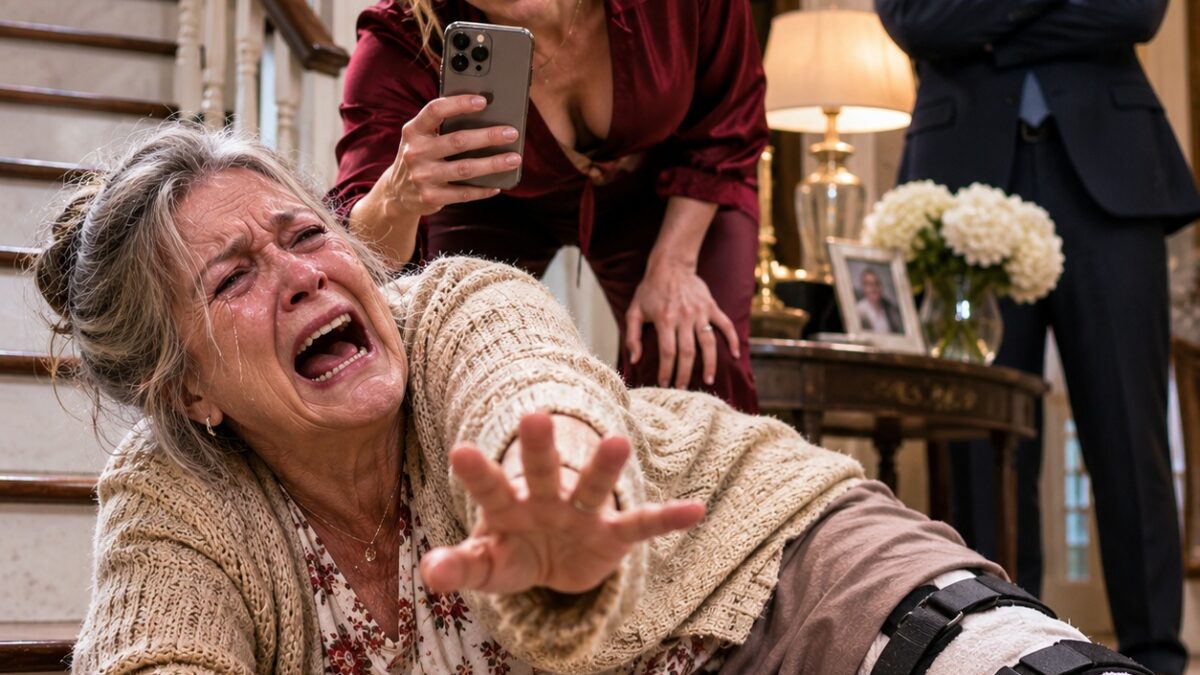
FULL STORY CONTINUATION
They took me to the emergency room the next morning.
Not that night.
The next morning.
I spent nearly nine hours on that sofa with a fractured tibia, a badly sprained ankle, and swelling so severe that the emergency physician later asked why I had waited.
I told him I had hoped it would improve.
That was easier than saying my own family had gone upstairs to sleep.
The doctor fitted me with a brace and told me I would need crutches for weeks.
“Be careful on stairs.”
I almost laughed.
Stairs had become the least dangerous thing in my house.
When we returned home, Chloe took another photograph.
I was standing beside Robert’s car, one crutch under each arm, trying not to put weight on my left leg.
“What now?” I asked.
“Insurance documentation.”
There were always reasonable words.
Documentation.
Safety.
Concern.
Family planning.
Medical evaluation.
That is how people disguise control when they do not want to call it control.
But the truth is, my fall was not the beginning.
It was only the moment when all the small humiliations that had come before became impossible to ignore.
Twenty years earlier, Robert and I had lived in a small house in New Jersey.
White kitchen tile.
A chipped wooden table that had belonged to my grandmother.
The smell of cinnamon coffee every morning.
Robert was eight years old then.
He would run home from school, throw his backpack near the sofa and yell, “Mom, I’m starving.”
I made grilled-cheese sandwiches cut into triangles.
Tomato soup.
He told me everything.
School.
Friends.
Teachers.
Dreams.
“I’m going to be an architect.”
“You are?”
“Yes.”
“What are you going to build?”
“A giant house.”
“For who?”
“For you.”
I laughed.
“What do I need a giant house for?”
“It’ll have a fountain.”
“Of course.”
“And a big yard.”
“Very fancy.”
“And you’re going to live there forever.”
Children make promises with absolutely pure hearts.
That is what makes them so dangerous to remember.
My husband Richard died when Robert was twelve.
Heart attack.
Sudden.
One ordinary afternoon.
One phone call.
One doctor saying there had been nothing they could do.
Robert and I sat on our living-room floor that night and cried until our faces hurt.
He kept saying, “What are we going to do?”
I held him.
“We’re going to survive.”
“How?”
“I’ll take care of you.”
I meant it.
That became the organizing principle of my life.
I sold my mother’s jewelry when tuition bills came.
I worked double shifts as a secretary.
I gave up vacations.
Stopped dating.
Stopped asking whether there might be a second chapter for me after Richard.
Robert became the chapter.
When he graduated, he wanted to start his own architectural studio.
Banks were cautious.
He was young.
Talented but unproven.
So I cosigned.
I mortgaged my little New Jersey house.
“Mom, I’ll repay every dollar.”
“You don’t owe me every dollar.”
“I owe you everything.”
“No.”
I touched his face.
“Just build a good life.”
His studio succeeded.
Slowly at first.
Then suddenly.
Commercial projects.
Luxury homes.
Hotels.
Corporate clients.
He started wearing suits that cost more than my monthly salary.
A Swiss watch appeared on his wrist.
He took clients to restaurants where the appetizers cost more than our old weekly grocery budget.
I was proud.
Genuinely proud.
Then one afternoon, he arrived at the New Jersey house with drawings.
“I found the land.”
“For what?”
He spread plans across my kitchen table.
A three-story home.
Huge windows.
Stone fountain.
Three-car garage.
Guest rooms.
Gardens.
He smiled.
“Remember my promise?”
I did.
God help me, I did.
The house took two years.
On moving day, Robert hugged me in the foyer.
“This is your home too, Mom.”
“Are you sure?”
“Forever.”
He kissed my forehead.
“You never have to worry again.”
For six months, I believed him.
Then Chloe arrived.
She worked public relations for a real-estate development company.
She was beautiful in the way expensive hotel lobbies are beautiful.
Perfect.
Polished.
Cold.
The first dinner I cooked for her was Robert’s favorite.
Turkey.
Mashed potatoes.
Gravy.
Green beans.
Cornbread.
Chloe took two bites.
“This is really heavy.”
I smiled awkwardly.
“Robert used to eat three plates.”
“I don’t eat carbs after six.”
Robert laughed.
Not with me.
At the situation.
Something in his face embarrassed me.
For the first time, I wondered whether the food that represented home to us now represented something he had outgrown.
Chloe began spending more nights at the house.
Then weekends.
Then all week.
Six months later, Robert proposed.
The wedding was enormous.
Vera Wang.
Champagne.
People whose names appeared on buildings.
I wore a pastel-blue dress I bought on clearance.
At the reception, Chloe’s mother looked at me from head to toe.
She didn’t say a word.
She didn’t have to.
I spent most of the evening at a table near the back.
After the wedding, Chloe moved in.
That was when my house began disappearing around me.
My framed family photographs vanished first.
Richard’s portrait disappeared from the living room.
“Where is your father’s picture?” I asked Robert.
He barely looked away from his phone.
“Basement.”
“Why?”
“Chloe thought it dated the room.”
Dated.
My dead husband had become a design problem.
I went downstairs.
Found the portrait inside a box.
Wiped dust from the glass.
“I’m sorry,” I whispered.
I should have carried it back upstairs.
I didn’t.
That was one of my first mistakes.
Not Chloe’s.
Mine.
Every time I accepted a small humiliation because fighting seemed exhausting, I taught them that the next humiliation would probably be accepted too.
Chloe replaced my flowers with minimalist landscaping.
Moved my dishes.
Changed furniture.
Set rules.
No kitchen after nine.
No music while she worked.
No gardening before the landscaper arrived.
No cinnamon coffee because she said the smell lingered.
My world became the third-floor bedroom.
It was a beautiful room.
Balcony.
Large windows.
Private bath.
A beautiful cage remains a cage.
One morning, I ignored the rules.
I went downstairs.
Put cinnamon sticks in a pot.
Coffee.
Brown sugar.
Cloves.
The smell filled the kitchen.
For one minute I was back in New Jersey.
Then Chloe appeared.
“What are you doing?”
“Coffee.”
“Alice just cleaned.”
“I’ll wash the pot.”
“You don’t understand.”
She walked to the stove.
“This house has a system.”
I stared at her.
“This is my home too.”
She smiled.
Not warmly.
“Your home?”
“Yes.”
“Elellanena, Robert built this house.”
“With money from the business I helped finance.”
“There it is.”
“What?”
“The story.”
She leaned against the counter.
“You sold jewelry.”
I said nothing.
“You worked two jobs.”
Silence.
“You mortgaged your house.”
Her voice became mocking without becoming loud.
“How long are you going to make Robert repay you for being his mother?”
My chest tightened.
“I never—”
“Isn’t that what mothers do?”
“What?”
“Sacrifice without expecting payment?”
She turned off my coffee.
Picked up the pot.
Poured it down the sink.
Dark liquid disappeared into stainless steel.
“You need to understand your place.”
She walked away.
That night, I cried.
But I did not tell Robert.
Another mistake.
Months later, I woke at three in the morning.
I couldn’t sleep.
I wandered downstairs.
Robert’s study door was partly open.
I went inside.
His diplomas lined the wall.
Awards.
Photographs with clients.
Architects.
Politicians.
Developers.
Not one picture of us.
I opened a drawer.
I wasn’t proud of that.
But grief and exclusion make people search for proof they still exist.
At the back was a yellow envelope.
Inside were documents concerning my little New Jersey house.
I read my name.
Then a phrase:
Assignment of Property Rights.
My stomach tightened.
The document said I had transferred my ownership interest to Robert and Chloe.
There was a signature.
Mine.
Except I had never signed it.
I studied every curve.
It looked close.
Very close.
But something was wrong.
The E.
My capital E leaned differently.
The date meant nothing to me.
I would have remembered giving away the only property that had ever truly belonged to me.
The next morning, I confronted Robert.
“There’s paperwork in your study.”
His expression changed.
“What paperwork?”
“The New Jersey house.”
Chloe appeared behind him.
Always there.
Always listening.
Robert sighed.
“Mom, we handled that years ago.”
“No.”
“You signed it.”
“I didn’t.”
“Notary office.”
“No.”
Chloe touched his shoulder.
“Robert.”
Then she looked at me.
“Your mother has been forgetting things.”
I stared.
“What?”
“The glasses incident.”
“What glasses?”
“See?”
I almost laughed.
“My glasses were in my bedroom.”
“You searched for them for twenty minutes.”
“I was reading!”
Robert rubbed his forehead.
“Mom, you’re sixty-five.”
“So?”
“Memory changes.”
“I did not sign away my house.”
His face hardened.
“Enough.”
It was the first time he shouted.
“I am tired of everything becoming a crisis.”
“I’m asking about property in my name.”
“You gave me that property.”
“I mortgaged it to help your business.”
“And I gave you this house.”
He gestured around him.
“You have everything.”
“What do I have?”
“A roof.”
That word hurt.
Roof.
Not home.
“You have food. Security. No bills.”
“I’m your mother, Robert, not a charity case.”
“Then stop acting like I’m failing you every time I don’t repay some imaginary emotional debt!”
He grabbed his briefcase.
“I have investors waiting.”
Then he left.
Chloe followed.
But before she did, she looked back.
Victory.
That was what I saw.
After that, I became invisible on purpose.
I woke before them.
Made tea.
Washed the cup immediately.
Stored crackers upstairs.
Ate lunch while Chloe went to the gym.
Stopped joining dinner.
Stopped asking Robert about work.
Stopped reminding anyone I existed.
I thought if I became small enough, they might stop resenting me.
Instead, they began planning what to do with the space after I disappeared.
One afternoon, Robert came upstairs.
“Mom?”
He wore the burgundy sweater I had given him for Christmas.
Seeing it gave me hope.
Foolish hope.
“Come in.”
He sat on my bed.
“We’ve been thinking.”
Those words rarely introduce anything good.
“About what?”
“The future.”
I waited.
“Kids.”
My heart softened automatically.
“You’re trying?”
“Soon.”
“That’s wonderful.”
He smiled briefly.
Then looked toward the windows.
“The third floor would be ideal for a nursery and playroom.”
I stared.
“My floor.”
“It’s huge.”
“My bedroom.”
“We’d make changes.”
“What are you saying?”
He inhaled.
“There are senior communities nearby.”
For several seconds, I did not understand the sentence.
Then I did.
“You want me to move into a retirement home.”
“Not a home.”
“What is it?”
“Assisted living.”
“I’m sixty-five.”
“They have activities.”
“I can drive.”
“People your age.”
“I grocery shop.”
“Nurses.”
“I do not need nurses.”
“You fell.”
There it was.
My fall.
The photograph.
The crutches.
The first piece of evidence being converted from an accident into a diagnosis.
“I broke my leg because I tripped over a rug.”
“You were alone.”
“Chloe was there.”
“She says you refused medical care.”
I stared at him.
“She told you that?”
“She said you became confused after the fall.”
“That is a lie.”
His face tightened.
“See?”
“See what?”
“You become defensive.”
“I become defensive when people lie about me.”
Robert stood.
“Three places.”
He put brochures on my desk.
“Look at them.”
“I am not leaving.”
“Mom.”
“You promised me I would live here.”
“You can’t hold me to something I said years ago.”
“You built this house and called it mine.”
“I built it.”
I heard the emphasis.
I built it.
Not us.
Not because you helped me become able to build it.
I built it.
“You need to decide soon.”
“Why?”
“Chloe wants renovations started in June.”
He left.
The brochures stayed.
Golden Villa.
Willow Ridge.
Heritage Gardens.
Every photograph showed smiling older people.
Painting.
Playing cards.
Walking beside fountains.
Nobody ever photographed the moment their child drove away.
A week later, Chloe entered my room with a measuring tape.
“What are you doing?”
“Nursery planning.”
“I haven’t moved.”
“You will.”
She measured a wall.
“Crib here.”
I stared.
“A changing table there.”
“Get out.”
She smiled.
“Don’t be dramatic.”
That evening, I went downstairs for dinner.
Their table was set for two.
Robert looked surprised.
“Mom.”
“I live here.”
Chloe brought another plate.
We ate in silence.
Finally she asked whether I had chosen a residence.
“No.”
Robert put down his fork.
“You need to.”
“No.”
“This cannot go on indefinitely.”
“Why not?”
Chloe answered.
“Because the house belongs to us.”
I turned toward Robert.
He said nothing.
“And if I refuse?”
She sipped wine.
“Then we take legal steps.”
That word changed the room.
“Legal?”
“We’ve spoken with someone.”
“About removing me?”
“About your welfare.”
I laughed.
“You want to kick me out and call it welfare.”
Robert looked exhausted.
“You’re making everything ugly.”
“No.”
I stood.
“I am naming what is ugly.”
Chloe stood too.
“You manipulate him.”
“What?”
“You remind him constantly what you sacrificed.”
“I barely speak to him anymore.”
“Because you sulk upstairs.”
“You drove me upstairs.”
“You made yourself dependent on him.”
Her voice sharpened.
“You built your entire identity around being Robert’s mother, and now you’re angry because he grew up.”
That hurt because some part of it was true.
Truth weaponized is still a weapon.
Robert shouted for both of us to stop.
Then he looked at me.
“Go upstairs.”
I stared.
“To my room?”
“Please.”
“You are sending me away from your dinner table.”
His eyes dropped.
I left.
Weeks passed.
Then Chloe confronted me in the garden.
“You have until the end of June.”
I was sitting under the willow tree.
She stood in front of me holding an iPad.
“Or what?”
“Legal action.”
“I am not incompetent.”
“That’s for professionals to determine.”
My body went cold.
“What are you talking about?”
“Memory issues.”
“I do not have memory issues.”
“You forgot signing your property documents.”
“I didn’t sign them.”
“You forget ordinary things.”
“No.”
“You fell down the stairs.”
“Anyone can fall.”
She smiled.
“We have documentation.”
There it was.
The picture.
My broken leg.
My crutches.
The photograph I had never understood.
She had turned my injury into a narrative.
“A doctor will evaluate you.”
“Which doctor?”
“Dr. Miller.”
I knew the name.
Robert’s acquaintance.
“You already arranged it.”
“We’re worried.”
“You’re lying.”
“Prove it.”
She walked away.
That night, I couldn’t sleep.
Around three, I went downstairs.
Robert’s study light was on.
He was on the phone.
I heard my name.
I stopped.
“No, she hasn’t agreed.”
Silence.
“End of June.”
Another pause.
“Then plan B.”
My hand tightened around the railing.
“The medical certificate should be enough.”
My mouth went dry.
He continued.
“Dr. Miller is willing.”
I covered my mouth.
“Once there is partial incapacity, relocation becomes easier.”
Relocation.
That was the word.
Not eviction.
Not abandonment.
Relocation.
“She won’t understand the nice way.”
Then:
“Chloe is pregnant.”
My knees almost failed.
Pregnant.
That was why everything had accelerated.
The nursery.
The third floor.
The deadline.
The desperation.
Robert continued speaking.
I slipped into the study after he left.
His laptop remained open.
I knew his password.
I found emails.
FINAL PLAN.
Golden Villa.
July 15.
Twenty-thousand-dollar deposit.
Dr. Miller.
Capacity evaluation.
Renovation drawings.
Nursery.
Everything.
I printed the messages.
Hid them inside my Bible.
The next day Chloe came upstairs.
She smiled.
“I wanted you to hear it from me.”
Her hand touched her stomach.
“I’m pregnant.”
I looked at her.
“Six weeks.”
“Congratulations.”
“You don’t sound happy.”
“I am happy for Robert.”
Her smile thinned.
“This changes things.”
“It seems everything changes things.”
“We need calm.”
“You need my room.”
“We need the third floor.”
She moved closer.
“You are not his future.”
“What am I?”
She considered the question.
“A paid debt.”
I felt the words physically.
“He gave you a beautiful house. Food. Security.”
She shrugged.
“He already paid you back.”
“My son is not a loan.”
“Then stop collecting.”
She told me Dr. Miller would arrive the next day.
“Routine.”
I nodded.
“All right.”
That surprised her.
Good.
For the first time in months, I had something she did not know I had.
Evidence.
Dr. Miller came at ten.
He was about sixty.
Professional smile.
Expensive briefcase.
Chloe hovered behind him.
He asked the date.
I answered.
Year.
Answered.
President.
Answered.
Arithmetic.
Memory.
Names.
Every question correct.
His expression changed.
Chloe noticed.
“Ask about recent memory.”
He did.
“What did you eat this morning?”
“Tea and crackers.”
“Yesterday?”
“The same.”
“Important recent events?”
I looked directly at Chloe.
“My daughter-in-law told me she is six weeks pregnant and wants my bedroom converted into a nursery.”
Dr. Miller shifted.
“How do you feel about that?”
“Would you like the answer they paid for or mine?”
Chloe stiffened.
“Elellanena!”
“The truth,” he said.
“Betrayed.”
He wrote.
“Discarded.”
More writing.
“Threatened.”
Chloe jumped in.
“Paranoia.”
I ignored her.
“They want to declare me incompetent so I cannot resist relocation.”
“Doctor, do you see?”
Chloe sounded almost relieved.
“She believes we are conspiring.”
I looked at Dr. Miller.
“How much are they paying you?”
He froze.
“Excuse me?”
“For the certificate.”
Chloe laughed nervously.
“There is no certificate.”
I turned toward her.
“I printed the emails.”
Her face changed.
Only for a second.
But it changed.
Dr. Miller closed the folder.
“I think a neurological evaluation would be appropriate.”
“Will that doctor also be a family friend?”
He left soon afterward.
Once the front door closed, Chloe faced me.
“You think you won something?”
“I think I know what you’re doing.”
“You have emails.”
“Yes.”
“No one will believe you.”
“I have proof.”
“You are sixty-five, broke, isolated, and already behaving aggressively toward medical professionals.”
Her voice was soft.
Calculated.
“We have lawyers.”
I stared at her.
“Then use them.”
“I will.”
“I’m not signing anything voluntarily.”
She smiled.
“We’ll see.”
Robert came home late.
He had already spoken with her.
He came upstairs furious that I had accessed his emails.
“Privacy?”
I laughed.
“You want to have me legally declared incapable and you’re lecturing me about privacy?”
“Mom, if you would just leave voluntarily—”
“No.”
“Why?”
“Because you are lying.”
“We need space.”
“Eleven rooms.”
“Chloe is pregnant.”
“I know.”
“We need our own family.”
I looked at him.
“What am I?”
His answer took too long.
Then came the sentence that finally killed what I had spent months trying to preserve.
“I need a life without you carrying your emotional weight into everything.”
I was silent.
He continued.
“You made me responsible for your happiness.”
That hurt because beneath the cruelty lived a truth I had avoided.
After Richard died, I had made Robert my reason for living.
I had wrapped sacrifice around him so tightly that perhaps sometimes it did feel like debt.
But that did not justify fraud.
It did not justify humiliation.
It did not justify a false diagnosis.
Two truths can exist at once.
I had loved my son with too much need.
And my son was betraying me.
“I understand,” I said.
He looked startled.
“You do?”
“Yes.”
“I need space.”
“I heard you.”
He seemed almost relieved.
Then a certified letter arrived.
June 15.
Legal capacity evaluation.
Hearing scheduled June 30.
My son was formally challenging my ability to control my own life.
Chloe held the notice as though it were inevitable.
“You can fight.”
She shrugged.
“Or you can cooperate.”
“What happens if I cooperate?”
“You choose a residence.”
“And Robert?”
“You can maintain a relationship.”
“And the baby?”
“If you’re stable.”
There it was.
My unborn grandchild being offered as a reward for obedience.
Something broke.
Not my mind.
My attachment.
“All right.”
Chloe blinked.
“What?”
“I’ll leave.”
Her face softened with satisfaction.
“But I want one conversation with Robert.”
She agreed.
That night, we sat in the living room.
No Chloe.
No lawyers.
Mother and son.
“What do you want to know?” Robert asked.
“One thing.”
He waited.
“When did you stop loving me?”
Pain crossed his face.
“I didn’t.”
“Then when did loving me become something you resented?”
He looked away.
He told me my love suffocated him.
That every sacrifice became a silent question.
Was I worth it?
Had he repaid me?
Was he grateful enough?
He said Chloe helped him recognize the guilt.
I listened.
And for the first time, I did not defend every part of myself.
“You’re right about something.”
He looked at me.
“After your father died, I made you my whole life.”
He said nothing.
“That was unfair.”
“Mom—”
“No.”
I continued.
“I should have rebuilt myself.”
I swallowed.
“I should have loved you without asking you to be my reason to exist.”
His eyes filled.
“But none of that makes what you are doing right.”
“I know.”
“Do you?”
Silence.
I stood.
“I’ll go.”
“Mom.”
“I’ll sign.”
His face collapsed.
“I didn’t want it like this.”
“You designed it like this.”
He covered his face.
“I love you.”
“Maybe.”
I touched his shoulder.
“But love that requires someone to disappear is not enough.”
The next day, I signed.
Voluntary admission to Golden Villa.
Acknowledgment of support needs.
Waivers.
Property documents.
Paper after paper.
My name becoming blue ink.
Chloe told me I could take two boxes.
Two boxes.
Sixty-five years.
Richard’s photographs.
Robert’s baby pictures.
My Bible.
Mother’s rosary.
Grandmother’s blanket.
A few books.
Everything else stayed.
On June 28, a moving van arrived.
I walked down the staircase for the last time.
The staircase where months earlier I had lain with a broken leg while Chloe photographed me.
Robert stood near his study.
Neither of us spoke.
Chloe drank green juice in the kitchen.
She did not say goodbye.
I entered the van.
The house disappeared in the side mirror.
Stone fountain.
Willow tree.
Windows.
A promise made by an eight-year-old boy.
Gone.
Golden Villa was exactly like the brochure.
Clean.
Bright.
Cheerful staff.
Flowers.
Activities.
My room was tiny.
One bed.
Desk.
Closet.
Parking-lot view.
I hated it.
For the first week, I barely left.
At lunch, a woman named Mrs. Lopez sat across from me.
“You’re new.”
“Yes.”
“How long?”
“A week.”
She nodded.
“Still in shock.”
I looked at her.
She smiled sadly.
“We all wait for them to come back.”
“Who?”
“Our families.”
Her son had visited twice the first month.
Then less.
Now maybe Christmas.
“How do you live with that?”
“At first, badly.”
She sipped coffee.
“Then you understand you can spend your last years waiting for someone who isn’t coming, or you can live anyway.”
That sentence followed me into the chapel two weeks later.
I sat alone.
Looked at the crucifix.
And asked myself a question I had never asked.
Who was I before Robert?
Before Richard?
Before motherhood?
Before sacrifice?
I remembered a twenty-year-old girl who wanted to travel.
Read.
Learn French.
See the ocean.
She had disappeared beneath responsibilities.
But maybe she wasn’t dead.
Maybe she was simply buried.
The next day, I went to the library.
Found a novel.
Read for three hours.
Mrs. Lopez became my friend.
Mr. Peterson taught me chess.
“Losing pieces isn’t losing the game,” he said.
I smiled.
“Is that about chess?”
“Mostly.”
Three months passed.
Robert did not call.
That hurt.
Then eventually, it stopped hurting every hour.
In October, he arrived.
He looked destroyed.
“Mom.”
I stayed seated.
“Robert.”
“Everything is falling apart.”
Chloe had miscarried.
Twelve weeks.
Natural loss, according to doctors.
She blamed him.
Blamed me.
Blamed the stress.
Then she told Robert she wanted a divorce.
“She said she married me for the lifestyle.”
I listened.
“She wants half of everything.”
Still I listened.
“Mom, tell me what to do.”
And there it was.
The old pattern.
Robert in pain.
Mother rescues.
I shook my head.
“No.”
He stared.
“No?”
“I’ll listen.”
“Then help me.”
“I am helping.”
“How?”
“By refusing to run your life.”
He sat on my bed.
“I ruined everything.”
“Yes.”
He looked shocked at the bluntness.
Then almost laughed.
“How do I live with that?”
“One day.”
I paused.
“Then another.”
His eyes filled.
“I miss you.”
For months, I had dreamed of those words.
Now they gave me peace instead of victory.
“I miss you too.”
He looked up.
“Can I visit?”
“Yes.”
Hope crossed his face.
“But not to unload every crisis.”
He nodded.
“If you come, come because you want to see me.”
“Yes.”
“Not because you need a mother to fix something.”
“I understand.”
He touched my shoulder before leaving.
That was enough.
For a while.
He began visiting every two weeks.
We learned to speak differently.
I told him about books.
Chess.
Mrs. Lopez.
He told me less about Chloe because I requested it.
Then one December afternoon, he arrived with a mustard-yellow scarf.
“I saw it and thought of you.”
I almost cried.
Not because of the scarf.
Because he had thought of me without needing something.
Then he told me Chloe was in legal trouble.
During their marriage, she had taken loans in his name.
Forged signatures.
Opened accounts.
Used property as collateral.
Three million dollars.
I stared.
The same woman who had helped create a questionable transfer of my New Jersey property had apparently been forging Robert’s documents too.
“What will you do?”
“My accountant says I should report it.”
“And?”
“I don’t know.”
“Why?”
“I still feel guilty.”
“For what?”
“Destroying her.”
I shook my head.
“Consequences are not destruction when the person created the conduct.”
He looked at me.
“Are you telling me to prosecute her?”
“I’m telling you not to protect fraud because honesty feels cruel.”
He sued.
Investigators followed.
Bank records.
Signatures.
Loans.
Hidden statements.
Unauthorized transfers.
Chloe blamed him.
Said he owed her.
Said she had supported his success.
Said she deserved the life she created.
Robert called me afterward.
“She did what I did to you.”
“What?”
“Used guilt.”
He sounded sick.
“She reminded me of everything she’d done and said that meant I owed her.”
I said nothing.
“I finally understand.”
That mattered.
Eventually Chloe was convicted of fraud and document falsification.
Years in prison.
I did not celebrate.
Robert didn’t either.
Justice rarely feels like movies.
There is no triumphant music.
Just consequences arriving where denial used to live.
Then the house collapsed financially too.
Chloe had mortgaged it repeatedly with fraudulent documents.
Banks demanded payment.
Robert couldn’t save it.
The house was sold.
The same enormous house with the fountain.
The third-floor bedroom.
The kitchen where cinnamon coffee had been forbidden.
The staircase.
The rooms Chloe wanted for a nursery.
Gone.
“I lost everything,” Robert told me.
“No.”
I looked around my tiny Golden Villa room.
“You still have yourself.”
He smiled bitterly.
“That doesn’t feel like much.”
“It becomes enough when you stop measuring life by houses.”
He looked at me.
“Do you have a home here?”
“Yes.”
He seemed surprised.
“Here?”
“Peace is home.”
Later, Chloe attempted to take her own life while incarcerated.
She survived.
She was transferred for psychiatric treatment.
When Robert told me, I felt no victory.
Only sadness.
For him.
For her.
For all of us.
People imagine villains are born carrying signs.
They aren’t.
Often they are frightened, damaged people who choose destructive methods to protect the part of themselves they refuse to heal.
Understanding that did not excuse Chloe.
It simply meant I no longer needed hatred to keep my boundaries.
A year after I entered Golden Villa, Robert brought me a photo album.
He had found photographs in the basement before the house was sold.
Richard.
Robert as a toddler.
Our New Jersey home.
Me with black hair.
Young.
Laughing.
Alive.
“I saved them.”
I touched Richard’s face.
“Thank you.”
“No.”
Robert sat beside me.
“Thank you for not giving up on me.”
“I did give up on something.”
His face changed.
“What?”
“Who I thought you were supposed to be.”
I took his hand.
“That was necessary before I could know who you really are now.”
He cried.
So did I.
Forgiveness did not bring the old relationship back.
It created space for a new one.
Two years after the beginning of all this, Robert visited every Tuesday.
His business survived.
Smaller.
Less glamorous.
More honest.
Chloe remained in treatment.
Mrs. Lopez died peacefully.
Her son never arrived in time.
I held her hand.
That taught me something too.
Family is blood.
But sometimes family is also the person who chooses not to let you die alone.
Mr. Peterson still beat me at chess.
Robert eventually began dating again.
Her name was Patricia.
Kindergarten teacher.
Divorced.
Two children.
“What do you like about her?”
He smiled.
“Peace.”
That was the best answer he could have given.
When I met Patricia, she was wearing an ordinary blue dress.
No performance.
No inspection of my clothes.
Her daughter sat on my lap.
Her son asked me to play checkers.
Patricia later told me her own mother had died.
“A mother should never be treated the way you were.”
I thanked her.
No dramatic bonding.
Just sincerity.
Then one morning, a law firm called.
Montes and Associates.
The same firm that had processed my departure.
Mr. Ramirez asked me to come in.
Robert insisted on accompanying me.
I expected trouble.
Instead, Mr. Ramirez opened a file.
“Your mother-in-law Martha Stevens left you property.”
Richard’s mother.
Dead three years.
We had never been especially close.
But apparently she had watched more than I realized.
“She left you a house in Palm Springs.”
I stared.
“California?”
“Yes.”
Three bedrooms.
Two baths.
Land.
Rented during probate confusion.
“And there are accumulated rental proceeds.”
“How much?”
He looked at the statement.
“Close to four hundred thousand dollars.”
I could not breathe.
Robert whispered, “Mom.”
I signed paperwork with shaking hands.
A house.
Money.
Freedom.
Not from Robert.
Not because I had sacrificed.
Not because I had begged.
Mine.
We traveled to California to see it.
The house was terra-cotta colored.
Wooden door.
Warm light.
A backyard with a tree and room for a garden.
I walked through every room slowly.
Nobody followed me with a measuring tape.
Nobody told me what I could cook.
Nobody told me I was too old to choose where furniture went.
Nobody needed me to prove I remembered signing anything.
Robert found me outside.
“What do you think?”
I looked around.
“I think your grandmother gave me something I didn’t know I needed.”
“A house?”
“A choice.”
He sat beside me.
“Are you leaving Golden Villa?”
I thought about Mrs. Lopez’s empty chair.
Mr. Peterson.
The library.
My routines.
The woman I had become there.
“No.”
Robert looked surprised.
“You have your own house.”
“Yes.”
“Why stay?”
“Because Golden Villa isn’t only where you sent me anymore.”
I smiled.
“It became somewhere I chose.”
He absorbed that.
“I think I’ll divide my time.”
“Between here and there?”
“Yes.”
“You could live here permanently.”
“I could.”
I looked at him.
“That is the point.”
Choice.
Everything had become about choice.
Robert choosing Chloe.
Chloe choosing fraud.
Me choosing silence.
Robert choosing betrayal.
Me choosing Golden Villa because I believed I had no alternative.
Then later:
Me choosing friendship.
Books.
Peace.
Boundaries.
Forgiveness.
Palm Springs.
Myself.
“Are you happy?” Robert asked.
I thought before answering.
“Yes.”
“Really?”
“Not the way I planned.”
I looked at the house.
“But yes.”
“What changed?”
“I stopped asking other people to confirm whether my life mattered.”
He reached for my hand.
“I’m sorry.”
“I know.”
“I don’t know if I can ever forgive myself.”
“Then start.”
“How?”
“Stop making guilt another way of staying centered in the past.”
He gave a broken laugh.
“You really changed.”
“So did you.”
“I had to lose everything.”
“No.”
I squeezed his hand.
“You had to lose what you thought everything was.”
We sat beneath the tree until sunset.
Years passed.
I divided my time between Golden Villa and Palm Springs.
At the residence, I had community.
At Palm Springs, space.
I started writing.
Stories about women who were discarded.
Women who lost homes.
Women whose children forgot them.
Women who found themselves after thinking there was nothing left to find.
I read the stories aloud in the common room.
Sometimes residents cried.
Sometimes they laughed.
Sometimes someone raised her hand afterward and whispered:
“That happened to me.”
And I would say:
“I know.”
Robert married Patricia six months ago.
Small garden wedding.
No social performance.
No people arranged by status.
Patricia asked me to read something during the ceremony.
I wrote:
Love is not ownership.
Love is not debt.
Love is not fear disguised as sacrifice.
Love gives roots and still allows movement.
Love holds without choking.
Love forgives without pretending nothing happened.
And real love remains not because it is trapped, but because it chooses to stay.
Patricia cried.
Robert cried.
I cried.
Her children now call me Grandma Elellanena.
The first time the little girl said it, I had to turn toward the garden so she wouldn’t see what it did to me.
Not because I needed another child to build my identity around.
Because this time, love arrived without debt.
Without promises.
Without my whole life balanced on whether someone stayed.
One evening in Palm Springs, I made cinnamon coffee.
The same coffee Chloe once poured down the sink.
The smell filled my kitchen.
I stood beside the stove.
No one objected.
No one told me the kitchen had a system.
No one told me I was making a mess.
I carried the cup outside.
The evening air was warm.
I thought about the woman lying at the bottom of Robert’s staircase years earlier.
Broken leg.
Tears.
Chloe photographing her.
That woman believed the worst thing happening to her was a fracture.
She had no idea that the photograph would become one small piece of an attempt to rewrite her identity.
Unsafe.
Forgetful.
Incompetent.
Dependent.
She had no idea her son would participate.
She had no idea she would lose the house.
Or that losing it would eventually save something more important.
Herself.
I used to think strength meant holding on.
Holding a family together.
Holding your son close.
Holding your home.
Holding memories.
Holding grudges when people deserved them.
Now I know strength can look like release.
I released the house Robert built.
I released the boy he used to be.
I released Chloe.
I released the belief that motherhood entitled me to permanent centrality in my son’s life.
And I released the equally cruel belief that growing older meant becoming disposable.
Those truths can coexist.
A mother should not make a child responsible for her entire happiness.
And a child does not gain the right to erase his mother simply because he becomes an adult.
Love needs boundaries on both sides.
I learned mine late.
But late is not never.
Sometimes Robert visits Palm Springs with Patricia and the children.
They knock.
Even though they know I will answer.
I like that.
Robert once asked why.
“It’s your house, Mom. You know I’d never just walk in.”
“That is exactly why I like hearing the knock.”
A knock says:
I know this space belongs to you.
I am asking to enter.
There is respect in that sound.
Something I once confused with distance.
Now I know better.
I have not seen Chloe in years.
Robert told me she eventually left psychiatric treatment and moved closer to family.
I hope she gets help.
I mean that.
I no longer need her suffering to validate mine.
What she did was wrong.
What happened to her afterward was tragic.
Both things are true.
Forgiveness did not make me naive again.
I would never sign a document she put in front of me.
I would never give her access to my finances.
I would never live under the same roof.
But I can hope she becomes better without allowing her back into my life.
That is another boundary I learned late.
Compassion does not require access.
Neither does forgiveness.
Tonight, I am sitting beneath the tree behind my Palm Springs house with a cup of cinnamon coffee.
I am sixty-seven years old.
My hair is gray.
My eyes, according to Patricia’s daughter, look “a little sad and a little happy.”
She is right.
Sad eyes are not failures.
They are eyes that have seen enough to know joy is temporary and still choose to recognize it when it arrives.
My life is not the one I planned.
Richard is gone.
The huge house is gone.
The little New Jersey property I once thought would be my permanent safety is part of a history too complicated to summarize in one sentence.
My relationship with Robert carries scars.
But I have a home.
Actually, I have two places where I belong.
More importantly, I belong to myself.
That was the thing nobody could forge away.
Not Chloe.
Not a doctor.
Not a lawyer.
Not even my son.
They could photograph me on the floor.
They could call me unstable.
They could hand me brochures.
They could write legal documents.
They could move my boxes.
They could convince themselves that removing me was kindness.
But none of those things had the authority to decide who I was.
Only I did.
It took me sixty-five years and a broken leg to understand that.
And perhaps the greatest irony is this:
Robert did build me a house once.
A beautiful house with a fountain.
But the real home I needed was never something my son could build for me.
I had to build it myself.
Inside my own life.
With boundaries for walls.
Self-respect for a foundation.
Forgiveness for windows.
And a door I alone decide when to open.
That home cannot be mortgaged.
It cannot be forged into someone else’s name.
It cannot be taken by a court.
And no one can declare me too old, too emotional, too inconvenient, or too unnecessary to live there.
It is mine.
At last, completely mine.


