HOA Sent Three Lawyers to Take 18 Feet of My Grandfather’s Land—Then I Asked Them for One Recording Number
HOA Sent Three Lawyers to Take 18 Feet of My Grandfather’s Land—Then I Asked Them for One Recording Number
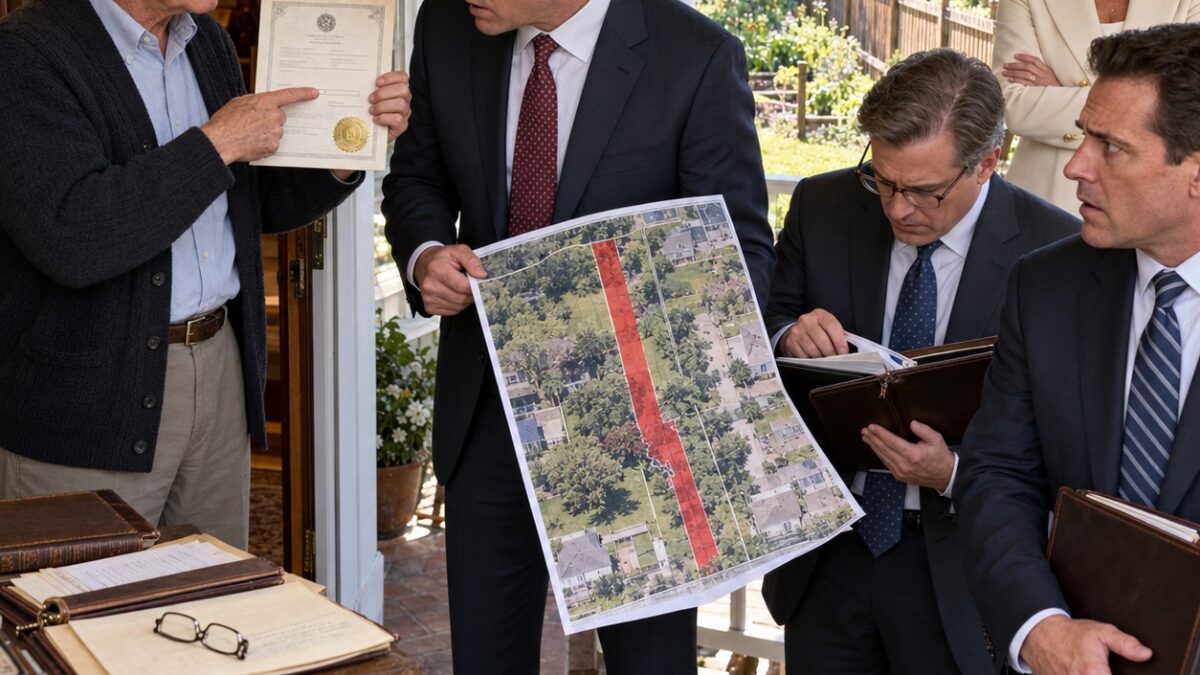
“Eighteen feet of your eastern boundary is now under HOA control, and if you interfere with our utility corridor, we’ll fine you, lien the property, and recover every dollar of enforcement cost,” the tallest of the three attorneys told me while standing on the porch of the house my grandfather had owned since 1946.
Behind him, HOA president Marlene Voss stood one step higher with her arms folded and a satisfied little smile, while another lawyer opened a survey showing a thick red strip cutting through the ground where my father had taught me to ride a bicycle.
Then I asked for the amendment’s county recording book and page number, and all three attorneys stopped moving—because I already had a certified document from the county clerk proving the “authority” Marlene had spent months threatening me with had never been legally recorded at all.
The knock came at 9:06 on a Thursday morning.
Not a neighbor’s knock.
Not UPS.
Not somebody looking for a lost dog.
Four hard raps.
A pause.
Then three more.
Coordinated.
Confident.
The kind of knock that expects the door to open because whoever is standing outside has already decided the conversation belongs to them.
I was at the kitchen table reading an administrative appeal with a mug of coffee beside my elbow.
Retirement had not cured me of reading complicated things before breakfast.
I put down my pen and walked to the front window.
Four people stood on my porch.
Three men in tailored suits.
Leather portfolios.
Polished shoes.
And behind them, positioned on the top step so she stood slightly above the others, was Marlene Voss.
President of Eastbridge Hills Homeowners Association.
Cream blazer.
Gold earrings.
Hair perfect.
She had staged it.
That was my first thought.
Not legally.
Visually.
She wanted me to open my front door and see three attorneys between me and the world.
Then see her above them.
I opened the door.
Nobody said good morning.
The lawyer closest to me unfolded a survey map across his forearm.
The second extended a stapled packet.
The title was printed in bold:
NOTICE OF EASEMENT ENFORCEMENT AND INTENT TO LIEN.
I took it.
Did not invite them inside.
The tallest attorney began.
“Mr. Mercer, we represent Eastbridge Hills Homeowners Association regarding clarification of a historical utility easement along the eastern boundary of your parcel.”
Historical utility easement.
Interesting phrase.
He pointed to the survey.
A thick red band ran down my property.
Eighteen feet wide.
It crossed land my family had owned before Eastbridge Hills existed.
Before its entrance monument.
Before its pool.
Before its clubhouse.
Before Marlene.
That strip was where my grandfather had grown beans.
Where Dad parked an old Ford tractor until the engine finally seized.
Where I had learned to ride a bicycle at ten years old while Dad jogged behind me with one hand gripping the seat.
Where a maple planted after my mother died now threw shade across the fence.
The lawyer continued.
“The association has authority to access the corridor for anticipated utility expansion and future infrastructure planning.”
“Authority from what?”
He ignored the interruption.
“If you obstruct lawful access, fines and enforcement costs will be assessed. The association also reserves the right to record a lien.”
Behind them, Marlene watched my face.
That was what she had come for.
Not merely service of papers.
A reaction.
Fear.
Anger.
Maybe surrender.
I looked down at the survey legend.
Two problems stood out almost immediately.
First, the document cited something called Amendment 12-B.
I had already searched for Amendment 12-B.
It existed in the HOA’s private binder.
It did not exist in the county’s recorded land records.
Second, the supposed easement was described as arising from:
PRIOR IMPLICIT DEDICATION FOR COMMUNITY BENEFIT.
Implicit dedication.
A sophisticated phrase people sometimes use when they would prefer you not ask who actually signed anything.
The attorney finished.
I looked at Marlene.
Then back at the three men.
“Before we continue, I suggest you verify who you’re standing in front of.”
Marlene’s smile tightened.
“Let’s not make this personal.”
“It isn’t.”
I folded the packet once.
“It’s procedural.”
The tallest lawyer said:
“The association’s governing documents are quite clear.”
“Good.”
I looked directly at him.
“Give me the recording book and page number for the amendment you’re relying on.”
Silence.
Not long.
Maybe two seconds.
But in a conversation built entirely around confidence, two seconds can be very loud.
The second attorney opened his portfolio.
The third glanced toward Marlene.
She stepped forward.
“The board has already reviewed this.”
“I’m sure it has.”
I handed the packet back, then took it again before he could reach for it.
“Actually, I’ll keep this.”
The lawyer said:
“That would be advisable.”
“I agree.”
I began closing the door.
Marlene said:
“You can’t stall modernization forever.”
I stopped.
“Modernization?”
“That strip is necessary for future infrastructure serving the community.”
I looked past them toward the eastern side of the property.
My grandfather’s fence line was still there.
Old cedar.
New repairs.
A piece of land that had survived eighty years without needing Marlene’s modernization.
Then I looked back.
“Book and page.”
Nobody answered.
I closed the door.
Carried their threatening packet to the kitchen.
Set it beside the plainest, ugliest, most important sheet of paper in my file.
A certification from the county clerk.
No matching recorded instrument for Amendment 12-B.
Three lawyers had arrived to take eighteen feet of my grandfather’s land.
What none of them knew when they knocked was that I had spent most of my professional life deciding whether agencies, boards, and officials had followed proper procedure.
I had been an administrative law judge.
And if Marlene wanted a fight based on paperwork, she had chosen the one arena where I had spent decades learning exactly how power fails when procedure is skipped.
PART2
This did not begin with three lawyers.
It began with a fence.
My grandfather, Henry Mercer, bought the property in 1946.
Two months after returning from the Pacific.
He paid cash.
Part of the money he had saved before the war.
The rest he earned laying rail through winter mud after he came home.
Back then, there was no Eastbridge Hills.
No subdivision.
No covenants.
No decorative stone monument announcing where one community supposedly began and another ended.
There were fields.
A narrow dirt road.
A farmhouse.
Trees.
And enough open ground that Granddad could stand at the eastern edge and see almost to the creek.
He set the first fence himself.
Cedar posts cut from a neighboring parcel.
Barbed wire pulled by hand.
Dad used to say the post spacing was so inconsistent you could tell exactly where Granddad had gotten tired.
Granddad denied that.
Said the cows had never complained.
My father, Thomas, inherited the property.
He maintained the fence.
Replaced wire.
Reset corners.
Kept every tax receipt.
Every survey.
Every deed.
Every probate paper.
Everything.
When I was ten, he took me out with a steel tape measure and the folded deed tucked into the back pocket of his work pants.
He made me read the metes-and-bounds description aloud.
I hated it.
“Beginning at an iron pin…”
I stumbled over the bearing.
He corrected me.
I started again.
“North eighty-seven degrees…”
“Not eighty-seven.”
I checked.
“Seventy-eight.”
“Read what’s written.”
“I am.”
“You’re guessing.”
“I’m ten.”
“That’s not a legal defense.”
That was Dad.
Dry humor.
No mercy.
We walked the whole line.
When we reached the eastern strip, I asked:
“Why do I need to know this?”
Dad tapped the deed.
“Because fences rot.”
I stared at him.
He held up the paper.
“This doesn’t.”
At ten years old, I thought it was the most boring lesson in human history.
Decades later, standing in my kitchen with Marlene’s threatened lien in front of me, I would have given anything to tell him how right he had been.
The HOA arrived much later.
Developers bought the farmland next door.
Survey crews appeared first.
Then bulldozers.
Then utilities.
Roads.
Curbing.
Rows of executive homes with stone façades and garages large enough to store a small aircraft.
The developer called it Eastbridge Hills.
My family’s property remained outside the original platted lots.
We were simply the old place at the edge.
The farmhouse.
The cedar fence.
The workshop.
The eastern strip.
No one objected.
No one asked us to join.
No one presented annexation papers.
No one claimed an easement.
For years, the relationship was simple.
They had their development.
We had our land.
Then Marlene Voss was elected HOA president.
She ran on something she called a modernization initiative.
Better signage.
Stricter architectural review.
Unified landscaping.
Digital enforcement.
Property-value optimization.
Her campaign materials used the phrase:
A COHESIVE VISION FOR EASTBRIDGE.
I remember reading it and thinking:
Cohesion is usually just another word for somebody wanting everything to look like them.
But I did not care enough to become involved.
I was retired from private practice by then.
Still serving occasional administrative matters.
Mostly I wanted quiet.
I wanted to restore Granddad’s old workshop.
Walk the property.
Read.
Spend time with my son when he visited.
Stay out of other people’s politics.
The first letter from Marlene concerned the fence.
NOTICE OF NONCOMPLIANT PERIMETER STRUCTURE.
Apparently, the old cedar fence had become aesthetically inconsistent with Eastbridge’s community standards.
I responded with one sentence.
Please identify the covenant provision applicable to my parcel and provide its recording information.
Her reply did not answer.
Instead:
The board has determined the fence affects community-facing aesthetics.
Second notice:
Landscaping irregularities.
Third:
Possible encroachment affecting a future utility corridor.
That word mattered.
Encroachment.
I answered every letter the same way.
What document?
What amendment?
What date?
Recorded where?
Book and page?
Instrument number?
Legal description?
The letters coming back became longer.
More formal.
More citations.
Less substance.
Marlene loved institutional language.
She wrote things like:
The association’s legal authority is well established.
And:
The board has broad discretion to interpret community-benefit provisions.
And:
Nonparticipation does not exempt legacy properties from modernization objectives.
Legacy properties.
That was us now.
Not the family who had owned the land since 1946.
A legacy obstacle.
Somewhere between notice two and notice three, I saw Amendment 12-B.
The citation appeared in a footnote.
I looked it up in the HOA package.
There it was.
A document adopted by a board twelve years earlier.
It expanded enforcement authority and included language allowing the association to “clarify historical common-use and utility corridors where ambiguity affects community benefit.”
Technically polished.
Broad.
And oddly out of place.
I searched the county recorder’s online index.
No 12-B.
I searched by HOA name.
Nothing.
Developer.
Nothing.
Date.
Nothing.
I did not tell Marlene.
Not yet.
There is no advantage in correcting someone’s homework while they are still confident enough to show you the rest of their mistakes.
Then the survey arrived.
Rigid tube.
Hand delivered.
The map inside showed the red eighteen-foot strip.
The legend used two phrases:
HISTORICAL UTILITY EASEMENT
and
IMPLICIT DEDICATION.
I sat at the dining table for a long time staring at that red band.
It was clean.
Straight.
Professional.
And if you did not know what existed behind the drawing, it looked authoritative.
That is the danger of presentation.
People assume neat graphics come after legal certainty.
Sometimes neat graphics come first and legal certainty is hoped for later.
I drove to the county archives the following morning.
The archives had the same smell they had when Dad used to bring me there.
Paper.
Toner.
Old carpet.
Dust from files nobody had touched in years.
A clerk named Nancy stood behind the counter.
I gave her our parcel number.
Then our legal description.
“Address?”
“I’d rather use the legal.”
She looked at me.
“Boundary issue?”
“Potentially.”
She nodded.
No surprise.
Land-record clerks have seen everything.
We started with Granddad’s 1946 deed.
Certified copy.
Then every conveyance forward.
Every probate order.
Every reservation.
Every easement.
Every marginal notation.
I read them all.
No eighteen-foot utility easement.
No grant to a future association.
No reservation.
No public dedication.
No community corridor.
No instrument remotely resembling what Marlene’s map showed.
Then we searched Amendment 12-B.
I had a copy from the HOA binder.
Nancy typed the association name.
Year.
Board president at the time.
Document title.
Nothing.
I showed her the internal amendment.
She searched again.
“No reception number.”
“Could it be misindexed?”
“Possible.”
We searched broader.
Nothing.
She pulled the recording sequence for the month the HOA claimed it had been adopted.
Every recorded association document around that date.
No 12-B.
I asked:
“Can you certify that?”
“Yes.”
Plain sheet.
County stamp.
Certification that no matching recorded instrument could be located in the public record under the identified association, amendment number, and dates.
Not flashy.
No red strip.
No legal threats.
Yet that single sheet was more useful than everything Marlene had mailed me.
I also pulled the original declaration.
Then every properly recorded amendment.
The original Eastbridge plat.
The development boundary stopped where our land began.
Exactly where Dad had taught me.
I walked out carrying certified copies in a flat folder.
Sat in the car.
Did not start the engine.
Instead, I looked at the old 1946 description.
Then the HOA’s map.
Then the county certification.
The first real emotion I felt was not relief.
It was anger.
Because Marlene had been threatening me for weeks with language she either knew—or should have known—rested on nothing public and recorded.
Then I remembered what I had spent my professional life telling litigants.
Anger is not evidence.
I started the engine.
Called a surveyor.
Calvin Rhodes had been practicing boundary surveying for more than thirty years.
He drove an old silver pickup with a dent behind the rear wheel and carried equipment that cost more than the truck.
When I explained the situation, he asked:
“You have the 1946 deed?”
“Yes.”
“Later surveys?”
“Yes.”
“Recorded subdivision plat?”
“Yes.”
“HOA map?”
“Yes.”
“Good.”
Then:
“Do not tell me what you think the answer is when I get there.”
That impressed me.
“You don’t want context?”
“I want documents.”
Fair.
He arrived Tuesday morning.
Walked the property.
Found old monuments.
Checked the eastern fence.
Measured.
Calculated.
Located an iron pin almost buried near the maple.
My father had shown it to me as a boy.
I had not seen the top of it in years.
Calvin brushed away soil.
“That’s old.”
“My dad knew it was there.”
“Good memory.”
He worked through the afternoon.
Returned two days later.
We sat at my kitchen table.
He placed the old survey beside a new preliminary plat.
Then laid the HOA drawing next to both.
He pointed.
“This is your deed line.”
Then the fence.
“Your fence tracks it very closely.”
Then Marlene’s red band.
“This has no surveyed basis I can verify.”
“They call it an easement.”
“Easements can cross boundaries.”
“I know.”
“Where’s the grant?”
“There isn’t one.”
“Then this drawing doesn’t create one.”
He leaned back.
“What did they call it?”
“Implicit dedication.”
Calvin’s eyebrows rose.
“Implicit to whom?”
“Good question.”
He smiled.
“Have them answer it.”
I asked:
“Can you prepare a stamped survey?”
“Yes.”
“Show the claimed strip?”
“Yes.”
“And note no recorded easement was provided?”
“I’ll word it carefully.”
That was exactly what I wanted.
Careful.
Not dramatic.
Not advocacy disguised as surveying.
The boundary was strong enough without theatrics.
While Calvin finished his work, I changed strategy.
Until then, Marlene had been sending me papers about land.
I sent her a request about governance.
If the association was spending homeowner money pursuing control over private property, there should be authorization.
I asked for:
Board minutes.
Votes approving easement enforcement.
Legal-retainer authorization.
Land-acquisition or infrastructure planning budgets.
Engineering studies.
Utility expansion plans.
Anything showing why the HOA supposedly needed those eighteen feet.
Ten business days.
No response.
On day eleven, the fines began.
Fifty dollars.
Then a hundred.
Then two hundred.
Compounding every seven days.
CONTINUING OBSTRUCTION OF COMMUNITY INFRASTRUCTURE PLANNING.
That phrase made me laugh.
I had obstructed nothing.
No one had asked for physical access.
No utility company had appeared.
No engineer.
No work crew.
The only thing I had obstructed was Marlene’s assumption that a red line on paper converted family land into HOA property.
I calculated the fines.
Then the potential lien amount.
Then something else.
Personal exposure.
I knew enough about boards to ask a question most homeowners never ask.
What insurance protects the directors?
I requested the association’s D&O declaration page.
The property manager sent it the next morning.
Routine request.
No suspicion.
I downloaded the complete policy.
Coverage limits.
Definitions.
Defense provisions.
Then exclusions.
There.
Knowing enforcement of invalid or unrecorded governing documents.
I read it twice.
Then again.
Insurance language is not self-executing.
An exclusion does not automatically mean every board member personally loses coverage.
Facts matter.
Carrier positions matter.
But strategically, the issue was obvious.
If Marlene continued after receiving formal notice that 12-B had not been recorded, board members might discover the umbrella they thought protected them had holes.
I printed the exclusion.
Placed it beside Nancy’s certification.
Then drafted a very short letter.
Please provide the county recording book and page number, or equivalent instrument number, for Amendment 12-B within ten business days.
Nothing else.
No insurance mention.
No threat.
Just the request.
Ten days passed.
No answer.
Day eleven:
Certified envelope.
NOTICE OF INTENT TO PLACE LIEN FOR UNPAID FINES AND ENFORCEMENT COSTS.
That was the moment the case stopped being annoying.
A lien is not merely a letter.
A lien can cloud title.
Complicate refinance.
Complicate sale.
Create litigation.
Even a bad lien can force a good owner to spend money removing it.
I read the notice.
Then called a real-estate litigator.
Before our appointment happened, Marlene sent the three lawyers.
Standing on my porch, the attorneys used every phrase except the one that mattered.
Adverse possession.
Historical use.
Implied dedication.
Community-benefit doctrine.
Infrastructure planning.
Clarification authority.
Then I asked:
“Which recorded instrument?”
The tall lawyer cited Amendment 12-B.
I asked:
“Book and page?”
He looked down.
Papers shifted.
The second lawyer leaned toward him.
The third opened a tablet.
Marlene’s arms folded tighter.
“It’s part of the association’s governing documents,” one lawyer said.
“That is not what I asked.”
Silence.
I stepped inside and retrieved Nancy’s certification.
Came back.
Held it out.
The tall lawyer read.
His posture changed.
He passed it to the man beside him.
That man read faster.
Marlene said:
“What is that supposed to prove?”
I looked at her.
“That your amendment is not recorded.”
“It was lawfully adopted.”
“Internally.”
“It governs the association.”
“Then enforce it against association property.”
Her jaw tightened.
“This is association property.”
“No.”
I pointed toward the red band.
“It is property you want.”
The lawyers looked at each other.
Marlene took a step.
“You are trying to intimidate volunteer board members with technicalities.”
I almost laughed.
Instead, I said:
“You should know who you’re standing in front of.”
The tall attorney looked up.
“I’m an administrative law judge.”
Marlene blinked.
Technically, by then I was serving in a limited senior capacity, but the title and experience were real.
“I spent decades reviewing whether boards, agencies, and officials followed procedural requirements before exercising authority.”
I held up the clerk certification.
“Your client has been asked repeatedly for a recorded instrument.”
Then the lien notice.
“She has none.”
Marlene said:
“You’re using your position to threaten us.”
“No.”
I looked directly at her.
“I’m offering you a chance to stop before the consequences become expensive.”
She scoffed.
“You think because you’re a judge you’re above the association?”
“My title does not put me above your association.”
I paused.
“My deed puts this land outside the authority you’re claiming.”
The third attorney finally spoke.
“Let’s keep this constructive.”
“Good idea.”
I pointed toward the driveway.
“Advise your client.”
The tall lawyer collected the survey.
“We will review the recording history.”
“Please do.”
Marlene was not finished.
“We are not backing down.”
I looked at the three attorneys.
Not one of them repeated her sentence.
That told me more than anything they had said all morning.
They left.
Three cars pulled away.
I closed the door.
My hands were shaking.
Not fear exactly.
Adrenaline.
People imagine that knowing the law makes confrontation easy.
It does not.
These were still three lawyers and an HOA president threatening my home.
The difference was that I knew fear and legal weakness were not the same thing.
I made coffee.
Then called Richard Coleman.
Richard handled real-estate litigation.
Not closings.
Not title-company paperwork.
Disputes.
Boundaries.
Easements.
Liens.
He had the unnerving habit of reading in complete silence.
I sat across from him while he went through my file.
Fence notices.
Marlene’s emails.
Amendment 12-B.
County certification.
Recorded declaration.
Calvin’s preliminary survey.
Fine schedule.
Lien threat.
The porch packet.
Then the D&O policy.
He stopped there.
Looked up.
“You found this?”
“Yes.”
“You did administrative law how long?”
“Long enough.”
He smiled.
Then went back to reading.
Finally:
“They have a problem.”
“Singular?”
“Several.”
“Do they have any plausible easement theory?”
“Not from what I see.”
“Implicit dedication?”
“Facts could theoretically create rights in some circumstances, but nothing in this file shows a historical utility use matching their claim.”
“No utility line.”
“No.”
“No prior access.”
“No.”
“No grant.”
“No.”
“No recorded reservation.”
“No.”
“Then why push?”
Richard closed the file.
“Leverage.”
That word.
Exactly.
“They believe pressure will produce consent.”
“What do you recommend?”
“Demand letter first.”
“Not suit?”
“Do you want a lawsuit?”
“No.”
“Good.”
He started dictating notes.
Retract easement claim.
Withdraw lien notice.
Rescind fines.
Cease enforcement.
Confirm no recorded easement.
Preserve records.
And:
If enforcement continued, we would seek declaratory relief and name responsible parties where legally appropriate.
I said:
“Include fees.”
“Yes.”
“Insurance?”
He thought.
“Not yet.”
“Why?”
“Let them have one clean opportunity to fix it before we explain every way continuing could hurt.”
That was good strategy.
We sent the letter.
Marlene responded by scheduling a community meeting.
Of course she did.
Thirty people attended.
That was roughly double normal.
Word had spread through Eastbridge that lawyers had come to the Mercer house.
Nobody knew exactly why.
The clubhouse had beige carpet.
Beige walls.
A projector screen.
Rows of folding chairs.
The kind of room built to make every meeting feel less important than the people running it wanted it to be.
Marlene stood at the lectern.
She had prepared slides.
Title:
LEGACY PROPERTY MODERNIZATION AND INFRASTRUCTURE EQUITY.
I almost admired the branding.
She did not say:
“We are trying to take eighteen feet.”
She said:
“Eastbridge must prepare responsibly for future infrastructure.”
She did not say:
“The amendment was never recorded.”
She said:
“Association authority has evolved over time.”
She did not say:
“The owner disputes our legal right.”
She said:
“One legacy parcel has refused to participate in shared modernization.”
Legacy parcel.
That was my family home now.
Not the property that had been there first.
A legacy problem.
She spoke about fairness.
Shared sacrifice.
Uniform standards.
Community values.
Then:
“No one is trying to take anyone’s property.”
I wrote that sentence down.
Always pay attention when someone denies something before anybody has accused them publicly.
When homeowner comment opened, I stood.
No projector.
Just copies.
“Amendment 12-B.”
The room quieted.
“This is the document the board has repeatedly cited as authority for its easement claim.”
I held up the county certification.
“It is not recorded in the county land records.”
Marlene interrupted.
“It was properly adopted.”
“Internally.”
“Our counsel recognizes it.”
I looked toward the three attorneys sitting along the wall.
None moved.
I continued.
“An internal HOA amendment does not, by itself, create a new burden against deeded property outside the association’s recorded land rights.”
I passed copies down the rows.
Then:
“There is no recorded easement over the eighteen-foot strip.”
More copies.
Calvin’s stamped survey.
The treasurer, a man named Howard Pike, leaned forward.
Marlene said:
“The association’s legal position is more nuanced than Mr. Mercer is presenting.”
I nodded.
“Then counsel can explain the recording number.”
Silence.
The tallest lawyer looked at his notes.
Did not speak.
I turned to the board.
“You have also continued fines after receiving notice of the recording defect.”
Marlene said:
“The fines address noncompliance.”
“With what?”
“The board’s directives.”
“Based on which recorded authority?”
She stopped.
I opened the D&O policy.
Richard had told me not to weaponize it unnecessarily.
But by then Marlene had chosen public escalation.
I read the exclusion carefully.
Not interpretation.
Text.
Claims arising from knowing enforcement of invalid or unrecorded governing documents.
Howard, the treasurer, shifted.
Another board member looked at Marlene.
I said:
“I am not telling you your insurer will deny coverage.”
Important distinction.
“I am telling you the policy contains an exclusion you should discuss with independent counsel before continuing after notice.”
Howard asked:
“Personal exposure?”
Marlene turned.
“Howard, this is being exaggerated.”
I answered:
“That is a question for your carrier.”
Then the wrongful-lien statute.
Potential attorney fees.
Statutory consequences where applicable.
I did not say anyone would definitely be liable.
I said:
“If the board files a lien, I will seek declaratory judgment and whatever relief the law permits.”
Then I looked directly at the five board members.
“And if the facts support naming individual decision-makers, I will.”
A woman in the back whispered:
“Personally?”
I nodded.
“That is what individual means.”
No applause.
Good.
I did not want applause.
I wanted caution.
I finished:
“No insults. No theatrics. Just the record.”
Then sat down.
The meeting never recovered.
Marlene tried to move to landscaping.
Nobody cared about landscaping anymore.
Howard whispered to another board member.
One of the lawyers left the room to make a phone call.
Residents began asking questions.
“Was the amendment recorded?”
“Did we vote on the legal fees?”
“Why are we fining him if counsel hasn’t confirmed the easement?”
“Is the utility project even approved?”
That last one mattered.
Because there was no utility project.
Not yet.
No engineer.
No utility company request.
No construction schedule.
No specific infrastructure plan.
Only Marlene’s desire to reserve land in advance.
By the end of the meeting, the audience had stopped looking at me.
They were looking at the board.
That is when local power begins to change.
Not when somebody shouts louder.
When the room starts asking the person with authority to show their work.
The morning after the meeting, Howard called me.
I did not answer.
Sent:
Please communicate through counsel regarding the boundary matter.
He replied:
Understood. This is personal, not board business. I owe you an apology for not asking more questions.
I sat looking at that message.
Then wrote:
Thank you. Ask them now.
He did.
Later discovery would show that within twenty-four hours of the meeting, Howard requested:
Full legal invoices.
Original 12-B adoption file.
Evidence of recording.
Insurance-carrier guidance.
Board authorization for the easement survey.
Marlene replied:
We should avoid overreacting to Mr. Mercer’s intimidation strategy.
Howard answered:
As treasurer, I am asking for documents.
The board was cracking.
Richard called me that afternoon.
“Their lawyers reached out.”
“What do they want?”
“To discuss resolution.”
“Already?”
“Their counsel is smarter than their president.”
“What do we offer?”
“We listen first.”
Two days later, the call happened.
Different tone.
No threats.
No community-benefit rhetoric.
One lawyer said:
“We believe there is a practical path that avoids unnecessary expense.”
I almost smiled.
“Go on.”
“The association would withdraw the lien notice.”
“Good.”
“Suspend enforcement regarding the eastern strip.”
“No.”
Silence.
I continued.
“Not suspend.”
“Withdraw?”
“Correct.”
They proposed mutual clarification of historical boundaries.
No admission of fault.
Each side pays own fees.
I let them finish.
Then:
“No.”
“What specifically?”
“Written acknowledgment that no recorded easement exists over my property.”
Pause.
“All fines formally rescinded.”
Pause.
“Written confirmation the association will not claim authority over the strip absent a lawfully created and recorded future instrument.”
Longer pause.
“And reimbursement of reasonable legal consultation fees I incurred after your client threatened an invalid lien.”
One lawyer said:
“That last part could create difficult optics.”
I looked at the phone.
“You came to my porch with three attorneys.”
No response.
“You threatened to encumber my title.”
Silence.
“You fined me under an unrecorded amendment after repeated requests for recording information.”
Still silence.
“If optics are the concern, litigation discovery will be more educational.”
I did not raise my voice.
Richard was on the line.
Silent.
I continued.
“Board emails.”
“Meeting minutes.”
“Amendment history.”
“Insurance discussions.”
“Legal invoices.”
“Internal communications after notice.”
“Any infrastructure plan that supposedly required the strip.”
Then:
“I would rather not litigate.”
That was true.
“But I will not sign a settlement designed to let the same claim come back under different wording.”
One attorney said:
“Give us forty-eight hours.”
They did not need forty-eight.
The first revised draft came in thirty-one.
Better.
Not enough.
Richard marked it.
Sent it back.
Second draft.
Clean.
The Association acknowledges that no recorded utility easement has been identified burdening the Mercer property along the disputed eighteen-foot eastern strip.
All fines and enforcement charges related to the disputed easement are rescinded.
The Association withdraws its notice of intent to lien.
The Association will take no enforcement action asserting easement rights over the strip absent a future lawful instrument.
The Association will reimburse specified reasonable legal-review expenses.
All board members signed.
Including Marlene.
No courtroom.
No gavel.
No headline.
Just ink.
But if you think that was the climax, you misunderstand what happens when a board nearly exposes its own members to personal liability over land they do not own.
The settlement ended my boundary dispute.
It did not end Eastbridge’s reckoning.
The next regular board meeting drew fifty-three homeowners.
A record.
Some people had never attended in twenty years.
Suddenly everyone cared about quorum.
About minutes.
About who approved legal spending.
About whether the board could create property rights through “clarification.”
Marlene entered ten minutes early.
She looked tired.
Not defeated.
Not yet.
Howard sat at the table with a three-inch binder in front of him.
Another board member, Denise Rowe, had printed copies of the association’s bylaws.
The atmosphere felt different.
Nobody was there to watch a fight.
They were there because they had realized something uncomfortable.
If a board could threaten one homeowner’s title without checking whether it had legal authority, what else had it done because nobody asked?
Marlene opened with her usual script.
“Before we begin, I want to clarify misinformation that has circulated regarding the Mercer matter.”
A murmur moved through the room.
She continued.
“The association made a practical business decision to avoid unnecessary legal expense.”
Howard looked up.
Marlene said:
“The underlying legal issues were complex and unresolved.”
That was not what the signed settlement said.
I had promised Richard I would not turn the meeting into another argument.
Fortunately, I did not need to.
Howard spoke.
“Point of clarification.”
Marlene looked at him.
He opened the binder.
“The agreement states no recorded easement was identified.”
“That does not mean—”
“It also rescinded all fines.”
“Yes, as part of settlement.”
“And reimbursed Mr. Mercer’s legal review.”
Marlene’s expression hardened.
“Howard, what is your point?”
He looked around the room.
“My point is that the minutes should accurately describe what happened.”
Silence.
Then Denise said:
“I agree.”
That was the moment Marlene lost the table.
Not her office.
Not yet.
But the table.
A president’s authority inside a board is partly formal and partly psychological.
For two years, Marlene had been the person who spoke first and longest.
Other people followed.
Now two board members were correcting her in public.
A homeowner named Thomas Ellison stood during new business.
Retired engineer.
Soft-spoken.
“I have a motion.”
Marlene sighed.
“State it.”
Thomas read from paper.
“Before any future enforcement action involving a lien, boundary claim, easement assertion, or expenditure of association funds for litigation, the board must obtain independent legal review from counsel not directly involved in ordinary management enforcement, document that review in executive-session records, and approve the action by recorded vote.”
The room went quiet.
Then he added:
“Where a claim affects title or property boundaries, no enforcement notice may issue before verification of the relevant recorded instrument.”
That second sentence was beautiful.
Marlene said immediately:
“This would paralyze normal governance.”
Thomas answered:
“It would slow abnormal governance.”
Laughter.
Not cruel.
But enough.
Marlene looked at me.
I had not spoken.
Thomas said:
“I move adoption.”
I stood.
“Second.”
That was all.
Discussion opened.
One homeowner worried about cost.
Howard answered:
“Independent review costs less than defending a wrongful lien case.”
Another asked:
“Would this affect ordinary fines?”
“No.”
“Paint colors?”
“No.”
“Parking?”
“Not unless you’re putting a lien on title.”
Another asked:
“Why wasn’t this already policy?”
Nobody answered.
The discussion lasted forty-three minutes.
At the end, Marlene made one final argument.
“This association has functioned for decades because elected board members are trusted to exercise judgment.”
I believed she meant it.
That was almost sadder.
Thomas answered:
“Trust and verification aren’t enemies.”
Howard nodded.
Denise nodded.
Vote.
Twenty-nine in favor.
Six against.
Three abstained.
Clear majority.
The guardrail passed.
People clapped.
Not for me.
For the rule.
That mattered.
Marlene sat very still.
She had wanted to modernize Eastbridge.
She had succeeded.
Just not in the way she intended.
The association now had more procedural restraint than before she arrived.
The next week, Howard sent an association-wide email.
Subject:
GOVERNANCE UPDATE.
No spin.
No accusation.
New legal-review policy.
New records-access procedure.
New requirement that material title claims be verified before enforcement.
Then one paragraph:
The Board acknowledges that recent events demonstrated the need for clearer safeguards when association action may affect property rights.
That was as close to institutional accountability as I expected.
I printed it.
Put it in the file.
Marlene did not send her own message.
Three months later, she resigned.
The letter said:
Professional commitments and personal priorities.
No drama.
No public apology.
No angry final meeting.
She simply stepped down.
I expected to feel triumphant.
I did not.
Mostly I felt tired.
There is a strange emptiness when a conflict that occupied your mornings and nights suddenly disappears.
For months, every certified envelope had raised my pulse.
Every email from Eastbridge had meant:
What now?
Then nothing.
Lawns got mowed.
Trash came Friday.
Pool opened.
Kids rode bicycles.
Homeowners complained about landscaping.
The neighborhood kept functioning.
That was useful.
Because Marlene had sometimes behaved as though Eastbridge depended on her.
It did not.
Institutions survive presidents.
Usually better than presidents imagine.
The reimbursement check arrived in a white envelope.
I deposited it.
Used part of the money to replace the eastern fence.
The old cedar had done its job.
Calvin came back.
Marked corners.
Checked the new posts.
I chose cedar again.
My son, Daniel Jr., came to help.
He was forty by then.
He carried two boards at a time and complained that I had apparently forgotten what retirement meant.
“Retirement means I can schedule your free labor whenever I want.”
“That is not what retirement means.”
“Your grandfather would disagree.”
We removed one of Granddad’s original posts.
Rotten at the base.
Weathered silver.
I could still see two old staple marks where the first barbed wire had been attached.
My son held it up.
“You keeping this?”
“Yes.”
“Why?”
“History.”
“It’s a rotten post.”
“History is often ugly.”
He shook his head.
I put it in the workshop.
The new fence went exactly where the survey said.
Not eighteen feet farther west.
Not one inch.
Exactly on the line.
When we finished, my son stood beside me.
“So this is what all that was about?”
I looked along the fence.
“What?”
“Eighteen feet.”
“Among other things.”
He walked into the strip.
Grass.
Maple.
Drainage swale.
Nothing dramatic.
“This?”
“Yes.”
He stared.
“That’s insane.”
“No.”
He looked at me.
“What?”
“The amount of land wasn’t the issue.”
“What was?”
“Whether somebody could create authority by repeating it.”
He nodded slowly.
Then:
“Still feels insane.”
“That too.”
I requested one final set of association records after settlement.
Not because I was looking for revenge.
Because I wanted to understand the process failure.
The minutes told the story.
Marlene had presented 12-B as enforceable because the board had lawfully adopted it.
Howard had once asked whether it had been recorded.
The answer in the minutes was:
Recording not necessary for internal enforcement.
True in some contexts.
Meaningless for creating an easement across separate deeded land.
Then an email from the property manager.
Recommend title verification prior to lien due to legacy parcel status.
Marlene’s reply:
Counsel can resolve after enforcement notice. We should maintain leverage.
I sat staring at:
maintain leverage.
That was the heart of it.
Not infrastructure.
Not modernization.
Leverage.
Act first.
Make me react.
Increase fines.
Threaten title.
Bring lawyers.
Maybe I would sign.
Maybe I would grant access.
Maybe I would accept an easement just to make the stress stop.
That is how weak claims sometimes become real rights.
Not because the law supported them.
Because exhausted people agree to something they never owed.
That realization made me angrier than the three-lawyer visit ever had.
Then I closed the email.
Because anger after resolution can become its own trap.
The land was secure.
The policy had changed.
Marlene was gone.
Move forward.
A year later, the guardrail policy was tested.
Different homeowner.
Different issue.
A disputed repair assessment.
The board considered a lien.
Under the new rule, independent counsel reviewed before filing.
Counsel found the notice had been sent to the owner’s old mailing address.
Procedure defective.
The board corrected the notice.
Owner received proper documentation.
The assessment itself was valid.
He paid.
No lawsuit.
No wrongful lien.
No war.
Howard called me afterward.
“You heard?”
“I did.”
“Policy worked.”
“Yes.”
There was pride in his voice.
Not because I had won something.
Because the system had.
That was the moment I knew the entire fight had been worth more than my eighteen feet.
A good guardrail does not make your side win.
It makes bad process harder for everyone.
People occasionally asked why I did not sue Marlene personally after settlement.
Some were disappointed.
“You had her.”
Maybe.
“You could’ve made an example.”
Maybe.
“You could’ve recovered damages.”
Maybe.
But I had spent months arguing that authority should be exercised only to the extent necessary and lawful.
Why would I turn around and use my leverage simply because I finally had more of it?
The settlement fixed the title problem.
Fees reimbursed.
Fines gone.
Lien withdrawn.
Written acknowledgment.
Guardrail passed.
Marlene resigned.
Enough.
Justice is not the same thing as maximizing someone else’s pain.
I wanted certainty.
I had it.
The D&O policy became neighborhood legend.
As stories do, it grew.
One version said I threatened to bankrupt every board member.
False.
Another said the insurance company had already canceled coverage.
False.
Someone told my son I had “discovered a loophole that made the board personally liable for everything.”
Also false.
The truth was less dramatic and more useful.
The policy had an exclusion.
That exclusion created uncertainty about coverage if the board knowingly enforced an invalid unrecorded document.
I read it aloud.
Board members realized they should verify before continuing.
That is what information does.
It changes risk perception.
I never needed the insurer to deny a claim.
The possibility was enough to make people ask the questions they should have asked months earlier.
Howard apologized to me in person after Marlene resigned.
We met near the mailbox cluster.
He looked older than he had six months earlier.
Board work will do that.
“I should’ve pushed back sooner.”
“You did eventually.”
“I signed some of the early fine approvals.”
“Yes.”
He winced.
“You don’t make this easy.”
“I’m not going to tell you something untrue to make you feel better.”
He nodded.
“Fair.”
Then:
“I trusted her.”
“I know.”
“Too much.”
“Yes.”
He looked toward the clubhouse.
“I thought questioning every legal claim would make me obstructionist.”
“That word gets abused.”
He laughed softly.
Then:
“I’m staying treasurer another year.”
“Why?”
“To fix what I helped miss.”
I respected that.
People are allowed to be wrong and then become useful.
If everyone who failed once were permanently disqualified from doing better, nothing would improve.
The new president was a woman named Eleanor Mills.
Retired hospital administrator.
First time she visited my property, she stopped on the road side of the gate.
Did not enter.
Good sign.
“I want to introduce myself.”
“Eleanor.”
“Judge Mercer.”
“Please don’t.”
She smiled.
“Daniel?”
“Better.”
She held a drainage plan.
“We’re replacing a culvert near the eastern boundary.”
I looked.
Work remained on HOA land.
No encroachment.
“We need temporary access near this corner for measurements.”
“Ask Calvin.”
“The surveyor?”
“Yes.”
She blinked.
Then laughed.
“I was told you’d say that.”
“Who told you?”
“Everyone.”
We coordinated.
Survey crew entered with permission.
Measured.
Work happened.
Drainage improved.
No threats.
No easement claim.
No lawyer.
No lien.
I told Eleanor afterward:
“Look at that.”
“What?”
“Actual modernization.”
She laughed.
That relationship worked.
Because cooperation and jurisdiction are not the same thing.
Marlene always seemed to believe she needed authority over something before she could coordinate with it.
Eleanor simply asked.
Often, asking is cheaper.
The old HOA easement map remains in my file.
Bold red strip.
Beautiful graphics.
If you saw it without context, you would assume it represented something legally established.
That is what bothers me about polished documents.
Not that polish is bad.
That people confuse appearance with provenance.
Every time somebody sends you a map, ask:
What kind of map?
Survey?
Plat?
GIS?
Planning overlay?
Marketing map?
Utility exhibit?
Concept drawing?
Recorded or not?
Prepared by whom?
For what purpose?
A map can be accurate and still answer the wrong legal question.
Marlene’s map showed what the HOA wanted.
Calvin’s survey showed what the deed described.
Those are not interchangeable.
The original Amendment 12-B is also still in the file.
Internally approved.
Never recorded.
I sometimes use it in lectures.
Not with names.
Not Eastbridge.
Just a hypothetical based on real experience.
I tell young attorneys:
“Never assume an organization’s governing binder is identical to the land records.”
Then I show two timelines.
Internal adoption.
Public recording.
One completed.
One missing.
Then ask:
“What authority exists against third-party land?”
They debate.
Good.
Procedure should be debated before somebody threatens title.
Not after.
My granddaughter was eight the first time she walked the eastern line with me.
My son brought her one spring.
She ran ahead.
Stopped near one of Calvin’s survey caps.
“What’s this?”
I crouched.
“Property marker.”
“Why?”
“So people know where the line is.”
She looked at the fence.
“Isn’t that the line?”
“Usually close.”
“Then why do you need this?”
Because fences move, I almost said.
Dad’s words.
Instead:
“Fences can be replaced. The survey helps us remember where the fence belongs.”
She touched the cap.
“Did someone forget?”
My son looked at me.
I smiled.
“Yes.”
“What happened?”
“They drew a line in the wrong place.”
“Did you tell them?”
“I did.”
“Did they listen?”
“Eventually.”
Children like clean endings.
She nodded.
Problem solved.
Then ran toward the maple.
My son stayed beside me.
“That’s basically what Grandpa told you, isn’t it?”
“Yes.”
“Fences rot.”
“Paper doesn’t.”
He smiled.
“Except paper definitely rots.”
“You ruin everything.”
“Digital backups, Dad.”
“Keep walking.”
The strip itself never changed.
That is one of my favorite parts.
No dramatic monument.
No victory sign.
No plaque.
Grass grows.
Maple drops leaves.
Rain follows the swale.
Sometimes deer cross at dawn.
The land does not know three lawyers once stood on my porch claiming it.
That is how property disputes should end.
With the property returning to being boring.
One summer evening, several years after Marlene resigned, I saw her at a grocery store.
Unexpected.
She was pushing a cart toward the return stall.
I was loading bags of soil into my SUV.
We recognized each other.
For a second, neither moved.
Then she walked over.
“Daniel.”
“Marlene.”
She looked older.
So did I.
“That fence looks good.”
“You’ve driven past?”
“Once or twice.”
I waited.
She said:
“I heard Eleanor’s drainage project went through.”
“It did.”
“No issues?”
“No.”
She gave a small laugh.
“Of course.”
Then silence.
She looked down.
“I believed 12-B was enough.”
That surprised me.
I said nothing.
“Previous management told us internal adoption gave us enforcement authority.”
“Against members, maybe.”
“I know that now.”
“Good.”
She looked at me.
“I should have checked the county record before we sent the first notice.”
“Yes.”
“I definitely should have checked before the lien letter.”
“Yes.”
She almost smiled.
“You’re not going to make this easier?”
“No.”
Fairness is not lying.
She sighed.
Then:
“I shouldn’t have brought three lawyers to your house.”
“No.”
“I thought if you understood we were serious, you’d cooperate.”
“Cooperate with what?”
She looked away.
“That’s the problem, isn’t it?”
I nodded.
For the first time, I think she understood the distinction.
She had treated resistance as proof I needed pressure.
Never stopped to ask whether my resistance was the evidence that her premise was wrong.
Then she said:
“I’m sorry.”
Simple.
No audience.
No board.
No leverage.
I had imagined an apology during the worst months.
In the imaginary version, I said something devastating.
Perfect line.
The kind fans love.
Reality was better.
I said:
“Thank you.”
She nodded.
Walked away.
I finished loading soil.
Went home.
That was closure.
Not because I forgave every decision.
Because the fight had finally become past tense.
The neighborhood still tells the story.
Badly.
Bertrand—one of the owners who attended the big meeting—insists I “destroyed three lawyers with one county form.”
I did not.
The attorneys did their jobs.
Once the defect became undeniable, they changed course.
Another neighbor claims Marlene resigned the night of the vote.
She did not.
Three months later.
Someone once told my granddaughter I “saved Eastbridge from bankruptcy.”
Ridiculous.
Eastbridge was never close to bankruptcy.
Stories simplify.
Reality is procedural.
A dozen small decisions.
A clerk.
A surveyor.
A policy exclusion.
A treasurer asking questions.
A lawyer who understood leverage.
A homeowner making a motion.
Another homeowner seconding it.
That is how power gets corrected.
Not one speech.
Sequence.
I still have the first three notices.
Fence.
Landscaping.
Encroachment.
In hindsight, you can see the escalation.
The language gets less specific and more authoritative.
Notice one asks for compliance.
Notice two asserts board interpretation.
Notice three speaks about enforcement authority.
By the time the lien notice arrived, the assumption had become a complete internal reality.
That is dangerous.
Organizations can create circular certainty.
A database says X.
A notice cites the database.
A board vote relies on the notice.
A lawyer is told the board already established X.
Then the lawyer writes a letter based on the board’s representation.
Suddenly five documents all appear to prove X.
But each one traces back to the same unverified assumption.
That was Eastbridge.
12-B existed internally.
Somebody treated it as a recorded land instrument.
Every later action inherited that error.
The answer was not to fight all five documents.
It was to find the first unsupported assumption.
No recording.
Everything above it lost weight.
That is what years in administrative law taught me.
When a decision tree looks complicated, find the earliest branch that was wrong.
Marlene’s phrase was modernization.
I do not hate modernization.
I modernized the house.
Rewired parts of it.
Upgraded plumbing.
Added insulation.
Put solar on the workshop.
My son teases me because the old family place has better internet than his house.
Change is fine.
The problem is treating old rights as obstacles to new plans.
If the HOA truly needed eighteen feet for utilities, there was a lawful path.
Ask.
Negotiate.
Offer compensation.
Draft an easement.
Survey.
Sign.
Record.
Done.
Maybe I would have agreed.
Depending on the project.
Maybe not.
But the point is, the process would have recognized ownership rather than pretending it had already disappeared.
Marlene wanted the result before the consent.
That was what I fought.
The most satisfying moment was not the settlement.
Not her resignation.
Not even the guardrail vote.
It happened two years later.
Eleanor called.
“We may need a temporary construction easement from another legacy parcel owner.”
“Okay.”
“I wanted to make sure we do this right.”
“Then don’t call it yours.”
She laughed.
“We’re offering compensation.”
“Good.”
“Independent survey.”
“Good.”
“Owner has counsel.”
“Excellent.”
“Board vote after terms.”
“Beautiful.”
She said:
“You realize you’ve become insufferable.”
“I was already insufferable.”
“Fair.”
The easement was negotiated.
Recorded.
Project completed.
Nobody sued.
Nobody got fined.
Nobody threatened anyone’s home.
That was the lasting payoff.
Eastbridge had learned that legal process was not an obstacle to governance.
It was governance.
I eventually retired completely from administrative work.
No more hearings.
No more agency files.
No more opinions.
On my last day, a younger attorney asked what case had taught me the most about procedure.
I could have named significant matters.
Licensing disputes.
Procurement cases involving millions.
Professional discipline.
Instead, I told him about eighteen feet of grass.
He laughed.
Then realized I was serious.
I said:
“Big institutions usually know procedure matters.”
“What about small ones?”
“Small institutions often think procedure is optional because everyone knows everyone.”
He nodded.
“That’s where trouble starts?”
“That’s where confidence outruns authority.”
I thought of Marlene.
Three lawyers.
Red survey strip.
And the silence after:
Book and page?
“Yes,” I said.
“That’s where trouble starts.”
After my father died, I found his old steel tape measure in the workshop.
The one he had carried when he made me walk the boundary at ten.
Rust on the edge.
Numbers faded.
I cleaned it.
Put it beside Granddad’s cedar post.
My son saw them.
“Your museum of terrible objects is growing.”
“They’re artifacts.”
“One is rotten wood and the other barely retracts.”
“Respect your heritage.”
He rolled his eyes.
Then asked:
“You ever think about what would’ve happened if you hadn’t checked?”
I did.
A lot.
Maybe the lien gets filed.
Maybe we fight later.
Maybe I sign a limited easement under pressure.
Maybe I negotiate the strip down from eighteen to twelve.
Maybe the HOA later treats that agreement as proof its original claim had merit.
Maybe future owners believe the corridor was always theirs.
Bad assumptions become history if nobody interrupts them.
That was the frightening part.
Not Marlene.
Time.
An incorrect statement repeated long enough can become something future people stop questioning.
That is why recording matters.
It tells the next person:
Here is what actually happened.
The guardrail policy remains in Eastbridge bylaws.
Revised slightly over the years.
Still requires independent legal review for title-impacting enforcement.
Still requires verification of recorded instruments.
Still requires a recorded vote before significant litigation spending.
One page.
Boring.
No one at a neighborhood barbecue talks about it.
Good.
Successful guardrails are usually invisible.
They matter only when somebody is about to make the same mistake again.
Sometimes people ask whether I “beat the HOA.”
I tell them no.
Eastbridge still exists.
It should.
The HOA maintains roads.
Pool.
Common landscaping.
Stormwater systems.
It does useful work.
I beat one unsupported claim.
That distinction matters.
When every dispute becomes:
Homeowner versus evil HOA,
people stop seeing the structural lesson.
HOAs are organizations.
Organizations need limits.
Boards need procedure.
Homeowners need records.
Authority can be legitimate and still be bounded.
Marlene’s mistake was not participating in an HOA.
It was treating a board position like a source of property rights.
It was not.
The final walk with my son happened last fall.
Leaves starting to turn.
Cool morning.
I carried the old deed.
He brought coffee.
We started at the north corner.
I made him read.
He groaned.
“Dad.”
“What?”
“You already did this to me.”
“Repetition builds character.”
“Repetition builds resentment.”
“Read.”
He read.
Bearing.
Distance.
Marker.
We walked.
At the eastern strip, I stopped.
The maple was taller than the HOA clubhouse roof now.
Fence gray.
Grass wet with dew.
My son looked along the line.
“Funny.”
“What?”
“It doesn’t look like something people would hire three lawyers over.”
“Land rarely looks like the argument.”
He nodded.
Then:
“So what did they actually lose?”
“Who?”
“Marlene. The board.”
I thought.
They had not lost eighteen feet.
They never owned it.
They had not lost the HOA.
It still operated.
They had paid some legal fees.
Embarrassing but survivable.
Marlene lost office eventually.
But that was not the deepest loss.
I looked toward Eastbridge.
“What they lost was the assumption.”
“Which one?”
“That nobody would ask them to prove it.”
My son smiled.
“That sounds like you.”
“It sounds like your grandfather.”
We kept walking.
At the southern marker, I put my hand on the cap.
My father had taught me the boundary.
I taught my son.
My granddaughter already knew the marker existed.
There was continuity in that.
Not ownership as domination.
Ownership as stewardship.
Knowing where your responsibility begins.
And where somebody else’s authority ends.
I told my son:
“They came for eighteen feet of Granddad’s land.”
He waited.
“What they lost instead was the illusion that polished letters, internal amendments, and enough lawyers could replace a lawful record.”
He looked back toward the fence.
“Worth it?”
I thought about the months of stress.
The certified mail.
The fines.
The lien notice.
Legal bills.
The night I woke at two wondering whether some hidden document existed that I had missed.
The meeting where Marlene called my resistance unfair.
The three attorneys on the porch.
The D&O exclusion.
Howard’s apology.
The settlement.
The guardrail vote.
The fence.
Then I thought about the later homeowner whose wrongful lien had been prevented because the new rule required review first.
“Yes.”
“Even with the money?”
“Yes.”
“Stress?”
“Yes.”
“Three lawyers?”
I laughed.
“Especially the three lawyers.”
He laughed too.
We headed toward the house.
Behind us, the eastern line remained where it had always been.
No utility corridor.
No red strip.
No HOA access road.
Just grass.
Maple.
Fence.
Recorded land.
That was enough.
I still keep the porch packet.
First page:
NOTICE OF EASEMENT ENFORCEMENT AND INTENT TO LIEN.
Behind it:
The HOA survey with the red strip.
Then:
Nancy’s county certification.
No recorded Amendment 12-B.
The contrast still makes me smile.
One document was designed to make me afraid.
The other merely stated a fact.
The fact won.
That is how authority should work.
Not based on who arrives with the most lawyers.
Not who writes the longest letter.
Not who says “community benefit” with the most confidence.
Authority should survive a question as simple as:
Where is it written?
Marlene’s did not.
If I learned anything, it is this:
Do not panic when somebody with a title tells you the answer is already settled.
Do not assume that because a document has a logo it has legal force.
Do not confuse an internal vote with a recorded property right.
Do not mistake a planning map for a deed.
And do not threaten someone’s title unless you are prepared to prove every step of the authority you claim.
Marlene came to my porch believing three lawyers would make me feel small.
Instead, the first question made the lawyers look at each other.
Book and page.
That was all.
The rest took months.
But the outcome was embedded in that silence.
No recording.
No easement.
No right to take eighteen feet.
The settlement put it in writing.
The board changed its rules.
The president resigned.
The neighborhood kept going.
And years later, I walked the same boundary with my son that my father had walked with me.
That is the ending I care about.
Not that Marlene lost.
That the line held.
The process improved.
And my family’s land remained exactly where the deed had always said it was.
They came for eighteen feet.
They left without an inch.
And the only thing Eastbridge permanently took away from the whole fight was a new rule forcing its own leaders to prove their authority before they ever tried something like that again.


