HOA Queen Sent Contractors to Tear Down My Fence—Then I Showed the Board Who Actually Owned the Easement
HOA Queen Sent Contractors to Tear Down My Fence—Then I Showed the Board Who Actually Owned the Easement
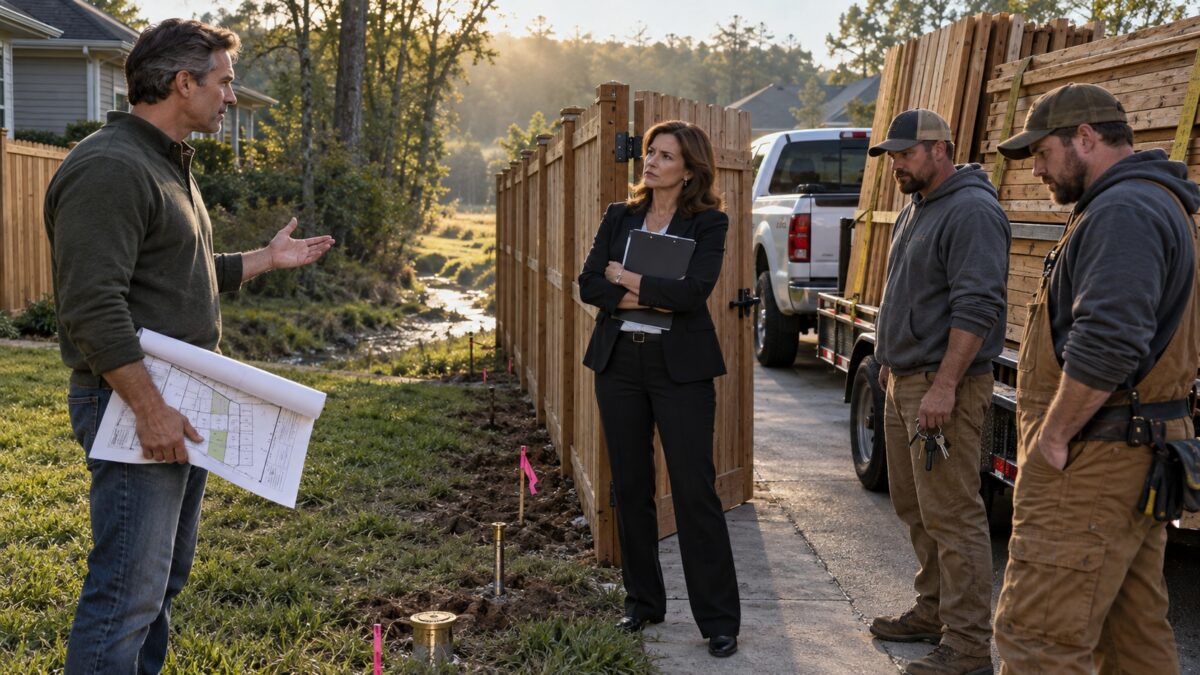
The first thing I saw that morning was the white HOA pickup backed tight against my alley gate, a contractor trailer behind it, and several fence panels strapped down as though the men standing in my yard had already decided what part of my property was coming out before I had even been given a chance to object.
Mrs. Grayson, the architectural chair, stood beside the latch with her clipboard pressed against her chest and told me they were beginning removal immediately because my fence violated the neighborhood setback, but when I asked for the work order, the board vote, and the exact covenant giving strangers permission to enter my deeded lot and dismantle an improvement I had paid for, she could not produce a single one.
Then I told her there was something she needed to know before anybody touched the first post—the line she was ordering those contractors to cross was not merely a property boundary, because twenty-five feet behind half our street belonged to a recorded federal flowage easement, and moving my fence where she demanded could put the HOA itself on the wrong side of the United States government.
The contractor stopped jingling his keys.
That tiny sound disappearing is what I remember most.
Until then, everybody had been performing a role.
Mrs. Grayson was the authority.
The men beside the trailer were the hired muscle.
The white pickup with the association logo made the whole thing look official.
And I was supposed to be the homeowner who came outside angry, realized the decision had already been made, and either stepped aside or gave them a reason to call me unreasonable.
I did neither.
I kept my hands where everybody could see them and looked toward the fence.
Straight cedar panels.
Pressure-treated posts.
Thirty inches into concrete.
Level.
Square.
Exactly where the licensed installer had placed them after measuring from the fixed survey points recorded on the plat.
“Morning,” Mrs. Grayson had said when I first walked out.
She had not even looked up.
“We’re starting removal today.”
I asked why.
“Setback violation.”
“I’ve disputed that.”
“You were notified.”
“I asked for measurements.”
“The board has already decided.”
“Then show me the vote.”
Her pen stopped.
It was only a fraction of a second.
But I noticed.
People who really have the document usually reach for it.
People who have been relying on authority as a substitute for documentation get irritated when you ask.
“If you interfere,” she said, “the fines continue, and the association will recover all enforcement costs. Legal included.”
I nodded.
“Show me where you have the right to enter my lot and remove an improvement without my permission.”
That was when she gave me the smile.
Polished.
Sympathetic.
Dismissive.
The smile people use when they want you to feel embarrassed for not understanding something they themselves have never bothered to prove.
I let the silence sit.
One second.
Two.
Three.
Long enough that the contractor glanced at her instead of at me.
Then I said:
“Before you move anything, you should understand what line that fence is actually marking.”
Her eyes shifted.
Not toward me.
Toward the posts.
For the first time that morning, she hesitated.
And to understand why that mattered, you need to know something about the property.
I had spent twenty years getting there.
Twenty years renting places where somebody else owned the ground beneath my shoes.
Twenty years asking permission to drill holes, build shelves, replace fixtures, plant anything permanent, or make the smallest improvement that might survive after the lease ended.
So when I finally bought my house in Maple Hollow, I did not treat the land casually.
Two stories.
Brick front.
A backyard that sloped gently toward the wooded retention corridor.
Creek water moving slowly behind the trees.
Old brass survey caps half buried near the rear third of the lot.
I loved those caps.
Most people never noticed them.
To me they were reminders that land has memory.
Lines existed before an HOA committee highlighted a paragraph.
Records existed before Mrs. Grayson discovered clipboards.
When I installed the fence, I did what I had always done around property and inspections.
I verified.
County permit portal.
Recorded plat.
HOA fence specifications.
Licensed installer.
Fixed points.
Measurements.
Thirty-inch post depth.
Concrete.
Straight line.
No guessing.
No “close enough.”
That was my approach to property.
I did not fight feelings.
I verified facts.
And Mrs. Grayson hated facts whenever they refused to behave like opinions.
PART2
She was never loud.
That was part of what made her effective.
There are people who bully with volume.
Mrs. Grayson did it with calm.
Pressed clothes.
Measured sentences.
A pen held above a clipboard.
She spoke as if every interpretation had already been approved by a room you had somehow forgotten to attend.
The first time we sat across from each other during what the HOA called a courtesy review, she slid the CC&Rs toward me.
One paragraph had been highlighted.
“Architectural harmony is the standard,” she said.
I looked at the page.
“Which section requires my fence to move?”
“It breaks alignment.”
“With what?”
“The established rear setback.”
“What is the setback?”
She smiled.
“Everyone understands the rear line.”
“That is not a measurement.”
“It’s the intent.”
“Intent measured from what point?”
That was when the language started changing.
The rear line.
The natural line.
The neighborhood line.
The established appearance line.
The visual corridor.
A lot of nouns.
No distances.
No bearings.
No reference points.
I had brought the installer’s as-built notes with me.
She barely looked at them.
“We don’t accept contractor opinions.”
“They aren’t opinions. They’re measurements.”
“Our committee has already reviewed the matter.”
“Using what measurement?”
“The board’s interpretation.”
“Of what?”
She closed the folder.
That meeting told me almost everything I needed to know.
Not enough to win.
Enough to start keeping records.
Three days later, the first envelope arrived.
VIOLATION NOTICE
Grainy photographs of my fence.
Cure deadline.
Then the ladder underneath.
Daily fine.
Attorney referral.
Lien rights.
Self-help removal at owner expense.
That phrase bothered me.
Self-help removal.
It sounded harmless.
Administrative.
Like a neighbor borrowing a ladder.
What it meant was:
If you refuse to do what we want, we may hire somebody to enter your property, dismantle what you built, charge you for the privilege, and then threaten your title if you refuse to pay.
I did not call Mrs. Grayson.
I did not write a long email.
I opened a folder.
Plain manila.
Wrote:
MAPLE HOLLOW — FENCE
Then I put the first notice inside.
The second envelope arrived soon after.
FINAL NOTICE
Bold type.
Twenty-five dollars a day.
Then fifty.
Then “all costs of enforcement.”
The word final was doing more work than the evidence.
The email afterward was smoother.
Mrs. Grayson wrote that the board had already determined the fence to be non-compliant and that continued violation would result in enforcement “up to and including self-help.”
I read it twice.
Then answered in numbered paragraphs.
No insults.
No accusations.
No speculation.
One:
Please provide the covenant section being enforced.
Two:
Please provide the architectural-guideline page and revision date establishing the required setback.
Three:
Please provide the measurements and fixed reference points used to determine my existing fence is non-compliant.
Four:
Please provide the committee or board minutes showing when the determination was voted.
Five:
Please provide the complete violation file, including photographs, notes, and inspection documentation.
Then I reminded them that the applicable state HOA process required notice, an opportunity to cure, and a hearing with a record.
That was not a threat.
It was the floor.
The minimum.
Two days later, they sent a hearing date.
Tucked into the packet was something much more revealing.
A contractor proposal.
Fence removal.
Fence relocation.
Price already quoted.
Materials.
Labor.
Disposal.
The contractor had already been lined up before the hearing.
That was when I stopped trusting summaries completely.
If the hearing was supposed to determine whether the fence violated anything, why did they already have demolition priced?
Maybe they would tell me it was just preparation.
Maybe it was.
But a homeowner should become suspicious when the process designed to hear him begins purchasing the result before he speaks.
So that night, I went to the shelf where I kept the closing binder.
Most homeowners open those documents once.
Sign where the title company points.
Then put everything away for the next twenty years.
I had done almost the same thing.
Warranty deed.
Title commitment.
Recorded plat.
Disclosure package.
Exhibits.
One of the plat pages showed the rear lot line.
Tiny notation.
Easy to miss.
Easement.
Book number.
Page number.
I stared at it.
The fence dispute suddenly felt different.
Mrs. Grayson kept talking about an imaginary neighborhood alignment.
The recorded plat was pointing me toward something older.
Something that existed independently of her committee.
The next morning, I went to the county clerk.
Property-record offices have a particular atmosphere.
Fluorescent light.
Low conversation.
Old counters polished by elbows.
Printers that seem to be working through decades one page at a time.
I handed the clerk the reference.
She found the index.
Clicked.
Printed.
The machine made a dull thump when the date stamp hit.
Recorded.
Permanent.
I took the pages to a table.
Read slowly.
It was not an HOA document.
Not a fence guideline.
Not a landscaping rule.
It was a recorded easement running behind half our street.
Metes and bounds.
Bearings.
Distances.
Defined width.
Twenty-five feet.
The restrictions were not vague.
No obstruction.
No structures.
No fill interfering with access, inspection, drainage, or maintenance.
I read the grantee.
Then read it again.
United States of America.
There are phrases that immediately lower the temperature of a neighborhood argument.
That is one.
I drove home.
Walked the fence.
Found the corner caps.
Compared the distances on the plat to the recorded description.
The fence line began making sense in a way Mrs. Grayson’s language never had.
It had not been placed according to some “natural neighborhood line.”
It had been located to stay outside that easement.
The installer had not guessed.
Someone had respected the recorded corridor.
If I moved the fence the direction the HOA demanded, I could be pushing it into federally protected ground.
I stood in the grass looking toward the creek.
Until that moment, the conflict had been:
Homeowner versus HOA.
Now there was another interest sitting behind the dispute.
One that did not care about architectural harmony.
I called the number associated with the recorded document.
Switchboard.
Transfers.
Hold music.
Another person.
Another department.
Eventually a woman answered who handled easement compliance for the watershed project.
I kept my explanation simple.
“I’m a homeowner on Maple Hollow.”
“All right.”
“I have a recorded flowage easement behind my property.”
“Okay.”
“My HOA wants me to relocate a fence closer to the channel.”
That produced a pause.
Not surprise exactly.
Recognition.
Like she had heard versions of this before.
She asked for my parcel number.
Legal description.
Book and page.
I read them.
I heard keyboard keys.
Then her tone changed.
Still helpful.
More precise.
“The easement is not advisory.”
“I assumed not.”
“It exists for access, inspection, maintenance, and project protection.”
“All right.”
“Structures inside it can be subject to removal.”
“What about penalties?”
“If an obstruction interferes with federal rights or project operations, civil remedies can apply.”
I looked out my window toward the fence.
The HOA had been threatening me with daily fines if I did not move it.
Now the agency responsible for the recorded easement was telling me that moving it could create an entirely different problem.
I asked:
“Can you give me that in writing?”
“Yes.”
Two days later, the email arrived.
PDF.
Agency letterhead.
Map exhibit.
Easement shaded.
One sentence mattered above everything else.
Relocating the fence as described could encroach upon federal rights.
I printed it.
Then did something Mrs. Grayson probably would never understand.
I did not send it to her.
Not yet.
Evidence is not stronger because you release it quickly.
It is stronger when it arrives complete enough that nobody can escape into another interpretation.
I had the recorded easement.
I had the federal letter.
I still wanted one thing.
A licensed survey.
Someone independent.
Someone whose professional stamp reduced the argument to coordinates.
I hired one.
He arrived with a tripod and instruments.
Located the iron pins.
Shot the rear line.
Mapped the easement.
Shot the fence.
Orange flags appeared in the grass.
Tiny punctuation marks between ownership and authority.
Two days later, I had the stamped drawing.
The fence sat 0.3 feet outside the easement boundary.
Parallel to the line within a tenth.
That mattered.
Not three feet.
Not two.
Three-tenths of a foot.
Close enough to show the installer had intentionally respected the corridor.
Far enough to remain outside it.
The survey did what all good measurements do.
It replaced argument with location.
I built a binder.
Not because I enjoy binders.
Because I have spent enough time around contractors, inspectors, auditors, banks, and property records to understand that the person who can open to the correct tab usually controls the next ten minutes.
Tab one:
Deed excerpt.
Tab two:
Recorded easement.
Tab three:
Plat.
Tab four:
Federal agency letter.
Tab five:
Stamped as-built survey.
Tab six:
Photo log.
Dates.
Angles.
Fence.
Pins.
Tab seven:
HOA notices.
Chronological.
Fine amount.
Deadline.
My response.
Their response.
Then the contractor proposal.
I sent one certified letter to the board and management company.
Not Mrs. Grayson alone.
Everybody with responsibility.
The opening sentence was simple.
Suspend enforcement immediately.
Then the reason.
Their demanded cure would require relocating my existing fence toward or into a superior recorded federal flowage easement.
Doing so could expose both me and the association to federal enforcement.
I offered a clean exit.
Withdraw the violation.
Cancel the fines.
Credit any money already assessed.
Add guidance acknowledging that where a recorded easement constrains a lot, that easement controls placement.
No demand for an apology.
No accusation that anyone was corrupt.
No threat to call television stations.
Just:
Here is the problem.
Here is the proof.
Here is how you can stop.
The return receipts came back signed.
Mrs. Grayson answered anyway.
One sentence near the middle told me she was not going to take the exit.
Setback standards remain enforceable notwithstanding external easements.
I read it.
Then read the federal letter again.
Her mistake was not believing the HOA had setback authority.
It probably did in appropriate circumstances.
Her mistake was assuming every piece of authority was equal.
It was not.
A private association can regulate aesthetics where its documents permit.
It does not get to order a homeowner into conflict with a superior recorded property right because architectural harmony looks better from the street.
She wanted the hearing.
Fine.
We would have the hearing.
The morning the contractors showed up came before that formal hearing.
That was what made it so extraordinary.
The HOA had the federal letter.
The survey.
The recorded easement.
And still:
White pickup.
Trailer.
Fence panels ready for disposal.
Mrs. Grayson at my alley gate.
“We’re starting removal today.”
I did not know whether she believed the board had authorized immediate self-help.
I did not know whether the contractor understood what legal authority had been given.
I did know one thing.
Nobody was touching the fence until someone produced paper giving them the right.
That was why I asked for the work order.
The board vote.
The entry authority.
She had threatened fines and legal costs.
I asked for the document.
When I told her she should know what line the fence was marking before anybody moved it, the contractor finally stopped acting as if demolition was inevitable.
He looked at the posts.
Then at Mrs. Grayson.
Then at me.
I said:
“There is a recorded twenty-five-foot flowage easement behind this line.”
Her jaw tightened.
“The HOA is aware of the easement.”
“Good.”
I pointed.
“My fence is surveyed outside it.”
“That doesn’t change the setback violation.”
“The cure you are demanding moves it toward federal land rights.”
“That is your interpretation.”
“No.”
I kept my voice level.
“It is the federal agency’s interpretation.”
The contractor shifted.
I could hear metal on the trailer behind him.
Mrs. Grayson looked toward him.
“This is an HOA matter.”
I had heard that before.
“The easement is not.”
I did not bring the entire binder outside.
I did not need to.
The point that morning was not to litigate the hearing at the gate.
It was to make sure nobody crossed the line because somebody in a pressed shirt had said the decision was final.
The contractor asked her quietly:
“Do you have something saying we can enter?”
That question changed everything.
Before, I was the problem.
Now the person she had hired wanted his own protection.
She repeated that the board had authorized removal.
He asked again:
“Written?”
Her answer became less clean.
The contractor did not unload.
The trailer left without touching the fence.
The white pickup left too.
Mrs. Grayson remained long enough to tell me the enforcement process was not over.
“I know.”
“You’re only increasing your costs.”
“Then put that in writing.”
She did not answer.
She left.
I went inside.
Made coffee.
Then wrote down the entire encounter while it was fresh.
Time.
Vehicles.
Words.
Contractor question.
No demolition.
No shouting.
Documentation is boring.
That is why it works.
People remember drama.
Records preserve sequence.
The formal hearing happened in the clubhouse conference room.
Beige carpet.
Long table.
Sign-in sheet.
Property manager with a laptop.
Three board members.
Mrs. Grayson at the end.
Rule book open.
Tabs everywhere.
She looked composed again.
If the contractor morning had unsettled her, none of it showed.
I carried only a slim folder.
Not the entire binder.
That was deliberate.
A hearing is not improved by making everybody dig through forty pounds of paper.
Give people what matters.
Let them see the chain.
I signed in.
Sat.
The board president opened.
Mrs. Grayson presented first.
Uniformity.
Precedent.
Community standards.
Rear alignment.
Setback.
She spoke smoothly.
No exact survey measurement.
No independent drawing.
No fixed reference points.
Photos of my fence went around the table.
Straight panels.
Even posts.
Nothing about the pictures proved a violation.
But certainty can make evidence feel unnecessary if nobody interrupts it.
When she finished, the president looked at me.
“Mr. Carter?”
I stood.
“Thank you.”
Placed one packet before each director.
One in front of management.
One in front of the association attorney who had arrived quietly and had not spoken yet.
I began with the easement.
Book and page.
Recorded.
Grantee:
United States of America.
Defined twenty-five-foot width.
Restrictions.
Then the stamped as-built survey.
Fence plotted against easement boundary.
0.3 feet outside.
Parallel.
Then the federal agency letter.
Letterhead.
Shaded exhibit.
The sentence.
Relocating the fence as described could encroach upon federal rights.
Then I stopped talking.
That was important.
There is a temptation in disputes to fill silence because you are afraid somebody else will reinterpret what you just handed them.
Do not.
Let good documents be read.
Pages turned.
The property manager stopped typing.
One board member traced the shaded map with a finger.
The association attorney read the agency letter twice.
Mrs. Grayson began tapping her pen.
Nobody had asked her anything.
She said:
“This is still an HOA matter.”
I looked toward the board.
“You can enforce aesthetics where you have authority.”
Then toward the federal letter.
“You cannot order me to violate a superior recorded easement or make the association part of that violation.”
Silence.
Not hostile.
Different.
The kind of silence that arrives when everybody realizes the argument they expected is no longer the argument they have.
The president asked:
“Was this easement disclosed in your original purchase documents?”
“Yes.”
“Recorded?”
“Yes.”
“Do we have a copy in the property file?”
The manager searched.
“I don’t see one.”
The attorney spoke for the first time.
“May I see the complete recorded instrument?”
I handed it over.
He reviewed the legal description.
Book.
Page.
Recording stamp.
Then the survey.
Then he asked:
“Where exactly does the HOA want the fence relocated?”
Mrs. Grayson described the preferred rear alignment.
He looked at the shaded exhibit.
Measured visually.
Then stopped.
The president asked:
“Counsel?”
He did not answer immediately.
Instead he said:
“I think the board should recess.”
Five minutes.
That was the request.
The board members, management, and attorney stepped into the adjoining office.
Door closed.
Low voices.
Mrs. Grayson remained in the conference room with me.
Her chin stayed high.
Pen tapping against the rule book.
Tap.
Tap.
Tap.
I did not speak.
Neither did she.
There are moments when talking only gives the other person a place to put their anger.
Silence is better.
I could hear fragments through the wall.
Not words.
Tones.
Question.
Response.
Longer explanation.
The five-minute recess became almost ten.
Mrs. Grayson finally stopped tapping.
When the door opened, the board came back.
The president sat.
He did not look at Mrs. Grayson.
He looked directly at me.
“Mr. Carter.”
“Yes.”
“Based on the documentation provided, the violation is withdrawn effective immediately.”
I waited.
“All fines assessed in connection with this matter are canceled.”
The manager began typing.
“Any amounts already paid will be credited to your account.”
I nodded.
The president continued.
“The association will take no removal action against the fence.”
The attorney added carefully:
“We are also withdrawing the contractor proposal related to relocation and self-help removal.”
There it was.
The white pickup.
The trailer.
The demolition quote.
Done.
Not because I yelled louder.
Because when their own lawyer put the contractor proposal beside the certified letter, the recorded easement, and the federal warning, continuing became legally reckless.
Mrs. Grayson leaned forward.
“I think it is important to recognize that this was simply a misunderstanding.”
The word almost made me smile.
A misunderstanding is when two people hear different meeting times.
This had included escalating fines, threat of lien rights, pre-priced removal, and a contractor arriving at my gate.
But I had not come there to argue vocabulary.
The president nodded once.
Then said:
“Going forward, the architectural committee will make recommendations only.”
Mrs. Grayson stopped moving.
The president continued:
“Final enforcement determinations will be made by the board with counsel review.”
That was bigger than my fence.
Her committee had been functioning as if interpretation and final authority were the same thing.
They were not anymore.
I thanked the board.
Gathered my copies.
Left.
No speech.
No victory lap.
I had not gone there to embarrass Mrs. Grayson.
I wanted the fence protected.
The fines gone.
The record corrected.
That was enough.
The morning after the hearing, I sent one last email.
Two paragraphs.
Board.
Management company.
I thanked them for correcting the violation.
Attached the recorded easement.
Stamped survey.
Federal agency letter.
Then asked that all three be added to the association’s permanent property file.
That part mattered.
A dispute truly ends only when the corrected information outlives the people who argued about it.
Committee chairs change.
Property managers leave.
Board members sell their homes.
Files remain.
If the next person opened my lot record ten years later, I did not want them to see only:
Fence controversy.
I wanted them to see:
Federal easement.
Exact boundary.
Stamped survey.
Placement verified.
Then I suggested one line for future architectural guidance.
Nothing grand.
Something any homeowner could understand.
Where a recorded easement constrains a lot, fence placement may align with the easement boundary rather than an assumed neighborhood setback.
The whole ordeal could have been avoided if that sentence had existed earlier.
Not because every homeowner would suddenly become an expert.
Because the committee would have been reminded to ask the correct first question.
Is there a recorded property constraint?
Before:
Does this look aligned with the neighbors?
Order matters.
That weekend, I spoke with the two neighbors whose rear lots shared the same corridor.
Not to celebrate.
Not gossip.
I showed them the recorded easement.
Twenty-five feet.
Federal rights.
No obstructions.
No structures interfering with access, maintenance, or drainage.
One of them had always assumed that strip was simply extra backyard.
“It isn’t?”
“No.”
“Even though it’s inside my lot?”
“You own the underlying property subject to the easement.”
He frowned.
“So they can make me remove something?”
“If it interferes with their rights.”
He looked toward the creek.
“What about a shed?”
“I’d check before building one.”
That was the whole conversation.
No panic.
Just information.
The other neighbor had been considering bringing in fill to flatten the back grade.
I told him the same thing.
“Check the easement before you move dirt.”
He did.
That was the useful part of everything Mrs. Grayson had started.
Not that I defeated the HOA.
I did not.
The HOA was not my enemy.
A good association should have been doing exactly what the board finally did at the hearing.
Check authority.
Review records.
Consult counsel.
Correct the mistake.
The problem had been the gap between recommendation and certainty.
Mrs. Grayson interpreted.
Then treated interpretation as fact.
Then treated fact as authority.
Then treated authority as permission to send contractors onto deeded property.
Each step made the next one easier.
That is how modest power becomes dangerous.
Not with one dramatic decision.
With assumptions that stop being questioned.
The first assumption was:
Everyone understands the setback.
I had asked:
What setback?
From where?
Measured how?
Instead of answering, she gave me vocabulary.
Natural line.
Rear line.
Neighborhood line.
Those phrases sounded official because they were familiar.
The recorded easement sounded less familiar.
Book and page.
Bearings.
Distances.
Twenty-five feet.
United States of America.
But unfamiliar does not mean weaker.
Quite the opposite.
The land did not care which line Mrs. Grayson found aesthetically pleasing.
The recorded instrument existed whether she liked it or not.
I think that was the part she disliked about me.
Not the fence.
The question.
Where does it say that?
People comfortable with authority often hate that question.
Not because it is disrespectful.
Because legitimate authority should be able to answer it.
If someone tells you:
You must move your fence.
Ask:
Which section?
If they say:
It violates setback.
Ask:
What measured distance?
If they say:
The board decided.
Ask:
Where are the minutes?
If they say:
We can enter and remove it.
Ask:
Show me the recorded authority.
Maybe they can.
Sometimes the HOA will be right.
That matters too.
I never believed homeowners should treat every rule as tyranny.
I pulled the permit for my fence.
Read the spec.
Hired the installer.
Because rules can be useful.
Good fences need correct placement.
Drainage corridors need access.
Flowage easements exist for reasons larger than one homeowner’s preferences.
The irony was that by fighting the HOA’s unsupported interpretation, I ended up protecting the more important restriction.
The federal one.
Had I simply obeyed and moved the fence, I might have created the exact obstruction the recorded easement was designed to prevent.
That is the danger of blind compliance.
Not every authority knows what other authority already controls the ground.
Sometimes the homeowner is the only person holding all the documents at once.
That became my role.
Not rebel.
Translator.
Here is what the HOA says.
Here is what the plat says.
Here is what the recorded easement says.
Here is what the federal agency says.
Here is what the survey says.
Now make a decision that fits all of them.
The board did.
Eventually.
Mrs. Grayson did not speak to me after the hearing.
Not immediately.
I did not need her to.
The source of the conflict was no longer personal communication.
It was the record.
That felt healthier.
I did not wake up wondering whether another fine would arrive.
The daily schedule stopped.
No attorney referral.
No lien threat.
No self-help notice.
The contractor never came back.
My fence remained where it had always been.
Sometimes I would stand in the yard with coffee.
Wet grass.
Creek moving behind the trees.
Orange survey marks fading slowly.
The cedar boards looked exactly as they had before.
That is the strange thing about property disputes.
Months of letters.
Threats.
Meetings.
Records.
Law.
Then one morning the physical world looks unchanged.
Fence.
Grass.
Trees.
Creek.
Only your understanding has changed.
I knew what lay behind those boards now.
Not bonus backyard.
Not an aesthetic margin.
A protected corridor.
Twenty-five feet.
Recorded years before Mrs. Grayson ever chaired an architectural committee.
The brass caps in the ground meant more too.
I had always liked them.
Now they represented something I had learned the harder way.
Land has memory.
Paper gives that memory a voice.
A board can forget.
A committee can misinterpret.
A homeowner can assume.
A clerk’s office keeps the page.
That page may sit unread for twenty years.
Still valid.
Still waiting.
I kept the full binder.
Of course.
Not on the kitchen table forever.
Eventually it moved to the shelf.
But I never threw away the contractor proposal.
That page remained especially instructive.
The hearing had not happened yet.
The committee still claimed facts were unresolved.
Yet removal had been priced.
People later asked me whether that proved bad faith.
I would not go that far without more evidence.
I did not need to.
It proved something simpler.
The enforcement process had moved farther toward action than the evidence justified.
That alone was enough reason to slow it down.
The contractor himself probably had no idea.
He arrived with a work order.
Trailer.
Panels.
Keys.
Then heard:
Federal easement.
No written entry authority.
Disputed removal.
He stopped.
That was responsible.
Once he had reason to question whether he had lawful permission, he did not turn my fence into firewood just because somebody in a polo shirt wanted the job completed.
I respected that.
The white HOA pickup bothered me longer.
Not the vehicle.
What it represented.
Branding.
People trust logos.
Uniforms.
Letterhead.
A pickup carrying the association seal looks more official than Mrs. Grayson arriving in her own car.
A contractor trailer behind it makes a decision look final.
Visual authority.
But logos do not create property rights.
Neither do bold headings.
FINAL NOTICE does not make an unsupported interpretation correct.
I learned that long before the fence dispute through banks and inspectors.
A document’s appearance tells you almost nothing about its legal strength.
Source matters.
Authority matters.
Recording matters.
Measurements matter.
Mrs. Grayson had photographs.
I had the deed chain.
She had highlights.
I had book and page.
She had “everyone understands.”
I had 0.3 feet.
That number probably mattered more than anything I said.
Three-tenths.
Precise enough to be boring.
That is the best kind of evidence.
Boring numbers rarely need charisma.
The board attorney understood immediately.
You could see the change in the room when he started reading.
Lawyers are useful in moments like that because they do not have to care which neighbor is more likable.
Their question is:
What happens if we keep going?
Contractor enters.
Fence removed.
Federal agency later says the new location obstructs recorded rights.
Homeowner produces certified letter warning board before removal.
Stamped survey proves old fence complied with superior easement.
That is not a pretty file for an association.
The five-minute recess was probably the most important part of the whole dispute.
Closed door.
Low voices.
No performance.
Just liability becoming visible.
When the president returned and withdrew everything, I knew counsel had done exactly what counsel should.
Stopped a volunteer committee from converting certainty into a lawsuit.
The architectural committee’s new role mattered too.
Recommendations only.
Some homeowners later interpreted that as punishment for Mrs. Grayson.
I saw it differently.
Governance repair.
An architectural committee can still be valuable.
Most board members do not want to personally inspect fence colors or shed designs.
Committees review.
Recommend.
Flag.
But if one committee member can effectively issue final legal determinations, approve self-help, and move contractors toward someone’s lot without meaningful board review, then the structure has stopped protecting everybody.
Including the committee member.
Final decisions belonged with the board.
Counsel review where necessary.
That was safer for all of us.
I did not ask for Mrs. Grayson to be removed.
The source never required that ending.
I did not need it.
She had made a bad call.
A serious one.
The board corrected the process.
My land stayed intact.
That was enough.
Months of conflict can distort your idea of what satisfaction should look like.
You begin imagining dramatic outcomes.
Public apologies.
Resignations.
Huge settlements.
Somebody admitting:
You were right about everything.
Real satisfaction can be much smaller.
I walked out after the hearing.
Got into my vehicle.
Drove home.
Opened the alley gate.
Looked at the fence.
Still standing.
That was it.
No one had taken anything.
No new hole in the ground.
No pile of cedar stacked on a contractor trailer.
No federal obstruction created because a neighborhood committee had preferred a prettier visual line.
Just the fence.
Straight.
Quiet.
Lawful.
I made coffee.
Walked to the back of the yard.
Morning sun made the creek visible through the trees.
The survey flags were still there.
I took a photograph.
Not for evidence.
Not really.
Maybe habit.
Then I put the phone away.
There is a moment in every long dispute when documentation stops being defense and starts becoming memory.
That was mine.
I had spent weeks saving every letter because I needed proof.
Now proof had done its job.
The next question was whether I would allow the fight to remain the main thing I saw every time I looked at the fence.
I did not want that.
I had built it for ordinary reasons.
Privacy.
Yard.
Property.
Something permanent after twenty years in rentals.
Mrs. Grayson had turned it into a case.
I wanted it back as a fence.
That took time.
At first I still looked toward the posts and thought:
0.3 feet.
Federal easement.
Hearing.
Contractor.
Then eventually:
Fence.
That was better.
One of my neighbors asked if I planned to paint it.
“No.”
“HOA approved color?”
“The existing finish is approved.”
He laughed.
“Had to ask.”
I laughed too.
That was what I wanted life to become again.
Small jokes.
Grass.
Creek.
Not constant enforcement strategy.
The permanent property file mattered because I knew I would not own the home forever.
Nobody does.
Twenty years to escape rentals had made me think in terms of handing something down.
Someday another person may stand at that same rear line.
Maybe my child.
Maybe a buyer.
Maybe somebody who has never heard Mrs. Grayson’s name.
They should not need to rediscover the easement through conflict.
They should open the file.
See the survey.
See the federal letter.
Understand.
Good records reduce the amount of history people are forced to repeat.
That may be the most useful outcome of the entire situation.
The guideline note could protect more than my lot.
Two neighbors shared the corridor.
Others along the street did too.
Aesthetic alignment was never going to override recorded federal access.
Now the association knew.
That knowledge could prevent future mistakes.
One evening, I pulled out the federal map again.
Shaded strip behind the street.
It looked so simple.
A band.
Twenty-five feet.
No drama.
The easement had probably been created for practical reasons.
Water management.
Access.
Inspection.
Maintenance.
Nobody drafting it imagined an architectural committee decades later arguing about backyard alignment.
That is the beauty of precise recorded rights.
They do not need to predict every future disagreement.
They define the constraint.
Future people must work around it.
Mrs. Grayson had been trying to reverse that relationship.
She wanted the easement to somehow accommodate the aesthetic standard.
Legally and physically, it worked the other way.
The fence accommodated the easement.
Correctly.
That was why the survey sat where it did.
0.3 feet outside.
I thought often about the installer.
At the original fence project, he had spent extra time finding the fixed points.
I remember watching him measure.
Then measure again.
I had probably been impatient.
“Good?”
He had said something like:
“Better to know now.”
At the time, ordinary contractor wisdom.
Years later, that careful work became the central fact in an HOA hearing.
You never know when precision will matter.
That is why I pay people to do things correctly.
The thirty-inch posts.
Concrete.
Straight line.
Those details had seemed like craftsmanship.
They became legal protection.
Mrs. Grayson had dismissed his notes as contractor opinions.
The licensed surveyor later put coordinates around the same reality.
That did not make the installer suddenly right.
He had been right already.
The survey simply produced the form of proof the board could no longer dismiss.
People sometimes confuse proof with truth.
Truth exists first.
Proof is how you make it usable to strangers.
My fence was where it was.
The survey did not move it.
The recorded easement existed.
My trip to the clerk did not create it.
The agency’s letter did not invent federal rights.
All those things already existed.
I just assembled them into a form the HOA had to acknowledge.
That was the whole strategy.
No clever trick.
No hidden loophole.
Read what already exists.
I later explained the dispute to someone who asked why I had not simply hired a lawyer at the beginning.
Maybe I could have.
But there was value in understanding the documents myself.
A lawyer can represent you.
They should not be the first person who knows what your deed says.
A homeowner should know enough to recognize when a demand conflicts with recorded property rights.
Not become an attorney.
Just know your own file.
Closing binder.
Plat.
Easements.
Restrictions.
That stack of boring paper is part of what you bought.
The house is not only walls.
Land is not only grass.
Rights travel through documents.
Ignore the documents and you may discover somebody else has been reading them for you.
Or worse:
Nobody has.
That was Maple Hollow’s problem.
The HOA had a fence spec.
Mrs. Grayson had a preferred interpretation.
Nobody had looked behind it at the recorded corridor.
Not management.
Not committee.
Maybe not previous boards.
The old easement sat quietly while newer rules accumulated above it.
Then one fence dispute forced everyone to notice.
I found some satisfaction in that.
Not revenge.
Correction.
The system now had better information than before.
That is what disputes should produce if people handle them well.
Better records.
Better process.
Not only winners and losers.
Mrs. Grayson probably saw it differently.
I cannot know.
I never asked.
After the hearing, our interactions became minimal.
Fine.
Not every conflict needs reconciliation.
You can live near someone without pretending you became friends because the board ruled against them.
Civility is enough.
Boundaries are enough.
Documentation is enough.
I had spent twenty years working toward a place I could hand down.
I was not going to spend the next twenty trying to force emotional closure from an architectural chair.
The fence stayed.
The federal corridor stayed open.
Life moved.
That was closure.
Months afterward, I saw an architectural notice sent to another homeowner.
Different issue.
Different lot.
The document had changed.
It included:
Exact covenant section.
Guideline revision date.
Measured condition.
Appeal information.
I smiled.
That was new.
I do not know whether my case caused every change.
Probably not.
But the process was better.
No vague “everyone understands.”
No mystery line.
If you are going to tell somebody their property violates a rule, tell them the rule.
That should not be revolutionary.
Sometimes basic fairness only becomes visible after somebody has been denied it.
The management company also kept better lot files.
Again:
Boring.
Useful.
The board president once stopped me near the mailboxes.
“Mr. Carter.”
“Yes?”
“I wanted to thank you for how you handled the hearing.”
That surprised me.
“I was protecting my property.”
“I know.”
“You don’t need to thank me.”
“No. But you could have turned that meeting into something else.”
“What?”
“A fight.”
“It already was.”
He shook his head.
“You know what I mean.”
I did.
I had seen homeowners arrive at meetings furious.
Sometimes with good reason.
They unload everything.
Old grudges.
New accusations.
Neighbors.
Politics.
Suddenly the narrow issue disappears.
The board begins managing emotion instead of evidence.
I did not want that.
Fence.
Easement.
Survey.
Federal letter.
That was the case.
Nothing else needed air.
“Your attorney helped,” I said.
“He did.”
“Then thank him.”
The president smiled.
“He billed us.”
Fair enough.
I went home.
The creek was high that week after several days of rain.
Standing water had collected farther into the corridor.
For the first time, I understood physically why the easement existed.
Access was not theoretical.
Drainage was not decorative.
Those twenty-five feet were part of a larger system.
The HOA’s proposed relocation could have pushed my fence toward an area where crews might someday need equipment.
Maybe not next year.
Maybe not in ten.
That is what easements are for.
Future need.
You cannot protect future access if each current homeowner treats the corridor as empty ground available for whatever fits.
That made my conversations with neighbors more important.
Not gossip.
Warning.
Do not assume.
Check.
One neighbor eventually had the corridor marked professionally before doing landscaping.
Good.
That was the kind of ripple I could support.
The best lessons from disputes should become ordinary precautions.
Not neighborhood legends.
Still, people talked.
Of course.
Maple Hollow was not large enough for a contractor trailer at my alley gate to remain secret.
I heard versions.
“Carter fought the HOA with the federal government.”
Not exactly.
“HOA almost got fined by Washington.”
No.
“His fence belongs to the government.”
Definitely no.
Rumors simplify.
I corrected them when necessary.
The truth was less dramatic.
The United States held a recorded flowage easement.
My fence remained outside it.
The HOA ordered a cure that could have pushed the fence into that easement.
The board withdrew the demand after reviewing documentation.
That is the real story.
Less exciting.
More useful.
Nobody received a suitcase of money.
Nobody went to jail.
Mrs. Grayson did not get frog-marched out of a meeting.
The board did not collapse.
My house did not become famous.
The ending was paperwork correcting paperwork.
I prefer that.
Property law should be boring when it is working.
The dramatic part had been the possibility that somebody was going to physically alter my land before verifying what they were doing.
Once that stopped, everything could return to process.
That morning at the gate remains the sharpest memory.
White pickup.
Trailer.
Panels.
Clipboard.
The contractor’s keys.
And Mrs. Grayson telling me:
“It’s already been decided.”
That phrase deserves suspicion anytime somebody says it while refusing to show you how.
Already decided by whom?
When?
Under what authority?
Recorded where?
People can decide many things.
A committee can decide it dislikes my fence.
That does not automatically create the legal right to remove it.
A board can adopt architectural guidelines.
That does not erase superior property interests.
An HOA can fine within its lawful authority.
That does not let it order a homeowner into federal noncompliance.
Decision is not magic.
Jurisdiction matters.
My father used to say something similar about inspections.
An inspector can fail you.
Then they need to tell you the code.
Otherwise you are not correcting work.
You are guessing at preference.
Preference is dangerous when dressed as law.
Mrs. Grayson had preferences.
Maybe sincere ones.
Straight rear fences.
Visual consistency.
Architectural harmony.
Nothing inherently evil about wanting a neighborhood to look orderly.
The problem began when preference stopped being distinguishable from authority.
She could not give me the measurement because the measurement was not driving the decision.
The picture in her head was.
The easement did not care about the picture.
That is why records mattered.
They anchor decisions outside individual taste.
I continued paying HOA dues.
People occasionally found that surprising.
“After all that?”
“Yes.”
“Why?”
“Because I still live in the association.”
The HOA had common expenses.
Maintenance.
Administration.
Whatever legitimate obligations applied.
My dispute did not erase them.
Being mistreated in one enforcement matter did not turn every association function illegitimate.
That kind of all-or-nothing thinking is how neighborhood conflicts become identity wars.
I did not want one.
I wanted the fence issue corrected.
It was.
Then I moved on.
That does not mean I became naïve.
I read notices more carefully.
Meeting agendas too.
When architectural guidelines changed, I checked the revision.
Not obsessively.
Enough.
Trust after a mistake should become informed, not impossible.
That is a healthier outcome than permanent suspicion.
The board had earned some trust back by withdrawing the violation instead of doubling down after counsel reviewed the evidence.
That mattered.
They could have forced litigation.
Could have spent dues defending a bad position.
They did not.
They corrected.
Credit where due.
Even Mrs. Grayson’s original insistence ultimately forced the association to identify a hole in its own process.
Again, that does not make the harassment good.
A bad process creating an opportunity to fix the process does not justify the bad process.
It simply means the community used the conflict for something better afterward.
Important distinction.
A year before all this, I barely knew what a flowage easement was.
Now I could explain one to anybody willing to stand near my back fence for five minutes.
That was not a hobby I had requested.
Still, useful knowledge.
I also learned the difference between a plat notation and the underlying recorded instrument.
The plat says:
Easement.
Book and page tell you what that actually means.
That distinction saved me.
Had I stopped at the plat, Mrs. Grayson could have argued about interpretation.
The recorded instrument named the United States.
Defined the width.
Restricted structures.
Once I had the original, the debate narrowed.
Original documents do that.
Summaries tell you what someone believes.
Recorded instruments tell you what was granted.
I became suspicious of any dispute where the person enforcing something only wanted to show me excerpts.
“Read the whole thing.”
That became my rule.
Entire section.
Entire amendment.
Entire easement.
Context.
Because one highlighted paragraph can become very persuasive if nobody reads the sentence above it.
Mrs. Grayson had used highlights like certainty.
I used complete pages.
The board attorney used both.
That is how it should work.
I think of the 0.3-foot measurement often.
People laugh when I tell them.
“You fought all this over three-tenths of a foot?”
No.
The three-tenths proved where the fence sat relative to the federal easement.
The HOA wanted the fence moved farther.
The amount of proposed movement was larger.
The point was not protecting three-tenths.
The point was protecting the correct line.
Property disputes often sound petty because distances are small.
A few inches.
A foot.
A strip.
But lines define responsibility.
Move one structure across the wrong line and suddenly maintenance rights change.
Drainage changes.
Access changes.
Liability changes.
The ground itself does not care whether the difference looks small.
Contracts do.
So do surveyors.
So do courts.
I liked that.
Precision can be comforting.
Not flexible.
Not personal.
A coordinate does not dislike your fence.
Mrs. Grayson could.
The coordinate did not care.
Years in rentals had made me especially protective of permanence.
When you rent, the line between yours and not yours is obvious.
You live there.
Someone else owns it.
Ownership gave me a different responsibility.
Not entitlement.
Stewardship.
Know what you have.
Know what burdens it.
Know what rights attach.
Know what somebody else cannot demand casually.
I had bought a house.
But I had also bought a position inside a chain of title.
That chain included the federal easement.
I could not pretend it did not exist simply because I preferred more backyard.
Neither could the HOA.
That is the bargain of land.
You receive rights.
You inherit restrictions too.
The fence respected both.
That was why it stayed.
The last time I opened the binder was several months later when one of the neighbors asked to see the book-and-page reference again.
I handed him the copy.
He took a photograph.
“Mind if I keep one?”
“I have extras.”
Of course I did.
I gave him a copy of the shaded exhibit too.
He thanked me.
Then looked toward my fence.
“Crazy.”
“What?”
“All this because of that.”
He pointed.
I looked at the fence.
“No.”
He frowned.
“Because nobody checked what was behind it.”
He thought.
“Fair.”
That was the real story.
Not fence versus HOA.
Assumption versus record.
Mrs. Grayson thought she knew the line.
I asked for the measurement.
The answer led backward.
Guideline.
Plat.
Book.
Page.
Federal easement.
Survey.
Agency letter.
Hearing.
Every question peeled away one layer of interpretation until the physical truth was visible.
The fence was where it was supposed to be.
Once you know that, everything else becomes easier.
The fines were canceled.
Any amounts paid were credited.
The contractor proposal disappeared.
The association stood down.
The property file was corrected.
The committee became advisory.
The board took final enforcement authority with legal review.
That is a complete ending.
I did not need more.
No one tore down Mrs. Grayson’s fence.
No one imposed a twenty-five-thousand-dollar penalty.
No dramatic federal agent appeared at the clubhouse.
The United States never needed to arrive because the recorded document did its job before anybody created the obstruction.
Sometimes the best legal outcome is preventing the larger legal fight.
That is what happened.
And that is why, when people ask whether I “beat” the HOA, I usually say no.
I made them read.
That was enough.
Eventually the orange survey paint faded.
Rain washed the grass.
The federal easement remained invisible again.
That amused me.
The most powerful line in the entire dispute was not marked by a wall.
Not a sign.
Not a chain.
Just documents and coordinates.
People think property boundaries become real when they see fences.
Sometimes the fence is the least important line.
Behind mine sat a twenty-five-foot legal corridor that could determine what every homeowner along that stretch was allowed to build.
Invisible does not mean imaginary.
Eleanor—Mrs. Grayson, in the source everybody called her only that—had confused those two ideas.
She trusted the line she believed everybody could see.
The neighborhood alignment.
The visual pattern.
The easement existed whether anybody saw it or not.
Recorded rights do not need aesthetics.
My fence remained visible because it respected the invisible thing.
That is the lesson I kept.
Years of property ownership later, I still walk the yard with coffee some mornings.
Wet grass.
Creek.
Old brass caps.
The fence catches early light.
Nothing dramatic.
Exactly how I like it.
I no longer see the white HOA pickup when I look at the alley gate.
No contractor trailer.
No panels waiting to become scrap.
That memory faded.
What remains is the line.
Not Mrs. Grayson’s imagined one.
The measured one.
The line the installer respected.
The survey confirmed.
The county recorded.
The federal agency protected.
The board eventually recognized.
My fence stayed exactly where it had been from the beginning.
Straight.
Quiet.
Lawful.
Marking the boundary they could not bully away.
And if there is one thing I learned from the entire ordeal, it is this:
Once an HOA realizes you actually read the deed, the plat, the easement, the minutes, and every page behind the rule they are trying to swing at you, they usually do not stop having rules.
They simply become much more careful about whether the next one truly applies.


