HOA Queen Called 911 to Have Me Arrested for Shutting Off Her Pond—She Forgot I Was the County Sheriff
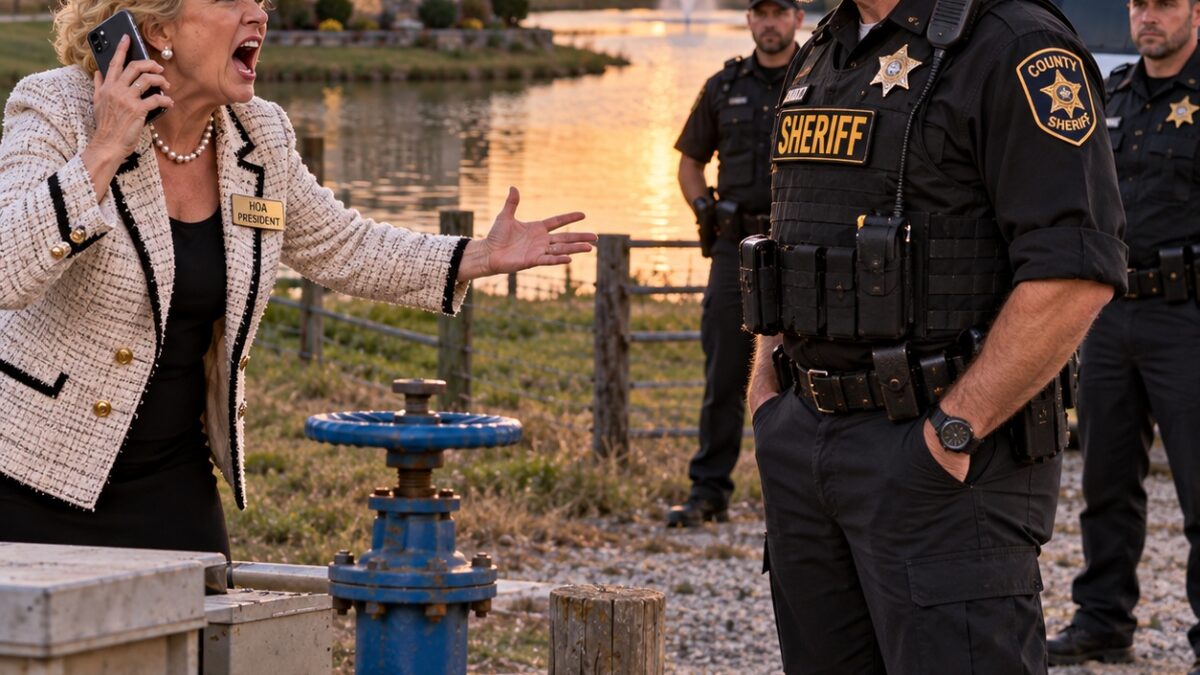
HOA Queen Called 911 to Have Me Arrested for Shutting Off Her Pond—She Forgot I Was the County Sheriff
The HOA president stood at the edge of my pasture with her phone raised like she was giving a press conference and told the 911 dispatcher that I had “sabotaged community utilities,” illegally shut down shared infrastructure, and needed to be arrested immediately—even though the only valve I had touched controlled a temporary irrigation spur connected to the private well my father had built on our ranch decades before her subdivision existed.
I stood twenty yards away with my hands in my pockets and listened while she carefully described my height, my build, my refusal to comply, and the “danger” I supposedly presented, because the dispatcher receiving every word worked for the county department I had been elected to lead for the last six years.
When she finally lowered the phone and looked at me as though deputies were about to come drag me away from my own fence line, I walked closer and said, “Ma’am, you just called my department”—but the real mistake she had made was much bigger than dialing 911 on the sheriff, because she had now put a criminal accusation on a recorded line without ever checking whether the HOA owned a single legal right to the water she was accusing me of stealing.
My family had owned that ranch for forty years.
Long before the subdivision.
Long before the decorative retention pond.
Long before anybody stood behind a clubhouse podium talking about community standards.
My father bought the property when most of it was scrub, clay, and stubborn weeds.
He was not a wealthy man.
He was not a developer.
He had no board.
No committee.
No management company.
He had a pickup, tools, time, and a belief that land became valuable when somebody cared enough to improve it without ruining what made it worth having.
He built slowly.
Fence first.
Then pasture.
Then the well.
I was twelve when he dug the original trench.
Fourteen when he stopped checking every move I made with a wrench.
He taught me how to listen to a pump.
How to read a pressure gauge.
How to tell when a line had air in it.
How to walk a fence and notice one leaning post before cattle turned it into ten.
He also taught me something I did not understand until I was much older.
“Ground doesn’t argue,” he used to say.
“People argue about ground.”
Land has boundaries.
Paper has boundaries.
Water has boundaries.
The trouble starts when somebody treats a convenience like ownership.
The subdivision went in along our north fence five years before this happened.
I did not fight it.
Some ranch owners around here would have.
I understood why.
Development changes everything around it.
Traffic.
Drainage.
Lights.
Noise.
People.
But progress comes whether you enjoy it or not.
The land being developed was not mine.
So I kept to myself.
Paid taxes.
Maintained my fence.
Answered questions when new homeowners asked whether the cattle were friendly.
They were not pets, but they were not killers either.
The developer approached me during construction because they had a problem.
Water.
The subdivision’s permanent utility setup was not ready yet, and construction crews needed temporary access for dust control and to fill equipment tanks.
My private well was close.
We worked out a temporary arrangement.
Written.
Twenty-four months.
Specific.
An auxiliary spur ran north from my system.
Temporary construction use only.
The developer paid for installation and usage.
When their permanent system went online, the arrangement was supposed to end.
Simple.
That is what temporary means.
It has an end date.
The subdivision finished.
Developer moved on.
Residents organized under their HOA.
And somewhere along the way, nobody disconnected the old irrigation spur.
At first I did not care.
The line barely mattered.
Then the HOA began using it to top off the decorative retention pond near the entrance.
Not drinking water.
Not residential service.
Not fire protection.
A landscaped pond.
Cattails.
Stone border.
Two little fountains.
The kind of thing developers put near a sign so buyers feel like they are entering somewhere more important than a collection of houses.
I knew they were using the spur.
For a while, I let it go.
The pump could handle it.
The cost was not destroying me.
Nobody was abusing the arrangement.
Then she became HOA president.
Before that, she had managed a regional office for a logistics company.
You could hear it in her voice.
Everything was bullet points.
Policies.
Deliverables.
Escalation.
She loved procedure.
Or at least she loved the appearance of procedure.
Those are not always the same thing.
Her first letters were almost harmless.
Fence alignment.
Pasture visibility.
A suggestion that I plant screening vegetation along the north boundary.
A reminder that residents had expressed concerns about “aesthetic harmony” where my ranch met the subdivision.
My ranch was not inside the subdivision.
That seemed important.
Apparently not to her.
I filed the letters.
Fixed my fence posts the way I always had.
Went back to work.
Then a certified envelope arrived.
That was when the tone changed.
The HOA accused me of illegally obstructing shared water infrastructure.
Shared.
One word doing almost all the legal work.
According to the letter, the irrigation spur crossing my land was community-controlled infrastructure because it served an association-maintained pond.
Therefore, the HOA claimed a right of access.
A right of maintenance.
A right to dictate operation.
They demanded I guarantee uninterrupted flow.
I read the letter twice.
Then opened the old property file.
Temporary construction rider.
Twenty-four months.
Expiration date.
Developer signature.
My father’s old utility drawing.
Nothing permanent.
Nothing granting the HOA an easement.
Nothing conveying ownership of the spur.
Nothing converting temporary access into a permanent community utility.
I sent one response.
Calm.
Direct.
If the HOA believed it held authority over infrastructure located on my parcel, I requested the recorded easement, maintenance agreement, utility plat, document number, and filing date granting that authority.
Certified.
No insults.
No threat.
Show me the paper.
They never did.
Instead, the fines started.
Fifty dollars a day.
Then a hundred.
Then a lien warning.
Then a laminated notice zip-tied to my front gate telling me the association would enter the property and “restore access” if I continued refusing compliance.
That was the moment I walked to the well house.
Opened the auxiliary line cabinet.
Wrapped my hand around the old valve.
And turned it clockwise until it seated.
PART2
I did not shut off anybody’s drinking water.
That point got lost almost immediately once the HOA president began telling the story.
The subdivision had its own residential water system.
Every house still had water.
Every toilet flushed.
Every shower worked.
Every hydrant remained exactly as functional as it had been the day before.
The valve I closed controlled one thing.
The old temporary construction spur feeding their decorative retention pond.
My private well.
My electricity.
My pump.
My line.
No recorded easement.
No permanent agreement.
No compensation.
No legal right I could find that allowed the HOA to treat it as theirs.
By evening, the fountains in the retention pond stopped.
The water level began dropping slowly.
That was enough for an email to go to the entire subdivision.
URGENT COMMUNITY INFRASTRUCTURE NOTICE
I got a copy because one of the homeowners forwarded it to me.
The message said a neighboring property owner had interfered with shared water infrastructure.
It warned residents that continued obstruction could threaten community resources.
It said the board was “pursuing all lawful remedies.”
My name was not printed.
It did not need to be.
Everybody near the north fence knew whose ranch sat behind the pond.
My phone started ringing.
A few homeowners were angry.
Most were confused.
One man asked whether his household water was going to stop.
“No.”
“Fire hydrants?”
“No.”
“Then what did you shut off?”
“The decorative pond.”
Silence.
“That’s it?”
“That’s it.”
Another neighbor called.
“HOA says the line belongs to us.”
“Then ask them for the recorded easement.”
“Do they have one?”
“They haven’t shown me one.”
That conversation probably repeated in some form around the subdivision all night.
The president did not like uncertainty.
Two days later, she arrived at my gate with backup.
Two board members.
Three-ring binder.
Thick enough to look persuasive.
She opened it before she even finished walking up.
“We will be filing criminal charges for utility tampering.”
I stood inside the gate.
Boots in dust.
Hands relaxed.
“This is now a law-enforcement matter,” she said.
“Already was.”
That made her pause.
“The line sits entirely inside my parcel.”
“The developer intended shared use.”
“Intent isn’t law.”
Her mouth tightened.
“Recorded documents are.”
She adjusted her glasses.
“This community relied on access for years.”
“I understand.”
“That creates rights.”
“Then show me the recorded easement.”
She flipped pages.
Bylaws.
Meeting minutes.
Maintenance invoice.
Photographs of the pond.
A utility sketch with no recorder stamp.
No easement.
No permanent access agreement.
No deed reference.
No county filing number.
I repeated myself.
“If you have recorded authority, send it to me. I’ll review it.”
One board member looked at her.
She closed the binder.
“You’re being deliberately obstructive.”
“No.”
“You shut off community infrastructure.”
“I shut off my private line.”
“We’ll let law enforcement decide.”
“Fine.”
That was the end of the conversation.
The next morning, a formal HOA notice arrived stating that the board had voted to authorize legal action and “emergency intervention” to restore water flow.
No easement attached.
No court order.
No property-access document.
Just the same claim in stronger language.
That afternoon she called 911.
I was checking the north pasture when I saw her vehicle stop along the fence.
She got out already holding her phone.
Two homeowners were nearby.
Maybe she wanted witnesses.
Maybe she wanted an audience.
She walked to the edge of the pasture and dialed.
Then raised her voice.
“Yes, I need an officer out here immediately.”
I stayed where I was.
Twenty yards away.
Dry grass around my boots.
Wind moving through the fence line.
“A property owner has illegally tampered with community utilities.”
I listened.
“He has shut down a shared water line.”
Pause.
“Yes.”
Another pause.
“He is refusing compliance.”
She described me.
Height.
Build.
Clothing.
Location.
She said I was being confrontational.
I was standing with my hands in my pockets.
She said she wanted someone arrested.
The dispatcher receiving the call worked in my department.
That part was almost funny.
Almost.
I had been county sheriff for six years.
I do not say that as a flex.
It mattered because I understood jurisdiction.
Evidence.
Chain of custody.
Recorded complaints.
And exactly what should happen when somebody accused a sheriff of a crime.
The worst possible thing I could do would be to insert myself into the process because of my position.
So I did not.
I let her finish.
Let her commit to every word.
When she lowered the phone, I walked closer.
Slow.
Calm.
“Ma’am.”
She stared.
“You just called my department.”
For the first time, her confidence flickered.
Only for a second.
Then it returned.
“Good. Then I expect your officers to handle this professionally.”
“So do I.”
“You need to restore the line before this escalates further.”
“No.”
Her eyes narrowed.
“That is exactly the kind of refusal I just reported.”
“You reported a crime.”
“Yes.”
“Then the deputy can investigate.”
She looked almost satisfied.
“Finally.”
She still thought the arrival of law enforcement would validate her authority.
That is the danger of believing your own paperwork for too long.
You stop recognizing the moment someone else begins asking for source documents.
A year before any of this started, I had commissioned a new boundary survey.
The subdivision had brought in excavation crews, utility contractors, and grading equipment near the north side.
Nothing unusual.
But I had learned long ago not to rely on memory when heavy machinery and new property owners appear near old boundaries.
The sealed survey sat in my safe.
Clean lines.
Recorded references.
No water easement.
No shared utility covenant.
No permanent right of access across my parcel.
The only instrument involving the spur was the original twenty-four-month temporary construction rider.
Expired three years earlier.
I also had printed emails from county planning.
The developer had never converted the temporary right into a permanent recorded utility easement before transferring subdivision control to the HOA.
I had not shown those documents to the president when she first demanded compliance.
Some people later asked why.
Because there is a difference between someone making a mistake and someone formally asserting power they do not possess.
If she had responded to my first letter with:
“We may have misunderstood the arrangement. Let us verify.”
This story probably would have ended there.
Instead:
Fines.
Lien threat.
Entry notice.
Criminal accusation.
Strategic patience only works if you let someone choose their position fully.
She had.
When dispatch notified me about the complaint, I told them to follow normal protocol.
Patrol deputy.
Body camera.
Report number.
I would not direct the investigation.
I would not interview her.
I would not decide the outcome.
Deputy Logan arrived about twenty minutes later.
He knew me.
Of course.
He also knew that meant he needed to be cleaner than usual.
Camera running.
He approached the fence.
Greeted both of us.
Then said:
“Sheriff, I’m going to treat you as the involved property owner.”
“Good.”
He turned to the president.
“Ma’am, tell me what happened.”
She did.
Beginning to end.
Or her version.
The line belonged to the community.
I had sabotaged it.
I had ignored formal directives.
I had interfered with shared infrastructure.
The board had authorized emergency intervention.
She wanted a criminal report.
Logan listened without interrupting.
When she finished, he asked:
“Do you have a recorded easement granting the HOA access to that utility line?”
Wind moved through the pasture.
She opened the binder.
Flipped.
Utility map.
Invoice.
Board motion.
Meeting summary.
Nothing with a county recorder stamp.
“There is historical usage.”
“I understand.”
“The developer intended the line to be shared.”
“I understand.”
“Residents have relied on it.”
Logan repeated the question.
“Do you have a recorded easement?”
Her voice sharpened.
“Usage establishes rights.”
“That may be an issue for civil counsel.”
He paused.
“I’m asking what document gives the HOA legal access to the line on his parcel.”
She did not answer.
I walked to my truck.
Retrieved three copies.
Updated survey.
Temporary construction rider.
County planning email.
I handed them to Logan.
He read the survey first.
Then the rider.
Expiration date highlighted.
Then the county email.
No permanent easement recorded.
No conversion.
No utility covenant.
The president crossed her arms.
“This is selective documentation.”
Logan asked:
“What document do you have that contradicts it?”
No answer.
She pivoted.
“Historical use creates an implied right.”
“That’s a civil-property claim.”
“He deliberately shut down community water.”
“Did any residence lose water?”
She hesitated.
“No.”
“Any hydrant?”
“No.”
“Any drinking-water system?”
“No.”
“What stopped receiving water?”
“The retention pond.”
Logan looked at me.
“Sheriff?”
“Decorative pond only.”
He looked back at her.
“Then what you have appears to be a civil dispute over the right to use a private well spur.”
Her face flushed.
“It is utility tampering.”
“Not based on what I have here.”
She raised her voice for the first time.
“Are you refusing to enforce the law because he’s your boss?”
That was the moment everyone near the fence went silent.
Logan did not react emotionally.
Good deputy.
He said:
“My body camera is recording, and this report will be independently reviewable.”
Then:
“If you have documentation establishing criminal tampering, provide it.”
“I already did.”
“No. You provided HOA documents showing the board believes it controls the line.”
“That is authority.”
“Not necessarily property authority.”
She looked toward me.
Then back at him.
Logan continued.
“Knowingly filing a false criminal complaint can carry consequences. I’m not saying that is what happened here. I am telling you to be accurate going forward.”
She became sharper.
Insisted she was accurate.
Insisted the HOA had rights.
Insisted the developer had promised access.
I said almost nothing.
I had learned years earlier that when someone is overcommitting to a story, interruption helps them.
Silence lets them finish.
Logan completed the report.
No arrest.
No handcuffs.
No restored pond.
Just documentation.
The president drove away furious.
That should have ended the criminal angle.
It did not end the HOA fines.
They remained on my account.
The lien threat remained.
The board had formally voted to proceed.
So I attended the next HOA meeting.
Not in uniform.
That mattered to me.
Boots.
Button-down shirt.
No badge displayed.
No campaign jacket.
No law-enforcement posture.
This was not my department.
It was governance.
The clubhouse was a square room with folding chairs and a projector humming against the far wall.
Maybe twenty-five homeowners showed.
More than usual.
Word about the 911 call had spread.
The president opened the meeting with the same confidence she always had.
Approval of minutes.
Landscaping.
Entrance lighting.
Retention pond condition.
Then:
“New business.”
She introduced a motion authorizing a lien against my property for unpaid utility-interference fines.
That was the moment.
I raised my hand.
She looked directly at me.
For a second, I thought she might refuse to recognize me.
Then too many people turned around.
“Sheriff.”
“Tonight I’m here as the property owner.”
Her jaw tightened.
“Mr. Carter,” she said.
I stood.
Asked for the floor.
She gave it reluctantly.
I connected a laptop to the projector.
First image:
Recorded plat.
My parcel.
Subdivision boundary.
North fence.
Utility corridors.
Nothing granting the HOA a water easement across my land.
I zoomed in.
Let people read.
Then the updated boundary survey.
Stamped.
Sealed.
Current.
Then the temporary construction rider.
Twenty-four months.
Purpose:
Construction access.
Expiration date.
Centered in red.
Three years expired.
Then the county planning email.
No permanent easement had ever been recorded by the developer.
No conversion filed.
No shared utility covenant.
Murmurs started.
One homeowner whispered:
“So we never owned it?”
Another:
“They’ve been using his well?”
The president leaned toward the microphone.
“The association has relied on that line openly for years.”
I nodded.
“That may be part of a civil argument.”
Then:
“But you voted to treat it as criminal tampering.”
I clicked again.
A transcript excerpt appeared.
The 911 call.
Public record.
Her words.
Illegally tampered.
Shared community utility.
Refusing compliance.
Need an officer.
Arrest.
The room became very still.
The president stared at the screen.
“You are mischaracterizing the call.”
“I’m reading the transcript.”
She looked toward the board attorney.
He had not been at the fence.
He was there now.
I continued.
“Here is what matters.”
I pointed to the plat.
“If the HOA wants to claim a private property right, it needs a legal basis.”
Then the temporary rider.
“The one written access agreement expired.”
Then the county email.
“No replacement was recorded.”
Then the 911 transcript.
“Calling the dispute criminal did not create an easement.”
The board attorney shifted.
That was the first moment I knew he understood how bad the sequence looked.
I kept going.
“If the HOA enters my property to manipulate the private wellhead without lawful access rights, the exposure is not theoretical.”
I did not raise my voice.
“Trespass.”
Pause.
“Possibly property damage depending on what is done.”
Another pause.
“Potential claims connected to selective enforcement and fines assessed without documented authority.”
I looked toward the board.
“Your dues are already paying counsel to discuss a line you apparently never owned.”
Nobody moved.
That landed harder than the word trespass.
Homeowners may tolerate board drama.
They care when board drama becomes their legal bill.
The president interrupted.
“The pond is a community amenity.”
“Yes.”
“The association has maintained it.”
“Yes.”
“Then the association must have reliable water.”
“Then install a lawful source.”
That brought murmurs.
She stared at me.
“You were willing to supply it for years.”
“I tolerated temporary usage after the agreement expired.”
“That establishes expectation.”
“Expectation isn’t ownership.”
One board member looked at the attorney.
“Is he right?”
The attorney answered carefully.
“We do not currently have a recorded easement in the file.”
That sentence changed everything.
Not:
He is right.
Not:
She is wrong.
Something more important.
The HOA itself could not produce the document supporting the lien it was about to file.
Another board member asked:
“Did the developer promise this?”
The president said:
“Yes.”
Attorney:
“Do we have that promise in writing?”
She opened her binder.
Again.
Pages.
Minutes.
Old emails.
Nothing that survived the original twenty-four-month rider.
I said:
“I have one request.”
The room quieted.
“Written confirmation that every fine based on interference with the well spur is rescinded.”
I paused.
“No lien.”
Another pause.
“And written acknowledgment that the HOA has no recorded easement granting access to my well or that spur line.”
The president shook her head.
“We cannot allow one property owner to hold the entire community hostage.”
I looked at the slide.
“Your houses have water.”
No answer.
“Your hydrants have water.”
No answer.
“The pond is dry.”
Silence.
“That is not a hostage situation.”
A man in the third row laughed once.
Then stopped when the president looked at him.
I continued.
“If the pond is important, build lawful infrastructure.”
That was all.
No demand she resign.
No demand the board apologize.
No demand for damages.
Correct the record.
Stop the lien.
Stop pretending my father’s well belonged to them.
The motion changed.
One of the board members proposed withdrawing the fines and formally acknowledging the absence of a recorded easement.
Another seconded.
The president objected.
The attorney advised the board to consider the documentary record before pursuing a lien.
Then they voted.
Four hands in favor.
One against.
The president’s.
She kept her hand raised for a second after everyone else lowered theirs.
I remember that.
Not because it was dramatic.
Because it was the moment she realized the gavel did not make her vote heavier.
Four to one.
Within a week, I received the letter.
Signed.
All fines withdrawn.
No lien.
The HOA acknowledged there was no recorded easement granting it access to my well or the irrigation spur.
Their attorney circulated an advisory to the board.
Future enforcement actions involving claimed property rights had to be based on documented authority.
Quiet language.
Careful tone.
Exactly what I wanted.
The decorative pond remained low.
The fountains stayed off.
Residents complained.
Some blamed me.
That was fine.
I did not need popularity.
I needed the property line respected.
Then something happened that should have happened years earlier.
Permitting signs appeared near the clubhouse.
Drilling equipment arrived.
Engineers.
Utility flags.
A rig.
The HOA applied for permits.
Filed plans.
Had a proper well installed for the retention pond.
Their well.
Their parcel.
Their equipment.
Their maintenance obligation.
Their water.
No assumptions.
No borrowed private infrastructure.
No threat.
It cost more than my informal cooperation had.
Of course it did.
Doing something correctly after years of relying on a free shortcut usually costs more.
That did not make the shortcut a legal right.
When the new well went online, the fountains came back.
Nobody asked me to turn anything on.
Nobody needed to.
The HOA finally owned the system it had spent months pretending it already controlled.
That was a much better ending than another lawsuit.
Some people expected me to celebrate.
I did not.
I drove past the pond.
Saw the fountains working.
Kept going.
I had never hated the pond.
I had never wanted residents to lose it.
I wanted a simple principle respected.
If you want to use somebody’s property permanently, make a permanent legal arrangement.
Pay if necessary.
Record the easement.
Define maintenance.
Define access.
Do not take a temporary favor and let it age into imagined ownership.
That is how neighbor relationships become lawsuits.
The 911 call became a running joke inside my department.
Not publicly.
Deputies knew better.
But every now and then someone would ask:
“Sheriff, anybody called to have you arrested this week?”
“Not yet.”
“Slow week.”
I laughed.
The actual report stayed in the system like any other.
That mattered.
I did not have it deleted.
Did not alter it.
Did not bury the embarrassment.
A citizen called.
A deputy responded.
Body camera recorded.
No criminal violation established.
Case closed.
That is what professional law enforcement should look like even when the accused person signs the responding deputy’s performance evaluation.
Especially then.
The president had tried to turn my office into leverage.
The best answer was making sure my office remained neutral.
I think that frustrated her more than if I had shouted.
She expected either intimidation or favoritism.
Instead she got procedure.
Real procedure.
Not the kind she liked to invoke at HOA meetings.
The kind where authority comes with limits.
I had been sheriff long enough to understand how dangerous it is when someone hears a title and thinks it makes a person bigger than the rule.
It does not.
Sheriff.
HOA president.
Board chair.
Developer.
Property manager.
Every title has boundaries.
That was the entire dispute in miniature.
She believed “HOA president” gave her more authority over my ranch than the title actually carried.
I believed “sheriff” required me to stay out of the decision about her complaint.
The difference was not personality.
It was jurisdiction.
My father would have appreciated that.
He distrusted anybody who claimed more land than their fence enclosed.
He would have distrusted anybody who claimed more authority than their document described for exactly the same reason.
One evening, weeks after the new HOA well went online, I walked to our original well house.
The paint had faded.
My father had used a pale green decades earlier.
Sun and weather had pulled it toward gray.
The concrete pad around the housing had hairline cracks from frost and heat.
Nothing structural.
Just age.
I put my hand on the pipe casing.
Old habit.
Dad used to do that.
He said you could learn things from vibration before you saw them on a gauge.
Pump running.
Pressure building.
A small vibration through steel.
I stood there longer than necessary.
The auxiliary spur remained closed.
It had not been reopened.
There was no reason.
The HOA had its own source.
My line went back to being what it had originally been meant to become after the temporary rider expired.
Mine.
I thought about the first construction season.
Workers pulling hoses.
Water trucks.
Dust.
The developer asking politely.
Me agreeing.
No conflict.
That is the frustrating part of these stories.
They usually start with cooperation.
Then people forget that cooperation is voluntary.
A favor survives long enough and somebody begins describing it as a right.
Then the person who stops the favor gets called hostile.
That is exactly what happened.
I did not regret helping the developer.
Why would I?
They needed water.
I had capacity.
We signed a temporary agreement.
It worked.
The problem was not generosity.
The problem was institutional amnesia.
The developer left.
The HOA inherited habits without reading the underlying documents.
People saw the pond full.
They saw the line crossing my property.
They assumed.
Then the new president turned assumption into enforcement.
Once enforcement began, she needed the assumption to be true.
That is when mistakes become dangerous.
A person can correct:
“We misunderstood.”
Harder to correct:
“We fined him.”
Harder still:
“We threatened a lien.”
Then:
“We threatened entry.”
Then:
“We called 911 and accused him of a crime.”
Each escalation makes admitting the original error more expensive to ego.
That is why strategic patience mattered.
I did not create her escalation.
I simply refused to rescue her from it by surrendering.
She had off-ramps.
My first certified letter was one.
Show me the easement.
She could have checked.
No permanent easement.
Call me.
“Sheriff, looks like the developer never finished this paperwork. Can we negotiate?”
Maybe I would have.
Probably.
The pond was not hurting me.
We could have signed something.
Metered usage.
Maintenance terms.
Insurance.
Access limits.
A fair agreement.
Instead, she chose fines.
Another off-ramp.
Before the lien threat.
Before the gate notice.
Before 911.
Every time, the question stayed the same.
Where is the recorded right?
No answer.
Authority is not a feeling.
That became the phrase I repeated to myself.
The president loved procedures.
Meetings.
Motions.
Resolutions.
But internal procedure cannot create external property rights the association never acquired.
Five board members can vote unanimously that my barn belongs to them.
It still does not.
A resolution can authorize counsel to pursue a claim.
It cannot make the claim true.
That distinction is obvious when stated plainly.
It becomes less obvious inside institutions where the same people repeat the same assumption for years.
One of the board members called me after everything settled.
Not the president.
The man who had seconded the motion to withdraw the fines.
He sounded embarrassed.
“I should’ve checked sooner.”
“Yes.”
“I trusted the utility map.”
“I understand.”
“It showed the line.”
“The line exists.”
“I assumed it was ours.”
“I know.”
Silence.
Then he said:
“That’s the problem, isn’t it?”
“Pretty much.”
He asked if I was angry at the whole board.
“No.”
“Why not?”
“Because four of you corrected it.”
That mattered.
Accountability is not the same as permanent condemnation.
They had made a bad decision based on incomplete or misunderstood information.
Once they had the actual documents, four changed course.
Good.
That is what a board should do.
The president did not.
Her choice.
I did not need every person to be equally wrong.
One homeowner who had called me angrily the first night stopped by the ranch later.
He leaned on the fence.
“Can I ask you something?”
“Sure.”
“Why didn’t you just keep giving us water?”
I thought about it.
“Because after the letters, it was no longer a favor.”
He frowned.
“How?”
“The board claimed ownership.”
“So?”
“If I kept supplying water while they fined me for controlling my own valve, I’d be accepting that claim.”
He looked toward the subdivision.
“But the pond needs water.”
“It has water now.”
“Yeah.”
“With a permitted well.”
He nodded slowly.
Then:
“Cost us a lot.”
“Yes.”
“Could’ve been cheaper.”
“Yes.”
He looked at me.
“You would’ve made a deal?”
“Before the fines?”
“Yeah.”
“Probably.”
That seemed to bother him more than anything.
Not because he was angry at me.
Because the expensive outcome had not been inevitable.
The HOA had manufactured it by choosing coercion over negotiation.
That lesson traveled faster than I expected.
A few months later, another property issue came up near the south entrance.
A homeowner owned a narrow strip the board wanted for drainage access.
This time:
Survey.
Recorded easement.
Negotiation.
Compensation.
Signed agreement.
No threats.
No daily fines.
No 911.
I heard about it afterward and smiled.
That is how systems learn.
Not through slogans.
Through somebody remembering the last bill.
The president remained in office until the next election cycle.
People ask why she was not immediately removed.
Because that was not part of the original outcome.
The board corrected the water issue.
The fines vanished.
The lien vanished.
The HOA built its own well.
The lesson was written into counsel’s advisory.
I did not need to run a political campaign against her.
If homeowners wanted different leadership, they could vote.
My ranch had already gotten what it needed.
I had no interest in turning the subdivision into a personal war.
There is a temptation after winning a dispute to broaden it.
Now we investigate everything.
Now we remove everyone.
Now every disagreement becomes evidence of corruption.
That can make you resemble the problem you just fought.
My issue was narrow.
Water spur.
Authority.
Fines.
Lien.
Solved.
Move on.
I still attended one HOA meeting afterward because they invited me to explain the temporary rider history.
I sat near the back.
The new well project was on the agenda.
Engineer’s estimate.
Permit costs.
Drilling depth.
Pump capacity.
For the first time, the pond water discussion involved people who actually understood wells.
Good.
A homeowner asked:
“Could we ever reconnect to the sheriff’s line?”
The board attorney answered before anyone looked at me.
“Not without a negotiated and recorded agreement with the property owner.”
I nearly applauded.
Did not.
That sentence was the entire story compressed into thirteen words.
Negotiated.
Recorded.
Agreement.
Property owner.
All the pieces missing from the original claim.
My father did not live to see any of it.
Part of me was glad.
He had little patience for committees.
If someone had zip-tied an entry notice to his gate claiming ownership of his well, this story might have involved language unsuitable for body-camera review.
But I thought about him often.
Especially when I walked the line.
The well was one of the few major pieces of his work still functioning almost exactly as he built it.
Components had been replaced.
Pump serviced.
Electrical updated.
But the layout was his.
The concrete pad bore a faint groove where he had dragged a form board during the original pour.
I remember watching him work.
I had asked why he cared so much about making the pad square when nobody would see it.
He said:
“You’ll know.”
That answer irritated me at twelve.
At fifty-something, I understood.
Do it right even when nobody is watching because someday the person relying on it may be you.
That was true of concrete.
True of surveys.
True of temporary agreements.
True of police reports.
True of governance.
Paperwork is the concrete beneath authority.
If it is bad, the structure may stand for a while.
Eventually something leans.
The subdivision’s new well took about a month to complete.
Drilling rig noise carried across my pasture.
I did not complain.
The sight actually pleased me.
Permits posted.
Utility markings.
Professional crew.
Everything happening on the HOA’s property.
Everything documented.
A system they owned and could maintain without crossing my line.
When the pond refilled, a few residents sent messages.
One said:
“Peace?”
I replied:
“Never had a problem with the pond.”
He sent back a thumbs-up.
That was enough.
I do not think the president ever apologized.
Not personally.
Not publicly.
I never asked.
People sometimes place too much value on apologies from people who still believe they were justified.
A forced apology is just another procedure.
The signed board letter mattered more.
No easement.
Fines rescinded.
No lien.
That is the kind of apology land records understand.
One thing did change in my department.
Not policy.
Culture.
The deputies saw how carefully Logan handled the call.
No favoritism.
No embarrassment.
No rushing to protect the sheriff.
He asked for documents.
He let both parties speak.
He identified civil versus criminal.
He preserved the record.
I used the body-camera footage later during training.
Not the president’s name.
Not to humiliate her.
The point was jurisdiction.
I told the deputies:
“If somebody accuses your supervisor, your friend, your relative, or someone powerful, the procedure should get cleaner, not dirtier.”
One rookie asked:
“What if she’d actually had the easement?”
“Then the civil issue changes.”
“Would you have been charged?”
“Depends on the law and facts.”
He looked surprised.
“But you’re sheriff.”
“Exactly.”
That was the lesson.
Titles should not erase process.
Mine included.
Especially mine.
The 911 recording eventually became public through ordinary records rules.
People talked.
Some mocked her.
I discouraged it when I could.
The call had already done its job.
It documented her claim.
Turning it into entertainment would not improve anything.
She had made a serious mistake.
That did not require me to enjoy her embarrassment.
I had seen enough people in criminal court ruin themselves with one overcommitted statement.
There is something sobering about watching somebody become trapped by their own certainty.
The best response is usually not laughter.
It is distance.
Years later, the decorative pond looked exactly as it had before.
Water.
Two fountains.
Landscaping.
Children occasionally stopping with bicycles.
Nothing about it announced:
This used to be fed by a line nobody owned.
That was good.
Bad governance should not have to become permanent scenery.
The new well served its purpose.
My old spur remained shut.
Eventually, I capped part of it during maintenance.
Not dramatically.
No ceremony.
The temporary arrangement had finally ended physically as well as legally.
Forty years of ranch history continued.
Cattle.
Fence repairs.
Dry summers.
Wet springs.
The subdivision became part of the horizon.
I stopped seeing it as an intrusion.
Mostly.
The homeowners were not the problem.
Most had never seen the original documents.
They had been told the pond line was community infrastructure.
Why would they question it?
That is another lesson.
Do not confuse people relying on bad information with people intentionally abusing authority.
The board president had access to the question.
I repeatedly asked her to verify.
Most residents did not.
Once they saw the records, many changed their minds.
Good.
A community should be allowed to learn.
One evening, I stood near the north fence with a homeowner named Rick.
He had lived there since the first phase.
He looked across my pasture.
“Funny.”
“What?”
“I always thought this was community water.”
“Why?”
“That’s what we were told.”
“By who?”
“Developer sales guy, maybe.”
There it was.
Maybe.
A sentence spoken near a sales trailer five years earlier.
Enough to become neighborhood folklore.
Then board assumption.
Then enforcement.
“Did you ever see anything in writing?”
“No.”
He laughed.
“Guess I should’ve.”
“Not your job.”
“Wasn’t hers?”
“It was before issuing fines.”
He nodded.
Fair.
I thought about how many disputes begin that way.
Somebody remembers a promise.
A developer intended.
A prior owner allowed.
People have always done it.
Then years later, somebody treats habit like title.
Law exists partly because memory is terrible.
Record it.
If it matters, put it in writing.
If it affects land, record it properly.
Temporary should not become permanent through laziness.
My father understood that better than most.
The original rider had been clear.
Twenty-four months.
No automatic renewal.
No permanent easement.
No transfer of rights to any future HOA.
At the time, those clauses probably seemed unnecessary.
Turns out they were the whole story.
The cost of the HOA’s new well became a lesson too.
Some homeowners were furious at the expense.
I understood.
They paid dues.
They had believed the old arrangement was free.
Then suddenly:
Drilling.
Permit.
Pump.
Electrical.
Tank connection.
Maintenance.
But “free” infrastructure is often just cost being carried by someone who never agreed to carry it forever.
My pump had run.
My electricity.
My equipment.
My wear.
Because I tolerated it.
That did not make the cost zero.
It made the cost invisible.
Once the HOA built its own system, residents could see the real price of the amenity.
That was healthier.
If the pond was worth the expense, fund it.
If not, drain it.
Community choices should be visible.
Not hidden inside somebody else’s property.
I never invoiced the HOA for past water.
Could I have tried?
Maybe.
Not interested.
Again, the goal was not to maximize pain.
I had allowed usage.
The dispute began when permission was replaced by claimed entitlement.
That was the line I cared about.
The board attorney understood.
In a later conversation, he told me:
“Had they come to you first, I would’ve advised a license agreement.”
“Exactly.”
“Metered use.”
“Probably.”
“Annual payment.”
“Maybe.”
“Insurance.”
“Definitely.”
He shook his head.
“Would’ve been cheap.”
“Compared to the new well?”
“Yes.”
We both laughed.
There was nothing funny about wasted money.
But the absurdity deserved recognition.
The HOA spent far more proving it could survive without my cooperation than it would have spent maintaining cooperation respectfully.
That happens often.
People think negotiation is weakness until coercion gets expensive.
The president had wanted a clean, decisive outcome.
Open valve.
Recognize HOA authority.
Pay fines.
Instead:
Deputy report.
Body-camera footage.
Public documents.
Board reversal.
New well.
Attorney advisory.
Permanent reminder that her assumption had been wrong.
All because she would not answer one question.
Show me the easement.
That became the phrase I remembered most.
Not:
You called my department.
Not:
No arrest.
Not:
Four to one.
Show me the document.
That is the useful part.
If someone claims property rights:
Show me the document.
If they claim a lien:
Show me the authority.
If they claim an easement:
Book and page.
If they claim a temporary agreement became permanent:
Show me where.
You do not have to be a lawyer.
You have to be willing to ask.
Then patient enough to wait for an actual answer.
The president was good at confidence.
Confidence fills silence.
Documentation survives it.
At the HOA meeting, she had the microphone.
Gavel.
Agenda.
Board seat.
I had the temporary rider.
The room eventually cared more about the rider.
That is how legitimate systems are supposed to work.
Titles matter only inside the boundaries that create them.
The ranch remained outside the HOA.
That never changed.
My taxes went to the county.
My property followed county code.
The north fence still marked where subdivision aesthetics ended and cattle started.
The HOA could send suggestions.
They eventually stopped.
Fence visibility.
Screening vegetation.
All of that faded.
Maybe the board realized that forcing every neighboring property to look like the subdivision was both impossible and legally pointless.
Or maybe they found other things to argue about.
Either way, my pasture stayed pasture.
My father would have liked that.
I eventually repainted the well house.
Same pale green.
Could have picked something new.
Did not want to.
I sanded the loose sections.
Primed.
Two coats.
When I reached the concrete pad, I left the hairline cracks alone.
They were harmless.
Part of the age.
I could still see the faint line from his original form board.
I left that too.
Some marks deserve repair.
Some deserve respect.
While I worked, the subdivision fountains were audible in the distance.
Their new pump.
Their own source.
The sound did not bother me.
If anything, it sounded like resolution.
No one owed anyone anything.
That is peaceful.
The original auxiliary valve remained inside the well housing.
Closed.
Paint worn around the handle from decades of use.
I put a small tag on it.
Not HOA UTILITIES.
Just:
OLD CONSTRUCTION SPUR — CLOSED
Clear.
Boring.
True.
If someday I am gone and someone else owns the ranch, they should not have to reconstruct the entire argument.
Labels matter.
Records matter.
Institutional memory matters.
I added the temporary rider and survey to a property-transfer folder.
Future owner gets both.
No ambiguity.
I learned from the HOA’s mistake.
Years later, a reporter once asked me whether I had enjoyed the irony of the HOA president calling 911 on the sheriff.
I told him no.
He looked disappointed.
“That’s the headline.”
“I know.”
“It is funny.”
“It’s memorable.”
“Not funny?”
I thought about it.
“Funny later.”
That satisfied him.
The truth was, during the call I was not thinking about irony.
I was thinking:
Do not interfere.
Let dispatch handle it.
Let a deputy respond.
Do not create even the appearance that your office is protecting you.
Because if I had walked over and said:
“You know who I am?”
in a threatening way, she would have gained something valuable.
A real abuse-of-power story.
Instead, I said:
“You just called my department.”
Factual.
Then stepped back.
Protocol did the rest.
That distinction mattered to me more than the property dispute.
A sheriff who cannot tolerate being investigated cannot expect anyone else to trust his department.
The body camera protected me.
It also protected her.
That is what clean process does.
The board’s attorney later requested a copy.
Public record.
He watched.
I suspect that footage contributed to his advice against pursuing the lien.
Not because the president looked ridiculous.
She did not.
She looked confident.
That was almost worse.
She made the criminal claim clearly.
Then the deputy asked for the easement.
Nothing.
Confidence without evidence is dangerous because people mistake tone for proof.
The video separated them.
I used that lesson with my own deputies too.
A caller sounds certain?
Good.
Collect evidence anyway.
A victim sounds confused?
Good.
Collect evidence anyway.
A suspect seems calm?
Does not matter.
Evidence.
The president had expected law enforcement to function like HOA enforcement.
Complaint.
Authority.
Compliance.
But policing cannot work that way.
At least not lawfully.
A complaint opens a question.
It does not answer it.
That may have been the deepest clash between us.
She believed reporting something made it official.
I believed official process was where verification started.
One winter, a freeze cracked part of my ranch irrigation line.
I shut down the well for several hours to repair it.
Subdivision unaffected.
New pond well running.
For the first time, I appreciated complete separation.
No phone calls.
No board.
No resident worrying about fountains.
I repaired my system on my schedule.
They maintained theirs.
Good fences.
Good utilities.
Good records.
People treat separation like hostility sometimes.
It is not.
Clear boundaries preserve relationships.
My father knew that.
His fence was not an insult to the neighbor.
It was information.
Cattle stop here.
Property changes here.
Responsibility changes here.
The same should have been true of the water line.
The temporary rider blurred that boundary for convenience.
That was acceptable while everybody remembered the terms.
Once memory disappeared, the blur became conflict.
Recording the new HOA well prevented the same problem from happening again.
Their permit file was complete.
Parcel clear.
Access clear.
Operator responsibility clear.
Nobody in fifteen years should have to argue about whether my ranch owes the pond water.
That is a successful ending.
The president eventually lost influence.
Not dramatically.
Homeowners became more skeptical.
Board members asked for source documents more often.
Motions got slower.
The attorney was consulted earlier.
That probably frustrated her.
It was good for governance.
A powerful chairperson may hate procedural friction.
Communities should value some.
Friction forces people to ask:
Are we allowed to do this?
Do we have documentation?
What will it cost?
Who owns the property?
Those questions feel inefficient when you are confident.
They feel priceless after a mistake.
The subdivision was not worse because the board became less decisive.
It became more accurate.
There is a difference.
I remained sheriff another term.
The 911 story followed me during reelection season.
Opponents barely touched it because the body camera and records were public.
One supporter wanted to use it in an advertisement.
I refused.
My property dispute was not campaign material.
The office had done what it was supposed to do.
That should be boring.
Government working correctly should not become a personal trophy.
I think that was another thing the HOA president never understood about authority.
She enjoyed the feeling of wielding it.
I enjoyed authority least when I had to use it.
Good authority should feel heavy.
If it feels like a toy, give it back.
My father never held public office.
Still understood that better than many elected people I have met.
He had authority over the ranch.
He used it by maintaining things.
Fixing fence.
Checking cattle.
Paying bills.
Keeping water clean.
Responsibility first.
Authority second.
The HOA president had reversed the order.
Authority first.
Responsibility when convenient.
That is how she ended up calling 911 over a pond line she did not own.
One spring morning, I walked the north fence after a storm.
Two posts leaning.
Tree branch down.
Subdivision beyond the wire looked neat.
Lawns cut.
Pond full.
Fountains running.
Nothing dramatic.
I repaired the posts.
One homeowner waved.
I waved back.
That was what I had wanted all along.
Not enemies.
Not a court case.
Not a neighborhood divided forever.
Just boundaries respected enough that ordinary neighborliness became possible again.
The ranch and subdivision could exist beside each other.
Different uses.
Different owners.
No need for one to absorb the other.
I thought about the original letters.
Pasture visibility.
Aesthetic harmony.
The irony was almost funny.
The most harmonious thing the HOA ever did was stop trying to make the ranch look like a subdivision.
Difference is not disorder.
Cows do not lower property values by failing to match landscaping.
A pasture does not become community common area because homeowners can see it.
A private well does not become an HOA asset because its water once crossed a fence.
Visibility is not ownership.
Habit is not title.
Intent is not recording.
Those distinctions sound obvious after conflict.
They were apparently invisible before it.
The board member who called me later eventually became president.
He was much quieter.
At his first meeting, he adopted a simple rule.
Any enforcement action involving land rights, access, easements, utilities, or liens had to include the underlying recorded authority in the board packet.
Not a summary.
The actual document.
That rule probably prevented more disputes than anyone will ever know.
No one celebrated it.
No headline.
Good.
The best policies often prevent stories.
I told him:
“That’s smarter than anything we argued about.”
He said:
“Wish we’d had it before.”
“So do I.”
Then we changed subjects.
That is another sign of healing.
You can talk to someone involved in a conflict and not spend the entire conversation inside it.
The temporary rider remains in my safe.
The original.
A little yellowed.
Developer signature.
Twenty-four months.
I could digitize it and throw the paper away.
I have digital copies.
Still keeping it.
Not as a trophy.
As history.
One agreement.
Properly written.
Properly expired.
Enough to defeat a false claim years later.
Documents do not need to be dramatic to matter.
They just need to exist when someone finally asks.
The president had a three-ring binder thick enough to suggest power.
My most important document was a few pages long.
Thickness means nothing.
Source means everything.
Same with uniforms.
Same with titles.
Same with phone calls to 911.
Anyone can make one.
The recording becomes useful only when compared with reality.
I sometimes imagine what would have happened if I had thrown away that old rider.
Maybe county planning records would still have helped.
Maybe the survey would have been enough.
Maybe attorneys would have reconstructed the history.
But it would have taken longer.
Cost more.
Created more uncertainty.
My father kept documents.
I inherited the habit.
He used to save receipts for fence staples.
That was excessive.
Still.
I am grateful.
When people ask what homeowners should do in disputes, I rarely tell them to become confrontational.
I tell them to find the original.
Original deed.
Original easement.
Original covenant.
Original agreement.
Not somebody’s summary.
Not a screenshot of a paragraph.
Not a board member saying “we’ve always done it this way.”
The original.
Then read the end date.
Read the exceptions.
Read the grant.
Read the legal description.
Read who actually signed.
The truth usually becomes less emotional after that.
Our truth was simple.
The HOA had a pond.
I had a well.
A temporary construction line once connected them.
The temporary agreement expired.
No permanent right replaced it.
Everything else was theater built around those facts.
Daily fines.
Lien warning.
Emergency intervention.
Criminal accusation.
Once the underlying facts were clear, all the dramatic language collapsed.
That is why I said less at the fence.
I did not need to outtalk her.
I needed her claim compared with the document.
The deputy did that.
The board did that.
Eventually the homeowners did too.
End of dispute.
The pasture still looks almost exactly the same today.
Dry grass in late summer.
Green explosion in spring.
Fence posts patched from different decades.
The well house with pale paint.
My father’s concrete pad.
North of it, rooftops.
Beyond those, the pond.
The physical distance between the ranch and the subdivision never changed.
The legal distance simply became visible again.
One evening near sunset, I walked past the well housing.
No reason.
Just checking things.
I put my hand against the casing.
Felt the pump vibration.
Steady.
Pressure good.
Paint worn beneath my palm.
The concrete had another hairline crack.
I thought about Dad.
About being twelve.
About his hands showing me which wrench fit which fitting.
About how irritated I used to get when he made me measure twice.
“Guessing costs money,” he would say.
He was talking about pipe.
Could have been talking about everything.
The HOA guessed it owned an easement.
That guess cost money.
Attorney consultations.
Drilling.
Permits.
A new well.
And something less measurable.
Trust.
That takes longer to rebuild.
But it can be rebuilt.
The subdivision did.
Slowly.
Not everyone agreed on what happened.
They did not need to.
The property records did not require consensus.
The pond eventually had its own lawful water source.
My ranch had its own private system.
The board stopped sending letters about my well.
I stopped thinking about their fountains.
That is peace.
Not agreement.
Separation clear enough that cooperation can become voluntary again.
I never reopened the auxiliary spur.
Why would I?
Nothing had ever been owed.
That line had done its job during construction.
Then outlived the agreement that justified it.
Closing it was not sabotage.
It was simply the delayed end of a temporary arrangement.
The HOA president called 911 because she believed the act of closing that valve was criminal.
What the call actually did was create the cleanest record we could have asked for.
Her claim.
My documents.
Deputy’s questions.
No easement.
No crime.
Sometimes the best response to overreach is not stopping someone from speaking.
It is letting them finish.
Let them use the strongest language.
Let them put the accusation on paper.
Let them put it on a recorded line.
Then ask:
What gives you the right?
If they have the answer, listen.
If they do not, the record becomes very interesting.
Power is not volume.
Authority is not assumption.
Procedure is not ownership.
And a gavel does not move a property line.
She called 911 to have me arrested for shutting off her pond.
Instead, she reminded an entire subdivision that the ranch had been there forty years, the well belonged to my family, the temporary agreement had expired three years earlier, and not one recorded document gave her HOA permanent rights to the water beneath my ground.
By the time their new permitted well started pumping, there was nothing left for me to prove.
I walked back to my father’s old well house one evening, rested my palm against the pipe casing, listened to the familiar pressure moving beneath it, and thought about everything that had happened because one person confused long use with legal ownership.
The pump hummed.
Cattle shifted in the pasture.
The new HOA fountains could be heard faintly beyond the north fence.
Two separate systems.
Two separate properties.
Exactly the way the paperwork now said they should be.
And that was enough.
Because this was never really about a decorative pond.
It was about precedent.
About the moment a temporary favor becomes an entitlement because nobody remembers the expiration date.
About what happens when procedure starts pretending it is ownership.
About how quickly confidence becomes dangerous when nobody asks for the document underneath it.
My father had understood that before I ever wore a badge.
Land teaches patience.
It also teaches boundaries.
Some are marked with fence posts.
Some with survey lines.
Some with signatures.
And sometimes the most effective thing you can do when someone claims authority they never had is exactly what I did that afternoon in the pasture.
Stand still.
Let them make the call.
Let them commit to every word.
Then open the file and show everyone where the line actually is.


