FULL STORY:“SHUT UP, YOU USELESS OLD WOMAN!” My Daughter-in-Law Smashed a Ladle Against My Head — My Son Just Turned Up the TV
FULL STORY CONTINUATION
I stood with one hand gripping the edge of the stove.
The kitchen tilted.
For a second, I thought I might faint.
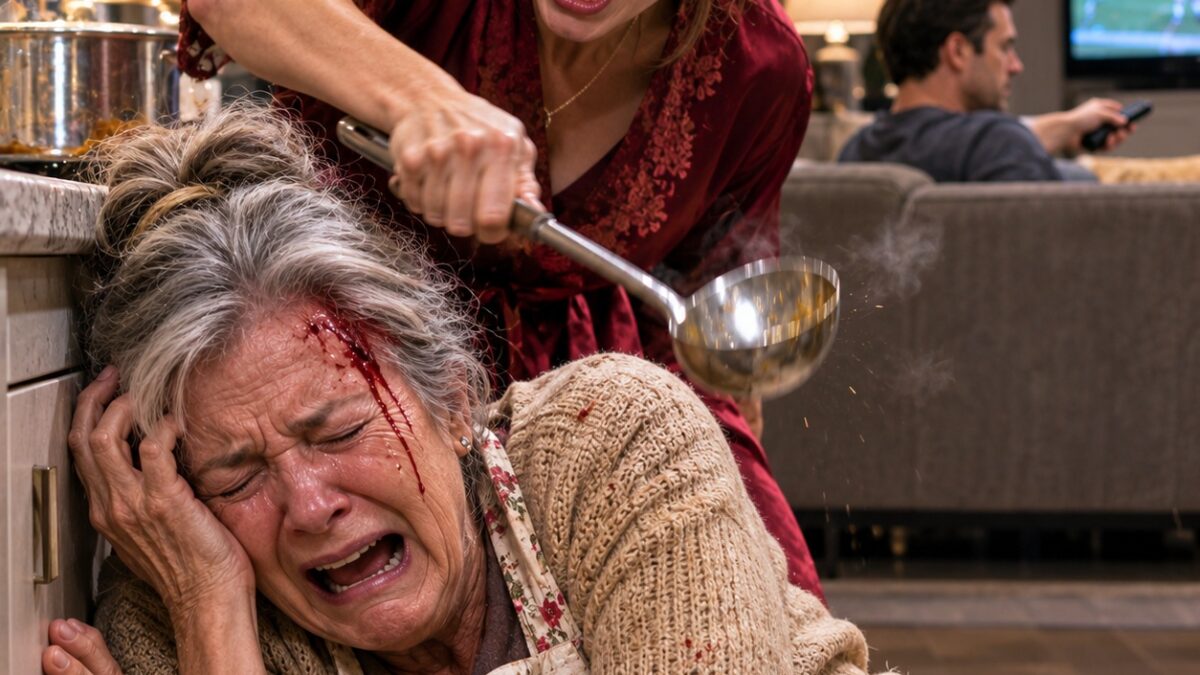
The side of my head burned where the ladle had struck.
Soup ran from my hair onto my blouse.
Dawn stared at me with both hands on her hips.
Not shocked.
Not ashamed.
Annoyed.
As though I had somehow inconvenienced her by being hurt.
“You’re pathetic,” she said.
I said nothing.
“Look at this mess.”
The ladle had fallen onto the floor.
Broth dotted the cabinets.
A carrot slice was stuck near the baseboard.
Dawn pointed toward it.
“You can’t even make soup without destroying the kitchen.”
I stared toward the living room.
The television was louder now.
Some game show.
Applause.
Laughter.
Artificial happiness pouring through the doorway.
Robert knew.
I whispered his name.
“Robert.”
No answer.
Dawn laughed.
“He’s tired of your drama too.”
Something snapped.
Not rage exactly.
Not insanity.
Clarity.
I looked at the pot.
Hours of work.
The soup Robert had loved since he was eight.
I lifted it.
Dawn’s eyes widened.
“What are you doing?”
I carried it to the sink.
Then poured every drop down the drain.
The soup disappeared in a rush of steam.
Dawn gasped.
“Are you crazy?”
I picked up another pot.
Dropped it.
Metal crashed against tile.
A plate slipped from the drying rack.
It shattered.
Then another.
A cup.
A bowl.
I wasn’t throwing things at Dawn.
I wasn’t trying to hurt anyone.
I was destroying the evidence of months spent earning a place in a house where my own son had decided I did not deserve protection.
The kitchen filled with noise.
Finally, Robert came running.
“What happened?”
He stopped in the doorway.
I was standing among broken dishes.
There was blood at my temple.
Soup dripped down my neck.
Robert stared at me.
Then he said the sentence that told me more about him than anything else.
“Mom, what did you do?”
Not:
Are you hurt?
Not:
Why are you bleeding?
Not:
What happened?
What did you do?
Dawn appeared behind him.
“She’s lost her mind.”
Robert looked from the broken dishes to me.
“Mom.”
“Your wife hit me.”
He blinked.
“What?”
“She hit me with a hot ladle.”
Dawn scoffed.
“Oh, please.”
I pointed toward my head.
“You saw nothing?”
Robert looked toward the floor.
“I didn’t hear it.”
My heart stopped.
I laughed once.
It sounded ugly.
“You turned up the television.”
“I didn’t know what was happening.”
“Liar.”
Dawn stepped forward.
“Do not call my husband a liar in my house.”
I looked at her.
Then at Robert.
“Your house.”
Something in my tone made him flinch.
Dawn crossed her arms.
“I am done.”
She looked at Robert.
“Either she goes or I do.”
Silence.
If you have never stood in a room waiting for your child to choose whether you matter, I hope you never do.
Robert stared at the floor.
I waited.
I thought of the boy who used to crawl into my bed during thunderstorms.
The teenager who called me from college because he had the flu.
The young man who cried into my shoulder when Henry died.
Surely that boy was still in there.
Surely he would look at my bleeding temple and remember I was his mother.
He did look.
Then he said:
“I think it’s better if you leave.”
I could not breathe.
Dawn smiled.
Very slightly.
“You’re throwing me out?”
“It’s not like that.”
“Your wife hit me.”
“Mom.”
“And you’re throwing me out.”
“We need space.”
He rubbed his forehead.
“You need independence too.”
Independence.
At seventy-one.
Six months after burying my husband.
After he had begged me to move in.
“It’ll be better for everyone.”
I stared at him.
“When?”
He hesitated.
“Tomorrow.”
Dawn spoke immediately.
“Morning.”
Robert nodded.
“I’ll call you a cab.”
I almost laughed.
A cab.
My son was removing me from his life like old furniture.
“I’ll help with a hotel.”
He still would not look at me.
That night, I packed.
Four suitcases.
Again.
Henry’s photographs went in last.
I sat on the edge of the bed holding one.
In it, he was forty-nine.
Smiling.
Sunburned.
Standing beside me at the beach.
“What did I do wrong?” I whispered.
Of course the photograph did not answer.
At dawn, a taxi horn sounded.
Robert waited near the front door.
He held two hundred dollars.
“For the hotel.”
I looked at the bills.
Then at him.
“You think two hundred dollars is enough?”
His face tightened.
“It’s just until you figure something out.”
“You told me to move here.”
“I know.”
“You told me not to live alone.”
“I know.”
“You said I was family.”
“Mom, please.”
I took the money.
Not because I wanted it.
Because I had nowhere else to go.
Robert did not hug me.
I did not say goodbye.
The taxi pulled away.
I watched him disappear in the rear window.
That was the last time I saw my son for months.
The driver asked where I wanted to go.
I had no answer.
“Somewhere cheap.”
He took me to a motel outside downtown Los Angeles.
Thirty dollars a night.
The sign buzzed red outside my window.
The room smelled like damp carpet and bleach.
I sat on the bed.
Then I cried.
Not quietly.
Not politely.
I cried with my whole body.
For Henry.
For Robert.
For myself.
For every breakfast I had cooked.
Every shirt folded.
Every insult swallowed.
I cried because I had spent months trying not to be a burden and discovered I had been treated like one anyway.
Eventually I looked in the bathroom mirror.
Purple swelling spread across my temple.
I touched it.
The physical bruise almost comforted me.
At least that pain had a shape.
The other one did not.
I stretched the two hundred dollars as long as I could.
Cheap food.
No taxis.
No extras.
I messaged Robert.
Son, we need to talk.
Read.
No response.
A day later:
I’m running low on money.
Read.
Nothing.
Finally:
Robert, please call me.
Read.
Silence.
One week later, the money was gone.
The motel clerk knocked.
“Ma’am, I need payment.”
“I can pay tomorrow.”
“I’m sorry.”
“I’m seventy-one.”
He looked uncomfortable.
“I understand.”
“I have nowhere to go.”
“I’m sorry.”
He meant it.
But rules were rules.
I packed again.
Four suitcases.
They felt heavier each time.
I walked until my feet blistered.
Eventually I reached a park.
Children played near swings.
Families ate lunch.
A young mother saw me and pulled her daughter slightly closer.
I understood.
I looked homeless.
Because I was.
That first night, I slept on a bench.
Or tried.
Every noise woke me.
Men argued near the sidewalk.
A car backfired.
Sirens passed.
I held my purse against my chest.
One man approached.
Dirty coat.
Gray beard.
He handed me stale bread.
“Eat.”
I stared.
“You need it more than me tonight.”
My eyes filled.
“Thank you.”
He shrugged.
“Be careful, Grandma.”
Then walked away.
A stranger living on the street showed me more tenderness than my son had.
That thought almost destroyed me.
The days blurred.
Church soup lines.
Public bathrooms.
Vending machines.
Trash bins behind restaurants.
Hunger changes shame.
The first time I picked food from a garbage bag, I cried.
The third time, I checked expiration dates.
Survival teaches quickly.
Weeks passed.
I stopped knowing exactly how many.
My clothes became dirty.
My hair greasy.
People stopped looking at me.
I became invisible.
Then one afternoon, searching through my suitcase for a cleaner blouse, I found an envelope.
Old.
Yellow.
My name in Henry’s handwriting.
Helen.
My heart stopped.
I sat on the park bench.
My fingers shook.
Inside was a letter.
And documents.
I began reading.
My dearest Helen.
I heard his voice immediately.
If you’re reading this, I’m probably no longer there to explain.
Tears filled my eyes.
Henry wrote that he had made investments over thirty years.
Small properties at first.
Then larger ones.
He had bought buildings in neighborhoods people ignored.
Held them.
Refinanced carefully.
Invested rental income.
Purchased stocks.
Saved.
Planned.
He had never told me the full extent.
He thought he was protecting me from financial stress.
I almost laughed.
Even dead, Henry was still trying to protect me in ways that kept me ignorant.
Then I unfolded the deeds.
One property.
Then another.
Another.
Thirteen.
I counted again.
Thirteen properties.
Apartment buildings.
Commercial units.
Investment certificates.
Bank accounts.
Then I saw an address.
452 Magnolia Street.
My breath stopped.
I read it again.
452 Magnolia.
Robert’s building.
The place Dawn had hit me.
The place Robert had expelled me from.
I looked at the ownership line.
Helen Salazar.
My hands began shaking.
The building was mine.
Not Robert’s.
Not Dawn’s.
Mine.
Henry’s letter continued.
Contact Roger Mendes.
A phone number followed.
He has the originals.
Then:
Helen, never let anyone make you feel smaller than you are.
I covered my mouth.
You are capable.
You are strong.
Defend yourself.
I started crying.
Then laughing.
People walking past stared.
I must have looked insane.
A filthy old woman laughing on a park bench while holding paperwork worth millions.
I found a public phone.
Dialed.
“Mendes and Associates.”
“I need Roger Mendes.”
“May I ask who’s calling?”
“Helen Salazar.”
Silence.
“Mrs. Salazar?”
“Yes.”
“We’ve been trying to find you for months.”
My knees weakened.
“What?”
“Where are you?”
I gave the park name.
“Stay there.”
Thirty minutes later, a black sedan pulled up.
A driver stepped out.
“Mrs. Salazar?”
“Yes.”
He loaded my suitcases without reacting to my appearance.
That dignity almost made me cry again.
Roger Mendes was in his fifties.
Gray hair.
Thin glasses.
Measured voice.
When he saw me, surprise crossed his face.
Then disappeared.
“Mrs. Salazar.”
“Water.”
He poured it himself.
I drank too fast.
“We have been trying to contact you since Henry passed.”
“My son said I moved.”
“Yes.”
“Did he give you an address?”
“No.”
I laughed bitterly.
“He kicked me out three weeks ago.”
Roger’s expression changed.
“I’ve been sleeping outside.”
That silenced him.
Then he opened a folder.
“Mrs. Salazar, your financial situation is extremely secure.”
“How secure?”
He turned the documents toward me.
“Thirteen properties.”
“Yes.”
“Current estimated value approximately eight million dollars.”
I stared.
“Investments and securities worth about two million.”
I could hear my pulse.
“Cash accounts totaling roughly five hundred thousand.”
I whispered:
“Ten million?”
“Approximately.”
I thought about the stale bread.
The church soup.
The park bench.
Ten million dollars.
Roger continued.
“The properties produce significant rental income.”
I laughed.
Not happily.
“I was eating garbage.”
Roger lowered his eyes.
“I’m sorry.”
Then he turned a page.
“One property is 452 Magnolia Street.”
“My son’s building.”
“Yes.”
“Apartment 301.”
Roger nodded.
“They occupy it under a deeply discounted lease your husband granted five years ago.”
“How much?”
“Four hundred a month.”
I thought I had misheard.
“What is market rent?”
“Approximately twenty-five hundred.”
I sat back.
Robert paid four hundred dollars.
Four hundred.
Then had given me two hundred dollars and sent me to a motel.
Something cold entered me.
“Can I change the rent?”
Roger studied me.
“You are the owner.”
“I want market rate.”
“That requires notice.”
“Give it.”
“Mrs. Salazar—”
“Properly.”
I leaned forward.
“Legally.”
I wanted no shortcuts.
No illegal eviction.
No cruelty he could use to make himself the victim.
“Raise it to market.”
Roger nodded.
Then his voice softened.
“Before any of that, we need to address your housing.”
“I have somewhere?”
He almost smiled.
“Several places.”
I looked at him.
That sentence changed something in me.
Several places.
Twenty-four hours earlier I had nowhere to sleep.
Now I had choices.
Roger booked a hotel suite from my account.
He gave me a bank card.
“Fifty thousand available immediately.”
I held it.
Then he opened a drawer.
“One more thing.”
Another envelope.
Henry’s handwriting.
I opened it.
My love.
If Roger gives you this, it means life has hurt you enough that you finally asked for help.
I laughed through tears.
He knew me.
I built this for you.
Not Robert.
Not anyone else.
You.
Then:
Don’t let even our own blood make you small.
And finally:
You’re a giant, Helen.
Now prove it.
I pressed the paper against my chest.
Roger looked away.
That night, I slept in a real bed.
But first I took a bath.
The water turned gray from weeks outside.
I washed my hair three times.
Scrubbed my skin.
Then ordered soup.
Fresh bread.
Chicken.
Salad.
Dessert.
I ate slowly.
Not because it was expensive.
Because it was mine.
Paid with money that had been mine while I was begging strangers.
The strangest part was not discovering I had wealth.
It was discovering how little wealth had to do with dignity.
The man who offered me stale bread had dignity.
Dawn in her expensive house did not.
For the next two weeks, Roger showed me my life.
Not my old life.
The life Henry had hidden inside paperwork.
Apartment buildings.
Commercial spaces.
A small shopping center.
Bank accounts.
Investments.
Rental reports.
Maintenance contracts.
Taxes.
Insurance.
I took notes.
Asked questions.
Roger explained.
“You learn quickly.”
“I spent fifty years running a household.”
He smiled.
“That’s management.”
“Apparently.”
My properties produced around forty-five thousand dollars per month gross.
After costs and taxes, hundreds of thousands annually.
I kept thinking the same thing.
I had been homeless.
But gradually, anger changed into something more useful.
Competence.
I wanted to understand.
Not be protected.
Not be handed money.
Understand.
That realization even changed how I thought about Henry.
He had loved me.
Deeply.
But he had made the same mistake Robert later made in a different form.
He had decided what I needed without giving me power over the decision.
His intentions were loving.
The result had still left me vulnerable.
I would never again allow someone else to manage my life while I remained ignorant.
I created a holding company.
Mendoza Enterprises.
Legal.
Private.
My ownership concealed from tenants.
I wanted to operate without Robert immediately knowing.
The Magnolia Street leases were reviewed.
Special discounts were eliminated where legally appropriate.
Everyone received proper notices.
Not just Robert.
That mattered.
If I had targeted only him with a fake rent increase, I would have become what Dawn accused me of being.
Vindictive.
I wanted fairness.
Robert’s new rent became twenty-five hundred dollars.
He called Roger’s office seven times.
“This is a mistake.”
“No.”
“My father gave me a special rate.”
“That arrangement ended.”
“I need to speak to the owner.”
“The owner is unavailable.”
I listened to updates.
Robert struggled.
Then I learned more.
His salary was respectable.
But Dawn’s spending was enormous.
Credit cards.
Loans.
Restaurants.
Designer clothes.
A financed car.
Appearance funded by debt.
I should have felt vindicated.
Mostly I felt sad.
Then I made a decision I later questioned.
Dawn’s largest consulting client rented space in one of my commercial properties.
Their rent was below market.
I raised it within legal limits.
They stayed.
Cut expenses.
One of the first contracts they eliminated was Dawn’s.
When Roger told me, I felt satisfaction.
That frightened me.
Justice can become revenge quietly.
I wrote that sentence in my notebook later.
Be careful who you become while correcting what was done to you.
It mattered.
Because I did not want Dawn to turn me into Dawn.
Robert fell behind on rent.
Two months.
Six thousand two hundred with fees.
He borrowed at thirty-two percent interest to catch up.
A terrible decision.
Then missed the next payment.
I instructed Roger to begin eviction.
Everything by the book.
Notice.
Documentation.
Court.
No tricks.
No humiliation.
Just consequences.
I hired an investigator.
Not because I wanted gossip.
Because part of me still needed to understand my son.
The report was heartbreaking.
Robert and Dawn fought constantly.
She blamed him for money.
He blamed her spending.
Robert’s job performance declined.
Debt increased.
Their marriage became a battlefield.
The mother in me wanted to intervene.
Call him.
Pay everything.
Fix it.
Then I remembered the television.
The volume rising.
That sound became my boundary.
Robert had to experience adulthood without me absorbing the cost.
The eviction hearing came.
I attended anonymously.
Dark suit.
New glasses.
Hair cut.
I barely looked like the woman Robert had expelled.
He came with Dawn.
He had lost weight.
She looked flawless.
Their lawyer argued.
Roger answered.
The judge reviewed the lease.
Robert admitted he could not pay.
Judgment went against him.
Ten days to vacate.
Dawn exploded.
“This is unfair!”
The judge barely looked up.
Robert stood silently.
Defeated.
They passed within feet of me.
Neither recognized me.
I expected triumph.
Instead, emptiness.
Roger met me afterward.
“You won.”
“Did I?”
“You enforced a legal agreement.”
“That isn’t what I meant.”
He understood.
Then he gave me another tenant’s letter.
Martha Gomez.
Single mother.
Two children.
Night-shift nurse.
Perfect payment history.
She asked if her increase could be phased in.
I read it twice.
“Approve it.”
Roger looked surprised.
“Six months?”
“Yes.”
“And consider keeping her below market if she continues paying.”
He smiled.
“That is generous.”
“No.”
I shook my head.
“It’s discrimination.”
He frowned.
“Between what?”
“Struggle and entitlement.”
Martha was not demanding that someone else carry her.
She was asking for time.
Robert had been handed years of favor and treated it as permanent ownership.
There was a difference.
I needed to remember it.
Dawn left Robert before the final eviction date.
Two suitcases.
Taxi.
Gone.
Robert lost his job.
He had forty thousand dollars of debt.
Two days before he had to leave, Roger called.
“Robert wants to meet the owner.”
I froze.
“What does he know?”
“Nothing.”
“What does he want?”
“To explain.”
I thought for a long time.
“Set it up.”
“Here?”
“Yes.”
“He’ll discover who you are.”
“I know.”
The next day, I sat behind Roger’s desk.
Charcoal pantsuit.
Cream blouse.
Hair styled.
Not costume.
Armor.
At three, Robert entered.
He stopped.
“Mom?”
I kept my voice level.
“Sit down.”
He stared.
“What are you doing here?”
“Sit.”
He did.
“Where have you been?”
I almost laughed.
“You never called.”
“I did.”
“No.”
I leaned forward.
“I checked.”
His face changed.
“Dawn said—”
“Dawn said.”
I repeated it.
“Robert, when did your wife become the person who decided whether your mother deserved contact?”
He looked down.
Then his eyes moved around the office.
“Why are you here?”
I took a breath.
“I am Mendoza Enterprises.”
Silence.
“What?”
“The Magnolia building.”
His face emptied.
“The twelve other properties.”
He stopped breathing.
“The investments.”
I continued.
“Everything Henry left.”
“It’s mine.”
Robert stood so fast the chair tipped.
“No.”
“Yes.”
“Dad never—”
“He never told me either.”
He stared.
“The building?”
“Mine.”
“Our apartment?”
“My property.”
He looked physically ill.
“Why didn’t you say something?”
And there it was.
The question I had been waiting for.
“So you would have treated me better?”
He froze.
“If you had known I was worth ten million dollars, would Dawn have hit me?”
“Mom—”
“Would you have turned up the television?”
He began crying.
“Would you have thrown me out with two hundred dollars?”
“Stop.”
“No.”
My voice rose for the first time.
“You need to hear this.”
He sank into the chair.
“Respect should not have depended on my bank account.”
He covered his face.
“I was your mother.”
My voice broke.
“That should have been enough.”
Robert sobbed.
“I’m sorry.”
I stood there watching my son cry.
Months earlier, I would have crossed the room.
Held him.
Told him it was okay.
I did not.
“I was a coward.”
His words came muffled.
“I heard Dawn.”
My whole body went still.
“You heard?”
“Yes.”
He lowered his hands.
“I turned the television up.”
Tears rolled down his face.
“Because I knew if I went in there I would have to choose.”
I felt sick.
“And you chose.”
“Yes.”
“Her.”
“Yes.”
His voice was barely audible.
“I thought keeping my marriage peaceful was easier than defending you.”
I closed my eyes.
There.
The truth.
Finally.
“Would you be apologizing if you still thought I was poor?”
Robert looked at me.
His mouth opened.
Closed.
Then:
“I don’t know.”
That honesty hurt.
But I respected it.
“I don’t know what kind of man I became.”
He wiped his face.
“Dawn left.”
“I know.”
He looked surprised.
“I lost my job.”
“I know.”
“Forty thousand in debt.”
“I know.”
“In two days I’ll have nowhere to live.”
He laughed bitterly.
“Exactly like you.”
“No.”
I looked at him.
“Not exactly.”
His eyes lifted.
“You had warnings.”
That landed.
He nodded.
“Are you enjoying this?”
The question stopped me.
“Is this revenge?”
I thought about everything.
The rent.
Dawn’s lost client.
The eviction.
The investigation.
Had revenge been mixed into it?
Yes.
I could admit that now.
But beneath it was something else.
“I wanted justice.”
Robert waited.
“I wanted you to feel what it meant when safety disappeared.”
His face crumpled.
“You succeeded.”
“Did I?”
He looked around.
“No wife.”
“No job.”
“No home.”
“No money.”
He stared at me.
“No dignity.”
I shook my head.
“Dignity isn’t something I can take.”
He looked confused.
“Your choices can damage it.”
“But you rebuild that yourself.”
He lowered his head.
Then I said the hardest thing.
“The eviction stands.”
Robert nodded.
“I understand.”
“You leave.”
“Yes.”
“You do not move into another one of my properties.”
He swallowed.
“Yes.”
“You do not get a check.”
“Yes.”
“You do not get a job from me.”
He looked up.
“I wasn’t asking.”
“Good.”
Silence.
Then:
“Can you tell me what happened to you?”
I hesitated.
“After I left?”
“Yes.”
I told him.
The motel.
The money running out.
The park.
The bread.
Trash bins.
Church soup.
Cold nights.
The shelter being full.
The bruised temple.
The vending machine swallowing my last two dollars.
Robert cried openly.
By the time I finished, he could barely speak.
“I failed you.”
“Yes.”
“Dad would hate me.”
“No.”
I answered immediately.
“He would love you.”
Robert looked up.
“And he would be furious with you.”
A weak laugh escaped him through tears.
“That sounds like Dad.”
“Yes.”
He wiped his face.
“Will you forgive me?”
“I don’t know.”
His expression broke again.
“Forgiveness isn’t a prize you get because you apologized.”
He nodded.
“I need change.”
“I understand.”
“Not change performed for me.”
“Yes.”
“Become someone you respect.”
He swallowed.
“I’ll try.”
I stood.
The meeting was over.
At the door, Robert stopped.
“When I find somewhere…”
I waited.
“Can I call?”
I looked at my son.
“You can try.”
He nodded.
“And I may not answer.”
“I understand.”
“Not until I see actions.”
“Yes.”
He left.
No hug.
No miracle.
Just truth.
Robert moved out one day early.
Three suitcases.
Taxi.
The doorman told Roger he left the apartment spotless.
That detail hurt.
It sounded like the boy I remembered.
I wanted to know where he went.
I did not ask the investigator.
That was important.
I was learning boundaries applied to me too.
The apartment was renovated.
New floors.
Paint.
Appliances.
It rented quickly at market rate.
Then I left the hotel.
I chose a small house from my portfolio.
Two bedrooms.
Big kitchen windows.
South-facing garden.
I decorated it myself.
Henry’s photographs went in the living room.
But not everywhere.
I left blank walls.
Space for a future.
I planted roses.
Tomatoes.
Herbs.
I enrolled in painting classes.
My first paintings were terrible.
Henry would have teased me.
I kept going.
I volunteered at the shelter that had once been full when I needed a bed.
Twice a week, I served soup.
One afternoon, I recognized the man from the park.
The one who gave me bread.
He looked cleaner.
Healthier.
“Grandma?”
I smiled.
“It’s me.”
“You look different.”
“I am.”
He laughed.
“What happened?”
“I found myself.”
He nodded like that made perfect sense.
Maybe to people who have lost everything, it does.
Three months passed.
No Robert.
Then my phone rang.
Unknown number.
I almost ignored it.
“Hello?”
“Mom.”
My heart changed rhythm.
“Robert.”
“I know you said you might not answer.”
“I remember.”
“I’m not calling for money.”
I waited.
“I found a studio.”
“Where?”
“Across town.”
“How?”
“I work nights in a warehouse.”
I sat down.
“Warehouse?”
“Loading.”
His voice sounded embarrassed.
Then steadier.
“It’s honest.”
“Yes.”
“I pay my own rent.”
“That’s good.”
“I’m paying debt.”
“Good.”
“I started therapy.”
That surprised me.
“Why?”
“To understand why I did what I did.”
I looked toward the garden.
He continued.
“I kept blaming Dawn.”
“But she didn’t turn up the television.”
“No.”
“She didn’t make me abandon you.”
“No.”
“I did that.”
His voice cracked.
“I’m trying to understand why.”
I breathed slowly.
“That matters.”
Silence.
Then:
“Could we have coffee someday?”
I closed my eyes.
“Not now.”
“I know.”
“Someday.”
His breath released.
“Really?”
“When we’re both ready.”
“Okay.”
He was quiet.
“I can wait.”
A pause.
“I love you.”
That sentence hurt differently now.
“I know.”
I whispered it.
Then hung up.
I did not say I loved him back.
Not because I didn’t.
Because I wanted those words to belong to honesty again.
Months later, I agreed to coffee.
A small place.
Neutral.
Robert arrived early.
He looked thinner.
Simple clothes.
No expensive watch.
He stood when I walked in.
“Mom.”
“Robert.”
He hesitated.
Then asked:
“Can I hug you?”
That question mattered.
Permission.
Something he had once stopped believing other people needed.
“Yes.”
He hugged me.
Carefully.
I hugged him back.
We sat.
No grand apology.
He had already given those.
Instead, he told me about work.
Therapy.
Debt.
Learning to cook.
He had burned rice twice.
I laughed.
“Your father burned rice for thirty years.”
Robert smiled.
“He blamed the pot.”
“Always.”
For a few minutes, Henry was between us in the best way.
Then Robert became serious.
“Dawn contacted me.”
I waited.
“She wants to try again.”
“What do you want?”
“I said no.”
“Because of me?”
“No.”
He shook his head.
“Because of me.”
That answer made me proud.
“I spent years letting the loudest person decide what I believed.”
He looked at me.
“I need to figure out who I am before I ever marry anyone again.”
I nodded.
“That sounds wise.”
He almost smiled.
“Therapy.”
“Worth the money.”
“Apparently.”
Then:
“I don’t expect inheritance.”
I became still.
“I know I probably won’t get anything.”
“Robert.”
“Please.”
He lifted a hand.
“I need to say it.”
I waited.
“If you leave everything to charity, I understand.”
“If you sell everything, I understand.”
“If you spend every dollar traveling, I understand.”
His eyes filled.
“It was never mine.”
Those words mattered.
Not because I had decided what my estate would become.
I had not.
But because he finally understood ownership and love were different things.
“I don’t know what I’ll do with it.”
I said.
“You shouldn’t.”
He smiled.
“You’re alive.”
I smiled too.
“Yes.”
“I finally understand that.”
I eventually moved part of my holdings into a professionally managed trust.
Not to hide.
To organize.
Some rental income went toward my living expenses.
Some toward reserves.
And a substantial portion went into a housing assistance fund for older women facing homelessness.
Especially widows.
Women who had spent their lives raising families and then discovered too late that they controlled nothing.
I knew that fear.
One evening, Roger asked:
“Why this cause?”
I looked at him.
“Because one week without information nearly killed me.”
He nodded.
“Money saved you.”
“No.”
I thought about the man with the stale bread.
“The letter saved me.”
“Knowledge saved me.”
“Money gave the knowledge force.”
That distinction mattered.
I also began teaching informal workshops at the shelter.
Basic estate planning.
Emergency documents.
Know whose name is on the deed.
Know your accounts.
Know where the originals are stored.
Know the lawyer’s number.
Know the passwords.
Do not let love become ignorance.
I told women:
“Being cared for is not the same as being powerless.”
That lesson had taken me seventy-one years.
I wanted someone else to learn it earlier.
Robert kept working.
The warehouse promoted him to shift supervisor.
He paid down debt.
He moved to a slightly better apartment.
Still modest.
He sent me pictures sometimes.
A used couch.
A small table.
A plant.
Never asking for money.
One Christmas, a year after the ladle, he called.
“Mom.”
“Yes?”
“Are you doing dinner?”
“I am.”
A pause.
“Can I come?”
I looked at Henry’s photograph.
“Just you.”
Robert understood.
“Yes.”
No Dawn.
No demands.
No drama.
He arrived holding groceries.
“I thought I’d help.”
“You know how?”
“No.”
“Excellent.”
We cooked together.
Vegetable soup.
The same recipe.
That was intentional.
Robert chopped carrots.
I handled the seasoning.
At one point, I handed him the ladle.
He froze.
So did I.
The room became very quiet.
Then Robert set it down.
“Mom.”
“Yes?”
“I know I’ve apologized.”
“You have.”
“But I need to say something about that day.”
I waited.
“I heard her hit you.”
My throat tightened.
“I know.”
“I knew.”
He stared at the counter.
“And I thought if I turned the TV louder, I could make it not my responsibility.”
Tears filled his eyes.
“I have thought about that sound every day.”
“So have I.”
He nodded.
“I’m sorry.”
I looked at my son.
“Are you still doing therapy?”
“Yes.”
“Keep going.”
He laughed through tears.
“I will.”
Then I picked up the ladle.
Tasted the soup.
“Needs pepper.”
Robert laughed.
A real laugh.
It startled both of us.
We ate at my small dining table.
No expensive china.
No performance.
Just soup.
Bread.
Two people trying to build something after breaking it.
I did not call it forgiveness.
Not yet.
Maybe I never would fully.
But it was movement.
And sometimes movement is enough.
Years passed.
I never became the woman who pretended none of it happened.
The scar near my temple faded.
The memory did not.
Dawn never returned to my life.
Robert eventually told me she remarried.
I wished her nothing.
Not good.
Not bad.
Nothing.
That was peace.
Robert changed careers eventually.
He became operations manager for a distribution company.
Steady salary.
Benefits.
He bought a small condo with his own money.
The day he closed, he called me.
“I did it.”
“What?”
“I bought something.”
I smiled.
“What?”
“A condo.”
My eyes filled.
“Robert.”
“Nothing fancy.”
“That isn’t the point.”
“I know.”
He laughed.
“I finally know.”
He invited me over after he moved in.
I went.
Two bedrooms.
Small balcony.
Secondhand furniture.
Clean kitchen.
He gave me a tour.
Then stopped near the window.
“This is mine.”
He said it with wonder.
Not arrogance.
Not entitlement.
Pride.
Earned pride.
I hugged him.
“I’m proud of you.”
He cried.
So did I.
We did not talk about Magnolia Street.
We did not need to.
He had built something without waiting for anyone to leave it to him.
That was more important.
My properties remained profitable.
I sold three.
Kept ten.
Diversified investments.
Roger eventually retired.
I attended the party.
He gave a speech about difficult clients.
I told everyone he meant me.
He denied it.
Nobody believed him.
The housing fund grew.
We helped dozens of older women.
One of them, Maria, reminded me of myself.
Seventy-four.
Widowed.
Son controlled her bank account.
She had no idea what she owned.
When we helped her discover that her husband had left retirement assets in her name, she cried in my office.
“I feel stupid.”
I took her hand.
“You are not stupid.”
“How did I not know?”
“Because people told women like us that being protected meant not asking questions.”
She looked at me.
“Is that what happened to you?”
“Yes.”
“What did you do?”
I smiled.
“I started asking.”
That became the foundation’s motto in my mind.
Ask.
Whose name is on the deed?
Whose name is on the bank account?
What does the will say?
Where are the documents?
Who controls access?
What happens if someone dies?
What happens if someone betrays you?
Questions are not distrust.
Sometimes they are survival.
One spring morning, years after everything changed, I stood in my garden watering roses.
The same flowers Henry had been watering when he died.
I had planted them deliberately.
Not to recreate the old house.
To carry something forward.
Robert arrived carrying coffee.
He no longer walked into my home without knocking.
He knocked.
Always.
I opened the door.
“Morning.”
“Morning.”
He held up the cups.
“Peace offering.”
“For what?”
“I bought the wrong kind.”
I looked.
“Hazelnut?”
“Yes.”
“You know I hate hazelnut.”
“I know.”
“Then why?”
“It was all they had.”
“Leave.”
He laughed.
So did I.
That kind of joke would once have hurt.
Now it was safe.
That mattered.
We sat on the deck.
Robert looked toward the roses.
“Dad would like this place.”
“Yes.”
“He’d complain about your tomato spacing.”
“Obviously.”
We drank coffee.
Then Robert said:
“Mom.”
“Yes?”
“Are you happy?”
I thought about the question.
The park bench.
The motel.
The ladle.
The office.
The first time I looked at a financial report and understood it.
Painting class.
The shelter.
The foundation.
Robert’s condo.
My garden.
“I’m peaceful.”
He smiled.
“You always say that.”
“Because happiness changes.”
“And peace?”
“Stays longer.”
He nodded.
After a while, he asked:
“Do you regret what you did to me?”
“The eviction?”
“Yes.”
“No.”
He absorbed that.
“Not even a little?”
“I regret that it became necessary.”
He looked at me.
“But I do not regret refusing to rescue you.”
“That hurt.”
“I know.”
“I thought you hated me.”
“I didn’t.”
“I hated myself enough for both of us.”
I looked at him.
“I know.”
Then he said:
“I think you saved me.”
I shook my head.
“No.”
“I think you did.”
“No, Robert.”
I put down my coffee.
“I stopped saving you.”
He went quiet.
“There’s a difference.”
I continued.
“You saved yourself after I got out of the way.”
He stared at the garden.
Then nodded.
“That sounds like something Dad would say.”
“It does.”
We sat in silence.
Good silence.
Not the silence of fear.
Not the silence of a television turned louder so a son would not have to hear his mother being hurt.
A different kind.
The kind two people can share when nothing needs to be hidden.
I am older now.
My hair is gray again.
I stopped dyeing it.
I earned every strand.
The scar at my temple is barely visible.
Sometimes I touch it without thinking.
Not because I miss the pain.
Because scars are records.
They prove something happened.
They also prove you survived it.
I still cook soup.
The vegetable recipe Robert loved.
I season it exactly the same way.
No one has ever complained.
Robert visits.
He brings bread.
Sometimes groceries.
Never because I need them.
Because he wants to contribute.
He washes dishes.
That part took seventy years for me to appreciate.
I used to believe motherhood meant making everything easier for your child.
Then I believed it meant sacrifice.
Then forgiveness.
Then endless giving.
Now I think motherhood is something simpler and harder.
Love your child.
Tell the truth.
Do not confuse help with enabling.
Do not confuse silence with peace.
Do not confuse money with worth.
Do not let another adult’s comfort require your disappearance.
And never teach someone that abusing you has no consequence just because you share blood.
Robert is still my son.
That never changed.
But I am no longer only his mother.
I am Helen Salazar.
A widow.
A property owner.
A painter of mediocre landscapes that occasionally become decent.
A volunteer.
A woman who learned personal finance at seventy-one.
A woman who slept on a park bench.
A woman who ate stale bread given to her by a stranger.
A woman who discovered thirteen properties in a yellow envelope.
A woman who had millions and still had to learn the difference between being wealthy and having power over her own life.
A woman who finally understood Henry’s last message.
You’re a giant.
For most of my life, I would have laughed at that.
Giants do not fold laundry.
Giants do not wash dishes.
Giants do not quietly season soup.
But maybe I misunderstood strength.
Strength is not being loud.
It is not having money.
It is not winning court cases.
It is not making someone who hurt you suffer.
Strength is being able to look at a person you love and say:
You may not treat me this way.
Then mean it.
Strength is letting consequences happen when rescuing someone would only make them worse.
Strength is admitting when justice begins turning into revenge and choosing not to become cruel.
Strength is rebuilding your own identity after decades of defining yourself through other people.
And strength is understanding that forgiveness—if it comes—does not erase the boundary that made healing possible.
I never forgot the sound of the television getting louder.
For years, I thought that sound represented the moment I lost my son.
I was wrong.
It was the moment I finally stopped losing myself.
Everything afterward came from that.
The motel.
The park.
Henry’s letter.
Roger.
The buildings.
The eviction.
The confrontation.
Robert’s warehouse job.
Therapy.
Coffee.
His condo.
My garden.
The shelter.
All of it.
One terrible sound.
Then a different life.
Sometimes I wonder what would have happened if Dawn had never hit me.
Maybe I would have continued waking at six.
Cooking.
Cleaning.
Being criticized.
Robert would have continued looking away.
I might have died in that guest room thinking I had become useless.
Thinking my value had ended when Henry died.
Thinking love required me to accept whatever scraps my son offered.
That possibility frightens me more than anything Dawn ever did.
Because sometimes the deepest danger in a family is not hatred.
It is gradual disappearance.
A little insult ignored.
A boundary moved.
A voice lowered.
A need dismissed.
A bruise explained away.
Until one day you are standing in someone else’s kitchen wondering how you became a guest in your own life.
I will never do that again.
Robert knows it.
Everyone does.
When he comes to my door now, he knocks.
When he enters my kitchen, he asks whether I need help.
When I say no, he hears no.
When I say yes, he stays.
And occasionally, when I place the soup on the table, Robert looks at the ladle.
Then at me.
There is sadness in his eyes.
But there is also gratitude.
Not because I forgot.
Because I didn’t.
Because remembering is part of why neither of us will ever become those people again.
I survived Dawn’s cruelty.
I survived my son’s cowardice.
I survived homelessness.
I survived discovering that the man I loved had protected me so completely that he had left me ignorant.
I survived becoming wealthy overnight and learning that money did not automatically heal humiliation.
I survived the temptation to turn pain into vengeance.
And eventually, I found something far more valuable than the ten million dollars Henry left me.
I found authority over my own life.
No one can inherit that from you.
No lawyer can write it into a deed.
No spouse can hide it in an envelope.
No child can give it back after taking it away.
You have to claim it yourself.
I wish I had learned that at forty.
Or fifty.
Or sixty.
But I learned it at seventy-one.
That still counts.
And every morning when I step into my kitchen, open the window over the herbs, and hear the birds outside my garden, I remember the woman who once believed she had nowhere to go.
I wish I could sit beside her on that park bench.
I wish I could take her dirty hand.
Give her a bowl of hot soup.
And tell her:
Helen, you are not finished.
Your son’s cruelty is not the final chapter.
Your husband’s death is not the end of your identity.
Your age is not a sentence.
Your poverty is not real.
Your humiliation is not permanent.
And even if you owned nothing at all—even if Henry had left no properties, no investments, no secret money—you would still deserve to stand up and say:
Enough.
Because the greatest thing I discovered was never hidden in Henry’s papers.
It was hidden in me.
The documents only gave me the chance to see it.
And now, when Robert sits across from me at dinner in the little home I chose for myself, when he tells me about work, therapy, bills, plans, mistakes, victories, I sometimes look at him and remember the stranger who once stood in that kitchen and asked:
“Mom, what did you do?”
Today I know the answer.
I stopped disappearing.


