FULL STORY:My 40-Year-Old Son Threw Ice Water in My Face at Christmas Dinner While My Family Watched—But 48 Hours Later, I Found Something in My Late Husband’s Desk That Changed EVERYTHING
FULL STORY CONTINUATION
I didn’t scream.
That’s the part people always find strange when I tell them what happened.
They expect rage.
A slapped face.
A shouted curse.
A mother lunging across the Christmas table at the forty-year-old son who had just humiliated her in front of the entire family.
But I did none of those things.
I sat there.
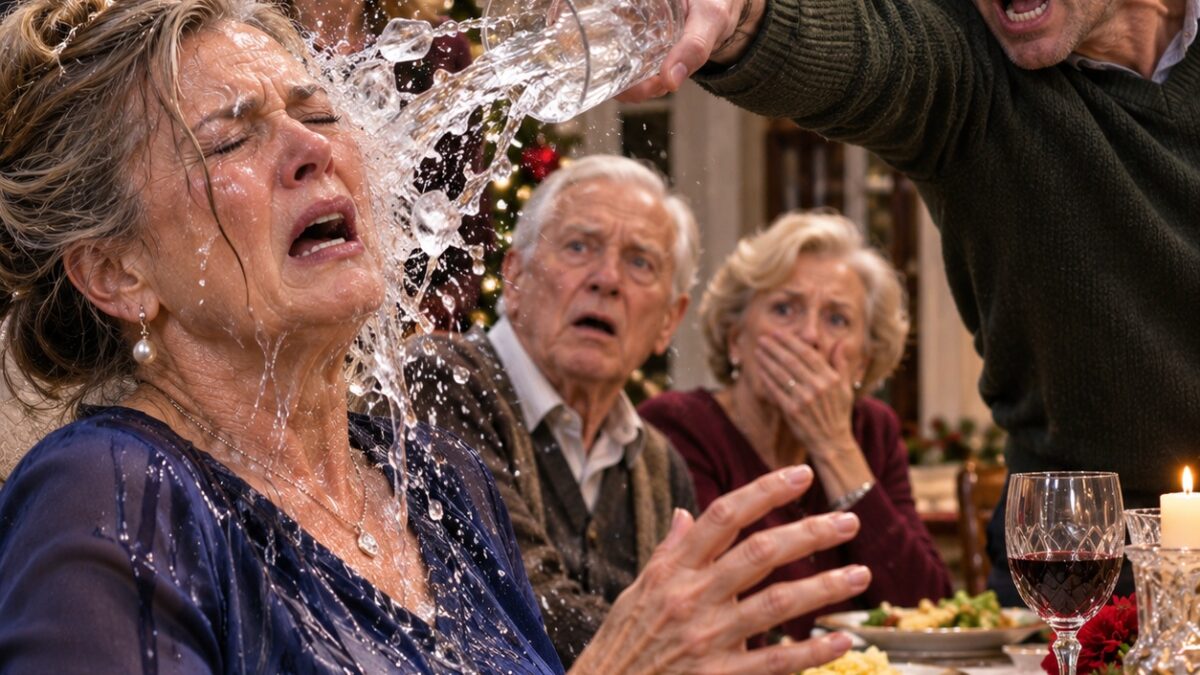
Water ran from my forehead into my eyes.
A small cube of ice had landed beside my dinner plate and was already beginning to melt.
My blue blouse clung cold against my collarbone.
For a few seconds, the only sound in the room was the faint crackle from the fireplace.
Nathan was breathing hard.
I could see something moving behind his eyes.
Not regret exactly.
Recognition.
Some part of him understood that he had crossed a line that could not be uncrossed.
But another part—the angry, entitled part that had been growing louder for months—was still waiting for me to fight back.
I reached for my napkin.
I wiped my face.
Then my neck.
Then the table in front of me.
I folded the napkin carefully.
Set it beside my plate.
And looked directly at my son.
Before I could speak, James stood.
He didn’t raise his voice.
He didn’t slam his hands against the table.
James has never needed volume to make himself understood.
“Get out.”
Nathan looked at him.
“What?”
“Get out of this house.”
Nathan gave a short disbelieving laugh.
“This isn’t your—”
“Do not finish that sentence.”
James’s voice stayed quiet.
That made it worse.
Nathan looked around the table again.
My father had put his fork down.
I had never seen that expression on his face before.
He wasn’t angry.
Anger would have been easier.
He looked heartbroken.
My mother sat with both hands folded in her lap, tears gathering in her eyes.
Rebecca had one hand over her mouth.
Lauren looked as pale as the tablecloth.
Nathan pushed his chair backward.
“You’re seriously throwing me out over water?”
Nobody answered.
He turned to me.
“Mom?”
I looked at him.
It would have been so easy.
That was the danger.
I could have said, Sit down.
I could have said, Everyone is emotional.
I could have saved him from the thing he had just done.
I had been doing some version of that for forty years.
Instead, I said:
“James asked you to leave.”
Nathan’s face hardened.
“I asked you.”
“I heard you.”
“And?”
I took another napkin and pressed it against my hair.
“And I agree.”
Lauren slowly stood.
“Nathan.”
He looked at her.
“Let’s go.”
For a second, he looked almost betrayed by her too.
Then he shoved his chair under the table harder than necessary.
He walked toward the hallway.
Lauren followed.
The front door opened.
Then closed.
And they were gone.
No one spoke for perhaps twenty seconds.
James sat beside me again.
He reached beneath the table and took my hand.
My father cleared his throat.
My mother reached across and covered both our hands with hers.
“Evelyn,” she whispered.
“I’m all right.”
She shook her head.
“No, you’re not.”
I looked around the table.
The turkey was still warm.
Candles were burning.
Robert’s father’s little wooden nativity sat in the centerpiece exactly where I had placed it that morning.
One corner of the white cloth was soaked.
I stood.
Rebecca immediately moved.
“Let me help you upstairs.”
“No.”
I took a breath.
“We are finishing dinner.”
Everyone stared at me.
My mother shook her head.
“Honey—”
“I spent two days making this meal.”
My voice shook once.
I steadied it.
“My father is eighty-one years old. My mother brought the pie herself. Rebecca drove an hour. James opened a perfectly good bottle of wine.”
My father gave the faintest smile.
“I am not letting what Nathan did become the last thing that happens in this room tonight.”
James looked at me.
“You sure?”
“Yes.”
So we finished Christmas dinner.
Not because we pretended nothing had happened.
Because I refused to surrender the whole evening to it.
My father said grace again.
A shorter version.
No grand sermon.
“Thank you for the people still sitting here,” he said.
That was all.
We passed the potatoes.
My mother eventually ate.
Rebecca told one terrible joke.
My father told another story about a hardware store that I had heard at least forty times.
And somewhere between dessert and coffee, my hair dried.
The wet tablecloth did not.
After everyone left, James offered to strip the table.
I stopped him.
“I’ll do it tomorrow.”
He looked at me carefully.
“You want to talk?”
“No.”
“You want me here?”
“Yes.”
That was enough for him.
We went upstairs.
James fell asleep eventually.
I didn’t.
I kept seeing the water leave the glass.
Not the impact.
The moment before it.
Nathan’s decision.
He had not lost control in the sense people like to use that phrase.
The glass had been in his hand.
He had looked at me.
He had made a choice.
At two in the morning, I gave up on sleep.
I pulled on my robe and went downstairs.
The house sounded different after midnight.
Pipes.
Wood settling.
The refrigerator humming.
Wind against the roof.
For seven years after Robert died, those sounds had comforted me.
That night, I listened to them and found myself reviewing the previous four months like an accountant rechecking a ledger.
The chair.
The friends.
The kitchen wall.
The contractor.
The utility account.
The fence.
When this place eventually comes to me.
I made tea.
Sat at the kitchen table.
And asked myself a question I should have asked weeks earlier.
What if Christmas hadn’t changed Nathan?
What if Christmas had simply revealed him?
That thought scared me more than the glass of water.
I needed something practical.
Something ordinary.
So I went into Robert’s old office to find the homeowner’s insurance renewal.
Robert had organized everything by year and category.
Color-coded tabs.
Home.
Taxes.
Medical.
Vehicles.
Retirement.
I had never changed his system.
Maybe because I liked opening a drawer and seeing evidence that he once expected to come back to it.
I pulled the third drawer open.
The insurance folder should have been near the front.
Instead, there was a plain manila envelope.
I stopped.
It did not belong there.
Nothing in that drawer changed position without me noticing.
I picked it up.
No label.
No name.
Sealed.
I sat in Robert’s chair.
Then I opened it.
Inside were three printed emails.
The first was from Nathan.
The recipient was a financial adviser I had never heard of.
I read the first paragraph.
Then again.
Then from the beginning.
Nathan had provided the estimated current value of my house.
He had researched comparable sales.
Square footage.
Lot size.
Neighborhood appreciation.
He had calculated potential value five years out.
Ten years out.
There were notes about taxes.
No mortgage.
Clean title.
I felt cold.
The second email came from the adviser.
It asked:
What is the likely transfer timeline?
Are there additional heirs?
Is the current owner expected to retain lifetime residence rights?
I stopped reading.
Current owner.
Me.
Not Mom.
Not Evelyn Carter.
Current owner.
Like I was an item sitting between Nathan and the next step of a financial strategy.
I forced myself to read the third email.
Nathan answered that there were no other children.
He confirmed the mortgage had been paid off.
Then he wrote:
The current estate plan is expected to favor me based on family discussions.
I stared at that sentence.
Family discussions?
There had been none.
I had never told Nathan he would inherit the house.
Had I assumed he probably would someday?
Yes.
He was my only child.
But assumption is not permission.
I thought about the night Robert and I paid off the mortgage.
Nathan had been there.
We ordered Chinese food because Robert said thirty years of interest deserved kung pao chicken.
We opened a thirty-two-dollar bottle of champagne.
Nathan knew exactly what the house represented.
He knew what it had cost us.
And while sleeping in my spare room because I had rescued him from losing his apartment, he had been discussing the financial value of my death with an adviser.
I set the papers on Robert’s desk.
Everything rearranged itself.
Lauren wanting to remove my kitchen wall.
Nathan calling himself the homeowner.
The contractor.
The fence.
The chair.
The utility account.
They weren’t isolated annoyances anymore.
They belonged to the same idea.
Nathan wasn’t living in my home.
He was rehearsing ownership.
I sat in the darkness until dawn.
I thought about Robert waking at 5:45 every morning for twenty-four years.
Forty minutes each way to a job he did not love.
He didn’t complain because that paycheck helped build this house.
And if Robert had been sitting beside me, I knew exactly what he would have said.
Evelyn, fix it.
So I did.
Nathan didn’t answer my first call the next morning.
I left a message.
“Nathan, come to the house at two. Alone. Leave Lauren out of this conversation.”
He called back twenty minutes later.
His voice was cautious.
“Is this about Christmas?”
“Two o’clock.”
“Mom, I’ve been thinking about what happened and—”
“Two o’clock, Nathan.”
He arrived at 1:58.
For once, he knocked.
I let him in.
James was home but stayed in the back room.
Nathan and I sat at the kitchen table.
The same table where he had asked to move in.
He immediately began.
“I know what I did was wrong.”
I waited.
“The water. I shouldn’t have done it.”
I said nothing.
“I lost my temper.”
I placed the manila envelope between us.
Nathan stopped talking.
His eyes dropped to it.
Something changed in his face.
Not confusion.
Recognition.
That told me almost everything before he said a word.
“Where did you get that?”
“In my desk.”
He swallowed.
“Mom—”
“The desk in my house.”
He looked away.
“I’ve read every page.”
He leaned back.
“Nathan, why have you been discussing my house with a financial adviser?”
He rubbed his hands together.
“It isn’t what you think.”
“What do I think?”
Silence.
“You gave him the estimated market value.”
“I was just—”
“You discussed transfer timelines.”
“Mom—”
“You told him there were no other heirs.”
“I didn’t say—”
“You told him my estate plan was already in your favor based on conversations with me.”
I leaned forward.
“What conversations?”
He looked at the ceiling.
Then back at me.
His voice softened.
That old voice.
The one he had used since childhood whenever he needed me to see the frightened boy instead of the man who had caused the problem.
“Mom, I’m forty years old.”
“I know.”
“My business collapsed.”
“I know.”
“My credit is destroyed.”
“I know.”
“I lost my apartment.”
“I let you into mine.”
He flinched.
“I was trying to figure out how to rebuild.”
“Using my house?”
“Planning.”
“For what?”
“The future.”
“Whose future?”
He became frustrated.
“Mine, Mom.”
There it was.
I sat back.
Nathan continued.
“I wasn’t trying to take anything from you.”
“You were making decisions around something you do not own.”
“It’ll be mine eventually.”
The room became completely silent.
Nathan heard himself.
I saw it.
But he didn’t take it back.
I folded my hands.
“How old do you think I am?”
He frowned.
“What?”
“How old am I?”
“Sixty-three.”
“And how many years do you think I have left?”
His face changed.
“That’s not what I’m saying.”
“Then explain the transfer timeline.”
“Mom.”
“When were you expecting this house to become available?”
“I wasn’t waiting for you to die.”
“Then why does your adviser need a timeline?”
He stood.
“This is ridiculous.”
“No. Sit down.”
He stared at me.
I almost surprised myself with the firmness of it.
Then he sat.
“You’ve been living here four months,” I said. “You moved Robert’s chair. You invited people without asking. You had a contractor come look at my property. You spoke to a utility company as the homeowner. You talked about replacing my fence when the house eventually came to you.”
“That doesn’t mean I want you dead.”
“I didn’t say it did.”
“That’s what you’re making me sound like.”
“No.”
I shook my head.
“I think you’re doing something more ordinary and maybe more dangerous.”
He stared.
“You stopped seeing me as a person.”
His face went still.
“You started seeing me as the current obstacle between you and an asset you believe belongs to your future.”
“That’s not fair.”
“Neither was water in my face.”
He looked down.
I continued.
“When you came here, what did you ask for?”
“Time.”
“How much?”
“Two or three months.”
“You’ve been here four.”
“I’ve been trying.”
“And while trying, you hired an adviser to plan around my house.”
“I didn’t hire him.”
“You communicated with him.”
“Yes.”
“Without talking to me.”
“Yes.”
“Because you knew I might say no.”
He didn’t answer.
I felt my voice crack.
Just once.
“This house is the last thing your father and I built together.”
Nathan looked at me.
“I know.”
“No, I don’t think you do.”
I pointed around us.
“He painted that wall with me.”
Nathan looked toward the kitchen.
“He hung the clock over the stove.”
My throat tightened.
“He repaired the back steps twice because he refused to admit he had done them wrong the first time.”
Nathan almost smiled.
I didn’t.
“I plan to live here.”
“I know.”
“I plan to grow old here.”
“I know.”
“And when I am gone, what happens to this property will happen because I chose it. Not because you began planning for it while I was still making you breakfast upstairs.”
Nathan looked down at his hands.
“I was scared.”
I waited.
“My whole life collapsed.”
His voice was quieter.
“The company. My credit. Everything. The house was the one thing I knew would always be there.”
I looked at him.
“The house?”
He swallowed.
“You.”
That answer hurt.
Because I believed part of it.
He had lost his father.
His business had failed.
He was frightened.
And somewhere along the way, his frightened mind had taken the thing that symbolized safety—this house, me, his childhood—and turned it into property.
I understood it.
Understanding did not make it acceptable.
“I want you and Lauren to move out.”
Nathan looked up sharply.
“Mom.”
“I will give you reasonable time.”
“You’re kicking us out?”
“I am ending a temporary arrangement.”
“Because of Christmas?”
“No.”
His eyes went to the envelope.
“Because of this?”
“Because of four months.”
He stared at me.
Then his face changed again.
“Are you changing the will?”
“I am meeting with an estate attorney.”
Panic entered his expression.
Real panic.
“Mom, don’t do something permanent because you’re angry.”
“I am not angry.”
I paused.
“I am clear.”
“That sounds like the same thing.”
“It isn’t.”
I stood.
“For most of my life, I thought clarity that hurt someone I loved must secretly be anger. It isn’t.”
“Please.”
“I love you.”
He shook his head.
“Then don’t do this.”
“That sentence is exactly why I have to.”
He looked stunned.
“The question has never been whether I love you, Nathan.”
“Then what is the question?”
“Whether you can be in my life without believing my life belongs to you.”
He had no answer.
I took the envelope and walked upstairs.
James found me sitting on the edge of our bed fifteen minutes later.
He sat beside me.
No questions at first.
Just his shoulder against mine.
Eventually he said:
“How bad?”
“He didn’t deny it.”
James nodded.
“He explained it.”
I looked at him.
“There’s a difference.”
“Yes.”
“I told him to leave.”
Another nod.
“And I’m seeing an attorney.”
“Good.”
I glanced at him.
“You’re not going to tell me I’m overreacting?”
“When have I ever talked you out of something that made sense?”
Despite myself, I smiled.
“This might change my will.”
“It’s your will.”
“The house.”
“Your house.”
“Nathan is my only child.”
“I know.”
James turned toward me.
“And you’re still alive.”
That sentence settled somewhere deep.
I called Michael Grant the next morning.
He specialized in estate planning.
My sister had used him and described him as boring in exactly the way a lawyer ought to be boring.
His first available appointment was six days away.
I took it.
During those six days, Nathan and Lauren moved through the house like people trapped inside a weather system.
Lauren stopped suggesting improvements.
Nathan stopped touching anything.
They ate quietly.
The tension was worse because everything was suddenly polite.
On the third day, Nathan caught me in the hallway.
“Mom.”
I stopped.
“Are you really going to cut me out?”
“I don’t know.”
“You don’t know?”
“I haven’t met with the attorney.”
“Can you at least tell me you’re not doing something irreversible?”
“I can tell you I’m going to make decisions about my property.”
He sighed.
“You keep saying that.”
“Because apparently I didn’t say it enough before.”
“I’m your son.”
“Yes.”
“Your only son.”
“Yes.”
“Doesn’t that matter?”
“It matters enormously.”
“Then—”
“And it does not give you ownership over me.”
His jaw tightened.
“I screwed up.”
“Yes.”
“I apologized.”
“For the water.”
“I’ll apologize for everything.”
“That’s not a transaction.”
“What?”
“You don’t insert an apology and receive an inheritance.”
He looked wounded.
That hurt me too.
But I kept going.
“You are still speaking as if the estate is something being taken away from you.”
He stared.
“It was never yours.”
He left without answering.
Michael Grant’s office was small.
No dramatic skyline.
No leather walls.
Just bookshelves, a conference table, and a man with reading glasses hanging from a cord around his neck.
He asked questions.
Who owned the house?
Me.
Mortgage?
Paid off.
Current will?
Seven years old.
When had I written it?
Three months after Robert died.
Mental state?
“Barely functioning.”
Michael nodded.
“Who is the primary beneficiary?”
“Nathan.”
“Do you want that to remain?”
I hesitated.
“I don’t know.”
“That’s acceptable.”
He put down his pen.
“What do you know?”
I thought about it.
“I want to be safe in my own home.”
“Good.”
“I want no one making decisions about this property without my authorization while I’m alive.”
“Good.”
“I want whatever happens after I’m gone to be based on what I actually choose, not what somebody assumed.”
Michael nodded.
“That’s enough to start.”
We discussed updating the will.
A revocable living trust.
Property protections.
Powers of attorney.
Healthcare directives.
Clear successor provisions.
Not revenge.
Structure.
Michael made one thing especially clear.
“You can leave assets to your son.”
“I know.”
“You can leave him nothing.”
“I know.”
“You can create conditions, distribute differently, give to charity, leave life interests, whatever suits your goals.”
I nodded.
“But don’t make the decision in this office today because you’re hurt.”
I looked at him.
“I thought attorneys liked people making decisions in their offices.”
He almost smiled.
“I like clients making decisions they will still recognize as their own five years from now.”
That was exactly what I needed.
We spent two hours organizing my life on paper.
I left with homework.
Records to collect.
Questions to answer.
A second appointment.
For the first time in months, I felt lighter.
I called James from the parking lot.
“How was it?”
“Boring.”
“Excellent.”
“Wonderful.”
He laughed.
“You sound better.”
“I feel like myself.”
There was a pause.
Then James said:
“You always were.”
“I know.”
I started the car.
“I’m catching up.”
When I returned home, Nathan was in the kitchen.
He looked at my face immediately.
“How did it go?”
“Fine.”
“What did he say?”
I put my keys down.
“He said my estate documents are outdated.”
Nathan went very still.
“And?”
“And I’m updating them.”
“Mom.”
“I’m also formally asking you and Lauren to find another place.”
His expression hardened.
“Formally?”
“Yes.”
“What does that mean?”
“You’ll receive the timeline in writing.”
He stared at me.
“In writing?”
“I am going to handle this properly.”
His face changed.
Not anger.
Something closer to betrayal.
“You were supposed to be on my side.”
The words were quiet.
Almost childlike.
I took a breath.
“I am on your side.”
He laughed bitterly.
“This is your version of being on my side?”
“Yes.”
“Throwing me out?”
“Telling you the truth.”
He shook his head.
“That doesn’t feel like support.”
“Support isn’t always making the ground softer.”
I thought of Robert.
“Sometimes support means refusing to keep you from hitting the ground you need to learn to stand on.”
Nathan looked at me for a long moment.
Then walked upstairs.
I stayed in the kitchen.
The wall remained exactly where it had been for twenty years.
For the first time, I noticed how much I loved the color.
The written notice gave Nathan and Lauren sixty days.
Michael helped me make sure it was clear and lawful.
I handed it directly to Nathan.
James stood several feet behind me.
Nathan held the envelope.
He didn’t open it.
He looked at me.
All the calculation I had seen over the previous months seemed gone.
He looked frightened.
“Mom.”
“I love you.”
He swallowed.
“I need you to leave.”
He nodded once.
That was all.
Three days later, he opened it.
I knew because he came downstairs carrying the paper.
“Sixty days.”
“Yes.”
“That’s it?”
“That is two months.”
“Lauren doesn’t have a job yet.”
“Then she has sixty days to keep looking.”
“My credit is destroyed.”
“I know.”
“Where are we supposed to go?”
“I don’t know.”
He stared as though he had never heard me say those words.
That was another thing I realized.
Nathan had grown up with a mother who always knew.
Where to go.
Whom to call.
How to fix it.
How much it cost.
What came next.
Maybe part of loving him differently was allowing myself not to know.
He sat.
“What can I do?”
I looked at him.
“To change your mind.”
There it was.
“About the sixty days?”
“Yes.”
“No.”
“Nothing?”
“No.”
His face tightened.
“Then why should I even try to fix things between us?”
The question hurt.
I let it.
“Because our relationship should not be a payment arrangement.”
He looked down.
I softened my voice.
“Nathan, the door to repairing us is open.”
He looked up.
“But repairing us does not mean you get to stay here.”
He sat quietly.
Then he said:
“That house was supposed to be mine.”
Not angrily.
Sadly.
I waited.
He rubbed his hands together.
“I know how that sounds.”
“It sounds like what you’ve believed.”
“I wasn’t waiting for you to die.”
“I believe you.”
He looked surprised.
“I do.”
“Then why—”
“Because intention and behavior are different things.”
I leaned forward.
“You may not have wanted me dead. But you were treating my life as the waiting period before your security arrived.”
He closed his eyes.
When he opened them, they were wet.
“After Dad died, everything felt temporary.”
I stayed quiet.
He continued.
“Dad was the solid part.”
His voice shook.
“I don’t know how to explain that.”
“Try.”
“He had the job. The house. The routines.”
Nathan looked around the kitchen.
“He was always here. Even when I was screwing up, Dad was here.”
I felt my throat tighten.
“Then he died.”
“Yes.”
“And then your business failed.”
He nodded.
“I kept thinking there would be something left. Something that couldn’t fall apart.”
His eyes moved toward the room.
“The house.”
“And you made it yours before it was yours.”
“So I would feel like I wasn’t drowning.”
We looked at each other.
For the first time, I believed we had reached the truth underneath the entitlement.
It didn’t excuse him.
But it explained something.
“That still doesn’t make what you did right.”
“I know.”
“You threw water at me.”
He looked at his hands.
“I know.”
“In front of your grandparents.”
“I know.”
“You talked to an adviser about my estate.”
“I know.”
“You called yourself the homeowner.”
“Yes.”
I waited.
He finally looked at me.
“I was wrong.”
Simple.
No qualification.
No but.
No you have to understand.
Just wrong.
For the first time since Christmas, I believed his apology.
“That’s a start.”
He nodded.
Then stood.
At the doorway he stopped.
“I’m sorry about Christmas.”
I didn’t answer immediately.
“I’m sorry about the adviser. The house. All of it.”
He swallowed.
“I know it doesn’t fix it.”
“No.”
I looked at him.
“But it’s a start.”
He went upstairs.
Twenty minutes later, Lauren came down.
“Can I talk to you?”
“Of course.”
She sat where Nathan had been sitting.
Her face was pale.
“I owe you an apology.”
I waited.
“I knew.”
“About the adviser?”
She nodded.
“Not at first. Later.”
“And?”
“I told him it was wrong.”
“Did you tell me?”
“No.”
“Why?”
Lauren stared at the table.
“Because it benefited me.”
The honesty surprised me.
She continued.
“We had debt. We had lost everything. Nathan kept saying the house was eventually his anyway.”
“And you believed him?”
“I wanted to.”
She looked up.
“I kept telling myself it was just planning.”
She took a breath.
“But I knew better.”
I said nothing.
“I made kitchen suggestions because in my head I had already started imagining us living here.”
That hurt more than I expected.
“I know that sounds awful.”
“It does.”
She nodded.
“I don’t want to pretend I’m a good person who accidentally made one mistake.”
Her voice shook.
“I made choices I knew were wrong because those choices made my future feel safer.”
I studied her.
She wasn’t asking for the deadline to disappear.
She wasn’t negotiating.
She was confessing something ugly because it was true.
“I appreciate you telling me.”
“I know it doesn’t change anything.”
“It changes something.”
She looked up.
“Not the sixty days.”
She almost smiled sadly.
“No.”
“But something.”
Lauren nodded.
At the doorway, she turned.
“Nathan loves you.”
“I know.”
“He has been terrified since Robert died.”
“So have I.”
“I know.”
She swallowed.
“He tried to turn the thing that made him feel safe into something he could own.”
I looked toward the dining room.
“That doesn’t make it right.”
“No.”
She left.
I sat at the table.
And that was when I understood something I wish more people understood about family.
You can understand why somebody hurt you and still refuse to let them continue hurting you.
Compassion does not erase consequences.
Love does not cancel boundaries.
Both can exist in the same heart.
The calls from relatives started the following week.
My mother first.
“Honey, Nathan sounds devastated.”
“I know.”
“Sixty days feels so short.”
“It’s two months.”
“Lauren still doesn’t have work.”
“Then I hope she finds something.”
“Evelyn.”
I closed my eyes.
“Mom, I love Nathan.”
“I know.”
“I am not disowning him.”
“I know.”
“I asked him to leave my house.”
She sighed.
“I just don’t want the family torn apart.”
“Neither do I.”
“Then maybe—”
“Mom.”
I kept my voice gentle.
“My son threw water in my face at Christmas.”
Silence.
“That wasn’t the whole problem. It was the moment the problem became impossible to ignore.”
She stayed quiet.
“I need you to trust me.”
Eventually she whispered:
“All right, baby.”
Rebecca called later.
She was less delicate.
“Have you actually talked to him?”
“Yes.”
“Or did you just hand him lawyer papers?”
“Both.”
“Evelyn, he’s your only child.”
“I remember giving birth.”
“That isn’t funny.”
“Neither was Christmas.”
She stopped.
I continued.
“You were sitting there.”
“I know.”
“You watched him throw water in my face.”
“I know.”
“And you’re calling me to question whether I have been too firm.”
Rebecca became quiet.
Then she said:
“Are you okay?”
The change in question softened me.
“Yes.”
“Really?”
“Better than I’ve been in months.”
“How?”
“Because I stopped negotiating with myself.”
She was silent.
Then she laughed softly.
“That sounds annoyingly healthy.”
“It feels annoyingly healthy.”
“All right.”
A pause.
“I trust you.”
That meant more than I expected.
Other calls came.
Cousins.
An aunt.
People who had heard versions of the story where a struggling son was being evicted by his unforgiving mother over one Christmas argument.
I stopped explaining details.
I used the same sentence.
“I love my son. This is my home. I made my decision.”
Eventually the calls stopped.
And something else stopped too.
The tension in the house.
I hadn’t noticed how constantly I had been monitoring my own rooms.
Had the chair moved?
Who was in the living room?
Had Nathan called someone?
Was Lauren measuring something?
Who had given a contractor permission?
Was someone opening my mail?
I had spent months guarding a home I already owned.
Now, even before Nathan moved, the shift in authority was clear.
He stopped pretending.
I stopped apologizing.
I began sleeping through the night.
Michael and I finished the estate plan before Nathan’s sixty days were over.
The will was updated.
The house was placed within a revocable living trust structured around my needs and control during my lifetime.
Healthcare documents were revised.
Powers of attorney clarified.
Everything Michael recommended was designed around one principle:
I was alive.
That sounds absurdly obvious.
But families sometimes speak about inheritance as though the current owner is merely holding property temporarily for the next generation.
I had fallen into that thinking myself.
I had written my old will while half numb from grief.
Nathan was the obvious beneficiary, so I named him.
No real discussion.
No evaluation of what I wanted.
Just momentum.
The new documents did not exist to punish Nathan.
They existed because my estate should reflect conscious decisions.
Not assumptions.
I signed them on a Tuesday.
Outside Michael’s office, I sat in my car and called James.
“It’s done.”
“How do you feel?”
“Responsible.”
He laughed.
“You have always been responsible.”
“No.”
I smiled.
“I’ve always been a good mother.”
“There’s a difference?”
“There shouldn’t be.”
I looked back toward the building.
“But for me, there was.”
I had spent so long arranging my life around what would be easiest for the people I loved that I had confused self-neglect with generosity.
The papers in my bag were not revenge.
They were a correction.
On day forty-one, Nathan came into the living room while I was reading.
“I got a job.”
I lowered the book.
“What?”
“Construction management.”
He sat across from me.
“A firm in Whitmore.”
I smiled before I could stop myself.
“Nathan, that’s wonderful.”
His face softened.
“It’s not my company.”
“No.”
“It’s a salary.”
“That can be a very nice thing.”
He laughed.
“I haven’t had a boss since I was twenty-nine.”
“Maybe behave.”
He actually laughed.
A real laugh.
It felt like hearing a familiar song after years.
“Lauren has a second interview at an accounting firm.”
“Good.”
“And we found an apartment.”
I closed the book.
“How is it?”
“Small.”
He looked almost embarrassed.
“Two bedrooms. Old kitchen.”
“Nothing wrong with an old kitchen.”
He caught the joke.
“No wall removal planned.”
“Excellent.”
He smiled.
Then his expression became serious.
“It needs work.”
“You know construction.”
“I do.”
A pause.
“And it’s ours.”
The way he said ours made my chest tighten.
Not inherited.
Not eventually.
Not guaranteed.
Theirs.
Built from jobs and rent and choices.
I nodded.
“I’m glad.”
He looked at his hands.
“Can I ask you something?”
“Yes.”
“Did I do this to myself?”
“The business?”
“All of it.”
I considered the question.
“I don’t know.”
He looked disappointed.
“I could tell you yes if you want a clean answer.”
He almost smiled.
“I don’t.”
“You made mistakes.”
“Yes.”
“Some came from fear.”
He nodded.
“Some came from entitlement.”
Another nod.
“And maybe knowing there was always a house somewhere in the background made risk feel different.”
He looked at me.
“But I can’t rewrite your past.”
I leaned toward him.
“What matters is what you build now.”
He stayed quiet.
Then he said:
“You’re not the backup anymore.”
“No.”
“And the house.”
I waited.
“It’s yours.”
Three words.
The most basic statement possible.
Yet hearing him say them released something in me.
“Thank you.”
He looked surprised.
“For saying what should have been obvious?”
“Yes.”
Sometimes obvious truths become sacred after someone spends months refusing to acknowledge them.
The moving truck came on day fifty-eight.
Two days early.
I did not help pack.
That was intentional.
Not punishment.
Nathan and Lauren needed to move themselves into the life they had chosen.
The house filled with the sound of tape being pulled from rolls.
Drawers opening.
Boxes sliding.
Footsteps.
Furniture moving carefully down the stairs.
Lauren came downstairs first.
She carried two bags.
Then she stopped in front of me.
“Thank you.”
“For what?”
“For letting us stay.”
I nodded.
“And for making us leave.”
That surprised me.
She laughed nervously.
“I didn’t enjoy it.”
“I didn’t enjoy doing it.”
“But we needed it.”
She hugged me.
A real hug.
“I don’t expect you to forget.”
“I won’t.”
“I know.”
She pulled away.
“I hope someday that’s okay.”
“It already is.”
Nathan came down last.
He stood in the hallway.
The house behind him looked strange without his boxes.
“Mom.”
“Nathan.”
He looked as though he wanted to speak.
I waited.
He couldn’t find the words.
For once, I didn’t rescue him from that discomfort.
“We’ll talk,” I said.
“When you’re ready.”
He nodded.
Then he hugged me.
I wrapped my arms around him fully.
No cautious distance.
No performance.
He was still my son.
That had never stopped being true.
At the door, he turned and looked into the living room.
At Robert’s chair.
The staircase.
The hallway.
For the first time, he wasn’t looking at measurements.
He was looking at memories.
“Take care of it.”
“I always have.”
He smiled sadly.
Then left.
The truck pulled away.
I closed the front door.
The silence that followed was enormous.
James walked up beside me.
Neither of us spoke.
I stood in the home Robert and I had worked twenty-nine years to own and felt months of tension leave my body.
That was when I finally understood what I had done.
I had not chosen the house over my son.
I had chosen to stop using the house to protect my son from adulthood.
Sometimes helping somebody means offering a place to land.
Sometimes loving them means removing the landing pad once they start refusing to fly.
The next morning, I woke at 6:15 without an alarm.
Before opening my eyes, I noticed the quiet.
No footsteps upstairs.
No doors.
No tension.
James slept beside me.
I got up.
Made coffee.
Sat in Robert’s wingback chair.
And did absolutely nothing.
No inventory.
No checking.
No wondering who had moved something.
Just coffee.
Sunlight.
My home.
Later that week, I walked into the empty guest room.
For years, I had told myself I should do something with it.
After Robert died, I kept it mostly unused.
Then Nathan and Lauren occupied it.
Now the room was mine again.
I bought rosemary.
Thyme.
Two kinds of basil.
A small lemon tree.
The woman at the nursery warned me it might take two years to produce fruit.
“I can wait,” I said.
I lined the plants along the sunny window.
James walked in.
He smiled.
“Herb garden?”
“I’ve wanted one for years.”
“Why didn’t you make one?”
I looked around the room.
“I thought I needed to keep the space available.”
“For what?”
I laughed.
“Apparently everybody except myself.”
He kissed my forehead.
The lemon tree smelled faintly sweet when I touched its leaves.
It became my favorite room.
Not because Nathan had left.
Because I had finally filled a space with something I wanted.
The difficult part wasn’t over.
My mother struggled.
She missed Nathan.
She missed the image of the whole family being uncomplicated.
One afternoon, I went to her house.
We drank her terrible tea.
She left the bag in until the water became nearly bitter, as she had my entire life.
“Mom.”
She looked at me.
“I need you to understand something.”
“I understand.”
“No. You understand that Nathan did something wrong.”
She stayed quiet.
“I need you to understand that my decision was not revenge.”
Her eyes filled.
“I just hate seeing everybody separated.”
“Me too.”
“He’s your son.”
“Yes.”
“You only get one.”
“I know.”
“I worry you’ll regret—”
“Mom.”
I took her hands.
“He didn’t just throw water.”
I told her about the financial adviser.
The emails.
The market valuation.
The inheritance assumptions.
Her expression changed.
“He did that while living with you?”
“Yes.”
My mother closed her eyes.
Then she whispered:
“Your father said you were right.”
I smiled faintly.
“Dad?”
“He told me after Christmas.”
“What did he say?”
“He said, ‘Evelyn has let that boy get away with enough.’”
I laughed.
That sounded exactly like him.
Mom squeezed my hands.
“I miss when families were simple.”
“They never were.”
“No.”
She smiled through tears.
“I suppose we were just younger.”
Probably.
Before I left, she hugged me.
“You’re a good mother.”
I almost corrected her.
Instead I said:
“I’m trying to be a good Evelyn too.”
She laughed.
“I suppose it’s about time.”
February passed.
Then most of March.
Nathan barely called.
One photograph arrived by text.
A kitchen cabinet he had repaired in the apartment.
No words.
Just the picture.
I replied with a heart.
That was all.
I thought about calling him constantly.
James always knew.
“You’re thinking about Nathan.”
“How?”
“You’ve been stirring that coffee for three minutes.”
I put the spoon down.
“Should I call?”
“Do you want to?”
“I want him to call me.”
“Then don’t.”
“Is that pride?”
“No.”
“What if he thinks I’m punishing him?”
“Evelyn.”
James leaned forward.
“You cannot do his part.”
I looked at him.
“You can keep the door open.”
He continued.
“You can love him.”
I nodded.
“You can wait.”
Another nod.
“But he has to walk through it.”
I hated how reasonable James was.
“I preferred Robert. He gave terrible advice sometimes.”
James smiled.
“I’ve heard.”
Nathan called ten weeks after moving out.
A Thursday evening.
I saw his name on my phone and froze.
Then answered.
“Hi.”
“Hi, Mom.”
His voice was different.
No measuring.
No performance.
Just Nathan.
“How are you?”
“Good.”
“How’s work?”
“Hard.”
“Good hard?”
He laughed.
“Yeah.”
He told me about the drive.
Forty-two minutes each way.
A supervisor he respected.
A project that had gone wrong and then gone right.
Lauren had started the accounting job.
The apartment’s water heater had broken.
Nathan repaired it himself.
Eventually, silence came.
Then he said:
“Mom, I’ve been thinking.”
I waited.
“I think I spent a lot of my life knowing you would catch me.”
My throat tightened.
“The business.”
He continued.
“Money. Dad. You. The house.”
He took a breath.
“There was always something underneath me.”
“Nathan—”
“Please let me finish.”
I did.
“I told myself the house was just security.”
His voice was careful.
“But I think knowing it was there changed how I lived.”
I sat down.
“Maybe I took risks because deep down I believed I could never really lose everything.”
He paused.
“And when I did lose everything, instead of rebuilding, I started waiting harder.”
I closed my eyes.
“I wasn’t building.”
He said.
“I was waiting.”
Those words hurt and healed something at the same time.
“I thought the house was guaranteed.”
He continued.
“And if something that big was guaranteed, why start from nothing?”
I stayed silent.
“I thought about Dad.”
His voice cracked.
“How he got up every day.”
“Yes.”
“He never acted like somebody was going to hand him the next thing.”
“No.”
“He just built.”
“Yes.”
“I want to be more like that.”
There it was.
No request.
No inheritance question.
No condition.
Just aspiration.
“You already are.”
“I don’t know.”
“The job.”
I said.
“The apartment.”
A pause.
“This phone call.”
He became quiet.
Then:
“I’m sorry.”
I pressed my palm against the table.
“Not only for the water.”
His voice shook.
“For looking at your house like that.”
I swallowed.
“For looking at you like that.”
My eyes filled.
“I think I stopped seeing you as a person.”
That one landed hardest.
“I saw Mom.”
He continued.
“The house.”
“The safety net.”
“The person who always knows how to fix things.”
His breath caught.
“Like an institution.”
I said nothing.
“And institutions don’t need anything.”
His voice was breaking now.
“They don’t need boundaries.”
“They just keep giving.”
He stopped.
“I saw you at Christmas after I threw the water.”
I pressed my lips together.
“You didn’t scream.”
“No.”
“You just wiped your face.”
“Yes.”
“And I remember thinking, that’s not some permanent thing that exists to hold me up.”
He inhaled shakily.
“That’s my mother.”
I cried then.
Quietly.
“I had already taken too much before I understood it.”
I breathed.
“You see it now.”
“Yes.”
“That matters.”
“Does it fix it?”
“No.”
I answered honestly.
“But it gives us somewhere to start.”
Silence.
Then:
“Are we okay?”
“We’re working on it.”
Nathan exhaled.
“That is more than I thought I had.”
We talked another twenty minutes.
Ordinary things.
Work.
Lauren.
His water heater.
My parents.
By the time we hung up, the conversation felt lighter than anything between us in almost a year.
James appeared in the doorway.
“Well?”
“It was good.”
“Good?”
“Genuinely good.”
He came over and sat beside me.
I thought about my son forty-two minutes away.
In a small apartment.
Paying rent.
Working a job.
Building something.
And I felt something settle inside me.
Not resolution.
A beginning.
Spring became summer.
Nathan called every week or two.
He never asked about the estate.
Not once.
That mattered.
Lauren called me in June for my pot roast recipe.
We ended up talking thirty-five minutes.
In July, Nathan asked:
“Can we come to dinner?”
I looked at my kitchen.
The intact wall.
The chair.
The table.
“Yes.”
“Saturday?”
“Six.”
“Lauren wants to help.”
“Potato gratin.”
He laughed.
“I’ll tell her.”
Saturday arrived.
Nathan knocked.
That was the first thing I noticed.
He no longer had a key.
He could have acted as if the house were still partly his.
He didn’t.
He stood on the porch holding a covered dish.
“Hi, Mom.”
“Hi, sweetheart.”
“Can we come in?”
That question almost made me cry.
“Of course.”
Lauren hugged me.
James shook Nathan’s hand.
Within minutes, Nathan and James were discussing plumbing because apparently complicated emotional reconciliation is easier for men when disguised as water-heater maintenance.
Dinner was good.
Not perfect.
Better.
No one mentioned Christmas.
We didn’t need to.
History can sit quietly at a table without controlling it.
After dinner, Nathan stayed in the kitchen while I wrapped leftovers.
“Mom.”
“Yes?”
“I need to say something.”
I turned around.
“Okay.”
He sat.
“I spent forty years thinking being your son gave me a claim.”
I stayed quiet.
“Not consciously.”
He shook his head.
“I didn’t think, ‘My mother owes me everything.’”
“But you believed it.”
“Yes.”
He pressed both palms against the table.
“I thought parents give.”
“Children receive.”
“Eventually children inherit whatever is left.”
He looked up.
“It felt natural.”
I nodded.
“But I finally understand that I stopped seeing the person doing the giving.”
My throat tightened.
“I saw what you represented.”
He continued.
“Home.”
“Safety.”
“Money.”
“Backup.”
“A place to go.”
“A house someday.”
He paused.
“But I didn’t see Evelyn Carter.”
I felt tears gathering.
“A sixty-three-year-old woman with her own marriage, her own memories, her own choices.”
He looked directly at me.
“I didn’t see that the house wasn’t waiting for me.”
“It was holding you.”
I said quietly.
“While I was alive inside it.”
Nathan nodded.
“Exactly.”
I pulled out the chair opposite him.
“What you just said is what I needed.”
“An apology?”
“No.”
I shook my head.
“Understanding.”
He looked relieved and sad at the same time.
“Is there a way back?”
“Not to what we had.”
He nodded.
“I know.”
“But to something better?”
“Yes.”
He breathed out.
“That’s why I opened the door.”
We sat there for a while.
Two adults.
Mother and son.
Not owner and future heir.
Not rescuer and rescued.
Just people.
It was better.
In October, Nathan called.
His voice sounded different again.
Lighter.
“Mom, I need to tell you something.”
My stomach tightened automatically.
“What?”
“Lauren’s pregnant.”
I sat down so fast I almost missed the chair.
“What?”
“Twelve weeks.”
“Nathan.”
“We waited until the second appointment.”
I started crying.
“Mom?”
“I’m fine.”
“Are you sure?”
“These are happy tears.”
He laughed.
That old full laugh.
The one I had worried I might never hear again.
“A baby?”
“Yes.”
“When?”
“March.”
“Does Grandma know?”
“You’re the first call.”
That stopped me.
“The first?”
“Yes.”
I put one hand over my mouth.
Nathan continued.
“Lauren wants to call you.”
“Anytime.”
“She wants advice.”
“She may regret that.”
He laughed again.
Then became serious.
“Mom.”
“Yes?”
“I know this year was hard.”
“It was.”
“And I know I made it hard.”
I waited.
“This baby is going to have a grandmother who is alive.”
My eyes filled again.
“Present.”
His voice thickened.
“In her own house.”
I covered my mouth.
“In her own life.”
He continued.
“And that matters to me now.”
I wiped my face.
“I am very much alive.”
“I know.”
“And I intend to be inconveniently alive for a long time.”
“Good.”
His voice broke slightly.
“Good.”
When I hung up, James was standing in the doorway.
He read my face.
“Baby?”
I nodded.
“Baby.”
He sat.
We held hands.
I thought about Robert.
He would have been unbearable.
He would have called every person he knew.
He would have driven to Nathan’s apartment that night.
He would have already bought a baseball glove regardless of the baby’s gender.
I missed him completely.
And I was happy completely.
Both things fit.
That was another lesson I had learned.
The heart is big enough for contradictions.
Christmas came again.
Same house.
Same table.
Same white cloth.
Same silver.
Same pine branches.
Same wooden nativity Robert’s father carved.
I did not change the tradition because something ugly had happened there once.
I refused to surrender the table too.
My parents came.
Rebecca.
James.
Nathan and Lauren.
Lauren was visibly pregnant now.
Beautifully so.
Nathan carried a dish he had made himself.
He had called me twice during practice attempts.
The first had apparently been nearly inedible.
The second passed.
He handed me the dish.
“How does it smell?”
I lifted the lid.
“Like somebody finally learned seasoning.”
“That’s cruel.”
“Accurate.”
He smiled.
Then looked around the kitchen.
The wall.
The cabinets.
The old clock.
“It looks the same.”
“It is.”
He nodded slowly.
“Good.”
We sat down.
My father said grace.
Same words.
Same slow voice.
He was eighty-one now.
I looked around that table and remembered the previous year.
The phone.
The argument.
The glass.
The silence.
I did not feel gratitude for what Nathan had done.
Pain does not become good just because something good eventually grows after it.
He had been wrong.
The entitlement was wrong.
The planning was wrong.
The water was wrong.
But I was grateful for what I had done afterward.
I had not screamed.
I had not minimized.
I had not rescued.
I had acted.
Halfway through dinner, Lauren put down her fork.
“I want to say something.”
Everyone became quiet.
She looked at me.
“Last Christmas was terrible.”
Nathan’s eyes dropped.
“And I don’t want us to pretend it wasn’t.”
She placed both hands on the table.
“I think pretending is part of how things got that bad.”
I listened.
“I knew Nathan’s thinking about the house was wrong.”
She continued.
“And I benefited from it.”
Her voice shook.
“I am still sorry.”
I nodded.
“Thank you for not hating us.”
My mother was already crying.
Rebecca stared upward as if the ceiling might help her.
James squeezed my hand under the table.
Lauren touched her belly.
“And thank you for leaving the door open.”
She smiled through tears.
“Our child gets to have you as a grandmother.”
My throat tightened.
“Lauren.”
She waited.
“Welcome back.”
She started crying.
My father cleared his throat loudly.
He lifted his water glass.
“To family.”
Everyone lifted theirs.
“To the people sitting here.”
His voice slowed.
“And to the people who taught us how.”
I knew he meant Robert.
We drank.
Then Dad set down the glass.
“Now, can someone explain video calls to me again? My tablet keeps turning my face sideways.”
The table exploded in laughter.
Real laughter.
Not nervous.
Not careful.
Full.
At one point I looked toward Nathan.
He was laughing too.
His water glass sat beside his plate.
For a second, our eyes met.
We both remembered.
Neither of us looked away.
That mattered.
After dinner, Nathan found me alone in the kitchen.
“Mom.”
“Yes?”
He leaned against the doorway.
“I used to think being your son meant I had a claim on whatever you had.”
I waited.
“I understand now that loving someone does not mean their life belongs to you.”
I looked at him.
“No.”
“It doesn’t.”
He nodded.
I saw Robert in his face.
The forehead.
The eyes.
The jaw.
But Nathan was not Robert.
That mattered too.
He had to become himself.
“You know what I think Dad understood that I didn’t?”
“What?”
“He never thought this house was proof that life owed him something.”
I smiled.
“No.”
“He thought it was proof that work eventually becomes something.”
“Yes.”
Nathan looked toward the dining room.
“I want my kid to understand that.”
“Then teach them.”
“I will.”
He stepped forward.
“Mom?”
“Yes?”
“Thank you for making me leave.”
I laughed softly.
“You hated me for it.”
“For a while.”
“I know.”
“I don’t anymore.”
“I know.”
He hugged me.
I held my son in my kitchen on Christmas night.
Not because everything had been erased.
Nothing had.
The memory of cold water still existed.
The emails existed.
The anger.
The sixty-day notice.
The months of silence.
But they no longer controlled the relationship.
The injury was part of our history.
It was not our entire history.
When Nathan pulled away, he glanced around the kitchen again.
“I’m glad you kept everything.”
“The wall?”
“The wall.”
“The chair?”
“Especially the chair.”
“The table?”
“All of it.”
I smiled.
“It was never going anywhere.”
He nodded.
“I know that now.”
Then he went back to the living room.
After everyone left, I stood alone in the dining room.
The candles had burned low.
A few glasses remained.
Crumbs on the table.
Chairs slightly crooked.
A real Christmas dinner.
Messy.
Robert would have approved.
I ran my hand across the back of a chair.
Thirty years.
That house had held birthdays.
Illness.
Teenage arguments.
Graduations.
Robert’s death.
My second marriage.
Nathan’s collapse.
Nathan’s return.
Soon, it would hold a grandchild.
I thought about the manila envelope.
About the night I opened it.
About the woman I had been before it.
I had spent sixty-three years being someone’s daughter.
Someone’s wife.
Someone’s mother.
I loved those identities.
I still do.
But I had forgotten they were descriptions of relationships.
They were not definitions of ownership.
My mother did not own me because I was her daughter.
James did not own me because I was his wife.
Nathan did not own my future because he was my son.
Love is not possession.
And a boundary is not rejection.
That was the lesson I had learned later than I should have.
A boundary is the shape around something valuable.
You put a fence around a garden because you hate the world outside it.
No.
You protect the garden because something living inside matters.
My home mattered.
My dignity mattered.
My remaining years mattered.
And, strangely enough, Nathan mattered enough for me to stop helping him become worse.
If I had forgiven the water immediately and let him stay indefinitely, maybe we would still have been “close.”
Maybe everyone would have called me a loving mother.
Maybe there would have been fewer uncomfortable phone calls.
But Nathan would still have been waiting.
Waiting for my property.
Waiting for rescue.
Waiting for the future to hand him something his father had spent decades building.
Instead, he got a small apartment.
A forty-two-minute commute.
A supervisor.
Bills.
Broken cabinets.
A water heater.
A wife who worked too.
A baby coming.
A life.
His life.
Not mine.
And because I finally stopped letting him lean on the future value of my home, he learned how to stand inside his own.
That was worth more than anything I could have left him in a will.
The following March, Lauren gave birth to a little girl.
Nathan called me from the hospital.
His voice cracked before he finished the first sentence.
“She’s here.”
I cried before he even told me the weight.
James drove because my hands were shaking.
At the hospital, Nathan met me outside the room.
He looked exhausted.
Terrified.
Happy.
Older.
He hugged me.
“Mom.”
“How’s Lauren?”
“Good.”
“The baby?”
“Perfect.”
“Every father says that.”
“She actually is.”
I laughed.
Inside, Lauren was holding this tiny red-faced person wrapped in a blanket.
She looked at me.
“Grandma?”
That word nearly destroyed me.
I approached slowly.
Lauren held out the baby.
I took her.
She weighed almost nothing.
Seven pounds and change.
A whole future resting in my arms.
Nathan stood beside me.
For a moment, I thought about the estate plan.
This child would someday be part of decisions I had not imagined when I met Michael Grant.
Maybe I would change things.
Maybe create something for education.
Maybe leave assets in trust.
Maybe not.
I would decide later.
That was the entire point.
Later belonged to later.
Today, I held my granddaughter.
I did not calculate inheritance.
I did not think about property.
I thought about how warm she was.
How tiny her fingers were.
How Robert should have been there.
Nathan watched me.
“She looks like Dad.”
I looked more carefully.
“Too early.”
“The forehead.”
I laughed.
“All babies have giant foreheads.”
He smiled.
Then became quiet.
“Mom.”
“Yes?”
“I want her to grow up knowing she can always come to me.”
“She should.”
“But I don’t want her thinking I exist to save her from every consequence.”
I looked at him.
“You have a little while before that becomes a problem.”
He laughed.
“Still.”
I shifted the baby carefully.
“Make your home a safe place.”
I said.
“Not a place where responsibility disappears.”
Nathan nodded.
“I think I know the difference now.”
“So do I.”
I still live in the house.
The kitchen wall remains exactly where it has always been.
The paint has been refreshed, but the color is nearly identical to the strange sage-cream compromise Robert and I chose decades ago.
The wingback chair has finally moved.
That surprises people who know the story.
I moved it myself.
Closer to the window.
Better reading light.
That was the funny part.
For months, Nathan moving that chair had symbolized everything wrong.
But once the house felt fully mine again, I realized ownership did not mean freezing every object where Robert had left it.
I could change things.
Because I chose to.
That’s different.
The guest room still has herbs.
The lemon tree finally produced two tiny lemons.
It took longer than the woman at the nursery promised.
I sent Nathan a picture.
He replied:
Worth waiting for.
I smiled at that.
The old estate documents remain in Michael Grant’s office.
The updated trust is secure.
Nathan knows I have a plan.
He does not know every detail.
He has never asked.
That is perhaps one of the clearest signs of how much changed.
At Christmas, when he walks through my front door, he knocks.
He brings something.
He asks before inviting anyone else.
His phone stays in his pocket at dinner.
Not because I demand it anymore.
Because he knows what the table means.
And sometimes, when the baby is asleep in the room upstairs and Nathan is talking with James about some repair, I look around and think about the night that ice water hit my face.
People love to call moments like that “blessings in disguise.”
I don’t.
Humiliation was not a blessing.
Betrayal was not a gift.
What Nathan did was wrong.
The fact that something better eventually came from our response to it does not make the injury necessary or good.
But it did reveal something.
It showed me what I had been unwilling to see.
My son had confused love with access.
He had confused inheritance with ownership.
And I had confused being a good mother with never letting my child experience the full weight of his choices.
All three beliefs had to break.
The glass of water didn’t fix us.
The boundary did.
The sixty days did.
The job did.
The apartment did.
The silence did.
The apology did.
The long, uncomfortable decision not to pretend did.
And now, years later, when I sit at my kitchen table with my granddaughter asleep against my chest and Nathan washing dishes because Lauren cooked, I know exactly what I will eventually leave my son.
Maybe money.
Maybe part of the house.
Maybe something else.
Those details can wait.
The most important inheritance has already been given.
He knows now that love does not entitle him to another person’s life.
He knows security is stronger when you build it instead of waiting to receive it.
He knows a mother can say no and still love her son completely.
And I know something too.
I am not merely the keeper of Robert’s house.
I am not merely Nathan’s mother.
I am not a bridge between what my husband built and what my child hopes to inherit.
I am Evelyn Carter.
Sixty-three became sixty-four, then sixty-five.
I am alive.
I have plans.
I have mornings I have not lived yet.
Rooms I may change.
Trips I may take.
A husband I love.
Parents I am grateful to still have.
A sister who calls too often.
A son learning to build.
A daughter-in-law who now makes my potato gratin almost as well as I do.
A granddaughter who will one day run through this house without knowing there was ever a Christmas when the people inside it almost broke apart.
And this home is still mine.
Not because ownership is the most important thing in life.
Because being able to say this is mine taught me how to say something even more important.
This life is mine.
My love is mine to give.
My boundaries are mine to set.
My future is mine to decide.
And the people who truly love me do not lose their place when I say where I stand.
They finally learn how to stand beside me.


