FULL STORY:He Wasn’t Even Six Months Old, Yet His Tiny Legs Were Too Weak to Hold Him Up, His Body Was Freezing at Just 90°F and His Gums Had Turned Almost White — But 35 Days Later, Rudy Did Something That Made His Rescuers Cry
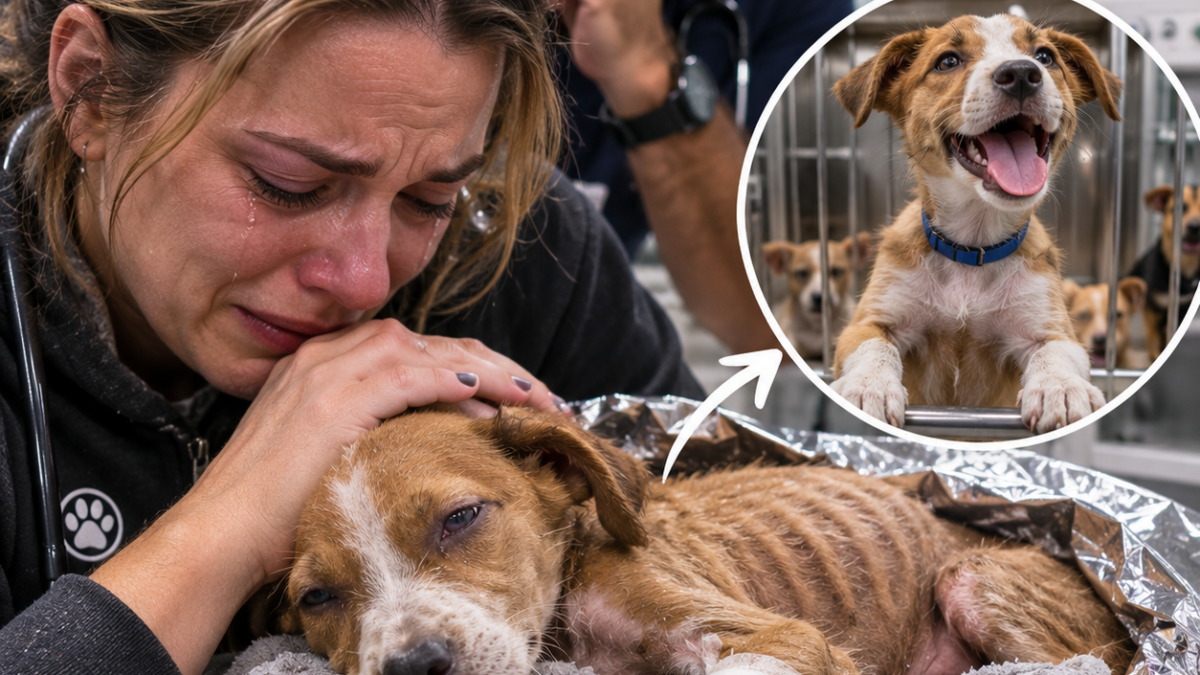
FULL STORY CONTINUATION
The first days were not a story of miraculous improvement.
They were a story of waiting.
That is often the part people do not see.
When a rescue story is eventually shared, people see the first photo and the last photo.
The broken body.
Then the bright eyes.
The ribs.
Then the healthy weight.
The helpless animal.
Then the dog standing beside a family.
There is a temptation to imagine a straight line between those pictures.
Medicine.
Food.
Love.
Recovery.
But Rudy’s line was not straight.
It was filled with uncertainty.
One hour could offer hope.
The next could bring another concern.
His caregivers would look at him and search for the smallest signs that his body was beginning to respond.
Was his temperature holding?
Were his gums slightly better?
Did his eyes follow movement?
Was his breathing stronger?
Could he lift his head?
Would his blood values improve?
Would his body accept the nutrition?
Nothing was taken for granted.
Not even tomorrow morning.
Then Rudy’s face began twitching.
At first, it might have looked small.
A movement.
A strange little spasm.
But his head began bobbing too.
The veterinary team noticed immediately.
For a healthy puppy, an odd twitch might be something to investigate.
For Rudy, already dangerously compromised, every new symptom carried weight.
His body had already been through so much.
Hypothermia.
Severe malnutrition.
Anemia.
Weakness so extreme he could not stand.
Now abnormal neurological-looking movements were appearing.
The staff watched.
Recorded.
Reassessed.
The question no one wanted to voice too confidently remained in the room.
What else had happened to this puppy?
And how much could his body take?
His next bloodwork brought another reason for concern.
Rudy’s white blood cell count was dangerously low.
Red blood cells carry oxygen.
White blood cells help defend the body.
Rudy was struggling on both fronts.
His body had been deprived so severely that even its defenses were compromised.
He was vulnerable at exactly the time he needed every system functioning.
That result made the waiting feel heavier.
They continued treatment.
There was nothing glamorous about it.
No single heroic gesture.
No one injection that suddenly made Rudy healthy.
The work happened through repetition.
Checking him.
Turning him carefully.
Cleaning.
Feeding.
Monitoring.
Adjusting.
Warming.
Documenting.
Watching.
Then doing it all again.
Morning.
Afternoon.
Night.
Again.
Rudy slept.
Rudy stared.
Rudy endured.
Sometimes his caregivers would talk to him.
Not because words could repair anemia.
Not because affection could substitute for medicine.
But because there was a little living being beneath all those numbers.
A puppy.
Somebody would say his name.
“Rudy.”
Maybe his eyes shifted.
Maybe one ear moved.
Maybe he looked toward the voice.
Those moments mattered more than they appeared to.
Because when an animal arrives nearly unresponsive, personality becomes a vital sign of its own.
Not one doctors can measure on a laboratory report.
But something everyone notices.
A small reaction says:
There you are.
Still in there.
Still listening.
Still with us.
Rudy began offering those moments.
Briefly.
Not enough to declare victory.
But enough to keep hope from disappearing.
A tiny look.
A little expression.
A flicker of interest.
His caregivers held onto every one.
They had seen puppies far healthier than Rudy behave like puppies.
That was normal.
Seeing Rudy do it, even for seconds, felt extraordinary.
Because he had not been given the chance to be normal.
Neglect steals ordinary things first.
Comfort.
Energy.
Curiosity.
Then, if it continues long enough, it steals movement.
Appetite.
Temperature.
Blood.
Life.
The veterinary team was trying to give those things back in reverse order.
First:
Life.
Then everything else.
Slowly, his temperature began to stabilize.
Nobody celebrated by declaring the battle won.
They knew better.
But the number was moving in the right direction.
Rudy’s body was beginning to hold warmth.
That meant something.
One system no longer seemed to be collapsing.
Then his bloodwork began showing improvement.
Again, not perfect.
But better.
The transfusion had given his body desperately needed support.
Nutrition was entering him.
Treatment was helping.
He had survived another night.
Then another.
The puppy who had arrived at the hospital with so little strength was still there.
Sometimes survival is not dramatic.
Sometimes it is simply the fact that morning comes and the patient is still breathing.
For Rudy, every morning became a victory.
But as the immediate danger eased enough for caregivers to look beyond the crisis, other injuries became more visible.
Rudy had spent too much time lying helpless.
A healthy puppy constantly shifts positions.
Rolls over.
Gets up.
Walks.
Runs.
Stretches.
Rudy had not been able to do that.
His body had pressed against surfaces in the same vulnerable places for too long.
Painful wounds had developed on his hip.
Another on his knee.
The skin there had suffered because there had not been enough movement, enough muscle or enough protection.
His caregivers began tending those injuries every day.
Cleaning.
Protecting.
Checking for infection.
Making sure pressure did not continue damaging the tissue.
Even touching those areas had to be done with care.
The puppy who needed to learn that human hands could be safe also needed those hands to clean painful wounds.
It was an unfair contradiction.
But there was no other way forward.
Then there was his tail.
At first, perhaps it seemed like another small problem compared with the crisis threatening his whole body.
But the tip had begun to die.
Damaged tissue.
Compromised blood supply.
Another consequence of how terribly depleted he had become.
His caregivers watched it.
Would it recover?
Would surgery become necessary?
Would part of the tail need to be removed?
Nobody wanted to put such a fragile puppy through more than necessary.
But leaving dead tissue could create problems too.
Every decision depended on how he progressed.
So once again:
Wait.
Watch.
Treat.
Hope.
Rudy’s entire recovery seemed built around those four words.
And somewhere during those days, the people caring for him stopped seeing only the list of problems.
They began seeing Rudy.
There was something about the way he looked at them.
Something about the little expressions that appeared as his energy returned.
His eyes became more aware.
His face became less vacant.
The puppy underneath the exhaustion was beginning to push forward.
The change was not dramatic enough for a movie scene.
There was no moment when Rudy suddenly jumped up.
Instead, life returned in fragments.
A little more attention.
A slightly stronger head lift.
More awareness of sounds.
Interest in movement outside his kennel.
Then came one particular moment.
Another dog passed.
Rudy noticed.
That alone might once have been encouraging.
But Rudy did more.
He barked.
It was a small act.
Ordinary.
Almost ridiculous.
Dogs bark.
Puppies bark.
Shelters and veterinary hospitals are full of barking dogs.
Sometimes caregivers probably wish they would bark less.
But Rudy’s bark was different.
Because days earlier, he had barely responded to the world.
Now the world passed his kennel and Rudy had something to say about it.
Maybe the other dog was too close.
Maybe Rudy was curious.
Maybe he was annoyed.
Maybe he was trying to act tougher than his recovering body had any right to act.
It did not matter.
He barked.
His voice came out.
And the people who had watched him lying nearly motionless heard something they had been waiting for without realizing it.
Personality.
Defiance.
Life.
There you are.
Rudy.
There you are.
He barked again at dogs passing the kennel.
Suddenly the puppy who had once been frighteningly quiet was becoming a little noisy.
Nobody complained.
Not yet.
Every bark felt like proof.
He had enough energy to notice.
Enough confidence to respond.
Enough oxygen.
Enough strength.
Enough of himself.
That voice became a milestone.
The puppy who had almost disappeared was announcing his presence.
I am here.
I see you.
This is my kennel.
Keep moving.
For the first time, perhaps, Rudy was getting to be inconvenient.
And there is something beautiful about an abused animal becoming inconvenient.
A neglected puppy gaining enough strength to bark too much.
A starving dog becoming picky.
A frightened animal demanding attention.
Because suffering often makes animals easy.
Quiet.
Still.
Unresisting.
Healing gives them preferences again.
Opinions.
Noise.
Boundaries.
Rudy’s caregivers wanted every one of them.
Let him bark.
Let him become a handful.
Let him discover that he was allowed to want things.
But his body still had a long way to go.
He could not simply bark his way out of weeks or months of neglect.
His muscles were severely weakened.
Imagine lying down for so long that your own body becomes unfamiliar.
Standing requires dozens of muscles working together.
Balance.
Coordination.
Strength.
Rudy had almost none of it.
His legs had to learn again.
His caregivers supported him carefully.
Rehabilitation had to be gentle.
Too much too soon could hurt him.
Too little would not rebuild what he had lost.
So they helped him position himself.
Encouraged weight bearing.
Allowed him to feel his paws beneath him again.
At first, his body might tremble.
His legs looked uncertain.
They had been asked to do almost nothing for too long.
Now they were being asked to hold an entire puppy.
It did not matter that the puppy was still painfully underweight.
To those weak legs, Rudy’s own body was a mountain.
He pushed.
Maybe he sagged.
Maybe he needed support.
Then he tried again.
There is a particular kind of courage animals show that humans often overlook.
They do not understand prognosis.
They do not know how bad yesterday was.
They do not stand in front of mirrors judging how weak they look.
They simply respond to what is in front of them.
A hand supports the chest.
The floor is beneath the paws.
Try.
So Rudy tried.
One moment, he supported himself.
Not gracefully.
Not confidently.
But his body was up.
For the caregivers who had seen him arrive unable to stand, it was enormous.
There he was.
On his own legs.
Maybe only for seconds.
Maybe wobbling.
But standing.
Someone probably wanted to cry.
Someone probably did.
Because a week earlier, they had been asking if Rudy would live.
Now Rudy was asking his legs if they remembered how to hold him.
The answer was beginning to become yes.
That was not enough for Rudy.
Standing led to the next impossible thing.
A step.
One paw shifted forward.
Then another.
Perhaps his legs trembled.
Perhaps he looked clumsy.
There was no elegance.
Puppies do not care about elegance anyway.
He moved.
A couple of tiny steps.
That was all.
But the distance did not matter.
For Rudy, those inches might as well have been miles.
A puppy who had been trapped inside a body too weak to move himself had changed his own location.
He had chosen somewhere else and gone there.
That is freedom at its most basic.
Movement.
Rudy had been denied it.
Now he was beginning to take it back.
His caregivers kept going.
Food was another battle turning in their favor.
At first, Rudy had needed a feeding tube.
Nutrition entering his body without his participation.
Now his appetite began returning.
He ate.
Actually ate.
The act looked so simple.
Head lowered.
Mouth working.
Swallow.
Again.
But every bite carried meaning.
His body was no longer only receiving survival.
Rudy was participating.
Hungry.
Interested.
Wanting more.
A puppy interested in food is doing one of the most puppy-like things imaginable.
His caregivers watched him eat and could finally imagine a day when feeding him would not require medical equipment.
They began tracking his weight.
The numbers moved upward.
Slowly.
Then steadily.
His body started filling in.
At first, the changes were subtle.
A little less sharp around the ribs.
A little more substance over the hips.
His face did not look quite as hollow.
His shoulders began gaining strength.
His legs looked less like fragile sticks trying to support him.
Every ounce mattered.
Every ounce represented calories he had been able to keep.
Tissue being rebuilt.
Muscle returning.
Energy stored.
Life accumulating.
His brindle coat became more visible.
It had always been there, of course.
But when Rudy first arrived, all anyone could see was suffering.
The eye went to bones.
Wounds.
Weakness.
Now people could look at him and notice color.
Pattern.
Beauty.
He had a beautiful brindle coat.
Little streaks and patches becoming clearer as his body filled out.
His ears had personality too.
Goofy ears.
The sort of ears that make a puppy look permanently surprised by his own existence.
Those details had been impossible to appreciate when everyone was worried whether his temperature would rise.
Now there was room for them.
That was one of the quietest signs of healing.
People could finally look at Rudy and smile before they worried.
His caregivers began seeing the puppy he could become.
Not only the patient he had been.
Still, the wounds remained.
His hip needed care.
His knee needed care.
The tail needed observation.
Healing skin can be slow.
Painful.
Messy.
One day a wound might look encouraging.
Another day, it might require more attention.
Rudy had to endure cleaning and bandaging again and again.
But now he had more energy to express his opinions about it.
Perhaps that made treatment harder.
It also made everyone happier.
A puppy who squirms has strength.
A puppy who complains has energy.
A puppy who tries to pull away from an unpleasant bandage change is, in some ways, doing exactly what a healthy puppy should do.
The medical staff wanted him healthy enough to become difficult.
Rudy was working on it.
As days passed, the difference became impossible to miss.
His eyes changed.
That may have been the most emotional part.
When Rudy first arrived, his eyes seemed exhausted.
There but distant.
As if too much of his body’s energy had been directed inward toward survival for him to engage with anything outside.
Later, his gaze sharpened.
He followed movement.
Looked toward voices.
Watched other dogs.
Watched people.
There was curiosity.
Interest.
Sometimes mischief.
An animal’s eyes can reveal when the world has started becoming worth watching again.
Rudy was watching.
And the world around him had changed too.
Before rescue, the world had meant confinement.
After rescue, it began meaning meals.
Blankets.
Caregivers.
Voices.
Treatment.
Dogs walking past.
Hands that lifted him but did not hurt him.
A kennel was still a kennel, but this one was temporary.
This one existed because people were trying to help him leave it healthy.
The meaning of walls was changing.
He had spent so much of his young life confined.
Now, ironically, confinement in a hospital was part of how he was being freed.
Because safety sometimes begins inside four walls.
Walls where nobody starves you.
Walls where temperatures are monitored.
Walls where food comes regularly.
Walls where the door opens and the person entering carries medicine instead of fear.
Rudy could not understand that distinction with words.
But his nervous system could learn it.
Every predictable meal taught him.
Every gentle touch taught him.
Every night he slept and woke without something terrible happening taught him.
Safety is learned through repetition.
So is trust.
One good experience does not erase suffering.
But one good experience followed by another, and another, and another begins building a new expectation.
Rudy was learning new expectations.
Food comes.
Water comes.
People come back.
Warmth remains.
Pain is treated.
Voices can be kind.
Hands can support.
Tomorrow can happen.
The days continued.
Ten.
Fifteen.
Twenty.
Each one carried more of Rudy away from the puppy who had arrived at death’s edge.
By then, staff could compare photographs.
The difference was startling.
In the early pictures, his body looked shrunken.
His face exhausted.
His entire posture communicated weakness.
Later, there was more of him.
Physically and emotionally.
He occupied space.
He lifted himself.
He reacted.
He barked.
He ate.
The puppy was coming back piece by piece.
But “coming back” was not exactly right.
Because Rudy had never really been allowed to become himself in the first place.
You cannot return to a childhood you never had.
Rudy was not recovering a normal puppyhood.
He was beginning one late.
That distinction mattered.
His caregivers could not give him the first months again.
They could give him the next ones.
That was the promise.
Not:
We can erase everything.
But:
What happened will not be everything.
There is enormous power in that.
For abused animals.
For injured animals.
For anyone whose story begins badly.
The beginning is not the whole story.
Rudy was living proof.
By week four, his progress began looking almost unbelievable compared with the day he arrived.
He had weight.
Strength.
Appetite.
Voice.
He could move.
Not perfectly.
Not endlessly.
But enough that his rehabilitation began feeling less like teaching a body how to survive and more like teaching a puppy how to use a growing body.
He needed practice.
Gentle exercise.
Time to strengthen muscles that had not developed normally.
His caregivers remained careful.
A puppy that suddenly feels better may try to do more than his healing body should.
That is another good problem.
One day you are praying for movement.
Later you are asking the recovering puppy not to overdo it.
Rudy had earned the right to create good problems.
Maybe he wanted to go farther.
Maybe his mind had more energy than his legs.
Maybe he barked at something and tried to follow.
His body still had limits.
His personality was beginning to forget them.
That was progress.
Food became pleasure.
He gained more weight.
His coat looked better.
His head lifted higher.
His posture changed.
He did not look like a body collapsing inward.
He looked like a puppy becoming interested in what came next.
Then came day 35.
Thirty-five days.
Just five weeks.
In some ways, a short period.
In other ways, an entire lifetime.
Think about what those thirty-five days contained.
A temperature of 90°F.
Pale gums.
A medical emergency.
Severe anemia.
Blood moving from a donor into Rudy’s failing body because his own could not carry enough oxygen.
A feeding tube because he was too weak to nourish himself.
Face twitching.
Head bobbing.
Dangerously low white blood cells.
Uncertainty.
Waiting.
Pressure wounds.
Hip.
Knee.
Tail tissue dying.
Possible surgery.
Daily treatment.
Then:
A bark.
Standing.
One step.
Another.
Food.
Weight gain.
Strength.
Thirty-five days earlier, every question had been about whether Rudy could survive.
Now people could put him in dinosaur pajamas.
Little dinosaur pajamas.
There he stood.
Brindle puppy.
Goofy ears.
Bright eyes.
A ridiculous outfit.
And maybe that was one of the most beautiful images in his entire story.
Because tragedy had finally become unnecessary in the frame.
Nobody needed to photograph him under blankets to show how sick he was.
Nobody needed to point out every rib.
Nobody needed to explain that his gums were pale.
Rudy could simply look silly.
A puppy in dinosaur pajamas.
That is what the people who hurt or neglected him had almost taken away.
Not only his life.
His silliness.
His chance to be ordinary.
His chance to look ridiculous in pajamas while someone laughed affectionately.
His chance to bark at dogs for no good reason.
His chance to discover toys.
His chance to be called goofy.
His chance to be loved without first having to nearly die.
Day 35 Rudy looked like a different puppy.
But he was not.
That is important.
It was the same Rudy.
The same little animal who had been lying there cold and nearly unresponsive.
The same heart.
The same eyes.
The same brindle fur.
He had not magically become someone stronger.
He had been strong the entire time.
We just could not see what strength looked like while his body was failing.
Sometimes strength looks like standing.
Sometimes strength looks like walking.
Sometimes strength looks like fighting.
And sometimes strength looks like doing nothing more than continuing to breathe beneath a blanket while strangers try to save you.
Rudy had done all of it.
His caregivers knew there was more recovery ahead.
Thirty-five days was not the finish line.
His wounds still needed attention.
His body still needed rehabilitation.
His strength had to continue growing.
Depending on the condition of his tail, additional treatment might still be necessary.
Healing is not completed simply because a photograph looks better.
But now there was something new.
A future that seemed possible.
Not hypothetical.
Possible.
Soon, Rudy could be ready for a home.
Those words carried incredible weight.
A home.
Not confinement.
Not survival.
Home.
A place where his body would not be something people evaluated every hour.
A place where the biggest problem might eventually be whether Rudy had chewed a shoe.
Imagine that.
A puppy who once needed a blood transfusion getting in trouble for stealing a sock.
A puppy who once could not eat without a tube begging beside a dinner table.
A puppy who once could not stand running through a hallway too fast.
A puppy whose voice disappeared into weakness barking because someone rang the doorbell.
These ordinary annoyances would be miracles.
Perhaps his future family would never truly understand what it meant the first time Rudy became mischievous.
Maybe they would laugh when he stole something.
Maybe they would sigh when he woke them up early.
Maybe they would complain affectionately that he had too much energy.
And somewhere, someone who had cared for him during those first days might see an update and smile.
Too much energy.
Good.
Perfect.
Let him have too much.
Rudy had known what it was to have almost none.
His future needed abundance.
Abundant meals.
Abundant warmth.
Abundant safety.
Abundant patience.
Abundant time.
Abundant love.
Not the suffocating kind.
Not love that treats an animal like property.
Love that allows a dog to become who he is.
The people who had cared for Rudy knew adoption would be another transition.
A recovering animal carries history.
Even if the physical wounds close, there may be behaviors shaped by the past.
Fear.
Uncertainty.
Sensitivity.
A puppy may need extra patience.
But Rudy also had something extraordinary working in his favor.
He was young.
So young.
Less than six months when the nightmare ended.
There was still so much life ahead of him.
First birthdays.
First holidays in a home.
First favorite toy.
First bed he decides is his.
First time he realizes nobody is taking his food away.
First time he sleeps through the night stretched completely out instead of curling tightly from cold or fear.
First walk where every smell becomes urgent business.
First friend.
First family photograph.
First moment when someone looks at him and realizes they cannot imagine the house without him.
Those moments were waiting somewhere ahead.
Rudy did not know.
That is one of the sweetest things about animals.
They do not sit around anticipating the future the way we do.
They meet it when it arrives.
A bowl appears.
Eat.
A person sits down.
Approach.
A door opens.
Look.
A leash comes out.
Maybe someday:
Run.
For Rudy, the future would arrive one ordinary day at a time.
And ordinary was the greatest gift anyone could give him.
People often use the phrase “second chance.”
Rudy certainly had one.
But perhaps it was even more than that.
A second chance suggests there was once a first chance.
Rudy had barely received one.
He was still a baby when his life became suffering.
Maybe what rescuers gave Rudy was simply his first real chance.
A chance to discover what being a dog was supposed to feel like.
A chance to be warm because homes are warm.
Full because meals come every day.
Tired because he played too hard.
Dirty because he ran through grass.
Sleepy because he spent the afternoon exploring.
Annoying because he wants attention.
Loved because he exists.
No other reason.
There should never have been anything remarkable about that.
And yet, because of what Rudy endured, every ordinary future moment became precious.
His caregivers could look back at the day he arrived and remember the fear.
The 90°F temperature.
That number would stay with them.
Ninety.
Dangerously cold.
A number showing how close Rudy’s body was to giving up.
They would remember his gums.
Nearly colorless.
They would remember the transfusion.
The tube.
The strange head movements.
The white blood cell count.
The wounds.
The tail.
The waiting.
They would remember wondering whether they were doing enough.
Whether his body had been damaged too badly.
Whether they would ever see him stand.
Then they could look at Rudy in his dinosaur pajamas.
The contrast almost hurt.
Not because it was sad.
Because sometimes relief is so intense that it hurts too.
You realize how close something precious came to disappearing.
Rudy did not understand how close.
He did not need to.
Let the humans carry that memory.
Rudy had better things to do.
He had dogs to bark at.
Food to eat.
Legs to strengthen.
People to charm.
A life to begin.
There is one moment in every recovery story when the language changes.
At first, people say:
“If.”
If he survives.
If his temperature stabilizes.
If the transfusion works.
If he responds.
If he can eat.
If he can stand.
If the wounds heal.
Then, almost without noticing, people begin saying:
“When.”
When he is stronger.
When he can walk farther.
When he no longer needs this treatment.
When his wounds close.
When he is ready.
When he goes home.
Rudy crossed that invisible line.
The future stopped being an impossible question.
It became a plan.
When Rudy gets a family.
When Rudy sleeps in his own bed.
When Rudy grows up.
That change may have been the most important milestone of all.
Because thirty-five days earlier, nobody knew whether Rudy had thirty-five days.
Now people were thinking in years.
What kind of adult dog would he become?
Would he stay goofy?
Probably.
Would those ears ever make sense?
Hopefully not.
Would he become a dog who barked at every passing animal?
Very possibly.
Would he love food with the enthusiasm of someone who once knew hunger?
Maybe.
Would he grow strong enough that strangers could never imagine he had once been carried because he could not stand?
That was the hope.
There would always be photographs.
Records.
People who remembered.
Rudy himself did not need to carry the narrative.
He only needed to carry his body.
And now he could.
That simple fact remained extraordinary.
He could stand.
There were days when his caregivers had not known if that would happen.
He could walk.
Only tiny steps at first.
But movement multiplies.
Two steps become four.
Four become ten.
Ten become a trip across a room.
A room becomes a hallway.
A hallway becomes a yard.
Maybe one day a yard becomes a running path with a family laughing behind him.
That is how life expands.
One step at a time.
Rudy’s first steps were small.
The future contained thousands.
The same was true of eating.
One meal.
Then another.
Weight.
Strength.
Growth.
His body, once forced to consume itself for survival, could finally build.
Muscle.
Healthy tissue.
A puppy growing instead of disappearing.
Imagine what it feels like for a caregiver to place food in front of an animal who once needed a feeding tube and watch him eat.
The bowl empties.
The puppy looks up.
Maybe he wants more.
There may be no applause.
But inside, someone remembers:
He could not do this.
Now he can.
Recovery is filled with private celebrations like that.
A normal temperature.
A normal appetite.
A normal poop.
A normal bark.
A normal nap.
The word “normal” becomes sacred.
Rudy deserved normal.
Maybe more than anything.
He had experienced too much abnormal suffering for such a young animal.
Pain should not have been his baseline.
Hunger should not have been routine.
Cold should not have been expected.
Confinement should not have been childhood.
His rescuers could not change what his first months taught him.
But they could teach him something new.
The world can also be gentle.
Not always.
But enough.
There are bowls that refill.
Hands that heal.
Doors that open.
People who stay.
And perhaps one day, Rudy would stop remembering with his body.
He would stop tensing in certain situations.
Stop expecting discomfort.
Stop watching for the next bad thing.
Maybe he would not.
Some animals carry pieces forever.
That does not make their recovery incomplete.
Healing does not require amnesia.
A dog can remember fear and still learn joy.
He can carry scars and still run.
He can lose a piece of a tail and still wag what remains.
He can have a past and still belong completely to the present.
Rudy’s wounds were real.
So was his joy.
Neither canceled the other.
By day 35, joy was winning more moments.
That was enough.
A little dinosaur pajama leg around a growing puppy limb.
Brindle fur beneath fabric.
Goofy ears above bright eyes.
There is almost something absurd about it.
Maybe that is why it is so moving.
Suffering wants to turn a life into a tragedy.
Love keeps insisting the life is more complicated than that.
Rudy was not only a victim.
He was a puppy.
That word needed to become more important than everything done to him.
Puppy.
Not abuse case.
Not emergency intake.
Not severe anemia.
Not hypothermic patient.
Rudy.
Puppy.
Goofy.
Brindle.
Opinionated.
Hungry.
Growing.
Loved.
Soon to be adoptable.
One day, the hospital portion of his story would end.
There would be paperwork.
Instructions.
Maybe medications.
Follow-up appointments.
Warnings about what still needed healing.
Then a carrier or leash.
A door.
Outside air.
Another transition.
Perhaps the first family he met would be the one.
Perhaps it would take time.
Either way, Rudy would no longer be waiting for someone to decide whether his life mattered.
That decision had already been made.
His life mattered.
The only question left was who would have the privilege of sharing it.
Somewhere, maybe a person would see Rudy’s photograph.
Brindle puppy.
Funny ears.
Maybe pajamas.
They would read what he had survived.
Their heart would break.
Then they would meet him.
And perhaps Rudy would do the best possible thing.
Not act grateful.
Dogs do not owe us gratitude for treating them decently.
Maybe Rudy would bark at them.
Sniff them.
Ignore them for something more interesting.
Maybe chew their shoelace.
Maybe climb into their lap.
Maybe pee somewhere inconvenient.
Perfect.
Let him.
Let him be a puppy.
Rescue is not successful when an animal spends the rest of his life performing thankfulness.
Rescue is successful when the animal becomes safe enough to be ordinary.
Rudy had earned ordinary.
He had earned boring mornings.
Uneventful vet visits.
Predictable meals.
Walks where nothing bad happens.
Naps.
Toys scattered everywhere.
Someone complaining that he stole a blanket.
A family taking too many photos because his ears look funny.
Birthdays.
Years.
Gray fur someday.
That last thought might have seemed impossible during his first night in emergency care.
Gray fur.
An old Rudy.
Imagine that.
A brindle face slowly whitening with age.
A dog who once nearly died before six months old reaching ten.
Twelve.
Maybe more.
Sleeping on a soft bed.
Moving slower not because he was starving but because he had lived a long life.
That is what everyone fought for even if they did not say it.
Not merely thirty-five days.
Years.
A whole life.
The right to become old.
Rudy’s story was not finished when he stood.
Not finished when he ate.
Not finished on day 35.
That was just the moment the story stopped being mainly about death chasing him and began being about life waiting for him.
There would still be hard days.
Healing wounds can hurt.
Rehabilitation can be tiring.
Bodies weakened by neglect do not instantly catch up.
But Rudy had crossed something important.
He was participating.
At first, everyone else had been fighting for him.
Veterinarians.
Rescuers.
Caregivers.
Blood donors.
Hands placing food through a tube.
People changing bedding.
People cleaning wounds.
People reading lab values.
Then Rudy joined them.
He ate.
He stood.
He stepped.
He barked.
He fought for himself in the only ways a puppy knows how.
Maybe “fight” is not even the right word.
Rudy did not know he was fighting.
He simply began wanting things again.
Food.
Movement.
Attention.
Other dogs to bark at.
Wanting is powerful.
An animal who wants something is imagining a next moment.
Rudy began imagining next moments.
The next bite.
The next step.
The next sound outside the kennel.
That is hope without language.
By the end of those thirty-five days, his caregivers did not have to search hard for Rudy’s personality anymore.
It was right there.
In his eyes.
In his ears.
In his bark.
In the way he moved.
In the ridiculous pajamas.
The puppy had finally become visible.
And once you saw him, it was difficult to imagine that he had ever been hidden beneath so much suffering.
But the early photographs remained.
They mattered.
Not because Rudy should forever be defined by them.
Because they showed what neglect can do.
Neglect is not simply forgetting to play with a dog.
It is not a dog looking a little thin.
Rudy showed where prolonged deprivation can lead.
A temperature too low to safely sustain life.
Blood values requiring emergency intervention.
A body unable to stand.
A puppy unable to eat.
Pressure wounds because he could not move enough to protect his own skin.
Tissue beginning to die.
That is what happens when suffering is allowed to continue until the body itself starts shutting down.
And yet Rudy also showed what care can do.
Not instantly.
Not magically.
But persistently.
A transfusion.
Nutrition.
Medical expertise.
Wound care.
Warmth.
Rehabilitation.
Patience.
Day after day.
Care took a body that had been collapsing and gave it conditions in which healing could begin.
Love did not replace treatment.
Love made sure treatment kept happening.
That distinction mattered.
People sometimes say love saved an animal.
In Rudy’s case, love looked practical.
Someone transported him.
Someone paid attention.
Someone drew blood.
Someone read results.
Someone donated blood or made it available.
Someone inserted a feeding tube.
Someone monitored temperature.
Someone cleaned wounds that probably did not smell pleasant.
Someone changed bedding.
Someone supported weak legs.
Someone showed up tomorrow.
And the next day.
And the next.
That is what love often looks like in rescue.
Repetition.
Responsibility.
Care when no one is taking photographs.
Rudy received it.
At last.
The beginning of his life had been shaped by people who failed him.
The next part would be shaped by people who refused to.
That difference was everything.
Maybe years from now, somebody would ask Rudy’s future family:
“Where did you get him?”
They would tell the story.
“He was a rescue.”
“He was in terrible shape.”
“He almost didn’t make it.”
And Rudy, hopefully, would be somewhere nearby doing something completely disrespectful to the emotional importance of the conversation.
Snoring.
Begging.
Dragging a toy across the room.
That would be perfect.
Because the best ending to a rescue story is often an animal who has no idea anyone thinks his survival was extraordinary.
He simply lives.
Rudy deserved that kind of ending.
Not a life spent as a symbol.
A life spent as a dog.
A puppy first.
Then a young dog.
Then an adult.
Then, if the world is kind, an old dog with a graying muzzle and people who cannot remember what their home felt like before him.
Thirty-five days earlier, Rudy had been less than six months old and too weak to stand.
He was dangerously cold.
Ninety degrees.
His gums were pale.
His blood could not do what his growing body needed it to do.
He required a transfusion.
He could not eat by himself.
He needed a tube.
Then the twitching came.
The bobbing head.
The dangerously low white blood cells.
The wounds.
Hip.
Knee.
Tail.
Every new problem seemed to ask the same question.
How much more can this puppy take?
Rudy answered without words.
Another day.
Then another.
His temperature stabilized.
His numbers improved.
His eyes woke up.
His voice appeared.
Bark.
His body followed.
Stand.
Step.
Another step.
His appetite returned.
Eat.
His weight increased.
Grow.
And by day 35:
Live.
Really live.
That was the word.
Not survive.
Live.
There is a difference.
Survival is a heartbeat.
Life is what the heartbeat gets to do afterward.
Rudy had survived.
Now he was beginning the afterward.
Maybe that was why the dinosaur pajamas mattered so much.
They belonged to the afterward.
Nobody puts a critically ill puppy in silly pajamas because the priority is keeping him alive.
Pajamas mean someone had space to think about comfort.
Warmth.
Cutness.
A photograph.
A smile.
They meant the crisis had loosened its grip enough for joy to enter.
Rudy stood there looking almost comically sweet.
The same puppy who had been too weak to hold himself up.
If his caregivers cried while looking at him, perhaps Rudy did not understand.
He did not know they were comparing two versions of him.
The first Rudy.
The one lying helpless.
And the Rudy in front of them.
But again:
There were never two Rudys.
Only one.
One puppy moving through different circumstances.
That is why the story hurts so much.
And why it is hopeful.
Because the first photograph was not who Rudy was.
It was what had happened to him.
There is a profound difference.
He was never weakness.
He was weakened.
He was never broken.
He was injured.
He was never empty.
He was exhausted.
He was never meant to lie silent in confinement.
He was meant to bark.
Run.
Eat.
Annoy.
Grow.
Love.
Be loved.
His recovery did not create value in him.
It revealed the value that had always been there.
Even when he could not stand.
Even when he could not eat.
Even when he could barely respond.
Rudy mattered before he got better.
That is why people fought so hard for him.
And maybe that is the part of his story worth remembering most.
Not every animal can show you immediately who they will become.
Some arrive terrified.
Some arrive sick.
Some arrive shut down.
Some cannot wag.
Some cannot play.
Some cannot trust.
Some, like Rudy, cannot even stand.
You have to care for the animal in front of you without demanding proof of the animal waiting underneath.
Rudy’s caregivers did that.
They treated him before he could entertain them.
Fed him before he could show affection.
Stayed beside him before he could bark.
Supported him before he could stand.
They did not require Rudy to prove he was worth saving.
They saved him because he already was.
Then, eventually, he showed them everything they had been waiting to see.
Bright eyes.
Goofy ears.
Brindle coat.
A bark.
A step.
A personality.
A puppy.
By the time Rudy became strong enough to start preparing for a family, the question was no longer whether he had a future.
The question was what kind of future it would be.
Hopefully:
Soft.
Warm.
Safe.
Probably noisy.
Maybe full of chewed shoes.
Maybe full of blankets stolen from couches.
Hopefully full of photographs where nobody mentions how thin he once was.
Photographs where he is simply Rudy.
Sleeping upside down.
Looking out a window.
Standing beside a birthday cake made for dogs.
Wearing another ridiculous outfit.
Running.
Maybe one day running so fast someone will laugh and say:
“Slow down, Rudy!”
Imagine that.
Slow down.
The puppy who once could not take two steps being asked to slow down.
There could be no sweeter problem.
Maybe the person saying it would not know exactly how much weight those words carried.
Someone else would.
The people who watched his first steps.
They would remember.
A couple of tiny movements across a hospital floor.
Wobbly.
Uncertain.
And now:
Slow down, Rudy.
That is how miracles should age.
Until they become ordinary.
Rudy’s beginning was painful.
No rewrite can make that less true.
No happy photograph should be used to soften what happened.
A puppy suffered.
A puppy was confined and neglected until his body was near collapse.
That matters.
But something else matters too.
The suffering did not get the final word.
Not at ninety degrees.
Not during the transfusion.
Not through the feeding tube.
Not during the twitching.
Not while his bloodwork frightened the people treating him.
Not when his hip and knee were raw.
Not when the tip of his tail began to die.
Suffering kept trying to define him.
Rudy kept living long enough to become something else.
First:
A patient.
Then:
A survivor.
Then:
A puppy again.
Soon:
Someone’s dog.
That final phrase may be the most beautiful.
Someone’s dog.
Not property.
Not something confined.
Not something forgotten.
Someone’s beloved dog.
The dog whose bowl has a name beside it.
The dog whose leash hangs by the door.
The dog whose hair ends up on every black shirt.
The dog who steals a spot on the couch.
The dog someone worries about when they are away too long.
The dog who gets Christmas presents he does not understand.
The dog who gets older surrounded by people who still remember the first day they met him.
Rudy deserved to be that dog.
And after thirty-five days of watching his little body fight its way back, the people who cared for him could finally believe he would.
There would come a day when Rudy left.
That would hurt too.
Rescuers learn to love animals they are preparing to give away.
That is part of the job.
You fight to keep them alive.
You celebrate every ounce.
You know every wound.
You recognize every expression.
Then one day the goal is to send them somewhere else.
A good home.
A permanent home.
You hope the goodbye feels painful because the ending is right.
Maybe Rudy would look back.
Maybe not.
Maybe he would be too excited by the new smells.
That would be fine.
His caregivers did not save him so he would remain dependent on them forever.
They saved him so he could leave.
Walk out.
On his own legs.
That image completes the circle.
Carried in.
Walking out.
Too weak to stand.
Leaving under his own power.
That is the future Rudy was moving toward one tiny step at a time.
No one could give him back the first months.
No one could erase the hunger.
No one could erase the cold.
No one could make his body unremember confinement.
But there were years ahead.
Hopefully many.
And years are powerful.
Enough good days can become a life.
One meal does not erase starvation.
But thousands of meals can teach a dog that hunger is no longer waiting around the corner.
One safe night does not erase fear.
But thousands of safe nights can teach a nervous system to rest.
One gentle hand does not erase abuse.
But years of gentle hands can become the expectation instead of the exception.
That was what Rudy needed.
Not one perfect ending.
A lifetime of ordinary proof.
You are safe.
Again.
You are safe.
Again.
Food is coming.
Again.
Nobody is hurting you.
Again.
You can sleep.
Again.
You can play.
Again.
Tomorrow will be here.
Again.
Eventually, maybe the past becomes quieter.
Not gone.
Just quieter.
And the life around it becomes louder.
Barking.
Running.
Playing.
People laughing.
Bowls clinking.
Doors opening.
A family calling:
“Rudy!”
And Rudy coming because he wants to.
Not because he is trapped.
That is freedom.
Not the absence of walls.
The ability to choose movement.
The puppy who could not move would one day choose where to go.
Toward food.
Toward another dog.
Toward the couch.
Toward his people.
Every choice would be something confinement once denied him.
Rudy’s story began with almost no choices at all.
By day 35, choices were returning.
Stand or lie down.
Eat another bite.
Bark or stay quiet.
Move toward someone.
Watch a dog.
Take a step.
That is what healing gives back.
Agency.
The ability to participate in your own life.
Rudy was participating now.
And if the people caring for him seemed overly excited when he barked, perhaps that was why.
They were not celebrating noise.
They were celebrating a puppy making a choice.
He saw another dog.
He had an opinion.
He expressed it.
After everything, that little opinion sounded like music.
The bark may have echoed through the kennel area for only a second.
But emotionally, it carried all the way back to Rudy’s first night.
To the blankets.
To the blood.
To the tube.
To the terrifying numbers.
The difference between those two moments was everything rescue hopes for.
From silence to voice.
From cold to warmth.
From helplessness to movement.
From starvation to appetite.
From disappearance to presence.
Rudy had become present.
That is perhaps the best way to describe day 35.
He was there.
Not simply breathing.
There.
Eyes bright.
Body filling out.
Coat visible.
Ears ridiculous.
Personality obvious.
When people looked at him, they did not have to search beneath the suffering anymore.
Rudy met them at the surface.
Hello.
Here I am.
And somewhere ahead was a family who had no idea yet that their future dog had just survived thirty-five of the hardest days of his life.
Maybe they were drinking coffee.
Going to work.
Scrolling through rescue photos.
Living an ordinary day.
They did not know Rudy.
Rudy did not know them.
But their stories might already have been moving toward each other.
One day they would learn the details.
Ninety degrees.
Transfusion.
Feeding tube.
Wounds.
First bark.
First steps.
Day 35.
Maybe they would cry.
Then Rudy might lick their face and ruin the seriousness of the moment.
Perfect.
Let him.
Because tears are for the humans.
Rudy’s job was to move forward.
To be the puppy who survived long enough to become annoying.
To become loved.
To become old.
To become ordinary.
And maybe years later, someone would look at a sleeping brindle dog stretched across a couch and think about the baby he had been.
Too weak to stand.
Too cold.
Too thin.
Barely responding.
Then look again at the dog occupying far more couch than any reasonable animal needs.
And smile.
Because that is what Rudy’s entire story was moving toward.
Not fame.
Not sympathy.
Not being remembered forever as the abused puppy.
A couch.
A meal.
A family.
A tomorrow.
The things he should have had from the beginning.
Rudy had spent the beginning of his life confined.
His body paid for that cruelty.
His blood.
His muscles.
His skin.
His tail.
His strength.
But the rest of his life did not belong to the people who failed him.
It belonged to Rudy.
And to the people willing to help him build it.
By day 35, the future was finally larger than the past.
That may be the greatest victory any rescued animal can have.
The beginning stops being the biggest part of the story.
There are more pages.
More days.
More meals.
More steps.
More love.
Eventually, the terrible first chapter becomes only a chapter.
Rudy was already writing the next one with every shaky step.
The puppy who once lay helpless had found his feet.
The puppy who barely responded had found his voice.
The puppy who could not eat had found his appetite.
The puppy whose body was disappearing had begun growing.
And soon, somewhere safe, someone would open a door for him.
Rudy would walk through it.
On his own legs.
Maybe wobbling.
Maybe excited.
Maybe barking.
But walking.
And this time, no one would close that door to trap him.
They would close it behind him because he was finally home.


