FULL STORY:“GET OUT, YOU OLD TRESPASSER!” My Daughter-in-Law Thought She Could Steal My Mountain Cabin — My Son Went Pale When I Smiled
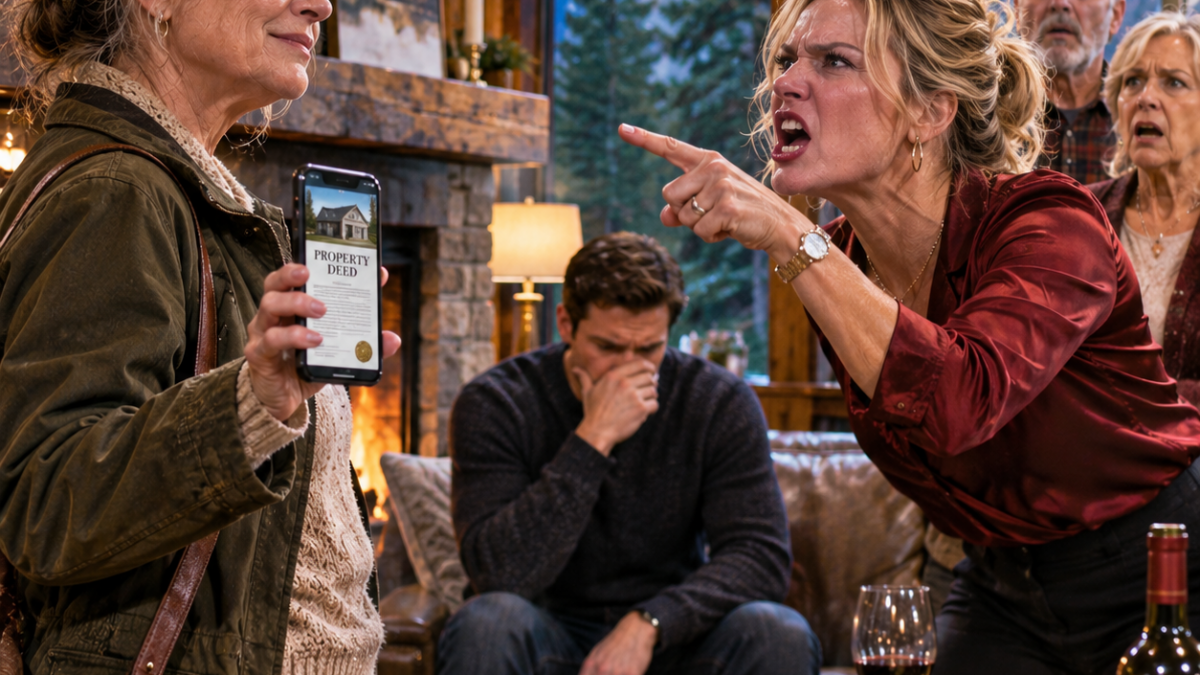
FULL STORY CONTINUATION
Sharon stared at me for a few seconds longer.
I could tell she was waiting for me to retreat.
That had always been the pattern.
Someone pushed.
I yielded.
Someone needed.
I provided.
Someone crossed a line.
I explained it away.
She had mistaken history for weakness.
Finally, she tapped the screen.
The call connected.
“Local police. What is your emergency?”
Sharon transformed instantly.
Her shoulders drew inward.
Her voice became softer.
Frightened.
Almost trembling.
“Yes, hello. We need help. There is a woman in our house causing a disturbance.”
I looked at Robert.
His face had turned gray.
Sharon continued.
“She entered without permission. She won’t leave.”
Our house.
I almost admired the confidence.
“Is the person armed?” the dispatcher asked.
“No.”
“Has she threatened anyone?”
Sharon glanced at me.
“She’s extremely agitated.”
I sat perfectly still.
“She’s older,” Sharon added. “I think she may be confused.”
There it was.
Not only was I trespassing.
Now I was confused.
The dispatcher asked for the address.
Sharon gave it.
“A unit is on the way.”
“Thank you.”
She ended the call.
Then she looked at me with satisfaction.
“You heard her.”
“I did.”
“You should leave before this becomes embarrassing.”
“For whom?”
Her expression tightened.
Robert finally stepped forward.
“Mom, please.”
I turned toward him.
“Did you invite them?”
He swallowed.
“Yes.”
“Did you ask me first?”
Silence.
“Robert.”
“No.”
Joe shifted in his chair.
“Now, wait. Robert told us you knew.”
I looked at him.
“He told you that?”
Joe nodded.
“He said you were traveling and had given him permission.”
Lucy jumped in.
“He told us this was a family weekend. We thought you’d be joining us tomorrow.”
I looked at Robert.
“Is that true?”
He rubbed the back of his neck.
“Mom, I figured you wouldn’t mind.”
“That wasn’t my question.”
He looked away.
Sharon snapped, “This is ridiculous.”
“No.”
I spoke quietly.
“What is ridiculous is standing in a house I own while people who did not ask permission debate whether I am allowed inside.”
Sharon laughed.
“Robert is your son.”
“Yes.”
“You’ve always said what’s yours will eventually be his.”
“Eventually is not today.”
“You’re being petty.”
I looked toward the wall.
“My photographs.”
She didn’t answer.
“Where are they?”
Robert spoke.
“Upstairs closet.”
“Why?”
“We wanted to update the room.”
“We?”
He glanced at Sharon.
She answered for him.
“The decor was dated.”
My mother had been dead nineteen years.
My father twenty-three.
Apparently their faces had become outdated.
I stood.
Sharon took a small step backward.
I didn’t approach her.
I walked to the wall where my parents’ photograph normally hung.
There was a pale rectangle where sunlight had faded the surrounding paint.
“You removed my family.”
“Temporarily.”
“You replaced them with pictures of yourself.”
“This is unbelievable.”
She threw up both hands.
“We came here for one weekend!”
“You came into my property without permission.”
“Robert invited us.”
“Robert doesn’t own it.”
“He’s your son!”
“That is a relationship, Sharon. It is not a deed.”
Joe gave a nervous cough.
“Alice, I think Robert made a mistake. We honestly believed everything was arranged.”
I believed him.
At least partly.
Joe and Lucy were not innocent of entitlement.
But Robert had told them a lie.
That mattered.
“I understand what Robert told you.”
Lucy relaxed slightly.
“Good.”
“I am telling you it was false.”
Her face fell.
“You should be angry with him, then.”
“I am.”
Robert looked as if he wanted the mountain to open beneath him.
Sharon’s anger returned.
“You’re doing this because you’ve never liked me.”
I almost laughed.
“This has nothing to do with liking you.”
“Oh, please.”
“You called me an old trespasser in my own home.”
“Because you barged in!”
“I opened my own front door.”
“You knew we wanted privacy.”
“I didn’t know you were here.”
“You should have called first.”
That sentence was so absurd that even Joe looked uncomfortable.
“Call first?”
“Yes.”
“Before entering my cabin?”
“You knew Robert uses it.”
“No. Robert has stayed here when I invited him.”
“Same thing.”
“No.”
I shook my head.
“That is exactly the problem. You think access and ownership are the same thing.”
Sirens weren’t necessary on that mountain road.
We heard the patrol car before we saw it.
The engine climbed the dirt lane.
Sharon straightened.
Robert whispered, “Jesus.”
I looked at him.
“No.”
He closed his eyes.
“Don’t do this.”
“I called nobody.”
A patrol vehicle stopped outside.
Two officers approached.
An older man.
A younger woman carrying a notebook.
Sharon rushed to the door.
“Thank God.”
The male officer stepped inside.
“Who made the call?”
“I did.”
Sharon pointed at me.
“She refuses to leave.”
The officer looked at me.
Then at everyone else.
“Who owns the property?”
“I do.”
Sharon immediately cut in.
“No, she is my husband’s mother.”
The officer held up a hand.
“That wasn’t the question.”
I almost smiled.
Sharon stopped.
“My name is Alice Martin,” I said. “I am the sole owner.”
“Do you have identification?”
“Yes.”
“Property documentation?”
“Yes.”
Sharon scoffed.
“This is a family dispute.”
The officer looked at her.
“Then let’s establish the property facts.”
I walked to my purse.
There was a reason I kept a small document folder with me whenever I traveled to the cabin.
The mortgage had been paid off.
But after decades of financial mistakes—not mine, mostly other people’s—I had learned to keep proof close.
Inside the folder were:
The deed.
The latest property-tax receipt.
Insurance paperwork.
Utility records.
A bank letter showing the mortgage was satisfied.
I handed everything over.
The older officer read first.
Then handed pages to the younger officer.
She compared my driver’s license.
Address.
Legal name.
Parcel number.
Sharon’s face slowly changed.
The older officer finally looked up.
“Mrs. Martin is the registered owner.”
Silence.
“Exactly,” I said.
Sharon looked at Robert.
“But he has permission.”
The young officer asked me, “Did you authorize your son or these individuals to occupy the cabin this weekend?”
“No.”
Robert stared at the floor.
“Did you know they were coming?”
“No.”
“Did you give your son general permission to use the property whenever he wants?”
“No.”
Sharon pointed at me.
“She told him what’s hers is his.”
The officer’s expression remained neutral.
“That does not transfer ownership or create unlimited permission.”
Lucy looked at Robert.
“You told us she agreed.”
Robert finally spoke.
“I thought she wouldn’t care.”
Joe’s face hardened.
“You told me she said yes.”
Robert said nothing.
Joe repeated himself.
“You said she knew.”
“I know.”
“You lied to us?”
Robert rubbed his face.
“I didn’t think it would matter.”
“It matters now,” I said.
Sharon spun toward me.
“You’re enjoying this.”
“No.”
“You are.”
I looked around the room.
Dirty glasses.
Missing photographs.
My son’s shame.
Her parents’ embarrassment.
Two police officers forced to mediate something that never should have happened.
“I am not enjoying any of this.”
I meant it.
“Then tell them everything is fine.”
“No.”
Her mouth opened.
I turned toward the officer.
“I want them to leave.”
He nodded.
“You are within your rights to revoke permission and request that they vacate.”
“I am revoking whatever permission they believed existed.”
The younger officer wrote something down.
“Do you want to file a formal complaint for trespass?”
I looked at Robert.
He finally met my eyes.
There were tears in his.
I thought of him at five.
At ten.
At twenty-three.
I also thought of the man who had watched his wife call me an intruder.
“No formal complaint today.”
Robert exhaled.
“But I want them off the property immediately.”
The officer nodded.
“You heard the owner.”
Sharon whispered, “Unbelievable.”
“Thirty minutes,” the officer said. “Collect your personal belongings and leave.”
Joe asked, “Can we finish packing the food?”
“Personal belongings only. Anything belonging to the property remains.”
Lucy sat down as though her knees had weakened.
Robert came toward me.
“Mom.”
I held up a hand.
“Not yet.”
“There is something else.”
He froze.
So did Sharon.
I walked back to my purse.
Removed a second folder.
This one was thicker.
The male officer glanced at me.
“Mrs. Martin, is this related to the ownership issue?”
“Not directly.”
I looked at Robert.
“But I would like witnesses.”
Robert closed his eyes.
He knew.
Sharon did not.
“Witnesses to what?”
I put the folder on the dining table.
Moved a wineglass aside.
Then opened the first bank statement.
“Robert, how much money have I given you in the last five years?”
Sharon looked confused.
“Why are we discussing this?”
“Robert?”
His voice barely came out.
“I don’t know.”
“I do.”
I placed the first summary on the table.
“Forty-two thousand dollars in direct transfers.”
Sharon stared.
Joe looked at his daughter.
Lucy looked at Robert.
I continued.
“Down payment assistance.”
Next document.
“Credit-card debt.”
Next.
“Car expenses.”
Another.
“Wedding costs.”
Sharon interrupted.
“Your wedding gift was a gift.”
“Part of it.”
I pulled another statement.
“The rest wasn’t.”
Robert whispered, “Mom.”
I ignored him.
“Travel.”
Another page.
“Emergency bills.”
Another.
“Household shortfalls.”
I arranged the papers across the table.
Then I moved to the recurring payments.
“Three hundred dollars a month for Robert’s car insurance.”
Sharon looked at him.
“You told me you were paying that.”
He looked away.
“Fifteen hundred—”
I stopped.
“No. One hundred fifty dollars monthly for your gym membership, Sharon.”
Her eyes widened.
“My gym?”
“Yes.”
“Robert said—”
“I know what Robert said.”
Then the largest recurring amount.
“For the last two years, I have been contributing eight hundred dollars every month toward the mortgage on the house where you live.”
Joe stood.
“What?”
Lucy stared at Sharon.
“You said you two paid the mortgage yourselves.”
Sharon rounded on Robert.
“What have you been telling everyone?”
He exploded.
“What have I been telling everyone?”
He pointed at her.
“You knew we couldn’t afford that house!”
“I didn’t know your mother was paying that much!”
“You knew she helped!”
“Not eight hundred!”
The officers exchanged a glance.
I raised my voice.
“Enough.”
Everyone stopped.
I had spent years listening to people argue over money I provided.
I was done.
“I went through every transfer.”
I picked up my summary.
“In five years, including regular support, I have spent approximately sixty-eight thousand dollars keeping Robert’s household afloat.”
Nobody spoke.
“Sixty-eight thousand.”
I let the number exist.
“To a grown man with a job.”
Robert started crying.
“Mom, I know.”
“No.”
I looked at him.
“You don’t.”
He wiped his face.
“You never added it up because you never had to.”
I turned to Sharon.
“And you certainly didn’t.”
She looked genuinely stunned.
“I didn’t know.”
“That does not make your behavior better.”
I picked up my phone.
Opened the bank application.
“As of today, all of it stops.”
Robert stepped forward.
“Wait.”
“No.”
“You’re angry.”
“Yes.”
“Don’t make financial decisions while you’re angry.”
I almost admired that sentence.
“You mean like continuing to pay for people who call me a trespasser?”
He flinched.
I tapped the first recurring transfer.
Mortgage contribution.
Cancel.
Confirmation.
Next.
Gym membership.
Cancel.
Next.
Insurance transfer.
Cancel.
The silence became oppressive.
Sharon finally spoke.
“You can’t cancel the car insurance.”
“I pay it.”
“We need that car.”
“Then pay for it.”
“Robert needs it for work.”
“Then Robert needs to include insurance in his budget.”
Robert looked panicked.
“Mom, please.”
I turned the phone toward him.
“Every month I have made your life look cheaper than it actually is.”
He said nothing.
“I protected you from the real cost of your choices.”
Another cancellation.
“You didn’t learn.”
Confirmation.
“So now you will.”
Lucy stood.
“This is cruel.”
I looked at her.
She was sixty-seven.
Joe about the same.
Neither was working.
They had moved in with Robert and Sharon three months earlier because they could no longer afford their own rent.
I knew that.
I had tried not to judge them.
But now I finally understood the full arrangement.
My money wasn’t supporting two adults.
It was supporting four.
“Cruel?”
“They’re your children.”
“Robert is my child.”
“Exactly.”
“He is also a grown man.”
“You’re going to destroy them.”
“No.”
I put my phone down.
“I am going to stop financing them.”
Joe spoke more carefully.
“Alice, we’re all emotional.”
“You are welcome to be emotional.”
“This could cost them their home.”
“The home I have been subsidizing.”
He had no answer.
Lucy tried again.
“We depend on them.”
I looked at her.
“And they depend on me.”
Her face changed.
“Yes.”
I nodded.
“That is the entire problem.”
The younger officer remained by the door.
She did not interfere.
But I could feel her attention.
I turned back toward Robert.
“The car loan is partly in my name.”
His shoulders dropped.
“I know.”
“I cosigned because you couldn’t qualify.”
“I know.”
“I’m contacting the lender Monday.”
“Mom.”
“You will refinance without me.”
“I can’t qualify right now.”
“Then return the car.”
Sharon shouted, “That’s insane!”
I looked at her.
“No.”
I pointed toward the door.
“Insane was calling the police on the woman paying part of your mortgage and your gym membership.”
Her mouth shut.
Robert started crying openly.
I felt pain seeing it.
Of course I did.
A boundary does not remove love.
Sometimes it makes love hurt more because you refuse to use it as an excuse.
“Mom.”
He approached slowly.
“I’m sorry.”
I waited.
“I didn’t know Sharon would talk to you like that.”
“No.”
“You knew she was doing it while she was doing it.”
He stopped.
“You sat there.”
“I was shocked.”
“You were silent.”
“I didn’t know what to say.”
“Try this.”
I looked directly at him.
“‘That is my mother. This is her house. You will not speak to her that way.’”
His face broke.
“I know.”
“You could have said it in ten seconds.”
He nodded.
“I know.”
“You didn’t.”
“I’m sorry.”
“I believe you are sorry right now.”
That distinction mattered.
“Right now?”
“Yes.”
He looked confused.
“You are sorry while police are standing outside, while the money is being cut off, while consequences are arriving.”
His eyes filled.
“That isn’t the same as change.”
“What do you want me to do?”
“For once?”
I looked at him.
“Nothing.”
He stared.
“Figure out your own life.”
Sharon began gathering bags.
Joe and Lucy went upstairs.
Robert remained.
“Is there any way to fix this?”
“Not today.”
“Will you ever forgive me?”
I thought carefully.
“Maybe.”
His face changed.
He had expected yes.
I had always given him yes.
“Yes to money.”
“Yes to emergencies.”
“Yes to extra chances.”
“Yes to requests I couldn’t afford.”
Maybe was new.
“Forgiveness is not the same as restoring access.”
He nodded slowly.
“If I forgive you someday, that does not mean the automatic payments come back.”
“I understand.”
“No, Robert.”
I softened my voice.
“You don’t understand yet.”
He started crying again.
“But you will.”
The officer stepped in.
“Ten minutes.”
Robert went upstairs.
Sharon came down carrying two bags.
She stopped near me.
Her arrogance was gone.
“Alice.”
I waited.
“How are we supposed to pay everything?”
I could have said something cruel.
I didn’t.
“You reduce your expenses.”
“We already struggle.”
“You go to restaurants.”
Her face tightened.
“You travel.”
Silence.
“You have a gym membership that costs one hundred fifty dollars a month.”
“That is my one thing.”
“Then pay for your one thing.”
She looked down.
“You bought clothes last month.”
“I work.”
“Good.”
I nodded.
“Then use your income.”
Joe came downstairs.
He looked older than he had an hour earlier.
“Alice, if they lose the house, Lucy and I have nowhere to go.”
I felt something.
Compassion.
Not responsibility.
Those are different.
“You should begin planning now.”
“My health isn’t good.”
“Apply for assistance.”
“We don’t know how.”
“Learn.”
He stared at me.
Not because I was cruel.
Because nobody had told him that in years.
Maybe nobody had told any of them.
The officers walked them outside.
One by one.
Joe.
Lucy.
Sharon.
Robert last.
He turned before stepping off the porch.
“Mom.”
I stood in the doorway.
“I love you.”
That hurt more than the insults.
“I love you too.”
Hope moved across his face.
Then I added:
“That is why I am stopping.”
He looked at me for a long time.
Then nodded.
The cars disappeared down the road.
The police remained a few minutes.
The younger officer asked if I felt safe alone.
“Yes.”
“You sure?”
I looked at the cabin.
The trees.
The porch.
The front door.
For the first time that afternoon, I smiled without forcing it.
“I am now.”
After they left, silence settled over the mountain.
I stood outside until I couldn’t see the patrol lights anymore.
Then I locked the door.
Inside, the living room looked violated.
Dirty dishes.
Wine.
Food.
Decorations.
My memories missing.
I began cleaning.
Not because Sharon deserved a clean room.
Because I did.
I washed glasses.
Wiped tables.
Collected trash.
Then I went upstairs.
My photographs were in a closet.
Not carefully stored.
Piled into cardboard boxes.
I sat on the floor.
Took them out one by one.
My mother.
Father.
Grandparents.
Robert.
Five years old.
Red bicycle.
Huge grin.
I held that photograph for a long time.
“When did this happen to you?” I whispered.
Then another question came.
How much of it had I helped create?
That hurt more.
Robert had not been born irresponsible.
At twenty-three, he lost his first job.
He came to me frightened.
Rent due.
Two thousand dollars.
I had been saving for a trip to Europe.
My first real vacation.
I canceled it.
Paid his rent.
“Only this once.”
He promised repayment.
It never came.
I never asked.
Six months later:
Credit-card debt.
Five thousand dollars.
Threats from collectors.
I had just finished paying off my own apartment.
For the first time in decades, I could breathe financially.
Robert arrived holding bills.
“Mom, I screwed up.”
I paid them.
“This is the last time.”
He promised.
It wasn’t.
There was always another crisis.
A transmission.
A deposit.
A medical deductible.
A wedding.
Sharon wanted something beautiful.
Twenty-three thousand dollars.
They contributed five.
Her father contributed three.
I agreed to contribute five.
I ended up paying fifteen.
Unexpected costs.
Deposits.
Contracts.
Flowers.
Music.
One more thousand.
Then another.
That delayed my cabin purchase by three years.
Three years of overtime.
Three years of saying no to myself.
And when I finally bought the cabin, they treated it as another family resource.
I hung my photographs back on the walls.
One after another.
Each nail felt like a declaration.
My life existed here.
My history belonged here.
I belonged here.
When I finished, I made tea.
Sat by the fire.
Checked the banking confirmations.
Mortgage transfer canceled.
Gym payment canceled.
Insurance payment canceled.
My phone buzzed.
Robert.
Mom, we made it home. Please reconsider. We can’t do this without your help.
I read it twice.
Then wrote:
Robert, I love you. But love does not mean allowing you to disrespect me. Learn to live within your means. Learn to manage your responsibilities. When your life no longer depends on me rescuing you, we can talk.
Send.
Then I blocked his number.
My hand shook afterward.
I cried.
Not because I regretted it.
Because doing something necessary can still feel terrible.
The next three days were almost unnaturally quiet.
I walked in the woods.
Read books I had owned for years but never opened.
Cooked simple food.
Slept.
I started noticing how much of my nervous system had been organized around other people’s emergencies.
Every buzz of a phone.
Every message.
Every “Mom, I need…”
At the cabin, nobody needed.
The silence was almost frightening at first.
Then it became beautiful.
On the fourth day, I drove back to the city.
My answering machine had fifteen messages.
Sharon.
Unknown numbers.
Family friends.
The bank.
I ignored everybody except the bank.
A representative confirmed my mortgage transfer had been canceled.
“Your son’s payment will increase by eight hundred dollars monthly.”
“I understand.”
“The car is more complicated. As cosigner, you cannot simply remove yourself without refinancing.”
“What does Robert need to do?”
“Qualify independently or surrender the vehicle.”
“Send me the paperwork.”
“Are you certain?”
“Yes.”
There was a pause.
“Mrs. Martin, if your son misses three mortgage payments, the lender may initiate foreclosure procedures.”
“I understand.”
I hung up.
Ten minutes later, Lucy called.
“Alice, please don’t hang up.”
I almost did.
Instead, I listened.
“We went to the bank.”
“I know.”
“We can’t afford this.”
“What is Robert’s income?”
“Eighteen hundred.”
“Sharon?”
“Nine hundred.”
“Total twenty-seven hundred.”
Lucy was quiet.
“The mortgage is fourteen hundred.”
“Yes.”
“Utilities?”
“About two-fifty.”
“Car insurance?”
“Three hundred.”
I calculated.
“They still have money left.”
“For four people!”
There it was.
“You and Joe.”
“Yes.”
“We need food.”
“I know.”
“Medication.”
“I know.”
“Joe’s doctor.”
“I know.”
Her voice cracked.
“What are we supposed to do?”
I leaned against my kitchen counter.
For years, that question triggered action.
Fix.
Pay.
Rescue.
Now I answered differently.
“Make a budget.”
She went silent.
“What?”
“Sell the expensive car if necessary.”
“Alice—”
“Apply for medical assistance.”
“We don’t understand those programs.”
“Ask someone.”
“We’re family.”
“Yes.”
My voice stayed calm.
“And family does not mean one sixty-one-year-old woman finances four adults indefinitely.”
She started crying.
“We could end up homeless.”
“Then start looking for cheaper housing now.”
“That sounds so cold.”
“It is practical.”
“You have money.”
“That does not mean you are entitled to it.”
She inhaled sharply.
I continued.
“I worked forty-five years.”
No answer.
“I built retirement savings because someday I knew I would be older and tired.”
Silence.
“I am older and tired now.”
“Alice—”
“I am not your retirement plan.”
I ended the call.
My hands shook for ten minutes.
Years of conditioning do not disappear because you say one strong sentence.
Every part of me wanted to call back.
Offer one month.
Then maybe two.
Just until things stabilized.
But “until things stabilize” had lasted years.
Two hours later, Sharon texted from an unknown number.
The insurance company canceled the car policy. Robert cannot get to work. If he loses his job, that’s on you.
I replied:
Public transportation exists. So do cheaper vehicles. His employment is his responsibility.
She wrote back immediately.
You’re heartless.
I deleted the message.
The next day, I went to the lender.
Robert had thirty days to refinance.
If he could not, the vehicle would have to be returned.
I signed everything required from me.
When I left the bank, I sat in my car and cried again.
People imagine empowerment feels like cheering.
Sometimes it feels like nausea in a parking lot.
Sometimes you shake.
Sometimes you miss the version of yourself who could make guilt disappear by writing a check.
But relief was underneath the fear.
For the first time, my future money belonged to my future.
Two weeks later, I returned to the cabin.
Cold weather had arrived.
Every morning I sat on the porch wrapped in a blanket.
Coffee.
Mountains.
No demands.
I checked my phone only once each evening.
Most messages faded.
Then one Friday, there were fifteen missed calls from an unknown number.
My stomach tightened.
Three voicemails.
The first was Robert.
“Mom, please answer.”
He was crying.
“Everything is falling apart.”
The second came hours later.
“I lost my job.”
I closed my eyes.
He explained.
Bus delays.
Three late arrivals.
Employer had enough.
“Without the car, I couldn’t get there.”
That sentence tried to hook directly into my guilt.
It almost worked.
The third message was Joe.
His voice was exhausted.
Robert and Sharon had been fighting for days.
Sharon blamed Robert for losing his job.
Robert blamed her spending.
They both blamed her parents for living there.
Mortgage payment overdue.
Bank calling.
Bankruptcy being discussed.
Joe’s chest pain worsening.
Lucy crying.
A whole household collapsing.
My instinct screamed:
Call them.
Fix it.
I picked up the phone.
Then I put it down.
If I rescued them now, I would teach them nothing except that chaos eventually restores my support.
An hour later, a text came from Sharon’s phone.
Robert.
Mom, I’m not asking for money.
I stared at the sentence.
I need advice.
That was new.
He explained the bank gave him limited time.
Sharon was looking for a second job.
Her parents needed housing.
He did not know what to do.
I did not respond.
Not yet.
Because growth is not measured by one good sentence.
I went walking.
By the time I returned, night had fallen.
The cabin smelled of pine smoke.
I made soup.
Then Sharon called.
I answered without planning to.
“Alice.”
Her voice barely sounded like hers.
No arrogance.
No polished superiority.
Exhaustion.
“I know you don’t have to listen.”
I waited.
“You were right.”
Silence.
“We were living beyond our means.”
She began crying.
“We knew you’d always help.”
Another breath.
“So we never changed.”
I sat down.
“We used you.”
Those words mattered.
Not because I needed humiliation.
Because they were accurate.
“We treated your money like it was part of our income.”
I said nothing.
“And I treated the cabin like it was ours.”
Her voice cracked.
“I don’t know why I called you that.”
“You called me a trespasser.”
“I know.”
“In my own home.”
“I know.”
“My photographs were in boxes.”
“I know.”
She cried harder.
“I’m ashamed.”
I let silence exist.
“My parents are moving out.”
“Where?”
“A rented room in a shared house.”
“How much?”
“Four hundred.”
“Can they afford it?”
“Barely.”
“Government medical assistance?”
“We applied.”
Good.
“I started cleaning houses at night.”
That surprised me.
“You still have your regular job?”
“Yes.”
“So two jobs.”
“Yes.”
“How does that feel?”
She gave a broken laugh.
“Terrible.”
I understood.
“Robert is taking anything he can find.”
“Good.”
“He’s devastated.”
“That isn’t necessarily bad.”
“He thinks he’s a failure.”
“No.”
I spoke carefully.
“Failing is not the same as being a failure.”
Sharon became quiet.
“He says he failed me.”
“He failed himself first.”
That surprised her.
“What do you mean?”
“Every adult who refuses responsibility eventually disappoints everyone around them. But the first person they betray is themselves.”
She said nothing.
Then:
“I’m not asking you for money.”
“I’m glad.”
“I need you to know that.”
“Good.”
“We might lose the house.”
“I know.”
She waited.
Maybe some small part still expected an offer.
None came.
Finally she whispered, “I understand.”
And I believed she was beginning to.
Not because she apologized.
Because she had taken a second job.
Because her parents were moving.
Because they had filed applications.
Because actions had started replacing excuses.
“I gave you sixty-eight thousand dollars over five years.”
“I know.”
“No.”
I leaned forward.
“You know the number now.”
She inhaled.
“But do you understand what it represents?”
She didn’t answer.
“Years.”
My voice thickened.
“Hours.”
Silence.
“Vacations I never took.”
I looked around my cabin.
“Things I didn’t buy.”
“Alice—”
“Security I should have kept.”
She was crying.
“I’m sorry.”
“Sorry is a beginning.”
I paused.
“Not an ending.”
“I understand.”
“Show me.”
“How?”
“Live differently.”
Then she surprised me.
“I will.”
She hung up.
Eight minutes and forty seconds.
That conversation contained more honesty than the previous five years.
Over the next weeks, updates reached me.
I did not ask.
But I read them.
Joe and Lucy moved into the rented room.
Robert got temporary warehouse work.
Eleven dollars an hour.
Night shifts.
Sharon cleaned houses after her regular job.
They sold furniture.
Cut subscriptions.
Stopped eating out.
The bank still initiated foreclosure.
They could not save the house.
A one-bedroom apartment became their next home.
Six hundred a month.
The expensive furniture was sold to pay the deposit.
The car went back.
Robert began using public transportation.
No one died.
That was important.
Everything they once treated as impossible became possible when there was no one left to subsidize avoidance.
Three weeks later, a man named Marcus Flores called me.
“Mrs. Martin?”
“Yes.”
“I’m a financial counselor.”
My first thought was that Robert had sent someone to manipulate me.
“What do you want?”
He laughed softly.
“Fair question.”
He explained that Robert had hired him.
Not for a loan.
For help.
Budgeting.
Debt planning.
Long-term financial management.
That stopped me.
“Robert asked for financial counseling?”
“Yes.”
“Voluntarily?”
“Yes.”
I almost smiled.
Marcus continued.
“He authorized me to contact you because he wants you to know he is not asking you to resume financial assistance.”
I said nothing.
“In fact, I told him that would be the worst thing for him.”
I liked Marcus immediately.
“He showed me the transfers you made.”
My throat tightened.
“He had never totaled them.”
“I know.”
“He did now.”
Silence.
“He cried.”
I looked toward the cabin window.
Snow clouds were gathering.
“Not because of the house.”
Marcus continued.
“Because he realized how much of your life he had quietly incorporated into his own budget.”
That sentence was painfully accurate.
“He wants to change.”
“Wanting is easy.”
“I told him the same thing.”
Good.
Marcus said Robert and Sharon had built a realistic plan.
Ugly.
Tight.
But possible.
“No rescue money.”
“No.”
“No refinancing from me.”
“No.”
“No emergency check.”
“No.”
“Then why are you calling?”
“To tell you that you are allowed to keep your boundary without wondering whether it is destroying him.”
I closed my eyes.
That was exactly what I had needed.
“He is struggling.”
Marcus continued.
“But struggling and being destroyed are different.”
Tears came.
I wiped them away.
“Thank you.”
“You’re welcome.”
December arrived.
The mountains turned white.
I stayed at the cabin almost continuously.
For the first time since I was a teenager, I lived according to my own schedule.
Wake when I wanted.
Coffee when I wanted.
Walk.
Read.
Cook.
Sleep.
No one called me selfish for resting.
No one asked me to transfer money.
No one treated my savings like an available line of credit.
On Christmas Eve, I made a small dinner.
Roast chicken.
Potatoes.
Green beans.
Apple pie from the grocery store because I decided baking for one person was unnecessary labor.
That itself felt revolutionary.
At seven-thirty, the phone rang.
Unknown number.
I answered.
“Mom.”
Robert.
I went completely still.
“Hello, Robert.”
“I know I’m not supposed to call.”
“You’re calling.”
“Yes.”
A nervous breath.
“I’m not asking for anything.”
“Okay.”
“I just wanted to say Merry Christmas.”
“Merry Christmas.”
Silence.
Then:
“And thank you.”
I had not expected that.
“For what?”
“For stopping.”
His voice broke slightly.
“For finally stopping me.”
I sat down.
“Robert—”
“No.”
He continued.
“Please let me say this.”
I waited.
“I hated you for a while.”
That hurt.
“I told Sharon you ruined us.”
“I imagined.”
“I blamed you for the car.”
“The job.”
“The house.”
“All of it.”
He exhaled.
“Then Marcus made me write down every dollar you gave me.”
I looked into the fire.
“I didn’t believe the total.”
“Sixty-eight thousand.”
“Yes.”
“I kept looking at it.”
He went quiet.
“And then I started remembering.”
“What?”
“Two thousand for rent.”
I closed my eyes.
“Five thousand for my cards.”
“Yes.”
“The wedding.”
“Yes.”
“The car.”
“Yes.”
“The mortgage.”
“Yes.”
“Mom, I had built a life I couldn’t afford.”
There it was.
I felt tears.
“And every time reality tried to tell me that, you protected me from hearing it.”
“That is true.”
“I’m not blaming you.”
“I know.”
“I let you.”
“Yes.”
“And then I started expecting it.”
“Yes.”
His voice shook.
“I’m ashamed.”
“Shame can help if you don’t turn it into self-pity.”
Marcus had apparently taught him well.
“I’m working two jobs.”
“I heard.”
“Warehouse nights and delivery weekends.”
“That sounds exhausting.”
“It is.”
He laughed softly.
“So was working sixty hours a week, I guess.”
I knew what he was saying.
He finally understood a little of what my years had cost.
“Sharon works two jobs too.”
“How are you two?”
“Different.”
“Good or bad?”
“Both.”
I smiled faintly.
“That sounds honest.”
“We fight less.”
“Why?”
“We’re too tired.”
I laughed.
So did he.
It was the first time we had laughed together in months.
Then he grew serious.
“The apartment is tiny.”
“I heard.”
“One bedroom.”
“Yes.”
“Kitchen table wobbles.”
“Fix it.”
“I did.”
I smiled.
Good.
“Mom?”
“Yes?”
“We paid December rent ourselves.”
I closed my eyes.
I never expected that sentence to make me cry.
But it did.
“Good.”
“I know that sounds stupid.”
“It doesn’t.”
“It felt… different.”
“I know.”
“Like the apartment was actually ours.”
“Yes.”
Not because his name was on paper.
Because his labor was attached to it.
“I understand the cabin now.”
My heart tightened.
“What about it?”
“I thought it was just another property.”
I said nothing.
“I didn’t understand what it meant that you bought one thing only for yourself.”
He swallowed.
“And then I brought everyone there without asking.”
“Yes.”
“And let Sharon remove your pictures.”
“Yes.”
“I don’t know why I didn’t stop her.”
“Do you?”
A long silence.
“I wanted her parents to think I was successful.”
There it was.
“Successful enough to have a mountain cabin.”
“Yes.”
“But it wasn’t yours.”
“No.”
“You borrowed my success.”
“Yes.”
That was perhaps the most honest thing Robert had ever said to me.
“I’m sorry.”
“I know.”
“I don’t expect you to forgive me.”
“Good.”
He sounded surprised.
I smiled sadly.
“Forgiveness works better when it isn’t being demanded.”
“I understand.”
“Do you?”
“I’m learning.”
Good answer.
He continued.
“I’m not asking you to unblock my number.”
I looked at my phone.
His number was still blocked.
He had borrowed another line.
“I know I have to prove this.”
“How?”
“Time.”
Another good answer.
“Merry Christmas, Mom.”
“Merry Christmas, Robert.”
“I love you.”
I stared at the fire.
“I love you too.”
After we hung up, I cried.
Not because everything was fixed.
Nothing was fixed.
Trust had not magically returned.
My money wasn’t going back.
The cabin key wasn’t being copied.
His number remained blocked.
But something had shifted.
For the first time, Robert had called without a request attached.
Two days later, a message came from Sharon.
Merry Christmas, Alice.
I almost deleted it.
Then continued.
Robert doesn’t know I’m writing.
I wanted to tell you I was wrong.
I kept reading.
Not just about the cabin.
About you.
I thought because you kept helping us, you wanted control.
I frowned.
But now I understand we were taking your generosity and then resenting you for having the power we kept giving you.
That sentence made me reread it.
She continued.
We should have become independent years ago.
You should never have had to cut us off this way because we should never have put you in that position.
If you forgive us someday, I hope it is because we earned back some trust.
If you don’t, I understand.
I hope your cabin is peaceful.
I stared at the screen for a long time.
Then I put the phone down.
No response.
Not because I hated her.
Because not every apology requires immediate comfort for the person apologizing.
Sometimes the most respectful response is time.
I walked to the window.
Snow was falling.
Heavy.
Slow.
The pine trees were turning white.
The mountain road was disappearing beneath it.
I picked up my phone again.
Opened blocked contacts.
Robert Martin.
My finger hovered above Unblock.
I could have done it.
Part of me wanted to.
Christmas.
Apology.
Progress.
Hope.
Then I remembered something Marcus said.
Struggling is not destruction.
And I realized reconciliation has its own version of the same lesson.
Waiting is not cruelty.
I put the phone away.
Not yet.
I returned to my chair.
The fire crackled.
My book waited open on the side table.
My tea was still warm.
For decades, I had thought motherhood meant making sure Robert never fell too far.
Rent crisis?
Catch him.
Debt crisis?
Catch him.
Wedding costs?
Catch him.
Mortgage?
Catch him.
Car?
Catch him.
Eventually, he stopped learning how to land.
And I had started believing my usefulness was the same thing as love.
It wasn’t.
My son did love me.
But he had also used me.
Both were true.
I loved him.
And I had enabled him.
Both were true.
Sharon had treated me cruelly.
But she was beginning to see it.
Both were true.
Joe and Lucy had behaved entitled.
But they were also frightened older people facing consequences they had postponed too long.
Both were true.
Growing older had taught me that maturity often means refusing to simplify people into heroes and villains.
Robert wasn’t evil.
He was dependent.
Entitled.
Cowardly in that cabin.
He was also my son.
A man capable of change if I stopped preventing change from being necessary.
Sharon wasn’t only the woman who called me an old trespasser.
She was also a woman who eventually took a second job cleaning other people’s houses rather than calling me for money.
That mattered.
Not enough to restore trust.
Enough to notice.
And me?
I wasn’t only the victim.
I had participated in the pattern.
Every time I canceled one of my dreams to rescue Robert.
Every time I said, “Don’t worry about paying me back.”
Every time I provided money before asking what he had changed.
Every time I treated his discomfort as an emergency.
I taught him a lesson I never intended:
Mom will absorb the consequences.
The cabin changed that.
It was supposed to be my sanctuary.
It became a classroom.
Not for Robert first.
For me.
I learned that saying no after years of yes will make people call you cruel.
Let them.
I learned that people who benefit from your lack of boundaries often experience your first boundary as an attack.
That does not make it one.
I learned that money given without limits can damage relationships as effectively as money withheld maliciously.
I learned that rescuing somebody and loving somebody are not automatically the same act.
Most of all, I learned that I was allowed to enjoy what I had built before I died.
That sounds obvious.
It wasn’t.
For forty-five years, there had always been somebody else’s future to prepare.
Somebody else’s emergency.
Somebody else’s dream.
Robert’s college.
Robert’s apartment.
Robert’s wedding.
Robert’s house.
Robert’s car.
Robert’s problems.
One winter morning at the cabin, I stood on the porch with coffee in my hand.
The sun had just begun to rise.
The mountains were pink.
Snow rested on the railing.
No cars in the driveway.
No music inside.
No strangers.
My photographs were back on the walls.
My parents.
Grandparents.
Robert on the bicycle.
I had considered removing that one.
I didn’t.
My son had done something terrible.
That did not erase the child he had been.
Nor did loving the child require me to protect the adult from every consequence.
I left the photograph where it belonged.
Weeks passed.
Then months.
Marcus occasionally called.
Not often.
Only because Robert had authorized general progress updates.
Robert maintained his jobs.
Sharon maintained hers.
They established an emergency fund.
Small.
Fifty dollars.
Then one hundred.
Then two hundred.
The numbers themselves didn’t matter.
The habit did.
They paid rent.
Utility bills.
Bought groceries with lists.
Sharon canceled the expensive gym.
Robert used the bus.
Eventually, he bought an old used sedan.
Cash.
Nothing impressive.
The first time Marcus mentioned it, I laughed.
“What?”
“He is strangely proud of that car.”
“How old?”
“Twelve years.”
“Good.”
“He says it makes a noise.”
“Even better.”
Marcus laughed.
“You’re tough.”
“No.”
I looked around my cabin.
“I’m tired of paying tuition for lessons people refuse to learn.”
By spring, Robert sent a letter.
Not email.
Paper.
Handwritten.
I recognized his handwriting immediately.
I did not open it for two days.
When I finally did, the first sentence was:
Mom, I am not writing to ask for anything.
That had become almost funny.
He told me about work.
The apartment.
The old car.
Sharon.
Her parents.
Joe had finally qualified for medical assistance.
Lucy had begun doing occasional bookkeeping work from home.
Nobody was thriving.
But nobody was waiting for me to save them either.
Then Robert wrote:
I understand now that the worst thing I did at the cabin wasn’t inviting them without permission.
I stopped.
It was watching Sharon disrespect you and deciding silence was easier than defending you.
My eyes filled.
I was afraid of conflict with my wife, so I allowed the conflict to fall on you instead.
I read that sentence twice.
That was cowardly.
Yes.
You should not have had to prove ownership of your own home to strangers because your son was too weak to speak.
I put the letter down.
Walked outside.
Cried.
Then returned.
Near the end, he wrote:
I still hope someday you will unblock me.
But I understand why you haven’t.
I want that decision to be yours, not another thing I pressure you into doing.
That evening, I opened my phone.
Blocked contacts.
Robert.
My thumb hovered.
This time, I pressed.
Unblock.
Nothing dramatic happened.
No music.
No call.
No message.
I simply put the phone back on the table.
Three days passed before Robert called.
One ring.
Two.
I answered.
“Hello.”
“Mom?”
“Yes.”
A breath.
“You unblocked me.”
“I did.”
“Thank you.”
“Don’t make me regret it.”
“I won’t.”
I smiled.
“We’ll see.”
He laughed.
A nervous, grateful laugh.
We talked eleven minutes.
Not about money.
Not about a crisis.
Weather.
His job.
The old car.
The cabin.
Before hanging up, he said, “Can I ask you something?”
I tensed.
Old habits.
“Yes.”
“Could I come see you someday?”
I looked toward the window.
Mountain afternoon.
Pine branches moving.
My sanctuary.
“When?”
“Whenever you’re ready.”
Another good answer.
“Come in June.”
He exhaled.
“Really?”
“Yes.”
“Sharon too?”
I thought.
“No.”
Silence.
Then:
“Okay.”
No argument.
That told me more than an apology would have.
Robert came alone.
He arrived in the twelve-year-old sedan.
It did, in fact, make a noise.
I heard it before it reached the house.
He stepped out carrying one overnight bag.
No entourage.
No expectation.
He stopped at the bottom of the porch steps.
Then looked at me.
“Hi, Mom.”
“Hi.”
He didn’t walk inside.
That mattered.
“May I come in?”
For a moment, I couldn’t speak.
The last time he had been there, he believed being my son made permission unnecessary.
Now he was asking.
“Yes.”
He stepped inside.
The first thing he saw was the photographs.
He stared at the one of himself on the bicycle.
“You put them back.”
“Of course.”
He looked ashamed.
“I’m sorry.”
“I know.”
He walked around slowly.
Did not touch anything.
Did not open cabinets.
Did not behave as if he owned part of the space simply because he had once been welcome there.
We drank coffee.
He looked older.
Not physically much older.
Something had changed around his eyes.
Responsibility does that.
“I paid off my first credit card this week.”
“Good.”
“No help.”
“Better.”
“Sharon and I have six hundred dollars in savings.”
“Excellent.”
He smiled.
“Six hundred used to feel like nothing.”
“What does it feel like now?”
“Like six hundred dollars.”
I laughed.
“That is progress.”
He looked down at his coffee.
“Mom.”
“Yes.”
“I’m not proud of what happened.”
“You shouldn’t be.”
“I know.”
He nodded.
“But part of me is grateful you did what you did.”
I waited.
“I hated losing the house.”
“Yes.”
“The car.”
“Yes.”
“The job.”
“Yes.”
“I felt humiliated working in that warehouse.”
I said nothing.
“Then I realized people there work that hard every day.”
He swallowed.
“And I had spent years acting like my life was difficult while you were subsidizing it.”
“That realization probably wasn’t pleasant.”
“No.”
“But useful.”
“Yes.”
He looked toward the fireplace.
“Marcus asked me what I would do if you died tomorrow.”
My chest tightened.
“What did you say?”
“Panic.”
At least he was honest.
“Then he asked me why.”
Robert looked at me.
“Not because you’re my mother.”
I waited.
“Because my finances were built around your continued existence.”
That sentence hurt.
But not because it was cruel.
Because it was true.
“I had turned your life into part of my income.”
He shook his head.
“I hate admitting that.”
“Keep admitting what is true.”
He nodded.
“That is how you stop repeating it.”
We walked in the woods that afternoon.
When Robert was little, he always walked too quickly.
Now he matched my pace.
At one point he said:
“Sharon wants to apologize in person someday.”
“Someday.”
“She knows not now.”
“Good.”
“She asks about you.”
“I’m fine.”
“I tell her that.”
We reached an overlook.
Mountains stretching beyond us.
Robert put his hands in his jacket pockets.
“Do you forgive me?”
There it was.
The question.
I could have made him wait longer.
I could have used forgiveness as leverage.
That would have turned me into a different version of the same pattern.
“I forgive you.”
His eyes immediately filled.
“But.”
He nodded.
“I know.”
“Trust is separate.”
“Yes.”
“Access is separate.”
“Yes.”
“Money is separate.”
He almost smiled.
“Definitely.”
I smiled too.
“I will never finance your lifestyle again.”
“I don’t want you to.”
“Good.”
“If I ever ask—”
“I’ll say no.”
“Good.”
I looked at him.
“And I will not feel guilty.”
“I hope not.”
We stood there.
Mother and son.
Not restored to what we had been.
That was impossible.
Something better had the chance to exist because neither of us could pretend anymore.
When Robert left Sunday afternoon, he carried his own bag to his own old car.
Before entering, he looked back.
“Love you, Mom.”
“Love you too.”
The car rattled down the road.
I laughed.
Then I went inside.
Locked my door.
Made tea.
And sat beside the fireplace.
Alone.
But not lonely.
That distinction had become one of the great gifts of my later life.
People sometimes imagine my story ended when the police ordered my family off the property.
It didn’t.
That was only the loud part.
The real ending took months.
It happened every time Robert paid his own rent.
Every time Sharon went to her second job.
Every time Joe and Lucy handled an application instead of calling me.
Every time I wanted to rescue them and chose not to.
Every time Robert called and did not ask for money.
Every time I allowed myself to enjoy something without calculating which family member might need those dollars later.
The cabin taught me to hear my own life again.
Wind through pine trees.
Wood popping in the fireplace.
Coffee brewing.
Pages turning.
Silence.
I had spent forty-five years making myself useful.
Useful worker.
Useful mother.
Useful mother-in-law.
Useful emergency fund.
Useful cosigner.
Useful mortgage supplement.
Useful problem solver.
It took being called useless in everything but name—an old trespasser in the sanctuary I bought—to finally ask a different question.
Was I valuable even when I wasn’t useful to anybody?
Yes.
That answer changed me.
I still help people.
I have not become hard.
Last winter, a friend needed someone to drive her home after surgery.
I did.
A neighbor’s furnace broke during a storm.
I brought blankets and soup.
Robert had a flat tire once.
I told him where to find the jack.
He laughed.
That is the difference.
Help should strengthen people.
Not replace their responsibility.
When I gave Robert money year after year, I thought I was making his life easier.
I was.
That was the problem.
I made it so easy that he never developed the muscles adulthood required.
Then I resented him for being weak where I had kept carrying him.
He was responsible for his choices.
So was I.
Admitting my part did not excuse his.
It freed me from repeating mine.
Today, Robert and Sharon still live modestly.
They never recovered the old house.
They stopped trying.
Their apartment is not impressive.
Their car isn’t either.
But every bill is theirs.
Robert’s work stabilized.
Sharon eventually left one of her jobs when their savings became healthier.
Joe and Lucy moved into subsidized senior housing after almost a year.
Joe receives medical assistance.
Lucy still works occasionally.
No one lives luxuriously.
No one is on the street.
Reality turned out to be less catastrophic than dependence had convinced them it would be.
Sharon came to the cabin almost a year after the police incident.
She asked first.
Robert called.
“Would it be okay?”
I considered it.
“Yes.”
When they arrived, she stood on the porch.
Did not enter.
“Hi, Alice.”
“Hello.”
“I owe you an apology.”
“Yes.”
Her eyes filled.
She looked toward the doorway.
“May I come in?”
That question mattered.
“Yes.”
She walked inside.
Saw the photographs.
Her face tightened.
“I shouldn’t have touched those.”
“No.”
“I thought this place was basically Robert’s.”
“It wasn’t.”
“I know.”
She looked at me.
“I know now.”
We sat.
She apologized without explaining herself away.
No “but.”
No blaming stress.
No blaming Robert.
No blaming her parents.
That mattered too.
“When you came through that door, I felt caught.”
“I imagine.”
“And instead of admitting I was wrong, I attacked you.”
“Yes.”
“I called you old.”
“Yes.”
“I called you a trespasser.”
“Yes.”
“I called police.”
“Yes.”
Tears rolled down her face.
“I am ashamed.”
I handed her a tissue.
Not absolution.
A tissue.
“I don’t expect everything to be normal.”
“It won’t be.”
“I know.”
“I forgive you.”
She cried harder.
“But forgiveness does not restore the old arrangement.”
“I understand.”
“No financial support.”
“I understand.”
“No cabin access without asking.”
“Yes.”
“No keys.”
“Yes.”
“No using Robert as an indirect way to pressure me.”
“Yes.”
“And if you ever call me a trespasser again—”
She laughed through tears.
“I will personally pack my bag before the police arrive.”
I smiled.
That was enough.
We did not become close overnight.
I did not need us to.
Respect came first.
The rest could decide whether it wanted to follow.
Sometimes Robert and Sharon visit together now.
One weekend.
Never longer without discussion.
They bring groceries.
They wash sheets before leaving.
Robert once tried to pay me for electricity.
I refused.
“That is hospitality.”
He looked at me suspiciously.
“No hidden lesson?”
“No.”
He laughed.
“I’m still learning the categories.”
“So am I.”
That might be the most important part.
I was learning too.
Learning not to interpret every request as danger.
Learning that saying yes voluntarily is different from saying yes out of fear.
Learning that boundaries are not walls unless you use them to avoid all vulnerability.
Learning that forgiveness does not require forgetting the map of how you got hurt.
Most evenings at the cabin, I still sit near the same window.
My parents’ photographs are where I put them.
My grandparents.
Robert on his red bicycle.
I added one new picture last year.
Robert and Sharon outside their little apartment.
Nothing glamorous.
Robert wearing jeans.
Sharon laughing.
Their old sedan behind them.
On the back, Robert wrote:
Our first life we actually pay for ourselves.
I laughed so hard when I read it that I called him.
“That car is still ugly.”
“It builds character.”
“It builds repair bills.”
“Those too.”
We laughed.
There are scars in our relationship.
I am not interested in pretending otherwise.
Sometimes when Robert asks something, a small part of me waits for a financial request.
Sometimes when Sharon walks toward one of my photographs, my body tenses before my mind remembers she is only looking.
Trust remembers.
So does hurt.
But neither has to rule forever.
My phone is no longer a source of dread.
My bank account is mine.
My cabin is mine.
More importantly, my decisions are mine.
I can say yes.
I can say no.
I can reconsider.
I can forgive.
I can refuse.
I can love somebody deeply without becoming responsible for preventing every painful consequence in their life.
At sixty-one, that freedom felt almost scandalous.
I wish I had learned it at forty.
Or thirty.
But wishing does not change the calendar.
So I use what remains.
The woman I was spent decades building safety for everybody else.
The woman I am now finally understands that she belongs inside that circle too.
Sometimes I think about the exact moment Sharon called the police.
If she had apologized immediately, maybe none of this would have happened.
If Robert had stood up and defended me, perhaps I would have continued paying.
The mortgage.
Insurance.
Everything.
They might still be living in that large house.
Joe and Lucy might still be there.
Robert might never have learned to budget.
Sharon might never have worked a second job.
I might still be quietly sacrificing my retirement so everyone else could maintain an image.
So in a strange way, that cruel afternoon gave all of us something.
Consequences.
The thing I had spent years protecting them from.
It gave Robert adulthood.
It gave Sharon humility.
It gave Joe and Lucy a reason to confront their own dependency.
And it gave me peace.
Not revenge.
Peace.
There is a difference.
Revenge would have required me to keep watching them suffer.
I did not.
Once they began changing, I wanted them to succeed.
Just not with my money holding the structure up.
Peace meant I could wish Robert well without financing his life.
I could forgive Sharon without giving her a key.
I could care about Joe’s health without paying his bills.
I could love my family without handing them every part of myself.
That is what I failed to understand for years.
Love is not measured by how much you let people take.
Sometimes love is the hand that catches you.
Sometimes it is the hand that lets go because you finally need to learn how to stand.
The night after Sharon’s first visit back, snow began falling over the mountains.
I watched it from the porch.
Robert and Sharon had already gone home.
Their dishes were washed.
Guest room clean.
Nothing moved without permission.
My photographs still on the walls.
I went inside.
Locked the door.
Put another log on the fire.
My old book was waiting on the armchair.
I poured tea.
Then I looked around the room.
My room.
My cabin.
My peace.
Years earlier, I thought buying that property was the reward for decades of work.
I had been wrong.
The real reward was learning that I had the right to protect it.
And myself.
Nobody has called me a trespasser since.
But if they ever do, I know exactly where the deed is.


