FULL STORY:“DON’T GO HOME. RUN!” My Doctor Slipped Me a Secret Note — Hours Later, I Heard My Own Family Planning to Have Me Declared Insane
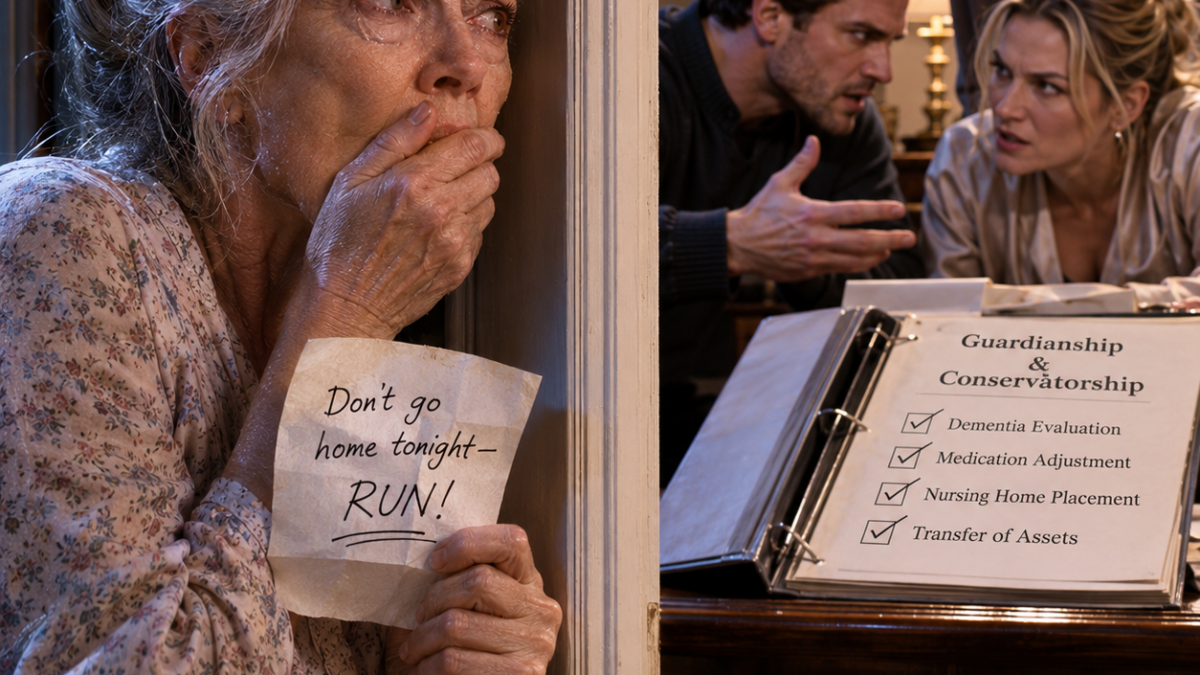
FULL STORY CONTINUATION
“I told him everything,” Vivian whispered sharply. “That she forgets conversations. That she leaves the stove on. That sometimes she doesn’t recognize people.”
I pressed my back against the hallway wall.
None of it was true.
Not one word.
Brandon answered in the calm voice he had used since he was a teenager whenever he believed a problem could be solved if everyone else simply listened to him.
“Then we find another doctor.”
Paisley sounded impatient.
“How long is this going to take?”
“Quiet.”
“No, Dad. Seriously. I already reserved my place at the university. I need money for housing and tuition.”
Vivian sighed.
“She could live another fifteen years.”
Something inside my chest tightened.
My own daughter-in-law said it as if discussing a broken appliance that refused to stop working.
Brandon lowered his voice.
“We are not talking about her dying.”
“You are,” Vivian replied. “Every time you say eventually. Eventually the house. Eventually the pension. Eventually the investments. Eventually everything. I’m tired of eventually.”
“The house alone is worth close to half a million.”
That was my son.
My son discussing the market value of the home Harold and I had bought when Brandon was still small enough to need a night-light.
“And the savings?” Paisley asked.
“Enough.”
“Enough for college?”
“Yes.”
My granddaughter laughed softly.
I clamped one hand over my mouth.
They thought I had maybe two hundred thousand dollars in retirement accounts.
A paid-off house.
Pension.
Nothing extraordinary.
They had no idea.
Vivian continued.
“I did not marry into this family so I could spend my fifties taking care of an old woman.”
“You don’t take care of me,” I whispered to the empty hallway.
I cooked.
I cleaned my own room.
I paid utilities.
I bought groceries.
I still drove.
I still handled every account.
But facts had stopped mattering.
Brandon said, “I’ll talk to the lawyer tomorrow.”
“What will you ask?” Paisley said.
“Whether we can petition for guardianship without a doctor’s certificate.”
“And if we can’t?”
A pause.
Then my son answered.
“Plan B.”
My skin prickled.
Vivian almost sounded excited.
“Tell her.”
“Dad?”
Brandon sighed.
“We create evidence.”
Silence.
“What kind?”
“We make mistakes happen around her.”
I felt myself becoming colder.
“Hide her keys.”
Vivian added, “Move her things.”
“Tell her she put them somewhere.”
“Change the clock.”
Paisley laughed nervously.
“That’s messed up.”
“You want college paid for?”
That silenced her.
Brandon continued.
“Switch medications.”
My knees weakened.
“Not enough to hurt her.”
Vivian said, “Just enough to make her groggy.”
“Exactly.”
“Then tell the doctor she is confused.”
“Leave the stove on.”
“Turn water on in the bathroom.”
“Tell her she did it.”
“Record her when she’s upset.”
Every sentence was another shovel of dirt thrown over the woman they were preparing to bury alive.
Paisley spoke again.
“What if Grandma figures it out?”
Brandon laughed.
The sound almost made me collapse.
“She trusts us too much.”
Vivian answered:
“She doesn’t have anyone else.”
Another laugh.
“No siblings.”
“No close friends.”
“Nothing.”
“She made this family her whole life.”
My son said:
“That’s what makes this possible.”
I closed my eyes.
Forty-five years.
I had raised that voice.
Fed it.
Protected it.
Paid for braces.
College.
A wedding.
Helped with debt.
Held Brandon when Harold died.
Listened while he sobbed that he didn’t know how to live without his father.
And now my devotion had become tactical weakness.
Paisley asked:
“Once she’s in the home, what happens?”
Vivian answered immediately.
“We get power over the accounts.”
“Sell the house.”
“Use her pension.”
“And the will?” Paisley asked.
Brandon said, “I’ll find it.”
“And if she didn’t leave everything to us?”
“We change it.”
My body went numb.
“Change it how?”
“Grandma signs another one.”
“What if she refuses?”
“She won’t know what she’s signing.”
Vivian laughed.
“Or someone signs it for her.”
The three of them laughed.
All three.
I had thought nothing could hurt worse than hearing Brandon talk about driving me insane.
Then Paisley laughed.
The girl I had taught to bake.
The little child who slept in my bed during thunderstorms.
The granddaughter whose first prom dress I had bought.
She laughed about forging my will.
Something broke.
Not my heart.
That had broken ten minutes earlier.
This was different.
Something soft inside me disappeared.
The part that automatically excused them.
The part that said Brandon is stressed.
Vivian is ambitious.
Paisley is young.
The part that had spent decades converting other people’s cruelty into explanations I could survive.
Gone.
I returned to my room.
Closed the door.
Sat on the floor.
Dr. Elliot’s note remained clenched in my hand.
Run.
I finally understood.
I opened the bottom desk drawer.
Behind old tax files was a black notebook Harold had given me two months before he died.
It contained information Brandon had never seen.
Harold had been much more successful than our family realized.
Not flashy.
Not publicly wealthy.
But careful.
He had bought property overseas through an adviser.
Invested.
Saved.
Diversified.
Shortly before his death, he told me:
“Martha, don’t tell Brandon everything.”
I had been offended.
“He’s our son.”
“I know.”
“Why hide it?”
“Because a person should become who they are before they know what they might inherit.”
At the time I thought Harold was being cynical.
Now I wished I could kiss him for it.
Two point two million dollars in cash and investments sat in accounts Brandon did not know existed.
Three foreign properties were worth roughly another one and a half million.
Almost four million dollars.
Not billionaire money.
Not fantasy money.
But enough to hire people who knew how to fight.
Enough to disappear safely.
Enough that my family had badly miscalculated the woman they considered dependent.
At five in the morning, I packed.
Not much.
Documents.
Medication.
Passport.
Three outfits.
The black notebook.
Harold’s photograph.
Then I turned on my phone recorder.
I walked slowly past Brandon and Vivian’s bedroom.
They were already awake.
Vivian whispered:
“First thing today, I’m copying her cards.”
Brandon said:
“I’m meeting the lawyer at nine.”
“What if she asks where you’re going?”
“Work.”
“She believes everything.”
Then he laughed.
“She’s too old and trusting.”
I stood outside their door.
Recording every word.
Vivian said:
“Sometimes I almost feel sorry for her.”
“Why?”
“She’s completely dependent on us.”
Brandon snorted.
“She chose that.”
“She could have remarried.”
“She could have made friends.”
“Instead she made being a mother her whole identity.”
“Now it’s going to cost her.”
I stopped recording.
Returned to my bedroom.
Closed the suitcase.
Then I left a note on the kitchen table.
Running errands. Back later.
Martha.
I walked out at 5:42 in the morning.
No dramatic goodbye.
No final look.
I had already looked too long.
The taxi dropped me at a Manhattan bank shortly after opening.
I moved money.
Changed contact instructions.
Requested additional fraud protections.
Then withdrew ten thousand dollars in cash.
The teller looked concerned.
“Mrs. Caldwell, is someone asking you to withdraw this?”
“Yes.”
Her posture changed immediately.
“Who?”
“Me.”
She relaxed only slightly.
“Are you safe?”
That question nearly made me cry.
A stranger cared enough to ask.
My own son was planning to drug me.
“Yes.”
I swallowed.
“I will be.”
From the bank, I went to the Plaza.
The suite felt almost obscene after the night I had lived through.
White sheets.
Flowers.
Silence.
City view.
I locked the door.
Put the chain on.
Then collapsed.
For two hours, I cried.
Not beautifully.
No quiet tears.
I cried until my throat hurt.
For Brandon at two.
For the adoption papers.
For Harold bringing him home.
For the first time Brandon called me Mommy.
For his scraped knees.
His graduation.
His wedding.
The day Paisley was born.
I cried because memories do not disappear when the people inside them become dangerous.
That is one of betrayal’s cruelties.
The good times remain true.
So do the terrible ones.
You cannot simply repaint forty-five years.
By noon, I was empty.
Then anger arrived.
Clean.
Cold.
Useful.
I sat at the desk.
Wrote five things.
Protect my assets.
Find the best attorney.
Document everything.
Investigate.
Do not go home alone.
Brandon started calling at 1:47.
I watched the phone buzz.
Again.
Again.
Again.
Finally, I answered.
“Mom?”
“Yes.”
“Where are you?”
“Out.”
“That isn’t an answer.”
“It is the answer you’re getting.”
Silence.
“What is going on with you?”
“Nothing.”
“You’ve never just disappeared.”
“I did not disappear.”
“You left a note saying errands.”
“Yes.”
“You’ve been gone eight hours.”
“I know.”
“Where are you?”
“Manhattan.”
“What?”
“I needed time.”
His voice hardened.
“Time for what?”
“Myself.”
Another silence.
“Mom, are you taking your medication correctly?”
There it was.
My first opportunity to test what I had heard.
“Yes.”
“All of it?”
“Yes.”
“You don’t sound like yourself.”
I smiled.
“Maybe you don’t know me as well as you think.”
“That’s exactly the kind of thing I mean.”
“Meaning?”
“Erratic.”
He chose the word carefully.
Clinical.
Useful later.
I almost admired him.
“I’m seventy, Brandon.”
“I know.”
“I have the right to spend a day in Manhattan.”
“No one said you didn’t.”
“You are asking my location like I escaped custody.”
“That is not fair.”
“No.”
I looked out at Central Park.
“What you were planning last night wasn’t fair.”
He stopped breathing.
“What?”
I let silence hang.
Then said:
“I’ll call you later.”
“Mom.”
I hung up.
Turned off my phone.
At three, I met Galen Maxwell.
I had chosen his firm because it had a separate elder-law and financial-fraud group.
He was not warm.
Good.
I did not need warmth.
I needed competence.
He listened to Dr. Elliot’s note first.
Then the recording.
By the time Brandon’s voice said switch medications, Galen had stopped taking notes.
When the recording ended, he leaned back.
“How long has this been happening?”
“I discovered it last night.”
“Anything before that?”
“Strange things.”
“Financial access?”
“They know some.”
“Power of attorney?”
“No.”
“Joint accounts?”
“One household account with small balance.”
“Property?”
“In my name.”
“Will?”
“Private.”
“Who has original?”
“My attorney from years ago.”
“Good.”
I told him about the secret money.
He asked:
“How much?”
“About 3.7 million total depending on property valuations.”
His pen stopped.
“Does Brandon know?”
“No.”
“Vivian?”
“No.”
“Anyone?”
“Financial adviser.”
He stared at me for a moment.
Then said:
“This is important.”
“Why?”
“Because they believe your financial ability to defend yourself is limited.”
“Yes.”
“They will likely become bolder.”
“I don’t want bold.”
“You want evidence.”
I understood what he meant.
Galen leaned forward.
“Martha, this may involve attempted guardianship abuse, conspiracy, identity theft, forgery, financial exploitation, coercion.”
“Can we arrest them?”
“Not for discussing ugly ideas.”
My anger flared.
“They discussed drugging me.”
“We preserve that.”
“Then what?”
“We find what they have already done.”
That afternoon, he introduced me to Daniel Reese.
Daniel did not look like the private investigators in movies.
No trench coat.
No dramatic voice.
Khaki pants.
Gray jacket.
Ordinary glasses.
He looked like a man who might sell insurance.
Perfect.
He asked for family names.
Businesses.
Vehicles.
Known debts.
Doctors.
Neighbors.
Social media.
Then:
“Do you want us to investigate your granddaughter too?”
I hesitated.
Paisley.
Nineteen.
Still my baby in some stupid part of me.
“She laughed.”
My voice broke.
Daniel understood.
“Yes.”
I closed my eyes.
“Everyone.”
That night, I turned my phone back on.
Sixty missed communications.
Brandon.
Vivian.
Paisley.
Messages became progressively more revealing.
First:
We love you.
Then:
You’re worrying us.
Then:
Your behavior is frightening.
Then:
We may need to contact authorities for your safety.
I saved everything.
Screenshots.
Backups.
Galen’s staff archived them.
I replied once.
I am safe.
Brandon immediately called.
I answered.
“Come home.”
“No.”
“Why?”
“I am comfortable.”
“Mom, this is not normal.”
“Which part?”
“Staying in a hotel.”
“How do you know I’m in a hotel?”
Silence.
I smiled coldly.
Vivian must have guessed.
Or tracked something.
“Brandon?”
“I assumed.”
“Interesting.”
“Mom, we are trying to help.”
“Then let me rest.”
“You need family around you.”
“I have spent forty-five years around family.”
My voice trembled.
“I think I can survive one week with myself.”
The next morning, Galen called at seven-thirty.
“We found credit cards.”
I sat upright.
“What cards?”
“Five accounts.”
“I have two.”
“Not these.”
My body chilled.
“Total balance?”
“Forty-three thousand.”
The room tilted.
“Where were they mailed?”
“Three to Vivian’s office. Two paperless.”
“What purchases?”
“Luxury retail.”
“Restaurants.”
“Miami hotel.”
I closed my eyes.
“Miami.”
“Yes.”
Three months earlier, Vivian had cried at breakfast.
Her mother was supposedly ill.
They needed to travel.
I gave them two thousand dollars.
“Daniel confirmed Brandon and Vivian traveled there together.”
“What about Paisley?”
“She went too.”
All three.
A family vacation.
Paid partly with credit stolen in my name.
Plus the cash I voluntarily gave them because I thought someone was sick.
I felt stupid.
Galen must have heard it in my silence.
“Martha.”
“I gave them money too.”
“That doesn’t make you stupid.”
“It makes me blind.”
“It makes them practiced.”
I appreciated the distinction.
Then he told me Brandon lost his job eight months ago.
I actually stood.
“No.”
“We verified.”
“He leaves every morning.”
“Coworking space. Cafes. Gym.”
“He comes home complaining about his boss.”
“Apparently imaginary now.”
I sat again.
Eight months of lies performed daily.
Tie.
Briefcase.
Kiss on my cheek.
“See you tonight, Mom.”
“What else?”
“Three doctors contacted.”
“For me?”
“Yes.”
“By Brandon?”
“Two by him. One by Vivian.”
“What did they ask?”
“Whether cognitive decline could be certified based on family reports.”
My hand tightened around the phone.
“Responses?”
“All refused without examination.”
“Good.”
“There is more.”
“Of course.”
Paisley was pregnant.
Three months.
The father was a married man around fifty.
Apparently a professor or businessman connected with a friend group.
He wanted no involvement.
My first reaction was pain.
Pure grandmother instinct.
My second was anger.
She had stood in my kitchen asking how quickly I could be institutionalized while carrying a child she was terrified to tell anyone about.
Then Vivian.
Affair.
Neighbor David.
Two years.
Tuesdays and Thursdays.
The days she supposedly attended yoga.
I thought about David’s wife Carol.
Sweet woman.
Brought soup when I had pneumonia.
I hated knowing.
“Document it.”
I said.
“Everything.”
Galen warned:
“Some of this may be irrelevant legally.”
“I understand.”
“Do not use irrelevant personal information as revenge.”
“I won’t.”
And I meant it.
I wanted justice.
Not chaos.
But I needed to know the truth about the people fighting me.
For years they had known everything about me.
Medication.
Accounts.
Habits.
Fear of dementia.
Weaknesses.
It was time for the balance to change.
That afternoon, I bought clothes.
It sounds shallow compared with fraud and elder abuse.
It wasn’t.
For years, every clothing decision started with:
Is it practical?
Can I cook in it?
Can I bend to pick up toys?
Will Vivian say it is too bright?
That day I bought a red dress because I liked the woman wearing it in the mirror.
An emerald one because it made my eyes look greener.
A black dress because it made my shoulders look strong.
Sophia, the hairstylist, asked:
“When did you last do something different?”
“I don’t remember.”
She smiled sadly.
“Then today.”
When she finished, I stared at myself.
Not younger.
I did not want younger.
I wanted visible.
I looked visible.
That night I called Brandon and recorded it.
He answered on the first ring.
“Mom, finally.”
“Hello.”
“Where are you?”
“Taking care of myself.”
“This is childish.”
“Is it?”
“You cannot vanish for days.”
“I did.”
“That’s exactly why we are worried.”
“Because I took a hotel room?”
“Because you have changed.”
“What do you think I need?”
He hesitated.
“A specialist.”
“What kind?”
“A psychiatrist.”
I closed my eyes.
Proof.
Not enough for court.
Enough for me.
“What would the psychiatrist do?”
“Evaluate you.”
“For what?”
“Mom.”
“For what, Brandon?”
“Memory.”
“Competency?”
Silence.
“I didn’t say that.”
“You didn’t have to.”
“Please come home.”
“No.”
“Why are you doing this?”
I spoke slowly.
“Because I know.”
He stopped.
“Know what?”
“The cards.”
Silence.
“Forty-three thousand dollars.”
“I don’t know what you’re talking about.”
“Miami.”
“Mom.”
“Your job.”
Longer silence.
“Eight months.”
His breathing became audible.
“Who is feeding you this garbage?”
“Doctors.”
“What doctors?”
“The ones you contacted.”
That did it.
“Mom, listen—”
“No.”
I leaned forward.
“You listen.”
I played part of my recording through another device.
His own voice.
Switch her medication.
He stopped breathing.
Then:
“You recorded us?”
“Yes.”
“That is illegal.”
“Maybe.”
I knew Galen had already reviewed state law.
“Maybe not.”
“You were spying.”
“You were planning to chemically manipulate me.”
“We were talking hypothetically.”
“Really?”
“Yes.”
“So you admit it was your voice.”
Silence.
“Brandon.”
“Come home.”
“No.”
“We can explain.”
“I’ll give you one chance.”
“For what?”
“Tell me everything.”
“There is nothing.”
“Return every dollar.”
“Nothing was stolen.”
“Then we are finished.”
“Mom, don’t do this.”
“Do what?”
“Destroy the family.”
I laughed.
A hard, unfamiliar sound.
“You were discussing locking me away.”
“That wasn’t—”
“You were discussing changing my medicine.”
“Vivian said—”
“You agreed.”
He became quiet.
“Good night, son.”
“Mom.”
“I’ll see you through lawyers.”
I hung up.
For the first time, I slept eight hours.
The following week, their behavior escalated.
Brandon went to my bank.
He claimed I had suffered a psychotic episode.
The bank manager refused access.
Security eventually asked him to leave.
Vivian listed two antique chairs online.
A sideboard.
A silver tea service.
My mother’s jewelry was photographed at a pawn shop.
The clerk refused to buy some pieces because Vivian could not prove ownership.
Paisley told friends I had advanced Alzheimer’s.
Then borrowed money for my supposed medical bills.
I stared at Daniel’s report.
“She is fundraising off my fake dementia?”
“Yes.”
“How much?”
“Several thousand.”
I closed the folder.
“God.”
Then Daniel told us about Paul Harding.
Known document forger.
Medical paperwork.
Signatures.
Fake histories.
Brandon, Vivian, and Paisley had met him in my dining room.
“Can you prove it?”
“Photographs.”
“Audio?”
“Not yet.”
Galen said:
“We need them to make a move.”
“I don’t like waiting.”
“Neither do prosecutors.”
“What do you propose?”
The plan was simple.
Create a situation where they attempted to exercise authority they did not possess.
Real estate.
My house.
Daniel discovered Brandon had contacted a brokerage.
So I arranged an appointment at the same firm.
Not to trap them illegally.
Simply to be present when they lied.
Monday morning, I wore the black dress.
Pearls that actually belonged to me.
My hair done.
Roger, the realtor, showed me a Hamptons property.
One point five million.
Beautiful.
Cold.
Not my taste.
We returned to the office.
There they were.
Brandon.
Vivian.
Paisley.
Speaking to another agent.
Brandon said:
“My mother is ill.”
The words carried across the lobby.
The agent asked:
“Do you hold power of attorney?”
“We’re finalizing it.”
Vivian smiled.
“The situation is urgent.”
“Has your mother authorized the sale?”
Vivian lowered her voice.
“She doesn’t really understand enough to authorize anything.”
I stepped onto the staircase.
“That’s fascinating.”
Three heads turned.
Brandon’s face went white.
Paisley whispered:
“Grandma.”
Vivian recovered first.
“Martha.”
I descended.
“What are you doing?”
“Looking at property.”
Roger joined me.
“We just toured the Whitmore estate.”
The other agent recognized the address.
“That’s listed at one point five.”
Paisley stared at me.
“One point five million?”
I looked at her.
“Yes.”
Brandon stepped toward me.
“Mom, we need to talk privately.”
“No.”
“Please.”
“No.”
His jaw tightened.
“You are proving our concern.”
“How?”
“Showing up places.”
I smiled.
“At a public real-estate office?”
“You followed us.”
“No.”
I turned to the agent.
“Did they tell you they have authority to sell my house?”
The agent looked uncomfortable.
“They said paperwork was being finalized.”
“It isn’t.”
Vivian interrupted.
“She doesn’t understand the legal process.”
“Do I understand that I own the house?”
People nearby turned.
Roger looked between us.
I raised my voice.
“Do I understand that no one here has power of attorney over me?”
Brandon whispered:
“Stop.”
“Do I understand that your wife has opened credit cards in my name?”
Vivian’s face changed.
“That is a lie.”
“Good.”
I smiled.
“Then you won’t mind lawyers reviewing it.”
I called Galen.
His associates arrived fifteen minutes later.
Two attorneys.
One notary.
Everything became formal immediately.
One lawyer addressed Brandon.
“Sir, please produce any document authorizing you to offer Mrs. Caldwell’s property for sale.”
Brandon said:
“We’re processing—”
“So none.”
“We are concerned about her competency.”
“Has a court found her incompetent?”
“No.”
“Any guardianship order?”
“No.”
“Power of attorney?”
“No.”
“Then you have no authority.”
Vivian snapped:
“She needs help.”
I took out my phone.
Played the recording.
My son’s voice filled the lobby.
We hide her things.
Brandon closed his eyes.
Switch medications.
Paisley began crying.
Any doctor will certify dementia.
People stopped pretending not to listen.
When it ended, Vivian shouted:
“You manipulated that!”
“No.”
“You edited it!”
“Then explain the original to investigators.”
The brokerage agent stepped away from them.
“We will not participate in any attempted transaction involving this property.”
Brandon came toward me.
One lawyer moved between us.
“Mom.”
I looked at him.
His eyes were desperate.
“This has gone too far.”
“Yes.”
“Come home.”
“No.”
“We can fix it.”
“No.”
Paisley cried:
“Grandma, please.”
I looked at her.
“Please what?”
Her mouth opened.
Nothing came.
Vivian finally broke.
“You bitter old woman.”
Everyone turned.
There she was.
The real Vivian.
“You have controlled Brandon his entire life.”
I said nothing.
“You adopted him because you needed a child.”
I felt the blow.
“You couldn’t have your own.”
Silence.
“So stop acting like some saint.”
I stared at her.
She continued.
“You chose every sacrifice.”
“Yes.”
“No one forced you.”
“No.”
“Then stop demanding repayment.”
I spoke quietly.
“I never demanded gratitude.”
“Bull.”
“I demanded only three things.”
She laughed bitterly.
“What?”
“Do not steal from me.”
Silence.
“Do not lie about my health.”
She looked away.
“And do not attempt to chemically manipulate me so you can take my property.”
Nobody spoke.
I stepped into the taxi.
Vivian shouted:
“Brandon gave you the best years of his life!”
I leaned toward the open window.
“No.”
My voice stayed calm.
“I gave him mine.”
Then the taxi pulled away.
That afternoon, Galen summoned me.
He looked almost excited.
“Your son panicked.”
“What did he do?”
“Paid Harding.”
“How much?”
“Fifty thousand.”
“With what?”
“Fraudulent credit.”
I rubbed my forehead.
“And Vivian sold her car.”
“For forged documents?”
“Yes.”
Then Galen smiled.
“Harding is cooperating with the FBI.”
I stared.
“What?”
“He has been an informant for six months.”
“Did he record Brandon?”
“Audio and video.”
I sat back.
Everything had shifted.
Up until that moment, most evidence showed planning.
Fraudulent cards.
Impersonation.
Attempted property sales.
Now there was a direct transaction for forged medical evidence.
I should have felt triumphant.
Instead I felt sick.
“That is my son.”
Galen’s expression softened.
“I know.”
“He paid a criminal fifty thousand dollars to manufacture proof that I am insane.”
“Yes.”
“Why doesn’t that feel real when I say it?”
“Because love and evidence live in different parts of the mind.”
I looked at him.
“You say things like a therapist.”
“I charge more.”
I laughed.
It surprised me.
That evening, I made the decision to speak publicly.
Not because Galen recommended it.
He actually warned me.
“Anything public can complicate litigation.”
“I’ll avoid protected evidence.”
“Don’t reveal investigative details.”
“I won’t.”
“Don’t accuse anyone of things we cannot prove.”
“I understand.”
“Why do this?”
I thought of the bank teller.
Dr. Elliot.
People who had quietly noticed something and acted.
“Because if this happened to me, it is happening to others.”
I went live from the hotel.
Three viewers.
Then twenty.
Then hundreds.
“My name is Martha Caldwell.”
I told them about Dr. Elliot’s note.
About hearing the conversation.
About fake dementia.
I played only recordings Galen had cleared.
I explained how financial exploitation can begin inside ordinary families.
The number climbed.
Five hundred.
A thousand.
Three thousand.
Messages flooded.
My brother did this to our mother.
My daughter has my debit card.
How do I freeze my credit?
Please keep talking.
Then Paisley called.
I answered publicly only after telling her she was on speaker.
“Grandma, stop.”
“Why?”
“Everybody is watching.”
“Yes.”
“My friends.”
“Yes.”
“My school.”
“Yes.”
“You’re ruining my life.”
Something in me snapped.
Not completely.
Enough.
“Do you know what being ruined feels like, Paisley?”
She went silent.
“It is standing outside your bedroom hearing the granddaughter you raised ask how soon she can get money once you’re locked away.”
“I didn’t say—”
“You were there.”
“I didn’t know everything.”
“You knew enough.”
“I need college.”
“There are loans.”
“You have money.”
There it was.
Not love.
Not apology.
Entitlement.
“Is my money yours?”
“No.”
“Then why did you plan around it?”
“I thought—”
“What?”
She cried.
“I thought you would help.”
“I would have.”
Silence.
“I would have helped you, Paisley.”
That hurt her.
“I probably would have paid tuition gladly.”
“Grandma—”
“But you were willing to help destroy me to guarantee it.”
She hung up.
Five minutes later, Brandon called.
He did not cry.
He screamed.
“Turn it off!”
“Hello, Brandon.”
“This is slander.”
“Which statement?”
“You’re making us look like criminals.”
I stared at the camera.
“Did you pay Paul Harding fifty thousand dollars yesterday?”
Silence.
Thousands of people watched the silence.
“How do you know that?”
He realized too late.
He had not denied it.
“Because Paul Harding is cooperating with federal authorities.”
“You’re lying.”
“Ask your lawyer.”
His voice changed instantly.
“Mom.”
“Yes?”
“Please.”
There was my little boy again.
For one dangerous second, my heart opened.
Then I remembered:
Switch her medication.
“We can work this out.”
“No.”
“Don’t do this publicly.”
“You were willing to destroy me privately.”
“Mom.”
“We are family.”
“No.”
His breath shook.
“You can’t just erase forty-five years.”
“I’m not.”
I swallowed.
“I remember every one of them.”
That was worse.
He said:
“We have debts.”
“I know.”
“We need money.”
“Earn it.”
“You don’t understand.”
“Then explain.”
Silence.
“Why was I acceptable collateral?”
“It wasn’t personal.”
Those words.
Quiet.
Almost impatient.
“It wasn’t personal.”
I repeated them.
Forty-five years.
Not personal.
Every birthday.
Not personal.
Adoption.
Not personal.
Harold.
Not personal.
My home.
My mind.
My medicine.
Not personal.
Something final happened inside me.
“All right.”
My voice steadied.
“Then from now on, neither is the legal process.”
I ended the call.
Seven thousand people had watched.
The next morning, clips were everywhere.
I hated it.
My face.
My pain.
Strangers discussing my family.
But then messages arrived.
One woman discovered unauthorized transfers from her father’s account.
Another froze her credit.
A social worker wrote:
Your video gave one of my clients enough courage to tell me her son has been withholding medication.
That changed how I felt.
Pain converted into warning becomes something else.
Not worth it.
Never worth it.
But useful.
Galen called.
“The district attorney wants the evidence.”
“Give it.”
“They also noted admissions during the stream.”
“Good.”
“Your family retained expensive counsel.”
“With what?”
He hesitated.
“More fraud.”
My stomach tightened.
Vivian had forged documents showing herself as co-owner of my house.
She had obtained a $200,000 loan.
Three weeks earlier.
“On my house?”
“Yes.”
“Spent?”
“Most.”
Harding.
Lawyers.
Credit debt.
Other creditors.
I stood at the hotel window.
The house Harold and I bought.
Mortgaged by a woman who did not own one brick.
“I want my things.”
“From the house?”
“Yes.”
“Not alone.”
“I know.”
We went with two attorneys and a court officer.
The lawn was overgrown.
Trash near the porch.
My home looked abandoned while three adults still lived inside.
Brandon opened the door.
“Mom?”
“I am collecting personal belongings.”
Vivian appeared behind him.
Hair unwashed.
Pajamas.
“You cannot come in.”
The court officer stepped forward.
“Mrs. Caldwell is the legal owner.”
Vivian folded her arms.
“We live here.”
“Occupancy does not equal ownership.”
I entered.
Takeout boxes.
Empty bottles.
Clothes.
Dishes.
For decades, I had kept that house clean enough that Harold joked visitors could perform surgery on the kitchen floor.
Now it smelled stale.
I climbed upstairs.
My bedroom had been ransacked.
Drawers open.
Mattress moved.
Closet boxes emptied.
They had searched everything.
“For what?”
Brandon stood at the door.
“What?”
“What were you looking for?”
“Nothing.”
“Accounts?”
“No.”
“Will?”
“No.”
“Cash?”
“Mom.”
I opened my jewelry box.
Empty spaces.
Diamond earrings.
Pearls.
Emerald bracelet.
Second engagement ring.
Gone.
I looked at Vivian.
“Where are they?”
“What jewelry?”
I called Daniel.
Speakerphone.
“List what she attempted to sell.”
He did.
Every missing piece.
Vivian went gray.
Brandon turned toward her.
“You sold Mom’s jewelry?”
“No.”
“Daniel has photographs.”
“They’re somewhere safe.”
“Where?”
No answer.
The officer began taking notes.
I packed photographs.
Harold’s watch.
Letters.
Documents.
Then, while I was upstairs, I heard frantic voices below.
Brandon:
“We have to get the jewelry back.”
Vivian:
“I can’t.”
Paisley:
“Why?”
“I sold it.”
Brandon swore.
“All of it?”
“We needed money.”
“How much did you get?”
“About fifty.”
“They were worth more than a hundred.”
I stepped into the kitchen.
Everyone froze.
“So you knew.”
Vivian’s face collapsed.
“Mom—”
“That is what you called me when you wanted forgiveness.”
She stopped.
“The earrings were Harold’s twentieth-anniversary gift.”
Silence.
“The pearls were my mother’s.”
Paisley cried.
“I didn’t know.”
“You didn’t know?”
“I thought they were old.”
“Old things.”
She looked at me.
I said:
“Like me?”
She began sobbing.
That broke something in me again.
Not compassion.
A realization.
They had stopped assigning value to anything whose usefulness they could not immediately measure.
Jewelry.
House.
Me.
I closed the final box.
At the front door, Brandon pleaded:
“Mom, please.”
I turned.
“We can still be a family.”
“No.”
His face crumpled.
“Family is not a word you shout when consequences arrive.”
I stepped outside.
“It is what you protect before they do.”
Then I left.
Two days later, Harding was arrested.
During interrogation, he confessed.
Medical records.
Doctor signatures.
False cognitive history.
And a forged will.
That one made me physically ill.
“What will?”
Galen slid a copy across the table.
It appeared to leave everything to Brandon.
Signed by me.
Not my signature.
Declared that I had become forgetful but wished my son to control everything.
Harding said Vivian first contacted him four months earlier.
Four months.
This was not panic.
Not a bad week.
Not desperation after I ran.
Premeditation.
I went back to the hotel.
Closed the curtains.
Sat on the floor.
For the first time since leaving, I did not want revenge.
I did not want justice.
I wanted Harold.
I wanted my husband sitting beside me.
I wanted him to tell me what to do.
I wanted the world where Brandon was still a little boy and none of this had happened.
But dead people do not return because the living disappoint you.
So I cried.
Then got up.
Washed my face.
And continued.
Paisley called the next afternoon.
“Grandma.”
“What?”
“Please don’t hang up.”
I nearly did.
“Five minutes.”
“I need to tell you everything.”
“Public place.”
“Yes.”
“Recorded.”
“Yes.”
“No lies.”
“I swear.”
We met in the hotel coffee shop.
She looked terrible.
Not fashionable.
Not polished.
Nineteen.
Finally nineteen.
“Start.”
She twisted a napkin.
“At first they really did talk about a nice home.”
I said nothing.
“They said you’d be happier.”
“Did I say I was unhappy?”
“No.”
“Continue.”
“Mom started looking through your papers.”
“When?”
“Months ago.”
“What did she find?”
“Pension.”
“House.”
“Savings.”
“She called the bank pretending to be me?”
Paisley nodded.
I closed my eyes.
“Dad lost money gambling.”
“How much?”
“Over a hundred thousand.”
There it was.
The urgency.
“Does he owe banks?”
“Some.”
“Others?”
She looked frightened.
“People.”
Dangerous people.
“So Vivian needed money to save Brandon.”
“And herself.”
“What does that mean?”
“Her business wasn’t doing well.”
I already knew.
Paisley touched her stomach.
I watched.
“Tell me.”
She cried.
“I’m pregnant.”
“I know.”
Her face shot up.
“How?”
“Investigator.”
She covered her face.
The father was fifty.
Married.
He wanted nothing to do with the child.
“I was scared.”
“I understand being scared.”
“I thought if we got money—”
“You thought stealing mine would solve your fear.”
She cried harder.
“I didn’t know they planned the medication.”
“But you knew they wanted me declared incompetent.”
“Yes.”
“And you were okay with that?”
“I thought…”
“What?”
“That you’d still be cared for.”
I leaned forward.
“Paisley, look at me.”
She did.
“If I falsely had you declared mentally ill, controlled your accounts, took your baby, sold your belongings, and locked you somewhere comfortable, would you call that care?”
Her face collapsed.
“No.”
“Then don’t use that word.”
She nodded.
“I’m sorry.”
I did not answer.
“Why now?”
Her mouth trembled.
“Dad and Mom are going to blame me.”
“For what?”
“The jewelry.”
My stomach tightened.
“Drugs too.”
“Do you use drugs?”
“No.”
“They’re going to say I manipulated them.”
She pulled out her phone.
“I recorded them.”
Texts.
Arguments.
Vivian counting jewelry money.
Brandon saying:
“If everything collapses, we say Paisley needed cash.”
My son was preparing to sacrifice his own daughter.
The pattern completed itself.
He had been willing to sacrifice me.
Now Paisley.
Anyone who stood between him and consequences.
“Why did you record it?”
“Because I realized I was next.”
She looked at me.
“No matter what happens, they’re going to save themselves.”
“Yes.”
“What do you want from me?”
She swallowed.
“Help finishing school.”
“What else?”
“Help with the pregnancy.”
“What else?”
Her eyes filled.
“Teach me.”
“What?”
“How not to become them.”
That answer reached somewhere the others hadn’t.
I did not forgive her then.
But I believed she might still become different.
“Testify.”
She nodded.
“Tell the entire truth.”
“Yes.”
“Your part too.”
She flinched.
“Yes.”
“No deal where you become innocent.”
“I understand.”
“I will help you because you are my granddaughter.”
She started crying again.
“Not as payment.”
“Yes.”
“You do the right thing because it is right.”
“I will.”
I held out my hand.
She took it.
“Then start now.”
The trial began three weeks later.
By then, the case was national news.
I hated the cameras.
I hated headlines calling me “Millionaire Grandma.”
As if money was the story.
It wasn’t.
The story was trust.
The prosecutor opened with audio.
My family’s voices filled the courtroom.
Switch her medication.
Vivian closed her eyes.
Hide her things.
Brandon looked at the table.
Any doctor will certify dementia.
Jurors shifted.
Then the credit cards.
Forty-three thousand dollars.
Then the fraudulent mortgage.
Two hundred thousand.
Then Harding.
He testified about the fifty-thousand-dollar payment.
He described the requested medical history.
The forged doctor’s letters.
The will.
The prosecutor asked:
“What was the purpose of the documents?”
Harding answered:
“To establish that Mrs. Caldwell could not manage her own affairs.”
“And then?”
“Her son would seek legal control.”
“And the will?”
“To guarantee inheritance if she died while under care.”
I stared at Brandon.
He did not look at me.
Paisley testified on the third day.
My granddaughter walked to the stand wearing a simple navy dress.
No dramatic makeup.
No performance.
She swore to tell the truth.
The prosecutor asked:
“When did you first hear discussions about placing your grandmother in care?”
“Months before she left.”
“What did you understand?”
“That my parents wanted access to her money.”
“Did you want some of that money?”
“Yes.”
Her honesty mattered.
“For what?”
“College.”
She swallowed.
“And because I was pregnant and scared.”
The prosecutor did not rescue her.
“Did you participate?”
“Yes.”
“How?”
“I repeated lies about her memory.”
My chest hurt.
“I borrowed money telling people she was sick.”
“Did you know she was not?”
“Yes.”
“Did you hear plans to alter medication?”
“Yes.”
“What did you do?”
“Nothing.”
Silence.
“Why testify now?”
Paisley looked toward Brandon and Vivian.
Then me.
“Because doing nothing is how it got this far.”
The defense attorney attacked.
“You’re pregnant.”
“Yes.”
“You need money.”
“Yes.”
“Your grandmother has millions.”
“Yes.”
“She promised to help.”
“Yes.”
“So your testimony has financial benefit.”
Paisley shook her head.
“No.”
“She did promise money?”
“She promised support.”
“What’s the difference?”
Paisley looked directly at him.
“The difference is I don’t get to steal it.”
I almost cried.
He pushed harder.
“Your grandmother offered help after you agreed to testify.”
“No.”
“You expect her to pay your college.”
“I hope she’ll help me.”
“So you benefit.”
Paisley paused.
“My grandmother would have helped me before all this if I had just asked.”
The courtroom went silent.
“That is the worst part.”
I covered my mouth.
“She would have helped.”
Paisley cried.
“And I still helped them hurt her.”
The defense attorney stopped.
Sometimes truth has a weight cross-examination cannot move.
When it was my turn, I walked to the stand.
Seventy years old.
Back straight.
Hands steady.
The prosecutor asked:
“How did you feel when you heard the recording?”
“Like I had misunderstood forty-five years of my own life.”
“What do you mean?”
“I thought sacrifice built love.”
I looked at Brandon.
“I learned sacrifice without boundaries can build entitlement.”
He looked down.
“What did you lose?”
“Trust.”
“Money?”
“Money can be replaced.”
“Property?”
“Property can be restored.”
“What couldn’t?”
I swallowed.
“The certainty that my son loved me.”
Brandon finally looked at me.
His face broke.
I continued.
“They made me question whether every Christmas, every birthday, every hug had been real.”
The prosecutor asked:
“Do you believe none of it was real?”
I thought.
“No.”
That surprised everyone.
“I think some of it was.”
Silence.
“That may be what hurts most.”
The defense lawyer approached.
“Mrs. Caldwell, isn’t it true you hid nearly four million dollars from your family?”
“Yes.”
“Why?”
“It was private.”
“Your son didn’t deserve to know?”
“No.”
He raised an eyebrow.
“He is your only child.”
“He was not my accountant.”
A few people smiled.
“You expected loyalty while withholding financial transparency?”
“No.”
“I expected him not to drug me.”
The judge warned me to answer only the question.
I apologized.
The attorney continued.
“Do you dislike Vivian?”
“Now?”
“Yes.”
“I distrust her.”
“Did you resent her before?”
“No.”
“Never?”
“I found her difficult.”
“So there was conflict.”
“Yes.”
“Could this be retaliation?”
“For what?”
“For your daughter-in-law setting boundaries.”
I stared at him.
“Did her boundaries include opening five credit cards in my name?”
Objection.
Sustained.
He changed direction.
“You went on social media.”
“Yes.”
“You publicly embarrassed your family.”
“Yes.”
“You enjoyed it?”
“No.”
“You gained thousands of supporters.”
“Yes.”
“Attention.”
“Yes.”
“You bought expensive clothing.”
“Yes.”
“Stayed in a luxury hotel.”
“Yes.”
“Viewed million-dollar houses.”
“Yes.”
He smiled.
“Does that sound like a frightened elderly victim?”
I leaned closer to the microphone.
“No.”
His smile widened.
“It sounds like a wealthy woman enjoying revenge.”
“No.”
I paused.
“It sounds like a frightened elderly woman discovering she still has choices.”
The jury looked at me.
The lawyer lost his smile.
“Why reveal the money publicly?”
“I didn’t initially.”
“But eventually.”
“Because your client argued I was helpless.”
“Did you want to humiliate them?”
“I wanted them to stop.”
“No further questions.”
The trial lasted five days.
The jury deliberated less than two hours.
I sat beside Galen.
Paisley held my hand.
When the clerk returned, my heart pounded so hard I could feel it in my throat.
Guilty.
Conspiracy.
Guilty.
Fraud.
Guilty.
Forgery.
Guilty.
Elder exploitation.
Vivian began crying.
Brandon remained motionless.
The judge sentenced him to twelve years.
Vivian received ten, including consequences for mortgage fraud.
When Brandon was allowed to speak, he finally turned toward me.
“Mom.”
The guard touched his arm.
The judge asked whether he had a formal statement.
Brandon swallowed.
“Yes.”
He stood.
“I don’t know how to make this sound less horrible.”
His voice shook.
“So I won’t.”
He looked at me.
“I needed money.”
Silence.
“I was ashamed.”
He rubbed his hands.
“I lost my job.”
“I gambled.”
“I lied.”
“Vivian said we could fix it if we controlled Mom’s finances.”
He closed his eyes.
“I told myself it was temporary.”
A tear rolled down his face.
“I told myself she would be comfortable.”
He looked at the judge.
“But the truth is I wanted her money more than I wanted to face what I had become.”
The courtroom was silent.
Then he looked at me again.
“I don’t deserve forgiveness.”
I did not move.
“I remember being two.”
My throat tightened.
“I remember you holding my hand when I couldn’t sleep.”
He sobbed once.
“I remember Dad teaching me to ride a bike.”
I closed my eyes.
“I remember calling you Mom for the first time.”
Paisley squeezed my hand.
“And I don’t know how the person who remembers all that became the person sitting here.”
Neither did I.
“I am sorry.”
I heard it.
I did not answer.
The judge ordered him seated.
Afterward, reporters crowded the courthouse steps.
One shouted:
“Mrs. Caldwell, do you feel justice was served?”
I stopped.
“Legal justice.”
“What about personal justice?”
I looked at Paisley.
Then at the sky.
“Personal justice was finding out I still had a life before they succeeded in taking it.”
Six months later, I bought a smaller home outside San Diego.
Not a mansion.
Not a statement.
A home.
Two bedrooms.
Garden.
Lots of light.
Paisley came with me.
She finished high school.
Chose to continue her pregnancy.
I made it very clear that decision belonged to her.
No emotional pressure.
No financial condition.
Her body.
Her life.
I would help either way.
She enrolled in college after the baby was born.
Eventually she became interested in law.
Elder rights.
Financial exploitation.
One afternoon we planted lavender.
Her stomach was large by then.
She asked:
“Grandma?”
“Yes?”
“Do you regret adopting Dad?”
My hands stopped in the soil.
“No.”
She looked surprised.
“After everything?”
“Yes.”
“Why?”
“Because he was two years old.”
I sat back.
“He needed a mother.”
“You loved him.”
“I did.”
“Do you still?”
I stared at the lavender.
“Some version of him.”
She waited.
“The little boy.”
“Not the man?”
“I don’t know.”
Honest answer.
She nodded.
“What do you regret?”
“Believing love meant endless sacrifice.”
Paisley looked at her hands.
“I think Mom believes money is love.”
“Maybe.”
“And Dad thinks rescue is love.”
“Maybe.”
“What is it?”
I smiled sadly.
“Respect with responsibility.”
She considered that.
“And loyalty?”
“Yes.”
“Truth?”
“Especially truth.”
Brandon wrote from prison.
The first letter remained unopened for a month.
Then I threw it away.
Vivian wrote too.
I did not open hers either.
People told me that was harsh.
Maybe.
But forgiveness is not access.
I can stop hating someone and still refuse to let them enter my life.
That distinction saved me.
Dr. Elliot visited once when he came to California for a conference.
I made coffee.
We sat in the garden.
I handed him the original note.
He stared.
“You kept it.”
“I framed a copy.”
He laughed.
“I was terrified giving you that.”
“Why?”
“Because if your family complained, I could have faced consequences.”
“You did it anyway.”
He looked toward the flowers.
“Your husband once told me something.”
“What?”
“If Martha ever seems helpless, you’re looking at her wrong.”
I cried.
Dr. Elliot looked embarrassed.
“Sorry.”
“No.”
I wiped my face.
“Thank you.”
Harold knew.
Maybe better than I did.
Paisley’s son was born healthy.
She named him Harold.
When she told me, I cried again.
“Are you sure?”
“Yes.”
“Why?”
“Because Grandpa gave Dad a family.”
Then she looked at me.
“And you saved what was left of ours.”
I held that baby.
Tiny fingers.
Warm cheek.
New life.
I promised myself something.
I would love him fiercely.
But I would never teach him that love means someone else must disappear.
Paisley still made mistakes.
So did I.
Trust came slowly.
There were times I caught her lying about small things.
I stopped her.
“No.”
She would sigh.
“Grandma.”
“No.”
Then she told the truth.
We practiced.
Because honesty is a muscle.
If your family teaches manipulation, you have to exercise another way of living until it becomes natural.
She once asked why I never told Brandon about the secret money.
“Were you testing him?”
“No.”
“Then why?”
“Your grandfather believed people should build a life without waiting for inheritance.”
“Was he right?”
“Yes.”
“Would Dad have been different if he knew?”
“Maybe worse.”
We sat quietly.
Then Paisley said:
“Do you think money ruined us?”
“No.”
I answered immediately.
“Entitlement did.”
She looked at me.
“Money only gave it something to chase.”
That became one of the clearest truths of my life.
Today, at seventy-one, I travel.
Not constantly.
Not extravagantly.
But enough.
I went to Paris.
I stood beside the Seine and cried because twenty-year-old Martha had dreamed of seeing it.
Then marriage.
Adoption.
Bills.
Parenthood.
Grandmotherhood.
Harold’s illness.
There was always a reason to wait.
I used to think the tragedy was that I waited fifty years.
Now I think differently.
I arrived.
That is enough.
I created a foundation with part of my money.
We help seniors freeze credit.
Review powers of attorney.
Find lawyers.
Understand guardianship.
Recognize coercive control.
Sometimes a seventy-five-year-old woman calls and whispers:
“My son says I’m confused.”
And I ask:
“Are you?”
Sometimes she is.
Sometimes she isn’t.
Either way, confusion does not make a human being property.
That matters.
One man discovered his daughter had been taking retirement money for four years.
Another woman learned her nephew had forged checks.
We cannot save everyone.
We can make silence harder.
That is enough for now.
I keep Dr. Elliot’s note framed in my office.
The paper has yellowed slightly.
The words are still clear.
Don’t go home.
Run.
For years, I thought those words meant escape.
Leave the house.
Hide.
Protect accounts.
Hire lawyers.
Now I understand something deeper.
Run from anyone who calls control concern.
Run from people who need you weak.
Run from the idea that being older makes your choices negotiable.
Run from the version of love that requires your silence.
Run toward evidence.
Toward truth.
Toward boundaries.
Toward the parts of yourself you abandoned while becoming useful to everyone else.
I ran.
Then eventually, I stopped.
Not because I went back.
Because nothing was chasing me anymore.
Brandon is still my son legally.
Emotionally?
That word has become complicated.
Some nights I remember the two-year-old boy.
I see him standing in the hallway of our first house.
Blue pajamas.
Teddy bear.
“Mommy?”
First time.
One word.
I remember turning toward Harold.
Both of us crying.
That memory remains beautiful.
I refuse to let what Brandon became contaminate everything he once was.
But I also refuse to let the child he was excuse the man he became.
Both truths belong.
Vivian remains distant.
I know almost nothing about her prison life.
I prefer it that way.
Paisley asked once:
“Do you hate Mom?”
“No.”
“How?”
I thought about it.
“Hate is another kind of attachment.”
She frowned.
“So you forgive her?”
“Not exactly.”
“What then?”
“I release the job of needing to feel anything about her every day.”
Paisley smiled.
“That sounds peaceful.”
“It is.”
That may be the greatest difference between the woman before Dr. Elliot’s note and the woman after.
Before, everyone lived inside my head.
What does Brandon need?
What does Vivian think?
Is Paisley upset?
Who needs dinner?
Who needs money?
Who needs me?
Now I ask:
What do I need?
Sometimes the answer is nothing.
A book.
Garden.
Silence.
Coffee.
The ocean.
At seventy, learning to need nothing for an afternoon felt almost revolutionary.
I no longer believe kindness means endless availability.
Kindness without boundaries becomes self-erasure.
I know because I erased myself beautifully.
Efficiently.
Proudly.
I called it motherhood.
That does not mean motherhood was the mistake.
Losing myself inside it was.
There is a difference.
I adopted Brandon because I loved him.
I do not regret that.
If I could return to the day Harold and I first saw him, I would still lift that frightened little boy.
Still bring him home.
Still kiss his forehead.
Still call him my son.
But I would teach him something differently.
I would let him fail sometimes.
Let him solve things.
Let him hear no.
Let him see me travel.
Let him know I had dreams.
Let him understand his mother’s life was not a support system built exclusively around his.
Maybe it would have changed him.
Maybe not.
We do the best we can with what we understand at the time.
That is all I can forgive in myself.
Paisley once said:
“You’re stronger than all of us.”
I corrected her.
“No.”
“You are.”
“I learned late.”
“That still counts.”
She was right.
Strength learned at seventy still counts.
A boundary drawn after forty-five years still counts.
A first trip alone still counts.
A first no still counts.
A life reclaimed late is still a life reclaimed.
Some evenings, Paisley brings little Harold over.
He runs through the garden.
Pulls flowers he is absolutely not supposed to pull.
Then looks at me with the exact guilty face Brandon had as a child.
That is hard sometimes.
Love leaves echoes.
I do not punish Harold for them.
I kneel.
“Did you pull Grandma’s lavender?”
“No.”
He hides the flower behind his back.
I raise an eyebrow.
He sighs.
“Yes.”
“What do we do when we make a mistake?”
“Tell truth.”
“And?”
“Fix.”
We replant what can be replanted.
Throw away what cannot.
Then he hugs me.
That is how I want the next generation to learn.
Truth.
Repair.
Not shame.
Not manipulation.
Not secrets.
One evening, after Paisley and Harold left, I sat outside with tea.
The sky was orange.
Warm San Diego air.
Harold’s wedding ring hung on a chain around my neck.
I touched it.
“I made it,” I whispered.
I don’t know if dead people hear us.
I don’t need to know.
The words were for me too.
I made it.
Not untouched.
Not unchanged.
Not victorious in some neat movie sense.
My son is in prison.
My daughter-in-law is in prison.
My granddaughter carries scars.
I carry them too.
That is not victory.
Victory is smaller.
I wake without fear.
My money is mine.
My house is mine.
My mind is mine.
My choices are mine.
That is enough.
Sometimes reporters still contact me.
They want updates.
“Do you forgive your son?”
“What would you tell other mothers?”
“Would you do anything differently?”
The answer to the last one is simple.
Yes.
I would have loved myself sooner.
Not instead of Brandon.
Alongside him.
That is what I misunderstood for most of my life.
Love is not a pie.
Giving some to yourself does not steal it from your children.
In fact, children who see a parent with boundaries learn that other people are real.
That their needs matter.
That their time matters.
That love is relationship, not consumption.
I taught Brandon devotion.
I forgot to teach him limits.
I paid for that mistake.
So did he.
I do not carry all of his guilt.
That would be another version of rescuing him.
His choices are his.
Mine are mine.
There is freedom in that sentence.
A few months ago, Paisley found me sitting in the office staring at Dr. Elliot’s note.
“You okay?”
“Yes.”
“You look sad.”
“I am.”
She sat beside me.
“For Dad?”
“Partly.”
“Do you miss him?”
I thought.
“I miss who I thought he was.”
She nodded.
“I miss Mom sometimes.”
“You’re allowed.”
“Even after everything?”
“Yes.”
“Does that make me weak?”
“No.”
I touched her hand.
“Missing somebody does not mean you should return to them.”
She looked at the framed note.
“You really left because of that?”
“I left because I listened to it.”
“What if you hadn’t?”
I imagined it.
Breakfast the next morning.
Vivian smiling.
Brandon suggesting another doctor.
Medication changed.
Keys missing.
Stove left on.
Me doubting.
A diagnosis.
A nursing home.
My house sold.
Accounts emptied.
A forged will.
Maybe ten years alive inside a place I never chose, telling everyone I was not confused while every protest became evidence that I was.
I felt sick.
“I don’t know.”
Paisley leaned against me.
“I’m glad you ran.”
“So am I.”
Then she said:
“You know what’s strange?”
“What?”
“They thought running proved you were unstable.”
I smiled.
“And it was the sanest thing I had done in years.”
Exactly.
My doctor secretly wrote:
Run.
My family believed I had nowhere to go.
They were wrong about the money.
Wrong about the lawyers.
Wrong about the evidence.
But most of all, they were wrong about me.
I was not helpless.
I was merely accustomed to helping everyone except myself.
Once that changed, everything changed.
If there is one thing I wish I could tell the woman sitting in Dr. Elliot’s examination room before the note entered her purse, it would not be:
Be stronger.
She was already strong.
It would be:
Stop spending all your strength protecting people who are willing to hurt you.
Use some of it for yourself.
Because that morning I believed I had a family and a home.
By that night, I believed I had lost both.
I hadn’t.
I had lost an illusion.
The house still existed.
So did I.
And eventually, I built a new family from the pieces that could still hold weight.
Paisley.
Little Harold.
Friends.
People at the foundation.
Dr. Elliot.
Even Galen, who still sends me Christmas cards that say:
Please do not create any new federal cases this year.
I send one back:
No promises.
Life continues.
That may be the most beautiful revenge of all.
Not prison sentences.
Not courtrooms.
Not exposing lies.
Living.
Living well enough that betrayal becomes a chapter instead of the title.
At seventy-one, my story is no longer about the night my son planned to lock me away.
It is about the morning I walked out.
The taxi door closing.
My suitcase beside me.
My hands shaking.
My heart destroyed.
And a small black notebook resting in my lap.
I had no idea what would happen.
I only knew one thing.
For the first time in forty-five years, I was not moving toward what my family needed.
I was moving toward myself.
That was the beginning.
Not Dr. Elliot’s note.
Not the trial.
Not the verdict.
The beginning was one old woman closing the front door before sunrise and finally believing that saving her own life was not selfish.
It was necessary.
And if I have learned anything since then, it is this:
The people who truly love you may need things from you.
They may disappoint you.
They may fail.
They may even hurt you.
But they do not need you confused.
They do not need you powerless.
They do not need your identity stolen, your medication altered, your voice silenced, or your freedom removed.
Anyone who requires your destruction in order to feel secure does not deserve access to your life.
I learned that at seventy.
Late.
Painfully.
Completely.
And every morning now, when I walk through my garden and feel the sun on my face, I know exactly who I am.
Martha Caldwell.
Not somebody’s inheritance.
Not somebody’s burden.
Not somebody’s diagnosis.
Not the old woman who had nowhere to go.
I am the woman who ran.
The woman who fought.
The woman who survived.
And, finally, the woman who came home to herself.


