FULL ENDING :My Son Showed Up With His Wife, Three Kids, and Suitcases While I Was Recovering From Hip Surgery—Then She Screamed, “Tell Her to Open This Door Right Now!”
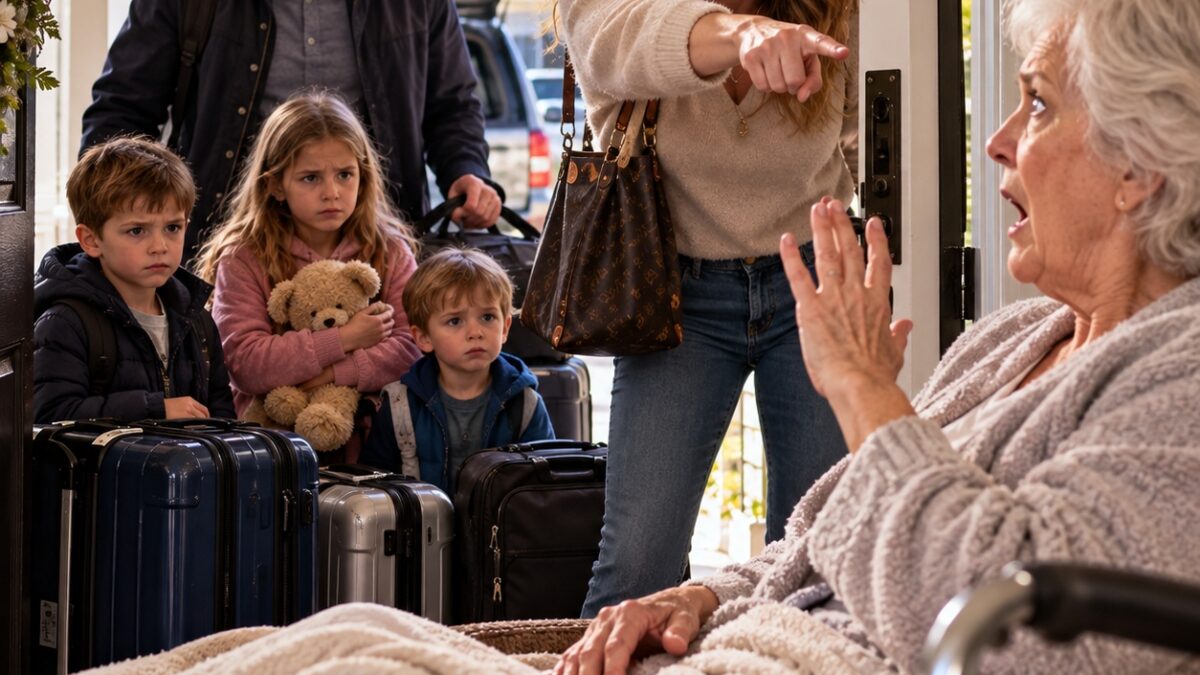
PART2
I walked back to the kitchen.
Slowly.
One hand against the wall.
My hip had begun to ache from standing at the window longer than I should have.
The knocking continued.
Hard.
Three fast blows.
Pause.
Then again.
I put the kettle on.
That may sound absurd.
My son, daughter-in-law, and three grandchildren were on my porch with luggage, and I was making tea.
But I had spent sixty-four years learning that decisions made while someone else is pounding on your door are usually decisions designed to stop the pounding rather than solve the problem.
I needed to think.
Tea gave me something to do with my hands.
The water began heating.
Heidi knocked again.
Then shouted:
“Marilyn!”
My name is Marilyn Foster.
She almost never called me Marilyn.
Usually Mom when she wanted warmth.
Mrs. Foster when she was angry enough to become formal.
Apparently this morning I was Marilyn.
“Open the door!”
I took a mug from the cupboard.
My hands were shaking.
Not dramatically.
Enough.
I hated that.
I wanted to feel calm because I already knew the correct answer.
But knowing your boundary and holding it while grandchildren stand outside are very different things.
Especially when you have spent most of your adult life believing that someone else’s emergency automatically becomes your obligation.
I had babysat through the flu.
Driven through February ice to pick up children because Mitchell and Heidi did not want to leave a party early.
Canceled a trip to Halifax to see my sister because they needed childcare for a wedding weekend in Niagara Falls.
Cooked Christmas Eve dinner for eleven people the previous year.
Heidi’s parents.
Her brother’s family.
My children.
My grandchildren.
Afterward, Mitchell helped clean for approximately eight minutes.
Then someone called him into the living room.
I finished alone.
At the time, none of those things felt like exploitation.
They felt like motherhood.
That distinction had become painfully important.
My phone rang.
Mitchell.
I stared at his name.
Then answered.
“Hello?”
“Mom.”
His voice was tired.
Careful.
“What’s going on?”
“You know what’s going on.”
“Heidi says you’re not opening the door.”
“That’s correct.”
A pause.
“Mom.”
“Mitchell.”
“You can see us.”
“Yes.”
“We have the kids.”
“I can see them.”
“And all our stuff.”
“Yes.”
“So why aren’t you opening the door?”
Because you did not ask.
The sentence came into my mind immediately.
I said it differently.
“I told you three weeks ago I needed six weeks of quiet.”
“I know.”
“My discharge instructions say no guests.”
“We’re not guests.”
That sentence landed hard.
I stared at the kettle.
“What are you, then?”
Silence.
Mitchell exhaled.
“Mom, come on.”
“No.”
“What do you mean, no?”
“I mean you made arrangements that depend on my house without talking to me.”
“We didn’t have many options.”
“You had the option of telling me.”
Silence.
“You rented your house.”
Another silence.
That was confirmation.
I continued.
“For four months.”
“Who told you?”
Not denial.
Never underestimate how revealing the wrong question can be.
“Brenda mentioned the moving truck.”
“Mom—”
“You knew I would say no.”
He said nothing.
“You knew.”
I repeated.
“Otherwise you would have called.”
“We were trying to figure things out.”
“No.”
I gripped the mug.
“You figured things out.”
“You rented your home.”
“You packed.”
“You moved.”
“And now you’re standing at my door hoping the children and the luggage will make it too uncomfortable for me to refuse.”
“That’s not fair.”
“It is exactly what happened.”
Outside, Heidi shouted something.
I could not hear every word.
Then clearly:
“Tell her we have nowhere to go!”
Mitchell covered the phone for a second.
Or tried to.
Heidi continued.
“Tell her the kids have been in the car all morning!”
That old feeling rose in my chest.
Guilt.
Instant.
Automatic.
Familiar as a reflex.
Poor children.
They did not choose this.
Theo was six.
My youngest grandson.
He still crawled into my lap even though he was getting too big for it.
His older sisters were old enough to understand tension but too young to understand finances.
I pictured them on my porch.
And suddenly the boundary that had seemed obvious became cruel.
That was how it always worked.
Somebody else created a difficult situation.
Then I arrived at the emotional end of it.
And because I hated watching people suffer, I solved it.
Mitchell said quietly:
“Mom, what are we supposed to do?”
There it was.
The question that had controlled half my life.
What are we supposed to do?
What he meant was:
What are you going to do for us?
I closed my eyes.
“I don’t know.”
“Mom.”
“I genuinely don’t know, Mitchell.”
“We have three kids.”
“Yes.”
“We need somewhere tonight.”
“Yes.”
“I thought—”
“I know what you thought.”
My voice softened.
“You thought I would open the door.”
He said nothing.
“I love you.”
My throat tightened.
“I love those children more than I can explain.”
“I know.”
“But I am not opening this door.”
He inhaled sharply.
“Mom—”
“I am three weeks out from major surgery.”
“You would have a bedroom.”
“That is not the point.”
“We’d help.”
“With what?”
Silence.
“Would Heidi cook?”
“She can.”
“Would you clean?”
“Yes.”
“Would the children stay downstairs?”
“Mom, they’re children.”
“Exactly.”
I looked around my quiet kitchen.
Three weeks of carefully controlled recovery.
No toys.
No running feet.
No meals for five extra people.
No laundry.
No noise.
No expectation that because I was technically “home,” I was available.
“You are asking a woman who cannot lift ten pounds to absorb a household of five because you rented out your own house without first confirming where you would live.”
When I heard the sentence aloud, the absurdity became even clearer.
Mitchell said:
“We thought it would only be four months.”
I laughed once.
Not happily.
“Only four months?”
“The rental income helps.”
“Of course it does.”
“We need it.”
“Then use some of it for housing.”
“Short-term rentals are expensive.”
“So is my hip.”
Silence.
Then, from outside, Heidi’s voice:
“This is unbelievable!”
She wanted me to hear it.
I know because Heidi always had two voices.
The voice she used to communicate.
And the voice she used when she wanted an audience.
“Tell her Theo is crying!”
My eyes filled immediately.
That was deliberate too.
Maybe Theo was crying.
Probably.
He was tired.
Confused.
Standing on Grandma’s porch.
My instinct screamed:
Open the door.
Take him inside.
Make toast.
Find cartoons.
Solve.
I gripped the kitchen counter.
Pain shot through my hip.
Physical pain.
Useful.
Real.
I breathed.
“Mitchell.”
“Yes?”
“What did I tell you from the car after surgery?”
He sighed.
“That you needed rest.”
“For how long?”
“Six weeks.”
“And what week is this?”
“Three.”
“Then why are you here?”
No answer.
“Because you decided my no would become yes if you made the alternative uncomfortable enough.”
“That’s not what—”
“Yes, it is.”
I was not angry when I said it.
That surprised me.
I was tired.
And suddenly very clear.
“You did not tell me because you knew.”
He spoke quietly.
“I thought once we were here…”
He stopped.
I waited.
There it was.
The truth trying not to become a full sentence.
“Once you were here?”
He sighed.
“I thought you’d understand.”
“No.”
“You thought I’d give in.”
He did not deny it.
I looked toward the hallway.
My walker leaned near the wall.
Prescription bottles on the counter.
Heating pad folded over a chair.
All the evidence of my recovery.
And somehow my family had constructed a plan that depended on me ignoring all of it.
“I’m sorry you’re in a difficult situation.”
I said.
“I mean that.”
“But it is a situation you created.”
“We can’t just—”
“You can.”
“I don’t know what it looks like.”
“But you can.”
“Hotel.”
“Short-term rental.”
“Call Heidi’s family.”
“Talk to the people who rented your house.”
“Talk to a rental agent.”
“I don’t know.”
“What I do know is that I am not medically able to be the solution.”
Mitchell said nothing.
I knew that phrase would hurt him.
Maybe it needed to.
For twenty-five years, I had made myself the solution so often that everyone had forgotten I was a person first.
Heidi screamed again.
“Tell her to stop being ridiculous!”
I felt something in me settle.
“Mitchell?”
“Yeah?”
“I love you.”
“I love you too.”
“I am not opening the door.”
Then I ended the call.
The knocking continued for another forty minutes.
Not nonstop.
Waves.
Heidi.
Then Mitchell.
Then silence.
Then again.
My phone rang twice.
I did not answer.
At one point, someone rang the doorbell repeatedly.
As though the bell might produce a different moral outcome.
I sat at my kitchen table with my tea.
The tea went cold.
My hip throbbed.
My hands stayed around the mug.
I told myself:
You are not hurting those children.
Then another voice:
They are outside because you will not open the door.
Then:
They are outside because their parents rented away the house they were living in without securing another one.
That was the truth.
The children’s discomfort was real.
My love for them was real.
Neither fact made me responsible for undoing their parents’ decision.
That distinction felt almost impossible to hold.
But I held it.
At around 8:30, the porch became quiet.
I moved slowly to the window.
Mitchell was loading the bags back into the van.
Heidi stood with her arms folded.
Her face was tight.
The girls climbed in.
Then Theo.
Before he got inside, he looked up at my house.
Straight toward the window.
He could not see me behind the curtain.
I could see him.
Something inside me broke.
“Baby.”
I whispered.
He looked so confused.
Maybe Heidi had told him Grandma was angry.
Maybe nobody had explained anything.
He did not understand mortgages.
Short-term rental income.
Postoperative restrictions.
Boundaries.
He only knew Grandma was inside.
And Grandma did not open the door.
I wanted to run outside.
I could not run.
I wanted to call his name.
I did not.
I pressed my fingers against the curtain.
Mitchell closed the van door.
Got behind the wheel.
They drove away.
Theo kept looking back until the vehicle reached the corner.
I cried then.
Hard.
Not because I regretted the decision.
Because correct decisions can still hurt people you love.
That is one of the cruelest parts of adulthood.
Boundaries are often described as though setting one immediately makes you feel empowered.
Sometimes it makes you feel terrible.
Sometimes you sit at a kitchen table with a healing hip and cry because your six-year-old grandson thinks you rejected him.
You hold the boundary anyway.
That afternoon, I called Suzanne Belanger.
Suzanne had been my lawyer since Harold died.
She had helped me through estate paperwork when I could barely remember what day it was.
Her voice was always calm.
“Marilyn.”
“Hi, Suzanne.”
“What happened?”
“Why do you assume something happened?”
“You only call me before lunch when something happened.”
Fair.
I told her.
The house rental.
The luggage.
The door.
Heidi shouting.
Mitchell admitting he thought I would change my mind once they arrived.
Suzanne did not gasp.
Did not say:
How awful.
Did not tell me I had overreacted.
She said:
“All right.”
Pause.
“What are you thinking?”
That question mattered.
Not:
What should Mitchell suffer?
Not:
Do you want to cut him out?
What are you thinking?
“I need to change some things.”
“Okay.”
“The power of attorney.”
I had named Mitchell after Harold died.
At the time, it had seemed obvious.
Oldest child.
Son.
Responsible job.
Family.
I had not thought deeply.
Grief does that.
It makes “natural” choices feel safer than deliberate ones.
“I want Brenda instead.”
Suzanne paused.
“Financial and personal care?”
“Yes.”
“Are you sure?”
“Yes.”
“Any concern Brenda would be uncomfortable?”
“I’ll ask her.”
“Good.”
Then the will.
I did not cut Mitchell out.
That would have felt like punishment.
I was not trying to punish.
I was trying to remove assumptions.
For six years, I had contributed to education savings for Mitchell’s children.
Quietly.
Regularly.
I wanted the children to retain the benefit.
They had done nothing wrong.
But I no longer wanted money moving through a structure Mitchell and Heidi treated as guaranteed household support.
Suzanne helped me restructure future contributions through my niece Judith as trustee, preserving access for the grandchildren while separating the money from Mitchell and Heidi’s ordinary budget.
That was the point.
Not:
You lose because I’m angry.
But:
This money belongs to the children’s future, not to your expectation of my financial availability.
Then we discussed the house.
Mitchell had mentioned twice in two years that it was “a lot of house for one person.”
Always casually.
“Have you thought about downsizing?”
“You know, eventually this place might be too much.”
Eventually.
Such an interesting word.
Eventually assumes ownership of a future that has not happened.
Harold and I bought the house thirty-one years earlier.
Detached century home.
Corner lot.
White exterior.
Dark green trim we chose together.
I owned it outright.
Its value had increased dramatically.
I tried not to think about the number often because thinking about your home as money instead of home can make you strangely detached from your own life.
But Mitchell had thought about it.
I could tell.
So I added explicit language to my estate documents.
No cohabitation rights.
No use rights.
No financial claims during my lifetime absent my signed consent.
I could live there.
Sell it.
Change it.
Leave it empty.
Paint every room purple.
Whatever I wanted.
Statements about “eventually” meant nothing.
Suzanne read everything back.
Then asked:
“Do you want time before you sign?”
I thought about that.
“I’ve had twenty-five years.”
She understood.
I signed.
Then I went home.
My hip hurt from the outing.
I used the heating pad.
Made chamomile tea.
Mitchell called that evening.
I watched his name appear.
Let it ring.
He texted:
Mom, I think we need to talk about this.
I did not answer.
Not because I wanted him anxious.
Because I was tired.
That distinction mattered.
I was allowed to respond tomorrow.
Another revolutionary discovery at sixty-four.
Not every incoming need required immediate action.
I sat in my living room.
Quiet.
No children.
No luggage.
No Heidi.
No one asking anything.
At first, the silence felt wrong.
Then peaceful.
The following morning, Heidi texted.
You’ve really upset the children. Theo keeps asking why Grandma is mad at him. I hope you’re happy with yourself.
I read it three times.
That old pressure returned instantly.
Theo.
Of course.
She knew exactly which name to use.
My thumbs hovered over the screen.
I could have answered angrily.
How dare you involve the children?
I could have ignored it.
Instead, I wrote slowly.
I am not mad at anyone. I set a boundary about my health in my home and I held it. I love those children and always will. What happened at my door was a choice you and Mitchell made, not something I caused. When Mitchell is ready to talk, I’m here.
I read it once.
Sent.
Heidi did not reply.
The days afterward were strange.
Quiet in a way I had almost forgotten.
Birds in the cedar hedge outside my kitchen window.
The sound of my own footsteps.
A neighbor waving while getting the newspaper.
The refrigerator humming.
Nothing urgent.
Around the fourth day, I realized I had not started a morning by checking my phone.
That shocked me.
For years, my day began with other people.
Messages.
Requests.
Can you pick up—
Can you watch—
Can you call—
Do you have—
Are you home—
I had interpreted that as being needed.
Needed meant loved.
Useful meant important.
But lying on my couch with my healing hip, I understood I had gradually stopped being treated like a person and started functioning like a resource.
Resources do not need rest.
They are accessed.
People do not ask how the emergency fund feels.
They use it.
People do not ask whether the spare bedroom is recovering from surgery.
They occupy it.
People do not ask a grandmother’s hip whether three children can run through the hallway.
They assume Grandma will manage.
That realization made me angry.
Not explosive anger.
Sad anger.
Because I had helped build the arrangement.
I had said yes so consistently that eventually my family stopped understanding yes as a choice.
It became infrastructure.
Brenda came Thursday evening with dinner.
Real dinner.
Not because I had asked.
She brought it because she thought I might like it.
We ate at the kitchen table.
Talked about her granddaughter’s hockey tournament.
A novel she had just finished.
What she wanted to plant in spring.
Normal things.
Not Mitchell.
Not Heidi.
Not estate documents.
Nothing about boundaries.
At one point Brenda said:
“I’m thinking tomatoes again.”
I laughed.
“You said never again after the squirrels.”
“I’m a forgiving woman.”
“The squirrels aren’t.”
We laughed for almost a full minute.
That night, I went to bed at nine.
Slept until six.
No pain waking me.
No phone.
No guilt.
My body seemed to understand safety before my mind did.
Mitchell called on day seven.
I answered.
“Hi, Mom.”
His voice had changed.
Careful.
But not the careful voice he used when trying to avoid Heidi getting upset.
This sounded effortful.
“Hi, sweetheart.”
“I wanted to say I’m sorry.”
I waited.
That silence was deliberate.
I had learned something.
Sorry can be the start of understanding.
Or the introduction to a new request.
Let the sentence finish.
“I should’ve told you about renting the house.”
“Yes.”
“I should’ve asked.”
“Yes.”
“I knew you’d probably say no.”
There it was.
“And I just…”
He sighed.
“I wanted the problem to solve itself.”
I looked out the window.
“That’s honest.”
“It’s not good.”
“No.”
“I know.”
We sat in quiet.
Then I asked:
“Were you planning to show up and wear me down?”
No accusation.
Just information.
Mitchell did not answer immediately.
Long enough.
Finally:
“I don’t think I thought it through that clearly.”
I almost laughed.
“What did you think?”
“I thought…”
He stopped.
“You know how you always…”
“Yes.”
I said it gently.
“I know how I always.”
Another silence.
“I’m sorry.”
This time it landed differently.
Not complete.
But honest.
He continued.
“Are you okay?”
“My hip?”
“Yeah.”
“Getting there.”
“I should’ve checked in more.”
“You should’ve checked in at all.”
He made a sound between a sigh and a laugh.
“The thumbs-up emoji wasn’t enough?”
“No.”
“I figured.”
We both laughed a little.
Then Mitchell said:
“Heidi still thinks—”
I interrupted.
“I know.”
He stopped.
“That’s between you and Heidi.”
“She thinks you’re punishing us.”
“I made changes to protect myself.”
Silence.
“If protection feels like punishment, you should probably ask why.”
He did not speak for a moment.
Then:
“Did you change the will?”
I had expected the question.
Still, hearing it hurt.
Not because it was unreasonable eventually.
Because it came so quickly.
“Yes.”
His breathing shifted.
“The kids didn’t do anything.”
“The children are still beneficiaries.”
“Oh.”
“I changed how some things are administered.”
“What does that mean?”
“It means the money is still for them.”
“Then why change it?”
“Because it should not function as part of your household budget.”
“Mom, it never—”
“It had become assumed.”
He stopped.
I continued.
“The children lose nothing.”
“I added a layer.”
“So Judith controls it?”
“She oversees what I’m contributing in the structure Suzanne prepared.”
“Because of Heidi?”
“Because of a pattern.”
Silence.
“One that has been going on longer than I wanted to admit.”
Mitchell said quietly:
“What do you want from us?”
I closed my eyes.
That question.
Maybe the most important question he had asked me in years.
Not:
What do you want us to pay?
Not:
When can we come over?
Not:
Can you still watch the kids?
What do you want?
I answered carefully.
“I want to be asked.”
He said nothing.
“Not assumed.”
I continued.
“I want you to notice when I’m not okay and ask about it before you decide whether my condition interferes with your plans.”
My voice started trembling.
“I want you to call me when nothing is wrong.”
That surprised even me.
“Not only when something is broken.”
Silence.
“That’s all.”
I wiped my eyes.
“That is actually all.”
Mitchell exhaled slowly.
“We can do that.”
Then softer:
“I can do that.”
I did not say:
Promise?
I did not need a promise.
Real change is not one good phone call.
It is a hundred small decisions.
Calling without asking for anything.
Asking before planning.
Hearing no.
Checking on my health.
Taking responsibility.
One phone call could begin.
Only behavior could continue.
Still, it was something.
They found a short-term rental in Cambridge.
Their tenants would leave after the four-month lease.
Mitchell said they had already given notice there would be no extension.
Interesting.
They had solved it.
Without my house.
That mattered.
People often become more resourceful after the person who always rescues them stops.
Heidi texted once the following week.
I hope your hip is healing well. The kids miss you.
Stiff.
Civil.
I responded:
I miss them too. Once I’m more mobile, I’d like to arrange a visit somewhere neutral. Maybe the park near your place.
She replied:
That would be nice.
I stared at those four words.
I did not trust them completely.
That was okay.
Keeping a door open is not the same as pretending nothing happened.
I wanted a relationship with my grandchildren.
I wanted some relationship with my son.
I was willing to see whether a respectful relationship with Heidi was possible.
But I was doing it because I chose to.
Not because I feared what would happen if I refused.
That difference changed everything.
Brenda came over the following Sunday.
Tea.
Shortbread biscuits she usually only made at Christmas.
“It’s April.”
I said.
“Biscuits are not seasonal.”
“Tell that to the tins.”
We sat in my living room.
Afternoon light came through the front window.
For a moment, I looked around.
The chair where Harold used to sit.
My books.
The blanket folded over the sofa.
My cane beside me.
Brenda.
No crisis.
And I thought:
This is what my house is for.
Not as an emergency overflow location.
Not as free childcare headquarters.
Not as the inevitable future landing place whenever somebody else monetizes their own home.
A home.
My home.
And I thought something else.
This is what I am for.
Not a solution.
Not a buffer between consequences and people who should experience them.
Not a free service someone can activate with a phone call.
A person.
Someone who gets to choose.
My hip reached about seventy percent according to Dr. Anand.
Maybe slightly ahead of schedule.
I was sleeping.
Eating properly.
Amazing what happens when you are not feeding five extra people three weeks after surgery.
I walked to the end of the street and back one afternoon.
Slowly.
Cane in my right hand.
The air in southern Ontario had that late-April smell.
Cold underneath.
Something sweet beginning.
Cherry trees along the boulevard were budding.
I stopped on the sidewalk across from my house.
White exterior.
Dark green trim.
Harold and I chose those colors together.
He wanted dark blue.
I thought it looked too serious.
We compromised.
The fern on the porch had survived eleven winters because I was apparently emotionally incapable of letting a plant die if I had already kept it alive for more than three years.
I stood there looking at the front door.
The same door I had opened thousands of times.
Children coming home from school.
Friends.
Deliveries.
Mitchell arriving with babies.
Heidi.
Christmas guests.
People needing help.
I thought about the morning I did not open it.
And then another thought came.
There had been many times I should have kept that door closed sooner.
Not literally.
Emotionally.
I had opened without asking enough questions.
Why do you need me?
What have you already tried?
Did you ask anyone else?
Can this wait?
What happens if I say no?
Instead, I had treated every knock as obligation.
Then, on the morning it mattered most, every old habit in my body screamed at me to open.
Children outside.
Son pleading.
Daughter-in-law accusing.
The neighborhood probably watching through curtains.
My hip hurting.
My heart breaking.
And I held the door closed.
Not to teach anyone a lesson.
Not because I enjoyed watching them leave.
Not because I wanted Theo confused.
Because I had finally listened to myself.
That woman on the sidewalk with the cane deserved that.
She had deserved it before surgery.
Before Harold died.
Before grandchildren.
Before anyone needed her.
I stood there until my hip reminded me this was not supposed to be a philosophical expedition.
Then I walked back.
Slow.
Careful.
I opened the door.
My door.
Closed it behind me.
That evening, Mitchell called.
No emergency.
That caught my attention.
“Hi.”
“Hi, Mom.”
“What’s wrong?”
He laughed.
“Nothing.”
I waited.
“I just thought I’d call.”
Something in my throat tightened.
“Okay.”
We talked about nothing.
His work.
My hip.
Theo losing a tooth.
One of the girls having trouble with a school project.
The weather.
Nothing broken.
Nothing requested.
At the end, Mitchell said:
“Okay, I’ll let you go.”
“Okay.”
“Love you.”
“Love you too.”
I sat with the phone in my hand after he hung up.
Tiny decision.
Exactly what I had asked for.
I did not immediately declare everything repaired.
But I noticed.
That was enough.
A few days later, Heidi called.
Not texted.
I nearly did not answer.
Then did.
“Hello?”
“Hi, Marilyn.”
Her voice was restrained.
“How are you?”
“Improving.”
“That’s good.”
Pause.
“The kids keep asking when they can see you.”
“I’d like to see them.”
Another pause.
“We could do Sunday.”
“I’m not ready for a long visit.”
“Okay.”
“Maybe forty-five minutes at the park.”
“Okay.”
I waited for resistance.
None.
“Mitchell can bring them.”
Silence.
Then:
“I can come too.”
I considered.
Not fearfully.
Simply considered.
“I’d prefer this first visit to be just Mitchell and the children.”
That was hard to say.
Heidi’s silence sharpened.
I felt my old instinct.
Explain.
Soften.
Offer alternative.
I stopped.
Finally she said:
“All right.”
“Thank you.”
We ended the call.
My heart pounded afterward.
Why?
Because a respectful boundary can still feel dangerous when you have spent years avoiding other people’s disappointment.
The body learns patterns.
Mine was learning new ones.
Sunday came.
Mitchell brought the children to the park.
Theo ran toward me.
I had to put up one hand.
“Slow!”
He stopped so abruptly it was almost comical.
“Grandma?”
“My hip.”
His face changed.
“Oh.”
Then he approached like I was made of glass.
I opened my arms.
“Gentle hug.”
He wrapped his arms around me carefully.
I cried.
Of course.
He said:
“Were you mad at me?”
There it was.
Heidi’s text made real.
I crouched as much as the hip allowed.
“No.”
“You didn’t open the door.”
“I know.”
“Why?”
Children deserve simple truth.
“Because Grandma had surgery and needed to rest.”
“But we needed a house.”
“Yes.”
“That was a grown-up problem.”
He frowned.
“Dad said they figured it out.”
“They did.”
He thought about that.
“So you weren’t mad at me?”
“Never.”
He hugged me again.
That moment healed something I had been carrying since the van drove away.
The girls approached more carefully.
They asked about the cane.
The scar.
One wanted to know whether my new hip was “robot metal.”
I told her I was approximately thirty percent robot now.
Mitchell rolled his eyes.
For forty-five minutes, we were grandmother and grandchildren again.
No luggage.
No house.
No negotiation.
When the time came, Mitchell did not push.
“Ready to go?”
I nodded.
He gathered them.
Theo waved.
I watched them leave.
Pain in my hip.
Warmth in my chest.
Boundaries had not ended love.
That mattered.
I had been afraid no would destroy everything.
It did not.
No changed the terms.
That is different.
Over the next several weeks, I thought constantly about the word mother.
What does it mean when your child is forty?
Does it mean housing him whenever he needs it?
No.
Does it mean never letting him fail?
Definitely not.
Does it mean loving him while sometimes allowing his choices to become inconvenient?
Apparently.
That was harder than changing diapers.
Nobody tells new mothers the emotional labor becomes more complicated after children can legally sign contracts.
A baby needs food.
Feed him.
An adult son rents out his home without arranging another because he assumes your postoperative house will be available?
Love remains.
Solution does not have to.
That distinction felt brutal at first.
Then freeing.
I thought about all the times I had rescued Mitchell.
Not because he was irresponsible as a person.
He was capable.
He worked.
Raised children.
Paid bills.
But somewhere along the way, both of us had learned a dangerous pattern.
If the problem became large enough, Mom would absorb the final portion.
Babysitting.
Driving.
Hosting.
Paying for something occasionally.
Canceling my plans.
Changing my schedule.
The individual acts were not wrong.
I would probably make some of the same choices again.
The problem was invisibility.
Nobody counted the cost to me because I never announced it.
The Halifax trip.
I had been looking forward to it for months.
My sister and I rarely got uninterrupted time together.
Flights booked.
Non-refundable.
Then Mitchell called.
Wedding in Niagara.
Babysitter canceled.
“Mom, I don’t know what we’re going to do.”
I canceled.
At the time, I told myself:
Family.
Years later, Mitchell probably barely remembered.
I remembered.
Not because I resented watching the children.
Because I had quietly trained everyone—including myself—to believe my plans were always the least important plans in the room.
That was the pattern I needed to break.
Not love.
Priority.
I had a right to exist on the priority list.
Hip surgery finally made that undeniable.
My body said no before I knew how.
I could not lift.
Could not clean.
Could not host.
Could not sacrifice safely.
It took a surgeon’s restrictions to expose how often I had treated my own needs as optional.
Funny.
Not funny.
I began practicing small changes.
Brenda called.
“Want company?”
I checked myself.
Old response:
Of course.
New response:
“Not tonight.”
No guilt.
She said:
“Okay. Thursday?”
“Yes.”
That simple.
Healthy people do this constantly, apparently.
I had considered every refusal a tiny social emergency.
No longer.
My sister called from Halifax.
“How’s the bionic woman?”
“Annoyed.”
“Good. That means you’re healing.”
I told her what happened.
All of it.
When I finished, she was quiet.
Then:
“You finally said no.”
No sympathy first.
No outrage.
That sentence.
“I say no.”
I protested.
She laughed.
“When?”
I searched my memory.
“That is rude.”
“It is accurate.”
I told her she was spending too much time talking to Brenda.
She said:
“I’ve been waiting forty years.”
That conversation stung.
Then helped.
Sometimes the people who love us notice patterns we call personality.
Generous.
Dependable.
Always there.
Those sound beautiful.
They can be.
They can also disguise a person who does not know how to disappoint anyone safely.
I was learning.
One morning, Suzanne called to confirm final paperwork.
“Everything is updated.”
“Thank you.”
“How do you feel?”
“Like I should feel guilty.”
“Do you?”
“Less than expected.”
“Good.”
I smiled.
“You’re not supposed to take sides.”
“I’m not.”
“You sound like Brenda.”
“Then Brenda sounds sensible.”
I asked:
“Was changing the power of attorney too dramatic?”
Suzanne became professional.
“It is not my role to tell you who should hold it.”
“I know.”
“But the question is whether you trust the person to make decisions solely in your best interest if you are unable.”
I thought about Mitchell standing on the porch.
My explicit medical restriction.
His four-month housing plan.
The answer became obvious.
“I trust Brenda.”
“Then you have your answer.”
That was the point.
Power of attorney should not be a birth-order award.
It is a responsibility.
Brenda had demonstrated concern for me when nothing in it benefited her.
She drove me home.
Stocked my refrigerator.
Checked in.
Did not ask to stay.
Did not ask for money.
Did not send an emoji and disappear.
Blood matters.
Behavior matters too.
I asked Brenda over tea whether she would accept.
She looked stunned.
“Me?”
“Yes.”
“What about Mitchell?”
“I’m changing it.”
“Does he know?”
“He will.”
She studied me.
“Are you sure?”
“Yes.”
Then Brenda said the sentence that confirmed my decision.
“What would you want me to do if there was disagreement?”
Not:
What do I get?
Not:
Why me?
She was already thinking about my wishes.
I explained.
She accepted.
I slept better that night.
Mitchell eventually asked.
“Brenda?”
“Yes.”
He sounded hurt.
“I thought I was your person for that.”
“You were.”
“What changed?”
“I started asking who has consistently centered my wellbeing without assuming access to me.”
“That’s harsh.”
“It may feel harsh.”
I paused.
“But I need someone making medical decisions who can hear me say no.”
Silence.
Then:
“I understand.”
I was not certain he did completely.
He did not argue.
That mattered.
The education money conversation took longer.
I had not taken anything from the children.
But Mitchell reacted emotionally because the structure represented trust.
I understood that.
He said:
“You don’t trust us.”
I answered:
“Not with everything.”
That hurt both of us.
Still true.
Trust is not one single object you either have or do not.
I trusted Mitchell to love his children.
Trusted him to work.
Trusted him to answer if I called at two in the morning with a genuine emergency.
I no longer trusted him to separate his own financial convenience from assumptions about my resources.
That trust could be rebuilt.
Not declared.
He asked:
“How?”
I said:
“By making different choices.”
He wanted something more precise.
People like checklists.
Relationships rarely provide them.
Call when nothing is wrong.
Ask before assuming.
Accept no without punishment.
Notice my needs.
Manage your own consequences.
That was the list, I suppose.
He began.
Not perfectly.
But enough for me to notice.
He called one afternoon simply to tell me Theo had scored his first goal in hockey.
I loved it.
No request.
Another morning, he texted:
Do you need anything from the pharmacy? I’ll be nearby.
I stared at the message for a long time.
Then replied:
Yes. Actually.
I sent two items.
He dropped them on the porch.
He did not come in because I had not invited him.
That mattered.
He rang the bell.
Stepped back.
I opened.
“Thanks.”
“No problem.”
“How’s the hip?”
“Annoying.”
“Good.”
I laughed.
“Why does everyone say that?”
“Because if you’re complaining, you’re probably okay.”
Harold used to say something similar.
For a second, grief flashed.
Then affection.
Mitchell left.
No hidden request.
Another small decision.
Stacked.
That is how change happens.
Heidi’s change was harder to read.
She remained civil.
That was enough initially.
I did not demand a dramatic apology because none came in the source of our actual relationship during those weeks.
I would not invent one emotionally for my own comfort.
Her text had blamed me for upsetting the children.
That told me something.
Her later civility told me something else.
People can move incrementally too.
I stayed open enough to observe.
Not open enough to be overrun.
That balance felt new.
My hip improved.
At seventy percent, I felt almost normal until I did too much.
Then my body reminded me.
One afternoon, I decided to reorganize a lower cupboard.
Stupid.
Halfway through, pain shot through my hip.
I sat on the floor.
Could not easily get up.
I laughed at myself.
Then called Brenda.
She came over.
Helped me safely.
“You’re an idiot.”
“I know.”
“Doctor said no housework.”
“It was one cupboard.”
“Cupboards are housework.”
“I reject your definition.”
She made tea.
I looked at her moving around my kitchen.
No entitlement.
No assumptions.
She asked before opening the wrong cabinet.
Such a small courtesy.
“Where do you keep the tea?”
She had been in my house hundreds of times.
Still asked.
That nearly made me cry.
Consent is visible in tiny habits.
I had become sensitive to them.
Perhaps oversensitive.
I did not mind.
Brenda said:
“You’re staring.”
“Nothing.”
“Is this about tea?”
“Possibly.”
“You need hobbies.”
She was right.
Recovery gave me too much time to think.
But thinking was changing me.
By late April, I could walk farther.
Cane.
Slow pace.
I returned to the boulevard often.
Cherry buds became blossoms.
Neighbors stopped asking about surgery every time they saw me.
Life resumed.
That was good.
Illness can make you feel temporarily reduced to a body part.
“How’s the hip?”
Eventually I wanted someone to ask:
“What are you reading?”
Brenda did.
My sister did.
Mitchell began.
That mattered.
One afternoon he called.
“What are you doing?”
“Reading.”
“What?”
I told him.
“Any good?”
“Actually, yes.”
Then we talked about the book.
Maybe ten minutes.
I hung up smiling.
This is what I meant.
Call when nothing is broken.
Let me be a person in ordinary life.
Not a service center.
At the park, Theo eventually stopped asking about the closed door.
Children adapt.
I did not want the event turned into family mythology.
I did not want him growing up hearing:
Grandma locked us out.
Or:
Mom and Dad tried to invade Grandma’s house.
Neither.
Adults made a poor decision.
Grandma held a medical boundary.
Everyone found somewhere else.
That was enough.
I told Mitchell:
“Please don’t make the children carry our conflict.”
He said:
“I won’t.”
I believed he meant it.
I hoped Heidi would too.
Again, behavior over time.
I began understanding something else.
I had worried boundaries would make me cold.
They did the opposite.
Once I stopped giving under resentment or pressure, I could give more cleanly.
When I invited the grandchildren for a short afternoon visit after my doctor approved it, I wanted them there.
That felt different.
I planned snacks.
Put out coloring materials.
No overnight.
No expectation I cook a giant meal.
Mitchell brought them.
Picked them up at the agreed time.
Perfect.
I was exhausted afterward.
Happy.
I had chosen yes.
Because no existed, yes felt meaningful again.
That became perhaps the biggest lesson.
If a person is never allowed to say no, their yes is not generosity.
It is compliance.
For years, my yes had been so automatic that even I did not know whether I meant it.
Now I checked.
Did I want to?
Could I?
What would it cost?
Was the cost acceptable?
Then answer.
Sometimes yes.
Sometimes no.
Sometimes not yet.
Life continued.
No catastrophe.
People adjusted.
That was almost insulting.
I had spent decades fearing disappointment.
Turns out disappointment is survivable.
Even Heidi survived.
Remarkable.
The house became deeply important to me after the incident.
Not because I had previously taken it for granted.
Because I started seeing it as the physical boundary around my own life.
Harold and I had bought it thirty-one years earlier.
We had chosen paint.
Replaced plumbing.
Argued about the porch light.
Raised children.
Hosted birthdays.
Sat through illnesses.
Buried a marriage partner from within those walls.
I owned it outright now.
People heard “large house” and saw unused capacity.
I saw accumulated life.
Mitchell’s comments about downsizing had always been light.
Maybe even practical.
But after he showed up with luggage, the word eventually changed.
Eventually we could use—
Eventually maybe—
Eventually this house—
No.
Eventually I might sell.
Eventually I might stay until death.
Eventually I might decide a century home is too much and move into an apartment with an elevator and terrible carpet.
All possibilities.
Mine.
No one else needed to design “eventually” while I was still healing in “now.”
That is why the estate language gave me peace.
Not because I expected a legal battle.
Clarity is calming.
Signed consent.
Simple.
No family member receives use rights because they say:
But Mom always said—
No.
Written intentions.
Ownership while alive.
I could breathe.
Suzanne called it good planning.
I called it finally learning to write down what I had assumed people would respect.
Sometimes assumptions are not enough.
There was a fern on my porch I had overwintered for eleven years.
Ridiculous plant.
Every autumn I dragged it inside.
Every spring outside.
Brenda once asked why.
“Because it’s alive.”
“So are the hundreds of ferns at the garden center.”
“Not this fern.”
She rolled her eyes.
The morning my family came with suitcases, the fern sat beside them.
I noticed it later in my memory.
A strange detail.
My family assumed my house would absorb them because it had space.
Meanwhile I had spent eleven winters protecting a plant because responsibility mattered to me once I accepted it.
There is a difference between responsibility chosen and responsibility assigned.
I had chosen the fern.
I had not chosen five houseguests during surgery.
That distinction amused me.
I told Brenda.
She said:
“You’re comparing your son to a fern.”
“No.”
“I’m comparing consent.”
“You definitely need hobbies.”
Probably.
I started reading more.
Recovery slowed me enough to rediscover reading without multitasking.
Three novels in two weeks.
Then more.
For years, I read twenty pages at night and fell asleep.
Now I could sit in the afternoon.
Tea.
Book.
Nothing urgent.
At first, guilt.
Then pleasure.
I wondered how much of life I had spent waiting for usefulness.
Retirement should have taught me.
It did not.
School secretary for decades.
The person who knew where everything was.
Who needed forms.
Who forgot lunch.
Which child was waiting for pickup.
Then motherhood.
Grandmotherhood.
Widowhood.
All roles organized around attention to others.
Hip surgery interrupted every role.
I could not efficiently help.
For a few weeks, I was simply a woman healing.
That felt uncomfortable.
Then necessary.
Brenda treated me like a person worth helping without exchange.
That may be why I trusted her with power of attorney.
She did not need me useful.
That is rare.
My sister too.
Beth—no, in this source there isn’t Beth; careful. The narrator’s children not named aside from Mitchell. Don’t introduce a daughter. Need avoid invented children. Continue.
Harold had treated me that way.
He died eight years earlier.
I still missed the ease of being known by someone who did not require a function.
We had been married long enough that silence did not mean failure.
Sometimes one of us simply sat.
After he died, I filled that absence with usefulness.
Maybe unconsciously.
If people needed me, I was less alone.
Then being needed became being assumed.
The line blurred.
I only saw it when my body forced me to stop.
I thought about Harold often during recovery.
What would he have done if Mitchell arrived with suitcases?
He would have opened the door.
For the grandchildren?
Probably.
Then he would have said:
“Two nights.”
And meant two nights.
Harold had boundaries in places I did not.
He could help without turning temporary into indefinite.
I used to find him inflexible.
Maybe we balanced each other.
After he died, the balance vanished.
I became all softness.
Softness without structure can lose shape.
I did.
Then rebuilt.
Not into Harold.
Into myself.
The front door became symbolic whether I wanted it to or not.
I had opened it too often.
Then held it closed once.
People online love symbolism.
Real life is less elegant.
The door needed weather stripping.
The knob stuck in winter.
Theo once slammed it accidentally hard enough to knock a picture crooked.
Still, after that morning, touching the lock felt different.
It reminded me choice existed.
Open.
Closed.
Mine.
One afternoon, Heidi came to the neutral park visit too.
Later, after several successful meetings.
She stood near the bench.
I had prepared myself for tension.
Instead, she said:
“Your cane looks different.”
I blinked.
“Doctor upgraded me.”
“That’s good.”
We watched the children.
Silence.
Then she said:
“I was angry that day.”
I waited.
Not an apology.
Do not create one where none exists.
“I know.”
“I thought you were making things harder.”
“I know.”
She glanced at me.
“I still think we were desperate.”
“You were.”
“I don’t think you understood.”
I looked at her.
“I understood you needed housing.”
She waited.
“I also understood I had just had major surgery.”
She looked away.
We did not resolve anything.
That was okay.
Not every conversation needs completion.
She eventually said:
“The Cambridge place is fine.”
“I’m glad.”
“The commute is annoying.”
“I’m sorry.”
That was all.
Civil.
Real.
Maybe relationship would grow.
Maybe not.
I did not force.
Keeping the door open because I choose is different from standing in the doorway begging someone to come through.
That distinction became central.
I thought about the phrase:
good mother.
The day of the porch incident, my nervous system told me a good mother opens the door.
Then another question appeared later.
Would a good mother teach her adult son that he can rent his home for income and then convert his recovering mother into free housing through surprise?
No.
Would a good mother model ignoring medical restrictions?
No.
Would a good mother teach grandchildren that love means one family member’s no can be overridden by pressure?
No.
The boundary was not anti-family.
It may have been one of the healthier family things I ever did.
Healthy family lets no exist.
Healthy family asks.
Healthy family repairs.
Healthy family does not weaponize children.
Healthy family accepts that being related does not erase consent.
These ideas sound obvious when written.
Living them is harder.
Theo’s face at the window remained the hardest memory.
Sometimes I saw it when trying to sleep.
Not Heidi shouting.
Not Mitchell’s silence.
Theo looking up.
That was the cost.
I had to make peace with the fact that he experienced confusion because of an adult boundary.
I repaired what I could.
I told him clearly I loved him.
Spent time with him.
Did not make him choose sides.
Eventually the memory softened.
Children benefit when adults refuse to make them emotional currency.
I wanted to protect him from that, not from every uncomfortable morning.
Impossible anyway.
Grandchildren survive parents making mistakes.
Grandparents too.
I began noticing how often women my age talked about similar patterns.
Not identical.
But familiar.
“My daughter just assumes I’ll babysit.”
“My son listed me as emergency pickup without asking.”
“They say, ‘You’re retired, what else are you doing?’”
That sentence makes my blood pressure rise.
Retirement is not public ownership.
Free time is still owned time.
A person does not become a community resource because she no longer receives a salary.
I started saying that.
Women laughed.
Then sometimes got quiet.
One friend said:
“I don’t know how to say no.”
I understood.
“Start small.”
“How small?”
“Decline something you genuinely don’t want.”
“What if they’re upset?”
“They might be.”
“That’s the problem.”
“No.”
I smiled.
“That’s their feeling.”
I was becoming insufferable.
But useful in a new way.
Not fixing.
Sharing.
I had to be careful not to turn boundaries into another service I performed for everyone.
Old habits.
I kept some lessons to myself.
My own home became quieter.
Not empty.
There is a difference.
After Harold died, quiet felt like absence.
After the confrontation, quiet felt like relief.
Then gradually it became ordinary.
That was best.
I did not want every silence to symbolize something.
Sometimes I sat with tea.
No revelation.
Excellent.
I cooked small meals.
One portion.
Maybe leftovers.
Easier.
My grocery bill changed.
My fridge looked different.
I had not even been hosting them yet, but thinking about what five extra people would have meant during recovery made me grateful again.
Breakfast for six.
Lunch.
Dinner.
Children needing things.
Showers.
Towels.
Noise.
Mitchell and Heidi insisting they would help.
Maybe they would.
Maybe for a week.
Then patterns.
I knew patterns.
The rental was four months.
My recovery six weeks.
Their timeline had ignored mine completely.
That fact remained stunning.
They did not think:
Mom cannot host.
They thought:
Mom says she cannot host.
Those are different.
One treats my statement as information.
The other as an obstacle to negotiate.
That was the core injury.
Not suitcases.
Not even the surprise.
They did not believe my no had authority.
I made sure it did.
There was a point, maybe two months later, when Mitchell said:
“I understand now why you didn’t open.”
That mattered.
“Do you?”
“I think so.”
“What changed?”
“The Cambridge place.”
I waited.
“It was a pain to find.”
“Yes.”
“It cost money.”
“Yes.”
“We had to make calls.”
“Yes.”
“And I kept thinking that all of that was the stuff I expected you to absorb.”
I was silent.
He continued.
“I didn’t think of it that way.”
“Most assumptions don’t announce themselves.”
He nodded even though we were on the phone.
“I’m sorry.”
This time, I believed the apology had grown.
Not complete redemption.
Growth.
I said:
“Thank you.”
No speech.
He did not need me to absolve him instantly.
I did not need him to suffer forever.
We continued.
That is relationships.
Sometimes I missed how simple things were when I just said yes.
Conflict was lower.
My internal cost higher.
After boundaries, external conflict rose temporarily.
Internal peace improved.
Worth it.
There is a line in my mind now:
Peace that requires one person’s constant surrender is not peace.
I wish I had known sooner.
Harold probably did.
He used to say:
“Marilyn, not every problem is ours.”
I would respond:
“If we can help…”
He would smile.
“Exactly.”
I hated that answer.
Now I hear him every time someone calls with a crisis.
Can I help?
Maybe.
Is it mine?
Different question.
Both matter.
I still help.
Of course.
Mitchell once called because one of the girls had a minor school issue and needed pickup while he was stuck in traffic.
By then my hip had healed enough.
He asked:
“Are you able?”
Not:
Can you?
Not:
We need you.
Are you able?
I checked.
“Yes.”
I picked her up.
Happy to.
Choice.
Later he said:
“Thanks.”
I said:
“You’re welcome.”
No resentment.
That is what I wanted.
Not distance.
Respect.
The education fund remained protected for the grandchildren.
I continued contributing according to my plan.
Mitchell knew.
He stopped asking.
The money returned to its purpose.
Their future.
Not proof I trusted their parents.
Not leverage.
Not punishment.
Just education.
I was proud of that decision.
Cutting the children out would have been emotionally satisfying for ten minutes and wrong for years.
Clarity over revenge.
Suzanne helped me see that.
I became less reactive with money generally.
I reviewed accounts.
Not because I feared Mitchell stealing.
Because I had been financially passive after Harold died.
He had handled some things.
I handled others.
After he died, I did enough.
Not always thoughtfully.
Updating documents gave me a sense of adulthood I thought I already possessed.
Funny.
You can be sixty-four and still discover areas where you have been operating on inherited assumptions.
Eldest son gets power of attorney.
Grandma funds things.
Family eventually gets house.
Why?
Because?
Not enough.
Ask.
Decide.
Write.
My estate became intentional.
That felt good.
It did not mean I loved Mitchell less.
If anything, separating love from legal power improved love.
Less pressure.
He did not need to represent my entire future.
He could simply be my son.
Brenda could be decision-maker because she fit the role.
Judith could oversee education money because structure mattered.
People do not need every role assigned by blood.
That was another late-life lesson.
When the four-month lease ended, Mitchell’s family returned to their house.
He called.
“Tenants are out.”
“How does it feel?”
“Like strangers lived here.”
I laughed.
“Maybe now you understand why I reacted badly to surprise houseguests.”
He groaned.
“Fair.”
We both laughed.
That joke would have been impossible earlier.
Time plus accountability makes room for humor.
He said:
“We’re not renting it again.”
“Probably wise.”
“At least not without somewhere to live.”
“Excellent innovation.”
“Mom.”
I laughed harder.
Humor became another sign the wound was integrating.
Not disappearing.
No one needed to stay solemn forever.
Heidi and I remained careful.
There were no dramatic hugs.
No tearful speech.
I prefer truth.
Some relationships recover in inches.
Respectful texts.
Short visits.
No surprise arrivals.
That was enough for the ending of this chapter.
I did not know whether Heidi fully believed I had been right.
I stopped needing that.
Agreement is not required for a boundary to be valid.
That sentence changed my life.
I used to argue until people understood.
Now sometimes:
“No.”
“But why?”
“I’ve explained.”
“But I don’t agree.”
“You don’t need to.”
Revolutionary.
I taught myself not to confuse disagreement with danger.
Heidi could think I was selfish.
I could still lock my door.
Mitchell could feel hurt about the will.
I could still update it.
Someone’s negative opinion did not automatically signal moral failure.
This was perhaps the deepest rewiring.
Women of my generation were often trained to use other people’s comfort as evidence we were behaving correctly.
Everyone comfortable?
Good woman.
Everyone fed?
Good mother.
Nobody angry?
Good wife.
Nobody disappointed?
Good grandmother.
That system guarantees self-erasure if followed far enough.
I was done.
Not done caring.
Done measuring goodness by absence of other people’s discomfort.
The first person I practiced on was myself.
Am I tired?
Rest.
Do I want company?
No?
Then no.
Would I rather have tea with Brenda?
Yes.
Do that.
Can I watch grandchildren Saturday?
Maybe.
Check.
Do I need to explain every choice?
No.
Life became less complicated.
Not easy.
Clearer.
Dr. Anand eventually told me I could resume most normal activities.
I wanted to hug him.
Instead:
“Does that include vacuuming?”
He said:
“Yes.”
“Then I’m not ready.”
He laughed that time.
Progress.
I returned the cane to the closet eventually.
Not immediately.
Kept it nearby for longer walks.
My body improved.
The event at the door moved further into the past.
But every so often, a hard knock made my stomach tighten.
Conditioning.
I would breathe.
Check.
Usually delivery.
Neighbor.
No luggage.
The nervous system takes longer than logic.
I respected that.
One afternoon, someone knocked hard.
I froze.
Then looked out.
Mitchell.
Alone.
Holding a box.
My heart jumped.
I opened.
“You could text.”
“Sorry.”
He held up the box.
“New toaster.”
I stared.
“You drove here to show me a toaster?”
“No.”
He laughed.
“Your old one is dangerous.”
“How do you know?”
“You complained on the phone.”
“I did not request a toaster.”
“I know.”
I eyed him.
“Is this a trap?”
“No.”
“You’re not moving in?”
“Mom.”
I took the box.
“Thank you.”
He stayed on the porch until I said:
“Do you want coffee?”
Only then came inside.
That small courtesy mattered more than the appliance.
He waited for invitation.
Evidence.
Stacked.
We had coffee.
No crisis.
When he left, I stood at the door.
He said:
“Love you.”
“Love you too.”
He walked away.
I closed the door.
Not dramatically.
Just because it was cold.
That is where I wanted to arrive.
A door can close without rejection.
Open without surrender.
It is simply a boundary with hinges.
I thought often about that.
The original morning taught me holding a door closed could be an act of care for myself.
Later mornings taught me opening it could be safe again when I chose.
Both.
A boundary is not a wall you build forever.
It is a gate you control.
That metaphor may sound neat.
Life finally allowed it to be true.
I continued seeing the grandchildren.
Theo eventually stopped tiptoeing around my hip.
Good.
The girls argued about television in my living room like before.
Also good, in limited doses.
I set end times.
Mitchell respected them.
If he was late, he texted.
Small.
Important.
I was no longer “Grandma whenever.”
I was Grandma with a schedule.
The children did not love me less.
They adapted faster than adults.
I wished I had known.
Children can handle:
“Grandma is resting.”
Adults are the ones who turn boundaries into moral crises.
Theo once asked:
“Can we sleep over?”
I said:
“Not tonight.”
He shrugged.
“Okay.”
That was it.
I almost laughed.
All my fear.
One six-year-old:
Okay.
Lesson.
Heidi sometimes struggled more.
But even she adjusted.
People learn the shape you consistently hold.
That sounds rigid.
It is actually peaceful.
If boundaries change unpredictably because guilt takes over, everyone keeps testing.
Consistency reduces drama.
I became consistent.
My house.
Ask before coming.
No long stays without explicit discussion.
No arrangements based on my assumed availability.
Medical needs take priority.
Grandchildren welcome within what I can manage.
Simple.
Nobody died.
Family continued.
I wish that were written on every woman’s refrigerator.
You may set rules and remain loved.
Not universally.
Some people leave when access ends.
That reveals something too.
Mitchell did not leave.
He adjusted.
That gave me hope.
Heidi stayed in the family, with distance and civility.
The grandchildren remained close.
Brenda remained Brenda.
My sister remained brutally amused by my late development.
Life.
I began planning another Halifax trip.
This time, before booking, I told Mitchell:
“I’ll be away these dates.”
Not:
Is that okay?
Information.
He said:
“Have fun.”
I waited for:
But could you—
None.
“Thanks.”
I booked.
Refundable, because I had learned some things.
My sister texted:
About time.
I sent a rude emoji.
Growth can include emojis.
The trip itself is beyond the core source window, so I will not invent a grand transformation there.
The plan was enough.
I had restarted choosing my own calendar.
That mattered.
There is another piece I think about.
The day Brenda told me Mitchell had moved out, I felt betrayed.
But underneath betrayal was embarrassment.
How had everyone else known?
Neighbor.
Moving truck.
Probably people on their street.
And not me.
His mother.
The person whose house they planned to use.
That secrecy was not accidental.
They had withheld information because information would give me the opportunity to refuse before their plan became difficult to reverse.
That is manipulation, even if Mitchell did not sit at a table and use that word.
Maybe he did not consciously say:
We will trap Mom.
He admitted he wanted the problem to solve itself.
But passive manipulation is still manipulation.
Create conditions.
Avoid explicit permission.
Rely on established pattern.
Then arrive.
Recognizing that helped me trust my reaction.
I was not overreacting to luggage.
I was responding to being deliberately bypassed.
Heidi’s shouting made the bypass explicit.
Tell her to open this door right now.
Not:
Can we talk?
Not:
We made a mistake.
Authority.
As though my locked door was misbehaving.
That phrase stayed with me.
At first angrily.
Later almost academically.
It revealed her assumption.
Door should open.
Because they had arrived.
My existence inside was secondary.
No.
The door worked exactly as designed.
Locked means permission required.
I gave none.
People sometimes use physical presence as pressure.
Show up.
Bring children.
Bring bags.
Make refusal visible.
I learned that visible refusal is still refusal.
You are not cruel because someone arranged the setting to make your no look cruel.
That insight went far beyond family.
I told Suzanne once:
“I think I finally understand why I felt so angry.”
“Why?”
“They turned my choice into a performance.”
She nodded.
“They counted on the audience.”
“The children.”
“The street.”
“Exactly.”
I had been supposed to fear being seen as the grandmother who would not let them in.
Heidi even amplified it by yelling.
“Your crazy mother.”
That word.
Crazy.
People use it when a woman’s boundary becomes inconvenient.
Not always.
Often enough.
Was I crazy?
Postoperative.
Medically restricted.
Clear notice given.
No invitation extended.
House rented out secretly.
Family arrives with luggage.
No.
The facts were boringly on my side.
I trusted boring facts.
They beat shouting.
As months passed, I rarely told the story to new people.
Not because I was ashamed.
Because it no longer needed constant retelling.
The event had done its work.
I changed documents.
Changed habits.
Changed expectations.
Relationship with Mitchell began changing.
No need to keep reopening the scene for validation.
That itself felt healthy.
I did not need everyone to agree I had been right.
I needed my life to reflect what I learned.
It did.
Some mornings, I sat with coffee and realized nobody had contacted me yet.
Old me might have felt lonely.
New me sometimes enjoyed ten quiet minutes before the first message.
Then if Mitchell texted:
Morning, Mom. How’s the hip?
I smiled.
Eventually the hip stopped being news.
He texted:
Morning. How are you?
Better.
Small language changes.
No crisis.
We were retraining a relationship.
I did not use that phrase with him.
It sounded clinical.
But it was true.
A new pattern.
One day he asked:
“Do you think I took advantage of you?”
Hard question.
I could have softened.
I did not brutalize either.
“Yes.”
Silence.
“On purpose?”
“Not every time.”
He waited.
“But impact doesn’t disappear because a habit was unconscious.”
“I know.”
“Your father and I also helped create the habit.”
That surprised him.
“How?”
“By making it easy.”
“Then it’s not just my fault.”
I smiled slightly.
“Careful.”
He laughed weakly.
“I’m not trying to get out of it.”
“I know.”
I continued.
“I am responsible for not setting boundaries.”
“You are responsible for what you did with the lack of boundaries.”
“Both.”
He absorbed that.
I was glad.
Accountability is healthier when it is precise.
Not:
You are terrible.
Not:
I caused everything.
Specific.
You assumed.
I allowed.
We change both.
That felt adult.
The conversation made me think about Harold again.
He was not perfect.
Neither was I.
We had loved our children deeply.
Maybe sometimes too protectively.
Parents rarely know which acts of help will become expectations.
You learn afterward.
Then adjust.
No need to rewrite entire childhood.
Mitchell was not a monster.
He was a son who had become accustomed to a mother who solved things.
He and Heidi made a selfish plan.
I stopped it.
He began seeing it.
That is enough complexity.
Viral stories often want villains.
Real life has patterns.
Heidi’s behavior was more confrontational.
Still, I did not need to invent motives.
Maybe she genuinely believed family should help.
Maybe she was stressed.
Maybe she was angry about money.
All possible.
None changed the boundary.
Understanding motive is useful only until it becomes excuse.
I stopped at the line.
One evening, Brenda asked:
“Would you have let them stay if they’d asked before renting the house?”
I thought for a long time.
“Not then.”
“Because of surgery?”
“Yes.”
“Later?”
“Maybe.”
That was important.
The answer had never been:
My family can never stay here.
The answer was:
Not six weeks after major surgery, and not by surprise.
Consent and timing.
People had tried to turn no into rejection of family.
It was rejection of conditions.
I wished Mitchell had understood that earlier.
Now he did.
Maybe.
I once imagined an alternate version.
Two months before my surgery, Mitchell calls.
“Mom, we’re thinking of renting our place for four months to help financially.”
“Okay.”
“Could we stay with you?”
“For four months?”
“Yes.”
I might have said no.
Or maybe negotiated.
Two weeks.
A month.
Contribute groceries.
Responsibilities.
Who knows?
But at least it would have been my answer.
That is all I wanted.
The right to participate in decisions involving my own house.
Shockingly radical.
I started applying the same principle to holidays.
Christmas approached months later.
Someone asked:
“Your place?”
Old pattern.
My house hosted because it was largest.
I said:
“Not this year.”
Pause.
Then someone else hosted.
That easily.
I almost felt cheated.
Had I known saying no could produce alternative solutions so efficiently, I might have started decades earlier.
I brought dessert.
Went home when tired.
Glorious.
I did not write a manifesto.
I simply changed behavior.
Family systems notice.
The world did not end.
Christmas still occurred.
Nobody starved.
Another lesson.
My physical recovery eventually completed enough that I stopped thinking about every step.
That felt miraculous.
At first:
Stand.
Turn.
Sit.
Cane.
Pain.
Later, I walked through my kitchen without calculation.
Bodies heal quietly.
Relationships too, if allowed.
The scar remained.
Small line.
I sometimes touched it when thinking about the door.
The hip caused the boundary.
Not really.
The hip exposed the absence of one.
There is a difference.
If I had not had surgery, I might have opened.
Then hosted five people for four months.
Cooked.
Cleaned.
Complained privately.
Resented.
Maybe damaged the relationship more deeply.
The surgery forced honesty early.
I would not call pain a gift.
That is sentimental nonsense.
I would have preferred no surgery.
But something useful emerged from necessity.
That is enough.
I never thanked the universe for the hip.
I thanked myself for listening to it.
One morning, Dr. Anand said:
“You can return to normal activity.”
I asked:
“Define normal.”
He laughed.
“Whatever normal is for you.”
That stayed with me.
Normal had changed.
Before:
Available.
After:
Available by choice.
Good change.
I kept the cane for a while.
Then stored it.
The day I walked to the end of the street without it, I stood outside my house again.
White.
Green trim.
Fern.
Door.
I smiled.
No revelation this time.
Just home.
That was best.
When a symbol becomes ordinary again, healing has happened.
The door stopped being the door I refused to open.
It became the door.
Mail.
Groceries.
Grandchildren.
Brenda.
Mitchell.
Sometimes Heidi.
Sometimes closed.
Sometimes open.
Function restored.
I liked that.
One Sunday, the grandchildren came for lunch.
Mitchell asked:
“What time should I get them?”
“Three.”
“At three?”
“Yes.”
He smiled.
“Understood.”
At 2:58, his car pulled up.
I laughed.
The kids complained.
“Already?”
“Yes.”
Grandma needs rest.
No guilt.
We hugged.
They left.
I sat down.
Tired.
Happy.
No resentment.
This is sustainable love.
That phrase entered my mind.
Sustainable.
Not heroic.
I had performed heroic grandmotherhood for years.
Flu babysitting.
Ice-storm driving.
Eleven-person Christmas dinner.
Heroic love looks impressive.
Sustainable love lasts.
Rest.
Limits.
Shared responsibility.
Better.
I became less proud of being the person everyone calls first.
That identity had once made me feel important.
Now I thought:
Why are professionals never first?
Why did they call me before a babysitter?
Before a rental agent?
Before planning?
Sometimes because family is practical.
Sometimes because I was free.
Sometimes because free meant no cost.
Emotional or financial.
No shame in noticing.
Love does not require pretending economics do not exist.
My time had value.
My body had value.
My quiet had value.
That did not mean charging grandchildren hourly.
It meant recognizing cost.
If I chose it, wonderful.
If I did not, someone else must solve.
Mitchell got better at solving.
That made me proud.
One day he told me they had hired a sitter.
I almost said:
“How much?”
Then stopped.
Not my account.
He laughed.
“You were about to ask.”
“I was.”
“Don’t.”
“Thank you.”
We both understood.
Progress.
Heidi remained complicated.
I am not going to manufacture a redemption scene because the source does not contain one.
She became civil enough for contact.
That was what I knew.
Maybe greater repair came later.
Maybe not.
At that point, I did not need certainty.
I wanted the grandchildren safe.
My relationship with Mitchell more honest.
My health protected.
My house mine.
Achieved.
The rest could unfold.
People sometimes think holding boundaries means you must be emotionally certain.
I was not.
There were mornings I doubted.
Was I too hard?
Did I overreact with legal documents?
Would Harold have told me to ease up?
Then I reviewed facts.
Power of attorney should reflect trust.
Estate documents should reflect intent.
Grandchildren retained benefit.
No one lost a home because of me.
Mitchell and Heidi found housing.
My hip healed.
Family contact resumed.
The boundary worked.
Doubt can coexist with good judgment.
You do not need perfect confidence before protecting yourself.
That helped.
I told a friend once:
“I still feel guilty sometimes.”
She said:
“Guilt isn’t always proof you did something wrong.”
Exactly.
Sometimes guilt is withdrawal from an old role.
I had been addicted, metaphorically, to being indispensable.
When I stopped, guilt arrived like withdrawal.
But I was not doing harm.
I was changing pattern.
The feeling caught up later.
This is important.
People wait to feel ready to set boundaries.
Sometimes readiness follows action.
I held the door while shaking.
The peace came afterward.
That morning, I did not feel empowered.
I felt awful.
Then I slept.
Ate.
Healed.
Saw grandchildren.
Adjusted documents.
Watched Mitchell grow.
Months later, empowerment felt less like a rush and more like normal breathing.
Much better.
My favorite days became Tuesdays.
No special reason.
Brenda sometimes came for dinner.
Not every Tuesday.
Enough.
We ate something simple.
Talked.
No one needed anything urgent.
I began associating Tuesday with ordinary companionship.
Maybe that is why the final memory of the source feels so gentle.
A quiet house.
Tea.
Friend.
Healing body.
A person no longer functioning as emergency infrastructure.
I had thought usefulness made me lovable.
Brenda proved presence was enough.
She brought shortbread out of season because she felt like it.
No transaction.
I let myself receive.
Harder than giving.
Receiving requires admitting need without immediately repaying.
I practiced.
“Thank you.”
No:
Let me send you home with—
No balancing.
Just thank you.
I was learning all kinds of late things.
My niece Judith called about the trustee arrangement.
“Are you sure?”
“Yes.”
“I don’t want Mitchell thinking I’m involved in a family feud.”
“You’re not.”
“What am I doing?”
“Administering according to written instructions.”
She relaxed.
“Okay.”
“Thank you.”
Again, structure.
No drama.
I liked professional clarity.
Family emotions could swirl.
Documents remained boring.
Bless boring documents.
Harold had always handled wills with seriousness.
After he died, I signed what was necessary and avoided looking again.
Updating everything felt like honoring adulthood, not betrayal.
I wanted no future:
“But Mom said…”
No.
Read the document.
I was alive enough to decide.
That gave me peace about death too, strangely.
Not because I expected it soon.
Because clarity is kindness to survivors.
I had seen confusion after Harold’s death.
I wanted less.
My home would eventually pass according to my wishes.
Not Mitchell’s assumptions.
Not Heidi’s.
Not anyone’s casual “eventually.”
That word belonged to me now.
Eventually, if I wanted, I might move.
Eventually, perhaps the grandchildren would inherit something.
Eventually, the fern would finally die despite my unreasonable efforts.
Everything eventually.
Today, mine.
That became a grounding phrase.
Today, mine.
My time.
My house.
My health.
My answer.
One morning, I woke with no pain.
Not zero forever.
But enough that I noticed.
I stood.
Walked to kitchen.
Made coffee.
Then realized I had not thought about the hip.
I laughed.
The body had stopped being the center.
Perhaps that is healing.
Later, relationships stopped being the center too.
I did not spend every day analyzing Mitchell.
Good.
A healthy boundary should eventually free you to think about other things.
Books.
Weather.
Garden.
Travel.
Dinner.
Life expanded.
The family incident became one chapter.
Important.
Not total.
That is where I wanted it.
I do not want to be remembered only as the mother who refused to open a door.
I worked decades in a school.
Raised children.
Loved Harold.
Lost him.
Kept living.
Read books.
Hated certain television shows.
Kept a ridiculous fern alive.
Walked southern Ontario streets in spring.
I am larger than one boundary.
The purpose of the boundary was to preserve that larger life.
That is why it mattered.
If I had opened, maybe nothing catastrophic would have happened.
Important honesty.
Perhaps Mitchell and Heidi would have genuinely helped.
Maybe four months would have passed.
Maybe my hip still healed.
But the issue would remain.
They would have learned:
If Mom says no, bypass the no.
Arrive.
Pressure.
Result.
I would have taught them my words were negotiable.
That consequence mattered more than predicting logistics.
I closed the door not because I knew disaster was certain if they entered.
I closed it because my answer deserved to mean something.
That is the deepest point.
Your no does not require proof that saying yes would destroy you.
No can be valid because you do not consent.
I had medical reasons.
Excellent.
Even without them, the principle stands.
My house.
My choice.
Health made it obvious.
I wanted to preserve that insight when health improved.
So I did.
One afternoon, Mitchell joked:
“Can we move in now that your hip’s better?”
I froze.
Then saw his face.
He immediately raised his hands.
“Bad joke.”
I stared.
Then laughed.
“Extremely.”
“Sorry.”
“You’re lucky I love you.”
“I know.”
The fact we could joke at all showed distance traveled.
But his immediate apology showed he understood the nerve.
Good.
We moved on.
No spiraling.
I was not made of glass.
Boundaries do not require permanent fragility.
He could make a mistake.
Repair.
Continue.
That is another thing I learned.
I did not want to replace being over-accommodating with being punitive.
Balance.
Hard.
Worth learning.
With Heidi, I practiced neutral civility.
“How are you?”
“Fine.”
“How are you?”
“Fine.”
Sometimes genuine conversation.
Sometimes not.
I did not perform closeness.
That would be another form of self-betrayal.
Distance can be honest.
Maybe warmth would return.
It needed evidence.
I let time decide.
Theo remained affectionate.
Children often make adults feel foolish by loving directly.
He climbed beside me on a park bench once.
“Grandma?”
“Yes?”
“Are you still robot?”
I laughed.
“Partially.”
“Can magnets stick to you?”
“No.”
He looked disappointed.
“Can we try?”
“No.”
There it was again.
“No.”
He shrugged.
Life continued.
Perfect.
I wished every no were that easy.
Maybe adults could learn from six-year-olds.
No does not have to become identity.
It is an answer to one request.
Move on.
The title of my life did not become Woman Who Says No.
I still said yes often.
Maybe more joyfully.
That is why the no mattered.
It restored meaning to yes.
At sixty-four, I finally understood language requires contrast.
If yes is the only permitted answer, it means nothing.
My yes mattered because my no existed.
That is the final line of the source, essentially, and it is the line I carry.
Not:
Close the door forever.
Not:
Family cannot be trusted.
Not:
Choose yourself over everyone.
Too simplistic.
The lesson is:
Choice gives love meaning.
A grandmother who chooses to babysit is giving love.
A grandmother forced by guilt is being used, even if everyone calls it family.
A mother who chooses to host is generous.
A recovering woman assumed into hosting is being disregarded.
Same action.
Different consent.
That distinction reshaped my life.
I became more attentive to how people asked.
Mitchell improved.
“Would you be willing?”
Better.
“Are you free?”
Better.
“No worries if not.”
Best.
Language reveals respect.
He learned.
I noticed.
I thanked him sometimes.
“That was a good ask.”
He groaned.
“Please don’t grade my questions.”
“Retired school secretary.”
“Can’t help it.”
We laughed.
Small repairs.
Heidi occasionally asked too.
More carefully.
Evidence.
I did not demand perfection.
Neither did I forget.
Both possible.
Brenda remained the person who could enter my house without making me feel invaded because even she knocked.
That became almost symbolic.
One day she said:
“You know I have a key.”
“I know.”
“Why do you always make me wait?”
“Because it’s your house.”
Exactly.
She understood without lesson.
That is why she had the key.
Trust is not access.
Trust is how someone behaves with access.
Important.
I gave keys more thoughtfully after that.
Not paranoid.
Intentional.
Mitchell eventually had access again for specific needs? The source doesn’t say that, so I won’t invent it.
Some boundaries remained.
Good.
No need to rush restoration to prove love.
The power of attorney stayed with Brenda.
The estate changes stayed.
Those were not temporary punishments waiting for Mitchell to behave.
They reflected considered judgment.
Relationship could improve without reversing every protective decision.
Another important distinction.
Sometimes people think reconciliation means restoring the old arrangement.
No.
The old arrangement helped create the problem.
A healthier relationship may need a new structure permanently.
Mitchell could become a more attentive son without becoming my power of attorney again.
The grandchildren could inherit education funds without their parents controlling them.
We could love each other without cohabiting.
That is maturity.
I felt no need to undo clarity.
Over time, Mitchell stopped asking.
That itself was growth.
My sister visited eventually.
She stood in the kitchen.
Looked around.
“So this is the fortress.”
“Get out.”
She laughed.
“No suitcases.”
“Then you may stay.”
She hugged me carefully.
By then my hip could handle it.
We sat.
She said:
“You look better.”
“Everyone says that.”
“Because you do.”
“Hip?”
“No.”
I looked at her.
She tapped the table.
“Here.”
I rolled my eyes.
But understood.
There is a physical look to being less burdened.
Shoulders.
Face.
Sleep.
I had it.
She said:
“You should’ve done this years ago.”
I answered:
“I did it when I could.”
She paused.
Then nodded.
“Fair.”
I appreciated that.
There is no use shaming people for delayed boundaries.
Often delay exists because the relationship matters.
Because love complicates self-protection.
Because patterns become invisible.
Because saying no has costs.
People act when clarity exceeds fear.
Mine happened at 7:43 in the morning with a healing hip.
That is when I could.
Enough.
I do not romanticize what happened.
The children were upset.
Mitchell was hurt.
Heidi angry.
I changed legal documents because trust had shifted.
It was painful.
But pain alone does not mean a decision was wrong.
Childbirth taught me that decades earlier.
Hip replacement reminded me.
Emotional boundaries confirmed it.
Sometimes necessary things hurt.
The question is what kind of life follows.
Mine improved.
Relationship with Mitchell became more honest.
Grandchildren stayed connected.
Health recovered.
House remained peaceful.
That is evidence.
I trust it.
There was a moment months later when I saw another moving truck on the street.
My heart leapt.
Then I laughed.
Different neighbor.
Different family.
The body remembers absurdly.
I stood on the porch.
No fear.
Watched people unload.
A woman called:
“Where does this box go?”
A man answered:
“Ask before you put anything in the kitchen.”
I laughed out loud.
They looked over.
I waved.
No explanation.
Life has a sense of humor if you are willing to notice.
The fern survived another season.
Of course.
I repotted it.
Too much work.
Worth it.
Chosen.
That word again.
I chose to care for a fern.
I chose tea with Brenda.
I chose neutral visits.
I chose legal clarity.
I chose not to host five people.
I chose to keep contact.
Choice created shape.
My life felt mine again.
There is something people misunderstand about independence later in life.
They think it means doing everything alone.
No.
I depended on Brenda after surgery.
I depended on Dr. Anand.
Suzanne.
My niece Judith in a legal role.
Neighbors sometimes.
Independence is not refusing help.
It is participating in decisions about help.
I accepted care.
I rejected occupation.
Different.
That became important because I did not want my boundary story to turn into:
Never need anyone.
I needed people.
Healthy interdependence respects no.
Brenda did.
Mitchell learned.
Heidi was still learning.
I was learning too.
When my hip hurt, I asked for help sooner rather than later.
Another change.
Before, asking made me feel burdensome.
Ridiculous.
I would help everyone but hated needing help myself.
That imbalance may have contributed to the family pattern.
If the mother never needs, she becomes a machine.
So I let people help.
Mitchell brought groceries once.
I said:
“Thank you.”
No repayment.
He looked pleased.
Maybe he needed chances to care for me too.
I had not always allowed them.
Another layer.
Boundaries are not only saying no.
Sometimes they are allowing others to carry weight instead of automatically taking it.
We both adjusted.
One evening he said:
“I didn’t realize how much you did.”
I answered:
“I didn’t either.”
Truth.
We had all mistaken the system for nature.
It was not.
Systems can change.
The house remained the clearest marker.
When I walked through rooms, I felt no expectation of incoming people.
No imagined claim.
Estate documents handled future.
Current life handled current.
I sometimes stood at the front window where I had watched them that morning.
Three children.
Luggage.
Groceries.
Heidi shouting.
Mitchell behind.
I did not feel rage anymore.
Mostly sadness.
Then gratitude toward myself.
I had been frightened.
I held.
I did not open.
That mattered.
I no longer needed the story to end with Heidi admitting I was right.
I did not need Mitchell on his knees apologizing.
He had apologized enough to begin change.
The children were okay.
Their house returned.
My hip healed.
Life continued.
That is a strong ending.
Much stronger than revenge.
No one needed to “suffer.”
They needed consequences.
They experienced them.
Temporary rental.
Expense.
Inconvenience.
Reconsideration.
I experienced healing.
Good.
That was proportionate.
I did not cut Mitchell out of the will.
Important.
Punitive decisions made in anger can create new injustice.
I wanted clarity, not retaliation.
The grandchildren remained provided for.
My son remained my son.
I simply stopped underwriting assumptions.
This is harder than dramatic revenge because it requires emotional regulation.
I am proud of that.
Suzanne helped.
Brenda helped.
Age helped.
Maybe pain meds slightly.
Joke.
Mostly age.
At sixty-four, I had finally lived long enough to know temporary anger passes.
Permanent documents should reflect considered intent.
I waited enough to be sure.
Then signed.
No regrets.
The clause on the house remained especially comforting.
No informal statement about eventually.
That wording made me smile.
Eventually had haunted me.
Mitchell saying:
“This place is big for one person.”
Maybe innocent.
Maybe not.
Now irrelevant.
My legal intent was explicit.
That allowed me to stop analyzing every casual comment.
Clarity reduces suspicion.
Another benefit.
I no longer wondered:
Are they waiting for the house?
Whatever they thought, my documents spoke.
Peace.
Maybe all older homeowners should review their documents regardless of family drama.
But this story is not legal advice.
It is about what clarity did emotionally.
I slept.
That is the measure.
Sleep improved.
I ate.
Walked.
Read.
Called my sister.
Visited grandchildren.
Normal life.
No constant anticipatory service.
This is what my house is for.
Living.
One afternoon, I sat with Brenda and said:
“I think I forgot what ordinary felt like.”
She bit shortbread.
“Ordinary is underrated.”
“Yes.”
“People only appreciate it after disaster.”
“This wasn’t a disaster.”
She looked at me.
“Five people with luggage at seven forty-three in the morning?”
I laughed.
“Fair.”
Then we talked about tomatoes.
That is the whole transformation.
From family crisis to tomatoes.
May everyone be so lucky.
I thought about the children’s education accounts sometimes.
The money represented six years of love.
I refused to let conflict poison that.
I kept contributing because I wanted to.
Again, choice.
If someday circumstances changed, I could review.
No automatic forever.
Every financial yes can be intentional.
I had once treated monthly transfers as invisible.
Now I looked.
Not obsessed.
Aware.
My money also represented my life.
Hours working at the school.
Years.
Retirement.
Harold’s contributions.
Resources deserve intention.
That did not make me greedy.
It made me responsible.
Mitchell understood more over time.
One day he said:
“I think I used to think because you had room, asking cost you nothing.”
Exactly.
“And because you were retired, your time was free.”
I waited.
“That sounds bad when I say it.”
“Yes.”
He laughed awkwardly.
“I’m learning.”
“So am I.”
We were.
I did not need superiority.
I had my own blind spots.
I had treated my time as free too.
That is how everyone learned.
If I assign no value, people follow.
Not always maliciously.
Systems adapt.
So I changed the signal.
My time has value.
My rest has value.
My medical recovery has value.
My plans have value even if they involve reading on the couch.
That last one was hard.
We think leisure is easier to override than obligation.
If I had a doctor’s appointment, no.
If I planned to read, maybe.
Why?
My planned rest is still a plan.
I began defending it.
“Can you watch the kids Saturday?”
“I have plans.”
“What plans?”
“I’m not available.”
No need to justify with socially respectable activity.
Maybe my plan is tea.
Still a plan.
This felt radical.
Then ordinary.
That is how healthy changes should end.
Ordinary.
No one applauds.
Good.
My story started with pounding.
It ends in quiet.
Not lonely quiet.
Chosen quiet.
That difference is everything.
I am still a mother.
Still a grandmother.
Still the woman Mitchell sometimes calls first.
But now he knows first does not mean automatically yes.
He asks.
I answer.
Sometimes yes.
Sometimes no.
Sometimes:
Give me an hour.
Imagine.
An hour.
I used to believe love required instant response.
Now I know thoughtful response is often better.
I am not an emergency service.
Unless there is a real emergency.
Then call me.
I will probably come.
That part of me remains.
I drove through ice because a child needed safe pickup.
I would again if appropriate.
Boundaries did not make me less loving.
They made me more precise about love.
I can distinguish emergency from inconvenience.
Their four-month housing gap was an inconvenience they created, not a life-threatening event.
That classification mattered.
My hip recovery was a health need.
Priority.
This is adult judgment.
I had outsourced too much of it to guilt.
No longer.
Sometimes I imagine what would have happened if Harold had been alive that morning.
Maybe he would have stood behind me.
Maybe told Mitchell:
“You heard your mother.”
That would have been comforting.
But Harold was not there.
I was.
I had to become the person behind myself.
That sentence means a lot to me.
For years after he died, I missed having someone reinforce my instincts.
“Marilyn, sit down.”
“Marilyn, that’s enough.”
“Marilyn, let them figure it out.”
Without him, I overextended.
The door morning forced me to provide my own reinforcement.
I heard:
You said six weeks.
You need rest.
You are allowed.
I believed myself.
That was grief growth too.
Becoming internally supported after losing a partner.
Not replacing him.
Integrating what he taught.
I wished he could see.
Maybe memory is enough.
When I repainted a small section of trim later, I chose the same green.
Not because Harold demanded.
Because I still liked it.
Our choices became mine naturally.
That is widowhood at its gentlest.
Shared life becomes individual inheritance of habits.
The house held that.
My marriage did not disappear because I became more independent.
It continued in me.
Mitchell saw some of Harold in my boundary too, I think.
One day he said:
“Dad would’ve told us to leave.”
I laughed.
“He probably would have helped you carry the bags.”
“Exactly.”
We both smiled.
That memory brought us closer rather than divided.
Good.
The front porch no longer holds luggage in my mind most days.
It holds the fern.
A chair.
Sometimes Theo’s muddy shoes.
A grocery bag.
Seasonal wreath.
Ordinary accumulation replaced crisis.
Places heal through repetition too.
Every respectful arrival rewrote a little.
Mitchell text:
Can we stop by for ten minutes?
I say yes or no.
Then arrival.
No suitcases.
Evidence.
Again.
Again.
Eventually nervous system relaxes.
That is how trust returns.
Not speeches.
Patterns.
I had told Mitchell that on the phone indirectly.
A hundred small decisions stacked over time.
He started stacking.
I watched.
No rush.
I am old enough to appreciate slow repair.
Fast promises are overrated.
My hip taught that too.
Week one.
Week two.
Week three.
No miracle morning.
Just less pain.
Then less.
Relationships.
Same.
Heidi’s civility may or may not become warmth.
No need to force.
Neutral is stable.
Stable is good.
My goal was never to punish her into affection.
It was respect.
If respect is all we get, enough.
Grandchildren do not need adults pretending closeness that is not real.
They need adults behaving safely.
We can do that.
I did not talk badly about Heidi to them.
Important.
My conflict with their mother was not their inheritance.
I protected that boundary too.
Mitchell appreciated it.
So did I.
Resentment is lighter when you do not recruit an audience.
The morning Heidi shouted for the street to hear, she had made our conflict public.
I chose not to continue that pattern.
No social media posts.
No neighborhood campaign.
No family group-chat trial.
Suzanne.
Brenda.
My sister.
People relevant to my wellbeing.
That was enough.
Privacy helped healing.
Ironically, now I am telling the story in full.
But with purpose.
Not to humiliate.
To explain the moment a lifetime pattern became visible.
That is worth sharing.
If one woman hears it and recognizes:
They are not asking me because they already decided I will say yes—
then good.
But the lesson must remain accurate.
Do not use my story to cut off family impulsively.
Use it to notice consent.
Ask.
Clarify.
Protect health.
Separate love from access.
Separate grandchildren from adult conflict.
Get professional advice for legal documents.
Make decisions after anger settles.
That is what I did.
The dramatic door was only one moment.
Most of the real change happened quietly afterward.
Tea.
Paperwork.
Phone conversations.
Walking with cane.
Park visit.
One no at a time.
One yes at a time.
That is transformation.
I do not think of myself as brave.
Brave is too cinematic.
I was tired.
Pain made me honest.
Sometimes exhaustion does what courage cannot.
You simply cannot carry another thing.
Then you discover you were never required to.
That morning, my hip physically could not carry a household.
My emotional life finally agreed.
Enough.
I hope I remember before my body has to force me again.
That is the goal.
These days, when someone asks something, I pause.
One breath.
Maybe two.
Can I?
Do I want to?
Is this mine?
Beautiful questions.
Mitchell sometimes hears the pause and says:
“You can say no.”
That makes me smile.
He learned.
So did I.
Sometimes I still say yes.
He sounds relieved.
But now both of us know it means yes.
Not inevitability.
That is healthier love.
I keep thinking about the line:
I want to be someone you call when nothing is wrong.
That may be the heart of my relationship with Mitchell.
For years, calls meant needs.
Maybe because I rewarded need with immediate closeness.
Ordinary calls felt unnecessary.
After the confrontation, I asked for ordinary.
He began giving it.
A picture of Theo.
A joke.
Weather.
Work annoyance.
No solution requested.
This made me feel more loved than some dramatic Mother’s Day gifts.
Because he was sharing life, not accessing service.
I told him once.
He said:
“I didn’t know.”
“I know.”
Now he did.
Parents assume children know what makes them feel loved.
Children assume parents are permanently secure.
Communication matters even after sixty-four years of being alive.
Another humbling lesson.
The neutral park became unnecessary eventually.
Visits could happen at my house again when I invited.
Important wording.
When I invited.
The first time Heidi returned after the incident, she stood at the porch.
No luggage.
She knocked once.
Waited.
I opened.
Something passed between us.
Memory.
She said:
“Hi.”
“Hi.”
“Thanks for having us.”
That phrase mattered.
Not:
We’re here.
Thanks for having us.
I stepped aside.
“Come in.”
Choice.
The door opened.
That was perhaps more healing than keeping it closed had been.
Not because I reversed the boundary.
Because I proved the boundary made safe openness possible.
I did not need to keep Heidi outside forever to justify the original no.
A boundary is not vengeance.
It creates conditions under which connection can resume.
She came.
Short visit.
No conflict.
Left when planned.
Good.
I slept fine.
Evidence.
Nothing dramatic.
Perfect.
Over time, the story shifted inside me.
At first:
The day my family tried to move in.
Then:
The day I changed my will.
Then eventually:
The day I started listening to my own no.
That is how I title it privately.
Not Heidi’s scream.
My listening.
Because other people’s behavior may trigger change, but the change belongs to us.
I do not give Heidi credit for my growth.
I give myself credit for responding.
Small distinction.
Important.
The original title has her shouting because that catches attention.
Fair.
But the emotional center is a quiet kitchen.
Woman with cold tea.
Phone.
Healing hip.
Saying:
I am not able to be the solution.
That sentence changed my life.
Not:
I refuse to help anyone.
Not:
You are terrible.
I am not able to be the solution.
Sometimes compassion is accurate limitation.
I repeat it when needed.
A friend called about something large.
I could listen.
Could not fix.
“I’m not able to be the solution, but I can sit with you.”
Different.
Healthy.
I wish I had learned sooner.
Again, no punishment.
Sixty-four works.
My house remains white with dark green trim.
The fern continues its unreasonable survival.
The front step holds ordinary shoes, not luggage.
My kitchen table holds tea, books, sometimes grandchildren’s crayons.
Brenda brings biscuits when she feels like it.
Mitchell calls when nothing is wrong.
Heidi is civil and sometimes more than civil.
The children know I love them.
My hip works.
Not perfectly every day.
Bodies age.
But I walk.
I sleep.
I eat.
I choose.
That last verb is the real outcome.
Choose.
I choose when the door opens.
I choose who holds legal authority.
I choose where money goes.
I choose whether the house remains mine.
I choose when family visits.
I choose when I need quiet.
I choose to love Mitchell without returning to the old arrangement.
I choose to keep contact with Heidi at the pace trust supports.
Choice is not selfishness.
It is adulthood.
Funny to learn at sixty-four.
Maybe we keep learning adulthood until we die.
Harold would laugh.
He used to say:
“You think too much.”
Now I think with tea.
Better.
There is one image I return to.
Not Theo looking back.
That one still hurts.
Not Heidi shouting.
Not even Mitchell’s apology.
It is me standing outside later with my cane, looking at the house.
The front door closed.
Sunlight on white siding.
Cherry buds nearby.
I remember thinking:
She deserves to be listened to.
Me.
Not because I had surgery.
Not because I was a widow.
Not because I had spent decades helping everyone.
I did not have to earn that.
I deserved to be listened to because I was speaking about my own life.
Simple.
If you take nothing else from my story, take that.
You do not need a medical certificate to justify every no.
You do not need years of sacrifice as proof you have given enough.
You do not need someone else to agree.
And you do not need to hate the person asking in order to refuse.
I loved Mitchell while saying no.
Loved Theo while watching the van leave.
That is what made it painful.
If there were no love, there would be no conflict.
Boundaries matter most precisely where love exists.
Otherwise we simply walk away.
Family is where we learn to say:
I love you.
And still no.
Both.
The morning of the suitcases, I thought those two sentences contradicted each other.
They do not.
“I love you.”
“I am not opening the door.”
Both true.
The truth can be emotionally brutal and still coherent.
That is adulthood too.
I am not angry anymore when I remember Heidi’s voice.
“Tell her to open this door right now!”
Sometimes I almost smile.
She believed volume could turn my home into a public space.
It could not.
The door stayed closed.
The street stayed intact.
Nobody arrested me for being a bad mother.
Eventually they drove away.
Eventually they found housing.
Eventually Mitchell apologized.
Eventually the children saw me again.
Eventually I healed.
The catastrophe my nervous system predicted did not happen.
Instead, a system changed.
That is why the memory now feels less like confrontation and more like a hinge.
A door hinge, fittingly.
One side of life:
Automatic yes.
Other side:
Chosen answer.
I live on the second side now.
Not perfectly.
Sometimes I catch myself.
Mitchell:
“Could you—”
My mouth starts:
“Of course—”
Then brain:
Wait.
I laugh.
He laughs.
“Check first.”
“Right.”
I check.
Sometimes still yes.
Practice.
No one graduates from boundaries.
Apparently.
Brenda says I am annoying about them now.
She is probably right.
She can tolerate it.
Good friend.
We had tea last Sunday.
Afternoon light came through the front window.
Shortbread.
Again out of season.
I asked:
“Why do you keep making Christmas biscuits?”
“Because no one can stop me.”
I smiled.
“Boundaries.”
She threw a napkin at me.
Perfect.
My house held laughter.
That was its job.
Not emergency storage.
Not permanent childcare.
Not future inheritance showroom.
Home.
I thought of Harold.
Eight years gone.
Still part of how I understood home.
He would have liked Brenda.
He did like Brenda, actually.
Trusted her.
That made the power of attorney choice feel even more right.
Not sentimental.
Grounded.
He had watched her show up for years.
So had I.
People reveal themselves in repetition.
Same way Mitchell is rebuilding through repetition.
I judge less by words now.
More by patterns.
Heidi’s pattern will determine our future relationship.
Not one civil text.
Not one angry morning.
Pattern.
Mine too.
If I say boundaries matter but collapse every time guilt appears, the pattern wins.
So I practice.
Repetition becomes character.
Maybe that is all character is.
My life had been repetition of yes.
Now it is repetition of choice.
Better.
I sometimes think about the legal clause on my house and smile.
No cohabitation rights absent signed consent.
Very formal language for:
You cannot move into Marilyn’s house because you feel like it.
Law has a way of turning emotional chaos into sentences.
I appreciate that.
Suzanne said:
“Hopefully never needed.”
“Exactly.”
Good documents are like umbrellas.
Best if not tested.
The clause sits quietly.
I sit quietly.
Peace.
That is the ending I want.
Not estrangement.
Not punishment.
Not family destroyed.
A woman in her own living room.
Tea.
Healing complete enough.
Relationships restructured enough.
Door under her control.
Phone not controlling morning.
Friend beside her.
Grandchildren still loved.
Son learning.
Daughter-in-law at a respectful distance that may change with time.
No one screaming.
Ordinary quiet.
If someone knocks tomorrow, I will decide.
That is all.
I may open.
I may not.
My answer will belong to the situation, not to decades of conditioning.
And if I say yes, it will mean yes because no is available.
There is freedom in that I cannot overstate.
My name is Marilyn Foster.
I am sixty-four years old.
Retired school secretary.
Widow.
Mother.
Grandmother.
Friend.
Homeowner.
Woman with one artificial hip and, apparently, one newly functioning spine.
That last part is a joke.
Mostly.
I have spent much of my life opening doors.
School office doors.
Car doors.
My front door.
Doors for children.
Doors for family.
Sometimes literally.
Sometimes metaphorically.
I thought that made me good.
Maybe it did, often.
But goodness without choice can become disappearance.
I was disappearing into usefulness.
Then my body slowed me.
My family arrived anyway.
And I finally did something I should have learned long before.
I listened when I said no.
The world did not end.
Love did not end.
My son did not stop being my son.
The grandchildren did not stop being mine to love.
The house did not become cold.
If anything, love became clearer once entitlement lost access.
That is what I know now.
On warm days, I still stand outside and look at the house.
White siding.
Dark green trim.
Fern.
Window where I once lifted the curtain half an inch.
Sometimes I remember the suitcases.
The hockey bag.
Groceries.
Three children.
Mitchell behind Heidi.
Her phone.
Her voice.
I let the memory come.
Then I look at the door.
Closed.
Quiet.
Not hostile.
Not afraid.
Simply mine to open.
That is the difference.
There was a time when I believed every closed door meant rejection.
Now I know some doors close to protect healing.
Some close because the person inside needs rest.
Some close because a plan was made without permission.
Some close because yes has been taken for granted too long.
And when those doors finally open again, they can open from choice instead of surrender.
That is what happened to mine.
The first time I invited Mitchell and the children back inside, I did not feel defeated.
I felt strong enough to be generous.
There is a difference.
He knocked.
I opened.
They came in.
Then they left when planned.
No suitcases.
No assumptions.
No emergency.
The door closed afterward.
Peace remained.
That was the relationship I wanted.
Not one where no one ever needed me.
One where needing me did not erase me.
I think about Theo sometimes.
His face in the van.
Then his face months later laughing about my “robot hip.”
Those two images now exist together.
Good.
The painful one is not the only one.
That is how memories heal.
Add more life.
More visits.
More ordinary calls.
More respectful knocks.
Eventually the worst moment loses monopoly.
I hope the same happens for Mitchell.
Maybe he once saw me as the mother who refused him at the door.
Now perhaps he sees the mother who finally taught him she was a person.
I do not know.
His interpretation belongs to him.
Mine belongs to me.
Another boundary.
If he resents parts of the story, he is allowed.
I do not have to manage his internal narrative.
That freedom is enormous.
For years I tried to control how everyone felt about me by being helpful enough.
Impossible project.
I resigned.
Now I aim to behave in ways I can respect.
Much simpler.
Did I communicate?
Was I honest?
Was I fair?
Did I protect myself without unnecessary cruelty?
Did I preserve the children’s interests?
Yes.
Then let other people have their feelings.
They will anyway.
This has improved my sleep dramatically.
Maybe better than the hip replacement.
I told Dr. Anand.
He said:
“I’m not prescribing boundaries.”
I said:
“You should.”
He laughed.
I like him more now.
My sister says I have become evangelical about saying no.
Possibly.
But I still say yes more often.
That is the funny part.
Just more consciously.
Yes to tea.
Yes to grandchildren.
Yes to helping when I can.
Yes to Halifax.
Yes to books.
Yes to rest.
Yes to myself.
That last yes was impossible while every no was forbidden.
Now both exist.
Language restored.
Life restored.
If you saw me today, you would not see a dramatic woman.
You would see an older woman walking normally most days.
Maybe carrying groceries.
Maybe standing beside the fern.
Maybe talking to Brenda.
Nothing in my appearance announces that one morning my entire understanding of motherhood shifted behind a locked front door.
That is fine.
Most transformations are invisible afterward.
They become posture.
Tone.
Habits.
Documents in a file drawer.
A phone call answered later instead of immediately.
A door opened only after knocking.
A grandmother who says:
“Not today.”
without apologizing for ten minutes.
That is where change lives.
Not in speeches.
I am grateful for the quiet version.
The loud version hurt too much.
I hear no pounding now.
No screaming.
Only occasional knocks.
Normal.
When the knock comes, I do not rush.
I finish standing safely.
I use the railing if needed.
I look through the window.
Then decide.
Sometimes Brenda.
Sometimes Mitchell.
Delivery.
Neighbor.
Children.
Life.
And every time I reach the lock, I remember—only briefly—that this mechanism has two functions.
Open.
Closed.
Both legitimate.
Both necessary.
A door that only opens is not a door.
It is an opening.
Maybe people are the same.
Without the ability to close, we are not generous.
We are exposed.
I spent years exposed.
Now I have hinges.
Locks.
Choice.
And somehow, surprisingly, more love.
That is the whole thing.
The woman my daughter-in-law called “crazy” loudly enough for the street to hear was not crazy.
She was recovering.
She had given notice.
She had said no.
And for once, she believed her own answer enough to withstand someone else’s anger.
I wish I could go back and tell the younger version of myself that this was allowed.
The mother with toddlers.
The school secretary answering everyone’s requests.
The wife who sometimes said yes because arguing seemed harder.
The grandmother canceling Halifax.
I would not tell her to stop being generous.
That would erase something good in me.
I would tell her:
“Make sure your generosity is yours.”
That is all.
Make sure yes belongs to you.
Make sure no belongs to you too.
Then help.
Love.
Give.
Open your door.
But open it because you decided to.
Not because somebody arrived with enough luggage to make refusal embarrassing.
Not because your son sounds tired.
Not because children are watching.
Not because your daughter-in-law screams louder.
Not because you have always been the one who fixes things.
Love does not become less real when you have limits.
Sometimes limits are the reason love can survive.
My relationship with Mitchell survived because I finally gave him a mother instead of an endless service arrangement.
He did not like the transition.
Neither did I.
We needed it.
He asks now.
I answer.
That is relationship.
The rest is habit.
Tonight, my house is quiet.
The same quiet that once felt strange.
Now I barely notice.
There is tea on the table.
My book is open.
The fern is inside because nights are still cold.
My hip aches faintly when rain comes.
Normal.
My phone is across the room.
If it rings, I will answer if I want.
Maybe Mitchell.
Maybe Brenda.
Maybe nobody.
I am not waiting for the next need.
That may be the most peaceful sentence I know.
I am simply here.
In my own house.
My own body.
My own evening.
And if someone arrives tomorrow morning with a request, I will listen.
I may help.
I may not.
But I will never again confuse another person’s urgency with my obligation.
The front door taught me that.
Or perhaps I taught myself while standing behind it.
Either way, I am glad I kept it closed that morning.
Not because I won.
There was nothing to win.
My grandson cried.
My son was embarrassed.
My daughter-in-law was angry.
I spent hours doubting myself.
That is not victory.
I am glad because the woman inside needed someone, finally, to take her side.
And for the first time in a very long time, that someone was me.
I had opened the door for everybody else for twenty-five years.
That morning I did not.
And by holding it closed, I finally made something clear to my family and to myself:
My love is real.
My help is real.
My home is real.
My health is real.
And so is my no.
Which means that whenever I say yes now, it finally means something too.


