FULL ENDING: My Daughter-in-Law Smashed a Plate Over My Head and Demanded My Apartment, Certain I Was Too Old to Fight Back
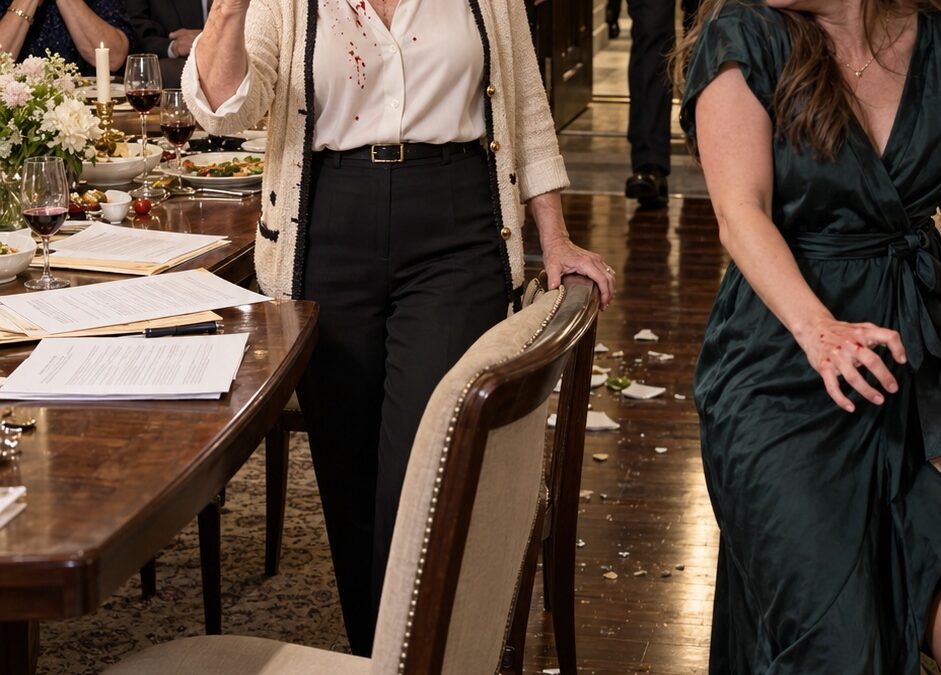
PART 2 and FULL ENDING 👇👇Thank you ❤️
“I gave you every opportunity to do this the easy way,” she continued.
Michael flinched.
Jessica did not notice.
“You’re going to sign that apartment over to Michael and me.”
“No.”
“And you’re going to continue the monthly payments.”
“No.”
Her eyes flashed.
“Thirty-five hundred dollars.”
“No.”
“Every month.”
“No.”
“For the rest of your miserable life.”
That was when several relatives began shouting at once.
“What are you talking about?”
“Jessica, have you lost your mind?”
“Michael, do something!”
But I raised my hand.
“Everyone stay where you are.”
Jessica stared.
Blood was still running down my temple.
I should have looked weak.
That was what she expected.
An elderly widow.
Bleeding.
Surrounded.
Afraid.
Instead, I smiled.
Slowly.
Jessica’s expression changed.
Only slightly.
But I saw it.
For the first time that evening, uncertainty entered her eyes.
“You have no idea what I just did while you were all eating dinner,” I said.
The room seemed to contract around us.
“What did you do?”
Her voice was quieter now.
I reached into the pocket of my dress.
Not for a weapon.
Not for the forged documents Jessica had spread across my dining table.
For my phone.
Michael stared at me.
Jessica took one step backward.
I unlocked the screen.
Pressed one number.
Someone answered immediately.
I looked directly into Jessica’s eyes.
“Agent Rodriguez.”
Jessica went pale.
“This is Brianna.”
My voice remained calm.
“We have the assault.”
Her lips parted.
“Twenty witnesses.”
She looked toward the front door.
“And the threats were recorded clearly.”
Jessica’s knees seemed to weaken.
“You can move in now.”
Then came the sound she had never expected to hear.
Heavy footsteps in the hallway outside my apartment.
Multiple people.
Moving fast.
Jessica turned toward the door.
So did everyone else.
And six months of lies, poison, forged documents, manipulated memories, fake medical emergencies, stolen money, and murder began collapsing all at once.
But to understand why federal agents were waiting outside my home while my daughter-in-law stood there with my blood on her hands, you have to understand something about me.
Jessica thought I was a lonely widow with money.
She thought age had made me soft.
She thought grief had made me stupid.
She thought being someone’s mother meant I would forgive anything my son brought through my door.
She was wrong about every single thing.
My name is Brianna Morrison.
I was sixty-eight years old when Jessica tried to steal my home.
And six months earlier, when she first came to me crying about five hundred dollars for her mother’s emergency surgery, I already knew enough about financial predators to recognize one terrifying possibility.
The only question was whether I could prove it before someone in my family died.
────────── ✦ ──────────
It started on a cold October morning.
Jessica knocked on my apartment door just after nine.
When I opened it, she was crying.
Not dramatically.
That would have been easier to distrust.
Jessica cried beautifully.
Her eyes filled without her mascara running.
Her lower lip trembled just enough.
She held several papers against her chest.
“Brianna, I’m so sorry to come over without calling.”
“What happened?”
“It’s Mom.”
Her mother was Patricia Williams.
I had met Patricia several times since Jessica began dating Michael.
Elegant woman.
Early sixties.
Controlled.
Always friendly.
Always watching.
At the time, I thought she was simply protective of her daughter.
“What happened to Patricia?”
“She needs surgery.”
I stepped aside.
“Come in.”
Jessica sat at my kitchen table.
I made coffee.
She barely touched it.
“The insurance won’t cover everything.”
“What kind of surgery?”
She looked down.
“Complications.”
That was the first small thing.
Not an answer.
But families do not interrogate one another during medical emergencies.
At least normal families do not.
“How much?”
“I hate asking.”
“Jessica.”
“Five hundred.”
That was all.
Five hundred dollars.
My late husband Harold had done well.
Very well.
He owned a construction company that grew from two trucks and six employees into a regional business.
We had never lived extravagantly.
But when Harold died, I was secure.
My downtown apartment was fully paid.
Investments were healthy.
Five hundred dollars would not change my life.
So I wrote the check.
Jessica hugged me.
“You have no idea what this means.”
“Tell Patricia not to worry about paying it back until she’s healthy.”
Jessica squeezed me tighter.
“You’re amazing.”
At the time, I thought I had helped family.
The next month, she needed a thousand.
“Complications.”
Then fifteen hundred.
“Physical therapy.”
Then two thousand.
“Specialist.”
Michael started coming with her.
That bothered me more than the money.
My son had always been confident.
Loud laugh.
Quick opinions.
Stubborn enough that Harold used to say raising him felt like negotiating with a labor union.
But the Michael sitting at my table during those months barely resembled him.
He looked exhausted.
His eyes seemed unfocused.
Sometimes I asked him a question and he took several seconds to answer.
“Are you sleeping?”
“Not really.”
“Why?”
“Work.”
Jessica usually answered for him.
“He’s under enormous pressure.”
I would look at my son.
“What kind of pressure?”
“Just work, Mom.”
His voice sounded hollow.
Jessica touched his arm.
“Tell her about the new project.”
He blinked.
“Oh.”
She guided the conversation away.
Again.
And again.
Whenever I tried getting Michael alone, Jessica appeared.
“Coffee?”
“Do you need anything?”
“Michael, remember we have that call.”
By February, she stopped pretending the money was a favor.
She walked into my apartment one Friday carrying her designer purse and said:
“We need three thousand by this afternoon.”
No tears.
No apology.
No request.
“Need?”
“Patricia found a treatment center in Arizona.”
“What treatment?”
Jessica’s expression tightened.
“Her condition.”
“What condition?”
“You know what she’s been going through.”
“I know several different descriptions of what she’s been going through.”
Silence.
“Can I see the doctor’s records?”
That changed her instantly.
“You want medical records?”
“If I’m helping pay for treatment, yes.”
Her eyes narrowed.
“I can’t believe you.”
“What?”
“My mother is sick.”
“I understand.”
“And you want proof?”
“Yes.”
“How dare you?”
The sweetness disappeared so quickly it almost impressed me.
“We’ve treated you like family.”
“I am family.”
“You know what I mean.”
“No, actually.”
Jessica grabbed her purse.
“This is humiliating.”
“What would be humiliating about showing me a bill?”
She stormed out.
Michael called two hours later.
“Mom, why did you upset Jessica?”
There was the script.
“Did she tell you what happened?”
“She said you accused her mother of lying.”
“I asked for medical documentation.”
“She’s hurt.”
“I’m sure.”
“She thinks you don’t trust her.”
“I don’t trust financial requests without documentation.”
He sighed.
“Mom.”
“Michael.”
Silence.
Then:
“Please just help them.”
Something in his voice frightened me.
Not the words.
The emptiness.
“Are you taking medication?”
“What?”
“Prescription medication.”
“No.”
“Sleeping pills?”
“No.”
“Anything Jessica gives you?”
His pause lasted half a second too long.
“Vitamins.”
“What vitamins?”
“Mom, stop.”
Jessica’s voice sounded in the background.
Then Michael said:
“I have to go.”
Click.
One month later, Jessica arrived carrying a folder.
She placed it on my kitchen table.
“These will simplify everything.”
I opened it.
Property-transfer documents.
Power-of-attorney forms.
A proposed deed transferring my apartment to Michael and Jessica.
I read the first page.
Then the second.
Then looked up.
“You want my home.”
Jessica smiled.
“We want to protect your home.”
“It’s already protected.”
“You’re getting older.”
“I noticed.”
She ignored the sarcasm.
“This place is becoming a lot for you.”
“My apartment has two bedrooms.”
“Property taxes.”
“Automatic withdrawal.”
“Repairs.”
“Building management handles most of them.”
“Brianna.”
Her voice hardened.
“Michael and I are thinking about the future.”
“My future?”
“Our family’s future.”
There it was.
“We think you should transfer the deed to us.”
“No.”
“You haven’t even considered it.”
“I just did.”
Her face stiffened.
“Michael agrees.”
“Where is Michael?”
“At work.”
“I’ll ask him.”
“That isn’t necessary.”
“Then why mention him?”
She pushed the documents closer.
“Sign.”
I smiled.
“No.”
“You’re being difficult.”
“I’m being literate.”
Her eyes darkened.
“I’m trying to help.”
“Then you won’t mind if my attorney reviews these.”
That was the moment Jessica’s mask cracked.
Not completely.
Enough.
“How dare you question our intentions?”
I leaned back.
“I question every document that transfers valuable property.”
“You’re paranoid.”
“Possibly.”
“You’re ungrateful.”
“Also possible.”
She stood.
“Michael warned me you were becoming difficult.”
My chest tightened.
“What exactly did Michael say?”
Jessica realized she had gone too far.
“Nothing.”
“No. Tell me.”
“He worries about you.”
“Why?”
“Memory issues.”
I almost laughed.
“My memory is fine.”
“See?”
“See what?”
“You’re defensive.”
She gathered the papers.
“Jessica.”
She stopped.
“If Michael believes I’m experiencing cognitive problems, I want him to tell me himself.”
She smiled.
“He will.”
After she left, I locked the door.
Then I called Ray Morrison.
Ray and I had known each other most of our adult lives.
He spent thirty years in law enforcement, many of them working financial crimes.
“Ray.”
“Brianna.”
“I need a favor.”
“That sentence is never good.”
“I want you to check someone.”
“Who?”
“My daughter-in-law’s mother.”
Pause.
“Why?”
“She’s been asking for money.”
“How much?”
“Started at five hundred.”
“And now?”
“Three thousand. Property papers appeared today.”
Silence.
Then:
“I’ll make some calls.”
I asked him to be discreet.
I told myself maybe Jessica was simply pushy.
Maybe Patricia’s illness was real.
Maybe Michael truly believed transferring the apartment would help me.
Maybe I was becoming suspicious because I had spent too many years around fraud cases.
That was the part Jessica never knew about me.
My maiden name was Brianna Chen.
Long before I became Brianna Morrison, Harold’s wife, Michael’s mother, and the widow in Apartment 18B, I worked for the United States Treasury Department.
Thirty years.
Tax fraud.
Money laundering.
Asset concealment.
Financial exploitation.
During the final decade of my career, I specialized in organized elder abuse.
I had interviewed hundreds of victims.
Reviewed thousands of forged documents.
Watched predators use the same weapons repeatedly.
Urgency.
Shame.
Isolation.
Family pressure.
Fake medical emergencies.
Concern about “declining memory.”
Attempts to control property.
Jessica’s behavior was setting off alarms I had learned to trust.
But instinct is not evidence.
So I waited.
Ray called three days later.
“Are you alone?”
“Yes.”
“Sit down.”
I did.
“Patricia Williams has no documented serious medical condition matching what Jessica described.”
I closed my eyes.
“Okay.”
“It gets worse.”
“How much worse?”
“Three elder-abuse investigations.”
My hand tightened around the phone.
“Where?”
“Different states.”
“Charges?”
“Dropped.”
“Why?”
“In one case the victim withdrew the complaint.”
“Other two?”
“One died.”
I said nothing.
“The other became mentally incompetent before trial.”
My training took over.
“What kind of death?”
“Natural causes.”
“Supposedly.”
“Supposedly.”
Ray came to my apartment the next evening with a folder.
He did not remove his coat.
That told me he was unsettled.
“Jessica and Michael’s marriage was never legally registered.”
I stared.
“What?”
“The ceremony was performed by Patricia’s brother.”
“I remember him.”
“He wasn’t authorized to solemnize marriages in this state.”
“But paperwork—”
“Never properly filed.”
My mouth went dry.
“Michael thinks he’s married.”
“Yes.”
“Jessica knows?”
“Almost certainly.”
That changed everything.
A marriage that never legally existed.
Medical bills that did not exist.
Pressure to transfer property.
An increasingly confused son.
Multiple previous elder-abuse investigations.
This was not family dysfunction.
This was an operation.
Over the next two weeks, Ray dug deeper.
What he uncovered frightened even me.
Patricia Williams had been running versions of the same scheme for years.
She had three daughters.
Jessica was the youngest.
All had used different surnames.
Different identities.
Different states.
They targeted families with assets.
Especially widows and widowers.
The pattern was terrifyingly consistent.
Enter through romance.
Create financial dependency.
Isolate the target.
Manufacture medical or cognitive concerns.
Gain control of money.
Then property.
Then remove the target.
Ray placed photographs on my table.
An eighty-year-old ranch owner in Texas.
Transferred his property.
Died after severe gastrointestinal illness.
A wealthy Florida widow.
Signed away her beach house.
Fell down her stairs.
A retired professor in Colorado.
Changed his will.
Suffered what authorities called a stroke.
The Colorado victim’s grandson demanded an expanded toxicology panel.
Oleander.
Castor-bean derivatives.
My stomach twisted.
“Plant toxins.”
Ray nodded.
“Difficult to detect unless you’re specifically looking.”
My hands began shaking.
Because I remembered Harold.
Perfectly healthy.
Then slowly tired.
Occasional stomach problems.
Moments of confusion.
Doctors blamed age.
Stress.
Then one night, after Jessica insisted on cooking dinner for us, Harold went to bed complaining of nausea.
Hours later, he suffered a massive heart attack.
Eight months after Jessica entered our lives.
I looked at Ray.
“No.”
“Brianna.”
“No.”
“We don’t know yet.”
I stood.
“You’re thinking it.”
“Yes.”
I walked to the window.
For three years, I had grieved a natural death.
Now that memory had been poisoned too.
Ray continued.
“Jessica isn’t Jessica Morrison.”
I turned.
“Real name is Jennifer Walsh.”
Multiple Social Security numbers.
Prior fraud arrests.
Identity theft.
Witnesses recanted.
Witnesses died.
Patricia’s network included more than family.
Lawyers.
Doctors.
Funeral-home employees.
Nursing-home administrators.
People positioned exactly where a criminal organization would need them.
Estimated theft at that point:
Millions.
Then Ray told me about Michael.
“We got blood samples.”
“How?”
“Don’t ask.”
“Ray.”
“You trained me better than that.”
“Results?”
His face hardened.
“Benzodiazepines.”
My knees weakened.
“What else?”
“Other sedating substances.”
“Prescription?”
“Not prescribed to Michael.”
I sat down.
“They’re drugging him.”
“Yes.”
The behavioral changes suddenly made terrible sense.
The delayed responses.
Blank eyes.
Memory problems.
Rehearsed conversations.
Michael was being kept functional enough to sign things and speak.
Confused enough to be controlled.
Jessica slipped medication into his coffee.
His supplements.
Occasionally food.
She spent his impaired hours telling him what he had supposedly agreed to.
Then reinforced false memories afterward.
But when Ray and I got Michael safely away from Jessica and under medical supervision, an uglier truth emerged.
The drugs were not the beginning.
Three months into their relationship, Michael developed a gambling problem.
At least that was what he believed.
It began with office pools.
Poker.
Sports betting.
Then underground games Jessica introduced him to.
Within months, Michael thought he owed thirty-eight thousand dollars to dangerous people.
He sobbed when he confessed.
“They were threatening me.”
We were sitting in Ray’s office.
A doctor had been monitoring Michael for several days while the drugs cleared his system.
“I thought they’d hurt me.”
“Why didn’t you tell me?”
“I was ashamed.”
“Michael.”
“I’m your son.”
His voice cracked.
“You and Dad taught me better.”
Shame.
Predators love shame because shame keeps victims quiet.
“Jessica said Patricia could help.”
He continued.
“She said they would pay the debt if I helped them temporarily.”
“Help how?”
“Information.”
My heart sank.
“My accounts?”
“Yes.”
“My schedules?”
“Yes.”
“Medical information?”
His eyes filled.
“Yes.”
“What else?”
He looked down.
“I let her into your apartment.”
I went still.
“When?”
“When you weren’t home.”
“For what?”
“She said she needed documents.”
He covered his face.
“She convinced me you were developing dementia.”
I almost laughed from the cruelty of it.
“How?”
“She showed me notes.”
“I never wrote them.”
“I know that now.”
“What else?”
“She would tell me things you supposedly said.”
“Nonsense?”
“Yes.”
“Forgetfulness?”
“Yes.”
Michael sobbed.
“I thought we were helping you.”
Jessica had been moving things inside my apartment.
Changing arrangements.
Hiding objects.
Then using my confusion when I could not find them as proof of decline.
She fabricated conversations.
Created documents.
Planted evidence.
Then told my son his mother was becoming incompetent.
Classic gaslighting.
Not casual manipulation.
Professional.
The endgame was guardianship.
Power of attorney.
Then a nursing home.
Michael whispered:
“They already picked one.”
“What?”
“Patricia has connections there.”
The facility had a history of neglect.
Suspicious deaths.
Forged commitment paperwork.
The plan was simple.
Have me declared incompetent.
Place me somewhere nobody would watch closely.
Control my assets.
Then eventually, I would suffer an accident.
Fall.
Medication overdose.
Cardiac event.
Whatever was convenient.
Michael had overheard them.
While drugged.
Barely conscious.
Jessica and Patricia discussing how they would kill me.
Then he said the sentence I will hear until the day I die.
“They talked about Dad.”
I could not speak.
“Jessica said he was easier than they expected.”
The world disappeared for a moment.
No Ray.
No office.
No papers.
Just Harold.
His laugh.
His hands.
His work boots near our old front door.
The way he always pretended not to cry at sentimental movies.
His last dinner.
His last night.
His death.
Michael continued through tears.
“They poisoned him slowly.”
I stared at the floor.
“They said the symptoms looked like aging.”
Fatigue.
Confusion.
Stomach pain.
Exactly what Ray had found in previous victims.
Jessica had bragged about it.
My husband had not simply died.
He had been murdered inside his own home by a woman we thought would join our family.
I wanted to scream.
Instead, I became very calm.
Thirty years in federal investigations taught me something about rage.
It is useful only when you give it a job.
So I gave mine one.
Justice.
Michael gripped my hands.
“Tell me what to do.”
I looked at my son.
The drugs were clearing.
For the first time in months, his eyes looked like his.
“Anything.”
His voice shook.
“I’ll do anything.”
Then I told him the part of my life I had barely discussed since retiring.
“Michael, Jessica made one mistake.”
“What?”
“She investigated your father’s money.”
I opened a filing cabinet.
“Your apartment.”
Another folder.
“My age.”
Old credentials.
“Your weaknesses.”
Case files.
“Everything except me.”
His eyes moved to the badge.
The seal.
My old identification.
“What is this?”
“Before I married your father, I was Brianna Chen.”
He stared.
“I worked for Treasury.”
“I know you worked for the government.”
“No.”
I smiled without humor.
“You know I told you I worked in financial compliance.”
“You didn’t?”
“Not exactly.”
Ray laughed from across the room.
“Your mother put organized criminals in federal prison.”
Michael stared at me.
I spread old case photographs across the desk.
“For thirty years.”
His mouth opened.
“My last ten years, I specialized in organized elder-abuse operations.”
“You…”
“I dismantled six major networks.”
He looked at Ray.
Ray nodded.
“Your mother was terrifying.”
“Thank you.”
“That was a compliment.”
Michael looked back at me.
“So when Jessica started asking for money…”
“I noticed.”
“How long?”
“October.”
His face changed.
“You knew?”
“I suspected.”
“All this time?”
“I needed evidence.”
“You let her keep coming into your home?”
“Yes.”
“Mom.”
“Michael.”
“She killed Dad.”
“I know.”
“She tried to poison you.”
“I know.”
He stood.
“You knew she was poisoning you?”
“Eventually.”
That nearly broke him.
I showed him laboratory reports.
Oleander.
Castor-bean derivatives.
Low but measurable levels.
Jessica had been slowly poisoning me for almost two months.
Same method.
Different delivery.
Tea.
Herbal remedies.
Essential oils.
Food.
Once I recognized the symptoms, I consulted toxicology specialists.
Countermeasures.
Frequent tests.
Strict food control.
Everything Jessica brought into my apartment was sampled and preserved.
Michael looked horrified.
“She could have killed you.”
“She tried.”
“And you stayed?”
“I needed the organization.”
Not just Jessica.
Not just Patricia.
All of them.
Because by then, federal authorities were involved.
My old contacts connected me with Agent Sarah Rodriguez.
Her task force had been investigating Patricia’s network across multiple jurisdictions.
Our case provided what they had been missing.
Live access.
Recordings.
Financial demands.
Evidence of poisoning.
Attempted property theft.
Potential murder conspiracy.
I had recorded every significant conversation in my apartment.
Tiny devices.
Invisible.
Clear audio.
Jessica discussing money.
Patricia coaching her.
References to earlier victims.
Plans concerning me.
The FBI built outward from there.
Bank transfers.
Shell companies.
Doctors.
Lawyers.
Funeral homes.
Care facilities.
By spring, investigators believed the network had stolen more than ten million dollars.
At least fifteen suspicious deaths were being reexamined.
Twelve elderly people were currently being targeted.
“We’ve been building this for six months.”
I told Michael.
He looked at me.
“What happens now?”
“Sunday dinner.”
“What?”
I smiled.
“I’m inviting the family.”
That was the dinner where this story began.
Officially, it was for Michael’s birthday.
Twenty relatives.
Food.
Wine.
Dessert.
Jessica expected Patricia to attend.
Patricia never would.
Federal agents arrested her that morning on outstanding warrants.
Jessica did not know.
Two undercover agents attended my dinner.
One introduced as a distant cousin Jessica had never met.
Another as a new neighbor.
Agents waited in the hallway.
Downstairs.
Outside.
Surveillance van nearby.
Michael wore a wire.
So did I.
The only instruction Agent Rodriguez gave me was simple.
“Do not lead Jessica.”
“I know.”
“Let her make the threats herself.”
“I know.”
“Brianna.”
“What?”
“You’re not thirty-five anymore.”
“Neither are you.”
She did not laugh.
“This woman has killed people.”
“I know.”
“If she becomes dangerous, we move immediately.”
“No.”
Her eyebrows rose.
“We need the threat.”
“We already have enough.”
“You want the whole organization.”
She knew me too well.
“Yes.”
Jessica arrived an hour late.
Immediately agitated.
“Where’s my mother?”
“I assumed she was coming with you.”
Jessica checked her phone.
Again.
Again.
Patricia was already in custody.
Dinner progressed badly.
Jessica barely ate.
Barely spoke.
By dessert, panic had begun leaking through her carefully controlled face.
Then she stood.
“I need everyone’s attention.”
There it was.
She pulled documents from her purse.
Forged power of attorney.
Property deed.
Financial-control paperwork.
“Brianna has been having problems.”
Several relatives looked confused.
Jessica continued.
“Memory.”
“Confusion.”
“She can’t properly manage her finances anymore.”
My sister frowned.
“I’ve never noticed that.”
Jessica smiled.
“It can be subtle.”
I almost admired the performance.
She explained that Michael and she would take legal control “for my protection.”
Michael stood near the kitchen.
He said nothing.
Exactly as planned.
Jessica pushed the papers toward me.
“Sign.”
“No.”
Her jaw tightened.
“Brianna.”
“No.”
“You’re embarrassing yourself.”
“I’m perfectly capable of managing my affairs.”
“Your attorney doesn’t need to be involved.”
“Yes, he does.”
“I’m family.”
“You are not my attorney.”
She leaned closer.
“Sign.”
“No.”
And then, finally, the predator appeared.
“How dare you.”
Her voice sharpened.
“After everything we’ve done.”
“You mean the money I gave you?”
Her face flushed.
“My mother needs care.”
“No medical records have ever been provided.”
“She is sick.”
“No.”
“You selfish—”
Several relatives shifted uncomfortably.
Jessica looked around.
She was losing the room.
Predators become most dangerous when the performance stops working.
“I am not asking anymore.”
Her voice rose.
“You are signing these documents tonight.”
“No.”
“There will be consequences.”
“No.”
“Patricia needs that money.”
“No.”
“You have hundreds of thousands sitting around.”
“My finances are not yours.”
“You’re old!”
Silence.
She realized she had said it aloud.
Then decided to continue.
“You don’t need all of this.”
She gestured around my apartment.
“You’re going to die anyway.”
Michael closed his eyes.
My cousin whispered:
“What the hell?”
Jessica pointed at me.
“Sign.”
“No.”
That was when she picked up the ceramic serving plate.
For one split second, I saw the decision happen.
Rage.
Humiliation.
Loss of control.
Her arm moved.
The plate struck my forehead.
Pain exploded.
I heard people scream.
Ceramic broke.
Warm blood ran down my face.
Jessica shouted:
“You stupid woman!”
Someone moved toward her.
I raised my hand.
Jessica kept going.
“You will sign this apartment over.”
“No.”
“You’ll pay thirty-five hundred every month.”
“No.”
“For the rest of your pathetic life.”
I smiled.
And told her she had no idea what I had done while everyone was eating dinner.
Then I called Agent Rodriguez.
The door burst open.
“Federal agents!”
Jessica froze.
Weapons.
Badges.
Commands.
Hands visible.
Do not move.
Michael stepped away from her.
She looked at him.
“Michael?”
He did not answer.
“Michael!”
Agent Rodriguez entered.
“Jennifer Walsh, also known as Jessica Morrison.”
Jessica’s face collapsed.
“You are under arrest for financial fraud, elder abuse, assault, conspiracy, and murder.”
Handcuffs clicked.
Jessica looked at me.
Not angry now.
Terrified.
“You…”
I pressed the napkin against my forehead.
“Yes.”
“You set me up.”
“No.”
I shook my head.
“You did all the work.”
The next seventy-two hours changed everything.
Federal authorities exhumed Harold.
Advanced toxicology confirmed lethal concentrations of the same plant-based toxins found in previous victims.
Oleander compounds.
Castor-bean derivatives.
Administered gradually.
Then a fatal dose.
My husband had been murdered over three months.
I sat in a federal briefing room when they told me.
I thought I was prepared.
I was not.
There are facts your mind understands before your heart accepts them.
Harold’s death had been part of a financial operation.
He was not collateral damage.
He was a target.
Jessica eventually confessed to nine murders.
Nine.
The FBI found what Agent Kim called her “murder kit” hidden in Michael’s apartment.
Seeds.
Extraction tools.
Measured doses.
Notes.
Symptoms.
Timelines.
Methods designed to mimic heart attacks, strokes, falls, accidental overdoses.
Trophies from victims.
Jewelry.
Photographs.
Small personal objects.
Some belonging to people investigators had not yet connected to her.
Patricia began talking too.
Faced with evidence, multiple jurisdictions, and potential capital charges, her organization came apart.
Fifteen years of elder exploitation.
More than twelve million dollars stolen.
Doctors falsifying medical records.
Lawyers creating fraudulent documents.
Funeral directors preventing autopsies.
Care facilities accepting victims under forged commitments.
Fifteen accomplices were eventually identified and arrested.
More than eight million dollars in assets were frozen or recovered.
Twelve elderly people actively being targeted were located before their situations turned fatal.
That number meant more to me than the money.
Twelve people.
Twelve families who would not receive the phone call I received after Harold collapsed.
Michael recovered physically within days.
Emotionally took much longer.
When the benzodiazepines cleared, his natural personality returned.
So did guilt.
“Mom.”
We sat in my apartment several weeks after the arrest.
He looked toward the spot where Jessica had hit me.
The wound was healing.
A thin scar remained.
“I helped them.”
“You were manipulated.”
“I gave them information.”
“You were drugged.”
“I let Jessica into your home.”
“You thought you were helping.”
“I gambled.”
I said nothing.
He looked at me.
“That part was mine.”
“Yes.”
He needed truth more than comfort.
“I made stupid choices.”
“Yes.”
He swallowed.
“I was ashamed.”
“I know.”
“That’s why I didn’t tell you.”
“I know.”
“I thought the debt was real.”
That part turned out to be another lie.
The people Michael believed were dangerous gambling creditors?
Patricia’s associates.
His debt had been inflated and manipulated.
Games arranged.
Numbers changed.
Threats staged.
They built desperation around him.
Then presented Jessica as rescue.
Agent Rodriguez told us the endgame.
After I died, they intended to kill Michael too.
Suicide.
Guilty son.
Mother dead.
Financial mess.
Easy story.
Michael cried harder than I had ever seen him.
“They were going to kill me?”
“Yes.”
“And make it look like I killed myself?”
“Yes.”
For weeks he blamed himself.
Then months.
Treatment helped.
Addiction counseling.
Trauma therapy.
Medical supervision.
I never told him he had no responsibility.
That would have been dishonest.
He had made choices.
But being responsible for some choices did not make him responsible for murder.
Jessica and Patricia engineered an environment in which his weaknesses became weapons against him.
Understanding that distinction helped him recover.
Six months after the arrests, the federal trial began.
It did not last long.
The evidence was overwhelming.
Audio.
Financial records.
Toxicology.
Confessions.
Victim files.
Witness testimony.
Physical evidence.
Jessica and Patricia eventually accepted plea agreements rather than risk capital prosecution.
Jessica received nine consecutive life sentences without parole.
Patricia received seven.
Neither would ever leave prison.
Fifteen additional members of their network faced convictions and sentences of their own.
I sat in the federal courthouse after sentencing.
For three years, I had believed Harold’s death was meaningless bad luck.
A heart that simply stopped.
Now I knew the truth.
That truth hurt.
But it also gave me somewhere to put the grief.
Justice cannot resurrect anyone.
It cannot reverse the final night.
It cannot give me another morning with Harold drinking coffee and complaining about the newspaper.
But justice says:
This happened.
It was wrong.
He mattered.
They do not get to rewrite his death as natural simply because their method was clever.
When I visited Harold’s grave after sentencing, Michael came with me.
We placed flowers.
He stood quietly.
Then:
“Dad would be proud of you.”
I looked at the stone.
“I hope so.”
“You got justice for him.”
“I got help.”
“You did more.”
He looked at me.
“You stopped them from doing it to other people.”
That mattered.
Two years have passed since the dinner party.
The scar on my forehead is small now.
Barely visible unless the light hits it.
I have never tried to hide it.
Sometimes someone asks.
I say:
“Long story.”
And smile.
The apartment Jessica wanted so badly is still mine.
Michael and I renovated it together.
Not because Jessica ruined it physically.
Because I wanted new memories in rooms that had held too many old ones.
New dining table.
Fresh paint.
Different lighting.
The hardwood where the plate shattered was refinished.
For a while, I considered replacing it completely.
Then decided against it.
I do not need to erase where something terrible happened.
I only need that terrible thing not to be the last thing that happened there.
So Sunday dinners returned.
Real ones.
Michael comes.
Sometimes Ray.
My sister.
Cousins.
Friends.
No forged paperwork beside dessert.
That helps.
Michael eventually turned his experience into work.
After completing treatment for gambling addiction and trauma, he began counseling other victims of financial manipulation.
He speaks openly.
That impressed me.
Shame once made him hide everything.
Now honesty is the tool he uses to help others.
At community centers he tells people:
“I was educated.”
“I had a career.”
“I thought I was smart enough to recognize manipulation.”
“None of that protected me.”
Then:
“Predators don’t need you to be stupid.”
“They need you to have a vulnerability.”
Everyone has one.
Loneliness.
Grief.
Debt.
Addiction.
Fear.
Family loyalty.
Pride.
Love.
The question is not whether you have a weakness.
The question is whether someone is using it to make your decisions for you.
Six months after the trials, Michael met Sarah.
A nurse.
She worked with elderly patients.
He told me about her slowly.
That alone made me like her.
No instant marriage.
No dramatic destiny.
No emergency.
No pressure.
They dated.
Argued.
Took time.
She asked questions.
Michael told her about Jessica early.
Everything.
Including the gambling.
Including the drugs.
Including me.
I asked:
“What did she say?”
“That it sounds like I survived something terrible and have work to do.”
I smiled.
“Smart woman.”
They married last spring.
Small ceremony.
Real officiant.
I checked.
Michael was horrified.
“Mom.”
“What?”
“You actually checked?”
“I learned things.”
Sarah laughed harder than anyone.
My retirement ended too.
Not officially.
Treasury did not give me my old office back.
Thank God.
But federal agencies began asking me to consult on elder financial-abuse cases.
Agent Rodriguez told me our investigation became a training model.
Documentation.
Cross-jurisdiction coordination.
Medical evidence.
Family manipulation.
Asset tracing.
I testified before congressional committees about elder financial crimes and the way organized groups move victims between state systems.
Reforms followed.
Better information sharing.
Stronger verification requirements.
Improved coordination between financial institutions, medical providers, and investigators.
But the work closest to my heart became the Harold Morrison Foundation for Elder Protection.
We created it using recovered restitution funds along with my own money.
Harold spent his life building things.
Homes.
Commercial spaces.
Businesses.
It felt right that something carrying his name should build protection.
The foundation operates a twenty-four-hour hotline.
Retired law-enforcement investigators.
Social workers.
Attorneys.
Financial specialists.
People who understand that when an elderly woman says:
“My daughter suddenly wants me to sign something.”
You listen.
When a widower says:
“My new girlfriend gets angry when I ask where the money is going.”
You listen.
When a son says:
“My mother’s behavior changed right after a new caregiver started controlling her medication.”
You listen.
We provide legal help.
Financial review.
Safety planning.
Referrals.
Emergency coordination.
In eighteen months, our programs helped prevent more than two hundred suspected cases of elder exploitation from becoming worse.
Some were misunderstandings.
Some were family conflict.
Some were criminal.
The important thing is that someone checked.
Michael works with us.
Sarah too.
Her medical expertise helped identify several cases involving covert drugging and poisoning.
The first time she caught one, she came to my apartment afterward.
Shaken.
“If we hadn’t asked for toxicology…”
“I know.”
“The family thought he had dementia.”
“I know.”
She looked at me.
“How many people die like that?”
I had no good answer.
That is why we keep working.
The relatives who attended the dinner where Jessica struck me became some of the foundation’s strongest supporters.
They had watched manipulation transform in real time.
At the beginning of the evening, some believed Jessica’s concerned-wife routine.
By the end, they watched federal agents remove a murderer in handcuffs.
That kind of lesson stays with you.
Ray still tells the story too dramatically.
According to him, I was “cool as ice” while blood covered half my face.
In reality, I was in pain and slightly nauseated.
I just knew the microphone was still recording.
Details matter.
One Sunday after dinner, Michael and I returned to Harold’s grave.
Sarah waited near the car.
Michael placed flowers.
Then touched the stone.
“Dad.”
He took a breath.
“I’m sorry.”
I stood beside him.
“For what?”
He looked at me.
“Everything.”
“You don’t owe your father an apology for being victimized.”
“I owe him one for hiding the gambling.”
“Maybe.”
He smiled sadly.
“You always do that.”
“What?”
“Refuse to tell me exactly what I want to hear.”
“That’s parenting.”
We stood quietly.
Then he said:
“Do you think he knew?”
“About Jessica?”
“Yes.”
The question hurt.
“I don’t know.”
“I keep thinking maybe he suspected.”
“Harold suspected everybody.”
That made Michael laugh.
Then:
“If he did, he probably kept quiet because he didn’t want to hurt me.”
“Maybe.”
“I wish he hadn’t.”
“So do I.”
That became another lesson.
Silence meant to protect family can become protection for predators.
Ask the uncomfortable question.
Request documentation.
Verify.
Real love survives reasonable caution.
A manipulator treats caution as betrayal.
Jessica became furious when I asked for medical records.
Furious when I wanted my lawyer to review a deed.
Furious when I said no.
Those were not random personality flaws.
They were warning signs.
Healthy people may feel disappointed when you set a boundary.
Predators feel obstructed.
There is a difference.
Patricia and Jessica depended on urgency.
Your mother needs surgery now.
We need the money Friday.
Sign tonight.
Do not call your lawyer.
Do not ask a doctor.
Do not wait.
Do not verify.
Urgency is one of the oldest tools in fraud.
It prevents thought.
That is one reason I tell families:
Slow down.
If something is legitimate today, it will usually still be legitimate after independent review tomorrow.
Predators hate tomorrow.
They need tonight.
I also tell older people something society does not say often enough.
Age does not erase your judgment.
Yes, cognitive decline exists.
Yes, everyone should plan for possible incapacity.
But too many manipulators weaponize stereotypes about aging.
They call normal disagreement confusion.
Caution becomes paranoia.
Independence becomes stubbornness.
A forgotten name becomes evidence of dementia.
Jessica used that against me.
I had seen it professionally.
Experiencing it personally was different.
It made me furious.
Now when someone calls the foundation saying:
“My family thinks I’m confused because I won’t sign.”
We do not automatically assume either side is right.
We investigate.
Respect requires evidence.
Michael once asked:
“Were you ever actually scared?”
I stared at him.
“Constantly.”
He looked surprised.
“You never seemed scared.”
“I was trained.”
“That isn’t the same.”
“No.”
“Even during the dinner?”
“Yes.”
“When she picked up the plate?”
“Especially then.”
“Why didn’t you move?”
“Because I didn’t know she would hit me until she did.”
He looked sick.
“I hate that you had to do that.”
“So do I.”
“Would you do it again?”
I thought.
“No.”
He seemed relieved.
Then I added:
“But I don’t regret stopping them.”
There is a difference between courage and romanticizing danger.
I would not recommend anyone conduct their own sting operation because I did.
Mine happened with federal coordination.
Medical monitoring.
Surveillance.
Backup.
Planning.
I was never as alone as Jessica believed.
That was the point.
Her victims before me were isolated.
I refused to be.
Ray.
Agent Rodriguez.
Doctors.
Family.
Investigators.
The best defense against sophisticated predators is rarely one heroic person.
It is a network of people sharing information quickly enough that manipulation cannot stay hidden.
That is what our foundation tries to create.
Patricia built a criminal network.
We built a protective one.
I like that symmetry.
Michael and Sarah visit most Sundays.
Sometimes they bring patients’ stories without names.
Cases that bother them.
We talk.
Harold would probably complain that Sunday dinner turned into work.
Then join the conversation anyway.
I still miss him.
Justice did not make that smaller.
It changed the shape.
For years, I missed him and thought:
His heart failed.
Now I miss him knowing someone took him.
That grief is angrier.
But it is also honest.
I no longer imagine I missed some obvious sign because I was foolish.
The murder was designed to look natural.
That matters.
Victims often blame themselves for not recognizing professional deception.
Professionals build deception specifically to avoid recognition.
Jessica had done this before.
Patricia had refined it for fifteen years.
Corrupt professionals supported them.
Harold was not stupid.
Michael was not stupid.
I was not invincible.
We were targeted.
What saved us was not superior intelligence.
It was eventually refusing isolation.
Two years after Jessica’s arrest, I stood before the foundation board and looked around at people Harold never met.
Retired agents.
Nurses.
Attorneys.
Social workers.
Victims.
Adult children.
Carol Stevens, our director, presented the numbers.
“Two hundred seventeen interventions.”
“Forty-three confirmed criminal cases referred to law enforcement.”
“Seventy-nine families provided emergency legal assistance.”
“Three suspected poisonings identified before they became fatal.”
Three.
That number stopped me.
Three people alive.
Because someone asked another question.
Afterward, Michael came over.
“You okay?”
“Yes.”
“You’re crying.”
“I’m allowed.”
He hugged me.
Then whispered:
“Dad would love this.”
I looked at the foundation sign.
HAROLD MORRISON FOUNDATION FOR ELDER PROTECTION.
“I think so.”
My apartment still bears the scar of that night too.
Not physically.
The floor was repaired.
The plate is gone.
But every time we sit around the dining table, I remember Jessica standing there demanding ownership.
And every time someone laughs now, that memory loses another piece of its power.
Sarah once asked why I did not move.
“Move where?”
“Different apartment.”
I looked around.
“This is my home.”
“You have bad memories here.”
“I also have good ones.”
She nodded.
“Fair.”
“I refuse to let Jessica own the meaning of a place she failed to steal.”
That became important to me.
Predators take more than money when they succeed.
They take the emotional meaning of ordinary things.
Homes.
Phones.
Meals.
Documents.
Family gatherings.
I reclaimed mine.
The scar on my forehead became part of that reclamation.
It is small.
White now.
Sometimes makeup covers it.
Sometimes not.
When I see it in the mirror, I remember pain.
But also the moment Jessica finally exposed herself completely.
For six months, she believed violence was proof of control.
Instead, that single act gave investigators one more undeniable charge.
Assault.
Witnesses.
Recorded threat.
Motive.
She hit me thinking she had finally forced obedience.
In reality, she completed the case against herself.
That irony still satisfies me.
The bigger irony is what happened to Michael.
Jessica exploited his weakness.
Now his willingness to speak about that weakness helps others.
He tells audiences about gambling.
Debt.
Shame.
Medication.
Manipulated memory.
The hardest part for him was admitting that before Jessica drugged him, he made choices that made him vulnerable.
But that honesty is exactly why people trust him.
A man once approached him after a talk.
“My daughter is dating someone who keeps borrowing money.”
Michael listened.
“She thinks we’re controlling because we’re asking questions.”
“Ask anyway.”
The man looked relieved.
Michael continued:
“If he loves her, he can survive questions.”
That line stayed with me.
Real love survives questions.
Fraud demands faith without verification.
Michael and Sarah’s marriage is not perfect.
Thank God.
Perfect relationships make me suspicious now.
They disagree.
Sarah calls him out when he avoids things.
Michael asks too many questions about shared accounts.
She teases him.
They use separate passwords.
Then discuss finances openly.
Healthy caution.
Not secrecy.
One evening Michael said:
“I think Jessica ruined romance for me.”
Sarah answered:
“No. She ruined recklessness.”
I nearly applauded.
Michael married well the second time.
Legally too.
I verified that.
Again.
He still complains about it.
The federal case also forced me to reconsider retirement.
For years after leaving Treasury, I tried being “normal.”
Gardening.
Travel.
Reading.
Lunch.
I loved parts of it.
But some part of me missed investigative work.
Not danger.
Purpose.
Patricia gave me purpose in the worst possible way.
I would never thank her.
But I will use what happened.
There is power in refusing to let perpetrators control what their crimes become.
They intended Harold’s death to create profit.
His name now protects victims.
They intended Michael’s addiction to destroy him.
His story now helps families.
They intended my age to make me invisible.
Now I speak publicly about elder exploitation.
That transformation is not forgiveness.
It is ownership.
Of my future.
Jessica does not get it.
Patricia does not get it.
I do.
Sometimes reporters ask:
“Did you know immediately?”
No.
I suspected financial manipulation early.
I did not immediately know Jessica was a killer.
I did not know Harold was murdered.
I did not know how deep the network went.
Anyone telling the story as though I saw everything from the first five-hundred-dollar check would be lying.
Investigation is accumulation.
One inconsistency.
Then another.
A medical story with no documents.
Pressure to transfer property.
Michael’s behavioral changes.
A marriage certificate that never existed.
Patricia’s prior investigations.
Toxicology.
Identity records.
Each piece changed the picture.
That is why I tell people not to wait for a dramatic smoking gun.
Pay attention to patterns.
Patterns are often evidence before evidence becomes obvious.
Jessica’s pattern was escalation.
Five hundred.
One thousand.
Fifteen hundred.
Three thousand.
Then my apartment.
Money was never the destination.
Control was.
The financial requests trained me.
Would I comply?
Would I question?
Would Michael pressure me?
Would anyone independently verify?
Predators test boundaries before crossing the largest ones.
I crossed back.
That saved me.
Not because I was fearless.
Because I had training.
And because I asked for help.
That part matters most.
When Ray entered my apartment with the first real evidence, I stopped being one potential victim alone.
Jessica and Patricia had an organization.
So did I.
Mine had badges they did not control.
Labs they could not bribe.
Records they could not forge.
And people willing to wait until the case was strong enough.
At the end of one foundation seminar, an eighty-two-year-old woman approached me.
Her daughter had been pushing her to sign a new power of attorney.
“Maybe she means well.”
“Maybe.”
“I feel guilty questioning her.”
“Why?”
“She’s my daughter.”
I nodded.
“Then she should want you protected.”
The woman looked at me.
“What should I do?”
“Independent lawyer.”
“She’ll be angry.”
“Healthy love can survive anger.”
The woman smiled.
“I like that.”
So do I.
I wish someone had told Michael that.
He hid his gambling because he thought my disappointment would destroy him.
Instead, secrecy gave Jessica leverage.
Families do not need to approve of every mistake to remain safe places for truth.
That became something Michael and I had to rebuild.
He can tell me ugly things now.
I do not rescue him.
I listen.
Sometimes disagree.
Sometimes get angry.
Then continue loving him.
That is healthier than the fragile perfection we had before.
Harold and I had loved Michael deeply.
Maybe so deeply that he became afraid to fail us.
Parents should think about that.
Admiration can become pressure if children believe love depends on living up to it.
Jessica saw Michael’s shame.
Then exploited it.
I cannot change that past.
I can make our future different.
Last spring, after Michael and Sarah’s wedding, we had dinner in my apartment.
Twenty people again.
Almost the same number as the sting.
At one point I looked around.
Family.
Music.
Dessert.
Someone dropped a fork.
I jumped.
Ray noticed.
“You okay?”
“Fine.”
“You sure?”
“Yes.”
He looked toward my forehead.
I rolled my eyes.
“I’m not made of glass.”
“No.”
He smiled.
“Ceramic apparently.”
“Leave.”
He laughed.
That moment told me more about recovery than anything dramatic.
I could be in the same room.
Same kind of gathering.
Same crowded table.
And laugh.
Trauma remained.
It no longer directed traffic.
After everyone left, Michael stayed.
He helped me load the dishwasher.
“Mom.”
“Yes?”
“Do you think you’ll ever stop thinking about her?”
“Jessica?”
“Yes.”
“No.”
He looked disappointed.
“I don’t mean every day.”
“Oh.”
“But forgetting isn’t the goal.”
“What is?”
I closed the dishwasher.
“Being able to remember without living there.”
He thought about that.
“I’m getting there.”
“Me too.”
We turned off the kitchen lights.
At the front door, he hugged me.
Then touched the small scar.
“Still mad about that.”
“So am I.”
“I wish I had stopped her.”
“You could barely stand straight back then.”
“I know.”
“Michael.”
He looked at me.
“You do not have to keep punishing yourself to prove you’re sorry.”
His eyes filled.
“That sounds like therapy.”
“It’s expensive. I listen.”
He laughed.
Then left.
I stood at the door after him.
The hallway was quiet.
Two years earlier, federal agents had run through that same hall.
Jessica had entered it many times carrying poison, lies, forged documents, and false concern.
Now Michael walked through it as himself.
That was enough.
As I write this, Jessica—Jennifer Walsh—is serving nine life sentences.
Patricia is serving seven.
Their network is dismantled.
Harold’s death certificate now reflects the truth.
Murder.
I once thought seeing that word would destroy me.
Instead, it brought a terrible clarity.
He did not simply vanish because his body betrayed him.
Someone betrayed him.
And the people responsible were held accountable.
I keep a copy of the corrected record with other important documents.
Not because I enjoy looking at it.
Because truth deserves a permanent place.
The same is true of the scar.
I do not wear it proudly because violence is something to celebrate.
I wear it without shame because survival is.
Jessica thought she was proving how powerless I was when she raised that plate.
She thought the blood would frighten me.
She thought twenty witnesses would pressure me into surrendering.
She thought she had finally become the person in control.
Instead, that was the moment every hidden piece of the case became visible.
The threats.
The greed.
The violence.
The forged documents.
The entitlement.
Everything.
And the woman she believed was another helpless target became the witness who ended her freedom.
But I do not want this story remembered only because an old woman outsmarted criminals.
That is entertaining.
It is not the deepest lesson.
The deepest lesson is simpler.
Ask questions.
Especially when someone tells you there is no time.
Especially when money and family are mixed together.
Especially when a person gets angry because you want independent advice.
Real love does not need forged signatures.
Real care does not demand property.
Real family does not punish you for protecting yourself.
And age does not make a person less entitled to autonomy.
At sixty-eight, I had decades of experience behind me.
Jessica saw wrinkles.
I had investigations.
She saw widowhood.
I had resilience.
She saw a paid-off apartment.
I saw Harold’s life’s work.
She saw a target.
She failed to see me.
That was her fatal mistake.
Michael once asked what I would say to Harold if I had one more minute.
I answered immediately.
“I’m sorry.”
Michael frowned.
“For what?”
“For not knowing.”
He took my hand.
“Mom.”
“I know.”
Then I thought again.
Maybe that is not what I would say.
Harold would hate hearing me apologize for being deceived by people who devoted their lives to deception.
So perhaps I would say:
“We got them.”
Then:
“Michael is okay.”
And finally:
“Your name is helping people.”
I think Harold would smile at that.
Probably complain that the foundation logo was too expensive.
Then ask whether I had reviewed the budget.
Some things do not change.
A few weeks ago, Michael and I placed fresh flowers on his grave.
Sarah stood beside us.
Michael said:
“Dad, Mom’s still terrifying criminals.”
I smacked his arm.
Sarah laughed.
The cemetery was quiet.
Wind moving through trees.
Ordinary afternoon.
I looked at Harold’s name carved in stone.
And for the first time in years, the memory that came first was not his death.
It was his laugh.
That is how I know justice did what it could.
Not erase what happened.
Make room for everything that happened before.
Love.
Marriage.
Our son.
The business.
Arguments.
Trips.
Sunday mornings.
Thirty years of ordinary life Jessica could not steal simply because she stole the ending.
The foundation continues.
Michael continues.
I continue.
And every Sunday, when people gather in the apartment Jessica once demanded I surrender, I look around the table and remember something she never understood.
Property is valuable.
Money matters.
Documents matter.
But what predators truly need from victims is isolation.
Once the right people start talking to one another, lies become much harder to maintain.
That is why I tell families:
Do not hide embarrassment.
Do not hide debt.
Do not hide concerns because you fear offending someone.
Do not let a manipulator convince you that asking for help is betrayal.
Ask.
Verify.
Slow down.
Talk.
If Michael had told me about the gambling earlier, Jessica’s leverage would have weakened.
If Patricia’s “medical treatment” had been independently verified, the scam would have cracked sooner.
If I had dismissed my instincts to keep family peace, I might not be alive.
None of those lessons require you to become suspicious of everyone you love.
They require something harder.
Respecting yourself enough to ask reasonable questions even when somebody you love dislikes them.
That is not paranoia.
That is wisdom.
My forehead scar is almost invisible now.
But some mornings, light from the bathroom window catches it.
A thin pale line.
I touch it.
And remember Jessica screaming.
You’re going to sign this apartment over.
You’re going to pay us every month.
I remember the plate.
Blood.
The stunned faces.
Then my own voice.
Calm.
“You have no idea what I just did while you were all eating dinner.”
That sentence marked the end of six months of pretending.
Her pretending to be family.
Michael pretending everything was fine.
Me pretending I was merely an aging widow while an investigation closed around them.
After that moment, nobody needed to pretend anymore.
The truth walked through my front door carrying federal badges.
And once it did, Jessica finally discovered what Patricia had taught her daughters to ignore.
Old does not mean weak.
Kind does not mean gullible.
Grief does not mean broken.
And a grandmother who has spent thirty years following money can be very dangerous to people who make the mistake of stealing from her family.



