FULL ENDING :My Daughter-in-Law Put Me Up for Auction for $1 in Front of 300 People—Then a Man Stood and Said, “$2 Million”
PART2
Nine days before the Belmont Community Foundation’s spring gala, my ten-year-old granddaughter Tess came to my house to draw horses.
She had recently discovered that if you drew the same animal forty times, by number forty it started looking less like a potato with legs.
She ran out of paper.
“Grandma, do you have scrap?”
“Hall shelf.”
She came back carrying a three-inch black binder with colored tabs.
My daughter-in-law Sloan’s gala binder.
She had left it at my house seventeen days earlier.
“Back pages are blank,” I told Tess.
She dropped it on my kitchen table.
I opened it.
And that was how I found the four handwritten lines that changed everything.
Not the one-dollar bill.
Not the ballroom.
Not the laughter.
Those four lines.
But before I tell you exactly what they said, you need to understand Sloan.
Because she was not stupid.
That would make the story easy.
Sloan was very, very good at certain things.
She married Daniel in 2014.
She was twenty-six.
He was thirty-two.
Wedding at the Belmont Club.
One hundred forty guests.
I thought that was a large number of people to watch two people promise something after dating for fourteen months.
I kept that opinion to myself.
Sloan could organize a room better than almost anyone I had ever met.
She was the unpaid event chair for the Belmont Community Foundation three years running.
The previous spring, she raised four hundred ten thousand dollars at one gala in a town where the median household income was around fifty-two thousand.
That is not luck.
That is skill.
She knew names.
Birthdays.
Which donor’s husband had a knee replacement.
Who preferred Chardonnay.
Who would double a bid if challenged publicly.
Who needed handwritten gratitude.
Her thank-you notes went out within forty-eight hours.
Every one.
Real skill deserves acknowledgement even when it belongs to somebody who hurts you.
I never denied Sloan hers.
What she could not tolerate was being seen beside someone she believed looked unsuccessful.
Someone like me.
Christmas 2019, family photo.
I arrived in the gray coat.
Sloan came out of the hall closet carrying a camel-colored coat still wrapped in dry-cleaner plastic.
“Just for the picture.”
She smiled.
I looked at the coat.
Then at her.
“Mine is fine.”
“I know.”
Her smile widened.
“This one photographs better.”
That kind of kindness is difficult to describe.
Kindness used as correction.
I put it on.
Took the picture.
Hung it back.
No argument.
That was what Sloan had learned about me.
Katherine does not argue.
She certainly never called me Mom.
Not once.
Always Catherine.
There was a reason.
Our problem really began at her engagement dinner in 2014.
Castellan’s.
Fourteen people.
Long table.
Sloan’s family included the Puits because Mr. Puit sat on three boards in Belmont, and Sloan understood even at twenty-six that boards were how ambitious people traveled from one room to another in small cities.
During the second course, Mrs. Puit leaned toward me.
“What do you do?”
“I inspect bridges.”
She gave a short laugh.
“How quaint.”
Several people laughed with her.
Daniel too.
One beat late.
The kind of laugh someone makes before deciding whether the joke is funny.
I buttered bread.
Sloan’s face turned red.
She barely ate for the rest of dinner.
In the car afterward, she said:
“You could have told them you owned a company.”
“I do own a company.”
“Then say it like it matters.”
I looked through the windshield.
Dark fields.
Road.
Nothing I wanted to say.
Then Sloan said something I remembered for years.
“People decide who you are in eleven seconds, Catherine.”
Eleven seconds.
Apparently she had read that somewhere.
I thought it was ridiculous.
Eventually I understood she had built half her life around it.
I had built mine around the opposite theory.
Do your work.
Do it correctly.
Let people find out.
Neither philosophy is free.
Mine cost more than I admitted.
Belmont had been underestimating me long before Sloan arrived.
In 1994, Onstot & Reed inspected the Hadley Street Bridge.
Steel girder crossing from 1951.
We found pack rust in the floor-beam connections and approximately eighteen percent section loss in two critical locations.
I recommended closure.
The county shut the bridge for fourteen months.
Hadley Freight ran eleven trucks over it every weekday.
The detour added nineteen minutes in each direction.
They lost two major accounts.
In 1996, the company closed.
Douglas Hadley died two years later at seventy-one.
Heart.
His daughter Priscilla never forgave me.
She never said:
You ruined my father.
She was too elegant.
Priscilla Hadley’s cruelty had perfect posture.
She became vice chair of the Belmont Community Foundation board in 2010.
At a reception four years before the gala, she walked across the room to me.
“Catherine.”
She touched the cuff of my coat.
Right over the visible mend.
“That coat.”
She smiled.
“You are the most consistent woman in Ohio.”
Then she squeezed my arm and walked away.
People nearby smiled because that was the kind of sentence you could classify as affectionate if you wanted to.
I did not.
But I said nothing.
Here is what bothered me more than the coat.
In thirty years, Priscilla had never once asked me about the bridge.
Never asked what we found.
Never asked whether another winter would have worsened the crack.
Never asked whether her father’s trucks were in danger.
Thirty years is a long time to avoid one question.
Belmont Community Foundation sits on Water Street in a glass-and-steel building completed in 2014.
Two stories.
Thirty-one-million-dollar endowment.
Nine employees.
Thirteen board members.
It funds after-school programming at Lincoln Elementary.
A mobile dental van.
Scholarships for trade school.
Real work.
Important work.
In February, Nora Whitlock announced she would retire as executive director at the end of June after nineteen years.
The board opened a search.
Three finalists by March.
Sloan was one of them.
She did not have a nonprofit management degree.
She had never managed a budget above six figures.
But she had three record galas and relationships with almost every family in Belmont that had money.
The search committee was divided.
Everyone knew because Belmont is small enough that closed meetings become grocery-store knowledge within forty-eight hours.
Board vote was scheduled eleven days after the spring gala.
Which meant the gala was not simply a fundraiser for Sloan.
It was an audition.
With chandeliers.
I had attended every annual meeting since 2014.
Every one.
Back row.
Aisle.
I took the printed report home.
Read all of it.
Including the footnotes.
Nobody ever asked me why.
I had reasons.
Sloan called me in the third week of March.
Her voice sounded unusually warm.
“Catherine, I need a favor.”
“What?”
“I think you’ll love it.”
That should have warned me.
She arrived Tuesday afternoon carrying the black binder.
Three inches thick.
Color tabs.
Schedule timed to the minute.
Seating chart.
Vendor list.
Auction lots.
She spread everything across my kitchen table.
I listened for twenty minutes.
Honestly, I enjoyed it.
Competence is interesting to watch.
She had thought through everything.
Then she said:
“I want you as a lot.”
I laughed.
“As what?”
“One hour of apple-pie lessons in this kitchen.”
“No.”
“Catherine.”
I laughed again.
She did not.
“Winner brings the apples.”
“Sloan.”
“It’s fun.”
“How am I an auction lot?”
“You’re not being auctioned.”
“That is exactly the sentence you just said.”
She sighed.
“It’s charming.”
She flipped the binder.
“Everybody in that ballroom has a grandmother they miss.”
“I am still alive.”
“You know what I mean.”
Then:
“Nobody’s going to bid much anyway.”
There was the truth.
She said it casually.
“That’s not the point.”
“What is the point?”
“Energy.”
She leaned toward me.
“We need the room feeling good before fund-a-need.”
Daniel was on speakerphone from his car.
I had not known he had been listening.
“Mom,” he said.
I looked at the phone.
“Don’t make this about you.”
I had heard that sentence from my son maybe forty times since Ray died.
It always came gentle.
Reasonable.
And usually translated to:
Please make your feelings small enough that I do not have to deal with them.
I said:
“All right.”
Sloan brightened.
“You’ll do it?”
“Yes.”
She hugged me.
Once-a-year hug.
Then hurried out because Gus had swim practice.
She left the binder.
I texted.
She replied:
Keep it. I have the file.
The binder sat untouched on the hall shelf for seventeen days.
I bought Granny Smith apples.
Flour.
Practiced lattice crust.
First crust tore.
Second looked respectable.
Standing there one afternoon, flour on my hands, I admitted something embarrassing.
It felt nice to be wanted.
Even for apple pie.
At seventy-one, I should have been past needing that.
I wasn’t.
That was when Reeve Hadley called.
Priscilla’s son.
Forty-one.
Real estate.
He had offered three times in three years to buy my riverfront land.
Two acres.
Sixty feet of frontage.
Developers would put condos there tomorrow if I said yes.
“No.”
I had said in 2023.
“No.”
Again in 2024.
This time:
“Just thinking about you, Catherine.”
“I’m still alive.”
He laughed.
“Market’s moving.”
“It moves every year.”
Then he said:
“Things might feel different after the gala.”
I stopped kneading dough.
“Why would the gala change how I feel about my land?”
“Oh, I just mean springtime.”
Pause.
“People get sentimental.”
He hung up.
I looked at my phone for a long time.
Then went back to the pie.
Six weeks before the gala, Sloan asked me to bring four sample pie boxes to the Belmont Club so the caterer could match plating.
I went on a Tuesday afternoon.
The ballroom without guests is ugly.
Moss-colored carpet.
Chairs stacked.
Stage eighteen inches high.
Sponsor rail bare.
I came through the service door because I was carrying boxes.
Sloan was onstage rehearsing.
Microphone on.
Reeve below with clipboard.
Eleven volunteers folding programs.
I was not hiding.
I simply stopped when I heard my name.
“Lot seven.”
Sloan said.
“Signed bike.”
Reeve answered.
“You push this one.”
“Copy.”
“Lot eight, Hilton Head.”
“Slow build.”
“Copy.”
Sloan looked down at the script.
Then her entire voice changed.
Bright.
Performance voice.
“And our final lot…”
Pause.
“My mother-in-law.”
She lifted one finger.
“One dollar.”
All eleven volunteers laughed.
Instantly.
Reeve pointed his pen at her.
“Gold.”
More laughter.
“Keep it exactly like that.”
“You think?”
“The room will come apart.”
I stood there holding four pies.
Nobody had seen me.
I placed the boxes carefully on the edge of the folding table.
Made sure the top one would not slide.
Then walked back through the service door.
I sat in the Buick for about a minute.
Keys in my hand.
I decided something.
That had been rehearsal.
Rehearsals exist to test things.
Maybe the line would be cut.
Maybe Sloan would hear herself later.
Maybe somebody would tell her.
I would wait.
Sunday, Daniel came to my house.
He said he wanted to look at the water heater.
It did not need looking at.
Sometimes adult sons need an excuse to visit mothers.
He was under the basement stairs with a flashlight when I said:
“I was at the club Tuesday.”
“Yeah?”
“I heard the rehearsal.”
Silence.
Then he came out.
Clicked the flashlight off.
“The dollar joke?”
There it was.
He knew.
“Yes.”
Daniel smiled.
An honest smile.
That made it worse.
“Mom, it’s a bit.”
“A bit?”
“A joke lot.”
“It didn’t feel funny.”
“That’s because you were standing there alone.”
He set the flashlight on the bench.
“The whole room loves you.”
“The whole room?”
“You’re the beloved grandma.”
I looked at him.
“That’s the joke.”
“I didn’t feel beloved.”
He picked up his jacket.
“Mom.”
Here it came.
“Don’t make this about you.”
I said nothing.
When you do not argue with people, sometimes they give you more truth than they intend.
Daniel sighed.
“She’s under a ridiculous amount of pressure.”
I waited.
“This executive search has been brutal.”
Still I waited.
Then:
“Priscilla Hadley has been coaching her since January.”
There.
Weekly calls.
Lunches.
Advice.
Priscilla Hadley.
The woman who had despised me politely for thirty years.
The woman who touched the mended cuff of my coat like she was confirming a theory.
Daniel did not see the connection.
He said:
“Priscilla really believes in Sloan.”
Then he left.
I stood in the basement.
Forty years of inspection work taught me that the first question gets an answer.
The second question gets a story.
I did not ask the second question.
Not yet.
The foundation held its donor tea a few days later.
Sixty people.
Coffee in real cups.
Pastries.
I attended every year.
Priscilla found me near the urn.
“Catherine.”
Her hand landed on my forearm.
Then moved to my cuff.
Always the cuff.
“That coat is holding up.”
“It certainly is.”
She smiled toward someone behind me.
“I’ve been working with Sloan.”
“So I heard.”
“She has hunger.”
Priscilla picked up an almond pastry.
“That can’t be taught.”
“She’s capable.”
“She is.”
Then, without changing her smile:
“A little humility is good for all of us, though.”
She glanced at me.
“Especially people who’ve been comfortable a long time.”
Then walked away.
I held my coffee.
Said nothing.
That is important.
For years, everybody in this story had counted on my silence.
They were not wrong.
On my way out, I stopped near the elevator.
There was a framed copy of a board resolution from November 2013.
Brass plate.
Cream mat.
The founding gift.
People passed it daily.
Nobody read it.
I did.
One line:
Accepted under terms of donor anonymity to be honored in perpetuity.
The mat covered the bottom third.
Signatures hidden.
Except the upper strokes.
Three signatures.
I counted them.
Three.
I stood there maybe four seconds.
Then I did what I had done my entire life.
I chose not to ask the second question.
I got more coffee.
Went home.
First Tuesday of every month, 7:15 a.m., I met Isaac Brennan at Blue Ribbon Diner.
Same booth.
Nine years.
Everybody calls him Ike.
He owned Brennan Steel and Fabrication.
Six hundred employees.
Hundreds of millions in annual revenue.
He was also chairman of the Belmont Community Foundation.
And in 1991, when he was twenty-three, he welded on the Hadley Street job.
My first inspection as principal.
We closed that bridge to heavy loads on a Friday.
Monday, county workers stripped paint from the third floor beam.
Fatigue crack.
Eleven inches.
Hidden beneath a splice plate.
Ike and his crew had eaten lunch beneath that beam every day for four months.
He had never forgotten.
Ike asked me at breakfast:
“How’s the hammer?”
“On the mantle.”
“Ray paid six dollars for it?”
“Six.”
“I’ll give you four thousand.”
“Not for sale.”
He shook his head.
“Nothing you own is for sale, Kathy.”
“Correct.”
Then he brought up the scholarship.
Again.
“Two hundred thousand a year.”
“No.”
“Ten years.”
“No.”
“Welding and bridge trades at the Zanesville program.”
“No.”
“Named after Ray.”
I looked at him.
“No.”
He stared over his coffee.
“You’re going to make me do this in public one day.”
I shrugged.
Ike had been trying for nine months.
I had not said yes.
Not yet.
Then, nine days before the gala, Tess found Sloan’s binder.
We sat at my kitchen table.
She wanted blank paper.
I flipped through the pages.
Timing.
Vendors.
Thirty tables.
My name was table nineteen.
Beside the kitchen door.
I knew the room.
That is where you seat somebody who may leave early.
Or somebody you are not trying to impress.
Then the auction pages.
Lot one.
Chicago weekend.
Lot three.
Hilton Head.
Lot six.
Signed bicycle.
Page nine.
My pie lesson.
Printed description was harmless.
Apple Pie Lessons with Katherine Onstot. One Hour. Winner Supplies Apples. Estimated Value: $75.
Then the blue handwriting in the margin.
Four lines.
I recognized the first hand.
The second was Sloan’s.
I read:
Lot 9. Open at $1. Keep it light.
Then:
She won’t say anything. She never does.
Then:
Live stream stays up. Best clip of the night.
And below, in Sloan’s round handwriting:
Perfect. 300 in the room. S.
I read it once.
Twice.
Three times.
Tess tugged my sleeve.
“Grandma, paper?”
“One second, sweetheart.”
I did not cry.
I did not call Sloan.
I did not call Daniel.
I did what thirty-six years of engineering had trained me to do.
I documented.
Four photographs.
Full page.
Close-up.
Binder spine.
Cover page with print date.
All in focus.
Then I stood.
Walked to the mantle.
Took down Ray’s six-dollar hammer.
Brought it to the kitchen table.
I tapped the wood twice.
Not hard.
Tess looked up.
“Why’d you do that?”
“I’m listening.”
“To the table?”
“Yes.”
She stared at me.
At ten years old, she had already developed the correct response to adults saying strange things.
“That’s stupid.”
I laughed.
“Probably.”
I handed her eleven blank pages from the back.
Then I sat alone for a while.
One sentence from the binder stayed inside me.
She won’t say anything. She never does.
Thirty years of evidence supported it.
That was the part I could not dismiss.
They were right.
I did not say anything.
Not when Mrs. Puit laughed.
Not when Daniel laughed.
Not when Sloan replaced my coat for a photograph.
Not when Priscilla touched the cuff.
Not when people mistook simplicity for failure.
Not when my son told me not to make my own humiliation about myself.
Silence had become my reputation.
Worse.
It had become permission.
Friday morning at 10:09, I called the foundation.
A grants associate named Bryce Lundy answered.
Twenty-nine years old.
I had met him twice.
“Belmont Community Foundation. This is Bryce.”
“Bryce, it’s Katherine Onstot.”
Half a second.
Then his voice changed.
“Mrs. Onstot.”
“Yes.”
“Yes, ma’am. What can I do for you?”
“I have a paperwork question.”
“Of course.”
“Has this year’s recommendation letter gone out?”
“No, ma’am.”
I looked at the bag of flour on my kitchen counter.
The letter was underneath it.
“The deadline is May thirtieth?”
“Yes, but it’s soft. We just need it before the board packet closes.”
“I have my copy.”
“All right.”
Then Bryce said something no twenty-nine-year-old foundation employee would say to a random elderly woman in a forty-dollar coat.
“Take all the time you need, Mrs. Onstot.”
Pause.
“Nobody here is going to rush you.”
I looked at the flour.
“Thank you, Bryce.”
“Yes, ma’am.”
The letter was eleven lines.
One page.
Foundation letterhead.
Two signature blocks.
The most boring-looking piece of paper in Ohio.
And if I did not sign it, nearly half the foundation’s operating support would not move.
That is when you need the part of my history nobody in Belmont knew.
In 2013, Onstot & Reed was purchased by an inspection conglomerate from Indianapolis.
We had twenty-two employees.
Four trucks.
Eleven county contracts.
Thirty-six years of field records.
Those records were worth more than people realized.
Bridges have memories.
If you want to know what a structure will do next, you need to know what it did before.
Every crack.
Every repair.
Every section-loss measurement.
Every patch.
Every inspection photograph.
We had it.
Sale price:
Eighteen million four hundred thousand dollars.
I kept two million four hundred thousand.
Enough for my house.
Taxes.
The Buick.
Groceries without anxiety.
I was fifty-eight.
Ray had been dead fourteen years.
Harriet was moving to Florida.
Daniel had a mortgage, a baby, a job he liked.
I had sixteen million dollars I did not need.
So I gave it away.
All sixteen million.
To the Belmont Community Foundation.
At the time, the foundation had eleven thousand dollars in its operating account.
Two part-time employees.
Rented office above a credit union.
Roof leaked over the copy room whenever rain came from the west.
I had one condition.
My name never appeared.
Three reasons.
First:
Ray.
He hated public gratitude aimed at money.
In 1993, he sat through a county meeting where commissioners thanked a wealthy donor for eleven minutes while a bridge four blocks away carried three school buses a day with a deck rated poor.
Ray came home angry.
“If people know who paid,” he said, “they thank the money instead of fixing the bridge.”
Second:
Daniel.
I had watched a colleague’s thirty-one-year-old son inherit enough money to stop being himself within three years.
Daniel was not that man.
I did not want to find out by experiment.
So my son believed I was comfortable.
Not rich.
I had never given him money.
Not for the wedding.
Not the Ridge Avenue house.
Not the minivan.
Not braces.
Nothing.
He thought I did not have much to give.
Third:
This one is less noble.
I liked being underestimated.
It is quiet.
Nobody performs for you.
Nobody invites you to lunch hoping for a check.
Nobody laughs harder at your jokes because they want something.
You learn who people are.
It is a luxury most wealthy people cannot buy.
I bought mine with a forty-dollar coat and silence.
Six million went directly into the foundation endowment.
Gone.
Properly.
I could never take it back.
The other ten million went into a donor-advised fund.
The foundation owns that money.
But I remained the adviser.
Every year, I signed one letter recommending where grants should go.
Only I could sign.
Last year, that one-page letter moved two million one hundred thousand dollars.
Nine hundred thousand dollars was administrative support.
Approximately forty-one percent of the foundation’s operating budget.
Nine jobs.
The executive director’s salary.
Utilities.
Everything.
Two people were supposed to know who I was.
Only two.
Ike Brennan.
And the necessary legal counsel.
That was why Bryce’s voice changed.
That was why the foundation waited for my letter.
I slid my phone across the diner table at our next breakfast.
Ike put on his reading glasses.
Held the phone away.
Took him nine seconds.
He set it down.
Then put his coffee cup down too hard.
Coffee spilled.
“Kathy.”
“I know.”
“Let me end this Monday.”
“No.”
“One call.”
“No.”
“Executive session.”
“No.”
“Two motions.”
“No.”
He stared.
“Why?”
I turned my water glass.
“They’re using a microphone.”
“So?”
“I am not fighting a microphone with a microphone.”
“That is a nice line.”
“It is also the answer.”
Ike leaned back.
“If we handle it Monday, it’s rumor forever.”
I said.
“Sloan tells her version.”
“Priscilla claims she was blindsided.”
I looked at him.
“I want the whole thing.”
“You want them to do it?”
“I want them to choose.”
He rubbed his jaw.
“And if they do?”
“Do not wait for me to ask.”
His expression changed.
“You understand what that means?”
“Yes.”
“I signed the anonymity agreement.”
“I know.”
“Arthur signed.”
“Yes.”
“So did Priscilla.”
There.
Third signature.
I already suspected.
Ike looked at me.
“If I stand in that room and say it, I break the promise.”
“Your choice.”
He was quiet.
“I’ve wanted to break it for nine years.”
I smiled.
“You resisted.”
“Barely.”
He paid for breakfast.
Always did.
Four days before the gala, a package arrived.
Navy dress.
Size twelve.
Borrowed from Ansley’s.
Tag still attached.
Card in Sloan’s handwriting:
Wear this. Not the coat. — S
I hung it beside the gray coat.
They looked absurd together.
A before-and-after advertisement where I could not tell which version was supposed to be improved.
That afternoon, Daniel dropped Tess and Gus off for two hours.
Gus played with blocks.
Tess sat at my kitchen counter while I rolled crust.
After four minutes:
“Grandma?”
“Yes?”
“Are you going to be sold?”
The rolling pin stopped.
“Who told you that?”
“Mom.”
My jaw tightened.
“She said it’s a game at her party.”
Gus looked up.
“How much are you?”
I wiped flour from my hands.
Came around the counter.
Lowered myself to their level.
“Nobody is selling anybody.”
“Then why are people bidding?”
“It’s a fundraiser.”
I pointed toward the school direction.
“The money helps things like after-school programs.”
Gus did not care about philanthropy.
“How much are you?”
I looked at him.
“People can put a price on you.”
Tess frowned.
I continued.
“Anybody can.”
“Anytime.”
“In front of anybody.”
I tapped the counter.
“But they cannot decide what you are worth.”
Tess stared.
“Those sound like the same thing.”
“They aren’t.”
“That’s confusing.”
“It is.”
I smiled.
“Until it isn’t.”
That night, I looked at the navy dress.
Then my gray coat.
I chose nothing yet.
Wednesday, I pulled an old banker’s box from the hall closet.
1988–2013
I sat on the floor.
My knees objected.
Inside:
Closing binder from the company sale.
My resignation letter from the Ohio Bridge Engineers Association.
Photo of Harriet holding a fish in Sarasota and looking offended by it.
Craft envelope.
Inside that envelope:
The original foundation documents.
I sat there for a long time.
Not because I was deciding whether to destroy Sloan.
I was deciding whether silence was still honorable after people started building plans around it.
That is different.
I chose to do nothing.
For now.
No call.
No warning.
No withdrawal from the auction.
No threat about the money.
No confrontation with Daniel.
Some people would call that passive.
It was the method I trusted.
Hit the structure once.
Then listen.
I had thirty years of information about Priscilla.
Twelve years about Sloan.
Decades about Daniel.
What I lacked was one clean test.
A room.
A microphone.
A choice.
I was going to give them that room.
Two days before the gala, Sloan came to inspect the pies.
She looked terrible.
I do not say that lightly.
Sloan usually looked assembled even during flu season.
This time:
Hair clipped badly.
Mascara smudged.
Cold coffee in a travel mug.
For eleven minutes, she was lovely.
She asked about my knee.
Told me Gus had learned to whistle and was driving everyone insane.
Ate test crust.
Said:
“This is better than my mother’s.”
Possibly the best compliment she had given me in years.
Then she said:
“You know what I did at sixteen?”
“No.”
“Coat check.”
“At the Belmont Club?”
“Two dollars an hour.”
She turned the mug.
“Priscilla Hadley came through constantly.”
I waited.
“I hung her coat probably a hundred times.”
Sloan stared at the table.
“She never looked at me.”
Her voice changed.
“Not once in four years.”
“I could have been a hook on the wall.”
For a moment, I almost comforted her.
I genuinely did.
Then I understood.
Being seen by Priscilla mattered to Sloan more than the executive-director title itself.
Priscilla had spent years not seeing her.
Now she called weekly.
Lunch.
Mentoring.
Attention.
Sloan had been sixteen again since January.
Then she looked at me.
“So don’t talk to me about dignity, Catherine.”
I blinked.
“Dignity is something you can afford.”
She picked up her keys.
At the door, she rehearsed softly to herself:
“Our final lot…”
She laughed.
“God, it’s going to kill.”
Then left.
I stood on the porch.
I understood her more clearly than I ever had.
Understanding did not change one thing.
The night before the gala, I baked four pies starting at ten because the club ovens were unreliable.
Daniel came by at eleven to collect folding chairs from the garage.
Third trip, he stopped in the kitchen doorway.
Smelled the pies.
“This smells like childhood.”
It was kind.
He meant it.
I asked:
“Do you know what is in the auction program?”
He set the chairs down.
“Mom.”
“That is a question.”
“We’ve been through this.”
“That is not an answer.”
He rubbed his face.
“It’s a joke lot.”
“That is still not an answer.”
“Don’t make this about you.”
There it was again.
I said nothing.
Then everything Daniel had been carrying for twenty-seven years came out.
“You want to talk about what’s fair?”
I waited.
“You went back to work eleven days after Dad’s funeral.”
The refrigerator hummed.
Daniel’s face changed.
“I was seventeen.”
“I know.”
“I ate cereal for six weeks.”
“I know.”
“You were in Wheeling.”
“I know.”
His voice cracked.
“So don’t stand there acting like you’re the person who gets hurt in this family.”
I did not defend myself.
Because he was right about one thing.
I had hurt him.
Intent does not erase impact.
“I know what I did.”
He stared.
“I’ve known for twenty-seven years.”
He waited for more.
I did not have more.
No explanation about scheduled inspections.
No speech about keeping the company alive.
No:
Your father would have wanted—
I did what I always did.
Nothing.
Daniel carried the last chairs to his truck.
Drove away.
I turned off the oven.
Sat in the kitchen until the pies were cold.
Saturday.
Third week of April.
Three hundred seats.
Thirty round tables.
Moss-colored carpet.
Chandeliers at full brightness.
Sponsor banner behind the stage:
BRENNAN STEEL & FABRICATION
Camera on a tripod in the center aisle.
Red recording light.
Live stream to the foundation page and lobby screens.
I wore the gray coat.
Not to prove anything.
It was warm.
It fit.
I had worn it to every foundation event since 2014.
The navy dress stayed in my closet.
Sloan saw me.
For half a second, the corner of her mouth tightened.
Then she became radiant again.
Three hundred guests.
I passed table three.
Priscilla Hadley sat with two women.
She did not lower her voice.
“A little humility is good for her.”
One woman laughed.
The other studied her plate.
I kept walking.
Table nineteen.
Near kitchen door.
Exactly where the seating chart said.
The server apologized for the noise.
“It’s fine.”
At 7:40, lights dimmed.
Sloan had planned a beautiful gala.
I will give her that forever.
Everything ran.
Salad at 7:22.
Exactly.
Nora Whitlock’s farewell speech finished two minutes early.
After-school program video made people cry.
Then auction.
Reeve Hadley took the microphone.
He was good.
Lot one:
Chicago.
Eleven thousand.
Hilton Head:
Twenty-two.
Signed bicycle:
Nine thousand five hundred.
After eight lots, total:
Sixty-one thousand four hundred.
More than the entire auction the year before.
The room applauded itself.
Sloan stood at the side of the stage.
Black dress.
Hands folded.
Glowing.
I watched the board.
Thirteen members.
Eleven of them watched her like they had reached a decision.
She knew it too.
That feeling—
the certainty that the room belongs to you—
is dangerous when a person has a microphone.
Reeve raised his hand.
“Folks.”
Noise lowered.
“We saved the best for last.”
Sloan took the microphone.
“Before Reeve does lot nine, I want to introduce her myself.”
She found me.
“Catherine?”
Three hundred faces turned.
“Come on up.”
Fourteen tables between me and the stage.
Sixty feet.
People clapped warmly.
That matters.
Most people in that ballroom were not cruel.
A man at table eleven stood halfway.
“There she is.”
He patted my arm.
He meant kindness.
I walked.
Stage.
Two steps.
Second flexed slightly.
Engineering habit.
I noticed.
Lights were hot.
Past the fourth row, faces became shapes.
Camera red light.
Sloan reached into a small envelope.
Pulled out a one-dollar bill.
Held it between two fingers.
High.
“Final lot.”
She smiled.
“My mother-in-law.”
Pause.
“One dollar.”
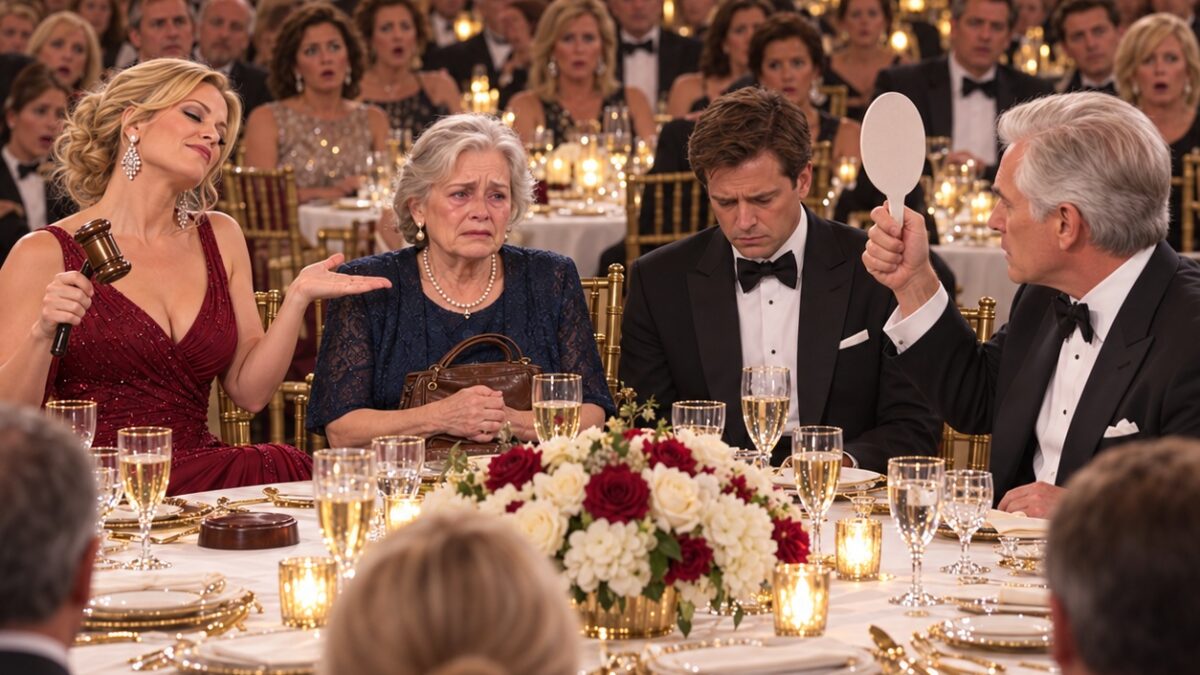
The room laughed.
Nine seconds.
I counted.
I count when uncomfortable.
Nine seconds is long when three hundred people are laughing and you are the object.
I have stood underneath bridges with fatigue cracks in critical beams and felt calmer.
Hands in coat pockets.
Wait.
Reeve returned.
Professional instinct.
“All right, all right.”
More laughter.
“Do I hear two?”
Someone shouted:
“Five!”
“Five dollars for Grandma’s pie!”
Laughter loosened.
Not vicious.
That was the strangest part.
Nobody believed they were being cruel.
That is how public humiliation often works.
Everybody thinks everybody else agrees the joke is harmless.
“Ten?”
“Twenty!”
More laughter.
I looked at table four.
Daniel.
His hand around a water glass.
Eyes down.
Eight inches in front of the glass.
He did not look up once.
That hurt.
More than Sloan.
More than Priscilla.
My son knew.
He stayed seated.
At table three, Priscilla rested her chin against the back of one hand.
Smiling.
Not at me.
At the board members.
Watching their reaction.
Then I looked toward the fourth row.
Ike Brennan.
Gray vest.
No tie.
Reading glasses hooked into his collar.
He had not bid on one thing all night.
Reeve said:
“Do I hear twenty-five?”
Then a chair scraped across the wooden floor.
One chair in a silent-enough ballroom is loud.
Ike stood.
Six-foot-two.
Built like someone who had spent his twenties lifting things.
“Two million dollars.”
He did not shout.
He said it like a purchase order.
Silence.
Total.
Behind the kitchen door near my table, I could hear the dish machine.
Reeve laughed once.
High.
Buying time.
“Sir, the lot is one hour of pie lessons.”
“I know what the lot is.”
Reeve tried:
“Two million from Ike Brennan, everybody!”
He clapped.
Nobody joined.
His two hands stopped.
I will remember that sound forever.
Ike walked up the center aisle.
Slow.
Eleven seconds, maybe.
Nobody spoke.
The nineteen-year-old running the livestream camera turned it to follow him.
He climbed the stage.
Second step flexed under him.
Took the backup microphone.
Sloan still held the dollar.
Ike did not look at her.
He looked at table three.
Then spoke.
“In 2013, this foundation had eleven thousand dollars in the bank.”
Nobody moved.
“We had a rented office and a roof that leaked into the copy room.”
I watched Priscilla.
“A donor gave this foundation sixteen million dollars.”
A sound moved through the room.
Not speech.
Air.
Ike continued.
“She had one condition.”
Pause.
“We never print her name.”
He looked over the ballroom.
“I signed that promise.”
Then:
“I am breaking it tonight.”
Sloan’s face changed.
Ike turned toward table three.
“And I will answer to the board Monday.”
Then:
“Priscilla.”
Her head lifted.
“So will you.”
Silence.
“Third signature on the page.”
A fork hit a plate somewhere behind me.
Ike continued.
“The executive director’s salary…”
His voice remained calm.
“…is currently paid from an administrative support grant originating in her fund.”
Then he looked at me.
“And she is standing up here while somebody holds a paddle that says one dollar.”
Priscilla stood.
Fast.
“You let me sign it!”
She was pointing at me.
Not Ike.
Me.
Her voice cracked.
“Thirteen years.”
People at her table reached.
She shook them off.
“Thirteen years I stood beside you at ribbon cuttings.”
“You knew.”
“You knew and said nothing!”
I watched her.
Priscilla’s face had lost the polish I had known for decades.
“I smiled.”
She shouted.
“I kept your secret because you made me.”
That was the first moment I felt something close to anger.
Not satisfaction.
Anger.
“I never made you carry anything.”
My voice was not amplified yet.
She probably did not hear.
But I knew.
I had asked a foundation to keep a donor anonymous.
Priscilla volunteered to sign.
Her resentment belonged to her.
Then a microphone hit the carpet.
Sloan had dropped it.
The amplified thump came through every speaker.
She stood two feet from me.
Hands shaking.
I bent down.
My knees were seventy-one.
It took a moment.
Three hundred people watched me pick up the microphone Sloan had dropped.
I brushed the grill against the sleeve of my coat.
Then I turned to Ike.
“Mr. Brennan.”
He looked at me.
“Name it for Ray.”
His jaw tightened.
He nodded once.
“Two million.”
Pause.
“Two hundred thousand a year for ten years.”
“The welding and bridge-trades program.”
“Yes.”
“Ray Onstot.”
“Yes.”
I nodded.
“That’s a yes.”
The room remained silent.
Then I turned toward the crowd.
I could not see beyond row four clearly.
Did not need to.
“The rest of it isn’t a story.”
My voice surprised me.
Steady.
“It’s a line item.”
I turned to Sloan.
Her chin trembled.
Both hands flat against her dress.
I had imagined many things I might say.
Something brilliant.
Something cruel.
Something that would make her feel exactly what I had felt.
Instead:
“You opened at a dollar.”
Her eyes met mine.
“I’m not going to argue with the price.”
She said nothing.
I looked at the bill still in her hand.
“But I’d like my dollar.”
She stared at it.
Like she had forgotten she was holding it.
Then extended her hand.
The paper shook enough that I could hear it.
I took the dollar.
Folded it once.
Then again.
Put it into the left pocket of my forty-dollar gray coat.
“Sold.”
Then I handed the microphone to Reeve Hadley.
Walked down the two steps.
Back through the ballroom.
Table nineteen.
Sat.
Nobody applauded for about four seconds.
Then Ike did.
One person.
Then table twelve.
Then another.
The entire ballroom stood.
It did not sound like celebration.
I have been to funerals where good people were thanked too late.
It sounded like that.
Sloan left through the kitchen door beside my table.
Passed within three feet.
Did not look at me.
Priscilla sat back down.
That remains one of the strangest images of the night.
She stayed.
Hands in lap.
Water glass untouched.
Leaving would have looked like admission.
Priscilla Hadley was not going to give the room that.
Daniel finally looked up.
Table four.
Our eyes met.
I nodded.
One nod.
The kind you give someone you know at the post office.
Then I put on my coat.
Walked out.
Got into the Buick.
Drove home along River Road.
Lights were on beneath the Hadley Street Bridge.
I looked at it as I passed.
Still standing.
That was enough.
The livestream remained online another forty-one minutes before someone shut it down.
Nine thousand four hundred views.
I have never watched the clip.
Not once.
The gala raised two million three hundred forty thousand dollars.
Record.
Ike’s two-million pledge was not improvised revenge.
His board had approved it months earlier.
He had been offering it to me since August.
That night he simply stopped waiting for my permission.
Foundation newsletter came Tuesday.
“Landmark evening for our community.”
Sloan’s name did not appear.
Priscilla resigned Monday morning.
Health reasons.
She never called me.
I did not expect her to.
I do not believe she was sorry.
Angry?
Certainly.
She may remain angry at eighty.
That is her work.
Sloan withdrew from the executive-director search nine days later.
Twelve days after the gala, a lawyer in Columbus sent me a letter.
One page.
“Defamation” in paragraph two.
Not one actual false fact identified.
Arthur Deming responded in four lines.
Nothing else happened.
Sloan made a social media post.
Eight hundred forty-seven reactions.
Some families protect their own. Mine keeps score.
No apology.
Not to me.
Not to the foundation.
Not to the room.
I did not reply.
Reeve Hadley called in June about my riverfront land.
Twenty-two percent more than his previous offer.
“No.”
He laughed.
I thanked him for his work at the auction because whatever else was true, he had worked hard.
That surprised him.
Good.
Then came the recommendation letter.
May twenty-ninth.
I signed.
Two million one hundred thousand dollars.
Same total as the year before.
Nine hundred thousand to the welding and bridge-trades program.
Seven hundred thousand to county libraries.
Five hundred thousand to establish the Ray Onstot Bridge Trade Scholarship.
Administrative support to the foundation?
Zero.
With sixty days’ notice.
More notice than required.
Nobody lost a job.
The foundation cut the gala budget.
Turned in a leased SUV.
The lights stayed on.
The children still received services.
The dental van still ran.
This was never revenge.
That matters.
I could have punished nine employees for Sloan’s behavior.
I did not.
I redirected.
There is a difference.
The dollar remained in the left pocket of my gray coat.
It is still there.
Sometimes I touch it.
Not because one dollar means anything.
Because arithmetic should be checked.
Then Daniel came to my house.
Third Saturday in May.
Cardboard box.
His father’s ties.
He sat on my porch step.
He had not done that since he was a teenager.
For ten minutes, neither of us spoke.
Then:
“I used to wait up for you.”
I looked at him.
“That summer after Dad died.”
His voice stayed low.
“I’d fall asleep on the couch.”
I remembered.
“You would come home and wake me.”
“I remember.”
“You’d tell me to go upstairs.”
“I remember.”
Daniel looked at his hands.
“I thought if I stayed awake…”
He stopped.
I did not finish for him.
Eventually:
“I thought maybe you’d sit with me.”
There it was.
Twenty-seven years late.
A hairline crack under paint.
Ray’s hammer in my mind.
Hit once.
Listen.
I had always understood Daniel’s anger intellectually.
I had never heard its exact sound.
Seventeen years old.
Father dead.
Mother back at work eleven days later.
Cereal.
Couch.
Waiting.
I had treated duty as survival.
Daniel experienced it as absence.
Both could be true.
I let the silence stay.
Then Daniel asked:
“So what happens to the kids’ college fund?”
That was Daniel.
Tenderness.
Then practical fear.
The entire conversation lasted maybe fifteen minutes.
People imagine revelations change people instantly.
They do not.
I gave him terms.
Once.
“First Saturday of every month.”
He looked at me.
“Ten in the morning.”
“Where?”
“Belmont Public Library.”
“Children’s room.”
I continued.
“I pick Tess and Gus up.”
“I bring them back at noon.”
“Sloan does not come.”
His face tightened.
“And we do not discuss money.”
“Mom—”
“Not the fund.”
“Not the will.”
“Not the foundation.”
“Not the house.”
“Ever.”
He opened his mouth.
“Those are my terms.”
Silence.
“You can say yes.”
“Or no.”
“You do not have to answer today.”
He answered Thursday.
Yes.
The first three Saturdays, Daniel sat in his truck in the library parking lot for the full two hours.
I knew.
Did not mention it.
Tess read to me.
She does character voices badly and refuses coaching.
Gus built bridges from wooden blocks.
Last month, he made a four-span bridge.
I pointed to one pier.
“That one goes first.”
“How do you know?”
I smiled.
“Hit it once.”
He hit the block structure.
I said:
“Then shut up and listen.”
It collapsed.
His eyes became enormous.
“Grandma!”
He thought it was the greatest engineering demonstration in library history.
Probably was.
Daniel had been right about one thing.
For years, he told me:
“Don’t make this about you.”
At the gala, standing under those lights, I finally understood something.
It was never about me.
Not really.
It was about the room.
What people do when they believe the person in front of them has no power.
What a daughter-in-law says when she thinks humiliation is safe.
What a son does when discomfort costs him less than defending his mother.
What a board vice chair does when resentment has been polished into etiquette.
What three hundred decent people do when laughter is presented as permission.
What a man who knows the truth does when he finally stands.
And what I do when everyone expects silence.
That was the test.
The room told the truth.
Priscilla had spent decades treating my modesty like failure.
Sloan mistook my silence for weakness.
Daniel mistook my endurance for immunity.
The crowd mistook laughter for harmlessness.
And I had mistaken saying nothing for dignity.
Everybody learned something.
Including me.
The one-dollar bill remains folded in my pocket.
Gray wool coat.
Same mismatched cuff.
Same forty-dollar purchase from 1994.
I did not replace it after the gala.
Why would I?
It is warm.
It fits.
Somebody once told me clothing is communication.
Perhaps.
Then my coat communicates this:
I do not throw away useful things because other people are embarrassed by them.
Same reason I kept Ray’s hammer.
Same reason I kept the Buick.
Same reason I kept the house on Ferry Street.
Same reason I refused Reeve’s offers.
Value and price are different jobs.
That lesson I taught Gus and Tess before I understood how publicly I would have to live it.
Anybody can assign a price.
A dollar.
Five dollars.
Twenty.
Two million.
Sixteen million.
Eighteen point four million.
Numbers.
Numbers are easy.
Worth is harder.
The one dollar Sloan held told the room nothing about me.
It told them what she believed she could safely do to me.
Ike’s two million did not make me worth two million either.
It told the room something about him.
That he had waited long enough.
That Ray mattered to him.
That trades education mattered.
That he would break thirteen years of secrecy and answer for it afterward because silence had changed from protection into complicity.
That was his decision.
I respected it.
People later told me:
“You showed them.”
I dislike that phrase.
It makes the night sound like I planned a reveal for applause.
I did not.
If Sloan had cut the joke from the final script, nothing would have happened.
If she had opened the lot normally at seventy-five dollars, I would have stood there, taught someone apple pie, signed my grant letter, and gone home.
If Daniel had told her:
“Don’t do that to Mom,”
maybe nothing would have happened.
If Priscilla had decided mentorship did not require humiliation, nothing.
I gave them a room.
They filled it.
That is all.
Engineers do this.
Load a structure.
Observe.
You do not create the weakness.
You reveal it.
That is what the gala did.
Sloan’s candidacy failed because the room finally saw what had been hidden behind competence.
Priscilla left because her own relationship to the foundation became visible.
Daniel and I began talking because silence finally became harder than truth.
And I changed the grant because I realized administrative comfort had become too disconnected from accountability.
No revenge.
Load test.
Result.
I do not feel triumphant.
That surprises people.
There are moments from that night that still hurt.
Daniel staring at the tablecloth.
That one more than anything.
Three hundred people laughing was public.
My son’s eyes were private.
He knew.
He had heard the rehearsal.
He had defended it.
He had told me not to make it about myself.
Then he watched.
That remains between us.
Our library arrangement is not forgiveness theater.
It is access with structure.
Tess and Gus did nothing wrong.
I love them.
Daniel does not get to use them as financial leverage.
I do not get to use them as punishment.
So we meet.
Books.
Blocks.
No money.
Very simple.
Maybe one day our arrangement changes.
Source of this story ends before that.
I do not predict.
I am seventy-one.
I have finally learned not to build bridges to places that do not exist yet.
Inspect what is in front of you.
Today:
First Saturday.
Library.
Two hours.
Enough.
I sometimes think about Sloan telling me:
“Dignity is something you can afford.”
She believed money buys dignity.
Understandable.
She had worked coat check.
She had been invisible to Priscilla.
Then Priscilla saw her.
Mentored her.
Opened doors.
Sloan confused proximity to power with becoming powerful.
A lot of people do.
I had money for thirteen years and wore the same coat.
Not because money made me morally superior.
It did not.
Remember my third reason for anonymity.
I enjoyed being underestimated.
That is vanity too.
The difference is I knew it.
Eventually.
Money protects you from certain consequences.
That is true.
Dignity, though?
Dignity is not being able to afford a better coat.
Dignity is wearing the coat you chose when someone offers you a costume.
Dignity is not needing a room’s laughter to reverse before you know who you are.
Dignity is saying no to cruelty without needing cruelty back.
Dignity is knowing that a foundation still deserves support even when some of its leaders disappoint you.
Dignity is allowing your son to tell you exactly how you hurt him without using your own pain as a defense.
That last one is the hardest.
I am still working on it.
I returned to work eleven days after Ray died because I thought that was strength.
Maybe it was partly.
It was also avoidance.
I knew if I stopped, I might not start again.
So I worked.
Daniel paid some of that bill.
He was seventeen.
He deserved more of me.
I cannot rewrite 1999.
I can listen now.
That is not enough to erase it.
Nothing is.
But listening is what I know.
Ray taught me.
Hit once.
Listen.
If only I had realized sooner that people have structural cracks too.
They tell you through sound.
Daniel’s sounded like:
“Don’t make this about you.”
For years I heard criticism.
Now I also hear:
Please do not make me hold your pain when nobody held mine.
That does not excuse him at the gala.
Explanation is not absolution.
Both truths stay.
He failed me.
I failed him once too.
Family relationships are rarely clean enough for one villain and one victim.
Sloan is more complicated too.
She was cruel.
Planned it.
Wrote:
Perfect.
Wanted the livestream clip.
Told her children Grandma was going to be “sold.”
Those are facts.
But she was also a sixteen-year-old coat-check girl in some corner of herself, desperate for Priscilla Hadley to finally look at her.
I understand that.
Understanding is not reconciliation.
I did not invite Sloan to the library.
No apology.
No trust.
At least not yet.
That is reality.
Priscilla is easiest.
She disliked me.
For a long time.
Probably always will.
I can live with that.
Some people need you to be responsible for the worst thing that happened to their family.
Hadley Freight failed after the bridge closure.
Maybe without the closure it would have survived longer.
Maybe another load would have found the fatigue crack first.
We will never know.
I know what the inspection showed.
The bridge was unsafe.
I wrote the report.
County closed it.
That was my job.
Priscilla had thirty years to ask.
She preferred resentment.
That was her choice.
The Hadley Street Bridge still carries traffic.
Every time I drive beneath its lights, I think about Douglas Hadley.
Not with guilt.
Respect.
His business mattered.
His loss mattered.
Safety mattered too.
Life gives you decisions where every outcome hurts somebody.
Engineering teaches that early.
So does family.
People ask whether I regret anonymity.
No.
If everybody had known in 2013, Sloan’s gala would never have happened that way.
Priscilla would have treated me differently.
Daniel would have known about the money.
Maybe he would have become more attentive.
Maybe less.
I would never know which relationships were genuine.
Anonymity gave me information.
Sometimes painful information.
Still information.
Worth having.
Do I regret silence?
Different question.
Yes.
Parts of it.
Silence can be discipline.
It can be dignity.
It can also become a hiding place.
I used it for all three.
By seventy-one, they had tangled.
The gala untangled them.
I can remain quiet without disappearing now.
That is different.
If something matters, I say it.
Not always loudly.
I have no interest in microphones.
I told Daniel my terms once.
I did not argue.
That is voice.
I redirected the grant.
That is voice.
I told Ike:
“Name it for Ray.”
Voice.
I told Sloan:
“I’d like my dollar.”
Voice.
None required shouting.
Perhaps I was never voiceless.
I just reserved speech for things I believed would matter.
The mistake was allowing other people to decide which things qualified.
I do not do that anymore.
At foundation events now, people behave differently around me.
Of course.
That is inevitable.
Some call me Mrs. Onstot with too much weight in it.
Some over-thank me.
Some approach carefully.
I dislike all of it.
That is exactly why anonymity existed.
But once broken, it cannot be restored.
Ike knew that.
I knew it.
There was a cost.
I accept it.
Occasionally someone asks:
“Why didn’t you tell us?”
I answer:
“Why did you need to know?”
Usually that ends the conversation.
The interesting answer would be:
Because they would have behaved differently.
Exactly.
That was the point.
I miss the old invisibility sometimes.
The gray coat no longer says what it used to say.
Now people in Belmont look at it and think they know a story.
The coat did not change.
Their arithmetic did.
I find that funny.
Reeve still wants the riverfront land.
No.
Some things never change.
Tess once asked why I did not sell if he offered so much.
“I like it.”
“That’s all?”
“Yes.”
She thought.
“Can’t he make you?”
“No.”
“Why?”
“Because it’s mine.”
She nodded.
Children understand property rights beautifully when adults do not complicate them.
Gus likes bridges.
Maybe that will pass.
Maybe not.
I refuse to romanticize it.
He is seven.
At seven, Daniel wanted to drive a garbage truck.
Still, when Gus builds bridges, I show him load paths.
Which pier carries more.
Where failure starts.
He loves destruction more than construction.
Normal child.
I have not told him he needs to become an engineer.
That is his bridge.
Not mine.
The Ray scholarship began helping students.
Ike wanted my name included somewhere too.
No.
Ray’s.
That mattered.
He had welded.
Worked sites.
Taught me to listen.
Trades program is exactly where his name belongs.
Not ballroom.
Not donor wall.
Students.
Steel.
Hands.
Tools.
Right place.
The administrative support change caused some discomfort at the foundation.
That was intentional.
Not suffering.
Awareness.
Organizations can become dependent on one source and forget dependence itself is a risk.
Any engineer understands redundancy.
Forty-one percent of operating support tied to one annual recommendation?
Bad design.
I had tolerated it because I trusted the institution.
After the gala, I decided they needed stronger structure.
They adjusted.
No one lost employment.
Good.
That is what I wanted.
Priscilla would probably say I used money to punish them.
She is allowed to say it.
The numbers say otherwise.
Programs continued.
Staff stayed.
Budget tightened.
Governance changed.
A structure under stress reveals weaknesses.
Then you reinforce.
Again:
Engineering.
Always.
I still meet Ike at Blue Ribbon Diner.
First Tuesday.
7:15.
He still pays.
I still tell him not to.
He still ignores me.
Once, months after the gala, he asked:
“You ever going to let me forget that?”
“No.”
“Worth it.”
“Maybe.”
He looked at me.
“You know I would have stood up even without the money.”
“I know.”
“What would I have said?”
“I don’t know.”
“I’d have said the same thing.”
“No.”
“What?”
“You would have said too much.”
He laughed.
Probably true.
Ike likes words more than I do.
Then he asked about Ray’s hammer.
“Still on the mantle.”
“Four thousand.”
“No.”
“Five.”
“No.”
He smiled.
“Had to try.”
Some relationships remain untouched by revelation because they were honest before it.
I value those more now.
Harriet called from Florida after the gala clip spread.
She had seen it.
Unlike me.
“Kathy.”
“Yes?”
“You still wearing that ugly coat?”
“Yes.”
“Good.”
Then she laughed for almost a minute.
I laughed too.
She asked:
“Did you really ask for the dollar?”
“Yes.”
“You’re impossible.”
“I learned from you.”
We talked about everything except money.
Old friends.
The sale.
Bridge records.
Ray.
Nothing performative.
I appreciated that.
One day Daniel asked why I never gave him any of the company-sale money.
Hard question.
“Because I was afraid.”
“Of me?”
“Of what money does when it arrives before a person knows who he is without it.”
He was quiet.
“You didn’t trust me.”
“I trusted you.”
“Then why—”
“I did not trust the experiment.”
That answer hurt him.
I could tell.
Maybe still does.
He had built a stable life.
Commercial insurance.
House.
Children.
Never missed payments.
He did it without my money.
Perhaps I denied him help he could have used.
Maybe.
Every parenting choice has alternative versions.
No one gets complete proof.
Would I make the same decision?
Probably.
Do I accept that Daniel may dislike it?
Yes.
That is adulthood.
Parents do not become correct because their intentions were protective.
Daniel can judge my choice.
I can live with his judgment.
What I will not do anymore is let his discomfort erase mine.
That was our old bargain.
No more.
At the library, we do not discuss any of this.
That is why it works.
Children’s room.
Books.
Blocks.
Two hours.
Tess recently read a story with six voices.
All terrible.
Gus built a bridge too wide for the base.
I pointed.
“That pier.”
He said:
“No.”
“Okay.”
He loaded toy animals across it.
Collapse.
He stared.
“How did you know?”
I tapped the table.
“You’ll learn.”
The first time I said Ray’s line to him, I almost cried.
Did not.
Not because crying is weakness.
Because the moment belonged to Gus.
He was laughing too hard.
Let children have joy without turning every inheritance into grief.
That is another lesson I learned late.
Ray can be present without making a seven-year-old responsible for missing him.
Daniel spent too much of his adolescence responsible for my grief, even when I thought I was hiding it.
I will not repeat that.
I keep the dollar in the coat pocket.
Not framed.
Not displayed.
No plaque.
Sometimes months pass before I remember it.
Then my fingers touch folded paper.
Arithmetic.
A dollar.
Two million.
Sixteen million.
Forty dollars.
Fifty-one thousand for the house.
Eighteen-point-four-million sale.
Numbers tell stories only if you know what they measure.
People confuse money with worth because money is countable.
Worth is inconvenient.
It has no column.
No audited statement.
No bid paddle.
No market value.
I spent a career working with measurable things.
Steel thickness.
Corrosion percentage.
Crack length.
Load rating.
Deflection.
Then family taught me the most important things resist measurement.
Respect.
Grief.
Humiliation.
Forgiveness.
Trust.
You know when they are present.
You know when they fail.
But you cannot write them to three decimal places.
That bothered me for years.
Now I accept it.
At the gala, Sloan tried to make worth measurable.
One dollar.
The room laughed because everybody understood the number was intentionally absurd.
Then Ike answered with another absurd number.
Two million.
People later described it as the moment my “true value” was revealed.
Wrong.
Two million was not my value.
Sixteen million was not my value.
The value of Onstot & Reed was not my value.
Those are transactions.
My worth existed before anybody knew.
Exactly as it existed after.
That is what I told Tess and Gus.
People can price you.
They cannot set your worth.
I understand it now.
Priscilla still does not speak to me.
When we occupy the same room, she is polite if necessary.
No cuff touching.
Improvement.
Sloan and I do not have a warm relationship.
Truth.
I will not manufacture reconciliation for a satisfying ending.
Maybe someday she apologizes.
Maybe she never does.
The story does not need it.
I am not waiting for Sloan’s apology to know what happened.
That is freedom too.
Daniel and I are more complicated.
There is love.
Anger.
History.
Library rules.
Occasional conversations.
Sometimes he calls.
Sometimes I do.
We have not solved 1999.
You do not solve twenty-seven-year-old grief in one porch conversation.
But now the crack is visible.
Visible damage can be addressed.
Hidden damage keeps spreading.
Ray would approve of that analogy.
I hear him sometimes.
Not ghosts.
Memory.
“Hit it once.”
I did.
The gala was the strike.
The sound came back dead in places I had suspected.
Sloan.
Priscilla.
Daniel’s silence.
My own pride.
But other parts rang true.
Ike.
Harriet.
Tess.
Gus.
The programs the foundation funded.
My ability to keep standing without humiliating anyone back.
That last one matters to me.
I could have said more to Sloan.
The microphone was mine.
Three hundred people ready to hear anything.
I knew her childhood coat-check story.
I knew she had spent years wanting Priscilla’s approval.
I could have cut her open publicly.
I did not.
“You opened at a dollar.”
That was enough.
I do not regret restraint.
Cruelty would have contaminated the truth.
The room already knew.
No need to decorate failure.
Engineers do not add unnecessary load.
The standing ovation embarrassed me.
I know that sounds ungrateful.
It did.
Everybody standing after laughing nine seconds earlier.
Human beings pivot quickly when social information changes.
I understood that.
Still, I wanted to ask:
Where were you thirty seconds ago?
Then I remembered:
Most had no context.
Sloan told them it was affectionate.
They trusted the framing.
When the framing collapsed, they changed.
That is not necessarily hypocrisy.
Sometimes it is learning.
I gave the room that benefit.
People deserve the chance to understand what they participated in.
A few apologized later.
Some did not.
Fine.
I had no interest in collecting regret.
There is too much paperwork already.
The foundation board changed procedures after Priscilla resigned.
I will not invent details not in my source.
I know only what touched my role.
The institution continued.
That was the goal.
If the whole foundation had collapsed because one gala exposed ugly behavior, sixteen million dollars would have been badly placed.
It was not.
Organizations are larger than individuals.
So are families, hopefully.
Sloan’s mistake should not become Tess and Gus’s inheritance.
Daniel’s old anger should not become their burden.
My money should not become their identity.
The library arrangement protects all three things.
Books.
Blocks.
Grandmother.
Nothing else.
At first Daniel sat in his truck because he did not trust what might happen.
Or maybe because he wanted to be close.
I never asked.
There are moments when the second question can wait.
I have learned that too.
Not every silence needs excavation.
Sometimes people need room.
I once believed silence was my greatest strength.
Then I thought it was my greatest weakness.
Now I understand it is a tool.
Like Ray’s hammer.
Used correctly:
Reveals.
Used carelessly:
Damages.
Use judgment.
That may be the most honest lesson of my old age.
My gray coat still hangs by the front door.
Sloan’s navy borrowed dress went back to the store with its tag.
I never wore it.
I did not need to.
Would wearing it have changed the humiliation?
No.
Would Priscilla have respected me more in navy?
Maybe for eleven seconds.
Then what?
I am tired of dressing for someone else’s arithmetic.
I wear what works.
Drive what works.
Live where I want.
Keep what matters.
Refuse Reeve.
Support trades.
Read financial statements.
Meet grandchildren.
That is enough.
Belmont continues talking.
Small towns require stories the way lungs require air.
For a while, I was the story.
Then somebody’s divorce happened.
Then a school-board argument.
Then weather.
Thank God.
I never wanted permanent fame.
The clip remains online somewhere.
I have never watched.
People tell me it is powerful.
Maybe.
I was there.
I do not need footage.
Memory is high definition enough.
I remember the heat on my head.
The flexing second step.
The red camera light.
Daniel’s water glass.
Priscilla’s hand under her chin.
The dish machine.
Reeve’s two claps dying in silence.
Ike walking.
Sloan’s shaking dollar.
Enough.
No replay.
Ray’s hammer stays on the mantle.
Sometimes I pick it up.
Still balanced well.
Oak smooth from his hand.
Six dollars.
Ike’s offer is ridiculous.
Four thousand.
Five.
Does not matter.
Not for sale.
Price and worth.
Always.
If Ray were alive, he would hate everything about the gala.
The microphone.
Applause.
Donor reveal.
Scholarship named after him.
Especially that.
He would say:
“You could’ve left my name off it.”
I would say:
“No.”
He would grumble.
Then secretly visit the program.
That is what I think.
Memory lets me imagine.
I do not confuse imagination with fact.
What I know:
Ray believed work deserved attention.
Not donors.
I chose a program where his name might make students ask who he was.
Someone would answer:
Welder.
Site foreman.
Taught a bridge engineer to listen.
Good enough.
Daniel may one day understand why.
Maybe not.
Again, no future inventions.
Today, our relationship exists under terms we can both hold.
That is success.
People think boundaries are rejection.
Sometimes boundaries are the only size in which a damaged relationship can survive.
Two hours.
First Saturday.
Library.
No money.
Works.
Without structure, our old patterns would return.
Daniel would ask about funds.
I would retreat.
Sloan would become subject.
We would fight.
So we do not.
We talk through children’s books.
Gus’s bridges.
Tess’s drawings.
A relationship can regrow around safer things before returning to dangerous ground.
If it ever does.
I am not in a hurry.
Seventy-one is old enough to respect time and young enough not to panic about every unfinished conversation.
My house on Ferry Street remains the same size.
The riverfront lot remains mine.
The Buick still has the dent.
I could buy a new car tomorrow.
I do not want one.
People now interpret that as eccentric wealthy-woman behavior.
Before, they interpreted it as poverty.
Same Buick.
Different story.
That should tell you everything about how unreliable appearances are.
Nothing about me changed the night Ike stood.
Only information changed.
Yet suddenly my coat was not pathetic.
My car was not sad.
My small house became “refreshingly modest.”
I heard someone use that phrase.
I nearly laughed in her face.
Refreshingly modest.
Yesterday it was shabby.
That is why I keep the coat.
It is an excellent instrument.
Shows people their own arithmetic.
I have never corrected anyone who compliments it now either.
Let them hear themselves.
Priscilla’s old line:
“You are the most consistent woman in Ohio.”
Maybe.
Consistency is not always virtue.
Sometimes stubbornness.
Sometimes integrity.
Sometimes fear.
Mine has been all three.
I stayed in the same house.
Kept same coat.
Same habits.
Same diner.
Same silence.
Some consistency protected me.
Some isolated me.
The gala forced distinction.
Keep what works.
Repair what does not.
Bridge logic.
Always.
The recommendation letter sits in a file now.
Signed May twenty-ninth.
One year.
There will be another.
I will read every line.
As always.
No automatic support.
No automatic punishment.
Evaluate.
Recommend.
That is responsibility.
Money does not become wiser because the donor is angry.
If anything, anger makes financial decisions more dangerous.
So I waited.
Numbers.
Programs.
Need.
Then signed.
That is why nobody lost a job.
I am proud of that.
Not the standing ovation.
That.
Restraint after humiliation.
Harder than revenge.
Better engineering.
When Sloan posted:
Some families protect their own. Mine keeps score.
I thought about replying.
One sentence.
Then did not.
Maybe she believed I was keeping score.
Maybe from her perspective, my silence had been a hidden ledger.
That is worth considering.
I knew things.
Said nothing.
Then one night everything surfaced.
It could feel like a trap.
But I had given Sloan multiple chances.
I asked Daniel.
He knew.
Sloan knew I heard the rehearsal? Actually she did not know at rehearsal, but the binder note and later interactions showed plan. I did not confront Sloan directly after binder. That was my choice.
Could I have said:
“This joke hurts me. Remove it.”
Yes.
I did not.
I own that.
Why?
Because by then it was not only the joke.
It was the note:
She never says anything.
The livestream.
Priscilla’s involvement.
Reeve’s strange land comment.
Daniel’s dismissal.
I wanted information.
Was that manipulative?
Maybe.
I can admit ambiguity.
I subjected the room to a test without telling them.
Engineers do tests.
Families are not bridges.
That difference matters.
Would I do it again?
I do not know.
People asking for a simple morality will be disappointed.
Life rarely provides one.
I do know I never lied.
Never threatened.
Never planted evidence.
Never changed their script.
I simply stopped preventing them from revealing themselves.
That is the truth I can live with.
If Sloan had chosen kindness, she would still likely be executive director today.
At least based on where the board stood that night.
She had won the room.
Then she used it.
That was her choice.
I did not take it from her.
The room saw.
That is why Ike’s disclosure mattered.
Without it, the joke might have been remembered as harmless.
With context, people understood the power relationship had been the opposite of what they assumed.
Sloan believed she was humiliating someone socially weaker.
That is what changed the meaning.
Cruelty does not become cruel only when the target is secretly wealthy.
Important.
Even if I had twenty dollars in my bank account, the joke would still have been wrong.
Ike’s reveal did not make me deserving of respect.
It exposed why their lack of respect was based on garbage assumptions.
I think people miss that.
The lesson is not:
Be careful humiliating old women because they might secretly be millionaires.
No.
Be careful humiliating anyone.
You do not know their history.
You do not know their wounds.
You do not know their contributions.
And even if they have contributed nothing you value, they still deserve basic dignity.
That is the lesson.
My money simply made the room confront its prejudice quickly.
That is all.
I wish Sloan understood that.
Maybe someday.
Not my job.
My job now is Saturday at the library.
Tess arrives carrying three books even though we only have two hours.
Gus heads for blocks.
I sit near the window.
Daniel sometimes waits outside.
Sometimes he leaves and returns at noon now.
Progress.
We do not discuss.
One Saturday, Tess asked why people stood at the gala.
She had heard something at school.
I answered carefully.
“Because they learned something.”
“What?”
“That they had misunderstood me.”
“Were they sorry?”
“Some.”
“Was Mom sorry?”
I paused.
“I don’t know.”
That was honest.
Tess looked down.
“Are you mad?”
“Sometimes.”
“Do you hate her?”
“No.”
Children ask questions adults avoid.
I said:
“Your mother and I have things to work out.”
“That doesn’t have anything to do with you.”
She nodded.
Then opened her book.
Boundary.
Again.
Do not recruit grandchildren.
I was determined about that.
Gus yelled from the block area:
“Grandma, this bridge is stronger!”
It was not.
I let him discover.
Some lessons need collapse.
He loaded blocks.
Bridge failed.
He laughed.
Safe failures are good teachers.
Maybe that is what I hope for Daniel too.
Our family had a failure in public.
Painful.
But not fatal.
Perhaps rebuilding becomes stronger if we examine the crack honestly.
I cannot guarantee.
I can only inspect my side.
My side includes pride.
Silence.
Work obsession after Ray died.
Enjoying being underestimated.
Not warning Sloan directly once I knew.
These are mine.
I do not hide them.
People like stories where the protagonist is secretly perfect.
I am not.
Never was.
My reports were precise.
My emotional communication was not.
Ray could have told you.
Harriet could.
Daniel definitely could.
But imperfection does not erase mistreatment either.
Both.
Always both.
At seventy-one, I have stopped requiring one clean answer when two uncomfortable truths fit.
Daniel hurt me.
I hurt Daniel.
Sloan humiliated me.
I understood Sloan.
Priscilla resented me unfairly.
Her family suffered financially after my report.
Ike broke a confidentiality promise.
He did it knowingly because he believed another obligation had become greater.
I accepted that.
The room laughed.
Most people were not malicious.
Complexity does not make morality meaningless.
It makes judgment slower.
That is fine.
Slow judgment is underrated.
Like old Buicks.
Like gray coats.
Like engineers.
When I put my hand in my left pocket now, the dollar feels almost weightless.
Paper.
Folded twice.
Some nights I check it.
Arithmetic.
Still one dollar.
Not transformed into two million.
Not magic.
One.
The number Sloan chose.
I keep it because I want to remember that other people’s numbers are information about them.
Not commands to me.
That is the clearest thing I learned.
People assign numbers constantly.
Salary.
Home value.
Age.
Follower count.
Dress price.
School ranking.
Inheritance.
Bid.
They use numbers to place you.
Useful sometimes.
Dangerous when confused with worth.
At seventy-one, anybody can stand in a room and assign me a price.
I cannot stop them.
What I can stop doing is agreeing.
That is my part.
For twelve years, I let Sloan’s arithmetic stand because correcting it felt like bragging.
I let Priscilla’s arithmetic stand because defending myself felt unnecessary.
I let Belmont’s arithmetic stand because anonymity suited me.
Then the numbers became a weapon.
One dollar.
Public.
Livestream.
That was when silence stopped being humility.
It became participation.
So I spoke.
Not with my bank balance.
Ike did that.
I spoke with one sentence.
“I’d like my dollar.”
That sentence still makes Harriet laugh.
It still makes Daniel uncomfortable.
It still makes me smile occasionally.
Because I meant it.
If you set the price, honor your own number.
Hand it over.
I still have it.
The coat still has the mismatched thread.
I could repair it correctly.
I will not.
That mend is older than Sloan’s marriage.
It held.
That is what repairs are supposed to do.
Not look perfect.
Hold.
Maybe my family can do the same.
I do not know.
We are in the holding stage.
First Saturday.
Two hours.
No money.
It holds.
Enough.
The Ray Onstot Bridge Trade Scholarship exists.
Students use it.
That is enough.
The foundation exists.
Good.
Priscilla is gone from its board.
Sloan is not executive director.
Those are consequences, not trophies.
I do not celebrate them.
I did not ask for either resignation.
People made choices.
Boards responded.
Life moved.
My riverfront land remains undeveloped.
Reeve will probably call again.
He is persistent.
I admire that professionally.
Will still say no.
The Hadley Street Bridge remains.
Every structure has a service life.
Eventually it will need replacement.
Everything does.
Except apparently my gray coat.
That may outlive the bridge.
I laugh every time I think that.
Ray would too.
His hammer may outlive all of us.
Steel head.
Oak handle.
Six dollars.
Value.
Price.
There it is again.
I return to that lesson because it is simple enough for children.
Gus understands after a block bridge falls.
Tess understands more each time we talk.
Daniel is learning differently.
Sloan, I do not know.
Priscilla, perhaps never.
Me?
Still learning.
That is the honest ending.
Not the gala.
Not the two-million-dollar bid.
Not the standing crowd.
An old woman still learning not to confuse silence with virtue.
A son learning his mother can be wounded.
Grandchildren learning numbers are not worth.
A foundation learning dependence is risk.
A town learning a coat can lie only because people invent the story around it.
That is enough meaning for one night.
Sometimes I sit in my kitchen where Sloan once spread the binder.
Original cabinets.
Same table.
Ray’s hammer visible from where I sit.
No cameras.
No audience.
I think about page nine.
She won’t say anything. She never does.
The sentence used to anger me.
Now I see it differently.
It was an inspection report.
Accurate at the time.
They had thirty years of evidence.
Then conditions changed.
That is what reports are for.
Structures change.
Loads change.
Cracks grow.
Repairs happen.
The next report should not simply copy the previous one.
If Sloan wrote about me now, she would need another sentence.
Maybe:
She does say something.
Not much.
Usually once.
That would be accurate.
I do not repeat myself anymore when the first sentence is clear.
Daniel knows that.
He asked once whether the library rules could change.
I said:
“Not now.”
He began:
“But—”
I looked at him.
He stopped.
Progress.
No argument needed.
People learn your boundaries partly from how many times you are willing to defend them.
One clear answer is enough if you believe yourself.
I spent too many years waiting for other people to believe me first.
No longer.
When Tess draws horses at my table, she still uses too much paper.
I buy more now.
Not because I cannot afford it.
Because I like the drawings.
Gus sometimes leaves blocks under furniture.
I complain.
Grandmother things.
Ordinary.
That is what I wanted after all.
Not being secretly important.
Not donor recognition.
Not revenge.
Ordinary relationship.
People who know me without calculating what I can do for them.
Ray gave me that.
Harriet.
Ike, mostly.
My grandchildren, for now.
Daniel is trying.
That is enough.
One afternoon Tess touched my coat cuff.
The mended one.
“Why is this thread different?”
“I repaired it badly.”
“Why don’t you redo it?”
“It works.”
She looked at me.
“That’s weird.”
“Probably.”
“Mom hates this coat.”
“I know.”
“Why?”
“You should ask her.”
Tess thought.
Then said:
“I like it.”
I smiled.
“You don’t have to.”
“I know.”
That answer pleased me more than if she had said the coat was beautiful.
You do not have to like what I like.
You do not have to approve.
Difference without correction.
That is respect.
Maybe the next generation learns faster.
I hope.
If not, life will teach them too.
Life always has load tests.
You cannot prevent all of them.
You can teach people to listen.
Ray’s hammer lesson keeps traveling.
From him.
To me.
To Gus.
Perhaps that is legacy.
Not money.
Not names on scholarship plaques.
A sentence.
Hit once.
Then shut up and listen.
What does the structure tell you?
What does the room tell you?
What does your family tell you when they think you cannot hear?
What do you tell yourself when everyone laughs?
Listen.
That night, the room told me exactly who everyone was.
But the more important sound came afterward.
The silence inside me.
It was different.
For the first time, silence was not surrender.
I had said what needed saying.
That is peace.
There is a difference between being quiet because you are afraid and being quiet because nothing more is required.
I live mostly in the second kind now.
Blue Ribbon Diner.
Library.
Ferry Street.
Gray coat.
Buick.
River.
Bridge lights at night.
A life can look unchanged from outside while everything underneath has been reinforced.
That is engineering too.
The best repair is sometimes invisible.
My family is not fully repaired.
I will not lie.
But I am.
More than before.
Not because I discovered I was wealthy.
I knew that.
Not because three hundred people stood.
Not because Ike bid two million.
Because when somebody publicly set my price, I finally stopped accepting their arithmetic.
I wish I had done it earlier.
I also understand why I didn’t.
There is no use beating an old structure for what it carried before reinforcement.
Inspect.
Repair.
Move on.
That is what I am doing.
If you ever see me in Belmont, you might notice the coat.
You may notice the Buick.
Maybe the Ferry Street house.
You might do the arithmetic people have done for years.
Go ahead.
I will not correct you.
Not because I need to be underestimated anymore.
Because your number is yours.
Mine is mine.
And worth is not arithmetic.
The dollar is still in my pocket.
Folded twice.
I put my hand there occasionally to make sure.
Still one.
Exactly the amount Sloan chose.
Exactly the amount I asked her to hand me.
And every time my fingers touch it, I remember the stage.
The laughter.
Daniel’s lowered eyes.
Ike’s chair scraping.
Two million dollars spoken like an invoice.
Priscilla standing.
Sloan’s microphone falling.
Three hundred people finally becoming quiet enough to listen.
Then I remember something more important.
I walked down those steps myself.
I returned to table nineteen.
I drove home in my dented Buick.
The bridge was still standing.
My house was still mine.
Ray’s hammer was still on the mantle.
Nothing about my worth had changed between seven forty and eight fifteen that night.
Nothing.
Only the room’s information changed.
That is the truth I wish people understood.
Recognition does not create worth.
Money does not create worth.
Applause does not create worth.
Humiliation does not erase it.
The room can be wrong.
Your family can be wrong.
The people laughing can be wrong.
Even the people who love you can build a version of you based on what is convenient for them to believe.
You do not have to destroy them for it.
You do not even have to convince them.
But you do eventually have to stop helping them maintain the fiction.
That is what I did.
At seventy-one.
Late.
Still counts.
My name is Katherine Onstot.
Structural engineer.
Retired.
Founder of Onstot & Reed.
Widow of Ray Onstot.
Mother of Daniel.
Grandmother to Tess and Gus.
Anonymous donor, once.
Woman in the gray forty-dollar coat.
All of those things are true.
None of them, alone, tells you what I am worth.
If somebody in your family has quietly decided what you are worth because you are old, quiet, unfashionable, widowed, ordinary-looking, inconvenient, too generous, or simply unlikely to fight back, remember this:
Their number is information about them.
It is not a measurement of you.
Anybody can hold up a dollar.
Anybody can laugh.
Anybody can decide who you are in eleven seconds.
Let them.
Eleven seconds is not a life.
And sometimes the strongest thing you can do is exactly what Ray taught me beneath steel bridges all those years ago.
Hit it once.
Then stop.
Listen.
Because eventually, when the room gets quiet enough, every structure tells the truth.


