“APOLOGIZE TO MY WIFE, MOM, OR GET OUT!” My Son Let His Wife Humiliate Me at His 40th Birthday — I Left His Birthday Party Holding the One Letter He Never Wanted Me to Receive.
FULL STORY CONTINUATION
By four o’clock, the house was full.
Michael’s coworkers.
Vanessa’s friends from Pilates.
Neighbors.
Real-estate people.
A DJ in the living room.
Wine everywhere.
I stayed mostly in the kitchen.
Being useful had always been easier for me than being social.
I refilled bowls.
Moved plates.
Wiped counters.
I had just picked up my tray of deviled eggs when I heard Vanessa’s voice from the other side of the island.
She was talking to three women.
One of them I later learned was Rachel.
Vanessa had a glass of white wine in one hand.
“And she just shows up with all this food like we’re incapable of feeding ourselves.”
One woman laughed softly.
“Maybe she’s trying to help.”
“It’s not help.”
Vanessa lowered her voice, but not enough.
“It’s a message.”
“What message?”
“Look how much I do for this family.”
Another woman said, “Maybe she’s lonely.”
Vanessa laughed.
“She’s lonely because she refuses to let go.”
My hands began shaking.
“Michael is forty,” she continued. “At some point, a mother has to cut the cord.”
One of the women saw me.
Her face changed immediately.
Vanessa turned.
She saw the tray in my hands.
No embarrassment.
No apology.
“Oh, Eleanor. Are those the eggs?”
“Yes.”
“Just put them anywhere.”
I set them down.
Went to the sink.
Turned on water.
There was nothing in my hands to wash.
I simply needed somewhere to look.
Don’t make a scene.
It is his birthday.
Don’t make a scene.
At five, I found Michael alone on the back deck.
He was checking his phone.
“Sweetheart?”
“Hey, Mom.”
“Do you have five minutes?”
“What’s wrong?”
“I need to show you the bank letter.”
His shoulders dropped.
“Mom.”
“Please.”
“I already told you Vanessa’s handling it.”
“You talked to her?”
“Last night.”
“What did she say?”
“Autopay error when she switched banks.”
My stomach tightened.
That was exactly the lie.
“She said the bank is fixing it?”
“Yes.”
“Did you call the bank yourself?”
He looked annoyed.
“No.”
“Michael, it’s three payments.”
“I know.”
“It’s over eleven thousand dollars.”
“I know my name is on the mortgage, Mom.”
He said it like I was reminding him of a favor.
“I’m not worried about being thanked.”
“Then why are you making this such a big deal?”
“Because if that house goes into foreclosure, they come after me too.”
“So this is about your credit.”
That hurt.
“No.”
“Mom—”
“I am worried about you.”
He rubbed the bridge of his nose exactly the way Frank used to.
“I’m sorry.”
He sighed.
“It’s my birthday. Can we not do this today?”
“Read the letter.”
“Monday.”
“You promise?”
“I’ll come to your place.”
“When?”
“Monday.”
He kissed my cheek.
“We’ll go through everything.”
I wanted to believe him.
So badly.
Then he went inside.
I walked toward the guest bathroom.
Occupied.
So I went down the hall toward the laundry room.
Vanessa was waiting there.
She shut the door behind me.
“We need to talk.”
“All right.”
“You told Michael about the bank letter.”
“Yes.”
“Why?”
I stared at her.
“Because he’s my son.”
“It is our mortgage.”
“My name is attached to it.”
“You had no right to interfere.”
“Vanessa, I called the bank.”
Her expression changed.
“You did what?”
“I called them.”
“You went behind our backs.”
“It’s my credit.”
“It is not your loan.”
“Then remove my name.”
The words came out before I could stop them.
For six years, I had never answered her like that.
She stared at me.
Then the polite face disappeared.
“You know what your problem is, Eleanor?”
“I’m sure you’ll tell me.”
“You think because you gave us money six years ago, you own us.”
“I have never said that.”
“You don’t have to.”
She stepped closer.
“You show up with food.”
“It’s his birthday.”
“You make comments about Frank.”
“Frank was his father.”
“You have a key.”
“Michael gave it to me.”
“You see Lily constantly.”
“Twice a month.”
“That is constant.”
That sentence hurt even more than I expected.
“You think I see my granddaughter too much?”
“Yes.”
The room seemed to shrink.
“Did you send me Lily’s piano recital invitation?”
She blinked.
“What?”
“Did you send it?”
“I don’t remember.”
“Lily says you did.”
“Then I probably did.”
“I never received it.”
“Mail gets lost.”
“Easter got lost too?”
Her eyes sharpened.
“Are you accusing me?”
“I’m asking.”
“Stop.”
“The school play?”
“Eleanor.”
“Where did the mortgage money go?”
She stepped close enough that I could smell wine.
Her perfume.
Mint.
“Listen carefully.”
I did.
“If you say one word to Michael today, I will make sure you never see Lily again.”
My chest tightened.
“You wouldn’t.”
“I will.”
“That’s my granddaughter.”
“That is my daughter.”
She leaned even closer.
“And if I have to, I will tell Michael you’re confused.”
The room went cold.
“My mother had Alzheimer’s.”
“I know.”
She smiled slightly.
“I’ll tell him you’re starting exactly the same way.”
I stopped breathing.
“I’ll tell him you call late at night and forget.”
“I don’t.”
“I’ll tell him you lose things.”
“I don’t.”
“I’ll tell him you’re paranoid.”
I gripped the dryer.
“He’ll believe me.”
“Why are you doing this?”
“Because this is my family.”
Her face was calm again.
“You had your turn.”
She opened the door.
Walked out.
Smiling.
I stayed there.
Hands on the dryer.
Breathing.
In.
Out.
In.
Out.
Just survive the party.
Go home.
Talk Monday.
Michael will see.
He has to see.
Dinner was served at six.
Silver catering trays.
Salmon.
Wild rice.
Vegetables.
My food remained in the kitchen.
Then I heard Michael call from the dining room.
“Where’s Mom’s roast?”
My heart lifted.
I carried it in.
“It’s cold now.”
One of Michael’s coworkers leaned over it.
“Oh my God. What is that?”
“Pot roast.”
“Looks incredible.”
“My husband’s recipe.”
Michael came over.
Put his arm around my shoulders.
“My dad made this every Sunday.”
For one moment, my son was my son again.
“My mom is the only person who gets it right.”
I almost cried from happiness.
That is how little I had begun requiring.
Then Vanessa appeared.
“Michael.”
“Yeah?”
“Can I borrow you?”
“In a minute.”
He picked up a plate.
“I’m getting Dad’s roast.”
“We paid four hundred dollars for salmon.”
“I’m eating salmon too.”
She laughed.
Thin.
Sharp.
“Of course you are.”
Then she reached past me.
“Here.”
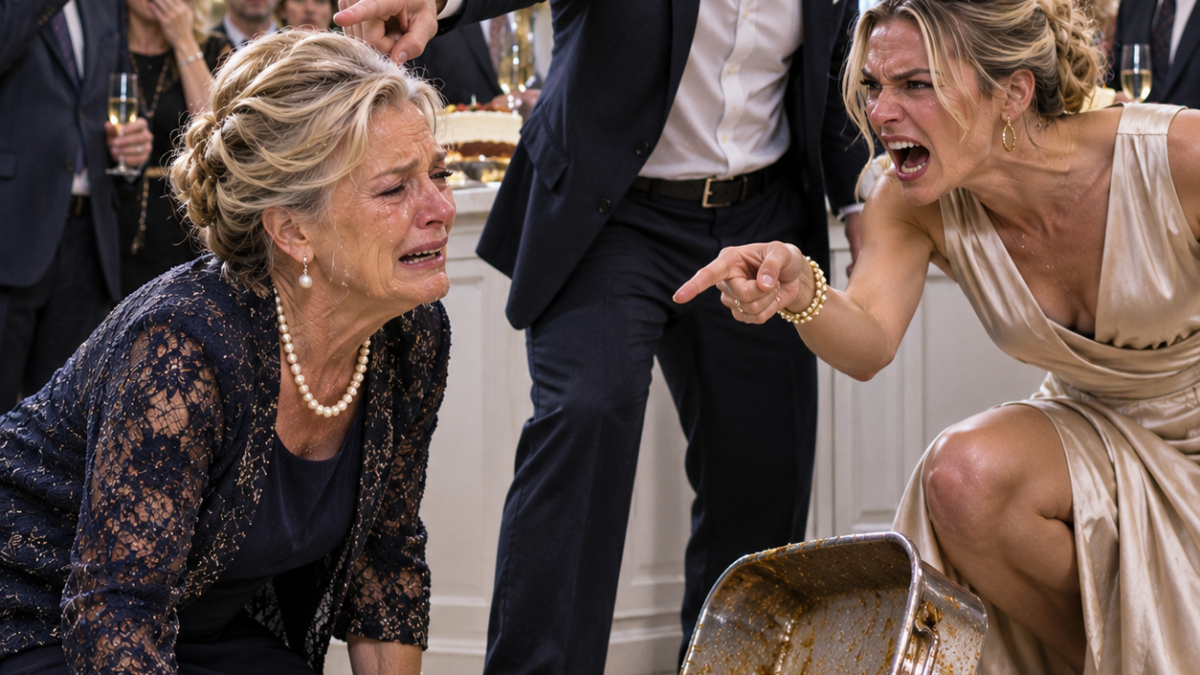
She grabbed the cast-iron pan.
“Let me help.”
For one second, I thought she was moving it.
Then I saw her wrist turn.
The whole roast slid.
Meat.
Carrots.
Pearl onions.
Red wine gravy.
It hit the white tile floor.
The sound of cast iron striking the buffet edge rang through the room.
No one spoke.
Vanessa gasped immediately.
“Oh my God!”
Too quickly.
“Oh my God, it slipped!”
She stared at me.
“Eleanor, why would you bring something this heavy?”
Gravy spread across the floor.
Across my shoes.
Into the grout.
Frank’s roast.
The last thing of his I could still make for our son.
Then Vanessa smiled.
Tiny.
Barely there.
But I saw it.
I got down on my knees.
I do not know why.
Maybe because standing suddenly felt impossible.
I picked up meat with my hands.
One piece.
Then another.
“Mom.”
Michael crouched.
“Stop.”
“It’s okay.”
“Mom, caterers will get it.”
“It’s your father’s.”
My voice broke.
Someone whispered behind us.
“Oh, that poor woman.”
Then Vanessa said:
“Here we go.”
I stopped.
Looked up.
“What?”
She lifted both hands.
“It was an accident, Eleanor.”
“You did it.”
The room went silent.
“What?”
“You did it on purpose.”
Her mouth fell open.
Then she looked toward Michael.
“Are you hearing this?”
“I watched you.”
She laughed.
Too loudly.
“You think I deliberately dumped food on my own kitchen floor at my husband’s birthday party?”
“Yes.”
“That sounds insane.”
“No.”
I stood.
Gravy on my hands.
“It sounds like the piano recital.”
Vanessa froze.
“And Easter.”
Her friends were watching.
“And Lily’s school play.”
“Oh my God.”
She covered her face.
Tears appeared instantly.
“I cannot do this anymore.”
Michael went to her.
“Babe.”
“I have tried.”
She sobbed.
“For six years.”
Michael put his arms around her.
Then he looked at me.
That was the worst part.
Not anger.
Disgust mixed with worry.
“Mom.”
He took my arm.
“Kitchen.”
He closed the pocket door behind us.
“What is wrong with you?”
I stared.
“She dumped it.”
“There are forty people in there.”
“I know what I saw.”
“My boss is out there!”
“She did it on purpose.”
“Stop.”
He had never raised his voice at me.
Not once.
“Do you know what Vanessa has been dealing with?”
“No.”
“Her business is struggling.”
I thought about the mortgage.
“She’s working eighty hours a week.”
“Michael—”
“And you come in here with food nobody asked for and bank letters and accusations.”
“You asked for the roast.”
“I didn’t ask you today.”
“At Christmas.”
He frowned.
“You said, ‘Mom, make Dad’s roast for my birthday.’ Lily was standing there.”
He did not remember.
Or did not want to.
“That isn’t the point.”
“Then what is?”
He took a breath.
“Vanessa has been telling me for months that you’ve been different.”
My stomach dropped.
“Different how?”
“Forgetful.”
“No.”
“Confused.”
“No.”
“Paranoid.”
My heart began pounding.
“She said you call late and forget.”
“I do not.”
“You accused her of hiding invitations.”
“She is!”
“Mom.”
“Check my phone records.”
“I am not checking my own mother’s phone.”
“Why not?”
“Do you hear yourself?”
Yes.
I did.
And suddenly I heard Vanessa too.
She had been preparing this.
Every missing invitation.
Every story.
Every supposed phone call.
Every “Eleanor forgot.”
She had not been improvising.
She had been building a version of me.
“Michael, look at me.”
He did.
“Do I look confused?”
He hesitated.
That hesitation nearly killed me.
“You were just on the floor sobbing and picking up meat in front of forty people.”
“Because it was your father’s.”
“Stop saying that.”
I stared.
“What?”
“You keep doing this.”
“Doing what?”
“Making everything about Dad.”
His face tightened.
“Making everything emotional.”
Frank had been dead six years.
Apparently grief had an expiration date nobody told me about.
Michael closed his eyes.
When he opened them, he was calm.
Too calm.
“Here’s what’s going to happen.”
I waited.
“You go back out.”
I already knew.
“You apologize to Vanessa.”
“No.”
“Mom.”
“It wasn’t an accident.”
“You apologize.”
“I will not lie to protect her.”
“It’s not lying.”
“What is it?”
“Keeping peace.”
I almost laughed.
“Peace that requires me to confess to something I didn’t do is surrender.”
“Please don’t do the wise-mother thing.”
“Michael.”
“You apologize or leave.”
Silence.
I heard every word.
But my mind resisted arranging them.
“Leave?”
“If you can’t apologize.”
“I’m your mother.”
“And she is my wife.”
“I know.”
“I have to choose my family.”
That sentence landed softer than the others.
Soft enough to cut deeper.
I waited.
Surely he would correct himself.
Surely he would say our family.
He didn’t.
I went to the sink.
Turned on water.
Washed Frank’s gravy from my fingers.
Slowly.
Under the nails.
Between my knuckles.
Michael stood behind me.
“Mom, come on.”
I dried my hands.
Untied my blue apron.
Lemons all over it.
Lily had given it to me when she was six.
I folded it.
Set it on the counter.
Then I opened my purse.
Removed the brass key Michael had given me when they bought the house.
He had laughed then.
“Mom, you paid for half the front door. You should be able to open it.”
I placed the key on top of the apron.
“What are you doing?”
“You told me to leave.”
“I meant the party.”
“Then say what you mean.”
“I mean cool off.”
“I have been cooling off for six years.”
“Mom.”
“I cooled off when Easter moved.”
My voice stayed quiet.
“I cooled off when Lily’s school play happened without me.”
He stared.
“I cooled off when your wife told her friends I was a burden.”
“Don’t.”
“And today my granddaughter asked why I missed a recital I was never invited to.”
His face shifted.
I picked up my purse.
Inside it was the bank letter.
For one second, I wanted to hand it to him.
Tell him everything.
No autopay.
Three missed payments.
Vanessa had lied.
But I remembered her words.
He will believe me.
And looking at my son, I knew she was right.
At least tonight.
If I gave him the letter now, I would be the crying woman with gravy on her shoes inventing another accusation.
So I left it inside my purse.
“Goodbye, Michael.”
“Mom.”
“Happy birthday.”
I walked through forty silent guests.
Vanessa was sitting with two women rubbing her back.
She looked up.
“Eleanor.”
I stopped.
“I hope you feel better.”
Loud enough for everyone.
Like I was sick.
Like she was compassionate.
I said nothing.
I got my coat.
Then footsteps ran toward me.
“Grandma!”
Lily grabbed my sleeve.
“Where are you going?”
“Home.”
“You promised to hear Mozart.”
I crouched.
My knees hurt.
“I know.”
“You promised.”
“I’m sorry.”
“Are you mad at me?”
My heart broke.
“No.”
“Then why are you leaving?”
What do you tell a nine-year-old?
“Grandma needs to rest.”
Her lip trembled.
“Mom says you’re getting sick in your head.”
Everything inside me stopped.
“She said that?”
Lily nodded.
“Are you?”
I held her face.
“What is your middle name?”
“Rose.”
“Favorite color?”
“Light purple.”
“Stuffed bunny?”
“Mr. Buttons.”
“What happened to his ear?”
“Lost it at the zoo.”
“Who fixed it?”
“You.”
I smiled.
“My head is fine.”
She nodded solemnly.
“Okay.”
Vanessa appeared at the end of the hall.
“Lily.”
My granddaughter stiffened.
“Come here.”
I kissed her forehead.
“Go on.”
“I love you.”
“I love you more.”
Then I walked out.
I did not look back.
At home, I sat in my driveway for almost ten minutes before I could go inside.
My phone buzzed.
Michael.
Mom, that was not okay.
Another.
Vanessa has been crying for an hour. I hope you’re happy.
Then another message arrived.
Unknown number.
This is Rachel from the party.
I opened it.
I’m sorry about tonight.
Then:
I saw what happened with the pan.
I don’t think it was an accident.
I read the message four times.
Then I went inside.
Frank’s reading glasses were still inside the end-table drawer.
I sat at our kitchen table.
The same table where I had signed the mortgage six years before.
I removed the bank letter.
NOTICE OF DELINQUENCY
$11,247.18 PAST DUE
I called the twenty-four-hour line.
Forty minutes of hold music.
Mozart.
Of all things.
Finally, a representative answered.
He confirmed three missed payments.
“Can you tell me when autopay stopped?”
“There is no active autopay.”
“When did payments stop?”
“May.”
“Who stopped them?”
He typed.
“The online account associated with the primary borrower.”
“Which email?”
He read it.
Vanessa’s.
My blood went cold.
“Has anyone called about the delinquency?”
“Yes.”
“A recent call requested electronic correspondence.”
“Who?”
“The primary borrower.”
“What about mail to me?”
“As cosigner, required notices still go physically to your registered address.”
Vanessa had tried to control every notification.
The bank letter was the one thing she could not stop.
Michael called near midnight.
His anger was gone.
He sounded tired.
“Are you okay?”
“I’m home.”
“That’s not what I asked.”
“I know.”
He sighed.
“Look, I said things.”
“Yes.”
“Vanessa was upset.”
“Yes.”
“You accused her in front of everyone.”
“Yes.”
“So tomorrow, just call her.”
“No.”
“Mom.”
“I am not apologizing.”
“Why are you making this bigger?”
“I’m not.”
He went quiet.
I looked at the bank letter.
“Michael.”
“What?”
“When you talked to Vanessa about the bank, what exactly did she tell you?”
“Mom.”
“Please.”
“She said autopay messed up when she changed banks.”
“What else?”
“She said she called.”
“What else?”
He hesitated.
“That you probably misread the notice.”
My heart sank.
“Do you believe that?”
“I don’t know.”
It was the first honest answer he had given me.
“Is she wrong?” he asked.
I could have unloaded everything.
Instead, I decided something.
For once, I would not carry evidence to my son and beg him to see.
He could look.
“Michael, I love you.”
“I love you too.”
“I will not apologize.”
He sighed.
“Then I guess we leave it there.”
“For tonight.”
I hung up.
At 5:48 the next morning, Vanessa texted.
Until you get help, you are not to contact Lily.
My hands began shaking.
No phone calls.
No mail.
Do not go near her school.
If you do, I will call the police.
I typed:
You know I would never hurt her.
Deleted it.
Typed:
I know about the mortgage.
Deleted that too.
Anything I wrote could become evidence.
Look what she sent me, Michael.
See how aggressive she is.
I turned the phone over.
Then I messaged Rachel.
We met Sunday morning at a Denny’s on Route 9.
She looked frightened.
Hair pulled back.
No makeup.
Both hands around a coffee she never drank.
“Can I ask you something?”
“Yes.”
“Is your memory okay?”
I almost laughed.
Instead I said:
“I know Lily’s middle name.”
Rachel watched me.
“Favorite color.”
“Light purple.”
“Mr. Buttons?”
She blinked.
“That’s the bunny?”
“One ear sewn back on.”
Her shoulders dropped.
“Okay.”
“What has Vanessa been saying?”
Rachel stared at the table.
“Early dementia.”
My stomach turned.
“She says you call at night and forget.”
“I don’t.”
“That you accuse people of stealing.”
“I don’t.”
“That you get lost driving.”
“Never.”
“I started wondering because the stories were too perfect.”
“Too perfect?”
“Every time we went out, there was another example.”
Rachel looked around.
Then leaned closer.
“What do you know about Vanessa’s business?”
“Michael says it’s struggling.”
“It’s gone.”
I stared.
“She lost her listings months ago.”
“What?”
“She owes office rent.”
My mouth went dry.
“And money to a private lender.”
“Does Michael know?”
“No.”
Rachel closed her eyes.
“She asked me to help make a spreadsheet showing fake commission numbers.”
“Why would you—”
“I didn’t do it.”
She reached into her purse.
“I’m a paralegal.”
“I know.”
“She called me six weeks ago asking about conservatorships.”
Every hair on my arms rose.
“What?”
“She wanted to know how to declare somebody unable to manage their own finances.”
I couldn’t speak.
“She asked whether a son could petition.”
Rachel’s voice dropped.
“And whether a conservator could sell the person’s house.”
My mother.
A courtroom.
A doctor explaining Alzheimer’s.
I knew exactly what conservatorship could mean.
“Did she ask about my house?”
Rachel nodded.
“She asked what a paid-off house in your neighborhood would sell for.”
I sat back.
“She’s building a case.”
“I think so.”
“Why tell me?”
Rachel looked down.
“My grandmother raised me.”
She swallowed.
“My uncle did something similar.”
Her eyes filled.
“By the time we understood, she had lost her house.”
I reached across the table.
Rachel held my hand.
“I was nineteen.”
She wiped her face.
“I told myself it wasn’t my business.”
She shook her head.
“I’m not doing that again.”
That afternoon, I pulled my credit report.
Tyler, my sixteen-year-old neighbor, helped.
Old mortgage.
Closed Sears card.
Cosigned mortgage.
Ninety days late.
Then Tyler frowned.
“What?”
“You have a Capital One card.”
“No.”
“Opened August twelfth.”
“I never opened one.”
“Fifteen-thousand-dollar limit.”
My heart pounded.
“Balance?”
“Fourteen-two.”
I held the chair.
“Address?”
He clicked.
“Commerce Parkway. Suite 200.”
Vanessa’s office.
The room blurred.
A card in my name.
Fourteen thousand dollars.
Sent to her office.
If a judge saw that?
A confused elderly woman claiming she did not remember opening her own credit card.
She had not just stolen money.
She had created symptoms.
Sunday night, Michael called.
He said the mortgage was handled.
Vanessa had shown him an email proving a payment plan.
“Did you read it?”
“She showed me.”
“Did you read the entire thing?”
“Mom.”
“There is no payment plan.”
“How do you know?”
“I called.”
He became defensive again.
“I am not doing this tonight.”
“I need to tell you something.”
“Is it about Vanessa?”
“Yes.”
“Then no.”
“Michael.”
“I’ll call you later.”
He hung up.
Monday morning, I was outside First Federal before they opened.
Gloria Chen sat with me.
Reading glasses on a chain.
Competent eyes.
She read my letter.
Then she looked at me.
“You’re the cosigner.”
“Yes.”
“And your son doesn’t know?”
I almost cried.
“How did you know?”
“I’ve been doing this twenty-six years.”
She pulled up the account.
“Ninety-four days delinquent.”
No payment plan.
No application for one.
No email confirmation.
Then she found something else.
A note.
September fourth.
Caller identified herself as Eleanor Hayes.
Requested mailing-address change.
Failed security questions.
Request denied.
Account flagged.
Someone had impersonated me.
Someone tried to redirect the only mail Vanessa could not control.
Gloria looked at me.
“Do you know who?”
“I have an idea.”
“Get a lawyer.”
That afternoon, I sat across from Tom Brennan.
His mother had been in my bridge club.
Tom ate my brownies as a teenager.
Now he was a lawyer with gray at his temples.
I showed him everything.
The bank letter.
Credit report.
Rachel’s information.
He read silently.
Then removed his glasses.
“Eleanor.”
“Don’t call me Mrs. Hayes.”
“I’m trying to be serious.”
“Tommy, you ate brownies in my kitchen.”
He almost smiled.
Then didn’t.
“This is serious.”
“I know.”
“Identity theft.”
I nodded.
“Bank impersonation.”
“Yes.”
“Possible elder financial exploitation.”
My stomach tightened.
“And the conservatorship questions?”
“Yes.”
He leaned back.
“Three things.”
He held up one finger.
“Freeze credit at all bureaus.”
Second.
“File a police report on the card.”
Third.
“Get a formal cognitive evaluation.”
I stared.
“There is nothing wrong with me.”
“I believe you.”
“Then why?”
“Because truth is better when it comes with documentation.”
I hated that he was right.
He leaned forward.
“If she goes before a judge, she has stories.”
He counted them.
“Missed calls.”
“Emotional incident at a party.”
“A credit card you supposedly don’t remember opening.”
“Family history.”
“And what do you have?”
“The truth.”
“Get me the truth on a neurologist’s letterhead.”
Tuesday, I saw Dr. Anna Morales.
She had treated me fourteen years.
She knew Frank.
Knew my knee.
My cholesterol.
My salt problem.
When I explained why I wanted testing, her expression changed.
Then she told me something.
“In August, a woman called my office.”
I froze.
“She said she was your daughter-in-law.”
My stomach dropped.
“She called herself your primary caregiver.”
“What did she want?”
“Medical records.”
“What kind?”
“Anything about cognitive decline.”
I closed my eyes.
“And family history.”
“My mother.”
“Yes.”
“Did you give her anything?”
“No.”
“Is there a record?”
“Yes.”
Dr. Morales touched my hand.
“Eleanor, she said you were too confused to sign a release.”
I felt physically ill.
The cognitive testing lasted over an hour.
Words.
Clocks.
Math.
Shapes.
Recall.
Executive function.
Animals.
I named thirty-one animals in a minute.
At the end, Dr. Morales smiled.
“Twenty-nine out of thirty.”
I laughed like I was crying.
“Is that good?”
“Better than most people half your age.”
“No impairment?”
“None.”
I sat in my car afterward.
Hands on the wheel.
And cried.
Not because I had ever truly believed Vanessa.
But because she had made me ask.
What if she’s right?
That was the deepest violation.
She had gotten inside my confidence.
Wednesday afternoon, Lily FaceTimed me from an unknown account.
Her face appeared close to the camera.
Whispering.
Coats behind her.
“Grandma?”
“Lily?”
“You can’t tell Mom.”
“I won’t.”
“Are you going to a home?”
My heart stopped.
“What?”
“She was talking.”
“To who?”
“I don’t know.”
“What did she say?”
“She said it’s almost done.”
My hand began shaking.
“She said Dad signed something.”
“Something what?”
“She said once you’re in, the house sells itself.”
My whole body went cold.
“My house?”
“I think.”
“Lily.”
“Yeah?”
“I am not going to a home.”
“Promise?”
“I promise.”
A door opened somewhere.
Vanessa’s voice.
“Lily?”
My granddaughter panicked.
“I have to go.”
“Delete the call.”
“Okay.”
“I love you.”
“I love you.”
The screen went black.
Thursday, I picked up Dr. Morales’s letter.
Official letterhead.
Signature.
No evidence of cognitive impairment.
Fully capable of managing financial, medical, and personal affairs.
I put it in a plastic protector.
Frank always protected important documents.
Then I drove home.
Michael’s car was in my driveway.
He sat on my steps holding a glossy brochure.
I already knew.
Willow Creek Memory Care.
Smiling older couple on the cover.
“Mom.”
“Come in.”
He stood in my kitchen.
Wouldn’t take coffee.
“I can’t stay long.”
“You never can.”
He placed the brochure down.
“Just listen.”
I did.
He said he and Vanessa were concerned.
He talked about genetics.
My mother.
The party.
Memory.
Safety.
He said Willow Creek had gardens.
A library.
Watercolors.
“Did Vanessa find it?”
“We did.”
“Did she find it?”
He looked down.
“Yes.”
I placed Dr. Morales’s letter on top of the brochure.
“Read.”
He did.
His eyes stopped.
“Twenty-nine?”
“Out of thirty.”
“You got evaluated?”
“Yes.”
“Why?”
“Because your wife has been telling people I have dementia.”
He shook his head.
“She isn’t telling everybody.”
“Pilates friends.”
“How do you know?”
“Someone told me.”
He immediately focused on the witness instead of the truth.
“Who?”
“It doesn’t matter.”
“It matters to me.”
“Michael.”
I leaned forward.
“Did Vanessa contact Dr. Morales in August?”
He blinked.
“What?”
“She asked for my records.”
“No.”
“She called herself my caregiver.”
His face changed.
“No.”
“Did she tell you?”
No answer.
I continued.
“There is no mortgage payment plan.”
“She showed me the email.”
“It is fake.”
He stood.
“Stop.”
“Someone called the bank pretending to be me.”
“Mom.”
“September fourth.”
“This is exactly what she predicted.”
“What?”
“That you’d accuse her of stealing.”
My heart sank.
“She opened a credit card in my name.”
“You don’t know that.”
“The statements go to her office.”
“Because maybe you used the address.”
“You hear yourself?”
He gripped Frank’s chair.
Then his phone rang.
Vanessa.
He answered.
“Yes.”
He turned slightly away.
“I’m here.”
Pause.
“She got some doctor’s letter.”
Pause.
“Twenty-nine.”
Pause.
“Yes.”
Pause.
“No, I won’t.”
Pause.
“Twenty minutes.”
He hung up.
“What did she say?”
He faced me.
“That those tests aren’t definitive.”
I stared.
“She said you probably studied.”
I almost laughed.
“Studied for dementia?”
“Mom.”
“No.”
He grabbed his keys.
“I have to go.”
“Of course.”
“Think about the tour.”
“No.”
“Just look.”
“No.”
“Mom.”
“I am not touring a memory facility because your wife needs a buyer for my house.”
His face went white.
“What did you say?”
“Go home.”
“Who told you that?”
I would not give him Lily.
“Your wife is waiting.”
He left.
The brochure remained.
I picked it up to throw it away.
A stapled packet slid out.
Willow Creek Memory Care Pre-Admission Intake Application.
My name.
Birth date.
Suspected early-onset dementia.
Financial arrangement:
Private pay. Resident’s primary residence to be listed for sale upon admission to fund care.
Then the signature.
Michael Hayes.
Dated September ninth.
Two weeks before his birthday.
I stared at my son’s handwriting.
The same handwriting he practiced at this kitchen table when he was twelve.
He had signed me away before I baked his cake.
Before the roast.
Before the party.
That night he had called asking whether I was still making Dad’s pot roast.
I sat at my table and sobbed until I could not breathe.
Then I called Tom.
The next morning he checked the probate docket.
His call came from courthouse steps.
“Sit down.”
I sat.
“There is a petition.”
My heart stopped.
“For conservatorship.”
“Filed by?”
“Michael.”
I closed my eyes.
“Emergency temporary petition.”
“What does that mean?”
“They asked for an order without notifying you first.”
“Why?”
“They claim immediate danger.”
“From whom?”
“Yourself.”
He read allegations.
Wandering.
Irrational financial decisions.
Paranoia.
Accusing relatives of theft.
The Capital One card was included as evidence.
The stolen card.
Then came the worst.
“A doctor’s declaration is attached.”
“Who?”
“Richard Hail.”
“I don’t know him.”
“Neurologist.”
“No.”
“It says he examined you September fifteenth.”
“No.”
“MoCA score eighteen out of thirty.”
“I scored twenty-nine.”
“I know.”
“The judge only saw eighteen.”
My blood went cold.
“What did the judge do?”
Silence.
“Tom.”
“The emergency order was signed yesterday.”
The day Michael sat in my kitchen.
“What does that mean?”
“Michael is your temporary conservator.”
“For how long?”
“Thirty days pending full hearing.”
“What can he control?”
A pause.
“Your finances.”
The next morning, CVS declined my debit card.
Twelve dollars.
Blood pressure pills.
I paid cash.
Fourteen dollars in my wallet.
Two dollars left.
Then I called my bank.
Restricted accounts.
Court order.
Michael confirmed the restriction at 8:15 that morning.
I sat in my car and laughed.
Not because it was funny.
Because Vanessa had frozen the very money that could have saved her mortgage.
The one thing she was trying to protect.
Tom filed an emergency objection.
Hearing Tuesday.
Rachel came to his office.
We examined Dr. Hail’s declaration.
Address:
UPS Store.
Phone:
Disconnected.
Rachel searched the state medical board.
Richard A. Hail existed.
Or had.
He died eighteen months earlier.
The neurologist who supposedly examined me was dead.
Tom asked me:
“Do you think Michael knew?”
Two days earlier I would have said no without hesitation.
Now?
“I don’t know.”
That answer hurt more than anything Vanessa had done.
Michael called Friday.
He said the conservatorship was temporary.
For my safety.
Then I asked:
“Who is Dr. Hail?”
He said Vanessa arranged it.
“She said she took you.”
“No.”
“She said you were embarrassed.”
“Michael.”
“What?”
“He died last year.”
Silence.
“What?”
“Look him up.”
I heard typing.
Then nothing.
A door opened near him.
Vanessa’s voice.
“Babe?”
Michael answered:
“Nobody. Work.”
He had called me.
Then lied to her about calling me.
The line ended.
Tuesday morning, I wore my navy dress.
Tom beside me.
Rachel came.
Gloria Chen came on her day off.
Dr. Morales sent sworn records.
Vanessa arrived wearing gray.
Pearls.
No obvious makeup.
Concerned daughter-in-law costume.
Michael followed.
He looked destroyed.
Vanessa came straight toward me.
Hugged me.
“Oh, Eleanor.”
Her cheek touched mine.
“We just want you safe.”
Then she whispered:
“You should have apologized.”
She walked away smiling.
Judge Patricia Delgado was sixty-ish.
Sharp.
Tired.
Vanessa’s attorney spoke first.
Family concern.
Alzheimer’s history.
Paranoia.
Credit-card debt.
Party incident.
Forty witnesses.
He had written statements describing me sobbing on the floor.
Then Tom stood.
He did not perform.
He simply handed the court evidence.
Dr. Morales:
29/30.
No cognitive impairment.
Medical-record request:
Vanessa claiming to be caregiver.
Bank note:
Impersonation attempt.
Police report:
Identity theft filed before conservatorship petition.
Then:
State medical board.
Richard Hail.
Deceased.
Judge Delgado read the page twice.
Then looked at Vanessa’s lawyer.
“Counsel.”
He stood.
“Yes, Your Honor.”
“The physician whose sworn declaration you submitted died eighteen months before allegedly examining Mrs. Hayes.”
The attorney looked at Vanessa.
For once, she had nothing.
Michael was called.
“Did you meet Dr. Hail?”
“No.”
“Attend any appointment?”
“No.”
“How did his declaration enter your petition?”
“My wife gave it to me.”
“Did you read it?”
Silence.
“Mr. Hayes?”
“The first page.”
The judge stared at him.
Then she asked about Willow Creek.
He admitted signing.
Vanessa had told him it merely reserved a spot.
He had not read the funding language.
The judge took off her glasses.
“Do you know how often I hear an adult child stand there and say, ‘I didn’t read it’?”
Michael looked down.
Then Tom submitted one more document.
A real-estate listing.
My address.
Coming Soon.
Entered September eighteenth.
Listing agent:
Vanessa Hayes.
Notes:
Motivated estate. Owner relocating to care facility. Available within sixty days.
My house.
Frank’s house.
She had listed it before Michael’s birthday.
Before I carried Frank’s roast into her kitchen.
Before she dumped it.
And she planned to collect the commission.
Michael looked at Vanessa.
“Did you list my mother’s house?”
She refused to answer.
“Vanessa.”
“Not here.”
“Did you?”
“I said not here!”
Her mask disappeared.
The judge struck her gavel.
Then ruled.
Emergency conservatorship dissolved.
Immediately.
Accounts unfrozen.
Petition dismissed with prejudice.
Matter referred to the district attorney.
Adult Protective Services.
Forgery.
Impersonation.
Identity theft.
Potential financial exploitation.
Then Judge Delgado looked at me.
“I’m sorry.”
My knees weakened.
“It should not have taken a courtroom for someone to believe you.”
I thanked her.
Then she smiled faintly.
“And twenty-nine out of thirty is better than I’d score.”
People laughed.
I could not.
For seven days, I had needed permission to buy blood pressure pills.
Now someone with authority had said publicly:
You are not crazy.
Outside the courtroom, Michael confronted Vanessa.
“Where did the mortgage money go?”
Her business had collapsed.
She owed money.
Not banks.
People.
One of them was a man named Dale.
She had planned to sell my house and use the proceeds.
“She doesn’t need four bedrooms,” Vanessa said.
“She’s one woman.”
Michael stared.
“That’s my mother.”
“She’s had her life.”
That sentence stopped me.
Vanessa saw me.
“This is your fault.”
I approached.
“You’re right.”
She blinked.
“If I had apologized, you would have had me in Willow Creek by Christmas.”
Her face hardened.
“My house would be sold by New Year’s.”
“You think you won?”
“No.”
I looked at her.
“Nobody won.”
Then she left.
Michael stayed.
“Mom.”
I waited.
“I didn’t know about the doctor.”
“I believe you.”
“Or the house.”
“I believe that too.”
Relief crossed his face.
Then I continued.
“But you signed the paperwork.”
His face collapsed.
“You had already signed it when you called me asking about my knee.”
He cried.
“She kept saying you were getting sick.”
“You never asked me.”
“I was scared.”
“I know.”
“I couldn’t lose you like Grandma.”
“So you let someone else handle me.”
He covered his face.
“I thought I was protecting you.”
“No.”
I spoke gently.
“You were protecting yourself from looking.”
He broke.
Then he asked what he had asked me his entire life.
“Mom, what do I do?”
Mortgage.
Lily.
Vanessa.
Police.
Everything.
My body moved instinctively toward him.
Then I stopped.
Every time he fell, I caught him.
Every bill.
Every mistake.
Every fear.
Maybe that was part of how we arrived here.
“I don’t know.”
He stared.
“Please.”
“For once, Michael, you will have to figure it out.”
I left.
At home, I opened the freezer.
There was one container of Frank’s roast.
An extra batch I had made Thursday.
I warmed it.
Set one place.
Poured wine.
Ate slowly.
For the first time in my life, I served myself first.
The following morning, I changed every password.
PIN.
Security question.
Verbal banking password.
Then I returned home and found a black SUV waiting.
A man in his fifties stepped out.
Leather jacket.
“Eleanor Hayes?”
“Yes.”
“Dale.”
I knew.
“Vanessa owes me sixty-two thousand dollars.”
My hands went cold.
“She put this house up as collateral.”
“This house was never hers.”
“She said she’d have authority soon.”
He tapped my car.
“Said you were going into a home.”
I cracked the window only two inches.
My phone was already on 91.
Thumb ready to press the second 1.
“Mr. Dale.”
He leaned closer.
“I buried my husband.”
He stopped.
“I buried my mother.”
Silence.
“I spent a week being told I had Alzheimer’s by a doctor who had been dead eighteen months.”
His face changed.
“Yesterday, a judge gave me my life back.”
I lifted the phone.
“So listen carefully.”
He straightened.
“This house is not for sale.”
I pointed toward the road.
“Whatever Vanessa promised you was not hers to promise.”
He looked at my phone.
“If you are here in thirty seconds, police can discuss your sixty-two-thousand-dollar loan with you.”
He laughed once.
“Lady, I wish my mother had half your nerve.”
Then he left.
I called Tom anyway.
Police report.
Officer Ruiz came.
Documented everything.
That night Tom asked:
“When is the last time you went somewhere for yourself?”
I could not answer.
The next morning, Michael called.
Vanessa had been arrested.
Detectives.
Handcuffs.
Front yard.
Neighbors watching.
“Where’s Lily?”
“Asleep.”
“Are you okay?”
“I don’t know.”
“Do you need me?”
A long silence.
“Yes.”
Then:
“No.”
That surprised me.
“I do, but I shouldn’t.”
His voice shook.
“I have to tell Lily.”
Pause.
“Call the lawyer.”
Pause.
“Call the bank.”
He inhaled.
“I cannot keep asking you to fix everything.”
I closed my eyes.
Forty years.
That was the sentence I had been waiting for.
“Okay.”
“Is that okay?”
“It’s more than okay.”
Later he brought Lily.
He stayed in the car.
My granddaughter walked straight into my arms.
“Mommy’s in trouble.”
“I know.”
“Did she hurt you?”
I thought carefully.
“She was scared.”
Lily looked skeptical.
“And scared grown-ups sometimes make terrible choices.”
“That doesn’t mean she doesn’t love you.”
Lily looked down.
“Did she do bad things to you?”
“Yes.”
A nine-year-old deserved simple truth.
When Michael picked her up, he told me the bank had called.
Nineteen days left.
“I’ll figure it out.”
He added immediately:
“I am not asking you.”
“I know.”
“I will.”
“I believe you.”
Then he asked:
“What are you going to do?”
I heard myself answer.
“Maine.”
“Mom?”
“Camden.”
Where Frank and I spent our tenth anniversary.
“How long?”
“I don’t know.”
For once, I booked something for myself.
One suitcase.
One room.
One woman.
The first week in Camden, I mostly slept.
Ten hours.
Sometimes twelve.
Then I walked to the harbor.
Sat on a bench.
Watched boats.
Nobody needed dinner.
Nobody expected me early.
Nobody called asking for money.
Nobody changed plans without telling me.
At first, the freedom terrified me.
One night, I called Rachel.
“I don’t know who I am if nobody needs me.”
She told me something her grandmother used to say.
“You can’t pour from an empty pitcher.”
Then she added:
“But sometimes you’re allowed to just be a pitcher.”
I laughed.
It sounded ridiculous.
It also helped.
A woman named June sat beside me one morning.
Red windbreaker.
Thermos.
“You’re either widowed, divorced, or running from something.”
“All three, sort of.”
She handed me coffee with whiskey.
“Start talking.”
I told her everything.
An hour and a half.
She listened.
When I said I had not spoken properly with Michael, she asked why.
“I’m afraid I’ll go home and start fixing everything again.”
June nodded.
“Then don’t go home until you’re sure you won’t.”
She brought me to painting class.
Eight women.
One shy retired dentist named Walt.
I had not painted since before Michael was born.
My first painting was the harbor.
Terrible.
My second was a pot roast.
June laughed until she cried.
“Therapeutic?”
“Revenge.”
“Same thing.”
Then Gloria Chen called.
“The mortgage is current.”
I leaned against the library wall.
“What?”
“Every payment.”
“Who?”
“Michael.”
“How?”
She sighed.
“He cashed part of his retirement.”
My throat tightened.
“And sold his car.”
The car he loved.
His pride.
His symbol of success.
“He is driving a 2011 Honda.”
I pressed my hand over my mouth.
“Why?”
Gloria said Michael told her:
“She’s carried this long enough.”
I went back into painting class.
Walt looked at me.
“You okay?”
“My son sold his car.”
He nodded.
“Good news?”
“The best in six years.”
A package arrived days later.
Michael’s handwriting.
Inside were letters.
Lily’s letters.
Birthday cards.
Recital invitation.
Easter card.
A drawing.
Never mailed.
Never delivered.
Then a three-page note.
Dear Grandma,
Mom says you are getting sick and might forget me.
So I am writing things down.
Your name is Eleanor.
You like the ocean.
You make eggs with red powder.
You fixed Mr. Buttons.
You love me the most.
Please don’t forget.
I read it eleven times.
My granddaughter had not forgotten me.
She thought I had forgotten her.
That might have been the cruelest thing Vanessa did.
I sent Lily a package.
Blueberry jam.
Harbor photograph.
A letter.
I got all your letters.
I never forgot you.
Then I listed everything.
Lily Rose.
Light purple.
Mr. Buttons.
Mozart.
I watched the postal worker put it into the outgoing bin.
I trusted nobody else.
A month after I left, Michael called.
I answered on the fourth ring.
“Mom.”
Silence.
“Lily got your package.”
“Did she like the jam?”
“She ate it with a spoon.”
I smiled.
“She sleeps with your letter.”
My eyes filled.
Then Michael said:
“I went to see Vanessa.”
County jail.
She confessed.
Business collapse.
Fake doctor.
Fake paperwork.
Listing.
Lender.
Everything.
“She made the medical letter herself.”
I closed my eyes.
“She found Dr. Hail in an obituary.”
He said Vanessa had admitted hiding Lily’s mail.
Michael’s voice broke.
“Mom.”
I waited.
“I need to say this properly.”
I held the phone.
“I was wrong.”
Silence.
“About all of it.”
My eyes closed.
“About you.”
His voice cracked.
“About her.”
Another breath.
“About what I owed you.”
I had waited forty years for my son to become the kind of man who could say I was wrong without putting but afterward.
“Say it again.”
He laughed through tears.
“I was wrong.”
“Thank you, sweetheart.”
Then I cried.
Not grief.
Release.
We talked almost two hours.
Lily.
Piano.
His terrible 2011 Honda.
It made a noise like a sick goose when turning left.
He had cashed retirement money.
Paid the mortgage.
Was refinancing me off the loan.
“You’ll pay penalties.”
“You gave us eighty-five thousand dollars of Dad’s insurance and never mentioned it for six years.”
I could not answer.
Then he asked:
“Can Lily and I come to Maine?”
Old Eleanor would have said yes before he finished.
I would have washed sheets.
Bought groceries.
Cooked.
Planned.
Started serving again.
Instead:
“Not yet.”
Silence.
“It isn’t punishment.”
“I know.”
“I need more time being a person who doesn’t have to get ready for anyone.”
Michael answered:
“Take it.”
Then:
“I’m not going anywhere.”
And I believed him.
Ten days later, Tom called.
Vanessa was taking a plea.
Identity theft.
Forgery of medical documents.
Attempted elder financial exploitation.
Eighteen months recommended.
Restitution.
Five years probation afterward.
I expected satisfaction.
Nothing came.
Then Vanessa’s lawyer asked whether I would accept a letter.
I did.
One handwritten page.
Vanessa wrote that she hated me because Michael trusted me.
When her business failed, she knew he would come to me.
I would help.
He would see her differently.
So she made me the problem first.
She admitted hiding Lily’s letters.
She admitted telling Lily I was sick.
She wrote:
I said it so often I started believing it.
Then:
I am not asking for forgiveness.
I just wanted one true thing written with my name on it.
June watched me finish.
“Change anything?”
I folded the letter.
“No.”
Then I thought.
“Yes.”
Both were true.
On November nineteenth, I flew home.
My neighbor Tyler picked me up.
He had gotten his license.
Drove with both hands locked at ten and two.
He had kept my rosemary alive.
Mostly.
When we reached my house, I sat looking at it.
Forty years.
Frank.
Michael’s childhood.
Christmases.
The place Vanessa tried to sell while I still lived there.
Inside, I opened the end-table drawer.
Frank’s reading glasses.
For six years, I had hidden them because seeing them hurt.
I placed them on top of the table.
Out in the open.
Missing him did not have to be managed anymore.
The next morning was sentencing.
Vanessa wore orange.
No pearls.
No cardigan.
No performance.
She pleaded guilty three times.
The prosecutor finished.
Then the judge invited me to speak.
I had three index cards.
I put them away.
“Your Honor.”
My voice was steady.
“For six years, I was told I was the problem.”
Quietly first.
Then publicly.
Then legally.
“I was called forgetful.”
“Paranoid.”
“A burden.”
I looked toward Vanessa.
“Eventually, a doctor who had been dead eighteen months supposedly diagnosed me.”
The courtroom was silent.
“But what she took from me wasn’t the money.”
I swallowed.
“Or even the house she tried to sell.”
“It was my trust in myself.”
My voice shook.
“For a few nights, I sat in my kitchen wondering if maybe I really was losing my mind.”
Then I spoke about Lily.
“Nine years old.”
Letters hidden.
A child believing her grandmother had forgotten her.
“I don’t want Lily to grow up believing her mother is a monster.”
Vanessa finally looked at me.
“She isn’t.”
I paused.
“She is a woman who was drowning and chose to hold somebody else underwater so she could breathe.”
Her eyes filled.
“That is terrible.”
“But it is human.”
I turned toward the judge.
“I am not asking for leniency.”
“I am asking that whatever happens helps her become someone who can someday look her daughter in the eye.”
I sat down.
Michael’s hand rested on my shoulder.
Then Vanessa stood.
She looked at me.
“Eleanor.”
The courtroom stopped.
“On Michael’s birthday, I told him to make you apologize.”
Her voice cracked.
“You wouldn’t.”
She swallowed.
“I thought that made you stubborn.”
“Proud.”
She looked down.
“Then after court, I told you everything was your fault because you couldn’t say one word.”
She looked back up.
“You were right.”
My chest tightened.
“You had nothing to apologize for.”
She began crying.
“I did.”
Six years of resentment.
Six years of hidden invitations.
Financial fraud.
Lies.
A dead doctor.
A stolen identity.
A stolen granddaughter.
All of it seemed to sit between us.
“I’m sorry.”
Then again:
“I am so sorry.”
I did not feel forgiveness rush through me.
No miracle.
No dramatic cleansing.
I felt finished.
That was better.
I nodded once.
The judge sentenced her to eighteen months.
Michael drove me home afterward.
The Honda made a terrible honking noise on left turns.
I laughed.
“Your father could have fixed that.”
“I tried YouTube.”
“How’d that go?”
“I made it worse.”
We laughed.
Then Michael became quiet.
“I filed for divorce.”
I had expected it.
“She isn’t fighting.”
“What about Lily?”
“We’ll work out custody when Vanessa gets out.”
“Fair.”
He nodded.
“But right now it’s me and Lily.”
Here it came.
“School ends at three.”
I waited.
“Piano.”
He sighed.
“Dinner.”
He looked embarrassed.
“I burned grilled cheese.”
“Impressive.”
“Mom.”
I smiled.
Then he asked:
“Could you move back?”
My whole body reacted.
Old instincts.
Yes.
Of course.
I can help.
I can pick up Lily.
I can cook.
I can become essential again.
Instead I breathed.
“No.”
Michael nodded before I explained.
“Okay.”
“I love you.”
“I know.”
“I love Lily.”
“I know.”
“But she needs you to become the parent she depends on.”
He stared ahead.
“What if I mess up?”
“You will.”
He laughed nervously.
“And then?”
“You fix it.”
“That’s being grown.”
He nodded.
“Dad used to say things like that.”
“Your father got most of his best material from me.”
He laughed again.
We pulled into my driveway.
Then I told him another thing.
“I’m selling the house.”
His head snapped toward me.
“No.”
“Yes.”
“Mom.”
“It is my choice.”
“That’s Dad’s house.”
“I know.”
“That’s what Vanessa wanted!”
“No.”
He looked confused.
“She wanted to take it.”
I touched the dashboard.
“I am choosing to let it go.”
His eyes filled.
“There is a difference.”
“Where will you live?”
“Camden.”
“Maine?”
“A cottage overlooking the harbor.”
“You bought a cottage?”
“I made an offer.”
“Without telling me?”
“Yes.”
He stared.
Then slowly smiled.
“That’s different too.”
“Yes.”
He sat quietly.
Then asked:
“Can I have the pantry door?”
“What?”
“The one with the pencil marks.”
Every birthday.
Frank measuring Michael.
Lines.
Dates.
A child’s growth recorded in graphite.
“I want to put it in my kitchen.”
He swallowed.
“And start measuring Lily.”
I could not speak.
I nodded.
December twenty-third, Michael and Lily drove eleven hours to Camden.
Lily counted fifty-seven sick-goose noises from the Honda.
She ran up the path.
“Grandma!”
I was waiting at the door.
Not behind it.
At it.
She jumped into my arms.
“Is that the ocean?”
“Yes.”
“It’s huge.”
“Biggest thing I know.”
Michael walked up carrying something heavy wrapped in a beach towel.
He brought it into my kitchen.
Unwrapped it.
Frank’s cast-iron roasting pan.
The one from the party.
The little chip in the handle from 1991.
I touched it.
“You kept this?”
“I washed it after you left.”
He looked embarrassed.
“I didn’t know what else to do.”
Then he opened a grocery bag.
Chuck roast.
Red wine.
Pearl onions.
Rosemary.
“What are you doing?”
“I’ve been practicing.”
“You don’t know Dad’s recipe.”
“I ate it every Sunday for twenty-five years.”
From the living room, Lily yelled:
“The first one was awful!”
Michael shouted back:
“Thank you!”
“Second one too!”
He rolled his eyes.
“Fourth one was decent.”
Lily appeared.
“It was okay.”
Michael rolled up his sleeves.
“Sit down, Mom.”
I almost stood to help.
Then stopped.
I sat.
Coffee in my hands.
My kitchen.
My son cooking for me.
He cut carrots too thick.
Used too much wine.
Forgot the bay leaf until the end.
“Dad won’t know,” he said.
I laughed.
I did not correct him.
When it finished, Michael carried the pan himself.
Served Lily first.
Then me.
Then himself.
I took one bite.
Frank’s roast?
No.
Michael’s.
Different.
Messier.
Better.
“Well?”
He watched me.
“Perfect.”
He narrowed his eyes.
“You’re lying.”
“A little.”
“Knew it.”
“Carrots are too thick.”
He laughed so hard he had to put down his fork.
After dinner, June came over.
Walt.
The painting group.
Someone arranged access to the old upright piano in the library basement.
Nine folding chairs.
Lily pointed at the first row.
“Grandma.”
“Yes?”
“That chair is yours.”
I sat.
She played Mozart.
The piece I had missed.
Some notes wrong.
Some perfect.
She kept going.
When she finished, she turned.
“Did you hear it this time?”
I cried.
“I heard every note.”
Christmas Eve morning, Michael and I walked to the harbor.
Two coffees.
Cold wind.
Fishing boats.
We sat on my bench.
“Mom.”
“Yes?”
“Can I tell you something?”
“Always.”
“That day at my birthday.”
I looked at him.
“When I said apologize or leave…”
He stared toward the water.
“I thought I was giving you two choices.”
“You weren’t?”
“No.”
He smiled sadly.
“I only saw one.”
I waited.
“I knew you’d apologize.”
My chest tightened.
“You always did.”
Yes.
“I thought saying ‘leave’ would scare you.”
He rubbed his hands together.
“I didn’t think you’d actually do it.”
“I know.”
“When you put that key down, I was furious.”
“Why?”
“I thought you were punishing me.”
He looked at me.
“It took me months to understand.”
“What?”
“You weren’t leaving me.”
He swallowed.
“You were leaving the version of yourself we’d all gotten used to.”
I said nothing.
“The one who always said yes.”
Wind moved across the harbor.
“The one who cleaned up everything.”
I took his hand.
“I was scared.”
“I know.”
“I thought choosing myself meant losing my son.”
“You didn’t.”
“No.”
I looked at him.
“I found him later.”
Michael laughed through tears.
“I’m glad you left.”
I raised an eyebrow.
“Careful.”
“I’m not glad why.”
He squeezed my hand.
“But if you had stayed…”
He stared at his coffee.
“I never would have seen Vanessa.”
A pause.
“Myself.”
Another.
“Or you.”
I leaned against him.
We sat that way.
Boats coming in.
Gulls screaming.
Coffee getting cold.
Then Michael said:
“I’m sorry.”
I smiled.
“You already said that.”
“I know.”
He looked at me.
“I like saying it.”
“Why?”
“Because somebody should have been saying it to you your whole life.”
For forty-one years, I had been Frank’s wife.
For forty years, Michael’s mother.
For nine years, Lily’s grandmother.
Those roles are still mine.
I treasure them.
But they are no longer the whole definition.
I am Eleanor Hayes.
Sixty-eight.
A widow.
A mother.
A grandmother.
A woman who once stood in her son’s kitchen with gravy running from her hands while forty people watched her dignity being questioned.
A woman who had a key.
Then chose to put it down.
A woman who almost lost legal control of her own life because other people had grown used to her never fighting back.
Vanessa thought the hardest thing she had to do was convince Michael I was confused.
She was wrong.
The easiest person to convince had almost been me.
That was the part I still think about.
There were nights when I wondered:
Maybe I am forgetting.
Maybe I did call.
Maybe the invitation did come.
Maybe the bank letter means something different.
Maybe my mother’s disease is beginning.
Gaslighting is a strange word.
Clinical.
Modern.
But what it felt like was simpler.
Someone took a mirror and slowly changed the reflection until I no longer trusted my own face.
Dr. Morales gave me a number.
29 out of 30.
Judge Delgado gave me my rights.
Tom gave me strategy.
Rachel gave me evidence.
Gloria gave me facts.
Lily gave me truth from a coat closet.
But in the end, I had to give myself something too.
Permission.
Permission to believe myself.
Permission to stop apologizing.
Permission to say no when Michael asked me to move back.
Permission to sell a house that carried forty years of memory because the choice was finally mine.
Permission to sit while someone else cooked.
Permission to eat before everybody else had been served.
Permission to love my son without managing his life.
Permission to love Lily without becoming her second parent.
Permission to forgive Vanessa without pretending what she did was acceptable.
I do not know exactly what Vanessa’s future will become.
Eighteen months is not forever.
I hope she uses the time.
Not because I want us to be close someday.
I don’t know if we ever will.
But Lily deserves a mother capable of honesty.
Michael deserves to stop living in a marriage built on fear.
And Vanessa deserves the opportunity to become something more than the worst things she did.
That does not mean erasing consequence.
It means allowing consequence to become useful.
Michael is learning.
Slowly.
He burns things.
Forgets appointments.
Calls me sometimes because he wants advice, then catches himself.
“Actually, never mind. I can figure it out.”
Sometimes I answer anyway.
Sometimes I don’t.
That is the difference now.
Choice.
He refinanced the mortgage entirely into his own name.
My signature is gone.
That piece of paper mattered more than any apology.
He sold the expensive car.
Keeps the ridiculous Honda.
The goose noise was eventually fixed by a mechanic who told him he had damaged something watching YouTube.
I laughed for three straight minutes.
Lily comes to Camden.
Not because I am expected to provide childcare.
Because she wants to see me.
She plays piano.
I paint.
June drinks coffee with too much something in it.
Walt still doesn’t speak much.
I planted rosemary outside my cottage.
It grows badly in the Maine cold.
I keep trying anyway.
Frank would laugh.
His reading glasses came with me.
They sit openly on a shelf now.
Not hidden.
Not preserved like a wound.
Some Sundays, Michael makes the roast.
It is getting better.
He still uses too much wine.
I have decided that may simply be his version.
One day, Lily asked why I kept the blue lemon apron.
I told her:
“Because you gave it to me.”
She said:
“Mom says it was at our old house forever.”
I nodded.
“Your dad saved it.”
That mattered too.
Michael saved the apron.
The pan.
The letters.
The pantry door.
Maybe that is how repair works.
Not by pretending nothing broke.
By choosing what deserves to be carried forward.
The birthday party used to be the memory I replayed most.
Vanessa’s hand on the pan.
The roast falling.
Michael pointing at the door.
My key on the counter.
Now another image has replaced it.
My little kitchen in Camden.
Michael standing over Frank’s roasting pan.
Lily stealing pearl onions.
Too much red wine.
Too-thick carrots.
A forgotten bay leaf.
My son serving me before himself.
No one apologizing for taking up space.
No one measuring love by sacrifice.
No one asking me to disappear so another person can feel secure.
That is the family I wanted all along.
Not perfect.
Not painless.
Honest.
There is an old pencil mark on the pantry door Michael took from my house.
He sent me a photograph after he installed it.
At the bottom are his childhood measurements.
Then a gap of decades.
Below them, in fresh pencil:
Lily Rose — 9 years old
Beside it, in Michael’s handwriting:
Grandpa Frank’s line continues.
I cried when I saw that.
Then I laughed because Frank would have said the line was crooked.
Some things survive.
Not because we cling to them.
Because we learn which parts deserve to come with us.
My son once pointed toward his front door and told me I had two choices.
Apologize for something I didn’t do.
Or leave.
He was certain I would apologize.
Everybody was.
Including me.
Instead, I folded my apron.
Set down my key.
Walked through forty silent people with gravy on my shoes and a bank letter in my purse.
I thought I was walking out of my family.
I was wrong.
I was walking out of the role they had assigned me.
The woman who fixes.
Pays.
Forgives first.
Absorbs blame.
Keeps quiet.
Says sorry.
I left her in that kitchen.
And once I stopped being her, my son finally had to become someone else too.
He became a man who could say:
“I was wrong.”
A father who showed up.
A son who learned that love does not mean permanent rescue.
And I became a woman who could finally hear an apology without needing it to survive.
That is why the last goodbye that mattered was never to Michael.
It wasn’t to Vanessa either.
It was to the Eleanor who had spent sixty-eight years believing that peace meant taking the blame so everybody else could stay comfortable.
I loved that woman.
She did her best.
But I don’t miss her.
Because the woman who replaced her wakes up near the ocean.
Makes coffee for herself.
Paints badly.
Laughs loudly.
Says no without explaining for twenty minutes.
And when her granddaughter sits at a piano and asks,
“Grandma, did you hear me?”
She can answer without hesitation:
“Every single note.”


