They Built 96 Luxury Homes on My Family’s Land—Then the HOA President Smirked and Called Me a Squatter
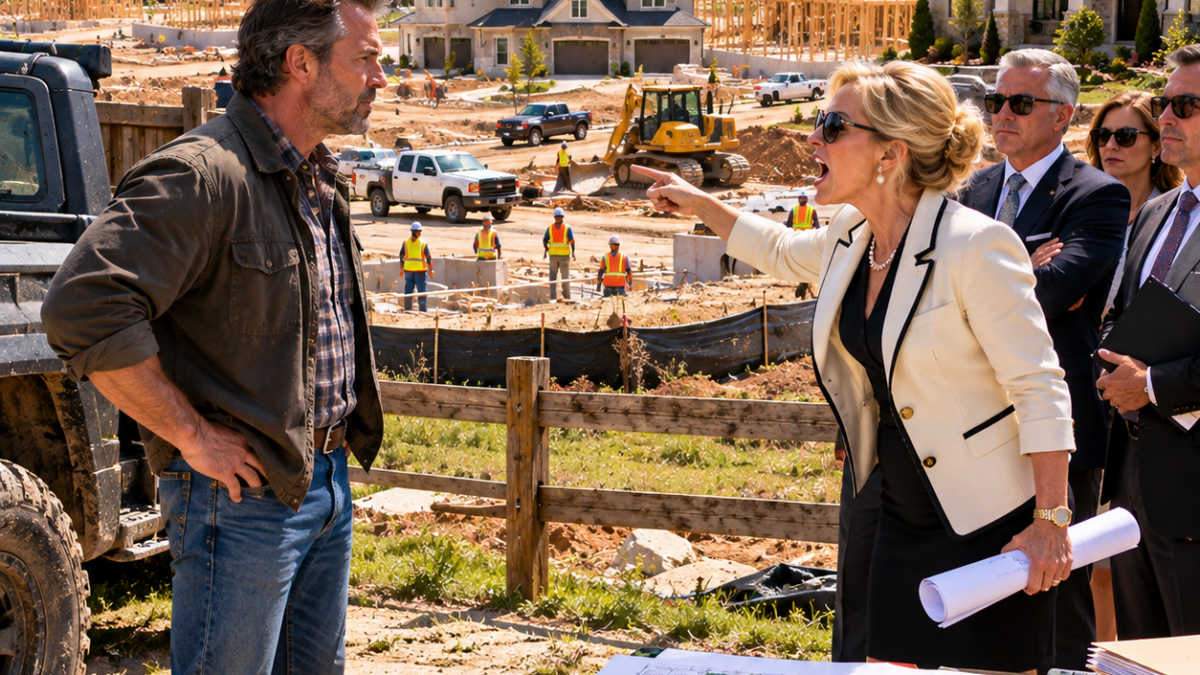
They Built 96 Luxury Homes on My Family’s Land—Then the HOA President Smirked and Called Me a Squatter
They built ninety-six luxury houses on land my grandfather had left me, sold every one of them, and then called me a scammer when I showed up with the deed.
The HOA president stood beside her white Range Rover, looked at my work boots and twenty-year-old truck, and told me people like me didn’t win against people like her.
I could have stopped construction that afternoon—but once my attorney showed me what they had really done, I decided to let them finish.
My name is Dakota Flint.
I was forty-seven years old when I drove into the Colorado foothills to scatter my grandfather’s ashes and discovered an entire subdivision where his forest used to be.
Not a few houses.
Not a construction site that had accidentally crossed a boundary line.
Ninety-six houses.
Paved streets.
Decorative streetlights.
Stone retaining walls.
Sidewalks.
Mailbox kiosks.
Landscaping crews.
Moving trucks.
Children riding scooters between freshly painted garages.
The entrance monument alone looked as if it had cost more than my house.
RIDGELINE HEIGHTS.
A WHITMORE LUXURY COMMUNITY.
I sat behind the wheel of my 2008 Silverado staring at those words while my GPS insisted I was exactly where I was supposed to be.
Parcel 55932408.
Forty-seven acres.
My land.
I checked the coordinates once.
Then again.
Then a third time.
My phone wasn’t wrong.
The road was wrong.
The houses were wrong.
Everything in front of me was wrong.
Three years earlier, that entrance had been an old fire road running through ponderosa pine and scrub oak.
My grandfather, William Flint, had bought the property in 1971 for $8,200 cash.
He grew up during the Depression and trusted banks about as much as he trusted snakes.
He kept receipts for things normal people forgot they had ever purchased.
Chainsaw blades.
Fence staples.
Diesel.
Survey work.
Timber permits.
County taxes.
Every important piece of paper went into a set of brown leather ledgers he stored in a steel cabinet in his workshop.
The ledgers smelled like pipe tobacco, machine oil, and whatever solvent he used to clean carburetors.
When I was a kid, I thought they smelled old.
After he died, they smelled like him.
Grandpa never became wealthy.
But he understood ownership.
He used to walk property lines with me when I was ten or eleven, pointing at iron markers half buried beneath pine needles.
“Land doesn’t argue with you,” he once told me. “People do. That’s why you keep records.”
When he died in 2019, he left the property to me.
Inside the envelope with the deed was a handwritten note.
Five words.
DON’T LET THE BASTARDS TAKE WHAT’S YOURS.
That was Grandpa.
No sentimental paragraph.
No speech about legacy.
Just five words and forty-seven acres.
For three years, I barely visited.
That became important later because Cassandra Whitmore would build almost her entire defense around those three years.
What she never seemed interested in was why I hadn’t been there.
My divorce had turned twelve months of my life into a paper shredder.
My daughter Emma was in college.
My son Tyler was trying to finish culinary school.
I was working seventy-hour weeks as a structural engineer because a major hotel project had gone sideways and half our department was trying to save it.
There were months when I ate more dinners at my desk than at home.
But I paid the property taxes.
Every April.
Never late.
About $6,400 a year.
Online payment.
Confirmation email.
Bank transaction.
County receipt.
I had every one of them.
So did the county.
I also hired a local man twice a year to check the perimeter fences.
The land wasn’t abandoned.
I was simply busy.
Apparently, to Cassandra Whitmore, those were the same thing.
I pulled toward the entrance.
A guard stepped out of a small stone gatehouse.
He was maybe sixty, wearing a navy security jacket despite the August heat.
He raised one palm.
“Residents and contractors only.”
“I’m going up to my property.”
He glanced toward the rows of houses.
“You live here?”
“No.”
“Then you need an appointment.”
“I own the land.”
That got a smile.
Not friendly.
The smile people give when they think someone is telling an obvious lie.
I held up my phone.
“I’m Dakota Flint. The county parcel is 55932408. Forty-seven acres.”
“Sure, buddy.”
“I’m serious.”
“So am I.”
I leaned toward the open window.
“My grandfather bought this land in 1971.”
The guard looked past me toward the Silverado.
Then he shrugged.
“And I’m Elon Musk. Turn around.”
I almost laughed.
Not because it was funny.
Because there are moments when reality becomes so ridiculous your brain doesn’t know what emotion to choose.
I opened the driver’s door.
The guard’s hand immediately moved toward the radio clipped to his shoulder.
“Sir, stay in the vehicle.”
“I want you to look at this.”
“I’m telling you to turn around.”
Then a white Range Rover rolled up behind me.
The guard straightened.
The driver’s door opened.
A woman stepped out.
Mid-fifties.
White linen pants.
White blouse.
Gold watch.
Large sunglasses.
Hair that had probably been professionally arranged before most people finished their first cup of coffee.
Even from twenty feet away, she looked expensive.
She walked toward us as if the entire road had been waiting for her arrival.
“Problem, Ray?”
The guard nodded toward me.
“This gentleman says he owns the development.”
She finally looked at me.
Boots.
Faded Carhartt jacket.
Work jeans.
Calloused hands.
Old truck.
I could almost see the filing system inside her head.
Laborer.
Disgruntled contractor.
Poor.
Unimportant.
Her mouth lifted slightly.
“How charming.”
“I’m Dakota Flint.”
“That doesn’t clarify anything.”
“My grandfather was William Flint.”
Something changed in her face.
Not fear.
Recognition.
Quick and controlled.
Then the smile returned.
“Ah.”
Just that.
Ah.
That single syllable told me she knew the name.
“I own this parcel.”
She pulled her sunglasses off.
“You believe you do.”
“I have the deed.”
“I’m sure you have something.”
“What does that mean?”
She pulled out her phone.
“Our title professionals conducted a forensic search before construction. The land had been abandoned for more than three years.”
I stared at her.
“Abandoned?”
“No active use. No improvements. No visible owner occupancy.”
“I paid taxes.”
She ignored that.
“Our legal counsel determined we had a valid adverse possession claim under Colorado law.”
“You don’t get adverse possession after three years.”
She gave me a look adults reserve for children who interrupt.
“If you’d allow me to finish—”
“And you definitely don’t get it when the legal owner is paying the property taxes.”
The smile sharpened.
“That’s adorable.”
I didn’t answer.
She stepped closer.
“You know just enough to be dangerous.”
I remember that sentence because of how casually she said it.
Not angry.
Not defensive.
Amused.
She reached inside a leather handbag and handed me a business card using two fingers.
BRIAN KEER.
ATTORNEY AT LAW.
WHITMORE DEVELOPMENT COUNSEL.
“Mr. Keer can explain why your claim is frivolous.”
“My claim?”
“Yes.”
I looked past her.
A framing crew was working on one of the unfinished homes.
Nail guns popped in rapid bursts.
A cement mixer turned somewhere beyond the trees.
Two landscapers were laying sod.
“You built these houses on parcel 55932408?”
“We built Ridgeline Heights pursuant to properly issued county permits.”
“How many houses?”
“Ninety-six.”
“How many sold?”
“All of them.”
That stopped me.
“All ninety-six?”
“Preconstruction contracts.”
“For how much?”
Her eyes narrowed.
“I don’t discuss private financial information.”
“How much?”
For some reason, she answered.
“Approximately sixteen million in deposits and presales.”
She said it proudly.
As if the amount itself proved legitimacy.
Families had already put sixteen million dollars into houses sitting on land I owned.
My stomach turned.
Cassandra must have seen something in my expression because she leaned closer.
“Families are moving in before Thanksgiving.”
It sounded like information.
It was actually a threat.
Do something now, and innocent people get hurt.
Then she added, “This is a legitimate project approved through Boulder County. If you continue entering the development or interfering with construction, I will contact Sheriff Mitchell personally.”
“Why personally?”
Another smile.
“We’ve been very supportive of the department.”
There it was.
Not technically a threat.
Just enough information to make sure I understood one.
Then she raised her phone and took a picture of my license plate.
“What are you doing?”
“Documenting.”
“Documenting what?”
“Your vehicle.”
“Why?”
“In case there’s vandalism.”
For the first time, I lost my calm.
“You think I’m going to vandalize houses built on my land?”
“I think desperate people behave unpredictably.”
I took one step toward her.
The security guard shifted.
Cassandra didn’t.
She lowered her voice.
“Listen to me carefully, Mr. Flint. People like you do not win against people like us.”
Something about the certainty in that sentence settled me.
People like you.
People like us.
That was the moment the dispute became simple.
Not easy.
Simple.
She believed money had already decided the outcome.
I got back into my truck.
The guard opened the gate so I could turn around.
I drove home with both hands locked around the steering wheel.
My arms were shaking.
Not from fear.
From anger so deep it felt electrical.
That night I cleared my kitchen table.
Grandpa’s deed.
Tax receipts.
Old surveys.
County correspondence.
Timber records.
The probate transfer from his estate to mine.
I spread everything across the table.
The original 1971 deed was yellowed around the edges.
William Flint.
Forty-seven acres.
Legal description.
Book and page number.
No ambiguity.
I found my own probate documents.
Then the annual tax confirmations.
Paid.
Paid.
Paid.
Paid.
Cassandra had called my land abandoned.
The county had been accepting my money the entire time.
I barely slept.
Monday morning, I called Brian Keer.
His receptionist answered with the perfectly controlled cheerfulness people use when they know they are standing between you and someone important.
“Mr. Keer is in depositions this week.”
“Tell him Dakota Flint called about Ridgeline Heights.”
Silence.
Not long.
Maybe two seconds.
Enough.
“Oh.”
“You know the name?”
“Mr. Keer anticipated you might contact us.”
“Good. Then put him on.”
“He isn’t available.”
“When will he be?”
“Mr. Keer has authorized me to communicate a settlement offer.”
I almost laughed.
“We haven’t even spoken.”
“The firm is prepared to offer you fifteen thousand dollars in exchange for execution of a quitclaim deed by Friday.”
I looked at the deed sitting beside me.
“Fifteen thousand?”
“Yes.”
“For forty-seven acres?”
“This is a nuisance settlement intended to resolve a disputed claim without unnecessary litigation.”
The land alone was worth more than four million dollars.
Without houses.
Without roads.
Without improvements.
They were offering fifteen thousand.
“What happens if I don’t sign?”
“Mr. Keer believes your ownership claim will be dismissed.”
“My ownership claim is a recorded deed.”
“I’m simply communicating the offer.”
I had learned about quitclaim deeds during my divorce.
They are useful tools when used correctly.
They are also a wonderful way to sign away whatever rights you might have without anyone admitting those rights exist.
My divorce attorney had told me something I still remembered.
Never sign one unless you’re certain you’re walking away from nothing.
I looked at Grandpa’s note.
DON’T LET THE BASTARDS TAKE WHAT’S YOURS.
“Tell Mr. Keer I’ll see him in court.”
“Mr. Flint—”
I hung up.
Then I realized I had a problem.
Owning land and proving ownership are two different experiences when the other side can spend a million dollars pretending the proof is complicated.
I needed a lawyer.
Not my divorce lawyer.
Not somebody who handled fence disputes and speeding tickets.
I needed the kind of attorney other attorneys disliked seeing on the opposing counsel list.
My friend Marcus gave me a name.
Lydia Chen.
Property litigation.
Land disputes.
Adverse possession.
She had represented a rancher in Wyoming against a railroad company and apparently made the railroad regret discovering locomotives.
Her consultation fee was five hundred dollars.
At that moment, I had about twelve thousand in liquid savings.
Emma’s next tuition bill was coming in January.
My Silverado needed a transmission.
Five hundred dollars felt irresponsible.
I paid it.
Lydia’s office was on the third floor of an older brick building in Denver.
Dark wood.
Old law books.
No motivational posters.
No fish tank.
No television playing cable news.
Everything about the place communicated that people came there because something serious had happened.
Lydia was around sixty.
Gray hair pulled into a tight bun.
Reading glasses on a beaded chain.
She shook my hand once and pointed toward a chair.
“Tell me everything in order.”
I did.
Grandpa.
The inheritance.
The three years.
The subdivision.
Cassandra.
The adverse possession claim.
The fifteen-thousand-dollar offer.
She barely interrupted.
She wrote constantly.
When I finished, she asked one question.
“Show me the tax receipts.”
I handed her the folder.
She went through them individually.
Then the county statements.
Then Grandpa’s records.
Then the deed.
Then the probate order.
I watched her expression change.
Barely.
One corner of her mouth moved.
“If these are authentic—and we’ll independently verify them—their adverse possession claim is dead.”
“How dead?”
“Born dead.”
I sat forward.
“Then we stop construction.”
“We could.”
“Could?”
“We could file an injunction this week.”
“Good.”
“I didn’t say we should.”
That confused me.
“They’re building houses on my land.”
“I know.”
“And you’re telling me to let them?”
“I’m telling you to think three moves ahead.”
She closed the folder.
“If we stop construction tomorrow, what happens?”
“I get my property back.”
“No. Whitmore Development declares bankruptcy.”
I frowned.
She continued.
“You now have ninety-six partially constructed houses, dozens of subcontractors, unpaid material suppliers, lenders, purchasers, title insurers, banks, county agencies, and families fighting over the same dirt.”
“That’s already happening.”
“Not yet.”
She leaned back.
“Right now, Cassandra Whitmore thinks she owns the battlefield. That’s useful.”
“So what do we do?”
“We let them finish.”
I thought I had misheard her.
“You want them to finish ninety-six houses on my property?”
“Yes.”
“That sounds insane.”
“It is strategically unpleasant. It is not insane.”
She pulled a blank legal pad toward her.
“If you obtain an injunction now, they freeze operations and hide behind insolvency. Every contractor files a lien. Every buyer sues. Their lender sues. Their title company sues. You spend three years untangling rubble.”
“And if we wait?”
“They complete the improvements.”
“On my land.”
“Correct.”
“They move families in.”
“Correct.”
“And then?”
“We file for declaratory judgment establishing title. If your documents hold—and I believe they will—you own the underlying land.”
“And the houses?”
“They’re permanent improvements affixed to land they knowingly had no right to possess.”
My mouth went dry.
She spoke carefully.
“I am not promising a judge will simply hand you ninety-six houses with bows tied around them. Litigation is never that clean. But your leverage becomes enormous.”
“What about the families?”
“They become victims of Whitmore’s fraud, not your adversaries.”
I looked out her window.
Traffic crawled along the street below.
“What if we lose?”
“We won’t.”
“That’s not an answer.”
“It’s the answer you’re paying me five hundred dollars to give after I’ve looked at the documents.”
I waited.
She sighed.
“Even if something unexpected happens, you are already in the worst practical position. Your land is occupied. Stopping construction now doesn’t restore the forest. It creates an unfinished development. Waiting lets Whitmore spend its own money creating assets on property it does not own.”
“That sounds cold.”
“It is.”
She leaned forward.
“Dakota, they are betting that you can’t afford to fight them. They offered fifteen thousand for four million dollars in land because they think pressure will make you cheap.”
“How much will fighting cost?”
“Forty thousand.”
My stomach dropped.
“Maybe fifty.”
“I have twelve.”
“Then we manage it.”
“My daughter’s in college.”
“I understand.”
“My truck is dying.”
“Most litigation clients have lives.”
“That’s not comforting.”
“I’m not here to comfort you.”
That was the moment I knew I liked her.
“What do you need from me?”
“Silence.”
“What?”
“Do not call Cassandra. Do not threaten anyone. Do not post on social media. Do not tell the residents they’re trespassing. Do not confront contractors. Do not give them a reason to paint you as unstable.”
“She already photographed my truck.”
“Excellent.”
“Excellent?”
“Documentation works both directions.”
She pointed at me.
“Your job is simple. Observe. Photograph. Preserve records. Pay taxes. Stay calm.”
“And watch them build?”
“Yes.”
“For months?”
“If necessary.”
I signed the retainer that afternoon.
The amount made my hand sweat.
September became October.
Twice a week, I drove to a public road overlooking Ridgeline Heights.
I stayed outside the development.
I photographed construction.
Date.
Time.
Location.
Crews.
Progress.
I kept a handwritten log.
September 14.
House 12 roof completed.
House 27 windows installed.
Road grading south cul-de-sac.
September 18.
Utilities connected.
Pool excavation started.
September 26.
Exterior stucco houses 30 through 42.
I hated every entry.
I was watching strangers improve stolen property.
But Lydia had told me something important.
Emotion wants immediate action.
Strategy sometimes needs patience.
Cassandra noticed me during the third week.
I was parked on the county shoulder with my phone camera pointed toward the development.
She stood near the entrance speaking to someone.
Saw the Silverado.
Raised her phone.
Twenty minutes later, a sheriff’s cruiser appeared behind me.
Deputy Torres.
Late twenties.
Polite.
Uncomfortable.
“Sir, license please.”
I handed it over.
“I’m parked legally.”
“Yes, sir.”
“On a public road.”
“Yes.”
“Am I being detained?”
“No.”
“Then why do you need my license?”
He sighed.
“We received a harassment complaint.”
“From Cassandra Whitmore.”
He didn’t answer.
That was answer enough.
He ran my plate anyway.
Returned.
“Mrs. Whitmore says you’ve been following her and photographing residents.”
“I’ve been documenting construction on land I own.”
He shifted his weight.
“If there’s a property dispute, that’s civil.”
“Exactly.”
“She says your behavior is making people uncomfortable.”
“Check county records.”
“For what?”
“Parcel 55932408.”
He looked at me.
“Owner Dakota Flint.”
His expression changed.
Just slightly.
“Look, Mr. Flint. I’m not going to get involved in a title dispute.”
“I’m not asking you to.”
“But if we get reports that you’re threatening anyone—”
“I haven’t.”
“I understand. I’m just telling you.”
He left.
I kept taking pictures.
By November, families were moving in.
That was the hardest part.
Construction crews were one thing.
Families were another.
I watched a young couple carry a crib into house 43.
The husband had one end.
The wife had the other.
They laughed when they got stuck in the doorway.
A little girl ran circles around them carrying a stuffed rabbit.
At another house, a father helped his son plant a maple tree.
The boy couldn’t have been more than eight.
They stepped back afterward, both muddy, admiring it.
I sat in my truck and felt sick.
Those people weren’t stealing from me.
They had paid.
They had trusted contracts.
Banks.
Title companies.
County permits.
They thought they had purchased homes.
They were victims of the same people I was fighting.
That distinction mattered.
Thanksgiving week, Cassandra sent me certified mail.
A formal cease-and-desist.
It accused me of stalking residents.
Trespassing.
Harassment.
Interfering with commerce.
A photograph of my Silverado was attached.
Taken from inside Ridgeline Heights.
My license plate had been circled in red.
Someone had written beside it:
DOCUMENT EVERYTHING.
I drove directly to Lydia’s office.
She read the letter.
Then she laughed.
Actually laughed.
Not cruelly.
With genuine delight.
“What?”
She held up the page.
“They are documenting their own knowledge.”
“I’m being accused of stalking people.”
“I know.”
“That doesn’t feel funny.”
“It isn’t funny for you. It is very useful for me.”
She tapped the date.
“This proves they knew you disputed ownership and they continued construction anyway.”
“They already know that.”
“Knowing something and proving they knew it are different.”
Grandpa’s voice came back to me.
That’s why you keep records.
Lydia handed the letter back.
“Do nothing.”
“That’s becoming your favorite advice.”
“Because Cassandra is generating evidence for free.”
Then she gave me homework.
“Find everything publicly available on Whitmore Development.”
I spent the next two weeks turning into the world’s angriest amateur investigator.
As an engineer, I knew how to read permits.
Plats.
Corporate filings.
Survey maps.
Loan records.
Whitmore Development LLC was registered in Delaware.
Cassandra was the managing member.
The financing came from Ridgeline Capital Group.
Ridgeline Capital was controlled by three partners.
One was Preston Whitmore.
Cassandra’s husband.
His name opened another door.
Two construction defect lawsuits.
One investor fraud case involving a resort project.
All settled.
Then I found the permit paperwork for Ridgeline Heights.
The land had been described as formerly tax delinquent.
That was false.
Then I found something worse.
The Whitmores had filed an adverse possession claim in March 2022.
Not won.
Filed.
Then they started permitting construction as though filing the claim had given them title.
Even I knew that wasn’t how it worked.
You don’t write “I claim this land” on a piece of paper and become the owner.
Lydia called after reviewing what I sent her.
“This is better.”
“Better?”
“For us.”
“They filed the adverse possession paperwork before they started building.”
“Yes.”
“But they never got a judgment.”
“No.”
“So they knew title hadn’t transferred.”
“That’s what we need to prove.”
“How?”
“Let me worry about it.”
Then Cassandra escalated.
December third, Boulder County Code Enforcement called.
A man named Rick Pollson.
“Mr. Flint, we received a report of illegal dumping on parcel 55932408.”
I nearly dropped the phone.
“What dumping?”
“Construction debris. Abandoned vehicles. Possible hazardous waste.”
“There are ninety-six houses there.”
Silence.
“I’m sorry?”
“There’s a development on the property.”
“I’m looking at a complaint saying the parcel is vacant.”
I laughed.
Couldn’t help it.
“It is definitely not vacant.”
Rick met me there that afternoon.
He was around fifty.
Sunburned.
County vest.
Clipboard.
We walked the outer perimeter.
No dumping.
No old vehicles.
No hazardous waste.
Unless you counted an entire subdivision built by people who didn’t own the land.
Rick eventually stopped beside his truck.
“There’s nothing here.”
“I know.”
“Somebody filed a false complaint.”
“Who?”
He looked at the form.
“Anonymous concerned citizen.”
“Of course.”
He hesitated.
“It was routed through Mrs. Whitmore’s office.”
I looked at him.
“She accused me of dumping garbage on land she is building ninety-six houses on?”
Rick scratched his jaw.
“Off the record?”
“Sure.”
“I’ve inspected six Whitmore projects.”
I waited.
“Every one had complaints against neighboring landowners shortly before or during permitting.”
“What kind?”
“Junk vehicles. Illegal grading. Drainage violations. Unpermitted structures.”
“Were they legitimate?”
He gave me a look.
“Not all of them.”
He handed me his card.
“If your attorney needs a statement, call me.”
I drove home with his card in my pocket and anger sitting beneath my ribs like broken glass.
Cassandra wasn’t satisfied with taking the land.
She was trying to create a record that I was irresponsible.
Negligent.
Dangerous.
Maybe then she could tell a judge, See? This is why the land was effectively abandoned.
But every false complaint also created another witness.
By Christmas, eighty-four houses were occupied.
Lights hung from roofs.
Wreaths appeared on doors.
Kids built snowmen on front lawns.
I drove past one evening and saw a family projecting red and green stars onto their garage.
For one strange second, it looked peaceful.
Normal.
That almost made it worse.
My court filing went in after New Year’s.
January 12.
Initial hearing.
Then, eight days before court, Cassandra stopped pretending the fight was about land.
At 11:07 p.m., Emma texted me.
Dad, are you in trouble?
I called her immediately.
“What happened?”
“Someone sent me something.”
“What?”
“Facebook.”
My stomach tightened.
“What about it?”
“They’re saying you’re stalking families.”
I opened Facebook.
I hadn’t used the account seriously since my divorce.
The post was pinned to a Boulder County community group.
Written by Cassandra Whitmore.
ALERT TO LOCAL FAMILIES.
LOCAL MAN DAKOTA FLINT HAS BEEN STALKING OUR FAMILY-FRIENDLY RIDGELINE HEIGHTS COMMUNITY, PHOTOGRAPHING RESIDENTS AND CHILDREN, AND MAKING FAMILIES FEEL UNSAFE. HE FALSELY CLAIMS TO OWN OUR NEIGHBORHOOD DESPITE CLEAR LEGAL TITLE. SHERIFF’S OFFICE IS AWARE. PLEASE REPORT SIGHTINGS.
Below it was a photograph of my truck.
License plate visible.
Hundreds of comments.
“Why hasn’t this creep been arrested?”
“Sounds like a predator.”
“Someone needs to warn the schools.”
“Is he on a registry?”
I sat alone in my kitchen reading strangers transform me into a monster.
My hands started shaking.
I called Lydia.
She answered immediately.
“I saw it.”
“She’s calling me a child stalker.”
“I know.”
“People are saying I’m a pedophile.”
“I know.”
“My daughter is crying.”
“I know.”
That calm voice almost made me angrier.
“I need to respond.”
“No.”
“I need to tell them what’s happening.”
“No.”
“Lydia—”
“Dakota, listen to me. Screenshot everything.”
“She is destroying my reputation.”
“And every share strengthens the defamation claim.”
“That doesn’t help me tonight.”
“No. It helps you in court.”
“I can’t just stay silent.”
“If you answer emotionally, she will use it. If you threaten her, she will use it. If you start arguing with strangers, she will screenshot the worst sentence and delete everything that led to it.”
I hated that she was right.
“Do nothing?”
“Document.”
By midnight, the post had hundreds of shares.
Someone created a hashtag using my name.
Former classmates messaged me.
People I hadn’t spoken to in twenty years wanted to know whether I was “okay.”
The next morning, my boss called me into his office.
Martin had hired me fourteen years earlier.
Former Navy.
Direct.
Fair.
He closed the door.
“Dakota, we have a problem.”
“The Facebook post.”
“Yes.”
I sat down.
“A potential client saw it.”
“What client?”
“School district.”
Of course.
He rubbed his face.
“I told them I know you. I told them the allegations aren’t proven.”
“But?”
“They asked whether you’d be assigned to their project.”
“And?”
“I said no.”
I looked at him.
“Am I fired?”
“No.”
“Suspended?”
“Paid leave. Two weeks.”
He slid an envelope across the desk.
“If this clears up, you come back.”
“And if it doesn’t?”
He didn’t answer.
Walking through the parking lot, I saw Jenny from accounting.
She usually smiled.
That morning, she crossed to the other side before we passed.
That hurt more than Martin’s envelope.
Cassandra had figured out something uglier than legal pressure.
Property fights are abstract.
People don’t care about deeds.
They care about children.
Make me look dangerous around children and suddenly it didn’t matter what my county records said.
I sat in my truck and called Lydia.
“They’re destroying me.”
“I’m filing an emergency motion.”
“For what?”
“Temporary restraining order. Defamation. Intentional interference with business relations. Harassment.”
I closed my eyes.
“She got me put on leave.”
“Add it to your damages log.”
“I don’t want a damages log. I want my life back.”
Lydia became quiet.
Then she said, “I can negotiate.”
“What?”
“If you want out, I can call them. Maybe we get half a million. Maybe more.”
I looked through my windshield.
Snow crusted the edges of the parking lot.
“You think they’d pay?”
“Now? Probably.”
“And I sign over the land.”
“Yes.”
I pictured Grandpa’s handwriting.
DON’T LET THE BASTARDS TAKE WHAT’S YOURS.
“No.”
“You sure?”
“No deal.”
“Then understand something.”
“What?”
“It gets worse before it gets better.”
She was right.
January seventh, someone spray-painted PERVERT across my garage door.
Red paint.
Big letters.
I stood in the driveway at six in the morning looking at it.
A neighbor slowed down while driving past.
Didn’t stop.
The police took a report.
The officer photographed the door.
No witnesses.
No camera footage.
That night, I slept with a baseball bat beside the bed.
January ninth, Emma called crying again.
Somebody had messaged her.
YOUR DAD’S A CREEP AND EVERYONE KNOWS IT.
I drove to Fort Collins.
She was sitting on the couch with her roommate.
When I entered, her roommate went into the kitchen.
That hurt.
Emma looked at me.
“Dad, I need you to tell me the truth.”
“I have.”
“No. Everything.”
So I did.
I brought the documents.
Grandpa’s deed.
Tax receipts.
Court filing.
Cassandra’s letters.
Pictures of construction.
The adverse possession filing.
Emma read for almost an hour.
Then anger replaced fear.
“She knew?”
“Yes.”
“She knew the land was yours?”
“We believe so.”
“And she posted that stuff anyway?”
“Yes.”
Emma closed the folder.
“Then why aren’t you fighting back publicly?”
“Because Lydia says court first.”
“Dad, you’ve spent your whole life letting louder people set the rules.”
I looked at her.
“What does that mean?”
“You did it with Mom during the divorce. You do it at work. You keep your head down and assume being right is enough.”
“Usually being right helps.”
“Not if the other person controls the story.”
I didn’t answer.
She reached across the table.
“I’m not saying do something stupid. I’m saying stop acting like defending yourself is something to apologize for.”
Two nights later, a text came from an unknown number.
DROP THE LAWSUIT OR EVERYONE FINDS OUT WHAT YOU REALLY ARE.
I forwarded it to Lydia.
Her reply came seconds later.
Bring the phone tomorrow.
We’re done playing defense.
The Boulder County courthouse smelled like floor wax and recycled air.
Courtroom 3C.
January twelfth.
I wore the only suit I owned.
It had fit better at Emma’s high school graduation.
Lydia met me outside.
Navy suit.
Leather briefcase.
Calm expression.
“You ready?”
“No.”
“Good.”
“How is that good?”
“People who aren’t nervous before court usually don’t understand what court can do to them.”
We went inside.
Cassandra sat beside Brian Keer.
Preston Whitmore sat on her other side.
I recognized him from corporate filings.
Sixty.
Gray hair.
Perfect suit.
The relaxed posture of a man accustomed to lawsuits being a business expense.
Cassandra looked at me.
And smiled.
Judge Angela Ramirez entered.
Everything about her said patience was limited.
“Counsel,” she said, “I received a motion to dismiss from the defense at 4:57 yesterday afternoon.”
Keer stood.
“Yes, Your Honor.”
“Interesting timing.”
He began.
“Plaintiff’s claim is defective. Whitmore Development holds title through adverse possession due to abandonment—”
“Did Mr. Flint pay property taxes?”
Keer stopped.
“Well, yes, but—”
“Then explain how your theory survives.”
He tried.
Words like effective abandonment.
Reliance.
Possessory interest.
Equitable title.
The judge listened for about thirty seconds.
Then turned to Lydia.
“Ms. Chen?”
Lydia stood.
“Your Honor, we agree the adverse possession theory is defective.”
Keer actually looked relieved.
For one second.
Then Lydia continued.
“But that is not the primary reason we’re here.”
She opened her briefcase.
“We are here because the defendants knew it was defective.”
She placed a document on the table.
“I’d like to offer Exhibit A.”
Copies went to the judge.
Keer.
Me.
Preston.
Cassandra.
Keer looked down.
His face changed.
Judge Ramirez read.
Her eyebrows rose.
“Mr. Keer, have you seen this before?”
He swallowed.
“No, Your Honor.”
Lydia didn’t smile.
“It was produced during discovery.”
I looked at my copy.
Email.
February 18, 2022.
From Preston Whitmore.
To Cassandra.
Subject: OLD MILL ROAD PROPERTY RISK ASSESSMENT.
I read.
Then reread.
The Flint parcel is not abandoned.
Current owner, William Flint’s grandson, has paid property taxes continuously since 2019.
Adverse possession unlikely to survive judicial review.
If we move quickly, initiate claim, secure permits, and sell lots before challenge, ownership dispute may become economically impractical for Flint to pursue.
Worst case, complete construction, restructure entity, and allow title insurers and lenders to resolve claims.
Similar strategy successful Aspen project 2019.
Projected gross: $16M.
I forgot to breathe.
They knew.
Not Cassandra suspecting.
Not a lawyer making a mistake.
Not bad paperwork.
They knew.
They had discussed me.
Calculated my probable legal budget.
Expected me to surrender because fighting them would cost too much.
Grandpa had always hated thieves.
I finally understood why.
Thieves don’t always take something because they need it.
Sometimes they take it because they have decided you are too weak to stop them.
Lydia spoke.
“This email was written months before construction accelerated. It proves the defendants knew Mr. Flint was the recorded owner.”
Keer stood.
“Context—”
Judge Ramirez raised a hand.
“Sit down.”
He sat.
She looked at Preston.
“Is this authentic?”
Preston started to stand.
His attorney grabbed his sleeve.
Keer said, “We need time to confer.”
Judge Ramirez looked at him for a long moment.
“I’ll take that as an indication the answer is not immediately no.”
She denied the motion to dismiss.
Then issued a temporary restraining order.
No additional sales.
No property transfers.
No marketing.
No retaliation.
Then she looked directly at Cassandra.
“And Mrs. Whitmore?”
Cassandra slowly raised her eyes.
“If I see another social media post targeting Mr. Flint, another questionable complaint to a county office, or another threat, we will discuss contempt.”
Cassandra’s face had gone pale.
“Yes, Your Honor.”
Outside the courtroom, I finally breathed.
Lydia walked beside me.
“Where did you get the email?”
“Former partner of Preston’s.”
“Why would he give it to you?”
“Aspen project.”
“The one in the email?”
“Yes.”
“What happened?”
“Preston burned him.”
I looked at her.
“How did you find this guy?”
For the first time all morning, Lydia smiled.
“I am very expensive for a reason.”
That night I sat on my back porch while snow drifted beneath the porch light.
For the first time in months, I felt like the ground underneath me was solid.
Then Lydia texted.
Tomorrow.
Ten a.m.
Bring coffee.
We build the rest.
Her conference room wall was covered with names when I arrived.
Preston.
Cassandra.
Whitmore Development.
Ridgeline Capital.
Rocky Mountain Title.
Contractors.
Banks.
Public officials.
Arrows connected everything.
“You look like a conspiracy theorist.”
“I get paid more.”
I handed her coffee.
She grabbed a donut.
Then pointed toward seven project names on the board.
“What are those?”
“Whitmore developments from the last decade.”
“Seven?”
“Seven I found overnight.”
She described the pattern.
Land with unclear or aging ownership.
Aggressive possession claims.
Fast development.
Fast sales.
Litigation afterward.
Victims settling because they couldn’t afford prolonged fights.
“They’re not developers,” Lydia said.
“What are they?”
“Land pirates with LLCs.”
Grandpa would have liked that phrase.
Our case was different because Grandpa kept records.
Every tax.
Every survey.
Every timber sale.
Every repair.
They had counted on confusion.
He had left me documentation.
Lydia planned depositions.
Preston.
Cassandra.
Title company.
Lender.
Contractors.
Permit officials.
She wanted to know who knew what and when.
Then she mentioned RICO.
I stared at her.
“Like organized crime?”
“Racketeer Influenced and Corrupt Organizations Act.”
“You’re calling them the mafia?”
“I’m saying if multiple related entities repeatedly use fraud to obtain property and money, federal law gets interested.”
“How interested?”
“Treble damages interested.”
She wrote numbers on the board.
Enough zeros to make my stomach tighten.
“They can’t pay that.”
“No.”
“Then what happens?”
“They settle or collapse.”
She circled Preston’s name.
“He personally guaranteed portions of the financing.”
“So bankruptcy doesn’t protect him?”
“Not completely.”
I sat quietly.
For months I had thought Cassandra was attacking me because she believed she was untouchable.
Now I understood something else.
People like the Whitmores often look powerful because nobody forces them to put everything on one table at the same time.
One complaint.
One project.
One settlement.
One victim.
Each looked manageable.
Lydia was building the whole picture.
Preston’s deposition happened January eighteenth.
Fourteenth floor conference room.
Denver.
The Rockies visible through glass walls.
He arrived with attorney Diane Kelso.
She looked like the kind of lawyer who could bill you for making eye contact.
Court reporter swore him in.
Lydia began gently.
Name.
Address.
Role.
Corporate structure.
Then:
“Mr. Whitmore, do you recognize this?”
The email.
He looked at it.
“Yes.”
“Did you write it?”
“Yes.”
“You knew in February 2022 that Dakota Flint was the recorded owner?”
Diane interrupted.
“Don’t answer.”
Lydia looked at her.
“Discovery order.”
Preston finally said, “I knew someone named Flint appeared in county records.”
“And you knew Mr. Flint had paid taxes?”
“We had been advised—”
“Answer yes or no.”
His jaw tightened.
“Yes.”
That single word was worth months of waiting.
Lydia spent three hours taking apart every explanation he tried.
The title company made the decision.
Then the lawyers.
Then county officials.
Then consultants.
Every time Preston moved blame, Lydia asked for a name.
Every name became another deposition.
By noon, sweat showed along his collar.
When it ended, Diane Kelso stayed behind.
She looked at Lydia.
“Your client should settle.”
Lydia closed her notebook.
“So should yours.”
“Name a number.”
“Ten million.”
I looked at her.
She kept going.
“Plus complete transfer protection for all ninety-six resident families. Plus reimbursement of our fees. Plus dissolution of the fraudulent possession claims. Plus Preston and Cassandra exit real estate development in Colorado.”
Diane actually laughed.
“He’ll never agree.”
“Then he can explain that email at trial.”
Two days later, Tyler called.
His voice was shaking.
“Dad, some guy came to the restaurant.”
I stood up.
“Who?”
“Private investigator.”
“What did he want?”
“He asked my manager if I’m reliable. Asked whether you’ve ever been violent. Whether you drink. Whether there are family problems.”
My hand tightened around the phone.
“Did you talk to him?”
“Only for a minute.”
“Name?”
“Thomas Brennan. Apex Investigations.”
“Did he leave a card?”
“Yes.”
“Send me a picture.”
Tyler exhaled.
“My manager thinks this is about me.”
“I’ll handle it.”
“I could lose my job.”
That sentence broke something in me.
Cassandra had gone after Emma through social media.
Now Preston’s people were walking into Tyler’s workplace.
I called Lydia.
She was furious.
Not loudly.
Lydia became quieter when she was angriest.
“That may qualify as intimidation depending on what was said.”
“He went to my son’s boss.”
“I know.”
“I want this stopped.”
“I’m filing tomorrow.”
Three days later, I received notice of an IRS audit.
Three years of returns.
Reported irregularities.
I was a salaried engineer with some retirement contributions and almost nothing unusual.
Lydia had one reaction.
“They’re panicking.”
“How do you know this is them?”
“I don’t.”
“Then what?”
“We subpoena Apex records.”
“And if they filed it?”
“Then they have another problem.”
January twenty-fifth, the Ridgeline Heights sales contracts leaked.
All ninety-six.
A Boulder real estate blog ran the headline:
LUXURY DEVELOPMENT BUILT ON DISPUTED LAND—BUYERS COULD LOSE MILLIONS.
My phone exploded.
Homeowners.
Reporters.
People begging for information.
Then Sarah Chen called.
House 67.
Two kids.
Moved from California.
Spent almost everything they had on the down payment.
She was crying.
“Mr. Flint, are you going to evict us?”
“No.”
“But if you win—”
“I am not trying to take your home.”
“You’re asking for ownership of the land.”
“Yes.”
“So what happens to us?”
I closed my eyes.
“You were defrauded too.”
“That doesn’t answer me.”
She was right.
I said the only thing I could honestly promise.
“I will not punish ninety-six families for something the Whitmores did.”
There was a long silence.
“Do you mean that?”
“Yes.”
That conversation changed the case for me.
Until then, I had been fighting for Grandpa’s land.
After Sarah, I understood winning couldn’t mean destroying people who had been lied to.
Lydia agreed.
“That’s how we go public,” she said.
“Public?”
“Channel 9.”
“No.”
“Yes.”
“I’m an engineer.”
“Congratulations.”
“I don’t belong on television.”
“Neither do most people on television.”
The reporter was Patricia Hughes.
Investigative journalist.
Real estate fraud.
Public corruption.
Two Emmys.
She came to my house with a cameraman and enough lights to expose every bad paint choice in my living room.
The interview lasted ninety minutes.
She asked about Grandpa.
The property.
Cassandra.
The threats.
The families.
At the end she asked one question.
“What do you want?”
Not money.
Not revenge.
What do you want?
I thought about it.
“I want the law to mean the same thing when you drive an old truck as it does when you drive a Range Rover.”
Patricia watched me.
Then nodded.
“And the families?”
“They keep their homes.”
“Even if the court says the houses belong to you?”
“They didn’t steal anything.”
The segment aired February second.
Aerial footage of Ridgeline Heights.
Grandpa’s deed.
Tax receipts.
Preston’s email.
My interview.
Patricia had uncovered political donations tied to permit approvals.
The story spread fast.
My boss emailed before the broadcast ended.
COME BACK MONDAY.
Emma called crying again.
Different tears.
Then, at 7:15, a blocked number sent me a message.
YOU JUST MADE THE BIGGEST MISTAKE OF YOUR LIFE.
Lydia told me to change my routines.
Lock doors.
Don’t go anywhere alone.
Two days later, I came home from the grocery store and found my front door slightly open.
I knew I had locked it.
I stayed outside.
Called 911.
Deputy Torres arrived with another officer.
They cleared the house.
Nothing missing.
No drawers opened.
No electronics taken.
On the kitchen table was a sheet of printer paper.
DROP IT OR LOSE EVERYTHING.
Torres bagged it.
I told him about Apex Investigations.
He asked whether I had cameras.
I didn’t.
Then my neighbor Carol walked over.
Seventy.
Retired librarian.
She noticed everything.
“I saw a black Audi yesterday.”
“What time?”
“Noon.”
“Who?”
“Man in a suit.”
She had written down the license plate.
Of course she had.
Librarian.
The plate came back to Apex Investigations.
Thomas Brennan’s company.
The same investigator who visited Tyler.
Torres looked genuinely disturbed.
“That’s not proof he entered.”
“But it’s something.”
“Yes.”
Lydia told me to stay elsewhere.
I spent the next nights at Emma’s apartment.
Then the title company flipped.
Rocky Mountain Title.
They admitted their people knew the adverse possession claim was defective.
They had accepted money from Preston.
Forty-five thousand dollars.
Emails.
Records.
Calls.
Everything.
“We have them,” Lydia said.
“You’re sure?”
“I’m a lawyer. I never say sure.”
“You just said we have them.”
“Yes.”
“That sounds sure.”
“We have them.”
Three days before trial, the Whitmores requested settlement.
Lydia declined.
February ninth.
Trial.
I wore the same suit.
Emma came with me.
Outside, news vans waited.
Inside, courtroom 3C was full.
Homeowners occupied the gallery.
I recognized Sarah.
She gave me a small nod.
Cassandra sat at the defense table in a cream suit.
Preston beside her.
Four attorneys now.
Money was finally frightened enough to hire reinforcements.
Judge Ramirez entered.
“This is a court of law,” she said. “Not a media event. Anyone who forgets that will leave.”
Lydia gave the opening statement.
“This case is about theft.”
The room went completely still.
“Not theft committed with a mask or weapon, but theft committed through paperwork, shell companies, false title claims, bribery, and the calculated assumption that the rightful owner could not afford to resist.”
She held up Preston’s email.
“They knew.”
That became the spine of everything.
They knew.
They knew I owned it.
They knew I paid taxes.
They knew adverse possession would fail.
They knew they were selling houses before title had legally transferred.
They knew residents were putting their savings into those houses.
They knew.
And they did it anyway.
Seven hours.
Witness after witness.
Rocky Mountain Title admitted taking money.
Rick Pollson described false complaints.
Deputy Torres explained Cassandra’s repeated calls.
Grandpa’s ledgers went into evidence.
I watched Lydia lift one of those brown books from an evidence box.
For a moment, I could smell Grandpa’s workshop again.
Pipe tobacco.
Oil.
Pine.
His handwriting sat on a courtroom projector screen.
1978 TAX PAID.
1986 EAST FENCE REPAIR.
1994 TIMBER SALE.
2003 SURVEY CONFIRMED.
A dead man had kept records for fifty years because he didn’t trust people to remember the truth.
Those records were now dismantling a multimillion-dollar fraud.
Preston testified.
That was a mistake.
Lydia took forty minutes to destroy him.
She asked about the email.
He claimed it was theoretical.
She showed the permits filed afterward.
He claimed advisors made the decision.
She showed his signature.
He claimed title insurance reduced the risk.
She asked why reducing risk was necessary if he believed the land was his.
He stopped answering cleanly.
Contradicted his deposition.
Then contradicted his own email.
Cassandra invoked the Fifth Amendment.
She did not testify.
At 4:47 p.m., Judge Ramirez said she would issue a ruling the next morning.
Outside the courtroom, homeowners surrounded me.
Sarah grabbed my arm.
“If you win, what happens?”
Everyone went quiet.
Dozens of faces.
Terrified.
I looked at Lydia.
She nodded.
I raised my voice.
“You keep your homes.”
Nobody moved.
“The Whitmores did this. You didn’t.”
Sarah covered her mouth.
“You mean that?”
“Yes.”
“What if the judge gives you the houses?”
“Then we find a way to make ownership right without throwing innocent families into the street.”
Someone started clapping.
Then another.
Within seconds, the courthouse hallway was full of applause.
Cassandra walked past during it.
Our eyes met.
For months she had controlled the narrative.
Squatter.
Stalker.
Deadbeat.
Predator.
Now the families she had used as leverage were standing beside me.
Outside, Patricia asked how I felt.
I looked toward the mountains.
“Like my grandfather is watching.”
The next morning, Judge Ramirez issued an eighteen-page ruling.
Lydia called before I finished my coffee.
“We won.”
I sat down.
“All of it?”
“All of it.”
The ruling found that Whitmore Development had participated in a deliberate fraudulent scheme.
My title to all forty-seven acres was affirmed.
The court recognized my legal interest in the improvements constructed upon it.
Damages were awarded.
Legal fees.
Trespass.
Loss of use.
Emotional harm.
The matter was referred to federal prosecutors and state regulators.
I read the order three times.
Then I found the paragraph that mattered most.
The one with Grandpa’s name.
William Flint.
1971 deed.
Continuous ownership.
Continuous tax payment.
Valid transfer to Dakota Flint.
Fifty years reduced to a few lines of legal language.
But there it was.
The truth.
Cassandra had been wrong about one thing from the first morning.
People like me could win against people like her.
We just usually had to keep better records.
The Whitmore empire collapsed quickly after that.
Ridgeline Capital dissolved.
Assets were frozen and sold.
Preston faced federal fraud charges.
Cassandra eventually took a plea arrangement that included restitution and restrictions that effectively ended her ability to run another real estate development in Colorado.
Rocky Mountain Title lost its license.
Attorneys involved faced professional consequences.
For months, I had imagined that moment would feel like revenge.
It didn’t.
Mostly, I felt tired.
Because there were still ninety-six families.
Legally, I had leverage over the houses.
A lot of leverage.
More than anyone expected.
People told me I should sell everything.
Evict residents.
Start over.
Take the land back.
Collect millions.
I understood the anger behind those suggestions.
But every time somebody said it, I remembered the crib.
The maple tree.
Sarah crying on the phone.
Those families had already paid.
They had been lied to by professionals they were supposed to trust.
I wasn’t going to become another person using their fear as leverage.
On March fifteenth, I called a town hall.
All ninety-six families attended.
The clubhouse wasn’t completely finished.
Plastic still covered parts of the floor.
Folding chairs filled every available space.
Sarah sat near the front with her daughter.
The Rodriguez family sat together near the back.
Lydia stood beside me.
I had practiced a speech.
Then I looked at the room and threw most of it away.
“I know you’re scared.”
Silence.
“You bought these homes in good faith. You paid money. You signed documents. You trusted banks, title companies, lawyers, developers, and county approvals.”
A man in the second row stared at the floor.
I continued.
“What happened here is not your fault.”
Sarah began crying.
“I’m not here to punish you for someone else’s fraud.”
Then I explained the plan.
Ridgeline Heights Community Trust.
A nonprofit ownership structure.
The homes would transfer into the trust.
Families would receive protected ownership interests based on what they had already paid.
Nobody would be forced to start over.
Nobody would be charged a second purchase price.
Remaining obligations would be restructured through the trust with no profit extracted by me.
Funds would maintain roads.
Taxes.
Shared infrastructure.
And one additional purpose.
A scholarship.
The William Flint Memorial Scholarship.
Engineering.
Forestry.
Environmental science.
Ten thousand dollars each year.
When I finished, nobody spoke.
Then Sarah stood.
“Are you serious?”
“Yes.”
“We don’t owe you another four hundred thousand dollars?”
“No.”
A woman behind her started crying.
Mr. Rodriguez stood slowly.
He walked toward me.
Older man.
Strong hands.
He shook mine with both of his.
“Your grandfather raised you right.”
That almost broke me.
Applause spread through the clubhouse.
Not the clean applause you hear at formal events.
Messy.
People standing.
Crying.
Hugging.
Someone shouted, “Thank you.”
Someone else did too.
I looked at Lydia.
She was wiping one eye and pretending she wasn’t.
“You crying?”
“Allergies.”
“In March?”
“Shut up.”
The scholarship launched that September.
Emma helped design the application process.
Grandpa’s name appeared on the first award letter.
I kept five acres.
The north end.
Old-growth pines.
Grandpa had refused to log that section even when timber prices were high.
I built a small two-bedroom cabin there.
Nothing fancy.
Wood stove.
Deep porch.
Enough windows to see the trees.
I sold my house in town.
Moved into the cabin.
Most mornings, deer crossed the clearing before sunrise.
Tyler visited when he could.
Emma brought her boyfriend, who, with perfect irony, was studying law.
Even my ex-wife Jennifer came once with her new husband.
We drank coffee on the porch.
She looked at the trees.
Then at me.
“I’m proud of you.”
Coming from an ex-wife, that sentence lands differently.
“Thanks.”
“You always were stubborn.”
“So were you.”
“That’s why we’re divorced.”
We both laughed.
Months later, Patricia Hughes did a follow-up story.
Not about stolen land.
About Ridgeline Heights surviving.
About the trust.
About the scholarship.
About how ninety-six families who had expected eviction ended up owning their homes with stronger protections than the developer had ever given them.
Sarah’s daughter drew me a picture.
Crayon.
Big house.
Mountains.
A stick figure labeled MR. DAKOTA holding an enormous piece of paper.
The word DEED was written across it.
I put it on my refrigerator.
I still have Grandpa’s original note.
Five words.
DON’T LET THE BASTARDS TAKE WHAT’S YOURS.
For a long time, I thought he was talking about land.
Now I’m not sure.
Maybe what was mine wasn’t just forty-seven acres.
Maybe it was the right to decide what kind of man I became once I won.
Cassandra and Preston had looked at land and seen leverage.
They looked at families and saw revenue.
They looked at me and saw someone too ordinary to afford justice.
Grandpa looked at property differently.
Land was something you took care of long enough to hand forward.
That was the difference.
The Whitmores built ninety-six houses because they believed ownership belonged to whoever had the most money, the best attorney, the fastest construction crews, and enough political influence to exhaust anyone standing in the way.
For a while, they were almost right.
They had money.
Lawyers.
Developers.
Security.
Political connections.
A title company willing to look the other way.
A sheriff’s department that returned their calls quickly.
A social media audience willing to believe the worst thing said loudly enough.
I had an old truck.
Twelve thousand dollars in savings.
Two kids who were scared for me.
A job I almost lost.
A lawyer I could barely afford.
And a stack of documents that smelled like my grandfather’s workshop.
But that stack of documents was real.
The deed was real.
The tax payments were real.
The survey was real.
Their fraud was real.
And eventually, reality became more expensive for them to ignore than it had been for me to defend.
I think about my first conversation with Cassandra sometimes.
The white linen clothes.
The Range Rover.
The gold watch.
The way she had looked at my boots.
People like you don’t win against people like us.
She believed wealth was a category of person.
She believed power was inherited through access.
She believed wearing the right clothes, donating to the right people, employing the right lawyer, and controlling the paperwork meant she could decide what was true.
She had confused advantage with ownership.
They are not the same.
The last time I saw her in person was after one of the final hearings.
No Range Rover.
No security guard.
No expensive smile.
She walked past me in the courthouse hallway with an attorney beside her.
She stopped for half a second.
“You destroyed everything.”
I looked at her.
“No.”
She laughed bitterly.
“You think you’re some hero?”
“No.”
“Ninety-six families could have lost everything because of you.”
That made me angry.
Probably the angriest I had been with her.
Not because she insulted me.
Because even then, she was trying to place those families between herself and accountability.
“You sold them houses on land you knew you didn’t own.”
Her jaw tightened.
“We were building a community.”
“You were building leverage.”
“You could have settled.”
“For fifteen thousand dollars?”
Her eyes flickered.
“You could have avoided all of this.”
I shook my head.
“No, Cassandra. You could have.”
She stared at me.
Then her attorney touched her arm.
She walked away.
That was it.
No dramatic final showdown.
No screaming.
No applause.
Just a woman disappearing around a courthouse corner after spending months believing I would be the one who eventually disappeared.
I drove back to the cabin.
That evening, snow started falling.
I made coffee.
Sat on the porch.
The pines turned white one branch at a time.
The land looked almost exactly the way it had when Grandpa first brought me there as a boy.
Not everywhere.
Ridgeline Heights existed now.
You could see some roofs through the trees during winter.
Streetlights glowed beyond the ridge.
Children lived there.
Families argued over garbage pickup and landscaping and whose dog kept digging beneath a fence.
Life had continued.
That mattered to me.
Because justice did not require pretending those ninety-six houses had never been built.
Justice required deciding what happened next.
I could not restore every tree the Whitmores cut down.
I could not erase the months my daughter thought strangers believed her father was dangerous.
I could not remove the word that had been spray-painted across my garage simply by painting over it.
I could not give Tyler back the hours he spent wondering whether a private investigator was about to cost him his job.
I could not make Jenny from accounting uncross that parking lot.
Some damage stays.
Winning does not mean nothing bad happened.
It means the person who caused it does not get to define the ending.
That was the lesson I carried forward.
A year after the trial, I walked through Ridgeline Heights.
Not as an owner inspecting property.
Just walking.
Sarah was outside with her daughter.
The maple tree I had watched that first family plant had survived the winter.
Kids rode bicycles in the cul-de-sac.
Someone had installed a basketball hoop.
For some reason, that made me smile.
Sarah walked over.
“You know,” she said, “a lot of people hated you at first.”
“I know.”
“They thought you were trying to take the neighborhood.”
“I know that too.”
“I did.”
“I figured.”
She looked embarrassed.
“Cassandra told us you were trying to exploit some old technicality.”
“My deed was the technicality?”
“Apparently.”
We laughed.
Then she became serious.
“Thank you for not taking it out on us.”
I looked at the houses.
“You paid for your home.”
“But legally—”
“Legal leverage and moral ownership aren’t always the same thing.”
“That sounds like something your lawyer told you.”
“No. Lydia would use more expensive words.”
Sarah smiled.
Her daughter ran over carrying a sheet of paper.
Another drawing.
This time it showed the entrance sign.
RIDGELINE HEIGHTS.
Underneath, in uneven blue crayon:
OUR HOME.
That one went on my refrigerator too.
Grandpa never met Sarah.
Never knew those families.
Never imagined a subdivision would replace most of his forest.
He certainly never imagined that the dusty ledgers he kept in a steel cabinet would someday become evidence in a courtroom.
But that was legacy.
Not controlling what happens after you die.
Giving the next person enough to make a good decision when the moment comes.
The first William Flint Memorial Scholarship went to a seventeen-year-old girl from Grand Junction who wanted to study civil engineering.
Her essay was about infrastructure in rural communities.
When we handed her the award, she shook my hand and said ten thousand dollars meant she could reduce the hours she worked while studying.
I thought about my own engineering degree.
The night shifts.
The cheap food.
The fear of one unexpected car repair destroying a semester.
I understood exactly what she meant.
Afterward, Emma nudged me.
“Grandpa would’ve loved this.”
“He would’ve complained about the ceremony.”
“He would’ve complained about the catering.”
“He would’ve stolen three sandwiches for later.”
“Four.”
We laughed.
Then I looked at his name on the scholarship banner.
William Flint.
The man who bought forty-seven acres for $8,200 because he wanted somewhere quiet.
Half a century later, that land had survived fraud, construction, litigation, political pressure, title manipulation, and a woman who thought my work boots proved I didn’t belong in the conversation.
And somehow it was paying for another engineer’s education.
That felt better than any revenge I could have invented.
I still drive the Silverado.
I eventually replaced the transmission.
It still burns oil.
Lydia told me I could afford a new truck now.
I told her the old one knows too much.
She said that made no sense.
She is probably right.
The dent in the passenger door is still there.
So is the faded paint on the hood.
When I park outside Ridgeline Heights, nobody calls the sheriff anymore.
Nobody photographs my plate.
The guardhouse is gone.
The community voted to remove private security after the trust took over.
Residents wanted something different.
Less controlled.
Less suspicious.
They also rewrote the HOA structure.
Limited fine authority.
Independent review before liens.
Public meeting records.
No board member could unilaterally authorize legal action.
Ray Pollson—I mean Rick Pollson from code enforcement—once joked that Ridgeline Heights had become the most legally paranoid neighborhood in Colorado.
Maybe.
But after what happened, paranoia had its uses.
I attended only one of their community meetings.
Someone asked whether I wanted a seat on the board.
I almost choked on my coffee.
“No.”
People laughed.
“I have had enough homeowners association excitement for one lifetime.”
Sarah said, “We promise we’re nicer.”
“I believe you.”
“Still no?”
“Especially no.”
That was another thing I learned.
You do not have to become part of every system you successfully challenge.
Sometimes you fix what you can and go home.
My home was five acres of pine forest.
A small cabin.
A desk near the window.
Grandpa’s ledgers on a shelf.
His note framed beside them.
Every April, I still pay property taxes.
Now I print the receipt.
I save the email.
I download the county confirmation.
I put all three in a folder.
Then I laugh because I can hear Grandpa’s voice.
Land doesn’t argue with you.
People do.
Keep records.
So I do.
Because the strangest part of my story isn’t that a developer built ninety-six houses on land it didn’t own.
It isn’t that the HOA president called the actual owner a squatter.
It isn’t the fake adverse possession claim.
The bribes.
The Facebook smear campaign.
The investigator.
The threatening messages.
The trial.
The damages.
The criminal case.
The strangest part is how close their plan came to working for the exact reason Preston predicted in his email.
Most people cannot afford to prove they are right.
That is what the Whitmores built their business model around.
Not superior legal claims.
Exhaustion.
Confusion.
Cost.
They looked for people who would run out of money before the truth ran out of evidence.
They almost chose correctly.
I had twelve thousand dollars.
A failing truck.
College bills.
No political influence.
No media connections.
No experience with high-stakes litigation.
Had Grandpa thrown away his old paperwork, maybe the outcome changes.
Had I missed tax payments, maybe it changes.
Had Marcus not given me Lydia’s name, maybe it changes.
Had I taken fifteen thousand dollars because I was scared, the Whitmores would have called Ridgeline Heights a successful project.
That thought stays with me.
Not because it makes me feel lucky.
Because it reminds me what corruption depends on.
Silence.
Isolation.
People believing resistance is pointless.
Cassandra needed me to believe she was bigger than me.
Preston needed me to believe the legal system was too expensive.
Their attorney needed me to believe the phrase adverse possession was more important than the requirements behind it.
The Facebook mob needed me to believe I could never repair my name.
The people who painted my garage needed me to feel ashamed enough to disappear.
Every part of their strategy required one thing from me.
Quit.
I didn’t.
Not because I was fearless.
There were nights I wanted to.
There were mornings I stared at my bank account wondering whether Grandpa would have told me to take the settlement and protect my children from the stress.
There were moments after the Facebook post when I wondered whether a piece of land was worth losing my job over.
When Emma looked at me and asked whether I was really stalking families, something inside me collapsed.
When Tyler called from the restaurant, I felt guilty.
My fight had reached his life.
I hated that.
Courage is not the absence of those moments.
Sometimes courage is having them and showing up the next morning anyway.
Lydia understood that better than anyone.
After the final settlement paperwork was complete, I took her to lunch.
Nothing fancy.
A diner near her office.
She ordered soup.
I asked the question that had bothered me since our first meeting.
“When you told me to let them finish the houses, did you know it would work?”
“No.”
I stared at her.
“You said we’d win.”
“I believed we would.”
“You sounded certain.”
“Clients pay me to sound certain.”
“That is horrifying.”
She smiled.
“What I knew was that an injunction would create chaos immediately. Letting construction continue preserved strategic options.”
“You gambled.”
“Litigation is controlled gambling.”
“With my land.”
“With your informed consent.”
“I didn’t understand half of what you said.”
“You understood enough to sign.”
I shook my head.
She drank her coffee.
“Would you do anything differently?”
I thought about it.
“No.”
“Then stop complaining.”
That was Lydia.
Before we left, she handed me a copy of the original Whitmore settlement offer.
Fifteen thousand dollars.
Quitclaim deed.
Friday deadline.
She had framed it.
Underneath she had written:
DECLINED.
I hung it in the cabin bathroom.
Not the living room.
Lydia said that was disrespectful.
I told her that was the point.
Sometimes visitors ask about it.
I tell them a very short version.
Some developers tried to buy four million dollars of land from me for fifteen thousand after they had already built a subdivision on it.
People usually laugh because it sounds impossible.
Then I show them the deed.
The thing Cassandra underestimated from the beginning wasn’t me.
It was the paper.
A deed is boring.
Tax receipts are boring.
Ledgers are boring.
Survey maps are boring.
Emails are boring.
Court records are boring.
Boring things saved me.
Her entire strategy was dramatic.
Luxury houses.
Political donations.
Threatening attorneys.
Social media accusations.
Private investigators.
Security guards.
Range Rovers.
Mine was a stack of boring documents.
That stack won.
Years from now, Ridgeline Heights will probably look like every other mature Colorado subdivision.
Trees taller.
Paint colors changed.
Kids grown.
Different cars in the driveways.
New families.
People will forget Cassandra.
Some already have.
They will forget Preston.
They will forget the headlines.
But the William Flint Memorial Scholarship will still carry Grandpa’s name.
The trust documents will still protect the residents.
And five acres of his original forest will still stand at the north edge.
That is enough for me.
Some mornings I walk out there before sunrise.
I stop near one of the original iron markers.
The same kind Grandpa showed me when I was a kid.
Rust on top.
Half buried.
Easy to miss if you don’t know where to look.
I put my boot beside it.
Beyond the trees, sometimes I hear a garage door from Ridgeline Heights.
A dog barking.
A car starting.
A child yelling because somebody forgot a backpack.
Ordinary life.
That sound used to make me angry.
Now it doesn’t.
Those ninety-six houses are no longer proof of what was stolen.
They are proof of what survived.
The families survived.
The land survived.
I survived.
And the people who believed they could bury the truth beneath sixteen million dollars of construction discovered something my grandfather understood fifty years before they ever arrived.
You can pour concrete over a boundary line.
You can pave roads across it.
You can build houses.
Plant trees.
Install streetlights.
Sell mortgages.
Create an HOA.
Hire lawyers.
Call the sheriff.
Attack the owner.
Tell everybody he is a squatter.
But if the deed says the land is his, and he has the records to prove it, eventually somebody is going to have to answer the simplest question in the room.
Who actually owns the ground?
When Judge Ramirez answered that question, she didn’t need Cassandra’s opinion.
She didn’t need Preston’s risk assessment.
She didn’t need the HOA’s entrance monument.
She didn’t need to know what kind of truck I drove.
She needed a deed.
Grandpa had left me one.
That was enough.
And every time I walk past his framed note now, I understand it differently.
DON’T LET THE BASTARDS TAKE WHAT’S YOURS.
He wasn’t telling me to hold onto every acre forever.
I sold most of the land into a structure that protected other people.
He wasn’t telling me to destroy anybody who crossed me.
I saved ninety-six families who had unknowingly benefited from the theft.
He was telling me not to surrender my right to decide simply because somebody richer had already decided for me.
That was what Cassandra wanted from the first minute.
Not the land.
Not really.
She wanted surrender.
She wanted me to look at ninety-six finished houses, sixteen million dollars in presales, expensive lawyers, permits, political connections, and frightened families and decide that ownership no longer mattered because challenging her would be inconvenient.
She almost got it.
Then Grandpa’s records landed on my kitchen table.
And I remembered whose grandson I was.
So I let them finish the houses.
I let them pour the sidewalks.
I let them paint the walls.
I let them install the kitchens.
I let them landscape the yards.
I let Cassandra stand behind the gate and smile every time she saw my truck because she thought my silence meant she had won.
She never understood what the silence actually meant.
I was waiting.
Waiting for the evidence.
Waiting for the paper trail.
Waiting for every lie to have a date attached to it.
Waiting until her company had invested too much to walk away.
Waiting until ninety-six houses stood complete on the wrong side of a deed she had never bothered to respect.
Then I walked into court.
Lydia set Grandpa’s original 1971 deed on the table.
And for the first time since I had met Cassandra Whitmore, she stopped smiling.

