The HOA Put a Lien on My Ranch and Claimed My Private Lake—They Never Checked Who Owned the Ground Beneath Their Favorite Trail
PART2
Then back at me.
“No, sir. I don’t see a criminal matter here.”
Karen snapped her head toward him.
“Then the HOA will handle it through fines and legal remedy.”
She said it quickly.
Almost defensively.
“The board has standing. We have already authorized lien action if he refuses to comply.”
Standing.
Lien.
Legal remedy.
Karen loved words that sounded expensive.
She used them the way other people used threats.
I finally looked down at the orange notice.
Section number.
Measurement.
Dollar amount.
Daily accumulation.
Everything typed neatly.
Everything dated.
Everything signed.
I should have been angry.
Instead, I looked over Karen’s shoulder.
Behind her, beyond the cottonwoods, ran a worn dirt path along the eastern bank of my lake.
Her path.
Or at least the path she had decided was hers.
I had watched her use it every morning for years.
Seven days a week.
She would come through a break in the trees from the subdivision side, walk along the water, loop around near the southern fence, then head back toward Ashford Pines.
Sometimes she came alone.
Sometimes she brought five or six neighbors.
Sometimes a dozen.
She called them community sunrise walks.
About a year earlier, I had come down to the lake before dawn and found a wooden post driven into my soil.
A laminated sign had been stapled to it.
ASHFORD PINES COMMUNITY APPRECIATION AREA.
RESIDENTS WELCOME.
No call.
No letter.
No conversation.
Nobody had knocked on my door.
Nobody had asked permission.
Karen had simply planted a sign beside my lake and announced that my property had become part of her neighborhood.
That morning, standing beside two deputies, she was doing the same thing again.
Only now she was putting it in writing.
I folded the orange notice once.
Then again.
Karen mistook my silence for surrender.
“I expect the sign removed by this afternoon.”
I looked at her.
“No.”
One word.
No anger.
No raised voice.
Her face tightened.
“You may want to reconsider that.”
“I already considered it.”
The deputy shifted slightly between us.
“Ma’am, there’s nothing for us to enforce here.”
Karen looked at him as though he had failed a test.
Then she turned back to me.
“The board will proceed.”
“Do what you think you need to do.”
She hated that answer.
People like Karen need resistance to look emotional.
They need shouting.
They need threats.
They need something they can point to later and call unreasonable.
I gave her nothing.
The deputies wrapped things up quickly.
There was no crime.
No disturbance.
No court order.
Just an HOA president trying to use a sheriff’s badge as decoration for her own authority.
Both cruisers backed down my gravel drive.
Karen watched until they disappeared through the gate.
Then she was on her phone.
Probably calling board members.
Probably telling them the sheriff had “responded.”
Probably leaving out the part where he had done absolutely nothing.
When she finished, she turned toward the trail.
And walked away across my land.
That was the part that stayed with me.
She had just accused me of violating HOA rules on my own ranch.
Then she left by trespassing across it.
Same steady stride.
Same certainty.
Like the ground beneath her feet belonged to her because she had walked it enough times.
I watched her until the trees swallowed her.
Then I pulled out my phone.
I wasn’t looking at my listing.
I wasn’t calling my attorney.
Not yet.
I opened the county assessor’s website and searched for a parcel number I remembered seeing years before.
A narrow undeveloped lot directly east of Karen’s home.
The trail crossed it before it reached my lake.
I had never cared who owned it.
There had never been a reason.
Now there was.
The page took a moment to load.
When it did, I stared at the screen longer than I expected.
The parcel was not owned by the HOA.
It was not owned by Karen.
It was not part of any designated community space.
The owner of record was High Crest Development LLC.
The company that had built Ashford Pines fifteen years earlier.
And according to the county tax record, High Crest had not paid taxes on that forgotten strip of land in more than two years.
I read that line twice.
Then I looked toward the trail.
For the first time that morning, I smiled.
Not because I had a plan.
Not yet.
But because Karen had just made a mistake she didn’t understand.
And I had learned a long time ago that when someone is determined to overreach, you don’t always have to stop them.
Sometimes you just let them keep reaching.
I bought the ranch in 2003.
Forty-seven acres.
Pasture, hardwoods, a modest ranch house, two old barns, and a six-acre spring-fed lake near the eastern end of the property.
Back then there was nothing behind me but more farmland.
The nearest cluster of homes was almost a mile away.
I bought the place because I wanted room.
Not luxury.
Room.
I had spent enough of my adult life living within twenty feet of somebody else’s kitchen window.
The ranch gave me distance.
I paid most of the purchase price in cash and financed the remainder through a local agricultural lender whose owner had known my father.
The deed was clean.
No subdivision restrictions.
No homeowners association.
No shared recreational agreements.
No easements across the lake.
I remember signing the closing documents because the county attorney handling the transaction had made a joke about the lake.
“Congratulations,” he said. “You’re officially responsible for every mosquito in six acres.”
For eight years, nobody cared what I did with the property as long as I paid my taxes and obeyed county code.
Then High Crest Development arrived.
They bought several agricultural parcels to my west and south and announced a ninety-six-home development.
Ashford Pines.
I watched the transformation from my fence line.
Bulldozers.
Survey stakes.
Road crews.
Drainage pipes.
Streetlights.
Then houses.
Lots of houses.
By 2011, I had a subdivision sitting almost against two sides of my ranch.
The developer established an HOA to maintain common landscaping, a clubhouse, a small pool, entry monuments, and a few pocket parks.
My property remained outside it.
That was documented from the beginning.
But because a portion of my ranch shared visible boundaries with the subdivision, High Crest had negotiated a few limited aesthetic covenants.
Fence height along certain sightlines.
Sign dimensions facing community roads.
Restrictions on obvious commercial operations visible from residential lots.
Nothing unusual.
Nothing that changed ownership.
Nothing that transferred my lake.
I read every page when the development was recorded.
Then I went back to minding my business.
For the first several years, that worked.
The HOA maintained its entrance signs.
Residents maintained their lawns.
I maintained my ranch.
We waved at one another on the county road.
Nobody tried to govern anyone outside their boundary.
Then Karen Whitmore became HOA president.
She ran unopposed.
That was probably the first lesson Ashford Pines should have learned.
A homeowners association can change personality very quickly depending on who has the energy to show up.
Karen always showed up.
She arrived at meetings with a prepared agenda, printed packets, highlighted bylaws, and the expression of someone who believed organization was the same thing as legitimacy.
Her campaign, if you could call it that, was built around three phrases.
Protect property values.
Enforce standards.
Build community identity.
None of those sounded unreasonable.
That was why people voted for her.
Within six months, she rewrote the fine schedule.
Daily penalties doubled.
Late fees increased.
The board hired Hendricks and Cole, a local property law firm, on retainer.
Then the orange notices started.
At first it was little things.
Trash cans visible from the street.
Holiday decorations left up too long.
Grass above the permitted height.
Then the interpretations became more creative.
Margaret Henderson lived two streets over from the clubhouse.
She was seventy-four.
Widowed.
Quiet.
Every spring she planted the same pink roses along her back fence.
She had been doing it long before Karen joined the board.
One April morning, she found an orange notice taped to her front door.
Unapproved landscaping modification within a visible boundary zone.
Three hundred dollars.
She paid it.
The next month another notice came.
She paid that too.
Eight months later, her son visited from Ohio.
He worked in insurance and had the kind of personality that actually read contracts.
He asked why his mother was paying the HOA three hundred dollars every month because of roses.
She showed him the notices.
He pulled the bylaws.
Section 9.4 did not govern private gardening.
It governed commercial landscaping contractors performing material changes to common-facing areas.
Her son went to the next board meeting.
He brought a printed copy.
He read the language aloud.
Karen listened.
Then said the board retained interpretive authority over its governing documents.
That was it.
No refund.
No apology.
Mrs. Henderson eventually stopped planting roses.
Not because she lost.
Because she got tired.
That was Karen’s real power.
Not rules.
Exhaustion.
The Martins learned the same lesson.
Their teenage son bought a portable basketball hoop with money from his summer job.
Weighted base.
Adjustable pole.
No bolts.
Nothing anchored to the house.
Karen cited them for an unauthorized structural modification.
They challenged it.
The board threatened a lien.
The Martins hired an attorney.
Twelve hundred dollars later, the HOA backed down.
The basketball hoop was not a structural modification.
Technically, the Martins won.
Their son barely used the hoop afterward.
Mr. Martin told me months later that every time the boy went outside, he looked toward Karen’s house.
That was what bothered me most about the whole thing.
A nineteen-year-old kid had learned that using his own driveway could invite legal trouble.
And Karen called that community standards.
For years, I stayed out of it.
I was not a full HOA member.
Most of the disputes did not involve me.
I understood the frustration, but I also understood why people paid.
A three-hundred-dollar fine is cheaper than a lawyer.
That equation kept Karen in power.
Then she planted the sign at my lake.
I found it just after six in the morning.
Fresh post.
Fresh staples.
Official HOA logo.
COMMUNITY APPRECIATION AREA.
RESIDENTS WELCOME.
I stood there with my coffee and stared at it.
I expected anger.
Instead I felt clarity.
She hadn’t asked because, in her mind, there was nothing to ask.
That was the dangerous part.
Karen had stopped treating ownership as a legal fact.
She treated it as a matter of use.
People walked there.
Therefore it belonged to the community.
She organized the walks.
Therefore she controlled the trail.
The lake improved residents’ enjoyment.
Therefore the HOA had an interest in it.
It was the logic of a child calling dibs on something that had never been theirs.
Except Karen had lawyers.
I pulled the sign out of the ground and placed it beside my barn.
Then I called my real estate agent.
I had considered selling before.
Not seriously.
The ranch was more land than I needed anymore.
The maintenance was constant.
My knees complained every time I repaired fence on the north pasture.
But Karen’s sign changed the question.
I no longer wondered whether I might sell someday.
I started wondering what kind of buyer would enforce boundaries more aggressively than I had.
Seventy-two hours later, the ranch was listed.
The police showed up two days after that.
By that afternoon, the first three new orange notices were rubber-banded to my front gate.
One for grass exceeding four inches within an eastern sightline zone.
Mine measured four and a quarter.
One for the real estate sign.
And one for “unapproved outdoor commercial activity adjacent to HOA-governed community space.”
That one interested me.
No code section.
No explanation.
Just a violation and a dollar amount.
I took all three inside.
At seven that evening, a silver sedan stopped outside my gate.
Karen’s husband stepped out.
I had met him maybe twice.
Quiet man.
Always looked vaguely embarrassed when Karen started discussing neighborhood rules.
He carried a manila envelope to the gate, wedged it between the posts, returned to his car, and drove away.
Inside was a four-page letter from Hendricks and Cole.
The HOA’s attorneys.
It ordered me to cease and desist from marketing or negotiating the sale of any property whose boundary “interfaces with HOA-governed common areas” without board approval.
I read it three times.
Not because the legal language intimidated me.
Because it didn’t make sense.
They cited three sections of the CC&Rs.
One governed exterior signage.
One governed commercial activities visible from common property.
One addressed alterations that could materially affect neighboring property values.
None prohibited the sale of private land.
Then I reached page three.
Third paragraph.
One sentence.
“Given that the lakeside common area has been utilized by residents for recreational purposes for a period of several years…”
I stopped reading.
The lakeside common area.
There it was.
Written on a law firm’s letterhead.
My private lake had now been formally described as HOA common property.
I found a pen.
Underlined the sentence.
Wrote the date beside it.
Then I opened a new file folder.
The attorney letter went inside.
The orange notices went behind it.
A copy of my 2003 deed went behind those.
Then I called Tom Garrett.
Tom was a property attorney I had known for more than a decade.
He had handled a boundary dispute for a friend of mine and helped me with an agricultural lease years earlier.
He answered on the second ring.
I explained the situation.
He listened.
Then asked me to read the cited sections.
I did.
He was quiet for about five seconds.
“Those restrictions don’t stop you from selling.”
“That’s what I thought.”
“They also don’t make your lake HOA property.”
“I know.”
“Did their attorney actually call it a common area?”
I read the sentence.
Tom exhaled through his nose.
“Keep that letter.”
“I plan to.”
“Whoever wrote it either didn’t pull the deed or was given bad facts.”
“Probably both.”
“Don’t sign anything.”
“I won’t.”
“Don’t meet with the board alone.”
“I wasn’t planning to.”
“And keep records.”
I looked at the folder in front of me.
“Already started.”
The listing stayed up.
Two days later, Mrs. Henderson forwarded me a screenshot from the Ashford Pines Facebook group.
Karen had posted:
REMINDER TO ALL RESIDENTS: OUR BEAUTIFUL COMMUNITY LAKE IS CURRENTLY SUBJECT TO AN UNVETTED SALE ATTEMPT BY AN ADJACENT PROPERTY OWNER. THE BOARD IS ACTIVELY WORKING TO PROTECT WHAT WE’VE BUILT TOGETHER.
Forty-seven comments by midnight.
Some residents were confused.
Some were angry.
Several wanted to know how I could sell “their” lake.
One man suggested the HOA should sue immediately.
Another asked if dues could be increased to buy the property.
A few people asked an obvious question.
Does the HOA actually own the lake?
Karen didn’t answer them.
I printed the screenshot.
Added it to the folder.
Attorney letter.
Facebook post.
Same false claim.
Same woman behind both.
The next morning, Mrs. Henderson called me.
Her voice was careful.
“I hope you don’t mind me contacting you.”
“Not at all.”
“I think there are things you should know.”
She told me about the yoga sessions first.
Three of them.
Karen had arranged for an instructor from town to lead sunrise yoga along the lake trail.
Twenty or thirty residents at a time.
Mats spread across my ground.
Photographs taken.
Pictures posted online.
Then there had been a community beautification day.
Karen organized volunteers to mulch the edges of the trail, trim brush, and plant decorative grasses.
Mrs. Henderson had taken pictures from a distance.
“I don’t know why I saved them,” she said. “I just remember thinking it was strange nobody ever mentioned asking you.”
She texted the photos.
There was Karen in a sun hat directing volunteers.
Wheelbarrows.
Mulch bags.
Garden tools.
And in the background, two green-and-white signs.
ASHFORD PINES COMMUNITY NATURE TRAIL.
MAINTAINED BY YOUR HOA.
I stared at the images.
Not because I was shocked.
Because every new piece was dated.
Photographed.
Documented.
Karen had not simply tolerated residents using the property.
She had organized it.
Named it.
Maintained it.
Advertised it.
And spent HOA money on it.
I thanked Mrs. Henderson.
Then drove to the county assessor’s office.
A clerk pulled the full plat for the area.
We spread it across the counter.
My ranch was clearly marked.
Parcel 031A.
The lake sat entirely inside my boundary.
The eastern path curved along the water inside my land.
Before reaching me, however, the path entered through another parcel.
047C.
The forgotten lot beside Karen’s house.
I asked about easements.
The clerk checked.
None.
No pedestrian easement.
No right-of-way.
No recreational access agreement.
Not on my parcel.
Not on 047C.
I asked who owned 047C.
High Crest Development LLC.
The original developer.
Then I asked about the unpaid taxes.
Thirty-one months delinquent.
Just under nine thousand dollars.
The county had already begun foreclosure proceedings.
The property was in its final redemption window.
I leaned against the counter.
“What happens if the owner doesn’t pay?”
“The county takes title or disposes of it through tax deed procedures.”
“Can someone buy it before that?”
She looked at me.
“Potentially. There’s a third-party acquisition mechanism if the county approves the offer and the redemption period expires.”
“Do you have the form?”
She slid a packet across the counter.
I took it home.
Before filling it out, I searched the HOA’s public meeting archive.
Fourteen months earlier, under New Business, I found exactly what I expected.
President Karen Whitmore moved to formally recognize and maintain the “lakeside access trail” as a community recreational amenity.
Seconded by Dale Pritchard.
Passed three to zero.
That was all.
Three people had voted to convert someone else’s private property into HOA recreational space.
No deed.
No survey.
No easement.
No purchase.
No owner notification.
Just a motion.
Passed three to zero.
I printed the minutes.
Added them to the folder.
Then I called the Martins.
Mr. Martin remembered the meeting.
“We were there.”
“Did anybody ask who owned the land?”
“No.”
“Did anybody ask whether there was an easement?”
“No.”
“Why didn’t anybody challenge it?”
There was a pause.
Then he laughed without humor.
“After the basketball hoop? We stopped volunteering for arguments.”
That answer told me more about Karen’s presidency than any bylaw ever could.
She had trained reasonable people to remain quiet.
Not because they agreed.
Because disagreement had a price.
A few days later, Karen escalated again.
Certified mail.
Formal lien notice.
Ashford Pines HOA had filed against my ranch.
Not threatened.
Filed.
The stated justification was “ongoing harm to community integrity” and “deliberate interference with HOA-governed common areas.”
I read those words standing at my kitchen counter.
For the first time, I felt actual anger.
Orange notices were irritating.
Facebook posts were dishonest.
A lien was different.
A lien attaches to title.
It follows the property.
It shows up in a buyer’s due diligence.
It can delay financing.
Kill closings.
Force legal action.
Karen had crossed from nuisance into financial interference.
I called Tom.
“They filed it.”
“Against the ranch?”
“Yes.”
“Basis?”
I read the language.
He was silent.
Then:
“They have no recorded interest in your lake.”
“I know.”
“No easement.”
“Correct.”
“No ownership interest.”
“Correct.”
“And you’re not selling an HOA parcel.”
“No.”
“Then it’s baseless.”
“Can they still file it?”
“They already did.”
That sentence stayed with me.
Wrong paperwork can still do damage if somebody files it in the right place.
Tom told me he could challenge it.
But it would take time.
Time was exactly what Karen wanted.
Two days later, my real estate agent called.
The Callahans had withdrawn their offer.
Retired couple.
Out of state.
They loved the ranch.
Loved the lake.
Loved the privacy.
Then somebody called them.
A woman.
She told them the property was tied up in a serious HOA dispute and could become subject to litigation.
They decided they didn’t want that kind of retirement.
My agent was furious.
I was quiet.
“When did they get the call?”
“Yesterday afternoon.”
“When did they withdraw?”
“This morning.”
I checked the county recording timestamp on the lien.
Forty-one hours.
That was how long it had taken between the filing becoming public and my buyer walking away after a phone call.
I wrote the timeline down.
Then I wrote two words underneath it.
Tortious interference.
I did not call Karen.
I did not call the board.
I did not confront anyone.
Instead, I went back to the county tax office.
Parcel 047C was still available.
High Crest had not responded to three calls.
Its registered agent’s voicemail box was full.
Thirty days remained in the redemption period.
I completed the third-party acquisition paperwork.
Offered the county’s assessed value subject to the outstanding tax process.
Signed every page.
Submitted it.
Then I said nothing.
Not to Tom.
Not to my agent.
Not to Mrs. Henderson.
Not to the Martins.
Nobody.
For the first time since Karen began escalating, I felt something close to patience.
She was fighting loudly.
I was reading records.
That difference mattered.
Three days later, an email appeared from the county recorder.
PARCEL 047C — TRANSFER CONFIRMATION.
I opened it at the kitchen table.
Read the legal description.
Checked the recording number.
Checked the map.
Then read it again.
The parcel was mine.
The narrow lot east of Karen’s house.
The lot her beloved trail crossed.
The access point every sunrise walk, yoga session, landscaping project, and “community nature trail” volunteer had used.
Mine.
I called a fencing contractor.
The next week, Ashford Pines announced a mandatory community forum.
PROTECTING THE FUTURE OF ASHFORD PINES.
IMPORTANT COMMUNITY UPDATE.
Tuesday.
Seven p.m.
Clubhouse.
I arrived early and took a seat in the back.
Karen saw me immediately.
Just for half a second, her expression changed.
Then the public version of Karen returned.
Folders straightened.
Shoulders back.
Professional smile.
Sixty-three residents attended.
I counted.
Karen opened the meeting with a photograph of my lake projected across the wall.
Golden-hour listing photo.
Still water.
Oak trees.
Pasture behind it.
A few people murmured.
Karen let them.
Then she began.
“Many of you are aware that an adjacent landowner is attempting to sell property that has become integral to the identity and enjoyment of our community.”
Attempting.
That word interested me.
As though selling land were an act she could approve or deny.
She displayed my listing.
Then portions of Hendricks and Cole’s letter.
Not the whole letter.
She read the threatening sections.
The CC&R references.
The cease-and-desist language.
She did not read the paragraph where her own lawyer had falsely described my lake as an HOA common area.
Then she held up the lien filing receipt.
“As of last week, your board has taken formal protective action.”
Applause.
Not everybody.
Maybe twenty people.
Still enough for Karen to smile.
“A lien has been filed to preserve the community’s rights while this matter is resolved.”
More applause.
I looked toward Mrs. Henderson.
She sat silently.
The Martins were near the rear.
Neither clapped.
Ray Chow, a newer board member, stood against the far wall with his arms folded.
He had called me after the lien vote.
He was the one dissenting board member.
Three to one.
Ray had argued that the board lacked authority.
Karen had called the vote anyway.
Now she was presenting the result as unanimous community protection.
“This individual,” Karen continued, gesturing vaguely toward the back, “wants to transfer property central to Ashford Pines to an unknown buyer. Potentially a developer. Potentially someone who does not share our values.”
That one worked.
People shifted in their seats.
Nobody likes an imaginary developer.
Karen continued.
“The board will not allow the character of this neighborhood to be damaged without a fight.”
Louder applause.
Then Dale Pritchard read a formal notice.
Thirty days to remove the listing or enter negotiations with the HOA.
Otherwise the board would pursue court action.
Karen opened the floor.
Questions came quickly.
“Can the HOA buy the lake?”
“Can you legally stop the sale?”
“What happens to property values?”
“Can a developer drain it?”
Karen answered every question with confidence.
Confidence was her best skill.
Not accuracy.
Confidence.
Then she looked directly at me.
“The adjacent property owner is present tonight.”
Heads turned.
“He is welcome to address the community.”
I stood.
Sixty-three people watched.
Karen folded her hands on the table.
Waiting.
Probably expecting an argument.
A plea.
Maybe anger.
I said eight words.
“I’ll have a formal response ready very soon.”
Then I sat down.
The silence lasted maybe two seconds.
Karen smiled.
“I believe our position is clear.”
It was.
So was mine.
She just didn’t understand it yet.
The meeting ended shortly after eight.
Residents left in groups.
I stayed.
From my truck, I watched Karen exit the clubhouse.
Dale drove home.
Karen didn’t.
She turned toward the trail entrance beside the trees.
The shortcut she used every morning.
The trail she had just spent an hour calling community property.
She walked into the dark without hesitation.
Across parcel 047C.
My new parcel.
The deed transfer had been recorded two days earlier.
She had no idea.
The fencing trucks arrived at 6:45 the next morning.
I met them at the eastern boundary marker with the survey and deed copies.
The lead contractor looked at the trail.
“You want the fence straight across this?”
“Exactly on the line.”
“Gate?”
“No.”
He shrugged.
“Your property.”
By seven, the first posts were in.
At 7:10, Karen came around the bend.
Earbuds in.
Coffee in one hand.
She saw the posts and stopped so abruptly coffee spilled onto the lid.
Her eyes moved from the workers to the trucks.
Then to me.
“What is this?”
“Fence.”
“I can see that. Why are you building it here?”
I said nothing.
Her voice sharpened.
“This isn’t your property.”
That was the moment I had been waiting for.
Not because I wanted to humiliate her.
Because she needed to encounter a fact she could not reinterpret.
I pulled a folded document from my jacket.
County deed.
Parcel 047C.
Recorded Tuesday morning.
I handed it over.
She looked at the seal.
Then the parcel number.
Then the legal description.
Her face changed.
Not dramatically.
Karen was too controlled for that.
But confidence left in layers.
First her mouth tightened.
Then her eyes stopped moving.
Then the color drained slightly from her cheeks.
“You bought this?”
“Yes.”
“You can’t just—”
“I did.”
“The HOA has use rights.”
“No.”
“We’ve used this trail for years.”
“That doesn’t create ownership.”
“We designated it as a community trail.”
I unfolded the plat map on my truck hood.
My ranch.
047C.
The trail.
No easement.
Nothing.
I placed the HOA meeting minutes beside it.
Her own motion.
Her own name.
“The board voted to designate a trail on land it did not own.”
She stared at the documents.
“That vote was based on community usage.”
“Usage you organized.”
“We maintained it.”
“Without permission.”
“We improved it.”
“Without permission.”
“You never objected.”
“I never gave permission.”
That one landed.
Karen reached for her phone.
She called Hendricks and Cole.
I could hear only her side.
“Deed transfer.”
Pause.
“He bought the lot.”
Pause.
“He’s fencing the trail.”
Longer pause.
Then her face changed again.
“Are you saying there’s nothing we can do?”
She listened.
Looked at me.
Then ended the call.
“What did he say?”
She ignored me.
Dialed another number.
The sheriff.
Nine minutes later, two cruisers arrived.
Same deputy from the first morning.
He stepped out.
Saw me.
Saw Karen.
Saw the fence.
His expression said he already knew how this conversation was going to go.
I handed him the deed.
He read it.
Checked the parcel map.
Walked the property line with his partner.
Then faced Karen.
“Ma’am, this parcel belongs to him.”
“The trail is an HOA amenity.”
“Do you have a recorded easement?”
“The board designated it.”
“That isn’t what I asked.”
Karen folded her arms.
“The community has used this for years.”
The deputy looked toward me.
“Did you grant access?”
“No.”
He turned back to Karen.
“Then I don’t see anything unlawful about the fence.”
She looked stunned.
“People have relied on this trail.”
“That’s a civil issue.”
“You’re just going to allow him to block it?”
“It’s his property.”
Same department.
Same result.
Six weeks earlier, she had called deputies because I put a legal FOR SALE sign on my ranch.
Now she had called them because I put a legal fence on my lot.
Both times, the law had refused to turn into whatever she needed it to be.
The cruisers left.
Karen remained standing beside the unfinished fence.
Then a front door opened across the road.
Mrs. Henderson stepped onto her porch.
House slippers.
Cardigan.
Hands clasped in front of her.
She didn’t say a word.
She simply watched.
The Martins appeared in their doorway next.
Then Ray’s car rolled slowly around the corner and stopped.
Window down.
He looked at the fence.
Then at Karen.
Then at me.
Nobody laughed.
Nobody applauded.
That somehow made it heavier.
Karen had spent years making people feel powerless one piece of paperwork at a time.
Now the only thing surrounding her was silence.
The contractors went back to work.
Post.
Rail.
Post.
Rail.
She finally turned away.
But she couldn’t take the lake trail home.
For the first time in years, Karen had to use the public street.
The fence was finished by noon.
At each end of the former trail, I installed a sign.
PRIVATE PROPERTY.
NO TRESPASSING.
Then I drove to the lake.
The original FOR SALE sign was still there.
Same post.
Same soil.
Same listing.
Karen had called the sheriff.
Issued fines.
Sent lawyers.
Filed a lien.
Contacted a buyer.
Held a community meeting.
And the sign had not moved one inch.
The next week was the quietest Ashford Pines had been in years.
No orange notices.
No attorney letters.
No neighborhood posts from Karen.
Nothing.
Tom filed the lien challenge fourteen days later.
His argument was simple.
The HOA’s lien depended on a claim that my lake was part of an HOA-governed common area.
The 2003 deed proved otherwise.
The county plat proved otherwise.
The lack of easement proved otherwise.
And the HOA’s own attorney letter documented the false classification.
The lien came off twenty-one days later.
I printed the release.
Added it to the file.
Then Tom sent formal notice to the HOA.
Their “community recreational trail” designation was legally void.
The board had no authority to designate private property as an HOA amenity.
Future organized access would constitute civil trespass.
The acknowledgment came back signed by Ray Chow.
Karen’s name was nowhere on it.
Then Tom addressed the buyer interference.
The Callahans.
The suspicious call.
The timing.
The lien.
The false statements.
The HOA’s insurance carrier became involved.
Hendricks and Cole quietly stopped representing the board.
New counsel recommended settlement before discovery.
The HOA paid my legal costs.
Forty-two hundred dollars.
I didn’t celebrate.
It wasn’t profit.
It was money I should never have needed to spend in the first place.
But there was something satisfying about the symmetry.
Karen had built a system where resistance cost more than obedience.
For once, the cost returned to the people who had created the problem.
Ray called an emergency board meeting six days after the fence went up.
Ironically, he used Section 7.4.
A rule Karen herself had written.
It allowed a board member to call a special session with forty-eight hours’ notice when evidence existed of serious governance misconduct.
Ray brought documents.
The lien filing.
His written objection.
The three-to-one vote.
The plat map.
The false common-area claim.
Mrs. Henderson attended.
For the first time in four years, she spoke publicly at an HOA meeting.
She brought a handwritten list.
Seven incidents.
Five years.
The roses.
The basketball hoop.
Selective enforcement over flagpoles.
Improper fines.
Threatened liens.
Rules interpreted differently depending on who Karen was dealing with.
Mrs. Henderson spoke for twelve minutes.
Nobody interrupted.
Someone recorded it.
By the next morning, the video was circulating in the neighborhood group.
Other residents began telling their own stories.
The strange thing about fear is how quickly it looks smaller once somebody else speaks first.
The Martins posted copies of their attorney correspondence from the basketball dispute.
Another homeowner posted two identical photographs of neighboring flagpoles—one cited, one ignored.
A young couple shared three months of fines over landscaping that had eventually been approved without explanation.
Ray called for a board vote.
Karen was removed as president.
Four to zero.
She did not attend.
Dale Pritchard resigned the same day.
Three weeks later, I relisted the ranch.
This time parcel 047C was included.
The new lot wasn’t large.
But its position mattered.
It controlled the eastern approach to the lake.
It closed the old pedestrian route.
And it removed any future ambiguity about access.
The appraisal came back significantly higher than what I had paid to acquire it.
My agent laughed when he saw the number.
“You turned their trail into value.”
“No,” I said. “The county map did.”
The Callahans contacted us again.
They were cautious.
I didn’t blame them.
They asked whether the HOA dispute was resolved.
I told them everything.
Lien removed.
Trail designation voided.
Access enclosed.
Board leadership changed.
They hired their own title attorney.
He verified every point independently.
Sixty days later, we closed.
The morning I signed the final papers, I expected to feel sentimental.
Fifteen years is a long time to own the same stretch of ground.
I had repaired fences in storms.
Buried dogs beneath the maple trees.
Watched deer cross the southern pasture before sunrise.
Sat beside the lake on nights when I needed silence more than company.
A property becomes more than acreage when you stay long enough.
But selling didn’t feel like losing.
It felt complete.
Six weeks after the fence went up, Karen’s husband listed their house.
Standard listing.
Nothing dramatic.
No scandal written in the remarks.
No explanation.
Just bedrooms.
Bathrooms.
Square footage.
Asking price.
I looked at the listing once.
Then closed the page.
Some consequences are loud.
Courtrooms.
Arguments.
Police cars.
Board votes.
Others simply become geography.
A new fence.
A different route home.
A sign where a path used to be.
Three weeks before closing, I walked the entire perimeter one last time.
I started at the north pasture.
Followed the old fence west.
Turned south through the oak stand.
Then crossed toward the lake.
When I reached parcel 047C, I stopped.
The place looked ordinary.
That was what struck me.
A few trees.
Grass.
Fence posts.
Nothing about it suggested how much trouble people had created simply by refusing to read a deed.
I walked the former trail.
No footprints.
No yoga mats.
No wheelbarrows.
No HOA signs.
No residents wandering through under the impression that a board vote could replace ownership.
At the corner post facing Karen’s house, I mounted one final metal sign.
Not angry.
Not theatrical.
Just clear.
PRIVATE PROPERTY.
I tightened the last bolt.
Stepped back.
The sign faced east.
Toward the subdivision.
Toward the house where Karen had spent years beginning her morning walks.
Then I continued toward the lake.
The SOLD rider had already been attached to the original real estate sign.
The same sign Karen had called the sheriff about.
The same sign she had fined.
The same sign her attorney ordered me to remove.
The same sign she had built an entire campaign around.
Now it had one small word across the top.
SOLD.
I stood there for a while.
The lake was flat.
Morning light moved across the surface.
Nothing dramatic happened.
No police arrived.
No orange notice appeared.
No HOA president walked out of the trees.
That was the ending I wanted.
Not revenge.
Not humiliation.
Quiet.
For years, Karen had made people believe that authority belonged to whoever sounded most certain.
But paperwork has a funny way of cutting through certainty.
Deeds do not care how many meetings you chair.
Boundary lines do not care how confidently you misquote a bylaw.
Ownership does not transfer because a board votes three to zero.
And calling something “community property” does not make it yours.
Karen had tried to stop me from selling my ranch.
She had tried to turn my lake into something the HOA controlled.
She had used fines, lawyers, a lien, police reports, public pressure, and even my prospective buyer.
In the end, none of that changed the most basic fact in the entire dispute.
She had never owned the land.
The HOA had never owned the lake.
And the trail she had spent years treating like a symbol of her authority only existed because the real owners had not forced her to look at the map.
Once I did, everything changed.
The new owners took possession on a Friday.
The Callahans sent me a photograph a month later.
Two chairs beside the lake.
Coffee cups on a small table.
No strangers in the background.
No community signs.
No trail traffic.
Just water.
Trees.
Their land.
Their morning.
I saved the picture.
Then I deleted the old HOA folder from the top of my desk and moved the physical file into storage.
I kept it for one reason.
Not because I expected Karen to come back.
She never did.
I kept it because that folder reminded me how quickly a small abuse of authority can grow when nobody challenges the assumptions beneath it.
It began with a trail.
Then a sign.
Then an orange notice.
Then lawyers.
Then a lien.
Karen believed each step made her position stronger.
What she never understood was that every step also created evidence.
Evidence that the HOA had claimed private property.
Evidence that they knew residents were using it.
Evidence that Karen had organized that use.
Evidence that the board had voted on land it did not own.
Evidence that their attorney had relied on false information.
Evidence that the lien had interfered with my sale.
She thought she was building leverage.
She was building my file.
And the morning she walked toward that fence holding cold coffee and saw the county deed in my hand, she finally discovered the difference.
REVIEW
The HOA Put a Lien on My Ranch and Claimed My Private Lake—They Never Checked Who Owned the Ground Beneath Their Favorite Trail
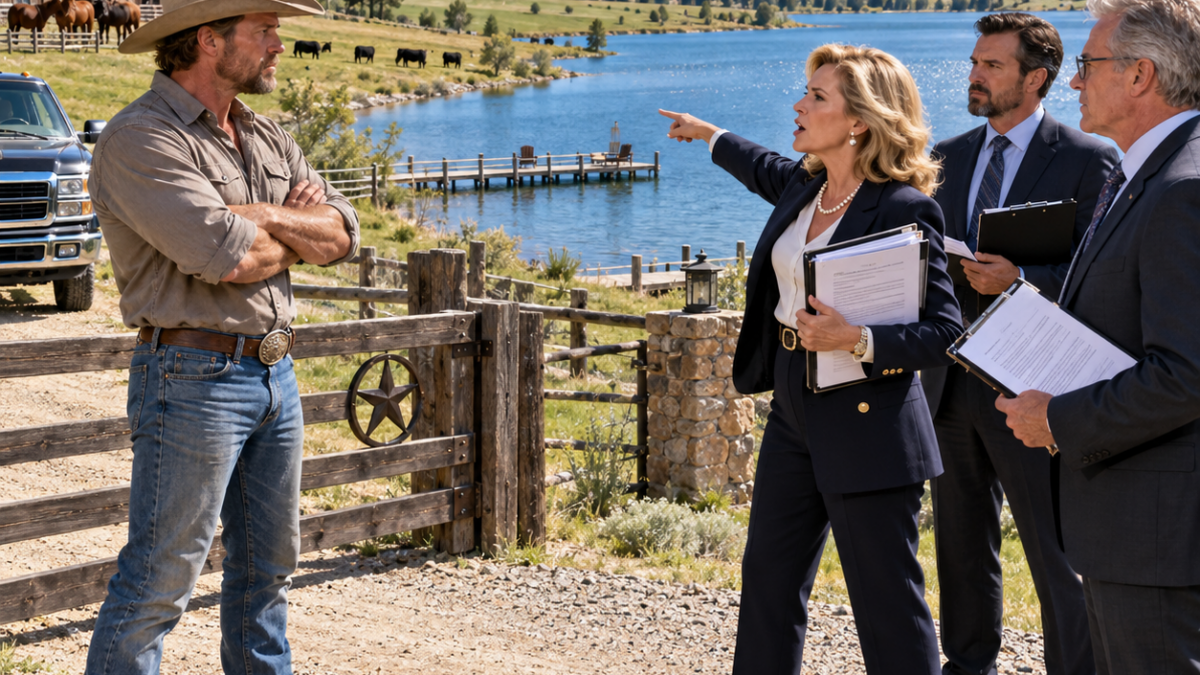
Two sheriff’s cruisers rolled up my gravel drive at eight in the morning because the HOA president had decided I needed her permission to sell my own ranch and private lake.
She stood behind the deputies with an orange violation notice in her hand and threatened to bury my property under daily fines and a lien if I didn’t take the FOR SALE sign down.
What she didn’t know was that the walking trail she had spent years calling a “community amenity” crossed land she had never owned—and by the time she learned the truth, she had already given me every piece of evidence I needed.
I was still tamping down the last post when the cruisers appeared.
The morning had been quiet until then.
Cool air.
A little mist still hanging over the lake.
The kind of morning that made owning forty-seven acres feel like the smartest decision I had ever made.
Then gravel popped beneath tires at the entrance to my ranch, and two county sheriff’s vehicles eased through my gate.
Behind them came Karen Whitmore.
She was walking fast enough to keep up with the cars but slow enough to make sure she looked composed when she reached me.
Folder under one arm.
Phone in her other hand.
Sunglasses perched on top of her head like she had come to supervise a construction site instead of report her neighbor to law enforcement.
She didn’t greet me.
She didn’t greet the deputies either.
She pointed at the real estate sign near the gate.
“He cannot list this lake without board approval.”
The older deputy looked at the sign.
Then at me.
Then at Karen.
I let the silence stretch.
Karen didn’t.
“That water touches community land,” she continued. “He’s trying to sell an amenity that affects Ashford Pines without authorization. He needs to remove the sign today or the board will begin lien proceedings.”
That was the first moment I realized she genuinely believed what she was saying.
Not that she believed she could intimidate me.
That part I already knew.
She believed she had authority.
There is a difference.
A bully knows he is taking something that is not his.
Karen had spent so long confusing board votes with ownership that somewhere along the way she had stopped recognizing the difference between the two.
The deputy closest to me cleared his throat.
“Sir, we received a complaint regarding unpermitted commercial signage activity.”
I looked toward the sign.
RANCH & PRIVATE LAKE FOR SALE.
My agent’s number underneath.
Nothing else.
I pointed at the ground beneath it.
“On which property?”
He hesitated.
“This property, sir.”
“My property?”
“Yes, sir.”
I nodded.
Karen opened her folder.
She pulled out a bright orange sheet of paper and held it toward me.
I knew the color before I read a word.
Ashford Pines HOA had been using the same orange paper for years.
Warnings.
Fines.
Compliance notices.
Threats dressed up as administrative paperwork.
She pushed it into my hand.
“Section 14.3B. Your sign exceeds the permitted dimensions by eleven inches. One hundred fifty dollars per day until corrected.”
I still didn’t read it.
Instead, I looked at the deputy.
“Is there a county law that prevents somebody from listing deeded private property for sale?”
The deputy glanced at his partner.
Then back at me.
“No, sir. I don’t see a criminal matter here.”
Karen snapped her head toward him.
“Then the HOA will handle it through fines and legal remedy.”
She said it quickly.
Almost defensively.
“The board has standing. We have already authorized lien action if he refuses to comply.”
Standing.
Lien.
Legal remedy.
Karen loved words that sounded expensive.
She used them the way other people used threats.
I finally looked down at the orange notice.
Section number.
Measurement.
Dollar amount.
Daily accumulation.
Everything typed neatly.
Everything dated.
Everything signed.
I should have been angry.
Instead, I looked over Karen’s shoulder.
Behind her, beyond the cottonwoods, ran a worn dirt path along the eastern bank of my lake.
Her path.
Or at least the path she had decided was hers.
I had watched her use it every morning for years.
Seven days a week.
She would come through a break in the trees from the subdivision side, walk along the water, loop around near the southern fence, then head back toward Ashford Pines.
Sometimes she came alone.
Sometimes she brought five or six neighbors.
Sometimes a dozen.
She called them community sunrise walks.
About a year earlier, I had come down to the lake before dawn and found a wooden post driven into my soil.
A laminated sign had been stapled to it.
ASHFORD PINES COMMUNITY APPRECIATION AREA.
RESIDENTS WELCOME.
No call.
No letter.
No conversation.
Nobody had knocked on my door.
Nobody had asked permission.
Karen had simply planted a sign beside my lake and announced that my property had become part of her neighborhood.
That morning, standing beside two deputies, she was doing the same thing again.
Only now she was putting it in writing.
I folded the orange notice once.
Then again.
Karen mistook my silence for surrender.
“I expect the sign removed by this afternoon.”
I looked at her.
“No.”
One word.
No anger.
No raised voice.
Her face tightened.
“You may want to reconsider that.”
“I already considered it.”
The deputy shifted slightly between us.
“Ma’am, there’s nothing for us to enforce here.”
Karen looked at him as though he had failed a test.
Then she turned back to me.
“The board will proceed.”
“Do what you think you need to do.”
She hated that answer.
People like Karen need resistance to look emotional.
They need shouting.
They need threats.
They need something they can point to later and call unreasonable.
I gave her nothing.
The deputies wrapped things up quickly.
There was no crime.
No disturbance.
No court order.
Just an HOA president trying to use a sheriff’s badge as decoration for her own authority.
Both cruisers backed down my gravel drive.
Karen watched until they disappeared through the gate.
Then she was on her phone.
Probably calling board members.
Probably telling them the sheriff had “responded.”
Probably leaving out the part where he had done absolutely nothing.
When she finished, she turned toward the trail.
And walked away across my land.
That was the part that stayed with me.
She had just accused me of violating HOA rules on my own ranch.
Then she left by trespassing across it.
Same steady stride.
Same certainty.
Like the ground beneath her feet belonged to her because she had walked it enough times.
I watched her until the trees swallowed her.
Then I pulled out my phone.
I wasn’t looking at my listing.
I wasn’t calling my attorney.
Not yet.
I opened the county assessor’s website and searched for a parcel number I remembered seeing years before.
A narrow undeveloped lot directly east of Karen’s home.
The trail crossed it before it reached my lake.
I had never cared who owned it.
There had never been a reason.
Now there was.
The page took a moment to load.
When it did, I stared at the screen longer than I expected.
The parcel was not owned by the HOA.
It was not owned by Karen.
It was not part of any designated community space.
The owner of record was High Crest Development LLC.
The company that had built Ashford Pines fifteen years earlier.
And according to the county tax record, High Crest had not paid taxes on that forgotten strip of land in more than two years.
I read that line twice.
Then I looked toward the trail.
For the first time that morning, I smiled.
Not because I had a plan.
Not yet.
But because Karen had just made a mistake she didn’t understand.
And I had learned a long time ago that when someone is determined to overreach, you don’t always have to stop them.
Sometimes you just let them keep reaching.
I bought the ranch in 2003.
Forty-seven acres.
Pasture, hardwoods, a modest ranch house, two old barns, and a six-acre spring-fed lake near the eastern end of the property.
Back then there was nothing behind me but more farmland.
The nearest cluster of homes was almost a mile away.
I bought the place because I wanted room.
Not luxury.
Room.
I had spent enough of my adult life living within twenty feet of somebody else’s kitchen window.
The ranch gave me distance.
I paid most of the purchase price in cash and financed the remainder through a local agricultural lender whose owner had known my father.
The deed was clean.
No subdivision restrictions.
No homeowners association.
No shared recreational agreements.
No easements across the lake.
I remember signing the closing documents because the county attorney handling the transaction had made a joke about the lake.
“Congratulations,” he said. “You’re officially responsible for every mosquito in six acres.”
For eight years, nobody cared what I did with the property as long as I paid my taxes and obeyed county code.
Then High Crest Development arrived.
They bought several agricultural parcels to my west and south and announced a ninety-six-home development.
Ashford Pines.
I watched the transformation from my fence line.
Bulldozers.
Survey stakes.
Road crews.
Drainage pipes.
Streetlights.
Then houses.
Lots of houses.
By 2011, I had a subdivision sitting almost against two sides of my ranch.
The developer established an HOA to maintain common landscaping, a clubhouse, a small pool, entry monuments, and a few pocket parks.
My property remained outside it.
That was documented from the beginning.
But because a portion of my ranch shared visible boundaries with the subdivision, High Crest had negotiated a few limited aesthetic covenants.
Fence height along certain sightlines.
Sign dimensions facing community roads.
Restrictions on obvious commercial operations visible from residential lots.
Nothing unusual.
Nothing that changed ownership.
Nothing that transferred my lake.
I read every page when the development was recorded.
Then I went back to minding my business.
For the first several years, that worked.
The HOA maintained its entrance signs.
Residents maintained their lawns.
I maintained my ranch.
We waved at one another on the county road.
Nobody tried to govern anyone outside their boundary.
Then Karen Whitmore became HOA president.
She ran unopposed.
That was probably the first lesson Ashford Pines should have learned.
A homeowners association can change personality very quickly depending on who has the energy to show up.
Karen always showed up.
She arrived at meetings with a prepared agenda, printed packets, highlighted bylaws, and the expression of someone who believed organization was the same thing as legitimacy.
Her campaign, if you could call it that, was built around three phrases.
Protect property values.
Enforce standards.
Build community identity.
None of those sounded unreasonable.
That was why people voted for her.
Within six months, she rewrote the fine schedule.
Daily penalties doubled.
Late fees increased.
The board hired Hendricks and Cole, a local property law firm, on retainer.
Then the orange notices started.
At first it was little things.
Trash cans visible from the street.
Holiday decorations left up too long.
Grass above the permitted height.
Then the interpretations became more creative.
Margaret Henderson lived two streets over from the clubhouse.
She was seventy-four.
Widowed.
Quiet.
Every spring she planted the same pink roses along her back fence.
She had been doing it long before Karen joined the board.
One April morning, she found an orange notice taped to her front door.
Unapproved landscaping modification within a visible boundary zone.
Three hundred dollars.
She paid it.
The next month another notice came.
She paid that too.
Eight months later, her son visited from Ohio.
He worked in insurance and had the kind of personality that actually read contracts.
He asked why his mother was paying the HOA three hundred dollars every month because of roses.
She showed him the notices.
He pulled the bylaws.
Section 9.4 did not govern private gardening.
It governed commercial landscaping contractors performing material changes to common-facing areas.
Her son went to the next board meeting.
He brought a printed copy.
He read the language aloud.
Karen listened.
Then said the board retained interpretive authority over its governing documents.
That was it.
No refund.
No apology.
Mrs. Henderson eventually stopped planting roses.
Not because she lost.
Because she got tired.
That was Karen’s real power.
Not rules.
Exhaustion.
The Martins learned the same lesson.
Their teenage son bought a portable basketball hoop with money from his summer job.
Weighted base.
Adjustable pole.
No bolts.
Nothing anchored to the house.
Karen cited them for an unauthorized structural modification.
They challenged it.
The board threatened a lien.
The Martins hired an attorney.
Twelve hundred dollars later, the HOA backed down.
The basketball hoop was not a structural modification.
Technically, the Martins won.
Their son barely used the hoop afterward.
Mr. Martin told me months later that every time the boy went outside, he looked toward Karen’s house.
That was what bothered me most about the whole thing.
A nineteen-year-old kid had learned that using his own driveway could invite legal trouble.
And Karen called that community standards.
For years, I stayed out of it.
I was not a full HOA member.
Most of the disputes did not involve me.
I understood the frustration, but I also understood why people paid.
A three-hundred-dollar fine is cheaper than a lawyer.
That equation kept Karen in power.
Then she planted the sign at my lake.
I found it just after six in the morning.
Fresh post.
Fresh staples.
Official HOA logo.
COMMUNITY APPRECIATION AREA.
RESIDENTS WELCOME.
I stood there with my coffee and stared at it.
I expected anger.
Instead I felt clarity.
She hadn’t asked because, in her mind, there was nothing to ask.
That was the dangerous part.
Karen had stopped treating ownership as a legal fact.
She treated it as a matter of use.
People walked there.
Therefore it belonged to the community.
She organized the walks.
Therefore she controlled the trail.
The lake improved residents’ enjoyment.
Therefore the HOA had an interest in it.
It was the logic of a child calling dibs on something that had never been theirs.
Except Karen had lawyers.
I pulled the sign out of the ground and placed it beside my barn.
Then I called my real estate agent.
I had considered selling before.
Not seriously.
The ranch was more land than I needed anymore.
The maintenance was constant.
My knees complained every time I repaired fence on the north pasture.
But Karen’s sign changed the question.
I no longer wondered whether I might sell someday.
I started wondering what kind of buyer would enforce boundaries more aggressively than I had.
Seventy-two hours later, the ranch was listed.
The police showed up two days after that.
By that afternoon, the first three new orange notices were rubber-banded to my front gate.
One for grass exceeding four inches within an eastern sightline zone.
Mine measured four and a quarter.
One for the real estate sign.
And one for “unapproved outdoor commercial activity adjacent to HOA-governed community space.”
That one interested me.
No code section.
No explanation.
Just a violation and a dollar amount.
I took all three inside.
At seven that evening, a silver sedan stopped outside my gate.
Karen’s husband stepped out.
I had met him maybe twice.
Quiet man.
Always looked vaguely embarrassed when Karen started discussing neighborhood rules.
He carried a manila envelope to the gate, wedged it between the posts, returned to his car, and drove away.
Inside was a four-page letter from Hendricks and Cole.
The HOA’s attorneys.
It ordered me to cease and desist from marketing or negotiating the sale of any property whose boundary “interfaces with HOA-governed common areas” without board approval.
I read it three times.
Not because the legal language intimidated me.
Because it didn’t make sense.
They cited three sections of the CC&Rs.
One governed exterior signage.
One governed commercial activities visible from common property.
One addressed alterations that could materially affect neighboring property values.
None prohibited the sale of private land.
Then I reached page three.
Third paragraph.
One sentence.
“Given that the lakeside common area has been utilized by residents for recreational purposes for a period of several years…”
I stopped reading.
The lakeside common area.
There it was.
Written on a law firm’s letterhead.
My private lake had now been formally described as HOA common property.
I found a pen.
Underlined the sentence.
Wrote the date beside it.
Then I opened a new file folder.
The attorney letter went inside.
The orange notices went behind it.
A copy of my 2003 deed went behind those.
Then I called Tom Garrett.
Tom was a property attorney I had known for more than a decade.
He had handled a boundary dispute for a friend of mine and helped me with an agricultural lease years earlier.
He answered on the second ring.
I explained the situation.
He listened.
Then asked me to read the cited sections.
I did.
He was quiet for about five seconds.
“Those restrictions don’t stop you from selling.”
“That’s what I thought.”
“They also don’t make your lake HOA property.”
“I know.”
“Did their attorney actually call it a common area?”
I read the sentence.
Tom exhaled through his nose.
“Keep that letter.”
“I plan to.”
“Whoever wrote it either didn’t pull the deed or was given bad facts.”
“Probably both.”
“Don’t sign anything.”
“I won’t.”
“Don’t meet with the board alone.”
“I wasn’t planning to.”
“And keep records.”
I looked at the folder in front of me.
“Already started.”
The listing stayed up.
Two days later, Mrs. Henderson forwarded me a screenshot from the Ashford Pines Facebook group.
Karen had posted:
REMINDER TO ALL RESIDENTS: OUR BEAUTIFUL COMMUNITY LAKE IS CURRENTLY SUBJECT TO AN UNVETTED SALE ATTEMPT BY AN ADJACENT PROPERTY OWNER. THE BOARD IS ACTIVELY WORKING TO PROTECT WHAT WE’VE BUILT TOGETHER.
Forty-seven comments by midnight.
Some residents were confused.
Some were angry.
Several wanted to know how I could sell “their” lake.
One man suggested the HOA should sue immediately.
Another asked if dues could be increased to buy the property.
A few people asked an obvious question.
Does the HOA actually own the lake?
Karen didn’t answer them.
I printed the screenshot.
Added it to the folder.
Attorney letter.
Facebook post.
Same false claim.
Same woman behind both.
The next morning, Mrs. Henderson called me.
Her voice was careful.
“I hope you don’t mind me contacting you.”
“Not at all.”
“I think there are things you should know.”
She told me about the yoga sessions first.
Three of them.
Karen had arranged for an instructor from town to lead sunrise yoga along the lake trail.
Twenty or thirty residents at a time.
Mats spread across my ground.
Photographs taken.
Pictures posted online.
Then there had been a community beautification day.
Karen organized volunteers to mulch the edges of the trail, trim brush, and plant decorative grasses.
Mrs. Henderson had taken pictures from a distance.
“I don’t know why I saved them,” she said. “I just remember thinking it was strange nobody ever mentioned asking you.”
She texted the photos.
There was Karen in a sun hat directing volunteers.
Wheelbarrows.
Mulch bags.
Garden tools.
And in the background, two green-and-white signs.
ASHFORD PINES COMMUNITY NATURE TRAIL.
MAINTAINED BY YOUR HOA.
I stared at the images.
Not because I was shocked.
Because every new piece was dated.
Photographed.
Documented.
Karen had not simply tolerated residents using the property.
She had organized it.
Named it.
Maintained it.
Advertised it.
And spent HOA money on it.
I thanked Mrs. Henderson.
Then drove to the county assessor’s office.
A clerk pulled the full plat for the area.
We spread it across the counter.
My ranch was clearly marked.
Parcel 031A.
The lake sat entirely inside my boundary.
The eastern path curved along the water inside my land.
Before reaching me, however, the path entered through another parcel.
047C.
The forgotten lot beside Karen’s house.
I asked about easements.
The clerk checked.
None.
No pedestrian easement.
No right-of-way.
No recreational access agreement.
Not on my parcel.
Not on 047C.
I asked who owned 047C.
High Crest Development LLC.
The original developer.
Then I asked about the unpaid taxes.
Thirty-one months delinquent.
Just under nine thousand dollars.
The county had already begun foreclosure proceedings.
The property was in its final redemption window.
I leaned against the counter.
“What happens if the owner doesn’t pay?”
“The county takes title or disposes of it through tax deed procedures.”
“Can someone buy it before that?”
She looked at me.
“Potentially. There’s a third-party acquisition mechanism if the county approves the offer and the redemption period expires.”
“Do you have the form?”
She slid a packet across the counter.
I took it home.
Before filling it out, I searched the HOA’s public meeting archive.
Fourteen months earlier, under New Business, I found exactly what I expected.
President Karen Whitmore moved to formally recognize and maintain the “lakeside access trail” as a community recreational amenity.
Seconded by Dale Pritchard.
Passed three to zero.
That was all.
Three people had voted to convert someone else’s private property into HOA recreational space.
No deed.
No survey.
No easement.
No purchase.
No owner notification.
Just a motion.
Passed three to zero.
I printed the minutes.
Added them to the folder.
Then I called the Martins.
Mr. Martin remembered the meeting.
“We were there.”
“Did anybody ask who owned the land?”
“No.”
“Did anybody ask whether there was an easement?”
“No.”
“Why didn’t anybody challenge it?”
There was a pause.
Then he laughed without humor.
“After the basketball hoop? We stopped volunteering for arguments.”
That answer told me more about Karen’s presidency than any bylaw ever could.
She had trained reasonable people to remain quiet.
Not because they agreed.
Because disagreement had a price.
A few days later, Karen escalated again.
Certified mail.
Formal lien notice.
Ashford Pines HOA had filed against my ranch.
Not threatened.
Filed.
The stated justification was “ongoing harm to community integrity” and “deliberate interference with HOA-governed common areas.”
I read those words standing at my kitchen counter.
For the first time, I felt actual anger.
Orange notices were irritating.
Facebook posts were dishonest.
A lien was different.
A lien attaches to title.
It follows the property.
It shows up in a buyer’s due diligence.
It can delay financing.
Kill closings.
Force legal action.
Karen had crossed from nuisance into financial interference.
I called Tom.
“They filed it.”
“Against the ranch?”
“Yes.”
“Basis?”
I read the language.
He was silent.
Then:
“They have no recorded interest in your lake.”
“I know.”
“No easement.”
“Correct.”
“No ownership interest.”
“Correct.”
“And you’re not selling an HOA parcel.”
“No.”
“Then it’s baseless.”
“Can they still file it?”
“They already did.”
That sentence stayed with me.
Wrong paperwork can still do damage if somebody files it in the right place.
Tom told me he could challenge it.
But it would take time.
Time was exactly what Karen wanted.
Two days later, my real estate agent called.
The Callahans had withdrawn their offer.
Retired couple.
Out of state.
They loved the ranch.
Loved the lake.
Loved the privacy.
Then somebody called them.
A woman.
She told them the property was tied up in a serious HOA dispute and could become subject to litigation.
They decided they didn’t want that kind of retirement.
My agent was furious.
I was quiet.
“When did they get the call?”
“Yesterday afternoon.”
“When did they withdraw?”
“This morning.”
I checked the county recording timestamp on the lien.
Forty-one hours.
That was how long it had taken between the filing becoming public and my buyer walking away after a phone call.
I wrote the timeline down.
Then I wrote two words underneath it.
Tortious interference.
I did not call Karen.
I did not call the board.
I did not confront anyone.
Instead, I went back to the county tax office.
Parcel 047C was still available.
High Crest had not responded to three calls.
Its registered agent’s voicemail box was full.
Thirty days remained in the redemption period.
I completed the third-party acquisition paperwork.
Offered the county’s assessed value subject to the outstanding tax process.
Signed every page.
Submitted it.
Then I said nothing.
Not to Tom.
Not to my agent.
Not to Mrs. Henderson.
Not to the Martins.
Nobody.
For the first time since Karen began escalating, I felt something close to patience.
She was fighting loudly.
I was reading records.
That difference mattered.
Three days later, an email appeared from the county recorder.
PARCEL 047C — TRANSFER CONFIRMATION.
I opened it at the kitchen table.
Read the legal description.
Checked the recording number.
Checked the map.
Then read it again.
The parcel was mine.
The narrow lot east of Karen’s house.
The lot her beloved trail crossed.
The access point every sunrise walk, yoga session, landscaping project, and “community nature trail” volunteer had used.
Mine.
I called a fencing contractor.
The next week, Ashford Pines announced a mandatory community forum.
PROTECTING THE FUTURE OF ASHFORD PINES.
IMPORTANT COMMUNITY UPDATE.
Tuesday.
Seven p.m.
Clubhouse.
I arrived early and took a seat in the back.
Karen saw me immediately.
Just for half a second, her expression changed.
Then the public version of Karen returned.
Folders straightened.
Shoulders back.
Professional smile.
Sixty-three residents attended.
I counted.
Karen opened the meeting with a photograph of my lake projected across the wall.
Golden-hour listing photo.
Still water.
Oak trees.
Pasture behind it.
A few people murmured.
Karen let them.
Then she began.
“Many of you are aware that an adjacent landowner is attempting to sell property that has become integral to the identity and enjoyment of our community.”
Attempting.
That word interested me.
As though selling land were an act she could approve or deny.
She displayed my listing.
Then portions of Hendricks and Cole’s letter.
Not the whole letter.
She read the threatening sections.
The CC&R references.
The cease-and-desist language.
She did not read the paragraph where her own lawyer had falsely described my lake as an HOA common area.
Then she held up the lien filing receipt.
“As of last week, your board has taken formal protective action.”
Applause.
Not everybody.
Maybe twenty people.
Still enough for Karen to smile.
“A lien has been filed to preserve the community’s rights while this matter is resolved.”
More applause.
I looked toward Mrs. Henderson.
She sat silently.
The Martins were near the rear.
Neither clapped.
Ray Chow, a newer board member, stood against the far wall with his arms folded.
He had called me after the lien vote.
He was the one dissenting board member.
Three to one.
Ray had argued that the board lacked authority.
Karen had called the vote anyway.
Now she was presenting the result as unanimous community protection.
“This individual,” Karen continued, gesturing vaguely toward the back, “wants to transfer property central to Ashford Pines to an unknown buyer. Potentially a developer. Potentially someone who does not share our values.”
That one worked.
People shifted in their seats.
Nobody likes an imaginary developer.
Karen continued.
“The board will not allow the character of this neighborhood to be damaged without a fight.”
Louder applause.
Then Dale Pritchard read a formal notice.
Thirty days to remove the listing or enter negotiations with the HOA.
Otherwise the board would pursue court action.
Karen opened the floor.
Questions came quickly.
“Can the HOA buy the lake?”
“Can you legally stop the sale?”
“What happens to property values?”
“Can a developer drain it?”
Karen answered every question with confidence.
Confidence was her best skill.
Not accuracy.
Confidence.
Then she looked directly at me.
“The adjacent property owner is present tonight.”
Heads turned.
“He is welcome to address the community.”
I stood.
Sixty-three people watched.
Karen folded her hands on the table.
Waiting.
Probably expecting an argument.
A plea.
Maybe anger.
I said eight words.
“I’ll have a formal response ready very soon.”
Then I sat down.
The silence lasted maybe two seconds.
Karen smiled.
“I believe our position is clear.”
It was.
So was mine.
She just didn’t understand it yet.
The meeting ended shortly after eight.
Residents left in groups.
I stayed.
From my truck, I watched Karen exit the clubhouse.
Dale drove home.
Karen didn’t.
She turned toward the trail entrance beside the trees.
The shortcut she used every morning.
The trail she had just spent an hour calling community property.
She walked into the dark without hesitation.
Across parcel 047C.
My new parcel.
The deed transfer had been recorded two days earlier.
She had no idea.
The fencing trucks arrived at 6:45 the next morning.
I met them at the eastern boundary marker with the survey and deed copies.
The lead contractor looked at the trail.
“You want the fence straight across this?”
“Exactly on the line.”
“Gate?”
“No.”
He shrugged.
“Your property.”
By seven, the first posts were in.
At 7:10, Karen came around the bend.
Earbuds in.
Coffee in one hand.
She saw the posts and stopped so abruptly coffee spilled onto the lid.
Her eyes moved from the workers to the trucks.
Then to me.
“What is this?”
“Fence.”
“I can see that. Why are you building it here?”
I said nothing.
Her voice sharpened.
“This isn’t your property.”
That was the moment I had been waiting for.
Not because I wanted to humiliate her.
Because she needed to encounter a fact she could not reinterpret.
I pulled a folded document from my jacket.
County deed.
Parcel 047C.
Recorded Tuesday morning.
I handed it over.
She looked at the seal.
Then the parcel number.
Then the legal description.
Her face changed.
Not dramatically.
Karen was too controlled for that.
But confidence left in layers.
First her mouth tightened.
Then her eyes stopped moving.
Then the color drained slightly from her cheeks.
“You bought this?”
“Yes.”
“You can’t just—”
“I did.”
“The HOA has use rights.”
“No.”
“We’ve used this trail for years.”
“That doesn’t create ownership.”
“We designated it as a community trail.”
I unfolded the plat map on my truck hood.
My ranch.
047C.
The trail.
No easement.
Nothing.
I placed the HOA meeting minutes beside it.
Her own motion.
Her own name.
“The board voted to designate a trail on land it did not own.”
She stared at the documents.
“That vote was based on community usage.”
“Usage you organized.”
“We maintained it.”
“Without permission.”
“We improved it.”
“Without permission.”
“You never objected.”
“I never gave permission.”
That one landed.
Karen reached for her phone.
She called Hendricks and Cole.
I could hear only her side.
“Deed transfer.”
Pause.
“He bought the lot.”
Pause.
“He’s fencing the trail.”
Longer pause.
Then her face changed again.
“Are you saying there’s nothing we can do?”
She listened.
Looked at me.
Then ended the call.
“What did he say?”
She ignored me.
Dialed another number.
The sheriff.
Nine minutes later, two cruisers arrived.
Same deputy from the first morning.
He stepped out.
Saw me.
Saw Karen.
Saw the fence.
His expression said he already knew how this conversation was going to go.
I handed him the deed.
He read it.
Checked the parcel map.
Walked the property line with his partner.
Then faced Karen.
“Ma’am, this parcel belongs to him.”
“The trail is an HOA amenity.”
“Do you have a recorded easement?”
“The board designated it.”
“That isn’t what I asked.”
Karen folded her arms.
“The community has used this for years.”
The deputy looked toward me.
“Did you grant access?”
“No.”
He turned back to Karen.
“Then I don’t see anything unlawful about the fence.”
She looked stunned.
“People have relied on this trail.”
“That’s a civil issue.”
“You’re just going to allow him to block it?”
“It’s his property.”
Same department.
Same result.
Six weeks earlier, she had called deputies because I put a legal FOR SALE sign on my ranch.
Now she had called them because I put a legal fence on my lot.
Both times, the law had refused to turn into whatever she needed it to be.
The cruisers left.
Karen remained standing beside the unfinished fence.
Then a front door opened across the road.
Mrs. Henderson stepped onto her porch.
House slippers.
Cardigan.
Hands clasped in front of her.
She didn’t say a word.
She simply watched.
The Martins appeared in their doorway next.
Then Ray’s car rolled slowly around the corner and stopped.
Window down.
He looked at the fence.
Then at Karen.
Then at me.
Nobody laughed.
Nobody applauded.
That somehow made it heavier.
Karen had spent years making people feel powerless one piece of paperwork at a time.
Now the only thing surrounding her was silence.
The contractors went back to work.
Post.
Rail.
Post.
Rail.
She finally turned away.
But she couldn’t take the lake trail home.
For the first time in years, Karen had to use the public street.
The fence was finished by noon.
At each end of the former trail, I installed a sign.
PRIVATE PROPERTY.
NO TRESPASSING.
Then I drove to the lake.
The original FOR SALE sign was still there.
Same post.
Same soil.
Same listing.
Karen had called the sheriff.
Issued fines.
Sent lawyers.
Filed a lien.
Contacted a buyer.
Held a community meeting.
And the sign had not moved one inch.
The next week was the quietest Ashford Pines had been in years.
No orange notices.
No attorney letters.
No neighborhood posts from Karen.
Nothing.
Tom filed the lien challenge fourteen days later.
His argument was simple.
The HOA’s lien depended on a claim that my lake was part of an HOA-governed common area.
The 2003 deed proved otherwise.
The county plat proved otherwise.
The lack of easement proved otherwise.
And the HOA’s own attorney letter documented the false classification.
The lien came off twenty-one days later.
I printed the release.
Added it to the file.
Then Tom sent formal notice to the HOA.
Their “community recreational trail” designation was legally void.
The board had no authority to designate private property as an HOA amenity.
Future organized access would constitute civil trespass.
The acknowledgment came back signed by Ray Chow.
Karen’s name was nowhere on it.
Then Tom addressed the buyer interference.
The Callahans.
The suspicious call.
The timing.
The lien.
The false statements.
The HOA’s insurance carrier became involved.
Hendricks and Cole quietly stopped representing the board.
New counsel recommended settlement before discovery.
The HOA paid my legal costs.
Forty-two hundred dollars.
I didn’t celebrate.
It wasn’t profit.
It was money I should never have needed to spend in the first place.
But there was something satisfying about the symmetry.
Karen had built a system where resistance cost more than obedience.
For once, the cost returned to the people who had created the problem.
Ray called an emergency board meeting six days after the fence went up.
Ironically, he used Section 7.4.
A rule Karen herself had written.
It allowed a board member to call a special session with forty-eight hours’ notice when evidence existed of serious governance misconduct.
Ray brought documents.
The lien filing.
His written objection.
The three-to-one vote.
The plat map.
The false common-area claim.
Mrs. Henderson attended.
For the first time in four years, she spoke publicly at an HOA meeting.
She brought a handwritten list.
Seven incidents.
Five years.
The roses.
The basketball hoop.
Selective enforcement over flagpoles.
Improper fines.
Threatened liens.
Rules interpreted differently depending on who Karen was dealing with.
Mrs. Henderson spoke for twelve minutes.
Nobody interrupted.
Someone recorded it.
By the next morning, the video was circulating in the neighborhood group.
Other residents began telling their own stories.
The strange thing about fear is how quickly it looks smaller once somebody else speaks first.
The Martins posted copies of their attorney correspondence from the basketball dispute.
Another homeowner posted two identical photographs of neighboring flagpoles—one cited, one ignored.
A young couple shared three months of fines over landscaping that had eventually been approved without explanation.
Ray called for a board vote.
Karen was removed as president.
Four to zero.
She did not attend.
Dale Pritchard resigned the same day.
Three weeks later, I relisted the ranch.
This time parcel 047C was included.
The new lot wasn’t large.
But its position mattered.
It controlled the eastern approach to the lake.
It closed the old pedestrian route.
And it removed any future ambiguity about access.
The appraisal came back significantly higher than what I had paid to acquire it.
My agent laughed when he saw the number.
“You turned their trail into value.”
“No,” I said. “The county map did.”
The Callahans contacted us again.
They were cautious.
I didn’t blame them.
They asked whether the HOA dispute was resolved.
I told them everything.
Lien removed.
Trail designation voided.
Access enclosed.
Board leadership changed.
They hired their own title attorney.
He verified every point independently.
Sixty days later, we closed.
The morning I signed the final papers, I expected to feel sentimental.
Fifteen years is a long time to own the same stretch of ground.
I had repaired fences in storms.
Buried dogs beneath the maple trees.
Watched deer cross the southern pasture before sunrise.
Sat beside the lake on nights when I needed silence more than company.
A property becomes more than acreage when you stay long enough.
But selling didn’t feel like losing.
It felt complete.
Six weeks after the fence went up, Karen’s husband listed their house.
Standard listing.
Nothing dramatic.
No scandal written in the remarks.
No explanation.
Just bedrooms.
Bathrooms.
Square footage.
Asking price.
I looked at the listing once.
Then closed the page.
Some consequences are loud.
Courtrooms.
Arguments.
Police cars.
Board votes.
Others simply become geography.
A new fence.
A different route home.
A sign where a path used to be.
Three weeks before closing, I walked the entire perimeter one last time.
I started at the north pasture.
Followed the old fence west.
Turned south through the oak stand.
Then crossed toward the lake.
When I reached parcel 047C, I stopped.
The place looked ordinary.
That was what struck me.
A few trees.
Grass.
Fence posts.
Nothing about it suggested how much trouble people had created simply by refusing to read a deed.
I walked the former trail.
No footprints.
No yoga mats.
No wheelbarrows.
No HOA signs.
No residents wandering through under the impression that a board vote could replace ownership.
At the corner post facing Karen’s house, I mounted one final metal sign.
Not angry.
Not theatrical.
Just clear.
PRIVATE PROPERTY.
I tightened the last bolt.
Stepped back.
The sign faced east.
Toward the subdivision.
Toward the house where Karen had spent years beginning her morning walks.
Then I continued toward the lake.
The SOLD rider had already been attached to the original real estate sign.
The same sign Karen had called the sheriff about.
The same sign she had fined.
The same sign her attorney ordered me to remove.
The same sign she had built an entire campaign around.
Now it had one small word across the top.
SOLD.
I stood there for a while.
The lake was flat.
Morning light moved across the surface.
Nothing dramatic happened.
No police arrived.
No orange notice appeared.
No HOA president walked out of the trees.
That was the ending I wanted.
Not revenge.
Not humiliation.
Quiet.
For years, Karen had made people believe that authority belonged to whoever sounded most certain.
But paperwork has a funny way of cutting through certainty.
Deeds do not care how many meetings you chair.
Boundary lines do not care how confidently you misquote a bylaw.
Ownership does not transfer because a board votes three to zero.
And calling something “community property” does not make it yours.
Karen had tried to stop me from selling my ranch.
She had tried to turn my lake into something the HOA controlled.
She had used fines, lawyers, a lien, police reports, public pressure, and even my prospective buyer.
In the end, none of that changed the most basic fact in the entire dispute.
She had never owned the land.
The HOA had never owned the lake.
And the trail she had spent years treating like a symbol of her authority only existed because the real owners had not forced her to look at the map.
Once I did, everything changed.
The new owners took possession on a Friday.
The Callahans sent me a photograph a month later.
Two chairs beside the lake.
Coffee cups on a small table.
No strangers in the background.
No community signs.
No trail traffic.
Just water.
Trees.
Their land.
Their morning.
I saved the picture.
Then I deleted the old HOA folder from the top of my desk and moved the physical file into storage.
I kept it for one reason.
Not because I expected Karen to come back.
She never did.
I kept it because that folder reminded me how quickly a small abuse of authority can grow when nobody challenges the assumptions beneath it.
It began with a trail.
Then a sign.
Then an orange notice.
Then lawyers.
Then a lien.
Karen believed each step made her position stronger.
What she never understood was that every step also created evidence.
Evidence that the HOA had claimed private property.
Evidence that they knew residents were using it.
Evidence that Karen had organized that use.
Evidence that the board had voted on land it did not own.
Evidence that their attorney had relied on false information.
Evidence that the lien had interfered with my sale.
She thought she was building leverage.
She was building my file.
And the morning she walked toward that fence holding cold coffee and saw the county deed in my hand, she finally discovered the difference.

