The HOA President Stole My Water for Months—Then She Ignored the One Warning That Could Have Saved Her Pool
PART2
She gave a small sigh.
“I’m telling you the board recognizes shared resources during unusual conditions.”
“That isn’t an answer.”
“It is exactly the answer.”
“No. The answer is either yes or no.”
She shifted the clipboard.
“This is what a community does.”
I stared at her.
Four weeks earlier, Vivian had personally mailed every house in Larkspur Meadows a drought notice.
No pool filling.
No pool topping.
No car washing.
Outdoor watering restricted.
Excess usage subject to county surcharge.
She had fined Nate Ferris sixty dollars in July because he left a garden hose running too long.
A seventeen-year-old kid two streets over got cited because he washed his mother’s car in the driveway.
And all summer Vivian’s thirty-eight-foot saltwater pool had remained blue, clean, and filled nearly to the coping.
I should have wondered why.
I hadn’t.
My own water bills had been keeping me busy.
May: six hundred eighteen dollars.
June: one thousand ninety.
July: one thousand four hundred eighty.
I had spent an entire Sunday beneath my house with a flashlight because I thought I had a leak I was too stupid to find.
And now the leak was standing in front of me wearing a robe.
I looked at her again.
“Do you understand that you are describing stealing water from my house?”
She stiffened.
“I would be careful with that word.”
“Why?”
“Because accusations have consequences.”
“So does taking twenty-six thousand gallons that somebody else paid for.”
I didn’t know the exact total yet.
But I knew by then it wasn’t small.
She glanced at my bare feet.
Then at my old work shirt.
Then back to my face.
“Honestly, Keith, most people would be grateful to contribute something to their community.”
There it was.
No embarrassment.
No denial.
Not even an excuse.
She believed she was entitled to it.
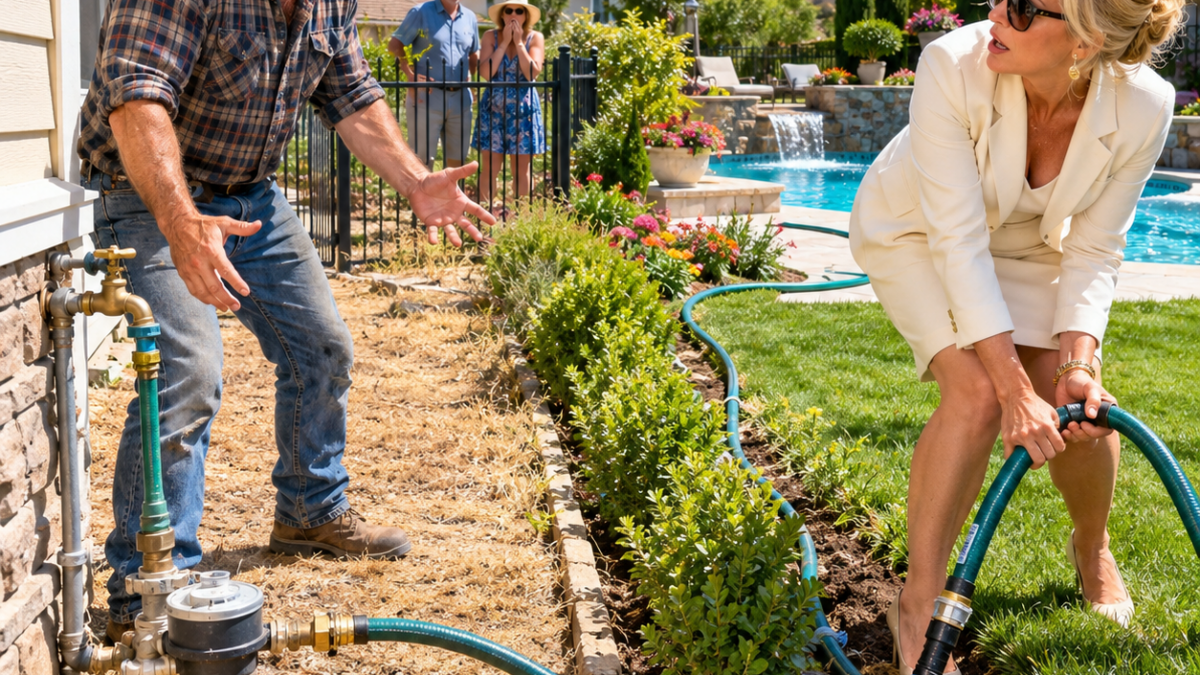
Then she bent down, pulled the hose back through the gap in the fence, and began coiling it.
Slowly.
Calmly.
The way you gather your own tools at the end of a job.
When she finished, she straightened.
“You’ll want to bring that exterior fixture into compliance.”
She tapped the orange notice with one fingernail.
“Fifty dollars a day is a lot of money for a man with a truck payment.”
Then she walked through her gate.
A few seconds later, I heard the pump on her pool shut down.
I stood there in the wet grass.
I didn’t yell after her.
I didn’t cut the hose.
I didn’t pound on the fence.
I walked to the side of my house and lifted the water-meter lid with my toe.
Every faucet inside was shut.
The dishwasher was off.
The washing machine was off.
My irrigation was disabled because of the drought restrictions she had mailed me.
But the little red sweep hand on that meter was moving.
Not creeping.
Turning.
I crouched over it.
Round and round.
I thought about the July bill.
One thousand four hundred eighty dollars.
I thought about May.
Six hundred eighteen.
June.
One thousand ninety.
I thought about the Sunday I had spent checking toilet flappers, supply lines, crawl-space joints, yard piping, pressure loss, hose bibs, and everything else I had spent two decades learning how to inspect.
My system had been fine.
I had been fine.
I had not missed anything.
My leak walked on two legs.
I peeled Vivian’s orange notice from the wall.
Turned it over.
And with a carpenter’s pencil from my pocket, I wrote:
August 11.
2:14 a.m.
Then the meter reading.
I still have that number in my head.
That orange card became the first page of a file Vivian Ashcroft never knew I was building.
I went inside.
I didn’t sleep.
Around four, I walked out to the shop.
My security camera normally pointed toward the driveway.
I rotated it toward the fence line.
Then I went back to the kitchen.
At sunrise, I made coffee and started thinking like a plumber instead of an angry neighbor.
When a customer tells you something impossible is happening, you don’t start with blame.
You follow the line.
Where does it enter?
Where does it leave?
What is connected?
What changed?
And what did somebody assume you would never notice?
To understand the answer, you have to understand my property.
Larkspur Meadows was built around my family.
Literally.
My grandfather owned forty acres before there was a subdivision.
Back then, this road had a grain elevator, a church, and not much else.
In the 1990s, he sold thirty-eight acres to a developer and kept two.
The developer built eighty-four houses.
Vinyl siding.
Two-car garages.
Cul-de-sacs.
Retention pond with a fountain nobody needed.
My grandfather’s house became Lot 42.
Except Lot 42 was never built like the other eighty-three.
When the county sewer line came through in 1996, every new house connected.
My grandfather refused.
He had installed a septic system two years earlier.
It worked.
He wasn’t paying a connection fee just because somebody put a public pipe in the street.
So every other house in Larkspur Meadows sent wastewater to the municipal sewer.
Mine didn’t.
County water came into my meter.
Wastewater left through my septic tank and leach field.
Private system.
My land.
My equipment.
My responsibility.
When I inherited the house in 2011, I inherited the septic system too.
I pumped it.
Inspected it.
Replaced components.
Pulled permits.
Kept records.
That was normal for me.
It is literally part of what I do for a living.
Vivian moved in five years later.
Big corner house.
Big backyard.
Big pool.
Her husband traveled constantly.
I had met him maybe four times.
Nice enough man.
Always looked like somebody trying not to hear whatever argument was happening nearby.
Vivian joined the HOA board in 2019.
Then she became president.
Then nobody ran against her.
She didn’t control the neighborhood by shouting.
She controlled it through paperwork.
That was what made her effective.
She read the declaration.
She read the fine schedule.
She learned how unpaid fines became assessments.
She learned how assessments became liens.
Once everybody understood a mailbox argument could eventually touch their mortgage, people stopped arguing.
Grass got cut when Vivian wanted it cut.
Trash cans disappeared when Vivian wanted them hidden.
Paint colors came from her approved palette.
My own HOA file was four pages thick by August.
A hundred dollars for parking my lettered truck in my driveway.
Two hundred for the gravel apron beside my shop, even though the apron existed before half the houses.
Repeated citations for my metal shop building.
My grandfather built that structure in 1988.
Vivian called it “inconsistent with the community aesthetic.”
I paid most of those fines.
I hated every check.
But I paid them.
Running a plumbing business in a county this size means your reputation matters.
I didn’t want to be known as the guy at war with his neighbors.
So for six years, I swallowed it.
Then the drought came.
The first Stage Two notice arrived in early June.
No filling pools.
No topping pools.
No washing cars in driveways.
Water use above household baseline carried surcharges designed to hurt.
Vivian sent a second HOA notice repeating the rules.
She signed it personally.
The irony didn’t occur to me until later.
All summer, the Ashcroft pool remained perfect.
Thirty-eight feet.
Salt system.
Pergola.
Outdoor kitchen.
Speakers.
That pool was where Vivian built her social power.
Memorial Day.
Fourth of July.
Labor Day.
If the neighborhood gathered anywhere, it gathered there.
People praised her for keeping the pool so beautiful despite the drought.
Nobody asked where the water came from.
I didn’t either.
Because I was dealing with my own bill.
I checked everything.
Service line.
Pressure.
Crawl space.
Toilets.
Hose bibs.
Underground pipe.
No leak.
No damp soil.
No loss of pressure.
Nothing.
At the end of one twelve-hour Sunday, I sat on my steps feeling embarrassed.
A plumber who can’t find his own leak is like a mechanic whose car won’t start.
Then Vivian appeared in my yard at two in the morning and solved it for me.
The next morning, I requested twelve months of usage history from the Danby County Water Authority.
Two days later, the envelope arrived.
I opened it at the mailbox.
October through May looked normal.
Flat.
Predictable.
The water-use pattern of one man.
Then June changed.
Every third or fourth night, starting around two a.m., my usage spiked.
Nine hundred gallons.
A thousand.
Eleven hundred.
Usually ending between four-thirty and five.
I sat in my truck and totaled it.
Twenty-six thousand gallons.
Twenty-six thousand.
That isn’t a dripping faucet.
It isn’t a running toilet.
It is enough to fill a swimming pool once and keep topping it through summer evaporation.
I expected anger.
What I felt first was relief.
My house wasn’t broken.
My work wasn’t sloppy.
I had not failed to find some hidden leak.
Then the relief embarrassed me.
Because it meant somebody had stolen twenty-six thousand gallons of water and I was just happy I wasn’t incompetent.
Friday morning, I shaved.
Put on a clean shirt.
Printed the usage report.
Walked to Vivian’s house.
I had decided I would not accuse her.
I would ask.
That distinction mattered to me.
She opened the door with reading glasses sitting on top of her head.
“Keith.”
“I need to show you something.”
She looked at the folder.
“What?”
“My water history.”
“I’m busy.”
“This will take two minutes.”
She sighed.
I showed her June.
Then July.
I put my finger beside the overnight usage.
“Vivian, I need to understand why water is leaving my house at two in the morning.”
She put on her glasses.
Read the numbers.
And nodded.
“That looks about right.”
I genuinely didn’t know what to say.
“What?”
“That looks about right.”
She handed the pages back.
“Your lot has excess capacity.”
“My lot?”
“The pool is not functionally mine.”
I looked behind her toward the backyard.
“Whose is it?”
“It serves the community.”
“It is behind your fence.”
“That doesn’t change its function.”
“You’re serious.”
“The board adopted a shared-resource position months ago.”
I almost smiled.
“Shared resource.”
“Yes.”
“So you voted to take water from my house.”
“Your language is unnecessarily provocative.”
“I paid for it.”
“The neighborhood benefits from the pool.”
“I don’t use your pool.”
“Your personal use is irrelevant.”
“Will you reimburse me?”
She actually smiled.
“I’m not going to reimburse a homeowner for contributing to a community benefit.”
Twenty-six thousand gallons.
Nearly three thousand dollars in water charges and drought surcharges.
And she said contributing.
Then she leaned toward me slightly.
“I would also be very careful about using the word theft publicly, Keith.”
“Why?”
“Defamation is expensive.”
I stared at her.
She closed the door.
Not slammed.
Closed.
A conversation finished.
I walked home and bought a steel locking cover for the hose bib.
Forty-one dollars.
Hinged metal box.
Padlock.
Installed it in twenty minutes.
I added a second camera under the eave.
Now one camera covered the fence.
The other looked directly down at the spigot and meter.
Then I wrote a letter.
One page.
No insults.
No threats.
No Vivian.
Just facts.
Unauthorized water had been drawn from my service.
Usage records were attached.
Approximate volume documented.
Permission had never been granted.
All future use must stop.
Certified mail.
Return receipt.
I knew the letter itself wouldn’t stop her.
But it would establish something important.
Notice.
After she signed for it, she could never say she didn’t know.
The HOA responded forty-eight hours later.
Not Vivian.
The board.
A fine.
One thousand two hundred fifty dollars.
Unapproved exterior fixture.
My hose bib.
Fifty dollars per day until corrected or removed.
She had fined me for the faucet she was stealing water from.
I called Marla Prentiss, the board secretary.
Marla wasn’t mean.
That almost made it worse.
She read the fine schedule softly.
Then she said, “Keith, I just want to make sure you understand that unpaid assessments can become a lien.”
“I understand.”
“I hope it doesn’t go that far.”
“So do I.”
I thanked her.
Hung up.
And sat alone in the kitchen.
Something changed that afternoon.
For six years I had been keeping my head down.
Now I started keeping records.
Three nights later, the steel lock was gone.
The hose was back.
The lock box lay in the grass.
Somebody had cut the shackle cleanly with a hacksaw.
I didn’t touch it.
I pulled the memory cards from both cameras.
I spent hours watching footage.
Four separate nights.
Same routine.
The first video started at 1:18 a.m.
Vivian came through her gate wearing the white robe.
She stood in my yard looking at my house.
Then a man appeared carrying the green hose.
Trent Ashcroft.
Her thirty-one-year-old son.
He lived in the apartment over their garage.
Before that day, the only thing I knew about Trent was that he backed out too fast.
Now I watched him kneel at my faucet.
Connect the hose.
Then attach a battery-powered timer.
That detail mattered.
People don’t install a timer for something they intend to do once.
A timer means routine.
A timer means planning.
A timer means you don’t want to wake up at five to turn the hose off.
The second camera showed more.
The night after I installed the steel cover, Trent tried the handle.
Found the lock.
Looked at it.
Walked away.
Two nights later, he returned carrying a hacksaw.
No hesitation.
No confusion.
Nobody accidentally brings a hacksaw onto somebody else’s property at two in the morning.
He cut the lock.
Connected the hose.
Set the timer.
Walked home.
Neither he nor Vivian looked at either camera.
That told me something else.
They didn’t think I was capable of protecting myself.
Wednesday, I did something I had avoided doing for six years.
I knocked on neighbors’ doors.
The first was Ida Fenwick.
Seventy-nine years old.
Two houses down.
Tomato plants in buckets all over her screen porch.
I asked whether she had ever received a water bill she couldn’t explain.
She got quiet.
Then she brought out a shoebox.
Two summers earlier, her outdoor faucet had apparently run at night for nearly a month.
Her monthly bills had jumped from around forty dollars to one hundred thirty.
She thought she had left the hose on.
That broke something in me.
Not because of ninety dollars.
Because of the way she said it.
“At my age, Keith, when something doesn’t make sense, you start assuming maybe you’re the part that’s gone wrong.”
She had paid every bill.
She had almost mentioned it at an HOA meeting.
Then she decided against it.
“I didn’t want to be next.”
Next was Nate Ferris.
His garage faced part of Vivian’s backyard.
He stopped me almost immediately.
“Keith. Don’t.”
“You know?”
He looked toward Vivian’s house.
“I’ve seen it.”
“How long?”
“More than one summer.”
“Why didn’t you say anything?”
His face changed.
“My wife’s on a payment plan with the HOA.”
“For what?”
“Fence stain.”
I almost laughed.
“Forty dollars a month. If they accelerate the balance, it becomes a lien.”
He looked at me.
“We refinanced this spring.”
I understood.
It is easy to call people cowards when the fight isn’t attached to their house.
Then the green certified-mail card came back.
V. Ashcroft.
Her signature.
She had personally received my written demand to stop.
That mattered.
I also requested board minutes.
Marla mailed them.
April meeting.
Three of five directors present.
Vivian had introduced something she called a Shared Neighborhood Resource Resolution.
It never mentioned water.
It never mentioned my property.
It said the board could designate “underutilized homeowner resources” for community benefit.
That was the legal fantasy she had built for herself.
The same board that had fined six households for drought violations had quietly voted itself authority to use my water.
By the end of the week, I had:
County usage records.
Two camera angles.
Vivian’s certified-mail signature.
Board minutes.
The cut lock.
Ida’s water bills.
Nate’s eyewitness account.
And almost nobody willing to say any of it publicly.
I didn’t blame them.
Vivian had trained people to understand that disagreement had a price.
I installed a second lock.
Hardened shackle.
Thirty-eight dollars.
Three days later, I came home from a septic-pump call and walked around the side of my house.
The lock was gone.
Again.
But this time, there was something new on the spigot.
A brass quick-connect fitting.
Trent had threaded it directly onto my faucet.
He had tightened it with a wrench.
Hard.
The jaw marks were fresh.
I knelt.
Looked closer.
Cross-threaded.
He had started it crooked and forced it rather than backing it off.
A bead of water formed at the collar.
Not enough to drip.
Just enough to wet my thumb when I touched it.
That was the moment.
Not the theft.
Not the fines.
Not the robe.
Not the threats.
The wet thumb.
Somebody who didn’t know plumbing had altered my house permanently so I could no longer lock him out of my own water supply.
Then I thought about the other end of that hose.
Submerged in a swimming pool.
A salt pool.
Chemical-treated water.
Connected directly to my drinking-water service.
That is a cross-connection.
If pressure ever dropped in the county main—
Fire hydrant.
Main break.
Pumper truck.
Anything—
The hose could siphon backward.
Pool water could enter the potable system.
And because the meter belonged to Lot 42, the violation would be mine.
So Vivian had created a setup where:
She stole my water.
She fined me for the faucet.
Her son destroyed two locks.
He altered my plumbing.
And if contaminated water ever backflowed into the main, I could be cited for the hazard.
That was not a neighborhood disagreement anymore.
I called the water authority.
Reported unauthorized use.
Tampering.
Cross-connection concern.
A woman named Dot opened a file.
She told me someone would inspect it in the coming weeks.
Weeks.
During an August drought.
Then I called the sheriff.
The deputy came out.
He watched the video.
Looked at the sawed lock.
Looked at the damaged fitting.
Then gave me the phrase every homeowner eventually hears when authorities want to leave.
“Neighbor dispute.”
I stared at him.
“He used a hacksaw on my property.”
“Probably civil.”
“He modified my plumbing.”
“Have you tried speaking to your HOA?”
“The HOA is the neighbor.”
He wrote a case number on a card.
I kept that card.
Not because it helped.
Because it explained everything that happened next.
Friday afternoon, Vivian walked up my driveway carrying an envelope.
Cream linen suit.
No robe this time.
She didn’t knock.
She waited for me to come outside.
“I wanted to deliver this personally so there would be no confusion.”
I opened it.
The faucet fine had grown.
Two thousand four hundred dollars.
Then another page.
The board had held a special meeting.
I had not been notified.
They had voted to record a lien against Lot 42.
Amount:
Nine thousand six hundred dollars.
At the bottom was a paragraph explaining their right to pursue foreclosure if the balance remained unpaid.
I read it twice.
“Nine thousand six hundred.”
“Yes.”
“Over a faucet.”
“Over repeated noncompliance.”
“The faucet you are taking water from.”
She ignored that.
“I hope this resolves things.”
She turned.
Walked back down my driveway.
And stepped directly over the steel lock box her son had cut apart.
She didn’t even look at it.
That night, I read the actual Larkspur Meadows declaration.
Not Vivian’s handbook.
Not her supplements.
The original recorded instrument.
More than forty pages.
I read every word.
There was no exterior-fixture rule.
Nothing.
Vivian’s rule existed in a board supplement.
Printed.
Approved internally.
Never recorded with the county.
That meant it might not be enforceable against the property at all.
I closed the binder.
Didn’t confront her.
Didn’t call a lawyer.
Not yet.
Because even if I killed the lien tomorrow, it wouldn’t stop the hose tonight.
So I asked myself the question I ask on every service call.
Not:
Who is using this line?
But:
What is this line connected to?
The next morning, I called Danby County Environmental Health.
“I have a plumbing question.”
The woman asked for my contractor number.
I gave it.
“I have an existing exterior hose bib. I want to disconnect it from potable water and convert it to a non-potable septic-effluent supply for permitted subsurface irrigation.”
She didn’t gasp.
Didn’t laugh.
Didn’t ask why.
She said, “Application, site sketch, fee, final inspection.”
“That’s it?”
“If you meet code.”
“I do septic work.”
“I can see your license.”
“People do this?”
“On larger lots? All the time.”
That was the part nobody believed afterward.
There was no secret trick.
No hidden valve.
No illegal sabotage.
I filed a permit.
Paid one hundred eighty dollars.
Wednesday.
Saturday, I did the work.
I shut down my water main.
Opened the wall.
Cut the branch serving that side-yard spigot.
Copper line.
I capped it properly.
Soldered.
Pressure tested.
Waited.
Checked again.
No loss.
The old spigot was no longer connected to county water.
Then I trenched from my septic pump chamber to the side of the house.
Sixty-two feet.
Purple pipe.
Purple means non-potable.
Every plumber knows it.
Every inspector knows it.
I installed a small effluent pump.
Connected the permitted line.
Fed it to that same exterior fixture.
The same brass handle Vivian’s son had been stealing from.
The outlet also served my approved pasture drip field.
Open that faucet now, and treated septic effluent came out.
Legal.
Permitted.
Inspected.
My property.
My system.
My irrigation use.
Then I installed warning signs.
Not tape.
Not paper.
Hard aluminum.
Bolted to the wall beside the faucet.
A second sign bolted to the fence post four feet from the gap where Trent fed the hose through.
Bright lettering.
NON-POTABLE WATER.
SEPTIC EFFLUENT.
DO NOT USE.
DO NOT DRINK.
DO NOT FILL.
Wendell Boyce from the county inspected the rough installation.
He had been signing my work for years.
He walked the trench.
Looked at the capped potable line.
Checked the purple pipe.
Read the signs.
Then looked at me.
“Well, Keith.”
“Yeah?”
“That’s belt and suspenders.”
“I want there to be no misunderstanding.”
“There won’t be.”
The final inspection was scheduled for the first business day after Labor Day.
Sunday morning, I mailed another certified letter.
One page.
Same as before.
No insults.
No threats.
The exterior fixture on the north side of Lot 42 was no longer connected to potable supply.
It now discharged septic effluent.
Warning placards were posted.
Any person drawing water from the fixture would be doing so against posted warning and written notice.
Copies to:
Vivian Ashcroft.
HOA board.
I kept the receipts.
Then I went to the August HOA meeting.
About forty people showed up.
Folding chairs.
Bad microphone.
Fluorescent lights.
Vivian at the front.
I sat in the back.
When homeowner comment opened, I stood.
Public speaking isn’t something I enjoy.
I had written three sentences on an index card.
I read them.
“Water has been removed from my household service without permission. County records and camera footage document approximately twenty-six thousand gallons.”
The room got quiet.
“As of this weekend, the exterior fixture near my north fence is no longer connected to drinking water. It is connected to a permitted septic-effluent irrigation system.”
A few heads turned.
“The fixture and fence are both posted. Nobody should connect a hose to it.”
I looked at Marla.
“Please put that in the minutes.”
She started writing.
Vivian waited.
She understood rooms better than I did.
She let the silence hang until people became uncomfortable.
Then she smiled.
“Keith, we are not going to be lectured about plumbing by a man who unclogs toilets.”
Several people laughed.
Nine.
Maybe ten.
I remember because I looked.
Some regretted it immediately.
Their eyes went down.
I stayed standing.
Vivian picked up my certified letter from the stack in front of her.
Still sealed.
“This is the second one of these.”
She held it so the room could see.
“It’s going where the first one went.”
Then she dropped it into the trash can beside the podium.
The laughter that followed was smaller.
Because everybody had just watched her throw away the written warning she was telling me to submit.
“The lien remains,” she said. “Fines continue to accrue. If you wish to dispute board procedure, submit your concerns in writing.”
That got another nervous laugh.
I sat down.
Meeting moved on.
Mulch contract.
Landscaping.
Retention pond fountain.
Then Marla announced the Labor Day neighborhood party.
Monday.
One p.m.
Ashcroft residence.
Bring a side dish.
Vivian smiled brightly.
“And yes, before anybody asks, the pool will be topped off and perfect by Sunday.”
A few people clapped.
I looked at her.
She looked directly at me.
Then moved to the next item.
In the parking lot, Ida touched my arm.
“I’m sorry.”
“For what?”
“The laughing.”
“You didn’t laugh.”
“I should have said something.”
“No.”
“Keith—”
“No, Ida.”
I meant it.
“You don’t owe me your house.”
I drove home.
Walked to the side yard.
Checked the signs.
One.
Then the other.
Both bolted.
No loose screws.
No tape.
No ambiguity.
The handle sat exactly where it always sat.
And I left it there.
Sunday morning.
2:14 a.m.
The camera caught Trent coming through the fence gap.
Green hose over his shoulder.
He snapped it onto the brass quick-connect fitting he had installed.
Clipped on his timer.
Then walked toward the fence.
He passed the first warning sign.
He stopped at the second.
Read it.
I know he read it because he stood still for several seconds.
Then he reached out.
Turned the sign face-down against the fence post.
So party guests wouldn’t see it.
Then he opened the faucet.
The effluent pump came on.
The line ran until nearly five.
I watched the footage at 6:30 that morning while drinking coffee.
That next hour is the part people usually want to argue about.
So I’ll tell it exactly.
I called the county environmental health after-hours line.
Gave my name.
Permit number.
Address.
Reported that a neighbor had connected a hose from my posted non-potable septic-effluent fixture into a private swimming pool.
The operator logged the call.
Holiday weekend.
On-call officer would respond.
Then I called Vivian.
Voicemail.
I left a message.
“Vivian, do not use your pool. The water added overnight came from the non-potable septic-effluent outlet described in my certified letter. Drain the pool. Keep people out of it.”
Then I walked over.
Trent met me at the gate.
“Get off the property.”
“I need to speak to your mother.”
“She doesn’t want to talk to you.”
“This isn’t about the HOA.”
“Leave.”
Vivian appeared on the deck.
Sunglasses.
Coffee cup.
“Not today, Keith.”
“Vivian.”
“Not today.”
“The water your son put into your pool last night came from my septic system.”
She stared at me.
“Do not let anybody swim.”
A small smile appeared.
“You’re pathetic.”
“I’m serious.”
“You expect me to believe you rerouted your house plumbing to sewage?”
“I filed a permit.”
“Nice try.”
“The warning is on the fence.”
“You mean the sign you put there to frighten us?”
“It means exactly what it says.”
She laughed through her nose.
“Go home, Keith.”
“Drain the pool.”
She walked inside.
That was warning number three.
Written.
Public.
Face-to-face.
The Labor Day party started at one.
Cars lined both sides of the street.
Music.
Kids.
Neighbors carrying casserole dishes and coolers.
I stayed home.
The folder sat on my kitchen table.
Permit.
Inspection card.
Certified-mail receipts.
Meeting minutes.
Camera clips.
Everything.
From my house, I could hear the party.
At one, nothing seemed wrong.
The pool looked beautiful.
That part surprises people.
Fresh effluent is not a movie prop.
It doesn’t necessarily arrive black.
The Ashcrofts had skimmed the surface that morning.
Chemicals were running.
For the first hour, it looked like any other blue backyard pool on a ninety-four-degree day.
Children swam.
Adults stood beneath the pergola.
Music played.
Around two, I heard someone say the deep end looked gray.
Another person said it was the lighting.
At two-thirty, a film appeared.
The circulation pump kept moving everything through the system.
And eventually the whole body of water began changing.
At first, I heard the party change.
That sound is burned into my memory more clearly than the sight.
Forty people talking happily.
Then forty people talking with concern.
Then multiple voices at once.
Then one woman yelling louder than everybody.
“Get out of the water!”
I went outside.
By the time I reached the fence, nobody was swimming.
I want that clear.
Nobody.
A little boy in orange floaties had been on the ladder.
His mother grabbed his arm.
Pulled him up.
Carried him toward the gate.
The pool had gone from blue to brown-gray.
Clouded.
The return jets pushed dirty blooms across the surface.
Then the smell reached the fence.
If you’ve worked septic as long as I have, you know that smell before you identify it.
Your body tells you.
Danger.
Waste.
Leave.
The party emptied fast.
People grabbed children.
Towels.
Shoes.
Some left food behind.
One man got sick in the flower bed.
The music shut off.
For a strange moment, the only sound was the pool pump still running.
Then Vivian saw me.
She came across the yard at a run.
“You did this!”
Her phone was in her hand.
Same position as the night she stood in my yard.
“You poisoned my pool!”
I didn’t move.
“I’m calling the police!”
“Call them.”
“Everyone here is a witness!”
That was when I noticed the neighbors.
Fifteen.
Maybe twenty.
They had stopped near the gate.
Nobody was leaving anymore.
They wanted to hear this.
I walked to the fence post.
The warning sign Trent had turned around was still facing backward.
I reached through.
Rotated it.
NON-POTABLE WATER.
SEPTIC EFFLUENT.
DO NOT USE.
DO NOT DRINK.
DO NOT FILL.
Vivian’s eyes followed my hand.
Her mouth stayed open.
No sound came out.
I picked up the folder I had brought with me.
Held it over the fence.
“County permit.”
I gave her the first page.
“Inspection approval.”
Second.
“Your signed receipt for the first certified warning.”
Third.
“Your signed receipt for the second.”
Fourth.
“HOA meeting minutes where I stated in front of this neighborhood that the outlet was connected to septic effluent.”
She stared at the documents.
Behind her, the pool smelled like a treatment pit.
People watched.
She turned the pages faster.
Once.
Twice.
Then looked at me.
Quiet now.
“You knew.”
I had spent two weeks imagining what I would say if that moment came.
I had rehearsed speeches.
Angry ones.
Sarcastic ones.
Nothing I had rehearsed survived.
What came out was calm.
“I told you three times.”
She said nothing.
Then I remembered the thing she had told me at two in the morning.
Water in this neighborhood is a community resource.
So I said:
“Vivian, you’re welcome to keep what you took.”
Nobody laughed.
Twenty minutes later, Wendell Boyce’s county truck pulled up.
He came through the side gate holding his clipboard.
Didn’t look at me.
Didn’t look at Vivian.
Good inspectors inspect.
He looked at the hose.
Green.
One end connected to my spigot.
The other end lying in the pool.
He followed it with his eyes.
Then looked at the sign.
Then at the water.
I watched his expression change.
“What happened?”
Vivian started talking immediately.
“He intentionally contaminated—”
Wendell raised a hand.
“Ma’am.”
She stopped.
He looked at me.
“Keith, is this the permitted outlet?”
“Yes.”
“Inspection card?”
I handed it over.
“Warning signs installed before use?”
“Both before rough inspection.”
“Certified notice?”
“Yes.”
He looked at the fence post.
“This sign been moved?”
Trent was nowhere around.
I said, “Camera footage shows her son turning it around before opening the line.”
Wendell’s face hardened.
He walked to the pool equipment.
Checked the line.
Asked Vivian several questions.
Then went to his truck.
When he came back, he had a closure order.
He zip-tied it to Vivian’s gate.
POOL CLOSED.
UNPERMITTED CROSS-CONNECTION.
POSTED NON-POTABLE SOURCE.
NO USE PENDING REMEDIATION AND REINSPECTION.
The citation went to the Ashcroft property.
Not mine.
Hers.
That was when Nate Ferris spoke.
He had been standing near his driveway.
He raised his voice.
“She’s been doing it for three summers.”
Everybody turned.
Vivian stared at him.
Nate didn’t look away.
“I’ve watched them run hoses at night.”
Then Ida Fenwick, seventy-nine years old, still sitting in a folding chair somebody had brought outside, said:
“I have the bills.”
You could feel six years of fear cracking.
Not all at once.
But enough.
The pool remained closed for five weeks.
People think you can just drain contaminated pool water into a storm sewer.
You can’t.
Not there.
Licensed hauler.
Treatment disposal.
Cleaning.
Surface remediation.
Sampling.
Reinspection.
A pool that size is not cheap to fix.
I knew the number eventually.
I stopped repeating it.
At some point, telling people how expensive her mistake had become started to feel too much like enjoying it.
I didn’t want that.
The county cited her for drawing from a posted non-potable source.
The water authority opened a diversion and tampering investigation against the Ashcroft household.
Dot’s August file mattered.
So did my meter records.
So did the camera footage.
The process moved slowly.
Government usually does.
But it moved.
I received no citation.
None.
My permit passed final inspection the next Tuesday.
The purple line was correct.
Pump was correct.
Placards were correct.
The potable branch was properly isolated.
There was no cross-connection on my side.
Everything I had done was legal.
The HOA lien was still sitting on my house.
For a while.
In October, I sent one more letter.
This one was not to Vivian.
It went to the board.
I attached the original 1994 recorded declaration.
Highlighted the relevant page.
Then attached Vivian’s exterior-fixture supplement.
I wrote one sentence.
Please provide the recording information establishing that this supplemental restriction legally encumbers Lot 42.
They couldn’t.
Because it had never been recorded.
The association attorney reviewed it.
Within eleven days, the fines were voided.
The lien was released.
All nine thousand six hundred dollars disappeared.
I never filed suit.
Never demanded compensation for the twenty-six thousand gallons.
Never asked them to pay my lawyer.
I didn’t even have a lawyer.
The recorded declaration did the work.
The neighborhood handled the rest.
At the October HOA meeting, Ida brought her shoebox.
She stood in front of the same microphone Vivian had used to humiliate people for years.
She opened the box.
Pulled out her water bills.
Read them.
Month by month.
Two summers.
Nobody laughed.
Afterward, two more households requested their usage histories.
Both found the same thing.
Large overnight draws during summer.
Same pattern.
Same hours.
Nate told the entire meeting what he had told me privately.
He had watched hoses move across property lines for years.
People started asking questions Vivian could no longer answer with procedure.
Who authorized the Shared Neighborhood Resource Resolution?
Why had private property been designated without owner consent?
Why were drought fines imposed on households while the president’s pool was being filled from other meters?
Why had homeowners been threatened with liens over a rule that had never been recorded?
Why were certified complaints being thrown in the trash?
Vivian lasted until November.
There was no recall vote.
One night around ten, residents received an email.
Three paragraphs.
She thanked the community for the privilege of serving.
Said she wanted to focus on family.
Said leadership required knowing when to make room for new voices.
She never mentioned the pool.
Never mentioned the water.
Never mentioned me.
I was fine with that.
I didn’t want an apology.
I wanted her to stop touching my faucet.
Marla Prentiss became president.
Marla is slow.
Careful.
She asks questions.
She reads documents before signing them.
Exactly what Larkspur Meadows needed.
My October water bill was six hundred eighteen dollars.
Same as May.
Same as it had been before my “leak” learned how to wear a bathrobe.
The first time I opened that bill, I stood at the mailbox for a long time.
Six hundred eighteen dollars.
Most people would hate that number.
I smiled.
Because it was mine.
Every gallon.
Every shower.
Every dishwasher cycle.
Every load of laundry.
Mine.
I started sleeping through the night again.
That seems small.
It wasn’t.
For almost an entire summer, part of my brain stayed awake listening for the motion light.
Two a.m.
Three a.m.
Fence.
Hose.
Water meter.
You don’t realize what constant vigilance costs until you stop needing it.
I also started parking my work truck in my own driveway again.
Decal facing the street.
Mercer Plumbing and Septic.
Nobody fined me.
Nobody sent a notice.
Nobody said the lettering violated community aesthetics.
Something else happened that I didn’t expect.
The phone started ringing.
Apparently, watching a licensed plumber stand calmly beside a contaminated pool and explain exactly how his permitted system worked was good advertising.
Nine new customers from Larkspur Meadows that fall.
Water heaters.
Drain cleaning.
Two sump pumps.
One septic alarm.
People who had barely nodded at me before started asking questions.
Not because I had become popular.
Because they finally understood what I did.
Vivian had laughed that I “unclogged toilets.”
That was true.
I do unclog toilets.
I also understand how water moves through a house.
How pressure changes.
How contamination travels.
How septic systems work.
How cross-connections kill people when idiots ignore them.
There is dignity in knowing a trade well enough to keep somebody’s home safe.
I never needed her to respect that.
But it felt good when the neighborhood finally did.
Ida started sending me tomatoes.
Every couple of weeks during the end of summer, I would find a paper bag hanging from the shop door.
Tomatoes.
Sometimes cucumbers.
Once a jar of preserves.
No note.
I knew.
In September, I took the old orange violation notice off the shop wall.
The one Vivian had taped above my faucet at two in the morning.
Unapproved exterior fixture.
V. Ashcroft.
Board President.
On the back:
August 11.
2:14 a.m.
Meter reading.
Carpenter’s pencil.
For weeks, I had kept it like evidence.
Eventually, I realized I didn’t need it anymore.
I threw it away.
The irony wasn’t lost on me.
Vivian had thrown both of my certified warnings into the trash.
Now I was throwing away hers.
But there was a difference.
Mine had already done its job.
The warning placards stayed.
Both of them.
They are still bolted there.
Not as trophies.
Not as a joke.
Because that line is still non-potable.
Code requires it.
The side-yard fixture still feeds permitted septic-effluent irrigation.
If you open it, you get exactly what the sign says.
Nothing hidden.
Nothing clever.
Nothing dishonest.
That’s why the story always bothered people who wanted to make it into something simpler.
They wanted it to be:
Woman steals water.
Plumber secretly connects sewage.
Pool destroyed.
Revenge.
That isn’t what happened.
I told her.
Then I told her again.
Then I told the entire HOA.
I mailed certified notices.
I installed signs.
I obtained a county permit.
I passed inspection.
I reported the misuse before the party.
I called her.
I went to her house.
I warned her not to let anybody swim.
What happened after that wasn’t a trap.
It was a woman walking past every warning because she had spent too many years believing rules belonged to other people.
That is the part I think about.
Not the smell.
Not the pool.
Not the county closure tag.
Not Vivian screaming.
Entitlement rarely begins with something dramatic.
It begins with tiny permissions people give themselves.
I can park here.
I can cut through this yard.
I can ignore this letter.
I can charge this fine.
I can use that faucet.
Nobody will stop me.
And every time nobody does, the next step gets easier.
By the time Vivian walked into my yard at two in the morning, she wasn’t sneaking anymore.
She believed my water belonged to her.
That belief destroyed her long before the pool did.
The green hose stayed coiled on my fence post for about a week.
I never moved it.
One morning, it was gone.
I don’t know whether Trent took it.
Vivian.
Her husband.
Somebody.
I never saw.
I didn’t care.
The last thing worth telling happened in the middle of September.
Saturday afternoon.
Hot.
Ida’s grandchildren were visiting.
Two little kids.
She had bought one of those plastic wading pools at the hardware store.
Blue sides.
Maybe eleven inches deep.
She had no idea how she was going to fill it because her hose wouldn’t reach.
She called me.
“Keith, I hate to ask.”
“What?”
“I bought something stupid.”
Twenty minutes later, I was standing in her yard with a hose connected to the faucet on the front side of my house.
The real faucet.
Potable water.
County supply.
Cold.
Clean.
I ran the hose across two lawns.
Filled the little pool.
Her grandchildren sat on the porch steps watching it rise like they were witnessing the construction of the Hoover Dam.
“Can we get in yet?”
“No.”
“How about now?”
“No.”
“How about now?”
“Still no.”
Ida laughed so hard she started coughing.
Eventually, the kids climbed in.
Eleven inches of water.
You would have thought I had given them an ocean.
They splashed.
Screamed.
Dumped plastic cups over each other’s heads.
I stood there holding the hose.
Across the fence, less than a hundred yards away, Vivian’s thirty-eight-foot pool sat empty.
Gray bottom.
No water.
No music.
A county closure tag still hanging from the gate.
I looked at it once.
Then stopped.
Because in my hand was clean water.
And for the first time all summer, it was going exactly where I wanted it to go.
Somewhere useful.
That was enough.

