The HOA President Seized My Garage Before Sunrise—She Never Expected Me to Lock Her Three Trucks Inside
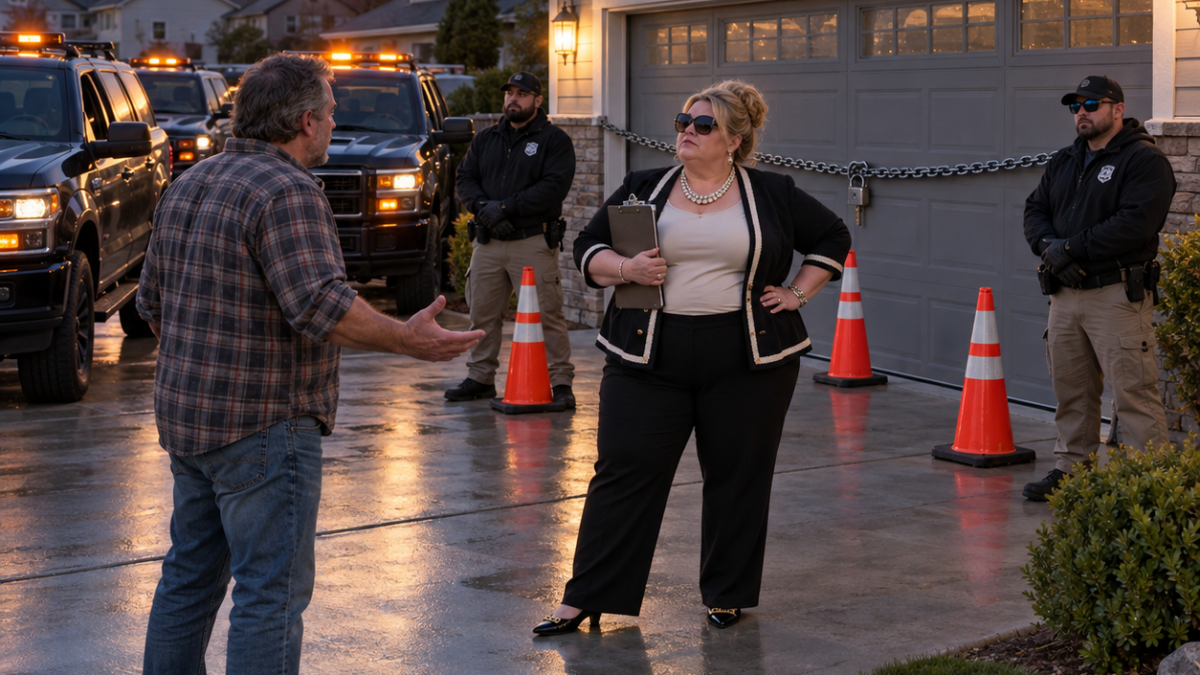
PART2
“This is not a good morning.”
I pointed around the shop.
“This is trespass.”
Wade glanced at her.
She ignored him.
“We are establishing a temporary maintenance staging area.”
“In my garage.”
“This structure is adjacent to an association access road.”
“It is on my land.”
“You have refused repeated requests to cooperate with Silver Pines.”
“Because I am not a member of Silver Pines.”
That part had always been Karen’s problem with me.
My property sat beside the development.
Not inside it.
The land had existed long before Silver Pines.
When the subdivision was created, the owner at the time refused to join the association’s boundary agreement.
That refusal went into the recorded title history.
When I bought the place, my purchase documents could not have been clearer.
No HOA covenants.
No association dues.
No architectural committee.
No Silver Pines enforcement authority.
Nothing.
I had approximately four thousand square feet of workshop because I had specifically bought property where nobody could tell me I needed permission to store a lathe.
Karen hated that.
My driveway connected to a road partly maintained by the association, and for years she treated that fact like a constitutional loophole.
She had sent notices claiming my outdoor equipment affected community appearance.
Not enforceable.
She had demanded that I repaint the garage.
Not enforceable.
She had asked me to submit my security lights to an architectural review committee.
Not enforceable.
Every time, I mailed back copies of my deed and survey.
Every time, she found a new theory.
But walking into the building was different.
She gestured toward the notice.
“Your refusal to cooperate has already resulted in penalties.”
“How much?”
“Twenty-five hundred dollars per day.”
I actually looked behind me, as if there might be another Nolan Vance standing there.
“For what?”
“For obstructing authorized community maintenance.”
“You parked three trucks inside my garage without permission.”
“Yes.”
“And now you are fining me until I allow you to keep them here?”
Her eyes narrowed.
“That is a hostile way of describing the situation.”
“It is the only accurate way.”
I looked at the crew.
“Everyone stop touching my tools.”
One man immediately released the rack.
Wade hesitated.
Karen said, “Continue.”
Nobody moved.
That second mattered.
Those men might have been willing to follow an HOA work order.
They were less comfortable continuing after the property owner had personally told them to stop.
I took out my phone.
Started recording.
No theatrics.
I filmed the entrance.
The notice.
Every truck.
Every license plate.
The moved racks.
The cabinet chained to the wall.
The engine.
Then Karen.
“Karen, I want a clear answer.”
She folded her arms.
“Go ahead.”
“Did you personally authorize these three Silver Pines vehicles to enter and remain inside this garage?”
“Yes.”
“You understand this property is privately owned and outside the Silver Pines HOA boundary?”
“I reject that characterization.”
“That is not what I asked.”
“As chairwoman, I have all the authority necessary to protect the interests of the community.”
I held the phone steady.
“So your answer is yes. You ordered the trucks onto the property.”
“Yes.”
“Good.”
I turned around.
That threw her.
“Where are you going?”
“Outside.”
“Nolan, you are not to interfere with association property.”
“I’m not touching association property.”
And I didn’t.
I didn’t touch a truck.
I didn’t touch Wade.
I didn’t take their keys.
I didn’t tear down the notice.
I didn’t yank the chain off my cabinet.
I walked outside.
Karen followed because she thought I was retreating.
Wade followed Karen.
The other two men followed Wade.
I waited.
Every person was outside.
Then I walked to the control panel mounted on the exterior wall.
The garage doors were commercial reinforced steel.
Heavy.
Slow.
Built that way because equipment inside my shop was expensive and because storms in our county occasionally came with wind strong enough to rearrange lesser buildings.
I pressed the close control.
The motors engaged.
Karen turned.
“Nolan.”
The doors descended.
“Nolan.”
Wade looked toward her.
Then toward me.
The first door touched concrete.
Then the second.
I entered the lock sequence.
The deadbolts engaged with a mechanical thud.
Three Silver Pines enforcement trucks were sealed inside.
Every human being remained safely outside.
Karen stared at me.
Then her face changed.
“Open those doors.”
I already had my phone in my other hand.
Dialing the sheriff.
“Open them now.”
Dispatch answered.
I gave my name and address.
Then I said, “Three vehicles entered my private garage without permission. The individuals who brought them are outside. Nobody is trapped. I have secured the building. I also have reason to suspect the vehicles may contain property that does not belong to the association. I need deputies.”
Karen laughed loud enough for the dispatcher to hear.
“You are going to jail.”
I looked at the closed doors.
“No.”
Then I looked at her.
“I think your trucks are going to wait for a warrant.”
That was the first time her expression cracked.
Just a little.
But enough.
Karen had expected anger.
That was clear to me almost immediately.
She needed anger.
She needed me shouting.
Grabbing somebody.
Damaging a truck.
Blocking workers physically.
Anything she could translate into one of her notices.
Dangerous property owner threatens HOA chair.
Mechanic obstructs emergency operations.
Hostile neighbor seizes association vehicles.
Instead, she had three undamaged trucks inside a locked private garage and a video of herself admitting she put them there.
So she started making calls.
First to the association attorney.
Then Wade’s company.
Then someone named Mara.
Then two board members.
Her voice got louder with each conversation.
“You need to get here.”
“No, he locked them inside.”
“Yes, all three.”
“No, I am not leaving.”
At one point she looked at me and said into the phone, “He has essentially stolen association property.”
I leaned against my truck.
Said nothing.
Two neighbors came outside.
Then another.
One stood on his porch holding a coffee mug.
He had the expression of a man who had stepped outside to check the weather and accidentally found the collapse of a small government.
Karen began pacing.
“You have no idea what you’re doing.”
“Maybe.”
“We’ll suspend your road access.”
I said nothing.
“We’ll place a lien against your property.”
Nothing.
“We can compel compliance.”
Nothing.
“You think silence makes you clever?”
“No.”
“What does it make you?”
“Tired.”
That irritated her more than an argument would have.
The sheriff’s cruiser arrived about twenty minutes later.
Grant Mercer got out first.
Grant had been sheriff for years.
He was one of those men who never seemed hurried even when everybody around him was.
He had the posture of someone who had learned that liars usually fill silence faster than honest people do.
Deputy Tessa Monroe stepped out of the passenger side.
Younger than Grant.
Fast eyes.
Tablet already in her hand.
Karen marched toward them.
“Sheriff, thank God.”
Grant looked past her toward the garage.
Then at me.
Karen pointed.
“I want him arrested.”
Grant asked, “For what?”
“He has unlawfully seized three vehicles belonging to Silver Pines Estates.”
Grant looked at me.
“Nolan?”
“They entered my garage before dawn without permission. I objected. I recorded the objection. I waited until everyone came outside. Then I closed the doors and called your office.”
Karen snapped, “That is not what happened.”
I raised my phone.
“It’s recorded.”
Tessa looked interested.
Grant did not react.
“Mrs. Whitmore, are the trucks registered to the association?”
“Yes.”
“Do you have written authorization from Mr. Vance to use this garage?”
“This structure serves an association access corridor.”
Grant asked again.
“Do you have authorization from the property owner?”
“Silver Pines has enforcement jurisdiction over infrastructure that impacts association operations.”
“That is not an answer.”
Karen pulled the temporary-control notice off my garage and handed it to him.
She held it like Moses bringing down a tablet.
Grant read the entire thing.
Then looked at her.
“Where is the court order?”
“It doesn’t require one.”
“Where is the deed?”
“This is community-access property.”
“Do you have a recorded easement allowing you to occupy the garage?”
“The building benefits from our road system.”
“Do you have an easement?”
Her jaw tightened.
“No specific instrument is necessary under emergency authority.”
Grant looked at me.
“Do you have your documents?”
I had known Karen long enough to keep them close.
I retrieved a folder from the house.
Deed.
Purchase agreement.
County survey.
Boundary map.
Grant studied the survey.
Tessa compared parcel numbers on her tablet.
My garage sat exactly where it had always sat.
Outside Silver Pines.
Grant handed the papers back.
“A shared or maintained road does not create authority to occupy somebody’s private building.”
“That is your opinion,” Karen said.
“No.”
Grant’s tone remained almost bored.
“That is how property ownership works.”
That should have ended it.
Instead, Karen escalated.
She threatened to assess $2,500 every day.
Threatened my access.
Threatened a lien.
Threatened to hire a tow operator to force the doors.
Then she said Silver Pines could initiate a compelled acquisition of the property because my refusal to cooperate endangered association maintenance.
Tessa kept typing.
Grant let her talk.
I think he understood what I had learned years earlier.
Karen’s greatest weakness was believing every extra sentence increased her authority.
Eventually Grant walked toward one of the narrow garage windows.
The glass was reinforced and dirty.
He used his flashlight.
Tessa joined him.
I stayed back.
Karen watched them.
“What are you doing?”
Grant didn’t answer.
He moved the beam across the first truck.
From outside, through the rear glass, you could see part of the cargo area.
Boxes.
A generator.
Tool cases.
Pieces of furniture.
Metal plaques.
Envelopes.
Then Grant stopped moving the light.
There was writing on the side of the generator.
White paint marker.
PROPERTY OF DORENE MADDOX.
Tessa straightened.
“I know that name.”
Karen looked sharply toward her.
“What?”
Tessa said, “Dorene Maddox reported a generator missing several months ago.”
The driveway changed.
You can feel moments like that.
Five seconds earlier, we were arguing about trespass.
Who owned what.
Who had authority.
Whether I could keep the trucks behind my doors.
Then a piece of property reported stolen by a resident was visible inside an HOA enforcement truck.
Karen felt the difference too.
Her voice got sharper.
“That equipment was lawfully obtained.”
Grant looked at her.
“How?”
“Enforcement.”
“What kind of enforcement?”
“She had substantial unpaid assessments.”
“Did a court authorize seizure of personal property?”
Karen did not answer.
Wade looked at the ground.
That interested me.
The association attorney arrived ten minutes later.
Russell Pike.
Gray suit.
Expensive briefcase.
The kind of expression lawyers wear when they have been told the emergency is probably stupid but profitable.
He walked up already talking.
“Those vehicles cannot be searched without a warrant.”
Grant nodded.
“That’s correct.”
Russell paused.
He hadn’t expected agreement.
Grant continued.
“So nobody is opening them until I have one.”
Karen pointed at the garage.
“Then order him to release them.”
“No.”
Russell stepped forward.
“Sheriff, my client owns those vehicles.”
“And one appears to contain property reported stolen.”
“It may have been legally seized.”
“That is what we are going to determine.”
Karen said, “This is absurd.”
Tessa moved to another window.
She shined her light into the second truck.
There was a small steel safe behind the seats.
A strip of tape had been stuck across its front.
Black marker.
LIEN PAYMENTS — CASH ONLY.
Tessa glanced at Grant.
Karen saw them looking.
Her entire body seemed to tighten.
I remember thinking:
She doesn’t want those trucks opened.
Not because they are trapped.
Because of what is inside them.
A few minutes later, Karen started sending messages to residents.
An emergency alert went out through the Silver Pines email system.
It accused me of stealing association vehicles.
Obstructing essential maintenance.
Endangering community operations.
Interfering with local government.
That one nearly got a reaction out of Grant.
Silver Pines was not local government.
It was an HOA with decals.
Then Karen called a towing company.
A heavy wrecker arrived and backed toward my garage.
Grant met the driver.
“You are not opening those doors.”
The tow operator pointed at Karen.
“She hired us.”
“This location is being preserved pending a warrant.”
That ended the tow attempt.
Karen immediately started arguing with Grant again.
While she did, I checked my security system.
The cameras had recorded the trucks arriving.
Around 4:30 that morning.
I watched the footage.
Three white vehicles drove onto my property.
What caught my attention was where they came from.
Not from the Silver Pines administrative building.
They approached from the opposite direction.
From Wade Corbin’s warehouse.
I copied the files.
Laptop.
External drive.
Cloud backup.
Then I sent a copy to my attorney.
I was finished relying on one piece of evidence existing in one place.
By then residents had started gathering.
One car pulled up fast.
Dorene Maddox climbed out wearing a coat over pajamas.
She had gray hair pinned badly behind her head, like she had dressed while moving.
She walked straight toward the garage window.
Tessa stopped her before she got too close.
Dorene pointed.
“That’s mine.”
“The generator?”
“And the cabinet.”
Karen walked toward her.
“Mrs. Maddox, this is an active dispute. You need to leave.”
Dorene did not look at her.
She kept staring through the window.
“Three months ago your people came to my house for a mandatory safety inspection.”
Karen crossed her arms.
“You had unresolved violations.”
“You fined me eighteen thousand dollars over landscaping.”
“That account was processed through an enforcement offset.”
Dorene finally turned.
“You took my belongings.”
“You had an outstanding debt.”
“There was no court order.”
Karen’s face froze.
Dorene looked at Grant.
“Wade’s crew entered my storage shed. They took that generator. A tool cabinet. Two boxes. They told me the property would be credited against what I owed.”
Grant asked, “Did they provide seizure paperwork?”
“No.”
“Receipt?”
“No.”
“Court order?”
“No.”
Karen stepped in.
“Silver Pines has broad contractual remedies—”
Dorene snapped.
“My husband bought that generator before he died.”
Everybody went quiet.
She pointed at the window.
“I filed a theft report because your office told me nobody knew where it went.”
Tessa began typing.
Then another resident arrived.
Then three more.
News moved through Silver Pines faster than any of Karen’s official notices.
People appeared carrying coffee.
Folders.
Phones.
One older man named Harold Pruitt looked into the first truck.
“That chainsaw is mine.”
Another woman recognized a mower.
A young couple named the Deckers saw framed photographs that had disappeared from a garage sale months before.
Someone recognized house-number plaques.
Another man said a toolkit had his initials engraved on the handle.
One by one, items inside Karen’s “enforcement” trucks acquired owners.
People became angry.
Not loud at first.
The dangerous kind.
Quiet.
Karen told them everything had been lawfully seized.
I asked her, “Under what clause?”
She turned toward me.
“What?”
“What clause in your covenants lets you enter somebody’s property and confiscate a generator without a court order?”
“This is not your matter.”
“You parked the evidence in my garage.”
Russell touched Karen’s elbow.
Pulled her aside.
They spoke low.
My camera caught some of it.
Russell said, “If they get a warrant, they’ll trace everything.”
Karen whispered something.
He shook his head.
“The warehouse too.”
She looked toward Wade.
Then typed something on her phone.
Wade checked his.
A minute later, he walked away.
I assumed he was leaving.
He wasn’t.
Five minutes later, an engine roared near the side of my property.
Wade returned driving a forklift.
He aimed it toward the smaller service entrance of the garage.
I stared at him.
The man had apparently decided that nothing calmed a potential theft investigation like attacking the crime scene with industrial equipment.
I took out my phone.
Recorded.
Grant walked directly into the forklift’s path.
One hand raised.
“Shut it down.”
Wade slowed.
“Sheriff, I’ve been authorized—”
“Engine off.”
Wade looked toward Karen.
She said nothing.
“Now.”
He shut it down.
Deputies ordered him out.
Inside the forklift cab they found a crowbar.
A battery cutting tool.
Fuel canister.
Karen spoke immediately.
“I never authorized this.”
Wade turned.
The look on his face changed.
For years, apparently, he had believed working for Karen meant she would protect him.
Now he understood the difference between being protected and being useful.
“She told me to recover the association property by whatever means necessary.”
Karen shook her head.
“He’s lying.”
Grant’s phone rang.
He listened.
Then looked at me.
“Warrant approved.”
Karen’s face lost color.
Grant continued.
“Nolan, open the garage.”
I entered the code.
The steel doors lifted slowly.
Nobody rushed inside.
Tessa entered first.
Grant behind her.
Two deputies.
Photographs before anything was touched.
Angles.
Truck positions.
License plates.
Cab interiors.
Cargo.
Chain of evidence.
That mattered.
The vehicles remained exactly where Karen’s people had parked them.
I had never opened a door.
Never searched a box.
Never moved an item.
Never touched the safe.
Whatever investigators found belonged to the people who brought it there.
Truck one held enough property to turn the driveway silent.
Dorene’s generator.
Two lawn mowers.
Multiple tool cases.
Furniture.
Electronics.
House plaques.
A mechanic’s toolkit engraved with a resident’s initials.
Boxes labeled with addresses.
And a handwritten sheet listing twenty-seven properties beside the word PROCESSED.
Some of the items matched reports filed months earlier.
Some went back years.
Then deputies opened truck two.
The steel safe came out first.
Tessa photographed the tape label.
LIEN PAYMENTS — CASH ONLY.
The safe contained $96,400.
Cash.
Envelope after envelope.
Homeowner names written across the fronts.
Some envelopes contained receipts.
Others had handwritten amounts.
A ledger showed fines marked as paid while penalties continued accruing in the official system.
Investigators found debt certificates.
Documents with signatures that residents later denied making.
And a rubber stamp imitating the county recorder’s seal.
One envelope belonged to a homeowner who had died months earlier.
Payments had continued being collected from the estate.
People around me stopped whispering.
Karen stood beside Russell.
He was no longer standing quite as close to her.
Then truck three opened.
At first it looked less dramatic.
File boxes.
Maps.
Contracts.
Planning binders.
Then Tessa unfolded one large development map across a table in my garage.
Across the top:
SILVER PINES WEST EXPANSION PROJECT.
My property was outlined in red.
So was the garage.
A label pointed directly to the building.
FUTURE MAINTENANCE HEADQUARTERS.
Below it:
ACQUISITION PENDING.
I walked closer.
My stomach changed.
This was no longer a fight about Karen believing she could use my garage for a few days.
She had been planning to take the property.
There were preliminary contracts.
One showed an outside investment group prepared to pay nearly five million dollars for development rights once a block of property along the western edge of Silver Pines had been assembled.
My land sat in the middle.
Karen had promised access to property she didn’t own.
Other papers outlined phases.
Some used softer corporate language.
Others were brutally simple.
Violations.
Daily assessments.
Liens.
Financing pressure.
Acquisition through intermediary entity.
Transfer to investment partner.
They intended to manufacture debts against properties.
Make refinancing difficult.
Use liens to create pressure.
Then purchase through shell companies when owners became desperate.
The trucks in my garage had not been random.
The documents described creating an “operational history” involving my workshop.
Repeated association use.
Maintenance staging.
Vehicle storage.
Access documentation.
The goal was to create the appearance that Silver Pines had long used my property.
Later, lawyers could argue implied access rights or long-term operational dependence while financial pressure came from the other direction.
I looked at Karen.
“You were trying to build a record.”
She said, “Those documents are fabricated.”
“Inside your truck?”
“They were planted.”
I almost laughed.
“My cameras recorded your trucks arriving locked.”
“Then someone placed them in the vehicles earlier.”
“Who?”
She had no answer.
Tessa kept photographing.
Karen’s fingerprints were eventually found on the safe.
On the development binder.
On several of the documents.
And some of the legal papers contained Russell Pike’s digital seal.
The moment Russell learned that, another foot of space appeared between him and Karen.
He said, “My firm will need independent counsel.”
Karen stared at him.
“You’re my attorney.”
“Not for this.”
Near the crowd stood Mara Beexley, the Silver Pines treasurer.
I had seen her at board meetings.
Quiet woman.
Early fifties.
Usually buried in spreadsheets.
Now she looked physically sick.
Karen walked toward her.
Leaned close.
My phone was still recording.
“If you say one word,” Karen whispered, “you go to prison with me.”
Mara flinched.
Then something happened.
Fear had kept her silent.
Now Karen used that same fear one time too many.
Mara stepped away.
Walked toward Grant.
“I have the real records.”
Karen said her name sharply.
“Mara.”
Mara kept walking.
“There are two accounting systems.”
Every conversation stopped.
Mara explained it.
The public books showed what residents saw.
Maintenance shortfalls.
Rising insurance.
Legal costs.
Emergency assessments.
Aggressive enforcement because, according to Karen, Silver Pines always needed more money.
The second ledger showed something else.
Payments to Wade’s contracting company.
A consulting business controlled by Karen.
Shell companies.
An account connected to Russell’s office.
Repeated cash withdrawals.
An unregistered local campaign fund.
Transfers disguised as maintenance costs.
Over five years, Mara believed at least $1.7 million had been diverted directly from association accounts.
Her hands shook.
She admitted she had discovered irregularities months after becoming treasurer.
Karen then learned about an old mistake in Mara’s personal finances.
Nothing connected to Silver Pines.
But embarrassing.
Potentially damaging.
Karen used it.
Mara began signing things.
Then lying.
Then signing more because the first lie had become leverage for the second.
“I know what I did,” she said.
I was standing close enough to hear her.
She looked at me.
“I should have stopped it.”
“Yes.”
She blinked.
Maybe she expected comfort.
I didn’t have any.
“You are responsible for what you signed.”
“I know.”
“But if you have records, give them everything.”
She nodded.
“I have backups.”
Hard drive.
Emails.
Cloud account credentials.
Recorded meetings.
Lists of liens.
Copies of transactions.
Communications between Karen and Wade.
And files tied to the plan for my property.
Grant called the state financial-crimes unit.
By noon, the problem had outgrown three trespassing trucks.
Residents wanted Karen arrested immediately.
She wasn’t.
That made some people furious.
I understood the frustration.
But accusations are not the same as a case.
Investigators needed custody records.
Search warrants.
Financial subpoenas.
Digital verification.
Forgery analysis.
Victim statements.
They had to connect cash to transactions.
Transactions to accounts.
Accounts to people.
The kind of case that looks obvious from a driveway can fall apart if somebody skips the boring parts.
Karen exploited the delay.
Of course she did.
That evening she called an emergency HOA meeting.
The agenda was astonishing.
Remove Mara as treasurer.
Authorize transfer of reserve funds.
Approve up to $600,000 for legal defense.
Authorize Wade to recover association vehicles.
Approve acquisition proceedings against my land.
And permit destruction of what the notice called “outdated administrative material.”
Destroy records.
The same day investigators discovered a second set of books.
Karen hired private security.
Residents who opposed her were blocked at the clubhouse door.
Dorene called me.
“They won’t let us inside.”
I drove over.
I did not force my way through.
That mattered.
I wasn’t a Silver Pines member.
I had no legal authority inside their meeting.
Karen built her entire operation by pretending boundaries could be ignored when she disliked them.
I wasn’t going to copy her.
So I stood outside with Dorene.
And Harold.
And Nate.
And two dozen others.
They began collecting signatures for emergency court relief to freeze any transfer of association reserves.
Then another piece fell into place.
Caleb Stroud from the county land-records office gave investigators an email.
Karen had contacted him months earlier.
She wanted the official Silver Pines boundary map modified.
Specifically, she wanted my workshop parcel shown as part of an association operational area.
Caleb refused.
Karen threatened to complain to county officials and have him removed.
Caleb saved everything.
Her email.
His response.
And a scanned map covered in Karen’s handwriting.
My garage circled.
Arrows.
Notes.
EXPANSION.
ACCESS.
ACQUIRE.
Not everyone had been afraid of her.
Some people had simply been waiting for someone to ask the right question.
That night Tessa obtained location records from the trucks.
All three had visited more than thirty Silver Pines properties during the previous months.
Many visits occurred shortly before homeowners reported missing possessions.
The GPS logs also showed the trucks at the association office the night before they appeared in my garage.
Karen’s access card placed her inside the building at the same time.
Her story that Wade had acted independently was collapsing.
The following morning deputies served a warrant at Wade’s warehouse.
Before they could search it, smoke was already coming through the roof.
I heard about the fire from Grant.
Three engines responded.
Neighbors reported a small explosion.
Fire investigators found accelerant in multiple places.
Wade claimed old electrical wiring caused it.
That story lasted until security footage from a gas station surfaced.
Karen’s SUV had entered the warehouse road less than twenty minutes before the fire began.
She said she had gone there to inspect association equipment.
By then even Russell stopped trying to make her explanations sound reasonable.
Firefighters recovered a partially burned metal filing box.
Inside were property records.
Lien documents.
Acquisition targets.
Several addresses already identified on the Silver Pines West map.
While the warehouse burned, Karen tried something even worse.
Two private security guards arrived at my property before dawn.
They cut the gate lock.
Attached a tow cable to one of the trucks, which had been moved to county-secured evidence storage inside the building pending transport.
I had installed additional motion alerts after the first incident.
My phone woke me.
I did not go outside.
I called Grant.
Tessa arrived while the men were still there.
They surrendered.
One of them had recorded Karen because he did not trust her.
On the recording, her voice was clear.
“Get the trucks out before sunrise. I don’t care what you have to break.”
That moved the case from fraud toward obstruction.
Wade heard about the guards.
Then the warehouse fire.
Then he learned Karen had denied authorizing the forklift.
That was enough.
He asked for an attorney.
Then offered cooperation.
His statement filled in the gaps.
According to Wade, Silver Pines enforcement trucks had been used for years to remove belongings from residents who owed fines.
Sometimes Karen called the property “collateral.”
Sometimes “offset.”
Sometimes “abandoned.”
There were rarely court orders.
The valuable items went to his warehouse.
Some were sold.
Cash payments were collected directly from residents afraid of liens.
Not all cash entered HOA accounts.
Wade’s crews placed notices.
Created inspection reports.
Photographed supposed violations from angles designed to exaggerate problems.
They moved objects onto properties.
Manufactured access histories.
Intimidated elderly homeowners.
Delivered low purchase offers after financial pressure peaked.
And the trucks in my garage?
That had been Karen’s idea.
She wanted repeated documented association use of my building.
If I protested violently, even better.
She could characterize the place as a dangerous operational problem affecting Silver Pines access.
If I tolerated it, the association could begin building a history of occupation.
Either outcome helped.
Wade also told investigators Karen intended to leave the state the following morning.
A charter flight had been arranged.
Grant requested an arrest warrant.
The district attorney wanted one last piece.
Direct evidence connecting Karen personally to the financial scheme.
Investigators returned to the envelopes found in the cash safe.
Some carried handwritten codes.
At first they looked meaningless.
Letters.
Numbers.
Short marks.
Then somebody compared them to codes on the expansion map.
They matched.
Each code corresponded to a target property.
Dorene.
Vera Kowalski.
Frank O’Day.
Mine.
More.
Then Tessa found one that stopped everyone.
Sheriff Grant Mercer’s name.
Grant owned land near a water source west of Silver Pines.
Karen’s files included paperwork claiming runoff from his property contaminated association drainage.
The evidence was fabricated.
The strategy was familiar.
Fine him.
Create debt.
Escalate.
Lien.
Pressure.
Acquire through one of the shell companies.
Grant read the documents.
His expression barely changed.
Then he handed them to Tessa.
“I’m stepping away from anything involving my property.”
Nobody asked him to.
He did it himself.
That stayed with me.
Karen had spent years increasing her authority every time a conflict appeared.
Grant reduced his own the second one appeared.
He did not make a speech about his integrity.
He did not claim he could remain objective.
He simply stepped back and let the state investigators and Tessa handle that part.
Real authority does not need to consume everything around it.
Over the next day, Dorene and I helped identify homeowners whose names appeared in the records.
Twelve agreed to meet.
Their stories sounded different until you placed them side by side.
Then they became the same story.
Unexplained fines.
Cash payments.
No receipts.
Liens remaining after balances were paid.
Property disappearing after inspections.
Threats about refinancing.
Warnings that legal challenges would cost more than surrender.
Then purchase offers.
Vera Kowalski was a retired teacher.
Seventy-two.
Karen had sat at her kitchen table with a thick folder of violations and told her that selling might be “the peaceful solution.”
Vera had believed she faced tens of thousands in penalties.
Several violations in the file were later shown to be invented.
Frank O’Day lost his wife three years earlier.
He admitted Karen nearly convinced him to sell because she said an HOA lien would prevent him from refinancing the house.
“I was tired,” he told me.
That sentence hurt more than anything else.
Not stupid.
Not fooled.
Tired.
That was Karen’s system.
She did not need to defeat everybody.
She needed to exhaust them.
When investigators mapped the targeted properties, another pattern appeared.
They lined up almost perfectly with Silver Pines West.
Dorene’s land sat near the proposed service entrance.
Vera’s interrupted a landscaping buffer.
Frank’s completed an access corridor.
Grant’s property controlled water access.
My workshop would become headquarters.
Karen had never been enforcing neighborhood rules.
She had been clearing a development site one frightened homeowner at a time.
Still, she called another association meeting.
She told residents the investigation was retaliation.
That I had manipulated the sheriff because I wanted to damage Silver Pines property values.
Three loyal board members sat behind her.
Private security guarded the doors.
Dorene came with notarized proxies.
More than two-thirds of Silver Pines homeowners had signed a petition demanding Karen’s immediate suspension.
Karen refused to recognize it.
She ordered security to remove Dorene.
I stepped beside Dorene.
Not toward the guards.
Just beside her.
“Everything here is being recorded.”
The two security men looked at Karen.
Then at the crowd.
Then the phones.
Neither moved.
That was when Karen’s power finally looked small.
For years, she had been strong because people believed refusal came with consequences.
Now she gave an order and two men simply chose not to obey.
Then Tessa entered the clubhouse.
State investigators had obtained data from Karen’s cloud account.
Among the files was an audio recording.
Karen had recorded herself.
I still don’t know why.
Maybe she wanted leverage over Wade.
Maybe she believed she would always control the file.
Either way, the entire room heard her voice.
Clear.
Calm.
Discussing my garage.
“Once we establish a pattern of using the space, the attorney can manufacture long-term access. Then the fines take the whole property.”
Nobody gasped.
That surprised me.
The room just became still.
People had passed the stage of surprise.
Now they understood.
The three trucks had never been maintenance vehicles that happened to need storage.
Parking them inside my workshop was the first physical step in a plan to take the land.
Tessa stepped toward Karen.
“Mrs. Whitmore, this investigation is no longer about unauthorized parking.”
Karen didn’t let her finish.
She shoved her chair backward.
Hit the table.
Ran through the side door.
For a woman who had spent years talking about authority, she moved very quickly once actual authority entered the room.
Someone shouted.
Tessa followed.
Karen reached an association SUV.
Inside the bag investigators later recovered were a passport.
Cash.
Credit cards.
Bank cards.
A backup hard drive.
Property contracts.
And a ticket for the charter flight Wade had described.
Tessa radioed the vehicle.
I stayed where I was.
I had no reason to join a chase.
Then I remembered something.
Western Road bridge was closed for repairs.
The normal airport route was blocked.
There were only two reasonable alternatives.
One passed my property.
I told a deputy.
“If she’s trying for the airport, she’ll come by my gate.”
Ten minutes later I heard tires.
Karen’s SUV appeared on the service road.
She tried to cut through my property to avoid the patrol units moving in from the main highway.
The steel gate was closed.
She hit it.
Hard.
The SUV’s front end crumpled.
The gate shook.
But stayed upright.
Karen threw the door open.
“Nolan!”
I stood inside the fence.
“Open it!”
“No.”
“I’ll erase every fine.”
“I never owed you fines.”
“I’ll sign the property back.”
“You never owned my property.”
“I’ll resign.”
“That seems to be happening without my help.”
Sirens grew louder.
Karen gripped the gate.
“Open this and we can resolve everything.”
Money.
Promises.
Threats.
Deals.
All the tools she had used for years.
None of them worked on a steel gate attached to land she did not own.
“You spent years believing every door would open if you threatened the person behind it,” I told her. “This one opens because I own it.”
She heard the sirens too.
Ran back toward the SUV.
A patrol vehicle blocked the road behind her.
She grabbed her bag and ran toward the trees.
Toward the western property line.
Toward the same survey boundary Karen had tried to erase from county maps.
Tessa and two state investigators followed.
Karen made it maybe a hundred yards.
She stumbled near the boundary marker.
Her bag tore open.
Paper scattered across the grass.
Cash.
Lien documents.
Contracts.
The hard drive.
Tessa reached her beside the survey post.
That was where Karen Whitmore was handcuffed.
Next to a metal marker proving my land had never belonged to Silver Pines.
People later told me there was something poetic about that.
Maybe.
At the time, it just felt exhausting.
The charges expanded for weeks.
Criminal trespass.
Conspiracy involving real-property fraud.
Forgery.
Organized theft.
Financial fraud.
Obstruction.
Witness intimidation.
Evidence destruction.
Ordering destruction of property.
Money laundering through shell companies.
The warehouse fire became its own piece of the case.
Russell Pike was questioned.
Wade signed a cooperation agreement.
Mara surrendered every file she had.
Karen still shouted from the back of the patrol car that I had set her up.
“He trapped the trucks!”
Grant stood several yards away.
By then he had recused himself from the portion involving his own property, but he was still present as sheriff for the parts unrelated to that conflict.
He looked toward my garage.
Then at Karen.
“Nolan closed the doors to his own building.”
She kept shouting.
Grant’s voice remained calm.
“You chose what to put inside.”
I thought about that sentence for a long time.
Because that was the whole story.
I had not put Dorene’s generator in the truck.
I had not filled a safe with cash.
I had not forged debt certificates.
I had not created a fake county seal.
I had not drawn an expansion map over people’s homes.
I had not promised my own property to investors.
I had not created two sets of books.
I had not burned Wade’s warehouse.
I had not hired guards to remove evidence.
All I had done was close my garage door.
The investigation lasted months.
The numbers kept climbing.
At first, investigators thought the losses might exceed two million dollars.
Then three.
The final audit found multiple channels.
Approximately $1.7 million diverted directly from association funds.
More than $900,000 collected through fraudulent or fabricated fines.
Hundreds of thousands in resident property stolen and resold.
More money pushed through unauthorized legal payments and shell-company contracts.
Dozens of homeowners had paid balances that were never properly credited.
Several had come dangerously close to losing homes under fraudulent liens.
Courts froze accounts.
False liens were voided.
Recovered money went into a restitution pool.
The three enforcement trucks remained evidence through trial.
Eventually they were sold at auction.
The proceeds also went toward restitution.
Reporters arrived almost immediately.
Regional stations parked outside Silver Pines.
One wanted me to stand in front of the garage and lower the doors again for television.
I declined.
Another wanted me to describe myself as the mechanic who “outsmarted” an HOA empire.
I declined that too.
I had no interest in becoming the Garage Guy.
Dorene agreed to one interview.
She was better at it than I would have been.
She didn’t talk much about Karen.
She talked about the system.
How easily homeowners can become afraid of official-looking paper.
How people assume somebody must have authority because a notice has a logo.
How fear of liens can make reasonable people pay money they do not owe.
And how nobody on a board should have the power to take property without independent review.
Karen eventually stopped fighting the criminal case.
The evidence was too broad.
Too physical.
Too documented.
Too many witnesses who no longer feared her.
Wade received consideration for cooperating.
He still lost his contractor’s license.
Still faced punishment.
Still had to identify property and return everything investigators could recover.
Russell lost his license and faced prosecution connected to forged documents and fraudulent transactions.
Mara was not treated as innocent.
She had signed false paperwork.
She had helped maintain the second accounting system.
Her cooperation mattered, but it did not erase what she did.
She received supervised probation, mandatory testimony, community service, and financial restrictions.
Some residents thought that was too easy.
Others thought it was too severe.
I never developed a clean answer.
She had been afraid.
She had also helped hurt people.
Both were true.
Life sometimes refuses to make one truth cancel the other.
Dorene got her generator back.
Also the cabinet.
Some of her tools.
Most of the property that could be identified went back to the original owners.
I repaired Dorene’s generator because sitting in storage and then inside an evidence truck had not improved it.
When I finished, she brought me an envelope.
I handed it back.
“No.”
“Nolan.”
“No.”
“You did work.”
“I did.”
“Then let me pay you.”
“You already paid enough.”
Her mouth tightened.
She knew what I meant.
I said, “Next time you see somebody using authority like that, speak sooner.”
She nodded.
“I can do that.”
“That’s payment.”
Silver Pines replaced its entire old board.
An interim committee came in under independent financial supervision.
The new rules were almost aggressively ordinary.
No cash collections.
No entry onto private property without consent or proper legal authority.
No confiscation of personal belongings.
Independent legal review before liens.
Recorded meetings.
Open financial statements.
Resident approval for major expenditures.
Formal complaint procedures.
And no Enforcement Division.
That one made me smile.
The signs came off the trucks.
The logo disappeared from the community entrance.
Eventually the temporary board installed a simple sign near the boundary.
PRIVATE PROPERTY BEGINS WHERE AUTHORITY ENDS.
Dorene suggested the language.
I told her it sounded dramatic.
She said, “So did three fake police trucks.”
Fair point.
At Karen’s sentencing, prosecutors displayed a photograph.
Three white Silver Pines vehicles inside my garage.
Exactly where I had found them.
The judge spoke about how Karen had treated property as a tool for her own ambition.
How she had used fear of liens and fines to create control.
How the arrogance that allowed her to occupy somebody else’s garage had also caused her to gather evidence of her broader crimes into one place.
Karen looked toward me.
I expected satisfaction.
For months, people had asked whether I was excited to see her sentenced.
I thought maybe I would be.
Instead, I felt tired.
Sad, almost.
Not for Karen.
For Dorene.
For Vera.
For Frank.
For people who had spent years opening their mail with dread.
For residents who had paid cash because they were terrified of losing houses they had spent decades buying.
For Mara, who had let fear turn her into something she never intended to become.
For Wade, who had traded judgment for obedience until he realized obedience would not protect him.
And maybe for myself.
Because I remembered standing in my driveway before sunrise.
Exhausted.
Looking into my own building and seeing strangers moving my tools.
There is a specific kind of anger that comes from having someone treat your ownership as a technical inconvenience.
You start wondering whether paper matters.
Whether boundaries matter.
Whether following rules matters when the other person simply invents new ones.
The answer turned out to be yes.
But only if somebody is willing to preserve the proof.
The new Silver Pines board mailed me a letter several weeks after the trial.
I almost threw it away unopened.
Old reflex.
The envelope looked too familiar.
Inside was not a violation.
It was an offer.
They wanted to buy the enforcement trucks after the court released them.
I declined.
Silver Pines did not need enforcement trucks.
It needed road-maintenance trucks.
Contractor vehicles.
Normal equipment.
Not white pickups designed to make residents feel like the association had police powers.
The board accepted my answer.
No argument.
That alone told me things had changed.
Money originally proposed for the trucks went toward restitution, road repair, audits, and canceling invalid fines.
They invited me to join a policy committee.
I declined that too.
I was still not a member of Silver Pines.
After everything Karen had done trying to erase that fact, joining would have felt almost comedic.
But when residents asked me to review maintenance contracts involving equipment or access, I sometimes helped.
Boundaries do not require hostility.
They require clarity.
Mara came to my shop a few months later.
The doors were open.
She stopped at the threshold.
I was rebuilding a compressor valve.
For several seconds she did not enter.
“You can come in.”
She stepped onto the concrete.
The shop looked normal again.
Tools where they belonged.
Racks straight.
Machines under covers.
No white trucks.
No notices.
No Karen.
Mara looked toward the place where truck two had sat.
“I’m sorry.”
“I know.”
“I should have come forward the first month.”
“Yes.”
She flinched.
I wasn’t trying to punish her.
I also wasn’t going to lie.
“I don’t expect you to tell me it’s okay,” she said.
“It isn’t.”
She nodded.
“I’m trying to fix what I can.”
“That matters.”
She hesitated.
“Do you think you’ll ever forgive me?”
I set the wrench down.
“Not today.”
Her eyes dropped.
“But trust is built by what you do next.”
She looked up again.
“I can do that.”
“Then do that.”
And she did.
Under the auditor, Mara spent months helping trace missing payments.
She identified duplicate accounts.
Recovered emails.
Matched cash records to homeowners.
Helped residents understand which fines had been fabricated.
It did not magically make her innocent.
It did make her useful in repairing the damage.
There was no single redemption scene.
No applause.
She just kept showing up.
That counted for something.
Grant visited the garage one afternoon after the criminal case finally released some of my property that had been held as evidence.
He brought back the external control remote for the garage doors.
He held it up.
“Most expensive garage lock in the county.”
I took it.
“It was already installed.”
“Still helped expose a multimillion-dollar fraud operation.”
“The lock didn’t expose anything.”
He raised an eyebrow.
“No?”
“No. The lock just closed a door.”
“What exposed it?”
“I didn’t lose my temper.”
Grant smiled.
I continued.
“I didn’t damage the trucks. I didn’t search them. I didn’t open the safe. I didn’t fight Wade. I didn’t threaten Karen. I recorded what she said. Then I called you.”
“That is a much less exciting version.”
“It’s the accurate version.”
He looked around the shop.
The $180,000 engine was finally finished.
It sat on the delivery platform, wrapped and ready to leave.
Grant pointed toward it.
“Ever think about what happens if you open those doors when Karen tells you to?”
“All the time.”
“What do you think?”
“She drives the trucks away.”
“Probably.”
“Everything disappears.”
“Some of it.”
“The warehouse gets cleaned sooner.”
“Maybe.”
“She blames Wade before anybody sees the files.”
Grant nodded.
“And by breakfast I’m the angry mechanic who locked HOA vehicles in a garage for no reason.”
“That would have been a difficult story to untangle.”
I looked at the door.
“I’m glad steel is patient.”
He laughed.
The trial itself took nearly a year.
I attended only when required.
Most of the time, I worked.
That helped.
Machines behave honestly.
A worn bearing never tells you it is actually a zoning decision.
A cracked gear does not threaten to put a lien on your house.
Hydraulic fluid does not call an emergency board meeting.
You open a failed machine and eventually it tells you why it failed.
Heat marks.
Scoring.
Contamination.
Improper tolerances.
Loose bolts.
Metal fatigue.
Cause.
Effect.
People are better at hiding the connection between the two.
Karen hid hers behind words.
Compliance.
Community.
Access.
Assessment.
Lien.
Maintenance.
Safety.
Authority.
But once investigators opened the system, it failed like any machine.
One component at a time.
The safe.
The trucks.
The envelopes.
The shell companies.
The warehouse.
The forged seals.
The cash.
The map.
The recordings.
The threats.
The false liens.
Cause and effect.
Silver Pines slowly became a normal neighborhood again.
A generator returned to Dorene’s shed.
A lawn mower went back to another homeowner.
People who had blamed neighbors for missing property apologized when they learned the truth.
Road contracts went through public bids.
Meetings were recorded.
Residents started asking questions before voting.
Some fines disappeared.
Some liens were voided.
Restitution checks came slowly.
Dorene joined the financial oversight committee.
They asked her to chair it.
She refused.
At the next meeting she said, “No one person needs that much control.”
Apparently everybody had learned something.
When the county finally sold the three old enforcement trucks at auction, I went to see them leave.
Not from my property.
From the county lot.
The Silver Pines decals had been removed.
Without them, the trucks looked unimpressive.
White pickups.
Used.
Scratched.
One with a dented bumper.
Nothing about them suggested authority.
That struck me.
So much of Karen’s power had worked the same way.
Logo.
Title.
Letterhead.
Committee.
Official-looking notice.
Truck decals.
A fake seal.
A lawyer.
A contractor.
A frightened treasurer.
People who assumed somebody else must have checked whether the rules were real.
Take away the costume and the structure underneath looked much cheaper.
Still dangerous.
Still capable of hurting people.
But not magical.
About a year after the morning this began, I was standing outside my garage before sunrise.
Same hour.
Different morning.
The sky was turning pale through the trees.
The three places where Karen’s trucks had once been parked were occupied by actual work.
An old milling machine waited for restoration.
A lathe was halfway through alignment.
My hydraulic press hummed under the lights.
The big industrial engine was gone.
Delivered months earlier.
Running beautifully at the client’s plant.
I will admit something.
Knowing that engine worked properly gave me more satisfaction than Karen’s sentence ever did.
I pressed the remote.
The reinforced garage doors rose.
Nothing behind them except my shop.
My machines.
My tools.
My work.
Beyond the fence stood the survey marker.
Same marker Karen had once tried to erase from a county map.
Still there.
Unmoved.
Property boundaries seem boring until somebody crosses one with enough confidence.
Then a line on a survey becomes something else.
It becomes the difference between neighbor and trespasser.
Between management and control.
Between authority and costume.
Silver Pines always had legitimate authority.
Inside Silver Pines.
It could maintain common roads.
Collect valid dues.
Repair drainage.
Enforce properly recorded covenants.
Approve budgets.
Manage common property.
Nothing about that bothered me.
What Karen tried to create was different.
A private government with its own enforcement trucks.
Its own cash seizures.
Its own invented debt.
Its own punishment system.
And eventually its own expansion plan.
She confused wanting something with having jurisdiction over it.
My silence in the driveway looked like weakness to her.
It wasn’t.
My camera looked like fear.
It wasn’t.
Closing my garage doors looked like theft to her.
It was ownership.
And the trucks she believed would prove Silver Pines had control of my property became evidence of how much property Silver Pines had taken from everyone else.
People sometimes ask what I would tell another homeowner in the same position.
Usually they expect something dramatic.
Never mess with a mechanic.
Never trust an HOA.
Build stronger doors.
Those make good punchlines.
They miss the point.
The most useful thing I did that morning was stay boring.
Document.
Preserve.
Know the boundary.
Keep people safe.
Do not search things yourself.
Do not destroy something that can become evidence.
Do not let anger become the other person’s defense.
Call the people who actually have lawful authority.
Then give them a clean scene.
Karen had spent years depending on people becoming emotional.
Afraid.
Embarrassed.
Exhausted.
Angry.
Those emotions made people easier to push.
A widow afraid of a lien signs a bad agreement.
A tired homeowner pays a false fine.
A contractor afraid of losing work follows the wrong order.
A treasurer afraid of exposure signs one more paper.
An angry mechanic punches somebody in his garage and suddenly the story is about the punch.
I gave her none of that.
I waited until every person was outside.
Then I closed the doors.
That was all.
When those doors opened again, the sheriff had a warrant.
Dorene had found her generator.
Residents were identifying their property.
Mara was starting to tell the truth.
Wade was beginning to understand that Karen would sacrifice him.
Tessa had a trail to follow.
And Karen’s entire operation was sitting on my concrete floor with license plates attached.
Three enforcement trucks entered my garage as a threat.
They left months later as evidence.
Karen never lost because I built a clever trap.
There was no trap.
She picked the garage.
She ordered the trucks inside.
She filled them with stolen property, fraudulent records, cash, and the paperwork for a scheme that had been hurting her own neighbors for years.
All I did was make sure the truth stayed exactly where she left it long enough for the right people to open the doors.

