The HOA Laughed While Selling Me Their “Worthless” Lot for $400—Until Their President Showed Up at My Gate Demanding It Back
PART2
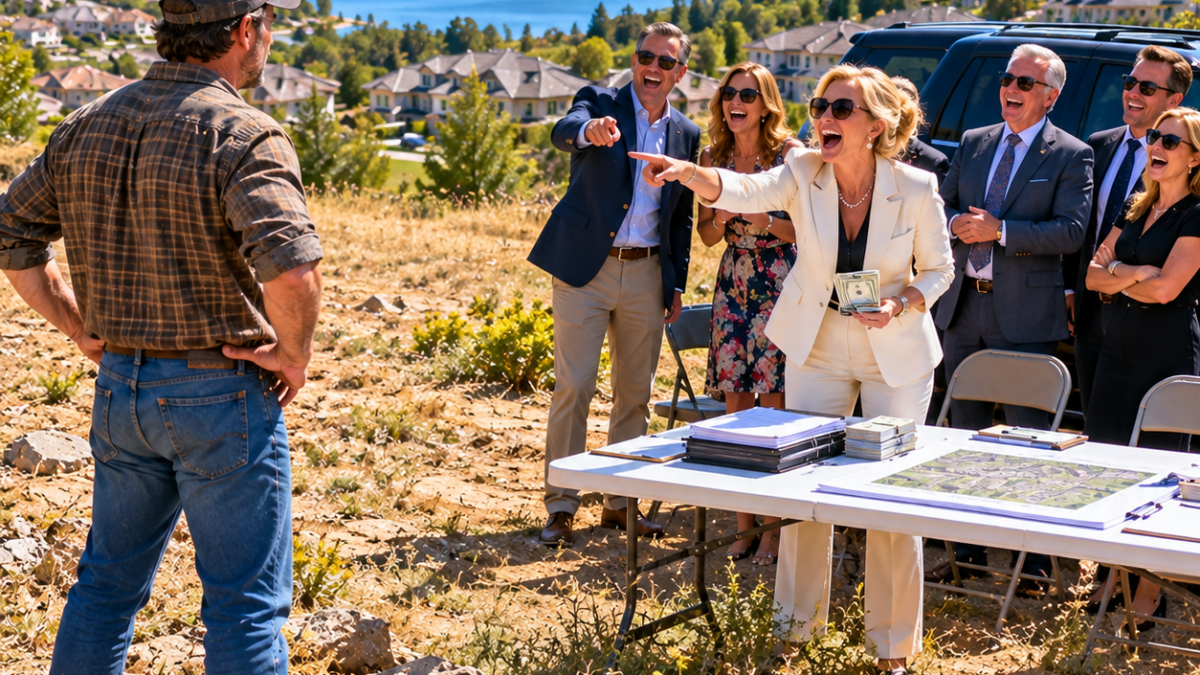
They made the secretary count my four hundred dollars out loud, one bill at a time, so the entire HOA board could hear exactly what they thought my family’s land was worth.
Three months later, the same woman who had called it worthless was standing at my fence with a deed transfer in her hand, demanding I give it back.
By then, a drilling rig was humming beyond my grandmother’s grave, and I had learned something about that nine-acre patch of dirt that made every lie she had told me suddenly make sense.
Karen Faircloth never offered me a chair.
That should tell you something about the kind of meeting she thought we were having.
I walked into the Ambleside Downs clubhouse a few minutes after nine on a Tuesday morning and found Karen at the long board table with the community manager, the HOA secretary, two directors, and their attorney.
A chair sat against the wall.
Another stood beside the coffee station.
But there was no chair for me.
Karen kept her hands folded over a stack of papers.
“Stand there,” she said. “This should take four minutes.”
I looked at her.
She looked back like she had already won something.
Karen Faircloth had been president of the Ambleside Downs Estates Homeowners Association long enough that she had learned how to make ordinary words sound like orders.
She was somewhere in her late fifties, always carefully dressed, always composed, always speaking in that measured tone people use when they want cruelty to sound administrative.
She pushed a deed across the table using two fingers.
“Nine point two acres,” she said. “Four hundred dollars cash. You don’t negotiate, you don’t ask questions, and after today, you don’t set foot in this clubhouse again unless invited.”
I looked down at the paper.
Parcel 24-086.
Outlot C.
I had been trying to buy that land for years.
Now she was practically throwing it at me.
I didn’t touch the deed yet.
“My grandmother is buried out there,” I said. “There are six graves.”
One of the board members looked down into his coffee.
Karen didn’t.
She leaned back in her chair.
“Then bury yourself out there too, Mr. Leatherwood. Nobody in this room is stopping you.”
There are insults that make a man angry immediately.
And then there are insults so ugly that your anger takes a second to understand what it just heard.
That one was the second kind.
I looked at her for a long moment.
Nobody apologized.
Nobody shifted in their seat.
Nobody told her she had gone too far.
So I reached into the inside pocket of my work jacket and took out four one-hundred-dollar bills.
I laid them on the table.
Karen looked at the secretary.
“Count it.”
The secretary glanced at me.
“Karen, it’s four bills.”
“Count it.”
So she did.
“One hundred.”
Pause.
“Two hundred.”
Another pause.
“Three hundred.”
The board member with the coffee smiled.
“Four hundred.”
A little laugh came from somewhere near the end of the table.
Not a big laugh.
That almost made it worse.
Karen nodded.
“Good.”
I still hadn’t signed.
I looked toward the window.
Beyond the clubhouse, past two streets of brick-front houses and trimmed maples, the ground fell toward the back corner of the subdivision.
Outlot C sat beyond that rise.
Nine point two acres of scrub grass, broken fence, second-growth timber, six graves, the remains of a stone chimney, and twenty years of garbage the HOA had been dumping beside my family cemetery.
I looked back at Karen.
“What about the trash?”
Her expression didn’t change.
Twenty years of brush.
Old paint cans.
Broken concrete.
Rotten landscape timbers.
Chunks of asphalt.
Discarded fencing.
The kind of things people throw away when they know nobody important is looking.
The pile had grown so large along the cemetery fence that one of the wooden rails had bowed inward over my grandmother’s headstone.
“That’s yours now,” Karen said.
“All of it?”
“All of it.”
“You know there’s a state issue with that dumping?”
Something flickered in her eyes.
Gone almost instantly.
Then she smiled.
“If there’s a problem on your property, Mr. Leatherwood, I suggest you deal with it.”
I nodded slowly.
“And I’ll need road access for cleanup trucks.”
Her smile disappeared.
“Holbrook Lane belongs to the association.”
“It’s the only practical access.”
“Touch our road with a commercial truck without authorization and I’ll fine you two hundred fifty dollars a day until you’re bankrupt.”
The HOA secretary stopped looking at me.
That was when I knew there was more going on than spite.
Karen turned to the secretary.
“Read the transfer language into the minutes exactly as I wrote it.”
The secretary hesitated.
Then she picked up the paper.
“The association hereby transfers a worthless lot to Daryl Leatherwood, as is.”
Karen lifted one finger.
“Worthless.”
The secretary looked at her.
“Excuse me?”
“Make sure you spell that right.”
Then Karen looked directly at me.
“Worthless.”
I signed the deed.
She didn’t look up when I left.
But as I walked back across that clubhouse parking lot with the deed in a manila folder under my arm, one thought kept pressing against the inside of my skull.
I had asked them to sell me that ground twice.
In April of 2019, I had offered them several times what they had just accepted.
They said no.
In 2023, I asked again.
They said no even faster.
And now, without me asking, Karen Faircloth had summoned me to the clubhouse, hired an attorney, prepared a deed, and transferred the entire parcel to me for four hundred dollars in nine days.
Nobody moves that fast to get rid of something they truly believe is nothing.
My name is Daryl Leatherwood.
I run a welding and fabrication shop off Bear Camp Road.
Twelve men work under my roof.
We build gates, structural frames, equipment trailers, pipe racks, cattle panels, and whatever else people bring through the door with a sketch and enough money to turn steel into an answer.
I have spent most of my adult life around hot metal.
It teaches you a few things.
One is that pressure reveals weakness.
Another is that the thing that looks strongest is not always the thing carrying the load.
My own land is forty acres.
Cattle.
Hay.
A low ridge running east to west.
And at the far edge, there is an old wire fence.
On one side is mine.
On the other is Outlot C.
But that fence was never the real dividing line.
My family had been on that ground long before Ambleside Downs existed.
My great-grandfather took the original patent in 1912.
My grandfather, Albert Leatherwood, took title in 1938.
He built a small house there with a stone chimney he laid himself.
When family died, he buried them on the rise where he could see their stones from the porch.
Six graves.
My grandmother went into the last one in 1996.
Two years earlier, my father had sold most of the farm to a developer.
He needed the money.
I understood that even when I was angry about it.
The developer cut roads, installed drainage, flattened fields, and built 208 houses.
They called it Ambleside Downs Estates.
What he couldn’t fit a house on became scraps on the plat.
One of those scraps was Outlot C.
Nine point two acres wrapped awkwardly around drainage, slope, and the cemetery.
In 2004, the developer conveyed it to the HOA.
Not sold.
Conveyed.
Nobody paid for it.
Nobody bid on it.
It was handed over because the developer didn’t want to maintain it.
For fifteen years after that, my family still cared for the cemetery.
We mowed.
We trimmed around the stones.
We painted the rails.
Every Memorial Day, we straightened the little American flags.
Nobody bothered us.
Then Karen Faircloth became HOA president in 2019.
Within months, there was a chain across the gate.
I went to the clubhouse.
Karen told me nonmembers were prohibited from entering association property.
I remember staring at her.
“My grandmother is buried there.”
“I understand.”
“No, I don’t think you do.”
“I understand perfectly. You are not a resident of Ambleside Downs.”
I asked to buy the land.
I offered enough money that any sane board should at least have discussed it seriously.
Karen read my letter aloud at the next meeting and made sure the minutes reflected the board’s unanimous position.
“We do not sell common ground to outsiders.”
That word stayed with me.
Outsider.
My grandfather had slept on that dirt before their first foundation existed.
My grandmother was buried under it.
But I was the outsider.
I tried again in 2023.
The answer came back in less than a week.
No.
So when Karen suddenly offered me the parcel for four hundred dollars in March, I knew something had changed.
I just didn’t know what.
Not yet.
What I learned later was that on February 9, the state Department of Environmental Quality had sent Ambleside Downs a notice of violation.
Open dumping.
The complaint concerned the far corner of Outlot C.
For years, landscape crews, contractors, maintenance people, and apparently more than one board member had been treating the property like a private dump.
The state didn’t care who had started it.
The state cared who owned it.
The cleanup estimate was roughly ninety-six thousand dollars.
Spread across 208 homes, that came to about four hundred sixty dollars per household.
Karen was standing for reelection that fall.
For two years, she had been promising residents a new stone entrance.
The reserve money was already allocated.
A ninety-six-thousand-dollar environmental cleanup would wipe that project out.
The state gave the association fifteen days to respond.
On February 24, Karen placed a resolution before the board to dispose of what she called a “surplus outlot.”
The vote was four to two.
Enid Tolbert voted no.
Enid had lived in Ambleside Downs since the first houses went up.
She asked one question.
“Has anybody pulled the full parcel file?”
Karen moved to the next agenda item without answering.
Nine days later, I was standing in that clubhouse with four hundred dollars on the table.
There was something else about the closing I didn’t understand until much later.
Their attorney, Roderick Salows, had been turning pages while Karen rushed us through the signatures.
Halfway down the final deed page, he stopped.
He tapped one paragraph with his pen.
“Paragraph six,” he said. “Does the board want to retain this?”
I leaned forward.
The paragraph reserved all oil, gas, and mineral rights beneath Outlot C to the HOA.
I didn’t know enough about mineral titles then to understand why it mattered.
Karen barely read it.
She took his pen.
Then she drew one diagonal line from one corner of the paragraph to the other.
“Delete it.”
Salows looked at her.
“All mineral reservations?”
“I don’t want one thing left tying us to that dirt.”
She initialed the margin.
K.F.
At the time, I thought it was just another sign of how badly she wanted the property gone.
Then Salows placed another document in front of us.
A mutual release.
I started reading.
Karen didn’t.
She signed before I had finished the first sentence.
Each party waived all future claims against the other arising from the transaction.
Including claims concerning the condition or value of the property.
I drove home with the paperwork on the passenger seat.
At a red light, I looked down at the folder.
Something didn’t add up.
The association had never paid for that land.
They had barely maintained it.
They had let people dump on it for decades.
Yet they had paid a lawyer to transfer it to me in nine days.
I started cleanup work March 12.
I rented a thirty-yard roll-off container and positioned it near the end of Holbrook Lane.
My son Abel brought the skid steer over from the shop.
My daughter Callie came with wire cutters, a hammer, fence staples, and the kind of determination she inherited from my mother.
Callie was twenty-two.
She had grown up hearing stories about the Leatherwood place.
To her, the cemetery wasn’t some forgotten patch behind a subdivision.
It was family.
The first thing I lifted from the trash pile was a five-gallon bucket of exterior stain with the lid rusted halfway through.
It had been sitting maybe eight feet from my grandmother’s headstone.
Callie picked it up.
“Dad.”
She turned it so I could read the label.
Then she looked toward the subdivision.
“This is the same color as the clubhouse shutters.”
I stared at it.
“Put it in the container.”
“You think they dumped it?”
“Put it in the container.”
“We should photograph—”
“We already photographed everything.”
She looked ready to argue.
“Callie.”
She exhaled through her nose.
Then she carried it to the roll-off.
By noon, we had cleared enough debris to see the top row of stones clearly for the first time in years.
My grandmother’s marker looked smaller than I remembered.
That bothered me more than the garbage.
The second morning, I found a laminated notice zip-tied to the gate.
Official association letterhead.
Effective immediately, no commercial vehicles over one ton permitted on Holbrook Lane.
Violations: $250 per day.
Abel read it.
Then read it again.
He looked down the road.
“Our roll-off swap is at two.”
“I know.”
“They can’t do that.”
“It’s their road.”
That was the problem.
Holbrook Lane was private.
The developer had constructed it and dedicated it to the HOA in 1994.
And for anything bigger than a pickup, it was the only practical route into Outlot C.
They had sold me the ground.
Now they were trying to remove the door.
I called Odali Bancroft, the community manager.
“I need fourteen days,” I told her. “Temporary commercial access. I’ll post a road bond if they want one. I’ll pay for an inspection afterward. If we damage anything, I’ll fix it.”
She put me on hold.
Four minutes later, she returned.
Her voice had changed.
You could hear when somebody was repeating language that had been dictated to them.
“The board declines. Holbrook Lane is the property of the residents. Mr. Leatherwood is not a resident.”
I was standing in my shop office with welding sparks flashing through the glass behind me.
“Odali.”
“Yes?”
“You understand I own the parcel at the end of that road.”
“I understand.”
“And the state wants the dump removed.”
“I understand.”
“And the HOA sold me the property knowing that.”
She didn’t answer.
That silence told me enough.
I hung up.
For the first time, I understood Karen’s strategy.
She wasn’t trying to win an argument.
She was making the property expensive enough to own that I would eventually beg her to take it back.
Six months.
Maybe a year.
I would get buried under cleanup bills, road restrictions, administrative fines, and legal threats.
Then I would walk into that clubhouse exhausted and offer Outlot C back for the same four hundred dollars.
And the state’s ninety-six-thousand-dollar problem would have been solved using my money.
So I quit arguing with Karen.
I drove to the Camberwell County recorder’s office.
The records room smelled like dust and old paper.
I asked for the original 1994 subdivision plat, the declaration, the deed of dedication, and every instrument recorded with them.
A clerk eventually brought me a book that looked heavy enough to stop a truck.
I spent more than an hour turning pages.
Roads.
Drainage.
Utility easements.
Common areas.
Restrictions.
The developer’s conveyance to the association.
I nearly missed the sentence that mattered because it wasn’t where I expected it to be.
It sat under exceptions.
Reserved: a thirty-foot access easement over Holbrook Lane to the Leatherwood family cemetery in perpetuity, for the benefit of the heirs of E. Leatherwood, their agents, contractors, and equipment.
I read it once.
Then again.
Then a third time.
My grandfather’s initials appeared on the same document.
The easement had been recorded in 1994.
Before Karen Faircloth ever lived there.
Before most of those houses existed.
The HOA owned the road subject to my family’s permanent right to use it.
Not only family members.
Agents.
Contractors.
Equipment.
I paid two dollars and forty cents for certified copies.
Then I sat in my truck in the courthouse parking lot with my hands resting on the steering wheel.
“They never owned the gate,” I whispered.
Not really.
The next morning, I walked into the clubhouse and placed the certified document on Odali’s desk.
She read the paragraph.
Then read it again.
Her face changed.
“I’ll have to send this to Karen.”
“Please do.”
Karen called two hours later.
She didn’t mention that she had been wrong.
People like Karen rarely begin with the part where they were wrong.
“Equipment access will be permitted from nine a.m. until eleven a.m. weekdays only,” she said. “No Saturdays.”
“That isn’t what the easement says.”
“Residents are entitled to quiet enjoyment.”
“I have ninety days to remove twenty years of your garbage.”
“You now own the parcel.”
“And I have a permanent access easement.”
“Then take it up with somebody.”
She paused.
“In the meantime, you have a bill coming.”
The bill arrived Thursday.
Nine thousand six hundred dollars.
The HOA claimed it represented maintenance of Outlot C from 2019 through 2025.
Mowing.
Inspections.
Administrative oversight.
I laughed when I read the mowing line.
Nobody from that HOA had mowed around those graves.
My family had.
The bill even included years when Karen had chained the gate and prevented us from entering.
At the bottom was a bold warning.
Unpaid balances may be referred for lien enforcement against the property.
Two days later, the state’s letter arrived.
That one I didn’t laugh at.
It was addressed to me.
Current owner of record.
Parcel 24-086.
Ninety days to remove and lawfully dispose of accumulated solid waste, with documentation.
Failure to comply could result in daily penalties.
I put the HOA bill beside the state letter on my kitchen table.
That night, my wife Tabitha found me staring at both.
She stood behind the chair for a moment.
“How bad?”
“I don’t know.”
“How much of the shop’s money?”
I looked at her.
“All of spring, probably.”
She pulled out the chair opposite me.
For a while neither of us spoke.
The shop wasn’t just mine.
It was our mortgage.
Our daughter’s college help.
Abel’s future.
Twelve employees.
Twelve families who counted on payroll clearing Friday.
Then Tabitha looked toward the dark window.
“Your grandmother’s out there.”
It wasn’t a question.
“No.”
“That means you’re going to finish it.”
“I have to.”
She nodded.
Then she stood and went upstairs.
On April 2, a man I had never seen before came into my shop.
Khaki pants.
Work boots too clean for my floor.
Truck with Oklahoma plates.
Magnetic sign on the door.
Pallister Energy Partners.
He waited until I finished the weld.
That impressed me.
Most people start talking while you’re holding an arc.
I flipped my hood up.
He extended his hand.
“Beau Kittridge.”
“Daryl Leatherwood.”
“Landman.”
I wiped my glove against my jeans before shaking.
“What can I do for you?”
“Are you the record owner of parcel 24-086? Outlot C, Ambleside Downs?”
“Since March.”
He nodded.
“Who holds the minerals?”
I stared at him.
“The what?”
“The oil, gas, and mineral rights.”
“I don’t know what you mean.”
He didn’t laugh.
That mattered to me.
He explained that Pallister was assembling an oil and gas lease block across the northern half of the county.
Outlot C sat almost directly in the middle of it.
They had been trying for months to determine who could legally sign for that acreage.
“We wrote the association,” he said.
“When?”
“Back in the winter.”
I felt something inside me tighten.
“You wrote Ambleside Downs?”
“Certified mail.”
“And they answered?”
“No.”
I set the welding stinger down.
“What exactly did you tell them?”
“Standard lease inquiry. We were interested in leasing the mineral rights if they owned them.”
I wiped my hands.
“Wait here.”
I walked outside and called Odali from the parking lot.
She answered on the third ring.
“Odali, did the association ever receive correspondence from an oil or gas company concerning Outlot C?”
“No.”
The answer came quickly.
Too quickly, maybe.
“You’re sure?”
“I’m sure. I’ve managed Ambleside since 2021. I would remember something like that.”
Then she hesitated.
“What?”
“Nothing.”
“What, Odali?”
She lowered her voice.
“Karen keeps her own file on that lot.”
“What does that mean?”
“It doesn’t go in the normal board packet.”
I drove to Halesboro Abstract and Title the next morning.
Coralie Winshaw had been examining county titles longer than I had owned a welder.
I handed her the deed.
She put on her glasses.
Read the legal description.
Flipped to the last page.
Then she stopped.
Her finger rested beside paragraph six.
“Mr. Leatherwood.”
“Yes?”
“Who struck this provision?”
“The HOA president.”
“In front of you?”
“Yes.”
“And she initialed it?”
“That’s her initials.”
Coralie looked at me over the top of her glasses.
“I want to pull the full chain.”
“How long?”
“A few days.”
Four days later, she called.
“Come in.”
Those two words sounded different coming from a title examiner.
When I arrived, she had three files open.
She pointed through the chain one transfer at a time.
Patent to my great-grandfather.
Deed to Albert Leatherwood in 1938.
My father to the developer in 1994.
Developer to the association in 2004.
Then she turned the deed toward me.
“I went back one hundred fourteen years.”
“And?”
“Nobody ever severed the minerals.”
I didn’t speak.
“Not your family. Not the developer. Nobody.”
She tapped paragraph six.
“The association attempted to reserve them when it transferred the parcel to you.”
“But Karen crossed that out.”
“Yes.”
“So what does that mean?”
“It means the surface and the mineral estate transferred together.”
I felt stupid asking the next question.
“All of it?”
Coralie nodded.
“All of it.”
“For four hundred dollars?”
“That appears to be what happened.”
I sat there looking at those two initials.
K.F.
What I felt was not excitement.
Not yet.
It was dread.
Because I knew Karen.
And I had watched her personally destroy the one paragraph that could have protected the HOA’s mineral interest.
If there was value under that land, the moment she understood what she had done, she would come for me.
So before I signed anything with Pallister, I hired my own attorney.
I gave her the deed.
The chain of title.
Coralie’s opinion.
The plat.
Everything.
Then I asked one question.
“If I sign an oil and gas lease, am I taking money that belongs to somebody else?”
She spent eleven days answering.
Her written opinion was one page.
The answer was yes, I could sign.
The mineral rights were mine.
On April 20, Beau Kittridge returned to my shop.
He read the agreement out loud.
Bonus payment: $3,200 per acre.
Royalty: three-sixteenths.
Primary term: three years.
Nine point two acres.
The signing bonus came to $29,440.
I looked at the check.
A parcel the HOA had officially called worthless was suddenly worth almost thirty thousand dollars before anybody drilled a single foot.
Beau slipped his copy of the lease into his case.
Then he said casually, “Would’ve been simpler if the association had answered us in January.”
I looked up.
“January?”
“January twelfth. Certified letter.”
“You’re sure?”
“I can pull the date.”
“They had it before they sold to me?”
“Should have.”
“Can I get a copy?”
“It’s archived with records in Tulsa.”
“How long?”
“Couple weeks.”
Then he studied me.
“You have a reason?”
“Not yet.”
I used almost all the lease bonus on cleanup.
Twenty-nine thousand dollars went straight to Iron Bark Environmental Services as a deposit.
I could have bought something nice.
I could have put money toward the house.
I could have paid down the shop line.
But I had already decided one thing.
Nobody was ever going to stand in court, in a clubhouse, or at my grandmother’s grave and say I got rich while leaving somebody else’s garbage piled against her stone.
Iron Bark started hauling the first week of May.
Nine to eleven.
Monday through Friday.
Exactly the ridiculous window Karen allowed.
Then the drilling rig arrived May 12.
Until you see a rig rise out of pasture, you don’t understand the scale of one.
Steel against sky.
Lights at night.
Trucks.
Pipe.
Mud tanks.
Generators.
The Leatherwood 1H spudded on a Tuesday.
By Wednesday evening, you could hear it from the decks in Ambleside Downs.
Not loud.
Just constant.
A low industrial hum under the neighborhood.
Karen came down to my fence on the third afternoon.
She stood with her arms crossed.
And for the first time since the closing, she smiled.
“So this is what four hundred dollars buys.”
I kept coiling an extension cord.
“You hired somebody to drill a hole in a garbage dump.”
I said nothing.
“You know what they call those around here?”
I looked at her.
“A dry hole.”
She smiled wider.
“They drill them all the time. Then the company leaves. You’ll still have nine acres of trash, a ninety-six-thousand-dollar cleanup bill, and you still won’t be a member of this association.”
She waited.
I realized she wanted an argument.
She wanted residents watching from decks to hear us shouting at each other.
She wanted me angry.
So I picked up the cord.
“Have a good evening, Mrs. Faircloth.”
Her smile disappeared.
She stood there another few seconds.
Then she turned and walked uphill.
Abel had heard the whole thing from the skid steer.
When she was gone, he climbed down.
“You should’ve told her.”
“Told her what?”
“That Beau thinks they might hit.”
“They might not.”
“But if they do—”
“She’ll find out.”
And that was the truth.
I didn’t know if there was oil.
Nobody did.
Beau had warned me.
Two of the last four wells drilled in that part of the county had been plugged.
I didn’t spend money I didn’t have.
I didn’t celebrate.
I kept hauling trash.
On June 2 at four in the morning, my phone rang.
Field superintendent Guthrie Pelham.
I answered half asleep.
“Daryl?”
“Yeah.”
“We’ve got it.”
I sat upright.
“What?”
“Stabilized flow. Six-forty a day.”
“Six hundred forty what?”
“Barrels.”
I said nothing.
“Gas cut’s better than modeled too.”
I walked outside wearing pajama pants, boots, and a coat.
A flare burned beyond the ridge.
Orange light flickered through the dark.
It touched the top of my grandmother’s headstone.
Tabitha came outside and stood beside me.
Neither of us spoke for almost a minute.
Then she said, “How long before Karen comes?”
“One day.”
I was wrong.
It took less.
At six-thirty the next morning, Karen Faircloth stood outside the gate in walking clothes.
No smile.
Phone in her hand.
Jaw tight.
I was checking the cemetery fence when she called through the wire.
“That’s our lot, Daryl.”
I looked at her.
“No.”
She stared.
I went back to work.
Three days later she returned with Berenice Quarles, the board treasurer.
Berenice carried a folder.
Karen carried a one-page agreement.
“We’re prepared to unwind the transaction.”
She extended it.
“Your four hundred dollars back, plus one thousand for inconvenience.”
I glanced at the paper.
My name had already been typed in.
“No.”
Her mouth tightened.
“Daryl.”
She had called me Mr. Leatherwood for six years.
Now suddenly I was Daryl.
“You have to understand,” she said softly, “how this looks.”
“I understand exactly how it looks.”
“Two hundred eight families have paid dues into this association for thirty years. That property is an association asset.”
“You called it worthless.”
“That described its condition.”
“You wrote it into the minutes.”
“We were disposing of an environmental liability.”
“You crossed out the mineral reservation yourself.”
Her eyes hardened.
“I’m not going to litigate this at a gate.”
“Then don’t.”
I unhooked the chain, climbed into my truck, and drove through.
In the mirror, I saw Berenice writing notes.
Four days later, the board held an emergency meeting.
June 10, I received a formal demand by certified mail.
Reconvey Outlot C within ten days.
June 16, they sued me.
Forty-one pages.
Their first theory was what I expected.
Mutual mistake.
They argued no reasonable association would knowingly sell productive mineral land for four hundred dollars.
Both sides, they claimed, had been mistaken about the property’s fundamental value.
Then my attorney called.
Her voice told me there was a problem before she explained it.
“They found something.”
“What?”
“Article Nine of the 1994 declaration.”
I waited.
“No conveyance of common area may occur without approval of two-thirds of the membership.”
My stomach tightened.
“There wasn’t a membership vote.”
“I know.”
“The board voted.”
“That may not be enough.”
“So they’re saying their own sale is invalid.”
“They’re saying the deed was void from the beginning.”
I leaned against the shop wall.
“If the judge agrees?”
“You get your four hundred dollars back.”
“And the land?”
“Returns to the association.”
“The minerals?”
“With it.”
Karen’s own failure to follow HOA procedure had become her strongest legal weapon.
The same woman who had rushed the sale through in nine days was now arguing that because she had rushed it through incorrectly, it never happened.
They filed a lis pendens against the property that afternoon.
The next morning, Beau called.
His tone was formal.
Business.
“We’re suspending plans for the second well.”
I closed my eyes.
“And royalties?”
“Suspense account.”
“For how long?”
“Until title is resolved.”
“How long can that take?”
“I’ve seen four years. Five.”
There was a producing well on my property making hundreds of barrels a day.
And legally, I couldn’t touch one dollar of the royalty.
Eleven days later, my bank froze the shop’s operating line.
One hundred fifty thousand dollars.
Nine years without a late payment.
The loan officer used the phrase “clouded title” four times in six minutes.
I had twelve employees.
A cleanup approaching ninety-six thousand dollars.
Twenty-nine thousand already committed.
And suddenly the credit line I used to buy steel and carry payroll between invoices was unavailable.
Karen wasn’t done.
On June 20, concrete barriers appeared across Holbrook Lane.
The HOA passed what it called an emergency safety resolution.
Heavy vehicle traffic.
Children playing.
Insurance exposure.
The cemetery easement still existed.
Karen knew that.
She also knew I would have to spend time and legal fees enforcing it.
Iron Bark rerouted around Bear Camp Road.
Nine extra miles.
Higher cost per load.
The state deadline kept moving closer.
Then the HOA newsletter arrived.
ASSOCIATION PROPERTY AT RISK.
It said an individual had obtained community property through an administrative error and was now attempting to extract millions in mineral revenue belonging to 208 families.
It didn’t print my name.
It printed the parcel number.
That was enough.
People I had known for years stopped speaking to me.
At the feed store, Hester Kilgallon saw me coming and crossed to another aisle.
Callie came home one afternoon, went upstairs, and shut her bedroom door.
Tabitha finally got the story out of her.
A woman Callie used to babysit for had cornered her in town.
“How does it feel knowing your family is stealing from an entire neighborhood?”
Callie had stood there while two other women listened.
My daughter had nothing to do with the deed.
Nothing to do with the drilling contract.
Nothing to do with Karen.
But that didn’t matter.
A few nights later, somebody spray-painted THIEF across the side of my roll-off container.
I found it Sunday morning.
I painted over it before Callie came outside.
Then came June 24.
The anniversary of my grandmother’s death.
Every year my family visited the cemetery that day.
At nine that morning, Abel, Callie, Tabitha, and I drove out together.
Abel had a wreath.
Callie carried flowers.
When we reached the gate, nobody moved.
Fresh green brush had been stacked across it.
Four feet high.
Right against the fence we had just rebuilt.
Abel stared.
“She did this.”
I didn’t answer.
“She had somebody do this today.”
A landscaping work order later showed the crew had been sent out at six that morning.
We moved the brush by hand.
Forty minutes.
Callie cried almost the entire time.
She never stopped working.
Tabitha barely said a word.
Once, I looked up and saw her standing at the fence staring toward Karen’s roofline above the hill.
Something changed in me that morning.
For three months, I had been trying to prove the land belonged to me.
The deed said it did.
The title opinion said it did.
The mineral lease said it did.
But Karen had found a technical argument that might erase all of it.
I could spend years proving ownership.
Years.
And maybe lose.
Then I realized I was fighting the wrong question.
The most important question wasn’t what I knew.
It was what Karen knew before she sold.
What had she been told?
What had she certified?
What had she ordered?
What had she signed?
A judge could void my deed over procedure.
But Karen could not erase her own paper trail.
That night, I drove into Ambleside Downs.
I parked outside one house.
Enid Tolbert answered the door.
She looked at me through the screen.
For several seconds, neither of us spoke.
Then she opened it.
“I wondered how long it would take you.”
Enid had lived there since the first slab went down.
She had spent nine years on the board.
She voted against the sale.
She made coffee and put me at her kitchen table.
“I asked one question that night,” she said.
“I know.”
“Has anyone pulled the file?”
I nodded.
“Karen ignored me.”
“I know.”
Enid looked toward the hallway.
Then she stood.
When she returned, she carried a three-ring binder nearly two inches thick.
“Board packets.”
“How far back?”
“2019.”
She set it on the table.
“I keep mine.”
“Why?”
“Because somebody should.”
She sat down.
“Daryl, these are the packets distributed to the directors.”
“Okay.”
“There’s another file.”
“Karen’s?”
Enid nodded.
“The president’s file.”
“Why are you helping me?”
She looked down at her coffee.
Then at me.
“Because I watched that woman let people dump concrete next to a family cemetery for six years and call it maintenance.”
I took the binder home.
I sat in my office at the welding shop after everyone left.
Nine p.m.
Ten.
Midnight.
One.
Two.
By three in the morning, I had found four documents.
The first one stopped me cold.
Pallister Energy Partners.
January 12.
Certified mail.
Addressed to Ambleside Downs Estates Homeowners Association.
Parcel number.
Acreage.
Outlot C.
The letter said Pallister wanted to discuss leasing the oil, gas, and mineral rights.
Across the top, somebody had written in blue ink:
ANOTHER SCAM. WORTHLESS DIRT. FILE IT.
I turned the page.
The ballpoint pressure had bitten hard enough to leave the words visible from the back.
Then I saw the initials in the bottom corner.
K.F.
Karen knew.
Eight weeks before she put the deed in front of me.
Eight weeks before she made the secretary count my four hundred dollars.
Eight weeks before she called the land worthless.
She had been told an oil company wanted to discuss the minerals.
She had dismissed it.
That destroyed the heart of her “mutual mistake” argument.
The second document was from October 2019.
Karen had signed a certification sent to Brightleaf Community Management and the HOA’s insurance carrier.
It listed association common areas for reserve study and insurance purposes.
Outlot C was omitted.
At the bottom was a note.
This parcel is not common area, is not maintained by the association, and is not a common expense.
I stared at that sentence for a long time.
Karen had done it to keep Outlot C out of the reserve calculation.
It saved the association roughly eleven hundred dollars a year in contributions.
It made her budgets look better.
And now the same woman was asking a judge to declare the land “common area” so she could invoke Article Nine.
For six years, she had certified the opposite.
The third document was an email.
March 2.
Two days before my closing.
From Karen Faircloth.
To Roderick Salows.
Subject: Closing Tuesday.
Strike six. I don’t want anything left tying us to that dirt. Have it clean before he sits down.
I read that email again.
Then again.
The moment from the closing came back to me.
Salows tapping paragraph six.
Karen striking it.
I had thought he was warning her.
He wasn’t.
He was confirming instructions already given.
Karen had deliberately ordered the mineral reservation removed before I arrived.
The fourth document was the mutual release.
Her signature.
Mine.
Each party waives all claims against the other, including any claim arising from the value of the property.
I put all four documents in a folder.
Then I sat alone in my dark shop listening to the building settle.
Steel pops when it cools.
Little clicks in the darkness.
Normally I barely notice.
That night each one sounded like a lock closing.
I was at my attorney’s office Monday morning.
She laid the papers across her conference table.
First: Karen’s email.
“Intent.”
Second: Pallister’s January letter.
“Knowledge.”
Third: the 2019 certification.
“Classification.”
Fourth: the release.
She sat down.
“Daryl, this changes the case.”
“How much?”
“A lot.”
She pointed to the January letter.
“There is no mutual mistake if one side received an oil-and-gas inquiry and chose to dismiss it.”
Then the email.
“She intentionally removed the mineral reservation.”
Then the certification.
“This may be the biggest problem for them.”
“Why?”
“They’re relying on Article Nine because they claim Outlot C was common area.”
“Right.”
“She certified to their management company and insurer for six years that it wasn’t.”
I nodded.
“She can argue one position or the other,” my attorney said. “She’s going to have trouble arguing both.”
“And the release?”
My attorney tapped it.
“That closes a lot of doors.”
I felt my shoulders loosen for the first time in weeks.
Then she said, “But this doesn’t get your money released tomorrow.”
The relief disappeared.
“The hearing is July sixteen. Even if we win, they can appeal. Pallister may keep royalties in suspense until everything is final.”
“How long?”
“A year. Two. Maybe longer.”
Four days later, Karen made her next move.
Special membership meeting.
July 9.
Notice mailed to all 208 homes.
Two agenda items.
First: formally demand return of Outlot C.
Second: approve a special assessment of $560 per household to finance the lawsuit.
Karen also changed the story.
The first newsletter had called the transfer an administrative error.
That wasn’t enough to make people write $560 checks.
So the second newsletter claimed I had been approached by an oil company before the sale.
It said I possessed inside information concerning mineral potential.
It said I concealed that knowledge.
It said I targeted a vulnerable community asset.
Everything was reversed.
Karen had received Pallister’s letter.
Karen had hidden it.
Karen had dismissed it.
Karen had ordered the mineral reservation removed.
But she was betting nobody else knew.
Then Hester Kilgallon called Tabitha.
Not to apologize.
To ask whether the newsletter was true.
The clock got tighter.
On July 2, Guthrie Pelham called.
“Our drilling contract ends midmonth.”
“What does that mean?”
“The rig’s committed to another pad.”
“Can you hold it?”
“No.”
“How long do I have?”
“July twelfth.”
My stomach dropped.
Four days after Karen’s membership meeting.
Four days before our hearing.
“If title isn’t clear?”
“We pull the rig.”
“And the second well?”
“Doesn’t happen this year.”
“Next year?”
“Maybe.”
Maybe.
That word can cost a man a fortune.
The membership meeting suddenly mattered more than the hearing.
If Karen convinced 208 households to approve that assessment, the association would have more than $116,000 to fund litigation.
Enough to keep my title tied up for years.
Enough to starve my shop while royalties sat in suspense.
Enough to make me surrender even if I was legally right.
My attorney wanted to file the four documents quietly.
Put them in the response brief.
Let the judge see them.
“That’s the clean way,” she said.
“No.”
She looked at me.
“No?”
“She gets the whole summer to lie.”
“That isn’t a legal argument.”
“I know.”
“She may settle once she sees what we have.”
“And stay president?”
“Possibly.”
“And everybody in that subdivision keeps believing I stole from them?”
She didn’t answer.
“The state cleanup order is still in my name. My bank line is frozen. My daughter gets called a thief in town. Karen chose the room. She sent every house an invitation. She gave herself a microphone.”
My attorney leaned back.
“What are you proposing?”
“I’m going to the meeting.”
By six-ten on July 9, every chair in the clubhouse was occupied.
Around 190 residents packed the room.
People stood three deep in back.
I walked in alone carrying one folder.
The room changed when people saw me.
A few conversations stopped.
Two men I had built gates for looked at me and then away.
I sat in the last row.
Karen had a projector.
The opening slide said:
RECOVERY OF ASSOCIATION PROPERTY: OUTLOT C.
The HOA crest appeared underneath.
At 6:15, she called the meeting to order.
The board stood behind her in a line.
It was deliberate.
A wall of authority.
Karen read the resolution.
“The board of directors hereby demands immediate reconveyance of Outlot C, Parcel 24-086, to the Ambleside Downs Estates Homeowners Association.”
Then she announced that the offer remained open.
Four hundred dollars returned.
One thousand dollars for my trouble.
Berenice read the financial section.
Talmadge Vanderson spoke about fiduciary duty.
Another director, Wilkin Foss, used the word stolen.
Karen didn’t correct him.
People applauded.
Almost two hundred people clapping while I sat at the back.
I thought about my grandmother.
My grandfather’s chimney.
The brush stacked across the cemetery gate.
Callie crying while she dragged it away.
Then Karen raised her hand.
The room quieted.
“Mr. Leatherwood is here tonight.”
Every head turned.
“I believe this community deserves to hear him answer for what has happened.”
She looked straight at me.
“Come up front, Daryl.”
She expected a man under pressure.
She expected anger.
She expected me to defend myself against 190 people.
I stood.
Carried my folder down the center aisle.
Placed it on the table.
I did not touch the microphone.
“I’m not here to argue about who owns the land.”
Karen smiled slightly.
I continued.
“That’s for a judge.”
Her smile weakened.
“But I would like to read one thing into this meeting before you vote, because it already exists in your own records.”
I opened the folder.
Certified minutes.
February 24.
“The association hereby transfers a worthless lot to Daryl Leatherwood, as is.”
The room shifted.
That was the only way I can describe it.
Not a gasp.
Not yet.
Just almost two hundred bodies moving slightly at the same time.
I looked at them.
“Your board wrote that four months ago.”
Karen stepped toward the microphone.
“That was a description of the condition of the land.”
“I understand.”
“Nobody on the board knew oil existed beneath it.”
I waited.
She kept going.
“Nobody could have known. This was a mutual mistake. The law does not enforce a transaction where both sides are mistaken about something fundamental.”
I said nothing.
She turned toward the residents.
“And more importantly, Article Nine of our declaration requires approval from two-thirds of this membership before common property can be conveyed. You never voted. Therefore that deed was void from the beginning.”
Then she looked at me.
“And Mr. Leatherwood had been contacted by an oil company before the transaction.”
There it was.
All three arguments.
In the order I needed.
I looked toward the laptop.
“Enid?”
Enid Tolbert was already standing.
Karen spun around.
“What are you doing?”
Enid plugged in a flash drive.
“Putting the records on the screen.”
The first image appeared.
The last page of my deed.
Eight feet tall.
Paragraph six.
The reservation of oil, gas, and mineral rights.
A diagonal line through it.
Two initials.
K.F.
I pointed.
“That paragraph would have reserved every mineral right to the association.”
Karen interrupted.
“That was a drafting decision by counsel.”
“Next page.”
Enid clicked.
Karen’s March 2 email appeared on the screen.
Strike six. I don’t want anything left tying us to that dirt. Have it clean before he sits down.
Nobody spoke.
Roderick Salows was sitting in the second row.
I watched him rise slowly to his feet.
He didn’t say anything.
He simply stood.
I looked at Karen.
“That email was sent two days before my closing.”
She opened her mouth.
I continued.
“So paragraph six was not a mistake made at the table.”
I looked toward Salows.
“It was removed because the president instructed counsel to remove it.”
The room stayed silent.
Karen gripped the edge of the podium.
“That does not change the fact that neither party had knowledge of oil.”
I turned to Enid.
“Next.”
Pallister Energy Partners.
January 12.
Certified delivery.
Parcel 24-086.
Oil, gas, mineral leasing inquiry.
Across the top:
ANOTHER SCAM. WORTHLESS DIRT. FILE IT.
The initials were visible in the corner.
K.F.
A woman near the middle of the room whispered, “Oh my God.”
Not quietly enough.
I faced the residents.
“That letter arrived eight weeks before the sale.”
Karen stepped forward.
“It was a solicitation.”
“Yes.”
“They send those everywhere.”
“Maybe.”
“There was no proof oil existed.”
“I didn’t say there was.”
I pointed toward the screen.
“You said nobody could have known there was mineral interest in this parcel.”
I looked at the letter.
“Your association was contacted about those exact mineral rights in January.”
I let that settle.
“And the letter never appeared in a board packet.”
People started murmuring.
Karen raised her voice.
“It changes nothing. Outlot C is common area. This membership was denied the vote required under Article Nine.”
I nodded.
“Next page, Enid.”
October 2019.
Karen’s certification to Brightleaf Community Management and the insurance carrier.
The list of common property appeared.
Outlot C was absent.
Then the footnote.
This parcel is not common area, is not maintained by the association, and is not a common expense.
The murmuring stopped.
I looked directly at Karen.
“You signed that.”
Her face had gone pale.
“You signed the same certification year after year.”
Talmadge Vanderson sat down behind her.
Nobody had asked him to.
I addressed the room.
“For six years, Outlot C was kept out of the association reserve study because the president certified that it was not common property and not a common expense.”
I pointed toward the screen.
“You cannot tell an insurance company a parcel is not common area when it saves you money, then tell a judge it is common area when you want oil rights.”
Karen turned toward Roderick.
“Roderick?”
He was still standing.
“Roderick?”
The HOA’s attorney looked around the room.
Then at Karen.
Then at the screen.
When he spoke, the microphone caught every word.
“I cannot continue representation on this record.”
Karen stared at him.
“What?”
“My firm will be withdrawing.”
Nobody clapped.
Nobody moved.
Some moments are too serious for noise.
Then Enid put the final document on the screen.
The mutual release.
My signature.
Karen’s.
The sentence highlighted.
Each party waives all claims against the other, including any claim arising from the value of the property.
I didn’t say anything.
I didn’t need to.
Karen stared at the screen.
Then, because stopping was apparently impossible for her, she shuffled her papers.
“We will now proceed to agenda item two, the special assessment.”
“Point of order.”
Enid’s voice carried from the laptop table.
Karen looked at her.
Enid stood straight.
“You’re asking us to pay five hundred sixty dollars per house to sue a man over a parcel you certified for six years that we didn’t own as common area.”
A voice came from near the front.
Hester Kilgallon.
“I want to know about the dump.”
Karen froze.
Hester turned toward me.
“The state cleanup. The ninety-six thousand dollars. Who is paying that?”
Nobody from the board answered.
So I did.
“I am.”
Hester blinked.
“Since when?”
“April.”
“The association isn’t paying any of it?”
“No.”
Another resident stood.
“What about the legal fees?”
Berenice looked down at her folder.
Someone else shouted, “How much have we spent already?”
The room began to move.
Karen called for order.
Nobody listened.
The special assessment went to a voice vote.
It failed.
Not close.
Then Enid stood.
“I move that a recall petition be circulated for the office of president and for any directors who authorized litigation without full disclosure of these records.”
Three people seconded the motion at once.
One from the left side.
One from the center.
One from the back.
Karen stood at the podium with one hand gripping the edge.
I gathered my papers.
I left two documents on the table.
A copy of my recorded deed.
And the four-hundred-dollar receipt stamped by the HOA on March 4.
At the door, I stopped.
Karen looked at me.
So did most of the room.
I said the only thing I had come there determined to say.
“The gate at the end of Holbrook Lane stays open.”
Karen said nothing.
“My grandmother has had enough people telling her she’s trespassing.”
Then I walked out.
The letter that saved the second well arrived faster than I expected.
July 11.
The HOA’s interim counsel notified Pallister that the association intended to dismiss its lawsuit and release the lis pendens.
At six the next morning, Guthrie called from the drilling pad.
Wind roared through the phone.
“Rig stays.”
I closed my eyes.
“That’s confirmed?”
“Rig stays. That’s all I’ve got.”
It was enough.
On July 14, the lawsuit was dismissed with prejudice.
Not delayed.
Not withdrawn temporarily.
Dismissed with prejudice.
They could not bring the same claim again.
The lis pendens was released that week.
Eleven days later, Pallister opened the royalty suspense account.
For months, oil had been coming out of the ground while the money sat beyond my reach.
Now it began flowing too.
But Karen’s decisions still had a price.
Roderick Salows’s firm had billed the HOA roughly $118,000 before withdrawing.
The association submitted the claim to its directors-and-officers insurance carrier.
The carrier denied coverage.
The reason would have been funny if 208 families had not been paying for it.
The lawsuit depended on Outlot C being common area.
But the insurer had years of signed certifications from Karen stating exactly the opposite.
So the assessment Karen had tried to avoid by dumping the property on me came back anyway.
Only now it wasn’t four hundred sixty dollars per house for environmental cleanup.
It was roughly five hundred sixty-eight dollars per house for the legal disaster created trying to take the property back.
The recall vote happened August 6.
Same clubhouse.
Same chairs.
This time, Karen was not standing in front of an applauding room.
The vote was 184 to 26.
Berenice Quarles and Talmadge Vanderson resigned before the final count was announced.
Enid Tolbert became interim president.
Her first motion was to open the president’s private file to the entire board.
Karen listed her house for sale near the end of August.
I heard about it at the feed store.
Same store where Hester had once crossed the aisle to avoid me.
A few people watched my face when somebody mentioned the listing.
I didn’t smile.
I didn’t celebrate.
I didn’t say anything cruel.
Karen leaving wasn’t mine to enjoy.
The concrete barriers disappeared from Holbrook Lane the week after the recall.
Enid came to my shop carrying an envelope.
Inside was a letter signed by the new board.
An apology.
She stood near the welding table while I read it.
“What else can we do?” she asked.
I folded the letter.
“One thing.”
“Name it.”
“Record the cemetery.”
She frowned.
“What do you mean?”
“In the county records. Plain language. Make it clear the Leatherwood family cemetery exists, that my family has permanent access, and that no future board gets to pretend six people buried there are trespassers.”
She nodded.
“That’s reasonable.”
They recorded the acknowledgement in September.
The filing cost twenty-eight dollars.
Twenty-eight dollars.
Six years of arguments.
Chains.
Threats.
Letters.
Fines.
All because nobody had wanted to do what twenty-eight dollars of paperwork could finally make permanent.
Iron Bark finished the cleanup on the last day of September.
The final invoice came to almost exactly ninety-six thousand dollars.
I paid it from royalty income.
I kept every disposal ticket.
Every scale receipt.
Every landfill record.
They are still in a box in my shop office.
Not because anybody requires me to keep them anymore.
Because I remember what it felt like when people called me a thief.
Then I spent money on something no court ordered and no state agency required.
We rebuilt the cemetery properly.
A dry stone wall around all six graves.
Three feet high.
Fieldstone from my own ground.
Abel built the gate.
Callie helped set the stones.
We repaired my grandfather’s chimney.
A load of broken concrete dumped years earlier had knocked off the top four courses.
We found an old 1938 photograph and rebuilt it to the same height.
It didn’t make the old house come back.
But it gave the place its shape again.
The new HOA board offered to return my four hundred dollars.
Twice.
I declined.
The original receipt hangs in my shop office.
Black frame.
Beside it is a copy of the final page of the deed.
Paragraph six.
One diagonal line across the mineral reservation.
Two initials in the margin.
K.F.
People come into the office and ask me about it.
Employees.
Customers.
Delivery drivers who have heard the story.
Sometimes they expect me to talk about oil.
Sometimes they want to know what the land is worth now.
I usually look at that framed page and tell them the same thing.
“That’s the most expensive thing I ever saw somebody give away for free.”
But even that isn’t really the part I remember most.
The part I remember happened on the last Saturday in October.
Callie found the old cast-iron sign in the brush where it had been lying upside down for years.
LEATHERWOOD 1938.
She carried it to the shop.
Wire-brushed the rust.
Painted the letters black.
Then she brought it back to the cemetery.
Abel had already finished hanging the new gate.
Callie screwed the sign to the post.
Then she stepped back with her hands on her hips.
For one second, she looked exactly like an old photograph I have of my grandmother.
Same posture.
Same stubborn chin.
The well flare had been shut down by then.
Production had settled.
All you could hear from the pad was that low mechanical hum in the distance.
The kind of sound that eventually disappears into the world around you.
Wind moved across the hill.
It lifted the little flags beside the six stones.
The grass had come back where the garbage used to be.
The fence stood straight.
The stone wall caught the late afternoon light.
And the gate was open.
It stays open now.
Sometimes I think about that morning in the clubhouse.
Karen refusing to offer me a chair.
The board member laughing into his coffee.
The secretary counting my money.
One hundred.
Two hundred.
Three hundred.
Four hundred.
Worthless.
Karen made sure they put that word in the minutes.
She wanted it permanent.
She wanted a written record that the HOA had unloaded its problem onto a man she considered beneath them.
And in a strange way, I’m glad she did.
Because when everything else changed, that word remained.
The oil didn’t make the land valuable.
Not to me.
The money didn’t make my grandmother’s grave more important.
The drilling rig didn’t change what my grandfather built there.
The royalty checks didn’t restore the twenty years of disrespect.
Karen’s mistake was believing value only existed when somebody could put a number beside it.
Four hundred dollars.
Ninety-six thousand dollars.
Twenty-nine thousand four hundred forty dollars.
Six hundred forty barrels a day.
A hundred eighteen thousand dollars in attorney fees.
Five hundred sixty-eight dollars per household.
Those numbers mattered.
They changed things.
But none of them explained why I signed that deed.
I signed because six people from my family were buried behind a fence somebody else had chained shut.
I signed because my grandmother deserved better than paint cans and broken concrete.
I signed because my grandfather had laid those chimney stones with his own hands.
And I signed because somewhere deep down, even before I knew about Pallister, even before I knew about paragraph six, I understood one thing Karen never did.
Land remembers who cares for it.
A board can rename it.
A developer can redraw the lines.
A president can call it surplus.
A lawyer can number it.
A newsletter can turn it into a scandal.
A courtroom can turn it into a question.
But none of that changes what was there before them.
My grandfather.
My grandmother.
Six graves.
A stone chimney.
A family name on an iron sign.
And a gate that stays open now.
The HOA called that ground worthless.
In the end, they were the only people who ever truly believed it.

