HOA Tried to Take Control of My 40-Acre Farm — They Never Expected Me to Find the Record They Buried 21 Years Ago
HOA Tried to Take Control of My 40-Acre Farm — They Never Expected Me to Find the Record They Buried 21 Years Ago
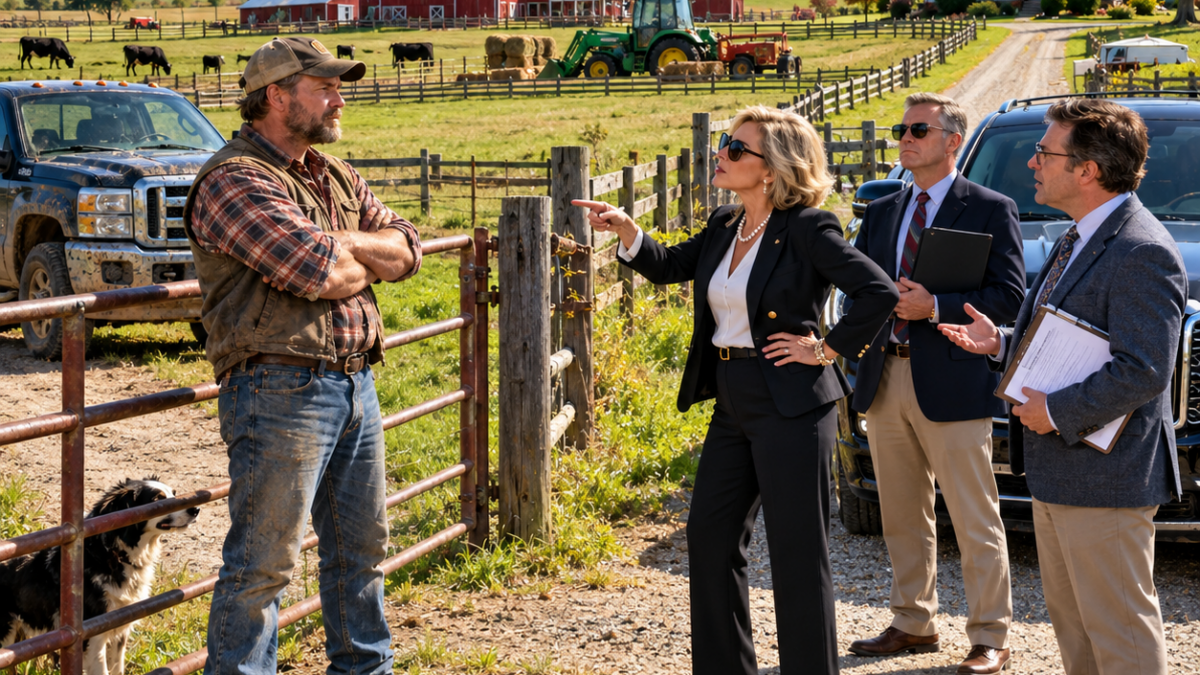
The HOA president drove a golf cart across my pasture, nailed a violation notice to my sixty-year-old barn, and told me forty acres I had legally bought outside her subdivision now belonged to her board.
When I showed her the certified plat proving she was wrong, she threatened a lien, locked the access road to my cattle, and announced in front of sixty neighbors that she was prepared to foreclose on my farm.
What Karen Bradford didn’t know was that I had spent nearly twenty years working with county property records—and buried inside her own HOA archives was a twenty-one-year-old document that was about to turn her demand for dues into something much more serious than a boundary dispute.
I heard the golf cart before I saw it.
The engine had a thin electric whine that carried surprisingly well across open pasture, followed by the crunch of tires over gravel.
My gravel.
I was in the machine shed checking a hydraulic line on my tractor when I heard it coming up from the east side of the property.
At first, I assumed it was Walt Higgins.
Walt lived across the boundary in the subdivision next door and occasionally drove his cart over to talk when he saw me working outside.
Then I stepped out of the shed and realized the cart wasn’t coming from Walt’s place.
It was cutting directly across my pasture.
Two people were inside.
A woman was driving.
A man sat beside her holding a clipboard.
Neither one slowed down when they saw me.
The cart rolled over a shallow rise near the fence line, crossed grass that had belonged to the Miller family since before most of the subdivision existed, and stopped beside my barn.
The woman jumped out first.
She was maybe in her late fifties, neatly dressed in khaki pants and a white polo embroidered with a dark green logo.
BRADFORD HILLS COMMUNITY ASSOCIATION.
The name meant something to me only because I had seen the subdivision signs along County Road 9.
I didn’t live in Bradford Hills.
That was one of the main reasons I had bought the farm.
The woman pulled out her phone and began taking pictures.
Fence.
Barn.
Driveway.
Pasture.
Then me.
The man climbed out carrying a hammer.
Before I could even reach them, he pressed an orange sheet of paper against the barn door and drove a nail into a plank that had been hanging there since Kennedy was president.
One strike.
Two.
Three.
I stopped about fifteen feet away.
“Can I help you?”
The woman lowered her phone.
“You Nathaniel Reyes?”
“I am.”
“You bought the old Miller property.”
“Six months ago.”
She nodded as if that confirmed something for her.
“Then you’ve received our notices.”
“I haven’t received anything from you.”
“Well, this is your formal notice.”
I looked at the orange paper.
VIOLATION NOTICE.
HOA DUES OUTSTANDING.
There was an account number beneath it and an amount.
$1,875.
I looked back at her.
“I don’t belong to an HOA.”
The man with the hammer gave a short laugh.
Not a friendly one.
The woman didn’t laugh.
She looked almost disappointed that I had forced her to explain something she considered obvious.
“Every property from this road to the highway falls under the Bradford Hills assessment district.”
“No.”
Her eyebrows rose.
“No?”
“My parcel is outside your subdivision.”
“That’s not correct.”
“It is.”
She folded her arms.
“I’m Karen Bradford. I’m president of the association. I’ve been president for nine years.”
That introduction seemed designed to settle the question.
It didn’t.
“I’m Nathaniel Reyes,” I said. “I’ve owned this farm for six months, and the deed has been recorded with the county since 1978.”
Her expression hardened.
“The board approved annexation of the surrounding parcels.”
“Not this one.”
“All contiguous properties are subject to community obligations.”
“That isn’t how property law works.”
The man tapped the orange notice with one finger.
“Thirty days.”
I looked at him.
“For what?”
“To bring the account current.”
“And if I don’t?”
Karen answered.
“The board files a lien.”
For the first time, irritation pushed through the calm I had been trying to maintain.
“You’ve driven onto private property without permission, nailed something to my barn, and now you’re threatening a lien against land that isn’t inside your association.”
Karen smiled.
Barely.
“You can make that argument at the board meeting.”
“It’s not an argument.”
She lifted her phone again.
Click.
Another photograph.
This time I was in it.
Standing beside my own barn.
“Your account is already delinquent,” she said. “The longer you resist, the more expensive this becomes.”
I stared at her.
Behind her were forty acres I had bought after months of research.
Roughly half was pasture.
There were wooded strips near the north boundary, the farmhouse, the barn, a equipment shed, a pond, and a narrow access route connecting the rear acreage to County Road 9.
I had not bought it casually.
After almost twenty years of dealing with deeds, plats, easements, legal descriptions, parcel numbers, recording dates, and boundary disputes, I had checked everything myself before closing.
The Miller farm was outside Bradford Hills.
Not near the edge.
Not ambiguously overlapping.
Outside.
“I’m going to ask you once,” I said.
Karen tilted her head.
“Get off my property.”
The man looked at her.
She didn’t answer immediately.
Then she slid her phone into her pocket.
“We’ll see you at the meeting.”
“No, you won’t.”
“You’ll want to attend.”
“I’ll decide where I want to attend.”
The man’s mouth tightened.
Karen walked back to the golf cart.
“We’ve dealt with difficult owners before, Mr. Reyes.”
I almost smiled.
“I’ve dealt with bad paperwork before.”
She didn’t understand the difference.
Not yet.
They climbed into the cart.
The electric motor hummed.
Then they drove away across my pasture exactly the way they had arrived, carving two faint tracks through grass they had no right to be on.
I stood there until I couldn’t hear the cart anymore.
Then I walked to the barn.
The orange notice fluttered in the afternoon wind.
I pulled the nail.
The paper came loose.
There were four fresh marks in the wood.
Inside the barn, hanging on the office wall, was a framed copy of the old Miller deed.
The original was secure with my closing papers.
The framed copy was mostly decoration.
But the legal description printed on it was real.
And it told a very different story from Karen Bradford’s.
I took the violation notice inside.
Placed it on my desk.
Then I sat down and read every word.
Twice.
There was plenty of language designed to sound official.
“Communitywide assessment obligation.”
“Delinquent dues.”
“Enforcement authority.”
“Failure to comply.”
“Lien remedies.”
What wasn’t there was more interesting.
No deed restriction.
No covenant reference attaching my parcel to Bradford Hills.
No instrument number.
No annexation document.
No plat reference.
No legal description.
Nothing tying Parcel 18-447-A—the Miller farm—to the HOA at all.
Just a demand for money.
I slept badly that night.
Not because I was afraid of Karen Bradford.
Paperwork had stopped frightening me a long time ago.
What kept me awake was the arrogance of it.
I kept replaying her voice.
Every property from here to the highway.
No exceptions.
People sometimes mistake certainty for knowledge.
I had watched it happen for years at the county recorder’s office.
A landowner would walk in furious because a neighbor had moved a fence.
A developer would insist an easement existed because someone had always used the road.
A buyer would swear a shed belonged to him because it was on “his side” of a row of trees.
Then somebody opened the actual records.
Deeds don’t care who sounds confident.
Plat maps don’t care who has the louder attorney.
Recording dates don’t care who has been president of an HOA for nine years.
The next morning, I walked the east boundary.
Walt Higgins was already outside.
He was seventy-one, gray-haired, narrow-shouldered, and always wore an old canvas jacket unless temperatures were high enough to make it medically impossible.
He spotted me near the fence.
“They get you?”
I stopped.
“Who?”
He laughed.
“The board.”
“You knew?”
“Knew what?”
“That they’d come onto my farm.”
His smile vanished.
“No. But Karen’s been talking about the Miller place ever since you moved in.”
“What has she been saying?”
“That the farm should’ve been paying assessments years ago.”
I leaned against the fence post.
“Should’ve?”
Walt nodded.
“She thinks because your driveway uses that road down there and your property touches the subdivision, you’re part of it.”
“I’m not.”
“I figured.”
“You figured?”
He shrugged.
“Old Miller used to hate the HOA.”
That interested me.
“You knew him?”
“Everybody did. Mean old son of a gun, but he was honest. Used to say he’d burn his barn before joining Bradford Hills.”
I looked back toward my barn.
Apparently the barn had survived.
The argument had not.
“What happens when people challenge Karen?”
Walt laughed without humor.
“You want the long version or the short version?”
“Short.”
“They pay.”
“What if they’re right?”
“They still pay.”
He pointed at his mailbox.
“Seventy-five dollars.”
“For what?”
“Wrong green.”
I thought he was joking.
He wasn’t.
“Wrong green?”
“Board approved forest green. Mine was apparently hunter green.”
“Those are almost the same color.”
“That’s what I said.”
“What happened?”
“They doubled the fine.”
“You paid?”
“Eventually.”
“Why?”
Walt stared at me like I had asked why he wore shoes.
“Because fighting seventy-five dollars would’ve cost me a thousand.”
That sentence explained more about Bradford Hills than anything Karen had told me.
Walt went on.
“She fined the Harris family for leaving Christmas lights up until January fifth. Basketball hoop three doors down got hit because it stayed beside the driveway overnight. Simmons got a notice because his grass was half an inch too high.”
“Half an inch.”
“Karen measured it.”
“Of course she did.”
“And if you don’t pay, they threaten liens.”
“Do they actually file them?”
“Sometimes.”
That got my attention.
“How often?”
“Enough.”
Walt looked toward the subdivision.
“Nobody likes her.”
“Then why is she president?”
“Because nobody wants the job enough to fight her for it.”
That was also familiar.
Power rarely requires majority enthusiasm.
Sometimes it just requires everybody else being tired.
The second notice arrived that afternoon.
Certified mail.
Same association letterhead.
Same account number.
Now there was an additional $250 administrative penalty.
I sat at the kitchen table and read it carefully.
Still no legal basis.
That was when I decided memory wasn’t enough.
I had spent too many years telling property owners that “I remember” was not a legal description.
I needed certified records.
The county building was twenty-seven minutes away.
I hadn’t worked there in years, but walking through the front doors felt strange enough that I slowed down.
Same stone lobby.
Same fluorescent lights.
Different faces behind the counter.
I filled out the request for the 1978 deed and original subdivision plat.
The clerk looked at the date.
“Older records can take a while.”
“That’s fine.”
“Maybe a week.”
“I’ve waited longer for worse news.”
She smiled.
I didn’t explain.
Nine days later, an envelope arrived.
I opened it in the barn office.
First came the deed.
Then the plat.
I unfolded the map across my desk.
There it was.
Bradford Hills subdivision outlined in dark recorded lines.
My property sat to the west.
Forty acres.
Clearly separate.
The subdivision line ran along the eastern side of the Miller parcel and never crossed it.
No annexation notation.
No amended plat.
No recorded extension.
Nothing.
I checked the recording references again.
Same conclusion.
Karen Bradford was wrong.
At that point, I still allowed for the possibility that she genuinely didn’t know.
HOA boards aren’t staffed with surveyors.
People inherit old records they don’t understand.
Mistakes happen.
So when the next monthly meeting came around, I went.
About forty residents sat in folding chairs inside the clubhouse.
Karen sat behind a long table with three other board members.
A gavel rested in front of her.
Of course it did.
I took a seat near the back.
The meeting began with landscaping contracts, pool maintenance, late assessments, and several violation appeals.
One man tried to argue against a $150 fine for storing trash cans beside his garage.
Karen interrupted him three times.
“The rule is clear.”
“But you couldn’t see them from the street.”
“The rule is clear.”
“They’re behind a hedge.”
“The rule is clear.”
Eventually, he sat down.
Karen moved on.
That was when I understood how these meetings worked.
The board wasn’t there to discuss disputes.
It was there to announce conclusions.
Resident comments opened near the end.
I stood with my certified deed and plat.
“My name is Nathaniel Reyes. I own the old Miller farm on County Road 9.”
Karen’s expression changed immediately.
“Yes, Mr. Reyes. We’re familiar with your matter.”
“I’ve received three notices claiming my farm owes HOA dues.”
“You do.”
“I’ve brought certified county records.”
I walked forward.
Several residents turned to watch.
I placed the deed and plat on the board table.
“Here’s the recorded deed. Here’s the original subdivision plat.”
Karen looked down.
She barely glanced at the deed.
She didn’t unfold the plat.
“Paperwork doesn’t override community obligations.”
A few people shifted in their chairs.
I kept my voice calm.
“This isn’t random paperwork. It’s the recorded legal boundary.”
“The board has determined that your parcel falls within the community assessment area.”
“On what recorded instrument?”
Her face tightened.
“Excuse me?”
“What document?”
“We’ve already established—”
“Annexations are recorded. Boundary changes are recorded. Covenants attaching land to an HOA are recorded. Show me the document.”
Karen leaned back.
“Every property between County Road 9 and the highway participates.”
“That’s not a legal description.”
“This board determines the community.”
“No.”
A quiet murmur passed through the room.
I pointed at the folded plat.
“The county determines what was recorded. The deed determines what I bought. Your governing documents determine what land is bound by the HOA. You don’t get to redraw the boundary by vote.”
Karen’s cheeks colored.
“The board’s attorney disagrees.”
“Great. Ask your attorney for the instrument number.”
She stared at me.
“You have until the fifteenth to bring your account current.”
“So you’re not going to look at the plat?”
“I’ve seen enough.”
That was the moment everything changed for me.
If Karen had unfolded the map, studied it, and argued over interpretation, I might still have believed this was ignorance.
But she wanted nothing to do with the evidence.
A person who thinks she’s right usually wants to prove it.
Karen wanted the proof removed from her table.
“If you don’t pay,” she continued, “the matter will escalate.”
“I understand.”
“I’d hate for that to happen.”
She looked like she would enjoy it very much.
I gathered my records.
As I did, I noticed one board member watching me.
His nameplate read R. OSTRANDER.
Older man.
Silver hair.
Glasses.
Unlike Karen, he was staring at the folded plat.
And there was something in his expression.
Recognition.
Not curiosity.
Recognition.
He noticed me looking at him and dropped his eyes.
That stayed with me.
I returned to my seat.
The meeting continued.
I heard almost none of it.
Three days later, I submitted a public records request for archived board minutes.
Nine years under Karen.
And several years before that.
If the Miller farm had ever been discussed, I wanted to see it.
The management company took eleven days.
Then forty-seven scanned pages landed in my email.
Some were crooked.
Some were faded.
Several had handwritten notes.
I printed everything.
That night, I sat at my kitchen table with coffee and read line by line.
Page twelve.
Pool repairs.
Page nineteen.
Roofing standards.
Page twenty-four.
Drainage easement.
Then page thirty-one.
March 2003.
I almost skipped it.
Then I saw two words.
Miller Farm.
I stopped.
Read the paragraph.
Then read it again.
BOARD DISCUSSED STATUS OF FORMER MILLER FARM PARCEL, COUNTY ROAD 9.
CONFIRMED EXCLUDED FROM PLATTED SUBDIVISION BOUNDARY PER ORIGINAL 1978 RECORDING.
NO FURTHER ACTION REQUIRED.
Six lines.
That was all.
Six lines changed the entire dispute.
The HOA had known.
Not Karen personally in 2003.
She wasn’t on the board then.
But the association knew.
The governing organization had documented the exact boundary question twenty-one years earlier and confirmed that the Miller property was outside the HOA.
This was no longer two people interpreting a map differently.
I called Walt.
“They knew.”
“What?”
“The farm. They knew it wasn’t part of the HOA.”
“How do you know?”
“Their own minutes.”
He was quiet.
“You’re kidding.”
“March 2003.”
Walt whistled.
Then he said, “Talk to Doris Faulner.”
“Who?”
“Corner house on Brookfield. Eighty-three. Been here forever.”
The next afternoon, I drove over.
Doris answered after my second knock.
She was small, sharp-eyed, and suspicious until I mentioned the Miller farm.
Then she laughed.
“That place?”
“You remember it?”
“Of course.”
“Was it ever part of Bradford Hills?”
“Absolutely not.”
No hesitation.
“You’re sure?”
“Son, I watched them build half those houses.”
She invited me inside.
Her living room smelled faintly of coffee and furniture polish.
Old photographs covered one wall.
“Frank Miller wouldn’t join,” she said. “Developers approached him twice. Maybe three times.”
“What did he say?”
She grinned.
“Frank had colorful language.”
“I’ve heard.”
“He told them he’d rather let cows live in his kitchen than let an HOA tell him what to do with his barn.”
I laughed.
“That sounds consistent.”
“Everybody knew that farm was separate.”
“Karen says otherwise.”
Doris’s smile faded.
“Karen says plenty.”
“Did the old board know?”
“Yes.”
“You’re certain?”
“Of course. There was a dispute years ago over drainage. They checked the map then.”
March 2003.
Exactly.
I thanked her.
Before I left, she touched my arm.
“Don’t let them scare you.”
“I’m not scared.”
“Good.”
She looked toward the window.
“Too many people around here are.”
I understood that better now.
I went home and built a file.
Certified deed.
Certified plat.
2003 board minutes.
All three violation notices.
Certified mail receipts.
My notes from the meeting.
Photographs of the orange notice on the barn.
I labeled every item.
Old habits.
For years, my work had taught me one thing above almost everything else:
Memory argues.
Documents testify.
I still didn’t confront Karen.
Not yet.
I wanted to see what she would do when she believed I had run out of options.
The answer came on a Thursday morning.
I had a veterinarian scheduled at ten.
Several cattle needed to be moved from the rear pasture, which meant hauling equipment down the access road.
The road ran near the edge of Bradford Hills before splitting toward my property.
I had used it since the day I bought the farm.
The Miller family had used it for decades.
A recorded easement established the right of access.
That morning, the gate was chained shut.
A new brass padlock hung from it.
I stopped my truck.
For several seconds, I stared through the windshield.
Then I got out.
Zip-tied to the chain was a laminated card.
ACCESS RESTRICTED.
CONTACT HOA MANAGEMENT OFFICE.
ACCOUNT MUST BE CURRENT FOR COMMUNITY ROAD ACCESS.
I actually laughed.
One short laugh.
Not because it was funny.
Because sometimes arrogance becomes so complete that disbelief is the only response left.
I called the sheriff’s non-emergency number.
A deputy arrived about forty minutes later.
By then, the vet had called twice.
The cattle were still where they shouldn’t have been.
The deputy was younger than I expected.
He looked at the sign.
Then at me.
“HOA dispute?”
“Apparently.”
“Do they own the road?”
“No.”
“You sure?”
I handed him the easement information.
He read it.
Then called the county surveyor.
We waited.
Ten minutes later, he hung up.
“You’re right.”
“I know.”
He smiled.
“You used to work county records?”
“Almost twenty years around property filings.”
“That explains the folder.”
He pointed at the documents under my arm.
“This easement is recorded for public and landowner access. HOA doesn’t have authority to block it.”
“Can you put that in the report?”
“Absolutely.”
I called the association.
Karen answered.
“Nathaniel.”
Not Mr. Reyes anymore.
That told me she had been expecting me.
“You locked the easement.”
“The road crosses association-maintained property.”
“It’s a recorded easement.”
“Access privileges can be restricted for delinquent accounts.”
“I’m standing beside a deputy who just confirmed with the county surveyor that you have no authority to restrict this road.”
Silence.
Small.
But noticeable.
Then Karen said, “Pay the assessment and we’ll talk about the gate.”
The deputy was close enough to hear.
His eyebrows rose.
I looked at him.
He looked back at me.
That was the moment the whole matter clarified itself.
Before, Karen had demanded money based on a false claim.
Now she had physically interfered with access to my property and directly tied restoration of that access to payment.
“Karen.”
“What?”
“You’re going to remove the lock.”
“When your account—”
“No.”
I kept my voice quiet.
“The deputy is documenting this conversation.”
Another silence.
“Do whatever you think you need to do.”
She hung up.
The deputy shook his head.
“She always like that?”
“I’ve known her about six weeks.”
“Feels longer, doesn’t it?”
Twenty minutes later, after confirming the easement again, he authorized removal of the obstruction and helped cut the lock.
The gate opened.
I got my equipment through.
The vet arrived irritated but still willing to work.
I lost most of a morning.
But I gained something more useful.
An independent law-enforcement report.
That afternoon, the deputy emailed me a copy.
Three paragraphs.
Date.
Time.
Location.
County surveyor confirmation.
Description of the lock.
HOA signage.
My complaint.
The recorded easement.
I printed it.
Added it to the file.
That evening I spread everything across my kitchen table.
The original violation.
Second notice.
Third notice.
Deed.
Plat.
2003 minutes.
Certified mail.
Gate photograph.
Sheriff’s report.
And another envelope that had arrived two days earlier.
NOTICE OF INTENT TO FILE LIEN.
I looked at the documents for a long time.
Individually, each item could be explained away.
Overzealous board.
Poor recordkeeping.
Boundary confusion.
Administrative mistake.
But together?
Together they told a different story.
They had demanded money.
I showed them the boundary.
They refused to look.
Their own old minutes confirmed the boundary.
They continued anyway.
They threatened a lien.
Then they blocked my access and demanded payment before restoring it.
That wasn’t confusion anymore.
It was a pattern.
I called Christine Park the following morning.
Christine had spent twelve years handling civil fraud, real property disputes, and title litigation.
A former coworker had recommended her.
Her first question was simple.
“What exactly are you trying to accomplish?”
“I want them off my property.”
“Anything else?”
“I want the lien stopped.”
“Anything else?”
I looked at the folder.
“I want the record to show they knew.”
That changed her tone.
“You have evidence they knew?”
“I have their own minutes.”
“Send me everything.”
I did.
She called back two days later.
“Nathaniel.”
“Yeah?”
“Don’t communicate with the board anymore unless I tell you to.”
“That good?”
“That bad.”
“What are you thinking?”
“Potential fraudulent assessment. Improper lien action. Interference with a recorded easement. Possibly more depending on state law and what the board knew.”
“Karen wasn’t on the board in 2003.”
“Doesn’t matter by itself. The association had notice. The bigger question is whether Karen later learned about it and proceeded anyway.”
I thought about Ostrander.
His face when he saw my plat.
“I think someone on the current board knew.”
“Why?”
I told her.
Christine paused.
“Name?”
“Robert Ostrander.”
“I’ll look into it.”
The fraud complaint was filed at 9:47 on a Wednesday morning.
I remember the time because Christine called while I was sitting in my truck outside the bank.
“You ready?”
“I thought you already filed.”
“I’m about to.”
“Do it.”
“Done.”
That was it.
No music.
No courtroom.
No speech.
A clerk stamped a case number somewhere downtown while I watched a woman feed deposit slips into an ATM.
Three hours later, Bradford Hills held its monthly meeting.
I went.
Not because Christine needed me there.
Because the board planned to formalize the lien.
And I wanted to hear Karen explain herself on the record.
The clubhouse was packed.
Maybe sixty people.
Word had spread.
Walt sat near the back.
Doris was two rows ahead.
I nodded to both of them and took a seat.
Karen called the meeting to order at six.
She looked completely comfortable.
That fascinated me.
She had no idea that a fraud complaint naming her and the association already existed.
“As many of you know,” she began, “the board has been working to resolve an ongoing compliance issue involving the former Miller farm property.”
Several people looked at me.
“The current owner has refused to meet his community assessment obligations.”
Refused.
Not disputed.
Refused.
Language matters.
Karen continued.
“This creates an unfair burden on every resident who does comply.”
A woman near the window nodded.
“Every homeowner pays his or her share. No individual can simply opt out because they disagree with community policy.”
I almost admired the construction.
If you didn’t know the facts, I sounded selfish.
Karen sounded principled.
“The board has therefore authorized filing a formal lien against the property.”
Murmurs.
Karen paused.
Then looked directly at me.
“If the account remains unresolved for ninety days following lien filing, the association is prepared to pursue foreclosure remedies.”
The word changed the room.
Foreclosure.
Even Walt looked stunned.
I opened the small notebook on my lap and wrote:
FORECLOSURE.
Then underlined it.
Karen kept talking.
“This is not retaliation. It is policy.”
I said nothing.
That bothered her.
I could tell.
She expected anger.
She wanted me to stand.
Argue.
Raise my voice.
Give her something she could put into the minutes.
Mr. Reyes became disruptive.
Mr. Reyes threatened the board.
Mr. Reyes refused reasonable discussion.
I gave her none of it.
When resident comments opened, she looked toward me.
I stayed seated.
Walt caught my eye.
He silently mouthed, “Nothing?”
I shook my head.
Karen eventually moved on.
Parking.
Pool rules.
Decorative landscaping.
The meeting ended at 7:14.
Outside, Walt caught up with me.
“What the hell are you doing?”
“Going home.”
“She just threatened foreclosure.”
“I heard.”
“And you’re not going to say anything?”
“Already did.”
“When?”
“This morning.”
He stared at me.
I smiled.
“Good night, Walt.”
Three weeks later, the hearing was scheduled.
Not a dramatic courtroom.
No jury.
No mahogany bench towering over us.
A county civil conference room with beige walls, bad fluorescent lighting, a long table, and a hearing examiner who looked as though he had spent twenty years listening to people explain why recorded documents didn’t mean what they plainly said.
Karen arrived with an attorney.
The moment I saw him, I knew she had finally hired someone serious.
He carried two binders.
Christine carried one.
That told me almost everything.
We sat.
Karen didn’t look at me.
The examiner called the matter.
Christine stood.
“This case is much simpler than the volume of correspondence suggests.”
She placed my certified deed on the table.
Then the original plat.
She unfolded the map.
Smoothly.
Carefully.
The same map Karen had refused to open in the clubhouse.
“The plaintiff owns approximately forty acres commonly known as the former Miller farm.”
Christine pointed.
“The recorded Bradford Hills boundary is here.”
Then she moved one finger.
“Mr. Reyes’s property begins here.”
A clean separation.
No overlap.
“The farm has never been within the platted subdivision.”
The examiner leaned forward.
Karen’s attorney studied the map.
Karen kept her hands flat on the table.
Christine continued.
“No annexation instrument has been produced. No covenant binding this parcel to the association has been produced. No deed restriction requiring Mr. Reyes to become an association member has been produced.”
Karen’s attorney shifted.
Christine placed the violation notices beside the map.
“Nevertheless, the association assessed dues, penalties, and threatened a lien.”
The examiner looked at Karen’s lawyer.
“Counsel?”
He cleared his throat.
“The association’s position is that the property has historically benefited from community infrastructure and falls within the functional service area.”
Christine didn’t react.
“Benefits don’t create recorded covenants.”
“No one is suggesting they do.”
“Then produce the instrument.”
He didn’t.
The examiner turned to Christine.
“Continue.”
She placed another document down.
March 2003.
I watched Karen.
For the first time all morning, something changed in her face.
Not much.
A tightening around the mouth.
Christine read the relevant entry.
“Board discussed status of former Miller Farm parcel, County Road 9. Confirmed excluded from platted subdivision boundary per original 1978 recording. No further action required.”
The examiner held out a hand.
Christine passed him the page.
He read it silently.
Then looked up.
“This is from the association’s own minutes?”
“Yes.”
“Produced by the association?”
“Yes.”
Karen’s lawyer leaned toward her.
Whispered something.
She didn’t respond.
The examiner looked at Karen.
“Ms. Bradford, were you on the board in 2003?”
“No.”
“Were you aware of this entry?”
Karen paused.
“The board has thousands of pages of historical records.”
“That wasn’t my question.”
Another pause.
“I don’t recall reviewing that specific entry.”
Christine said nothing.
She didn’t need to.
The examiner wrote something.
Then Christine placed a photograph of the chained gate on the table.
The sheriff’s report followed.
“After Mr. Reyes disputed the assessments, the association physically blocked a recorded access easement serving his farm.”
Karen’s attorney raised his head.
“We contest the characterization—”
Christine passed him the county easement record.
He stopped.
“The sheriff’s deputy verified the easement with the county surveyor while present at the scene.”
The examiner read the report.
Christine continued.
“During a telephone call witnessed by the deputy, Ms. Bradford stated that access would be discussed after Mr. Reyes paid the disputed assessment.”
Karen finally spoke.
“That’s not exactly what I said.”
I looked at her.
Christine did not.
“Then we’ll rely on the deputy’s report.”
Karen’s attorney touched her arm.
A warning.
Stop.
She did.
The examiner continued through the file.
Notice after notice.
Assessment after assessment.
Lien threat.
Then Christine said, “We have one additional witness.”
Robert Ostrander entered.
The same board member who had watched my plat in the clubhouse.
He looked miserable.
Karen turned toward him.
For the first time, she looked afraid.
Ostrander sat.
The examiner swore him in.
Christine began.
“Mr. Ostrander, how long have you served on the Bradford Hills board?”
“Four years.”
“Did the board ever discuss the Miller parcel before Mr. Reyes purchased it?”
Ostrander looked at Karen.
Then down at his hands.
“Yes.”
“When?”
“About a year before.”
Christine waited.
He swallowed.
“I found a reference in archived files.”
“What reference?”
“The 2003 minutes.”
The room became very still.
“What did you do?”
“I brought it to Karen.”
Karen’s attorney closed his eyes for half a second.
Christine’s voice remained calm.
“What did you tell her?”
“That the old farm might not be part of the HOA.”
“Might not?”
“I hadn’t pulled the plat yet.”
“What did Ms. Bradford say?”
Ostrander rubbed his palms together.
“She said the current board position superseded old minutes.”
“And then?”
“She told me to drop it.”
Karen’s lawyer stopped taking notes.
Christine let the silence work.
“When Mr. Reyes presented a certified plat at the later board meeting, did you recognize what it was?”
“Yes.”
“Did you believe it supported the concern you previously raised?”
“Yes.”
“Did the board seek legal review before threatening a lien?”
Ostrander looked toward Karen again.
“No.”
“Before blocking the easement?”
“No.”
“Before announcing potential foreclosure?”
“No.”
Karen suddenly leaned toward her lawyer.
Whispered urgently.
He shook his head.
The examiner raised one hand.
“Ms. Bradford, you’ll have an opportunity through counsel.”
She sat back.
I thought about the first afternoon.
The golf cart.
The camera.
The hammer.
The orange paper curling against my barn door.
Karen had looked so certain.
That’s not up to you anymore.
This is HOA property now.
Thirty days or we file a lien.
Now the county examiner had the actual map in front of him.
The deed.
The board’s own admission from 2003.
A current board member testifying that Karen had been warned.
And a sheriff’s report documenting what happened after I refused to pay.
Confidence had run into evidence.
Evidence was winning.
Karen’s attorney eventually tried to narrow the issue.
He argued that the board believed service-area obligations could support an assessment.
Christine asked for the provision.
He couldn’t identify one binding my property.
He suggested old meeting minutes might not reflect current interpretation.
Christine pointed out that recorded property boundaries don’t change because a later board interprets them differently.
He argued the gate closure was an administrative misunderstanding.
Christine read the deputy’s account connecting access directly to payment.
Every path led back to the same problem.
They had no document giving them jurisdiction.
And evidence showed they knew there was a serious boundary issue before they tried to collect anyway.
After almost two hours, the examiner called a short recess.
I walked into the hallway.
Walt was there.
So was Doris.
I hadn’t known they were coming.
“How’d you get in?”
“Public hearing,” Doris said.
She looked offended that I had asked.
Walt shook his head.
“She knew?”
“Looks that way.”
“All this time.”
“Looks that way.”
Doris crossed her arms.
“I told you she was trouble.”
“You told me everybody knew the farm was separate.”
“Same thing.”
The door opened.
We went back inside.
The examiner sat down.
He organized the documents into a neat stack.
Then he spoke.
His voice was flat.
No drama.
Which somehow made the words heavier.
“Based on the evidence presented, the recorded subdivision plat, the deed history, the association’s own prior meeting minutes, the witness testimony regarding actual notice, and the law-enforcement documentation concerning interference with the recorded easement, this office finds substantial evidence supporting fraudulent assessment and improper lien practices.”
Karen went motionless.
The examiner continued.
“The purported assessment against the Miller Farm parcel lacks demonstrated legal foundation.”
Her lawyer stared at the table.
“Any lien arising from that assessment is subject to invalidation.”
Karen’s fingers curled.
“This matter will be referred to the county attorney for additional compliance review.”
That was the first time I saw Karen Bradford lose control of her face.
Only for a second.
But it happened.
The confidence vanished.
No sneer.
No little smile.
No president’s voice.
Just the realization that the process had moved beyond her.
She had spent years using paperwork to frighten other people.
Now paperwork belonged to someone else.
Outside the third-floor window, I could see the highway.
Somewhere beyond it was County Road 9.
My pasture.
My barn.
The four tiny nail holes in the door.
I didn’t feel triumphant.
Mostly I felt tired.
Eleven days later, Christine called.
I was repairing a fence rail.
“It’s official.”
I set down the drill.
“Tell me.”
“Assessment voided.”
I exhaled.
“Lien authority rejected?”
“Completely.”
“Good.”
“There’s more.”
I waited.
“The county confirmed the fraudulent assessment finding. Compliance review is moving forward against the board. Your legal fees are being assessed against the association, along with a civil penalty.”
“And Karen?”
“Removed from the board under the enforcement resolution.”
I leaned against the fence.
Christine continued.
“She’s also barred from serving in HOA leadership within the county under the settlement terms tied to the compliance action.”
For a moment, I said nothing.
“You there?”
“Yeah.”
“Thought you’d be happier.”
“I am.”
I looked across the pasture.
“It’s just quieter than I expected.”
“Good outcomes usually are.”
That sounded like Christine.
The formal notice appeared publicly three days later.
By Saturday, half of Bradford Hills seemed to know.
Walt arrived carrying a six-pack.
He leaned against my fence.
“Twenty-three years.”
“What?”
“I’ve lived here twenty-three years.”
“I know.”
“I paid every stupid fine.”
“Most of them were probably legitimate under your covenants.”
“That’s supposed to make me feel better?”
“No.”
He handed me a beer.
“I never once looked.”
“At what?”
“Anything. Rules. Deed. Plat. I just assumed if the board mailed it, they could do it.”
“That’s why the system worked.”
He frowned.
“The bad system?”
“The board’s rules were real in a lot of cases. That’s what gave the made-up parts credibility.”
Walt thought about that.
Then nodded.
“Doris requested her property records.”
“Good.”
“Three other families, too.”
“Also good.”
“Harris family is talking to a lawyer about those Christmas fines.”
“That might be a stretch.”
He laughed.
“Let them have their moment.”
I took a drink.
“You know what everybody’s saying?”
“No.”
“That you took down Karen.”
I shook my head.
“I didn’t.”
“Come on.”
“She drove onto land she didn’t control, demanded money she couldn’t legally collect, ignored a plat, ignored old minutes, blocked an easement, threatened a lien, and then promised foreclosure in front of sixty witnesses.”
Walt grinned.
“So?”
“I just kept the paperwork.”
He raised his beer.
“To paperwork.”
I laughed.
“That’s the saddest toast I’ve ever heard.”
The HOA scheduled a special election two weeks later.
I didn’t go.
Whatever Bradford Hills did next wasn’t my business.
That was the whole point.
At 7:43 that evening, Walt texted me.
OSTRANDER WON.
UNOPPOSED.
Five minutes later:
FIRST MOTION: REVIEW ALL OPEN FINES.
Then:
SECOND MOTION: NO MORE PROPERTY ACTION WITHOUT ATTORNEY REVIEW.
I wrote back:
Sounds expensive.
He replied:
CHEAPER THAN KAREN.
Fair enough.
The gate stayed open.
For a while, I left the cut chain hanging there as a reminder.
Then one cold morning in November, I removed it.
The brass lock.
The chain.
The laminated HOA notice.
I put everything in a paper bag and delivered it to the county as part of the evidence file.
When I got home, I opened the gate all the way.
The wind pushed it gently against the fence.
No lock.
No chain.
No notice.
Just access.
The way it had been recorded.
About a week after Ostrander became president, I drove into town and visited the copy shop.
I printed one page on heavy paper.
The county’s final ruling.
Case number.
Findings.
Formal language.
No jurisdiction over my property.
Assessment invalid.
Lien void.
Fraudulent collection finding sustained.
I brought it back to the farm.
Walked into the barn.
Stopped at the door.
The four nail holes were still visible.
Same height.
Same pattern.
I held the ruling over them.
For six months, I had resisted doing anything theatrical.
No angry speech.
No sign at the road.
No confrontation in the clubhouse.
No social media rant.
No public humiliation.
That morning, I allowed myself one small ceremony.
I tacked the county ruling exactly where Karen’s orange violation notice had been.
Same barn.
Same wood.
Same property.
Different paper.
I stepped back.
The first notice had said I owed money to an association my land had never joined.
The document replacing it said what the records had said all along.
They had no claim.
People sometimes ask whether I sued because of the money.
I didn’t.
The original dues demand was irritating, but I could have paid it.
That’s exactly why boards like Karen’s get away with things.
The amount is usually small enough that surrender is rational.
A few hundred dollars.
A thousand.
Maybe two.
Less than the cost of hiring a lawyer.
So people pay.
Then the next notice arrives.
And the next.
And eventually everyone forgets that authority is supposed to come from somewhere.
I sued because she knew the boundary was in dispute and chose coercion anyway.
I sued because a board that couldn’t produce a single document attaching my land to its covenants still believed it could threaten my title.
I sued because they locked an easement I needed to reach my cattle and tried to turn access to my own property into leverage for a debt they had no right to collect.
And I sued because when I placed the answer in front of Karen Bradford, certified and recorded, she wouldn’t even unfold it.
That told me almost everything.
People acting in good faith can be wrong.
They make mistakes.
They read things badly.
They misunderstand old surveys.
They rely on bad advice.
But when an honest person is shown evidence that they may be wrong, they look.
Karen wouldn’t look.
Because the question she cared about wasn’t whether the farm belonged to Bradford Hills.
The question was whether she could make me behave as though it did.
For a while, she probably thought she could.
I was the new owner.
One man.
She had ninety-six households behind her, an attorney on retainer, a management company, fines, a lien process, and nine years of residents learning that resistance cost more than compliance.
On paper, she had leverage.
The problem was that I understood a different kind of paper.
The kind filed at the courthouse.
The kind stamped with recording dates.
The kind that existed before Karen ever owned a gavel.
The farm became quiet again.
Real quiet.
Not the tense silence of waiting for another certified letter.
Farm quiet.
Cattle moving through grass.
Wind against the barn.
A tractor starting badly on cold mornings.
Crows on the fence posts.
Rain hitting the metal roof.
By late November, frost settled over the pasture before sunrise.
One evening, I walked down toward the access road.
The sun was dropping low behind the trees, turning everything orange.
From the gate, I could see the subdivision boundary about a hundred yards east.
Invisible on the ground unless you knew where to look.
Perfectly clear on the recorded plat.
That’s the strange thing about boundaries.
They can be invisible and still be real.
Karen had treated the absence of a physical wall as permission.
No fence separating legal jurisdictions.
No giant sign saying HOA ENDS HERE.
Just a line on a map.
But that line mattered.
It had mattered in 1978.
It mattered in 2003.
It mattered when I bought the place.
It mattered when she crossed it in a golf cart.
It mattered when she nailed that orange notice to my barn.
And it mattered when the county finally put in writing that she had no authority on my side of it.
Doris called me one afternoon not long after that.
“I got my plat.”
“Congratulations.”
“Don’t be sarcastic.”
“I wasn’t.”
“I’ve lived here forty-one years and never looked at it.”
“What’d you find?”
“My property is exactly where I thought it was.”
“That’s usually good.”
“But there’s an easement behind my fence I’d forgotten about.”
“Still good?”
“Means the HOA can’t build the storage shed Karen had been talking about.”
I laughed.
“So the records are already paying off.”
“You’re a bad influence.”
“Apparently.”
She lowered her voice.
“You know what I think?”
“What?”
“People are reading now.”
That stayed with me.
People are reading now.
Maybe that was Karen’s real legacy.
Not the fines.
Not the lawsuit.
Not the public ruling.
For years, residents had treated official-looking envelopes like commandments.
Now they were asking questions.
Show me the rule.
Show me the covenant.
Show me where my deed says that.
Show me the plat.
Show me the vote.
Show me the authority.
Not every answer favored the homeowner.
Sometimes a fine was valid.
Sometimes the HOA really did have jurisdiction.
Sometimes the rule really was recorded.
But now people checked.
A board is much less dangerous when the people it governs understand that “because we said so” is not a legal citation.
I kept my evidence folder.
It’s still in the barn office.
The original orange notice.
Certified deed.
Subdivision plat.
2003 minutes.
Photographs.
Sheriff’s report.
Christine’s filings.
Hearing transcript.
Final ruling.
All of it.
Not because I expect Bradford Hills to try again.
They won’t.
Ostrander mailed me a letter after becoming president.
Not a violation.
An apology.
It was short.
He wrote that the board formally recognized the Miller farm as outside association jurisdiction and would make no future claim regarding assessments, architectural control, or membership.
He also apologized for not speaking sooner.
That part surprised me.
I called him.
“You didn’t have to send this.”
“Yes, I did.”
“You testified.”
“Eventually.”
“That mattered.”
“I knew a year earlier.”
I didn’t argue.
He sighed.
“Karen had a way of making disagreement feel expensive.”
“I’ve heard that.”
“I told myself it wasn’t worth a fight because it wasn’t my property.”
“And then?”
“Then I watched her threaten yours.”
There was silence.
“I should’ve stopped it earlier.”
“Probably.”
He laughed softly.
“You’re not supposed to agree.”
“I’m not very good at comforting people.”
“I noticed.”
Before hanging up, he said, “For what it’s worth, we changed the policy.”
“What policy?”
“No enforcement action affecting title, access, or property boundaries without outside legal review.”
“That’s a good policy.”
“Would’ve saved us a lot of money.”
“Most good policies do.”
I never spoke to Karen Bradford again.
Not once.
I saw her car occasionally on County Road 9.
She still lived in Bradford Hills.
Removing somebody from a board doesn’t erase their house.
At first, I wondered whether she would stop.
Roll down the window.
Say something.
She never did.
Maybe her lawyer told her not to.
Maybe pride did.
Either way, I was grateful.
I had no speech prepared.
There was nothing left to say.
The records had already said it.
The old Miller place had never belonged to her association.
The dues were never mine.
The lien was void.
The threat of foreclosure collapsed with it.
The locked gate became evidence.
And the orange violation notice she had confidently nailed into my barn became the first page in the file that removed her from the position she had spent nine years believing made her untouchable.
Sometimes I look at the county ruling hanging on that barn door and think about the day she arrived.
She stood with one boot against my grass, camera in hand, while her compliance officer hammered a nail into wood he didn’t own.
She looked at forty acres of someone else’s property and saw an account number.
A source of dues.
Another homeowner who would eventually learn that fighting was more expensive than paying.
What she didn’t see was the man standing twenty feet away from her.
Not really.
She saw a new resident.
What she had was a retired county records man who had spent most of his adult life watching people lose arguments because they relied on what they believed instead of what had been recorded.
Karen Bradford brought confidence.
I brought dates.
She brought notices.
I brought deeds.
She brought a gavel.
I brought a plat.
She brought nine years of neighbors who had learned not to challenge her.
I brought one six-line paragraph her own association had written twenty-one years earlier.
In the end, six lines were enough.
That’s the part I remember most.
Not the hearing.
Not the ruling.
Not even Christine telling me the lien was dead.
Page thirty-one.
March 2003.
A board secretary sitting at a desk two decades earlier had typed the truth into the minutes without knowing anyone would ever need it.
Miller Farm excluded.
No further action required.
Twenty-one years later, Karen tried to rewrite that fact with a violation notice.
She couldn’t.
Facts don’t become less true because nobody checks them for a while.
Boundaries don’t move because a board votes harder.
Recorded rights don’t disappear because enforcing them is inconvenient.
And ownership doesn’t become communal because someone with a clipboard drives across your pasture and says it is.
My farm is still where it has always been.
Forty acres outside Bradford Hills.
The barn is still standing.
The gate stays open.
The cattle still move through the back pasture.
The access road is clear.
No HOA golf cart crosses my grass anymore.
No orange notices show up on the barn.
No certified letters demand dues.
And no one has threatened to foreclose on land they don’t govern.
One cold evening near the end of November, I walked down to the gate just before dark.
The sun sat low over the fields.
Frost had already started silvering the shaded grass.
I rested one hand on the gate and looked toward Bradford Hills.
From where I stood, there was no visible line separating my land from theirs.
No wall.
No ditch.
No sign.
But I knew exactly where the boundary ran.
I could have pointed to it within a few feet.
Nearly twenty years around county records will do that to a person.
I thought about Frank Miller.
A man I’d never met.
The stubborn farmer who apparently told developers he would put cows in his kitchen before joining an HOA.
He had protected his land by refusing annexation decades before I arrived.
Then somebody recorded that choice correctly.
That recording outlived him.
Outlived the old board.
Outlived most people’s memory.
And when I needed it, there it was.
I realized then that I hadn’t really won because I understood the system better than Karen.
I won because the truth had been preserved long enough for someone to look.
That’s all records are, when they’re done right.
Memory that doesn’t get tired.
Memory that doesn’t get intimidated.
Memory that doesn’t care who currently holds the gavel.
The wind pushed the gate slowly against my hand.
I let it swing.
No chain stopped it.
No brass lock.
No laminated warning.
Nothing demanding that I call an HOA office before entering my own land.
Just an old metal gate opening onto property that had belonged outside Bradford Hills since before Karen Bradford ever knew the subdivision existed.
I walked back toward the barn.
The county ruling was still tacked to the door.
Four small nail holes surrounded it.
Karen’s notice had occupied those holes first.
Sometimes I considered filling them.
A little wood putty.
A little stain.
They’d disappear.
I never did.
Not because I needed a reminder that Karen had been wrong.
I remembered that just fine.
I left them because they reminded me how small the beginning had been.
Four nail holes.
One orange piece of paper.
One woman who thought nobody would check.
That was all it took to start everything.
The dues demand.
The certified notices.
The board meeting.
The hidden minutes.
The padlock.
The sheriff.
The lien threat.
The word foreclosure spoken confidently in front of sixty neighbors.
The fraud filing.
Ostrander’s testimony.
The county ruling.
Karen’s removal.
All of it began with someone assuming I would do what everybody before me had done.
Pay because fighting was inconvenient.
She was right about one thing.
Fighting was inconvenient.
It cost time.
Trips downtown.
Certified copies.
Lawyer meetings.
Phone calls.
Hours reading old minutes.
A morning lost at a locked gate.
An afternoon in a county hearing room.
There were moments when paying the original demand would have been easier.
That’s why I don’t judge Walt for paying seventy-five dollars over a mailbox.
Or the Harris family for paying their Christmas fine.
Or anyone else who decided their time and sanity were worth more than proving an HOA wrong.
Not every hill deserves a war.
But some things grow if nobody pushes back.
A seventy-five-dollar fine becomes a lien threat.
A lien threat becomes a culture.
A culture becomes a woman telling someone that recorded boundaries don’t matter because her board says otherwise.
And eventually she locks a road she doesn’t own and threatens foreclosure on a farm outside her jurisdiction.
That was my line.
Not the dues.
The assumption behind them.
The belief that my property rights existed only until they became inconvenient to someone else’s authority.
I couldn’t live with that.
So I didn’t.
The following spring, I repainted the barn.
Not because the HOA told me to.
There was no HOA to tell me anything.
The old red paint had faded almost pink on the south wall.
I rented a sprayer, bought five gallons of deep barn red, and spent an entire Saturday doing it myself.
Walt came over around noon.
He stood with his hands on his hips.
“That an approved color?”
I looked down at him from the ladder.
“No.”
“Violation.”
“Get off my land.”
He laughed.
Doris stopped by later.
She brought lemonade.
Ostrander even drove past once, slowed, then kept going.
Nobody photographed me.
Nobody measured anything.
Nobody asked for an architectural request.
When I finished, the barn looked almost new.
Except for the door.
I painted around the county ruling.
Carefully.
Left it in place.
Maybe that sounds dramatic.
It probably was.
I didn’t care.
Some documents belong in filing cabinets.
Some deserve a wall.
That one had earned the barn door.
Months later, a man looking at a neighboring property stopped by.
He was considering buying inside Bradford Hills.
He had heard some version of the story.
People had exaggerated parts.
Apparently, in one version, I was a retired judge.
In another, I had been an FBI investigator.
Walt told somebody I was a “government land lawyer,” which was wrong in three separate ways.
The buyer asked, “Is the HOA really that bad?”
I looked toward the subdivision.
“No.”
He seemed surprised.
“It was.”
“What’s the difference?”
“People started reading.”
He laughed because he thought I was making a joke.
I wasn’t.
Organizations aren’t automatically bad.
Rules aren’t automatically tyranny.
Sometimes shared standards make sense.
Road maintenance costs money.
Pools cost money.
Common land has to be managed.
The problem begins when people running those systems stop remembering where their authority ends.
Karen forgot.
Or maybe she knew and decided nobody would force her to respect it.
Either way, the result was the same.
The new board still sent notices.
Walt showed me one.
Annual dues increase.
Properly voted.
Properly documented.
Applied to actual members.
He groaned about it.
“You going to fight this one?”
I asked.
“No.”
“Why not?”
“Because it’s legal.”
I smiled.
“Look at you.”
“Don’t start.”
That was the difference.
Before, people paid because they were afraid.
Now they paid what they actually owed and challenged what they didn’t.
That is a healthier system.
Not perfect.
Just accountable.
I never recovered every hour Karen cost me.
Nobody can return a morning once it’s gone.
The vet rescheduled part of his work because of the locked gate.
I lost time dealing with documents.
I paid Christine before the fee award reimbursed me.
I spent evenings reading minutes when I would rather have been outside.
But sometimes the best resolution isn’t getting every inconvenience back.
It’s making sure the same thing can’t happen the same way again.
Karen no longer controlled the board.
Ostrander had learned what silence costs.
Walt had learned to ask for the rule.
Doris had rediscovered her plat.
Other residents were reviewing old fines.
And Bradford Hills adopted procedures requiring legal review before the board interfered with title, easements, or property boundaries.
My farm remained outside.
Exactly as before.
One day, Christine mailed me the final closed-file package.
On top was a copy of the original complaint.
I read the first paragraph.
It described the matter in the sterile language lawyers use.
Wrongful assessment.
Misrepresentation of HOA jurisdiction.
Attempted encumbrance of nonmember property.
Interference with recorded easement rights.
It was accurate.
But it didn’t sound anything like what the experience had felt like.
Legal cases rarely do.
The paperwork doesn’t capture Karen’s expression when she photographed me on my own land.
It doesn’t capture the hollow feeling of seeing a padlock across the road when livestock are waiting.
It doesn’t capture sixty people turning their heads when the word foreclosure lands in a room.
It doesn’t capture Ostrander staring at his coffee cup before deciding whether to tell the truth.
It doesn’t capture Walt’s face when he realized the board had known.
Or Doris saying, “People are reading now.”
Documents preserve facts.
People preserve meaning.
I put Christine’s package beside the original evidence folder.
Then I went outside.
No dramatic ending.
No crowd.
No applause.
That’s one thing Karen and I were very different about.
She seemed to need an audience.
I never did.
The cattle needed water.
A section of fence needed tightening.
Rain was coming.
Farm work doesn’t care whether you recently won a civil case.
By sunset, my boots were muddy and my hands hurt.
I preferred that feeling.
Real work.
Real property.
Real problems.
Things that don’t become true because somebody votes on them.
The county ruling is still on the barn door.
Its edges have started curling slightly.
Someday I’ll probably replace it with a cleaner copy.
Or maybe I’ll take it down.
I haven’t decided.
But the four nail holes will remain either way.
And whenever I see them, I remember the first thing Karen Bradford ever told me.
“Every property from here to the highway pays HOA dues. No exceptions.”
She said it with the kind of confidence that had probably worked on dozens of people.
Maybe hundreds.
And I remember looking past her at the pasture, the barn, and the forty acres I had spent months making sure were free of exactly that kind of control.
She thought she was explaining my obligations.
What she was actually doing was creating Exhibit One.
The next exhibit was her second notice.
Then the third.
Then her refusal to read the plat.
Then the association minutes.
Then the gate.
Then the lock.
Then the sheriff’s report.
Then the lien.
Then the public foreclosure threat.
By the time she realized there was a case, she had built most of it herself.
All I had to do was keep the pages in order.
That’s the lesson I took from it.
Not that every HOA is corrupt.
Not that every board member is lying.
Not even that every demand should become a lawsuit.
The lesson is simpler.
If someone claims authority over your property, ask where that authority comes from.
If they cite a rule, read the rule.
If they claim a boundary, look at the plat.
If they claim an easement, pull the recording.
If they threaten a lien, make them identify the legal basis.
And if they tell you the paperwork doesn’t matter?
That’s when the paperwork matters most.
Karen Bradford spent nine years running Bradford Hills as though certainty itself were jurisdiction.
For a long time, that worked.
Then she crossed one boundary that had been sitting in county records since 1978.
She never moved that line.
She only proved why it was there.
And years from now, after the ruling yellows and the barn needs another coat of paint, after Walt finally replaces that green mailbox and Doris’s house belongs to somebody else, that boundary will still be exactly where it always was.
My side.
Their side.
Forty acres that never joined.
A gate that stays open.
And an old barn door with four tiny holes marking the exact spot where an HOA once tried to claim land it never owned—and accidentally nailed the first piece of evidence in its own fraud case to my wall.

