HOA President Tried to Seize My 340-Acre Family Farm—Then My Lawyer Walked In With the County File
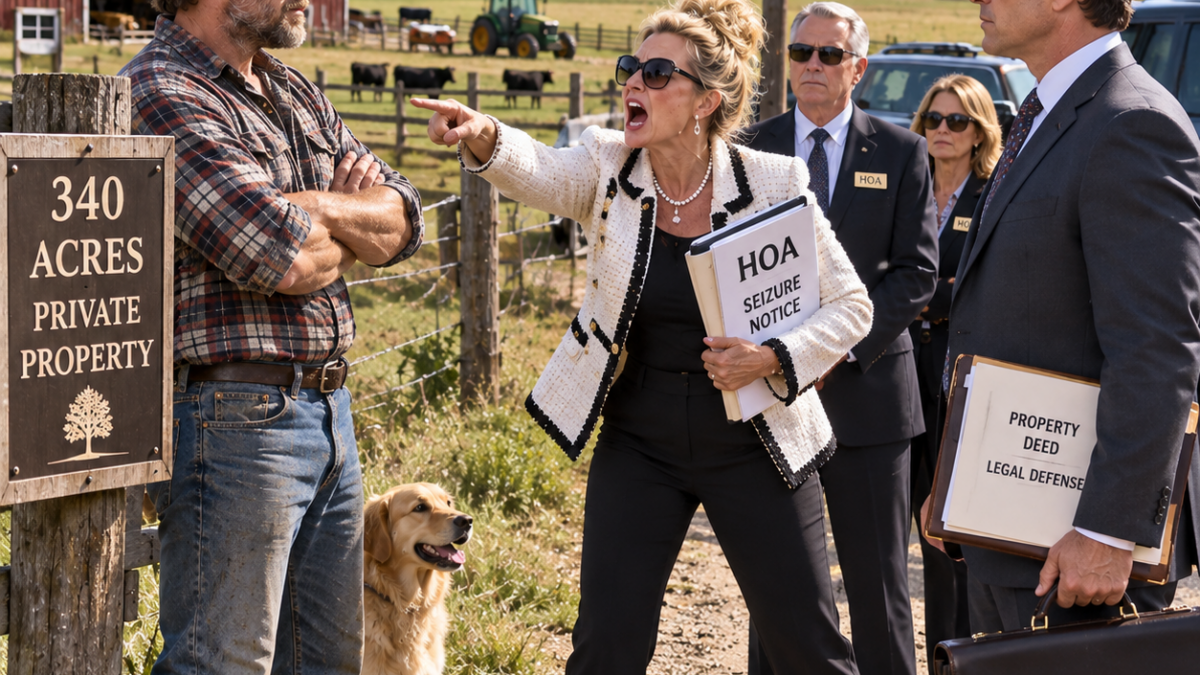
The HOA president stood on my porch and told me I had thirty days to tear down the barn my great-grandfather built with his own hands.
Then she claimed my 340-acre farm had somehow become part of her subdivision without my signature, my consent, or even a phone call.
I should have laughed, but there was something about the county stamp on the paper in her hand that made my stomach turn cold.
Her name was Karen Maxwell.
She stood ten feet from my front steps in a pink pantsuit, gripping a clipboard against her chest while the July heat shimmered above my gravel driveway.
Behind her, beyond the tree line, sat Oakwood Bluffs—a five-year-old subdivision of matching beige houses, clipped lawns, decorative mailboxes, and enough rules to regulate everything from fence colors to holiday wreaths.
In front of her stood my family farm.
Three hundred forty acres.
Pasture.
Hayfields.
Corn.
Two ponds.
A farmhouse with floors worn smooth by four generations of Callahans.
And the barn.
That barn had been standing since 1888.
My great-grandfather had cut some of the timber himself.
My grandfather had repaired the roof during the Depression with salvaged boards because he couldn’t afford new lumber.
My father had taught me how to drive a tractor beside it.
I had stood inside that barn after his funeral, alone in the dark, with my hand against one of the old beams because it was the closest thing I had left to touching him.
Karen looked at it like it was garbage.
“Article Seven, Section Four,” she said, tapping her clipboard. “Detached structures over two hundred square feet are prohibited.”
I stared at her.
“My barn was here before your neighborhood.”
“That isn’t relevant anymore.”
I actually thought I had misheard her.
“Excuse me?”
Karen lifted her chin.
“The association amended its covenants. Adjacent properties that negatively affect community standards may now fall under Oakwood Bluffs jurisdiction.”
I looked past her toward the subdivision.
Then back at her.
“You’re telling me your HOA voted itself authority over my land?”
Her lips tightened.
“I’m telling you the amendment was legally recorded.”
She pulled several pages from the clipboard and held them out.
I had spent twenty-five years working with the Army Corps of Engineers. Contracts, easements, construction disputes, government filings—I knew what official paperwork looked like.
And this looked official enough to be dangerous.
There was a county recording stamp.
Dates.
Signatures.
Legal language.
And buried halfway down the page was a new section claiming the HOA could annex neighboring property when the board determined that property harmed the “aesthetic or financial interests” of Oakwood Bluffs.
I read it twice.
Then I looked at Karen.
“This doesn’t make my farm part of your HOA.”
“The board disagrees.”
“The board doesn’t own my farm.”
“You’ll receive formal violation notices.”
“For what?”
She pointed toward the barn.
“That structure, for starters.”
Something inside me went completely still.
Not angry.
Not yet.
Still.
The way I used to feel when a project went wrong overseas and everybody else started shouting.
You learn quickly that panic wastes energy.
Facts don’t.
I handed the papers back.
“Karen, you are standing on private property.”
Her eyes narrowed.
“I am conducting official association business.”
“No. You’re trespassing.”
Her face reddened.
“You cannot intimidate me, Mr. Callahan.”
“I haven’t tried.”
I stepped off the porch.
Gravel crunched beneath my boots.
“But I’m telling you once. My farm has never belonged to Oakwood Bluffs. It does not belong to Oakwood Bluffs now. And if you send anyone onto this property to touch that barn, we’re going to have a problem much larger than paint colors and lawn rules.”
She stared at me for several seconds.
Then she smiled.
It wasn’t friendly.
“We can place liens, Mr. Callahan.”
That got my attention.
“We can impose daily fines. We can pursue enforcement in court. Fighting an entire community becomes very expensive.”
She turned toward the subdivision.
At the edge of my driveway, she stopped.
“Thirty days.”
Then she walked away.
I remained outside after she disappeared.
The farm was quiet again.
Cattle moved slowly in the west pasture.
A crow called from the oak beside the equipment shed.
Wind pushed through the corn exactly the way it had when I was ten years old.
But the place suddenly felt different.
Someone had come onto my land carrying paperwork designed to make generations of my family’s ownership look negotiable.
When I finally went inside, my wife Sarah was sitting at the kitchen table.
She took one look at my face.
“What happened?”
I closed the door behind me.
“Apparently,” I said, “we’ve been annexed by the HOA.”
Sarah stared at me.
Then she stopped smiling when I told her about the county stamp.
PART 2
Sarah had worked as a paralegal for almost twenty years.
I had watched her untangle contracts that made my engineering documents look like children’s coloring books. She could find one bad sentence buried inside eighty pages of legal language and worry at it until the entire argument around it collapsed.
So when her expression changed, I paid attention.
“Tell me exactly what the document said.”
I pulled out the chair across from her.
I repeated everything.
The language about adjacent properties.
The allegation that my farm harmed the neighborhood’s appearance.
The threat to demolish the barn.
The promise of fines and liens.
Most importantly, I described the recording stamp.
Sarah stopped me there.
“Recorded doesn’t mean valid.”
“I know.”
“But it means somebody actually went to the county and filed it.”
“I know that too.”
She leaned back.
“That bothers me more.”
It bothered me more too.
A ridiculous letter could be thrown away.
An angry neighbor could be ignored.
A recorded document affecting property rights was something else.
Even a fraudulent document could cause trouble before it was defeated. Banks cared about records. Buyers cared about records. Title companies cared about records. Courts cared about records.
And people like Karen counted on the cost of proving them wrong.
Sarah closed her laptop.
“Tomorrow morning, go to the county records office.”
“I was planning to.”
“Don’t explain the fight to anybody. Don’t accuse anybody of anything. Just request documents.”
“What documents?”
“Our complete chain of title. Every deed, easement, covenant, restriction, and recorded instrument affecting this farm.”
She began counting on her fingers.
“Then Oakwood Bluffs’ original declaration. Every amendment. Articles of incorporation. Anything involving annexation.”
I smiled faintly.
“Paper first?”
“Always.”
That night I barely slept.
At two in the morning, I walked downstairs and stood at the kitchen window.
Moonlight lay silver across the pasture.
The barn was only a dark shape beyond the yard.
I remembered my father standing beside it during one of the last summers before cancer made him too weak to work.
A developer had offered him enough money to make most farmers stare at the number twice.
Dad hadn’t.
The man had spread maps across our kitchen table and talked about opportunity, growth, retirement, progress.
My father listened politely.
Then he folded the maps.
“You’re looking at acres,” he told him. “I’m looking at graves, births, weddings, bad harvests, good harvests and four generations of people who woke up before daylight because this place mattered to them.”
The developer increased the offer.
Dad opened the door.
That had been the end of the meeting.
Or so we thought.
Oakwood Bluffs was built on the property east of us instead.
Five years later, the houses had crept right up to our woods.
Dad had been dead three of those years.
Standing at the window that night, I wondered whether Karen’s little campaign was simply about an ugly barn.
I didn’t believe it.
People did not manufacture legal language and record amendments because they disliked a roof.
Something else was underneath it.
At 7:45 the next morning, I was standing outside the county courthouse.
The records office opened at eight.
By eight-ten, I had my first file.
The Callahan property went back farther than the clerk could pull easily on her computer, so part of the search meant old scanned deeds and older microfilm.
I sat there for hours.
1888.
1889.
1890.
1891.
1892.
1893.
Every transfer.
Every survey.
Every easement.
No HOA.
No declaration.
No restrictive covenant.
No annexation agreement.
Nothing gave Oakwood Bluffs—or anyone associated with it—the slightest jurisdiction over our farm.
Then I opened their records.
The original Oakwood Bluffs covenants were exactly what I expected.
Exterior paint.
Landscaping.
Pools.
Parking.
Fences.
Trash containers.
Satellite dishes.
After enough pages, I found the annexation section.
I read it once.
Then again.
My heartbeat quickened.
Oakwood Bluffs could expand.
But not the way Karen had claimed.
The original declaration required approval from seventy-five percent of the association’s membership.
More importantly, any outside property could only be incorporated with the voluntary written consent of that property’s owner.
There it was.
No consent.
No annexation.
No ambiguity.
I kept searching.
Two amendments had been recorded since the development was established.
The first dealt with satellite dishes.
The second had been recorded six weeks earlier.
Karen’s amendment.
I put both versions side by side.
Somebody had rewritten the annexation language.
The requirement for my consent had disappeared.
In its place was language giving the HOA board authority to absorb neighboring parcels that it believed harmed property values or community aesthetics.
It was astonishingly aggressive.
And astonishingly stupid.
Then I reached the signature page.
President: Karen Maxwell.
Vice President: Robert Ellison.
Secretary: Amy Parsons.
Except Amy’s signature wasn’t there.
On the secretary line were four words:
K. Maxwell, by proxy.
I stared at them.
Karen had signed her own name in the space intended for another officer.
Maybe there was legal authorization somewhere.
Maybe.
But if there wasn’t, Karen hadn’t simply stretched a rule.
She had taken a shortcut on a recorded instrument affecting real property.
I ordered certified copies of everything.
When the clerk handed me the packet, its weight felt reassuring.
Not because I had won.
Because now the facts existed outside Karen’s mouth.
At home, Sarah spread the papers across our dining table.
She found the signature in less than thirty seconds.
“Well.”
“What?”
She tapped it.
“This is interesting.”
“That’s what I thought.”
“Did the file include a power of attorney?”
“No.”
“A board resolution authorizing her to sign for Amy?”
“No.”
“Written consent from Amy?”
“No.”
“Minutes?”
“Nothing.”
Sarah slowly sat down.
“What exactly did Karen think she was doing?”
“Winning.”
“No. Winning is what competent people try to do. This is something else.”
She flipped back to the original declaration.
“Look at this.”
The annexation clause couldn’t have been clearer.
Consent of the affected landowner was mandatory.
Sarah looked up.
“She removed the one requirement that made what she wanted impossible.”
“Which tells us she knew it was there.”
“Exactly.”
I could feel the anger returning.
Not the hot kind from the driveway.
Something colder.
“You think we call a lawyer?”
Sarah gave me a look.
“Jack, we passed ‘call a lawyer’ yesterday.”
We spent the next two hours drafting a factual summary.
No insults.
No threats about destroying the HOA.
No dramatic language.
We listed the farm’s title history.
We quoted the original declaration.
We identified the conflicting amendment.
And we asked one simple question about the signature:
What legal authority allowed Karen Maxwell to execute a recorded instrument on behalf of the association secretary?
Sarah knew who the HOA’s registered counsel was from the filing.
We sent the packet to him.
We copied every board member.
Certified mail.
Return receipt.
Seven envelopes.
The post-office clerk looked at the stack.
“Bad day for somebody?”
“Not yet,” I said.
That turned out to be true.
Because ten days later, Karen made her second mistake.
The first five violation notices arrived together.
Five hundred dollars for an “unapproved agricultural vehicle.”
The vehicle was my John Deere tractor.
Two hundred fifty dollars for “improper landscape maintenance.”
That was a hayfield.
A thousand dollars for the barn.
Another fine for the old stone wall that had divided the south pasture since my grandfather was a boy.
The last cited Sarah’s vegetable garden.
Total: $2,750.
Daily penalties would follow.
I stood at the kitchen counter reading them.
Sarah came in carrying groceries.
She saw my face and set the bags down.
“What?”
I handed her the notices.
She read the first one.
Then the next.
By the time she reached the garden violation, she was smiling.
“Why are you smiling?”
“Because she’s doing exactly what we need.”
“Sarah, she’s claiming we owe nearly three thousand dollars.”
“No, Jack. She’s creating evidence that she is asserting jurisdiction after being formally notified that her authority is disputed.”
“I’d prefer she stop.”
“I know.”
“She mentioned liens.”
“I know.”
“What happens if she actually records one?”
“Then Marcus gets involved.”
That was the first time she’d said his name.
I knew exactly who she meant.
Marcus Thorne had served with me years earlier.
He hadn’t been an engineer.
He had been a military lawyer assigned to a command where impossible construction disputes, civilian claims and procurement disasters seemed to breed overnight.
Marcus could be loud when he wanted to be.
But the dangerous version of Marcus was quiet.
After leaving the service, he had built a serious real-estate litigation practice.
I had not called him because part of me still believed I ought to handle my own property problem.
Sarah knew that.
“You’ve proven the title,” she said. “You’ve put them on notice. Now she’s deliberately escalating. Stop treating this like a disagreement between neighbors.”
She was right.
Still, before I called Marcus, I wanted to understand the neighborhood.
Karen kept invoking “the community.”
I wanted to know whether the community actually knew what she was doing.
So I started walking the county road beside Oakwood Bluffs with Buster, my old black Lab mix.
I stayed on public pavement.
The subdivision looked almost unnaturally orderly.
Same setbacks.
Same palette.
Same shrubs.
Same approved mailboxes.
On my third walk, I saw an older man cleaning a flagpole in his front yard.
The American flag flew above a Marine Corps flag.
An orange HOA notice was stuck to the pole.
I slowed.
“Problem with the flag?”
He looked at me.
Vietnam veteran cap.
Lean shoulders.
Eyes that missed very little.
“Pole’s two feet too tall.”
I glanced at the notice.
He continued.
“Second flag isn’t approved.”
“Seriously?”
“Five hundred dollars seriously.”
I extended my hand.
“Jack Callahan.”
Recognition appeared immediately.
“The farm.”
“The farm.”
He shook my hand.
“Bill Hedges.”
We talked beside his driveway for forty minutes.
Bill had been fined for the flagpole.
A garden ornament his granddaughter bought him.
His son’s pickup staying overnight.
A bench that was apparently the wrong shade of brown.
Every story ended with Karen.
“She drives around in that golf cart taking pictures,” he said. “People see her coming and start moving things.”
“And the board allows it?”
“The board allows whatever Karen says the board allows.”
“Why?”
Bill shrugged.
“Most people have jobs. Families. Mortgages. They don’t want a legal war over a flowerpot.”
That sentence stayed with me.
Bullies did not always need real power.
Sometimes they only needed to make resistance more exhausting than surrender.
“Bill, did you know they filed an amendment six weeks ago?”
His forehead wrinkled.
“What amendment?”
“Supposedly giving the HOA authority to absorb neighboring property.”
He laughed.
Then he realized I wasn’t joking.
“You?”
“Three hundred forty acres of me.”
His mouth fell open.
I explained just enough.
When I mentioned the secretary’s signature, Bill stopped me.
“Amy?”
“Amy Parsons.”
“She quit the board.”
“When?”
“About a week after some fight with Karen.”
“What kind of fight?”
Bill glanced toward the houses as if Karen might materialize from behind a hedge.
“Amy questioned some fines. Karen embarrassed her in a meeting. After that, Amy was done.”
I felt something click into place.
“Do you know her?”
“My wife does.”
“Could you ask whether she’d be willing to speak privately?”
Bill studied me.
“You planning to sue?”
“I’m planning to protect my farm.”
“That wasn’t my question.”
“No.”
I looked toward Oakwood Bluffs.
“I’m planning to stop Karen.”
Bill smiled.
“Then you might have more friends than you think.”
That night, I called Marcus.
He answered on the fourth ring.
“Thorne.”
“Still charming.”
There was a pause.
Then a laugh.
“Jack Callahan. Either you’re inviting me fishing or something has gone catastrophically wrong.”
“Second one.”
“I knew it.”
I spent twenty minutes explaining.
He interrupted only to ask dates.
When I reached the rewritten annexation clause, he stopped me.
“She filed that?”
“Yes.”
“With the county?”
“Yes.”
“And she signed for another officer?”
“Yes.”
“Written authority?”
“Not in the record.”
“Owner consent?”
“None.”
“Then she sent you fines?”
“More every week.”
“How much?”
“About eleven thousand now.”
Silence.
I thought the call had dropped.
“Marcus?”
“I’m here.”
“What do you think?”
“I think this woman has done something remarkable.”
“What?”
“She has documented her behavior for us.”
I sat back.
He continued.
“Send me everything. Deeds. Covenants. amendments. letters. receipts. fines. photographs. Do not communicate with her directly unless necessary. Do not pay anything. Do not destroy anything.”
“You taking the case?”
“Of course.”
“What’s your retainer?”
“Nothing.”
“Marcus—”
“Jack, I bill companies enough money to make both of us uncomfortable. Every once in a while I like remembering why I went to law school.”
His voice changed.
“Besides, if the facts are what you say they are, this stopped being a barn dispute the moment she tried to manufacture authority over land she didn’t control.”
“What do you want to do?”
“First, protect title. Second, freeze direct contact. Third, find out whether she acted alone. Fourth…”
He paused.
“Let her keep talking.”
I didn’t like that last part.
Marcus knew it.
“You were always terrible at patience.”
“I spent half my career waiting for government contractors.”
“Exactly. Think of Karen as a contractor who’s about to submit her own evidence of nonperformance.”
For the first time in weeks, I laughed.
The next morning, Marcus formally notified the HOA’s law firm that he represented me.
Any communication regarding the farm had to go through him.
He also began preparing claims for slander of title, abuse of process and damages arising from the HOA’s continued assertion of authority.
Meanwhile, Bill called.
“Friday night. My place. Seven.”
“For what?”
“You wanted allies.”
I arrived through Bill’s garage so Karen’s golf-cart intelligence service wouldn’t have much to photograph.
Five people were waiting.
Luis and Maria Garcia had two young children and looked exhausted before anybody even spoke.
Karen had been fining them fifty dollars a day over a wooden backyard playset.
Dana Brooks was an emergency-room nurse and single mother. She had nearly lost her shift assignment because Karen twice had her car threatened with towing while Dana was working long hospital rotations.
Helen Morris, a retired librarian, had a folder on her lap thicker than some engineering reports I had submitted to the federal government.
Karen had fined Helen over wind chimes.
Bill began.
“Jack’s got something you people need to hear.”
I told them what Karen was doing to my farm.
Nobody interrupted.
When I reached the amount of the fines, Maria whispered, “Thirty thousand?”
“Thirty-two as of yesterday.”
Luis stared at me.
“And you haven’t paid?”
“Not a dollar.”
“What happens?”
“My lawyer thinks Karen is creating the case against herself.”
Dana leaned forward.
“You have a lawyer?”
“Yes.”
“An HOA lawyer?”
“A real-estate litigator.”
For the first time that evening, I saw something change in the room.
Hope is too dramatic a word.
It was more like people realizing the locked door they’d been staring at might have a hinge.
I placed copies of the original HOA declaration and Karen’s amendment side by side.
“This is the original annexation rule.”
They read.
“This is the version Karen filed.”
Dana’s eyes narrowed.
“She removed the consent requirement.”
“Yes.”
“Can she do that?”
“Not to my land.”
Helen adjusted her glasses.
“And this signature?”
“That is Karen signing for Amy Parsons.”
Bill spoke.
“Amy says she didn’t authorize it.”
Every face turned toward him.
“You talked to her?” I asked.
“Last night.”
“What did she say?”
“She won’t come to a meeting yet. She’s scared Karen will retaliate. But she says she never gave Karen permission to sign legal documents for her.”
The room became quiet.
Maria was the first to speak.
“Then why hasn’t anyone stopped her?”
Nobody answered.
Because everyone in that room already knew.
Karen had survived by isolating people.
She made each homeowner believe his or her problem was individual.
A flagpole.
A swing set.
A parked car.
Wind chimes.
A garden.
One violation at a time.
One intimidated family at a time.
None of them had seen the complete pattern.
Until now.
“I need evidence,” I said. “Not rumors. Not revenge stories. Documents.”
Helen lifted her folder.
“Good.”
She placed it on the coffee table.
“I’ve kept every notice since 2024.”
Dana laughed.
It was the first joyful sound I had heard all evening.
Within a week, Marcus had more material than he’d expected.
Emails.
Violation letters.
Photographs.
Tow warnings.
Board notices.
Copies of checks residents had paid.
Helen’s detailed journal.
Then Amy sent a signed statement.
She stated clearly that she had never given Karen Maxwell written authority to execute the third amendment on her behalf.
Marcus called me that afternoon.
“This is no longer interesting.”
“Bad?”
“No.”
I heard paper moving on his end.
“This is getting ugly for her.”
“What next?”
“Nothing.”
“I hate when you say that.”
“I know.”
Karen solved our waiting problem three days later.
I was inside the workshop sharpening mower blades when I heard a diesel engine coming up the driveway.
Not a pickup.
Heavy truck.
Air brakes hissed outside.
I stepped through the side door.
A commercial tow truck was stopped beside my grandfather’s Model T.
The driver was already lowering equipment.
I walked toward him.
“Morning.”
He barely looked at me.
“You Callahan?”
“Yes.”
“Got an order to remove an abandoned vehicle.”
He held up a work order.
Oakwood Bluffs HOA.
Authorized by Karen Maxwell.
I looked at the Model T.
My grandfather had bought that car long before I was born.
It didn’t run anymore.
Hadn’t for years.
But I restored the body with Dad during the summer I turned sixteen.
We kept it beneath a small open shelter near the barn.
“That’s not abandoned.”
“HOA says it is.”
“The HOA has no jurisdiction here.”
“Not my problem.”
He bent down to attach the chain.
“Don’t touch the car.”
He stood.
He was heavier than me by fifty pounds and younger by fifteen years.
“Sir, I have an authorized tow request.”
“And you’re standing on private property.”
“You can argue with the HOA.”
“I am.”
He turned back toward the car.
I took out my phone.
First, I began recording.
Then I called the sheriff.
The driver heard me give the address.
His posture changed.
“Come on, man.”
“I asked you not to touch the vehicle.”
“This is civil.”
“Maybe.”
“Cops aren’t going to care about some HOA tow.”
“Then neither of us has anything to worry about.”
He muttered something and started photographing the car.
We waited.
Ten minutes later, a sheriff’s cruiser came up the drive.
Deputy Ryan Cole stepped out.
I knew his father.
Didn’t know Ryan well.
He listened to the driver first.
Then me.
I handed him my driver’s license.
The deed copy I had begun carrying in my truck.
Marcus’s representation letter.
Ryan looked at the tow order.
Then across the pasture.
“Where exactly is Oakwood Bluffs?”
I pointed.
“Other side of those trees.”
He looked back toward the Model T.
“That’s what, a quarter mile?”
“Roughly.”
Ryan turned to the driver.
“Who gave you permission to enter Mr. Callahan’s property?”
“The HOA.”
“Does the HOA own this property?”
“They said they control it.”
Ryan looked at me.
“They don’t.”
He looked back at the driver.
“Unhook the car.”
The man tried to protest.
Ryan’s voice hardened.
“You have been informed by the owner that you do not have permission to be on this property or remove this vehicle. Now I’m informing you. Unhook it.”
The driver obeyed.
Within minutes the tow truck was gone.
Ryan remained.
“Jack, I don’t know what kind of circus you’ve got going on with those people.”
“Neither do I anymore.”
“You want an incident report?”
“Yes.”
“Good.”
That report became exhibit twenty-seven.
The video became exhibit twenty-eight.
Marcus watched it twice.
Then called.
“We’re done waiting.”
“What changed?”
“She used a third party to attempt physical enforcement on disputed property after receiving notice from counsel.”
“So we file?”
“We file.”
I expected to feel triumphant.
Instead, I felt tired.
I walked out to the barn that evening and sat on an overturned bucket.
Sunlight came through gaps in the siding.
Dust moved in the beams.
For weeks, every conversation in our house had been about Karen.
Every piece of mail.
Every phone call.
Every walk.
Every dinner.
Sarah found me there around sunset.
She sat beside me.
“You okay?”
“I hate that she’s gotten inside this place.”
“What do you mean?”
“I come out here and think about lawsuits.”
Sarah looked around.
“Your father hated lawyers.”
“He hated developers more.”
“That too.”
I smiled.
She rested her head against my shoulder.
“We’re going to win.”
“I know.”
“You don’t sound convinced.”
“Winning doesn’t give us these months back.”
“No.”
She was quiet.
“Maybe that’s why you need to finish it.”
The lawsuit was filed the following Monday.
Marcus did not merely ask the court to declare the amendment invalid.
He challenged the entire campaign.
The rewritten annexation clause.
The unauthorized signature.
The fines.
The threats.
The attempted tow.
The title damage.
The repeated assertions of jurisdiction.
Karen Maxwell was named personally.
That changed everything.
The first response came not from Karen but from Oakwood Bluffs’ attorney.
Marcus called me.
“He sounds unhappy.”
“With us?”
“With Karen.”
Apparently, the HOA’s counsel had not approved many of the actions Karen claimed had been approved.
The attorney had reviewed an earlier draft of an amendment months before.
Not the version ultimately recorded.
He had warned the board that annexing outside property required owner consent.
Karen had apparently solved that inconvenience by proceeding without his approval.
“Does that help us?” I asked.
“It helps everyone except Karen.”
But Karen kept going.
She posted neighborhood messages describing me as hostile.
She claimed my farm threatened property values.
She told residents that defending the association from me might require a special assessment.
That was another mistake.
Because nothing turns passive homeowners into investigators faster than telling them your personal feud may appear on their mortgage budget.
Attendance at the next board meeting tripled.
Bill called afterward.
“They’re asking questions.”
“Good.”
“Karen hates questions.”
“Better.”
Marcus had another idea.
“Public pressure.”
“I don’t want to turn this into a circus.”
“Neither do I.”
“So why involve media?”
“Because this isn’t only your case anymore.”
He pointed out the obvious.
If Karen were quietly removed, the board might bury the amendment and call it a misunderstanding.
The residents who had paid thousands in fines could remain stuck.
Amy could be painted as disgruntled.
The pattern mattered.
A reporter could establish the pattern publicly.
Marcus knew someone.
Jessica Riley worked investigations for the largest television station in the state capital.
She arrived at the farm in a black sedan with one producer and no camera crew.
That impressed me.
She wanted documents before pictures.
We sat at our dining table.
The table had become headquarters.
Sarah had arranged everything chronologically.
Original deed.
Original HOA declaration.
Recorded amendment.
Certified-mail receipts.
Fine notices.
Amy’s statement.
Incident report.
Tow video.
Homeowner statements.
Jessica read for nearly two hours.
She asked hard questions.
“Did Karen ever explicitly say she wanted your land?”
“No.”
“Did the developer ever communicate with her?”
“Not that I can prove.”
“So we don’t say that.”
“Agreed.”
“Did you threaten her?”
“I told her anyone attempting to damage the barn would create a bigger legal problem.”
“Anything more?”
“No.”
“Any profanity?”
“Not from me.”
Sarah raised an eyebrow.
I looked at her.
“Not much.”
Jessica almost smiled.
Then she watched the tow video.
Afterward she closed the laptop.
“This is extraordinary.”
“I’ve been using other words.”
“I need to speak with the HOA.”
“Of course.”
“I also need independent legal analysis.”
“Of course.”
“And your neighbors.”
“They’ll decide individually.”
She nodded.
“You understand I can’t do a story that simply takes your side.”
“I don’t want you to.”
That was true.
Facts were enough.
Two days later, Jessica called Karen.
She asked about the amendment.
Karen said the association had legal authority.
Jessica asked about my missing consent.
Karen said consent was unnecessary under the revised language.
Jessica asked who revised it.
Karen said it was a board action.
Then came the signature.
“Ms. Maxwell, did Amy Parsons authorize you in writing to execute the amendment on her behalf?”
Silence.
Karen finally answered.
“Board procedures are internal matters.”
Jessica followed with the tow truck.
Karen became angry.
She called the Model T a nuisance.
Jessica asked how a vehicle located on private farmland hundreds of yards outside the development could constitute an HOA violation.
Karen ended the call.
The television story aired on Thursday.
I watched it with Sarah.
Jessica opened with an aerial view of Oakwood Bluffs.
Perfect roofs.
Curved streets.
Landscaped entrances.
Then the camera crossed the tree line.
The view changed.
Fields.
Ponds.
Cattle.
The barn.
For some reason, seeing the farm from above hit me harder than I expected.
Three hundred forty acres looked enormous from the air.
Not enormous in terms of wealth.
Enormous in terms of history.
Generations had left their fingerprints everywhere.
Jessica did not call Karen a criminal.
She didn’t need to.
She put the two annexation clauses on screen.
Original.
Revised.
She interviewed an independent property-law professor who explained that recorded paperwork does not automatically make an invalid claim lawful.
Then came the homeowners.
Maria cried when she described nearly removing the playset her children loved.
Dana explained leaving an emergency-room shift because she feared her car would be towed.
Bill stood beneath his flags.
Helen brought her folder.
Finally, viewers saw the tow truck video.
Karen’s own statements followed.
The contrast was devastating.
By sunrise the next morning, Oakwood Bluffs was in chaos.
The story had spread online.
The management company’s phones were flooded.
Residents demanded a meeting.
Two board members contacted the HOA attorney separately.
One claimed Karen had misrepresented what they were voting on.
Another claimed he had never seen the final amendment before it was recorded.
Marcus was skeptical.
“Everybody develops amnesia when liability arrives.”
“Do we need them?”
“No.”
“Then why listen?”
“Because scared people produce documents.”
He was right.
By Monday, we had board emails.
Karen had circulated an early amendment described as a technical clarification.
The version she eventually filed contained much broader language.
Amy had objected.
In one email she wrote:
I do not support any attempt to impose Oakwood Bluffs rules on property whose owners have not voluntarily joined the association.
Karen replied that Amy was “obstructing community protection.”
Three days later, Amy resigned.
A week after that, Karen signed the filing “by proxy.”
Sarah read the email twice.
“There it is.”
I nodded.
“Intent.”
Marcus was even more interested in another message.
Karen had emailed the management company asking how quickly liens could be placed on “noncompliant adjacent property” once fines began accumulating.
The message predated her first visit to my farm.
This had not been spontaneous.
She had planned escalation before she ever walked up my driveway.
That hurt more than I expected.
I don’t know why.
Maybe part of me had still wanted to believe she’d simply become intoxicated by authority in the moment.
But no.
She had sat somewhere, probably at her kitchen table, and thought through ways to pressure me.
Fine him.
Create debt.
Threaten liens.
Make resistance expensive.
Marcus called late that afternoon.
“Jack?”
“Yeah.”
“We have enough.”
“For what?”
“To make them choose.”
“Choose what?”
“You or Karen.”
The HOA’s attorneys requested a settlement conference.
Marcus refused to dismiss Karen personally.
He was willing to protect ordinary homeowners from a massive judgment.
But there were conditions.
The third amendment had to be formally rescinded.
Every fine against my farm had to be voided.
Every similar discretionary fine issued under Karen’s invented interpretations had to be reviewed.
Residents who had paid improper penalties had to receive credits or refunds.
The HOA had to acknowledge in writing that it possessed no jurisdiction over Callahan Farm.
And the board had to adopt procedures requiring outside counsel to review any future recorded amendments.
The board agreed in principle.
Karen did not.
Her attorney withdrew from representing her in her personal capacity.
Then came the day Marcus finally arrived at the farm in person.
I had not seen him in years.
He pulled up in a dark sedan wearing a charcoal suit that probably cost more than my first pickup.
I walked out of the barn wiping my hands.
He looked at me.
Then at my jeans.
Then at the barn.
“You clean up terribly.”
“You’re overdressed.”
“I represent civilization.”
“You represent billable hours.”
He hugged me anyway.
Sarah came outside laughing.
We took him into the house.
Marcus opened his leather case and removed a folder.
“I wanted to show you something before tomorrow.”
Tomorrow was Karen’s deposition.
He placed a certified copy of the recorded amendment on the table.
Beside it he placed Amy’s sworn declaration.
Then the email exchange.
Then Karen’s inquiry about liens.
Then the sheriff’s report.
Finally, the video still showing the tow truck attached to my grandfather’s Model T.
He arranged everything in a straight line.
“She’s going to have to explain these under oath.”
I looked at the documents.
“So that’s the plan?”
“No.”
He smiled.
“That’s the warm-up.”
Karen arrived at Marcus’s office the next morning with a new attorney.
The woman I had met in the pink pantsuit looked different.
No bright color.
No clipboard.
No smirk.
Black dress.
Dark jacket.
Thin lips.
She did not acknowledge me.
I sat behind Marcus.
A court reporter swore her in.
Marcus spent the first hour on boring questions.
Her education.
Her term as president.
Board procedures.
The governing documents.
Her understanding of fiduciary duties.
Authority to enforce covenants.
It almost felt pointless.
Then Marcus opened the county file.
Karen’s eyes moved toward it.
He placed the original declaration in front of her.
“Please read the highlighted sentence.”
Her attorney objected to something.
Marcus waited.
Then repeated the request.
Karen read the annexation provision.
Voluntary written consent of the property owner.
“Did Mr. Callahan ever provide written consent?”
“No.”
“Verbal consent?”
“No.”
“Did he apply for membership in Oakwood Bluffs?”
“No.”
“Pay dues?”
“No.”
“Vote?”
“No.”
“Use association amenities?”
“No.”
“Then what event caused you to believe the Callahan farm became subject to Oakwood Bluffs?”
“The amendment.”
Marcus slid the second document toward her.
“Your amendment?”
“The board’s amendment.”
“Who drafted this language?”
Karen hesitated.
“I worked on it.”
“With counsel?”
“We discussed it.”
“Please answer the question. Did an attorney draft Section 15B as recorded?”
“I don’t remember.”
Marcus handed her an email.
“Does this refresh your recollection?”
Her face changed.
Only slightly.
But I saw it.
She had written the revised language herself.
Marcus continued.
“You removed the requirement that neighboring owners consent.”
“It needed clarification.”
“Clarification?”
“Yes.”
“By removing the neighboring owner’s right to consent?”
Her jaw tightened.
“We had to protect community property values.”
“From whom?”
“From neglected adjacent properties.”
“Callahan Farm?”
“Among others.”
“Name another.”
Silence.
Marcus waited.
Her lawyer shifted in his chair.
Karen finally said, “I don’t recall.”
Marcus moved to the signature page.
He placed it directly in front of her.
“Is this your signature?”
“Yes.”
“This one?”
“Yes.”
“And this line designated for Secretary Amy Parsons?”
Karen looked at it.
“Yes.”
“You signed it?”
“Yes.”
“Did Amy sign it?”
“No.”
“Did she give you a written power of attorney?”
“No.”
“Written authorization of any kind?”
“I had authority as president.”
“That was not my question.”
Her attorney objected again.
Marcus remained calm.
“Did Amy Parsons provide you written authorization to sign her name or sign on her behalf?”
“No.”
“Did she give verbal authorization?”
Karen paused.
“Yes.”
My hands tightened beneath the table.
Marcus didn’t react.
“Where?”
“What?”
“When did she give you that verbal authorization?”
“I don’t remember.”
“Before or after she resigned from the board?”
Another pause.
“Before.”
Marcus picked up Amy’s sworn statement.
He didn’t read it.
He simply placed it beside the amendment.
Karen saw her name.
Then Amy’s.
Then the notary seal.
Her face lost color.
That was the moment from the title.
Not when Marcus raised his voice.
Not when a judge entered.
Not when somebody dramatically shouted “gotcha.”
Her face dropped because my lawyer laid her own signature beside the sworn statement of the woman whose authority she had claimed.
And suddenly Karen understood exactly how small that conference room had become.
Marcus leaned forward.
“Amy Parsons has testified under oath that she never authorized you, verbally or in writing, to execute this instrument for her.”
Karen looked at her lawyer.
He looked down.
Marcus continued.
“Would you like to change your answer?”
For the first time since this began, I almost felt sorry for her.
Almost.
“No,” she whispered.
Marcus nodded.
“Very well.”
Then he moved to the fines.
My tractor.
“What covenant prohibits farm machinery on Callahan Farm?”
Karen tried the aesthetic clause.
Marcus reminded her the farm wasn’t in the HOA.
My hayfield.
Same problem.
Sarah’s garden.
Same problem.
The barn.
Same problem.
My stone wall.
My antique car.
Every document became another step downward.
Then Marcus reached Oakwood Bluffs residents.
The Garcias’ playset.
“Please identify the specific prohibition.”
Karen flipped through the covenants.
Nothing.
Dana’s vehicle.
Helen’s wind chimes.
Bill’s Marine flag.
Each time, the same thing happened.
Karen had relied on vague phrases such as visual harmony, nuisance, community standards and preservation of values.
But when forced to identify actual rules supporting some of her penalties, she could not.
Finally, Marcus produced the tow authorization.
“Did you contact the towing company?”
“Yes.”
“Did you direct them to enter Callahan Farm?”
“They were authorized.”
“By whom?”
“The HOA.”
“What document granted the HOA possession or control over Callahan Farm?”
“The amendment.”
“The amendment whose validity we’ve just discussed?”
Her lawyer leaned toward her.
Karen stared at Marcus.
“Yes.”
“And you understood Mr. Callahan disputed that amendment?”
“Yes.”
“You knew he was represented by counsel?”
“Yes.”
“You knew your association’s attorney had received notice directing future communication through counsel?”
“Yes.”
“Yet rather than seek a court order establishing the association’s claimed authority, you sent a private towing company onto his land?”
“The vehicle was abandoned.”
Marcus looked at me.
Then back to her.
“Abandoned by whom?”
Karen didn’t answer.
“It belonged to Mr. Callahan’s grandfather, correct?”
“I didn’t know that.”
“You knew Mr. Callahan claimed ownership?”
“Yes.”
“You knew it was on his deeded property?”
“Yes.”
“You knew he had not consented to removal?”
“Yes.”
“Yet you ordered the tow?”
Karen’s shoulders lowered.
“Yes.”
The room became silent except for the court reporter.
Marcus closed the folder.
“Thank you.”
Four hours.
That was all it took.
Not to destroy Karen.
She had done that herself.
Four hours simply converted what she had done into sworn testimony.
Outside the building, Marcus loosened his tie.
“How do you feel?”
“Like I need a tractor.”
He laughed.
“That’s your answer to everything.”
“It works.”
He became serious.
“Don’t confuse this with revenge, Jack.”
I looked at him.
“I’m trying not to.”
“Good. Revenge makes people stupid. Accountability is enough.”
I thought about Dad.
He would have liked that sentence.
The emergency HOA meeting took place two nights later.
Oakwood Bluffs had a clubhouse I’d never entered.
Until that night.
Every chair was filled.
People stood against the walls.
More crowded the hallway.
Jessica Riley sat near the back.
No television cameras.
Just a notebook.
Bill saved seats for Sarah and me.
The Garcias sat on our left.
Dana sat on our right.
Helen had, naturally, brought her folder.
The board entered.
Karen’s chair remained empty.
The HOA attorney stood.
He didn’t waste time.
He explained that counsel had completed a review.
The recorded third amendment contained defects.
It exceeded authority.
Its execution was improper.
And it could not lawfully impose Oakwood Bluffs covenants upon Callahan Farm.
I had known all of that for months.
Hearing it said publicly still released something in my chest.
The board voted.
Unanimous.
Third amendment rescinded.
Then came the fines.
Every fine against our farm was voided.
Not reduced.
Not negotiated.
Voided.
The HOA formally acknowledged it had no jurisdiction over my property.
Then residents’ fines were addressed.
The Garcias’ playset penalties disappeared.
Maria covered her face.
Luis wrapped his arm around her.
Dana’s towing-related penalties disappeared.
Helen’s wind-chime fines disappeared.
Bill’s flag violation disappeared.
Other residents I had never met heard their names called.
Penalty after penalty.
Gone.
Then the attorney paused.
“The board has also accepted the resignation of Karen Maxwell as president and director, effective immediately.”
The room exploded.
People cheered.
Not because a woman had been humiliated.
Because pressure had finally lifted.
You could hear it.
Years of irritation.
Fear.
Embarrassment.
Resentment.
Thousands of dollars.
Arguments between spouses.
Children told to stop playing on equipment their parents feared they could no longer keep.
People who had avoided putting flowers or flags in their own yards because they didn’t want another orange notice.
That cheer was what happened when people realized the person controlling them no longer controlled them.
I didn’t clap.
Sarah noticed.
“You okay?”
“Yeah.”
“You sure?”
I looked around the room.
“Just tired.”
The acting president approached us afterward.
Robert Ellison.
He had signed the amendment.
He looked older than I remembered.
“Mr. Callahan.”
“Robert.”
He extended his hand.
I didn’t take it immediately.
“I owe you an apology.”
“Yes.”
He seemed surprised by the answer.
Maybe he expected me to spare him.
I wasn’t going to.
“You signed that amendment.”
His eyes dropped.
“I did.”
“Why?”
“Karen told us counsel had approved it.”
“Did you read it?”
Silence answered.
I finally shook his hand.
“Then don’t ever sign something affecting somebody else’s home without reading it again.”
“I won’t.”
“And don’t let your next president become your ruler.”
He nodded.
“We’re changing procedures.”
“Good.”
Bill appeared beside me.
“Jack.”
“What?”
“You’ve got people lined up wanting to shake your hand.”
“I didn’t do this alone.”
“Try telling them that.”
The next morning, a FOR SALE sign appeared in Karen Maxwell’s yard.
I learned that from Bill.
I did not drive over to look.
I didn’t need to.
The personal lawsuit continued.
Karen’s deposition had left very little room.
Her new attorney approached Marcus about settlement.
I told Marcus I didn’t want her ruined.
He seemed unsurprised.
“She tried to put a cloud over your family property, Jack.”
“I know.”
“She accumulated tens of thousands in invented fines.”
“I know.”
“She sent a tow truck.”
“I was there.”
“So what do you want?”
I looked toward the barn.
“I want enough consequences that she never does it to anybody again.”
Marcus nodded.
“That’s different from ruin.”
The eventual settlement was confidential.
I can say this:
Karen paid personally.
The association contributed to reimbursing affected homeowners.
The remaining amount allocated to me was more than I wanted.
So Sarah and I discussed it.
We used part of it to repair the barn roof.
Part went toward legal and title expenses.
A substantial portion was donated to a veterans housing organization.
When Marcus found out how much we were donating, he stared at me.
“I worked for free and you still found a way to make this expensive for me emotionally.”
“You’ll survive.”
“Barely.”
He came to the farm the day the roof repairs began.
We stood outside watching a crew replace damaged boards.
“Looks good.”
“Dad would complain about the new lumber.”
“Your father complained about oxygen.”
“Only when somebody overcharged him for it.”
Marcus laughed.
A pickup came up the driveway.
Bill climbed out carrying a small wrapped package.
“Got something for you.”
“What?”
“Open it.”
Inside was a brass plaque.
Simple.
Heavy.
Engraved with three lines.
THE CALLAHAN BARN
EST. 1888
STILL STANDING
For a moment, I couldn’t say anything.
Sarah touched my arm.
Bill cleared his throat.
“Thought it belonged here.”
“It does.”
We mounted it beside the main door.
That afternoon, after everybody left, I stayed behind.
The sun was dropping low over the west pasture.
The repaired boards were lighter than the old wood.
In ten years, weather would darken them.
In fifty, nobody would know which pieces had been replaced.
That thought comforted me.
Preserving something doesn’t mean freezing it in time.
It means caring enough to repair what threatens it.
The same was true of communities.
Oakwood Bluffs changed after Karen left.
Bill was elected vice president.
Dana, to everybody’s surprise except mine, became president.
Her first meeting lasted forty-three minutes.
Bill told me that was considered a miracle.
They created a formal appeal procedure.
No single board member could issue a major fine.
Recorded documents required attorney review.
Residents were given time to correct genuine violations before penalties.
And the landscaping committee stopped measuring flagpoles.
One Saturday in spring, Dana walked over from the subdivision.
Not drove.
Walked.
She found me replacing fence posts.
“President Brooks.”
“Don’t start.”
“How’s the dictatorship?”
“Terrible. People keep expecting me to listen to them.”
“Unreasonable.”
She leaned on the fence.
“We’re having a neighborhood picnic next weekend.”
“Congratulations.”
“You’re invited.”
“I don’t live in the neighborhood.”
“Exactly.”
I looked at her.
She smiled.
“No annexation paperwork required.”
I laughed so hard I nearly dropped the post driver.
Sarah and I went.
So did Bill.
The Garcias brought their children.
Their wooden playset was still visible behind their house.
Bill’s flags still flew.
Helen had apparently added two more wind chimes.
Nobody died.
Property values did not collapse.
Civilization survived.
The strangest moment came when a man I didn’t recognize approached me near the food tables.
He was in his forties.
Oakwood Bluffs resident.
“Mr. Callahan?”
“Jack.”
“I just wanted to say thanks.”
“You don’t owe me anything.”
“I kind of do.”
He looked embarrassed.
“Karen fined us last year because my wife’s mother stayed with us for two months after surgery. She said we had an unauthorized long-term occupant.”
I shook my head.
“We paid it.”
“I’m sorry.”
“That’s the thing.”
He looked across the lawn.
“I used to think paying was easier. Fifty here. Two hundred there. Then I watched what happened to you.”
He paused.
“You didn’t just protect your farm. You reminded a lot of us that rules have limits.”
I thought about Marcus’s warning.
Accountability.
Not revenge.
“Rules aren’t the problem,” I told him.
“No?”
“No. Rules keep people from parking junk cars in intersections and building sewage pits beside playgrounds.”
He laughed.
“The problem is forgetting rules are supposed to serve people.”
That night, Sarah and I walked home.
The path between Oakwood Bluffs and our land wasn’t official.
Just flattened grass beside the tree line.
When we reached our property, she took my hand.
“You know what your father would’ve said?”
“That I wasted too much money on lawyers?”
“He would’ve liked Marcus.”
“Dad would’ve argued with Marcus until one of them died.”
“True.”
We reached the barn.
The brass plaque caught moonlight.
Sarah stopped.
“You almost never talk about how scared you were.”
I looked at her.
“What makes you think I was scared?”
“I’m your wife.”
Fair point.
I leaned against the barn door.
“When Karen first showed me that county stamp, I was scared.”
“Of losing the farm?”
“Not exactly.”
I searched for the right words.
“I knew she couldn’t just legally steal three hundred forty acres because she filed a piece of paper.”
“But?”
“But legal nonsense can still hurt people.”
Sarah nodded.
I continued.
“Dad spent his entire life protecting this place. Grandpa nearly lost it in the Depression. Great-granddad started with almost nothing. And for one second, I pictured being the generation that let paperwork screw it up.”
She squeezed my hand.
“You didn’t.”
“No.”
“You couldn’t have.”
“I could have if I’d ignored it.”
That was the lesson I kept.
Not that every HOA is evil.
Not that every dispute needs a lawsuit.
Not that the loudest person always deserves to be crushed.
Something simpler.
Pay attention when someone claims authority over what belongs to you.
Read the document.
Check the record.
Ask the question.
Keep the letter.
Save the email.
Don’t let intimidation substitute for law.
And never assume you’re the only person being treated badly.
Bullies depend on isolation.
Karen’s greatest advantage had never been the HOA covenants.
It had been silence.
Bill thought he was alone with his flagpole.
The Garcias thought they were alone with the swing set.
Dana thought she was alone with her car.
Helen thought she was alone with her wind chimes.
Amy thought she was alone when she objected inside the board.
I thought I was alone when Karen stood on my driveway threatening my barn.
Then we compared paperwork.
And her kingdom disappeared.
Months later, I received one last envelope connected to the case.
No HOA logo.
No violation number.
No certified-mail sticker.
Just an ordinary white envelope.
Inside was a copy of the county index showing the formal rescission of the third amendment.
I took it outside.
The barn doors were open.
Late-afternoon light stretched across the floor.
Dust floated over Dad’s old workbench.
I could almost see him there.
Bent over something.
Cursing at a rusted bolt.
Pretending not to smile when I made a mistake he’d warned me about.
I set the rescission document on the bench.
“Still here,” I said quietly.
The barn didn’t answer.
It didn’t need to.
Wind moved through the hayloft.
A hinge creaked.
Cattle called from the pasture.
The same ordinary sounds I’d heard the day Karen first appeared.
Except now they felt like victory.
Not the screaming kind.
Not revenge.
Something better.
Peace.
A year after Karen left, the farmland east of Oakwood Bluffs came up for sale.
Another developer bought it.
Rumors started almost immediately.
More houses.
More traffic.
Possibly a commercial strip.
I attended the county planning meeting.
Not because anybody threatened me.
Because growth affects everybody.
Dana was there representing Oakwood Bluffs.
She sat beside me.
“Never thought we’d be on the same side of a land-use meeting,” she whispered.
“Don’t get comfortable.”
The developer presented plans.
Road access.
Drainage.
Stormwater.
Buffers.
When the engineer reached the drainage plan, I raised my hand.
Old habits.
He had overlooked how runoff crossed the southeastern corner toward one of our ponds.
I wasn’t angry.
I showed him the contour issue.
He checked.
Paused.
Then nodded.
“You’re right.”
They revised it.
No lawsuits.
No threats.
No fake annexation.
Just people at a table doing what Karen could never understand.
Listening.
Compromising.
Respecting boundaries.
That is how communities are supposed to work.
The final piece of the story came nearly eighteen months after Karen first stepped onto my driveway.
Bill and Dana asked me to attend another HOA meeting.
I resisted.
“I’ve served my sentence.”
“Just come.”
“Why?”
“You’ll see.”
The clubhouse was full again.
But the atmosphere was completely different.
People talked.
Children ran between chairs.
Somebody had brought cookies.
Helen’s wind chimes weren’t there, thankfully.
Dana called the meeting to order.
“We have one unusual item tonight.”
Bill stood.
He looked at me.
I immediately became suspicious.
“As many of you know, the association’s relationship with our neighbor Mr. Callahan began badly.”
People laughed.
“That’s one word,” I said.
More laughter.
Bill continued.
“But some good came from it. We rewrote our enforcement procedures. Residents got involved. The board learned humility.”
“Some of us,” Dana muttered.
“And we remembered something.”
Bill paused.
“A neighborhood isn’t defined by how many rules it can enforce.”
The room became quieter.
“It’s defined by whether people still want to help one another when the rules aren’t enough.”
He held up a framed document.
I groaned.
“If that’s annexation paperwork, I’m leaving.”
The room erupted.
Bill grinned.
“No.”
He turned the frame around.
It was a resolution.
Not a covenant.
Not legally binding.
Just words.
The Oakwood Bluffs board had voted to recognize Callahan Farm as a historic neighboring property and to acknowledge its agricultural operations as part of the area’s heritage.
No jurisdiction.
No control.
No conditions.
Just recognition.
At the bottom, someone had added one final sentence:
The Callahan Barn shall remain none of our business.
I stared at it.
Then at Dana.
She was trying not to laugh.
“Who wrote that?”
“Unanimous committee recommendation.”
“Bill?”
“Fifth draft.”
I shook my head.
“You people finally wrote a rule I can support.”
They hung a copy in the clubhouse.
I took another home.
Sarah framed it beside the county rescission.
Sometimes visitors ask why two bureaucratic documents hang in our farmhouse hallway.
I tell them one represents what happens when power forgets its limits.
The other represents what happens when ordinary people remember theirs.
Karen wanted the barn gone because she believed uniformity was the same thing as value.
She wanted my tractor hidden.
My fields controlled.
My stone wall corrected.
My family property absorbed into something she could regulate from a clipboard.
What she never understood was that the barn’s value wasn’t in its appearance.
It was in memory.
The marks on one beam where my grandfather measured children as they grew.
The initials Dad carved when he was twelve and later pretended he hadn’t.
The stall where my mother’s mare delivered a foal during an April storm.
The corner where Sarah and I stored folding chairs after our wedding reception.
The loft where I sat alone after Dad died because grief felt easier in a place that still smelled like him.
You cannot calculate that in subdivision property values.
You cannot standardize it.
You cannot replace it with approved siding.
The summer after everything ended, I finally repaired the big north door.
Dad had been promising to fix it for twenty years.
So had I.
Sarah watched me struggle with the hinge.
“Need help?”
“No.”
Five minutes later:
“Need help?”
“No.”
Ten minutes later, the door nearly fell on me.
Sarah crossed her arms.
“Military engineering?”
“Shut up.”
She laughed.
I laughed too.
Eventually we got it hung.
At sunset, I stood outside and looked at the barn.
Fresh hinge.
New roof boards weathering slowly.
Brass plaque beside the door.
Still standing.
Not because I was stronger than Karen.
Not because Marcus was the smartest man in every room, though he certainly believed that.
Not because television viewers became angry.
Not even because the law was on my side.
It was still standing because when somebody tried to turn intimidation into authority, enough people refused to remain isolated.
Sarah found the weakness in the paperwork.
The county preserved the record.
Marcus forced facts into sworn testimony.
Amy told the truth.
Bill brought people together.
The Garcias spoke.
Dana spoke.
Helen documented everything.
Deputy Cole refused to let a piece of HOA letterhead become permission to take private property.
Jessica asked questions Karen couldn’t answer.
Even Robert, late as it was, finally admitted the board had failed.
That mattered.
A lot of people imagine standing up for yourself looks dramatic.
Usually it doesn’t.
Usually it looks like saving receipts.
Reading boring documents.
Making copies.
Showing up at meetings.
Refusing to sign something you don’t understand.
Calling the right person.
Waiting.
Documenting.
Waiting some more.
And keeping your temper while somebody across the table desperately wants you to lose it.
Karen’s weapon had been exhaustion.
Ours was patience.
In the end, patience won.
One autumn evening, almost exactly two years after our first confrontation, I was on the porch with Sarah.
Buster was asleep near my boots.
He was older now.
So was I.
The trees along the driveway had turned red and gold.
A pickup from Oakwood Bluffs slowed on the road.
The driver waved.
I waved back.
No hostility.
No suspicion.
Just neighbors.
I could see the barn beyond the pasture.
Behind it, evening sunlight turned the clouds orange.
“You ever think about selling?” Sarah asked.
I looked at her.
“What brought that on?”
“Nothing. Just asking.”
I considered it.
Someday the farm would belong to somebody else.
That’s true of every piece of land.
We call ourselves owners, but we’re really caretakers with paperwork.
Dad understood that.
Great-granddad probably did too.
“Maybe someday,” I said.
Sarah raised an eyebrow.
“Really?”
“When I’m dead.”
“There he is.”
I smiled.
“But whoever gets it next has one requirement.”
“What?”
I pointed toward the barn.
“They keep the plaque.”
She looked at the little brass rectangle shining in the distance.
THE CALLAHAN BARN.
EST. 1888.
STILL STANDING.
Sarah leaned against me.
“Deal.”
Across the fields, the beige houses of Oakwood Bluffs caught the last light.
They didn’t look like an invading kingdom anymore.
They were simply homes.
Families inside them.
People cooking dinner.
Children doing homework.
Someone mowing too late.
Someone probably violating a mailbox rule.
Normal life.
And that was the best ending I could have asked for.
Karen once stood on my driveway and told me the community demanded my barn disappear.
She was wrong about the barn.
She was even more wrong about the community.
Because when the people she claimed to represent finally learned what she had been doing in their name, they didn’t help her take my farm.
They helped me stop her.
My family’s land remained exactly where it had always been.
The fines vanished.
The false amendment was erased from the county record.
The attempted seizure failed.
The neighbors got their voices back.
And the woman who had tried to turn a clipboard into a crown discovered that authority without consent has an expiration date.
Sometimes justice arrives with a judge’s gavel.
Sometimes it arrives with television cameras.
Sometimes it comes in a lawyer’s briefcase.
Ours arrived as a stack of county records laid quietly across a conference-room table.
And when Marcus placed Karen Maxwell’s own signature in front of her, beside the evidence she could no longer explain away, I watched the certainty leave her face.
She had spent months warning me that the clock was ticking.
She had been right.
She just never realized it was ticking for her.
I went home that evening, opened the barn doors, and watched sunset spill across the same wooden floor four generations of Callahans had walked before me.
Then I ran my hand across the old beam near the entrance.
For once, there was nothing left to fight.
The farm was quiet.
The title was clean.
The barn was safe.
And my father’s land was still ours.
Exactly where it belonged.

