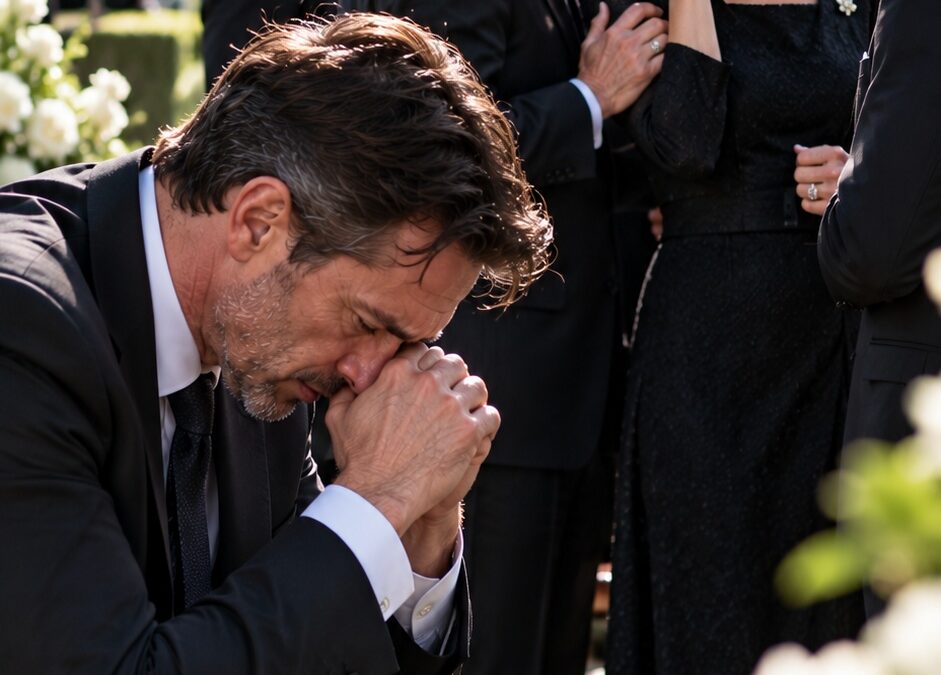
They congratulated my wife before her father’s coffin had even reached the hearse. That was the moment I knew something had already been decided without me.
𝗙𝗨𝗟𝗟 𝗦𝗧𝗢𝗥𝗬 


My name is James Stratton.
I was forty-seven years old when my father-in-law died, and I had spent twenty-three years helping build the company everyone at his funeral had already decided belonged to my wife.
Five days later, Victoria fired me in front of the board.
My own son voted with her.
That evening, she sat in my chair at home drinking her dead father’s favorite Scotch and told me I had never really been management material.
She had no idea what was waiting for her Monday morning.
But to understand why, you have to understand Richard.
And you have to understand what I thought my marriage was before I discovered what it had become.
Richard Hartley founded Hartley Medical Systems in 1981.
Medical imaging equipment.
Diagnostic machinery.
The kind of equipment that sits in hospitals almost invisibly until somebody you love needs it.
By the time I married his daughter Victoria in 2001, Hartley Medical had grown from a small California engineering company into a respected regional manufacturer.
Not huge.
Not yet.
But serious.
I was a systems engineer then.
Stanford degree.
Too much confidence.
Too little patience.
At twenty-four, I believed almost every inefficient system could be fixed if somebody intelligent enough was allowed to redesign it.
At twenty-five, I learned that companies were harder than machines because companies were built out of people.
Richard liked me almost immediately.
That surprised everyone, including Victoria.
He wasn’t warm.
He wasn’t the kind of father-in-law who invited you fishing and called you son after two beers.
Richard observed people.
Tested them.
He noticed whether you arrived early.
Whether you blamed others.
Whether you knew the answer or pretended to.
The first time we really talked, he asked me what I thought was wrong with one of Hartley Medical’s manufacturing lines.
I had toured the facility once.
I told him.
He stared at me for maybe ten seconds.
Then he said, “You’re either arrogant or useful.”
“Probably both.”
That made him laugh.
Years later, he told me that was when he started trusting me.
By 2007, Hartley Medical was in trouble.
Costs were rising.
Two large hospital networks delayed purchases.
Credit tightened.
Then the financial crisis hit.
People remember recessions in terms of headlines.
At a company, you remember them in faces.
You remember the plant supervisor who asks whether layoffs are coming.
You remember the accounts payable manager quietly moving invoices around to keep suppliers from cutting you off.
You remember employees pretending not to be afraid.
Richard was sixty-three.
Still sharp.
Still stubborn.
But the company needed more than confidence.
It needed capital.
It needed restructuring.
I had recently sold rights associated with a patent I helped develop.
The proceeds were substantial.
Victoria wanted us to buy a larger house.
Instead, I put twelve million dollars into Hartley Medical.
Richard structured it as an equity purchase.
Not a loan.
I knew that.
I knew I owned a meaningful piece of the company.
What I did not fully understand at the time was how carefully Richard planned everything that followed.
I focused on keeping the business alive.
I renegotiated supplier agreements.
Redesigned procurement.
Cut overhead by thirty-eight percent without laying off a single production worker.
Changed the manufacturing schedule.
Consolidated warehouses.
Flew to Munich to save one critical imaging-component contract after the supplier threatened to walk.
For almost eighteen months, I barely slept.
Victoria was running marketing.
She attended conferences.
Approved campaigns.
Developed relationships with hospital executives.
She was good at that side of the business.
I won’t pretend she contributed nothing.
She could walk into a room of nervous investors and make everything sound controlled.
That mattered.
But she eventually began confusing being the person who explained the work with being the person who had done it.
Hartley survived.
Three direct competitors didn’t.
Richard stood beside me one night after the final restructuring meeting.
Everyone else had gone.
He poured two glasses of bourbon.
“You saved my company.”
“We saved it.”
“No.”
He shook his head.
“I built it. You saved it.”
I remember feeling embarrassed.
Praise from Richard was rare enough that I never knew what to do with it.
So I made a joke.
“It was math.”
He smiled.
“It was character.”
At the time, I thought he meant the work.
Years later, I understood he meant something much larger.
Victoria and I had two children.
Brandon was twenty-two when Richard died.
Emily was nineteen.
Brandon worked in business development at Hartley Medical.
That had been Richard’s suggestion.
Not mine.
I wanted Brandon to spend a few years somewhere else first.
I thought learning under people who didn’t know his last name would be good for him.
Victoria disagreed.
“Why should he waste time proving himself somewhere irrelevant?”
Because proving yourself is never irrelevant.
But that argument was already becoming familiar between us.
Brandon had his mother’s gifts.
Charm.
Timing.
Instinct for hierarchy.
He knew who mattered in a room before introductions were finished.
Emily was different.
She questioned everything.
Journalism student at Northwestern.
Stubborn.
Observant.
Unimpressed by titles.
She got that from me.
I used to worry about how difficult that would make her life.
Then Richard died.
And I discovered exactly why the world needs people who notice what everyone else is pretending not to see.
His funeral was Thursday.
Two hundred people came.
Board members.
Doctors.
Investors.
Employees.
Politicians Richard had supported over the years.
The service itself was beautiful.
Richard would have hated it.
Too polished.
Too expensive.
Too many flowers.
He once told me that funerals should cost less than a used pickup truck because the dead person was not going to complain.
Victoria planned everything.
Of course she did.
The program had photographs of Richard from his early years with Hartley Medical.
Richard with the first prototype.
Richard at the opening of the second factory.
Richard shaking hands with governors and hospital executives.
My name appeared nowhere.
Not in the list of speakers.
Not in the company-history section.
Not beside the photograph taken during the 2008 turnaround in which I had actually been standing two feet outside the crop.
At first, I told myself it didn’t matter.
A funeral was not a shareholder report.
Then I saw the seating arrangement.
Victoria was front row.
Brandon beside her.
Thomas Reeves, the chairman of the board, beside him.
My assigned seat was three rows back.
Next to Emily.
She noticed immediately.
“Dad.”
“It’s fine.”
“No, it isn’t.”
“Today isn’t about me.”
Her eyes moved toward her mother.
“Apparently it’s about Mom.”
“Emily.”
“What?”
“Not today.”
She took my hand.
That was all.
But she didn’t let go until the service ended.
Victoria gave the eulogy.
She spoke beautifully.
That was always her gift.
“Legacy.”
“Vision.”
“Leadership.”
“The next chapter.”
She said Hartley Medical had always been more than a company.
She said her father had prepared the next generation to carry forward his mission.
People looked at her when she said it.
She knew they would.
There was no direct announcement.
There didn’t need to be.
The message was clear.
Richard was gone.
Victoria was next.
After the burial, people formed a line.
That was when the congratulations began.
Fourteen.
I counted.
Maybe because I was angry.
Maybe because counting gave me something to do.
“Your father would be proud.”
“You’re ready for this.”
“Hartley is in good hands.”
One board member actually called her Madam CEO.
She smiled.
She never corrected him.
Brandon stood beside her shaking hands.
I watched my twenty-two-year-old son absorb the attention.
People treated him differently too.
The heir’s son.
Future leadership.
Family continuity.
He stood straighter with each conversation.
Emily stayed beside me.
“Why aren’t you up there?”
“Because I wasn’t invited.”
She looked at me sharply.
“What’s going on?”
“Nothing yet.”
“What does that mean?”
I watched Thomas Reeves whisper something to Victoria.
“It means your mother believes something has already happened.”
“And has it?”
I looked toward Richard’s casket.
“No.”
Not yet.
Monday morning, my email password stopped working.
At first, I assumed normal security maintenance.
I reset it.
An hour later, access to the financial database disappeared.
By Tuesday, meetings I had scheduled were being canceled and recreated without me.
Email threads stopped including me.
Executives who had copied me automatically for fifteen years suddenly forgot my address.
That sort of thing never happens by accident.
Wednesday morning, I drove to headquarters in Foster City.
Same route I had driven for more than two decades.
Same coffee shop.
Same security gate.
Same building.
My badge opened the main entrance.
At the elevator bank, it stopped working.
Red light.
Access denied.
Janet, the security supervisor, saw it.
She had worked there longer than half the executive team.
Her face changed.
“Mr. Stratton…”
“What happened to my badge?”
She checked the screen.
“I’m sorry.”
“Janet.”
“It says executive access temporarily suspended pending transition review.”
“Transition to what?”
She looked down.
“I don’t have those details.”
I could see how uncomfortable she was.
“I can escort you upstairs.”
I almost laughed.
I had redesigned half the security procedures in the building after a theft fifteen years earlier.
Now I needed an escort.
“Please.”
She swiped her card.
The elevator doors closed.
The ride to the fifth floor lasted maybe twelve seconds.
It felt longer.
When the doors opened, the first thing I saw was my office.
Door open.
Two people inside.
Boxes on the floor.
I walked past them toward the main conference room.
Our Wednesday operations meeting had started without me.
Through the glass wall, I saw Victoria at the head of the table.
My seat.
Brandon sat on her right.
Eight other executives surrounded them.
On the screen was a Q4 projection deck.
I had created it.
Victoria was presenting it.
She looked up.
Saw me.
For three seconds, we stared at each other through the glass.
Twenty-three years together.
Two children.
A marriage.
A company.
Then she turned away and continued speaking.
Nobody else looked up.
That was worse.
I walked back to my office.
A young HR associate named Derek was packing files with Victoria’s assistant, Melissa.
They froze.
“Mr. Stratton,” Derek said.
“What are you doing?”
He swallowed.
“Consolidating executive materials.”
“Those are not duplicates.”
Melissa stepped in.
“Mrs. Stratton asked that all executive documentation be centralized during the transition.”
Mrs. Stratton.
Not Victoria.
A tiny detail.
But I noticed it.
She was already being treated as the authority in the room.
I picked up a framed photograph of Emily graduating high school.
Her blue gown.
Her ridiculous decorated cap.
Her laughing because I had whispered that commencement speeches were revenge invented by retired professors.
I put the frame in my briefcase.
“You can have the rest.”
Derek looked shocked.
I left.
Thursday, my parking space disappeared.
Fifteen years in the same space.
Third row.
Number forty-seven.
Close to the south entrance because Richard had assigned it after my knee surgery.
That morning, a Honda Civic sat there beneath a sign.
RESERVED — V. STRATTON.
Victoria’s new spot.
Mine had been reassigned to the fifth level.
Far corner.
I parked.
The elevator was broken.
So I walked down five flights of stairs.
I didn’t complain.
By Friday, my badge no longer existed in the system.
A young guard I had never met asked for identification.
“Mr. Stratton, I’ll need you to sign the visitor log.”
Visitor.
In the company I had spent half my life protecting.
I signed.
That weekend, Victoria barely spoke to me.
She was always on the phone.
Board calls.
Lawyers.
Brandon joined several of them.
When I entered a room, conversations changed.
Emily noticed.
At dinner Saturday, she asked, “Are we pretending this is normal?”
Victoria placed her fork down.
“What does that mean?”
“It means Dad is being treated like a stranger at his own company.”
“Our company,” Victoria corrected.
Emily looked at her.
“Interesting word choice.”
“Emily.”
“What?”
“Show some respect.”
Emily glanced at me.
I shook my head.
Not because Victoria deserved the silence.
Because the argument no longer mattered.
I had already begun thinking about Richard’s safe.
Monday morning arrived quietly.
Too quietly.
I put on the charcoal Tom Ford suit Victoria had given me for our twentieth anniversary.
There had been a time when that gift meant something.
She had stood behind me in our bedroom, adjusted the collar, kissed my cheek, and said, “You finally look like an executive.”
At the time, I thought she was teasing.
Years later, I wondered if she had meant it.
I arrived at 8:45.
Signed in as a visitor.
Took the elevator upstairs.
The boardroom was full.
Nine directors.
Victoria at the head.
Brandon on her right.
One chair empty across from them.
At 9:03, Melissa opened the door.
“Mr. Stratton, they’re ready.”
I entered.
Nobody stood.
Thomas Reeves gestured toward the chair.
“James.”
I sat.
Thomas had been my friend for fifteen years.
Golf trips.
Dinners.
Our families knew each other.
Now he was using the gentle voice men use when they want to hurt you without feeling cruel.
“We appreciate everything you’ve contributed to Hartley Medical.”
Past tense.
That told me everything.
“Your technical expertise has been invaluable.”
Again.
Past tense.
“However, given the organizational restructuring and the strategic realignment under Victoria’s leadership, the board has made the difficult decision to terminate your position effective immediately.”
Nobody moved.
I looked around.
Patricia Vaughn, our CFO, stared at the table.
The head of research studied his tablet.
A director I had personally recommended three years earlier suddenly found the wall fascinating.
Brandon looked at me once, then away.
I counted to five silently.
Not because I needed time to think.
Because I wanted them to sit inside what they had done.
Then I smiled.
Just slightly.
“Of course.”
Victoria’s eyes changed.
She had expected anger.
Maybe pleading.
Maybe betrayal.
She wanted the emotional evidence that she had defeated me.
I gave her none.
Patricia pushed a folder toward me.
“Your severance package includes six months’ salary, twelve months of medical coverage, and accelerated vesting of your retirement account.”
I didn’t touch it.
“That’s thoughtful.”
Thomas cleared his throat.
“We’ll need all company property returned by end of day.”
“Absolutely.”
Brandon shifted.
He looked uncomfortable.
Good.
He should have been.
Victoria leaned forward.
“Is there anything you’d like to say?”
There was almost hunger in the question.
I stood.
Buttoned my jacket.
Everyone waited.
“Yes.”
Victoria’s expression sharpened.
I looked around the table.
“Thank you for the opportunity.”
Silence.
“It’s been educational.”
Then I walked out.
No speech.
No slammed door.
No accusations.
I pressed the elevator button and watched the floor numbers descend.
My phone buzzed before I reached the lobby.
Emily.
Dad. Brandon told me. Are you okay?
Fine.
A few seconds later:
What happens now?
I stared at the screen.
Monday will be interesting.
She replied immediately.
What happens Monday?
Justice.
I packed my office before noon.
One cardboard box.
Emily’s photograph.
A piece of titanium from our first successful imaging prototype.
A paperweight Richard had given me.
My MIT graduate diploma.
That was all I wanted.
The rest belonged to Hartley Medical.
Martha, our receptionist, cried when I passed the front desk.
“This isn’t right.”
I looked at her.
“It’s exactly right.”
She frowned.
“Trust me.”
When I reached home, Victoria’s Mercedes wasn’t there.
But the house told me she had celebrated.
Fresh flowers.
New ones.
A half-empty bottle of Macallan 25 on the bar.
Richard’s favorite.
I stood looking at it.
She had opened her dead father’s Scotch to celebrate firing me.
Something inside me went very quiet.
I walked toward the den.
She was there.
Sitting in my leather chair.
The chair she had complained about since 2008.
Too masculine.
Too heavy.
Too dark for the room.
She had never sat in it.
Not once.
Now her shoes were off.
A crystal glass rested in her hand.
She looked perfectly comfortable.
“This is better for both of us,” she said.
I placed my cardboard box near the stairs.
“Is it?”
“You’ll be happier outside corporate leadership.”
I stared at her.
“You were never really management material.”
That almost made me laugh.
She continued.
“You’re technically brilliant. No one denies that.”
Very generous.
“But strategy? Vision? Leadership? Those were never your strengths.”
I leaned against the doorway.
“And yours are?”
“My father thought so.”
“Did he tell you that?”
“He didn’t have to.”
Of course.
“He started including me in board conversations. Consulting with me more. He was preparing me.”
I looked at the Scotch.
At my chair.
At my wife.
There are moments in a marriage when you suddenly see the person across from you with painful clarity.
Not as they were.
Not as you hoped they were.
As they are.
I had loved Victoria.
Maybe part of me still did.
But the woman sitting in front of me had spent the week after her father’s funeral erasing her husband from a company he helped save.
She had involved our son.
She had celebrated.
And she still believed the most important question was whether I understood why she deserved it.
I turned toward the stairs.
Halfway up, I stopped.
“Did you ever wonder about the safe?”
She went still.
“What safe?”
“The biometric safe in my office.”
Her hand stopped moving.
“Your father installed it in 2012.”
“I didn’t know there was a safe.”
“That was the point.”
“What’s in it?”
I looked back.
“The documents you should have read before you fired me.”
Her face changed.
Only slightly.
But I knew her too well.
“What documents?”
I continued upstairs.
“James.”
I kept walking.
“What documents?”
I closed my study door.
Then I called Arthur Hastings.
Richard’s attorney.
Seventy-one.
Estate lawyer.
Wire-rim glasses.
Forty-three years of handling Hartley family business.
He answered on the second ring.
“James.”
“It happened.”
A pause.
“She fired you?”
“Yes.”
Arthur exhaled.
“I’ve been expecting this call for six years.”
I sat down.
“Richard told you?”
“He told me exactly what he believed would happen.”
“What did he say?”
Arthur’s voice softened.
“He said, ‘When I’m gone and Victoria fires James, open the vault.’”
I closed my eyes.
Even dead, Richard was still three moves ahead.
“Monday?”
Arthur asked.
“Monday.”
Sunday evening, I drove to Arthur’s office in Palo Alto.
His building was old.
Restored Victorian.
Dark wood.
Small brass sign.
No modern glass lobby.
No assistants running around carrying tablets.
Arthur had always believed competent people did not need theatrical offices.
A battered leather briefcase sat on his desk.
When I entered, he stood.
“James.”
We shook hands.
Then he unlocked the case.
Inside was a leather binder.
A sealed envelope.
My initials written across the front.
He placed everything before me.
“Richard reviewed these documents repeatedly. Nothing has been superseded.”
I opened the binder.
Stock agreements.
Trust documents.
Equity transfers.
Voting-right instruments.
Some dated from 2007.
Others much more recent.
Arthur placed his finger on the first tab.
“When you invested twelve million dollars in 2007, Richard structured it as a twenty-nine percent equity purchase.”
“I remember.”
“Voting rights included.”
“Yes.”
“Over the following years, you acquired additional shares.”
I frowned.
“Some.”
“More than some.”
Arthur turned pages.
Silent partnerships.
Custodial structures.
Trust holdings.
Transfers Richard had arranged.
Shares I knew existed individually but had never mentally assembled into one number.
Then he placed a spreadsheet before me.
At the bottom:
62%.
I stared.
“What is this?”
“Your total controlling interest.”
I looked up.
“Sixty-two percent?”
“Yes.”
“That can’t be right.”
“It is.”
He adjusted his glasses.
“Richard finalized the last transfer in 2019.”
“Victoria doesn’t know?”
“No.”
“Brandon?”
“No.”
“The board?”
“Not the consolidated structure.”
I leaned back.
“Why?”
Arthur looked toward the window.
“Because Richard loved his daughter.”
“That doesn’t answer my question.”
“It does.”
He folded his hands.
“He loved her enough to protect the company from her.”
I didn’t speak.
Arthur continued.
“Richard became increasingly worried about Victoria over the last decade.”
“Why didn’t he tell me?”
“He did, indirectly.”
Not enough.
“He saw entitlement. Ambition without corresponding discipline. He believed she wanted the company because of what it represented.”
“Power.”
“Yes.”
“He thought I was different?”
“He believed you cared about whether Hartley Medical worked.”
Arthur pushed the sealed envelope toward me.
“Read it.”
The wax broke beneath my thumb.
Inside was one sheet of Richard’s stationery.
Blue ink.
His handwriting.
James,
If you are reading this, I am gone and my daughter has made the mistake I feared she would make.
I am sorry I could not fix her.
I tried.
What I could protect was Hartley Medical.
You saved this company once.
If necessary, save it again.
Do not let sentiment destroy what thousands of people depend on.
The company is yours to protect now.
—Richard
I read it twice.
Then folded it carefully.
For years, Richard had trusted me with problems.
Now he had trusted me with his life’s work.
It did not feel like victory.
It felt heavy.
Arthur watched me.
“What do you want to do?”
I closed the binder.
“Call an extraordinary shareholder meeting.”
His eyebrows lifted.
“Clause 12-C?”
“Exactly.”
“Immediate?”
“Noon tomorrow.”
Arthur smiled.
For the first time all evening.
“Richard would enjoy this.”
“Richard is dead.”
“Yes.”
Arthur leaned back.
“But if there is an afterlife, tomorrow might improve his opinion of it.”
We worked until after midnight.
Every transfer.
Every signature.
Every voting instrument.
Everything was clean.
Documented.
Legally executed.
When I left, I texted Emily.
Tomorrow changes everything.
Her reply came immediately.
Good.
Then:
Mom has been unbearable.
I wrote:
She may get worse before she gets quiet.
At 9:01 Monday morning, the email went out.
Every board member.
Every relevant corporate officer.
Arthur.
The trustee.
Subject:
NOTICE OF EXTRAORDINARY SHAREHOLDER MEETING — CLAUSE 12-C
The language was simple.
As majority voting shareholder of Hartley Medical Systems, I demanded immediate board assembly to consider leadership restructuring, executive appointments, corporate governance, and equity review.
Meeting time:
12:00 p.m.
Mandatory attendance.
Attached:
Twelve documents.
Equity agreements.
Trust records.
Voting-right confirmations.
My sixty-two percent.
At 9:07, Victoria called.
I watched her name appear.
Declined.
Again at 9:09.
Again at 9:11.
Thomas Reeves called next.
Voicemail.
Patricia sent a text.
James, we need to talk. This cannot be legitimate.
I replied:
See you at noon.
Arthur called.
“The CFO contacted me.”
“And?”
“I sent her the original 2007 agreement and the trust confirmation.”
“What did she say?”
“She hung up.”
At 9:31, Emily called.
“Dad?”
“What happened?”
“Brandon is here.”
“With you?”
“He drove to my apartment.”
“Why?”
“He says you’re trying to steal the company.”
I laughed once.
“I’m not stealing anything.”
“I know.”
“I’m reclaiming authority I legally already have.”
She lowered her voice.
“Mom is apparently throwing things in her office.”
“That sounds productive.”
“Dad.”
“What?”
“She’s my mother.”
“I know.”
“And she’s still wrong.”
I was quiet.
Then Emily said, “I trust you.”
That mattered more than sixty-two percent.
“Thank you.”
“I mean it.”
“I know.”
At 10:15, bonded couriers arrived at Hartley Medical with physical copies.
Black folders.
Signature required.
No ambiguity.
Martha later told me Victoria tried to intercept them in the lobby.
She opened her copy beside an artificial ficus tree.
Read page one.
Then page two.
Then asked Martha, “Is this legal?”
Martha had apparently looked at her and said, “Ma’am, I answer phones.”
I would have paid to see that.
At 11:47, I walked through Hartley Medical’s front entrance.
Martha looked at me.
“Mr. Stratton.”
“Good morning.”
She reached toward the visitor log.
Then stopped.
I smiled.
“No visitor badge today.”
“No, sir.”
The elevator carried me to five.
At 11:53, I stood outside the boardroom.
Through the glass, I could see Victoria pacing.
Phone against her ear.
Brandon seated near her.
Thomas reading documents.
Patricia speaking with Arthur.
At exactly noon, I opened the door.
The room went silent.
Victoria stood at the head of the table.
“This meeting is invalid.”
No greeting.
Good.
We were past theater.
I stepped inside.
“Sit down, Victoria.”
“I am acting CEO.”
“For the moment.”
Her face tightened.
“You cannot convene a board restructuring vote without proper notice.”
Margaret Vickers spoke before I did.
Richard had appointed Margaret trustee years earlier.
Sixty-seven.
Silver hair.
Reading glasses.
Zero interest in anybody’s ego.
“The meeting is valid.”
Victoria turned.
“Excuse me?”
Margaret looked up from the documents.
“Mr. Stratton holds controlling voting interest and has invoked Clause 12-C properly.”
“That’s impossible.”
“No.”
Margaret adjusted her glasses.
“It’s inconvenient.”
That nearly made me smile.
Victoria looked around the room.
“The ownership structure is public.”
“Not entirely.”
Margaret continued.
“James Stratton controls sixty-two percent of voting shares.”
Silence.
“Victoria Stratton holds eighteen percent through inheritance.”
Victoria stared at her.
“Brandon Stratton holds six percent.”
Brandon went pale.
“Emily Stratton holds seven percent.”
Victoria turned toward me.
“You knew?”
“Not the full number.”
“Don’t lie.”
“I knew I owned equity. I did not know Richard had consolidated the later transfers this way until yesterday.”
She looked betrayed.
Which was extraordinary.
“You kept this from me.”
“Your father kept it from you.”
“Why?”
Nobody answered.
She already knew.
Thomas cleared his throat.
“James, perhaps we can discuss this privately.”
Margaret interrupted.
“All in favor of restructuring current executive leadership?”
Victoria turned.
“Thomas?”
He looked miserable.
Margaret continued.
“This is a vote.”
Patricia raised her hand first.
Then research.
Then two independent directors.
Another.
Another.
Thomas waited longest.
Finally, he raised his.
Every hand.
Unanimous.
Margaret wrote something.
“The motion carries.”
Victoria stared around the table.
People who had congratulated her at her father’s funeral six days earlier would not look at her.
“Victoria Stratton is removed as acting chief executive officer effective immediately.”
Her mouth opened.
“You can’t.”
I spoke for the first time in several minutes.
“I can.”
She looked at me.
“And I just did.”
Brandon stood.
“Dad, what are you doing?”
“What your grandfather prepared me to do.”
“You don’t even work here anymore.”
That came from Victoria.
Desperate.
I looked at her.
“I never stopped owning the company.”
Margaret slid documents toward me.
“Mr. Stratton. Sign here.”
Three pages.
Chairman.
Chief executive officer.
Emergency governance authority pending board confirmation.
I signed.
The scratch of the pen sounded louder than it should have.
When I looked up, Victoria was staring at me.
Not furious.
Not yet.
Shocked.
As if gravity had changed without consulting her.
I turned toward the board.
“We reconvene Wednesday.”
Patricia nodded.
“I want a complete financial review.”
“Yes.”
“Thomas, review executive decisions made during the last six months.”
He looked uncomfortable.
“Of course.”
Then I looked at Victoria.
“You are welcome Wednesday as an eighteen-percent shareholder.”
Her expression hardened.
“But you’ll sit in the gallery.”
Brandon touched her arm.
“Mom.”
She ignored him.
Instead, she walked toward me.
Stopped inches away.
The perfume was the same one she had worn on our wedding day.
“You planned this.”
“No.”
“All of it.”
“No.”
Her eyes narrowed.
“Then who did?”
“Your father.”
That hit her harder than anything else I could have said.
“I only followed the instructions he left.”
She walked out.
Brandon followed.
By four o’clock, the story leaked.
Hartley Medical CEO Ousted in Shareholder Revolt.
Founder’s Son-in-Law Takes Control.
Then came the details.
My ownership percentage.
Victoria firing me days earlier.
The funeral.
The board vote.
One unnamed source called firing me “the most expensive strategic error the company had ever made.”
By evening, the story was everywhere in the Bay Area business community.
I hated it.
Victoria would have loved the publicity if the headline had gone the other direction.
I never liked being the story.
I preferred solving one.
Emily called around dinner.
“Dad, it’s everywhere.”
“I know.”
“People are making jokes.”
“I know.”
“Are you okay?”
“Yes.”
She hesitated.
“There’s something else.”
“What?”
“Brandon found a memo in Mom’s office.”
My stomach tightened.
“What memo?”
“She wrote it six months ago.”
Six months.
Richard had still been alive.
“She already had a plan to remove you.”
I sat down.
“Send it.”
It arrived minutes later.
The document was blunt.
Phase out legacy technical leadership.
Consolidate executive authority.
Transition James Stratton away from operational influence.
Present removal as strategic modernization.
Legacy technical leadership.
That was me.
She had been planning this while her father was dying.
While I was sitting at Richard’s bedside.
While she was telling me we needed to stay united as a family.
That hurt more than being fired.
Not because of the job.
Because of the marriage.
I understood then that my wife had not made an impulsive decision after inheriting power.
She had anticipated her father’s death.
Not emotionally.
Organizationally.
She had built a plan around it.
And I had been one of the obstacles scheduled for removal.
Wednesday morning, the financial review began.
That was when the story became something much worse than family betrayal.
Patricia entered the boardroom with three folders.
She looked exhausted.
I had Richard’s old portfolio beside me.
Worn leather.
Faded initials.
I had found it in storage and brought it deliberately.
Not for symbolism.
At least, that’s what I told myself.
“Before anything else,” I said, “the employee pension account.”
Patricia went still.
That told me enough.
“What about it?”
“Four point two million dollars moved out over eight months.”
Nobody spoke.
“Where did it go?”
Patricia opened the first folder.
“Transfers were authorized as temporary internal loans.”
“By whom?”
She hesitated.
“Victoria.”
“For what?”
“Cash flow.”
“Was the money returned?”
“No.”
“When was the first transfer?”
“Eight months ago.”
I looked around the table.
“Sixty-day temporary loan?”
Patricia nodded.
“Eight months.”
“Yes.”
“Where is the money now?”
Second folder.
Bank records.
Consulting payments.
Transfers.
Entities I didn’t recognize.
I started reading.
Then stopped.
“These companies don’t exist.”
Patricia said nothing.
Thomas leaned forward.
“What?”
“Three of these consulting firms have no meaningful operating history.”
I looked at Patricia.
“Who owns them?”
“We’re still tracing it.”
Arthur sat near the wall with two forensic accountants.
One spoke.
“We have preliminary evidence the accounts are connected to entities controlled by individuals associated with Mrs. Stratton.”
My stomach turned.
“Associated how?”
“Personal.”
Thomas whispered, “Jesus.”
I kept reading.
This was no longer about arrogance.
No longer about Victoria wanting the CEO title.
Employees had retirement money sitting in that account.
People who had spent thirty years at Hartley Medical.
People Richard knew by name.
Assembly technicians.
Engineers.
Receptionists.
Warehouse managers.
Victoria had treated their retirement like private liquidity.
“This is embezzlement.”
Thomas said it first.
I looked at him.
“It may also be federal fraud.”
Patricia spoke quickly.
“I did not authorize the consulting relationships.”
“You executed the transfers.”
“I was told they were temporary.”
“You are CFO.”
Her face reddened.
“I trusted the CEO.”
“She wasn’t CEO eight months ago.”
Silence.
That was another problem.
Richard had still been alive.
So Victoria had used influence without formal authority.
And people had allowed it.
I leaned back.
“Patricia, you’re suspended pending investigation.”
Her face drained.
“James—”
“If you knew, you’re finished.”
“I didn’t.”
“If you didn’t know, then we need to understand why the chief financial officer transferred more than four million dollars from employee retirement assets without adequate verification.”
She looked down.
Fair.
Brutal.
Necessary.
I turned toward the room.
“Every dollar goes back.”
Arthur looked at me.
“Immediately?”
“By Friday.”
“That may require liquidity.”
“I’ll provide it personally if necessary.”
One director started speaking.
I raised a hand.
“No.”
He stopped.
“Three hundred employees are not financing this family’s internal war.”
Nobody argued.
“We restore the pension. Then we recover the money legally.”
By the end of that meeting, we had frozen consulting contracts.
Implemented dual authorization requirements.
Commissioned a two-year forensic audit.
Rebuilt financial controls.
Then I addressed Brandon.
“He’s terminated.”
Thomas looked at me.
“James.”
“No.”
“He’s your son.”
“That is exactly why he cannot receive special protection.”
“His role was junior.”
“He voted at the board meeting as family representative.”
Thomas looked confused.
“He participated knowingly in an executive removal he did not understand.”
“He followed Victoria.”
“That is not a defense.”
Nobody disagreed.
At 11:30, Emily texted.
Brandon is here.
He’s crying.
Says Mom told him you were basically an employee.
What do I do?
I stared at the message.
Then replied.
He’s your brother.
Help him if you want.
But he made his decision.
Another message.
He wants to apologize.
Tell him I’m here.
At 2:15, Brandon arrived.
When he entered my office, he looked ten years younger and ten years older at the same time.
Rumpled shirt.
Red eyes.
No confidence.
He stood near the door.
“Dad.”
“Sit.”
He sat.
For a while, neither of us spoke.
Then he said, “I didn’t know.”
“About what?”
“The shares.”
I waited.
“Grandpa’s plan.”
More silence.
“Mom told me you were technical.”
“I am technical.”
“She said you weren’t leadership.”
“And what did you think?”
He looked at the floor.
“I believed her.”
“Why?”
“She’s my mother.”
“So?”
He looked up.
I kept my voice calm.
“You’re twenty-two, Brandon.”
His face tightened.
“Not twelve.”
“I know.”
“You worked here three years.”
“Yes.”
“You watched me negotiate hospital contracts.”
“Yes.”
“You watched me run operations meetings.”
He said nothing.
“You watched your mother leave difficult technical decisions to me.”
His eyes filled.
“Yes.”
“You saw all of it.”
“I did.”
“And you voted anyway.”
He wiped his face.
“I’m sorry.”
I looked at my son.
Sorry.
Such a small word.
We use it after breaking a glass.
After arriving late.
After betraying someone.
Same five letters.
Different weight.
“Sorry doesn’t restore four point two million dollars.”
“I didn’t know about that.”
“Sorry doesn’t undo your vote.”
“I know.”
“Sorry is often what people say when consequences arrive.”
He flinched.
I hated hurting him.
But protecting children from consequences is sometimes just another way of helping them remain children.
“You’re fired.”
He nodded.
“I figured.”
“That part is not negotiable.”
“I understand.”
“What happens after that is your choice.”
He looked at me.
“You can spend the rest of your life telling yourself your mother manipulated you.”
“She did.”
“Yes.”
He looked surprised.
“She did manipulate you.”
I leaned forward.
“But you cooperated.”
His eyes dropped.
“You can blame me for embarrassing her. Blame the board. Blame Grandpa for hiding the shares.”
I paused.
“Or you can decide this is the worst decision you’ll ever make because you learned from it.”
He whispered, “What would Grandpa do?”
I almost smiled.
“Your grandfather would tell you character isn’t inherited.”
Brandon looked at me.
“He would?”
“No.”
I smiled faintly.
“He’d probably say something less polished and involve profanity.”
Brandon laughed despite himself.
Then cried harder.
I stood and walked around the desk.
Placed a hand on his shoulder.
“He loved you.”
“I know.”
“He expected you to make mistakes.”
“Not this one.”
“He made worse.”
Brandon looked surprised.
“All men do eventually.”
He wiped his face again.
“Can I call you?”
“You just did.”
“I mean after this.”
He swallowed.
“Not about the company.”
I understood.
“As my dad.”
My chest tightened.
“You never lost that.”
His shoulders dropped.
“Okay.”
At the door, he stopped.
“One more thing.”
“What?”
“Mom is planning something.”
“What?”
“I don’t know.”
He looked ashamed.
“She keeps saying you haven’t won yet.”
I nodded.
“Thank you.”
The legal challenge came that night.
Victoria’s attorney filed for an injunction trying to freeze my authority pending an ownership dispute.
The judge rejected the emergency request.
Documentation too strong.
Chain of title clear.
Trust instruments valid.
Voting structure established years before Richard’s death.
Arthur texted me.
She has very little left.
I sat in Richard’s old office watching the sun disappear over Foster City.
For the first time since the funeral, I felt something close to peace.
Not because I had defeated Victoria.
Because the truth no longer depended on convincing anyone.
It was documented.
Signed.
Witnessed.
Audited.
Reality had finally become stronger than presentation.
A few weeks later, I organized a dinner.
Not a victory party.
Richard would have hated that.
I called it the legacy dinner.
Sixty people.
The old engineers.
The first sales executives.
Employees from the original production line.
People who remembered Hartley Medical before polished offices and investor conferences.
We held it at a quiet private room in Menlo Park.
Simple flowers.
Good food.
No cameras.
No press.
I did not invite Victoria.
That decision hurt more than I expected.
Whatever she had done, she was still my wife.
Or had been.
Divorce papers were moving by then.
Lawyers handled most conversations.
Our marriage had become a collection of documents.
Financial disclosures.
Property schedules.
Formal notices.
Twenty-three years reduced to folders.
At the dinner, I stood after the main course.
I had no prepared speech.
I looked around at the faces.
Gray hair.
Wrinkles.
People who had actually built things.
“Richard Hartley never built Hartley Medical because he wanted his name on a building.”
A few people smiled.
“He built things because somebody needed them.”
I told the story of a rural Montana clinic whose imaging unit failed during winter.
Richard personally arranged replacement parts on a private freight flight because normal shipping would take too long.
I told them about the 2008 downturn.
How he cut his own compensation before touching assembly payroll.
How he believed companies existed because people did work that mattered.
Then I said, “Some people inherit titles.”
The room quieted.
“Others inherit responsibility.”
I looked around.
“Richard knew the difference.”
I never mentioned Victoria.
I didn’t need to.
Afterward, people came to tell stories.
A technician remembered Richard rewiring a prototype at two in the morning.
An accountant remembered him sleeping in the factory during the recession.
One original investor shook my hand.
“He chose correctly.”
I looked at him.
“I don’t know.”
“He did.”
I glanced toward the room.
“Ask me in ten years.”
Around 9:40, I stepped outside.
Cool air.
Fountain.
Traffic humming in the distance.
“Dad.”
I turned.
Emily stood in the doorway.
“I thought you were at school.”
“I drove down.”
“You have class.”
“Tomorrow afternoon.”
She walked toward me.
“I wasn’t missing this.”
I put my arm around her.
We stood quietly.
Then she said, “Mom called me.”
I waited.
“She wants me to convince you to settle.”
“What does settlement mean?”
“Board seat.”
Of course.
“And a consulting role.”
I almost laughed.
“She’s still trying to get back inside.”
“What did you tell her?”
Emily looked at the fountain.
“I told her Grandpa didn’t leave her the company because she never learned the difference between building something and taking it.”
I looked at my daughter.
“That was harsh.”
“That was honest.”
She sounded exactly like Richard.
I smiled.
“What happens now?” she asked.
“With what?”
“Everything.”
Inside, somebody laughed.
The quartet had begun again.
I looked through the open doors.
“Now we work.”
“That’s it?”
“That’s it.”
“We fix the company.”
“Yes.”
“The family?”
I took a breath.
“That part may take longer.”
“What about Mom?”
“She owns eighteen percent.”
Emily raised an eyebrow.
“So she still gets rich?”
“She was already rich.”
“You know what I mean.”
“She gets dividends.”
I nodded.
“She attends shareholder meetings.”
“And?”
“She never runs Hartley Medical.”
Emily was quiet.
“Ever?”
“Ever.”
She looked relieved.
I wasn’t.
Not exactly.
There is no satisfaction in watching someone you loved become a person you can no longer trust.
People talk about betrayal like anger is the strongest emotion.
It isn’t.
Grief is.
You grieve the person you thought existed.
You grieve your own blindness.
You grieve every memory because you no longer know which ones meant the same thing to both of you.
Eight months later, Hartley Medical posted the strongest quarter in its history.
The pension fund was fully restored.
The fraudulent consulting money was being recovered through litigation.
Several executives resigned.
Others cooperated with investigators.
New controls stayed in place.
We signed contracts with two large hospital networks.
Employee turnover dropped.
For the first time in years, engineering began receiving the same strategic attention as marketing.
Brandon enrolled at Berkeley.
Business ethics.
When he told me, I laughed.
“So that’s what you’re studying now?”
“Seemed appropriate.”
He called every Sunday.
Sometimes conversations lasted ten minutes.
Sometimes an hour.
We were not fixed.
But we were trying.
That mattered.
He worked outside Hartley Medical.
On purpose.
I told him if he ever returned, it would not be because his last name was Stratton.
He said he understood.
I think he finally did.
Emily graduated.
She eventually applied for an opening in Hartley Medical’s communications division.
I recused myself from the process.
She interviewed with three people.
Submitted work samples.
Competed against outside candidates.
When HR told me they had selected her, I asked the director, “Would you have hired her if she were Emily Parker?”
He said yes.
“Then hire her.”
When she found out, she called.
“You really made them interview me four times?”
“I didn’t make them do anything.”
“Dad.”
“You said you wanted to earn it.”
“I did.”
“Then stop complaining.”
She laughed.
Richard would have loved that.
Victoria moved to Santa Barbara.
She used Hartley professionally again.
Hartley Consulting.
Medical startups.
Strategy.
Brand positioning.
I heard she did reasonably well.
That didn’t surprise me.
Victoria was talented.
That was part of what made everything so unnecessary.
She could have built something.
Instead, she believed she was entitled to inherit something already built.
There is a difference.
Our divorce finalized quietly.
No public fight.
No dramatic testimony.
By then, both of us had had enough public humiliation.
She kept her shares.
Her personal assets.
Property included in the settlement.
I kept mine.
The company remained under my control.
The last time Victoria and I spoke alone, we met in a lawyer’s conference room.
She looked older.
So did I.
Twenty-three years of marriage sat between us in two stacks of documents.
She signed the final page.
Then placed the pen down.
“Did you ever love me?”
I stared at her.
The question surprised me.
“Yes.”
She looked away.
“Do you still?”
I thought about lying.
“No.”
She nodded slowly.
“Because of the company?”
“No.”
Her eyes came back to mine.
“Because I don’t know when you stopped seeing me as your husband and started seeing me as an obstacle.”
For once, Victoria had no response.
I stood.
She said, “My father chose you over me.”
I stopped.
That wound was real.
Whatever else she had done, I finally understood that.
Richard’s plan had saved the company.
It had also confirmed Victoria’s deepest fear.
That her father trusted her husband more than his daughter.
“He chose the company,” I said.
“That’s worse.”
Maybe it was.
“I’m sorry.”
She laughed bitterly.
“No, you’re not.”
“Yes.”
I looked at her.
“I am.”
She studied me.
Then her expression changed.
Not softened.
Just tired.
“Goodbye, James.”
“Goodbye, Victoria.”
That was the end of our marriage.
No slammed door.
No victory speech.
Just two people leaving by different elevators.
Years earlier, I thought legacy meant what survived after you died.
Richard taught me something different.
Legacy is what survives your mistakes.
A company can survive a bad quarter.
A bad executive.
A bad family decision.
Maybe even a betrayal.
But only if people care enough about what was built to protect it from the people who believe ownership is the same thing as stewardship.
Sometimes late at night, I sit in Richard’s old office.
His desk is still there.
The leather portfolio stays in the bottom drawer.
I could replace everything.
Modern furniture.
Glass table.
Better lighting.
I don’t.
Not because I worship the past.
Because I like remembering that the company existed before any of us believed we were important.
Richard started Hartley Medical in a workshop.
No investors.
No press.
No succession plan.
Just an engineer trying to make equipment hospitals could afford.
All the titles came later.
Chairman.
CEO.
Majority shareholder.
Founder.
Legacy.
Words.
Important sometimes.
Dangerous when you mistake them for the work itself.
Richard trusted me because, for most of my career, I cared more about whether the machine worked than whose name was on the presentation.
I lost sight of that too sometimes.
Power can flatter anyone.
Even the person who believes he is immune to it.
So I keep people around me who disagree.
I listen to engineers.
Floor supervisors.
Young analysts.
Emily, who still tells me when something I say sounds like corporate nonsense.
Brandon too.
He has become much less interested in telling me what I want to hear.
That may be the best thing he learned.
A year after the funeral, the three of us visited Richard’s grave.
Me.
Emily.
Brandon.
No board members.
No reporters.
No black cars.
Just family.
Brandon stood with his hands in his coat pockets.
“I think Grandpa would still be mad at me.”
“He would.”
Emily elbowed me.
“Dad.”
“What?”
“You don’t have to lie to him.”
Brandon smiled.
“No. He’s right.”
He looked at the headstone.
“But maybe less mad.”
“Probably.”
We stood there quietly.
Finally Brandon said, “Do you think he knew all of this would happen?”
“No.”
“But the shares…”
“He planned for risk.”
I looked at the name carved into the stone.
“He understood people.”
Emily asked, “Even Mom?”
I took a long breath.
“Especially your mother.”
Nobody said anything after that.
Before we left, I placed one hand on the top of the stone.
Cold granite.
“Company’s doing well,” I said quietly.
Emily smiled.
Brandon looked down.
“We’re working on the rest.”
The wind moved through the trees.
Nothing answered.
Nothing needed to.
On the drive back, I thought about that first funeral.
Victoria receiving congratulations.
Me sitting three rows behind.
My name missing from the program.
I had believed humiliation was the story.
It wasn’t.
Being excluded from a chair was not the important part.
Owning the company was not even the important part.
The real story was that Richard had spent years watching all of us.
Watching Victoria.
Watching me.
Watching his grandchildren.
He had understood something I had not.
Family does not automatically protect a legacy.
Sometimes family is the greatest threat to it.
And love does not mean handing responsibility to the person who wants it most.
It means trusting the person who understands what responsibility costs.
Victoria wanted the chair.
I wanted the company to survive.
Brandon wanted approval.
Emily wanted the truth.
Richard had known the difference long before any of us did.
Eight months after taking control, I stood on the production floor watching a new imaging system come off the line.
One of our senior technicians, Luis Ramirez, had worked at Hartley Medical for thirty-one years.
He slapped the side of the machine.
“Your father-in-law would complain about the casing.”
“He complained about everything.”
“True.”
Luis grinned.
Then his face became serious.
“My pension is back.”
I looked at him.
“All of it.”
“I know.”
“My wife cried when the statement came.”
I didn’t know what to say.
Luis held out his hand.
“Thank you.”
I shook it.
But the gratitude felt misplaced.
“That money was always yours.”
“Still.”
He nodded.
“Somebody had to remember that.”
He walked away.
I stood beside the machine.
That was the moment I finally understood Richard’s letter.
Not the sixty-two percent.
Not the boardroom.
Not Victoria.
The employees.
The hospitals.
The machines.
The people who would never know who won a corporate fight in Foster City but whose lives depended on whether Hartley Medical kept doing its job.
Richard had not given me control so I could win.
He had given me control so I could be responsible.
Those are not the same thing.
Winning feels good.
Responsibility often doesn’t.
Responsibility means firing your own son when he fails.
Suspending people you like.
Restoring money you did not steal.
Admitting a system failed even when the failure embarrasses you.
Going home at night knowing some people hate you because you made a decision you still believe was necessary.
That is leadership.
Victoria had wanted the title.
I had spent years trying to avoid it.
In the end, neither attitude mattered.
The work was still waiting.
Sometimes I wonder what would have happened if Victoria had opened the safe before firing me.
Maybe she would have negotiated.
Maybe she would have pretended to reconcile.
Maybe she would have found some legal strategy around Richard’s plan.
Maybe our marriage would have lasted another year while quietly dying in every way that mattered.
I am almost grateful she didn’t.
Her certainty exposed everything.
She believed she had won.
So she stopped hiding.
That made the truth easier to see.
The day she fired me, she thought she was removing a redundant technical executive.
What she actually removed was the last reason I had to protect her from the consequences of her own decisions.
Monday did not become interesting because I took revenge.
Monday became important because I stopped cooperating with a lie.
The lie that Victoria had built what she inherited.
The lie that Brandon deserved authority because of his bloodline.
The lie that the board had acted courageously when they fired a man they thought had no leverage.
The lie that ownership was about surnames.
Documents ended those lies.
But the documents only mattered because somebody had earned Richard’s trust long before anybody knew those papers would be needed.
That is the part I carry with me now.
Not the headline.
Not the board vote.
Not the look on Victoria’s face.
Trust earned quietly lasts longer than power claimed loudly.
Richard taught me that.
And in the years since his death, Hartley Medical has kept growing.
Not perfectly.
No company does.
We have made mistakes.
Lost contracts.
Missed projections.
Built products that had to be redesigned.
I have made decisions Richard probably would have hated.
That is fine.
My job was never to become him.
It was to protect the principle underneath what he built.
Make something useful.
Treat workers like they matter.
Don’t confuse presentation with substance.
Don’t hand authority to people just because they expect it.
And never forget that a title tells you where someone sits.
It does not tell you what they built.
Victoria learned that too late.
Brandon learned it painfully.
Emily seemed to know it from the beginning.
And I learned it the morning my wife fired me from the company she thought she owned.
I walked out carrying one cardboard box.
Five days later, I walked back in carrying nothing.
I didn’t need to.
Everything that mattered had already been signed years before.
By a man who understood his daughter.
By a founder who understood his company.
And, apparently, by a father-in-law who understood me better than I understood myself.
Richard had spent his life building Hartley Medical.
When he died, everyone thought the question was who would inherit his power.
It wasn’t.
The real question was who would accept the responsibility.
In the end, the answer had been sitting quietly in a locked safe the whole time.

