The Night My Wife Invited Me to Her Company Gala, Every Detail Had Been Chosen for a Reason I Wasn’t Supposed to Discover
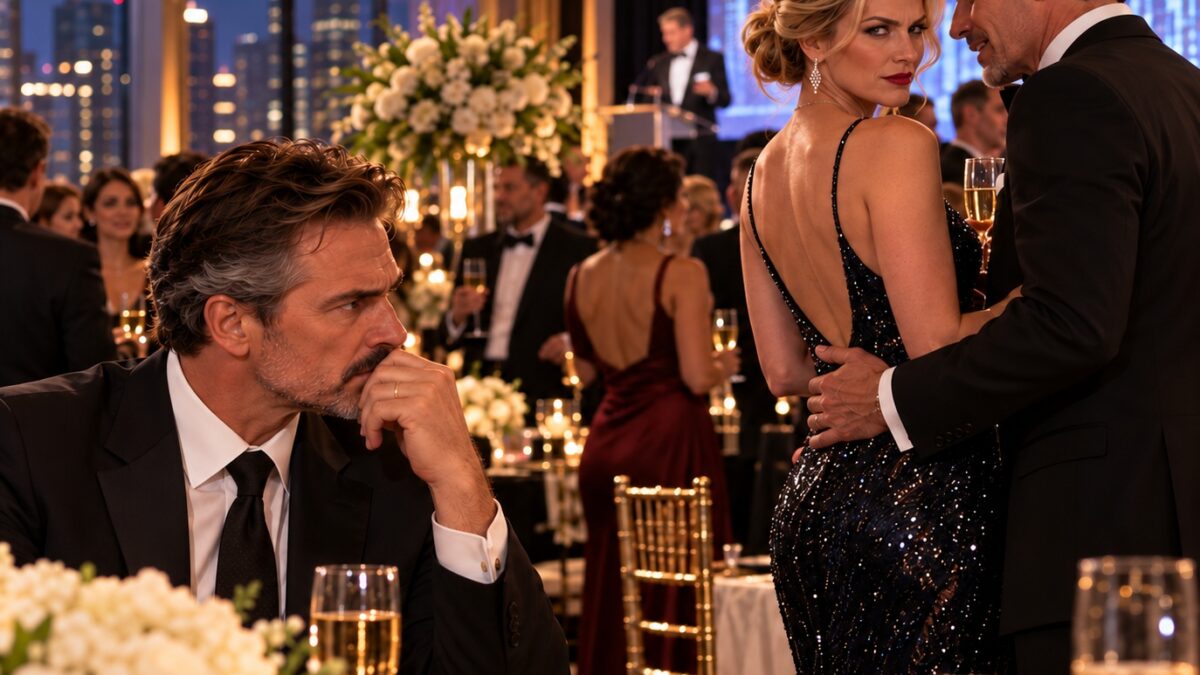
My name is Derek Cross. I was fifty-two years old then, teaching American history at a public high school in Elmhurst, just west of Chicago, and coaching varsity wrestling the way I had for twenty-two years.
I wasn’t rich.
At least, I never thought of myself that way.
I drove a pickup with almost 190,000 miles on it. I bought work shirts when the elbows wore thin. I packed leftovers for lunch. I taught teenagers about the Constitution in a classroom where one window stuck every winter and the overhead projector had to be slapped twice before it worked.
And I liked my life.
That was something my wife, Vanessa, had stopped understanding.
We had been married twenty-four years.
She was forty-nine and a senior partner at Ashford Strategic Group, a consulting firm occupying the thirty-first floor of a glass tower on Wacker Drive.
Vanessa could earn more in a week than I made in a month.
That never bothered me.
What bothered me was what the money slowly seemed to do to the way she looked at me.
Or maybe not the money.
Maybe success simply gave her permission to become the person she had wanted to be all along.
By the time our daughter left for college, Vanessa had begun speaking to me the way she spoke to hotel staff.
Polite.
Brief.
Distracted.
“Morning.”
“Don’t forget dry cleaning.”
“I’ll be late.”
“Did you pay the insurance?”
She rarely looked up from her phone.
Our daughter was a junior at the University of Illinois in Champaign, and once she was gone, our house became painfully quiet.
For years, children fill all the empty places in a marriage.
There is always homework.
Soccer.
College applications.
Dentist appointments.
Birthday parties.
Laundry.
Arguments about curfew.
Then one day the child leaves, and the silence begins asking questions.
Ours asked one question louder than the others.
What was left between Vanessa and me when we were no longer busy being parents?
I did not like the answer.
The invitation arrived on a Tuesday in March.
Heavy cream envelope.
Gold lettering.
ASHFORD STRATEGIC GROUP SPRING GALA.
Saturday, April 12.
The Heraldgate Club.
Oak Brook.
Black tie.
Vanessa dropped it on top of the quizzes I was grading at the kitchen table.
“You’re coming.”
I looked up.
“What?”
“The gala.”
I picked up the invitation.
“In six years, you haven’t invited me to a single firm event.”
“I know.”
“Why this one?”
“Because it matters.”
She was already scrolling through her phone.
“Spouses are expected this year. Everybody will be there.”
I studied her.
“And suddenly you care whether I’m there?”
She sighed.
That sigh had become familiar.
The sound of Vanessa being forced to deal with something beneath the level of importance she believed she should be handling.
“Derek, I don’t have time to turn everything into a discussion.”
“I asked one question.”
“The whole firm will be there. Preston wants the gala perfect.”
Preston.
Preston Ashford.
Founder.
Managing partner.
The name on the door.
The man Vanessa had mentioned more often over the past two years than I had ever cared to notice.
She turned to leave, then paused.
“Rent a decent tux this time.”
I leaned back in my chair.
“Was the last one indecent?”
She didn’t smile.
“And please don’t spend all night talking about wrestling.”
Then she walked out.
I sat there with the invitation in one hand and a sophomore’s essay on Reconstruction in the other.
What stayed with me wasn’t the insult.
It was the word please.
I couldn’t remember the last time she had said it to me.
The Heraldgate Club looked like a place designed to make people feel poor before they reached the front desk.
Huge chandeliers.
Polished wood.
Oil paintings of men who looked like they had inherited railroads.
A string quartet played near the staircase.
Four hundred people in formalwear filled the ballroom.
At registration, a young woman found Vanessa’s name.
She handed her a cream place card stamped in gold.
VANESSA CROSS
SENIOR PARTNER
TABLE 1
Then she handed me mine.
DEREK CROSS
GUEST
TABLE 41
The young woman smiled professionally.
“Table forty-one is toward the back, sir.”
I looked toward Vanessa.
She was already walking away.
I followed her with my eyes.
Table one sat on a raised platform near the stage.
Table forty-one was so close to the kitchen doors that waiters came through behind my chair carrying trays.
I stared at my card.
Guest.
Not husband.
Not spouse of senior partner.
Guest.
Maybe that sounds petty.
It wasn’t the word itself.
It was the planning.
Someone had made a seating chart.
Someone had looked at Vanessa Cross, senior partner, table one.
Then Derek Cross, husband of twenty-four years.
Table forty-one.
Kitchen doors.
And Vanessa had known.
I was straightening my napkin when someone squeezed my shoulder.
“Your father would have hated this seating chart.”
I turned.
Lorraine Pike.
Sixty-three.
Short silver hair.
Reading glasses hanging from a beaded chain.
She had been Ashford Strategic Group’s controller almost since the company opened.
Before that, she’d kept the books for my father.
I smiled.
“He’d hate the price of the drinks more.”
That got a small laugh.
For about two seconds.
Then Lorraine looked toward table one.
Her smile vanished.
“Keep your chin up tonight, Derek.”
Something in her tone made me stop.
“What does that mean?”
She touched my sleeve.
“Whatever happens.”
Before I could ask another question, she walked away.
Lorraine was the last person at Ashford who still talked about my father as if he were more than an old investor whose signature lived somewhere in company records.
Walt Cross had been a CPA in Oak Park for thirty-five years.
He worked above a pharmacy when I was a kid.
Then over a hardware store.
Eventually he rented a modest office with three rooms, one receptionist, and a coffee maker that had probably violated several health codes.
In 1999, a thirty-two-year-old consultant named Preston Ashford walked into Dad’s office with a business plan, no money, and what my father called “dangerous confidence.”
Preston wanted to build a consulting firm.
Banks wouldn’t touch him.
The idea was good.
The numbers were thin.
Dad liked him anyway.
Or perhaps he liked the idea of helping someone build something.
He took out a home equity loan against the house my mother loved.
One hundred fifty thousand dollars.
In exchange, he received twenty percent of the new company.
I remember asking whether Mom was scared.
Dad said, “Your mother married an accountant. Fear comes with the package.”
Ashford Strategic Group survived.
Then grew.
Then grew faster.
By the time Preston had offices downtown, nobody talked much about the accountant from Oak Park who had once helped cover payroll.
Preston made sure everyone knew whose surname was painted on the glass.
Nine years after Dad invested, Vanessa was stuck in a job she hated at a bank.
Low-level management.
No path upward.
One afternoon, Dad called Preston.
“My daughter-in-law deserves an interview.”
That was all he asked.
An interview.
Vanessa got the job.
She was good.
I never denied that.
Smart.
Organized.
Relentless.
She understood corporate politics in a way I never would.
She became a manager.
Then director.
Then partner.
Then senior partner.
Over the next seventeen years, the origin story changed.
First it was, “Your dad got my foot in the door.”
Later it became, “Your dad introduced me to Preston.”
Eventually it became, “I built this career myself.”
Which was mostly true.
Mostly.
Dad died three years before the gala.
His twenty-percent stake passed into the Cross Family Trust.
I became sole trustee and beneficiary.
The stock paid a dividend every December.
About six thousand dollars.
Barely enough to cover the property taxes on our house.
That never made sense to me, but I wasn’t a corporate accountant and didn’t care enough to fight about it.
Preston ran the company.
Preston decided what got distributed.
Dad’s twenty percent felt less like wealth than a family artifact.
A souvenir.
And Dad was sentimental about paper.
He saved everything.
Tax returns.
Contracts.
Receipts.
Letters.
Cancelled checks.
After he died, I brought eleven banker’s boxes from his house to my basement.
I intended to sort them.
Three years later, they were still stacked beside the furnace.
I could never quite bring myself to throw his handwriting away.
The man seated to my left introduced himself as Kyle.
Early thirties.
Good haircut.
Confident smile.
Tuxedo that fit better than mine.
His place card said GUEST.
“My wife’s in accounting,” he said. “Us plus-ones have to stick together.”
“Apparently.”
He laughed too hard.
I didn’t think much of it.
Not then.
But I did notice his phone.
He propped it upright against the flower arrangement in the middle of our table.
Camera pointed toward us.
Then he didn’t touch it again.
At 8:40, Preston Ashford stepped onto the stage.
He was fifty-eight.
Tall.
Silver-haired.
Tan in April, which meant money.
He spoke about growth.
Vision.
Transformation.
Market leadership.
The usual things executives say when everybody already knows the important announcement hasn’t happened yet.
Then he raised his glass.
“By this summer, Ashford Strategic Group will be a very different company.”
Applause.
“And I couldn’t have gotten us here without one partner in particular.”
He turned.
“Vanessa Cross.”
My wife stood.
Four hundred people applauded.
She looked radiant.
Preston stepped beside her.
Kissed her cheek.
Vanessa smiled at him.
Nobody at table one looked toward table forty-one.
I clapped.
Because whatever else was happening between us, she had worked hard.
Dinner began.
A waiter asked whether I wanted salmon or short rib.
“Salmon.”
I ate maybe four bites.
At 9:14, I looked at my watch.
That time stayed with me.
Preston leaned close to Vanessa.
His mouth near her ear.
His hand rested against the small of her back.
At first, it looked intimate for a boss.
Then it moved.
Lower.
Past the point where any professional hand should go.
And stayed there.
Vanessa did not pull away.
She leaned toward him.
My chest tightened.
Then she turned her head.
Not toward the stage.
Not toward another partner.
Toward me.
Across four hundred people.
Across the dance floor.
Across forty tables.
She found me.
And smiled.
That smile explained the entire evening.
The invitation.
The tuxedo.
The back table.
The kitchen doors.
She wanted me there.
Not despite where I had been seated.
Because of it.
She wanted me to see.
Maybe she wanted me embarrassed.
Maybe jealous.
Maybe angry.
At that moment, that was all I understood.
Kyle leaned toward me.
“Wow.”
I said nothing.
“If that were my wife…”
I looked at him.
He shook his head.
“I’d walk right up there and flatten the guy.”
Still I said nothing.
“You’re seriously going to let him do that?”
My wrestling boys hear the same speech every season.
Anger is weight.
If you control yours and let the other guy throw his around, he’ll eventually give you something.
A leg.
An arm.
His balance.
His back.
Twenty-two years in wrestling rooms teaches you more about people than most management seminars ever could.
So instead of watching Vanessa, I looked around the ballroom.
That’s when I saw camera two.
The event videographer had two professional cameras.
One pointed toward the stage.
The other had been drifting around the room earlier.
Now it was pointed directly toward table forty-one.
Toward me.
Not toward Vanessa.
Not toward Preston.
Toward me.
I felt something inside me settle.
This wasn’t simply humiliation.
Someone was waiting for a reaction.
I picked up my water.
Took a slow drink.
Set it down.
Folded my hands.
Kyle whispered, “You’re kidding me.”
I ignored him.
It didn’t take long.
Preston said something to Vanessa.
Then he picked up his scotch.
Stepped down from the platform.
Crossed the dance floor.
Slowly.
Not in a hurry.
Almost theatrically.
People noticed.
Conversations quieted as he passed.
He walked the entire length of the ballroom and stopped beside my chair.
“Derek the history teacher.”
His voice carried.
Three tables turned.
“Best seat in the house, huh?”
I looked around.
“First crack at the dessert cart.”
A few people laughed.
“The salmon was fine.”
His smile tightened.
“Your speech ran long.”
More laughter.
Smaller.
Nervous.
Preston set his scotch on our table.
Then planted both fists on the tablecloth and leaned toward me.
His breath smelled like whiskey.
“You know what your problem is, Derek?”
I looked at him.
“You’ve spent your whole life sitting at the kids’ table.”
I heard chairs shift nearby.
“Your wife outgrew you ten years ago.”
I glanced past him.
Vanessa was watching.
“So everybody in this room knows?”
His eyes narrowed.
“Everybody.”
I nodded.
“People in this room know a lot of things, Preston.”
“What does that mean?”
“Most of them are about you.”
The table beside us went silent.
Kyle shifted closer until his shoulder nearly touched mine.
Preston lowered his voice.
“Stand up.”
I remained seated.
“Come on.”
His face darkened.
“Stand up and say that to my face like a man.”
“I can see your face just fine from here.”
Kyle whispered, “Come on, man. He’s asking for it.”
That confirmed what my instincts had already told me.
Preston was drunk.
Kyle wasn’t.
Yet Kyle wanted violence more than Preston did.
Preston reached down.
Grabbed a fistful of my tuxedo lapel.
Pulled.
“Stand up.”
So I stood.
But not the way he expected.
I rose in one smooth movement while turning my shoulder.
The same simple motion I had taught hundreds of wrestlers when someone tried to control them by the jacket or collar.
His fingers slipped off the satin.
Preston had committed his weight to the pull.
When I wasn’t where he expected me to be, there was nothing holding him up.
He stumbled backward.
Hit the empty chair beside me.
The chair tipped.
And Preston Ashford went over it.
Flat on his back.
Right there between table forty-one and the kitchen doors.
His glass overturned.
Scotch spread across the white tablecloth.
His glasses skidded under the next table.
I never touched him.
I looked at my watch.
9:24.
At 9:14, his hand had been on my wife.
Ten minutes later, he was lying on polished parquet beneath a chandelier while four hundred people stared.
The string quartet kept playing Vivaldi.
That was the strangest part.
Nobody had told them to stop.
Preston blinked at the ceiling.
I stood beside my chair with both hands at my sides.
Vanessa reached us in maybe fifteen seconds.
She dropped to her knees beside Preston.
One hand immediately went to his chest.
Not mine.
His.
Then she looked up at me.
“What did you do?”
“Nothing.”
“You pushed him.”
“No.”
“You—”
“That’s going to be your problem.”
Her face tightened.
“What?”
“I didn’t touch him.”
Two men helped Preston up.
He cradled his right wrist.
His face had gone pale.
“He did this.”
He pointed at me.
“Everybody saw it.”
Nobody answered.
The people at tables thirty-nine and forty had seen exactly what happened.
One older man met my eyes.
Gave me a slow nod.
Kyle was staring at his phone.
For a second, he didn’t look shocked.
He looked disappointed.
“You should’ve done something,” he muttered.
That sentence stayed with me too.
I buttoned my jacket.
Picked up my place card.
Walked out.
Lorraine Pike was standing near coat check.
Waiting.
She did not ask what happened.
She touched my arm.
“Go home, Derek.”
I studied her.
“And don’t say a word tonight.”
“Why?”
“Not to anyone.”
Then she walked away.
Vanessa did not come home.
At 1:00 a.m., my phone lit up.
STAYING DOWNTOWN. DON’T CALL.
I didn’t.
Sunday morning at ten, an email arrived from Ashford Strategic Group’s marketing department.
Thank you for celebrating with us!
Three exclamation points.
Full gala footage available for download for seven days.
Relive the magic.
The message had been sent to everybody registered for the event.
I was not staff.
I was not a partner.
But Vanessa had entered my email address when she RSVP’d.
I downloaded both camera files.
Camera two ran four hours and six minutes.
I made coffee.
Sat at our kitchen table.
Watched.
For the first two hours, camera two behaved normally.
Crowd.
Bar.
Dance floor.
Awards.
Then, at exactly 8:40, when Preston walked onto the stage to give the most important speech of the evening, camera two turned away from him.
It moved to the back.
Stopped on table forty-one.
Stayed.
Forty-four minutes.
A professional event camera ignored the company’s founder during his keynote so it could record a schoolteacher sitting near the kitchen.
At 9:14, it zoomed slightly.
Onto my face.
Before Preston even stood.
I watched him cross the ballroom.
Watched him lean over me.
Watched his mouth move.
Watched his hand grab my jacket.
Then frame by frame, I watched myself stand.
Turn.
His hand slide free.
His body lose balance.
My hands never rose.
Not once.
I watched it three times.
Then I copied both files.
Flash drive.
Cloud storage.
External hard drive.
Twenty-four years of teaching history had taught me something my students hated hearing.
Sources matter.
Originals matter more.
Vanessa came home Sunday evening.
She was still wearing her gala dress beneath a borrowed coat.
She walked directly to the refrigerator.
“Preston is very upset.”
“I’m sure.”
“He’s considering his options.”
“He can consider every one of them.”
She turned.
“You embarrassed him in front of the entire firm.”
“He handled that himself.”
“Derek.”
“I had an excellent view.”
I paused.
“Back row, but excellent.”
She slammed the refrigerator.
“You think this is funny?”
“No.”
“What do you think you’re doing?”
“Right now?”
“Yes.”
“Making sure you know I didn’t touch him.”
Her face shifted.
Only slightly.
Then she went upstairs.
I slept in the guest room.
It felt less like a decision than an acknowledgment.
Monday morning, ten minutes before first period, my phone rang.
The man identified himself as an investigator in Oak Brook.
“Mr. Cross, Preston Ashford filed a formal complaint yesterday.”
I leaned against my desk.
“For what?”
“Battery.”
I almost laughed.
“He says you caused his injury Saturday night.”
“Did he tell you there were four hundred witnesses?”
“He listed one.”
I knew before the investigator said it.
“Kyle Brandt.”
I stared at the empty student desks.
My fellow guest.
“My wife’s in accounting.”
Us plus-ones.
His phone pointed at me.
“I’d like you to come in and give your side.”
“I’ll do better.”
“What does that mean?”
“I’ll be there at four with something you should watch.”
At lunch, I called Maggie Mooney.
Maggie was sixty-four.
Small law office above a dry cleaner in Oak Park.
Voice like gravel dragged over concrete.
She had handled my father’s estate.
Created the Cross Family Trust.
She listened without interrupting.
The seating.
Vanessa.
Preston.
Kyle.
Camera.
Complaint.
When I finished, Maggie said, “Do not talk to anyone else.”
“I haven’t.”
“I’ll meet you at the station.”
At 3:45, she was already outside.
The investigator had a gray crew cut and shoulders like he’d spent time playing linebacker.
He watched camera two once.
Then again.
Third time, he slowed it down.
Frame by frame.
Preston’s hand.
My shoulder.
My turn.
His fall.
The investigator leaned back.
“You never touched him.”
“No.”
“That’s a man who lost his footing.”
Maggie said nothing.
I pointed toward the screen.
“Watch the beginning again.”
He frowned.
“What am I looking for?”
“Why does that camera spend forty-four minutes filming me?”
He replayed it.
Preston walked to the podium.
Camera moved away.
Table forty-one.
Me.
The investigator looked at me.
Then at Maggie.
Then wrote something on his pad.
“This complaint isn’t going anywhere.”
He paused.
“And I’m going to have another conversation with Mr. Brandt.”
That night, I opened the Ashford Strategic Group website.
Clicked OUR PEOPLE.
I found Preston.
Vanessa.
Partners.
Managers.
Associates.
Then I saw him.
Kyle Brandt.
Associate.
Same face.
Same grin.
He did not have a wife in accounting.
He worked for Preston.
He had been given a GUEST place card.
Seated beside me.
Phone recording.
Encouraging me to hit the boss.
Now the whole evening looked different.
But I still didn’t know why.
Humiliation?
Divorce?
Maybe Vanessa wanted out.
Maybe she wanted me to look violent when she left.
Our daughter was grown, so custody wasn’t an issue.
The house had about four hundred thousand dollars in equity.
A man facing a battery charge would have a harder time arguing that he should remain in the home during a hostile divorce.
It made sense.
Not enough.
But it made sense.
Then I remembered my father’s shares.
Twice in the past year, Preston had tried to buy them.
The first offer arrived the previous April.
Three hundred fifty thousand dollars.
“Book value,” he called it.
Plus a small sweetener.
Vanessa pushed me.
“Sell them.”
“They were Dad’s.”
“They’re paper.”
“They’re twenty percent of the company.”
“They pay six thousand a year.”
She rolled her eyes.
“Pay down the mortgage. Put the rest into retirement.”
I refused.
Then Preston made another offer in September.
Same basic number.
Handwritten note.
FINAL OFFER.
Vanessa pushed even harder.
“What are you holding on to?”
“My father’s shares.”
“A dead man’s souvenir.”
That one hurt.
I still said no.
Because Dad had left me one unusual instruction.
A letter tucked into his estate papers.
One line underlined.
DON’T SELL TO PRESTON. NOT UNTIL YOU’VE SEEN THE BOOKS WITH YOUR OWN EYES.
I never understood what he meant.
I assumed he wanted me to look at company financials.
I never bothered.
Maybe that had been stupid.
But even if Preston hated that I wouldn’t sell, a battery complaint did not magically transfer ownership.
At least, I didn’t think it did.
Tuesday at 5:15, a courier knocked on my door.
Thick envelope.
Signature required.
Ashford Strategic Group letterhead.
NOTICE OF MANDATORY REPURCHASE OF SHARES.
I sat down.
Read slowly.
The letter stated that under Section 9.4 of the amended shareholder agreement, my “act of violence” at the April 12 gala and the resulting criminal complaint triggered the company’s right to repurchase all shares held by the Cross Family Trust.
At book value.
Enclosed:
Cashier’s check.
$310,000.
Payable to Cross Family Trust.
I stared at it.
Twenty percent of a company Dad had helped create.
Three hundred ten thousand dollars.
At the bottom of the notice:
Lorraine Pike
Controller and Corporate Secretary
Lorraine.
Keep your chin up.
Whatever happens.
Go home.
Don’t say anything tonight.
For the first time, I wondered whether I had misunderstood her.
Maybe she hadn’t been helping me.
Maybe she had been protecting the company.
I picked up the cashier’s check.
Held it beneath the kitchen light.
Teaching history gives you habits.
Whenever I put a primary document in front of students, I ask the same question first.
When was it created?
Not what does it say.
Not who wrote it.
When.
Dates expose motives.
The check was dated Thursday, April 10.
I looked again.
Thursday.
The gala had been Saturday, April 12.
The check to repurchase my father’s shares had been purchased two days before I supposedly committed the act that gave Ashford Strategic Group the right to repurchase them.
I sat down very slowly.
Then I read everything again.
Every page.
Every attachment.
The way I taught juniors to read the Declaration of Independence.
The amendment had been adopted at a special shareholder meeting the previous November.
New Section 9.4.
If any shareholder, or any trustee controlling shares, committed an act of violence at a company function or was charged with a crime of violence, the company could repurchase those shares at book value.
Among all Ashford shareholders, only one stake was held through a trustee.
Mine.
The amendment had passed with exactly seventy-five percent approval.
The minimum required.
The second attachment supposedly proved I had received notice of the November meeting.
Certified mail.
Sent October 28.
Delivered October 30.
I had never seen it.
I looked at the evening again in my mind.
Vanessa suddenly insisting I attend the first company event she’d invited me to in six years.
Table forty-one.
Far from anyone who knew me.
Kyle beside me.
Phone recording.
Camera two pointed at my table before anything happened.
Preston touching Vanessa where I could see.
Vanessa checking to make sure I saw.
Kyle telling me to hit him.
Preston walking all the way across the ballroom to provoke me.
And a check already sitting somewhere in an office.
Waiting.
They had not invited me to humiliate me.
Humiliation was the bait.
They needed me to swing.
I did not cash the check.
I slid it into a plastic document sleeve.
Put it inside a folder.
Wednesday, during my planning period, I went online and requested proof of delivery for the certified letter.
The email arrived that evening.
Delivered October 30.
11:52 a.m.
Addressed to:
Derek W. Cross
Trustee
Cross Family Trust
Signed:
V. Cross.
Blue ink.
I stared at the signature.
I had seen it thousands of times.
Mortgage paperwork.
Tax returns.
Birthday cards.
Anniversary notes.
Vanessa.
Back then, she worked from home every Wednesday.
She had signed for certified mail addressed specifically to me as trustee.
And never given it to me.
Then I did the math.
Preston owned sixty-eight percent.
My father’s trust owned twenty.
Vanessa owned seven.
The two junior partners split the remaining five.
Preston alone could not pass the amendment.
He needed seven percent.
Exactly.
Vanessa’s seven.
My father had gotten Vanessa her first interview at that company.
She had used the power he helped her build to create a rule designed to take his shares from his son.
That Wednesday, Vanessa came home at 8:30.
She saw the proof-of-delivery printout before she removed her coat.
“What’s that?”
“Read it.”
She picked it up.
I watched her eyes reach the signature.
I watched her think.
Then I watched my wife decide to lie.
“I sign for packages all the time.”
“Do you?”
“I must have put it with the mail.”
“It was certified.”
She stared at me.
“From Ashford’s outside lawyers.”
Silence.
“Addressed to me as trustee.”
“Derek—”
“Nineteen days later, you voted your seven percent to pass the exact rule in the letter.”
“It was a standard conduct clause.”
“Was it?”
“Yes.”
“Half the firms in Chicago don’t buy the buyback check two days before the misconduct happens.”
Her face changed.
I placed the plastic sleeve on the table.
“April tenth.”
She looked at the date.
“Preston knew Thursday that he would need this Monday.”
I leaned forward.
“Unless you were the one who knew.”
Something broke in her expression.
The polished corporate mask disappeared.
What remained was angry.
“You were never going to do anything with those shares.”
For the first time in years, Vanessa was actually talking to me.
Not around me.
Not past me.
To me.
“You would have let them sit there another twenty years out of loyalty to your father.”
“They belonged to him.”
“He’s dead, Derek.”
My jaw tightened.
“And you live in the past.”
She pointed toward the folder.
“You teach dead presidents to teenagers. You coach high school boys in a basement gym. You’ve spent your entire life treating standing still like it’s some kind of moral victory.”
I let her finish.
Then she made the mistake that exposed the rest.
“Meanwhile, Tallmad Row is about to write a twenty-six-million-dollar check for the firm.”
The second the number left her mouth, she froze.
I didn’t.
Twenty-six million.
Preston’s speech.
By summer, this firm will be very different.
His two offers.
Three hundred fifty thousand dollars.
I did the math out loud.
“Twenty percent of twenty-six million.”
Vanessa said nothing.
“Five point two million dollars.”
She gripped the counter.
“And Preston tried to take it for three hundred ten thousand.”
“It wasn’t supposed to happen like this.”
Her voice had changed.
Almost a whisper.
I looked at her.
“You expected me to hit him.”
She closed her eyes.
I answered for her.
“You were supposed to smile across the ballroom.”
No response.
“Kyle was supposed to provoke me.”
Still nothing.
“Camera two was supposed to capture it.”
Her shoulders dropped.
“The complaint only had to last long enough for me to deposit that check.”
“Derek—”
“I stayed in my chair.”
That was the one variable they hadn’t controlled.
She looked at me then.
Really looked.
“It wasn’t supposed to go this far.”
“How far was it supposed to go?”
She had no answer.
Twenty minutes later, she came downstairs with a rolling suitcase.
Laptop bag on her shoulder.
At the front door, she paused.
“Preston’s lawyers say the clause is airtight.”
I looked at the eleven closed basement boxes in my mind.
The father who saved everything.
“Then Preston’s lawyers never met my father.”
She left.
I sat alone in the kitchen.
Then I arranged the facts the way I would build a lesson on the causes of the Civil War.
Chronology first.
Preston began discussing a sale.
Dad’s shares became expensive.
I refused to sell.
Preston needed a mechanism to force a buyback.
Vanessa gave him the seven percent necessary to adopt that mechanism.
She intercepted notice so I could not object.
Then they manufactured the condition.
The touching.
The humiliation.
The provocation.
The witness.
The camera.
The police complaint.
The check.
None of it was spontaneous.
The most painful part was realizing the house probably had nothing to do with it.
Four hundred thousand dollars of equity was nothing compared with five million.
Whatever Preston had promised Vanessa existed on his side of the sale.
My father’s shares were the obstacle.
Thursday after school, I drove to Maggie’s office.
I gave her everything.
Notice.
Check.
Amendment.
Proof of delivery.
She read in silence.
Tapped her pen slowly against the desk.
That meant she was furious.
“First.”
She pointed at the check.
“You do not cash that.”
“I haven’t.”
“You don’t deposit it.”
“I know.”
“Not even to see whether it clears.”
“It’s in a plastic sleeve.”
“Good.”
She leaned back.
“Second, as trustee and shareholder, you have inspection rights.”
“For what?”
“Books. Minutes. Shareholder records. Agreements. Any sale documents relevant to your ownership.”
She pulled a legal pad toward her.
“I’ll draft a formal demand.”
“The corporate secretary is Lorraine Pike.”
Maggie’s pen stopped.
She knew Lorraine through my father.
“She signed the buyback letter.”
Maggie considered that.
“Then we’ll find out which side Lorraine is on.”
That weekend, I went downstairs.
Eleven banker’s boxes.
Dust.
Dad’s square handwriting on every label.
TAXES 1982-1988.
HOUSE.
CROSS CPA.
ASG.
CAR TITLES.
I found a receipt for a lawn mower from 1984.
Dad trusted paper more than handshakes.
Saturday night, inside the ninth box, I found a thick folder.
ASG 1999.
Original shareholder agreement.
Not a photocopy.
The signed original.
Dad’s pencil notes covered the margins.
Page fourteen stopped me.
Section 11.2.
Dad had underlined it twice.
No amendment reducing the value, voting rights, or transferability of any shareholder’s shares would bind that shareholder without his or her written consent.
I read it again.
And again.
The final page contained two signatures.
Walter J. Cross.
Preston R. Ashford.
Preston had signed it when he was thirty-two.
Back when my father was the man whose home equity kept his company alive.
Tucked into the folder was a photograph.
A cramped office.
Folding tables.
Dad in shirt sleeves.
Grinning.
A younger Lorraine stood beside him with a pencil behind her ear.
On the back:
DAY ONE. WALT AND LORRAINE.
Monday morning, before first period, I called Maggie.
Read Section 11.2.
Silence.
Then Maggie laughed.
Short.
Dry.
“Your father was a very careful man.”
“What does it mean?”
“It means unless they have your written consent, Section 9.4 cannot reduce your rights.”
“They never asked.”
“Exactly.”
“Can Preston amend Section 11.2 out?”
“Doing that reduces your protections.”
“So he’d need my consent.”
“Now you’re thinking like your father.”
Maybe Preston had forgotten the clause.
Maybe he’d hoped the original was lost.
Either way, Maggie said the same thing.
“That’s his problem.”
Tuesday evening, I was locking the wrestling room after practice when Lorraine called.
No hello.
“Your lawyer’s demand came Thursday.”
I stopped.
“Preston told me to send a one-page summary.”
I waited.
“I told him I would.”
My stomach tightened.
“I’m bringing everything instead.”
I said nothing.
“Tomorrow. Four o’clock. Maggie’s office.”
“Why?”
“Because your father would expect me to.”
The next afternoon, Lorraine arrived carrying a banker’s box.
She placed it on Maggie’s desk.
Then arranged three stacks.
Neat.
Exact.
The way my father used to.
The first was a letter of intent from Tallmad Row Partners.
National consulting firm based in New York.
Signed in January.
Purchase price:
$26 million.
Closing scheduled no later than May 30.
One condition had been underlined.
Seller must deliver one hundred percent of outstanding shares.
There it was.
My twenty percent wasn’t merely expensive.
It could block the deal.
Attached was a list of key personnel Tallmad Row intended to retain.
Preston’s name was first.
Vanessa’s name wasn’t there.
I noticed.
But I assumed senior partners were handled elsewhere.
The second stack contained the November meeting minutes.
Cross Family Trust absent.
Two junior partners abstained.
Preston:
68%.
Vanessa:
7%.
Amendment passed:
75%.
The third stack contained one page.
Notarized that morning.
Lorraine’s statement.
She read it aloud.
“On Thursday, April tenth, Mr. Ashford instructed me to obtain a cashier’s check in the amount of three hundred ten thousand dollars payable to the Cross Family Trust.”
I looked at her.
“He told you before the gala?”
“Yes.”
“What exactly did he say?”
Lorraine adjusted her glasses.
“When I asked why he needed it, he said, ‘The Cross buyback. It’ll be needed Monday.’”
Maggie leaned forward.
“He said Monday?”
“Yes.”
Two days before the gala.
Before the touching.
Before the confrontation.
Before any police complaint.
Before my supposed violence.
Preston already knew he would have the condition he needed.
“Why did you buy it?” I asked.
Lorraine looked tired.
“Because if I’d refused Thursday, he’d have fired me Thursday.”
“You could have waited.”
“And then somebody else would have bought it Monday.”
She removed her glasses.
“I bought it on the day he ordered me to.”
The realization hit me.
“The bank date.”
“Yes.”
“You wanted the date on the check.”
Lorraine smiled.
Small.
Sad.
“Preston doesn’t look at anything smaller than a million dollars.”
I almost laughed.
“I hoped somebody would.”
“Why didn’t you call me?”
“I tried.”
“When?”
“Friday night.”
“The night before the gala?”
“Yes.”
“I didn’t get a call.”
“Vanessa answered.”
The room went quiet.
“She said you were asleep.”
I stared at Lorraine.
“I asked her to have you call me first thing.”
“She didn’t.”
“I didn’t think she would.”
“Why didn’t you leave details?”
“Because all I had was a check and one word.”
“What word?”
“Monday.”
Lorraine folded her hands.
“I could guess the setup. I couldn’t prove it.”
“So at the gala…”
“Keep your chin up.”
Whatever happens.
Go home.
Don’t say anything.
“She wasn’t protecting Preston,” Maggie said quietly.
Lorraine shook her head.
“I knew there was a check in the office safe with the Cross Family Trust written across it.”
She looked at me.
“I was trying to stop you from giving them anything else.”
Then she told me something I never knew.
When Dad invested in Ashford in 1999, he had asked Lorraine to leave his accounting practice and work for the startup.
“Walt told me he wanted one honest set of books wherever his money went.”
Her voice wavered.
“I kept them twenty-six years.”
I looked toward the old photograph.
“When he got sick, he made me promise something.”
“What?”
“If Preston ever came after you, I was supposed to look out for you.”
Lorraine’s eyes filled.
“I’m sorry it took me so long.”
“It didn’t.”
She looked at me.
“It took exactly as long as it took to do it right.”
Dad’s letter finally made sense.
Don’t sell until you’ve seen the books with your own eyes.
He had not meant balance sheets.
He meant Lorraine.
The woman keeping the books.
The person he trusted to make sure the numbers—and Preston—stayed honest.
I opened the ASG 1999 folder.
Showed Lorraine Section 11.2.
She stared at it.
For a long time.
Then she whispered, “I knew this existed.”
Maggie looked up.
“What?”
“The firm’s original copy disappeared when we moved downtown in 2006.”
“Who had it?”
“Preston.”
Lorraine touched the page.
“He told outside counsel it must have been lost during the move.”
“And what did he give them instead?”
“A two-page summary he wrote.”
Maggie sat back.
“You’re kidding.”
Lorraine shook her head.
“I always wondered.”
Before she left, Maggie asked one more question.
“What happens to a partner’s shares if the partner is terminated for cause?”
Lorraine answered immediately.
“Mandatory repurchase at book value.”
I thought about Vanessa.
“How long has that rule existed?”
“Longer than Vanessa has been a partner.”
“She signed it?”
“Eleven years ago.”
Thursday afternoon, the Oak Brook investigator called.
“I thought you’d want an update.”
“What happened?”
“Kyle Brandt changed his statement.”
I stopped walking.
“He watched the video with counsel present.”
“And?”
“He admits Mr. Ashford personally assigned him to your table.”
My jaw tightened.
“With a guest place card.”
“Yes.”
“What was he told to do?”
The investigator’s voice remained flat.
“Get the husband going.”
I closed my eyes.
“And record it.”
“Yes.”
“Why?”
“Five-thousand-dollar bonus.”
I exhaled slowly.
“He also says Mr. Ashford never viewed the gala footage before filing the complaint.”
That stunned me.
“He didn’t watch it?”
“No.”
Preston had assumed Kyle’s statement would be enough.
He didn’t need a conviction.
He didn’t need the truth.
He only needed an allegation on paper long enough to trigger the buyback.
“What’s happening to the complaint?”
“It’s becoming a false-report investigation.”
“Against Preston?”
“Yes.”
“Kyle?”
“Cooperating.”
The investigator paused.
“This may be referred to the state’s attorney.”
That night, Maggie and I sat in her office.
Lorraine’s three stacks between us.
“We can sue tomorrow,” Maggie said.
“For what?”
“Shareholder oppression. Fraud. Breach of fiduciary duty. Interference with trust rights. Pick one.”
“Would we win?”
“Yes.”
“How long?”
“Two years.”
I shook my head.
“Too long.”
She studied me.
“What are you thinking?”
“The closing.”
“May twenty-ninth.”
“That’s the only date Preston cares about.”
Maggie waited.
“He plans to sit in that room and represent that he owns one hundred percent.”
“Or controls it.”
“Same problem.”
I looked at the letter of intent.
“I want to be sitting there when he says it.”
Maggie smiled for the first time that evening.
“Now you sound dangerous.”
“I’m a history teacher.”
“Exactly.”
She picked up the phone.
“Tallmad Row’s general counsel needs to know there’s a title problem before she wires twenty-six million dollars.”
The next morning, Maggie called New York.
Tallmad Row’s general counsel listened.
Asked for copies.
Then asked more questions.
After a long silence, she agreed.
She wanted Preston to make his representations at closing.
On the record.
With the documents present.
The Cross Family Trust would be heard.
Nobody would warn Preston.
Closing:
Thursday, May 29.
10:00 a.m.
Ashford Strategic Group.
Thirty-first floor.
The night before, I packed my father’s old leather briefcase.
The cashier’s check.
Still uncashed.
Plastic sleeve.
Certified-mail proof.
Flash drive.
Lorraine’s statement.
Sale documents.
November minutes.
Original 1999 agreement.
My father’s folder.
I slept better than I had in weeks.
Thursday morning, I put on my good gray suit.
Not a rented tuxedo.
Maggie rode downtown with me.
At reception, a young woman checked a list.
“Your name isn’t here.”
I looked through the glass conference-room wall.
Everybody was inside.
Preston at the head.
Wrist healed.
Gold pen.
Vanessa beside him in a navy suit.
Two junior partners.
Outside counsel.
Lorraine at a side table.
Laptop open.
And across from Preston sat Tallmad Row’s general counsel.
Charcoal suit.
Closed leather folder.
I walked past reception.
“Sir—”
Maggie followed.
Preston saw me through the glass.
He stood so fast his chair rolled backward and hit the wall.
I opened the door.
“This is a private closing.”
“Is it?”
“You have no business here.”
“I own twenty percent of the company you’re selling.”
“You owned twenty percent.”
I set Dad’s briefcase on the table.
Preston pointed toward me.
“Those shares were repurchased under Section 9.4.”
“Were they?”
“You’ve been paid.”
I opened the briefcase.
Placed the cashier’s check on the table.
Still inside the sleeve.
“Here’s your payment.”
Tallmad Row’s general counsel picked it up.
I said, “Check the date.”
She did.
“April tenth.”
“Two days before the gala.”
Her eyes moved toward Preston.
“Two days before I supposedly committed the act that gave Ashford Strategic Group the right to write that check.”
Nobody spoke.
The last time Preston and I had been in the same room, he’d placed me beside the kitchen.
This time, there was one empty chair directly across from him.
I pulled it out.
Sat.
Preston’s outside lawyer stepped in.
“The amendment was properly approved by seventy-five percent of shareholders.”
“Was proper notice provided?” Maggie asked.
“Yes.”
He produced a copy.
“Certified mail.”
I slid the proof of delivery across the table.
“Addressed to me.”
The general counsel read it.
“Signed V. Cross.”
“My wife.”
Vanessa stared at the table.
“She worked from home every Wednesday.”
I looked at her.
“She signed for it.”
No response.
“Never gave it to me.”
Preston recovered.
“Doesn’t matter.”
His voice was louder.
“Notice or no notice, the shareholders voted.”
“Seventy-five percent.”
“Correct.”
“Sixty-eight percent from you.”
I turned toward Vanessa.
“Seven from my wife.”
Vanessa looked down.
Preston snapped, “The clause is valid.”
I reached into the briefcase.
Pulled out the ASG 1999 folder.
“Then you’ll like this.”
His face changed.
Just slightly.
“This is the original shareholder agreement.”
I opened it.
“Not your two-page summary.”
Lorraine looked toward Preston.
The general counsel leaned forward.
“Page fourteen.”
I pushed the agreement across.
“Section 11.2.”
She read.
I waited.
Then I recited it.
“No amendment that reduces the value, voting rights, or transferability of a shareholder’s shares binds that shareholder without written consent.”
I looked at Preston.
“I never consented.”
His lawyer reached for the document.
The general counsel kept it.
I continued.
“So your Section 9.4 may bind everybody else in this room.”
Pause.
“It doesn’t bind my father’s trust.”
The general counsel turned to the signature page.
Two names.
Walter J. Cross.
Preston R. Ashford.
She looked up.
“Mr. Ashford.”
Preston said nothing.
“Is this your signature?”
Nothing.
For the first time since I had known him, Preston Ashford had no prepared answer.
I opened the briefcase again.
“One more thing.”
I handed Lorraine the flash drive.
She plugged it into the conference-room system.
Camera two filled the wall.
The room watched.
Forty-four minutes focused on table forty-one.
My face at 9:14.
Preston touching Vanessa at the head table.
Walking toward me.
Leaning over me.
Grabbing my lapel.
My shoulder turning.
His hand slipping.
Preston falling.
My hands visible.
At my sides.
The entire time.
Maggie spoke calmly.
“Oak Brook investigators have this footage.”
She looked at Preston’s counsel.
“So does Kyle Brandt.”
Preston’s face hardened.
“Mr. Brandt has withdrawn his first statement.”
Maggie opened another folder.
“He has admitted Mr. Ashford assigned him to table forty-one with instructions to provoke Mr. Cross and record his reaction.”
The Tallmad Row general counsel closed her folder.
Very slowly.
“Mr. Ashford.”
Preston stared at her.
“Your disclosure schedule states that the Cross Family Trust shares were validly repurchased.”
Nobody moved.
“It also states there is no pending criminal matter involving senior management.”
Preston started to speak.
She raised a hand.
“Both statements appear to be false.”
Then she stood.
“Tallmad Row is suspending this closing effective immediately.”
Vanessa’s head snapped up.
“No.”
Everyone looked at her.
“This can be fixed.”
Her voice was thin.
Desperate.
“I know the client book better than anyone. I’m on the transition team.”
The general counsel looked at her.
Not angrily.
Almost sadly.
“Mrs. Cross.”
Vanessa waited.
“You are not on our transition team.”
Silence.
“What?”
“Your position is listed for elimination upon closing.”
Vanessa stared.
The general counsel continued.
“Mr. Ashford approved the final personnel schedule in March.”
Vanessa turned toward Preston.
Slowly.
I watched the realization spread across her face.
This wasn’t the woman who had smiled at me across the ballroom.
This was someone discovering that the future she had betrayed her marriage to purchase had never been for sale.
“You told me…”
Preston looked at the gold pen.
“You told me I’d be managing director.”
He did not answer.
“You promised me a million dollars out of the transaction.”
Still nothing.
And there it was.
The final piece.
Vanessa had helped Preston take my father’s shares because Preston had promised her a future.
Money.
Title.
Maybe him.
Maybe both.
But Preston had already written her out of the company he planned to sell.
He used her vote.
Her ambition.
Her resentment.
Her body across a ballroom.
Her marriage.
Then planned to discard her.
I thought I would enjoy watching her understand.
I didn’t.
By then, I had grieved my marriage somewhere between table forty-one and that conference room.
There was a knock on the glass.
The receptionist stood outside.
Pale.
Two men behind her.
Sport coats.
One was the Oak Brook investigator.
They entered.
“Preston Ashford?”
Preston’s face emptied.
“Yes.”
The investigator produced paperwork.
“We have a warrant for your arrest for filing a false police report.”
No one moved.
“Please stand.”
Preston stood.
For a second, he looked at me as though I had done something to him.
That expression almost made me laugh.
Almost.
“You told me to stand up once.”
His eyes narrowed.
“I did.”
The investigator took his arm.
“You’re the one who ended up on the floor.”
They handcuffed him.
Walked him out.
Through the lobby.
Past glass offices.
Past employees pretending not to stare.
Vanessa remained seated.
The conference room slowly emptied.
Lawyers.
Partners.
Tallmad Row representatives.
Finally, she looked at me.
For the first time in years, my wife actually looked at me.
No phone.
No corporate smile.
No impatience.
Just Vanessa.
“I never meant for it to go this far.”
I closed Dad’s briefcase.
“You planned every step.”
“No.”
“The invitation.”
She looked away.
“The seating chart.”
Silence.
“Kyle.”
Her eyes closed.
“Camera two.”
“Derek—”
“The check.”
She started crying.
“The only thing you didn’t plan…”
I stood.
“…was me staying in my chair.”
Lorraine caught my eye.
Gave me one small nod.
Dad used to do the same thing when I won a difficult wrestling match.
Not applause.
Not celebration.
Just a nod.
Sixteen months have passed since that gala.
Tallmad Row did not abandon the acquisition.
They abandoned Preston.
Their condition was simple.
Preston had to resign.
No management role.
No consulting arrangement.
No board seat.
Nothing.
He signed his resignation in June.
The scandal reduced the purchase price by two million dollars.
The rest of the shareholders, including the Cross Family Trust, agreed to proceed on one condition.
Every dollar of that reduction came out of Preston’s share.
The sale closed in August.
The Cross Family Trust received twenty percent of the original twenty-six-million-dollar value.
Five million two hundred thousand dollars.
By wire.
I sat at my kitchen table when Maggie called.
“The money landed.”
I looked around the room.
Same table where Vanessa had once put the gala invitation on my students’ quizzes.
Same room where I confronted her with the pre-dated check.
Same house.
Different life.
“What are you going to do?”
Maggie asked.
“Tomorrow?”
“Yes.”
“Teach third period.”
She laughed.
“No, seriously.”
“I am serious.”
Preston pleaded guilty to filing a false police report.
Felony.
Two years’ probation.
Two hundred hours of community service.
The conviction will appear on every serious background check he faces for the rest of his working life.
His remaining sale proceeds went into escrow for three years to cover claims.
The first major claim was ours.
The Cross Family Trust sued for fraud.
Preston settled.
Nine hundred thousand dollars.
Plus every hour Maggie billed.
His name came off the company.
Ashford Strategic Group no longer exists under that name.
The Chicago office now operates under Tallmad Row.
His lake house went on the market that fall.
Legal bills.
Criminal defense.
Civil settlement.
Consequences have invoices.
The three-hundred-ten-thousand-dollar cashier’s check was returned uncashed.
Still inside the plastic sleeve.
Kyle Brandt was fired during the fallout.
He cooperated with prosecutors.
His original statement had been false, but his cooperation mattered.
He received court supervision on a reduced misdemeanor matter.
The last thing I heard, he was selling insurance in Indiana.
I don’t hate him.
He was weak.
Weakness can still hurt people.
But I have spent enough years with teenagers to know that one cowardly choice does not have to become an entire life.
Vanessa’s outcome was harder for me to absorb.
After Preston resigned, Tallmad Row lawyers reviewed the November meeting.
Certified notice addressed to me.
Signed by Vanessa.
Hidden.
Then Vanessa voting the exact seven percent necessary to pass the amendment.
That gave the surviving partners everything they needed to terminate her for cause.
And the partnership agreement contained an old rule.
A partner terminated for cause had to sell her equity back at book value.
Vanessa had signed that rule eleven years earlier.
Her seven percent returned to the firm for about eighteen thousand dollars.
At the actual transaction value, that seven percent would have been worth roughly $1.82 million.
She tried to take my father’s shares at book value.
In the end, hers were taken the same way.
I did not celebrate that either.
Our divorce became final the following spring.
I kept the house.
Refinanced her name off the mortgage.
Vanessa kept her retirement account and car.
She rents a condo in Schaumburg now.
Does contract work through a staffing firm.
Our daughter sees her about once a month.
That’s her decision.
I never asked her to choose.
One night, months after the divorce, my daughter called me.
“Are you angry that I still see Mom?”
“No.”
“You sure?”
“She’s your mother.”
“She hurt you.”
“Yes.”
“She tried to steal Grandpa’s money.”
“Yes.”
“She used Preston.”
“Or Preston used her.”
“Both.”
“Then why aren’t you angry?”
I thought about it.
“Because I don’t need you to punish her for me.”
She cried.
So did I.
Quietly.
After the sale, I paid off the mortgage.
Set aside money for my daughter’s graduate school.
Put most of the rest into a conservative investment portfolio managed by a financial adviser who is required to explain everything to me twice a year whether I want to hear it or not.
And I started a scholarship at my high school.
For wrestlers who want to study accounting, finance, or business.
The Walter Cross Scholarship.
The first recipient was a kid named Jamal who worked evenings at a grocery store and still made every six-a.m. practice.
When I called to tell him, he thought it was a prank.
“Coach, that’s not funny.”
“I’m not joking.”
“You’re serious?”
“Completely.”
He went silent.
Then said, “My mom’s going to cry.”
I looked at the photo of Dad on my desk.
“Mine would’ve too.”
Lorraine retired the week the deal closed.
At Christmas, she sent me a card.
One sentence.
Walt would have liked the seating chart this time.
I laughed so loudly my daughter came into the room.
“What?”
“Nothing.”
I put the card beside Dad’s photograph.
I still teach American history.
Same classroom.
Same stuck window.
Same projector.
Although the district finally replaced it after I threatened to submit it for preservation as a nineteenth-century artifact.
I still coach wrestling.
On the first day of practice last fall, fourteen freshmen stood in front of me.
Nervous.
Trying to look tough.
I told them something I had said thousands of times.
“You don’t have to hit anybody to win.”
They looked confused.
Wrestling is not boxing.
“You stay balanced.”
I demonstrated.
“You make the other guy carry his own weight.”
One kid raised his hand.
“Coach, what if he’s stronger?”
“Then you’d better be smarter.”
I thought about table forty-one.
“What if he’s mad?”
“Even better.”
They laughed.
I didn’t.
“Angry people commit weight.”
I pointed toward the mat.
“They reach too far. Pull too hard. Move before they know where they’re going.”
I demonstrated again.
“Your job isn’t to be angrier.”
I stepped aside.
“Your job is to stay standing.”
That night at the gala, Preston thought sitting still meant weakness.
Vanessa did too.
So did Kyle.
They believed a man who taught public school, drove an old truck, and sat at the back of the room would need to defend his pride the moment someone challenged it.
They counted on it.
They built an entire corporate transaction around it.
All I had to do was swing once.
One punch.
One shove.
One angry second.
And I would have given them exactly what they needed.
Sometimes I wonder what would have happened.
If I had walked across the ballroom at 9:14.
If I had grabbed Preston when his hand touched my wife.
If I had punched him.
There would have been four hundred witnesses.
Camera two.
Kyle’s recording.
A police report.
Section 9.4.
The check.
I might have deposited it while angry and confused.
Maybe Maggie could have fought the amendment later.
Maybe Section 11.2 still saved the trust.
Maybe not.
The legal fight would have been harder.
The story certainly would have been.
“Jealous husband attacks executive at gala.”
That’s a good headline.
Far better than:
“Executive falls over chair trying to provoke high school teacher.”
The difference was ten seconds of restraint.
That bothers me sometimes.
Not because I’m proud of myself.
Because I know how close anyone can come to changing their life in one bad moment.
People tell men to “stand up for themselves” as though standing up always means moving forward.
Sometimes standing up means staying exactly where you are.
Letting somebody show you why they want you angry.
I eventually went through all eleven of Dad’s banker’s boxes.
Every one.
It took months.
I found useless things.
Old appliance warranties.
Expired insurance documents.
Receipts from restaurants that had closed twenty years ago.
A copy of my first driver’s license.
My high school wrestling statistics.
A letter I wrote him from college asking for fifty dollars and promising to pay it back.
I never did.
I found notes from the early days of Ashford.
Preston asking for another month.
Dad calculating payroll.
Lorraine’s handwriting in margins.
The company had been far closer to collapse than I ever knew.
Dad never talked about it.
One evening I found a letter Preston wrote him in 2001.
Walt,
I know I haven’t always said it properly, but there would be no Ashford Strategic Group without you.
I stared at that sentence for a long time.
The man Preston became had once known gratitude.
Maybe that’s what bothered me most.
People are rarely born into the version of themselves that hurts you.
They become that person choice by choice.
I showed the letter to Maggie.
She read it.
Then said, “Keep it.”
“Why?”
“Because people will tell you Preston was always Preston.”
“He wasn’t?”
“Maybe.”
She handed it back.
“But history teachers should know better than anybody that people change.”
I smiled.
“You’re getting philosophical.”
“Don’t spread it around.”
Dad’s instruction still sits inside the ASG folder.
DON’T SELL TO PRESTON. NOT UNTIL YOU’VE SEEN THE BOOKS WITH YOUR OWN EYES.
For years I thought the sentence was about suspicion.
Now I understand it differently.
Dad didn’t tell me never to sell.
He didn’t tell me Preston was evil.
He told me to look.
See.
Verify.
Know what something is worth before allowing the loudest man in the room to tell you.
That lesson turned out to be bigger than stock.
For years, Vanessa told me in small ways what my life was worth.
Teaching.
Coaching.
Old truck.
Modest salary.
She never said I was a failure.
Not directly.
She didn’t need to.
A raised eyebrow when I mentioned a wrestling tournament.
An impatient sigh when another teacher called.
A joke about my pension at dinner with her colleagues.
“Derek likes stability.”
People laughed.
I laughed too.
Eventually, I started believing I should be embarrassed by a life I had chosen willingly.
That realization was harder than losing my marriage.
Because Vanessa wasn’t the only one who had undervalued me.
I had begun doing it too.
The five-point-two-million-dollar wire did not fix that.
Money doesn’t retroactively make your life respectable.
If the trust had been worth thirty-one dollars, I would still have been the same teacher.
The same coach.
The same father.
The same man.
And I wish I had understood that before a bank account proved something that never needed proving.
A few months after the divorce, I ran into one of Vanessa’s former colleagues at a grocery store.
He looked uncomfortable.
“Derek.”
“Hi, Mark.”
He stared at the tomatoes like they had suddenly become complicated.
“I wanted to say something.”
“You don’t have to.”
“I was at the gala.”
“I remember.”
“I laughed.”
I waited.
“When Preston made the kids’ table comment.”
He swallowed.
“I laughed.”
“I heard.”
“I’ve felt awful about it.”
I put two tomatoes into my cart.
“Why?”
“What?”
“Why do you feel awful?”
“Because you were being humiliated.”
“Then maybe next time don’t laugh.”
He blinked.
I wasn’t angry.
That surprised both of us.
“I guess that’s fair.”
“It is.”
He nodded.
Then smiled slightly.
“Still teaching?”
“Yes.”
“Still coaching?”
“Every day.”
“That sounds good.”
“It is.”
And that was enough.
People wanted the ending of my story to be revenge.
It makes a cleaner narrative.
Preston loses his company.
Vanessa loses her partnership.
Derek gets millions.
Justice.
Maybe.
But when I think about that year, I don’t think much about Preston in handcuffs.
I remember sitting alone at my kitchen table after Vanessa left with her suitcase.
The silence.
The coffee cooling.
The cashier’s check under plastic.
The realization that my wife had spent months helping someone construct a trap around me.
I remember opening Dad’s boxes and smelling dust and paper.
I remember Lorraine’s face when she told me Walt had asked her to look out for me.
I remember my daughter asking whether she was allowed to keep loving her mother.
Those were the moments that mattered.
Money was easy by comparison.
The legal part became paperwork.
The emotional part was learning that someone can betray you and still remain part of your history.
For twenty-four years, Vanessa and I were not pretending every minute.
I refuse to rewrite the whole marriage simply because of how it ended.
She was there when our daughter was born.
She sat beside my hospital bed when I had pneumonia.
She helped me care for Dad during his last months.
She made Christmas mornings warm.
She laughed so hard on our honeymoon that she fell off a dock.
Those memories are real.
So is table forty-one.
Both can be true.
That took me a long time to accept.
Our daughter once asked, “Do you still love Mom?”
I told her the truth.
“I love the woman I was married to for many years.”
“Isn’t that her?”
“Partly.”
She frowned.
I tried again.
“People aren’t one thing.”
That might be the most useful thing history teaches.
Nations aren’t.
Families aren’t.
People aren’t.
Vanessa was ambitious.
Loving.
Resentful.
Loyal for years.
Disloyal later.
Generous.
Cruel.
Brilliant.
Foolish.
Human.
I don’t need one label to explain her anymore.
The same applies to my father.
For most of my life, I thought Dad’s habit of saving documents was excessive.
He kept everything.
Every contract.
Every letter.
Every signature.
I teased him.
“Dad, nobody needs a lawn mower receipt from 1984.”
He would answer, “Not today.”
I used to think that was ridiculous.
That original shareholder agreement saved millions.
Not because paper has magic.
Because memory is weak and power is selective.
Preston’s lawyers worked from the version of the agreement Preston chose to give them.
Two-page summary.
Convenient omissions.
Dad kept the version everybody signed.
That is what mattered.
The old leather briefcase is in my bedroom closet now.
Inside it are copies of the trust.
The final sale documents.
The settlement.
Dad’s letter.
Lorraine’s Christmas card.
And the uncashed check was returned, but I kept a photocopy.
April 10.
Two days early.
Sometimes the smallest detail proves the largest lie.
My students know I love dates.
They groan every year.
“Do we really need to know the exact day?”
“Sometimes.”
“Why?”
“Because sequence tells you motive.”
They think I’m talking about Fort Sumter.
Watergate.
The New Deal.
Wars.
Treaties.
I’m also thinking about a cashier’s check.
The date turned conspiracy into evidence.
Without it, Preston could have said they prepared the check after the complaint.
Vanessa could have said the gala went wrong unexpectedly.
Kyle could have said I frightened him.
With that one date, the future existed before the event.
The outcome had been prepared before the cause.
History teachers notice things like that.
Apparently Preston didn’t think much of history teachers.
One afternoon after wrestling practice, a junior named Mateo stayed behind.
His parents were divorcing.
I knew because his grades had dropped and he’d started falling asleep in class.
“Coach?”
“Yeah?”
“How do you not get mad?”
I almost laughed.
“I get mad all the time.”
“You never look mad.”
“That’s different.”
He sat on the edge of the mat.
“My dad keeps saying stuff about my mom.”
I sat beside him.
“You want advice?”
He nodded.
“Don’t make permanent decisions while somebody else is controlling your emotions.”
He stared at the floor.
“What does that mean?”
“It means if somebody can make you angry on command, they’re driving.”
He looked at me.
“Even if they’re wrong?”
“Especially if they’re wrong.”
He nodded slowly.
I don’t know whether he understood.
I barely understood it at fifty-two.
The thing about restraint is that it rarely feels powerful while you’re using it.
At table forty-one, I did not feel powerful.
I felt humiliated.
My wife was smiling while another man touched her.
A stranger beside me was questioning my manhood.
My wife’s boss was insulting my career in front of hundreds of people.
Every primitive part of me wanted to stand up and erase the humiliation with violence.
Had I known five million dollars was involved, maybe restraint would have been easier.
I didn’t.
That’s what matters.
I stayed seated when I thought the only thing at stake was pride.
That’s the part I try to remember.
Real discipline is what you do before you know there will be a reward.
I finally replaced my truck last month.
My old one reached 214,000 miles.
Transmission started slipping.
Brandon—one of the assistant coaches—said, “Coach, you have five million dollars. Buy a truck.”
“I have more than five million now.”
“That makes it worse.”
So I bought one.
Nothing ridiculous.
Ford pickup.
Dark gray.
My daughter came home that weekend.
She walked around it.
“Leather seats?”
“Yes.”
“Heated?”
“Yes.”
She put a hand to her chest.
“What happened to my father?”
“Your father got tired of freezing.”
“Grandpa would be ashamed.”
“Your grandfather drove a Cadillac.”
“Fair.”
I kept the old truck for two more weeks.
Couldn’t let it go.
Finally Hank from the auto shop offered to buy it for his nephew.
When he drove away, I stood in the driveway longer than necessary.
That truck had carried Dad’s boxes.
Driven me to the gala.
Taken me to Maggie’s office.
Sat outside wrestling meets in snow.
Some things have value no transaction captures.
Dad understood that.
He just also understood that sentimental value is no excuse to let somebody steal financial value.
I think that’s what Vanessa never understood about why I refused Preston’s offers.
It wasn’t greed.
The shares connected me to Dad.
Preston thought that sentimental attachment made me weak.
Vanessa thought it made me foolish.
But sentiment is not the same as ignorance.
Dad gave me those shares with a warning.
I wasn’t going to ignore him because someone offered a neat number and called it book value.
Lorraine and I have lunch every few months.
She hates retirement.
Complains about daytime television.
Keeps correcting restaurant bills when servers make mistakes.
The first time we met after everything was over, I asked a question I had been carrying.
“Did Dad distrust Preston from the beginning?”
“No.”
That surprised me.
“Really?”
“Your father liked Preston.”
“He wrote me that warning.”
“Years later.”
“What changed?”
Lorraine stirred her coffee.
“Success.”
“Preston got greedy?”
“That’s too simple.”
She thought.
“Preston used to know he needed people.”
I listened.
“Then the company got big enough that he decided needing people was weakness.”
She looked out the window.
“Your father noticed.”
“Did Vanessa change the same way?”
Lorraine didn’t answer immediately.
“She wanted to belong there.”
“At Ashford?”
“At the front.”
I knew what she meant.
“She worked very hard.”
“I know.”
“Sometimes when people work hard to get into a room, they start despising anyone who reminds them where they came from.”
That sentence hurt.
Because I was exactly that person for Vanessa.
The history teacher.
The old pickup.
The public school.
Her husband’s father getting her the original interview.
I represented the version of herself she wanted to believe she had outgrown.
Preston understood that.
He didn’t invent her resentment.
He used it.
That’s what predators are good at.
They do not always create weaknesses.
They locate them.
The firm sold without his name.
Vanessa lost the future he promised.
And somewhere beneath all the legal documents was one simple human tragedy.
My wife wanted someone to tell her she had become important.
Preston told her.
Then charged her everything for the compliment.
I wish she had believed she was important without him.
I wish I had told her more often.
That doesn’t excuse what she did.
Regret and accountability can exist in the same room.
That’s another thing I’ve learned.
I can wish I had been a more attentive husband and still know she chose betrayal.
I can recognize her loneliness and still condemn what she did with it.
I can understand without forgiving everything.
For a while, friends treated me like I had won some contest.
“Five point two million.”
“Kept the house.”
“She lost her shares.”
“Boss arrested.”
They expected a victory lap.
What I actually wanted was to eat dinner without thinking about Vanessa.
To sleep without replaying the ballroom.
To hear my phone ring after ten and not wonder if some new document existed.
That took longer.
Maybe six months.
Maybe a year.
Healing is boring compared with revenge.
No dramatic music.
No courtroom.
No handcuffs.
Mostly ordinary mornings where the bad thing isn’t the first thing you remember.
One day I realized I’d gone an entire wrestling practice without thinking about the gala.
A few weeks later, I realized I’d driven past Wacker Drive without looking up at the tower.
Then Christmas came.
Lorraine’s card.
Dad’s picture.
My daughter laughing in the kitchen.
Life began to occupy its own space again.
That was when I understood I’d actually won something.
Not the shares.
Not the lawsuit.
My attention.
The people who hurt you take enough.
They don’t deserve permanent ownership of your thoughts too.
I keep table forty-one’s place card in my desk at school.
DEREK CROSS.
GUEST.
My daughter found it once.
“Why would you keep this?”
I shrugged.
“Reminder.”
“Of Mom?”
“No.”
“Preston?”
“No.”
“What then?”
I handed it to her.
She looked at the word GUEST.
“At the gala, that card was meant to tell me where I belonged.”
She frowned.
“Back by the kitchen?”
“Exactly.”
“And now?”
“Now it’s cardboard.”
She laughed.
“That’s very philosophical for a wrestling coach.”
“I teach history.”
“Same difference.”
I almost told her that was something Vanessa would have said.
I didn’t.
Some comparisons don’t need to be spoken.
Last fall, my school held an awards dinner.
Small hotel ballroom.
Nothing like the Heraldgate Club.
Maybe one hundred fifty people.
Teachers.
Parents.
Students.
I was receiving an award for twenty-five years in the district.
The principal asked where I wanted my family seated.
I looked at the floor plan.
Then at the front table.
“Put Lorraine there.”
He blinked.
“Who’s Lorraine?”
“Friend of my father.”
“And you?”
“Wherever the wrestlers are.”
So I sat with six teenage boys who consumed enough prime rib to threaten the district budget.
Lorraine sat beside my daughter at the front.
Halfway through dinner, she looked back.
Caught my eye.
Smiled.
Later, she handed me a note.
Walt would definitely approve of this seating chart.
I kept that one too.
I don’t know whether I’ll ever marry again.
People ask.
Usually married people, which I’ve always found funny.
“Are you dating?”
“No.”
“You should.”
“Why?”
“Companionship.”
“I spend all day with teenagers. I value silence.”
They laugh.
The truth is simpler.
I’m not afraid of relationships.
I’m not bitter about women.
I’m not waiting for Vanessa to come back.
I’m simply comfortable.
For a long time, I believed being alone after divorce was evidence of loss.
It isn’t always.
Sometimes it is simply room.
My life has room now.
Teaching.
Wrestling.
My daughter.
Old friends.
Lorraine.
The scholarship.
Dad’s papers.
I learned how to cook three meals Vanessa used to make.
Two are edible.
One is still under investigation.
Maybe someone will eventually sit across from me and make me want something different.
If so, I’ll pay attention.
That’s really the only promise I made myself after the divorce.
Pay attention.
Not become suspicious.
Not assume betrayal.
Pay attention.
There is a difference.
Trust without attention becomes negligence.
Suspicion without evidence becomes poison.
Somewhere between the two is judgment.
Dad had judgment.
Lorraine had it.
Maggie definitely had it.
I had to learn.
There is a framed photograph in my classroom now.
Dad and Lorraine in that cramped office.
Day one.
Most students assume they’re relatives.
One asked, “Is that your mom?”
Lorraine would kill him.
“No.”
“Who are they?”
“Two accountants.”
He looked disappointed.
“Why do you have a picture of accountants?”
I smiled.
“Because history is mostly made by people nobody thinks are important at the time.”
He rolled his eyes.
Teenagers.
But it’s true.
At the gala, everyone looked at Preston.
Founder.
Stage.
Microphone.
Vanessa.
Senior partner.
Table one.
Nobody cared about Lorraine at the edge of the room.
Nobody cared about the schoolteacher at table forty-one.
Nobody cared about the dead accountant whose papers were gathering dust beside a furnace.
Yet everything turned on those people.
Lorraine buying the check exactly when Preston ordered her to.
Dad preserving one contract.
Me checking one date.
Power is not always sitting at the head table.
Sometimes power is remembering where the original document is.
Sometimes it’s knowing when not to move.
I teach the causes of wars every year.
Students always want one cause.
Slavery caused the Civil War.
The assassination caused World War I.
Pearl Harbor caused America’s entry into World War II.
They want history clean.
One trigger.
One result.
Real events are chains.
Pressure.
Incentives.
Old grievances.
Bad assumptions.
Timing.
People.
My marriage ended the same way.
Not because Preston touched Vanessa at 9:14.
Not because of one affair.
Not because of money.
Not because Vanessa signed certified mail.
Not because I taught school and she became a partner.
Those were pieces.
The marriage had been weakening for years.
Ambition.
Silence.
Contempt.
My passivity.
Her resentment.
Distance after our daughter left.
Preston simply found the fault line and pushed.
I take responsibility for my side now.
I should have confronted the contempt earlier.
Not angrily.
Clearly.
The first time Vanessa mocked my job in front of colleagues, I laughed.
The second time too.
The third time, I told myself marriage means choosing battles.
Maybe.
But there is a difference between choosing your battles and surrendering your borders.
I didn’t know it.
By the time I noticed how she spoke to me, the pattern had become normal.
That was my mistake.
Still, nothing I did gave her the right to conspire to steal inherited property.
Maturity is refusing both easy lies.
I was not a perfect husband.
She still betrayed me.
Both statements are true.
A few months ago, Vanessa emailed.
First direct message since the divorce.
Subject:
WALT’S SCHOLARSHIP.
She had seen something online.
The message was short.
I heard about the scholarship. Your father would be proud.
I stared at it.
For a long time.
Then replied:
I think so too.
That was all.
She wrote back:
I am sorry, Derek.
I didn’t answer.
Not because I wanted to punish her.
Because there was nothing I needed to add.
Apologies matter.
They do not always require reopening the relationship.
Sometimes forgiveness is private.
Sometimes distance is permanent.
Both can coexist.
Our daughter told me Vanessa is doing better.
Smaller condo.
Less money.
Fewer titles.
More time.
Apparently she volunteers twice a month at a nonprofit helping women prepare résumés.
I hope she finds peace.
I mean that.
I do not need her unhappy for my life to feel justified.
That might be the biggest difference between justice and revenge.
Justice returns what can be returned.
Revenge needs someone to keep suffering.
I don’t.
Preston is a different story.
Not because I hate him more.
Because he never apologized.
Even during settlement discussions, everything was somebody else’s fault.
Kyle lied.
Vanessa pressured him.
The police misunderstood.
Tallmad Row overreacted.
Maggie exploited technicalities.
Dad’s old agreement was outdated.
He was always the victim of somebody else’s response to his own decision.
Lorraine said something about him once.
“Preston thinks consequences are things other people do to him.”
Exactly.
When he was led from the conference room in handcuffs, he looked at me as if I had caused the arrest.
Just like at the gala.
He pulled.
I moved.
He fell.
To Preston, the fall was my fault.
That is how some people live.
They throw their weight into the world and blame the floor.
I teach my wrestlers the opposite.
Know where your weight is.
Know what you’re committing.
Know what happens if the other man moves.
Accountability is balance.
Without it, somebody eventually hits the floor.
The cashier’s check was the best evidence in the whole mess.
Not because of the amount.
Because of the date.
April 10.
I sometimes think about the person at the bank counter.
Lorraine asking for a cashier’s check.
Three hundred ten thousand dollars.
Routine transaction.
Some clerk printed the date.
No idea it would later sit in a conference room and stop a twenty-six-million-dollar sale.
People imagine evidence as dramatic.
Secret recordings.
Confessions.
Hidden cameras.
Sometimes it is.
Other times it’s a date printed automatically by a bank.
That’s why I tell students never to ignore boring documents.
Boring documents are where people forget to lie.
Dad knew that.
Maybe that’s why he saved everything.
At the end of every wrestling season, I give the seniors one final talk.
I keep it short.
Teenagers stop listening after about ninety seconds anyway.
This year’s seniors sat on the mat.
Four years of sweat in that room.
Some would wrestle in college.
Most wouldn’t.
I said, “There’s one thing I hope you remember.”
They looked at me.
“Strength isn’t proving you can hurt somebody.”
One kid smirked.
He knew the story about the gala.
Most of them did.
“Strength is having enough control to decide what happens next.”
I paused.
“You will meet people who want your reaction more than they want the truth.”
No one laughed now.
“Bosses.”
“Friends.”
“People you love.”
“Strangers.”
“They’ll insult you.”
“Humiliate you.”
“Lie about you.”
“Maybe they’ll deserve everything you want to give them.”
I looked around.
“Ask yourself one question first.”
Who benefits if I lose control?
That was the question I didn’t know I was asking at table forty-one.
Why is the camera on me?
Why is Kyle pushing me?
Why did Vanessa make sure I was watching?
Why is Preston crossing the room?
The answers came later.
The question saved me.
After the seniors left, I stood alone in the wrestling room.
Mats rolled.
Lights half off.
My phone buzzed.
My daughter.
Dinner Sunday?
I answered:
YES.
She replied:
MOM TOO?
I stared at the screen.
Vanessa had not been inside my house since the divorce.
My first instinct was no.
Then I thought about our daughter.
Not Preston.
Not money.
Not the shares.
Our daughter.
I typed:
IF YOU WANT HER THERE.
A long pause.
Then:
THANK YOU.
Sunday, Vanessa came to dinner.
First time in almost two years.
She stood on the porch holding a pie.
For one strange second, we were twenty-eight again.
Young parents.
Too little money.
Too much work.
Then reality returned.
“Hi, Derek.”
“Hi.”
“I brought apple.”
“You remembered.”
“You always liked it.”
I stepped aside.
Dinner was awkward.
Of course it was.
Our daughter filled silence.
Work.
School.
Friends.
News.
Vanessa asked about the scholarship.
I asked about her contract work.
Nobody mentioned Preston.
Nobody mentioned the gala.
At one point, Vanessa looked toward Dad’s photograph.
“He’d be happy you kept teaching.”
I smiled.
“He was always happier when I did what he wanted.”
She almost laughed.
“He liked being right.”
“He usually was.”
After dessert, Vanessa offered to help with dishes.
Our daughter went upstairs to find an old photograph.
For the first time, Vanessa and I were alone in the kitchen.
Same kitchen.
She dried a plate.
“I thought you would leave teaching after the sale.”
“Why?”
“Five million.”
“I like teaching.”
“I know.”
She stared at the towel.
“I don’t think I understood that.”
“No.”
“I thought…”
She stopped.
“What?”
“That you stayed because you were afraid of doing something bigger.”
I looked at her.
“And now?”
“I think maybe you knew what mattered to you before I did.”
That was as close to a real apology as I had heard from her.
“I wasn’t completely innocent.”
She looked up.
“Don’t do that.”
“What?”
“Don’t make what I did smaller to be kind to me.”
I said nothing.
She put the plate down.
“You were distant sometimes.”
“Yes.”
“You avoided conflict.”
“Yes.”
“You could be stubborn.”
“Absolutely.”
A faint smile.
“But you didn’t do what I did.”
Her eyes filled.
“I know.”
We stood there in silence.
Then our daughter came back downstairs waving a photograph.
The moment ended.
Vanessa left at nine.
At the door, she said, “Thank you.”
“For dinner?”
“For letting me come.”
I nodded.
“Good night.”
“Good night, Derek.”
We did not hug.
I watched her walk to her car.
I did not want her back.
That surprised me less than I expected.
I also didn’t want her destroyed.
That surprised me more.
Maybe this is what healing looks like when it grows up.
Not forgetting.
Not returning.
Not pretending.
Just allowing a person to become human again without giving them back the key.
I went inside.
Our daughter was sitting at the kitchen table.
“You okay?”
“Yeah.”
“Really?”
“Really.”
She smiled.
“I’m glad.”
“So am I.”
I washed the last glass.
Then noticed something beside my place at the table.
Dad’s old letter.
My daughter had apparently been looking through the briefcase earlier.
DON’T SELL TO PRESTON.
NOT UNTIL YOU’VE SEEN THE BOOKS WITH YOUR OWN EYES.
I held it.
Twenty-six years after Dad invested in Ashford, the sentence had finally completed its work.
I put it back.
The next morning, I taught the Compromise of 1850.
Thirty teenagers stared at me as though I had personally invented homework.
Nothing dramatic happened.
No police.
No millions.
No conspiracies.
At lunch, I ate a turkey sandwich.
At three, I walked downstairs to wrestling practice.
At five-thirty, I drove home in my new truck.
That ordinary day meant more to me than the wire transfer ever had.
Because I had my life back.
Not the life I had before.
That one was gone.
Something quieter.
More deliberate.
Mine.
People sometimes hear the story and say the gala was where everything changed.
Maybe.
But I think the more important moment happened two days earlier.
Thursday.
Lorraine at a bank counter.
Preston telling her the Cross buyback would be needed Monday.
A teller printing April 10 on a check.
The whole plan depended on everybody behaving predictably.
Vanessa expected jealousy.
Preston expected violence.
Kyle expected ego.
They knew I coached wrestling.
They knew I was old-fashioned.
They knew I loved my wife.
They thought all of that would make me easy to provoke.
What they didn’t understand was the first thing wrestling teaches.
Balance before attack.
Always.
Keep your feet under you.
Know where the other man’s weight is.
Let him commit first.
At 9:24 that Saturday night, Preston Ashford grabbed my jacket and told me to stand up.
So I did.
I simply didn’t stand up the way he expected.
His own weight did the rest.
In the months that followed, the same thing happened again and again.
He committed himself to the false report.
The check exposed him.
He committed himself to Section 9.4.
My father’s agreement exposed him.
Vanessa committed her seven percent to the plan.
The partnership rule eventually took her shares.
Kyle committed himself to a lie.
The video exposed him.
They all kept throwing their weight forward.
Eventually there was nowhere left to land.
I did not beat them by being richer.
Or smarter.
Or more ruthless.
I did what I had spent twenty-two years teaching boys on a mat to do.
I stayed on my feet.
And let the other person’s momentum tell me where the truth was going.
That’s what I remember now.
Not Vanessa smiling from table one.
Not Preston on the floor.
Not the handcuffs.
Not even the $5.2 million.
I remember sitting at table forty-one with a glass of water in my hand while every part of me wanted to move.
And choosing not to.
Because sometimes the strongest thing a man can do when someone is trying to make him swing…
is make them wonder why he hasn’t.

