The Night I Watched My Fiancée Walk Into Our Wedding Venue With the One Man Who Had Every Reason to Hate Me


My name is Nathaniel Hollis.
Most people call me Nate.
I was thirty-nine years old then, and for seventeen years I had made my living finding the parts of structures everybody else missed.
Bridges.
Parking garages.
Retaining walls.
Temporary stages.
Rigging.
Old masonry.
Load paths hidden behind finishes.
The bolts nobody notices until one of them shears.
I was a senior structural inspector for Allegheny County outside Pittsburgh, and I ran a small consulting practice on the side for private venues that wanted somebody willing to say no.
That’s the thing about structural work.
Most people think an inspector’s job is to approve things.
It isn’t.
Your job is to know when not to.
A contractor wants the project open.
A developer wants the certificate.
An event planner wants the doors unlocked.
The owner wants money moving through the building.
Everybody has a reason for you to say yes.
Sometimes your entire value is your willingness to ruin somebody’s afternoon.
That was how I met Renata.
Four years before everything came apart, I was called to a private estate above the river to inspect temporary event structures before a charity gala.
Beautiful place.
Huge lawn.
White tent.
Raised stage.
Overhead lighting.
Live band.
Two hundred guests expected.
Caterers were setting tables.
Florists were building centerpieces.
A crew was still hanging lights from the truss system when I found a scaffolding connection near the stage that had no business carrying what they planned to put above people’s heads.
Wrong connector.
Bad load path.
Too much suspended weight.
Ninety minutes before doors opened, I put a red tag on it.
The woman running the event came across the lawn like she wanted to use my clipboard as a weapon.
“You’re shutting me down?”
Her heels sank into the grass as she stopped in front of me.
“I’m shutting down that section.”
“We have four hundred people coming.”
“Then you’ve got four hundred reasons to fix it.”
Her eyes narrowed.
“Do you have any idea what happens if I delay this event?”
“Yes.”
I pointed toward the truss.
“Do you know what happens if that connection fails?”
She looked.
Then back at me.
“It’s been installed exactly the way the rigging company—”
“The rigging company is wrong.”
“You’re certain?”
“Yes.”
“How certain?”
“Certain enough that if you make me choose between ruining your night and putting my name on that connection, your night loses.”
She stared at me.
I could almost see her deciding whether I was arrogant or competent.
Then she turned.
“Mike!”
The rigging supervisor looked up.
“Get over here.”
Twenty minutes later, a replacement connection was on its way.
Fifty-three minutes after that, I signed the structure.
The gala started six minutes late.
Nobody died.
Two weeks later, my office phone rang.
“Nathaniel Hollis?”
“Yes.”
“This is Renata Voss.”
I remembered the voice immediately.
“The woman whose gala I tried to destroy.”
“You didn’t destroy it.”
“That sounded almost painful for you to admit.”
“It was.”
I laughed.
She didn’t.
Then I realized she was trying not to.
“I have another event in six weeks,” she said. “Do you do private consulting?”
“Sometimes.”
“Good.”
“That depends.”
“On what?”
“Whether you’re going to argue with me for ninety minutes every time I find something wrong.”
“I argued for maybe seven.”
“Felt longer.”
That was our first real conversation.
Coffee came a few weeks later.
Then dinner.
Then another dinner.
Then a call at eleven at night because Renata wanted to argue over whether the exit width at a converted warehouse met occupancy requirements.
“You are not calling your engineer at eleven p.m. about a door.”
“You answered.”
“That does not make this normal.”
“You’re awake.”
“I’m regretting it.”
She laughed.
I liked making her laugh.
More than I expected.
Renata was thirty-four then.
Smart.
Fast.
Driven.
She had built a boutique event-design company from nothing.
Three employees.
High-end weddings.
Corporate events.
Development galas.
Product launches.
If you worked for a Pittsburgh executive who wanted an event to look expensive without feeling gaudy, you knew her name.
She understood rooms the way I understood structures.
She could walk into an empty space and see finished lighting, tables, movement, color, sight lines.
I could walk into the same room and see dead loads, live loads, egress, lateral bracing, and what would happen if six hundred pounds showed up in the wrong place.
It worked.
For a while.
Coffee became weekends.
Weekends became moving boxes.
Eventually we bought a stone colonial in Fox Chapel that was too large for two people.
Renata fell in love with the built-in shelves in the study.
I fell in love with Renata.
So we bought it.
Sunday mornings became ours.
Coffee on the back porch.
Her reading vendor contracts.
Me reviewing inspection reports.
Sometimes one of us would read some ridiculous line aloud.
“Listen to this,” she’d say.
“Bride requests twelve hundred suspended glass candles.”
“No.”
“I didn’t ask.”
“Still no.”
Or I’d read:
“Developer claims existing beam is probably adequate.”
She’d glance at me.
“Probably?”
“Exactly.”
It wasn’t exciting.
That was what I loved about it.
It felt ordinary.
Solid.
The kind of ordinary people spend years looking for.
By the time I proposed, Renata’s company had grown.
I had been promoted to senior inspector.
Most of my county work involved infrastructure.
Bridges especially.
Projects where being careless could get somebody killed.
We set the wedding for June.
Renata chose the venue.
“The Ellery.”
She pushed her phone across the kitchen island one night.
The photographs showed exposed brick.
Floor-to-ceiling glass.
Steel beams.
A rooftop terrace overlooking the river.
“New place?”
“Restored.”
She swiped.
“Industrial but elegant.”
“That phrase should be illegal.”
“You’re impossible.”
“What’s the structure?”
She smiled.
“See?”
“What?”
“You can’t look at one wedding photo without asking about concrete.”
“Concrete matters.”
“Not when I’m showing you table layouts.”
“It matters especially when you’re showing me table layouts.”
She rolled her eyes.
Then she said:
“I know the ownership group, so we’re getting a good rate.”
I should have asked which ownership group.
I didn’t.
There are moments you look back on later and want to reach into the past.
Not to change everything.
Just to ask one more question.
That was one of mine.
The shift in Renata didn’t come all at once.
If it had, I probably would have caught it.
I was trained to notice sudden movement.
It’s slow movement that gets you.
Our anniversary dinner got rescheduled twice.
Vendor emergencies.
That had never happened before.
One night, her phone lit up on the counter.
PK.
Two initials.
She turned the phone face down.
“What do you want for dinner?”
“Whatever.”
Sunday mornings disappeared.
First occasionally.
Then almost completely.
“Site walkthrough.”
“On Sunday?”
“Client’s schedule.”
Her wardrobe changed.
Renata had always dressed well.
But this was different.
New labels.
Different perfume.
Heels designed less for floor-plan reviews than being noticed when you entered a room.
I explained all of it.
People change.
Businesses grow.
Clients become demanding.
Then she began needling me.
Not fighting.
Needling.
Small comments.
“Do you ever want to do something that isn’t looking at concrete?”
I was reading a load-rating report at the kitchen table.
“Somebody needs to make sure the concrete doesn’t inspect us first.”
Normally that would have earned a laugh.
She didn’t.
“I’m serious.”
“So am I.”
“Nate.”
“What?”
“You’ve gotten so careful.”
I finally looked up.
“Careful?”
“Yes.”
“Since when is that bad?”
“It’s not bad.”
She filled her wineglass.
“It’s just become your whole personality.”
I stared at her.
“Last year I watched a parking structure in Ohio partially collapse on a Tuesday afternoon because someone decided careful was optional.”
“That isn’t the same.”
“Nineteen people were inside.”
“You know that isn’t what I’m talking about.”
“Then what are you talking about?”
She looked away.
That was the moment.
She had something.
A sentence.
A complaint.
Something she wanted to say.
Instead, she changed the subject to seating charts.
I let her.
That’s on me.
I spent my entire career making people explain problems they wanted to ignore.
At home, I accepted silence because forcing the issue felt uncomfortable.
Late winter, Renata landed what she called the account.
Not an account.
The account.
“This could change the firm.”
“What is it?”
“Development group.”
“Name?”
“Confidential.”
I laughed.
“You tell me about clients constantly.”
“This one’s different.”
“How?”
“Multiple properties. Long-term retainer.”
She packed a site bag.
“If I get the full scope, we can finally stop depending on weddings.”
“We?”
“The company.”
“I know.”
She kissed me.
Quick.
Distracted.
“I’m happy for you.”
I meant it.
Even though something bitter had started living in the back of my throat.
She was already looking at her phone before she reached the driveway.
I stood at the kitchen window thinking like an inspector.
Something in the load path had shifted.
I just couldn’t see which connection yet.
Structural engineers use the word deflection for the amount a member bends under load.
Some deflection is normal.
Every beam moves.
Every structure gives.
The question isn’t whether it moves.
The question is whether it moves within what it was designed to tolerate.
By March, that was my marriage.
Late nights?
Normal deflection.
New perfume?
Maybe normal.
Phone turned away?
Client confidentiality.
Restaurant charge on our credit card from a night she told me she’d been at the studio?
Less normal.
PK appearing on her phone again?
Less normal.
She was in the shower when the phone lit up.
PK.
I stood over it for ten seconds.
I did not touch it.
I hated myself for wanting to.
Then hated myself for feeling proud that I didn’t.
The break came through someone else.
Isa Ror.
Isa had been Renata’s business partner for two years.
Renata handled relationships.
Isa handled operations.
Budgets.
Logistics.
Vendor payments.
We had eaten together several times.
I liked Isa.
She was practical.
Less polished than Renata.
More direct.
The kind of person who would tell a bride her flower budget was absurd and somehow make her grateful for it.
The four of us were supposed to have dinner downtown to celebrate Renata landing the big account.
Renata was twenty minutes late.
Another new habit.
Isa swirled her wine.
“I don’t know how she’s doing all these walkthroughs herself.”
I looked up.
“What walkthroughs?”
“All the Cade properties.”
I set my glass down.
Slowly.
“Cade?”
“Preston Cade.”
She said it casually.
“The development group.”
Something went cold behind my ribs.
Isa kept talking.
“He’s been an absolute nightmare about scheduling.”
I barely heard her.
“Changed the walkthrough three times this week.”
“Renata says the account is worth it.”
Preston Cade.
I had not said that name aloud in three years.
But I’d written it.
I had written PRESTON CADE at the top of a formal violation notice on one of the worst days of his professional life.
Three years earlier, Cade Development had been finishing a luxury riverfront residential project.
Beautiful place.
High-end units.
Views.
A parking structure underneath that had already begun serving residents and construction crews.
I was brought in after a discrepancy appeared in submitted load calculations.
The deeper I went, the worse it got.
It wasn’t an aesthetic problem.
It wasn’t paperwork.
The structure did not have the reserve capacity the documents claimed.
I issued a stop-work order.
Red tag.
Public filing.
Construction frozen.
The project sat for months while engineers tore through calculations and repairs.
At least one major investor walked.
Preston sat across from me in a site trailer the afternoon I signed the order.
His hands were flat on the table.
His voice never rose.
“You have no idea what you’ve done to me.”
“I know exactly what the order does.”
“No.”
His eyes stayed on mine.
“You’ve made an enemy today.”
Then:
“I hope your paperwork was worth it.”
I remember thinking it was a strange thing to say to someone whose job was keeping your building from hurting people.
Now his initials had been appearing on my fiancée’s phone.
Isa looked at me.
“You okay?”
“Fine.”
“You look—”
“Small world.”
I reached for my water.
“I did inspection work near one of his sites.”
That was true.
It just wasn’t all of the truth.
Renata arrived.
Apologized.
Kissed my cheek.
For the first time in four years, the kiss felt performed.
I watched her through dinner differently.
Not like the woman I was marrying.
Like a structure I had already flagged once.
Waiting to see where the next crack appeared.
That night she fell asleep easily.
I did not.
At the kitchen table, I opened county records.
Old Cade filings.
My own stop-work order.
Then a newer transfer caught my attention.
Eighteen months earlier, a riverfront parcel moved from Cade Development LLC to Riverside Hospitality Group.
I knew the address.
I had stood there in a hard hat three years earlier.
I texted a county-records employee named Ferris.
He owed me a favor.
Fifteen minutes later, he sent the state registration.
Riverside Hospitality Group.
Registered agent:
Preston Cade.
I stared.
Then searched our wedding venue.
THE ELLERY.
Same exposed brick.
Same glass.
Same rooftop terrace.
Same parcel.
The building where Renata planned to marry me was owned by Preston Cade.
The man I’d red-tagged.
The man who had told me I’d made an enemy.
Renata knew the ownership group.
Her words.
I already know the ownership group.
She had booked our wedding in his building.
And she had never said his name.
Coincidences can explain one thing.
Maybe two.
They don’t survive that many connections.
I opened a blank document.
Inspectors make punch lists.
Things wrong.
Things incomplete.
Things requiring verification.
I made one for my own life.
PK phone calls.
Restaurant charge.
Cade account.
Property records.
The Ellery.
Renata’s schedule.
Dates.
Times.
At the top I wrote:
PRESTON CADE.
Beside it:
LOAD-BEARING.
Because whatever was happening, he wasn’t a side detail anymore.
He was holding up too much of the story.
The following week, I added eleven items.
None proved anything.
Suspicion is not evidence.
Every competent inspector knows the difference.
Then Renata gave me an opening.
Thursday morning.
Toast.
Coffee.
She said:
“Final walkthrough at the Ellery tonight.”
“What for?”
“Vendor logistics.”
She buttered toast.
“Ceremony timing. Sunset. Deliveries.”
I almost let it pass.
Then I thought about Cade.
“I’ve got that bridge deck evaluation east of the city.”
“Oh.”
“Probably overnight.”
She nodded.
“Be safe.”
I did have an inspection.
I moved it.
At 6:40 that evening, I parked twelve minutes from home in the opposite direction from the bridge.
The Ellery stood across the lot.
Glass glowing.
River beyond it.
I parked where the streetlights barely reached.
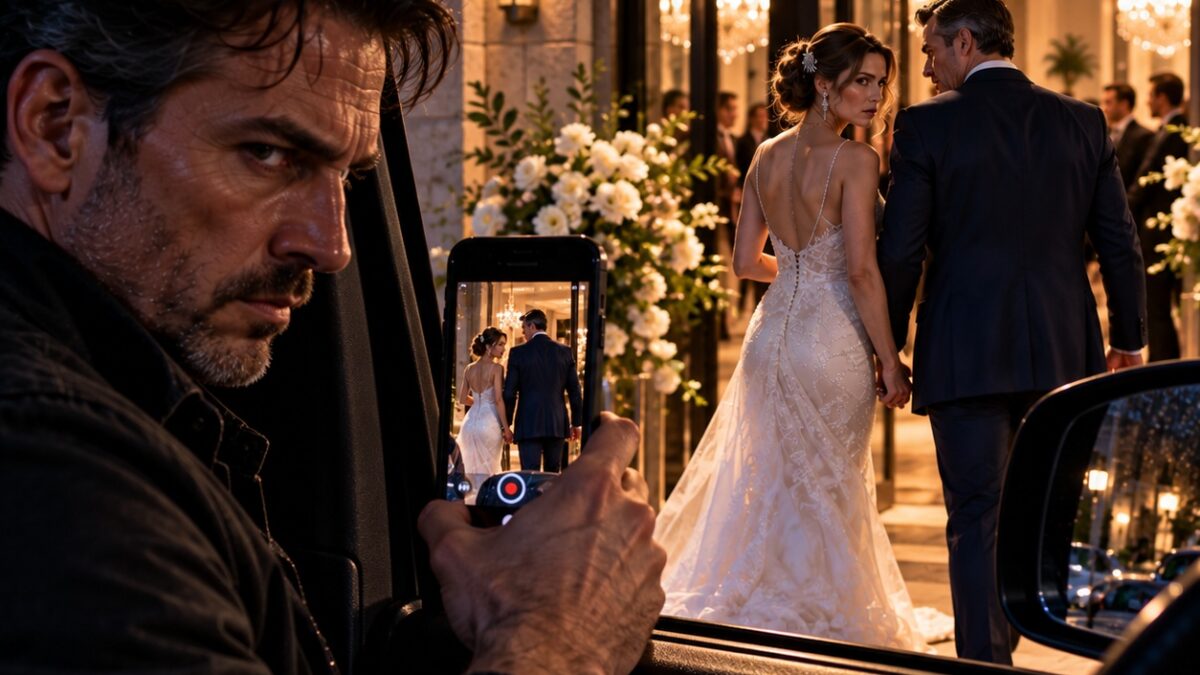
At seven, Renata arrived alone.
No vendor van.
No staff.
She walked to a side entrance.
Pulled out a key.
Let herself in.
A key.
To our wedding venue.
I had never seen it.
Twenty minutes later, a black sedan entered.
I knew Preston before he got out.
Three years isn’t long enough to forget the face of a man who tells you he’s going to remember what you cost him.
He crossed the lot without looking around.
No hesitation.
Like a man entering property he owned.
Because he did.
I watched through the second-floor glass.
The Ellery’s entire selling point was visibility.
Floor-to-ceiling windows.
Industrial elegance.
That night, it was a stage.
Renata waited near the bar.
Preston approached.
She smiled.
Not business polite.
Warm.
Personal.
He said something.
She laughed.
Then his hand went to the small of her back.
I had watched that body for four years.
Watched her reach for me in dark rooms.
Watched her check railings after spending too much time around me.
Watched her sleep.
I knew the way she stood when she wanted distance.
She didn’t want distance.
Preston’s hand remained there.
And she let it.
Something exact left me.
That’s the only way I can explain it.
The structure didn’t collapse.
But a connection failed.
I gripped the steering wheel.
Every instinct told me to go inside.
Open the door.
Put Preston through a wall.
Demand an explanation.
Demand the truth.
But my career had trained a different response deeper into me.
When something fails, document before you disturb it.
I raised my phone.
Started recording.
Not because I was calm.
Because holding a phone was the only thing stopping my hands from doing something else.
A loading door near the back had been propped open.
Deliveries.
I approached close enough to hear pieces.
Preston’s voice first.
“Told you he’d never think to look here.”
Amusement.
“Man spends his whole career finding problems other people miss.”
Pause.
“And he still can’t see the one sitting in his own kitchen.”
Renata answered.
Quiet.
“He’s not stupid, Preston.”
Hope is pathetic sometimes.
One sentence.
For half a second, I wanted her to save me.
Then Preston laughed.
“I didn’t say stupid.”
I could picture his expression without seeing him.
“I said blind.”
Glasses touched.
“Three years I sat on that red tag.”
His voice hardened.
“Watched two investors walk before I got a shovel back in the ground.”
“You know what it costs to rebuild a reputation after a stop-work order goes public?”
“I do.”
He laughed.
“So forgive me if I enjoy this part more than I should.”
Renata answered.
“You act like I did it for you.”
Again, hope.
Useless.
Preston:
“You did it for the retainer.”
A pause.
“I just made sure the retainer came with a view.”
My mouth went dry.
This wasn’t romance in the simple way I’d imagined.
Money was inside it.
Business.
Revenge.
Then Renata asked:
“What happens if he figures it out?”
Something in her voice almost sounded real.
Preston answered immediately.
“He won’t.”
Easy.
Certain.
“Men like him check everything except what’s standing directly in front of them.”
Then he said:
“That’s what makes them so easy to build a case around.”
Renata laughed.
Not nervously.
Not reluctantly.
An easy laugh.
The laugh that used to belong to our kitchen.
I stood behind the open loading door and finally let myself ask the question I had been avoiding.
Had this relationship with Preston developed after the account?
Or had I been the reason the account existed?
Renata didn’t defend me.
That stayed with me more than his insults.
She didn’t tell him he was wrong.
Didn’t say I wasn’t blind.
Didn’t say he was taking the revenge too far.
She moved on to the caterer’s headcount.
My humiliation was a completed line item.
I backed away.
Walked to my truck.
Sat there until my hands felt like mine again.
I didn’t confront her.
God, I wanted to.
I wanted both of them to know that they had failed.
But I had spent seventeen years watching bad things become worse because someone reacted before understanding the load.
So I drove home.
Copied the recording three times.
Laptop.
Encrypted drive.
Cloud.
Then I lay beside Renata that night while she slept and stared at the ceiling.
I remember thinking:
This bed belongs to a life that doesn’t exist anymore.
Before dawn, I stopped replaying the recording.
Started making a new list.
Not what they had done.
What I would do.
Preston wanted a stage.
Fine.
I knew how stages came apart.
Monday morning, I called Priya Anand.
Family law attorney.
A colleague had used her in a difficult custody dispute.
He told me she was the calmest person he’d ever watched destroy a bad argument.
“Start at the beginning,” Priya said.
I did.
The original Cade stop-work order.
The venue.
Ownership records.
PK.
The dinner with Isa.
The loading-dock recording.
Priya wrote the whole time.
When I finished, she said:
“This is good.”
I stared at her.
She caught herself.
“Not good that it happened.”
“Glad we clarified.”
“Good that you documented before confronting anybody.”
She tapped the file.
“Most clients bring me emotions.”
“You brought chronology.”
“Occupational disease.”
“It may save you.”
She leaned back.
“First, the venue contract has both your names.”
“So?”
“I’ll prepare cancellation notice.”
“Send it.”
“Not yet.”
I frowned.
“Why?”
“Because you don’t need to give Renata warning while we are still checking joint financial exposure.”
“There isn’t much.”
“You’d be surprised.”
She pointed at me.
“Second, you do not confront her yet.”
“I already waited four days.”
“Good.”
“Third, we check every financial relationship her firm has touched where your money or name appears.”
“The wedding?”
“Especially the wedding.”
Priya said something that stayed with me.
“People notice the affair because it hurts.”
She opened a folder.
“The money is often what costs them.”
Two days later, her paralegal found a vendor line item in our wedding payments.
Floral and decor consulting.
$2,200.
Vendor:
Larkspur Creative Solutions.
No invoice.
No work order.
No actual deliverables.
I recognized the routing number.
Months earlier, Renata had asked me to move money between her business accounts while she had both hands full of fabric samples.
The number had appeared on her screen.
I hadn’t cared.
Larkspur had one registered officer.
Isa Ror.
My stomach sank.
Isa.
The woman who accidentally told me Preston’s name.
The person I trusted most in Renata’s professional world.
Priya’s office traced more.
Same shell vendor.
Other client deposits.
Small percentages.
Enough to avoid being obvious.
For more than a year.
“Skimming,” Priya said.
“Isa?”
“Her name is on the entity.”
“Does Renata know?”
“Separate question.”
“Did Renata approve our payment?”
“Yes.”
That mattered.
Whatever Renata knew about the larger scheme, she had approved money going to a vendor that performed no real work.
Another crack.
Another person who wasn’t what I thought.
The third name came from Preston’s old appeal file.
Priya’s office pulled everything from the stop-work challenge three years earlier.
Cade had hired an outside structural engineer.
Vivien Marsh.
I remembered her.
Barely.
Licensing conference.
No-nonsense.
Smart.
Reputation for walking away from clients who wanted conclusions rather than analysis.
I called.
She remembered the case immediately.
“I told my firm never to take him again.”
“Why?”
“He didn’t want engineering.”
“What did he want?”
“A weapon.”
She paused.
“There is a difference.”
I waited.
“When clients lose an appeal, most of them get angry at the process.”
“Cade?”
“He got angry at you.”
“Personally?”
“I spent six months in meetings where your name came up more than the actual load calculations.”
My grip tightened around the phone.
Vivien continued:
“For what it’s worth, Nathaniel, nothing you’re describing sounds like a man who fell in love with your fiancée.”
I said nothing.
“It sounds like a man who found a very efficient way to get back at the inspector who cost him money.”
There it was.
Someone else saying what I had been afraid to say.
“She was a means.”
Vivien’s voice softened.
“Not the point.”
I thanked her.
Before hanging up, I asked if she would put her professional recollection in writing if necessary.
“Yes.”
Then:
“And Nathaniel?”
“Yeah?”
“Call me sometime when the reason isn’t a possible deposition.”
I almost laughed.
“I’ve got enough happening right now.”
“So I’ve gathered.”
I didn’t think about that conversation again for months.
By the following Tuesday, I had enough.
Ownership records.
Financial records.
Vivien’s statement.
The recording, even though Priya hadn’t yet told me whether we could use it.
I asked Renata to sit with me that evening.
She thought we were discussing seating charts.
I let her believe that until she sat down.
“We need to talk about the Ellery.”
She looked at me.
“And Preston Cade.”
Her face changed.
“And Larkspur Creative Solutions.”
Three expressions crossed her face.
The one I expected never appeared.
No surprise.
No confusion.
What I saw was calculation.
Fast.
“You’ve been going through my accounts.”
“OUR accounts.”
“Nate, that’s insane.”
“Our joint wedding payments.”
“This is actually insane behavior.”
I set my phone on the table.
The screen showed Preston’s hand at her back.
“I was at the Ellery Thursday.”
Renata went still.
“I heard the conversation about the retainer.”
Her face reset.
“You were spying on me.”
“I was documenting something I already suspected was compromised.”
“Do you hear yourself?”
“Yes.”
“That’s your answer?”
“It’s my job.”
I leaned toward her.
“And I’m very good at it.”
“This isn’t what you think.”
“It is.”
“No.”
“It took me until Thursday to understand what to call it.”
She stared.
“This isn’t just an affair.”
She opened her mouth.
“It’s retaliation.”
Silence.
“Preston Cade is using you to reach me.”
Her jaw tightened.
“You really think everything is about you?”
“Actually, that’s what I was hoping wasn’t true.”
I kept my voice level.
“But the venue is his.”
“The account is his.”
“He spent three years talking about me after the inspection.”
“And I heard him laughing about the red tag through a loading door while his hand was on you.”
She looked away.
I said:
“He didn’t fall for you.”
That landed.
“He recruited you.”
“Nate—”
“You were the delivery mechanism.”
She stood.
“You don’t get to make this about him.”
“I didn’t.”
“You made our entire engagement about your rules.”
“My rules?”
“Your procedures.”
“Your inspections.”
“Your carefulness.”
“There it is again.”
“You don’t take chances.”
“You don’t move.”
“You don’t want anything bigger.”
“Renata—”
“I found somebody who—”
She stopped.
I waited.
“Who what?”
Nothing.
“Who enjoyed watching you laugh at me through a propped loading door?”
I said it quietly.
That hurt her more than yelling would have.
Her face hardened.
“I’m not doing this.”
“Neither am I.”
I stood.
“The venue is canceled.”
“What?”
“Priya has the notice.”
“Who is Priya?”
“My attorney.”
The color changed in Renata’s face.
“And Larkspur?”
“What about it?”
“The payments have been traced.”
“Isa isn’t part of this.”
First real crack.
Not when I mentioned Preston.
Not when I mentioned the recording.
Isa.
“Isa owns Larkspur.”
“That doesn’t mean—”
“She received money from our wedding deposit through a company that did no work.”
“That was consulting.”
“For what?”
Renata said nothing.
“Exactly.”
I pushed my chair back.
“I’m not asking for an explanation tonight.”
“Nate.”
“I already know enough.”
“You think you know everything.”
“No.”
I looked at her.
“I know enough to stop building a future on what I don’t.”
She didn’t cry.
Didn’t apologize.
She sat at the kitchen table in the house we’d bought together and looked at me the way a project manager looks at a problem that hasn’t been solved yet.
I almost respected the consistency.
Almost.
Three days later, she was waiting outside my county office during lunch.
Leaning against her car.
“You haven’t answered.”
“I know.”
“I’ve called eight times.”
“I know.”
I kept walking.
“Nate, people are going to hear a version of this.”
I stopped.
She came alongside me.
“I would rather they hear it from both of us.”
That almost made me laugh.
“You came to my job to manage the narrative?”
“We can act like adults.”
“We are.”
“Then talk to me.”
“Being adults means your attorney talks to mine.”
Her face tightened.
“And whatever happens with Isa’s other clients is no longer something I control.”
“What does that mean?”
“It means Larkspur is bigger than our wedding.”
Her expression changed.
“You’re going to make sure everyone knows.”
“No.”
I unlocked my truck.
“I won’t have to.”
I looked at her.
“You did that part yourselves.”
I opened the door.
“I’m just the guy who stopped covering for it.”
She had no answer.
I drove away without checking the mirror.
Sometimes once you’ve identified the actual point of failure, another inspection doesn’t help.
The following Monday, I filed a conflict-of-interest disclosure with the county.
Everything.
Personal relationship.
Preston Cade.
The Ellery.
Riverside Hospitality.
No active enforcement matter.
Formal recusal from future inspection work on those properties.
My supervisor read it twice.
“You want to talk?”
“No.”
He filed it.
That document may have been the cleanest thing I did all month.
Priya handled the rest.
Then she gave me bad news about my recording.
“You can’t use it in court.”
“Why?”
“Pennsylvania.”
I knew immediately.
Consent.
“Two-party?”
“All-party.”
“So I illegally recorded them.”
“You made a recording without their consent.”
I felt sick.
“Am I in trouble?”
“Not based on what you’ve done with it so far.”
She pointed at me.
“But the recording is not Exhibit A.”
“Then what good was it?”
“It gave you the truth.”
I sat back.
Priya slid another folder toward me.
“Fortunately, public ownership records do not require consent.”
Another folder.
“Neither does financial discovery.”
Larkspur unraveled quickly.
The first missing deposit led to another.
Then another.
Brides.
Corporate clients.
Vendor pass-throughs.
Small amounts repeated over time.
The district attorney’s office called it theft by deception.
By early summer, Isa accepted a restitution deal instead of forcing victims to testify in front of a jury about money skimmed from events they had trusted her to manage.
Renata’s business didn’t survive.
Not because I destroyed it.
Because losing a partner in a financial-fraud case has consequences.
Clients left.
Vendors got nervous.
By August, I heard Renata was doing freelance coordination.
Small jobs.
Nothing like before.
The house was easier.
We weren’t married.
No divorce.
Two names on a deed.
Appraisal.
Equity.
Buyout.
Three weeks.
I kept the house.
Renata took her half in cash.
As far as I know, she never returned to Fox Chapel.
Then came the part nobody had planned.
Mid-June.
Two months after our kitchen conversation.
Vivien called.
“You’re not going to believe who contacted my office.”
I looked at the bridge plans on my desk.
“The Ellery?”
She laughed.
“Close.”
“Insurer?”
“Exactly.”
“What happened?”
“Mechanical retrofit.”
My spine straightened.
“When?”
“About a year ago.”
“Roof?”
“Rooftop terrace.”
I closed my eyes.
“New HVAC equipment.”
“Yes.”
“Larger units.”
“Yes.”
“Permit revision?”
“Apparently.”
“Updated structural calculations?”
Vivien paused.
“Somebody signed something.”
That tone told me enough.
She continued:
“Either the calculations were wrong or nobody actually performed them.”
I stared at the wall.
“What did county do?”
“Pulled the terrace certificate of occupancy pending full review.”
“When?”
“This morning.”
I laughed once.
Not because it was funny.
Our wedding would have been six weeks away.
“That is expensive.”
“Very.”
“How did they call you?”
“I’m the only structural engineer in three counties with documented history on that exact site who isn’t currently engaged to somebody connected to the ownership group.”
I smiled.
“You taking it?”
“No.”
“Why?”
“Conflict.”
She sounded amused.
“Small industry.”
People did talk.
By the end of summer, the story moving through Pittsburgh development circles wasn’t primarily about my failed engagement.
It was about Preston Cade.
A developer who had apparently used his own event venue as a stage for a personal grudge against the county inspector who had once red-tagged one of his projects.
Then that same venue failed a life-safety review.
Different issue.
Different year.
But reputations don’t care much about legal separation.
Investors began asking questions.
Some walked.
Preston’s relationship with Renata ended almost immediately after the headlines.
At least that’s what people told me.
His calls stopped around the same time his lawyers started making more calls than he did.
I never chased the outcome.
That matters to me.
I didn’t call investors.
Didn’t leak anything.
Didn’t ask the county to investigate The Ellery.
In fact, I recused myself.
All I did was document my own situation and step away cleanly.
The rest fell apart on its own schedule.
Structures built wrong usually do.
Almost a year later, Vivien and I drove to a bridge inspection two counties over.
Her idea.
Half professional curiosity.
Half excuse.
We spent four hours disagreeing about load assumptions in a way I found strangely enjoyable.
Afterward, we stood near the rail drinking terrible gas-station coffee from paper cups.
She looked at me.
“You’re doing it again.”
“What?”
“The thing.”
“What thing?”
“You go quiet.”
“So?”
“Then your face changes like you’re calculating something.”
“Occupational hazard.”
Vivien bumped her shoulder lightly against mine.
“You realize not everything is broken.”
“I know.”
“Do you?”
“Yes.”
“You inspect conversations.”
“I do not.”
“You just inspected that answer.”
I laughed.
She smiled.
“Good habit, mostly.”
Then:
“Remember to look up from the report sometimes.”
I looked at her.
She took a sip.
“Some structures are worth trusting without a second inspection.”
I thought about that the whole drive home.
For seventeen years, my job taught me not to trust appearances.
Paint can hide corrosion.
Tile can hide movement.
A building can look perfect while the load path is wrong.
That mindset kept people safe.
But people aren’t bridges.
You cannot red-tag your way out of vulnerability.
If you inspect every human being like you’re waiting for collapse, eventually nobody will want to stand beside you.
That was the thing I had to relearn.
Not blind trust.
Not carelessness.
Trust with judgment.
There’s a difference.
I still keep punch lists.
I probably always will.
But there isn’t anything on mine now worth losing sleep over.
Sometimes people ask me whether I regret not walking inside The Ellery that Thursday night.
No.
Never.
Do I regret recording a conversation I couldn’t legally use?
Maybe.
Priya would tell you yes.
Professionally.
But that recording told me the truth before I could be manipulated into doubting what I had seen.
The important part is what I didn’t do with it.
I didn’t publish it.
Didn’t threaten Preston.
Didn’t send it around town.
Didn’t use it as blackmail.
I brought it to a lawyer and accepted when she told me its legal limits.
That’s one of the hardest lessons people learn when their personal life explodes.
Being wronged doesn’t make every response you want to take legal.
Or wise.
Pain doesn’t create permission.
Facts matter.
Procedure matters.
Documentation matters.
Sometimes restraint feels weak because nothing dramatic happens.
That night, I didn’t punch Preston.
There was no confrontation.
No broken glass.
No police.
I simply drove home.
But almost everything that protected me later came from what I didn’t do.
I didn’t touch Renata’s phone.
Didn’t hack Preston’s accounts.
Didn’t misuse county authority.
Didn’t reopen his old inspections for revenge.
Didn’t show up at his house.
Didn’t make threats.
Didn’t spread rumors.
I stayed boring.
Boring is underrated.
Especially when the other side expects anger.
I think Preston wanted anger.
Maybe not consciously at first.
But the more I thought about his comment at the Ellery, the clearer it became.
Men like him are easy to build a case around.
That’s what he’d said.
He thought he knew me.
Careful county inspector.
Proud of his judgment.
Fiancée humiliates him.
Old enemy involved.
What happens next?
I explode.
Maybe I misuse my badge.
Maybe I inspect Preston’s sites personally.
Maybe I threaten him.
Maybe I put something in writing he can hand a lawyer.
Maybe he gets to tell people the original red tag was always personal.
Suddenly three years of legitimate enforcement become part of a jealous-man narrative.
He didn’t need to destroy my career directly.
He needed me to damage it myself.
That was the stage.
The affair was only scenery.
Renata?
I spent months trying to understand what she had been.
Victim?
Accomplice?
Unhappy woman?
Ambitious business owner?
Person who made terrible choices?
All of them, probably.
That’s the uncomfortable answer.
Preston used her.
That doesn’t erase what she did.
Her dissatisfaction with me may have been real.
Maybe I was too careful.
Maybe I was emotionally lazy because our life looked stable.
Maybe I confused routine with connection.
Maybe I stopped asking questions that had nothing to do with work.
Those things belong to me.
But I didn’t make her lie.
I didn’t make her accept Cade’s secret account.
I didn’t make her book our wedding in his building without telling me who owned it.
I didn’t make her sit inside that building and laugh while he talked about building a case around me.
Understanding why a person crossed a line doesn’t move the line.
Priya once asked me:
“Do you still love her?”
This was months later.
I said:
“I don’t know.”
She looked over her glasses.
“That wasn’t very convincing.”
“I loved the life.”
“Different question.”
“I loved who I thought she was.”
“Still different.”
I hated lawyers sometimes.
Finally I said:
“Yes.”
Priya nodded.
“There.”
“That doesn’t mean I want her back.”
“I didn’t ask that.”
“No.”
“You can love somebody and still know they are unsafe for your future.”
That helped.
Structural work makes you think binary.
Pass.
Fail.
Open.
Closed.
Safe.
Unsafe.
Human relationships resist categories.
Renata did good things for years.
She built a company.
She loved parts of our life.
She supported me through ugly county politics.
Sat beside me when my mother had surgery.
Made my birthday feel important.
None of that disappeared because of Preston.
Neither did the betrayal.
Both exist.
I don’t need to erase the first four years to justify leaving after the fifth.
Vivien understood that better than most people.
We took things slowly.
Very slowly.
The first time she came to the house in Fox Chapel, she stood in the study and looked at Renata’s built-ins.
“These are why you bought this place?”
I stared.
“How do you know that?”
“You told me.”
“I did?”
“Bridge inspection.”
“Which one?”
“Three counties over.”
“You remember too much.”
“Engineer.”
“Fair.”
She ran a finger over the wood.
“You keeping the shelves?”
“Yes.”
“Good.”
“Why?”
“The shelves didn’t cheat on you.”
I laughed.
That line probably did more for me than she realized.
For months after Renata left, I had wanted to purge the house.
New furniture.
New paint.
Sell it.
Move.
Erase.
Then slowly I realized the house had not betrayed me.
The porch hadn’t lied.
Sunday mornings were still mine.
A room doesn’t belong permanently to the worst thing that happened in it.
So I kept the built-ins.
Changed almost nothing.
Except one thing.
On the wall of the study, I framed the first red-tag notice I ever issued as a county inspector.
Not Preston’s.
An older one.
Seventeen years earlier.
Small pedestrian bridge.
Corroded connection.
Nobody cared about the job except me and the maintenance crew.
Below it, I framed the closing page of my conflict-of-interest disclosure from the Ellery matter.
Not because I’m proud of the engagement ending.
Because those documents remind me of the same thing from opposite directions.
Your job isn’t to control the outcome.
Your job is to make your part defensible.
Facts.
Process.
Signature.
Then let the load go where it goes.
Isa eventually paid restitution.
I heard she left event work entirely.
I don’t know where she is now.
I never called.
For a long time, I was angry at her in a strange way.
Renata’s betrayal was personal.
Preston’s was revenge.
Isa’s felt cheap.
Two thousand two hundred dollars from our wedding.
Then more from other couples.
Money slipping sideways through a shell vendor.
People handing over savings for one important day and somebody shaving pieces off the top.
But even that anger faded.
Everyone pays for their own decisions eventually.
Sometimes in court.
Sometimes in lost clients.
Sometimes when nobody trusts their name anymore.
Renata’s firm had been her identity.
Watching it collapse probably hurt more than anything I could have said in our kitchen.
Preston?
I never spoke to him again.
Not once.
That surprises people.
They expect a final scene.
Some moment where I stand across from him and deliver a perfect line.
Life rarely arranges itself that neatly.
The last time I heard Preston Cade’s voice directly was through a propped loading door while he explained to my fiancée that I was blind.
Maybe that was enough.
His revenge depended on me seeing myself through his eyes.
I stopped doing that.
In the months after, I kept hearing variations of the same thing from people in development.
“He’s furious.”
“His investors are nervous.”
“He blames you.”
I always answered:
“I haven’t done anything to him.”
And eventually people understood.
I hadn’t.
His own venue failed review.
His own ownership records were public.
His own words to Renata created the situation.
His own reputation followed him.
That distinction mattered.
Revenge is active.
Consequences often aren’t.
Sometimes all you have to do is stop holding up somebody else’s bad structure.
Gravity does plenty.
The first anniversary of the night outside The Ellery came and went without me realizing it.
That felt important.
Vivien and I had dinner.
Nothing elaborate.
Italian place outside the city.
She ordered something I hated.
I complained.
She told me my opinion wasn’t a code requirement.
We argued about whether old bridges are more beautiful because of their imperfections or in spite of them.
Halfway home, I realized the date.
April.
Thursday.
Almost exactly a year.
I didn’t tell her.
Not because I was hiding it.
Because it no longer needed a ceremony.
Healing isn’t always a dramatic release.
Sometimes you simply realize the date lost its power while you weren’t paying attention.
I drove past the turn that would eventually take you toward the Ellery.
Kept going.
No tight chest.
No need to look.
The building had become a building again.
That is one of the strangest gifts time gives you.
It returns places.
For months, our kitchen belonged to the confrontation.
Then one morning it was just where I burned toast.
The back porch belonged to lost Sundays.
Then Vivien sat there with coffee and complained that my deck railing was two degrees out of level.
“It is not.”
“It is.”
“You brought a level?”
“I didn’t need one.”
“You’re intolerable.”
“Occupational hazard.”
I smiled.
And suddenly the porch belonged to the present too.
I’m still careful.
Vivien was wrong about that part.
Or maybe she never wanted me to change it.
I still test railings.
Still read every contract.
Still check public records if something significant depends on ownership.
I don’t apologize for any of that.
Carefulness didn’t destroy my engagement.
Secrecy did.
Contempt did.
Dishonesty did.
My mistake was allowing somebody to convince me that the quality she originally respected had somehow become proof I was too small for her future.
There’s a lesson in that.
People who benefit from your insecurity will often attack the trait that makes you hardest to manipulate.
Preston mocked my caution.
Renata started mocking it too.
Careful.
Predictable.
Safe.
Those words became insults.
Yet what saved me?
Careful documentation.
Predictable professional procedure.
Safe choices.
The exact qualities they had begun treating like weaknesses.
That doesn’t mean every criticism from a partner is manipulation.
Sometimes you’re difficult.
Sometimes you need to change.
I did.
I learned to look up from reports.
I learned stability isn’t intimacy by itself.
I learned asking “How was your day?” isn’t the same as asking “Are you happy?”
I learned that two people can live in the same house and still build entirely different versions of the future.
But if someone needs you ashamed of your strongest values before their behavior makes sense, pay attention.
Renata didn’t start with lies.
She started by making my life seem small.
Inspecting concrete.
County job.
Carefulness.
Routine.
Then Preston offered a version of her future that felt larger.
His company.
His properties.
His money.
The retainer.
His admiration.
Maybe that made deception easier to justify.
People rarely wake up and decide to betray the person beside them.
They build a story first.
He doesn’t understand me.
I’ve outgrown this.
I’m finally being seen.
I deserve something bigger.
Then one lie becomes another.
Eventually they are sitting inside their own wedding venue laughing while the man they’re supposed to marry is outside documenting it.
I don’t say that cruelly.
I’ve spent enough time thinking about Renata to know she probably wasn’t laughing at my pain in the beginning.
The story grew.
By the time I heard it, I had become a character in it.
Blind Nate.
Careful Nate.
The inspector who never looks up.
That’s the danger of letting resentment go unspoken.
It writes fiction.
I wish Renata had sat across from me months earlier and said:
“I am unhappy.”
Maybe we still would have separated.
Maybe not.
At least it would have been honest.
Instead, we almost stood in front of two hundred people inside Preston Cade’s building and promised honesty forever.
That part still amazes me.
Six weeks before a wedding, a county pulled the rooftop certificate because the loads hadn’t been checked properly.
People called that poetic.
I didn’t.
Structural failure isn’t poetry.
It is paperwork and physics and people who might get hurt.
I was relieved nobody held an event up there before the review.
That was all.
Vivien later told me the retrofit itself could be corrected.
Strengthening.
Load redistribution.
Equipment repositioning.
Not cheap.
But possible.
“See?” she said.
“What?”
“Even that building wasn’t doomed.”
I looked at her.
“That’s annoyingly philosophical.”
“I’m an engineer.”
“Engineers aren’t philosophical.”
“We just hide it in calculations.”
The Ellery reopened eventually.
Different operating conditions.
Corrected structure.
I heard they hosted a wedding there the following year.
Good.
Buildings should get to become useful again after people make mistakes.
People too, maybe.
Renata and I exchanged one final message about six months after the house settlement.
Email.
No drama.
She wrote:
I know you probably don’t want this, but I am sorry for the way I let Preston turn my anger at our relationship into something cruel. I was angry at you for things I never actually gave you a chance to fix. That was my responsibility. I also knew Larkspur wasn’t clean. Not all of it, but enough. I should have stopped it.
I read that twice.
Then answered:
Thank you for saying it plainly.
Nothing else.
I didn’t need to forgive her in writing.
Didn’t need a friendship.
Didn’t need to punish her.
Closure is overrated when people define it as one perfect conversation.
Sometimes closure is simply reaching a point where no additional answer changes your next decision.
I had reached it.
Priya asked whether I wanted her to preserve the original Ellery recording indefinitely.
“For what?”
“Evidence file.”
“It can’t be used.”
“True.”
“Then delete it.”
She raised an eyebrow.
“You’re sure?”
“Yes.”
I had copies too.
I deleted mine.
Every one.
That surprised me.
For months, the recording had been the most important object in my life.
Proof I wasn’t imagining things.
Then eventually it became eleven minutes of two people I no longer needed to hear.
Facts had moved elsewhere.
Documents.
Financial records.
Public ownership.
My own decisions.
I didn’t need to keep reopening the wound to prove it existed.
People ask if I would record again.
Legally?
I would call Priya first.
That’s the answer seventeen years of inspection work should have taught me.
Know the rules before you create evidence.
Pain made me forget that for one night.
I was lucky it didn’t cost me.
The county reviewed my conflict disclosure and found no wrongdoing.
No misuse of access.
No retaliation.
No inspection action involving Preston after our relationship conflict became known.
That clean file meant more to me than I expected.
My career had always been about signing my name under conclusions other people might hate.
If that name had become compromised, Preston would have taken something from me I couldn’t easily replace.
He didn’t.
Not because he lacked the opportunity.
Because I refused to hand it to him.
A year after the Ellery, my supervisor called me into his office.
I assumed there was a problem.
He closed the door.
“You still want the bridge-program lead?”
I stared.
“I applied two years ago.”
“I know.”
“You told me budget wouldn’t support it.”
“Now it will.”
I leaned back.
“Is this because—”
“No.”
He stopped me.
“And before you ask, nobody is rewarding you for surviving personal drama.”
“Good.”
“This is because you filed the cleanest conflict disclosure I’ve seen in fifteen years.”
I laughed.
“That’s depressing.”
“It is.”
Then he slid the offer across.
I took it.
Not because I needed a win.
Because I wanted the job.
That difference mattered too.
For years, I thought ambition meant Preston’s kind of life.
Bigger project.
Bigger firm.
More money.
Visibility.
Renata’s success made me question whether my own life was too small.
It wasn’t.
My ambition was different.
I wanted bridges nobody thought about because they never failed.
I wanted junior inspectors who understood why paperwork mattered.
I wanted a private consulting practice with enough work to choose clients who valued honesty.
I wanted a home that felt peaceful.
Those things count.
Size isn’t the only measure of a life.
Vivien once asked if I’d ever considered leaving government work.
“Every budget season.”
“Private sector would pay you more.”
“I know.”
“Much more.”
“I know.”
“So why stay?”
I thought.
“Because sometimes the person saying no shouldn’t be paid by the person who needs yes.”
She smiled.
“There you are.”
“What?”
“The man Renata originally liked.”
That stopped me.
“Don’t do that.”
“Do what?”
“Turn this into a lesson where I was perfect.”
“I didn’t.”
She took my hand.
“You weren’t.”
“Thanks.”
“You got comfortable.”
“Yes.”
“You avoided emotional conversations.”
“Yes.”
“You sometimes hide inside work.”
“Yes.”
“You’re irritating about railings.”
“That’s not a flaw.”
“It absolutely is.”
I laughed.
She continued.
“But none of that made the other things acceptable.”
I squeezed her hand.
Vivien understood something I had struggled with.
Accountability is not shared blame.
I can own my failures without assuming responsibility for somebody else’s choices.
That’s a hard distinction in long relationships.
After betrayal, people either want to make themselves entirely innocent or entirely responsible.
Both are easier than complexity.
The truth usually lives in the middle.
I was not attentive enough.
Renata was not honest enough.
I neglected important emotional maintenance.
She entered a secret relationship with a man who had targeted me professionally.
Those statements are not equal.
They do not cancel.
They’re simply both true.
Now when I train younger inspectors, I talk a lot about assumptions.
Not my story.
They don’t need that.
But the principle.
“You are never paid to prove your first impression correct.”
I say it every year.
“You are paid to test it.”
If you think a structure is safe, test.
If you think it isn’t, test.
If you hate the contractor, test.
If you like him, test.
Your emotions don’t belong in the equation.
Then one kid inevitably asks:
“Do you ever trust your gut?”
“Yes.”
“When?”
“Your gut tells you where to look.”
I point at the calculations.
“This tells you what is actually there.”
That applies outside work too.
My gut told me something was wrong months before I knew Preston’s name was involved.
The mistake wasn’t feeling it.
The mistake was either extreme.
Blindly ignoring it.
Or acting on it without evidence.
The middle is harder.
Pay attention.
Ask questions.
Respect privacy.
Respect yourself.
Document what matters.
Then make decisions based on what you actually know.
I know that sounds clinical for love.
Maybe it is.
But the alternative isn’t romance.
The alternative is pretending doubt doesn’t exist until it turns into catastrophe.
There is one memory from before everything changed that I protect deliberately.
First year together.
Renata had a charity dinner in an old warehouse.
Windy November evening.
Temporary tent extension outside.
She called me because a sidewall kept moving.
I arrived after dark.
She was wearing a coat over a dress.
Hair coming loose.
Furious.
“Tell me this thing isn’t going to fly away.”
“It won’t.”
“How do you know?”
“Ballast.”
“What about that corner?”
“Fine.”
“That one?”
“Fine.”
“That?”
I looked at her.
“You trust me?”
“With structures.”
“What about everything else?”
She smiled.
“We’ll see.”
I laughed.
Years later, that line would hurt if I let it.
I don’t.
That night was real.
So were the Sunday mornings.
A relationship does not become imaginary just because it ends badly.
That’s another place where people damage themselves.
They discover betrayal and decide every good memory was a lie.
Sometimes yes.
Sometimes no.
Humans are capable of loving somebody one year and failing them badly another.
That isn’t comforting.
It’s simply true.
I don’t need Renata’s past love to be fake for my decision to leave to be right.
I don’t need Preston to be pure evil for his revenge to be unacceptable.
I don’t need Isa to have been dishonest in every business decision for her skimming to be theft.
Adult judgment doesn’t require cartoon villains.
Only facts.
The facts were enough.
The last time I saw The Ellery in person, I was driving across the river.
Vivien sat beside me.
We were on the way to dinner.
The building was lit.
Rooftop terrace open.
People standing behind glass.
Music, probably.
I glanced.
Then back at the road.
Vivien noticed.
“That it?”
“Yes.”
“The famous one?”
“Unfortunately.”
She looked for a few seconds.
“Pretty.”
“It is.”
“You hate it?”
“No.”
That surprised me as I said it.
I thought.
“No.”
“What do you feel?”
“Nothing much.”
She smiled.
“That’s usually the goal.”
Maybe.
People imagine healing as finally feeling positive about painful things.
Sometimes neutrality is better.
The Ellery didn’t need to become beautiful again.
It only needed to stop being dangerous inside my head.
It did.
Preston’s development group eventually survived.
Smaller.
Different financing.
More oversight.
That disappointed a few friends who wanted a dramatic ending.
They wanted him ruined.
I didn’t.
I wanted distance.
His investors made their decisions.
Regulators made theirs.
The market did what markets do.
My satisfaction did not require bankruptcy.
That’s important.
If your peace depends on the other person’s destruction, they still control your peace.
I didn’t want Preston holding anything else.
Not my career.
Not my reputation.
Not my blood pressure.
Not my future.
So I stopped checking.
Completely.
If his name appears in industry news now, I scroll past.
I do not need updates from a structure I no longer occupy.
Renata’s career recovered somewhat too.
I heard she eventually joined a larger event-management company.
Not as owner.
Employee.
Good.
People should be allowed to rebuild after consequences.
That statement makes some people uncomfortable.
They confuse accountability with permanent exile.
I don’t.
She lost her company.
Her relationship.
Her reputation took damage.
She paid the price connected to her decisions.
I don’t need every door locked forever.
The same applies to Isa.
If she made restitution and complied with her agreement, I hope she became better.
What happened to me doesn’t give me ownership over their future punishment.
My responsibility ends with protecting my own boundaries.
Vivien once said:
“That sounds very enlightened.”
“It isn’t.”
“What is it?”
“Energy conservation.”
She laughed.
“Engineer.”
“Exactly.”
Life is loads.
You only have so much capacity.
Carry what belongs to you.
Everything else eventually creates unnecessary stress.
That may be the most structural thing I’ve ever said about human relationships.
I still live in the Fox Chapel house.
The study still has Renata’s built-ins.
Vivien spends enough time there now that one shelf holds her engineering journals.
She complains I alphabetize nothing correctly.
I tell her load order matters more than alphabetic order.
She tells me that’s not a real argument.
Sunday mornings returned.
Coffee.
Reports.
Her laptop.
Mine.
Different woman.
Different relationship.
Sometimes no talking for an hour.
Then one of us reads something ridiculous.
Last Sunday she said:
“Listen to this.”
I looked up.
“Contractor says existing conditions are assumed adequate.”
“No.”
“I knew you’d say that.”
“Absolutely not.”
She smiled.
And I realized ordinary had come back.
Not the same ordinary.
You don’t restore a failed connection by pretending nothing happened.
You redesign.
Reinforce.
Change how the loads move.
Life after betrayal isn’t a repair to original condition.
It’s a retrofit.
You keep what still works.
Remove what doesn’t.
Strengthen what matters.
Then test whether the structure can carry a different future than the one it was built for.
Mine can.
If you asked me what saved me that Thursday outside The Ellery, I would give you a simple answer.
I didn’t react before I documented.
But if you ask what actually changed my life afterward, the answer is larger.
I stopped confusing emotion with evidence.
Stopped confusing evidence with permission.
Stopped confusing caution with cowardice.
Stopped confusing understanding someone with excusing them.
And stopped believing that because something I loved failed, I had somehow been foolish to trust it in the first place.
Trust always carries load.
That’s what makes it trust.
If you require certainty before loving anybody, you’ll stand alone inspecting empty structures your whole life.
The goal isn’t to eliminate risk.
You can’t.
The goal is to know yourself well enough that when something moves in a way it shouldn’t, you don’t destroy everything trying to stop the motion.
You assess.
You document.
You protect.
Then you choose.
That night, Preston Cade thought he had figured me out.
Maybe for a while he had.
Man spends his career finding problems other people miss and still can’t see the one in his kitchen.
He was right about one thing.
I had been blind.
But blindness ends the moment you decide to look.
And once I looked, I didn’t need revenge.
I didn’t need a punch.
I didn’t need a public scene.
I needed facts.
A lawyer.
A clean paper trail.
And enough patience to let badly built things carry their own weight.
They did.
Renata’s lies.
Isa’s money trail.
Preston’s grudge.
The Ellery’s structural issue.
None of those things needed me to push.
They were already overloaded.
All I finally did was stop standing underneath them.
Almost a year after that parking lot, Vivien and I stood on a bridge deck two counties away with gas-station coffee going cold in our hands.
She bumped my shoulder.
“Look up from the report once in a while.”
I looked.
River below us.
Winter light.
Steel stretching in both directions.
Nothing visibly dramatic.
Nothing failing.
Just a structure doing exactly what it had been designed to do.
Carry weight.
Allow movement.
Remain standing.
I think that’s when the whole thing finally made sense to me.
For seventeen years, I had believed strength meant preventing failure.
Now I knew better.
Strength is knowing what can be repaired.
What must be reinforced.
What should be abandoned.
And what is sound enough that, eventually, you have to stop inspecting it and simply trust the work.
I still keep a punch list.
Old habit.
But these days there’s nothing on it worth losing sleep over.

