The Man Who Said First Class Wasn’t for Women Like Me Never Asked Why I Refused to Move
The Man Who Said First Class Wasn’t for Women Like Me Never Asked Why I Refused to Move
“First class isn’t really for someone like you.”
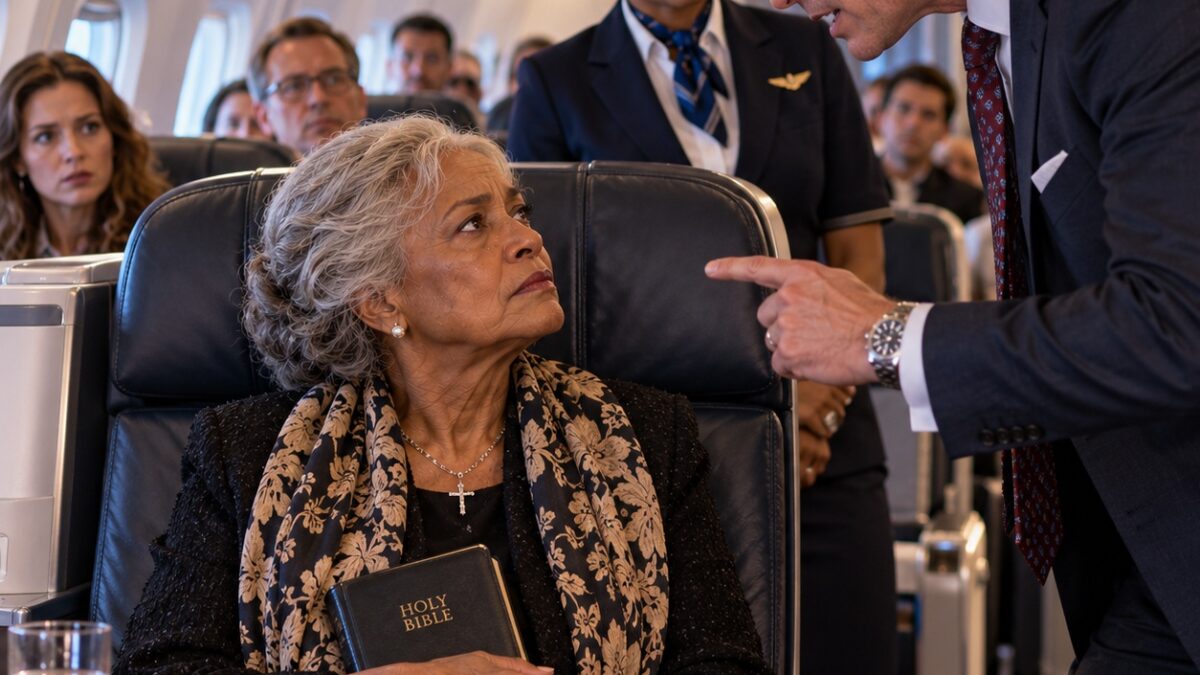
The man had one hand wrapped around the armrest of my seat as if ownership could be established through grip strength.
He leaned down until his face was close enough for me to smell coffee on his breath.
Then he smiled.
It was not an angry smile.
I almost wish it had been.
Anger would have made the moment easier to understand.
Instead, he wore the patient expression of a man who believed he was doing me a favor by explaining my place in the world.
“A Black woman traveling alone at your age…”
He lowered his voice.
“Honey, you probably got bumped up here by mistake.”
Three rows of passengers could hear him.
Nobody said anything.
“It happens.”
He shrugged.
“No shame in it.”
I looked down at the Bible resting across my knees.
My hands were folded over the cracked black cover.
I had owned that Bible longer than the man standing over me had probably been alive.
He straightened and snapped his fingers toward the flight attendant.
Actually snapped them.
As if calling a waiter across a country club dining room.
Then he looked back at me.
“These seats run around nine hundred dollars.”
His smile returned.
“I think we both know that’s probably not in your budget.”
That was when I finally looked up.
Not because he had insulted my clothes.
Not because he had assumed I was poor.
Not even because he had decided a seventy-four-year-old Black woman could not possibly have purchased the seat she was sitting in.
I looked at him because something in his voice reminded me of Mississippi.
Not the accent.
He did not have one.
The certainty.
That calm, comfortable certainty that the world would eventually rearrange itself around his expectation.
I knew that sound.
I had been hearing versions of it since I was seven years old.
“My name is Dorothy Washington.”
I reached into my brown leather purse.
Took out the printed boarding confirmation.
Unfolded it.
Placed it carefully on the armrest beneath his hand.
“My seat is 2A.”
I tapped the paper.
“My name is printed right there.”
He glanced down.
Then back at me.
And somehow, the evidence made him more irritated.
“My assistant books me in 2A every time I fly this route.”
“That may be.”
“This is clearly a mistake.”
“It isn’t mine.”
The flight attendant shifted beside him.
Her name was Sandra.
She had already checked her handheld device.
I watched her do it.
Seat 2A.
Dorothy M. Washington.
Booked twenty-two days earlier.
Paid in full.
His boarding pass said 3A.
There was no confusion.
There was only a man who wanted something another person already had.
But Sandra hesitated.
Half a second.
That was all.
Men like Clifford Baxter build entire lives inside other people’s half-second hesitations.
He felt it too.
He turned toward her.
“My assistant always books 2A.”
His voice grew slightly louder.
“I fly this route three, sometimes four times a week.”
Sandra looked at her screen again.
“Mr. Baxter, I understand, but your confirmed seat today is 3A.”
He gave a patient sigh.
“I have a ten o’clock meeting in Chicago.”
He looked around the cabin now, making sure others could hear the importance.
“A significant meeting.”
Then back toward Sandra.
“Transactions that affect a lot of people.”
His eyes moved toward me for exactly one second.
“Surely there’s a solution here that works for everyone.”
I almost laughed.
There was already a solution.
He could sit in 3A.
But people often call something a “compromise” when what they really mean is that the quieter person should surrender.
Sandra turned toward me.
And I heard it before she finished the sentence.
The tilt.
That subtle shift in service language away from what was correct and toward what was easiest.
“Ma’am, would you be open to considering a seat in premium economy?”
I stared at her.
“It’s genuinely very comparable, and we’d be happy to—”
“My name is Dorothy.”
She stopped.
“My seat is 2A.”
I pointed again to the confirmation.
“I paid for it.”
“Yes, ma’am, I understand.”
“Do you?”
Silence.
“Because you just confirmed that this is my seat and then asked me to move because the man standing over me doesn’t like that fact.”
Sandra’s face changed.
Not anger.
Embarrassment.
That told me she knew.
I folded my hands again.
“I would appreciate it if someone would actually read my ticket before asking me to give away what I paid for.”
Nobody spoke.
Across the aisle, a woman about thirty had stopped pretending to look at her phone.
Later, I would learn her name was Clare Oay.
She wrote for The Atlantic.
At that moment, she was simply another passenger watching.
Three rows back, a businessman stared at his screen with extraordinary concentration.
A woman adjusted headphones that were not playing anything.
A couple across the aisle became fascinated by the window.
Everyone was listening.
Nobody wanted to become involved.
Then a little girl somewhere behind me asked:
“Daddy, why is that man trying to take that lady’s seat?”
The father whispered:
“Shh.”
“But she was there first.”
That was the clearest moral analysis anyone had offered all morning.
I turned.
She was maybe seven.
Braids.
Window seat.
Eyes wide.
We looked at each other.
I gave her the smallest nod.
Thank you.
She understood.
Children often do before adults learn how to complicate simple things.
My name is Dorothy May Washington.
I was born Dorothy May Simmons on July 4, 1950, in Clarksdale, Mississippi.
My mother used to say being born on Independence Day was either God’s sense of humor or a prophecy.
Which one depended on how tired she was.
The house where I was born had two rooms and a porch that leaned to the left.
My father, Earl Simmons, rented it for fourteen dollars a month from the same white family whose land he worked.
He made three dollars a day when cotton was coming in.
Less when it wasn’t.
Even at seven years old, I understood the arithmetic did not work.
Three dollars.
Fourteen dollars rent.
Food.
Clothes.
Everything else.
My father understood it too.
He simply had fewer options.
What I remember most about him, though, was not money.
It was his hat.
Every time we passed a white man on the road, Daddy removed it.
Every single time.
Not dramatically.
Automatically.
Hand up.
Hat off.
Head slightly lowered.
Then hat back on after the man had passed.
When I was seven, we were walking home from the feed store carrying paper bags.
A white man approached us.
Red face.
Heavyset.
My father moved to the edge of the sidewalk.
Removed his hat.
The man walked past without even acknowledging him.
I waited until he was far enough away.
“Daddy?”
“Yes?”
“Why do you do that?”
He kept walking.
For several steps, he said nothing.
Then:
“Because I know what happens when I don’t.”
That was the entire answer.
I never asked him again.
But something settled inside me that afternoon.
Quiet.
Hard.
Permanent.
I would be polite.
I would work.
I would follow rules when the rules deserved following.
But Earl Simmons’s daughter was not going to spend her life removing her hat simply because someone else expected it.
That promise followed me everywhere.
School was four miles from our house.
I walked every day.
The textbooks were older than some of our teachers.
Pages missing.
Mildew.
Names of white children written inside from the schools that had used them before they reached us.
The town library let Black children borrow two books.
White children could take five.
There was a handwritten sign near the catalog.
COLORED PATRONS — LIMITED ACCESS.
The librarian was not cruel.
That almost made it stranger.
She simply followed the rule as if injustice became neutral when performed politely.
I checked out two books every week.
Returned them on time.
Never tore a page.
Never lost one.
At eleven, I already understood that some people search for excuses to remove what little access you have.
I refused to give them one.
When I was sixteen, my family left Mississippi.
My father’s cousin had gone to Chicago.
He wrote that factories were hiring.
Real wages.
Apartments with front doors Black families were allowed to use.
Daddy borrowed a truck.
We packed everything we owned.
Drove north overnight.
Chicago was not freedom.
Not exactly.
But it was different enough to matter.
I earned my GED at nineteen.
Worked in a diner on South Michigan Avenue.
Studied at the kitchen table after shifts.
I saved something every week.
Five dollars.
Ten.
Whatever I could.
I wrote the amount in a notebook in my dresser.
I had no grand plan.
I simply understood savings were the distance between you and the life where someone else makes every decision.
Then I met James Washington.
Church social.
Summer of 1972.
He was a postal worker.
Quiet.
Read novels during lunch.
Had opinions about every one of them.
On our second evening together, he made me laugh.
On the third, he asked questions about the future serious enough that I started imagining one.
We married in March of 1974.
Moved to Atlanta five years later when James received a promotion.
Jordan came in the spring of 1986.
For nine years, I had the life I had been building toward since Mississippi.
Not perfect.
Ours.
Then James died.
Thursday in October.
Heart attack at work.
No warning.
The hospital called at 6:17.
Jordan sat at the kitchen table doing long division.
He was nine.
I said yes twice into the phone.
Thank you once.
Then hung up.
For a few seconds I stood with my back to my son because I did not know what face a mother was supposed to wear when she was about to break her child’s life.
Then I turned.
“Come here, baby.”
Jordan crossed the kitchen.
I held him.
Did not cry.
Not yet.
I simply held him while he asked what happened.
That night, after he slept, I sat at the kitchen table alone.
The house had never sounded that empty.
I thought of James.
Then my father.
Earl Simmons removing his hat on the Mississippi road.
And I made two promises.
The first:
Jordan would never feel the full size of what had disappeared.
I would be enough.
Maybe not perfectly.
But enough.
The second promise I said aloud.
Very quietly.
“Earl Simmons’s daughter still isn’t taking her hat off for this world.”
I went back to work six days after James died.
Not because I was brave.
Rent was due.
That is the truth behind much of what people later call strength.
The bills kept arriving.
I had secretarial experience.
Good references.
But office jobs paid twelve, maybe thirteen dollars an hour.
I needed more hours.
Benefits.
Flexibility.
Grady Memorial Hospital hired me as an orderly at fourteen dollars and seventy-five cents an hour.
I worked there thirty-one years.
It was physical work.
Invisible work.
I changed linens.
Moved patients.
Restocked carts.
Cleaned rooms.
Carried supplies.
Did the hundred small things hospitals need at three in the morning when administrators are home and visitors are gone.
Evening shifts paid more.
Weekends.
Holidays.
I took them.
I put the difference into savings.
I also kept another notebook.
Jordan’s notebook.
Questions he asked.
Things he noticed.
Signs that his mind worked differently.
When he was ten, a teacher called because he asked why computers used binary instead of another number base.
She suggested he focus on the lesson.
I wrote the question down.
Saturday morning, I took him to the library.
We found an old computer science reference.
Jordan read the section three times.
Then asked two more questions.
I wrote those down too.
At thirteen, he discovered computers properly on a donated IBM desktop in the library.
The machine took four minutes to start.
The G key stuck.
Jordan sat there every Saturday for seven months.
Took handwritten notes from books he could not check out.
At fourteen, he tried joining the coding club at school.
The adviser told him the club was for honors-track students.
Jordan’s GPA was 3.9.
I visited the adviser the following afternoon.
Placed the report card on his desk.
“I’d like you to look at this.”
He did.
“Then explain the enrollment requirements to me again.”
Jordan joined the club the next week.
The adviser never spoke to me again.
I considered that a successful meeting.
At fifteen, Jordan built a little website selling custom ringtones.
First month, he made $4,200.
He showed me the PayPal balance.
His eyes were bright.
Trying to pretend he was calm.
I studied the number.
Then him.
“Don’t let money make you careless.”
Three months later, I spent one full month of my own take-home pay on a refurbished laptop.
Eight hundred forty dollars.
I did not tell him what it cost.
“It’s a tool.”
I said.
“Tools are worth what you build with them.”
Jordan took that seriously.
His first company failed.
Software consultancy during his second year at Georgia Tech.
Fourteen months.
Ran out of money.
He called.
Sounded embarrassed.
I listened until he finished.
“You done?”
“Yeah.”
“Good.”
“What?”
“Now you know exactly what didn’t work.”
I smiled.
“Try again.”
He did.
But there was one phone call I never forgot.
Two in the morning.
Tuesday.
Junior year.
Jordan’s voice was different.
Not disappointed.
Not frustrated.
Empty.
A mother knows that difference.
I listened four minutes.
Put on my coat.
Drove four hours through darkness.
Reached his apartment at 6:15.
He opened the door.
I walked inside.
Sat in the chair near his desk.
“I’m here.”
He started explaining.
I raised my hand.
“You don’t have to explain anything.”
I stayed until he slept.
Then I drove back to Atlanta.
Changed clothes.
Went to work.
We never discussed that night afterward.
We did not need to.
Years later, people would look at my son and talk about genius.
Discipline.
Talent.
Vision.
Strength.
They did not know that sometimes strength is simply one person staying in a chair until another person can breathe normally again.
Jordan knew.
That was enough.
By seventy-four, I had watched him build more than I ever understood.
Companies.
Funds.
Investments.
He became Jordan Elliot Washington in rooms where people said his whole name carefully because it meant something financially.
Washington Capital.
I could not explain every piece of his business if you paid me.
I knew only that he had more money than anyone in our family had ever imagined.
He tried giving me some.
I resisted.
For years.
Eventually, I allowed him to deposit money into an account because arguing had become more exhausting than accepting.
But when he offered to buy my plane ticket to Chicago for the University ceremony, I refused.
“I want to fly you first class, Mom.”
“I’ll book my own.”
“Mom.”
“Jordan Elliot Washington.”
That made him laugh.
“I have been paying my own way since before you entered this world.”
“I know.”
“I am not stopping at seventy-four.”
“At least let me check prices.”
“Good night, baby.”
I booked the ticket myself that evening.
10:47.
Three airline websites.
Reading glasses.
Notebook.
Meridian Airlines Flight 227.
Atlanta to Chicago O’Hare.
7:50 a.m.
Seat 2A.
First class.
$874.
Non-refundable.
I stared at the confirm button for a long time.
Not because I could not afford it.
Because somewhere inside me still lived a Mississippi girl who had been taught that certain spaces were not built with women like her in mind.
Do you really need this?
Do you deserve it?
What kind of woman spends $874 to sit at the front of an airplane?
I heard all of it.
Then clicked CONFIRM.
Printed the boarding pass twice.
Read my own name three times.
Dorothy M. Washington.
2A.
First Class.
I paid.
I belonged.
That should have been the end of the question.
Instead, twenty-two days later, Clifford Baxter stood over me and tried to reopen it.
Senior flight attendant Marcus Powell arrived after Sandra went for help.
He was tall.
Calm.
Experienced.
I could tell immediately.
He had the particular manner of a person accustomed to calming rooms.
“Mr. Baxter.”
He began.
That was his first mistake.
He began with Clifford.
“I understand there’s been some confusion.”
There had not.
“Let’s see if we can find a solution that works all around.”
I looked at Marcus.
Then at Clifford.
Then at the seat confirmation I had already shown them.
There was no “all around.”
My seat was 2A.
Clifford’s was 3A.
But Marcus was trying to be neutral.
Good people often confuse neutrality with fairness.
Sometimes there is no middle.
Sometimes one person has the seat.
The other does not.
Marcus’s careful diplomacy gave Clifford exactly what he needed.
The sense that his claim deserved equal consideration.
So Clifford began again.
His assistant.
His status.
How often he flew Meridian.
Platinum elite.
Professional relationship.
Expectations.
I sat quietly.
Not because I had nothing to say.
Because my evidence had already said everything.
Then, twelve rows behind me, a man spoke.
Flat voice.
Not loud.
“Is there a problem with my mother’s seat?”
I knew the voice before I turned.
Jordan.
For one instant, I felt relief.
Then irritation.
Because he was not supposed to be there.
He was supposed to meet me in Chicago.
He stood in the aisle wearing a gray hoodie, dark jeans, headphones around his neck.
Nothing about him looked like money.
That was deliberate.
Jordan had learned very young that the richest person in the room did not always need to dress like the richest person.
Clifford looked him over.
Three seconds.
Maybe less.
Made another one of his fast judgments.
“This doesn’t involve you.”
Then:
“Go back to your seat.”
Jordan ignored him.
Marcus started:
“Sir, if you could just—”
“He’s my son.”
I said.
The cabin quieted.
Jordan looked at Marcus.
Not Clifford.
“Is my mother’s seat confirmed?”
Marcus hesitated.
“The system shows a booking under her name, but—”
“Is her name on the ticket?”
“Yes.”
“Then the seat is confirmed.”
No anger.
No volume.
A fact.
Clifford started again.
“I don’t know who this individual thinks he is, but I have been flying Meridian—”
Jordan had stopped listening.
He took out his phone.
Typed two messages.
I could see his thumbs moving.
Fast.
I gave him the look mothers give grown sons when we know they are about to turn a small fire into a controlled demolition.
He looked back.
Sorry, Mom.
That was what his eyes said.
I looked away.
I had raised the boy.
There are limits to parental authority after thirty-eight.
Jordan sat in the empty seat beside me.
“Are you all right?”
“I’ve been through worse.”
He nodded.
Forty seconds later, his phone vibrated.
He read.
Then read again.
His face barely changed.
But I knew him.
Something had shifted.
Later, he told me what the message said.
Washington Capital held 31.2 percent of Meridian Air Holdings through one of its infrastructure funds.
Second-largest shareholder after the founders’ trust.
More surprising:
Washington Capital also held 19 percent of Baxter Asset Management through the Vertex Growth Portfolio.
Jordan was Clifford Baxter’s single largest outside investor.
His analyst had ended with one question:
Does Clifford Baxter actually not know who you are?
Jordan wrote back:
He does now.
Then he stood and walked toward the galley.
I closed my eyes.
“Lord.”
I whispered.
Not prayer exactly.
Recognition.
My son was about to make phone calls.
Jordan makes very efficient phone calls.
The first went to Gerald Whitmore.
CEO of Meridian Air Holdings.
“Jordan.”
Gerald apparently answered.
“Good to hear from you. What can I do?”
Jordan told him.
Flight 227.
Atlanta.
His mother.
Confirmed first-class seat.
Passenger with no legitimate claim demanding she move.
Crew treating the objection as if it carried the same weight as a documented booking.
Then Jordan said:
“It doesn’t.”
Four seconds of silence.
Gerald asked for five minutes.
Jordan’s second communication went to the investment contact overseeing Baxter Asset Management.
One sentence.
Washington Capital was beginning a formal review of its continued position in Baxter Asset Management following a personal matter Jordan had witnessed directly.
Clifford would understand the context.
Then my son returned to 2B.
Sat beside me.
And waited.
Clifford was still speaking.
“Professional courtesy.”
He used that phrase twice.
Professional courtesy apparently meant everybody except Clifford needed to make an accommodation.
Then his phone rang.
He looked at the screen.
Robert Yei.
One of Baxter Asset Management’s senior partners.
Clifford answered casually.
“Robert, we’re about to push back. Can we—”
He stopped.
Listened.
His free hand gripped the headrest beside him.
“What?”
Another pause.
Then:
“What?”
Quieter.
Forty-two seconds later, he lowered the phone.
The color had left his face.
He turned toward Jordan.
Slowly.
“You’re…”
Stopped.
Restarted.
“You’re Jordan Washington.”
My son said nothing.
“The Jordan Washington.”
Still nothing.
Then Clifford began doing something remarkable.
He became polite.
Not gradually.
Instantly.
The posture changed.
Voice changed.
Words changed.
“I had absolutely no idea.”
He looked between Jordan and me.
“I never would have—if I’d known who you—”
“I know.”
Jordan finally spoke.
“That’s exactly the point.”
I looked at my son.
That sentence landed exactly where it needed to.
If Clifford had known Jordan’s name before insulting me, he would have smiled.
If he knew my son controlled billions, he would have offered me the seat himself.
Perhaps carried my purse.
That was not evidence he was capable of respect.
It was evidence he understood consequences.
The aircraft door opened again.
Ground operations supervisor.
Patricia Voss.
She came through the operations entrance carrying a company tablet.
The expression on her face told me somebody very high up had called somebody very quickly.
She looked at Jordan.
Clifford.
Then me.
And walked directly toward 2A.
“Mrs. Washington.”
Name first.
That mattered.
“I want to apologize to you directly and without qualification on behalf of Meridian Airlines.”
The cabin had become silent again.
“You are in your confirmed seat.”
She continued.
“You have every right to be here.”
Then:
“What you experienced this morning should never have happened.”
She did not say misunderstanding.
Did not say if you were offended.
Did not say unfortunate situation.
“I am sorry.”
I studied her.
There are apologies designed to end problems.
This one sounded like an apology designed to name one.
“I appreciate you saying that.”
Patricia turned toward Jordan.
“Mr. Washington, Gerald Whitmore has asked me to convey his personal apology.”
Jordan nodded.
Clifford stepped forward.
He had used the previous minutes to reconstruct his public personality.
Reasonable.
Professional.
Controlled.
He extended his hand toward Jordan.
“Jordan.”
My son looked at the hand.
Did not take it.
“I want you to know this was a genuine misunderstanding.”
Clifford said.
“I had no intention of disrespecting anyone.”
No one spoke.
“These things get out of hand.”
Then:
“I’m sorry if it came across badly.”
Jordan looked at him.
“You told my mother that people like her don’t belong in seats like this.”
Clifford’s hand remained suspended.
“That wasn’t a misunderstanding.”
Jordan said.
“That was a choice you made out loud in front of a full cabin.”
He held Clifford’s eyes.
“I’d like you to sit with that.”
Clifford lowered his hand.
I should have been satisfied.
I was.
Then Jordan did something ridiculous.
He turned to Patricia.
“How many empty seats are there in economy and Economy Plus?”
She blinked.
“I’m sorry?”
“Every unoccupied seat.”
She checked.
“Seventy-three.”
“I’d like to buy them.”
I turned toward him.
“Jordan.”
He did not look at me.
Patricia stared.
“All seventy-three?”
“Yes.”
“Under Washington Capital Group.”
My son had already opened his phone.
Screens.
Confirmation.
The amount appeared.
About $178,000.
He approved it.
I closed my eyes.
“Jordan.”
Still nothing.
Then he told Patricia:
“Move every passenger in economy forward into whatever premium seats are available.”
“Keep families together.”
“Medical needs first.”
“That should be sufficient.”
I stared at him.
“You have lost your mind.”
He almost smiled.
Not quite.
The entire cabin was openly watching now.
No pretense left.
Jordan spoke to the surrounding passengers.
Not a speech.
No theater.
“My mother bought her ticket.”
He said.
“She arrived on time.”
“She sat in the correct seat.”
“She had a boarding pass with her name printed on it.”
“And for the last thirty minutes, she has been made to feel like she did something wrong.”
He paused.
“What happened to her this morning happens every day to people who have done everything right.”
Then:
“Everyone in economy is being moved forward.”
“Not as charity.”
“As a statement that every person on this aircraft deserves the same basic dignity.”
“That’s all.”
Silence.
Then the man across the aisle—the one who had buried himself in his phone while Clifford spoke to me—stood.
He looked at Jordan.
Then me.
“I should’ve said something when this started.”
His voice was unsteady.
“I’m sorry I didn’t.”
Jordan looked at him.
“Yes.”
The man flinched slightly.
“You should have.”
Then my son softened.
“Thank you for saying so.”
That mattered too.
Accountability without cruelty.
Patricia turned to Clifford.
“Mr. Baxter, we’ll be relocating you to 4A.”
Clifford said nothing.
Collected his jacket.
Bag.
Moved.
When he passed me, I did not look.
The sky outside the window was brightening.
November blue.
Clouds thin above the runway.
I had spent too much of my life watching men walk past while measuring whether I was lowering my head enough.
I was done tracking them after they passed.
Clare Oay lowered her phone.
Looked at Jordan.
“It’s already out.”
He understood.
She had recorded everything.
The aircraft door closed three minutes late.
Cabin reorganization took eighteen minutes.
It was something to watch.
Families from economy suddenly guided toward larger seats.
Children discovering entertainment screens.
An elderly couple placed together with enough room between them to hold hands comfortably.
A college student who had apparently expected five hours squeezed near a lavatory settled into a fully reclining seat and spent almost a minute looking around as if waiting for someone to tell her it was a joke.
I watched.
And felt something complicated.
Kindness after cruelty is difficult.
The kindness does not erase what happened.
Sometimes it even makes the original cruelty more visible.
The plane pushed back.
Engines rose.
Chicago ahead.
Morning still young.
Jordan sat beside me without talking.
He learned silence from me.
I never told him.
Eventually I said:
“You embarrassed that man in front of everybody.”
Jordan looked at me.
“He embarrassed you in front of everybody first.”
“And that makes it different?”
He paused.
“How?”
I already knew my answer.
I simply disliked it.
“It doesn’t.”
I said.
“I just needed to say that.”
Jordan nodded.
Then I looked at him.
“You spent almost two hundred thousand dollars.”
“I’m aware.”
“Jordan.”
“Mom.”
The way he said it contained an entire childhood.
I raised my eyebrows.
He stared straight ahead.
“You drove four hours in the middle of the night when I was twenty-one and sat beside me until I could breathe again.”
I looked at him.
“You went home, changed clothes, and went directly to work.”
“Jordan—”
“You never told me what that cost.”
His voice remained level.
“Don’t talk to me about two hundred thousand dollars.”
I had no answer.
My hand rested on the armrest.
His was beside it.
I moved my fingers.
Found his.
We flew that way quietly for a while.
Georgia disappeared beneath us.
Then Tennessee.
Clouds and roads rearranging themselves in the patterns only altitude reveals.
After some time, Jordan spoke.
“There’s something I need to tell you in person.”
I looked at him.
“I’ve been building something for two years.”
I waited.
“A financial literacy center.”
He spoke slowly.
“Free programs for families in underserved communities.”
“Credit basics.”
“Saving.”
“Small-business development.”
“Investing.”
“The kind of education that changes what’s possible when people start with nothing.”
I listened.
“It opens next month.”
“Where?”
“Clarksdale.”
Everything in me stopped.
“Mississippi?”
“Yes.”
I turned fully toward him.
“Same road where your grandfather worked.”
Jordan continued.
“I bought the land six months ago.”
“Four miles from where you walked to school.”
My throat tightened.
Then he said:
“I named it the James Washington Financial Literacy Center.”
I looked out the window.
Could not speak.
Jordan did not fill the silence.
He knew better.
At last, I said:
“Your daddy would’ve hated the airplane thing.”
Jordan laughed softly.
“I know.”
“He would’ve said it was excessive.”
“Yes.”
“He would’ve been right.”
“Probably.”
Clouds moved outside.
Long.
White.
Peaceful from above.
Chaotic from the ground.
Then I said:
“He would’ve cried at the center.”
My voice broke on the final word.
Jordan did not answer.
He did not have to.
Several rows behind us, Clifford Baxter sat holding his phone with both hands.
I knew because I caught his reflection once.
He was reading the same message repeatedly.
Whatever was happening to his business had begun.
I gave it no attention.
A small hand appeared beside my armrest.
The little girl with braids.
She held a piece of paper.
A crayon drawing.
A woman wearing a wide-brimmed hat.
Sitting in an airplane seat.
Clouds.
Stars.
Orange and yellow everywhere.
At the bottom, in careful letters:
THE QUEEN.
I took it with both hands.
Studied it seriously.
Children know when you patronize their work.
“Thank you.”
She nodded solemnly.
Mission completed.
Then returned to her family.
I placed the picture against my knee.
Jordan watched.
Said nothing.
Good boy.
Some moments should not be narrated by the person beside you.
Then Clare approached.
“Mrs. Washington?”
“Yes?”
“My name is Clare Oay.”
“I write for The Atlantic.”
I nodded.
“I’ve been recording since Atlanta.”
That did not surprise me.
“Would you be willing to speak with me?”
She asked.
“Not about your son.”
Pause.
“About you.”
“About this morning.”
“And everything this morning was made of.”
I looked at Jordan.
He gave the smallest shrug.
“Your call, Mom.”
Always your call.
That mattered more than he knew.
I turned back to Clare.
“I have a few things I’ve been meaning to say for a long time.”
We landed at O’Hare at 9:31.
Eleven minutes late.
By then, Clare’s video had four million views.
She had sent it to her editor during the flight.
Unedited.
Beginning with Clifford’s hand around my armrest.
Ending with Patricia moving him away.
By the time passengers opened overhead bins, six major outlets had picked it up.
I did not know what “trending” really meant before that morning.
By lunch, apparently I was doing it.
Jordan and I were among the last people off.
I held his arm through the jet bridge.
When we entered the terminal, a small group of passengers from our flight waited near the gate.
Not blocking us.
Not demanding photographs.
Just there.
Some nodded.
Several said:
“Thank you.”
A young mother who had spent the flight juggling twin toddlers touched my arm.
Nothing else.
I understood.
Sometimes words make a moment smaller.
Clifford’s consequences moved quickly.
Washington Capital formally reviewed its position in Baxter Asset Management.
By midday, publicly traded positions connected to the firm had fallen more than four percent.
Andre Kim issued a short statement.
Carefully written.
No accusations.
No defense.
The kind of language financial people understand precisely because of what it avoids saying.
Robert Yei released another statement.
“Alignment of values.”
Several times.
Jordan explained to me what that meant.
“He’s distancing the firm from Clifford.”
“Then why doesn’t he say that?”
“Because lawyers exist.”
“Unfortunate profession.”
Jordan laughed.
Clifford released his own statement that afternoon.
Communications firm.
Four paragraphs.
The word “misunderstanding” twice.
“Deeply regret” once.
No “wrong.”
No “sorry.”
No “Dorothy Washington.”
People noticed.
People always notice when an apology works harder to protect the speaker than acknowledge the person harmed.
Meridian moved differently.
Gerald Whitmore held a press conference the next morning.
Eleven minutes.
No prepared statement.
He called what happened an institutional failure.
Said the airline’s training had not adequately prepared employees to respond when bias entered passenger disputes.
Then announced what Meridian called the Dignity Initiative.
I disliked the corporate name.
I appreciated the content.
The first rule was beautifully simple.
A documented seat assignment was a settled fact.
Not the opening position in a negotiation.
I almost laughed hearing that.
It had taken a seventy-four-year-old Black woman, a billionaire investor, a viral video, and a market crisis for an airline to officially write down:
The person whose name is on the seat gets the seat.
Better late than never.
Sandra was not fired.
Jordan recommended against it.
When he told me, I agreed.
“She made a mistake under pressure.”
He said.
“That’s fixable.”
“What Clifford did was a deliberate choice made in comfort.”
He looked at me.
“Different problems.”
I thought about my childhood librarian.
Not cruel.
Followed the sign.
Two books for Dorothy.
Five for someone else.
There is a special danger in systems that allow decent people to perform unfairness politely.
Training cannot fix everything.
It can at least teach people when neutrality becomes participation.
Sandra completed the new training.
Later I heard she called it the most consequential development of her career.
I hoped that was true.
The University of Chicago ceremony happened Thursday afternoon.
Old stone hall.
Tall windows.
Jordan wore academic robes and looked uncomfortable.
That pleased me.
A mother enjoys occasional evidence that her son remains human.
I sat in the third row.
Second seat.
Navy dress.
Cream-ribbon hat.
Brown leather purse on my lap.
The same purse James gave me for our twentieth anniversary.
When Jordan’s name was called, he walked to the podium.
He did not look at cameras.
Trustees.
Faculty.
He looked at me.
I gave him the same nod I had given him through every important moment in his life.
School play.
Graduation.
Business award.
Funeral.
Everything.
I see you.
I have always seen you.
Jordan looked away before his eyes betrayed him.
Smart.
I would have teased him forever.
Clare’s article ran three weeks later.
It was not primarily about Jordan.
I appreciated that.
The world had enough stories about wealthy men using power.
She wrote about me.
About Mississippi.
My father’s hat.
The library.
The two books.
The migration north.
James.
Grady Hospital.
Jordan.
And the small repeated moments through American life where people like me are expected to prove our right to occupy space after we have already paid, earned, qualified, arrived, and sat down.
The sentence people quoted most came from our conversation somewhere above Indiana.
Clare had asked:
“What did you want in that moment?”
I told her:
“I wasn’t asking anybody to move.”
Pause.
“I was already where I belonged.”
That sentence went places I never expected.
T-shirts.
Church sermons.
Signs.
Letters.
One woman in Memphis cross-stitched it and mailed it to my home.
No explanation.
Only a note.
Two words.
ME TOO.
I keep it in my bedroom.
Not because I enjoy being a symbol.
I don’t.
Symbols flatten people.
I am Dorothy.
I complain about my knees.
I overcook chicken sometimes.
I have opinions about how much Jordan pays for coffee.
I forget why I walked into rooms.
I am not a slogan.
But “Me too” reminded me that seat 2A had never been only about me.
There are millions of people who enter rooms already prepared to demonstrate they deserve to remain.
Some because of race.
Age.
Class.
Disability.
Accent.
Clothing.
Gender.
Any visible thing someone else mistakes for evidence of lesser worth.
Most of those moments never become viral.
Nobody’s billionaire son is sitting twelve rows back.
No CEO answers on the second ring.
No newspaper writer happens to record.
That is why the airline’s response mattered more to me than Clifford’s humiliation.
Systems should work when nobody powerful is watching.
Otherwise they do not work.
The James Washington Financial Literacy Center opened in December.
Clarksdale, Mississippi.
Four miles from the library that once allowed me two books.
Jordan and I drove there together.
The road had changed.
Of course it had.
But enough remained that my body recognized places before my mind named them.
Red earth.
Flat fields.
Winter sky.
I thought of Earl Simmons.
Three dollars a day.
Fourteen-dollar rent.
Arithmetic designed never to resolve.
Savings had been my rebellion against that arithmetic.
Education had been Jordan’s.
Now there stood a brick building on the same land where our family once measured survival by the week.
James Washington Financial Literacy Center.
The sign nearly undid me.
Jordan let me stare.
No speech.
I was grateful.
Opening day was Saturday.
Families gathered.
Local students.
Small-business owners.
Church people.
Reporters.
Jordan offered me pages of remarks.
I ignored them.
When it was my turn, I walked to the microphone.
Looked at the building.
Then at my son.
“My husband’s name was James Washington.”
I said.
“He believed a person should know what something costs before signing their name to it.”
A few people laughed.
“He also believed work should leave something behind.”
I looked toward the doors.
“This place is for people who believe where you begin should not decide where you finish.”
That was all.
I cut the ribbon.
Stepped aside.
Doors opened.
People went in.
Jordan stood beside me.
Later he told me he had been thinking about the airplane.
I told him to stop thinking about that airplane.
He did not listen.
Children remain disobedient no matter how rich they become.
He said:
“Everything I built started with you.”
I shook my head.
“No.”
“Yes.”
“With your grandfather.”
“With my father.”
“With James.”
“With libraries.”
“With scholarships.”
“With people.”
He smiled.
“Fine.”
“Everybody.”
Better.
Because that is the truth.
Successful people enjoy pretending success is individual.
It rarely is.
Behind Jordan stood me.
Behind me stood Earl and Ruth.
James.
Teachers.
Libraries.
Coworkers.
People whose names will never appear in financial newspapers.
That is one reason Clifford’s assumption bothered me so much.
He looked at my dress.
My age.
My skin.
My hat.
And believed none of that could possibly contain a history valuable enough to belong near his.
He assumed status has a uniform.
Money has a face.
Importance announces itself.
He was wrong on all three.
A few months after the flight, someone asked if I hated him.
“No.”
They seemed disappointed.
People want clean emotions after public cruelty.
Anger.
Victory.
Revenge.
Hate is expensive.
I spent my childhood watching people like my father calculate the cost of every public reaction.
I had no desire to spend my seventies carrying Clifford Baxter around emotionally.
What he did was wrong.
That is enough.
I do not need him to become evil in every dimension of his life for that morning to have mattered.
Perhaps he was kind to someone once.
Perhaps he loved his wife.
Perhaps he donated money.
Perhaps he believed himself a good man.
People can do all of those things and still make a racist, arrogant choice.
That truth is more useful than turning him into a cartoon.
Because if only monsters behave that way, ordinary people never examine themselves.
Clifford’s greatest mistake was not that he failed to recognize Jordan Washington.
It was that he believed recognition should have mattered.
“I never would’ve if I knew.”
I remember those words.
That was exactly the problem.
He would not have humiliated a powerful man’s mother.
But he was comfortable humiliating a woman he believed had no power.
Character is not how you treat the person who can damage you.
Character is what you do when you believe there is no cost.
Emily—no, wrong story, I remind myself sometimes when people mix public stories together.
There was no hidden rescuer on my flight.
There was a little girl who said the obvious.
A journalist who documented.
A flight attendant who hesitated.
A supervisor who corrected.
A son who stood up.
And a cabin full of people who mostly looked away.
That last group mattered.
The businessman who later apologized gave me something useful.
“I should’ve said something.”
Jordan told him:
“Yes, you should have.”
Some people criticized my son for that.
Too harsh.
I disagreed.
The man already knew.
Why dilute truth to protect his comfort?
Then Jordan thanked him for admitting it.
Both things can exist.
You failed.
Thank you for acknowledging it.
That is how adults grow.
I thought about my father.
How many people watched Earl remove his hat and told themselves:
That is simply how things are.
How many librarians saw the sign?
How many teachers used old textbooks?
Most injustice survives not because every person supports it.
Because enough people adapt to it.
They say:
I don’t want trouble.
Not my fight.
There are rules.
I’m just trying to keep things calm.
Marcus Powell had tried to keep things calm.
That was why the moment mattered.
Peace is not always justice.
Sometimes peace is merely the quieter person absorbing the cost.
That morning, I refused.
Not loudly.
I did not insult Clifford.
Did not threaten.
Did not mention my son.
I put my name on the armrest.
Dorothy Washington.
2A.
That was my argument.
Everything else was noise.
People later praised my composure.
I understand what they mean.
But composure is complicated for women like me.
Especially Black women of my generation.
We learned early that anger could be used as evidence against us.
Too loud.
Difficult.
Aggressive.
Unreasonable.
So we became skilled at holding storms behind our teeth.
I do not romanticize that skill.
It helped me survive.
It also cost something.
There were moments I should have shouted.
Times my father should have been allowed not to remove his hat without worrying whether he would make it home.
Times my mother should have opened the envelope immediately without preparing herself for bad news.
Times I should not have needed perfect manners to borrow two books.
So when people say:
Dorothy handled it with such grace,
I thank them.
Then I think:
I also should have been allowed to be angry.
Both are true.
I was angry.
I simply chose what to do with it.
That is different from having none.
Years at Grady taught me that too.
Emergency rooms are full of emotion.
Fear.
Pain.
Rage.
You do not deny it.
You decide what needs doing next.
Seat 2A needed one thing.
Stay seated.
So I stayed.
Jordan later told me he had seen Clifford from row fourteen before the confrontation escalated.
He had booked 14C to surprise me after landing.
He wanted to see my face at O’Hare when he appeared behind me.
Ridiculous man.
Instead he spent boarding watching someone insult his mother.
“Why didn’t you stand sooner?”
I asked.
“I was watching.”
“For what?”
“To see if the crew handled it.”
“They almost did.”
“I know.”
“And?”
He looked guilty.
“I also knew you’d be mad if I jumped in too early.”
Correct.
“You raised me.”
He said.
“I know better than to take over your fight before you decide you need help.”
That answer softened me.
There is a difference between support and rescue.
Jordan understood because I spent years forcing him to learn.
Even with money.
Especially with money.
When he began sending deposits into my account, I resisted because I did not want love turned into dependency.
Eventually, I accepted some help.
Age teaches humility too.
But the plane ticket?
Mine.
That mattered.
If Jordan had bought it, Clifford’s story could have transformed afterward.
Oh, her son upgraded her.
She did not really pay.
She was there because of him.
No.
Four months of deliberate saving.
My own card.
My own booking.
My own name.
My own seat.
I am glad for that, though I wish I did not have to be.
Months passed.
Life became normal again.
Mostly.
I still shopped.
Went to church.
Read.
Argued with Jordan.
He still tried to upgrade things in my house.
I still stopped him.
One Sunday he walked into my kitchen and stared at the refrigerator.
“How old is this?”
“It works.”
“That wasn’t the question.”
“It is the answer.”
“Mom.”
“Jordan.”
He sighed.
No billionaire on earth wins against his mother by sighing.
That is a law.
He eventually replaced the refrigerator after it actually failed.
I let him.
Growth.
Mine too.
Clare stayed in touch occasionally.
Not constantly.
I liked that.
Her article had made me public for a while.
She never treated that as ownership.
Once she called and asked whether I regretted speaking with her.
“No.”
“Anything you wish I’d changed?”
“Yes.”
Her voice sharpened.
“What?”
“You made me sound more patient than I am.”
She laughed.
That was enough.
The little girl’s drawing stayed with me.
THE QUEEN.
I framed it.
Not because of the word queen.
Because she had understood the problem before the adults.
A woman was seated first.
Ticket matched.
A man tried to take the seat.
Why?
Children ask why before they learn how much social energy adults spend avoiding answers.
The father who shushed her later wrote me a letter.
He said he had been embarrassed.
Not by his daughter.
By himself.
He told her afterward she had been right.
Good.
A child should not learn silence from her father when she has already identified injustice correctly.
Maybe that was one useful ripple.
I never knew.
There were many.
Meridian’s Dignity Initiative became mandatory before January.
Procedures changed.
Staff training.
Clear authority in seat disputes.
Documented assignments treated as fact.
Bias escalation protocols.
Jordan followed the implementation more closely than I thought necessary.
He said:
“If they’re going to use your morning to announce change, they can actually change.”
Fair.
Washington Capital remained invested in Meridian after review.
Jordan said leadership responded seriously.
Baxter Asset Management was more complicated.
I did not follow every financial detail.
Not my business.
Jordan did not discuss confidential decisions.
What mattered publicly was that the relationship changed.
Clifford’s position weakened.
The firm’s partners began separating themselves from his conduct.
Maybe he eventually learned something.
Maybe he did not.
I cannot control every lesson.
That is another freedom age gives you.
When Jordan was small, I believed I had to teach him everything.
By seventy-four, I understood people will learn or refuse on their own schedule.
Your responsibility is your own conduct.
Sometimes your seat.
The university honorary degree sits somewhere in Jordan’s office now.
I asked once.
“Where did you put it?”
“Which one?”
I stared.
He laughed.
“Mom.”
“You have too many things.”
“Probably.”
“You know which thing matters more?”
“The center.”
He answered immediately.
Good.
I raised him correctly after all.
The financial literacy center expanded.
Classes filled.
Teenagers.
Parents.
Small businesses.
People learning credit.
Savings.
Debt.
Compound interest.
How contracts work.
How not to sign what you do not understand.
The knowledge my father never had access to.
The knowledge I learned in pieces.
The knowledge Jordan turned into wealth.
Now going back into Clarksdale for free.
That felt like a better response to the past than revenge ever could.
My father worked land he did not own.
His granddaughter cut the ribbon on land her son purchased to teach families how ownership works.
There are moments when history does not heal exactly.
But it bends.
Just enough for you to notice.
I wish Earl had seen it.
I wish James had.
I wish my mother had walked through those doors.
That is the thing about progress.
The people who paid the highest price rarely live long enough to enjoy the finished version.
You inherit their unfinished work.
Then leave some of your own.
I think of that whenever someone calls Jordan self-made.
He hates the phrase.
Good.
Nobody is self-made.
He was made from Earl’s bowed head and my refusal to bow mine.
From Ruth’s unopened envelopes.
James’s postal uniform.
Grady night shifts.
Library books.
An $840 laptop.
A four-hour drive at two in the morning.
Failure.
Second attempts.
Scholarships.
People.
Always people.
On the plane, Jordan had moved seventy-three people into better seats.
Some journalists called it extravagant.
It was.
Some called it a publicity stunt.
It wasn’t planned enough to qualify.
I called it my son being emotional with a credit limit too large for his own good.
He disagreed.
But I understood what he was trying to say.
Dignity should not be rationed according to the price of the ticket.
Still:
$178,000.
Good Lord.
I reminded him for months.
“You could’ve built another classroom.”
“We already did.”
“That’s not the point.”
“I know.”
“Do you?”
“Yes, Mom.”
Maybe.
The older I got, the more I appreciated this about Jordan:
He could be corrected.
Power makes that rare.
Clifford’s problem was not only money.
It was a lifetime of people adjusting around him until he stopped recognizing adjustment as a favor.
His assistant always booked 2A.
The airline knew him.
He flew constantly.
Perhaps people had moved for him before.
Perhaps staff had bent rules.
Maybe every small accommodation taught the same lesson:
Your preference is almost a right.
Then one morning, a seventy-four-year-old woman occupied the seat.
He assumed the world would adjust again.
When it didn’t, he interpreted the resistance as disorder.
Entitlement is often just privilege repeated until it feels like procedure.
That is why Sandra’s hesitation mattered.
Clifford saw it and thought:
Yes.
This is how the world works.
Pressure the system.
The system will move the quieter person.
He was almost right.
That bothers me more than the insult.
If Jordan had not been there, would I have kept 2A?
Maybe.
Marcus eventually knew the facts.
Clare was recording.
I believe Patricia could have been called.
But I should not need a billionaire son in 14C.
Nobody should.
The woman in seat 2A with the correct ticket should have been enough.
That became the center of Clare’s article.
Not:
Look who her son was.
But:
Why did her son’s identity change how quickly people accepted facts that were already documented?
That is the better question.
Jordan himself insisted on it.
When reporters called, most wanted him.
He declined many.
“Talk to my mother.”
He would say.
“She was there.”
That irritated me.
I did not want to spend my retirement doing television.
But I appreciated the principle.
He did not turn my humiliation into his hero story.
Important.
We talked about it later.
“You know people keep calling you the man who defended his mother.”
“I know.”
“You did not defend me.”
“I know.”
“You made phone calls.”
“Yes.”
“I defended me.”
“Yes, ma’am.”
“Good.”
He smiled.
“Can I still be proud?”
“That’s allowed.”
He was.
I was proud of him too.
Not because he had enough financial power to frighten Clifford.
Power can be accidental.
Markets change.
Companies disappear.
I was proud because when he had power, he used it to widen something rather than only punish.
Move families forward.
Protect employees who made correctable mistakes.
Build a center.
Not perfect.
But direction matters.
James would have approved.
After the center opened, I returned to Atlanta.
My small house on Delmare Street.
Nineteen years there.
Some reporters expected me to move.
Why?
Because Jordan had money?
I liked my house.
The azaleas.
Church close by.
The woman next door who stole my trash bin every second Tuesday by accident.
My desk.
My husband’s photograph.
The little wooden drawer where I once kept savings notebooks.
That house understood my scale.
Jordan’s world sometimes felt oversized.
Boardrooms.
Numbers with too many zeros.
My life had always been built in smaller units.
A shift.
A paycheck.
A book.
A child’s question.
A seat.
Maybe dignity is like that too.
People talk about it in grand language.
Human rights.
Equality.
Respect.
But most of the time, dignity is decided in tiny transactions.
Does the clerk look at you?
Does the doctor speak to you rather than your younger companion?
Does the waiter assume who is paying?
Does the landlord return your call?
Does the flight attendant believe the ticket in your hand?
Does a stranger call you honey while telling you that you cannot afford something?
Does the room ask the loud man to explain himself or the quiet woman to compromise?
Small moments.
Accumulated.
A life.
That is what Clare understood.
Her article was not about one rude businessman.
It was about accumulation.
A thousand times being told, directly or indirectly:
This space may not have been intended for you.
And the private calculation afterward:
Do I fight?
Do I ignore?
Do I leave?
Do I prove?
Do I swallow it?
Every Black person of my generation knows those calculations.
So do many others for different reasons.
Age adds another layer.
At seventy-four, people sometimes talked to me like childhood had returned.
Sweetie.
Honey.
Young lady.
Words meant kindly can still shrink you if delivered carelessly.
Clifford combined age, race, class assumption, and entitlement into one sentence:
First class isn’t really designed for someone like you.
He never defined “someone like you.”
He did not need to.
I had heard that blank filled in all my life.
Someone like you.
Black.
Old.
Woman.
Modestly dressed.
Alone.
Not visibly powerful.
The beauty of a ticket is that it does not care.
Dorothy M. Washington.
2A.
Paid.
Fact.
That is why I placed it on the armrest.
Not to explain myself.
To end explanation.
I think my father would have understood that.
Earl could not always rely on documents to protect him.
Documents themselves had often been designed against men like him.
But he taught me something through absence.
Watch who gets to act as if belonging is automatic.
Then notice who is constantly required to demonstrate it.
I had demonstrated enough.
At seventy-four, I wanted to sit down.
So I did.
Years after the flight, people still occasionally mailed letters.
Most kind.
Some strange.
A few angry.
“You only won because your son is rich.”
Wrong.
My seat was mine before Jordan stood up.
Everything after was consequence.
That distinction matters.
I did not “win” seat 2A because Washington Capital owned Meridian shares.
I owned seat 2A because Meridian sold it to me.
Jordan’s wealth changed the cost of ignoring that fact.
It did not change the fact.
That is the whole story.
Another letter said Clifford had been treated unfairly because his career suffered over one moment.
Maybe.
Consequences can be large.
I do not rejoice in someone’s collapse.
But public actions create public information.
Investors make decisions based on character, judgment, risk.
His business partners responded to what he showed them.
Not my decision.
I did not ask Jordan to sell anything.
In fact, I would have preferred he finish the flight without moving the stock market before breakfast.
He is his own man.
I taught him independence.
Sometimes you regret your own success.
Still, he distinguished between Sandra and Clifford.
One made a pressured error.
The other repeatedly chose escalation despite clear facts.
That distinction helped me accept what followed.
People deserve room to correct mistakes.
They are not entitled to escape consequences for deliberate conduct.
Both truths matter.
Marcus wrote me an email months later.
He apologized.
Not publicly.
Personally.
He said he had spent his career trying to make everyone feel heard and had never examined what happened when “hearing both sides” gave an unsupported claim the same legitimacy as documented truth.
I wrote back.
Three sentences.
Thank you for thinking about it.
Fairness is not always halfway.
I hope the next Dorothy keeps her seat faster.
He replied:
She will.
I liked that.
No grand speech.
No self-defense.
Forward.
That is how systems improve.
Not by pretending good people never fail.
By teaching them what failure looked like so they recognize it sooner.
Sandra’s internal reflection apparently said something similar.
I never met either of them again.
That is fine.
Not every lesson needs reunion.
Patricia Voss sent me a handwritten note.
Thanked me for my grace.
I nearly wrote:
You should have seen me at thirty-five.
Then decided not to ruin her impression.
I have mellowed.
Slightly.
Jordan disagrees.
One Thanksgiving, our family discussed the flight after dinner.
A cousin asked:
“What would you have done if Jordan wasn’t there?”
I answered immediately.
“Stayed in 2A.”
“But if the crew forced you?”
“Then they’d have had to force me.”
Everyone went quiet.
I was not being dramatic.
That was simply true.
I had paid.
I had followed instructions.
I had no reason to move.
At some point, dignity becomes less about comfort than about refusing to assist in your own erasure.
My father removed his hat because he knew what happened if he didn’t.
I had inherited a different world because people like him survived long enough for people after him to push farther.
I could stay seated partly because Earl sometimes had to step aside.
That is painful.
Also true.
Each generation gets a different line to hold.
His was survival.
Mine was presence.
Jordan’s, perhaps, is what to do with power once you have it.
The little girl in row five will have her own.
I hope hers is farther forward.
That is what progress should mean.
Not pretending the old road disappeared.
Moving the line.
The financial literacy center became one of my favorite places.
Children used computers newer than anything Jordan had at their age.
Adults sat in evening classes after work.
One woman told me she had never understood credit-card interest until that night.
A man starting a landscaping business learned how to separate personal and business finances.
A teenager opened her first savings account.
Small things.
Huge things.
I stood once in the building lobby and thought about my old savings notebook.
Five dollars.
Ten.
No plan.
Only conviction.
Savings were distance from dependence.
Now someone taught that lesson on the land where my family once had almost none.
History bends.
I keep saying that because I still do not believe history “comes full circle.”
Circles return to the same place.
We should hope not.
Spirals, maybe.
You pass the old place at a different height.
You recognize it.
But you are not exactly there.
Clarksdale was still Clarksdale.
I was still Earl Simmons’s daughter.
Yet now I stood beside a building carrying my husband’s name while my son funded education for families whose starting line looked familiar.
Different height.
Same landscape.
That is closer to truth.
One afternoon after a center event, Jordan and I drove the road near where my father had worked.
We stopped.
No plaque.
No marker.
Just land.
I got out slowly.
Age.
Knees.
Jordan offered an arm.
I took it.
We stood.
“Somewhere around here?”
He asked.
“Yes.”
“You sure?”
“No.”
The exact boundaries had changed.
Fields sold.
Road widened.
Memory is not a survey map.
I looked down at red soil.
Thought of my father’s shoes.
My mother’s hands.
Four miles to school.
Two books.
Then seat 2A.
“Funny.”
I said.
“What?”
“I spent half my life trying to get away from places where people told me how much room I could take.”
Jordan waited.
“And now?”
“Now I know I was never asking for much.”
He looked at me.
“No.”
I shook my head.
“I was asking for exactly what was mine.”
That is different.
There is a trap in stories like mine.
People hear them and conclude we should all demand more.
Maybe.
But my lesson was not excess.
I never wanted Clifford’s seat.
I did not ask for 3A.
Did not ask another passenger to move.
Did not ask the plane to wait.
I wanted the seat I bought.
Equality is sometimes that plain.
Not special treatment.
Not revenge.
Not elevation.
The right thing, delivered without humiliation.
That should not be revolutionary.
Yet sometimes it is.
I still own the cream-ribbon hat.
It sits in a box.
The navy dress too.
I wore the hat to church again months after the flight.
An older woman saw me.
“You famous now.”
“No.”
“Yes, you are.”
“I was Dorothy before.”
She laughed.
“Still are.”
Exactly.
Public attention passes.
Thank God.
The internet needs fresh outrage.
Another video.
Another story.
Eventually, strangers stopped recognizing me.
That was a relief.
I could return to the grocery store without someone whispering:
Seat 2A.
But the deeper changes remained.
Meridian changed training.
The center opened.
Clare’s article remained.
Jordan remained Jordan.
I remained me.
Clifford became a smaller part of the story over time.
That felt appropriate.
Cruel people often occupy too much narrative space because conflict is dramatic.
My father matters more.
James matters more.
Jordan.
The little girl.
The people learning at the center.
Those are the people I choose to remember.
Clifford was a test.
Not the foundation.
I think of that whenever someone asks:
“What did you feel when he realized who Jordan was?”
Truth?
A small, human satisfaction.
I am not a saint.
Watching arrogance discover consequences has a flavor.
But it passed quickly.
Because his sudden respect was insulting too.
He had not changed his view of me.
He had changed his estimate of my power.
Those are not the same.
He saw Jordan Washington.
Investor.
Influence.
Money.
Then I became worthy.
No.
I had been worthy twenty minutes earlier when he thought I had none of those things.
That is why my son’s sentence—
That’s exactly the point—
remains my favorite thing he said.
Not the stock review.
Not the $178,000.
Not the phone call to the CEO.
That.
Because he understood.
If your decency depends on someone’s status, it is not decency.
It is strategy.
My father’s hat taught me that long before Jordan had a bank account.
Earl removed it because the white men on the road had power.
That ritual was not respect.
Respect cannot be forced by fear.
It was survival theater.
Clifford’s politeness after learning Jordan’s identity was another form of performance.
Different century.
Different clothing.
Same basic equation.
Power changes behavior.
Character is what remains when you think power is absent.
That is why the little girl mattered.
She believed I had none.
Still knew wrong from right.
That is why Clare mattered.
She did not know Jordan before recording.
That is why the man who apologized mattered, even though he failed first.
He examined himself afterward.
Those are the human pieces.
I do not know exactly what became of Clifford personally.
The source story records business consequences, public statements, review, separation inside his firm.
That is enough.
I have no interest in inventing an ending for him.
Maybe he learned.
Maybe he did not.
My life did not depend on it.
That is another freedom.
You do not need the person who humiliated you to transform for your dignity to become whole again.
Mine was never theirs to restore.
It had remained in 2A the entire time.
Under my hands.
Inside my name.
Sometimes I still fly.
Not often.
Jordan tries to send his jet.
I refuse whenever commercial service makes more sense.
“Mom, why are you like this?”
“Because God knew you needed supervision.”
“From seventy-four?”
“Especially now.”
When I book, I still check the confirmation more than once.
Old habits.
Name.
Date.
Flight.
Seat.
I do not always fly first class.
Sometimes economy.
Sometimes premium.
Depends on price.
The point was never the front of the plane.
That is another misunderstanding.
Seat 2A mattered because it was mine.
If someone tried removing me from 27F after I paid for 27F, I would respond exactly the same.
Dignity does not improve with legroom.
The ticket does not become more morally important because it cost $874.
The issue was ownership of a basic fact.
My name.
My place.
My decision.
Those are things I spent a lifetime defending in much larger ways.
Perhaps that is why I was so calm.
Clifford believed we were fighting over a seat.
I had been fighting that argument since childhood.
Who gets space?
Who gets access?
Who gets believed?
Who moves first?
Who must prove?
Who is expected to be grateful simply for being allowed in?
By seventy-four, I knew my answer.
I had no intention of giving him a speech.
I had my boarding pass.
Sometimes paper is enough.
I keep the original.
Jordan asked why.
“You sentimental?”
“No.”
“Then why?”
“Receipts matter.”
He laughed.
Accountants and investors have ledgers.
Hospital orderlies have pay stubs.
Sharecroppers had numbers that never worked.
Black children had library rules.
Airline passengers have boarding passes.
Documents do not always create justice.
But they tell stories.
Mine says:
Dorothy M. Washington.
Seat 2A.
First Class.
Paid in full.
Every time I look at it, I do not think primarily about Clifford.
I think about clicking CONFIRM at 10:47.
That minute before I did.
The old voice.
Do you need this?
Do you deserve it?
Is this really for someone like you?
The most important person I had to answer was not Clifford Baxter.
It was the voice inside me left by seventy years of being told to calculate how much room I deserved.
I clicked anyway.
That happened before the flight.
Before Jordan.
Before the video.
Before anyone applauded.
That was the real victory.
I gave myself permission to buy the seat.
Then when someone tried taking it, I stayed.
People later called that courage.
Maybe.
I call it consistency.
If you spend four months saving for something, you should at least sit in it.
James would have laughed at that.
Then told me I should have let Jordan pay.
He and Jordan were alike in that way.
Men who love a stubborn woman and never learn when to stop negotiating.
I miss James most during moments that should have belonged to both of us.
Jordan’s doctorate.
The center.
Every milestone.
Grief does not end when your life becomes good again.
It simply stops demanding center stage.
At the Chicago ceremony, when Jordan looked at me from the podium, I saw James in his face.
Not physically.
Something about the eyes.
The effort not to cry.
James always looked away when emotional too.
I almost laughed.
Then the ache came.
Sharp.
Beautiful.
That is life at seventy-four.
Joy with ghosts standing politely at the edge.
You learn to make room.
The center in Clarksdale gave James a permanent room.
Not because his name was on the building.
Because its purpose sounded like him.
Know what you have.
Know what you owe.
Understand before signing.
Build something that lasts.
Help someone after you.
James Washington.
That was him.
Jordan had understood his father too.
That mattered more than the plaque.
At the ribbon cutting, I thought of that airline morning once.
Only once.
When Jordan stood beside me.
A reporter asked whether the center opening felt like “the final answer” to what happened on Meridian 227.
I said no.
They looked surprised.
“That flight has nothing to do with why this center exists.”
Jordan had been building it for two years.
Long before Clifford.
People love making every good thing a response to a bad thing.
No.
We were already building.
That is important.
My life was not created by the man who insulted me.
The center was not revenge.
Jordan’s success was not vindication.
We had our direction before Clifford entered the cabin.
He interrupted one morning.
That is all.
Do not give people who hurt you authorship they did not earn.
That may be the most useful thing I learned after the story went public.
Headlines made Clifford central.
Memory did not.
My story began in Mississippi.
With a man removing his hat.
With a girl deciding privately she would not.
It continued through Chicago.
James.
Atlanta.
Grady.
Jordan.
Libraries.
Computers.
Failure.
Night drives.
Savings.
Only then came seat 2A.
And afterward came more life.
There is always more life if you refuse to reduce yourself to the incident everybody else finds most dramatic.
That is why I resisted interviews after Clare’s piece.
I had said what I needed.
“I wasn’t asking anyone to move.”
“I was already where I belonged.”
Enough.
Those words were not only about airplanes.
They were for every room where someone has entered properly and been made to feel like an intruder.
Workplace.
School.
Neighborhood.
Boardroom.
Hospital.
Restaurant.
Voting line.
Family.
Anywhere.
If you have done what was required, do not automatically accept somebody else’s discomfort as evidence that you are misplaced.
Check the facts.
Sometimes you may be wrong.
Fine.
Correct.
But when the facts are yours?
Hold them.
Quietly if you can.
Loudly if you must.
You are not obligated to shrink so another person can feel more natural in a room.
My father never had the luxury of living fully by that rule.
I do.
Because of him.
That distinction keeps me humble.
I did not invent my courage.
I inherited unfinished courage from people whose circumstances prevented them from expressing it openly.
Then I passed some to Jordan.
He will pass it somewhere else.
Maybe to the students in Clarksdale.
Maybe to a young employee afraid to speak.
Maybe simply by remembering that the man in a gray hoodie can own half the room while the man in the expensive jacket can misunderstand everything.
Appearance is weak evidence.
Clifford should have known.
Now perhaps he does.
The last time I held that little crayon drawing, I noticed something I had missed.
The girl had drawn the airplane with enormous windows.
Much larger than real aircraft windows.
Outside were stars even though our flight happened in the morning.
Children do not care about factual accuracy when emotional accuracy is available.
The woman in the hat sat near the window.
Big seat.
Straight back.
Hands on her lap.
She looked peaceful.
Below:
THE QUEEN.
I smiled.
Not because queens interest me.
Because in her drawing, no one was standing over the woman.
No one was asking her to move.
She simply occupied the place.
That is all I wanted.
I never asked to be treated like royalty.
Only like the person named on the ticket.
Maybe equality looks unimpressive when finally achieved.
A woman sitting in a chair she bought.
No speech.
No conflict.
Nothing viral.
Good.
That should be the goal.
The next Dorothy should have a boring flight.
The flight attendant should check the manifest.
“Mr. Baxter, your seat is 3A.”
He should sit.
The plane should leave.
The little girl should never notice.
Clare should have nothing to record.
Jordan should surprise his mother at O’Hare like he originally planned.
That would be better.
Real progress is when the story stops being interesting because the right thing happens immediately.
Until then, people hold lines.
One seat at a time.
I am Dorothy May Washington.
Daughter of Earl and Ruth Simmons.
Wife of James.
Mother of Jordan.
Retired hospital worker.
Reader.
Saver.
Woman with a brown leather purse whose clasp has been repaired twice.
Woman who still thinks $874 is an outrageous amount to spend on a plane ticket.
And woman who would pay it again under the same circumstances.
Not because first class proved anything about me.
Because I wanted the seat.
I paid.
My name was printed on it.
That morning, Clifford Baxter looked at me and saw someone who should move.
He was not the first.
He will not be the last person to misread a woman like me.
But after seventy-four years, I know something he did not.
Belonging does not become real when the loudest man in the room recognizes it.
It was real before he arrived.
It was real while he argued.
It remained real after he left.
My boarding pass said 2A.
So I stayed in 2A.
Sometimes dignity is no more complicated than that.

