The Lieutenant at Table 12 Thought My Silence Meant I Had Something to Hide
The Lieutenant at Table 12 Thought My Silence Meant I Had Something to Hide
The first time Lieutenant Bryce Anderson accused me of wearing a uniform I had not earned, I was halfway through a piece of halibut.
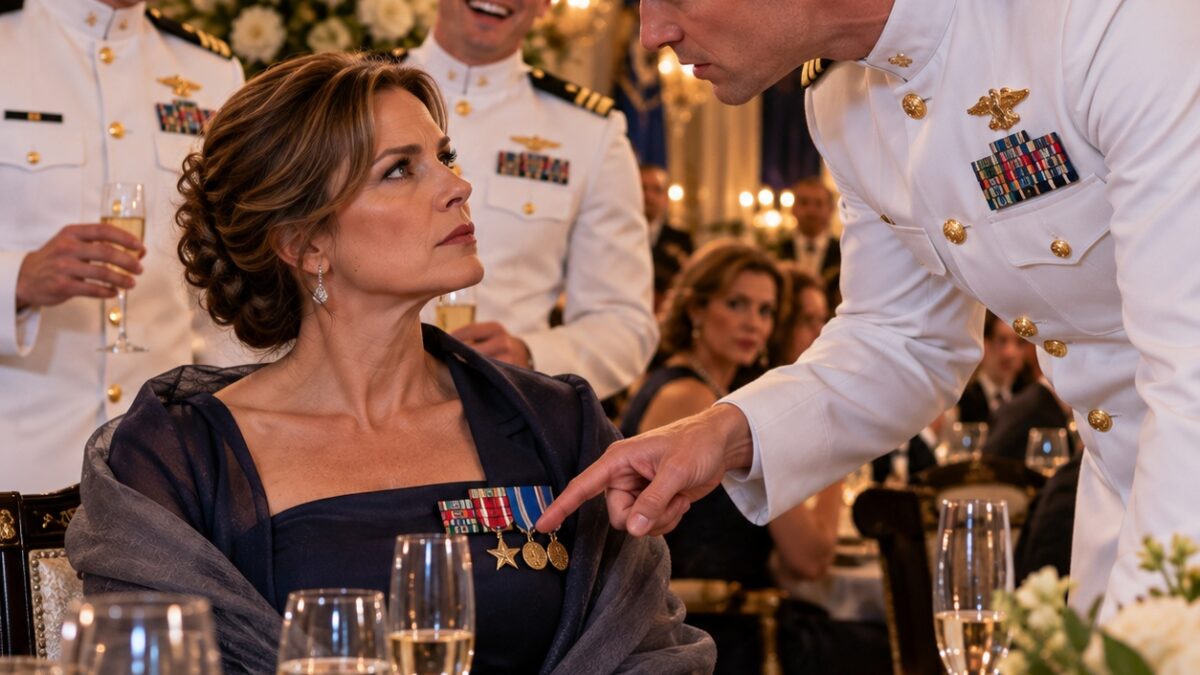
He stood beside my table in Navy dress whites with a gold SEAL trident shining under the ballroom chandeliers, two younger men grinning behind him, and enough confidence in his posture to fill the empty chair across from me.
He looked at my ribbons.
Then my face.
Then the shawl covering my shoulders.
And he decided he knew who I was.
“What’s with the costume, sweetheart?”
I set down my fork.
“Excuse me?”
“You heard me.”
One of his friends snorted.
The other lifted his champagne glass.
Anderson straightened slightly, making sure I could see the trident on his chest.
“I’m a Navy SEAL.”
“I can see that.”
He smiled.
Not warmly.
The kind of smile a man gives when he expects the conversation to end on his terms.
“You look like somebody’s wife who raided a closet before the party.”
I stared at him.
He leaned closer.
“No visible rank. No unit patch I recognize. Nobody in this room seems to know you.”
His eyes dropped again to my ribbon bar.
Combat Action Ribbon.
Bronze Star.
Two pieces of metal and fabric representing memories I would have paid almost anything not to own.
“And those?”
He pointed.
“You expect people to believe you earned those?”
His friends laughed.
I did not.
“Walk away, Lieutenant.”
That should have been enough.
It was not.
Men like Bryce Anderson often mistake restraint for weakness because they have spent their lives believing power must announce itself.
He tilted his head.
“Or what?”
I said nothing.
“You’ll report me?”
His friends laughed again.
Anderson leaned closer.
“Come on. No rank I can see. No command patch. No one claiming you.”
Then he said it.
“Just some woman playing dress-up in a uniform she didn’t earn.”
I looked directly into his eyes.
“Say that one more time.”
His smile widened.
“Playing dress-up.”
Then he reached down and touched my ribbon bar with one finger.
Not hard.
Almost casual.
That somehow made it worse.
I put my fork down.
Slowly.
Looked at his hand.
Then back at his face.
For twenty-two years, I had learned to recognize the exact moment when another person expected an emotional reaction.
Fear.
Anger.
Humiliation.
Anything they could use to prove the story they had already written about you.
Bryce wanted me to flinch.
So I didn’t.
He waited.
Nothing.
Finally he laughed, slapped one of his friends on the shoulder, and walked toward the bar.
“Told you,” I heard him say.
“Costume. Hundred percent.”
I picked up my fork.
Cut another piece of fish.
Chewed.
Swallowed.
My hand did not shake.
Under the table, my left knee pressed so hard against the chair leg that I would find a bruise the next morning.
That was the only sign.
The ballroom around me kept moving.
Two hundred and fifty people.
Senior officers.
Defense contractors.
Political aides.
Retired generals.
Reporters.
Men and women with careers built around noticing threats.
Almost none of them noticed what had happened at table 12.
Or maybe they did.
Maybe they decided it was safer not to notice.
That happens more often than people admit.
Three hours earlier, the ballroom had been nearly empty when I arrived.
5:47 p.m.
Coronado.
Hotel staff still adjusting table settings.
White cloths stretched flat.
Ice sculptures sweating under yellow light.
Place cards lined up in careful rows.
Admiral this.
General that.
Senator someone.
Table numbers quietly dividing the room into categories.
One through eight:
Power.
Nine through sixteen:
Everyone else.
I chose table 12.
Corner of the room.
Far from the podium.
Far from cameras.
Far from the handshake line.
I had never liked handshake lines.
Twenty-two years in the Navy had taught me many things.
How to read a combat brief quickly.
How to tell when an operations plan was pretending risk did not exist.
How to sit across from a four-star officer and tell him his preferred option would get people killed.
How to keep pressure on a wound while someone younger than my career whispered for his mother.
And one other lesson.
The loudest person in the room is rarely the most dangerous.
So I preferred corners.
Corners let you watch.
That evening I wore Navy dress whites and a dark shawl because the ballroom air-conditioning was too cold.
The shawl covered my shoulder insignia.
Not deliberately.
At least not at first.
From a short distance, people could see my name.
UNDERWOOD.
They could see the Combat Action Ribbon.
The Bronze Star.
Other decorations.
They could not easily see my rank.
That detail would become more important than I ever expected.
Sixty days earlier, the Secretary of Defense had signed a short memorandum.
Three paragraphs.
One page.
The kind of document that looks unimpressive until you understand what authority sits inside it.
It created the Joint Special Operations Evaluation Group.
Our purpose was straightforward on paper and much more complicated in practice.
Assess culture.
Readiness.
Professional conduct.
Command climate.
Across special operations units.
SEALs.
Green Berets.
Marine special operations personnel.
Others whose reputations often entered rooms several minutes before the people themselves.
The memorandum named one commanding officer.
Me.
Commander Briana Underwood.
I had not requested the assignment.
At the time, I had been finishing a tour in Rota, Spain.
My phone rang.
Pentagon number.
I considered letting it go to voicemail.
Then recognized the voice.
Vice Admiral Hargrove.
Old mentor.
One of the few senior officers in my career who had learned to criticize me without first explaining that I should be grateful for being in the room.
“Briana.”
“Sir.”
“You’re being reassigned.”
“To where?”
“Coronado.”
I stopped walking.
“Naval Special Warfare Command?”
“Yes.”
I almost laughed.
“Sir, I’m a surface warfare officer.”
“I am aware.”
“I’ve never served in the SEAL community.”
“That’s exactly why they selected you.”
There was the answer.
An outsider.
Not impressed by tridents.
Not invested in internal loyalties.
Not raised in the same institutional culture I was being asked to evaluate.
I arrived thirty days later.
One duffel bag.
Base housing.
No family with me.
No entourage.
Every morning at 0500, I ran Coronado Beach.
Then I read.
Reports.
Investigations.
Classified summaries.
After-action reviews.
Complaints.
Command-climate assessments.
Things people had said publicly.
Things they had only been willing to say anonymously.
Patterns.
The Monday after the gala was supposed to be the official launch.
That was when unit leadership would be told my name, face, authority, and scope.
Saturday night was simply a formal event.
I intended to eat dinner.
Observe.
Leave.
My mother texted me around seven.
YOU EATING ENOUGH?
CALL TOMORROW.
LOVE YOU, BABY.
I smiled.
First time all evening.
My mother had been calling me baby since before I could walk and apparently saw no reason four stripes, combat deployments, or twenty-two years of service should change that.
Then Bryce Anderson crossed my peripheral vision.
Tall.
White dress uniform.
Gold trident.
Twenty-nine years old.
Three combat deployments.
Junior Officer of the Year nominee.
I knew his file.
Not intimately.
But enough.
Strong tactical evaluations.
Highly rated under pressure.
Aggressive.
Charismatic.
Repeated comments about maturity and interpersonal judgment written carefully enough that nobody had been forced to act on them.
He walked like a man who had spent years being told that confidence and competence were the same thing.
Lieutenant Travis Cole followed him.
Ensign Derek Shaw behind Travis.
Three men.
Three glasses.
Three expressions saying the evening belonged to them.
Then came the first confrontation.
And when it ended, I returned to dinner.
Ten minutes passed.
A quartet played something classical.
A senator gave a brief speech about sacrifice.
Champagne continued moving.
At the bar, Anderson told a story.
His voice grew louder with each glass.
I finished my fish.
Folded my napkin.
Drank water.
Waited.
I knew men like Anderson.
Humiliation does not calm them when they believe they are entitled to obedience.
Silence is not received as de-escalation.
It is interpreted as defiance.
Sure enough, he came back.
This time alone at first.
He pulled out the chair across from me without asking.
Sat with his legs wide.
Elbows on the tablecloth.
“Still here.”
“Yes.”
“Look.”
He leaned toward me.
“I’m going to be straight with you.”
“I would appreciate that.”
“I’ve been doing this seven years.”
“This?”
“Serving.”
I almost smiled.
“Three deployments.”
I said nothing.
“I’ve bled for this country.”
His voice had changed.
Less mocking now.
Something wounded underneath.
“The men in this room have bled for this country.”
Then he pointed at my Bronze Star.
“That ribbon.”
His jaw tightened.
“I know what it takes to earn one.”
His voice cracked slightly.
“My best friend died earning his.”
For the first time that evening, I saw something human behind the arrogance.
Pain.
Real pain.
Poorly carried.
That mattered.
It did not excuse what came next.
“When I see somebody wearing one who doesn’t look like she’s ever been near a combat zone…”
He stopped.
“Yeah.”
“I have questions.”
“Then ask them.”
“I am asking.”
“No.”
I looked directly at him.
“You’re accusing.”
Silence.
At table 11, people became intensely interested in their plates.
A waiter slowed.
Then continued.
Anderson’s jaw tightened.
“You know what?”
He stood.
“I’ll find out one way or another.”
He walked off.
Pulled out his phone.
Started typing.
My mother texted again.
DON’T FORGET YOUR VEGETABLES.
STAND UP STRAIGHT.
YOU’RE SOMEBODY’S COMMANDER.
I nearly laughed.
At the bar, Anderson talked with Travis and Derek.
Animated.
Planning something.
Major Ellen Crawford noticed before I did.
Marine.
Silver oak leaves.
The kind of face that could identify bad judgment before it finished introducing itself.
She walked to Anderson.
Touched his elbow.
“Lieutenant.”
He turned.
“Ma’am.”
“Whatever you’re thinking.”
Pause.
“Don’t.”
“With respect, Major, this is a SEAL community matter.”
“It’s a judgment matter.”
“She’s wearing something she didn’t earn.”
“You don’t know that.”
“That’s enough.”
“No.”
Crawford stepped closer.
“That woman has done nothing to you.”
Anderson smiled.
Formal.
Cold.
“Noted, ma’am.”
Crawford walked away.
She pulled out her phone.
Texted someone.
I would learn later the message contained two words.
TABLE 12.
The recipient was Colonel Raymond Voss.
Old friend.
Army.
Someone who had known me long enough to understand the difference between my being calm and my being finished.
He was outside on the terrace.
By the time he came in, Anderson had found the microphone.
The master of ceremonies had left it on the podium after the senator’s speech.
Anderson picked it up.
Tapped twice.
THUMP.
THUMP.
Two hundred and fifty conversations stopped.
He stood beneath the lights.
Trident catching every reflection.
Champagne high enough in his bloodstream to remove caution but not coordination.
“Ladies and gentlemen.”
His voice rolled through the ballroom.
“Quick moment.”
People turned.
He smiled.
“Tonight is about service.”
Pause.
“Real service.”
A few voices answered from SEAL tables.
“Hooyah.”
Anderson continued.
“The kind that costs something.”
Then he looked at me.
“So I want to recognize a special guest.”
Every head turned toward table 12.
I sat alone.
Water in front of me.
Shawl around my shoulders.
“And this woman…”
He pointed.
“Is wearing Navy dress whites.”
Laughter from somewhere.
Small.
Nervous.
“With a Combat Action Ribbon.”
He paused.
“And a Bronze Star.”
Then:
“Impressive, right?”
Nobody answered.
“But here’s the thing.”
His tone turned mock thoughtful.
“Nobody here knows her.”
I looked around.
He was wrong about that.
Voss had entered.
Crawford knew.
A retired rear admiral near table 11 was studying me too carefully to be confused.
But Anderson was no longer gathering information.
He was performing certainty.
“No unit patch.”
He continued.
“No visible rank.”
“No commanding officer has claimed her.”
He looked back at me.
“So I would like to invite her to come up here.”
He extended his hand dramatically.
“Tell us your story.”
Where had I served?
Which deployment earned the Combat Action Ribbon?
What action earned the Bronze Star?
“Come on up.”
He smiled.
“We’d all love to hear it.”
It was not an invitation.
It was a tribunal disguised as courtesy.
He wanted me to defend my right to exist in front of 250 strangers.
I picked up my water.
Took one sip.
Set it down.
Then looked at him.
Nothing else.
His smile flickered.
He had expected panic.
People who build their power around dominance often need participation from the person they are humiliating.
I refused.
“No takers?”
He laughed into the microphone.
“That’s fine.”
Shrug.
“I’m sure there’s a perfectly good explanation.”
He put the microphone down.
The room slowly restarted.
Conversation.
Silverware.
Music.
But table 12 was no longer invisible.
Everyone watched.
Some with curiosity.
Some embarrassment.
Some pity.
Most with the quiet relief of people who are grateful someone else has become the target.
I stayed where I was.
Waiting.
Waiting had carried me through worse.
Kandahar.
Nine hours near a burning vehicle after an ambush.
Shrapnel through my left shoulder.
Three wounded Marines.
One tourniquet made from my belt because supplies were gone.
The world reduced to blood, dust, heat, breathing.
A nineteen-year-old Marine named Davis gripping my wrist.
“Tell my mom…”
Then nothing.
I still remember the sky.
Absurdly blue.
The reviewing chain later questioned portions of the timeline surrounding my recommendation.
A higher valor award became a Bronze Star.
I learned then that sometimes people will accept your blood more easily than your version of how it was spilled.
Waiting.
For evacuation.
For recognition.
For rank.
For rooms to stop being surprised by my presence.
I had become very good at it.
Colonel Voss reached table 12.
Pulled out the chair Anderson had used.
Sat.
“You good?”
“I’m good.”
“I saw the microphone.”
“I know.”
“That kid has no idea, does he?”
“No.”
“You want me to handle it?”
“No.”
Raymond studied me.
“Monday’s going to be interesting.”
“Monday’s going to be fine.”
He almost smiled.
Stood.
Squeezed my shoulder.
Left.
Dessert arrived.
Chocolate mousse.
I tried it.
Excellent.
Across the room, Anderson was still drinking.
Still talking.
Still convinced the universe was waiting to confirm his opinion.
Then he came back a third time.
By then Travis looked less amused.
Derek had gone quiet.
Anderson did not sit.
He stood over me.
Too close.
“Last chance.”
I looked up.
“For what?”
“To explain yourself before I do it for you.”
“And how would you do that?”
He held up his phone.
Wikipedia.
Blue and white screen.
“Stolen Valor Act.”
I almost closed my eyes.
He continued.
“Federal crime.”
He read selected words aloud.
“Fine.”
“Imprisonment.”
Then looked at me triumphantly.
“That’s not me talking.”
He tapped the screen.
“That’s the United States government.”
“Put the phone away.”
“No.”
His face was flushed.
“Because in about thirty seconds, I’m calling security.”
He leaned closer.
“They’re going to verify your credentials.”
Travis touched his arm.
“Bryce.”
Anderson shrugged him away.
“When you can’t produce a valid CAC card matching those decorations…”
He smiled.
“You leave in handcuffs.”
“You have no authority to demand identification from me.”
“What?”
“You are a lieutenant.”
I kept my voice quiet.
“You are not security.”
His face reddened.
“You are not my superior.”
A muscle jumped in his jaw.
“And you are not operating in your chain of command.”
Each sentence made him angrier because each one was true.
In front of witnesses.
By a woman he had already decided was beneath him.
That combination was more than he could handle.
He reached across the table.
And ripped my name tag off my chest.
The Velcro tore loudly.
A small sound.
In that ballroom, it felt enormous.
He held it between two fingers.
UNDERWOOD.
“There.”
He turned it toward himself.
“Underwood.”
Then toward the room.
“Never heard of you.”
No one moved.
“Anyone?”
He lifted the tag.
“Has anyone here served with Commander Underwood?”
Someone might have answered.
No one did in time.
Anderson interpreted silence as victory.
“Exactly.”
He threw the tag onto the table beside my water glass.
“Nobody knows you because you’re not real.”
Then he called security.
“Lieutenant Anderson.”
He gave his affiliation.
“Suspected stolen valor.”
He described me as a Black woman in Navy dress whites wearing combat decorations she supposedly could not account for.
Major Crawford appeared.
Her face was white with anger.
“Lieutenant.”
Anderson turned.
“You just made the worst mistake of your career.”
“With respect—”
“No.”
She stepped closer.
“No respect.”
Then counted.
“You physically touched another person’s uniform.”
“Publicly accused her of stolen valor without evidence.”
“Called security.”
“And you still haven’t established who she is.”
Anderson shook his head.
“She isn’t an officer.”
Then:
“Look at her.”
Crawford stared at him.
“I have.”
Her voice dropped.
“And unlike you, I’ve also read the guest list.”
She walked away.
That was the first moment doubt entered his face.
Small.
Not enough.
Security arrived.
Two guards.
One of them looked older.
Retired master chief, if I guessed correctly.
Gray hair.
He looked at my ribbons.
Then my face.
Then Anderson.
“Sir.”
His tone was cautious.
“You’re sure?”
“Positive.”
The guard turned toward me.
“Ma’am.”
He looked uncomfortable.
“I apologize, but we received a report.”
“I understand.”
“Would you mind providing identification?”
I glanced at the ballroom clock.
8:44.
Then back at him.
“In about two minutes.”
Anderson laughed.
“Two minutes?”
I ignored him.
“What happens in two minutes?”
At table 11, the retired rear admiral leaned toward his wife.
I heard him say:
“That SEAL kid is going to regret this.”
She asked how he knew.
He answered:
“Because that woman isn’t scared.”
Then:
“She’s waiting.”
Travis put down his glass.
“Bryce.”
Anderson did not look.
“Major Crawford was right.”
“Stop.”
“Bryce.”
“I said stop.”
The security guard touched his earpiece.
Then his posture changed.
Straight.
Shoulders back.
Hands positioned automatically.
Anderson noticed.
“What?”
The guard raised one hand.
“Sir.”
Pause.
“Someone’s coming.”
The ballroom doors opened at 8:46.
General Harold Whitaker entered first.
Four stars.
Army dress greens.
Colonel James Pratt half a step behind.
Command Master Chief Elena Ruiz.
Two staff officers.
Then Admiral Katherine Bennett.
Chief of Naval Operations.
Four stars.
Navy dress whites.
The room stood so quickly chairs scraped in one enormous wave.
Bartenders stopped moving.
The quartet went silent.
Whitaker and Bennett crossed the ballroom side by side.
No hurry.
People with real authority rarely need one.
Their entourage followed.
Anderson watched them approach.
His body understood before his mind did.
He stepped away from my table.
Once.
Again.
The security guards moved aside automatically.
Whitaker stopped in front of me.
Looked at the missing tag.
Torn Velcro.
Security.
Anderson.
Then me.
“Commander Underwood.”
Two words.
That was all.
Anderson went gray.
Not pale.
Gray.
His jaw locked.
The room became absolutely silent.
Admiral Bennett stepped closer.
Her eyes went to my chest.
Missing tag.
Damaged backing.
Then to Anderson.
I had seen that expression from senior leaders before.
Not anger.
Something colder.
Assessment before consequence.
Whitaker turned to the room.
“Ladies and gentlemen.”
No microphone.
Did not need one.
“Allow me to introduce Commander Briana Underwood, United States Navy.”
Anderson did not move.
“Twenty-two years of service.”
Whitaker continued.
“Two combat deployments.”
“Combat Action Ribbon for actions under fire in Kandahar Province.”
My throat tightened.
“She assisted in the rescue of Marines from a burning vehicle while under enemy contact.”
Every eye in the room returned to Anderson.
Whitaker continued.
“Commander Underwood has been appointed by the Secretary of Defense as commanding officer of the Joint Special Operations Evaluation Group.”
Then:
“Effective Monday, she will lead the assessment of special operations units in this command.”
Pause.
“Culture.”
“Readiness.”
“Conduct.”
He looked directly at Anderson.
“Every unit.”
The words landed harder than any threat I could have made.
Admiral Bennett reached toward my table.
Picked up my name tag.
Held it.
Then handed it to me.
“I believe this belongs to you, Commander.”
“Thank you, Admiral.”
I pressed it back onto the Velcro.
It sat slightly crooked.
I left it that way.
Then I stood.
Straightened my uniform.
Looked at Whitaker.
Bennett.
And said:
“I believe we have a program to launch Monday.”
Whitaker nodded.
“So we do.”
Anderson still had not moved.
I could have left then.
Maybe I should have.
Instead, I looked at the podium.
The microphone.
The same microphone Anderson had used to turn a room into a courtroom.
I walked toward it.
Each step sounded loud.
Shoes against marble.
Click.
Click.
Click.
I adjusted the microphone.
Two hundred and fifty people watched.
“I wasn’t planning to speak tonight.”
My voice sounded calm.
I did not entirely feel calm.
“I came here to eat dinner.”
A few nervous expressions.
“To sit in a corner.”
“Watch a room do what rooms like this often do.”
Pause.
“Measure one another.”
I looked down at my chest.
“My rank.”
“My ribbons.”
“My uniform.”
Then back up.
“Tonight, somebody measured me.”
No one moved.
“He looked at my face.”
“My uniform.”
“And decided I did not belong before he asked my name.”
I let the sentence breathe.
“Before he checked a roster.”
“Before he asked where I served.”
“Before he asked about my deployments.”
Then:
“Before he asked about the Marines I carried from a burning vehicle outside Kandahar.”
My voice cracked slightly.
I did not hide it.
I thought of Davis.
“Tuesday afternoon.”
I said quietly.
“A day I remember more often than I would like.”
The ballroom blurred for half a second.
Then cleared.
“He did not ask.”
I continued.
“Because he believed he already knew the answer.”
I looked across the room.
At admirals.
Generals.
SEALs.
Marines.
Civilians.
People with all varieties of authority displayed on shoulders, collars, sleeves, and résumés.
“I am not standing here to discuss punishment.”
“That will go through appropriate channels.”
“What I want to say is simpler.”
I rested one hand on the podium.
“The uniform is not the person.”
Pause.
“Rank is not character.”
Another.
“And ribbons mean very little if the person wearing them can look at another human being and decide they are worth less before learning anything about them.”
No one applauded.
Not yet.
Good.
I did not want applause while I was still talking.
“Monday, my team begins its work.”
“We will be fair.”
“We will be thorough.”
“And we will judge every person and every unit under the same standard.”
I looked toward Anderson.
Not to threaten him.
To include him.
“The standard of basic human dignity.”
Then I put down the microphone.
Walked back to table 12.
Sat.
That was all.
The applause began behind me.
One person.
Two.
Then Crawford.
Then the retired admiral at table 11.
Then most of the room.
People stood.
I did not.
I picked up my water.
Took a sip.
Across the ballroom, Bryce Anderson stood alone.
Five minutes later, Admiral Bennett removed him through a service corridor.
I did not witness the conversation.
I heard about it later.
She told him the incident was being documented.
Security footage.
Witness statements.
Officer accounts.
He would submit a written report by 0800.
He was relieved of duty immediately pending review.
His access card collected.
At some point, Anderson apparently tried to say I had never proven myself to him.
Bennett’s answer was short.
I did not need to prove myself to him.
I had already proven myself to the Navy.
To the Department of Defense.
And to people who mattered long before Bryce Anderson ever learned my name.
By Sunday morning, eleven written statements had reached Admiral Bennett’s office.
Political aides had notified their offices.
A defense reporter present at the gala submitted an internal memorandum.
By Monday, the inquiry became official.
NCIS opened a preliminary review.
Conduct.
Professional standards.
Possible violations under the Uniform Code of Military Justice.
Anderson sat for questioning.
A JAG officer asked him to explain the night.
He talked for forty-three minutes.
I read a summary later.
He told most of the truth.
The drinking.
Less clearly.
The laughter.
Minimized.
The name tag.
Described as a confrontation rather than the physical act everyone had seen.
Then the JAG officer asked the question that mattered most.
“Before publicly accusing Commander Underwood, did you attempt to verify her identity through official channels?”
Anderson answered:
“No, sir.”
“Why?”
Long pause.
“Because I thought I already knew.”
That sentence became central to everything.
Because I thought I already knew.
Bias rarely introduces itself as hatred.
Often it introduces itself as certainty.
I already know what someone like that looks like.
I already know who belongs.
I already know who earned what.
I already know what kind of woman wears this uniform.
I already know what a commander looks like.
Certainty removes curiosity.
Without curiosity, evidence becomes almost irrelevant.
Anderson’s two companions faced consequences too.
Travis Cole had laughed.
Followed.
Enabled.
He had not touched me.
Had not taken the microphone.
Had tried, eventually, to stop Anderson.
Too late.
He received nonjudicial punishment.
Loss of pay.
Extra duty.
Formal reprimand.
Derek Shaw left before the night ended.
He submitted a statement voluntarily before he was asked.
His consequences were lighter.
Formal counseling.
Reassignment.
None of them walked away untouched.
Nor should they have.
The executive officer of Anderson’s team, Commander Nathan Briggs, had been in the ballroom.
He saw enough.
Did nothing.
That mattered.
Leadership is not only what you personally refuse to do.
It is what you tolerate in people whose conduct reflects your command.
Briggs lost his position.
The board described it as systemic failure.
He did not fight the finding.
Anderson’s review took three weeks.
Five senior officers.
Two days of testimony.
Security footage from multiple cameras.
The ballroom from above.
Side angles.
Anderson leaning over me.
The microphone.
His hand ripping my name tag free.
The call to security.
It was all there.
Video is merciless.
It does not care about the story you tell yourself afterward.
I sat in the gallery for part of the proceedings.
Anderson watched the footage.
I watched Anderson watch himself.
That may have been the first genuine consequence.
He did not look proud.
The man on screen looked arrogant.
Cruel.
Reckless.
Certain.
Anderson stared as though somebody else had borrowed his body.
The findings were unanimous.
Dereliction.
Conduct unbecoming.
Failure to maintain professional standards.
Violation of equal opportunity policy.
Consequences were serious.
Formal reprimand in his permanent record.
Removal from SEAL qualification.
Transfer out of Naval Special Warfare Command.
Mandatory leadership remediation.
One-year assignment in fleet support.
The board asked for my recommendation regarding placement.
Some people expected me to ask for the harshest option.
I did not.
There is a difference between accountability and destruction.
I had spent too much of my career watching institutions either ignore misconduct or respond only after public embarrassment with punishment designed to protect the institution’s image.
Neither approach fixes culture.
Accountability should be precise.
Connected to behavior.
Designed, when possible, to create the conditions for change.
Anderson had built too much identity around being a SEAL.
Around the trident.
Around believing elite selection made him elite in every dimension.
Removing him from that environment seemed more useful than burying him inside it.
I recommended one year in fleet operations.
No trident.
No special warfare culture.
No room full of men reinforcing the version of himself he already knew.
A ship.
Watch schedules.
Logistics.
Maintenance.
Junior sailors.
Chiefs who did not care where he had deployed.
Mission before ego.
Three nights after the board decision, someone knocked on my door at the visiting officers’ quarters.
Eleven p.m.
I was wearing a sweater.
Reading glasses.
Military-history paperback open beside me.
I opened the door.
Bryce Anderson stood there.
Civilian T-shirt.
Running shorts.
Red eyes.
No uniform.
No trident.
For a moment, he looked twenty-nine.
Not Lieutenant Anderson.
Not SEAL.
A young man who had learned that talent does not protect you from becoming the worst version of yourself.
“Ma’am.”
I waited.
“Commander.”
His throat moved.
“I…”
He looked down the hallway.
“I came to apologize.”
I said nothing.
“Not because the board told me to.”
“They didn’t?”
“No.”
“Good.”
He swallowed.
“I came because what I did was wrong.”
Still nothing.
“And I knew…”
His voice cracked.
He stopped.
Started again.
“I knew it was wrong while I was doing it.”
That mattered.
“And I did it anyway.”
I studied him.
Talent.
Shame.
Fear.
Potential.
I had seen that combination many times in junior officers.
Sometimes the difference between a ruined person and a better one was whether somebody treated the mistake as identity or evidence.
“Come in.”
He sat in the desk chair.
I sat on the edge of the bed.
Government room.
Thin walls.
Air conditioner humming.
For several moments, neither of us spoke.
Then I asked:
“Do you know why I didn’t stop you at the gala?”
He shook his head.
“No, ma’am.”
“Because people have been stopping me my entire career.”
He looked up.
“Stopping my explanation.”
“Stopping my story.”
“Deciding what I am before I get the chance to show them.”
He lowered his eyes.
“I promised myself a long time ago that if I ever had authority, I would not do the same thing to someone else.”
“Even when their story makes them look terrible.”
I paused.
“Especially then.”
Because truth matters most when it becomes uncomfortable.
Anderson stared at the floor.
I reached for my wallet.
There was a photograph inside.
Old.
Creased.
Edges faded.
I handed it to him.
He looked.
Then went completely still.
Two people.
A young Black lieutenant in Navy uniform.
Me.
Next to an older white senior chief.
Strong.
Weathered.
Tattoos on his forearms.
Quiet smile.
Anderson’s hand began trembling.
“That’s…”
“Yes.”
He looked at me.
“My father?”
“Senior Chief Daniel Anderson.”
I pointed toward the background.
“Rota, Spain.”
He stared at the photograph.
“2010.”
“He was my leading chief.”
Anderson stopped breathing for a second.
I continued.
“I was a new lieutenant.”
“That can’t…”
“It can.”
He looked at me again.
“Your father taught me how to lead people who had every reason to assume I did not understand their work.”
I smiled faintly.
“I did not understand much.”
“Not then.”
“Your father never humiliated me for that.”
“He corrected me.”
“Constantly.”
“He taught me how to listen before I started giving orders.”
Anderson pressed the photograph between both hands.
“He never told me about you.”
“He wouldn’t.”
That was Daniel.
“He did not tell stories about himself.”
“He lived them.”
Anderson’s eyes filled.
I remembered his father saying something during a miserable week in Spain.
I had been frustrated.
Young officer.
Trying too hard.
Concerned with authority rather than mission.
Daniel waited until everyone left.
Then said:
“Ma’am, the insignia doesn’t make the sailor.”
I asked what did.
“The mission.”
Then:
“And the mission is always people.”
I told Bryce.
He closed his eyes.
For a long time.
When he opened them, he looked smaller.
Not diminished.
Human.
“What happens to me now?”
He sounded like a boy.
“I recommended an assignment aboard a fleet ship.”
He looked up.
“Assistant operations role.”
“One year.”
“No special warfare.”
“No SEAL qualification during the assignment.”
His mouth tightened.
“Is that punishment?”
“That depends on what you do with it.”
I handed him a folded piece of paper.
He opened it.
Five words.
YOUR FATHER WAS A QUIET WARRIOR.
BE LIKE HIM.
He read it twice.
Then the tears came.
Not dramatic.
Not begging.
The kind that happens when pride has finally run out of energy.
I let him cry.
I did not tell him everything would be okay.
I did not tell him I forgave him.
Not then.
Forgiveness should not be offered simply because the person who hurt you has become uncomfortable with themselves.
I sat there.
Let him feel what he had done.
Eventually, he stood.
Returned the photograph.
I shook my head.
“Keep it.”
His eyes widened.
“Ma’am—”
“You need it more than I do.”
He held the photograph carefully.
At the door, he turned.
Saluted.
This time there was no performance in it.
I returned the salute.
He left.
I went back inside.
Put my reading glasses on.
Opened my book.
Turned the page.
Life is not a movie.
The next morning, I still had meetings.
Reports.
Personnel issues.
The Joint Special Operations Evaluation Group did not exist to process Bryce Anderson’s personal transformation.
We had work.
And we did it.
Command climate reviews.
Anonymous interviews.
Unit assessments.
Readiness metrics.
Leadership failures.
Patterns hidden behind high operational performance.
One of the hardest truths in elite organizations is that competence in one field often becomes a shield against accountability in others.
Good shooter.
Strong operator.
Successful deployment.
Therefore leadership concerns get minimized.
Interpersonal failures dismissed.
Bias treated as personality.
Poor judgment reclassified as intensity.
Our job was not to destroy elite culture.
It was to ask whether parts of that culture were undermining the mission it claimed to protect.
Anderson’s gala incident became a catalyst.
Commandwide policies changed.
Mandatory conduct training.
Better reporting mechanisms.
Explicit protocols for official events.
Some officers complained quietly.
Others loudly.
Fine.
Institutional change that inconveniences no one is usually decorative.
Months passed.
I received periodic reports about Anderson.
Not because I requested special treatment.
Because I had helped place him.
His early evaluations aboard ship were uneven.
Technically capable.
Impatient.
Struggled with not being the most experienced person in the room.
Good.
He needed that.
A chief boatswain’s mate named Reyes apparently educated him quickly.
Thirty years in the Navy.
No SEAL trident.
No interest in Anderson’s biography.
During a replenishment-at-sea evolution, Reyes completed a complex rigging sequence Anderson had never personally done.
Anderson admitted that.
Progress already.
The story reached me secondhand.
According to the report, Reyes chewed on a coffee stirrer and told him:
“You SEALs think war is the hard part.”
Then gestured around at steel, cables, ocean, logistics.
“This is the hard part.”
I laughed when I read that.
Chiefs.
Always efficient.
By the second month, Anderson attended leadership training on command climate.
The instructor was a female lieutenant younger than he was.
Afterward, she apparently recognized him.
“You’re the guy from the gala.”
He could have denied.
Deflected.
He didn’t.
“Yes.”
She asked:
“Worth it?”
“No.”
“What did you learn?”
According to the evaluation, he took time before answering.
Then said:
“I was so busy protecting what I thought the uniform meant that I forgot what it actually means.”
Good answer.
Better if lived.
The instructor gave him a training manual.
Page 42.
Leadership under pressure.
The case study was anonymized.
But he recognized me.
Commander.
Combat experience.
Years of being underestimated.
Judged before being heard.
My story had been turned into doctrine.
I had mixed feelings.
No one likes becoming a case study while still alive.
But if the lesson traveled farther than the humiliation, I could accept it.
By his fourth month aboard ship, Anderson began changing in small ways.
The reports became less formal.
Chiefs notice character differently than officers.
He ate breakfast with enlisted sailors more often.
Learned names.
Not rates.
Names.
Where people were from.
Who had children.
Who was afraid of failing advancement exams.
Who missed home.
One sailor was a nineteen-year-old seaman apprentice named Torres.
She wanted to apply to the Naval Academy.
She told Anderson she did not think she looked like an officer.
When I heard that part later, I stopped reading.
Sat back.
Because I knew exactly what he would have heard inside that sentence.
What does an officer look like?
Once, Bryce Anderson believed he knew.
He told Torres:
“I used to think I knew.”
Then:
“I was wrong.”
He wrote her recommendation.
Three pages.
By the sixth month, his executive officer pulled him aside.
Strong evaluations.
Operations running clean.
Leadership improving.
There was apparently informal discussion that he might someday have a path back toward the community he had lost.
Probationary.
Conditional.
Nothing guaranteed.
Anderson surprised them.
He asked to remain where he was longer.
The executive officer reportedly said:
“Most people in your situation would run back.”
Anderson pulled the photograph from his pocket.
Creased now.
His father beside me in Spain.
Then the note.
Your father was a quiet warrior.
Be like him.
“I’m sure, sir.”
He wanted to stay.
Learn.
That was when I began to believe the apology had become something more than guilt.
People love dramatic redemption.
One speech.
One tearful apology.
Transformation complete.
Real change is boring.
Breakfast with sailors.
Listening.
Learning a job beneath your ego.
Writing a recommendation.
Choosing not to return immediately to the identity that once made you arrogant.
Doing the same thing differently over and over until the pattern changes.
That is redemption if such a thing exists.
I did not erase what Anderson had done.
I never would.
He had looked at me.
A Black woman.
Alone.
Uniform partly obscured.
And decided I could not possibly be what my decorations suggested.
He did not make a factual error after a reasonable inquiry.
He built an accusation out of appearance.
Then protected that accusation against every warning.
Major Crawford warned him.
His own friend warned him.
Security hesitated.
He ignored them all.
Because certainty had become part of his identity.
That mattered.
It still matters.
But people are not only the worst evening of their lives.
If they were, most of us would deserve no future.
The question is what we do after the evidence becomes undeniable.
Deny?
Minimize?
Blame alcohol?
Blame stress?
Blame the victim?
Or look directly at ourselves and admit:
I thought I already knew.
I was wrong.
Then change the habits that made the mistake possible.
That is harder than punishment.
Anderson’s father never knew all the details.
At least not from me.
Daniel Anderson had retired to Virginia Beach.
Quiet life.
Coffee on the porch.
The same man I remembered from Spain.
I could have called him.
Told him what his son did.
I did not.
Bryce’s reckoning did not need to become his father’s shame.
That, too, was part of not stopping someone else’s story.
Months later, I heard Daniel was still waking early.
Still sitting outside at sunrise.
He probably had no idea that a sentence he said in Spain years earlier had become the center of his son’s second chance.
The insignia doesn’t make the sailor.
The mission does.
And the mission is always people.
I have carried those words longer than Daniel ever knew.
At the gala, Bryce Anderson had everything visible that people associate with elite status.
Trident.
Combat experience.
Dress whites.
Confidence.
Reputation.
I had rank hidden under a shawl.
A name no one in his immediate circle recognized.
A face that did not match his assumption.
He looked at the visible symbols and thought they told him everything.
That was the irony.
He believed deeply in the meaning of symbols.
Yet understood almost nothing about the values those symbols were supposed to represent.
The trident was real.
His deployments were real.
His friend’s death was real.
His sacrifice was real.
So was his prejudice.
These truths can exist together.
That is uncomfortable.
People want clean categories.
Hero.
Villain.
Good officer.
Bad officer.
Life is rarely that cooperative.
Sometimes a brave man can also be cruel.
Sometimes a highly capable operator can make a catastrophic moral judgment.
Sometimes a person with legitimate trauma turns that trauma outward and uses it as permission to wound someone else.
And sometimes the person he wounds chooses not to destroy him when she has the authority to do so.
Not because he deserves mercy.
Because accountability is not revenge.
That distinction mattered to me.
Admiral Bennett once asked privately whether I regretted recommending fleet service instead of pushing for Anderson’s separation.
“No.”
She studied me.
“You sure?”
“Yes.”
“Why?”
“Because throwing him away would have taught everyone the safest response to misconduct.”
“What’s that?”
“Hide it better.”
She was quiet.
I continued.
“If there is no path after accountability, institutions learn to protect people from accountability.”
That does not mean everyone deserves another chance in the same role.
Anderson lost something real.
His qualification.
Career trajectory.
Reputation.
Access to the community that defined him.
Those consequences were necessary.
But we gave him a place where he could find out whether anything remained when the symbol disappeared.
That question changed him.
Who are you without the trident?
Who are you without applause?
Who are you when the people around you are not impressed?
Who are you when the mission requires humility rather than aggression?
Most of us should be forced to answer versions of those questions at least once.
I had answered mine much earlier.
Who are you when nobody believes you belong?
That was my question.
I answered it for twenty-two years.
Show up.
Do the work.
Know the mission.
Learn the people.
Keep your records.
Save lives when you can.
Accept that recognition may arrive late or crooked or not at all.
Do not let other people’s limited imagination become your definition.
That was how I survived.
But survival can harden a person.
I had to guard against that.
Every time somebody underestimated me, there was temptation to become contemptuous.
To treat ignorance as inferiority.
To enjoy being the hidden answer to a test someone did not know they were taking.
That is dangerous too.
At the gala, I knew by the second confrontation that Anderson had no idea who I was.
A small part of me could have enjoyed it.
Let him keep digging.
Let the room watch.
Then crush him publicly.
I did not want that.
I wanted him to stop.
Crawford tried.
Travis eventually tried.
He refused.
After that, consequences belonged to him.
That difference matters to me because people later retold the story as though I had orchestrated some elaborate reveal.
I did not.
I was eating fish.
I wore a shawl because I was cold.
The Joint Special Operations Evaluation Group was scheduled to be publicly introduced Monday.
Whitaker and Bennett arrived because of a separate coordination meeting and because Voss had alerted them that something was going wrong.
I did not set a trap.
Bryce built one.
Then stepped into it himself.
That is usually how arrogance works.
It does not need help.
It only needs room.
Months after everything, my mother asked me about the gala.
She had eventually heard enough from official circles that pretending nothing happened became impossible.
We sat in her kitchen in Virginia Beach.
She put coffee in front of me.
“You should have called me.”
“During?”
“Yes.”
“Mom.”
“What?”
“A lieutenant was accusing me of stolen valor in a ballroom full of senior officers.”
“And?”
“And you were supposed to do what?”
She lifted her chin.
“Pray louder.”
I laughed.
She did too.
Then her eyes became serious.
“Did it hurt?”
That question almost broke me.
Not:
Were you afraid?
Not:
Did you win?
Did it hurt?
“Yes.”
I answered.
“It did.”
“Which part?”
I thought.
The accusation.
The name tag.
The microphone.
Security.
The room watching.
None was the deepest cut.
“He touched the ribbon.”
My mother waited.
“He pointed at the Bronze Star and acted like he was protecting something sacred from me.”
I stared at my coffee.
“He didn’t know what it cost.”
My mother reached across the table.
Put her hand over mine.
“You know.”
“Yes.”
“The Marines you carried know.”
Some of them.
“God knows.”
I smiled slightly.
She was my mother.
That was always where the conversation ended eventually.
I thought about Davis.
Nineteen.
His mother.
The message I never got to hear completed.
Sometimes the medal felt less like honor than inventory.
Here is what happened.
Here is what survived.
Here is what did not.
I had never worn it for Bryce Anderson.
That helped.
You do not need every person to believe your story for the story to remain true.
Another lesson.
By the end of Anderson’s first year outside special warfare, his evaluations were strong.
Not flawless.
Better.
He remained aboard ship longer than originally planned.
Torres submitted her Naval Academy package with his recommendation.
I heard she made it to the next stage.
No idea how the story eventually ended for her.
That is okay.
Leadership means contributing to outcomes you may never witness.
Bryce learned that.
I hope.
As for me, the evaluation group completed our first major report.
Some findings were uncomfortable.
Training changes followed.
Commanders complained.
Others thanked us privately.
Culture did not transform overnight.
No institution does.
But people began asking questions they had previously avoided.
Who gets protected because they perform well operationally?
Who is expected to tolerate disrespect because reporting it might harm the unit?
Who gets the benefit of the doubt?
Who must prove belonging repeatedly?
How does a command distinguish toughness from cruelty?
How do leaders intervene before bad behavior becomes scandal?
Those questions were larger than one gala.
Larger than me.
Larger than Anderson.
That was always the point.
My story became useful only if it stopped being only my story.
The last time I saw Bryce in person was more than a year after the incident.
He looked different.
Same face.
Different posture.
We crossed paths during a joint leadership conference.
He was in service uniform.
No trident.
He saw me from across a hallway.
Stopped.
Waited until I finished another conversation.
Then approached.
“Commander.”
“Lieutenant.”
He smiled slightly.
“I’m staying fleet for now.”
“I heard.”
“I like it.”
“That surprises you?”
“It did.”
“How’s Torres?”
His expression brightened.
“She got an appointment.”
“Good.”
“She said my recommendation helped.”
“I’m sure her record helped more.”
He nodded.
“Probably.”
We stood quietly.
Then he reached into his breast pocket.
Not to hand me anything.
Just enough that I saw the edge of the photograph.
His father.
Me.
Spain.
Still carrying it.
“Thank you.”
He said.
“For what?”
He thought.
“Not letting the worst thing I did become the only thing I was allowed to do afterward.”
I looked at him.
“That was never my decision.”
“It kind of was.”
“No.”
I shook my head.
“The consequences were partly my recommendation.”
“Your future was yours.”
He nodded.
Then:
“I called my dad.”
That surprised me.
“What did you tell him?”
“Everything.”
I waited.
“How did that go?”
Anderson laughed once.
“No yelling.”
That sounded like Daniel.
“He was quiet for a long time.”
“What did he say?”
Bryce looked down.
“He said the same thing you wrote.”
The insignia doesn’t make the sailor.
Bryce looked back up.
“He told me he was disappointed.”
“That probably hurt.”
“Worse than the board.”
I believed him.
“Then he said disappointment isn’t the same thing as being done with somebody.”
I smiled.
“That sounds like your father.”
“He asked whether I was finally listening.”
“And?”
“I said yes.”
“Were you?”
“I think so.”
I extended my hand.
He shook it.
Not subordinate to commander.
Not offender to victim.
Two officers.
Two people carrying different parts of the same lesson.
Then we walked in opposite directions.
That is where I prefer to leave his story.
Not with punishment.
Not with applause.
Not even with redemption fully completed.
With a man still walking.
Learning.
Listening.
Because that is more honest.
I never forgot table 12.
The ice sculptures.
The cold air.
The crooked name tag.
The taste of chocolate mousse while security walked toward me.
The unbelievable silence after Whitaker said:
Commander Underwood.
People later told me my expression was remarkable.
Calm.
Controlled.
Graceful.
I appreciate the compliment.
But grace is often what people call pain when they only see the outside.
Inside, I was angry.
Humiliated.
Tired.
I wanted to go home.
I wanted Davis alive.
I wanted my mother.
I wanted twenty-two years of service to be enough to enter one room without being asked to produce evidence.
It was not calm because nothing hurt.
It was control because plenty did.
There is a difference.
Control is not absence of emotion.
It is deciding emotion does not get the steering wheel.
That skill saved lives in Kandahar.
It saved Bryce Anderson from a much worse evening.
And perhaps, eventually, it helped save part of his career.
I do not say that proudly.
Just accurately.
The strongest person in a room is not always the quietest.
I would never turn that into a rule.
I have known loud courage.
Quiet cowardice.
Soft-spoken cruelty.
Confident kindness.
People are complicated.
But power does not need constant announcement.
That much I know.
Real authority remains real under a shawl.
Real service remains real when nobody recognizes your name.
Real courage remains real when someone laughs at it.
And character?
Character reveals itself most clearly when the symbols that usually protect us stop working.
Bryce had his trident.
I had my hidden rank.
For one night, both of us discovered what remained underneath.
He found arrogance he had mistaken for certainty.
I found anger I had learned how to carry without letting it own me.
A year later, he had learned enough humility to remain somewhere nobody cared that he had once been a SEAL.
And I had learned something too.
I did not need every room to see me immediately.
I only needed to never start believing that their failure to see me meant I had disappeared.
Monday morning came after the gala exactly as scheduled.
I ran the beach.
Cold air.
Wet sand.
Gray Pacific light.
No cameras.
No applause.
No generals walking through doors.
Just my breathing.
My shoes.
Ocean.
At 0730, I stood in front of the Joint Special Operations Evaluation Group for the first official briefing.
Officers.
Chiefs.
Analysts.
Staff.
People waiting to see what kind of commander I would be.
I looked around the room.
Then I thought of Daniel Anderson.
Quiet warrior.
The mission is always people.
So I began there.
“Before we discuss metrics, readiness, or reporting structures, I want one thing clear.”
Pens stopped.
Faces lifted.
“We are not here to prove we are better than the units we evaluate.”
“We are not here to embarrass anyone.”
“And we are not here to reward reputations.”
I paused.
“We are here to see clearly.”
That became our rule.
See clearly.
Not what you expect.
Not what tradition tells you.
Not what rank suggests.
Not what a face makes you assume.
What is actually there.
Because the night before, a lieutenant looked directly at me.
And saw everything except the truth.
I never wanted my command to make the same mistake.

