The Key I Gave My Wife Became the First Clue That Someone Had Been Living Inside My Life
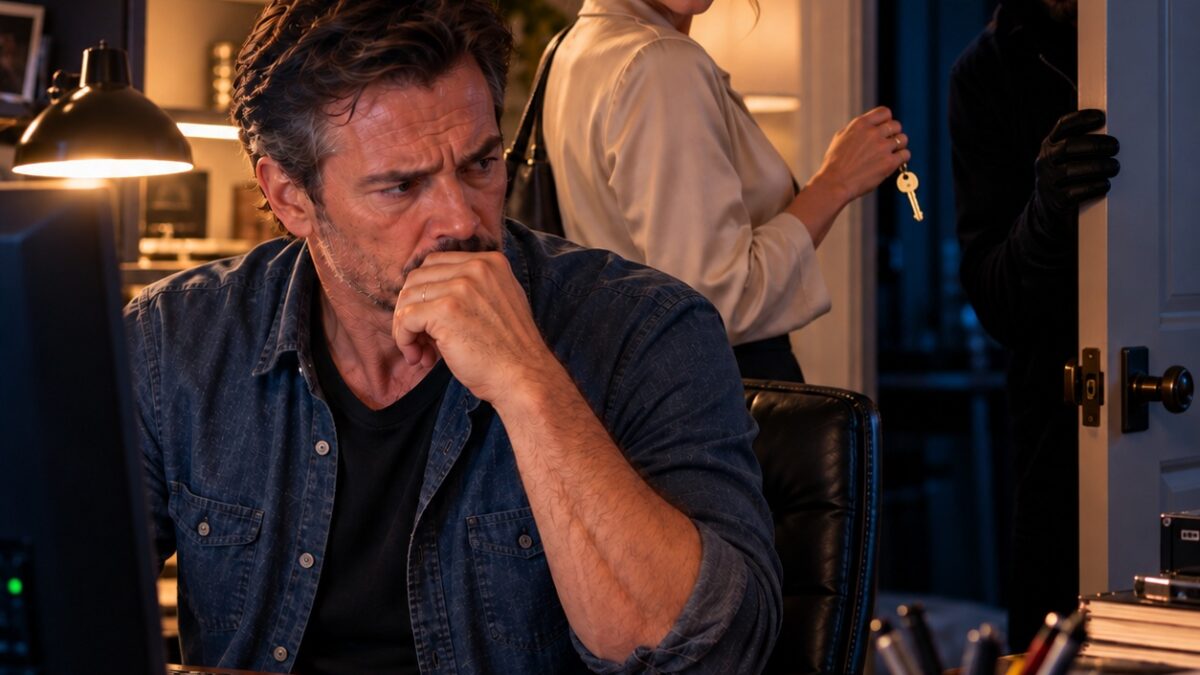


My name is Wade Larkin.
I was forty-six years old when my life split open.
I owned Larkin Computer Service in Grand Rapids, Michigan, on the second floor of an old brick building on Leonard Street above a dry cleaner that had been there so long people gave directions using it.
“Upstairs from the cleaners.”
That was us.
Two workbenches.
A server rack.
Parts shelves.
A cramped office.
A steel door with a keypad.
Nothing about the place looked important.
That was part of the problem.
I hadn’t planned on owning a computer shop.
I’d spent fourteen years in the systems department of a manufacturing company until one Friday a man from corporate used the word restructuring six times in twenty minutes and my entire career became a line item.
I was thirty-eight.
Our mortgage wasn’t small.
Our daughter Piper was still a baby.
My wife Danielle had just gone part-time so she could be home more.
The severance package was insulting enough that I folded the letter before I finished reading it.
What saved me was an old man named Emmett Bradock.
Emmett owned Bradock Medical Components out in the industrial belt.
They made surgical fixtures, spinal hardware, and precision components designed to spend the rest of their useful lives inside human bodies.
The kind of parts that couldn’t be wrong.
My father had run a mill for Emmett back in the eighties.
When Emmett heard I’d been laid off, he called me at seven in the morning.
“You working?”
“Not anymore.”
“Good.”
I laughed because I thought he’d misheard me.
“Emmett, I said I lost my job.”
“I heard you.”
“Then why is that good?”
“Because my network’s a disaster.”
Two days later, he handed me administrator access to his entire company before I’d even printed business cards.
Then he co-signed the loan on my shop because no bank in Kent County was going to take a serious look at a laid-off systems guy with a mortgage and a six-month-old business plan.
You don’t repay something like that with money.
You carry it.
Eight years later, Larkin Computer Service had thirty-one business clients across the west side.
Dentists.
Accountants.
Nonprofits.
A restaurant group.
A machine shop.
Small manufacturers.
And Bradock Medical Components.
I thought of myself as the guy who fixed computers.
That was how I talked about the business.
That wasn’t what I actually was.
Every one of those thirty-one companies had trusted me with the keys to its life.
Administrator passwords.
Backups.
System images.
Accounting databases.
Customer records.
Employee files.
In several cases, full drive clones sat on hardware in my rack because that was how we handled disaster recovery.
I wasn’t a repairman.
I was a custodian.
I just didn’t understand the difference yet.
My wife was Danielle Larkin.
Thirty-nine.
Sharp enough to make you feel like she’d noticed something about you before you’d noticed it yourself.
We had been married fourteen years.
Our daughter Piper was nine.
Piper was all elbows, questions, tangled hair, and certainty.
She believed her father could fix anything.
I let her.
Two years before everything happened, Danielle went back to full-time work at Hallbrook Systems downtown.
Hallbrook was a software company.
Medium size.
Corporate clients.
Good salaries.
Clean glass offices.
The kind of place with colored walls and conference rooms named after Michigan lakes.
Danielle came alive there.
I mean that literally.
The first few months, she came home glowing.
She had new words.
Strategy.
Client expansion.
Verticals.
Scalability.
Market penetration.
I teased her about it.
She threw a dish towel at me.
But I liked seeing her want something.
For years, so much of our marriage had been schedules.
Bills.
Piper.
Groceries.
School.
My shop.
I was proud of her.
I had a young employee at the shop too.
Colby Dunham.
Twenty-four.
Colby walked in one afternoon with a résumé that was mostly enthusiasm.
He was smart enough to know what he didn’t know and eager enough that I mistook every gap in his experience for something I could teach.
I hired him.
Trained him myself.
His second month, he built new shelving along the back wall.
To get the shelves where he wanted them, he moved the insurance camera higher into the corner.
“Better angle,” he said.
I climbed a ladder and looked.
He was right.
I remember thinking the kid had initiative.
He called me boss without sarcasm.
I was proud of that too.
Danielle was the one who insisted I attend Hallbrook’s client appreciation night.
Rooftop of the Ellsworth Hotel.
A Tuesday in September.
I didn’t want to go.
“You’ll survive.”
“I hate work parties.”
“You hate everybody else’s work parties.”
“That’s what I said.”
She smiled at herself in the elevator mirror.
Then she said something I didn’t fully understand until much later.
“Half these people don’t even know I’m married to somebody useful.”
Useful.
I laughed.
“What am I, a cordless drill?”
“You know what I mean.”
I thought I did.
The roof was glass, steel, city lights, and about forty people who already knew one another.
I found the only other man who looked as uncomfortable as I felt.
His name was Perry Odell.
Developer.
We were three sentences into a conversation about nothing when Adrien Voss approached.
“Wade, right?”
He didn’t offer his hand.
Adrien was Hallbrook’s director of client solutions.
Mid-forties.
Well dressed.
Calm.
The kind of man who never seemed to occupy space accidentally.
“So you’re the husband.”
He said it toward the room more than toward me.
“That’s what they tell me.”
“Danielle’s mentioned you.”
I waited.
“The computer guy.”
The way he said it made my shop sound like I fixed microwaves from the back of a van.
That part didn’t really bother me.
The part that bothered me was Danielle’s mentioned you.
Somewhere inside Hallbrook Systems, my wife had been describing me to people I had never met.
And she had apparently done it well enough that Adrien Voss already believed he understood what kind of man I was.
“I run a service company,” I said. “Thirty-one business accounts.”
“Sure.”
He nodded the way people nod when a child explains a model airplane.
Then he lowered his voice.
“Can I be straight with you?”
“Seems like you’re going to.”
“I don’t think you fully understand the trajectory your wife is on.”
I looked at him.
“A climb like hers requires a particular support structure at home.”
“I’m proud of her.”
“Are you?”
He tilted his head.
“Because from where I’m standing, the anchor is already set.”
“Anchor?”
“Comfortable.”
Pause.
“Predictable.”
Another.
“Safe.”
He smiled.
“Those aren’t insults, Wade. They’re measurements.”
Twenty-two years of solving problems had taught me not to swing at the first thing that moved.
I set my beer on the railing.
“Adrien, you’ve known me four minutes and you’ve already got me appraised.”
His smile faded slightly.
“That’s either very good instinct or a very old habit.”
I waited.
“I’d bet habit.”
Something changed in his eyes.
Half a second.
Then Danielle appeared beside us.
Flushed.
Bright.
Standing about three inches closer to Adrien than she needed to.
“You two getting along?”
“Fast friends,” Adrien said.
“I was telling Wade about the expansion.”
Danielle looked at him.
“West Coast?”
“Probably.”
“Travel mostly?”
Adrien smiled.
“Real commitment from the team.”
“The travel’s the best part.”
Danielle said it lightly.
I watched her.
Travel.
Fourteen years married, and I had never once heard her talk about travel for Hallbrook.
Not in our kitchen.
Not in bed.
Not while scheduling Piper’s activities.
Adrien checked his watch.
“Meeting you has been enlightening, Wade.”
He walked away.
On his way, he and Danielle exchanged a look.
A quarter of a second.
Maybe less.
I’ve spent my life noticing small things.
I noticed that one.
I said nothing.
Later, I found myself beside Perry again.
He was about four drinks past discretion.
“Your wife’s good.”
“So she tells me.”
“No, I mean really good.”
He waved toward Adrien.
“Voss knew it before any of us did.”
“What does that mean?”
“Had her résumé on his desk a month before the job ever posted.”
I turned.
“What?”
“Told People Ops to keep the interview short.”
Perry grinned.
“Man’s got an eye.”
I filed that away the way you notice a strange sound in an engine that still seems to be running fine.
One other thing happened that night.
Danielle’s best friend, Renata Quinlan, was there.
Renata had known Danielle since Michigan State.
She was Piper’s godmother.
She also handled an outside design contract for Hallbrook’s marketing group.
Renata was loud by nature.
She hugged strangers.
Started conversations in grocery lines.
Yet that night she spent almost two hours at the far edge of the roof with her arms folded.
Every time Adrien moved toward her side, she moved somewhere else.
Every time.
She left before the speeches.
At the elevator, she kissed my cheek and squeezed my shoulder.
“You’re a good one, Wade.”
The doors closed.
I stood there wondering why it sounded like an apology.
On the drive home, Danielle leaned her head against the passenger window.
Happy.
Quiet.
“What did you think of Adrien?” she asked.
“Very sure of himself.”
A small smile appeared in the glass.
“He gets things done.”
“You never told me about travel.”
There was a pause.
Not long.
Maybe a second and a half.
I’ve learned exactly how long a second and a half can be.
“It isn’t decided.”
“West Coast?”
“Probably.”
I let it go.
That’s what reasonable men do.
They let it go.
Drive home.
Check on their daughter.
Tell themselves the tightness in their chest is bad beer and an unfamiliar room.
At 11:40, I opened the alarm application on my phone.
I had closed the shop quickly that afternoon and couldn’t remember whether I’d set the system.
The screen showed one word.
SECURE.
Normally, that was all I looked at.
I’d turned off keypad notifications years earlier because I got tired of my phone telling me I’d opened my own building.
But that night, for reasons I still can’t explain, I tapped into the access history.
Tuesday.
2:41 a.m.
Door opened.
Alarm disabled.
Door remained open eleven minutes.
Alarm reset.
Exit.
No failed code.
No hesitation.
No second attempt.
Whoever had entered knew exactly how to use the system.
Only three codes had ever existed.
Mine.
Colby’s.
And one I had created six years earlier for Danielle.
She had used it twice as far as I knew.
Both times to bring me lunch.
I stared at the name beside the 2:41 entry.
DANIELLE.
I was lying in bed.
My wife was asleep beside me.
Or pretending to be.
I listened to her breathe.
I didn’t wake her.
People don’t understand that part.
They imagine the instant you discover something impossible, you confront it.
I’ve spent my entire adult life recovering failed systems.
Rule one is simple.
Don’t touch anything until you understand what you’re looking at.
Panic writes over evidence.
So I lay there and thought about eleven minutes.
A burglar doesn’t spend eleven minutes in my shop.
There wasn’t enough visible value.
Used towers.
Memory sticks.
A soldering station.
Monitors.
Eleven minutes was enough time to sit down.
Plug something into a workstation.
Start a copy.
Wait.
I got up at 4:30.
Left Danielle a note saying I had an early service call.
Leonard Street at five in the morning was streetlights, silence, and a bakery van.
I entered my shop and treated my own business the way I would treat a frightened client’s.
Cameras first.
The recorder still had the previous night.
2:41:06.
The door opened.
A figure stepped inside.
Dark coat.
Hood up.
Not tall.
Could have been anybody.
Four seconds after the door closed, the figure crossed directly to the rear corner.
Reached up.
The camera swung ninety degrees.
Ceiling tile.
Fluorescent fixture.
Eleven minutes of absolutely nothing.
Then the frame moved back.
The room was empty.
Door closing.
I watched four times.
Four seconds.
No searching for the camera.
No hesitation.
Straight across the floor.
Straight to a lens mounted eight feet up in a corner invisible from the entrance.
Danielle had been in my shop twice in six years.
She shouldn’t have known where that camera was.
Whoever walked in did.
I went to pull older footage.
There wasn’t any.
The recorder was configured for three days.
I had set it to thirty.
The configuration history showed the change.
Thirteen weeks earlier.
Thursday afternoon.
2:02.
From a workstation inside the shop.
Using an administrator account.
Two people had admin rights.
Me.
Colby.
My first thought wasn’t betrayal.
It was that Colby had done something dumb.
A drive fills up.
A young technician shortens retention.
Forgets to mention it.
That’s plausible.
I built half a morning around that explanation.
Because the alternative was the kid I’d trained to solder being part of something I couldn’t yet see.
Then I pulled the full keypad history.
That log still existed because the data lived on a monitoring-company server in Ohio.
Thirty-four dollars a month.
Nobody standing inside my shop could erase it.
Most systems keep records locally.
Mine didn’t.
That piece of luck saved me.
Eleven entries.
Eleven.
Over nineteen weeks.
All using Danielle’s code.
Every one between one and three in the morning.
Always Monday night into Tuesday or Wednesday night into Thursday.
Never a weekend.
Shortest visit, six minutes.
Longest, twenty-eight.
Eleven times my wife had climbed out of bed while I slept, driven eight minutes, and entered my business.
Then I compared dates.
First night entry:
Nineteen weeks earlier.
Camera retention changed:
Thirteen weeks earlier.
Six weeks between them.
That meant the first month and a half of late-night entries had been captured on a recorder holding thirty days of video.
Somebody eventually realized the camera was a problem.
Then on a Thursday afternoon, in daylight, a person with legitimate access shortened retention to three days.
That wasn’t part of the original plan.
It was a patch.
Whoever entered at night knew exactly where the camera was.
Whoever changed the retention had discovered a hole later.
Two people.
At least.
Danielle hadn’t done this alone.
Colby arrived at 8:15 with two coffees.
Set mine beside me.
“Want me to start on the dentist server?”
“In a minute.”
He waited.
“The recorder is only holding three days.”
“Yeah.”
No blink.
No hesitation.
“That you?”
“Drive was at ninety-four percent in the summer. I dropped retention.”
He shrugged.
“Meant to tell you.”
“Put it back to thirty.”
“Sure.”
He turned.
Then stopped.
“Hey, you want me to take those overnight backup jobs off your plate?”
I stared at him.
“You still run them manually. I could script the whole thing.”
“I’ll think about it.”
“Okay.”
He went back to work whistling.
I sat with the coffee he’d bought me and realized I had no idea what was true inside my own building.
By ten, I was inside the imaging server logs.
Backup jobs leave records.
You can delete files.
You can rotate camera footage.
But jobs write histories.
I pulled five months.
Sorted by time.
Every late-night door entry corresponded to a manually started imaging job.
My main workstation.
My user account.
That wasn’t mysterious.
My password had been on a sticky note under the keyboard tray for years.
Stupid.
Convenient.
The destinations were the problem.
Not our rack.
Not our contracted off-site storage.
External USB drive.
Front port.
Job starts.
Gigabytes move.
Drive removed.
By the time I finished building the list of stolen data, my hands were shaking.
Accounting firm on Fulton.
Two nonprofits.
Restaurant group.
A machine shop that subcontracted for two defense suppliers.
And Bradock Medical Components.
Four separate Bradock jobs.
More data than every other client combined.
Engineering drawings.
Tolerances.
Supplier terms.
Validation files.
Thirty years of work.
Everything Emmett trusted me to keep safe.
I walked out onto the landing above the dry cleaner and stood in the cold until I could breathe normally again.
That evening, I did the hardest work of my life.
Nothing.
I went home.
Grilled chicken.
Helped Piper with a Great Lakes diorama.
Asked Danielle about her day.
At nine, she sat on the couch scrolling.
I rinsed a plate.
“Hey.”
“Hmm?”
“Monday night, did you come to bed late?”
She didn’t hesitate.
“I was at Renata’s.”
I turned slightly.
“Everything okay?”
“Her sister’s having problems again.”
She looked up.
“I got home around one. You were snoring.”
“Sorry.”
“You’re allowed.”
She smiled.
I smiled back.
I didn’t feel rage.
I felt something worse.
Tenderness.
The kind you feel for someone who doesn’t know what is coming toward them.
Whatever Danielle believed she was doing on those nights, she had walked out of my building carrying Emmett Bradock’s life eleven times.
I waited until Thursday.
Then I called Renata from the shop.
We did small talk.
I asked how her sister was doing.
Pause.
“My sister?”
“Danielle said she was at your place Monday helping you with something involving your sister.”
Silence.
Long enough that I heard a radio in the background.
“I haven’t seen Danielle outside work in two months.”
I closed my eyes.
“Renata.”
“Wade, listen.”
Her voice changed.
Lower.
Faster.
“Whatever you’re doing right now, you’re coming at it from the wrong end.”
“What’s the right end?”
“I can’t tell you.”
“You can’t or won’t?”
“Can’t.”
A breath.
“Do not ask me about Adrien Voss.”
I sat down.
“Renata—”
“Not by phone. Not in person. Not at Christmas.”
“What the hell are you talking about?”
“If you still want to know in four years, ask me then.”
She hung up.
Renata Quinlan, who had never ended a telephone call in under twenty minutes, ended one in the middle of a sentence.
The line lit again.
Emmett Bradock.
He sounded happier than I’d heard him in years.
“Wade, you sitting down?”
“I can be.”
“Sinclair Orthopedics is putting a number on the table.”
My stomach dropped.
“A real one?”
“A real one.”
He laughed.
“Due diligence starts second week of November. If it holds, I’m out by spring.”
“Emmett.”
“Forty-one years.”
His voice cracked slightly.
“I’m buying a boat I don’t know how to drive.”
I closed my eyes.
“That’s tremendous.”
“They’ll want everything.”
He sounded almost annoyed.
“Drawings. Validation. Files. Whole damn box.”
Then he laughed.
“Good thing I’ve got a fellow who keeps my house in order.”
I told him I’d have everything ready.
Normal voice.
Then I put the phone down.
Sat in my empty shop for twenty minutes.
Forty-one years.
A boat.
Grandchildren.
And somewhere outside my building was a portable drive containing the entire engineering history of his company because I had told him his data was safe with me.
I had been looking at the wrong problem.
Danielle was too close.
A husband sees the wife first because she’s the only shape his mind can hold.
Renata had told me.
Wrong end.
That afternoon, I stopped investigating my marriage.
I started investigating Adrien Voss.
Everything I did after that, I did legally.
Public records only.
Nothing hacked.
Nothing stolen.
Nothing I couldn’t print and hand a prosecutor with my name on top.
Because I knew how to get into places I shouldn’t.
Phones.
Accounts.
Networks.
I’d spent twenty years learning those systems.
And one illegal shortcut could turn me from victim into defendant.
State registries.
Court dockets.
Public corporate filings.
Adrien had been at Hallbrook two and a half years.
Before that, Charlotte.
Twenty-two months.
Before that, Tulsa.
Three years.
Same general position.
Mid-sized software companies.
Corporate customer access.
Normal career.
What wasn’t normal was what happened behind him.
In Tulsa, four months after Adrien left, a managed-services company called Vaughn Technology Group collapsed.
Charlotte?
Five months after he left there, a two-man network firm surrendered assets to creditors.
Both companies handled other businesses’ data.
I searched the Northern District of Oklahoma docket.
Dean Vaughn.
Forty-nine.
Unauthorized transfer of protected commercial information.
Wire fraud.
Prosecutors said he had copied client engineering designs and sold them to a competitor.
He pleaded guilty.
Twenty-six months.
Six-figure restitution.
His house sold during a divorce.
I opened the divorce docket.
Public.
Dates lined up like parts on a jig.
Wife filed for divorce.
Two weeks later, Dean was indicted.
Wife wasn’t charged.
The settlement gave her the house and insulated her from the business debt because she claimed she knew nothing about her husband’s criminal activity.
I sat staring at the screen.
Nobody was after my house.
Nobody was after my van.
There wasn’t enough wealth in my marriage to justify a four-month conspiracy.
What they wanted was in my rack.
The divorce wasn’t the prize.
It was the exit door.
Separate the wife first.
Make her legally independent.
Legally innocent.
Then let the data theft surface.
One man remains holding the credentials.
The husband.
Bitter.
Abandoned.
Owner of the shop.
Perfect story.
Dean Vaughn may have signed a plea saying he sold those files.
Maybe he physically carried them.
But the scheme hadn’t stopped when he went to prison.
Someone had continued.
And Adrien Voss kept moving city to city.
Dean hadn’t designed the machine.
Dean had been handed the bill.
I found his former wife’s name.
Marissa Vaughn.
Tulsa.
Within ninety seconds, I had a phone number at a dental office.
Calling her is the mistake I would take back if I could.
At the time, I thought I was being smart.
Here was a woman who had lived through what I feared was happening to me.
Someone who might believe me.
Marissa answered on the second ring.
Warm voice.
Kind.
Patient.
I told her some of it.
Then more.
She understood immediately.
When I mentioned Emmett, she made a small sound.
“Oh, God.”
“Nobody believed Dean,” she said.
“I spent two years begging people to look deeper.”
I felt relief.
Then she started asking questions.
Gently.
“Have you saved your door logs somewhere separate?”
“Yes.”
“Do you have a lawyer?”
“Not yet.”
“Does your employee know?”
“No.”
“Anyone else?”
“No.”
“Where are you keeping your evidence?”
I told her.
Every answer.
She warned me that people had gone after Dean’s copies first.
“If everything is in one place, move it tonight.”
I thanked her.
Actually thanked her.
She told me to call anytime.
Two hours and ten minutes later, my phone started lighting up.
Failed sign-in.
Cloud account.
Another.
Unknown location.
Password-reset request on the account controlling my business domain.
Authorization attempt against the off-site backup service.
I ran.
Killed sessions.
Rotated credentials.
Changed every important password.
Pulled the encrypted evidence drive from my rack and stuffed it inside my jacket.
My hand shook badly enough that I dropped the screwdriver twice.
Two hours and ten minutes.
Long enough for Marissa to make a call.
And someone else to make another.
Marissa hadn’t escaped the Tulsa scheme.
She was part of it.
She walked out with a paid-off house and a clean record because that had been her compensation.
Now she stayed in the machine.
Waiting for calls from the next men.
That evening, I finally saw the whole shape.
Adrien hadn’t pursued Danielle because he wanted my wife.
Danielle wasn’t the prize.
She was the door.
They needed access to a business with client data.
A keypad.
An administrator password.
A trusted spouse who could walk into the building without breaking anything.
A woman who would carry a portable drive out for the man she believed represented her future.
Danielle wasn’t the mastermind.
That did not make her innocent.
She was the tool.
And the terrible thing about tools is that once the job is finished, they go back into the drawer.
I drove home slowly.
Piper had a friend over.
Shoes everywhere.
Danielle was upstairs packing.
“Chicago.”
She folded a blouse.
“Seven a.m. flight tomorrow. Back Sunday.”
“Right.”
“It’s on the calendar.”
“I believe you.”
“There are leftovers.”
She smiled.
“Don’t let Piper stay up past nine.”
I went downstairs.
Took out recycling.
Thursday night.
Mostly cardboard.
School papers.
Then I saw an envelope.
Law office.
Leland and Pike.
Addressed to Danielle Larkin.
Postmarked twenty weeks earlier.
I stood at the curb.
Did the math.
Divorce attorney retained twenty weeks ago.
First late-night entry into my shop:
Nineteen weeks ago.
Seven days.
The lawyer came first.
That mattered.
People don’t stumble into an affair and then slowly decide five months later to build an elaborate legal exit while stealing corporate data.
You build the exit first.
Then the theft begins.
By the time the crime surfaces, the wife has been separated long enough to claim distance.
And the husband stands alone with every credential.
Danielle wasn’t leaving because of Adrien.
She was leaving on a schedule.
Friday morning, she flew to Chicago.
I made Piper waffles.
Drove her to school.
Then I had an empty house and about six weeks until Sinclair Orthopedics’ due-diligence team opened Emmett’s records.
I needed a lawyer.
My accountant gave me a name instantly.
“Best family lawyer in Grand Rapids.”
“Who?”
“Grant Leland.”
I froze.
Leland.
Leland and Pike.
Danielle’s lawyer.
I had almost walked directly into the firm representing my wife.
That’s how close I came.
I canceled eleven minutes before the appointment.
Instead I found Adele Rohr.
Small storefront office on Division.
Her name on the glass.
Eleven years as an Assistant United States Attorney before leaving government practice.
She listened for fifty minutes.
Didn’t write anything.
Then she gave me three truths.
“First, your evidence is clean.”
“Good.”
“Keep it clean.”
I nodded.
“You touch Voss’s phone, email, or private accounts and you turn yourself into a co-defendant.”
“I won’t.”
“Second, you can prove theft.”
“Yes.”
“You cannot yet prove the thief.”
I started to object.
She raised a hand.
“A door code is not a face.”
“The picture—”
“A person in a hood.”
“My wife—”
“Any competent defense lawyer says your employee wore it. Or you staged it. Or somebody else knew the code.”
I went quiet.
“Third.”
She leaned back.
“You’re going to hate this.”
“What?”
“You are responsible.”
“For what?”
“For your clients’ data.”
My stomach tightened.
“They trusted you.”
“I know.”
“No. Read your contracts.”
She tapped my folder.
“Every one of those businesses paid Larkin Computer Service to safeguard its systems.”
I said nothing.
“Whatever Adrien did, Bradock Medical has a claim against you.”
“I know.”
“You don’t yet.”
She looked directly at me.
“You have to tell Emmett.”
I swallowed.
“Before Sinclair finds it.”
“Yes.”
“Before federal agents?”
“Yes.”
“Before anybody.”
She nodded.
“You.”
That was the hardest part.
But before I saw Emmett, another piece arrived from the last person in the world I expected.
Piper.
My daughter photographed everything.
Dog.
Shoes.
Her breakfast.
Clouds.
Her own feet.
Her tablet backed up automatically to our family account, which was my account on hardware I owned.
I went through weeks of photographs.
Hundreds.
Then July.
Wednesday night.
2:19 a.m.
Picture of the microwave clock.
Piper had taken it because she thought being awake at two in the morning made her grown-up.
The clock was in focus.
Behind it, half visible in the mudroom doorway, was a woman wearing a dark coat.
Hood already up.
Danielle.
Door log:
2:31.
Twelve minutes later.
I stared at the photograph for a long time.
My nine-year-old daughter had stood in the kitchen laughing quietly to herself while her mother passed behind her on the way to commit a felony.
That picture was the first clear face the case had.
Piper would never know she took it.
Then I learned something else.
Adrien Voss hadn’t always been Adrien Voss.
Kent County name-change petition.
Eleven years earlier.
Aaron Puit.
Forty dollars.
No objection.
Approved.
And seven months before that, Tulsa County records showed a divorce.
Aaron Puit.
Renata Quinlan.
I drove to Renata’s house.
She opened the door.
Saw the folder.
Stepped aside.
“You didn’t ask me.”
“I didn’t ask anything.”
We sat in her kitchen.
Coffee neither of us touched.
“He was Aaron when I married him,” she said.
My stomach turned.
“How long?”
“Six years.”
“You lived in Tulsa.”
She nodded.
“Danielle knew him?”
“Barely.”
Renata stared at her cup.
“She saw him at your wedding.”
I tried to remember.
Nothing.
“And my mother’s funeral.”
“That’s it?”
“He was heavier then. Beard. Sold industrial fittings.”
She looked at me.
“The man Danielle works for didn’t exist when she knew him.”
“You didn’t tell her?”
“I tried.”
“When?”
“Fourteen months ago.”
My hands tightened.
“The job offer.”
She nodded.
“I sat right here and told her he was dangerous.”
“What did you say?”
“Everything I legally could.”
“Why couldn’t you tell her the rest?”
Renata’s face twisted.
“Settlement.”
“What?”
“Sixteen-year structured settlement.”
She looked ashamed.
“Quarterly payments.”
“And?”
“If I discuss the marriage, his conduct, or the business with third parties, payments stop.”
My chest tightened.
“How long left?”
“Four years.”
“That is what you meant on the phone.”
“Yes.”
“Why agree to that?”
“I have a daughter in college.”
She wiped her face.
“My mother needs care.”
“I’ve been ashamed for eleven years.”
“When did you know he hadn’t stopped?”
“When Danielle showed me the offer.”
She took a breath.
“I told her he wasn’t what he looked like.”
“And?”
“She thought I was jealous.”
Renata laughed bitterly.
“Thought I was the divorced friend who couldn’t stand watching her succeed.”
I said nothing.
Then Renata looked at me.
“He doesn’t want your shop.”
“I know.”
“He never wants the shop.”
She pressed both hands around the mug.
“He wants what is inside it.”
Her voice lowered.
“And he needs somebody standing there holding the bag after the data is gone.”
Then she told me the Tulsa story.
Aaron—Adrien—had done it before.
The supply company where Renata worked kept sensitive design information.
Her boss had lost everything.
At the time, she had been married to the man stealing from him.
She didn’t understand the scheme until years later.
And there was one pattern.
“He moves when a company is being sold.”
I went still.
“Why?”
“Stolen drawings aren’t worth much sitting on a drive.”
She looked at me.
“They become worth everything when a buyer is six weeks away from due diligence.”
Sinclair.
Emmett.
November.
“That’s why he waited two years with Danielle,” she said.
“He wasn’t waiting on her.”
Her voice broke.
“He was waiting on Emmett Bradock to get tired.”
I left Renata’s house.
And I didn’t drive back to Leonard Street.
I want that in the record.
Because men tell stories like this afterward and pretend they were calm every minute.
That’s a lie.
And lies about restraint are dangerous.
Adrien’s address was public.
Brick colonial.
Northeast side.
Lamp post near the walk.
At 9:40, I sat two blocks away.
Engine running.
There was a tire iron under the passenger seat.
It had been there six years.
Until that night, it had only been a tire iron.
I thought about Piper’s photograph.
Emmett.
Dean Vaughn.
Renata.
Danielle.
Eleven drives.
I thought about how long it would take to get from my truck to Adrien’s front door.
Maybe eighty seconds.
Eighty seconds of feeling like a man.
Then assault.
Trespassing.
Maybe worse.
And a defense attorney standing before a jury someday.
Ladies and gentlemen, the government’s key witness is a jealous husband who drove to my client’s home at night carrying a tire iron.
Eighty seconds.
Adrien walks.
Emmett loses thirty years.
Piper visits me in prison.
I put the truck in gear.
Turned around.
Drove home.
I’ve never told Adele about that night.
I never needed to.
What I did instead was the cleverest thing I’ve ever done.
Not illegal.
Not destructive.
Just controlled.
Adele had already told me to move every client’s real data out of my building.
I started with Emmett.
On Saturday, I transported Bradock Medical’s complete clean archive back to its own facility.
Hardware Emmett owned.
Room Emmett controlled.
Door Emmett locked.
The real drawings no longer slept in my building.
Then I put something else where they used to be.
Same folder structure.
Same names.
Same file paths.
Six gigabytes of engineering data.
But the drawings were wrong.
Not cartoonishly wrong.
Not obviously wrong.
Tolerances off by two-thousandths of an inch in strategic places.
Old supplier information.
Parts that looked real.
Files that agreed internally.
And forty-one documents contained a quiet call to an external resource.
Nothing malicious.
No executable.
No virus.
No destructive code.
A header component that lived on a server I rented legally.
Open the document and my server recorded time, network address, and system-identifying information associated with the request.
Adele reviewed the design.
Every piece.
“My property,” I said.
“Your property.”
“My server.”
“Yes.”
“My files.”
“Yes.”
“No intrusion.”
“No.”
She nodded.
“Nobody is legally required to leave the good silver in a house they know is being robbed.”
Then I walked to Colby.
“You still want the overnight jobs?”
His face lit up.
“Absolutely.”
“I’ll put you on Bradock Monday.”
“The big share?”
“Yes.”
“Sure, boss.”
No hesitation.
No blink.
I waited until Thursday to tell Emmett.
Cowardice, I suppose.
There’s exactly one kind of conversation I’ve never learned to repair with tools.
I sat across from him beneath a framed photograph of the first medical fixture his company had ever shipped.
He was turning a pen between his fingers.
“Emmett.”
“Yeah?”
“I need to tell you something before Sinclair finds it.”
The pen stopped.
I told him.
Every stolen backup.
Every night.
Every copied archive.
Danielle.
When I finished, Emmett said nothing for a long time.
Then he turned the pen twice.
“Does Sinclair know?”
“Not yet.”
“They will.”
“I know.”
He looked directly at me.
“Your daddy ever tell you about scrapping four hundred parts in 1986?”
“No.”
“He did.”
Emmett leaned back.
“Bad setup.”
“He tell you?”
“He walked into this office before the shift ended.”
Emmett almost smiled.
“Could’ve hidden it till morning.”
“He didn’t.”
“Cost me eleven thousand dollars.”
I swallowed.
“He told me himself.”
Then Emmett set down the pen.
“So now you’re going to tell me what you’re doing about my problem.”
I nodded.
“And I’ll tell you what I’m doing.”
“What?”
“I’m calling Sinclair.”
“Today?”
“Today.”
“You’ll weaken your negotiating position.”
He stared at me.
“I’ll weaken a lie.”
Then:
“You can’t sell a man a company while there’s a fire in the basement and hope he doesn’t smell smoke.”
He called Sinclair that afternoon.
The buyer heard the truth from Emmett himself.
Four weeks before their forensic team would have discovered the breach.
Monday, I moved Colby onto the overnight backup work.
Showed him the Bradock share.
Went home.
Helped Piper with long division.
Thursday at 11:04 p.m., the first marked document opened.
Calder Precision.
Outside Dayton, Ohio.
A contract manufacturer that had spent nine years trying to win Bradock’s spinal line.
By Sunday, thirty-one of the forty-one documents had opened.
Twenty-six from Calder’s network.
Three from a laptop registered to Adrien.
Two from Tulsa.
Adele took the records to a former colleague at the United States Attorney’s Office.
After that, the story stopped belonging to me.
Federal investigators moved faster than expected.
The reason wasn’t Bradock.
One of the stolen data sets belonged to a machine shop that subcontracted for two defense suppliers.
Suddenly, this wasn’t just a commercial theft.
Federal agents were in my shop within nine days.
The government’s forensic team found no evidence that those defense-related files had been opened anywhere outside my system.
Adrien apparently had no buyer for them.
They had been copied because someone had been instructed to copy a folder and copied the whole folder.
Careful about eleven things.
Lazy about the twelfth.
That’s what brought federal badges up my staircase.
Calder Precision made an even worse mistake.
They didn’t just possess Bradock’s false drawings.
They used them.
Three weeks of shop time.
Tooling.
Setup.
Machining.
Two-thousandths of an inch is almost nothing.
You can’t see it with your eye.
Can’t feel it with your thumb.
On a drawing, everything looks reasonable.
But after the metal is cut, a coordinate measuring machine tells the truth.
Calder spent about $160,000 discovering that.
Possession of a stolen file can be argued.
Use of stolen engineering data is harder to explain.
Adrien came to my shop on a Tuesday in December.
Four in the afternoon.
Topcoat worth more than my truck.
He climbed the stairs without calling.
Stood in the middle of my shop looking at my benches like they were cheap furniture in a rental house.
“Wade.”
I said nothing.
“You’ve been busy.”
Still nothing.
“Somebody at Calder has been telling stories.”
I leaned against the bench.
“That’s unfortunate.”
“For them.”
He smiled.
“I have no connection to any of it.”
“Of course.”
“I thought you’d want to hear from a friendly party before somebody less friendly starts asking questions.”
“That’s decent.”
“I am a decent man.”
The frightening thing was that he almost believed it.
Then he looked around.
“Here’s what I think.”
I waited.
“You found out about your wife.”
He watched me.
“You took it about as well as any husband would.”
I said nothing.
“And somewhere in the past few months you did something in this room that is going to be difficult to explain.”
He glanced toward the back.
“You have a daughter.”
That was the threat.
Soft.
Civilized.
He continued.
“So let me give you the advice nobody gave Dean Vaughn.”
I didn’t move.
“Stop.”
He lowered his voice.
“Take the divorce.”
“Take the house.”
“Take the kid.”
“Go back to fixing laptops.”
Then:
“You aren’t equipped for the other thing.”
A lot of men would have hit him.
I understand that.
For ninety seconds, it probably would have felt wonderful.
Instead, I asked:
“Adrien, do you know what a thousandth of an inch is?”
He blinked.
“What?”
“Roughly a third the width of a human hair.”
He stared at me.
“You can’t see it.”
I picked up a screwdriver, then put it down because my hands needed something to do.
“You can’t feel it.”
I stepped toward him.
“It doesn’t look wrong on a drawing.”
His expression changed.
“And no engineer catches it by staring at the screen.”
Now he understood.
“You find it after you cut metal.”
I continued.
“When the measuring machine tells you the finished part is wrong.”
His face drained.
“And by then you’ve paid for tooling.”
“Setup.”
“Labor.”
“Three weeks of production.”
He said nothing.
“You’ve spent twenty years around people who manufacture things.”
I shook my head.
“And in all that time, it never occurred to you to learn what any of them actually do.”
I looked at him.
“That’s the part I can’t understand.”
“Not that you stole it.”
“That you didn’t even find it interesting.”
He stood there longer than he wanted to.
Then he smiled badly.
“Have a good Christmas, Wade.”
He went downstairs.
Never came back.
Months earlier, when I confronted Colby about camera retention, I had ordered him to restore thirty days.
He did.
Cheerfully.
Four minutes.
So Adrien’s entire visit existed on video.
Eleven minutes.
Date stamped.
Sound.
Everything.
Fourteen months later, prosecutors played that recording to a jury.
People who sat in the courtroom told me it hurt Adrien more than the engineering evidence did.
Colby lasted about forty minutes with federal agents.
Adele had predicted that.
Twenty-four years old.
No record.
Mother on the telephone telling him not to say anything.
Then he started talking before lunch.
His mother was Marissa Vaughn.
The woman in Tulsa.
The woman I had called.
The woman who warned me where to move my evidence and then told the network exactly where it was.
Colby hadn’t wandered into my shop by accident.
I had never posted a job advertisement.
I had been three weeks behind.
Overwhelmed.
Then a polite young man walked in with the exact availability I needed and told me he could start Monday.
I had treated him like a gift.
Never asked where he’d heard I needed help.
He learned imaging because he was supposed to.
Built the shelving.
Moved the camera.
Which is why Danielle knew exactly where to reach when she entered in a hood.
Colby discovered the thirty-day retention setting.
Reduced it.
Thought he had solved a problem.
He assumed the keypad logs lived in the local alarm panel.
They didn’t.
Eleven nights.
Eleven portable drives.
Seven were eventually recovered through search warrants.
Two from a storage unit in Ohio.
Four from a house in Tulsa.
One from the trunk of a vehicle in Hallbrook’s parking structure.
Four were never found.
By then, seven were more than prosecutors needed.
Marissa Vaughn was charged with conspiracy and receipt of stolen trade secrets.
She had never been an innocent survivor in Tulsa.
Her family remained part of the operation.
Whatever Dean Vaughn had or hadn’t done, he had faced the consequences alone while his wife and son moved on to the next target.
Marissa received fifty-one months.
Colby got twenty-eight months and a permanent restriction preventing him from holding positions with administrative access to other companies’ systems.
He’ll be around thirty when he’s fully free of it.
He wrote me a letter.
I read it once.
Never answered.
Adrien Voss—Aaron Puit—went to trial.
Men like Adrien always think the room will like them.
The jury didn’t.
Prosecutors showed eleven nights of door logs from an Ohio server he never knew existed.
The camera swinging toward the ceiling four seconds after Danielle entered.
The forty-one marked engineering documents calling home from Calder Precision.
The eleven-minute conversation where he stood in my shop and explained that I wasn’t equipped for his world.
Then they called Renata.
That was Adele’s cleanest piece of lawyering.
Renata’s settlement said she would lose payments if she voluntarily disclosed the marriage and scheme.
But a private contract cannot prevent lawful testimony compelled by subpoena.
Renata did not choose to break the agreement.
The United States required her to testify.
For two hours, eleven years came out of her.
Adrien was convicted.
Eighty-seven months.
Seven years and three months in federal prison.
No parole in the federal system.
Restitution that will follow him for most of his remaining working life.
People kept calling him brilliant.
He wasn’t.
He was brilliant about people.
Lazy about everything else.
He knew what Danielle needed to hear.
He knew what Dean Vaughn feared.
He knew how to recruit a tired twenty-four-year-old.
He understood resentment.
Ambition.
Loneliness.
He studied human weakness.
But he never bothered learning where my alarm company stored its logs.
He never knew my imaging server had only one administrator.
He didn’t know Piper’s tablet backed itself up every night.
He didn’t know what two-thousandths of an inch means on a machined spinal component.
He studied the one part of my life he thought had a lock.
Walked past everything else.
Sinclair Orthopedics bought Bradock Medical the following March.
Final price was about nine percent below the original offer.
Emmett called it “the cheapest honest haircut I’ve ever gotten.”
“A buyer you tell on Thursday will argue over price,” he said.
“A buyer who discovers a fire himself in the data room walks.”
He bought his boat.
Thirty-one feet.
Muskegon Lake.
He is, without exaggeration, one of the worst boat drivers in Michigan.
Calder Precision settled after Adrien’s criminal trial rather than face a civil jury after its own machinists had already testified.
Injunction on the spinal line.
Money I’m not free to disclose.
Consent order keeping them out of that market for six years.
By then, Emmett had sold the company, but the transaction documents preserved his right to pursue the theft claim.
Sinclair’s lawyers were happy to let him have that fight.
Danielle pleaded guilty to unauthorized access to a protected computer.
Three years’ probation.
Restitution she will be paying into her sixties.
Felony conviction.
Hallbrook fired her the week she was indicted.
She asked to see me a month after sentencing.
No lawyers.
She called the shop.
We met at a diner on Plainfield where the coffee is terrible and nobody we know eats.
She looked older.
Not because of the year.
Because some kinds of knowledge age people in places wrinkles don’t.
“I need you to hear me say this out loud.”
I waited.
“Not for a judge.”
She wrapped both hands around her cup.
“I knew I was taking things out of your building.”
I said nothing.
“I didn’t know what they were.”
“That matters less than you think.”
“I know.”
She swallowed.
“I never asked.”
Then:
“And I’ve had a long time to understand that not asking was the decision.”
I looked at her.
“There is no version where I didn’t know I was doing something to you.”
“All right.”
“But I want you to know why.”
She turned her cup half a turn.
“You’re going to hate it.”
“Say it.”
“It wasn’t him.”
“Adrien?”
“It was never about him.”
She looked at me.
“He told me I was going to run a division.”
I said nothing.
“He said it in a conference room.”
“Six people heard.”
Her chin lifted.
“And for the first time in about nine years, I felt like a person.”
That hurt in a place I hadn’t expected.
Then she said:
“You never asked me what I wanted.”
I looked away.
“Not once in fourteen years.”
“That isn’t true.”
“Yes, it is.”
“I asked about your day every night.”
“My day.”
She nodded.
“You asked what happened.”
“Who annoyed me.”
“What Piper needed.”
“What groceries we were out of.”
“What bill was due.”
Her eyes filled.
“You never asked what I wanted my life to be.”
I sat with that.
Because part of it was true.
And a man who refuses the true part hasn’t earned the right to condemn the rest.
“That’s fair.”
Danielle looked surprised.
“I didn’t ask.”
I nodded.
“I thought providing was the same thing as asking.”
“It isn’t.”
“No.”
“I’ll carry that.”
“Thank you.”
I put both hands on the table.
“Now I’m going to tell you the part you still don’t understand.”
She waited.
“Then we’re done.”
Her face tightened.
“Adrien didn’t pick you despite me.”
I leaned forward.
“He picked you because of me.”
Silence.
“Every thing he told you in that conference room…”
“You’re brilliant.”
“You’re underused.”
“You deserve more.”
“You should lead.”
“He said those things because I had a keypad.”
Danielle’s expression changed.
“And a server rack.”
I continued.
“And thirty-one companies trusted me.”
She shook her head.
“No.”
“You were not the prize.”
“Wade—”
“You were the door.”
Her face went white.
“He spent two years telling you how exceptional you were because he needed eleven minutes at a time inside a room above a dry cleaner.”
“Stop.”
“The minute those drives stopped coming out…”
I shook my head.
“You would have been a divorced insurance clerk with a felony record.”
“He would have been in Charlotte or Tulsa or wherever came next.”
She stared at me.
Then I said the part I truly could not forgive.
“It isn’t the eleven nights.”
“What?”
“It isn’t even Adrien.”
Her eyes moved to mine.
“July.”
She knew instantly.
“Piper got up at 2:19.”
Danielle closed her eyes.
“She took a picture of the microwave clock.”
“Wade.”
“You’re standing behind her in the mudroom.”
Dark coat.
Hood up.
“You looked at our daughter.”
Danielle began breathing differently.
“And you walked out anyway.”
I let the silence stay.
“That has nothing to do with what I failed to ask you.”
“That choice was yours.”
She did not cry.
I will give her that.
I leaned back.
Then I remembered something.
“Somebody useful.”
She looked confused.
“What?”
“The rooftop.”
“September.”
“You told me half those people didn’t know you were married to somebody useful.”
She looked down.
“I was useful.”
I said it quietly.
“To everybody on that roof.”
“To you.”
“To Adrien.”
“To Hallbrook.”
“To Emmett.”
“To thirty-one companies.”
I stood.
“And I’ve made my peace with it.”
“Because being useful is the reason Bradock Medical still had a company to sell.”
“And being useful is the reason Piper still lives in the house she grew up in.”
I picked up the check.
“But you don’t get to put that sentence in front of me again.”
I paid for the coffee.
Danielle let me.
I filed for divorce in November.
She didn’t contest much.
She has Piper every other weekend and Wednesday nights.
Some people think that is harsh.
I don’t.
At the time decisions had to be made, I was the only parent in that house who had not handed a stranger access to it.
Danielle sells insurance now for a brokerage on Twenty-Eighth Street.
She’s good at it.
Piper says her apartment is nice.
I kept the house.
I kept the shop.
Keeping the shop was harder.
Federal prosecution is one thing.
Looking thirty-one clients in the face and admitting their data had been compromised under my roof is another.
I called every one myself.
Four days.
Same sentence.
“I failed to protect information you trusted me to protect.”
Eleven left.
I didn’t blame them.
Twenty stayed.
Within a year, two of those twenty sent new clients to me.
That’s the only endorsement I’ve ever cared about.
Larkin Computer Service works differently now.
No client’s full data sleeps in my building.
It sleeps in theirs.
Hardware they own.
Keys they control.
I get called when it breaks.
Costs me margin.
I sleep fine.
Fourteen months after Adrien’s verdict, Emmett invited us onto that ridiculous boat for the Fourth of July.
Piper stood at the bow taking four hundred pictures of the water.
Renata came too.
She had about a year and a half left on her old settlement payments.
But something in her changed during testimony.
She stopped caring about the money.
You could hear it.
Emmett cut the engine in the middle of the lake.
Handed me a beer.
Then said the one thing from all of this I kept.
“Your daddy scrapped four hundred parts in 1986.”
“I know.”
“Cost me eleven thousand dollars.”
He looked toward shore.
“Eleven thousand in 1986 money.”
I laughed.
“You’ve mentioned it.”
“He told me before the shift ended.”
Emmett nodded.
“That mattered.”
Then he looked at me.
“I handed his boy my network eight years ago because of it.”
He took a drink.
“Best return I ever got on eleven thousand dollars.”
Piper shouted from the bow.
“Dad! Come look!”
I stood.
“What’s she found?”
“Probably water.”
Emmett laughed.
I went to look.
And I remember thinking that this was what survived.
Not the affair.
Not Adrien.
Not the court.
Not the drives.
Trust damaged is not always trust destroyed.
Some people earn it again.
Others don’t.
What happened to my marriage was never really an affair story.
The affair was access.
Adrien didn’t steal Danielle because he wanted her.
He needed a key.
He needed a woman who could walk through my door without setting off an alarm.
He needed someone who believed he saw something special in her.
Then when the door stopped being useful, he would have discarded the key.
That’s the part Danielle eventually understood.
It’s also the part I had to understand about myself.
I spent years believing that because I could fix things, I could prevent loss.
That’s not true.
You can maintain a server and still lose data.
You can provide for a marriage and still fail to ask the person beside you what she wants.
You can love someone and still be blind to the fact that she has already started leaving.
You can train an employee and not notice he was placed in your shop.
You can protect thirty-one companies and still put your own password on a sticky note.
Being competent in one part of life doesn’t make you wise in all the others.
What saved me wasn’t brilliance.
It wasn’t money.
It wasn’t revenge.
It wasn’t even technology.
What saved me happened on a dark residential street at 9:40 at night.
Adrien’s house was two blocks ahead.
There was a tire iron under my passenger seat.
Everything inside me wanted eighty seconds.
Eighty seconds to make him afraid.
Eighty seconds to show him I wasn’t the harmless computer guy he thought I was.
Eighty seconds to feel powerful.
If I had taken those eighty seconds, every piece of evidence after that would have looked different.
Jealous husband.
Violent husband.
Unstable business owner.
Vindictive technician.
Adrien understood stories.
He knew juries understand simple ones.
I almost handed him the simplest story possible.
Instead, I turned around.
That’s it.
No dramatic speech.
No heroism.
I turned the truck around.
Drove back to a little computer shop above a dry cleaner.
And did the work.
That was the moment everything changed.
Not when I found Danielle’s code in the door log.
Not when Renata told me who Adrien was.
Not when the marked drawings started calling home.
Not when federal agents climbed my stairs.
The whole story balanced on one ordinary decision.
I went home instead of to his door.
I finally understood something my father had apparently known in 1986.
The strongest thing you can do after making a mistake is not hide it.
It’s tell the truth before somebody else finds it.
He told Emmett about four hundred ruined parts.
I told Emmett about thirty years of stolen data.
Emmett told Sinclair before due diligence.
Renata eventually told a federal jury what eleven years of silence had cost.
Even Danielle, too late to repair what she’d done, finally told me she knew she was betraying me.
Truth doesn’t undo damage.
It gives the damage an edge.
A place where the rot stops spreading.
Larkin Computer Service is smaller in some ways now.
Less margin.
More controls.
No giant client archives sleeping ten feet from where I eat lunch.
I still fix dead machines.
Still recover drives.
Still answer emergency calls.
Piper is older.
She doesn’t believe I can fix everything anymore.
That’s probably healthy.
Sometimes she asks why there are so many rules at the shop now.
Two-factor authentication.
No shared credentials.
No passwords under keyboards.
No personal codes.
No unattended portable drives.
I tell her:
“Because your dad got old enough to learn that convenience is expensive.”
She rolls her eyes.
That’s healthy too.
There’s one thing I never changed.
The steel door is still there.
Same keypad.
But the list of active codes is shorter.
I review it every month.
Not because I distrust everyone.
Because I finally understand what keys mean.
Keys are not love.
Passwords are not trust.
Access is not affection.
Access is access.
It should be granted deliberately.
Reviewed deliberately.
Removed deliberately.
That lesson sounds cold when you say it that way.
It isn’t.
Knowing where your keys are does not mean you love people less.
It means you respect what you are asking them to hold.
And if somebody ever tells you that asking questions is the same thing as distrust, remember this:
I trusted my wife for fourteen years.
The problem wasn’t that I trusted her.
The problem was that I stopped paying attention to what the trust allowed.
There is a difference.
I don’t spend my days hating Danielle.
That surprises people.
What would hatred buy me?
She has consequences.
Adrien has consequences.
Marissa has consequences.
Colby has consequences.
Calder paid.
Hallbrook lost an executive.
I lost clients.
I lost money.
I lost a marriage.
Emmett lost part of his sale price.
Nobody walked away untouched.
That is what real consequences look like.
They are rarely satisfying enough to be revenge.
Piper still loves her mother.
I want her to.
Danielle was not lying during every good year of our marriage.
She was not a monster when Piper was born.
She was not pretending every Christmas.
Human beings don’t become simple because they betray you.
That was hard for me to accept.
It’s easier to hate a villain than grieve a complicated person.
Danielle was lonely.
Ambitious.
Flattered by Adrien.
Angry that she believed I had never asked what she wanted.
All of that can be true.
And she still made a choice at 2:19 in the morning.
Piper was in the kitchen.
Danielle saw her.
Then walked outside wearing a hood to steal from my clients.
Understanding a person’s pain does not erase the line they crossed.
I can own what I failed to do without owning what she chose to do.
That distinction took me longer to learn than anything about computers.
Emmett once asked whether I’d open another location.
“No.”
“Why?”
“One is enough.”
“You used to want to grow.”
“I used to think growth proved something.”
“What proves something now?”
I thought about it.
“Sleeping.”
He laughed.
Then nearly drove the boat into a marker.
Some people never improve at certain things.
I hope he never does.
Renata calls occasionally.
We don’t talk about Adrien much.
She spent too many years with him occupying space in her life.
The subpoena freed her from more than the confidentiality clause.
It gave her permission to stop organizing her future around his threats.
She once told me she thought she had failed Danielle.
“I tried to warn her.”
“You did.”
“Not enough.”
“You told her as much as you legally could.”
“She didn’t believe me.”
“That was her decision.”
Renata looked at me.
“You really believe that?”
“I have to.”
“Why?”
“Because otherwise I’d have to believe every bad choice made by somebody we love belongs partly to us if we failed to stop it.”
She considered that.
Then nodded.
“Fair.”
Maybe that’s another version of keys.
You can give someone information.
You can warn them.
You can love them.
You cannot turn the lock for them.
Colby’s letter is still in a drawer.
I don’t read it.
I remember enough.
He apologized.
Said he had debts.
Said his mother told him it was just copying files.
Said nobody would be hurt.
Said he admired me.
That may be true.
The disturbing thing about betrayal is that admiration and exploitation can exist in the same person.
He probably did like me.
He still moved my camera.
Still reduced retention.
Still helped build access for Danielle.
Still watched me drink the coffee he bought while knowing someone had been inside my business at two in the morning.
The fact that he wasn’t cruel every minute doesn’t matter.
Neither does the fact that Danielle wasn’t cruel every day.
Character doesn’t reveal itself only in how people feel.
It reveals itself in what they are willing to do.
Adrien understood feelings.
That’s why he was good at recruitment.
He found what people wanted to hear.
Danielle wanted to hear that she was exceptional.
Colby wanted to hear he was smarter than the older man training him.
Marissa wanted security.
Dean Vaughn probably wanted something too.
Adrien studied desires.
Then converted them into access.
But he never respected work.
That’s why two-thousandths of an inch beat him.
He treated engineering drawings like treasure maps.
He saw information only as something with a price.
Emmett saw thirty years of men and women learning how metal behaves.
I saw a client who had trusted me.
Calder saw stolen advantage.
Adrien saw leverage.
He never understood the thing itself.
I think about our last conversation sometimes.
“You are not equipped for the other thing.”
He was right in a way.
I wasn’t equipped for his world.
I didn’t understand manipulation the way he did.
I didn’t know how to build a conspiracy across states.
I didn’t know how to recruit people’s weaknesses.
Didn’t know how to leave one man holding the criminal bag while everyone else moved away clean.
What I knew was systems.
Logs.
Backups.
Machining tolerances.
People like Emmett.
Small details.
That’s what beat him.
Not playing his game better.
Refusing to become him.
Piper once asked me what happened to Adrien.
“He went to prison.”
“Because he stole from you?”
“Not exactly.”
“Then why?”
“Because he built a life around stealing from people.”
She thought about that.
“Did Mom help him?”
There are questions fathers wish children never asked.
I could have softened it.
Instead, I told the truth carefully.
“She made choices that helped him.”
Piper looked down.
“Did she know?”
“She knew some of it.”
“All of it?”
“No.”
“Does that make it better?”
I breathed slowly.
“A little.”
She looked at me.
“Not enough?”
“No.”
She accepted that better than most adults would.
Children understand complexity if adults don’t rush to remove it.
Years from now, she may read court records.
Maybe she’ll find the microwave photograph.
Maybe she’ll ask Danielle harder questions.
That belongs to them.
My job isn’t to build Piper’s opinion of her mother.
It’s to make sure she has enough truth to build her own.
The last thing I want is for this story to become one more reason somebody decides never to trust a spouse.
That’s the wrong lesson.
I trusted Danielle because she was my wife.
That’s what marriage is supposed to contain.
Access.
Vulnerability.
Shared life.
The mistake was not loving.
The mistake was allowing important systems—business and personal—to exist without review simply because review felt impolite.
No business should have had my password sitting under a keyboard.
No employee should have shared administrator rights unnecessarily.
No camera system should have gone unchecked for eighteen months.
No backup structure should have put thirty-one clients’ lives beneath one roof because it was convenient.
And no marriage should go fourteen years without both people asking a question deeper than, “How was your day?”
What do you want?
What are you afraid of?
What feels missing?
Where do you think we’re going?
I didn’t ask those questions enough.
I know that now.
But here’s what I will not do.
I will not turn that failure into permission for what Danielle did.
Two truths can exist.
I was inattentive.
She betrayed me.
I failed to understand some of her needs.
She knowingly entered my shop at night and removed data that didn’t belong to either of us.
I should have asked better questions.
She should have said no.
Adults can hold both.
The day Sinclair finally closed on Bradock Medical, Emmett called me.
“Done.”
I was underneath a desk replacing a switch.
“How much?”
“Enough.”
“Boat?”
“Tomorrow.”
“Please take lessons.”
“Don’t insult me.”
“You almost hit a dock last time.”
“Dock moved.”
I laughed.
Then he became quiet.
“You told me before they found it.”
“I did.”
“That saved the deal.”
“It cost you nine percent.”
“It saved the other ninety-one.”
Pause.
“Your daddy would’ve understood.”
That was enough.
After we hung up, I stayed under the desk for a minute.
Not because anything was wrong.
Because I wanted to feel grateful somewhere private.
My father had died believing the only useful thing he’d taught me about work was that if you make a mistake, tell the man whose money it costs.
He had taught me more.
I just didn’t understand until I needed it.
There are still nights when the alarm application shows secure and I think about 2:41 a.m.
Eleven minutes.
Such a small amount of time.
You can stand in line for coffee longer than that.
You can sit through commercials longer.
Yet eleven minutes repeated often enough can carry thirty years out a door.
That’s how damage usually happens.
Not one giant event.
Small windows.
Small permissions.
Small things nobody questions.
Eleven minutes.
A sticky-note password.
A camera moved three feet.
A retention setting.
One employee who seems helpful.
One spouse who knows the code.
One man who says exactly what she has wanted somebody to say for years.
The scale of the final crime doesn’t resemble the size of the openings that allowed it.
That’s why I still inspect small things.
Not obsessively.
Not fearfully.
Respectfully.
Locks deserve attention.
Promises do too.
Today, Larkin Computer Service looks almost exactly as it did before.
Same old brick building.
Same dry cleaner downstairs.
Same two benches.
Different server rack arrangement.
Different policies.
I replaced the fluorescent fixture with the dead ballast.
Took me eight years and a federal conspiracy to finally get around to it.
Hank, one of my longtime clients, laughed when he noticed.
“So crime finally got you to fix the light.”
“Something did.”
The shelving Colby built is still there.
People ask why I don’t tear it out.
Because shelves aren’t guilty.
Neither was the camera.
Neither was my shop.
I refuse to let the people who used a place badly decide what the place means forever.
Same reason I can sit on Emmett’s boat with Renata.
Same reason I can drive past Hallbrook without feeling my chest tighten.
Same reason Piper can come home from Danielle’s apartment and tell me they watched a movie together without me needing details.
Recovery isn’t erasing what happened.
It’s refusing to let what happened become the owner of everything around it.
On the Fourth of July, when Emmett handed me that beer in the middle of Muskegon Lake, Piper yelled because she thought she saw something in the water.
I walked to the bow.
“What?”
“There!”
“Where?”
She pointed.
Some little flash beneath the surface.
Probably a fish.
Maybe sunlight.
I never saw it.
She took twelve photographs anyway.
Behind me, Emmett started the engine too hard and nearly knocked Renata sideways.
She yelled at him.
He laughed.
I laughed.
Piper laughed.
For a minute, nobody in that boat belonged to a court case.
Nobody was evidence.
Nobody was victim, witness, client, defendant’s ex-wife, or compromised custodian.
We were just people on bad water with an old man who couldn’t drive a boat.
That’s what life eventually becomes again if you’re lucky.
Ordinary.
Not the old ordinary.
A new one.
I once thought the goal after betrayal was to get back what you lost.
You can’t.
The marriage I thought I had isn’t coming back.
The clients who left aren’t coming back.
Piper’s view of her mother will never be exactly what it was.
Emmett’s data was copied.
That fact cannot be uncopied.
But there are things you can build after.
Better systems.
Cleaner boundaries.
More honest relationships.
A smaller company that sleeps better.
A daughter who knows her father will answer difficult questions without making her choose sides.
A friendship with an old client built not on perfection, but on the fact that when something went wrong, I told him before he discovered it himself.
That’s enough.
More than enough.
If you ask me now what kind of man I am, I don’t say I’m somebody who fixes things.
Not first.
I’m a man who maintains them.
There’s a difference.
Fixing waits for failure.
Maintenance pays attention before something falls apart.
I wish I’d understood that about marriage.
About security.
About people.
But understanding something late is still better than never understanding it.
The steel door on Leonard Street still locks every night.
I know every active code.
My clients know where their data lives.
The administrator accounts are documented.
Nothing critical depends on one sticky note, one spouse, one employee, or one man’s memory.
And every once in a while, usually late when the cleaners downstairs have gone home and the street is quiet, I stand alone in the shop and remember the man I was at 9:40 that night outside Adrien Voss’s house.
Engine running.
Tire iron beneath the seat.
Eighty seconds away from giving him everything he needed.
Then I remember the turn.
The steering wheel under my hands.
The corner.
His house disappearing in my mirror.
That was the repair that mattered most.
Not a server.
Not Emmett’s archive.
Not even my business.
Me.
I didn’t know it then.
But I was the broken thing in the truck that night.
Angry.
Humiliated.
Scared.
Ready to become exactly the man Adrien needed a jury to see.
And for once, I didn’t fix the feeling by acting on it.
I let it hurt.
I drove home.
I kept the evidence clean.
I told the truth.
And because I did, the right people eventually had to carry the weight of what they had done.
Adrien.
Marissa.
Colby.
Danielle.
Even me.
That’s where the story really ends.
Not with prison.
Not with a divorce.
Not with Emmett’s sale.
Not with the boat.
It ends one block short of another man’s house.
With an ordinary truck turning around in the dark.
Because everything that came after depended on me not becoming the easiest person in the whole scheme to blame.

