PART2:We Rescued Six Orphaned Puppies—Then the Vet Lifted Nia and Realized Her Legs Couldn’t Hold Her Up
PART2
We did not have enough immediate space for all six puppies in one place.
That became the first problem.
People sometimes imagine rescue as a van arriving, doors opening, and every animal driving away toward safety.
Sometimes it works that way.
Often it does not.
Shelters are full.
Foster homes are full.
Veterinary clinics have limited isolation space.
Rescues operate with budgets that do not expand simply because suffering does.
So the phone calls started.
One shelter.
Another.
A foster coordinator.
A rescue several towns away.
Can you take one?
Two?
What about tomorrow?
Can somebody transport?
Do you have quarantine space?
Every yes mattered.
I stayed near the puppies while others coordinated.
I kept looking at Nia.
She had stopped trying to stand.
Instead, she rested against my leg.
Not affection, I think.
Exhaustion.
When we placed food down, the puppies changed instantly.
All six moved toward it.
Nia tried.
She really tried.
She got her front paws under herself.
Pushed.
Her body lifted.
Then trembled.
One sibling bumped her accidentally.
Nia fell sideways.
The others reached the food.
I moved part of the meal toward her.
Not too much.
We had no idea yet how severe her malnutrition was, and feeding a severely depleted animal has to be done carefully.
She sniffed.
Ate.
Fast.
Stopped.
Ate again.
I held the dish where she could reach without standing.
Watching a puppy eat should not make an adult cry.
That day it did.
Because puppies are supposed to eat with greed born from confidence.
They shove noses into bowls.
Step in the food.
Steal from siblings.
Nia ate like every mouthful required concentration.
Her body did not have much energy to waste.
By late afternoon, arrangements had been made.
One by one, the siblings would go to places capable of caring for them.
That was the good news.
The painful part was separation.
Again, I do not know how puppies understand family.
But these six had already lost their parents.
Now the only familiar creatures remaining were being divided because division was the only way to save them all.
One puppy left first.
Then another.
The group became five.
Four.
Three.
Each time, the remaining puppies watched.
I wanted to explain.
They are not disappearing the way your parents did.
They are going somewhere with food.
Somebody is waiting for them.
Words are useless if the listener has no language for them.
So we used the only language available.
Hands that did not hurt.
Blankets.
Warmth.
Meals.
Presence.
Nia was transported to the veterinary clinic because she appeared to be the weakest.
I rode with her.
She lay wrapped in a towel beside me.
For most of the drive, her eyes remained open.
Not wide.
Just open.
Every turn moved her body slightly.
She did not resist.
I kept one hand near her.
“You don’t have to do anything right now.”
I said.
“Just breathe.”
I have said that to many frightened animals.
Maybe I say it for myself too.
At the clinic, the staff took one look at Nia and moved quickly.
Weight.
Temperature.
Hydration.
Blood.
Physical exam.
Questions.
How long without parents?
Unknown exactly.
What had she been eating?
Whatever neighbors could provide.
Any vomiting?
Unknown.
Diarrhea?
Possibly.
Could she walk?
Barely.
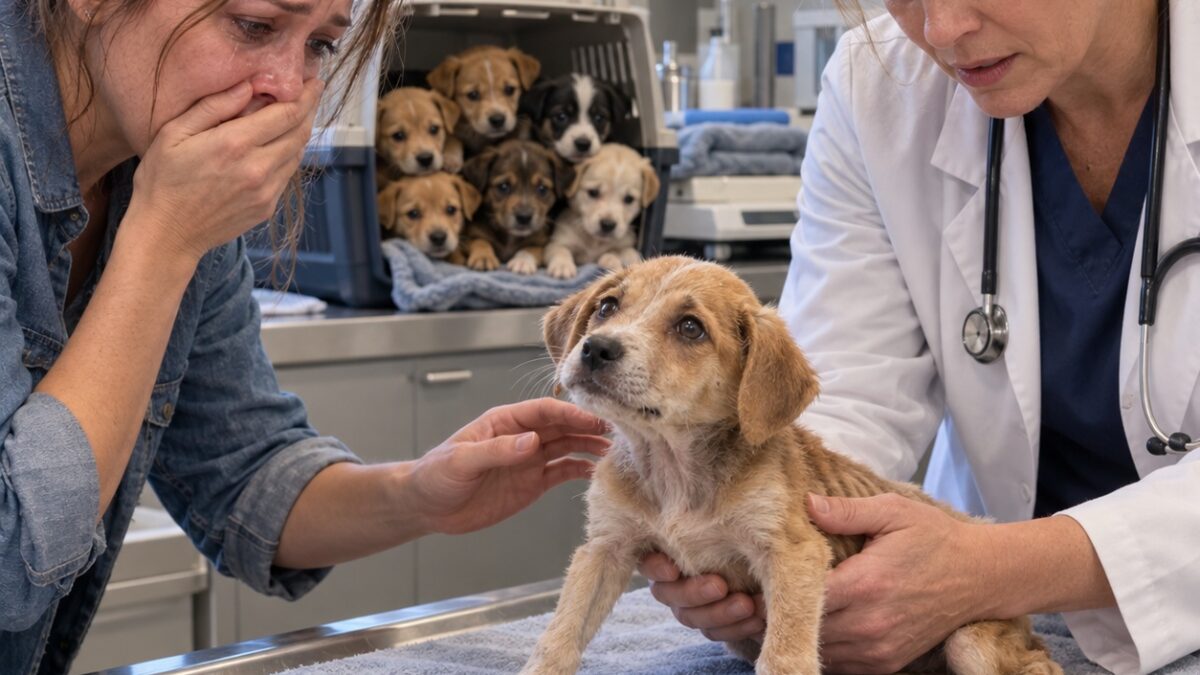
When the veterinarian placed Nia on the examination table, she tried standing again.
I think that effort broke all of us more than if she had simply remained down.
Because there was still puppy instinct inside her.
Stand.
Move.
Explore.
Her mind asked.
Her body answered:
I can’t.
Her front legs straightened.
The muscles visibly trembled.
Her rear legs tried to engage.
For two seconds she stood.
Maybe three.
Then folded.
The veterinarian caught her.
He examined her limbs carefully.
Joints.
Paws.
Reflexes.
Spine.
I waited for the worst.
Neurological problem.
Injury.
Something permanent.
Instead, he looked at me and said:
“Her legs themselves may be okay.”
“Then why can’t she stand?”
He rested a hand gently over Nia’s side.
“She has almost no muscle.”
I stared.
He continued.
“She’s severely malnourished.”
“Her body has been without enough nutrition during a period when she should have been growing rapidly.”
“So she’s weak?”
“Extremely.”
“Can she recover?”
He paused.
Not because he wanted drama.
Because good veterinarians do not promise what bodies have not yet proven.
“I think she has a real chance.”
I looked at Nia.
Her head rested on the towel.
“What does she need?”
“Nutrition.”
“Carefully.”
“Rest.”
“Gentle rehabilitation.”
“And patience.”
“How long?”
“We don’t know.”
I hated that answer.
Not because he was wrong.
Because I wanted a date.
Tell me Tuesday.
Tell me two weeks.
Tell me after twelve meals this baby will stand and the story will stop hurting.
Bodies do not negotiate that way.
He continued.
“We have to rebuild her from the inside.”
That became the sentence I carried.
Rebuild her from the inside.
Food would not simply fill her stomach.
It had to become blood.
Energy.
Muscle.
Strength.
Every calorie had work to do.
Nia spent that first night under close observation.
I went home.
Physically.
My mind stayed at the clinic.
I imagined her waking.
Looking around.
No siblings.
No parents.
Unfamiliar smells.
Unfamiliar humans.
I worried that saving her body meant asking her to endure another loss.
Then I reminded myself that her siblings were safe too.
Alive.
Fed.
Warm.
Sometimes rescue requires breaking one familiar thing so a healthier future can form.
That does not make the breaking painless.
The next morning, I went back early.
Nia was awake.
A small dish sat nearby.
She had eaten.
Not enough to impress an ordinary person.
Enough to make me smile.
“Good morning.”
Her eyes followed me.
I sat on the floor near her enclosure.
I did not reach in immediately.
“Remember me?”
Probably not in any conscious way.
Her nose moved.
Maybe scent mattered.
I put my hand near.
Nia leaned forward slightly.
Her chin came to rest across my fingers.
That was the beginning of our routine.
Meals first.
Small.
Balanced.
Frequent enough to support her without overwhelming a body that had adapted to scarcity.
The veterinary team monitored her closely.
We watched everything.
Hydration.
Digestion.
Energy.
Weight.
Then exercises.
Gentle.
Very gentle.
At first, rehabilitation sounded ridiculous.
She was a puppy.
Puppies do not need exercise programs.
They create their own.
They run because a leaf moved.
They jump because another puppy exists.
They sprint through rooms for reasons known only to puppies.
Nia could not.
So movement had to be rebuilt deliberately.
A caregiver would support her chest and belly while her paws touched the ground.
Nia’s legs trembled.
We let her bear a little weight.
Then rest.
Again later.
No forcing.
No turning recovery into another form of suffering.
The first goal was almost embarrassingly small.
Shift her weight.
That was it.
Not walk.
Not stand independently.
Shift.
Left.
Right.
Teach muscles they still had a job.
Teach balance.
Teach her body that food was coming and movement could begin costing energy again because energy would be replaced.
The first few days were emotionally brutal because progress was difficult to see.
People asked:
“How is Nia?”
I would say:
“She ate.”
“Is she standing?”
“Not really.”
“Walking?”
“No.”
“Is she better?”
What does better mean?
Alive?
Yes.
Fed?
Yes.
Safe?
Yes.
Strong?
No.
Not yet.
I started understanding why long recovery is difficult for people watching from outside.
They want evidence.
Something visible.
Before and after.
But sometimes the most important progress is microscopic.
A body processing nutrition.
Muscle beginning to rebuild.
A puppy sleeping deeply because she is warm enough not to spend the night conserving heat.
Those things do not make dramatic photographs.
They save lives anyway.
Nia slept a lot.
At first, that worried me.
The vet reassured us.
“She needs it.”
Her body had been spending everything on survival.
Now it had permission to repair.
So we let her sleep.
She slept after meals.
After exercises.
Sometimes while I sat beside her talking.
I told her about her siblings.
Even when I did not have updates yet.
“They’re okay.”
I would say.
“You’re all okay.”
I did not know whether that was fully true.
I needed it to become true.
A few days later, we began hearing about the others.
Eating well.
Settling.
One already showing puppy mischief.
I laughed when I heard that.
Destruction can be a health indicator in puppies.
Chewed blanket?
Excellent.
Stolen sock?
Strong prognosis.
Nia still had not stolen anything.
She barely moved beyond what rehabilitation required.
But her eyes were becoming brighter.
I noticed that first.
The head stayed low.
Body weak.
But the eyes began following more.
A person entered.
Nia watched.
A bowl appeared.
Nia lifted her head.
Another puppy barked somewhere.
Her ears moved.
Curiosity was returning before strength.
That gave me hope.
One afternoon, we placed a soft little toy near her.
Nothing elaborate.
Nia sniffed.
Then rested her chin beside it.
No play.
Fine.
The next day, she nudged it with her nose.
I almost called someone over to witness.
Then stopped.
Let her have the moment without humans making it an event.
That became a lesson.
Not every improvement needed applause.
Nia did not need to become our inspiration.
She needed to become a puppy.
There is a difference.
In the second week, her meals became one of the most beautiful parts of the day.
At the beginning, hunger had seemed desperate.
Now she began eating with more rhythm.
Less panic.
Her body was learning food was scheduled.
That another meal would appear.
I have always found that transition emotional.
An animal leaving food in the bowl for later is sometimes more moving than an empty bowl.
It means scarcity has stopped controlling every decision.
Nia was not there yet.
But she was moving toward it.
Then came her first real standing milestone.
A caregiver supported her lightly.
Hands barely touching.
Nia pushed upward.
Front legs.
Rear legs.
She stood.
We waited.
One second.
Two.
Three.
Her knees shook.
Four.
Five.
Then she sat.
Not collapsed.
Sat.
There is a difference.
I covered my mouth.
Someone whispered:
“Did you see that?”
Yes.
We all saw.
Five seconds.
Maybe six.
If you had walked into the room at that moment, you might have thought we were ridiculous.
A puppy stood for a few seconds.
That was all.
But we remembered the examination table.
We remembered her legs folding immediately.
We remembered carrying her because she could not carry herself.
Five seconds was enormous.
I crouched.
“You did it.”
Nia looked at me.
Then toward the food area.
Priorities.
Good.
The next session was worse.
That matters too.
She stood less.
Trembled more.
Needed support.
I felt crushed.
The caregiver shrugged gently.
“She’s tired.”
“But yesterday—”
“Yesterday was yesterday.”
Recovery is rude that way.
It refuses to perform consistently for the people cheering.
A good day is not a guarantee.
A bad day is not a verdict.
We had to stop treating every session like a test of the whole future.
Today Nia could do what she could do today.
Tomorrow would get its own chance.
I started writing down small milestones.
Not for social media.
For myself.
Day 1: ate.
Day 3: lifted head when I entered.
Day 5: shifted weight without full support.
Day 8: ate entire planned meal.
Day 11: stood five seconds.
Day 12: stood three.
Seeing them together helped.
Progress looks uneven up close.
From farther away, direction appears.
Forward.
Nia began gaining weight.
Slowly.
Her body looked less fragile around the shoulders.
Still thin.
Still unmistakably recovering.
But changing.
The vet would run his hands over her muscles.
Nod.
“Better.”
That single word could carry me through an entire day.
We introduced exercises using safe surfaces.
Nothing slippery.
Support.
Short distances.
Nia would stand between two people.
One would encourage.
The other ready to catch.
At first, she moved one paw.
Then froze.
The body has to solve walking.
Healthy puppies make it look automatic.
For Nia, it had become a problem.
Weight on one side.
Lift paw.
Balance on three legs.
Place paw.
Transfer.
Repeat.
Her muscles had to tolerate each transfer.
Her brain had to trust the muscles.
I watched her concentrate.
She would look down.
Move.
Shake.
Stop.
I wanted so badly to lift her and say:
Enough.
You do not have to.
But rehabilitation requires us to distinguish pain from effort.
We never forced.
We also did not rescue her from every difficult second.
That is another form of care.
Supporting without stealing the work.
One step.
Rest.
Another.
One afternoon, Nia managed three steps.
Then four.
She sat.
I sat beside her.
“You walked.”
She licked my thumb.
First time.
A tiny tongue.
One lick.
I laughed.
“There you are.”
That phrase kept returning.
There you are.
As if Nia had been hidden somewhere inside the malnutrition.
Not erased.
Hidden.
Every improvement revealed another piece.
Her curiosity.
Her appetite.
Her affection.
Eventually, mischief.
But not yet.
In the third week, she started trying to stand before we asked.
That was huge.
I arrived one morning.
Nia saw me.
Her tail moved.
I had seen small tail movements before.
This was different.
Recognition.
Excitement.
She pushed herself up.
Nobody touched her.
Her legs shook.
But she stood.
For me.
Or for breakfast.
I choose not to ask which.
“Hey.”
I whispered.
Nia took one step toward the front of the enclosure.
Then another.
She stumbled.
Recovered.
Third.
I was crying before she reached me.
She pressed her nose against my hand.
Not understanding at all why the human had malfunctioned.
I sat down.
Nia lowered herself beside me.
My hand rested over her back.
There was more body under it now.
Still small.
But stronger.
I remembered the first day.
How weightless she felt.
How she collapsed into my hands.
That puppy had not disappeared.
She had survived long enough to become this one.
There is an important difference between transformation and continuation.
Nia was not becoming a new dog.
She was finally getting the resources to become the dog her body had been trying to grow into all along.
Food.
Care.
Time.
A puppy should not need heroism to develop.
But when deprivation interrupts development, ordinary growth can look miraculous.
I tried to remember that.
We were not giving Nia some extraordinary gift.
We were restoring basics she should have had.
Nutrition.
Safety.
Care.
The miracle was her body’s willingness to respond.
Around that time, we received more updates about her siblings.
All placed.
Safe.
Some stronger than Nia had been.
Some needing their own care.
But alive.
I showed Nia photos on my phone once.
Ridiculous.
She sniffed the screen.
Then tried to lick it.
“That’s your brother.”
Lick.
“Maybe sister.”
Lick.
“I honestly can’t tell which one from this angle.”
Nia lost interest.
Humans build family albums.
Dogs have scent.
Still, it comforted me.
All six had made it out.
When I first stood among them, I had been afraid one would disappear between phone calls.
Now each had someone feeding them.
That fact felt enormous.
Nia’s challenge remained physical recovery.
And slowly, the sessions changed.
We stopped measuring standing only in seconds.
We began measuring walking in distance.
A few feet.
Rest.
Another few.
Someone placed food at the other end as encouragement.
Nia looked at it.
Then us.
As if offended we had created work between her and breakfast.
That expression was so normal I laughed.
“Come get it.”
She stood.
Step.
Step.
Step.
Her back legs wobbled.
She paused.
Then continued.
The bowl was perhaps eight feet away.
Eight feet became a marathon.
When she reached it, we cheered.
Nia immediately ate.
No ceremony.
Appropriate.
Animals do not romanticize their own progress.
Humans do enough for everyone.
There were still difficult days.
One morning she seemed tired.
Would not stand long.
My stomach dropped instantly.
Something wrong?
Relapse?
Illness?
The vet examined her.
Nothing alarming.
“She’s growing.”
He reminded me.
“And recovering.”
“Both cost energy.”
I had begun treating Nia’s improvement like a promise never to look weak again.
That was unfair.
Healthy puppies sleep.
Healthy puppies have quiet days.
Recovery had made me hypervigilant.
I had to learn not every nap was danger.
That lesson became easier as Nia became stronger.
Her normal range widened.
She could be tired without frightening us.
She could stumble without collapsing into crisis.
Eventually, she fell once because she was moving too quickly.
I gasped.
Nia bounced up.
That was the first time a fall made me laugh.
Because it looked like a puppy fall.
Clumsy.
Unconcerned.
Not weakness.
She shook herself and continued.
I watched with tears in my eyes.
A body that once collapsed from standing now fell because it was trying to move too fast.
That is the kind of problem rescue workers dream about.
Then came play.
Real play.
Not a nose touching a toy.
Not curiosity.
Play.
Another young dog was nearby.
Healthy.
Friendly.
Carefully introduced.
Nia watched.
The other dog lowered its front half.
Play bow.
Nia stared.
The dog bounced sideways.
Nia’s ears lifted.
Tail.
Then Nia moved.
Two quick steps.
Stopped.
The other dog bounced again.
Nia answered.
Awkwardly.
Front down.
Back end not quite sure what assignment it had been given.
Then she lunged forward.
Not aggressively.
Joyfully.
I laughed so loudly someone turned around.
The two puppies moved around each other.
Nia could not keep going long.
We stopped before exhaustion.
But something irreversible had happened.
Her world had expanded beyond survival and rehabilitation.
There was another dog.
A game.
A reason to move that had nothing to do with exercise.
This is why play matters.
Play says:
There is enough energy for something unnecessary.
Enough safety to be silly.
Enough confidence to invite another creature into unpredictability.
For Nia, that was enormous.
The next time she saw the same dog, she remembered.
Tail immediately.
Body forward.
Her new furry friend had become part of recovery.
Soon there were others.
Carefully.
Not too much at once.
A little pack forming around her.
Nia, who had lost her original family as a tiny puppy, was not being given replacements.
I do not believe relationships work that way.
Her parents were gone.
Her five siblings had their own paths now.
But life was adding new relationships.
That is not replacement.
It is continuation.
New furry friends.
Humans.
A safe environment.
Nia learned social things she should have been learning all along.
How to chase.
How to be chased.
How to tell another puppy:
Too much.
How to steal a toy.
How to lose the toy.
How to recover from the greatest injustice ever suffered by a puppy—someone else getting the better sleeping spot.
I watched her becoming ordinary.
Nothing moved me more.
About a month after rescue, the change became undeniable.
Nia could run.
That sentence still makes me emotional.
Not professionally.
Personally.
She could run.
No support.
No careful hands under her belly.
No counting seconds.
Run.
The first real time I saw it, she was outside with other dogs.
Someone opened access to a safe play space.
Nia went out walking.
Then another puppy ran past.
Something ancient awakened.
Nia accelerated.
For one second I almost shouted:
Careful.
Then stopped.
She ran.
Legs moving beneath her.
Not perfect.
Not the fastest.
It did not matter.
She chased.
Another dog turned.
Nia turned too.
The puppy who once could not hold herself up changed direction at speed.
I put both hands over my face.
Someone beside me said:
“You okay?”
“No.”
Then laughed.
“Yes.”
I watched through tears.
Nia ran toward one dog.
Then another.
Stopped.
Jumped.
Actually jumped.
Tiny hop.
Still.
Jumped.
I remembered the vet.
Her legs aren’t the problem.
Her body has been starving so long that she barely has enough muscle left to hold herself up.
And now those same legs were carrying her across grass.
There are moments in rescue where the entire emotional weight of weeks collapses into one ordinary action.
A dog eating.
Sleeping.
Wagging.
Walking.
For me, Nia’s moment was running.
Every meal was inside that run.
Every exercise.
Every hand supporting her body.
Every time we stopped before she became too tired.
Every ounce gained.
Every nap.
Every caregiver returning.
All of it translated into motion.
Nia had muscle now.
Not simply enough to survive.
Enough to play.
She did not know why the humans were crying.
Thank goodness.
A puppy should not have to understand tragedy in order to enjoy recovery.
She just ran.
When she got tired, she flopped down near the others.
Panting.
Happy.
I sat nearby.
After a minute, Nia came over.
Not because she needed support.
By choice.
She put one paw against my shoe.
Then sat.
I touched her head.
“You did it.”
She tried chewing my shoelace.
I laughed.
There.
Perfect.
A puppy.
Finally.
People sometimes ask which part of Nia’s story was hardest.
They expect me to say finding her unable to stand.
That was terrible.
But the hardest part emotionally was knowing how little separated her condition from normal puppyhood.
Food.
That was the cruelty of it.
Her body was not born incapable of walking.
She had been deprived of enough nutrition during a critical period that standing became physically difficult.
Something as basic as regular nourishing meals stood between a puppy collapsing and a puppy running.
That should make us angry.
Not at the neighbors who gave what scraps they could.
They helped keep six puppies alive until more help arrived.
At circumstances that allowed six babies to remain without enough for long enough to become weak.
Hunger is so ordinary that people sometimes underestimate its violence.
It does not always look dramatic.
It can look like a puppy growing too slowly.
Muscle not forming.
Legs trembling.
A head lowered because curiosity costs energy.
Meal after meal missing.
The body quietly choosing which functions matter most.
Survive first.
Play later.
Nia’s recovery reversed that.
Nutrition rebuilt possibility.
I became obsessed with the ordinariness of what saved her.
No rare miracle cure.
No complicated surgery.
Nourishing meals.
Gentle exercise.
Patience.
Professional veterinary guidance.
Consistency.
These things sound almost too simple.
Simple does not mean easy.
Someone still has to provide them every day.
That is where rescue lives.
In repetition.
There was no single heroic meal.
No single exercise session restored her.
It was accumulation.
One meal.
Then one more.
One assisted stand.
Then another.
One rest.
One walk.
One curious look.
The body keeps records.
Eventually, the records became muscle.
I think about that when people ask whether small help matters.
A bag of puppy food.
A foster space.
A transport.
Money for veterinary tests.
One shift caring for an animal.
Maybe you are not the person who “saves” Nia.
Maybe there is no single person.
Maybe saving is a pile of ordinary contributions large enough that a tiny body gets a future.
I prefer that understanding.
It is more accurate.
And more hopeful.
You do not need to be capable of everything.
Bring one thing.
The neighbor who finally made the call brought information.
Shelters brought space.
Drivers brought transportation.
Veterinary staff brought medical knowledge.
Caregivers brought time.
Food became strength.
Other puppies eventually brought play.
Everybody added something.
Nia ran because a chain of people held long enough.
That is how community works when it works well.
One person notices.
Another answers.
Another has room.
Another has expertise.
Another waits.
The animal lives in the overlap.
Nia was lucky enough to find that overlap in time.
I never forgot the neighbor who reached out.
It would be easy to focus only on the rescuers arriving.
But somebody had to make the first request.
That can take courage.
People worry:
What if they judge me?
What if the shelter is full?
What if nobody answers?
Call anyway.
Because until the call is made, nobody outside the immediate problem can help.
Six puppies received placements because one person finally said:
We cannot do this alone.
That sentence saves lives.
Not only animal lives.
People too.
We live in a culture that praises handling things ourselves.
Sometimes responsibility means admitting capacity has been exceeded.
Six hungry puppies were too much for occasional scraps.
So someone called.
Good.
That should be celebrated.
As Nia got stronger, I noticed another change in myself.
At first, I approached her with pity.
I hate admitting that word.
Pity.
Poor baby.
Look what happened.
Then pity disappeared.
Respect replaced it.
Not because Nia consciously fought like some inspirational athlete.
Animals do not need human narratives of bravery attached to every biological process.
But she participated.
She ate.
She tried.
Her body responded.
When tired, she rested.
When curious, she explored.
When strong enough, she stood.
Eventually she ran.
There was dignity in letting her recovery be hers.
We supported.
She lived it.
That distinction matters.
Rescue workers can become possessive of stories.
We saved her.
Yes.
And no.
We created conditions.
Nia’s body did the growing.
Her nervous system adapted.
Her muscles developed.
She learned.
The best rescue eventually becomes unnecessary.
You support until the animal can do ordinary things without you.
The day Nia ran was proof she needed us differently now.
Not to hold her upright.
Maybe to provide care.
Food.
Safety.
But her legs belonged to her again.
That made me incredibly happy.
I stopped hovering as much.
That was difficult.
She would run toward something.
My body prepared to catch.
No.
Let her.
She tumbled once.
Got up.
Healthy puppies tumble.
I had to let normal risk return.
Protecting an animal through recovery can make you forget that living contains risk.
You cannot turn safety into another cage.
Nia needed movement.
Play.
Other dogs.
Exploration.
Controlled appropriately.
But real.
We gradually gave her more.
She flourished.
The little pack accepted her.
Dogs are interesting that way.
They do not ask for medical histories before friendship.
A sniff.
Body language.
Play.
Done.
Nia became one of them.
I watched a bigger puppy slow down near her during an early play session.
Maybe coincidence.
Maybe social awareness.
Nia chased.
The larger dog let her.
Then reversed.
Nia squealed with excitement.
I thought of her siblings.
Wherever they were.
I hoped they were having their own versions of this.
A safe place.
A dog friend.
A human hand.
Food arriving predictably.
Six babies had been torn out of one family by accident.
No one could rebuild exactly what was lost.
But six futures could still be created.
That became enough.
I received a photograph of one sibling sleeping upside down.
Another had apparently developed a habit of stealing slippers.
I laughed until my face hurt.
There they were.
Puppies.
Not orphans in every sentence.
That mattered.
Language can trap rescued animals in their worst day.
“The orphaned puppy.”
“The starving puppy.”
“The dog who couldn’t stand.”
All true.
Not complete.
Nia deserved more nouns.
Runner.
Playmate.
Troublemaker.
Friend.
Nap thief.
Whatever came next.
I wanted the story to outgrow the tragedy.
The tragedy would remain part of it.
Not all of it.
Around the one-month mark, I looked at an early video.
Nia trying to stand.
I had avoided it.
Seeing her legs tremble after watching her run felt unreal.
Same puppy.
Only weeks apart.
The speed of puppy growth made the contrast dramatic.
I paused the video at the moment her body began folding.
My chest hurt.
I wanted to reach through the screen.
Then I reminded myself:
She is not there now.
Memory is not location.
That is an important lesson in rescue.
You can become so focused on what happened that you emotionally keep the animal in the past.
Nia had moved.
I needed to follow.
I closed the video.
Went outside.
Found her trying to initiate play with another puppy.
Present.
Better.
She did not need me mourning the version of her that could not stand while she was busy learning how fast she could run.
So I laughed instead.
There will always be sadness in her story.
Both parents gone.
Five siblings separated.
Days hungry.
Body weakened.
But sadness is not the only honest emotion.
Joy is honest too.
Watching Nia race across a room is not denial of what happened.
It is evidence that what happened did not get everything.
That is what recovery means to me now.
Not erasing damage.
Refusing to let damage claim every future moment.
Nia did that simply by growing.
A puppy’s entire job is becoming.
She resumed becoming.
That may be the most beautiful sentence I can give her.
Nia resumed becoming.
The accident interrupted.
Hunger interrupted.
Malnutrition interrupted.
Care restarted the process.
Now there were things ahead.
More growth.
More play.
More relationships.
Whatever home and future awaited.
The story no longer pointed backward only.
It pointed forward.
People wanted updates because they had seen the fragile version.
I understood.
Every new image created relief.
Standing.
Walking.
Running.
Friends.
But I hoped people noticed what happened between the updates.
Work.
Patience.
Meals.
Because other animals will not recover on the same timeline.
Some take months.
Years.
Some live with permanent disability.
Their lives are not less successful because the ending looks different.
Nia’s recovery was relatively quick once proper care began because her body was young and capable of rebuilding.
That was fortunate.
I never wanted her success used to judge another animal.
“Why isn’t this dog walking after a month?”
Bodies differ.
Damage differs.
Medical conditions differ.
Care means responding to the actual animal.
Not the story we want.
Nia’s vet believed she could recover.
We followed that path.
And she did.
Beautiful.
That is her truth.
One morning, I arrived and found Nia already playing before I entered.
She did not stop to greet me immediately.
I pretended to be offended.
“Really?”
Nia chased another puppy.
“You used to rest your head on my hand.”
Ignored.
“I helped you stand.”
Nothing.
Someone laughed.
“She has friends now.”
“I see how it is.”
Eventually Nia noticed me.
Ran over.
Ran.
That word still had power.
She placed both front paws against my shin.
I crouched.
“Hey.”
She licked my chin.
Then left again.
I smiled.
That was exactly what I wanted.
A dog should not need a rescuer forever.
Attachment without dependence.
She knew me.
Liked me.
Then went back to living.
I sat and watched.
There is a strange sadness in success.
When an animal needs you less, your role shrinks.
Good.
Shrink.
That means the animal’s world grew.
We should celebrate becoming less necessary.
Parents know this.
Teachers.
Rehabilitators.
Rescuers.
The work is partly designed to end.
You cannot make the animal’s dependence proof of your importance.
Nia’s independence was the proof.
She ran away from me toward play.
Perfect.
I remembered the first day when she could not move toward food without help.
Now she chose directions based on joy.
That is freedom.
Not merely being physically capable.
Having enough options that you can choose what matters in the moment.
Nia chose another puppy.
A toy.
A smell.
Me.
Food.
Sunlight.
Every choice was a little celebration of strength.
Her body could carry intention now.
I think that is why mobility matters so emotionally.
Thought becomes movement.
Want something?
Go toward it.
That basic connection had been broken by weakness.
Recovery restored it.
Want friend.
Run.
Want food.
Walk.
Want nap.
Find bed.
Want human.
Approach.
Simple.
Profound.
I never again saw her legs trembling the same way.
They grew stronger.
Her gait became steadier.
Confidence followed experience.
Every successful movement told the nervous system:
You can.
Again.
Again.
Soon nobody counted seconds.
That was another milestone.
The day we stopped measuring.
At first:
She stood five seconds.
Walked eight feet.
Later:
Where’s Nia?
Outside playing.
No metrics.
Normal.
Healing sometimes becomes complete enough that the chart stops being the center.
I loved that.
Not because medical follow-up ceased to matter.
Because Nia had become more interesting than her deficits.
She always had been.
We were finally able to see it.
One afternoon, she curled up with two furry friends.
A pile.
Legs overlapping.
Heads in impossible positions.
I looked at them.
Six siblings had once slept together because survival pushed them into one small group.
Now Nia slept among new friends because she chose company.
Again, same outward behavior.
Different meaning.
Context matters.
Closeness from necessity.
Closeness from comfort.
I liked the second.
I sat nearby.
Nia opened one eye.
Saw me.
Closed it again.
Trusted enough to sleep.
There is a reason sleep appears in so many rescue stories.
A sleeping animal is vulnerable.
Deep rest requires the body to lower its defenses.
Nia had not shown severe fear the way some abused animals do.
Her issue had been hunger, weakness, loss.
Still, safety changes sleep.
Food in the body.
Warmth.
Other dogs nearby.
Humans managing the environment.
Nothing she needed to solve.
Sleep.
I watched her chest move.
Healthy puppy rhythm.
Fast.
Steady.
I thought about her parents.
That grief belongs more to us than to Nia now, perhaps.
I do not know what she remembers.
I like to think the care they gave their puppies before the accident existed somewhere in the puppies’ bodies.
Early warmth.
Milk.
Scent.
Maybe that foundation helped them endure.
Maybe not.
We cannot know.
I refused to make the parents’ deaths into a sentimental device.
They were simply gone.
The tragedy was real.
The puppies suffered consequences.
Then people stepped in.
That is enough.
Sometimes stories hurt because nobody is to blame for the first loss.
An accident.
Sudden.
No villain.
What matters is response.
A bad thing happened.
Then hunger made it worse.
Neighbors helped.
Then someone called.
Rescuers responded.
Shelters made room.
Veterinary care rebuilt Nia.
This is what humans can control.
Not every accident.
What comes after.
I find hope there.
We cannot stop every loss.
We can reduce what loss is allowed to destroy afterward.
Nia lost parents.
We could not return them.
We could feed her.
We could support her legs.
We could find places for siblings.
We could help her run again.
That is enough to matter.
People sometimes become paralyzed because they cannot fix everything.
Do what can be fixed.
The unfixable and fixable often sit beside each other.
Parents gone: unfixable.
Starvation continuing: fixable.
Weak muscles: treatable.
No shelter space: solvable through calls and cooperation.
Future loneliness: maybe addressed through new relationships.
Work there.
That philosophy came directly from Nia.
When I first held her, grief wanted to ask:
How could this happen?
Care asked:
What does she need next?
Both questions matter.
Only one produces breakfast.
So we fed her.
Then again.
I sometimes tell new volunteers this story when they feel overwhelmed.
They see five problems at once.
Medical.
Behavior.
Housing.
Money.
Transport.
I say:
“What is the next necessary thing?”
Do that.
Then reassess.
For Nia:
Get six puppies safe.
Then veterinary exam.
Then food.
Then rest.
Then exercises.
Then more food.
Then standing.
Walking.
Play.
No one solves the month in one afternoon.
You solve the hour.
Enough solved hours become recovery.
That is encouraging to me far beyond animal work.
Life often appears impossible only because we try to hold the entire future simultaneously.
Nia could not run on day one.
That did not mean day one failed.
Day one’s job was survive.
Day five’s job was different.
Day thirty’s different again.
Respect the day.
Maybe puppies know this naturally.
They do not sit worrying about next month.
Humans do enough.
When Nia finally ran, she did not pause afterward to compare herself with the puppy who collapsed.
She moved on to chewing something inappropriate.
Excellent philosophy.
I took photographs, of course.
One from the early days.
One later.
People loved the contrast.
I understood.
Visual storytelling matters.
But when I look at the two images, I do not see:
Sad Nia / Happy Nia.
I see continuity.
Same eyes.
Same little face.
Different resources.
That distinction matters because it puts responsibility where it belongs.
Nia did not need to become worthy.
Her circumstances needed to change.
Food changes bodies.
Safety changes behavior.
Care changes trajectories.
Sometimes people look at a rescued animal afterward and say:
“She became such a good dog.”
Maybe she was always good.
She simply became healthy enough to show you who she was.
Nia was.
Even when she could not stand.
She was not less puppy.
Her body was deprived.
That is all.
We should be careful not to confuse wellness with value.
A sick animal is not a failed version of a healthy one.
They are the same life at a difficult point.
Nia deserved tenderness before anyone knew she would run.
That is the moral center for me.
We believed recovery was possible.
Even if it had not been complete, she still deserved every meal.
Every gentle exercise.
Every warm place to sleep.
Care is not a reward for prognosis.
That is especially important in rescue.
Sometimes the outcome is uncertain.
Care anyway.
Nia happened to give us the joyful outcome.
I remain grateful.
About a month after her rescue, I watched her play until she tired herself out.
She came over.
Dropped near my feet.
Panting.
I sat.
She rolled partly onto one side.
I rubbed her chest.
Her legs were warm and solid beneath my hand.
Not massive.
Still puppy legs.
But there was muscle.
Real muscle.
I squeezed gently.
Nia looked at me as if I had become weird.
“Sorry.”
I laughed.
“I remember when these didn’t work.”
She tried chewing my wrist.
“Yeah, yeah.”
I let her mouth my sleeve for a moment.
Puppy behavior.
Another thing people might correct.
For me, it was glorious.
A mouth with energy for nonsense.
Teeth.
Trouble.
Life.
Eventually I redirected her to a toy.
Nia attacked it.
I thought:
This is what we were trying to save.
Not merely a heartbeat.
This.
The annoying, joyful, inconvenient future hidden inside the weak body.
That is what every rescue contains.
Possibility we cannot fully see yet.
Sometimes the future dog is a runner.
Sometimes a couch sleeper.
A working dog.
A family companion.
We do not know.
Our responsibility is to give possibility enough time to reveal itself.
Nia revealed hers quickly.
She loved other dogs.
Movement.
Attention.
Food, unsurprisingly.
And apparently shoelaces.
The first time she ran away with one loosened from someone’s shoe, we all laughed.
The person wearing the shoe did not find it as poetic.
That was okay.
Nia did not exist to be poetic.
She existed.
Period.
The best outcome.
I stayed in touch with updates about her siblings as much as possible.
There was comfort in knowing the original little group had not simply vanished into bureaucracy.
One by one, they were adapting.
Each path different.
I sometimes pictured all six together again.
Would they recognize one another?
Probably through scent.
Would they remember searching for scraps?
Who knows.
I did not need a reunion scene to make the story complete.
The success was dispersal into safety.
What had once felt painful—separating them—became the mechanism that saved them.
That is another lesson.
The action that looks sad in the moment may still be right.
Six together and starving is not kinder than six separated and cared for.
Love cannot be measured only by physical togetherness.
Sometimes care requires distributing responsibility.
Parents know this.
Rescue too.
If one organization had insisted on keeping all six without capacity, outcomes could have worsened.
Calling others was not failure.
It was collaboration.
I wish more rescues had the resources to say yes to everyone.
Reality does not permit it.
So networks matter.
Nia’s life passed through several hands.
No single one owns the credit.
That makes me happy.
Shared credit usually means a stronger system.
A neighbor.
Rescue calls.
Shelters.
Vet.
Caregivers.
Dogs.
Future people.
A web.
The puppies fell.
The web caught them.
Not perfectly.
In time.
I have replayed the first phone call many times in my mind.
What if it had come two days later?
Nia was already severely malnourished.
Her muscle loss was significant.
Young bodies can deteriorate quickly.
I do not enjoy imagining alternatives.
But they remind me urgency matters.
Puppies are small.
Their reserves are limited.
Waiting to “see if they improve” without adequate food can become dangerous.
That is why the call mattered.
That is why intervention mattered.
We got Nia while the vet still believed she could rebuild.
She did.
I choose not to spend too much time in the other possible future.
This one is enough.
In this one, she ran.
Sometimes when a rescue ends well, people say:
“Everything worked out.”
I never say that.
Everything did not work out.
Her parents still died.
The puppies were still hungry.
Nia still reached the point where she could barely support herself.
Those things do not become okay because she later ran.
What happened is that the ending did not compound the loss.
People changed direction.
That is different.
A happy ending is not retroactive permission for suffering.
It is evidence that intervention matters.
I want to preserve both truths.
Terrible beginning.
Joyful recovery.
Neither cancels the other.
That emotional complexity is why Nia stayed with me.
I can watch her run and feel happiness so intense it hurts.
Because I remember.
Memory deepens joy.
It also makes joy heavier.
Perhaps that is why rescue workers cry so often over ordinary things.
We have context.
You see a puppy walking.
We see a puppy who could not.
You see a dog eating.
We remember the empty body.
You see sleep.
We remember hypervigilance.
Context turns ordinary life into miracle without requiring anything supernatural.
Nia’s miracle was calories and care doing what healthy bodies are designed to do.
That is enough.
Science itself can be beautiful.
Protein becomes muscle.
Gentle exercise becomes coordination.
Rest becomes growth.
Safety becomes curiosity.
No magic.
Still astonishing.
The vet who first examined Nia saw her again later.
I loved that moment.
He entered.
Nia was standing.
Not simply standing.
Trying to get toward something she wanted.
He looked down.
Then at us.
“That’s her?”
I laughed.
“Yes.”
He crouched.
Nia came over.
He ran his hands carefully over her limbs.
Muscle.
Strength.
He smiled.
“Good.”
That same word.
Better than any speech.
Good.
I wanted to remind him of what he said that first day.
Her legs aren’t the problem.
He remembered.
“Looks like she found them.”
He joked.
Nia tried licking his face.
“Yes.”
I said.
“She did.”
That sentence became my private summary.
She found her legs.
Of course they had always been there.
But ability had returned.
What else would she find?
Her people.
Favorite places.
Favorite games.
A future.
The story source ends around a month after rescue, with Nia running and playing among new furry friends.
I like that boundary.
We do not need to invent years to make her recovery meaningful.
At that point, the essential answer had arrived.
Could the puppy who could barely hold herself up recover?
Yes.
Not instantly.
Not through one dramatic intervention.
One meal.
One exercise.
One careful day at a time.
That is enough ending.
Still, when I think of Nia, my mind naturally pauses at one particular afternoon.
She was running with the others.
Sunlight.
No dramatic setting.
A safe play area.
She chased one dog.
Then changed direction.
Her legs carried her easily.
She came toward me for several steps.
For one hopeful second, I thought she was coming to say hello.
Then she veered past me because another puppy had something interesting.
I laughed.
“Fine.”
Nia did not look back.
Good.
Run.
That is what I wanted to tell her.
Run wherever your safe little world allows.
Run because nobody has to carry you.
Run because your muscles are yours now.
Run because food will be waiting afterward.
Run because being tired from playing is different from being weak from hunger.
Run because your life has problems appropriate for a puppy now.
Who has the toy?
Who gets the best bed?
Why is that human holding the treats so slowly?
Let those be your emergencies.
You have had enough real ones.
Nia and the other puppies eventually settled after play.
A cluster of small bodies.
Some sleeping.
Some chewing.
Nia lay near them.
Her head lifted when someone walked by.
Curious.
Not desperate.
That distinction hit me.
At the beginning, people approaching meant:
Maybe food.
Maybe help.
Maybe something necessary to survive.
Now a person walking by was simply interesting.
Maybe petting.
Maybe not.
Her entire relationship with the world had changed.
Scarcity makes everything urgent.
Safety allows neutrality.
Not every footstep needs to matter.
That may be a form of freedom we rarely discuss.
Nia could ignore people now.
Do you understand how beautiful that is?
She did not need every stranger to save her.
Her basic needs were already handled.
A puppy can become selective only after survival stops being a negotiation.
She had crossed that line.
I watched her close her eyes.
The first time I held Nia, I thought:
Please stay alive.
A month later, I thought:
Please have a wonderfully ordinary life.
Those are very different prayers.
The second is better.
I hope she spends years not knowing what remarkable means.
I hope meals become boring.
I hope walking becomes unconscious.
I hope running becomes so normal no one stops to film it.
I hope she develops habits that annoy people who love her.
I hope she steals a sock.
I hope someone says:
“Nia, what are you doing?”
And she wags.
I hope her body forgets hunger enough that she can leave food because she knows there is more.
I hope she sleeps through noises.
I hope her new furry friends teach her every social rule we cannot.
I hope eventually nobody introduces her as:
The puppy who couldn’t stand.
Let that become something people remember quietly.
Because Nia is larger than that moment.
Still, I will remember.
I will remember her legs trembling.
The way she collapsed into my hands.
Her light body.
The vet saying muscle had disappeared because her body had gone too long without enough food.
I will remember standing milestones.
Three seconds.
Five.
Steps.
Distance.
The first run.
Not because I want Nia trapped in a rescue story.
Because those memories remind me what consistent care can do.
They remind me to answer calls.
To make calls.
To ask other shelters when ours is full.
To celebrate the neighbor who reaches out instead of judging them for not solving everything.
To respect small progress.
To stop demanding recovery be linear.
To recognize curiosity as healing.
To remember that puppies need calories before inspiration.
Nia taught all of that without trying.
Animals do not exist to teach us lessons.
But if we pay attention, living beside their recovery changes us.
I became less impressed by dramatic rescue and more impressed by repeated care.
The dramatic part lasted hours.
The healing required weeks.
The same is true in so many lives.
Crisis gets attention.
Recovery needs commitment.
If you want to help, learn to love the middle.
The boring middle.
Where improvement is one second longer standing.
One ounce.
One meal.
One less tremble.
That is where lives change.
Nia’s story contains no villain you can easily hate.
That makes it different from many rescue stories.
Her parents died suddenly.
Neighbors did what they could.
Food still was not enough.
Someone called.
People responded.
The enemy was circumstance, scarcity, and time.
Maybe that makes the story even more important.
Because compassion should not require a villain.
We do not need to be angry at a cruel person before deciding suffering matters.
Sometimes bad things simply happen.
Help anyway.
A puppy does not care whether hunger came from deliberate cruelty or tragedy.
Her body needs food either way.
Compassion can be simple.
Need exists.
Respond.
Nia’s caregivers did.
And she responded in turn, biologically, beautifully.
Her muscles returned.
She stood.
Walked.
Ran.
That sequence is the whole miracle.
At the end of that first month, someone sent me a short video.
Nia was with the little pack.
One puppy sprinted across frame.
Nia chased.
Another joined.
They circled.
Nia stumbled slightly.
Recovered without stopping.
The video was only seconds.
I watched it again.
Again.
Then paused at the final frame.
Nia’s mouth open.
Tongue visible.
Body in motion.
Alive in the fullest puppy sense.
I put the phone down and cried.
Not because she looked sad.
Because she did not.
That is the kind of crying rescue gives you when it is kind.
Relief large enough to look like grief.
I thought of the original six.
Searching for food.
Weak bodies.
No parents.
Then:
Nia running.
I whispered:
“You made it.”
I know that is not technically true yet.
Life always has uncertainty.
But she had made it through this part.
Sometimes that deserves the sentence.
You made it through this part.
Then you keep going.
Nia did.
She kept running.
And that is where I leave her.
Not on the examination table.
Not trembling.
Not in my arms because her legs cannot carry her.
I leave her moving.
Because movement was what hunger had stolen.
Because every meal returned a little of it.
Because every gentle exercise told her muscles to try again.
Because caregivers stayed beside her when progress was measured in seconds.
Because a body given what it needs can sometimes do astonishingly ordinary things.
Nia runs toward another puppy.
Her ears bounce.
Her legs keep up.
Nobody reaches down to catch her.
Nobody counts the seconds she remains upright.
Nobody says:
Careful.
For that moment, she is not the orphan.
Not the malnourished puppy.
Not the baby who could not stand.
She is simply Nia.
A puppy chasing her friends.
Exactly what she should have been allowed to be all along.

